
CS 2510 Graduate Operating Systems Jack Lange
AM
Published · 24 slides · 0 views

1 / 1
Description
CS 2510 Graduate Operating Systems Jack Lange Associate Professor University of Pittsburgh Course Objectives Understand basic OS principals Understand historical background of OS design Gain practical experience with current systems x86 and
Related Topics
Share
Embed code
Download this presentation From Below
"CS 2510 Graduate Operating Systems Jack Lange" is the property of its rightful owner. Permission is granted to download and print the materials on this website for personal, non-commercial use only, and to display it on your personal computer provided you do not modify the materials and that you retain all copyright notices contained in the materials. By downloading content from our website, you accept the terms of this agreement.
Presentation Transcript
01
CS 2510
Graduate Operating Systems Jack Lange
Associate Professor
University of Pittsburgh<br>
Associate Professor
University of Pittsburgh<br>
02
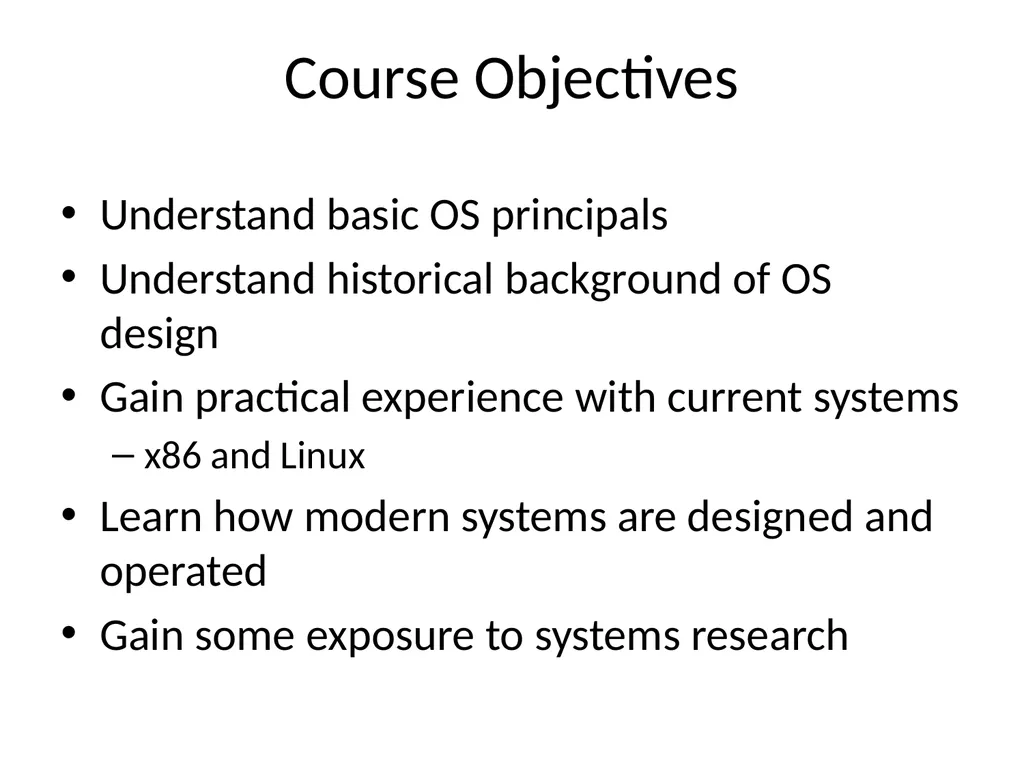
Course Objectives Understand basic OS principals
Understand historical background of OS design
Gain practical experience with current systems
x86 and Linux
Learn how modern systems are designed and operated
Gain some exposure to systems research<br>
Understand historical background of OS design
Gain practical experience with current systems
x86 and Linux
Learn how modern systems are designed and operated
Gain some exposure to systems research<br>
03
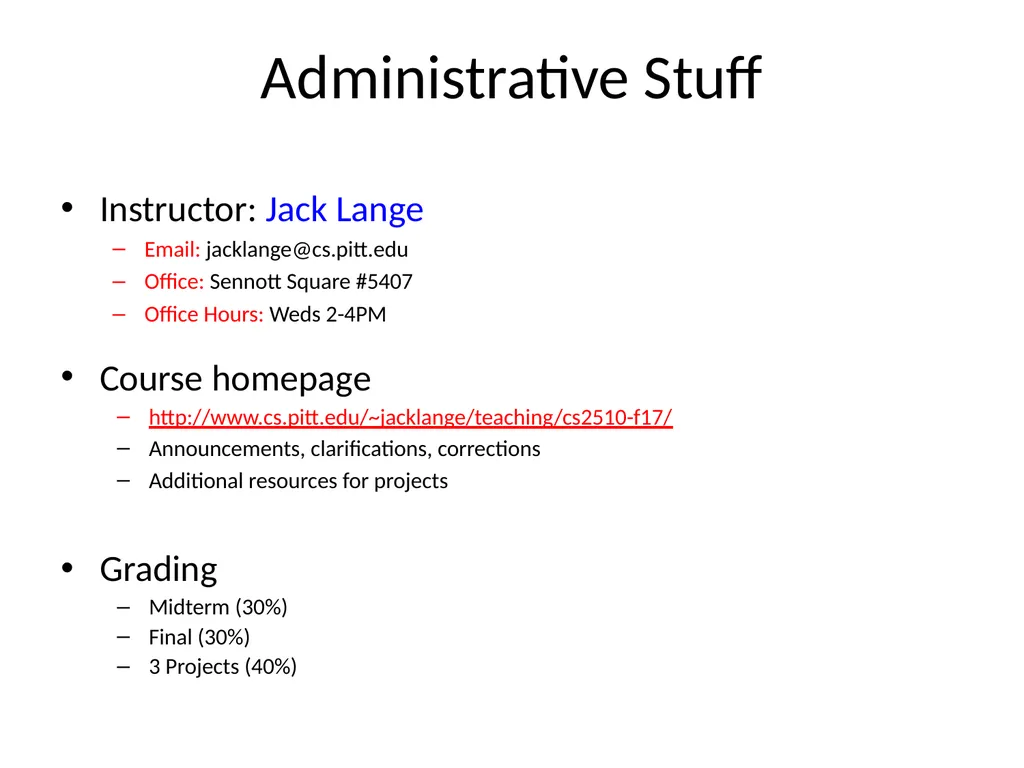
Administrative Stuff Instructor: Jack Lange
Email: jacklange@cs.pitt.edu
Office: Sennott Square #5407
Office Hours: Weds 2-4PM
Course homepage
http://www.cs.pitt.edu/~jacklange/teaching/cs2510-f17/
Announcements, clarifications, corrections
Additional resources for projects
Grading
Midterm (30%)
Final (30%)
3 Projects (40%)<br>
Email: jacklange@cs.pitt.edu
Office: Sennott Square #5407
Office Hours: Weds 2-4PM
Course homepage
http://www.cs.pitt.edu/~jacklange/teaching/cs2510-f17/
Announcements, clarifications, corrections
Additional resources for projects
Grading
Midterm (30%)
Final (30%)
3 Projects (40%)<br>
04
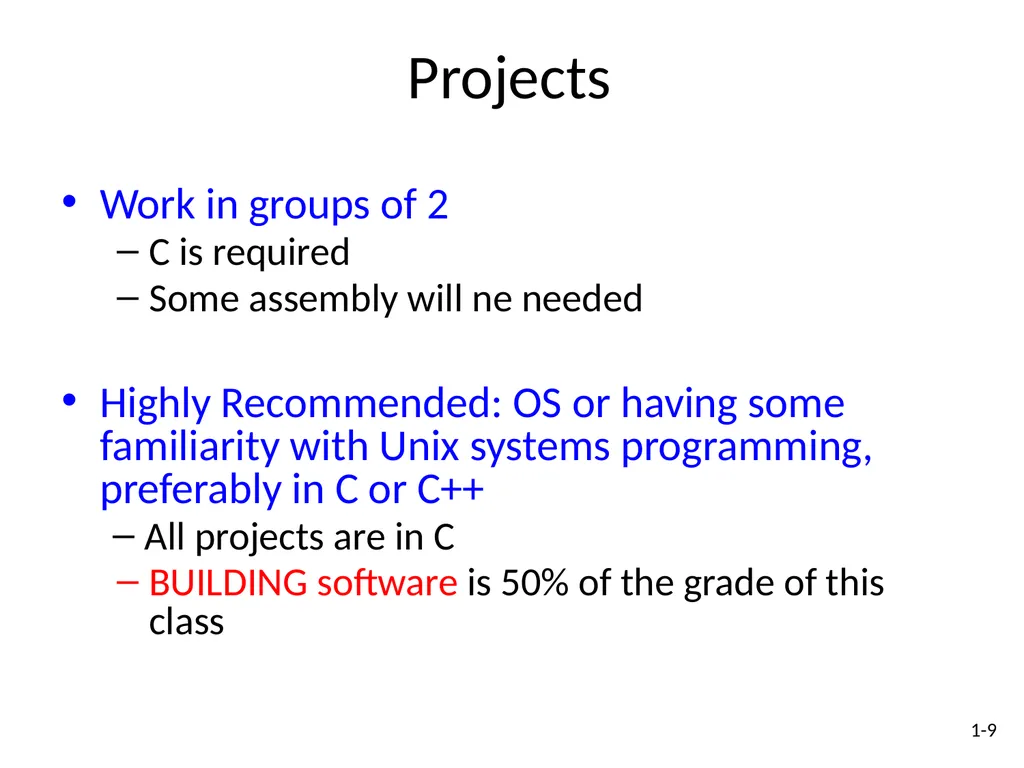
Projects Work in groups of 2
C is required
Some assembly will ne needed
Highly Recommended: OS or having some familiarity with Unix systems programming, preferably in C or C++
All projects are in C
BUILDING software is 50% of the grade of this class 1-9<br>
C is required
Some assembly will ne needed
Highly Recommended: OS or having some familiarity with Unix systems programming, preferably in C or C++
All projects are in C
BUILDING software is 50% of the grade of this class 1-9<br>
05
Textbooks See course website
Primary:
Operating Systems: Three Easy Pieces Remzi H. Arpaci-Dusseau and Andrea C. Arpaci-Dusseau, http://pages.cs.wisc.edu/~remzi/OSTEP/
Secondary:
Intel x86 Architectural Manuals (Vols. 2 and 3 are necessary for Projects)
Linux Device Drivers (Very helpful for Projects) Jonathan Corbet, Alessandro Rubini, and Greg Kroah-Hartman
Linux Kernel Development Robert Love
Understanding the Linux Kernel, Marco Cesati nad Daniel P. Bovet<br>
Primary:
Operating Systems: Three Easy Pieces Remzi H. Arpaci-Dusseau and Andrea C. Arpaci-Dusseau, http://pages.cs.wisc.edu/~remzi/OSTEP/
Secondary:
Intel x86 Architectural Manuals (Vols. 2 and 3 are necessary for Projects)
Linux Device Drivers (Very helpful for Projects) Jonathan Corbet, Alessandro Rubini, and Greg Kroah-Hartman
Linux Kernel Development Robert Love
Understanding the Linux Kernel, Marco Cesati nad Daniel P. Bovet<br>
06
Why learn about Operating Systems? Tangible reasons
Build or modify a real operating system
Administer and use system well
Tune application performance
Intangibles
Intrinsic curiosity
Understand how your computer works
Gain/apply knowledge in other areas of Computer Science
Computer architecture and devices
Synchronization in programming languages
Data structures and algorithms
Performance analysis
Challenge of designing large, complex systems<br>
Build or modify a real operating system
Administer and use system well
Tune application performance
Intangibles
Intrinsic curiosity
Understand how your computer works
Gain/apply knowledge in other areas of Computer Science
Computer architecture and devices
Synchronization in programming languages
Data structures and algorithms
Performance analysis
Challenge of designing large, complex systems<br>
07
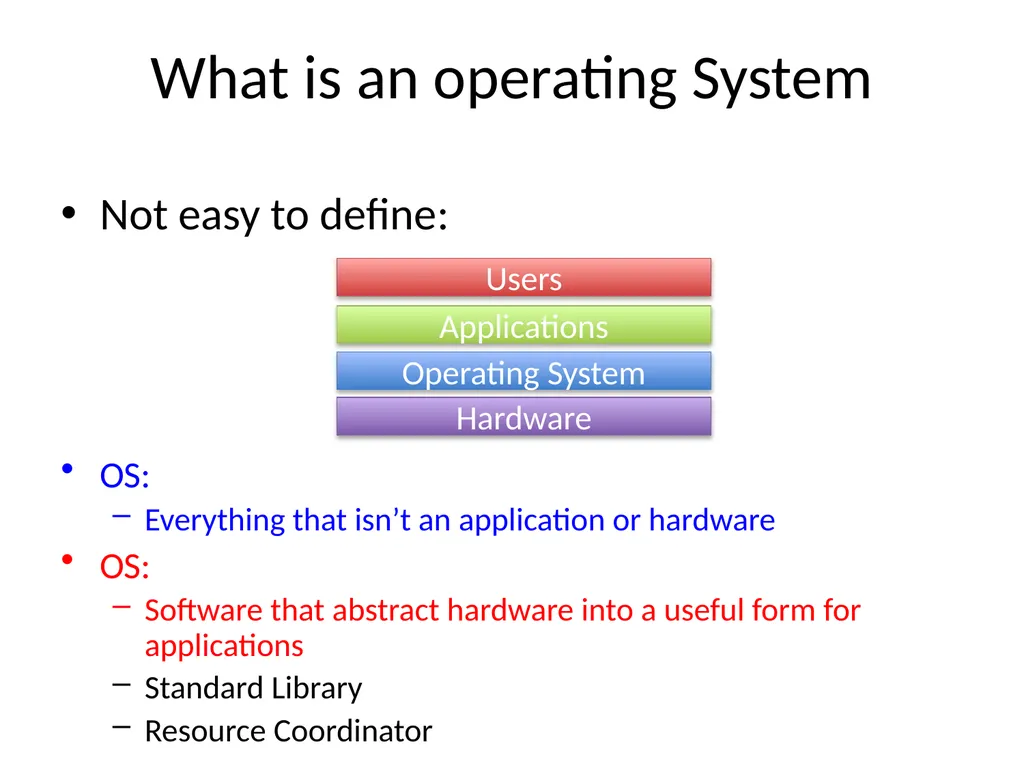
What is an operating System Not easy to define: OS:
Everything that isn’t an application or hardware
OS:
Software that abstract hardware into a useful form for applications
Standard Library
Resource Coordinator<br>
Everything that isn’t an application or hardware
OS:
Software that abstract hardware into a useful form for applications
Standard Library
Resource Coordinator<br>
08
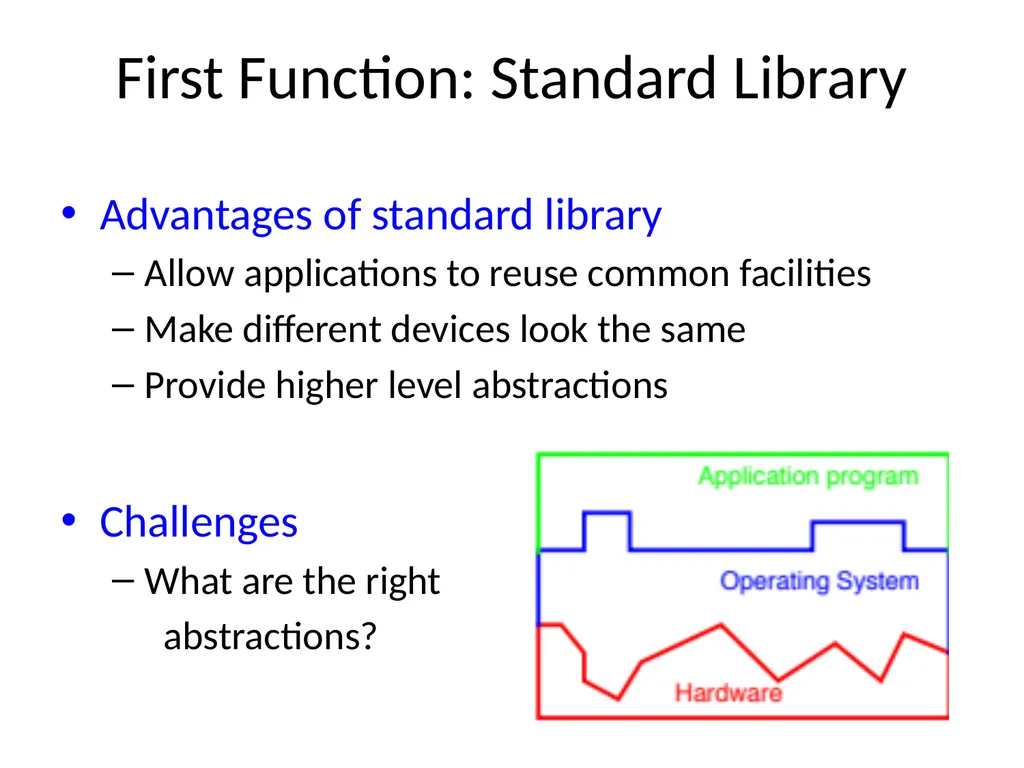
First Function: Standard Library Advantages of standard library
Allow applications to reuse common facilities
Make different devices look the same
Provide higher level abstractions Challenges
What are the right
abstractions?<br>
Allow applications to reuse common facilities
Make different devices look the same
Provide higher level abstractions Challenges
What are the right
abstractions?<br>
09
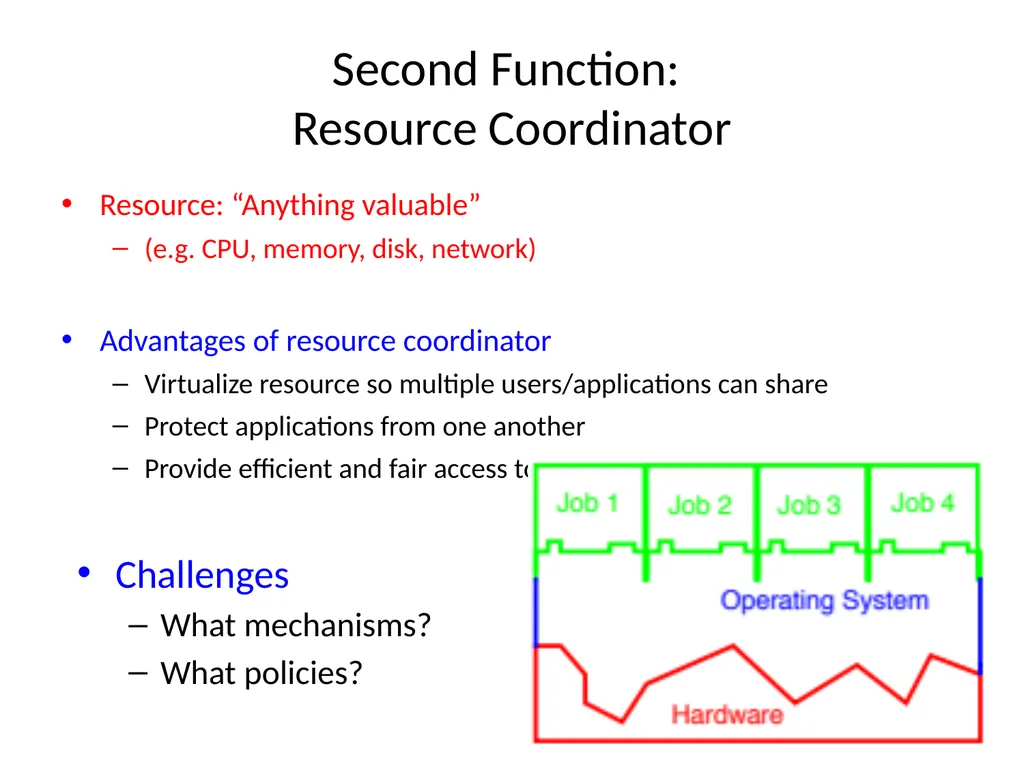
Second Function:
Resource Coordinator Resource: “Anything valuable”
(e.g. CPU, memory, disk, network)
Advantages of resource coordinator
Virtualize resource so multiple users/applications can share
Protect applications from one another
Provide efficient and fair access to resources Challenges
What mechanisms?
What policies?<br>
(e.g. CPU, memory, disk, network)
Advantages of resource coordinator
Virtualize resource so multiple users/applications can share
Protect applications from one another
Provide efficient and fair access to resources Challenges
What mechanisms?
What policies?<br>
10
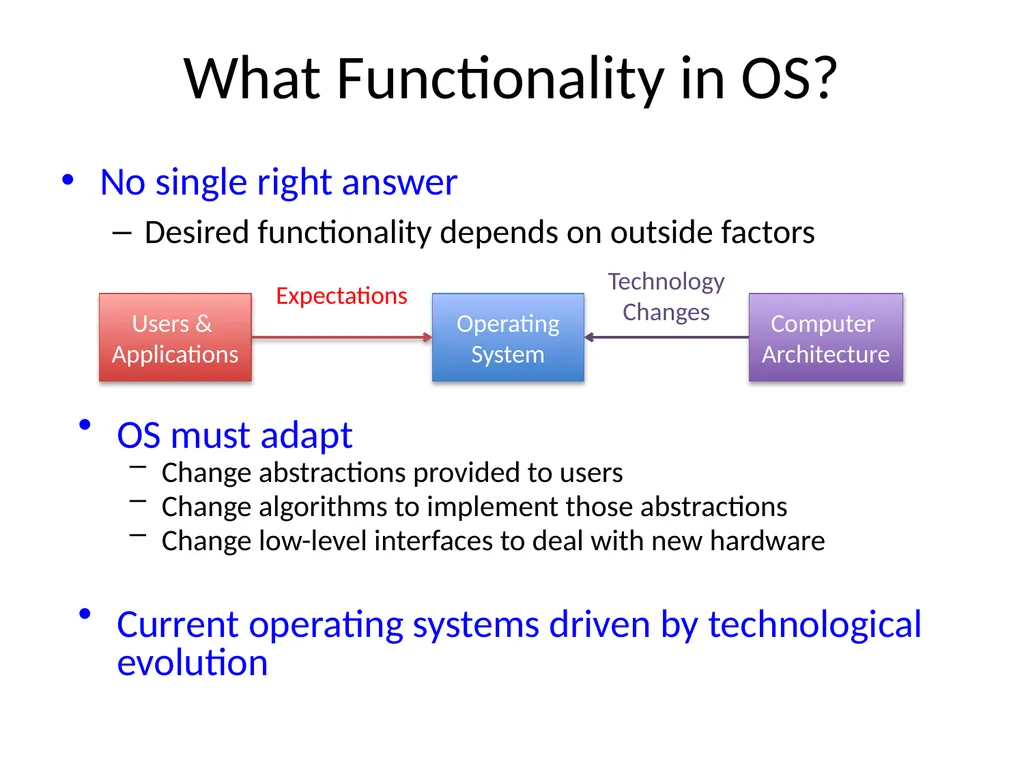
What Functionality in OS? No single right answer
Desired functionality depends on outside factors OS must adapt
Change abstractions provided to users
Change algorithms to implement those abstractions
Change low-level interfaces to deal with new hardware
Current operating systems driven by technological evolution<br>
Desired functionality depends on outside factors OS must adapt
Change abstractions provided to users
Change algorithms to implement those abstractions
Change low-level interfaces to deal with new hardware
Current operating systems driven by technological evolution<br>
11
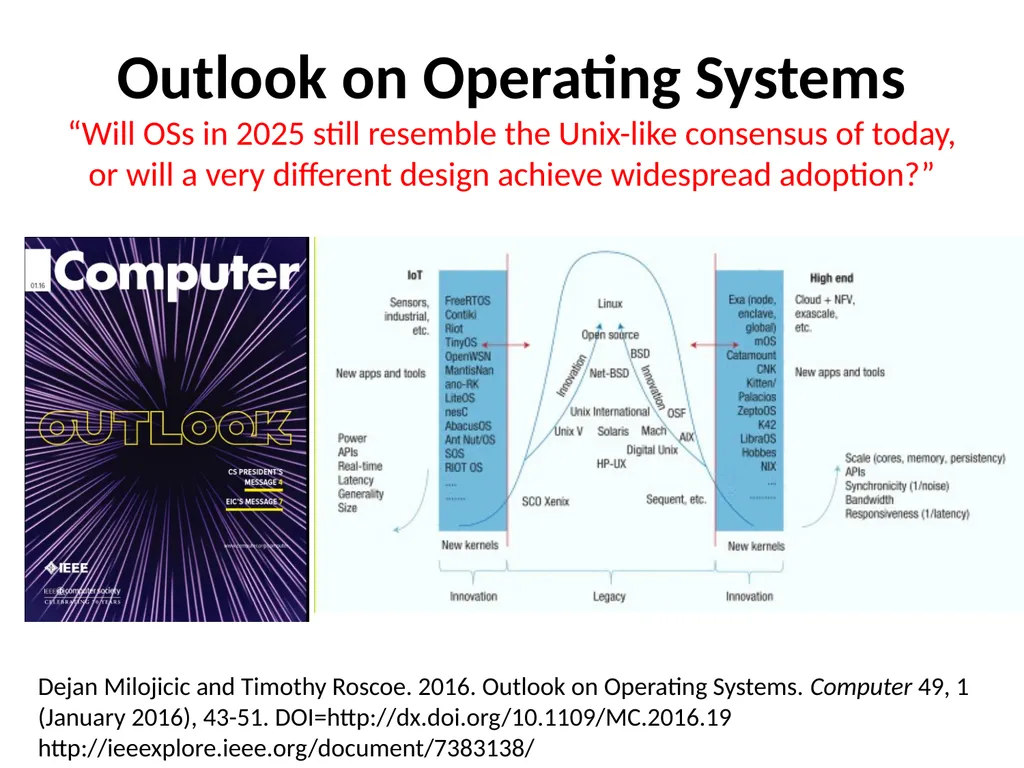
Outlook on Operating Systems
“Will OSs in 2025 still resemble the Unix-like consensus of today, or will a very different design achieve widespread adoption?” Dejan Milojicic and Timothy Roscoe. 2016. Outlook on Operating Systems. Computer 49, 1 (January 2016), 43-51. DOI=http://dx.doi.org/10.1109/MC.2016.19
http://ieeexplore.ieee.org/document/7383138/<br>
http://ieeexplore.ieee.org/document/7383138/<br>
12
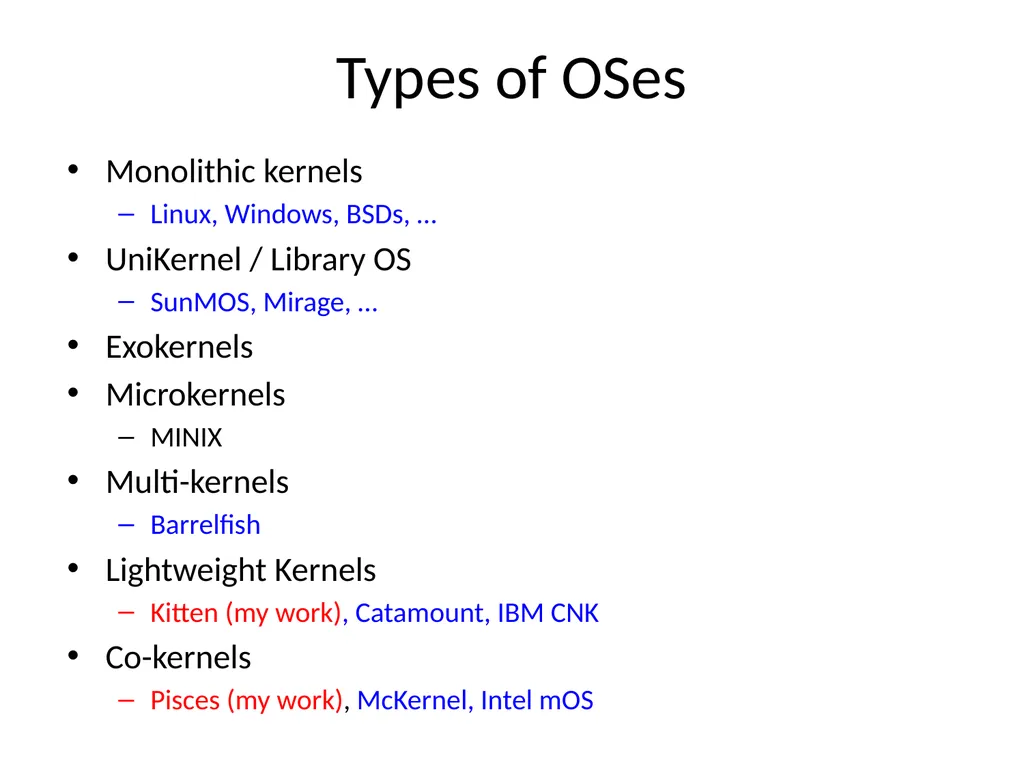
Types of OSes Monolithic kernels
Linux, Windows, BSDs, …
UniKernel / Library OS
SunMOS, Mirage, …
Exokernels
Microkernels
MINIX
Multi-kernels
Barrelfish
Lightweight Kernels
Kitten (my work), Catamount, IBM CNK
Co-kernels
Pisces (my work), McKernel, Intel mOS<br>
Linux, Windows, BSDs, …
UniKernel / Library OS
SunMOS, Mirage, …
Exokernels
Microkernels
MINIX
Multi-kernels
Barrelfish
Lightweight Kernels
Kitten (my work), Catamount, IBM CNK
Co-kernels
Pisces (my work), McKernel, Intel mOS<br>
13
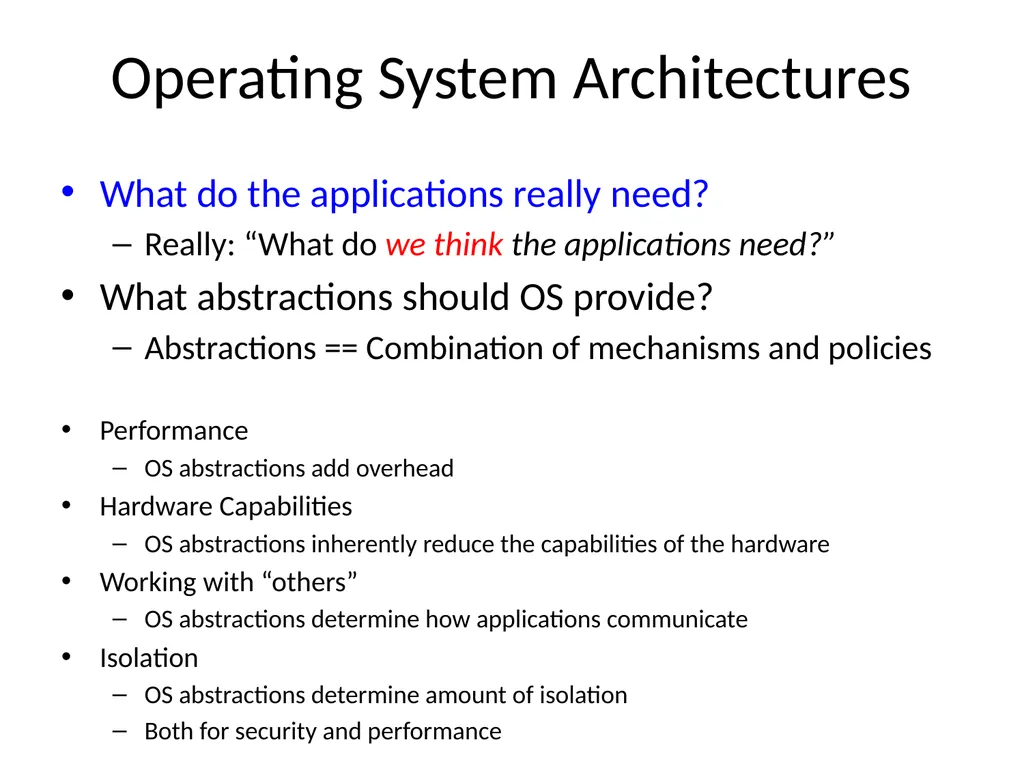
Operating System Architectures What do the applications really need?
Really: “What do we think the applications need?”
What abstractions should OS provide?
Abstractions == Combination of mechanisms and policies
Performance
OS abstractions add overhead
Hardware Capabilities
OS abstractions inherently reduce the capabilities of the hardware
Working with “others”
OS abstractions determine how applications communicate
Isolation
OS abstractions determine amount of isolation
Both for security and performance<br>
Really: “What do we think the applications need?”
What abstractions should OS provide?
Abstractions == Combination of mechanisms and policies
Performance
OS abstractions add overhead
Hardware Capabilities
OS abstractions inherently reduce the capabilities of the hardware
Working with “others”
OS abstractions determine how applications communicate
Isolation
OS abstractions determine amount of isolation
Both for security and performance<br>
14
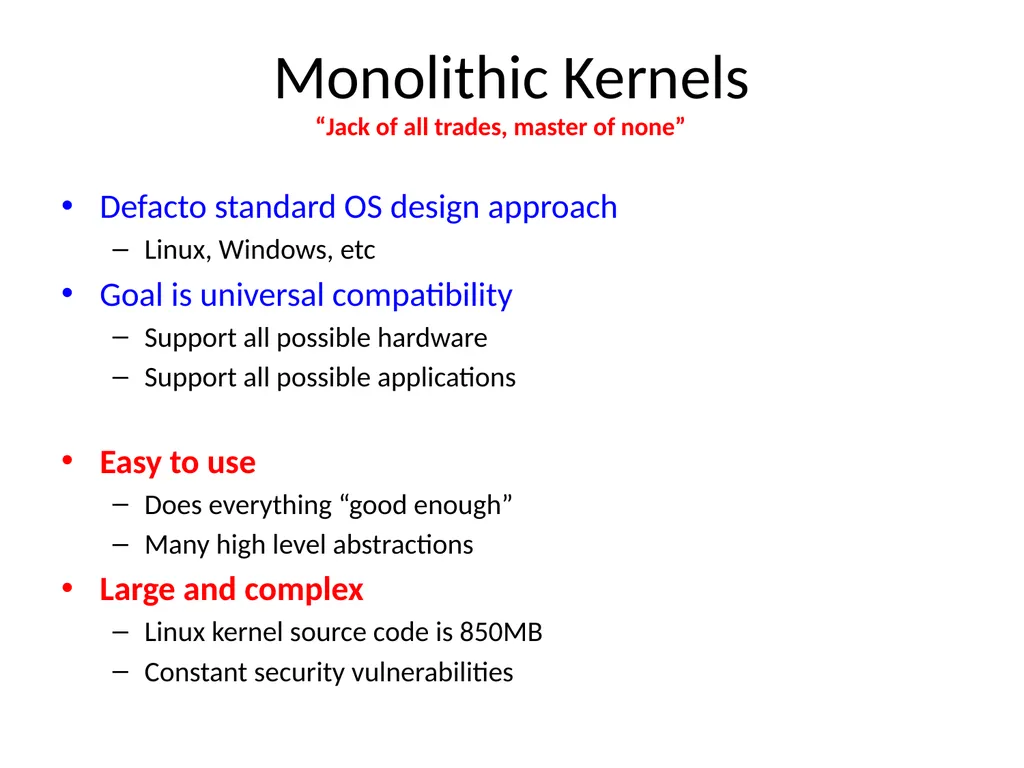
Monolithic Kernels Defacto standard OS design approach
Linux, Windows, etc
Goal is universal compatibility
Support all possible hardware
Support all possible applications
Easy to use
Does everything “good enough”
Many high level abstractions
Large and complex
Linux kernel source code is 850MB
Constant security vulnerabilities “Jack of all trades, master of none”<br>
Linux, Windows, etc
Goal is universal compatibility
Support all possible hardware
Support all possible applications
Easy to use
Does everything “good enough”
Many high level abstractions
Large and complex
Linux kernel source code is 850MB
Constant security vulnerabilities “Jack of all trades, master of none”<br>
15
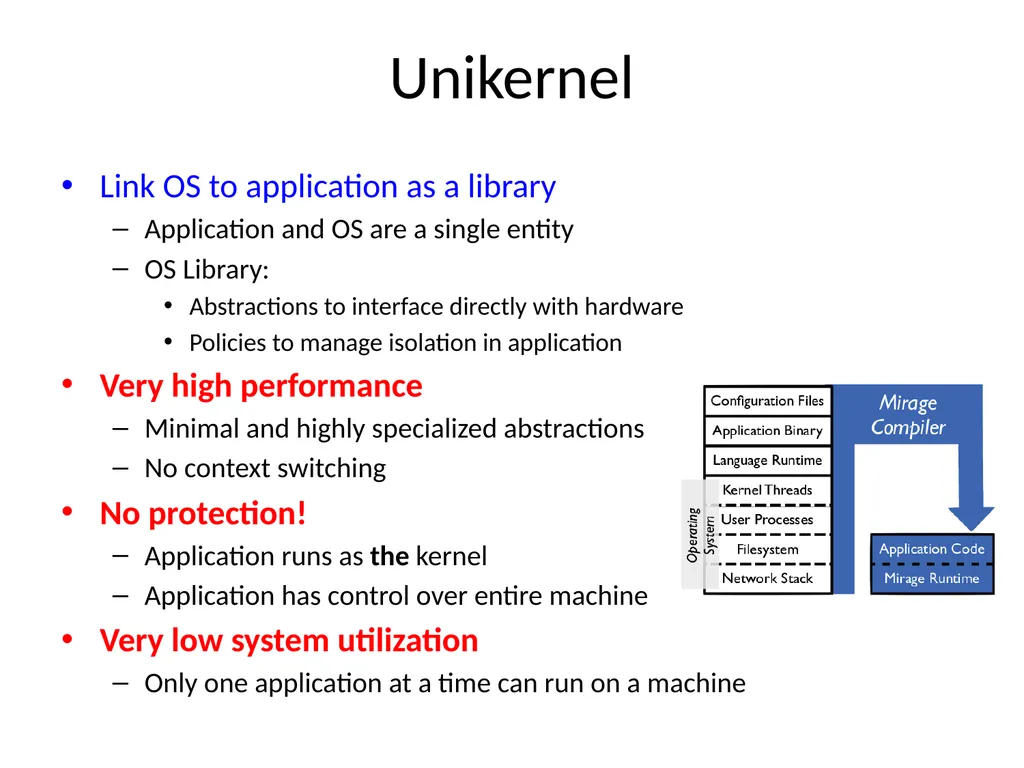
Unikernel Link OS to application as a library
Application and OS are a single entity
OS Library:
Abstractions to interface directly with hardware
Policies to manage isolation in application
Very high performance
Minimal and highly specialized abstractions
No context switching
No protection!
Application runs as the kernel
Application has control over entire machine
Very low system utilization
Only one application at a time can run on a machine<br>
Application and OS are a single entity
OS Library:
Abstractions to interface directly with hardware
Policies to manage isolation in application
Very high performance
Minimal and highly specialized abstractions
No context switching
No protection!
Application runs as the kernel
Application has control over entire machine
Very low system utilization
Only one application at a time can run on a machine<br>
16
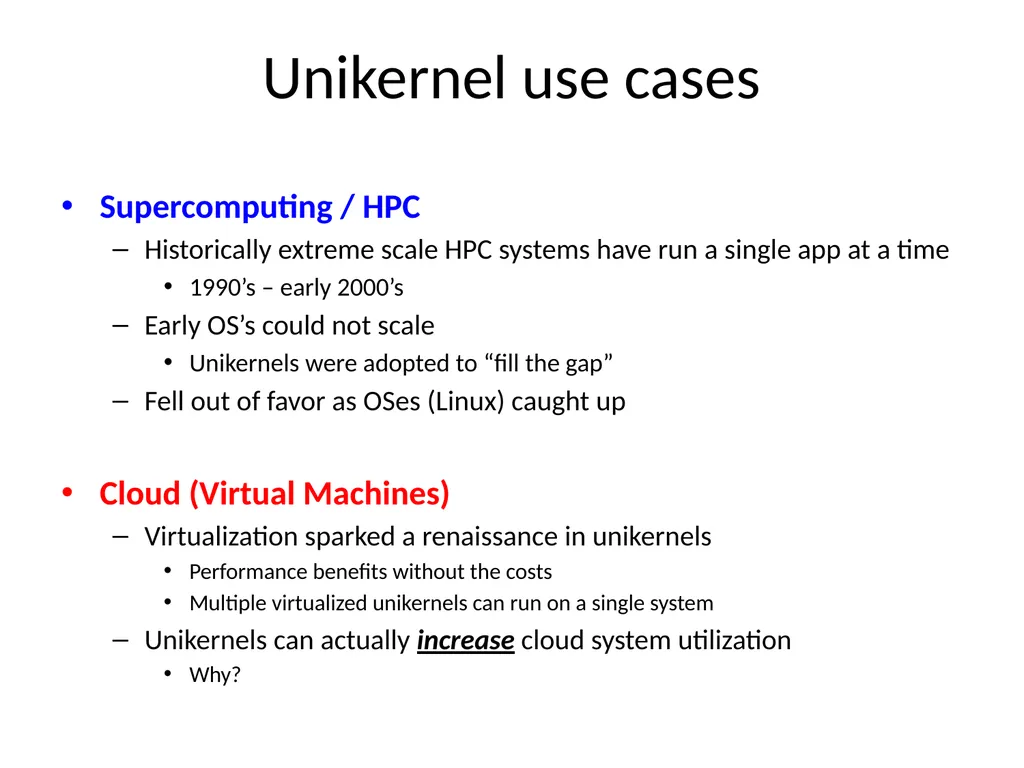
Unikernel use cases Supercomputing / HPC
Historically extreme scale HPC systems have run a single app at a time
1990’s – early 2000’s
Early OS’s could not scale
Unikernels were adopted to “fill the gap”
Fell out of favor as OSes (Linux) caught up
Cloud (Virtual Machines)
Virtualization sparked a renaissance in unikernels
Performance benefits without the costs
Multiple virtualized unikernels can run on a single system
Unikernels can actually increase cloud system utilization
Why?<br>
Historically extreme scale HPC systems have run a single app at a time
1990’s – early 2000’s
Early OS’s could not scale
Unikernels were adopted to “fill the gap”
Fell out of favor as OSes (Linux) caught up
Cloud (Virtual Machines)
Virtualization sparked a renaissance in unikernels
Performance benefits without the costs
Multiple virtualized unikernels can run on a single system
Unikernels can actually increase cloud system utilization
Why?<br>
17
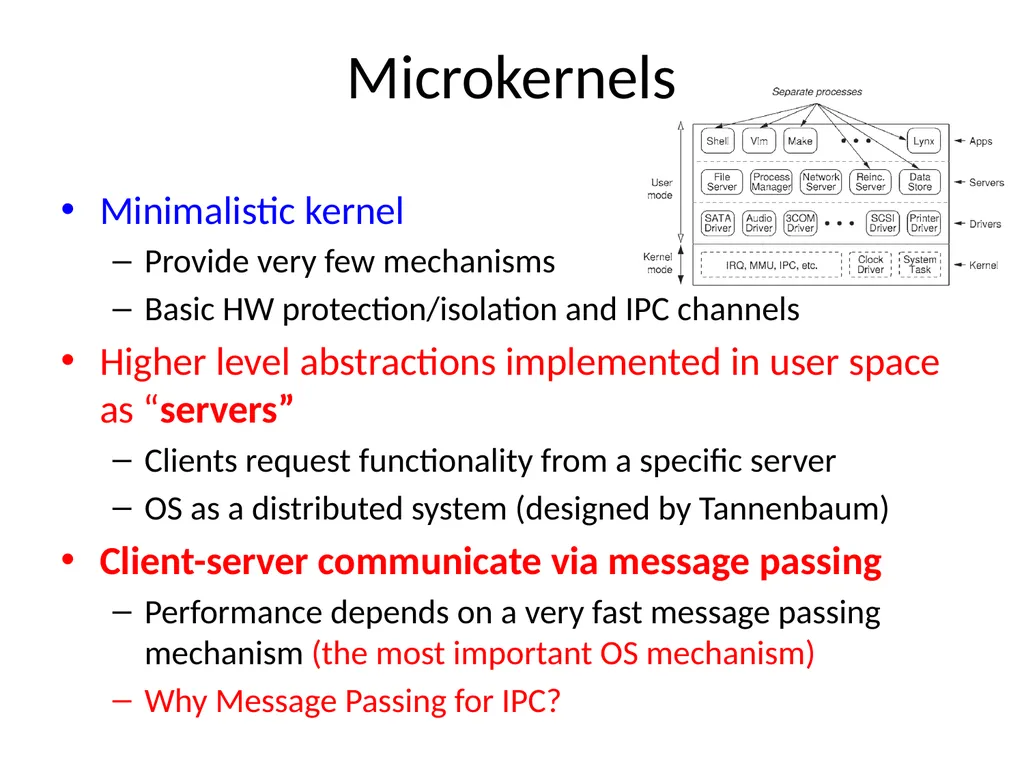
Microkernels Minimalistic kernel
Provide very few mechanisms
Basic HW protection/isolation and IPC channels
Higher level abstractions implemented in user space as “servers”
Clients request functionality from a specific server
OS as a distributed system (designed by Tannenbaum)
Client-server communicate via message passing
Performance depends on a very fast message passing mechanism (the most important OS mechanism)
Why Message Passing for IPC?<br>
Provide very few mechanisms
Basic HW protection/isolation and IPC channels
Higher level abstractions implemented in user space as “servers”
Clients request functionality from a specific server
OS as a distributed system (designed by Tannenbaum)
Client-server communicate via message passing
Performance depends on a very fast message passing mechanism (the most important OS mechanism)
Why Message Passing for IPC?<br>
18
Exokernels A combination of micro- and uni- kernels
Very small kernel provides basic HW protection
No OS provided IPC mechanisms
Applications provide own higher level services
Applications can choose their level of abstraction
Implement their own services<br>
Very small kernel provides basic HW protection
No OS provided IPC mechanisms
Applications provide own higher level services
Applications can choose their level of abstraction
Implement their own services<br>
19
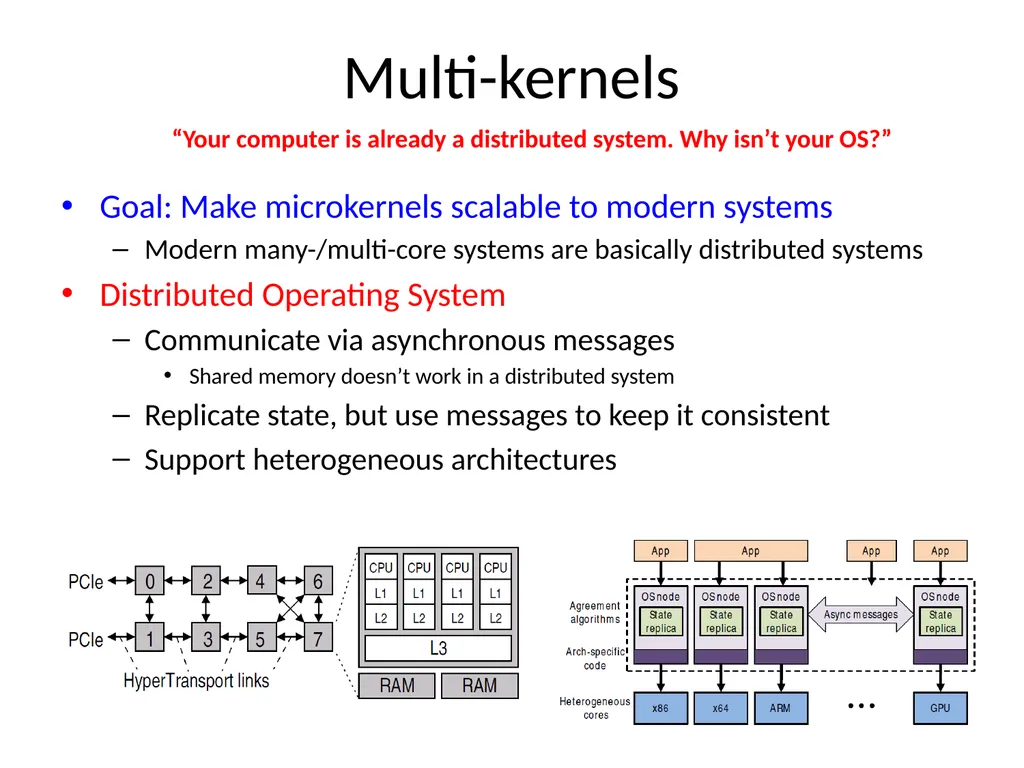
Multi-kernels Goal: Make microkernels scalable to modern systems
Modern many-/multi-core systems are basically distributed systems
Distributed Operating System
Communicate via asynchronous messages
Shared memory doesn’t work in a distributed system
Replicate state, but use messages to keep it consistent
Support heterogeneous architectures “Your computer is already a distributed system. Why isn’t your OS?”<br>
Modern many-/multi-core systems are basically distributed systems
Distributed Operating System
Communicate via asynchronous messages
Shared memory doesn’t work in a distributed system
Replicate state, but use messages to keep it consistent
Support heterogeneous architectures “Your computer is already a distributed system. Why isn’t your OS?”<br>
20
Lightweight kernels (LWKs) Designed specifically for extreme scale HPC
Large scale supercomputers in the upper ranks of the top 500 (http://www.top500.org)
Large scale, but small world
Small number of applications
Small number of application requirements
Small number of systems
LWKs provide a stripped down OS environment
Provide the OS features needed and nothing else
“Leaky” microkernel
Will provide functionality in OS when it makes sense What is a Lightweight Kernel?
http://dl.acm.org/citation.cfm?id=2768414<br>
Large scale supercomputers in the upper ranks of the top 500 (http://www.top500.org)
Large scale, but small world
Small number of applications
Small number of application requirements
Small number of systems
LWKs provide a stripped down OS environment
Provide the OS features needed and nothing else
“Leaky” microkernel
Will provide functionality in OS when it makes sense What is a Lightweight Kernel?
http://dl.acm.org/citation.cfm?id=2768414<br>
21
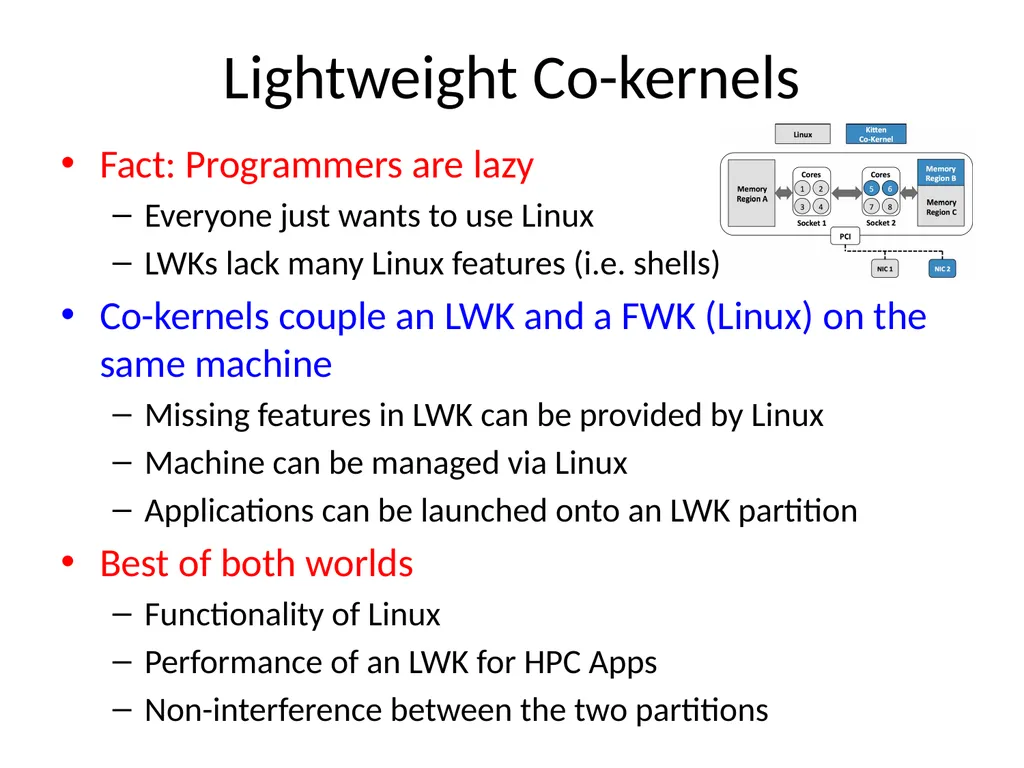
Lightweight Co-kernels Fact: Programmers are lazy
Everyone just wants to use Linux
LWKs lack many Linux features (i.e. shells)
Co-kernels couple an LWK and a FWK (Linux) on the same machine
Missing features in LWK can be provided by Linux
Machine can be managed via Linux
Applications can be launched onto an LWK partition
Best of both worlds
Functionality of Linux
Performance of an LWK for HPC Apps
Non-interference between the two partitions<br>
Everyone just wants to use Linux
LWKs lack many Linux features (i.e. shells)
Co-kernels couple an LWK and a FWK (Linux) on the same machine
Missing features in LWK can be provided by Linux
Machine can be managed via Linux
Applications can be launched onto an LWK partition
Best of both worlds
Functionality of Linux
Performance of an LWK for HPC Apps
Non-interference between the two partitions<br>
22
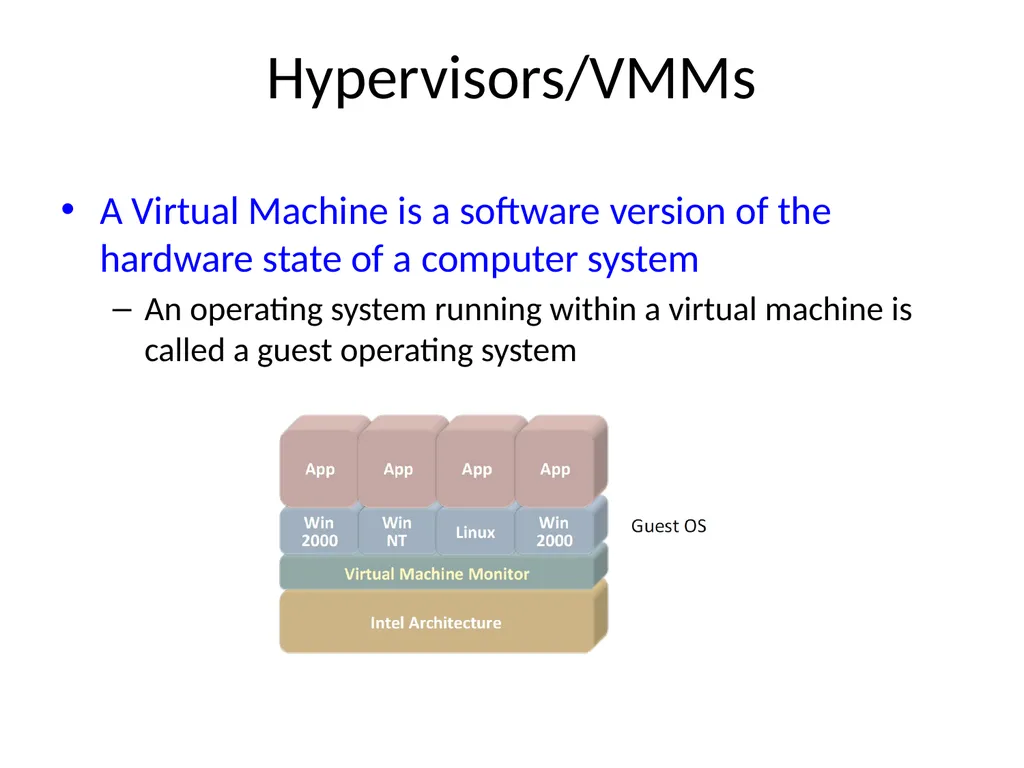
Hypervisors/VMMs A Virtual Machine is a software version of the hardware state of a computer system
An operating system running within a virtual machine is called a guest operating system<br>
An operating system running within a virtual machine is called a guest operating system<br>
23
Virtual Machine Monitors (VMMs) Virtual Machines run an OS as an application
Implements hardware interface in software
Ways to build a VMM (Type 1 vs Type 2)
Type 2: VMs run as apps in a native OS
VMWare Player, KVM, VirtualBox
Type 1: Hypervisor is the native OS
No native apps, everything runs in a VM
Xen, VMWare ES<br>
Implements hardware interface in software
Ways to build a VMM (Type 1 vs Type 2)
Type 2: VMs run as apps in a native OS
VMWare Player, KVM, VirtualBox
Type 1: Hypervisor is the native OS
No native apps, everything runs in a VM
Xen, VMWare ES<br>
24
Some References Andrew Baumann, Simon Peter, Adrian Schüpbach, Akhilesh Singhania, Timothy Roscoe, Paul Barham, and Rebecca Isaacs. 2009. Your computer is already a distributed system. why isn't your OS?. In Proceedings of the 12th conference on Hot topics in operating systems (HotOS'09). USENIX Association, Berkeley, CA, USA, 12-12.
Avi Kivity, Dor Laor, Glauber Costa, Pekka Enberg, Nadav Har'El, Don Marti, and Vlad Zolotarov. 2014. OSv: optimizing the operating system for virtual machines. In Proceedings of the 2014 USENIX conference on USENIX Annual Technical Conference (USENIX ATC'14), Garth Gibson and Nickolai Zeldovich (Eds.). USENIX Association, Berkeley, CA, USA, 61-72.
Simon Peter, Jialin Li, Irene Zhang, Dan R. K. Ports, Doug Woos, Arvind Krishnamurthy, Thomas Anderson, and Timothy Roscoe. 2014. Arrakis: the operating system is the control plane. In Proceedings of the 11th USENIX conference on Operating Systems Design and Implementation(OSDI'14). USENIX Association, Berkeley, CA, USA, 1-16.
Tanenbaum-Torvalds Debate (https://groups.google.com/forum/#!topic/comp.os.minix/wlhw16QWltI%5B1-25%5D)
Jorrit N. Herder, Herbert Bos, Ben Gras, Philip Homburg, and Andrew S. Tanenbaum. 2006. MINIX 3: a highly reliable, self-repairing operating system. SIGOPS Oper. Syst. Rev. 40, 3 (July 2006), 80-89. DOI=http://dx.doi.org/10.1145/1151374.1151391
J. Ouyang, B. Kocoloski, J. Lange and K. Pedretti, Achieving Performance Isolation with Lightweight Co-Kernels, Proceedings of the 24th International ACM Symposium on High Performance Parallel and Distributed Computing, (HPDC 2015)
J. Lange, K. Pedretti, T. Hudson, P. Dinda, Z. Cui, L. Xia, P. Bridges, M.Levenhagen, R. Brightwell, A. Gocke, S. Jaconette, Palacios: A New Open Source Virtual Machine Monitor for Scalable High Performance Computing, Proceedings of the 24th IEEE International Parallel and Distributed Processing Symposium, (IPDPS 2010)<br>
Avi Kivity, Dor Laor, Glauber Costa, Pekka Enberg, Nadav Har'El, Don Marti, and Vlad Zolotarov. 2014. OSv: optimizing the operating system for virtual machines. In Proceedings of the 2014 USENIX conference on USENIX Annual Technical Conference (USENIX ATC'14), Garth Gibson and Nickolai Zeldovich (Eds.). USENIX Association, Berkeley, CA, USA, 61-72.
Simon Peter, Jialin Li, Irene Zhang, Dan R. K. Ports, Doug Woos, Arvind Krishnamurthy, Thomas Anderson, and Timothy Roscoe. 2014. Arrakis: the operating system is the control plane. In Proceedings of the 11th USENIX conference on Operating Systems Design and Implementation(OSDI'14). USENIX Association, Berkeley, CA, USA, 1-16.
Tanenbaum-Torvalds Debate (https://groups.google.com/forum/#!topic/comp.os.minix/wlhw16QWltI%5B1-25%5D)
Jorrit N. Herder, Herbert Bos, Ben Gras, Philip Homburg, and Andrew S. Tanenbaum. 2006. MINIX 3: a highly reliable, self-repairing operating system. SIGOPS Oper. Syst. Rev. 40, 3 (July 2006), 80-89. DOI=http://dx.doi.org/10.1145/1151374.1151391
J. Ouyang, B. Kocoloski, J. Lange and K. Pedretti, Achieving Performance Isolation with Lightweight Co-Kernels, Proceedings of the 24th International ACM Symposium on High Performance Parallel and Distributed Computing, (HPDC 2015)
J. Lange, K. Pedretti, T. Hudson, P. Dinda, Z. Cui, L. Xia, P. Bridges, M.Levenhagen, R. Brightwell, A. Gocke, S. Jaconette, Palacios: A New Open Source Virtual Machine Monitor for Scalable High Performance Computing, Proceedings of the 24th IEEE International Parallel and Distributed Processing Symposium, (IPDPS 2010)<br>