
CS 525 Advanced Distributed Systems Spring 2015
MY
Published · 82 slides · 0 views
1 / 1


Description
CS 525 Advanced Distributed Systems Spring 2015 Indranil Gupta (Indy) Lecture 6 Key-valueNoSQL Storage Feb 5, 2015 All slides IG 1 The Key-value Abstraction (Business) Key Value (twitter.com) tweet id information about tweet
Related Topics
Share
Embed code
Download this presentation From Below
"CS 525 Advanced Distributed Systems Spring 2015" is the property of its rightful owner. Permission is granted to download and print the materials on this website for personal, non-commercial use only, and to display it on your personal computer provided you do not modify the materials and that you retain all copyright notices contained in the materials. By downloading content from our website, you accept the terms of this agreement.
Presentation Transcript
01
CS 525
Advanced Distributed Systems
Spring 2015 Indranil Gupta (Indy)
Lecture 6
Key-value/NoSQL Storage
Feb 5, 2015 All slides © IG 1<br>
Lecture 6
Key-value/NoSQL Storage
Feb 5, 2015 All slides © IG 1<br>
02
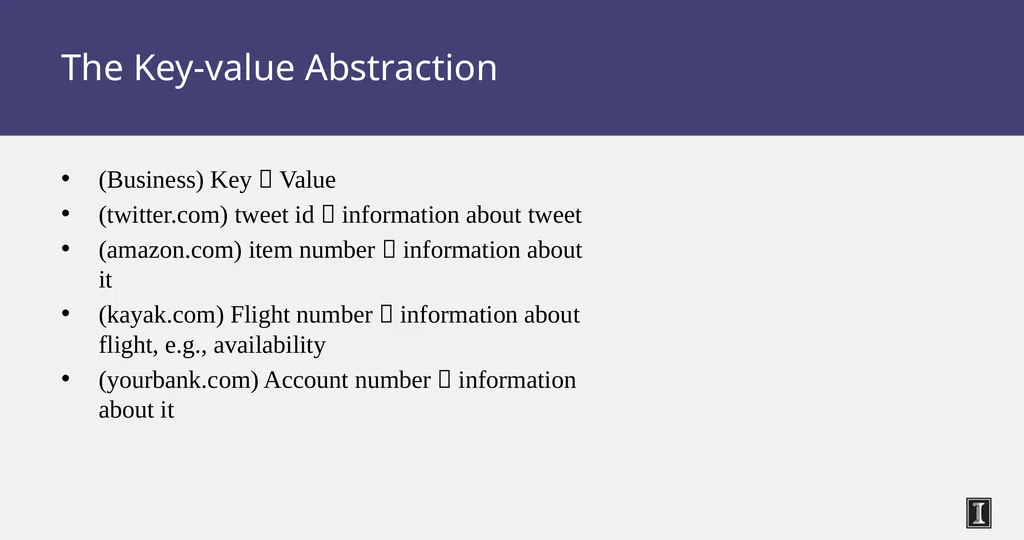
The Key-value Abstraction (Business) Key Value
(twitter.com) tweet id information about tweet
(amazon.com) item number information about it
(kayak.com) Flight number information about flight, e.g., availability
(yourbank.com) Account number information about it<br>
(twitter.com) tweet id information about tweet
(amazon.com) item number information about it
(kayak.com) Flight number information about flight, e.g., availability
(yourbank.com) Account number information about it<br>
03
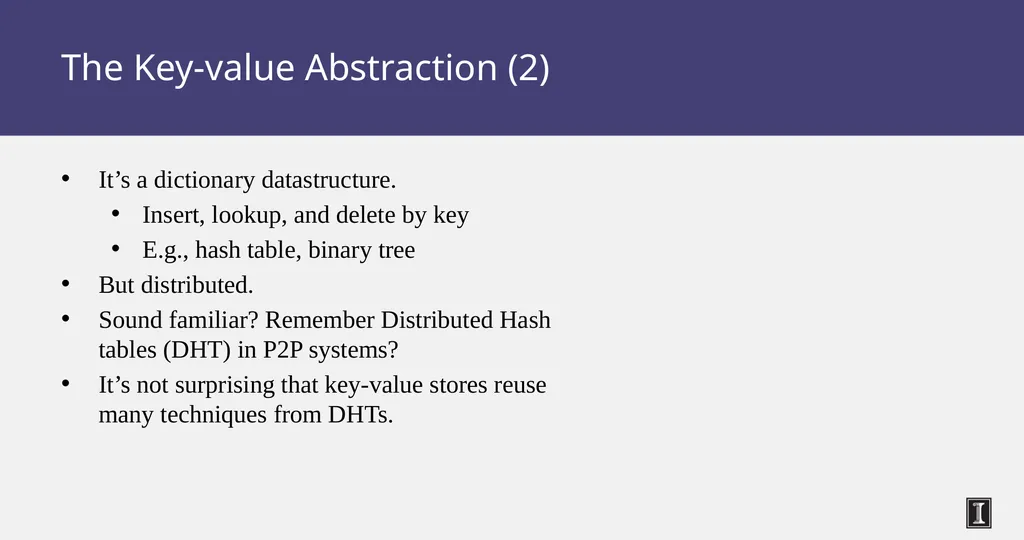
The Key-value Abstraction (2) It’s a dictionary datastructure.
Insert, lookup, and delete by key
E.g., hash table, binary tree
But distributed.
Sound familiar? Remember Distributed Hash tables (DHT) in P2P systems?
It’s not surprising that key-value stores reuse many techniques from DHTs.<br>
Insert, lookup, and delete by key
E.g., hash table, binary tree
But distributed.
Sound familiar? Remember Distributed Hash tables (DHT) in P2P systems?
It’s not surprising that key-value stores reuse many techniques from DHTs.<br>
04
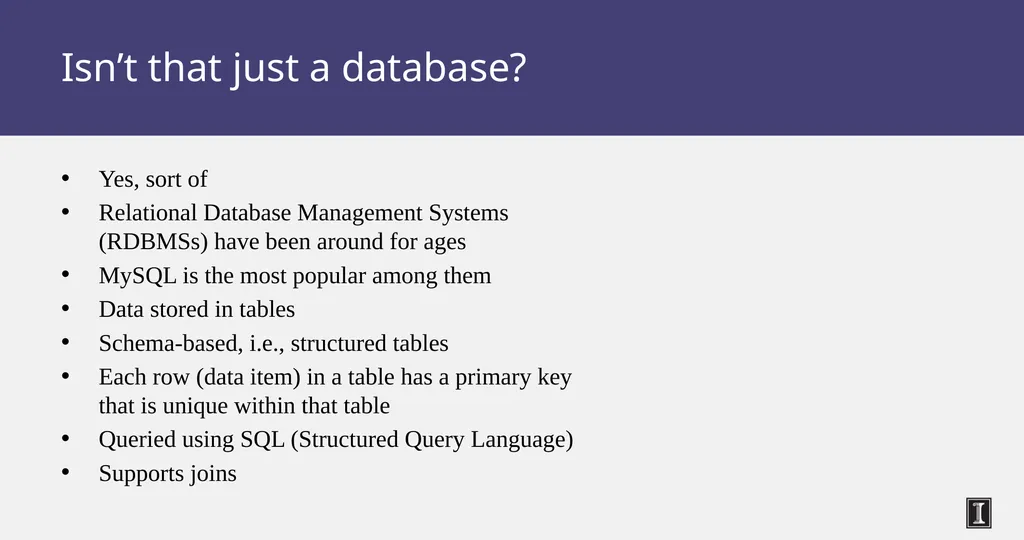
Isn’t that just a database? Yes, sort of
Relational Database Management Systems (RDBMSs) have been around for ages
MySQL is the most popular among them
Data stored in tables
Schema-based, i.e., structured tables
Each row (data item) in a table has a primary key that is unique within that table
Queried using SQL (Structured Query Language)
Supports joins<br>
Relational Database Management Systems (RDBMSs) have been around for ages
MySQL is the most popular among them
Data stored in tables
Schema-based, i.e., structured tables
Each row (data item) in a table has a primary key that is unique within that table
Queried using SQL (Structured Query Language)
Supports joins<br>
05
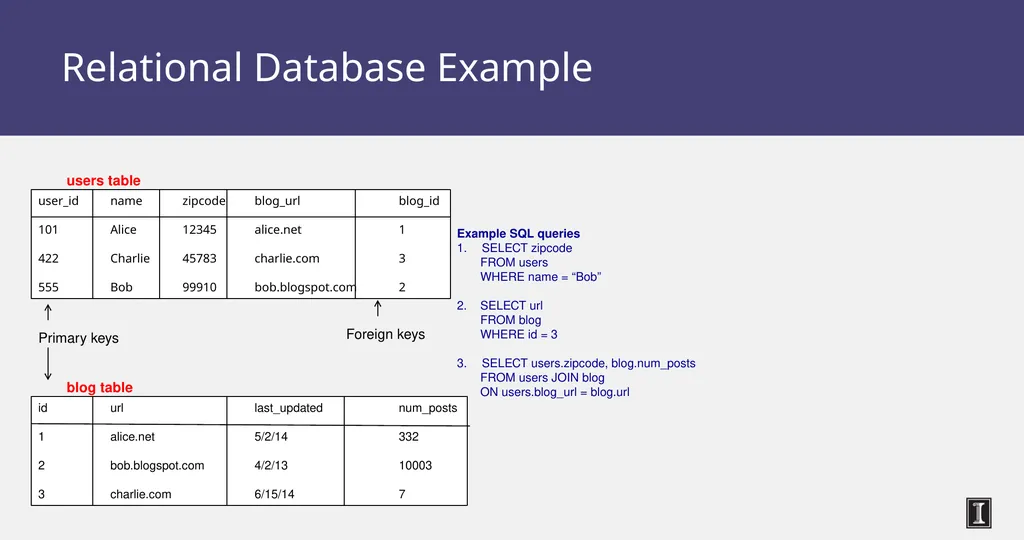
Relational Database Example Example SQL queries
SELECT zipcode
FROM users
WHERE name = “Bob”
2. SELECT url
FROM blog
WHERE id = 3
SELECT users.zipcode, blog.num_posts
FROM users JOIN blog
ON users.blog_url = blog.url<br>
SELECT zipcode
FROM users
WHERE name = “Bob”
2. SELECT url
FROM blog
WHERE id = 3
SELECT users.zipcode, blog.num_posts
FROM users JOIN blog
ON users.blog_url = blog.url<br>
06
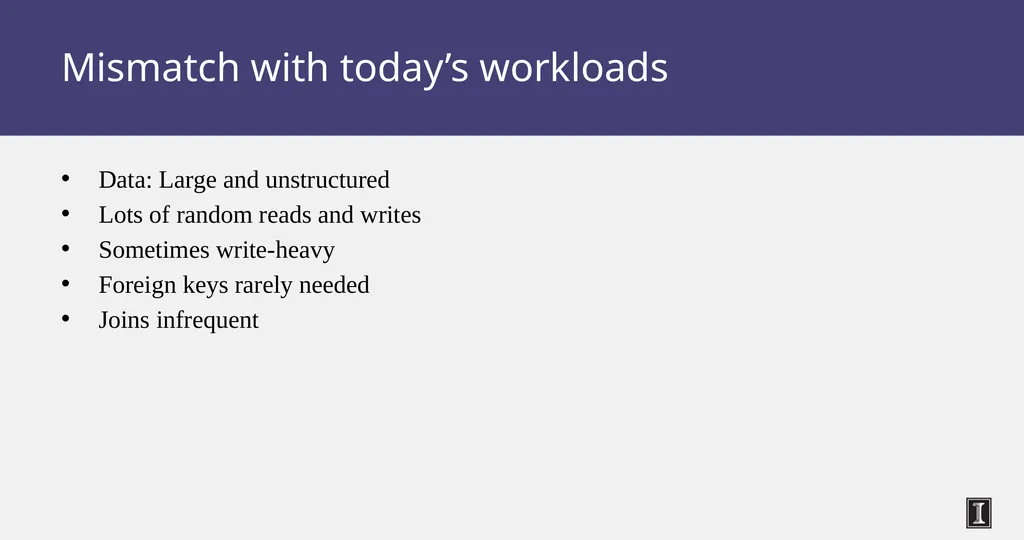
Mismatch with today’s workloads Data: Large and unstructured
Lots of random reads and writes
Sometimes write-heavy
Foreign keys rarely needed
Joins infrequent<br>
Lots of random reads and writes
Sometimes write-heavy
Foreign keys rarely needed
Joins infrequent<br>
07
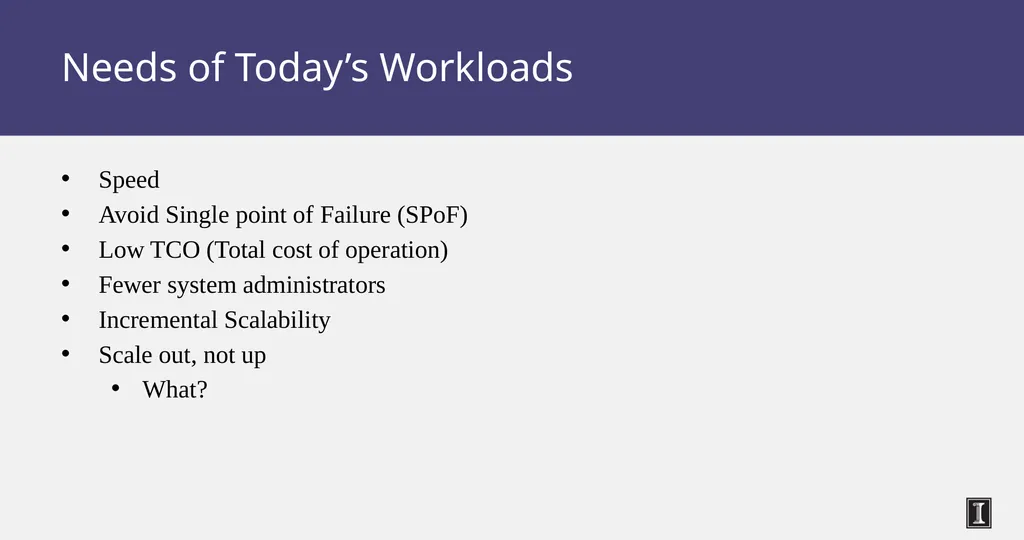
Needs of Today’s Workloads Speed
Avoid Single point of Failure (SPoF)
Low TCO (Total cost of operation)
Fewer system administrators
Incremental Scalability
Scale out, not up
What?<br>
Avoid Single point of Failure (SPoF)
Low TCO (Total cost of operation)
Fewer system administrators
Incremental Scalability
Scale out, not up
What?<br>
08
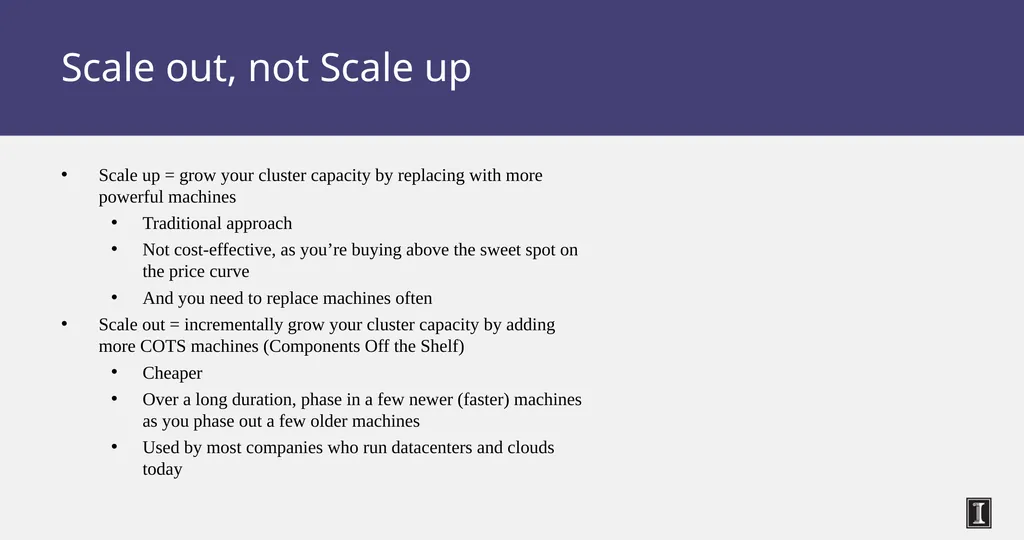
Scale out, not Scale up Scale up = grow your cluster capacity by replacing with more powerful machines
Traditional approach
Not cost-effective, as you’re buying above the sweet spot on the price curve
And you need to replace machines often
Scale out = incrementally grow your cluster capacity by adding more COTS machines (Components Off the Shelf)
Cheaper
Over a long duration, phase in a few newer (faster) machines as you phase out a few older machines
Used by most companies who run datacenters and clouds today<br>
Traditional approach
Not cost-effective, as you’re buying above the sweet spot on the price curve
And you need to replace machines often
Scale out = incrementally grow your cluster capacity by adding more COTS machines (Components Off the Shelf)
Cheaper
Over a long duration, phase in a few newer (faster) machines as you phase out a few older machines
Used by most companies who run datacenters and clouds today<br>
09
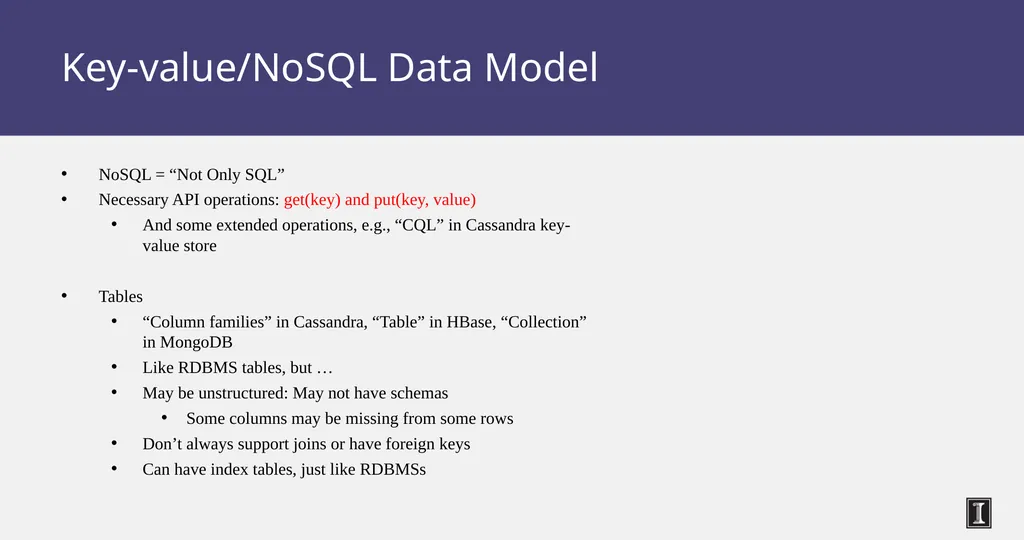
Key-value/NoSQL Data Model NoSQL = “Not Only SQL”
Necessary API operations: get(key) and put(key, value)
And some extended operations, e.g., “CQL” in Cassandra key-value store
Tables
“Column families” in Cassandra, “Table” in HBase, “Collection” in MongoDB
Like RDBMS tables, but …
May be unstructured: May not have schemas
Some columns may be missing from some rows
Don’t always support joins or have foreign keys
Can have index tables, just like RDBMSs<br>
Necessary API operations: get(key) and put(key, value)
And some extended operations, e.g., “CQL” in Cassandra key-value store
Tables
“Column families” in Cassandra, “Table” in HBase, “Collection” in MongoDB
Like RDBMS tables, but …
May be unstructured: May not have schemas
Some columns may be missing from some rows
Don’t always support joins or have foreign keys
Can have index tables, just like RDBMSs<br>
10
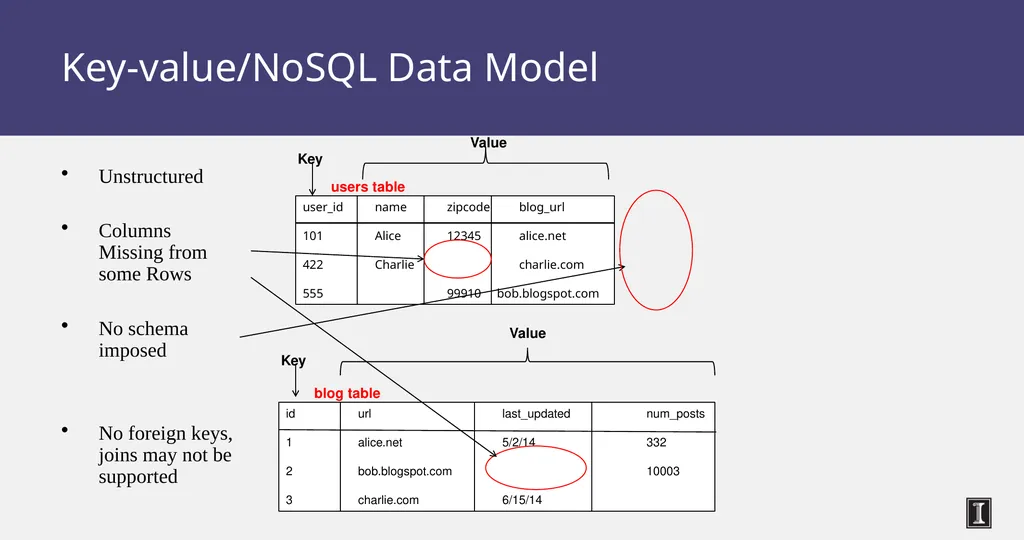
Key-value/NoSQL Data Model Unstructured
Columns Missing from some Rows
No schema imposed
No foreign keys, joins may not be supported Key Value Key Value<br>
Columns Missing from some Rows
No schema imposed
No foreign keys, joins may not be supported Key Value Key Value<br>
11
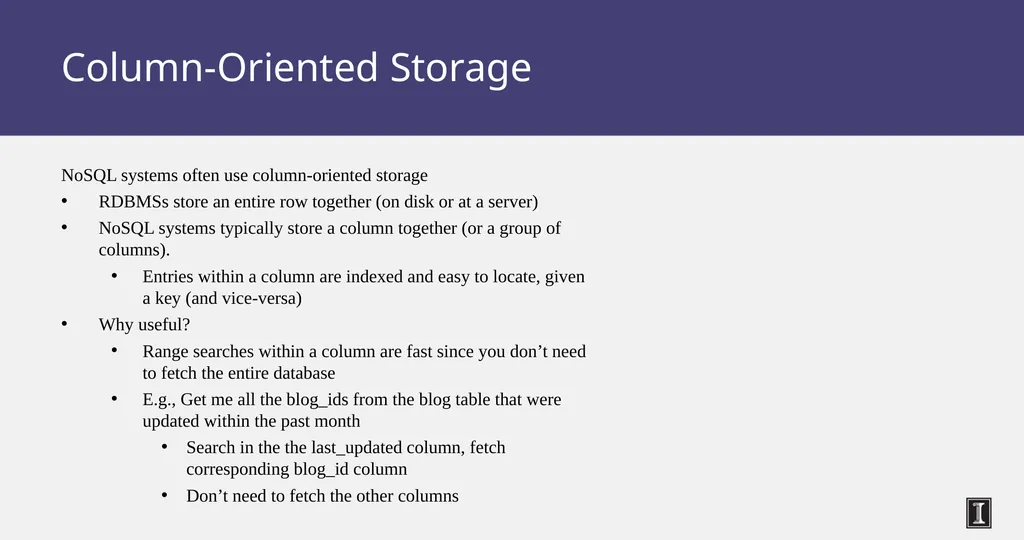
Column-Oriented Storage NoSQL systems often use column-oriented storage
RDBMSs store an entire row together (on disk or at a server)
NoSQL systems typically store a column together (or a group of columns).
Entries within a column are indexed and easy to locate, given a key (and vice-versa)
Why useful?
Range searches within a column are fast since you don’t need to fetch the entire database
E.g., Get me all the blog_ids from the blog table that were updated within the past month
Search in the the last_updated column, fetch corresponding blog_id column
Don’t need to fetch the other columns<br>
RDBMSs store an entire row together (on disk or at a server)
NoSQL systems typically store a column together (or a group of columns).
Entries within a column are indexed and easy to locate, given a key (and vice-versa)
Why useful?
Range searches within a column are fast since you don’t need to fetch the entire database
E.g., Get me all the blog_ids from the blog table that were updated within the past month
Search in the the last_updated column, fetch corresponding blog_id column
Don’t need to fetch the other columns<br>
12
Next Design of a real key-value store, Cassandra.<br>
13
Cassandra A distributed key-value store
Intended to run in a datacenter (and also across DCs)
Originally designed at Facebook
Open-sourced later, today an Apache project
Some of the companies that use Cassandra in their production clusters
IBM, Adobe, HP, eBay, Ericsson, Symantec
Twitter, Spotify
PBS Kids
Netflix: uses Cassandra to keep track of your current position in the video you’re watching<br>
Intended to run in a datacenter (and also across DCs)
Originally designed at Facebook
Open-sourced later, today an Apache project
Some of the companies that use Cassandra in their production clusters
IBM, Adobe, HP, eBay, Ericsson, Symantec
Twitter, Spotify
PBS Kids
Netflix: uses Cassandra to keep track of your current position in the video you’re watching<br>
14
Let’s go Inside Cassandra:
Key -> Server Mapping How do you decide which server(s) a key-value resides on?<br>
15
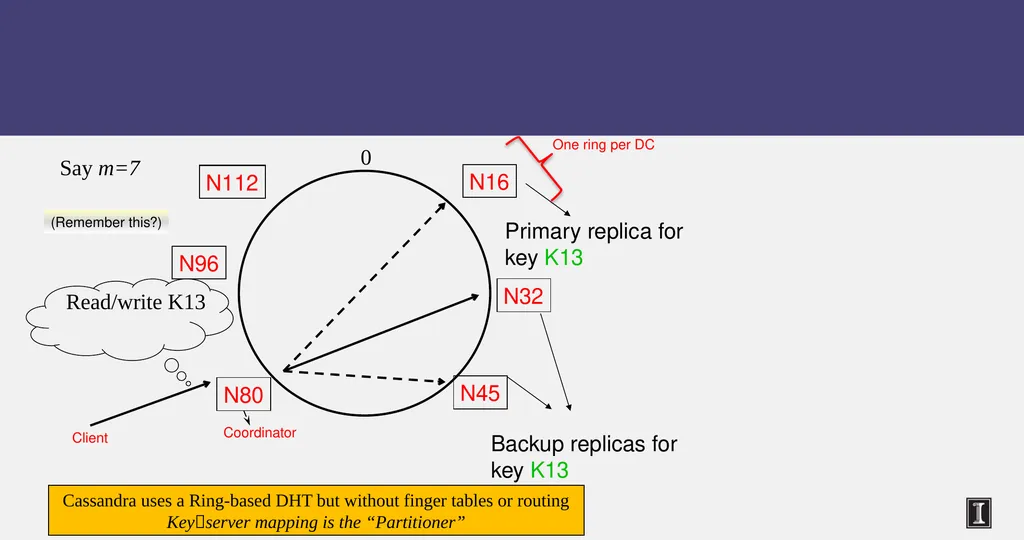
N80 0 Say m=7 N32 N45 Backup replicas for
key K13 Cassandra uses a Ring-based DHT but without finger tables or routing
Keyserver mapping is the “Partitioner” N112 N96 N16 Read/write K13 Primary replica for
key K13 (Remember this?) Coordinator Client One ring per DC<br>
key K13 Cassandra uses a Ring-based DHT but without finger tables or routing
Keyserver mapping is the “Partitioner” N112 N96 N16 Read/write K13 Primary replica for
key K13 (Remember this?) Coordinator Client One ring per DC<br>
16
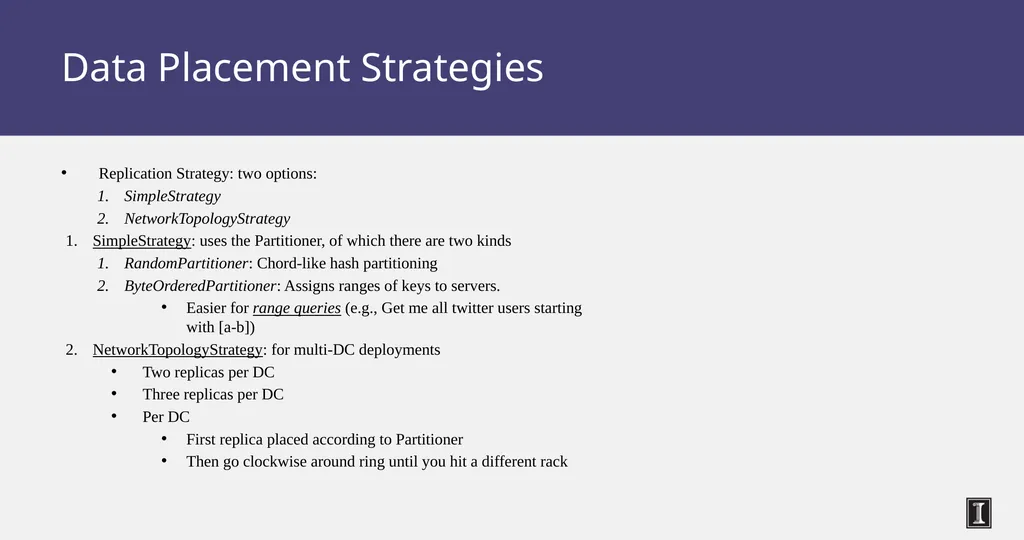
Data Placement Strategies Replication Strategy: two options:
SimpleStrategy
NetworkTopologyStrategy
SimpleStrategy: uses the Partitioner, of which there are two kinds
RandomPartitioner: Chord-like hash partitioning
ByteOrderedPartitioner: Assigns ranges of keys to servers.
Easier for range queries (e.g., Get me all twitter users starting with [a-b])
NetworkTopologyStrategy: for multi-DC deployments
Two replicas per DC
Three replicas per DC
Per DC
First replica placed according to Partitioner
Then go clockwise around ring until you hit a different rack<br>
SimpleStrategy
NetworkTopologyStrategy
SimpleStrategy: uses the Partitioner, of which there are two kinds
RandomPartitioner: Chord-like hash partitioning
ByteOrderedPartitioner: Assigns ranges of keys to servers.
Easier for range queries (e.g., Get me all twitter users starting with [a-b])
NetworkTopologyStrategy: for multi-DC deployments
Two replicas per DC
Three replicas per DC
Per DC
First replica placed according to Partitioner
Then go clockwise around ring until you hit a different rack<br>
17
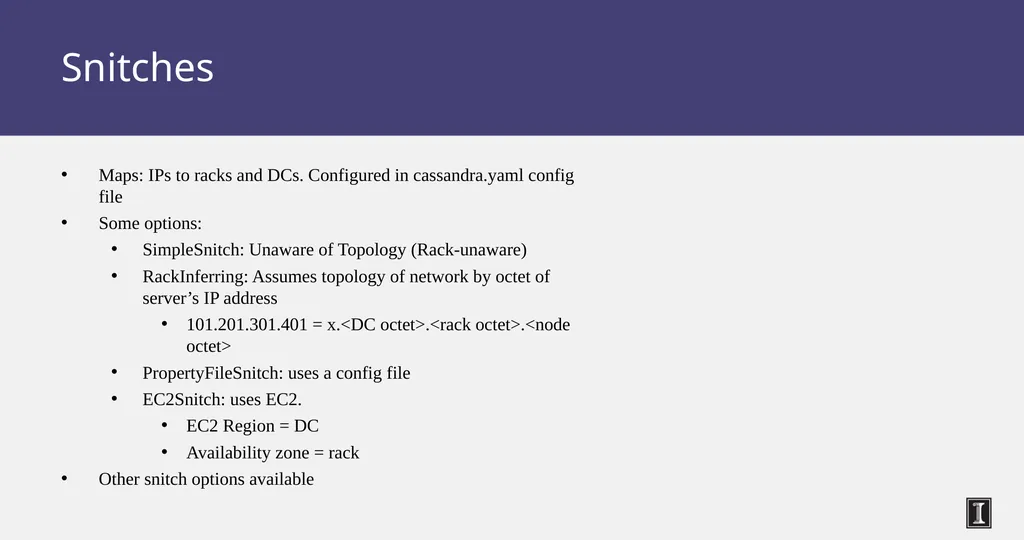
Snitches Maps: IPs to racks and DCs. Configured in cassandra.yaml config file
Some options:
SimpleSnitch: Unaware of Topology (Rack-unaware)
RackInferring: Assumes topology of network by octet of server’s IP address
101.201.301.401 = x.<DC octet>.<rack octet>.<node octet>
PropertyFileSnitch: uses a config file
EC2Snitch: uses EC2.
EC2 Region = DC
Availability zone = rack
Other snitch options available<br>
Some options:
SimpleSnitch: Unaware of Topology (Rack-unaware)
RackInferring: Assumes topology of network by octet of server’s IP address
101.201.301.401 = x.<DC octet>.<rack octet>.<node octet>
PropertyFileSnitch: uses a config file
EC2Snitch: uses EC2.
EC2 Region = DC
Availability zone = rack
Other snitch options available<br>
18
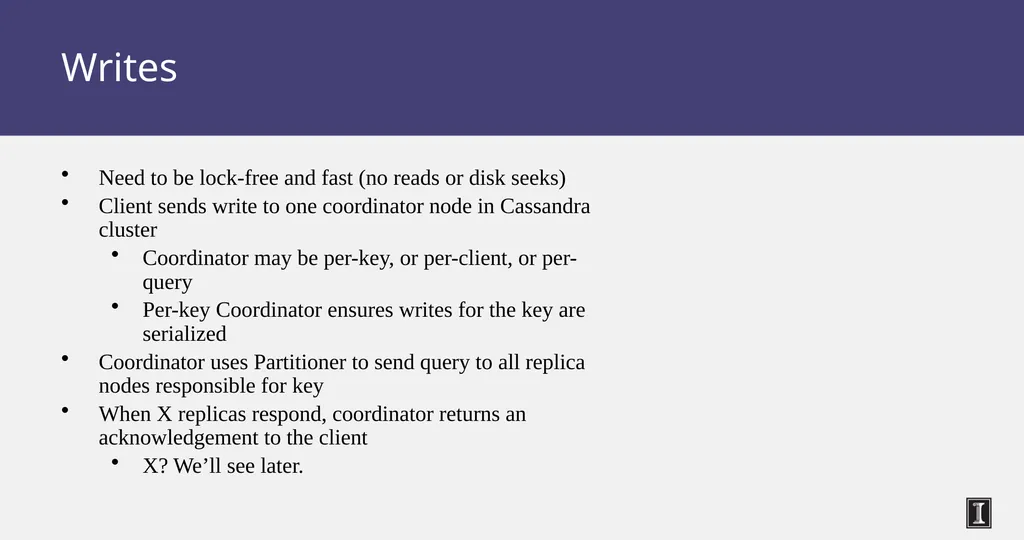
Writes Need to be lock-free and fast (no reads or disk seeks)
Client sends write to one coordinator node in Cassandra cluster
Coordinator may be per-key, or per-client, or per-query
Per-key Coordinator ensures writes for the key are serialized
Coordinator uses Partitioner to send query to all replica nodes responsible for key
When X replicas respond, coordinator returns an acknowledgement to the client
X? We’ll see later.<br>
Client sends write to one coordinator node in Cassandra cluster
Coordinator may be per-key, or per-client, or per-query
Per-key Coordinator ensures writes for the key are serialized
Coordinator uses Partitioner to send query to all replica nodes responsible for key
When X replicas respond, coordinator returns an acknowledgement to the client
X? We’ll see later.<br>
19
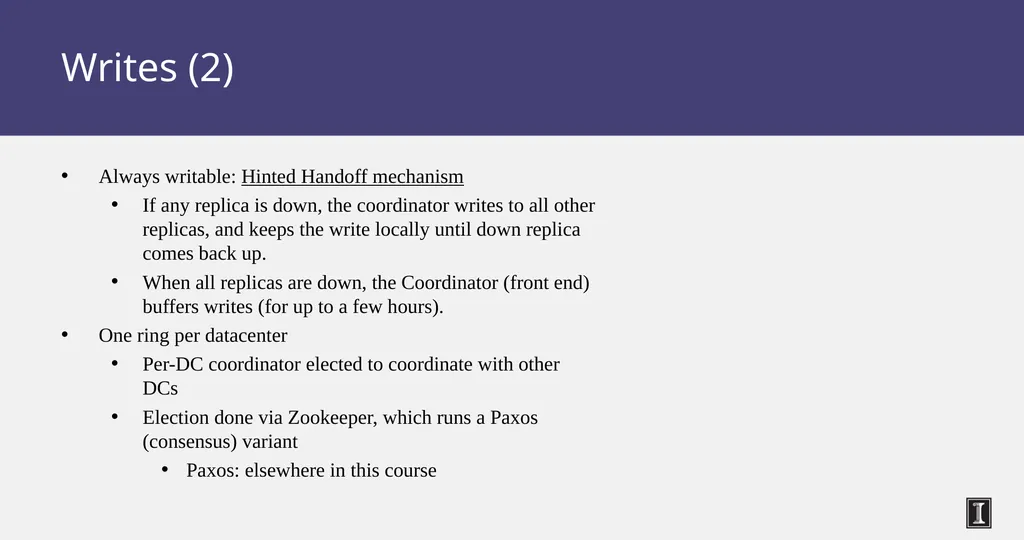
Writes (2) Always writable: Hinted Handoff mechanism
If any replica is down, the coordinator writes to all other replicas, and keeps the write locally until down replica comes back up.
When all replicas are down, the Coordinator (front end) buffers writes (for up to a few hours).
One ring per datacenter
Per-DC coordinator elected to coordinate with other DCs
Election done via Zookeeper, which runs a Paxos (consensus) variant
Paxos: elsewhere in this course<br>
If any replica is down, the coordinator writes to all other replicas, and keeps the write locally until down replica comes back up.
When all replicas are down, the Coordinator (front end) buffers writes (for up to a few hours).
One ring per datacenter
Per-DC coordinator elected to coordinate with other DCs
Election done via Zookeeper, which runs a Paxos (consensus) variant
Paxos: elsewhere in this course<br>
20
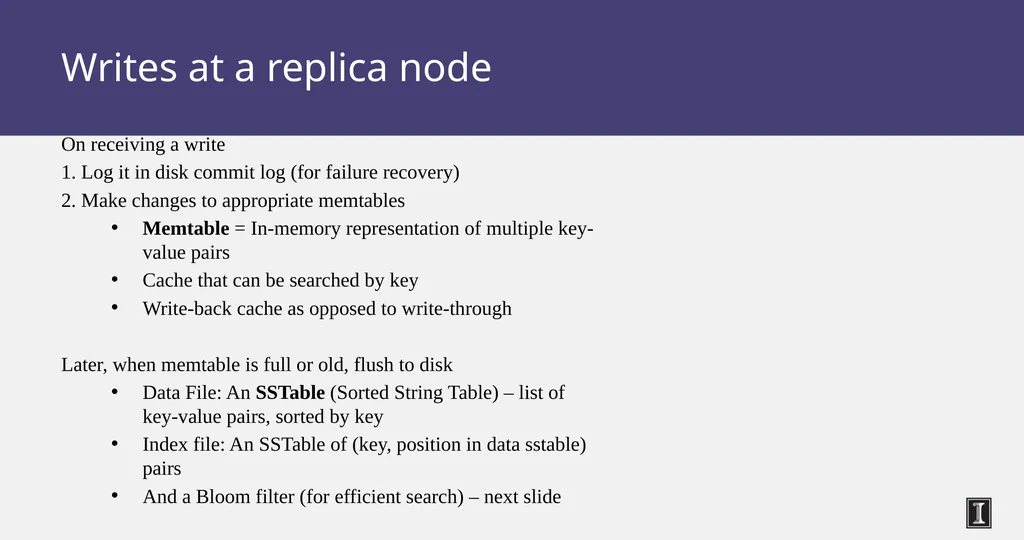
Writes at a replica node On receiving a write
1. Log it in disk commit log (for failure recovery)
2. Make changes to appropriate memtables
Memtable = In-memory representation of multiple key-value pairs
Cache that can be searched by key
Write-back cache as opposed to write-through
Later, when memtable is full or old, flush to disk
Data File: An SSTable (Sorted String Table) – list of key-value pairs, sorted by key
Index file: An SSTable of (key, position in data sstable) pairs
And a Bloom filter (for efficient search) – next slide<br>
1. Log it in disk commit log (for failure recovery)
2. Make changes to appropriate memtables
Memtable = In-memory representation of multiple key-value pairs
Cache that can be searched by key
Write-back cache as opposed to write-through
Later, when memtable is full or old, flush to disk
Data File: An SSTable (Sorted String Table) – list of key-value pairs, sorted by key
Index file: An SSTable of (key, position in data sstable) pairs
And a Bloom filter (for efficient search) – next slide<br>
21
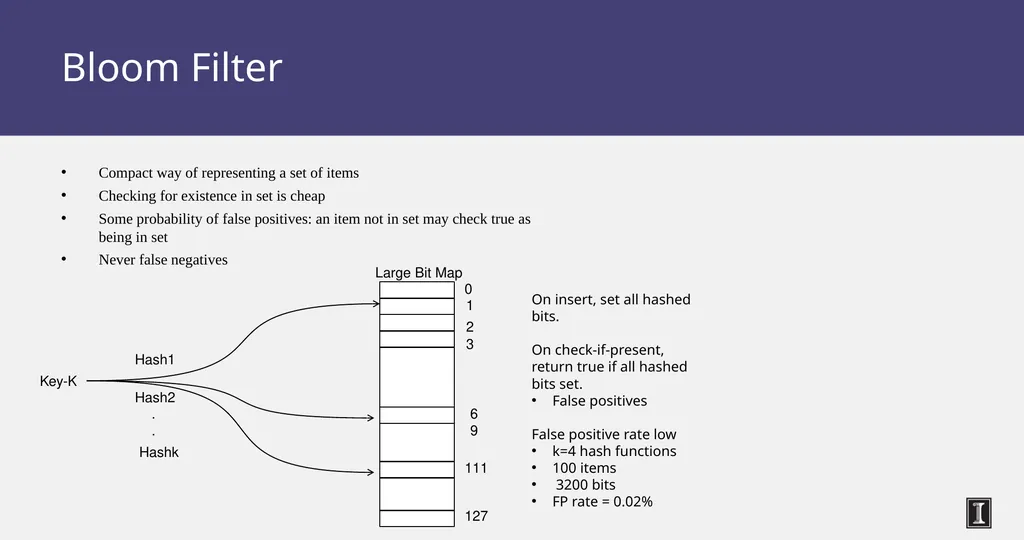
Bloom Filter Compact way of representing a set of items
Checking for existence in set is cheap
Some probability of false positives: an item not in set may check true as being in set
Never false negatives Large Bit Map 0 1 2 3 69 127 111 Key-K Hash1 Hash2 Hashk On insert, set all hashed bits.
On check-if-present,
return true if all hashed bits set.
False positives
False positive rate low
k=4 hash functions
100 items
3200 bits
FP rate = 0.02% .
.<br>
Checking for existence in set is cheap
Some probability of false positives: an item not in set may check true as being in set
Never false negatives Large Bit Map 0 1 2 3 69 127 111 Key-K Hash1 Hash2 Hashk On insert, set all hashed bits.
On check-if-present,
return true if all hashed bits set.
False positives
False positive rate low
k=4 hash functions
100 items
3200 bits
FP rate = 0.02% .
.<br>
22
Compaction Data updates accumulate over time and SStables and logs need to be compacted
The process of compaction merges SSTables, i.e., by merging updates for a key
Run periodically and locally at each server<br>
The process of compaction merges SSTables, i.e., by merging updates for a key
Run periodically and locally at each server<br>
23
Deletes Delete: don’t delete item right away
Add a tombstone to the log
Eventually, when compaction encounters tombstone it will delete item<br>
Add a tombstone to the log
Eventually, when compaction encounters tombstone it will delete item<br>
24
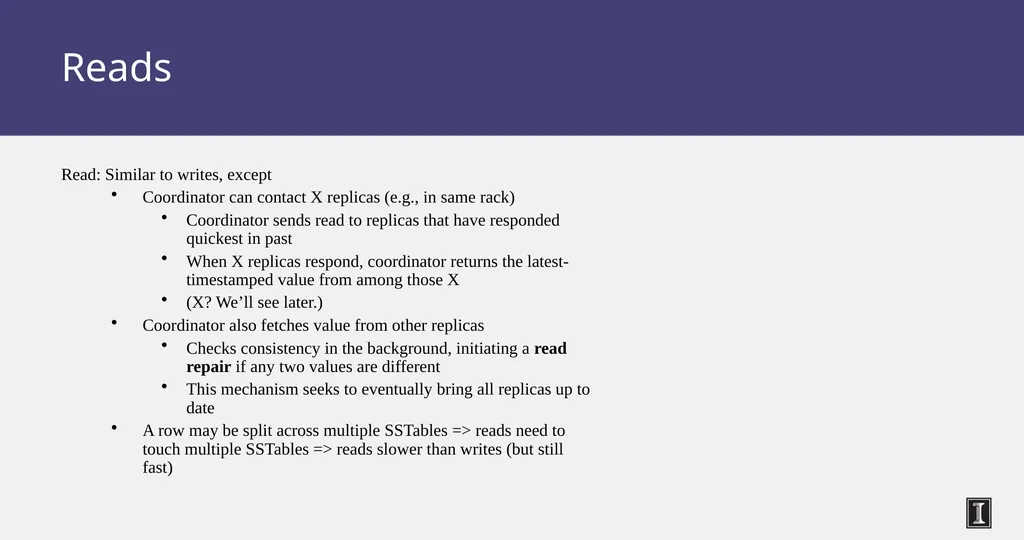
Reads Read: Similar to writes, except
Coordinator can contact X replicas (e.g., in same rack)
Coordinator sends read to replicas that have responded quickest in past
When X replicas respond, coordinator returns the latest-timestamped value from among those X
(X? We’ll see later.)
Coordinator also fetches value from other replicas
Checks consistency in the background, initiating a read repair if any two values are different
This mechanism seeks to eventually bring all replicas up to date
A row may be split across multiple SSTables => reads need to touch multiple SSTables => reads slower than writes (but still fast)<br>
Coordinator can contact X replicas (e.g., in same rack)
Coordinator sends read to replicas that have responded quickest in past
When X replicas respond, coordinator returns the latest-timestamped value from among those X
(X? We’ll see later.)
Coordinator also fetches value from other replicas
Checks consistency in the background, initiating a read repair if any two values are different
This mechanism seeks to eventually bring all replicas up to date
A row may be split across multiple SSTables => reads need to touch multiple SSTables => reads slower than writes (but still fast)<br>
25
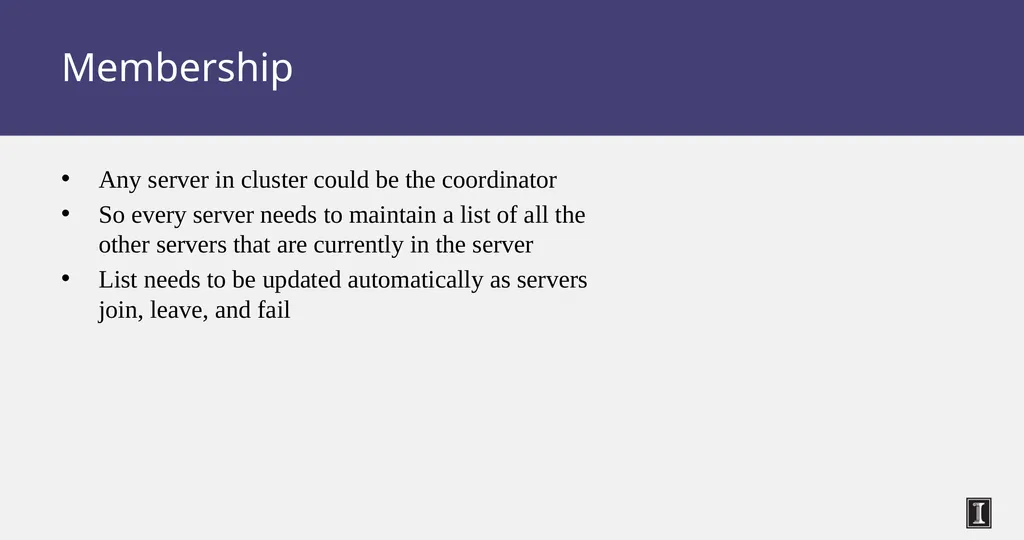
Membership Any server in cluster could be the coordinator
So every server needs to maintain a list of all the other servers that are currently in the server
List needs to be updated automatically as servers join, leave, and fail<br>
So every server needs to maintain a list of all the other servers that are currently in the server
List needs to be updated automatically as servers join, leave, and fail<br>
26
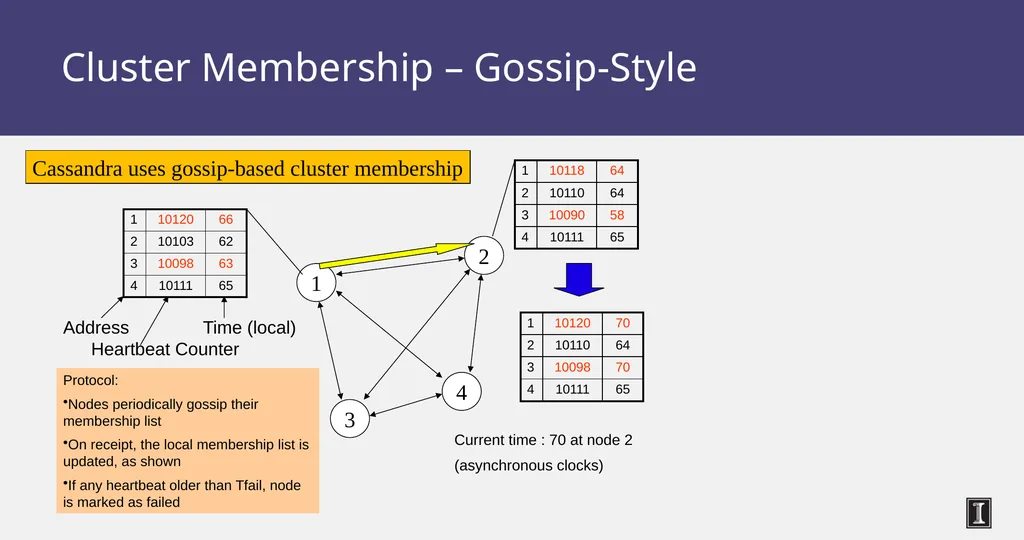
Cluster Membership – Gossip-Style 1 2 4 3 Protocol:
Nodes periodically gossip their membership list
On receipt, the local membership list is updated, as shown
If any heartbeat older than Tfail, node is marked as failed Current time : 70 at node 2
(asynchronous clocks) Address Heartbeat Counter Time (local) Cassandra uses gossip-based cluster membership<br>
Nodes periodically gossip their membership list
On receipt, the local membership list is updated, as shown
If any heartbeat older than Tfail, node is marked as failed Current time : 70 at node 2
(asynchronous clocks) Address Heartbeat Counter Time (local) Cassandra uses gossip-based cluster membership<br>
27
Suspicion Mechanisms in Cassandra Suspicion mechanisms to adaptively set the timeout based on underlying network and failure behavior
Accrual detector: Failure Detector outputs a value (PHI) representing suspicion
Apps set an appropriate threshold
PHI calculation for a member
Inter-arrival times for gossip messages
PHI(t) =
– log(CDF or Probability(t_now – t_last))/log 10
PHI basically determines the detection timeout, but takes into account historical inter-arrival time variations for gossiped heartbeats
In practice, PHI = 5 => 10-15 sec detection time<br>
Accrual detector: Failure Detector outputs a value (PHI) representing suspicion
Apps set an appropriate threshold
PHI calculation for a member
Inter-arrival times for gossip messages
PHI(t) =
– log(CDF or Probability(t_now – t_last))/log 10
PHI basically determines the detection timeout, but takes into account historical inter-arrival time variations for gossiped heartbeats
In practice, PHI = 5 => 10-15 sec detection time<br>
28
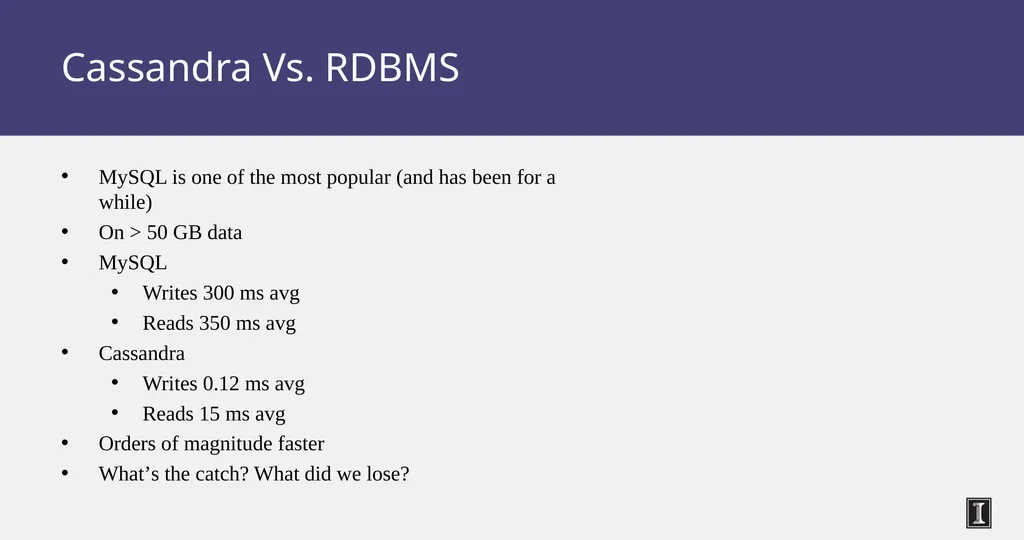
Cassandra Vs. RDBMS MySQL is one of the most popular (and has been for a while)
On > 50 GB data
MySQL
Writes 300 ms avg
Reads 350 ms avg
Cassandra
Writes 0.12 ms avg
Reads 15 ms avg
Orders of magnitude faster
What’s the catch? What did we lose?<br>
On > 50 GB data
MySQL
Writes 300 ms avg
Reads 350 ms avg
Cassandra
Writes 0.12 ms avg
Reads 15 ms avg
Orders of magnitude faster
What’s the catch? What did we lose?<br>
29
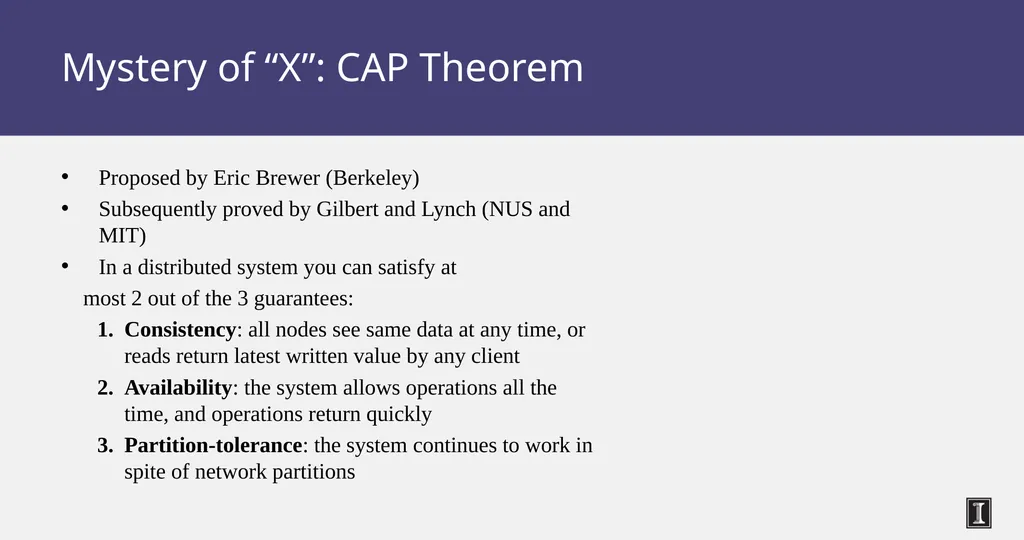
Mystery of “X”: CAP Theorem Proposed by Eric Brewer (Berkeley)
Subsequently proved by Gilbert and Lynch (NUS and MIT)
In a distributed system you can satisfy at
most 2 out of the 3 guarantees:
Consistency: all nodes see same data at any time, or reads return latest written value by any client
Availability: the system allows operations all the time, and operations return quickly
Partition-tolerance: the system continues to work in spite of network partitions<br>
Subsequently proved by Gilbert and Lynch (NUS and MIT)
In a distributed system you can satisfy at
most 2 out of the 3 guarantees:
Consistency: all nodes see same data at any time, or reads return latest written value by any client
Availability: the system allows operations all the time, and operations return quickly
Partition-tolerance: the system continues to work in spite of network partitions<br>
30
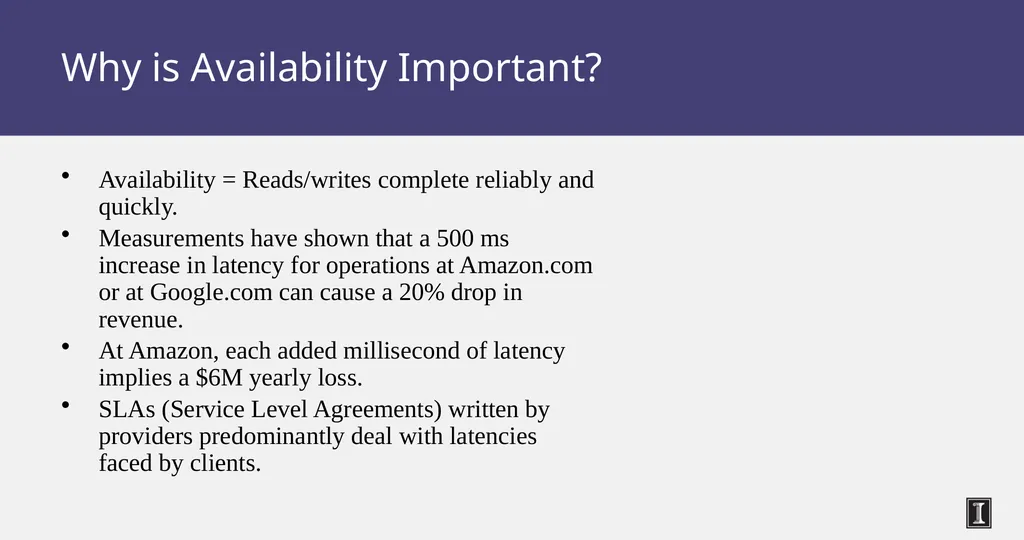
Why is Availability Important? Availability = Reads/writes complete reliably and quickly.
Measurements have shown that a 500 ms increase in latency for operations at Amazon.com or at Google.com can cause a 20% drop in revenue.
At Amazon, each added millisecond of latency implies a $6M yearly loss.
SLAs (Service Level Agreements) written by providers predominantly deal with latencies faced by clients.<br>
Measurements have shown that a 500 ms increase in latency for operations at Amazon.com or at Google.com can cause a 20% drop in revenue.
At Amazon, each added millisecond of latency implies a $6M yearly loss.
SLAs (Service Level Agreements) written by providers predominantly deal with latencies faced by clients.<br>
31
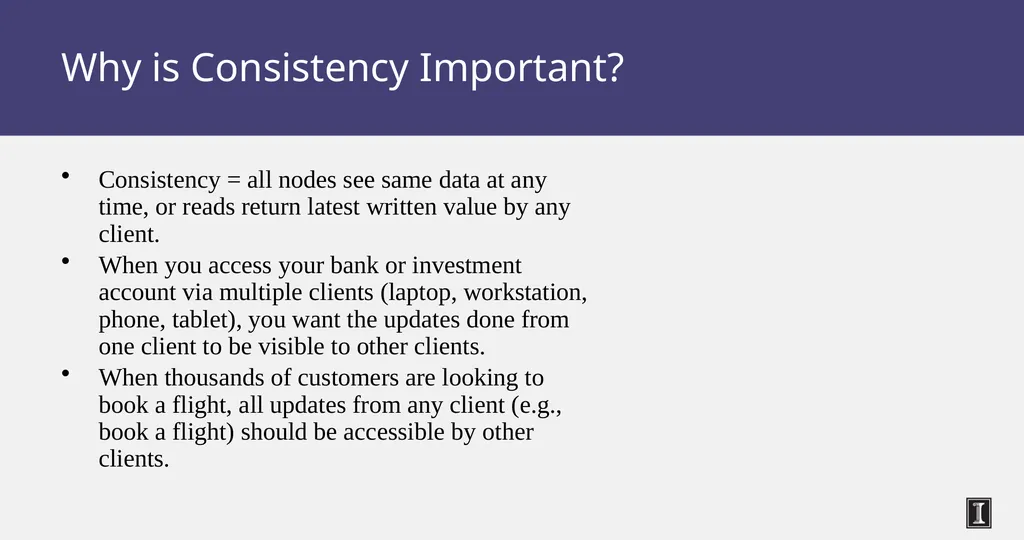
Why is Consistency Important? Consistency = all nodes see same data at any time, or reads return latest written value by any client.
When you access your bank or investment account via multiple clients (laptop, workstation, phone, tablet), you want the updates done from one client to be visible to other clients.
When thousands of customers are looking to book a flight, all updates from any client (e.g., book a flight) should be accessible by other clients.<br>
When you access your bank or investment account via multiple clients (laptop, workstation, phone, tablet), you want the updates done from one client to be visible to other clients.
When thousands of customers are looking to book a flight, all updates from any client (e.g., book a flight) should be accessible by other clients.<br>
32
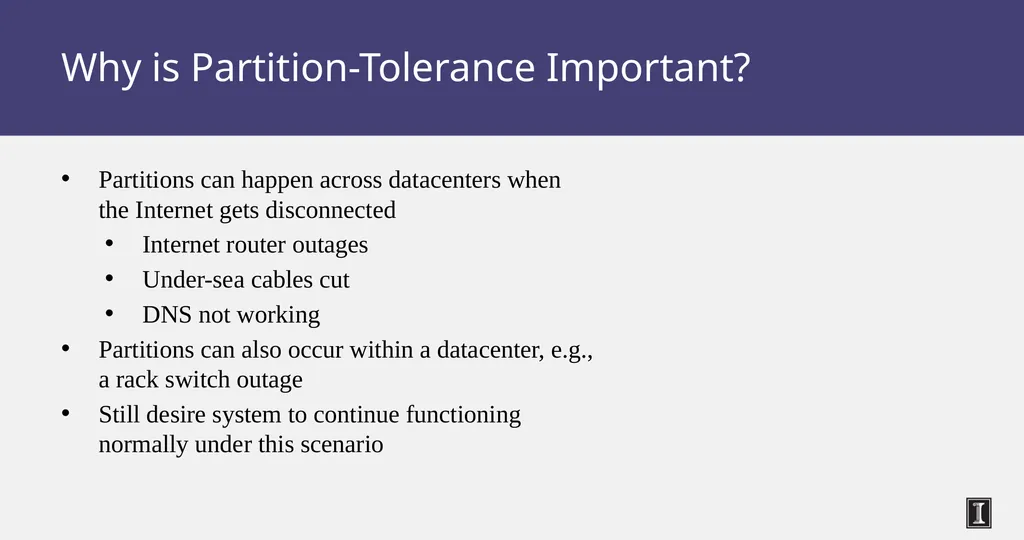
Why is Partition-Tolerance Important? Partitions can happen across datacenters when the Internet gets disconnected
Internet router outages
Under-sea cables cut
DNS not working
Partitions can also occur within a datacenter, e.g., a rack switch outage
Still desire system to continue functioning normally under this scenario<br>
Internet router outages
Under-sea cables cut
DNS not working
Partitions can also occur within a datacenter, e.g., a rack switch outage
Still desire system to continue functioning normally under this scenario<br>
33
CAP Theorem Fallout Since partition-tolerance is essential in today’s cloud computing systems, CAP theorem implies that a system has to choose between consistency and availability
Cassandra
Eventual (weak) consistency, Availability, Partition-tolerance
Traditional RDBMSs
Strong consistency over availability under a partition<br>
Cassandra
Eventual (weak) consistency, Availability, Partition-tolerance
Traditional RDBMSs
Strong consistency over availability under a partition<br>
34
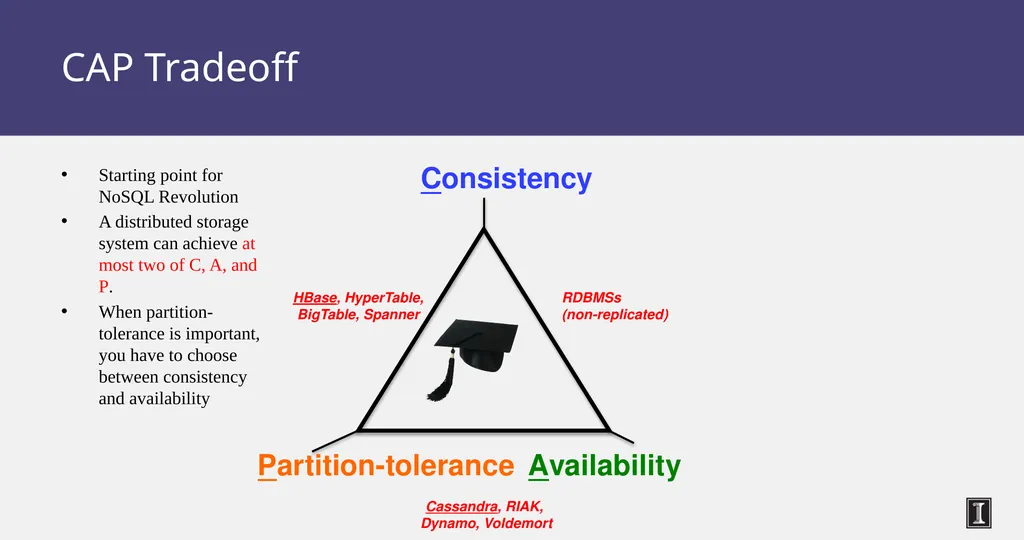
CAP Tradeoff Starting point for NoSQL Revolution
A distributed storage system can achieve at most two of C, A, and P.
When partition-tolerance is important, you have to choose between consistency and availability Consistency Partition-tolerance Availability RDBMSs
(non-replicated) Cassandra, RIAK,
Dynamo, Voldemort HBase, HyperTable,
BigTable, Spanner<br>
A distributed storage system can achieve at most two of C, A, and P.
When partition-tolerance is important, you have to choose between consistency and availability Consistency Partition-tolerance Availability RDBMSs
(non-replicated) Cassandra, RIAK,
Dynamo, Voldemort HBase, HyperTable,
BigTable, Spanner<br>
35
Eventual Consistency If all writes stop (to a key), then all its values (replicas) will converge eventually.
If writes continue, then system always tries to keep converging.
Moving “wave” of updated values lagging behind the latest values sent by clients, but always trying to catch up.
May still return stale values to clients (e.g., if many back-to-back writes).
But works well when there a few periods of low writes – system converges quickly.<br>
If writes continue, then system always tries to keep converging.
Moving “wave” of updated values lagging behind the latest values sent by clients, but always trying to catch up.
May still return stale values to clients (e.g., if many back-to-back writes).
But works well when there a few periods of low writes – system converges quickly.<br>
36
RDBMS vs. Key-value stores While RDBMS provide ACID
Atomicity
Consistency
Isolation
Durability
Key-value stores like Cassandra provide BASE
Basically Available Soft-state Eventual Consistency
Prefers Availability over Consistency<br>
Atomicity
Consistency
Isolation
Durability
Key-value stores like Cassandra provide BASE
Basically Available Soft-state Eventual Consistency
Prefers Availability over Consistency<br>
37
Back to Cassandra: Mystery of X Cassandra has consistency levels
Client is allowed to choose a consistency level for each operation (read/write)
ANY: any server (may not be replica)
Fastest: coordinator caches write and replies quickly to client
ALL: all replicas
Ensures strong consistency, but slowest
ONE: at least one replica
Faster than ALL, but cannot tolerate a failure
QUORUM: quorum across all replicas in all datacenters (DCs)
What?<br>
Client is allowed to choose a consistency level for each operation (read/write)
ANY: any server (may not be replica)
Fastest: coordinator caches write and replies quickly to client
ALL: all replicas
Ensures strong consistency, but slowest
ONE: at least one replica
Faster than ALL, but cannot tolerate a failure
QUORUM: quorum across all replicas in all datacenters (DCs)
What?<br>
38
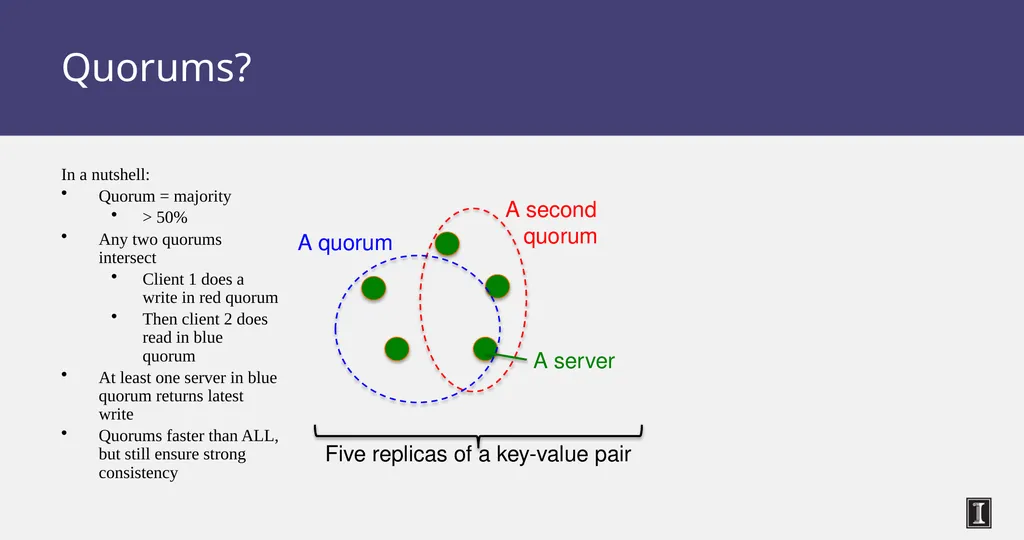
Quorums? In a nutshell:
Quorum = majority
> 50%
Any two quorums intersect
Client 1 does a write in red quorum
Then client 2 does read in blue quorum
At least one server in blue quorum returns latest write
Quorums faster than ALL, but still ensure strong consistency Five replicas of a key-value pair A second
quorum A quorum A server<br>
Quorum = majority
> 50%
Any two quorums intersect
Client 1 does a write in red quorum
Then client 2 does read in blue quorum
At least one server in blue quorum returns latest write
Quorums faster than ALL, but still ensure strong consistency Five replicas of a key-value pair A second
quorum A quorum A server<br>
39
Quorums in Detail Several key-value/NoSQL stores (e.g., Riak and Cassandra) use quorums.
Reads
Client specifies value of R (≤ N = total number of replicas of that key).
R = read consistency level.
Coordinator waits for R replicas to respond before sending result to client.
In background, coordinator checks for consistency of remaining (N-R) replicas, and initiates read repair if needed.<br>
Reads
Client specifies value of R (≤ N = total number of replicas of that key).
R = read consistency level.
Coordinator waits for R replicas to respond before sending result to client.
In background, coordinator checks for consistency of remaining (N-R) replicas, and initiates read repair if needed.<br>
40
Quorums in Detail (Contd.) Writes come in two flavors
Client specifies W (≤ N)
W = write consistency level.
Client writes new value to W replicas and returns. Two flavors:
Coordinator blocks until quorum is reached.
Asynchronous: Just write and return.<br>
Client specifies W (≤ N)
W = write consistency level.
Client writes new value to W replicas and returns. Two flavors:
Coordinator blocks until quorum is reached.
Asynchronous: Just write and return.<br>
41
Quorums in Detail (Contd.) R = read replica count, W = write replica count
Two necessary conditions:
W+R > N
W > N/2
Select values based on application
(W=1, R=1): very few writes and reads
(W=N, R=1): great for read-heavy workloads
(W=N/2+1, R=N/2+1): great for write-heavy workloads
(W=1, R=N): great for write-heavy workloads with mostly one client writing per key<br>
Two necessary conditions:
W+R > N
W > N/2
Select values based on application
(W=1, R=1): very few writes and reads
(W=N, R=1): great for read-heavy workloads
(W=N/2+1, R=N/2+1): great for write-heavy workloads
(W=1, R=N): great for write-heavy workloads with mostly one client writing per key<br>
42
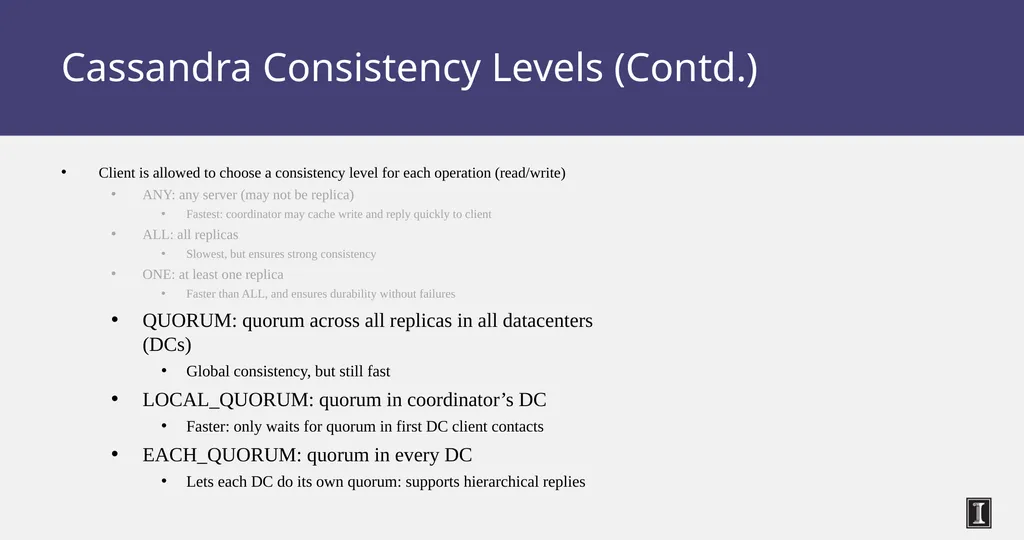
Cassandra Consistency Levels (Contd.) Client is allowed to choose a consistency level for each operation (read/write)
ANY: any server (may not be replica)
Fastest: coordinator may cache write and reply quickly to client
ALL: all replicas
Slowest, but ensures strong consistency
ONE: at least one replica
Faster than ALL, and ensures durability without failures
QUORUM: quorum across all replicas in all datacenters (DCs)
Global consistency, but still fast
LOCAL_QUORUM: quorum in coordinator’s DC
Faster: only waits for quorum in first DC client contacts
EACH_QUORUM: quorum in every DC
Lets each DC do its own quorum: supports hierarchical replies<br>
ANY: any server (may not be replica)
Fastest: coordinator may cache write and reply quickly to client
ALL: all replicas
Slowest, but ensures strong consistency
ONE: at least one replica
Faster than ALL, and ensures durability without failures
QUORUM: quorum across all replicas in all datacenters (DCs)
Global consistency, but still fast
LOCAL_QUORUM: quorum in coordinator’s DC
Faster: only waits for quorum in first DC client contacts
EACH_QUORUM: quorum in every DC
Lets each DC do its own quorum: supports hierarchical replies<br>
43
Types of Consistency Cassandra offers Eventual Consistency
Are there other types of weak consistency models?<br>
Are there other types of weak consistency models?<br>
44
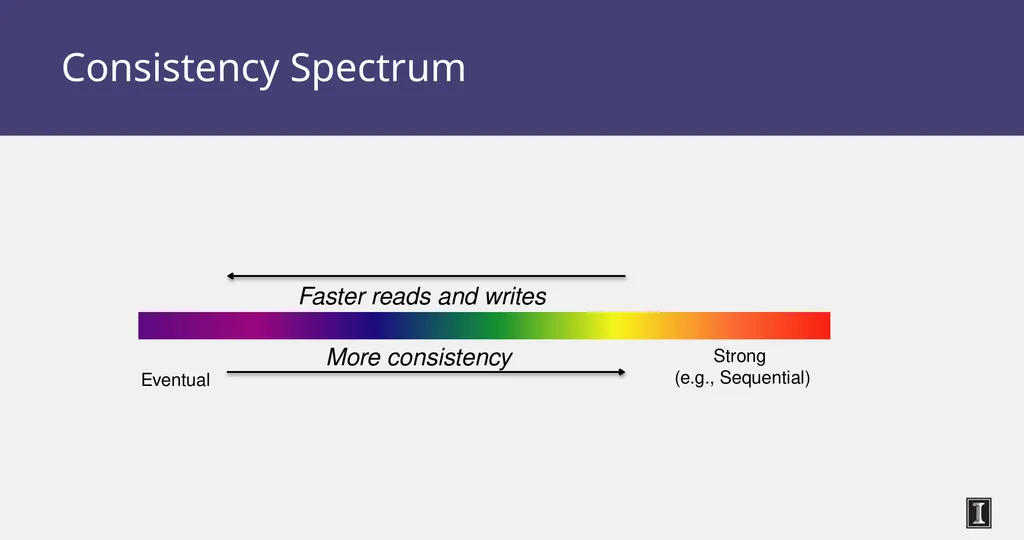
Consistency Spectrum Strong
(e.g., Sequential) Eventual More consistency Faster reads and writes<br>
(e.g., Sequential) Eventual More consistency Faster reads and writes<br>
45
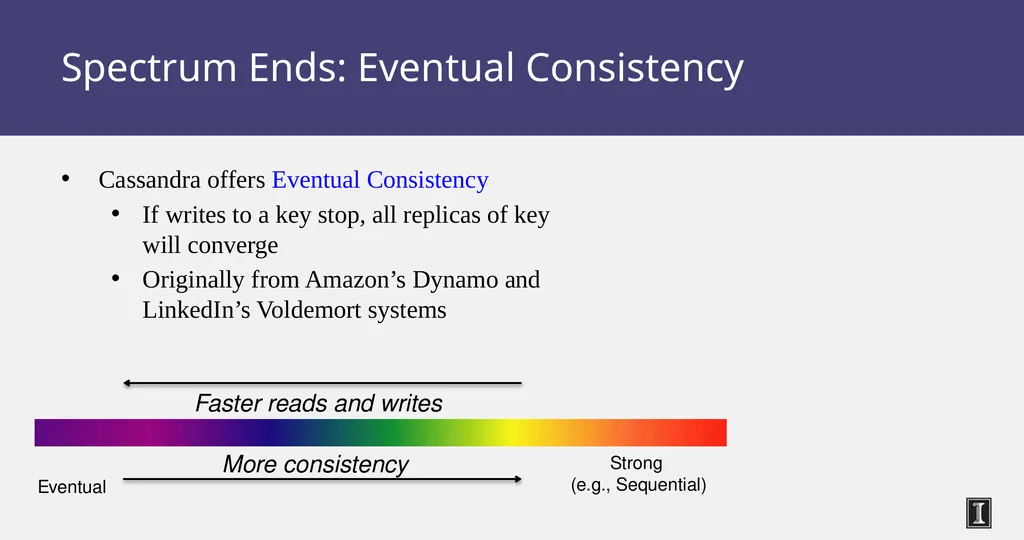
Spectrum Ends: Eventual Consistency Cassandra offers Eventual Consistency
If writes to a key stop, all replicas of key will converge
Originally from Amazon’s Dynamo and LinkedIn’s Voldemort systems Strong
(e.g., Sequential) Eventual More consistency Faster reads and writes<br>
If writes to a key stop, all replicas of key will converge
Originally from Amazon’s Dynamo and LinkedIn’s Voldemort systems Strong
(e.g., Sequential) Eventual More consistency Faster reads and writes<br>
46
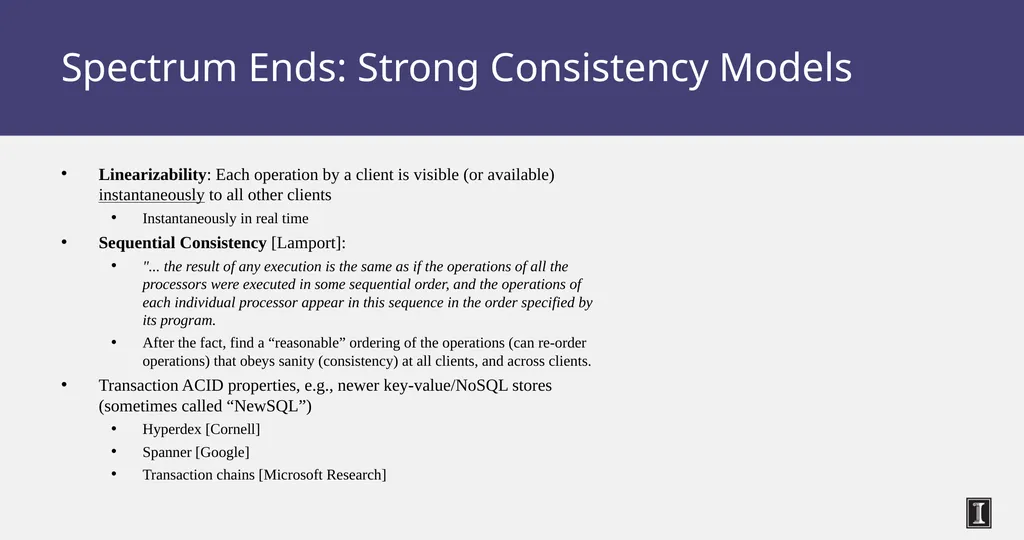
Spectrum Ends: Strong Consistency Models Linearizability: Each operation by a client is visible (or available) instantaneously to all other clients
Instantaneously in real time
Sequential Consistency [Lamport]:
"... the result of any execution is the same as if the operations of all the processors were executed in some sequential order, and the operations of each individual processor appear in this sequence in the order specified by its program.
After the fact, find a “reasonable” ordering of the operations (can re-order operations) that obeys sanity (consistency) at all clients, and across clients.
Transaction ACID properties, e.g., newer key-value/NoSQL stores (sometimes called “NewSQL”)
Hyperdex [Cornell]
Spanner [Google]
Transaction chains [Microsoft Research]<br>
Instantaneously in real time
Sequential Consistency [Lamport]:
"... the result of any execution is the same as if the operations of all the processors were executed in some sequential order, and the operations of each individual processor appear in this sequence in the order specified by its program.
After the fact, find a “reasonable” ordering of the operations (can re-order operations) that obeys sanity (consistency) at all clients, and across clients.
Transaction ACID properties, e.g., newer key-value/NoSQL stores (sometimes called “NewSQL”)
Hyperdex [Cornell]
Spanner [Google]
Transaction chains [Microsoft Research]<br>
47
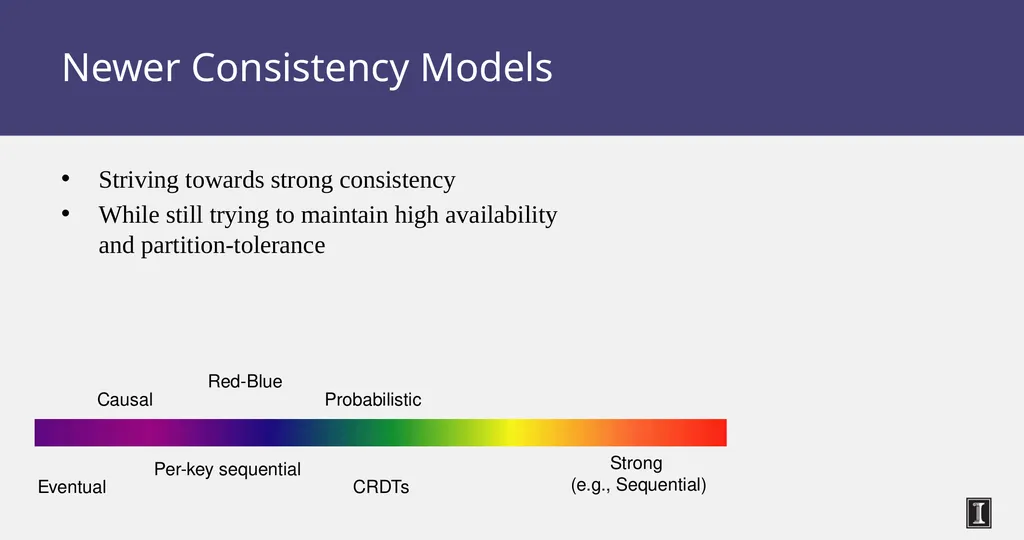
Newer Consistency Models Striving towards strong consistency
While still trying to maintain high availability and partition-tolerance Strong
(e.g., Sequential) Eventual Causal Red-Blue CRDTs Per-key sequential Probabilistic<br>
While still trying to maintain high availability and partition-tolerance Strong
(e.g., Sequential) Eventual Causal Red-Blue CRDTs Per-key sequential Probabilistic<br>
48
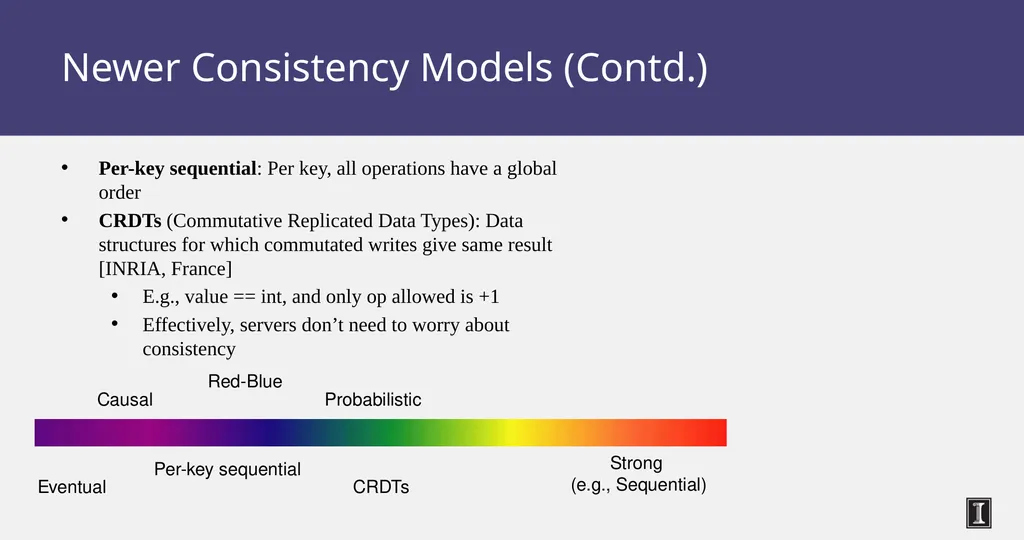
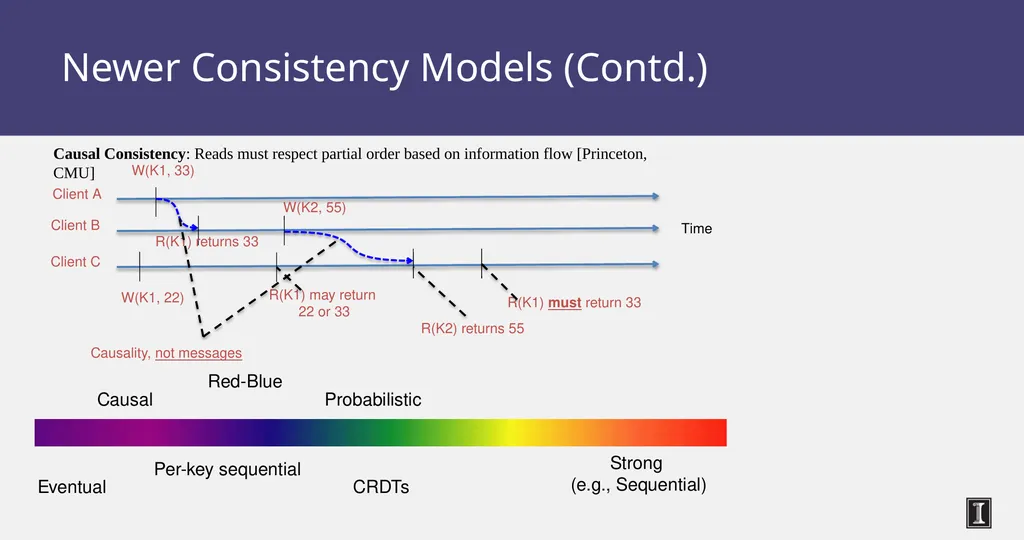
Newer Consistency Models (Contd.) Per-key sequential: Per key, all operations have a global order
CRDTs (Commutative Replicated Data Types): Data structures for which commutated writes give same result [INRIA, France]
E.g., value == int, and only op allowed is +1
Effectively, servers don’t need to worry about consistency Strong
(e.g., Sequential) Eventual Causal Red-Blue CRDTs Per-key sequential Probabilistic<br>
CRDTs (Commutative Replicated Data Types): Data structures for which commutated writes give same result [INRIA, France]
E.g., value == int, and only op allowed is +1
Effectively, servers don’t need to worry about consistency Strong
(e.g., Sequential) Eventual Causal Red-Blue CRDTs Per-key sequential Probabilistic<br>
49
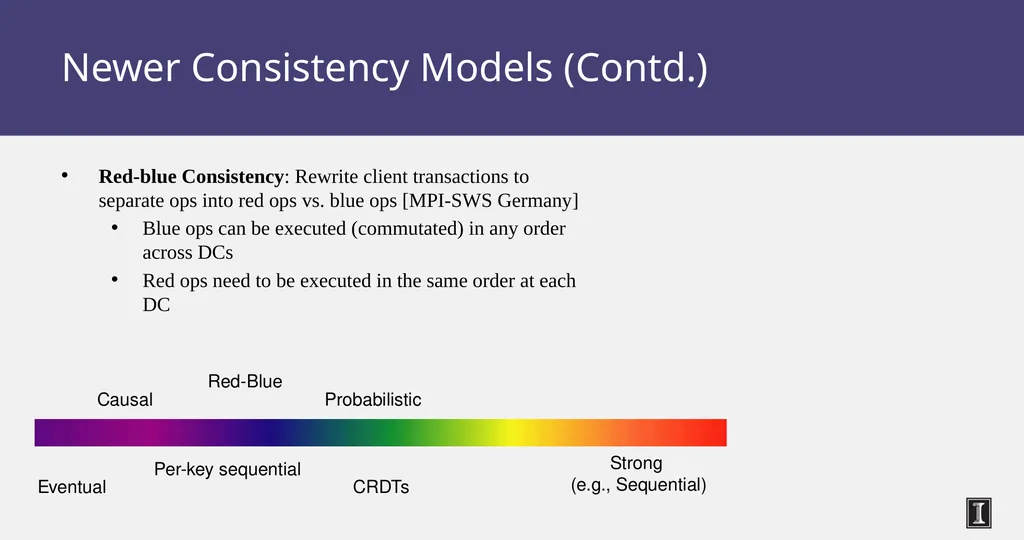
Newer Consistency Models (Contd.) Red-blue Consistency: Rewrite client transactions to separate ops into red ops vs. blue ops [MPI-SWS Germany]
Blue ops can be executed (commutated) in any order across DCs
Red ops need to be executed in the same order at each DC Strong
(e.g., Sequential) Eventual Causal Red-Blue CRDTs Per-key sequential Probabilistic<br>
Blue ops can be executed (commutated) in any order across DCs
Red ops need to be executed in the same order at each DC Strong
(e.g., Sequential) Eventual Causal Red-Blue CRDTs Per-key sequential Probabilistic<br>
50
Newer Consistency Models (Contd.) Strong
(e.g., Sequential) Eventual Causal Red-Blue CRDTs Per-key sequential Probabilistic Causal Consistency: Reads must respect partial order based on information flow [Princeton, CMU] Client A Client B Client C W(K1, 33) W(K2, 55) R(K1) must return 33 W(K1, 22) R(K1) may return
22 or 33 Time R(K1) returns 33 R(K2) returns 55 Causality, not messages<br>
(e.g., Sequential) Eventual Causal Red-Blue CRDTs Per-key sequential Probabilistic Causal Consistency: Reads must respect partial order based on information flow [Princeton, CMU] Client A Client B Client C W(K1, 33) W(K2, 55) R(K1) must return 33 W(K1, 22) R(K1) may return
22 or 33 Time R(K1) returns 33 R(K2) returns 55 Causality, not messages<br>
51
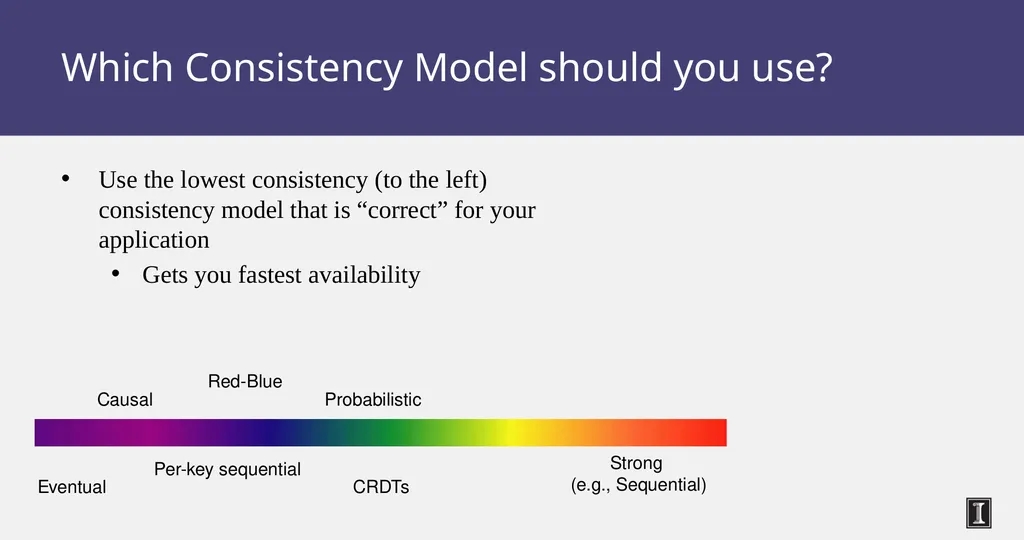
Which Consistency Model should you use? Use the lowest consistency (to the left) consistency model that is “correct” for your application
Gets you fastest availability Strong
(e.g., Sequential) Eventual Causal Red-Blue CRDTs Per-key sequential Probabilistic<br>
Gets you fastest availability Strong
(e.g., Sequential) Eventual Causal Red-Blue CRDTs Per-key sequential Probabilistic<br>
52
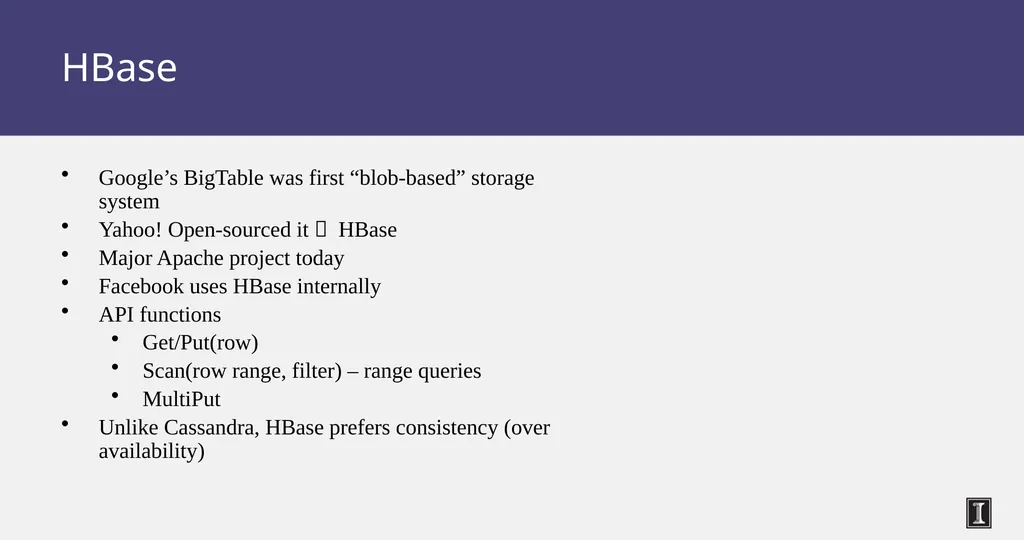
HBase Google’s BigTable was first “blob-based” storage system
Yahoo! Open-sourced it HBase
Major Apache project today
Facebook uses HBase internally
API functions
Get/Put(row)
Scan(row range, filter) – range queries
MultiPut
Unlike Cassandra, HBase prefers consistency (over availability)<br>
Yahoo! Open-sourced it HBase
Major Apache project today
Facebook uses HBase internally
API functions
Get/Put(row)
Scan(row range, filter) – range queries
MultiPut
Unlike Cassandra, HBase prefers consistency (over availability)<br>
53
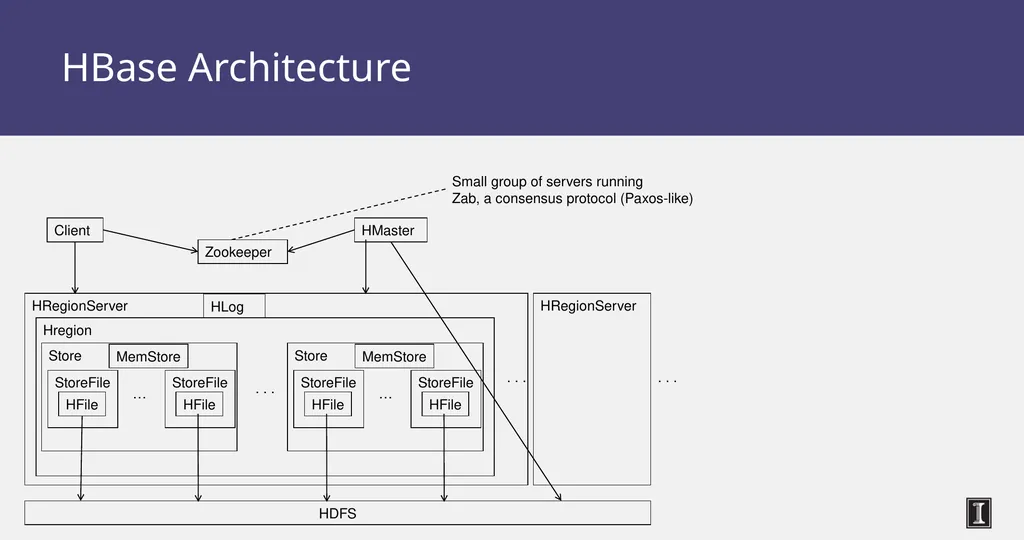
HBase Architecture Small group of servers running
Zab, a consensus protocol (Paxos-like)<br>
Zab, a consensus protocol (Paxos-like)<br>
54
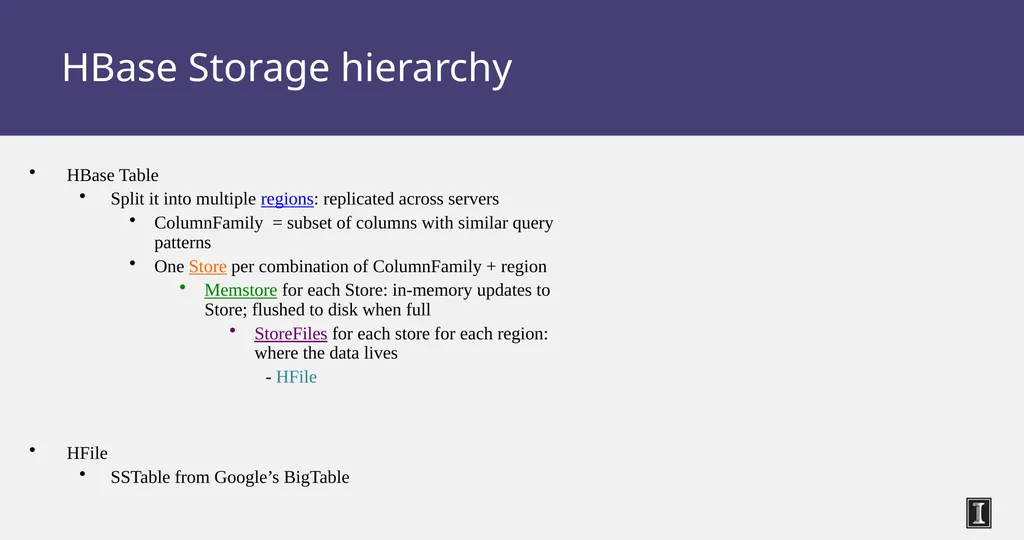
HBase Storage hierarchy HBase Table
Split it into multiple regions: replicated across servers
ColumnFamily = subset of columns with similar query patterns
One Store per combination of ColumnFamily + region
Memstore for each Store: in-memory updates to Store; flushed to disk when full
StoreFiles for each store for each region: where the data lives
- HFile
HFile
SSTable from Google’s BigTable<br>
Split it into multiple regions: replicated across servers
ColumnFamily = subset of columns with similar query patterns
One Store per combination of ColumnFamily + region
Memstore for each Store: in-memory updates to Store; flushed to disk when full
StoreFiles for each store for each region: where the data lives
- HFile
HFile
SSTable from Google’s BigTable<br>
55
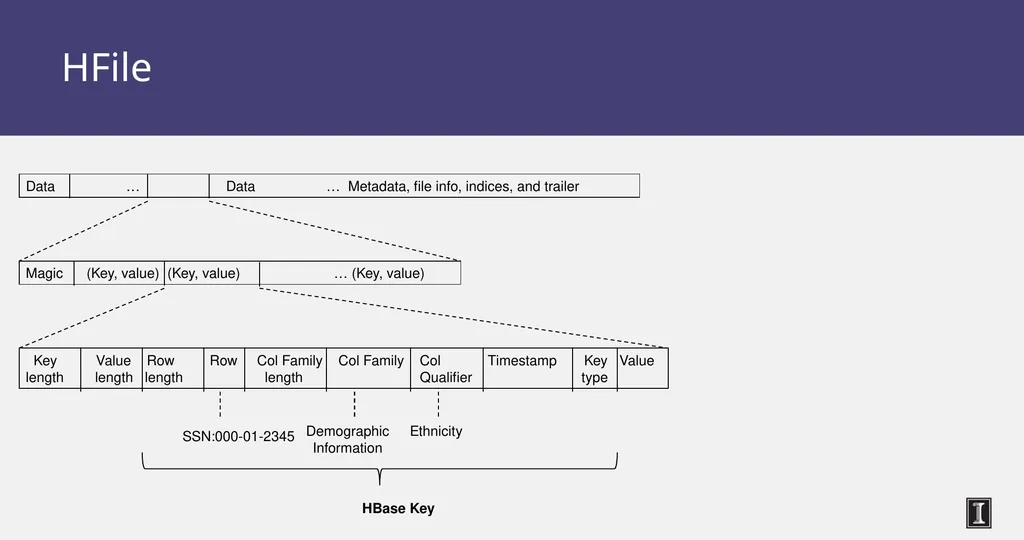
HFile Data … Data … Metadata, file info, indices, and trailer Magic (Key, value) (Key, value) … (Key, value) Key Value Row Row Col Family Col Family Col Timestamp Key Value
length length length length Qualifier type SSN:000-01-2345 Demographic
Information Ethnicity HBase Key<br>
length length length length Qualifier type SSN:000-01-2345 Demographic
Information Ethnicity HBase Key<br>
56
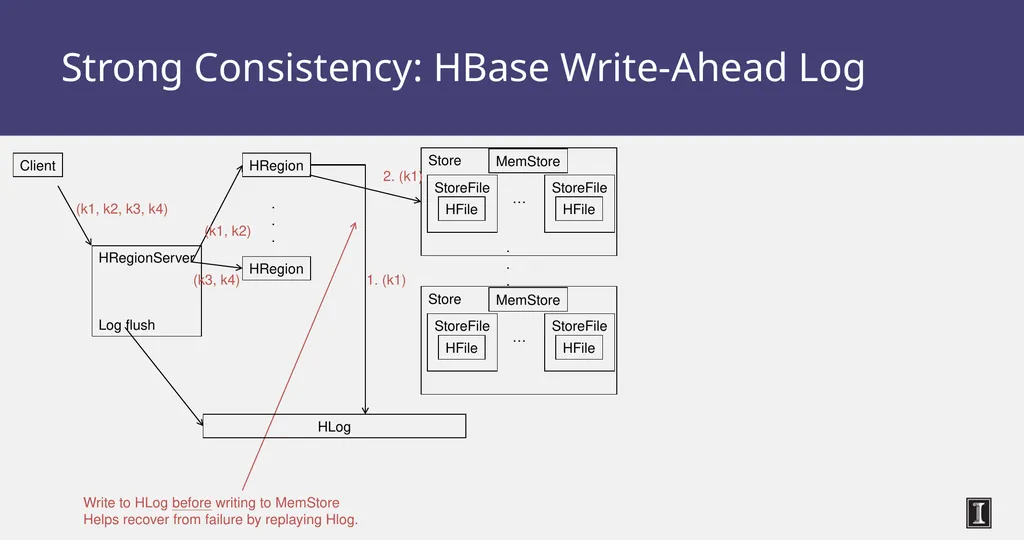
Strong Consistency: HBase Write-Ahead Log Write to HLog before writing to MemStore
Helps recover from failure by replaying Hlog. Client HRegionServer
Log flush HLog HRegion HRegion .
.
. (k1, k2, k3, k4) (k1, k2) (k3, k4) .
.
. 1. (k1) 2. (k1)<br>
Helps recover from failure by replaying Hlog. Client HRegionServer
Log flush HLog HRegion HRegion .
.
. (k1, k2, k3, k4) (k1, k2) (k3, k4) .
.
. 1. (k1) 2. (k1)<br>
57
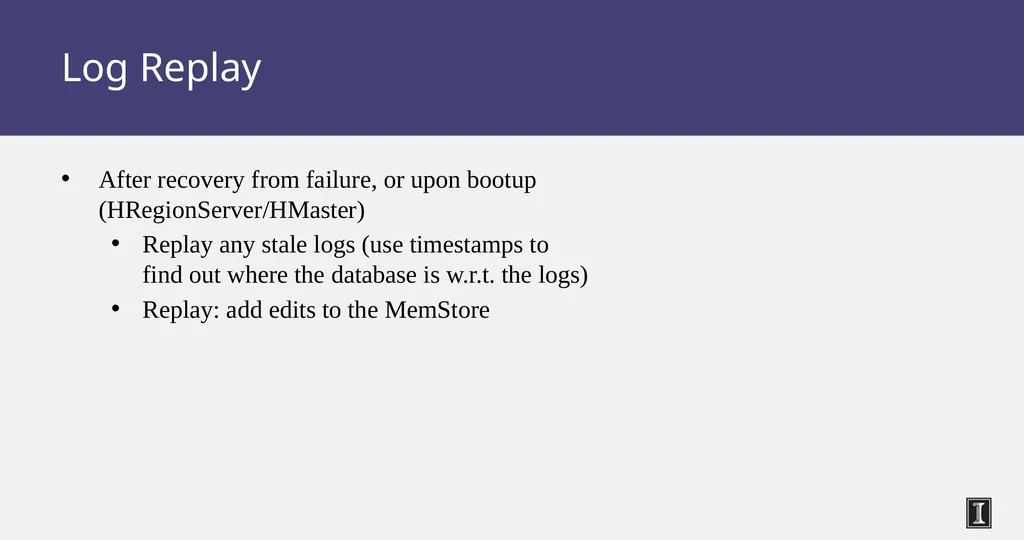
Log Replay After recovery from failure, or upon bootup (HRegionServer/HMaster)
Replay any stale logs (use timestamps to find out where the database is w.r.t. the logs)
Replay: add edits to the MemStore<br>
Replay any stale logs (use timestamps to find out where the database is w.r.t. the logs)
Replay: add edits to the MemStore<br>
58
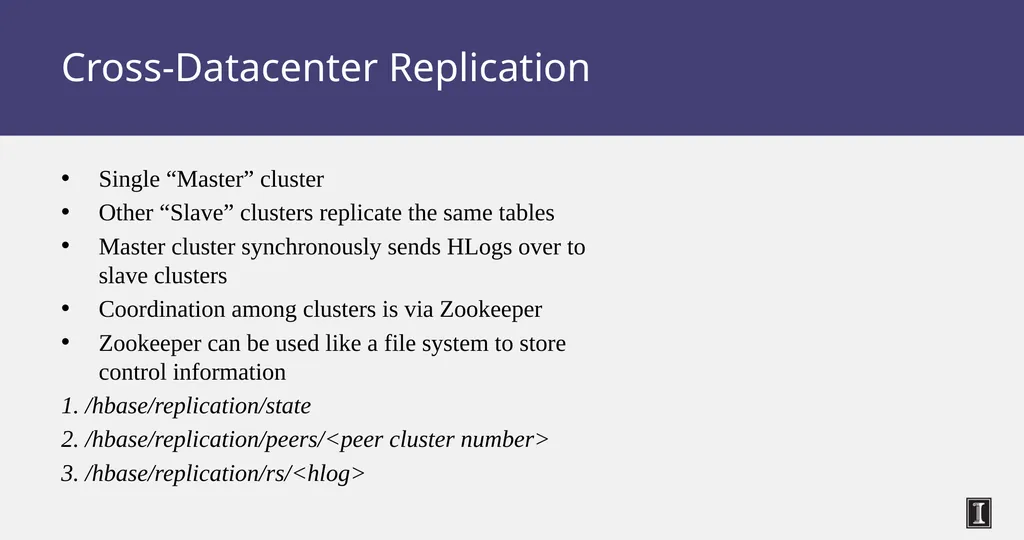
Cross-Datacenter Replication Single “Master” cluster
Other “Slave” clusters replicate the same tables
Master cluster synchronously sends HLogs over to slave clusters
Coordination among clusters is via Zookeeper
Zookeeper can be used like a file system to store control information
1. /hbase/replication/state
2. /hbase/replication/peers/<peer cluster number>
3. /hbase/replication/rs/<hlog><br>
Other “Slave” clusters replicate the same tables
Master cluster synchronously sends HLogs over to slave clusters
Coordination among clusters is via Zookeeper
Zookeeper can be used like a file system to store control information
1. /hbase/replication/state
2. /hbase/replication/peers/<peer cluster number>
3. /hbase/replication/rs/<hlog><br>
59
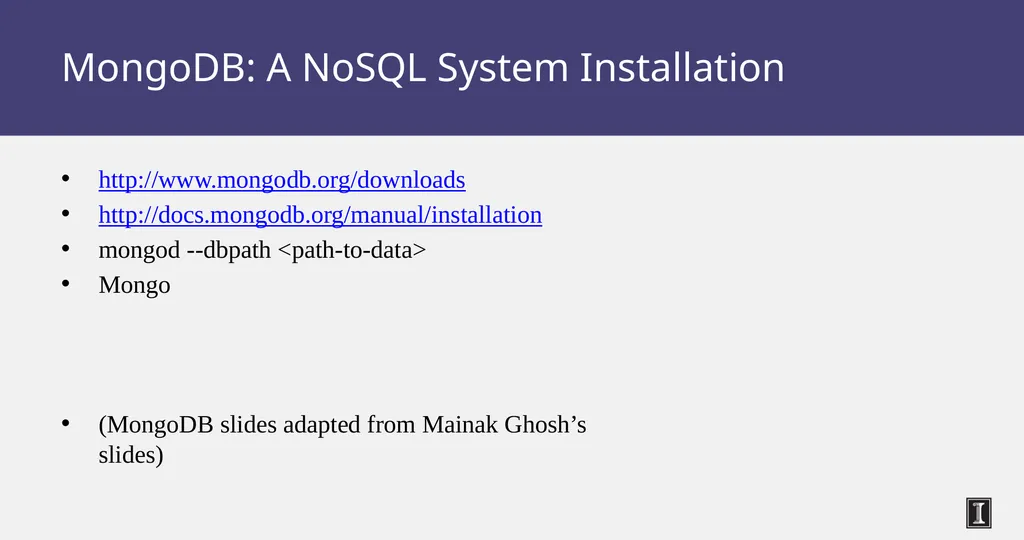
MongoDB: A NoSQL System Installation http://www.mongodb.org/downloads
http://docs.mongodb.org/manual/installation
mongod --dbpath <path-to-data>
Mongo
(MongoDB slides adapted from Mainak Ghosh’s slides)<br>
http://docs.mongodb.org/manual/installation
mongod --dbpath <path-to-data>
Mongo
(MongoDB slides adapted from Mainak Ghosh’s slides)<br>
60
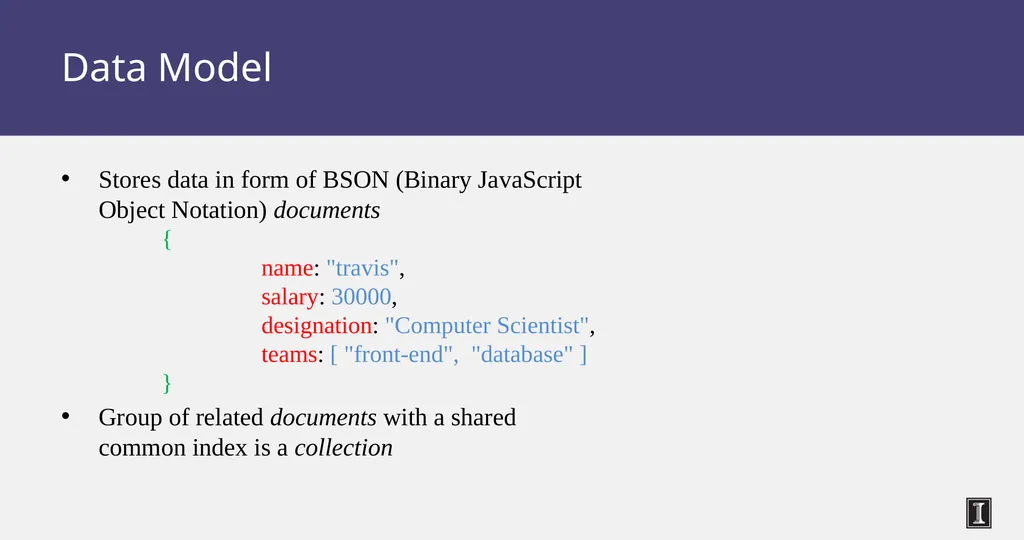
Data Model Stores data in form of BSON (Binary JavaScript Object Notation) documents
{
name: "travis",
salary: 30000,
designation: "Computer Scientist",
teams: [ "front-end", "database" ]
}
Group of related documents with a shared common index is a collection<br>
{
name: "travis",
salary: 30000,
designation: "Computer Scientist",
teams: [ "front-end", "database" ]
}
Group of related documents with a shared common index is a collection<br>
61
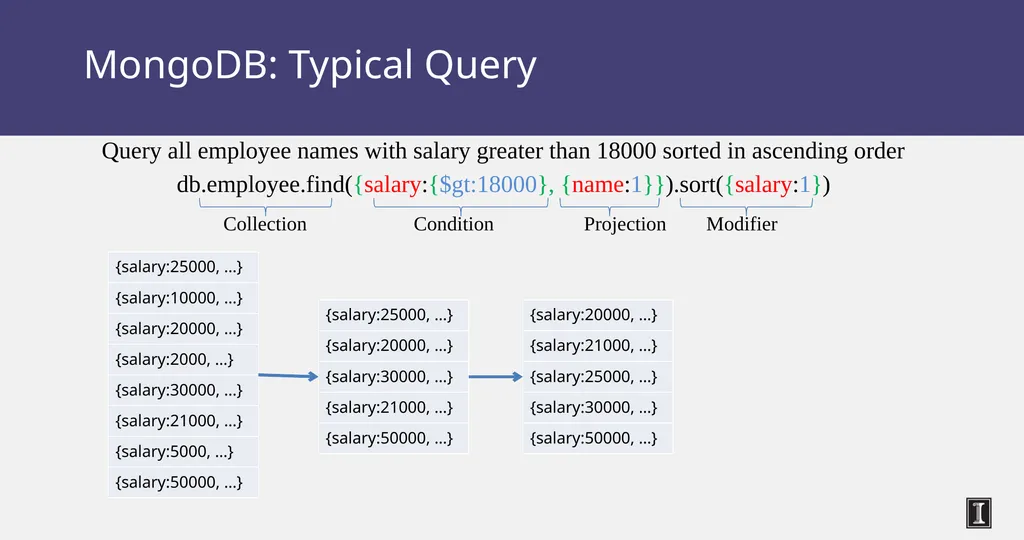
MongoDB: Typical Query Query all employee names with salary greater than 18000 sorted in ascending order
db.employee.find({salary:{$gt:18000}, {name:1}}).sort({salary:1})
Collection Condition Projection Modifier<br>
db.employee.find({salary:{$gt:18000}, {name:1}}).sort({salary:1})
Collection Condition Projection Modifier<br>
62
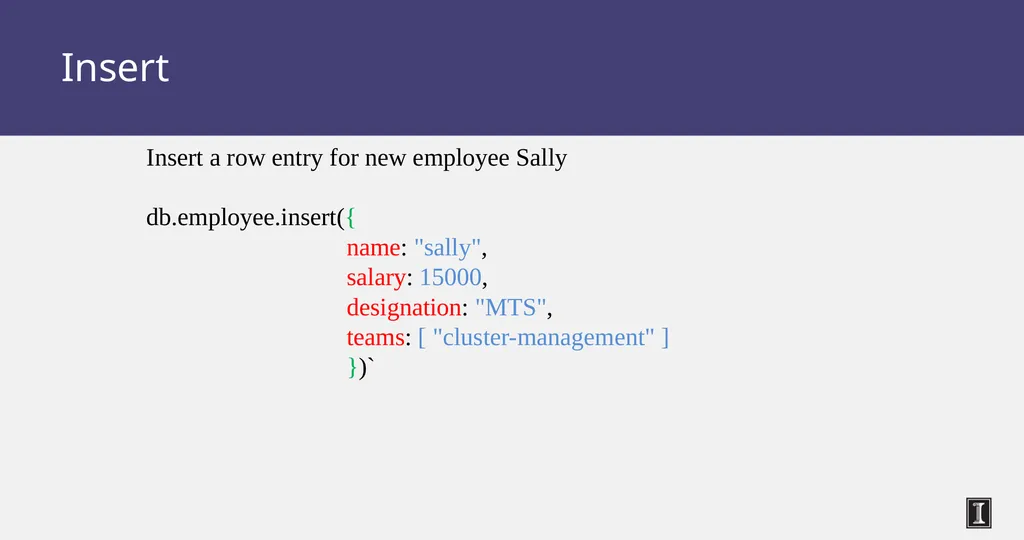
Insert Insert a row entry for new employee Sally
db.employee.insert({
name: "sally",
salary: 15000,
designation: "MTS",
teams: [ "cluster-management" ]
})`<br>
db.employee.insert({
name: "sally",
salary: 15000,
designation: "MTS",
teams: [ "cluster-management" ]
})`<br>
63
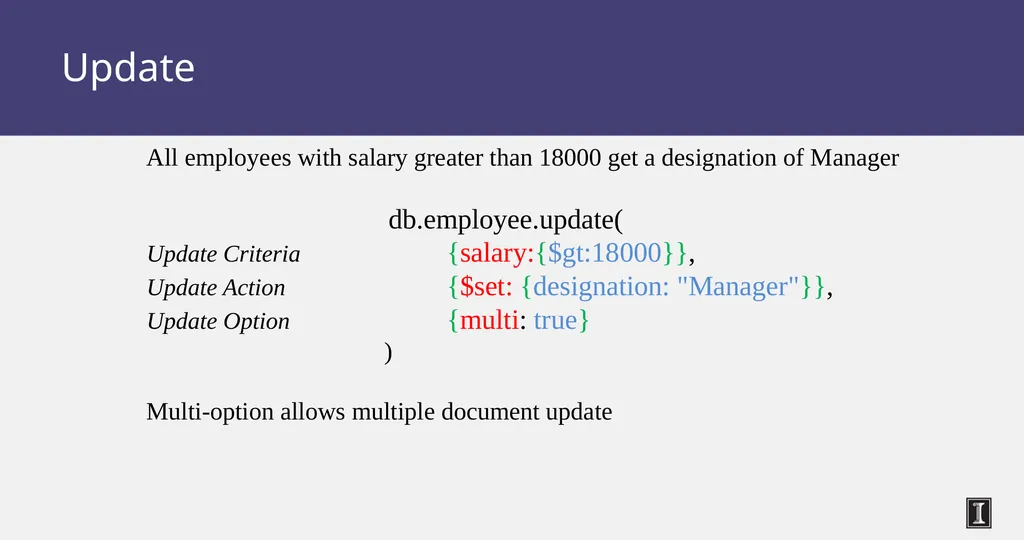
Update All employees with salary greater than 18000 get a designation of Manager
db.employee.update(
Update Criteria {salary:{$gt:18000}},
Update Action {$set: {designation: "Manager"}},
Update Option {multi: true}
)
Multi-option allows multiple document update<br>
db.employee.update(
Update Criteria {salary:{$gt:18000}},
Update Action {$set: {designation: "Manager"}},
Update Option {multi: true}
)
Multi-option allows multiple document update<br>
64
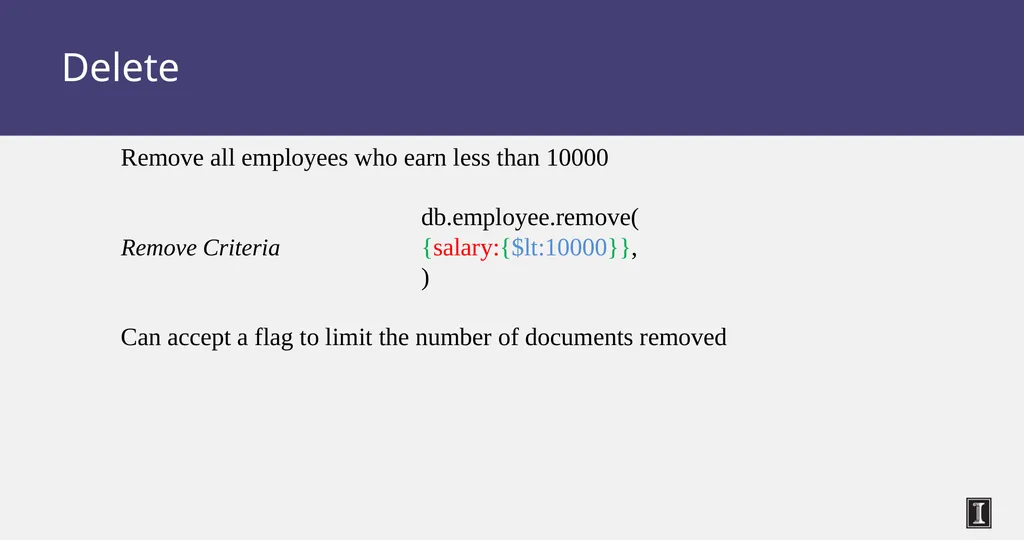
Delete Remove all employees who earn less than 10000
db.employee.remove(
Remove Criteria {salary:{$lt:10000}},
)
Can accept a flag to limit the number of documents removed<br>
db.employee.remove(
Remove Criteria {salary:{$lt:10000}},
)
Can accept a flag to limit the number of documents removed<br>
65
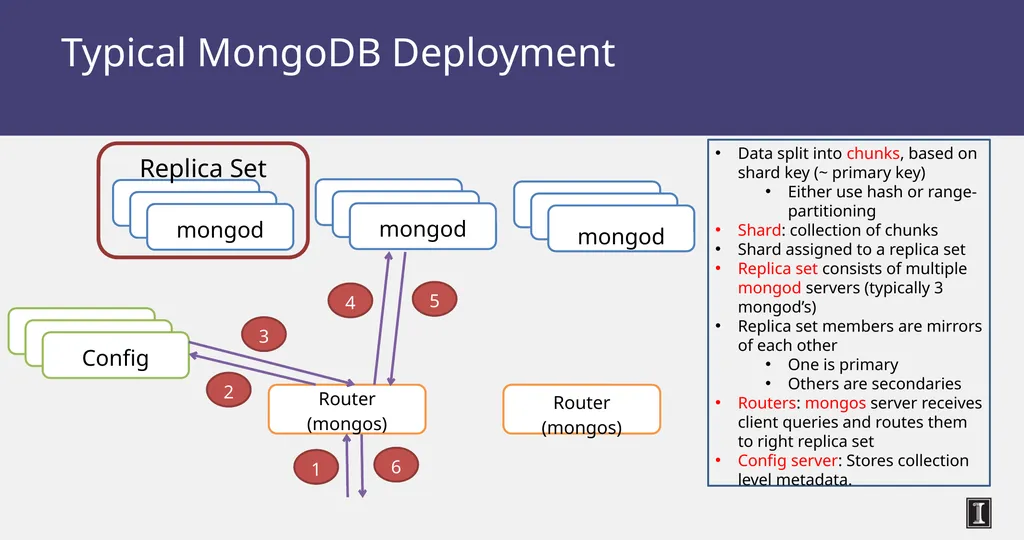
Typical MongoDB Deployment Data split into chunks, based on shard key (~ primary key)
Either use hash or range-partitioning
Shard: collection of chunks
Shard assigned to a replica set
Replica set consists of multiple mongod servers (typically 3 mongod’s)
Replica set members are mirrors of each other
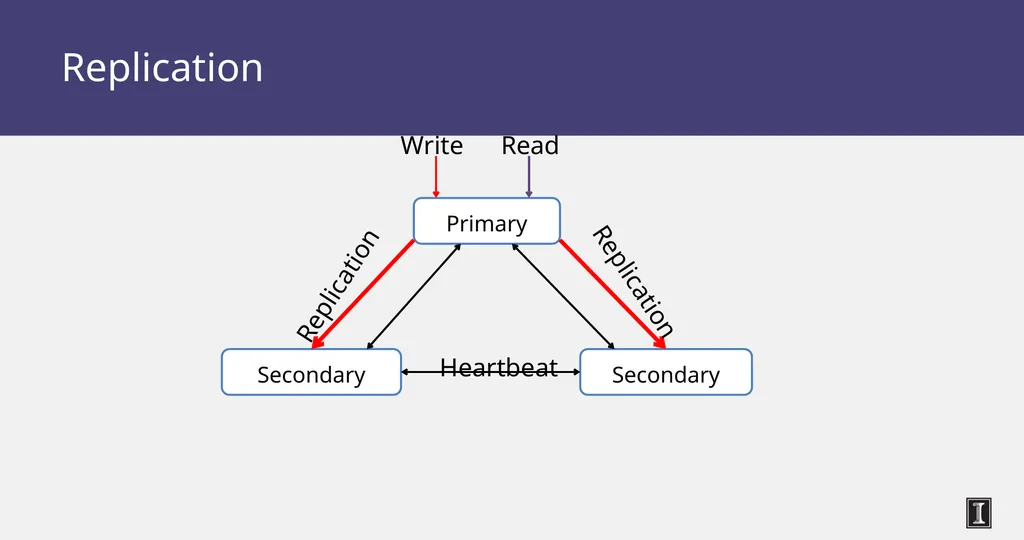
One is primary
Others are secondaries
Routers: mongos server receives client queries and routes them to right replica set
Config server: Stores collection level metadata. Mongod Mongod mongod Mongod Mongod Config Router (mongos) Router (mongos) Mongod Mongod mongod Mongod Mongod mongod 1 5 4 3 2 6 Replica Set<br>
Either use hash or range-partitioning
Shard: collection of chunks
Shard assigned to a replica set
Replica set consists of multiple mongod servers (typically 3 mongod’s)
Replica set members are mirrors of each other
One is primary
Others are secondaries
Routers: mongos server receives client queries and routes them to right replica set
Config server: Stores collection level metadata. Mongod Mongod mongod Mongod Mongod Config Router (mongos) Router (mongos) Mongod Mongod mongod Mongod Mongod mongod 1 5 4 3 2 6 Replica Set<br>
66
Replication Secondary Primary Secondary Heartbeat Write Read Replication Replication<br>
67
Replication Uses an oplog (operation log) for data sync up
Oplog maintained at primary, delta transferred to secondary continuously/every once in a while
When needed, leader Election protocol elects a master
Some mongod servers do not maintain data but can vote – called as Arbiters<br>
Oplog maintained at primary, delta transferred to secondary continuously/every once in a while
When needed, leader Election protocol elects a master
Some mongod servers do not maintain data but can vote – called as Arbiters<br>
68
Read Preference Determine where to route read operation
Default is primary. Some other options are
primary-preferred
secondary
nearest
Helps reduce latency, improve throughput
Reads from secondary may fetch stale data<br>
Default is primary. Some other options are
primary-preferred
secondary
nearest
Helps reduce latency, improve throughput
Reads from secondary may fetch stale data<br>
69
Write Concern Determines the guarantee that MongoDB provides on the success of a write operation
Default is acknowledged (primary returns answer immediately).
Other options are
journaled (typically at primary)
replica-acknowledged (quorum with a value of W), etc
Weaker write concern implies faster write time<br>
Default is acknowledged (primary returns answer immediately).
Other options are
journaled (typically at primary)
replica-acknowledged (quorum with a value of W), etc
Weaker write concern implies faster write time<br>
70
Write operation performance Journaling: Write-ahead logging to an on-disk journal for durability
Indexing: Every write needs to update every index associated with the collection<br>
Indexing: Every write needs to update every index associated with the collection<br>
71
Balancing Over time, some chunks may get larger than others
Splitting: Upper bound on chunk size; when hit, chunk is split
Balancing: Migrates chunks among shards if there is an uneven distribution<br>
Splitting: Upper bound on chunk size; when hit, chunk is split
Balancing: Migrates chunks among shards if there is an uneven distribution<br>
72
Consistency Strongly Consistent: Read Preference is Master
Eventually Consistent: Read Preference is Slave (Secondary)
CAP Theorem: Under partition, MongoDB becomes write unavailable thereby ensuring consistency<br>
Eventually Consistent: Read Preference is Slave (Secondary)
CAP Theorem: Under partition, MongoDB becomes write unavailable thereby ensuring consistency<br>
73
Performance 30 – 50x faster than Sql Server 2008 for writes[1]
At least 3x faster for reads[1]
MongoDB 2.2.2 offers slower throughput for different YCSB workloads compared to Cassandra[2]
[1] http://blog.michaelckennedy.net/2010/04/29/mongodb-vs-sql-server-2008-performance-showdown/
[2] http://hyperdex.org/performance/<br>
At least 3x faster for reads[1]
MongoDB 2.2.2 offers slower throughput for different YCSB workloads compared to Cassandra[2]
[1] http://blog.michaelckennedy.net/2010/04/29/mongodb-vs-sql-server-2008-performance-showdown/
[2] http://hyperdex.org/performance/<br>
74
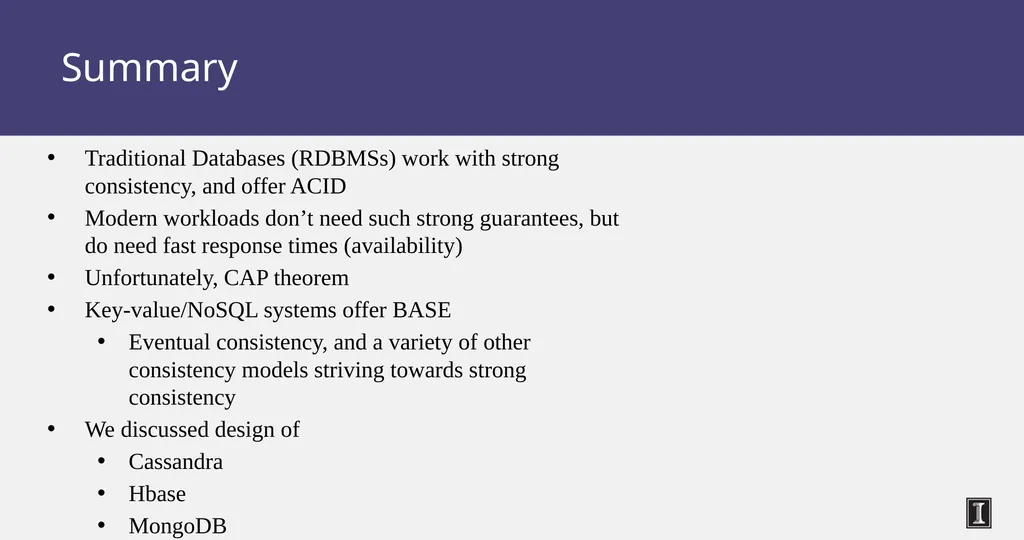
Summary Traditional Databases (RDBMSs) work with strong consistency, and offer ACID
Modern workloads don’t need such strong guarantees, but do need fast response times (availability)
Unfortunately, CAP theorem
Key-value/NoSQL systems offer BASE
Eventual consistency, and a variety of other consistency models striving towards strong consistency
We discussed design of
Cassandra
Hbase
MongoDB<br>
Modern workloads don’t need such strong guarantees, but do need fast response times (availability)
Unfortunately, CAP theorem
Key-value/NoSQL systems offer BASE
Eventual consistency, and a variety of other consistency models striving towards strong consistency
We discussed design of
Cassandra
Hbase
MongoDB<br>
75
Optional: Some more MongoDB queries 75<br>
76
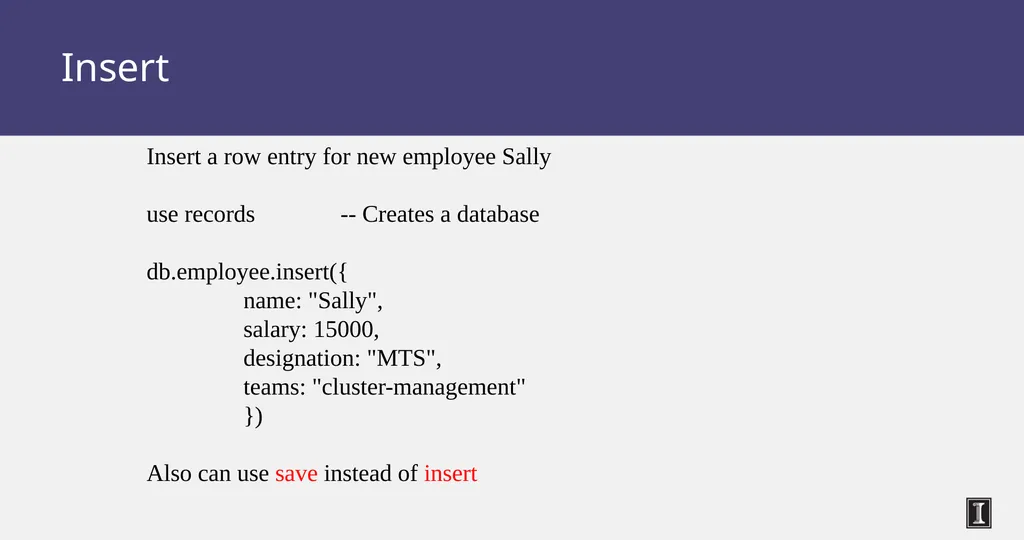
Insert Insert a row entry for new employee Sally
use records -- Creates a database
db.employee.insert({
name: "Sally",
salary: 15000,
designation: "MTS",
teams: "cluster-management"
})
Also can use save instead of insert<br>
use records -- Creates a database
db.employee.insert({
name: "Sally",
salary: 15000,
designation: "MTS",
teams: "cluster-management"
})
Also can use save instead of insert<br>
77
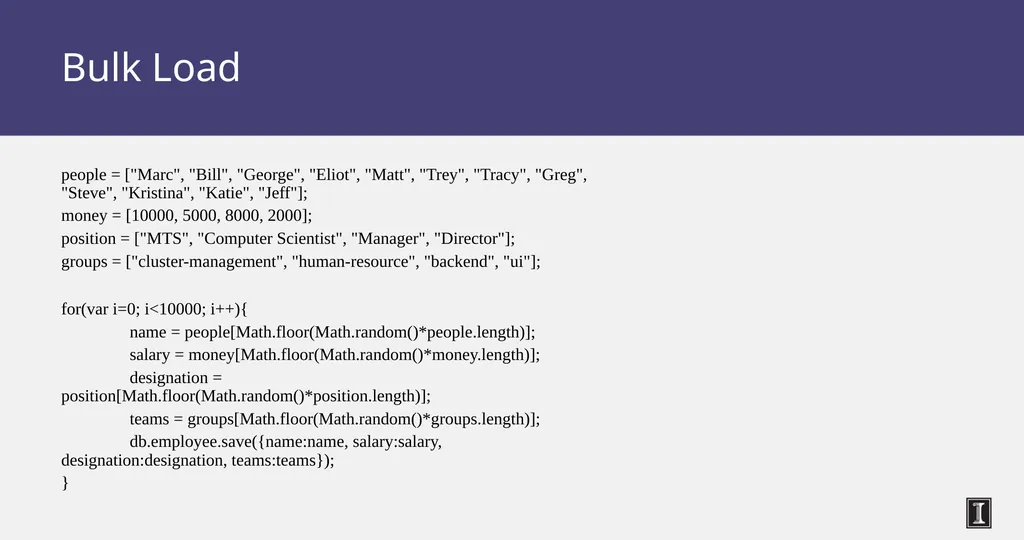
Bulk Load people = ["Marc", "Bill", "George", "Eliot", "Matt", "Trey", "Tracy", "Greg", "Steve", "Kristina", "Katie", "Jeff"];
money = [10000, 5000, 8000, 2000];
position = ["MTS", "Computer Scientist", "Manager", "Director"];
groups = ["cluster-management", "human-resource", "backend", "ui"];
for(var i=0; i<10000; i++){
name = people[Math.floor(Math.random()*people.length)];
salary = money[Math.floor(Math.random()*money.length)];
designation = position[Math.floor(Math.random()*position.length)];
teams = groups[Math.floor(Math.random()*groups.length)];
db.employee.save({name:name, salary:salary, designation:designation, teams:teams});
}<br>
money = [10000, 5000, 8000, 2000];
position = ["MTS", "Computer Scientist", "Manager", "Director"];
groups = ["cluster-management", "human-resource", "backend", "ui"];
for(var i=0; i<10000; i++){
name = people[Math.floor(Math.random()*people.length)];
salary = money[Math.floor(Math.random()*money.length)];
designation = position[Math.floor(Math.random()*position.length)];
teams = groups[Math.floor(Math.random()*groups.length)];
db.employee.save({name:name, salary:salary, designation:designation, teams:teams});
}<br>
78
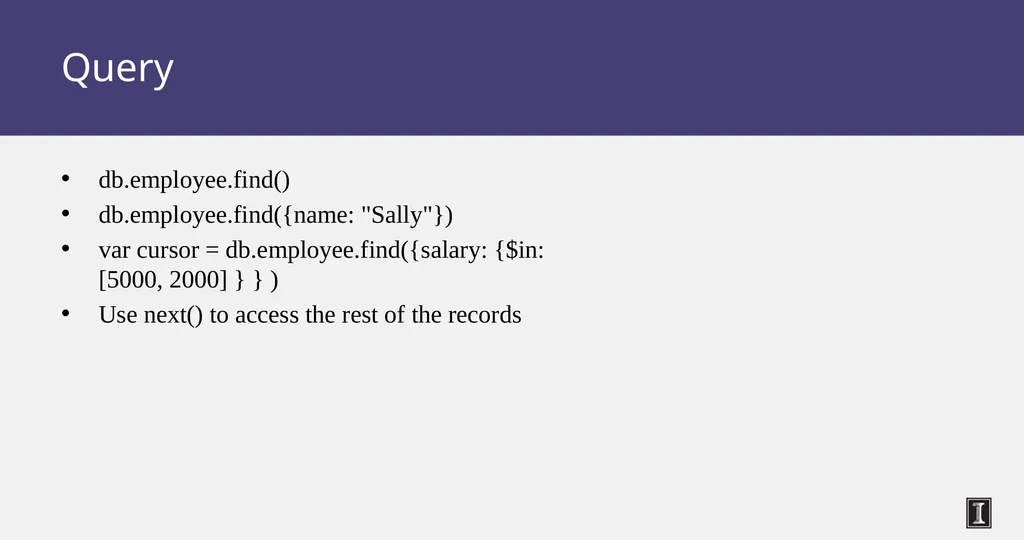
Query db.employee.find()
db.employee.find({name: "Sally"})
var cursor = db.employee.find({salary: {$in: [5000, 2000] } } )
Use next() to access the rest of the records<br>
db.employee.find({name: "Sally"})
var cursor = db.employee.find({salary: {$in: [5000, 2000] } } )
Use next() to access the rest of the records<br>
79
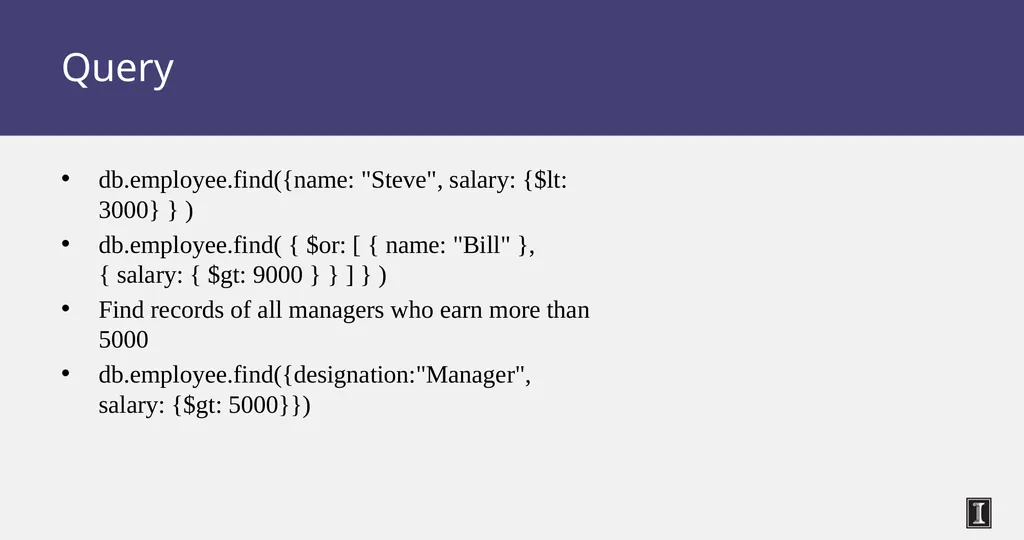
Query db.employee.find({name: "Steve", salary: {$lt: 3000} } )
db.employee.find( { $or: [ { name: "Bill" }, { salary: { $gt: 9000 } } ] } )
Find records of all managers who earn more than 5000
db.employee.find({designation:"Manager", salary: {$gt: 5000}})<br>
db.employee.find( { $or: [ { name: "Bill" }, { salary: { $gt: 9000 } } ] } )
Find records of all managers who earn more than 5000
db.employee.find({designation:"Manager", salary: {$gt: 5000}})<br>
80
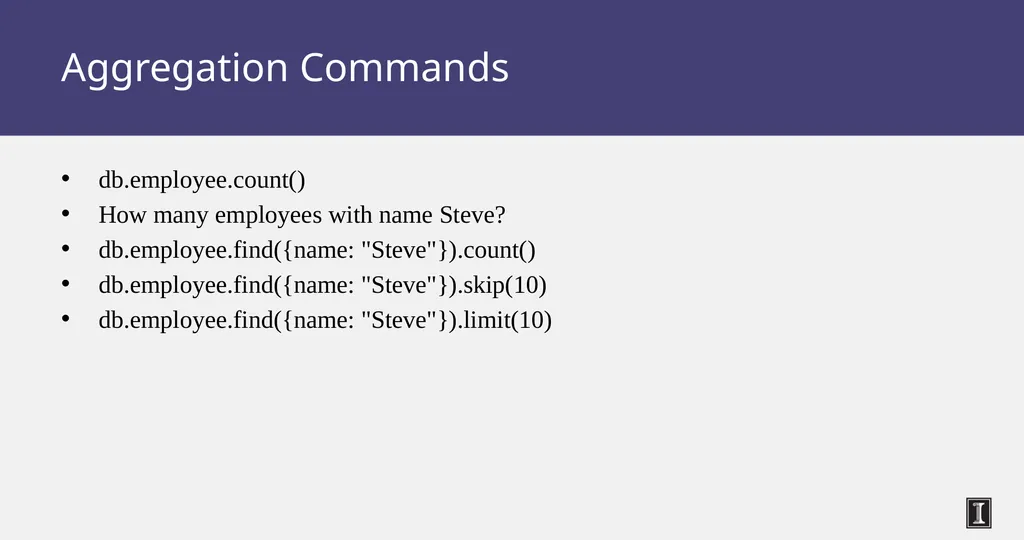
Aggregation Commands db.employee.count()
How many employees with name Steve?
db.employee.find({name: "Steve"}).count()
db.employee.find({name: "Steve"}).skip(10)
db.employee.find({name: "Steve"}).limit(10)<br>
How many employees with name Steve?
db.employee.find({name: "Steve"}).count()
db.employee.find({name: "Steve"}).skip(10)
db.employee.find({name: "Steve"}).limit(10)<br>
81
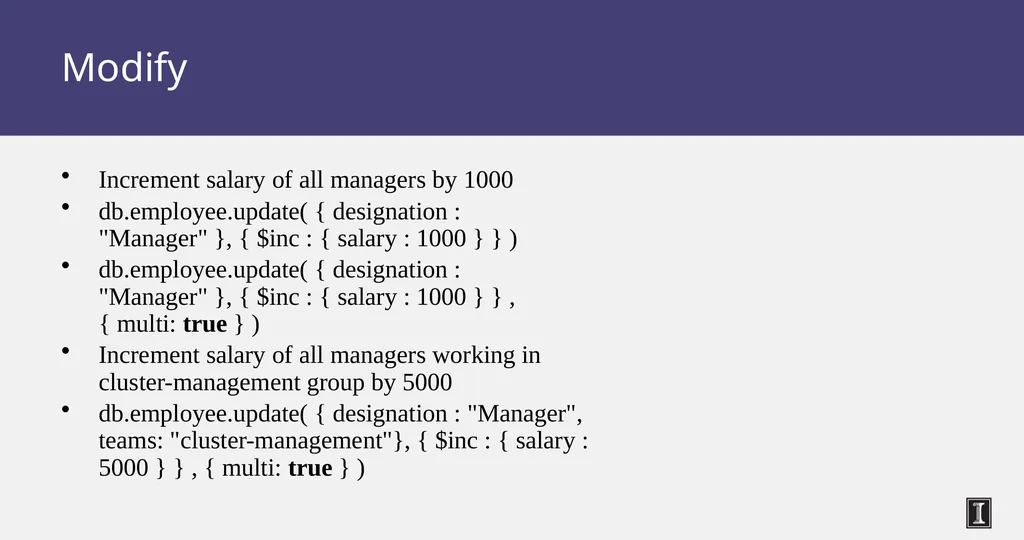
Modify Increment salary of all managers by 1000
db.employee.update( { designation : "Manager" }, { $inc : { salary : 1000 } } )
db.employee.update( { designation : "Manager" }, { $inc : { salary : 1000 } } , { multi: true } )
Increment salary of all managers working in cluster-management group by 5000
db.employee.update( { designation : "Manager", teams: "cluster-management"}, { $inc : { salary : 5000 } } , { multi: true } )<br>
db.employee.update( { designation : "Manager" }, { $inc : { salary : 1000 } } )
db.employee.update( { designation : "Manager" }, { $inc : { salary : 1000 } } , { multi: true } )
Increment salary of all managers working in cluster-management group by 5000
db.employee.update( { designation : "Manager", teams: "cluster-management"}, { $inc : { salary : 5000 } } , { multi: true } )<br>
82
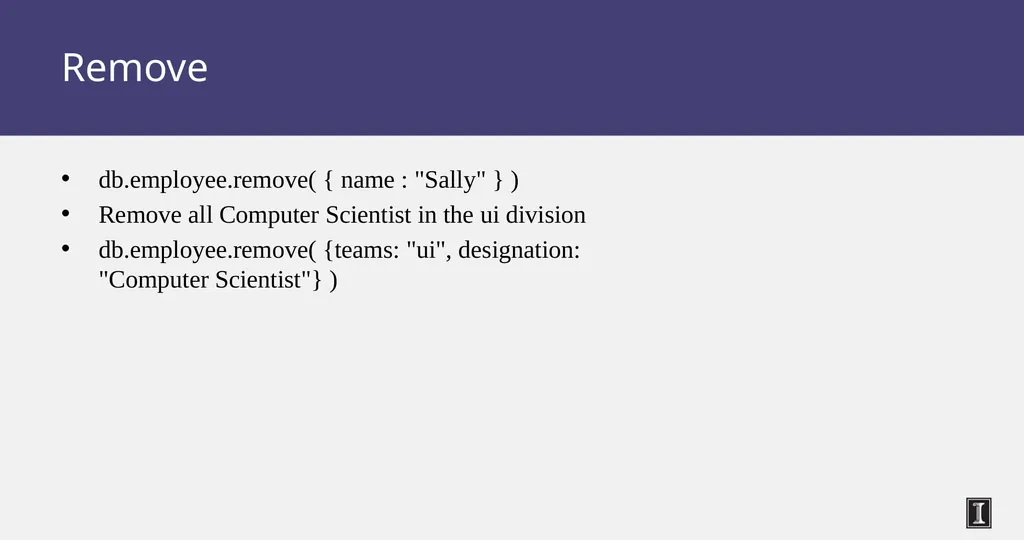
Remove db.employee.remove( { name : "Sally" } )
Remove all Computer Scientist in the ui division
db.employee.remove( {teams: "ui", designation: "Computer Scientist"} )<br>
Remove all Computer Scientist in the ui division
db.employee.remove( {teams: "ui", designation: "Computer Scientist"} )<br>