
CS5412: Spring 2016 Cloud Computing Ken Birman
PC
Published · 37 slides · 0 views
1 / 1

Description
CS5412: Spring 2016 Cloud Computing Ken Birman Lecture 1 CS5412 Spring 2016 (Cloud Computing: Birman) 1 A course dedicated to the technology behind cloud computing! Welcome to CS 5412... In my country of Khazackstan, many excellent hacker.
Related Topics
Share
Embed code
Download this presentation From Below
"CS5412: Spring 2016 Cloud Computing Ken Birman" is the property of its rightful owner. Permission is granted to download and print the materials on this website for personal, non-commercial use only, and to display it on your personal computer provided you do not modify the materials and that you retain all copyright notices contained in the materials. By downloading content from our website, you accept the terms of this agreement.
Presentation Transcript
01
CS5412: Spring 2016
Cloud Computing Ken Birman Lecture 1 CS5412 Spring 2016 (Cloud Computing: Birman) 1<br>
02
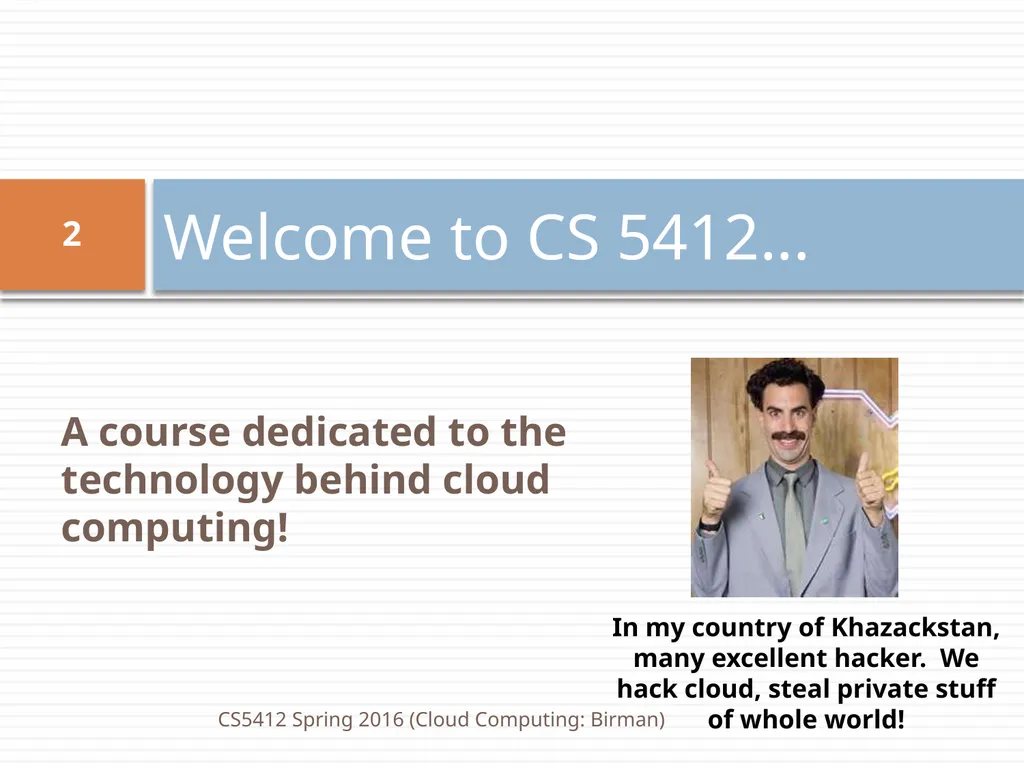
A course dedicated to the technology behind cloud computing! Welcome to CS 5412... In my country of Khazackstan, many excellent hacker. We hack cloud, steal private stuff of whole world! CS5412 Spring 2016 (Cloud Computing: Birman) 2<br>
03
Cloud Computing: The Next New Thing A general term for the style of computing that supports web services, search, social networking
Increasingly powerful and universal
Enables a new kind of massively scaled, elastic app
Our goal: understand the technology of the cloud, its limitations, and how to push beyond them
Invent “highly assured cloud computing” options CS5412 Spring 2016 (Cloud Computing: Birman) 3<br>
Increasingly powerful and universal
Enables a new kind of massively scaled, elastic app
Our goal: understand the technology of the cloud, its limitations, and how to push beyond them
Invent “highly assured cloud computing” options CS5412 Spring 2016 (Cloud Computing: Birman) 3<br>
04
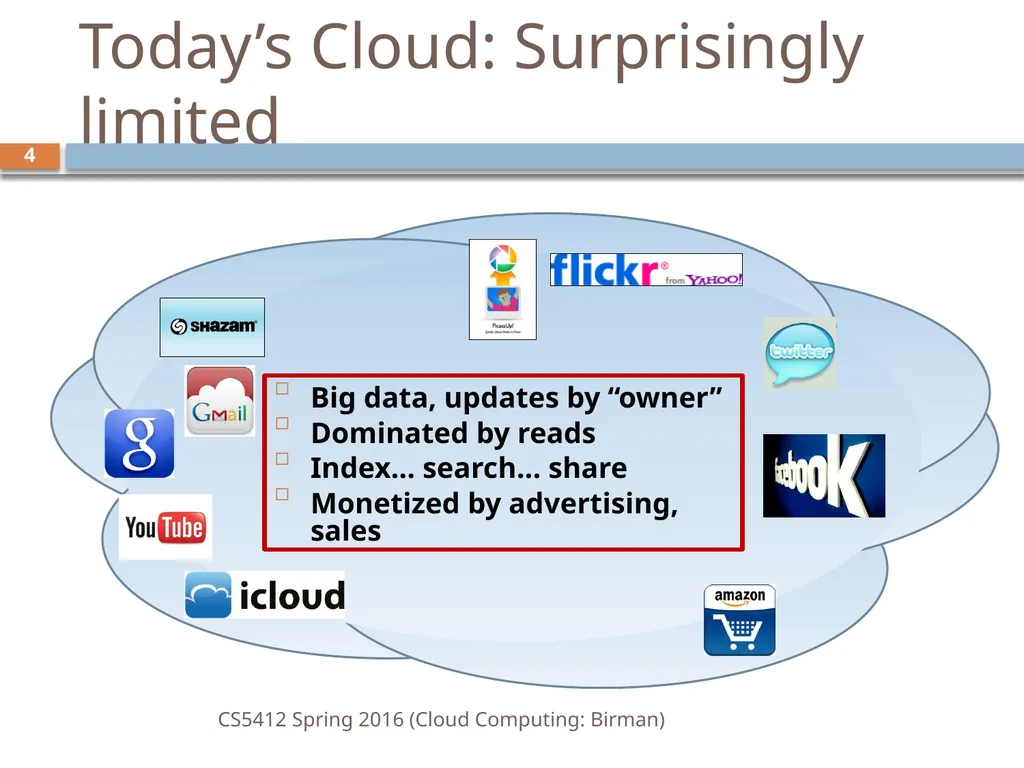
Today’s Cloud: Surprisingly limited Big data, updates by “owner”
Dominated by reads
Index... search... share
Monetized by advertising, sales CS5412 Spring 2016 (Cloud Computing: Birman) 4<br>
Dominated by reads
Index... search... share
Monetized by advertising, sales CS5412 Spring 2016 (Cloud Computing: Birman) 4<br>
05
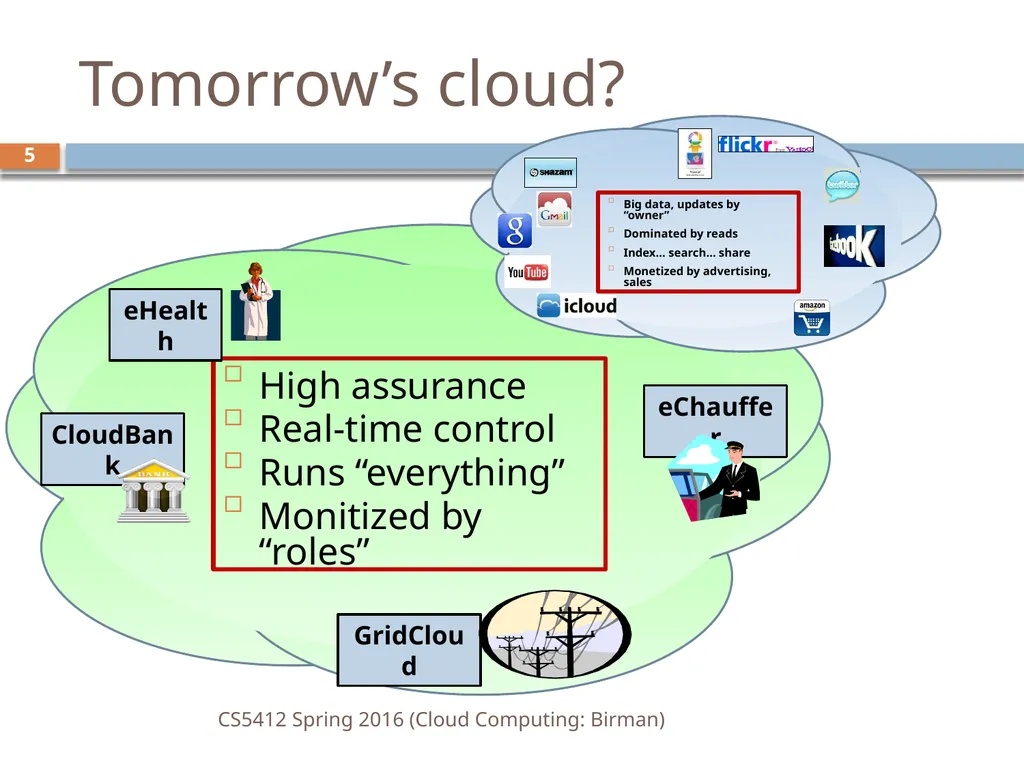
Tomorrow’s cloud? High assurance
Real-time control
Runs “everything”
Monitized by “roles” eHealth CloudBank GridCloud eChauffer Big data, updates by “owner”
Dominated by reads
Index... search... share
Monetized by advertising, sales CS5412 Spring 2016 (Cloud Computing: Birman) 5<br>
Real-time control
Runs “everything”
Monitized by “roles” eHealth CloudBank GridCloud eChauffer Big data, updates by “owner”
Dominated by reads
Index... search... share
Monetized by advertising, sales CS5412 Spring 2016 (Cloud Computing: Birman) 5<br>
06
Clouds are hosted by data centers Huge data centers, far larger than past systems
Very automated: far from where developers work. Often close to where power is generated (ship bits... not watts)
Packed for high efficiency. Each machine hosts many applications (usually in lightweight virtual machines to provide isolation)
Scheduled to keep everything busy (but overloads hurt performance so we avoid them) CS5412 Spring 2016 (Cloud Computing: Birman) 6<br>
Very automated: far from where developers work. Often close to where power is generated (ship bits... not watts)
Packed for high efficiency. Each machine hosts many applications (usually in lightweight virtual machines to provide isolation)
Scheduled to keep everything busy (but overloads hurt performance so we avoid them) CS5412 Spring 2016 (Cloud Computing: Birman) 6<br>
07
Clouds are cheaper… and winning… Range in size from “edge” facilities to megascale.
Incredible economies of scale
Approximate costs for a small size center (1K servers) and a larger, 50K server center. Slide provided by Roger Barga, Head of Cloud Computing, Microsoft 7 CS5412 Spring 2016 (Cloud Computing: Birman)<br>
Incredible economies of scale
Approximate costs for a small size center (1K servers) and a larger, 50K server center. Slide provided by Roger Barga, Head of Cloud Computing, Microsoft 7 CS5412 Spring 2016 (Cloud Computing: Birman)<br>
08
Key benefits? Machines busier, earn more $’s for each $ investment
Hardware handled a whole truckload at a time
Applications far more standardized
Automated management: few “sys admins” needed
Power consumed near generator: less wastage
Data center runs hot, wasting less on cooling
Can “rent” resources rather than owning them
Supports new, extremely large-scale services
Elasticity to accomodate surging demands
Can accumulate and access massive amounts of data
But must read or process it in a massively parallel way
Enables overnight emergence of major companies, but scalability model does require new programming styles, and imposes new limits CS5412 Spring 2016 (Cloud Computing: Birman) 8<br>
Hardware handled a whole truckload at a time
Applications far more standardized
Automated management: few “sys admins” needed
Power consumed near generator: less wastage
Data center runs hot, wasting less on cooling
Can “rent” resources rather than owning them
Supports new, extremely large-scale services
Elasticity to accomodate surging demands
Can accumulate and access massive amounts of data
But must read or process it in a massively parallel way
Enables overnight emergence of major companies, but scalability model does require new programming styles, and imposes new limits CS5412 Spring 2016 (Cloud Computing: Birman) 8<br>
09
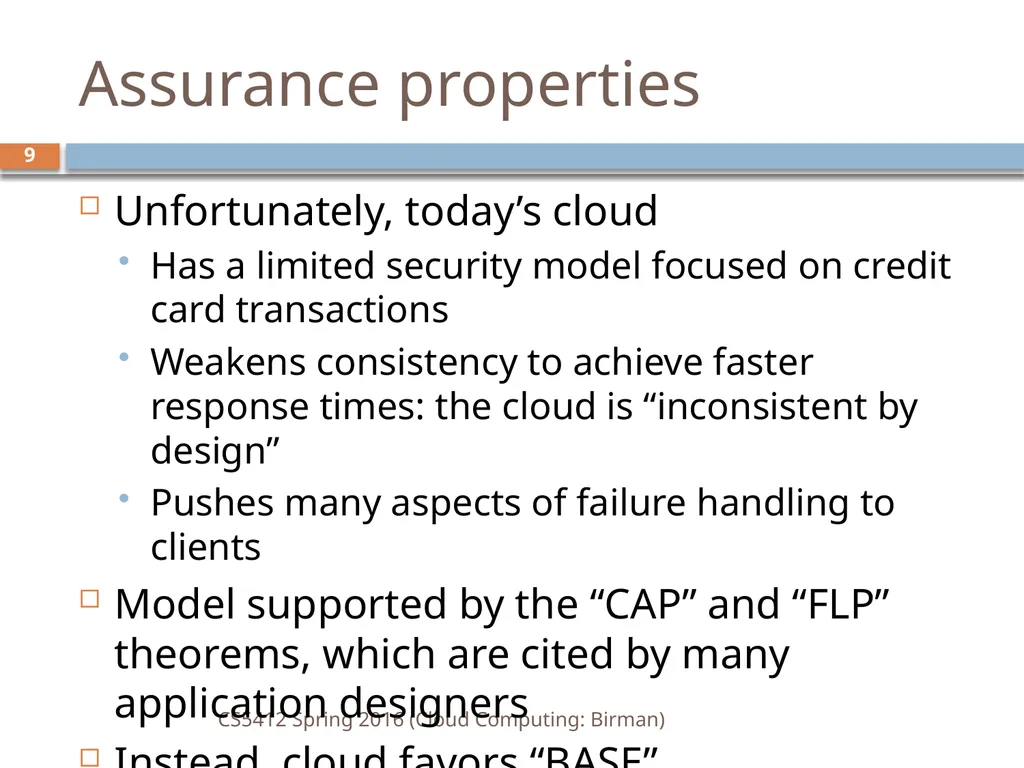
Assurance properties Unfortunately, today’s cloud
Has a limited security model focused on credit card transactions
Weakens consistency to achieve faster response times: the cloud is “inconsistent by design”
Pushes many aspects of failure handling to clients
Model supported by the “CAP” and “FLP” theorems, which are cited by many application designers
Instead, cloud favors “BASE” CS5412 Spring 2016 (Cloud Computing: Birman) 9<br>
Has a limited security model focused on credit card transactions
Weakens consistency to achieve faster response times: the cloud is “inconsistent by design”
Pushes many aspects of failure handling to clients
Model supported by the “CAP” and “FLP” theorems, which are cited by many application designers
Instead, cloud favors “BASE” CS5412 Spring 2016 (Cloud Computing: Birman) 9<br>
10
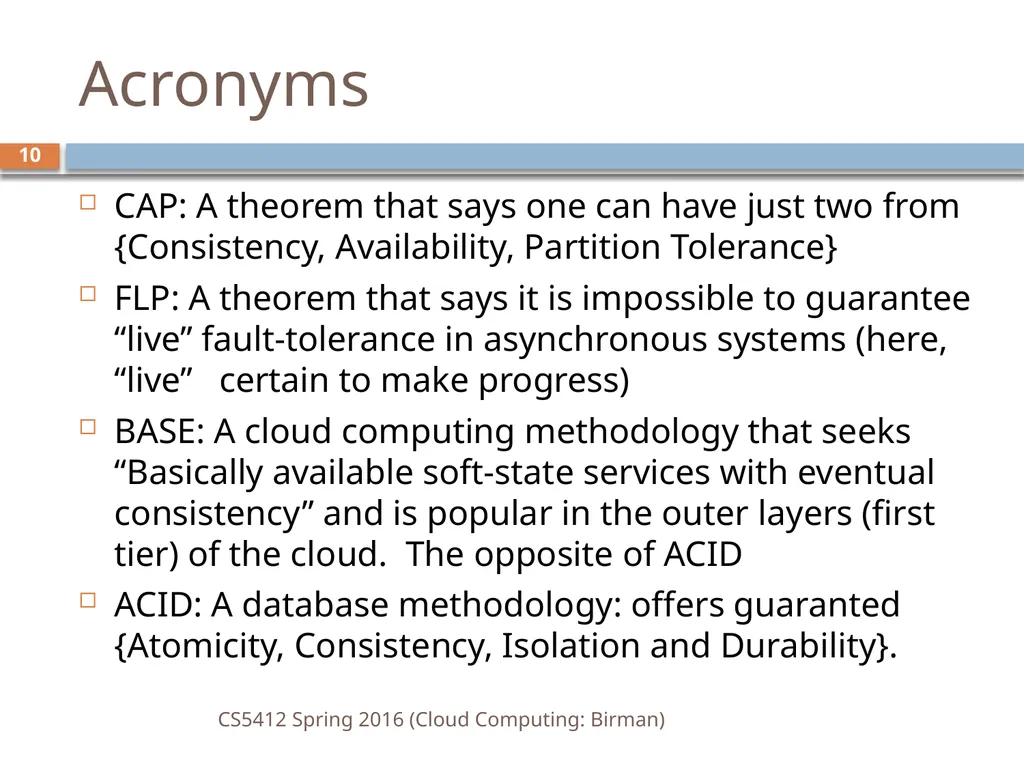
Acronyms CAP: A theorem that says one can have just two from {Consistency, Availability, Partition Tolerance}
FLP: A theorem that says it is impossible to guarantee “live” fault-tolerance in asynchronous systems (here, “live” certain to make progress)
BASE: A cloud computing methodology that seeks “Basically available soft-state services with eventual consistency” and is popular in the outer layers (first tier) of the cloud. The opposite of ACID
ACID: A database methodology: offers guaranted {Atomicity, Consistency, Isolation and Durability}. CS5412 Spring 2016 (Cloud Computing: Birman) 10<br>
FLP: A theorem that says it is impossible to guarantee “live” fault-tolerance in asynchronous systems (here, “live” certain to make progress)
BASE: A cloud computing methodology that seeks “Basically available soft-state services with eventual consistency” and is popular in the outer layers (first tier) of the cloud. The opposite of ACID
ACID: A database methodology: offers guaranted {Atomicity, Consistency, Isolation and Durability}. CS5412 Spring 2016 (Cloud Computing: Birman) 10<br>
11
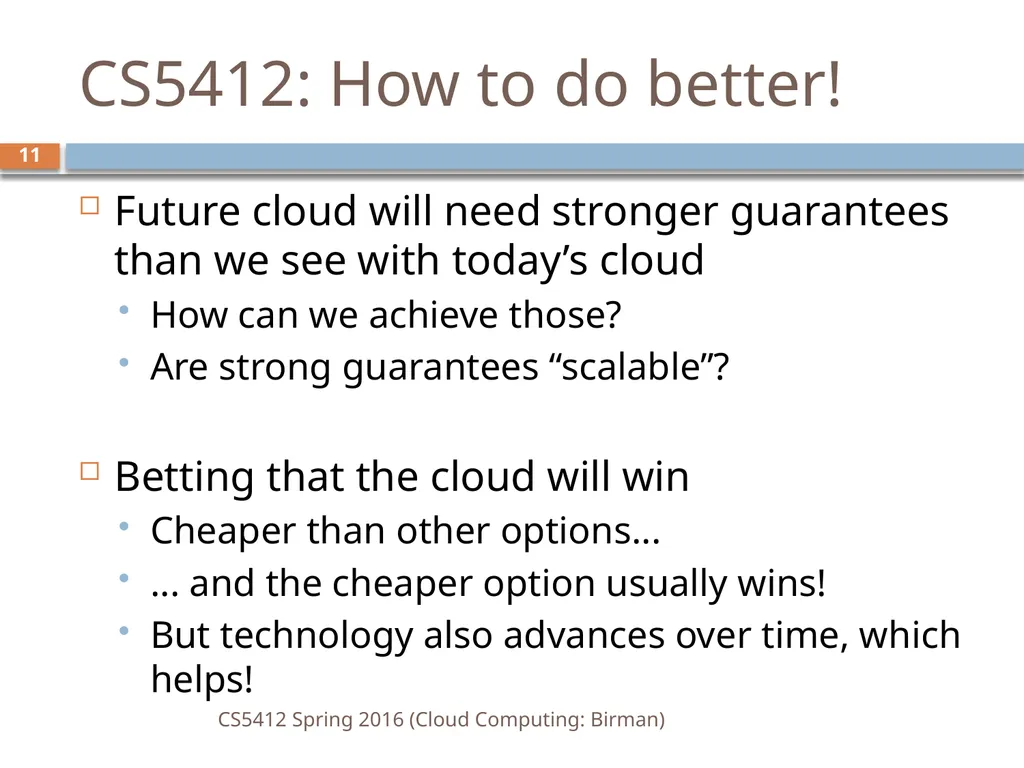
CS5412: How to do better! Future cloud will need stronger guarantees than we see with today’s cloud
How can we achieve those?
Are strong guarantees “scalable”?
Betting that the cloud will win
Cheaper than other options...
... and the cheaper option usually wins!
But technology also advances over time, which helps! CS5412 Spring 2016 (Cloud Computing: Birman) 11<br>
How can we achieve those?
Are strong guarantees “scalable”?
Betting that the cloud will win
Cheaper than other options...
... and the cheaper option usually wins!
But technology also advances over time, which helps! CS5412 Spring 2016 (Cloud Computing: Birman) 11<br>
12
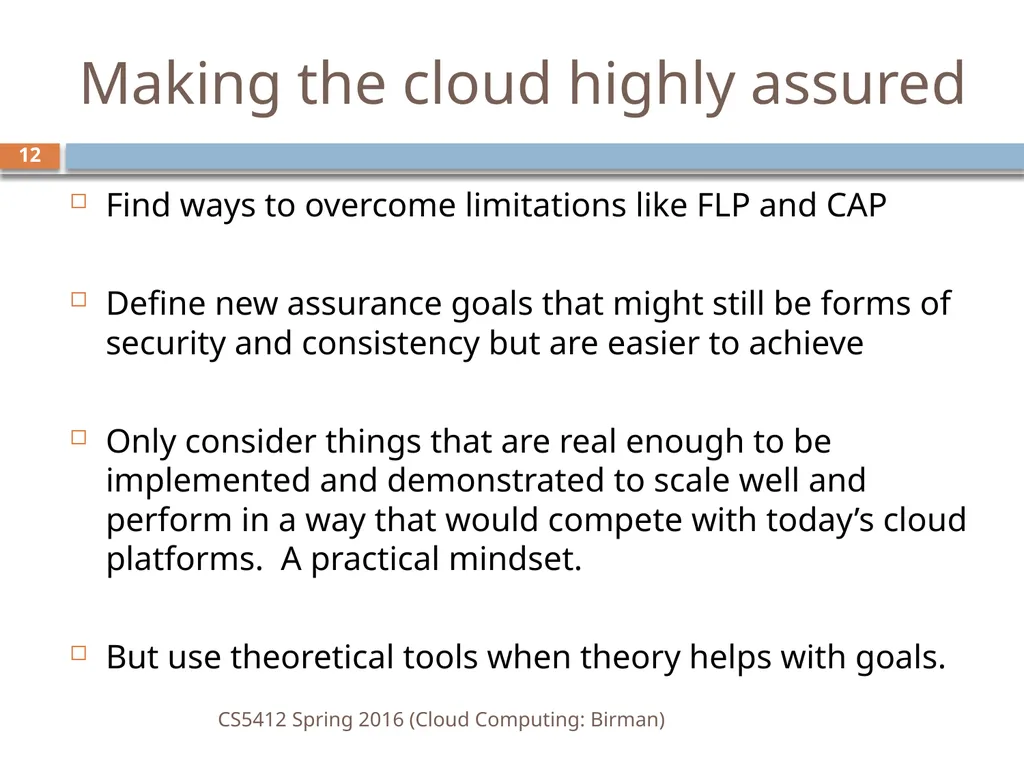
Making the cloud highly assured Find ways to overcome limitations like FLP and CAP
Define new assurance goals that might still be forms of security and consistency but are easier to achieve
Only consider things that are real enough to be implemented and demonstrated to scale well and perform in a way that would compete with today’s cloud platforms. A practical mindset.
But use theoretical tools when theory helps with goals. CS5412 Spring 2016 (Cloud Computing: Birman) 12<br>
Define new assurance goals that might still be forms of security and consistency but are easier to achieve
Only consider things that are real enough to be implemented and demonstrated to scale well and perform in a way that would compete with today’s cloud platforms. A practical mindset.
But use theoretical tools when theory helps with goals. CS5412 Spring 2016 (Cloud Computing: Birman) 12<br>
13
… And making it fast CS5412 Spring 2016 (Cloud Computing: Birman) 13 The cloud makes it easy to create “mashups”
Applications send data to each other, one system might “call upon” 10 or 100 others for help
Very powerful but also very inefficient in some ways
Example: Networks that become overloaded because of the same image or video being sent again and again!
Getting the cloud to “scale” and perform well comes down to enabling productivity while also finding tricks to ensure super good performance
Example”: store the image, ship a URL…<br>
Applications send data to each other, one system might “call upon” 10 or 100 others for help
Very powerful but also very inefficient in some ways
Example: Networks that become overloaded because of the same image or video being sent again and again!
Getting the cloud to “scale” and perform well comes down to enabling productivity while also finding tricks to ensure super good performance
Example”: store the image, ship a URL…<br>
14
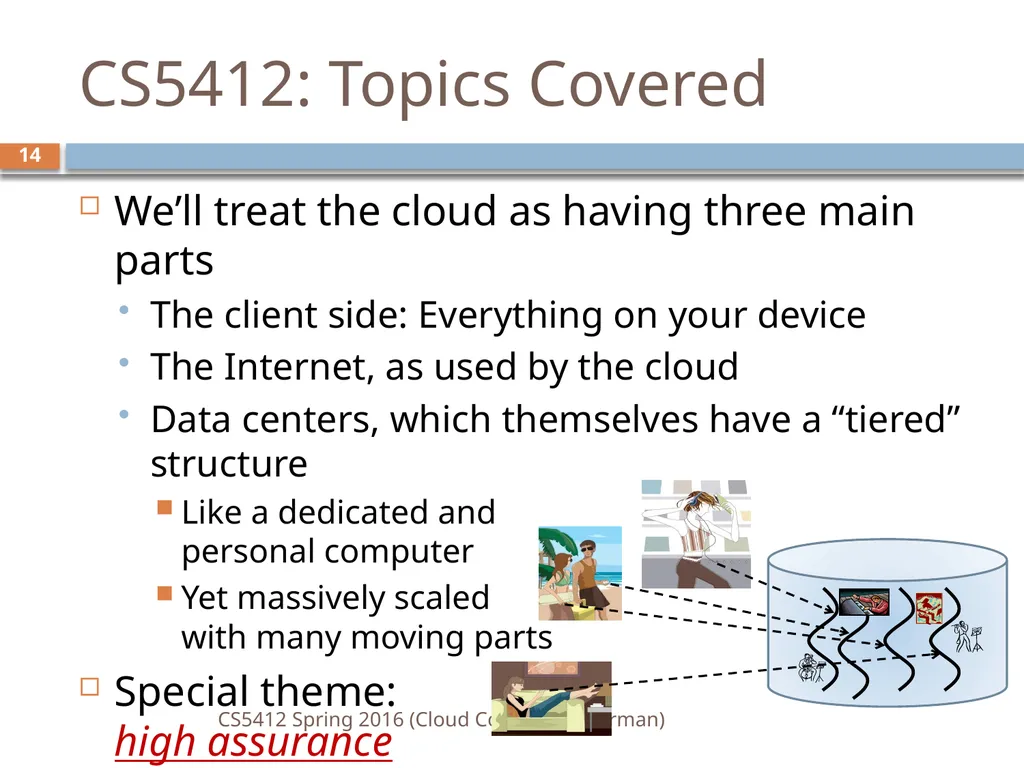
CS5412: Topics Covered We’ll treat the cloud as having three main parts
The client side: Everything on your device
The Internet, as used by the cloud
Data centers, which themselves have a “tiered” structure
Like a dedicated and personal computer
Yet massively scaled with many moving parts
Special theme: high assurance 14 CS5412 Spring 2016 (Cloud Computing: Birman)<br>
The client side: Everything on your device
The Internet, as used by the cloud
Data centers, which themselves have a “tiered” structure
Like a dedicated and personal computer
Yet massively scaled with many moving parts
Special theme: high assurance 14 CS5412 Spring 2016 (Cloud Computing: Birman)<br>
15
The Old World and the New Old world: we replicated servers for speed and availability, but maintained consistency
New world: scalability matters most of all
Focus is on extremely rapid response times
Amazon estimates that each millisecond of delay has a measurable impact on sales!
But our premise is that we can have scalability and also have other guarantees that today’s cloud lacks 15 CS5412 Spring 2016 (Cloud Computing: Birman)<br>
New world: scalability matters most of all
Focus is on extremely rapid response times
Amazon estimates that each millisecond of delay has a measurable impact on sales!
But our premise is that we can have scalability and also have other guarantees that today’s cloud lacks 15 CS5412 Spring 2016 (Cloud Computing: Birman)<br>
16
High Assurance: Many (conflicting) goals Security: Only correctly authorized users (who are properly authenticated) can perform actions
Scalability: Can support lots of simultaneous users
Privacy: Data doesn’t leak to intruders
Rapid response despite failures or disruption
Consistency and coordinated behavior
Ability to overcome attacks or mishaps
Guarantee that center operates at a high level of efficiency and in a highly automated manner
Archival protection of important data CS5412 Spring 2016 (Cloud Computing: Birman) 16<br>
Scalability: Can support lots of simultaneous users
Privacy: Data doesn’t leak to intruders
Rapid response despite failures or disruption
Consistency and coordinated behavior
Ability to overcome attacks or mishaps
Guarantee that center operates at a high level of efficiency and in a highly automated manner
Archival protection of important data CS5412 Spring 2016 (Cloud Computing: Birman) 16<br>
17
Must ask many questions If we were to run high assurance solutions on today’s cloud, what parts of the standards would limit or harm our assurance properties?
Goal is to leverage the cloud or even run on standard clouds, yet to improve on normal options
This forces us to look hard at how things work CS5412 Spring 2016 (Cloud Computing: Birman) 17<br>
Goal is to leverage the cloud or even run on standard clouds, yet to improve on normal options
This forces us to look hard at how things work CS5412 Spring 2016 (Cloud Computing: Birman) 17<br>
18
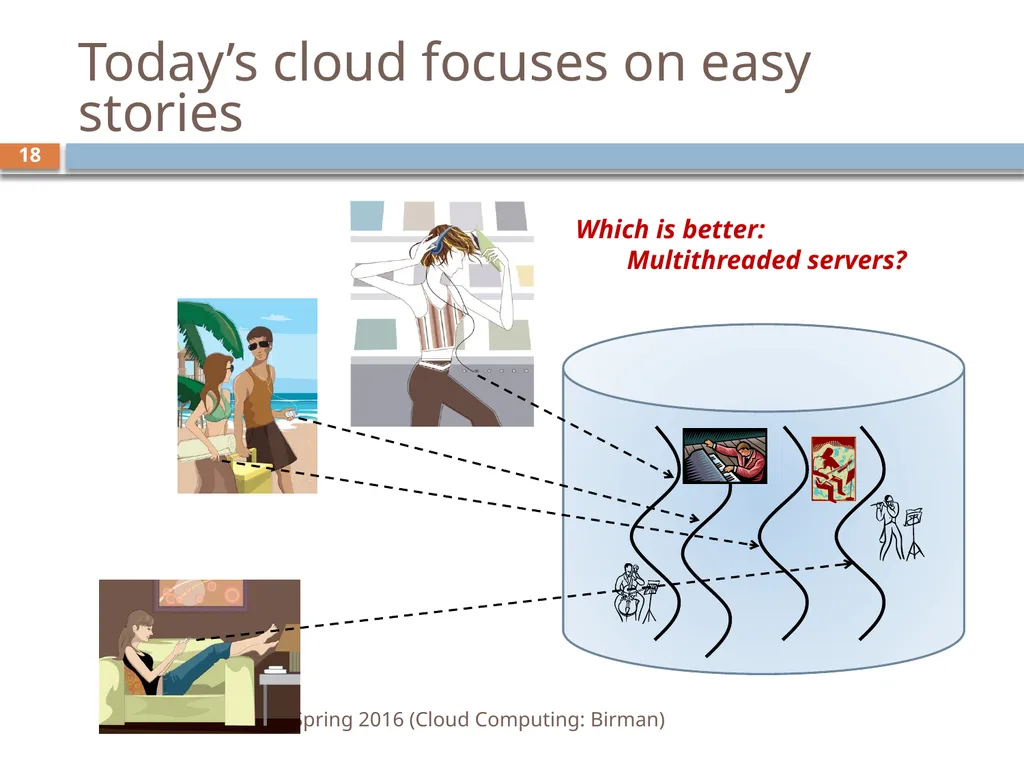
Today’s cloud focuses on easy stories Which is better:
Multithreaded servers? 18 CS5412 Spring 2016 (Cloud Computing: Birman)<br>
Multithreaded servers? 18 CS5412 Spring 2016 (Cloud Computing: Birman)<br>
19
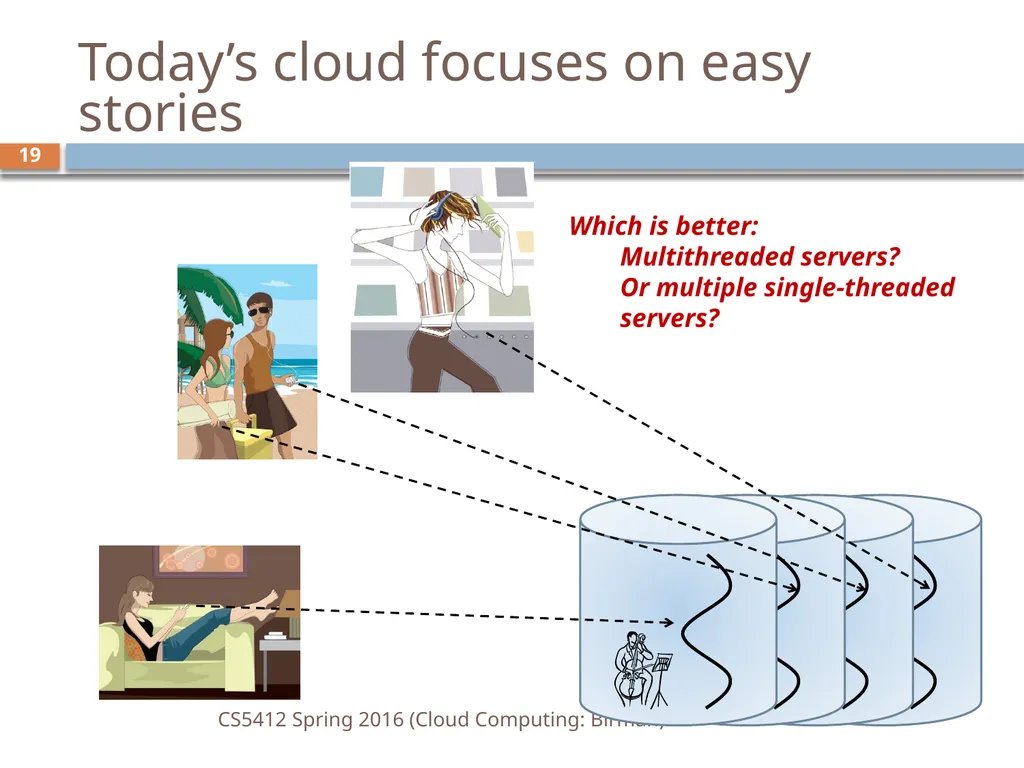
Today’s cloud focuses on easy stories Which is better:
Multithreaded servers?
Or multiple single-threaded servers? 19 CS5412 Spring 2016 (Cloud Computing: Birman)<br>
Multithreaded servers?
Or multiple single-threaded servers? 19 CS5412 Spring 2016 (Cloud Computing: Birman)<br>
20
Which scales best? CS5412 Spring 2016 (Cloud Computing: Birman) 20 Build it the easy way!
One VM or “container” per server
Server handles one user
Make the server single threaded if possible
Why?
Better fit to the hardware (no lock/memory contention)
Quicker way to build it, reuses existing stuff<br>
One VM or “container” per server
Server handles one user
Make the server single threaded if possible
Why?
Better fit to the hardware (no lock/memory contention)
Quicker way to build it, reuses existing stuff<br>
21
VMs versus Containers CS5412 Spring 2016 (Cloud Computing: Birman) 21 A container is a normal Linux process with a library that mimics a full VM.
The system looks “private” but actually is shared
Benefit is that full virtualization has 10% or so performance overheads and containers avoid these
Also, containers launch and shut down much faster than a full VM, because we don’t need to load the whole OS
Degree of isolation isn’t quite as strong
In CS5412 we treat both options as forms of virtualization.<br>
The system looks “private” but actually is shared
Benefit is that full virtualization has 10% or so performance overheads and containers avoid these
Also, containers launch and shut down much faster than a full VM, because we don’t need to load the whole OS
Degree of isolation isn’t quite as strong
In CS5412 we treat both options as forms of virtualization.<br>
22
Some of today’s rules of thumb Built from things that already exist and already work, as much as possible
Expect that each 10x scaleup will still break things and that much of your work will be on fixing them
When feasible, go for “no brainer” scalability
Armies of cheap machines and cheap storage
A form of “brute force” solution
Success stories of today’s cloud often are applications that naturally fit this approach CS5412 Spring 2016 (Cloud Computing: Birman) 22<br>
Expect that each 10x scaleup will still break things and that much of your work will be on fixing them
When feasible, go for “no brainer” scalability
Armies of cheap machines and cheap storage
A form of “brute force” solution
Success stories of today’s cloud often are applications that naturally fit this approach CS5412 Spring 2016 (Cloud Computing: Birman) 22<br>
23
Acronyms! (How to be a party bore) CS5412 Spring 2016 (Cloud Computing: Birman) 23 One issue with the cloud is that it has a million acronyms: IaaS, SaaS, PaaS, SOAP, AWS, EC2, S3...
These make for a very confusing landscape!
But a business perspective on the cloud only needs to focus on a few of them, as a starting point
What does the “aaS” mean?
Cloud vendors sell “services”
“aaS” == “as a Service”<br>
These make for a very confusing landscape!
But a business perspective on the cloud only needs to focus on a few of them, as a starting point
What does the “aaS” mean?
Cloud vendors sell “services”
“aaS” == “as a Service”<br>
24
The Important *aaS options CS5412 Spring 2016 (Cloud Computing: Birman) 24 Infrastructure. (IaaS: Infrastructure as a Service)
Cloud vendor rents you some hardware
A network, perhaps a wide-area network
A machine, always “virtual” but perhaps just for you
A file server, again virtual, but you can save files in it
They operate this for you, and you pay for what you think you need (or sometimes, for what you use)
And they sell backup services too
For example, you could rent a private Internet from AT&T, or 500 computers from Amazon EC2
AWS is elastic: you rent and pay by the hour
AWS can accommodate huge swings in your needs<br>
Cloud vendor rents you some hardware
A network, perhaps a wide-area network
A machine, always “virtual” but perhaps just for you
A file server, again virtual, but you can save files in it
They operate this for you, and you pay for what you think you need (or sometimes, for what you use)
And they sell backup services too
For example, you could rent a private Internet from AT&T, or 500 computers from Amazon EC2
AWS is elastic: you rent and pay by the hour
AWS can accommodate huge swings in your needs<br>
25
The Important *aaS options CS5412 Spring 2016 (Cloud Computing: Birman) 25 Software. (SaaS: Software as a Service)
Cloud vendor runs some software that you use remotely
Classic example: SalesForce.com has a sophisticated infrastructure that manages your sales contact data
In effect you “outsource” your sales support system and SalesForce.com runs it for you
Other SaaS options: accounting, billing, email, document handling, shared files…
They also apply patches, fix bugs…<br>
Cloud vendor runs some software that you use remotely
Classic example: SalesForce.com has a sophisticated infrastructure that manages your sales contact data
In effect you “outsource” your sales support system and SalesForce.com runs it for you
Other SaaS options: accounting, billing, email, document handling, shared files…
They also apply patches, fix bugs…<br>
26
The Important *aaS options CS5412 Spring 2016 (Cloud Computing: Birman) 26 Platform. (PaaS: Platform as a Service)
Cloud vendor creates a sophisticated platform (typically a software environment for some style of computing, or for database applications)
Your folks use it to create a custom solution
Cloud vendor runs your solution in an elastic way
They promise that if you use their PaaS solution, you’ll benefit from better scalability, performance, ease of development or other advantages<br>
Cloud vendor creates a sophisticated platform (typically a software environment for some style of computing, or for database applications)
Your folks use it to create a custom solution
Cloud vendor runs your solution in an elastic way
They promise that if you use their PaaS solution, you’ll benefit from better scalability, performance, ease of development or other advantages<br>
27
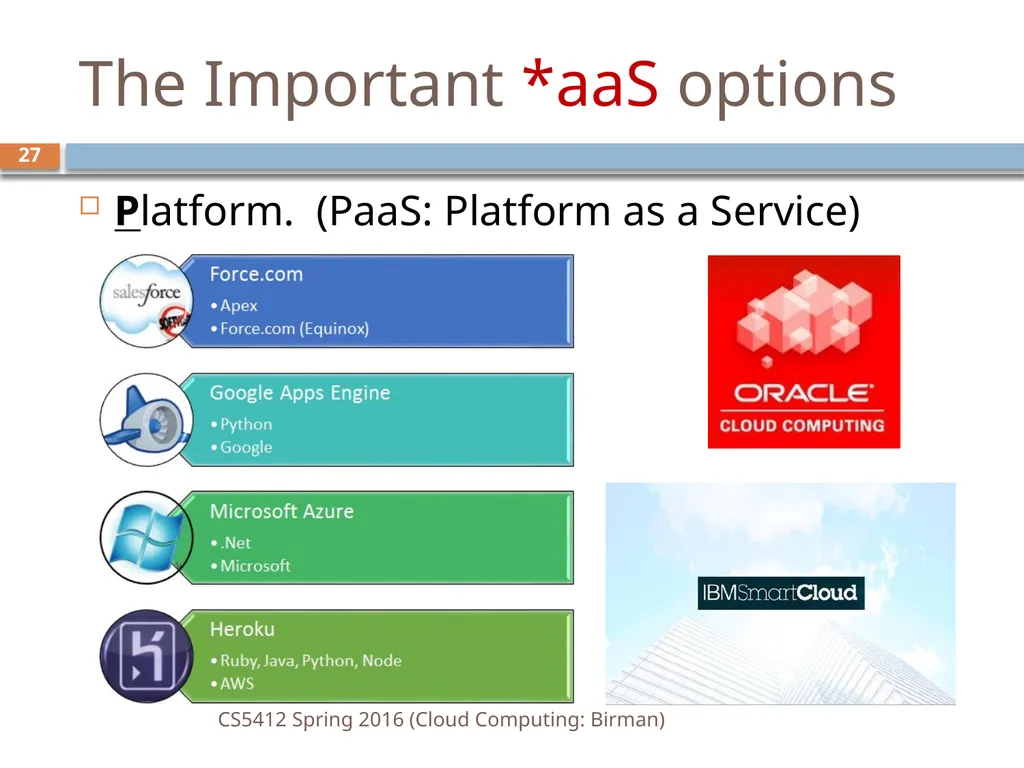
The Important *aaS options CS5412 Spring 2016 (Cloud Computing: Birman) 27 Platform. (PaaS: Platform as a Service)<br>
28
… these aren’t the whole cloud CS5412 Spring 2016 (Cloud Computing: Birman) 28 The cloud mixes many models
Some integrate humans into the loop, such as outsourced audio-to-text, or Amazon’s Mechanical Turk
There are companies with specialized roles
Akamai: The most famous data hosting company, especially successful for storing videos and images that are used in your web pages. They specialize in rapid data delivery
DoubleClick: You leave a frame on your web page, they put the perfect advertisement for this particular user in it
There are even cloud “HPC systems”! (Rent on demand)<br>
Some integrate humans into the loop, such as outsourced audio-to-text, or Amazon’s Mechanical Turk
There are companies with specialized roles
Akamai: The most famous data hosting company, especially successful for storing videos and images that are used in your web pages. They specialize in rapid data delivery
DoubleClick: You leave a frame on your web page, they put the perfect advertisement for this particular user in it
There are even cloud “HPC systems”! (Rent on demand)<br>
29
Open source CS5412 Spring 2016 (Cloud Computing: Birman) 29 The cloud has hugely benefitted from
open source (basically, source for programs is made available to customers),
free open source (same, but no fee for use), and
open development (many developers at many companies contribute).
In fact nothing about the cloud demands “open.”
But these are certainly powerful factors that help explain the vibrant cloud ecosystem.<br>
open source (basically, source for programs is made available to customers),
free open source (same, but no fee for use), and
open development (many developers at many companies contribute).
In fact nothing about the cloud demands “open.”
But these are certainly powerful factors that help explain the vibrant cloud ecosystem.<br>
30
So… what’s cloud computing? CS5412 Spring 2016 (Cloud Computing: Birman) 30 In some sense, the term means nothing!
If you make “full use” of modern off-the-shelf computing products and systems, you are a cloud computing user
You can’t really buy “non-cloud” systems anymore
The Internet and cloud standards are built into everything
You can block some features, but it is surprisingly hard to create a cloud-free computing system (one of many reasons it is so easy to break into many systems)<br>
If you make “full use” of modern off-the-shelf computing products and systems, you are a cloud computing user
You can’t really buy “non-cloud” systems anymore
The Internet and cloud standards are built into everything
You can block some features, but it is surprisingly hard to create a cloud-free computing system (one of many reasons it is so easy to break into many systems)<br>
31
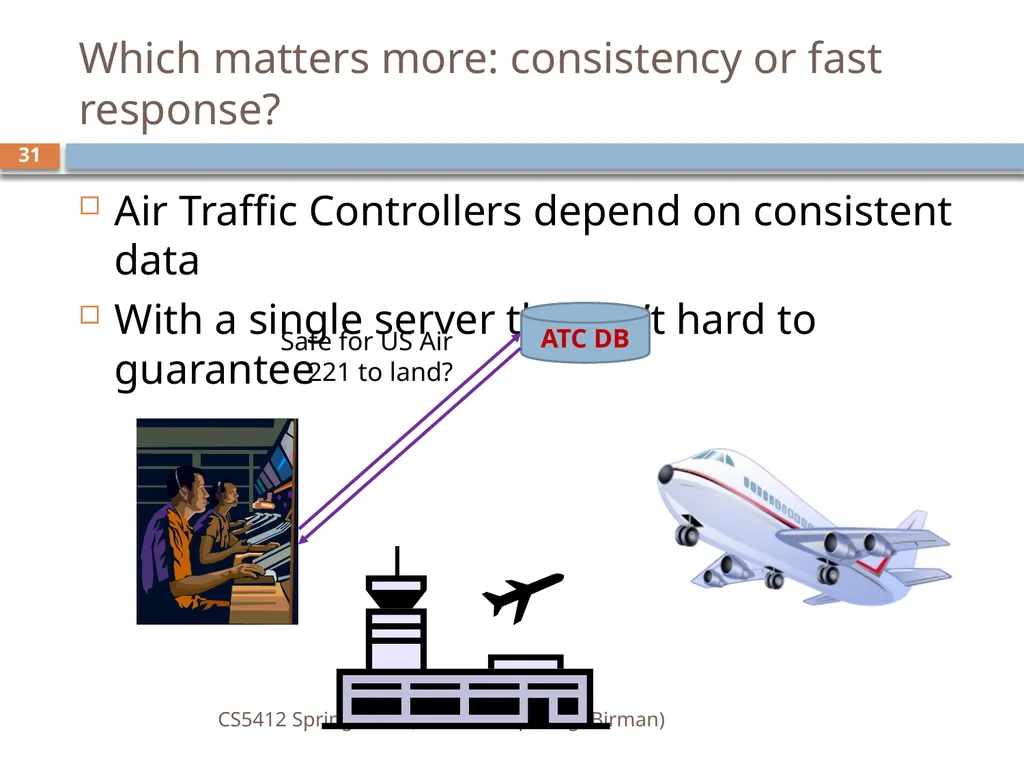
Which matters more: consistency or fast response? Air Traffic Controllers depend on consistent data
With a single server this isn’t hard to guarantee ATC DB Safe for US Air 221 to land? CS5412 Spring 2016 (Cloud Computing: Birman) 31<br>
With a single server this isn’t hard to guarantee ATC DB Safe for US Air 221 to land? CS5412 Spring 2016 (Cloud Computing: Birman) 31<br>
32
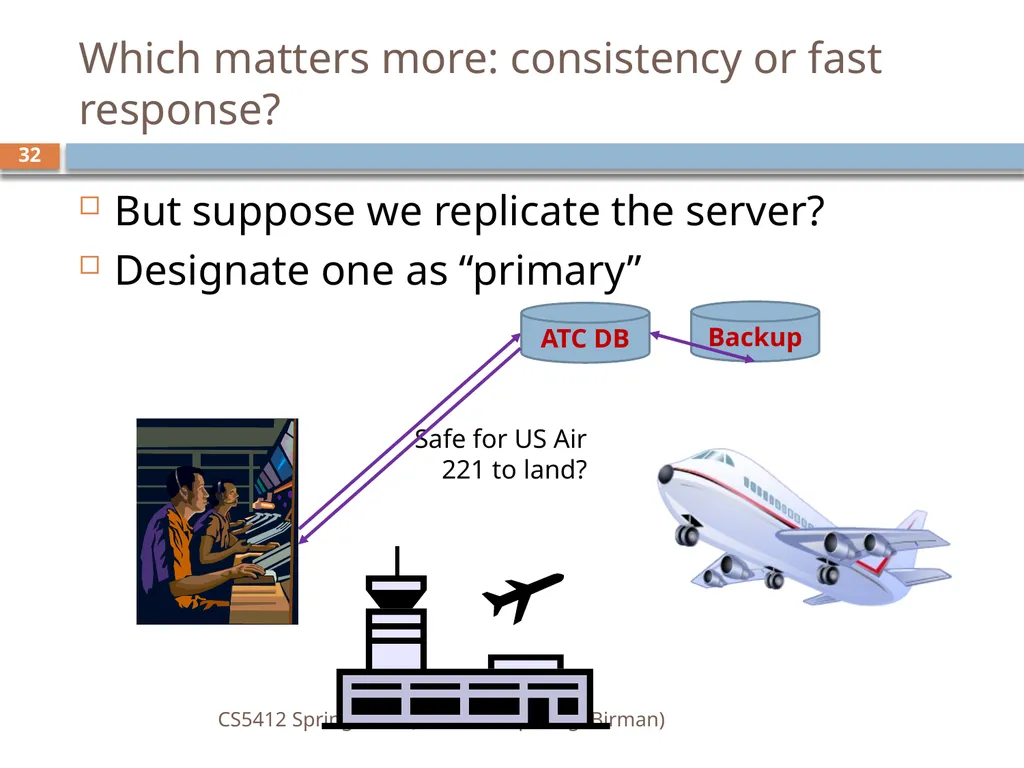
Which matters more: consistency or fast response? But suppose we replicate the server?
Designate one as “primary” ATC DB Safe for US Air 221 to land? Backup 32 CS5412 Spring 2016 (Cloud Computing: Birman)<br>
Designate one as “primary” ATC DB Safe for US Air 221 to land? Backup 32 CS5412 Spring 2016 (Cloud Computing: Birman)<br>
33
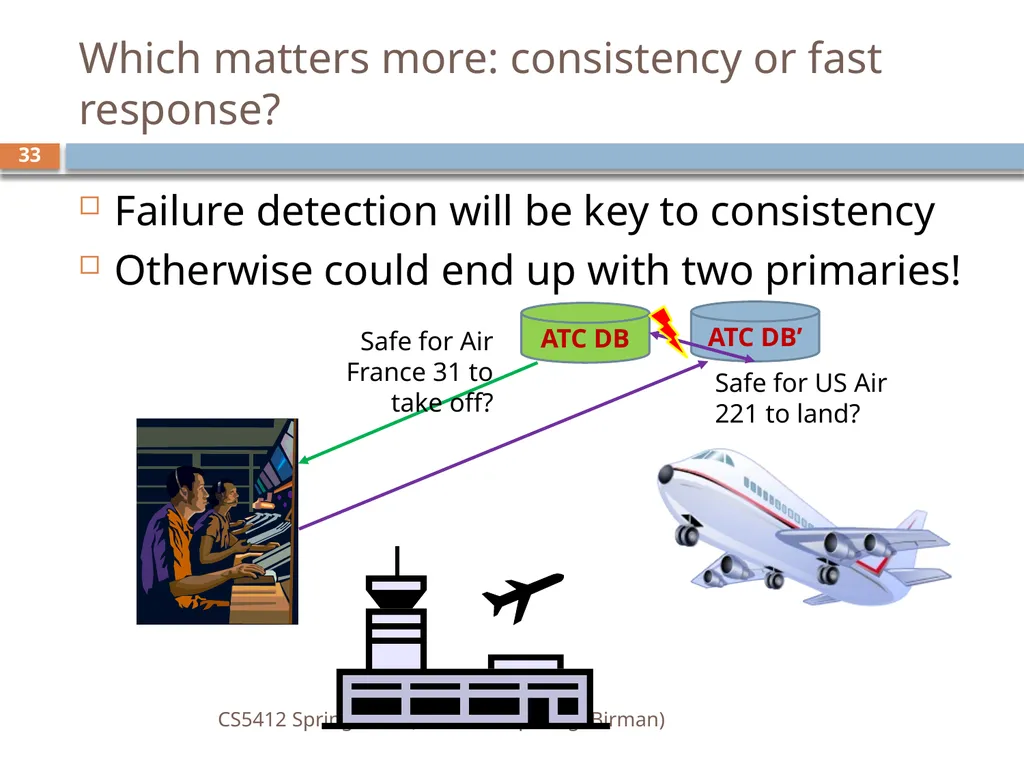
Which matters more: consistency or fast response? Failure detection will be key to consistency
Otherwise could end up with two primaries! ATC DB Safe for US Air 221 to land? ATC DB’ Safe for Air France 31 to take off? 33 CS5412 Spring 2016 (Cloud Computing: Birman)<br>
Otherwise could end up with two primaries! ATC DB Safe for US Air 221 to land? ATC DB’ Safe for Air France 31 to take off? 33 CS5412 Spring 2016 (Cloud Computing: Birman)<br>
34
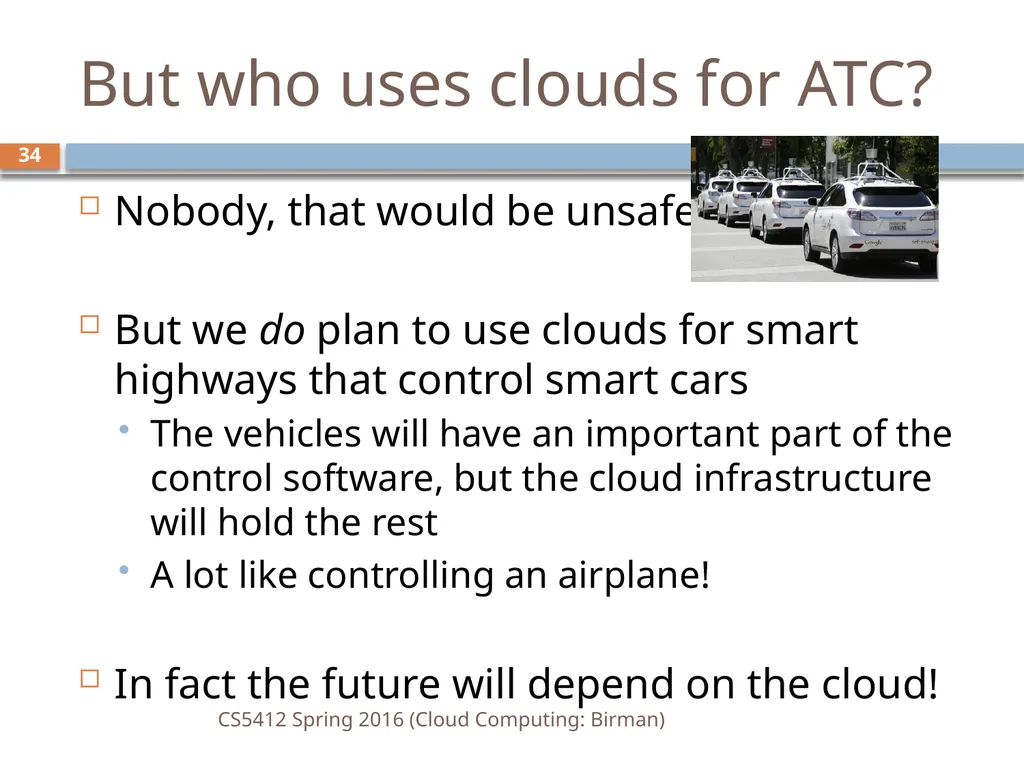
But who uses clouds for ATC? CS5412 Spring 2016 (Cloud Computing: Birman) 34 Nobody, that would be unsafe.
But we do plan to use clouds for smart highways that control smart cars
The vehicles will have an important part of the control software, but the cloud infrastructure will hold the rest
A lot like controlling an airplane!
In fact the future will depend on the cloud!<br>
But we do plan to use clouds for smart highways that control smart cars
The vehicles will have an important part of the control software, but the cloud infrastructure will hold the rest
A lot like controlling an airplane!
In fact the future will depend on the cloud!<br>
35
High assurance in the cloud Today’s cloud is built with simple components and yet even so, exhibits problems like split brain behavior, thrashing, rolling failures, other issues
Companies spending a fortune to eliminate such issues
They can limit scalability
Tomorrow’s cloud thus poses a deep question
Will it be limited to simple applications?
Or can we migrate application like health care, transportation control, banking, etc to the cloud? CS5412 Spring 2016 (Cloud Computing: Birman) 35<br>
Companies spending a fortune to eliminate such issues
They can limit scalability
Tomorrow’s cloud thus poses a deep question
Will it be limited to simple applications?
Or can we migrate application like health care, transportation control, banking, etc to the cloud? CS5412 Spring 2016 (Cloud Computing: Birman) 35<br>
36
Background assumed? Solid understanding of computer architectures, operating systems, good programming skills including “threads” in Java, C++ or C#
Some basic appreciation of how networks work, how operating systems work, virtualization
Prior exposure to “distributed computing” not required or expected CS5412 Spring 2016 (Cloud Computing: Birman) 36<br>
Some basic appreciation of how networks work, how operating systems work, virtualization
Prior exposure to “distributed computing” not required or expected CS5412 Spring 2016 (Cloud Computing: Birman) 36<br>
37
Logistics CS5412 Spring 2016 (Cloud Computing: Birman) 37 This ends our introduction lecture
But now a few words about how the class will run
Lectures (advice: attend them!)
Exams (prelim, final)
Projects<br>
But now a few words about how the class will run
Lectures (advice: attend them!)
Exams (prelim, final)
Projects<br>