
CS6456: Graduate Operating Systems Brad Campbell –
AM
Published · 46 slides · 0 views

1 / 1
Description
CS6456: Graduate Operating Systems Brad Campbell bradjcvirginia.edu https:www.cs.virginia.edubjc8cclasscs6456-f19 1 What does Real Time mean? In computing broadly Real time the time measured by a physical clock Real time
Related Topics
Share
Embed code
Download this presentation From Below
"CS6456: Graduate Operating Systems Brad Campbell –" is the property of its rightful owner. Permission is granted to download and print the materials on this website for personal, non-commercial use only, and to display it on your personal computer provided you do not modify the materials and that you retain all copyright notices contained in the materials. By downloading content from our website, you accept the terms of this agreement.
Presentation Transcript
01
CS6456: Graduate Operating Systems Brad Campbell – bradjc@virginia.edu
https://www.cs.virginia.edu/~bjc8c/class/cs6456-f19/ 1<br>
https://www.cs.virginia.edu/~bjc8c/class/cs6456-f19/ 1<br>
02
What does “Real Time” mean? In computing broadly
Real time = the time measured by a physical clock
Real time operation generally means the execution keeps up with the pace of events
A speech or video sample of 1 second, if processed in 1 second or in less
In real time systems
Task execution meets specific deadlines 2<br>
Real time = the time measured by a physical clock
Real time operation generally means the execution keeps up with the pace of events
A speech or video sample of 1 second, if processed in 1 second or in less
In real time systems
Task execution meets specific deadlines 2<br>
03
Real Time Operating System Real Time Tasks
Process control in industrial plants
Robotics
Air Traffic control
Telecommunications
Weapon guidance system e.g. Guided missiles
Medical diagnostic and life support system
Automatic engine control system
Real time data base
Mars Rovers
Curiosity : OS – VxWorks, Processor BEA’s RAD 750 3<br>
Process control in industrial plants
Robotics
Air Traffic control
Telecommunications
Weapon guidance system e.g. Guided missiles
Medical diagnostic and life support system
Automatic engine control system
Real time data base
Mars Rovers
Curiosity : OS – VxWorks, Processor BEA’s RAD 750 3<br>
04
Terms and definitions Release time (or ready time): This is the time instant at which a task(process) is ready or eligible for execution
Schedule Time: This is the time instant when a task gets its chance to execute
Completion time: This is the time instant when task completes its execution
Deadline: This is the instant of time by which the execution of task should be completed
Runtime: The time taken without interruption to complete the task, after the task is released 4<br>
Schedule Time: This is the time instant when a task gets its chance to execute
Completion time: This is the time instant when task completes its execution
Deadline: This is the instant of time by which the execution of task should be completed
Runtime: The time taken without interruption to complete the task, after the task is released 4<br>
05
Today Intro to real time systems and real time scheduling
Hardware support
Mixed criticality systems 5<br>
Hardware support
Mixed criticality systems 5<br>
06
Terms and Definitions Tardiness: Specifies the amount of time by which a task misses its deadline. Its is equal to the difference between completion time and deadline
Laxity: Is defined as deadline minus remaining computation time. The laxity of task is the maximum amount of time it can wait and still meets its deadline 6<br>
Laxity: Is defined as deadline minus remaining computation time. The laxity of task is the maximum amount of time it can wait and still meets its deadline 6<br>
07
Soft and Hard Real Time tasks Hard real time task:
Task must complete before or at deadline.
Value of completing the task after deadline is zero.
Software real time
Missing deadline incurs a penalty
Penalty increases as tardiness increases 7<br>
Task must complete before or at deadline.
Value of completing the task after deadline is zero.
Software real time
Missing deadline incurs a penalty
Penalty increases as tardiness increases 7<br>
08
Examples Types of Real Time Tasks
Hard Real-time task
Air traffic control
Vehicle subsystems control
Nuclear power plant control
Soft Real-time Task
Multimedia transmission and reception
Networking, telecom (cellular) networks
Web sites and services
Computer games.
Firm Real Task
Periodic Task
Aperiodic Task
Sporadic Task
Preemptible/Non-Preemptible Tasks 8<br>
Hard Real-time task
Air traffic control
Vehicle subsystems control
Nuclear power plant control
Soft Real-time Task
Multimedia transmission and reception
Networking, telecom (cellular) networks
Web sites and services
Computer games.
Firm Real Task
Periodic Task
Aperiodic Task
Sporadic Task
Preemptible/Non-Preemptible Tasks 8<br>
09
Scheduling concerns Scheduling in Real time in operating systems:
No of tasks
Resource Requirements
Release Time
Execution time
Deadlines
Examples:
Rate Monotonic Algorithm
Earliest Deadline First Algorithm 9<br>
No of tasks
Resource Requirements
Release Time
Execution time
Deadlines
Examples:
Rate Monotonic Algorithm
Earliest Deadline First Algorithm 9<br>
10
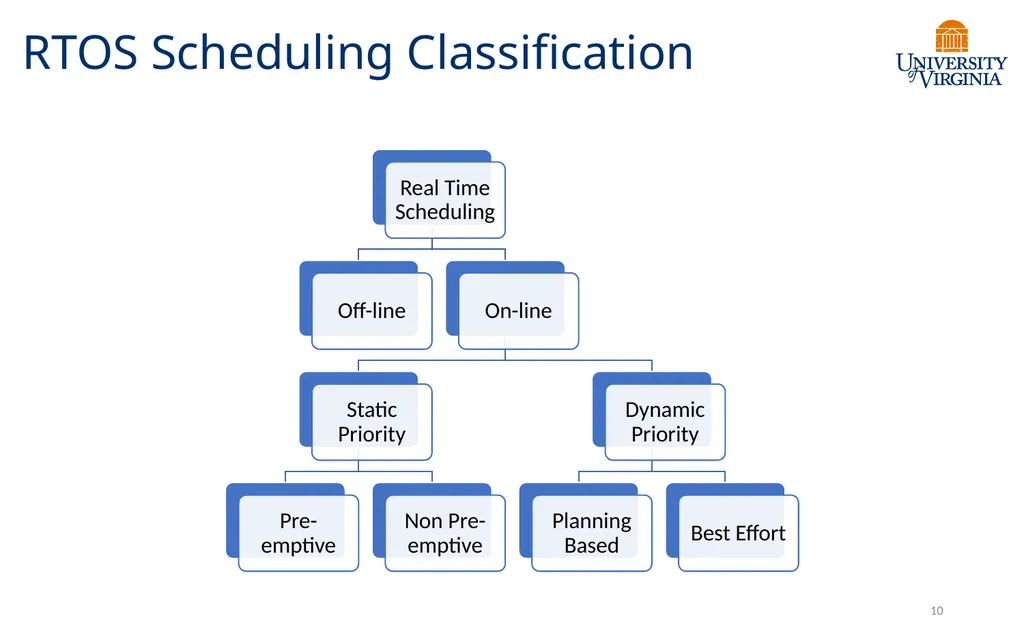
RTOS Scheduling Classification 10<br>
11
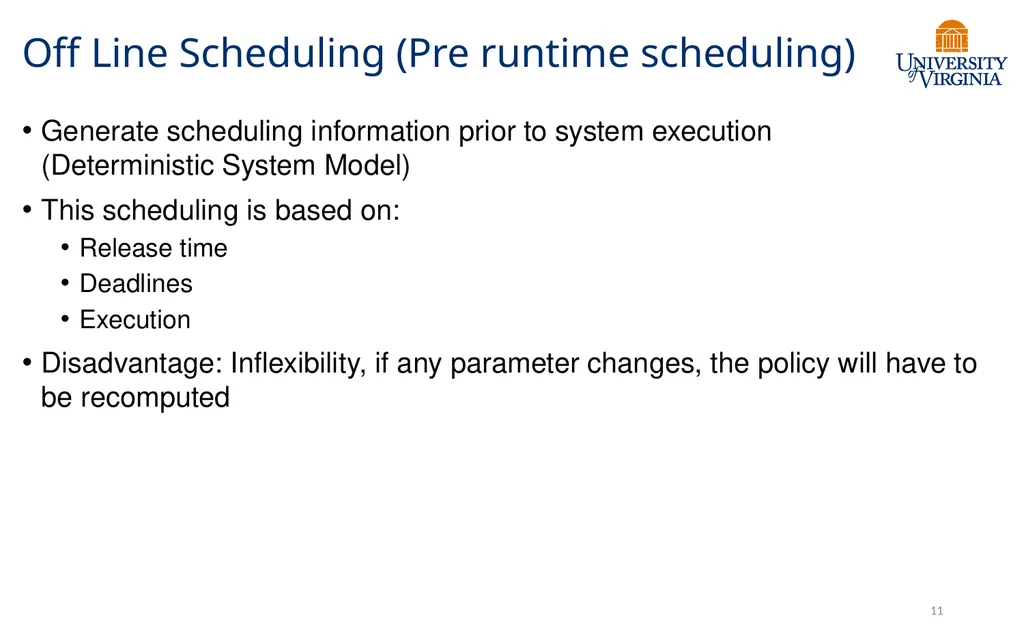
Off Line Scheduling (Pre runtime scheduling) Generate scheduling information prior to system execution
(Deterministic System Model)
This scheduling is based on:
Release time
Deadlines
Execution
Disadvantage: Inflexibility, if any parameter changes, the policy will have to be recomputed 11<br>
This scheduling is based on:
Release time
Deadlines
Execution
Disadvantage: Inflexibility, if any parameter changes, the policy will have to be recomputed 11<br>
12
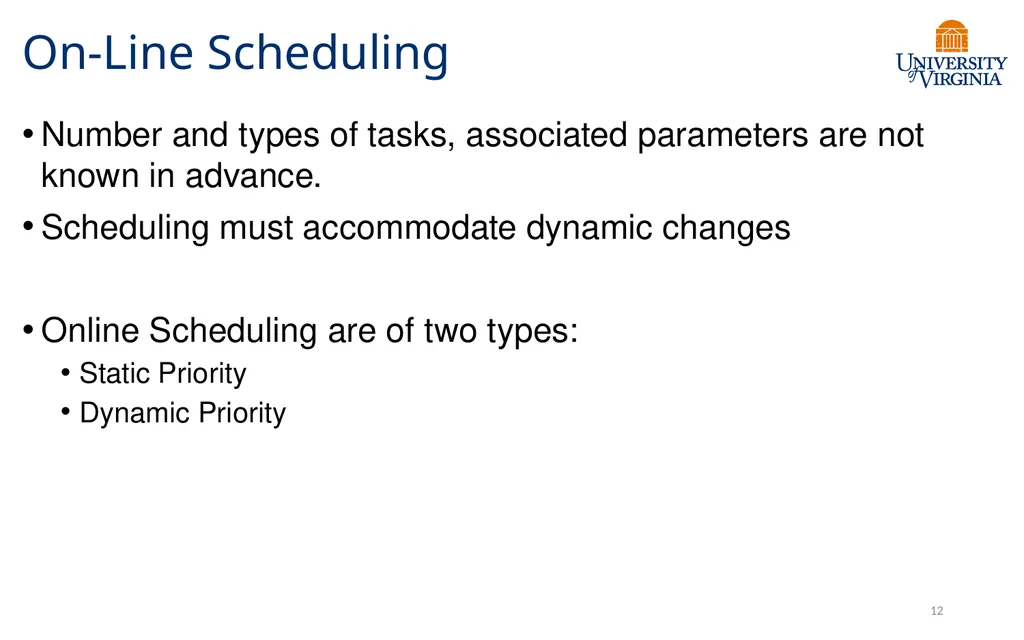
On-Line Scheduling Number and types of tasks, associated parameters are not known in advance.
Scheduling must accommodate dynamic changes
Online Scheduling are of two types:
Static Priority
Dynamic Priority 12<br>
Scheduling must accommodate dynamic changes
Online Scheduling are of two types:
Static Priority
Dynamic Priority 12<br>
13
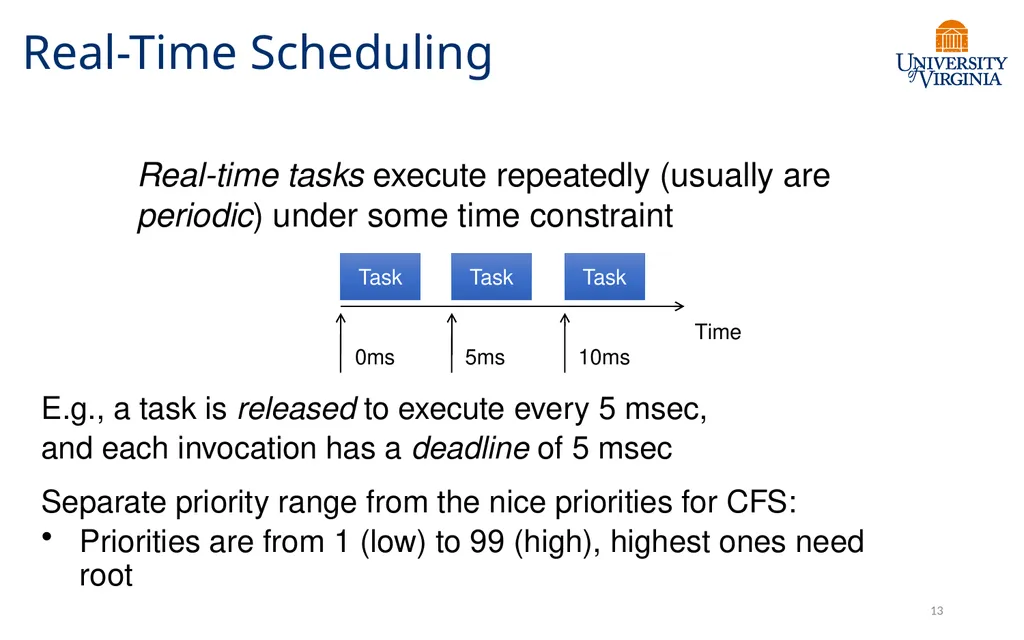
Real-Time Scheduling 13 Real-time tasks execute repeatedly (usually are periodic) under some time constraint E.g., a task is released to execute every 5 msec,
and each invocation has a deadline of 5 msec
Separate priority range from the nice priorities for CFS:
Priorities are from 1 (low) to 99 (high), highest ones need root 0ms 5ms 10ms Time<br>
and each invocation has a deadline of 5 msec
Separate priority range from the nice priorities for CFS:
Priorities are from 1 (low) to 99 (high), highest ones need root 0ms 5ms 10ms Time<br>
14
Conflicts with traditional kernel scheduling Deadlines vs. fairness
For example, if a user accessed the kernel: “can you guarantee my task will run for 1 second at every 5 second interval?”
Challenges:
Linux uses proportional sharing – so the answer is highly dependent on other system activity
What if another process boosts its priority?
What if another process is starved? 14<br>
For example, if a user accessed the kernel: “can you guarantee my task will run for 1 second at every 5 second interval?”
Challenges:
Linux uses proportional sharing – so the answer is highly dependent on other system activity
What if another process boosts its priority?
What if another process is starved? 14<br>
15
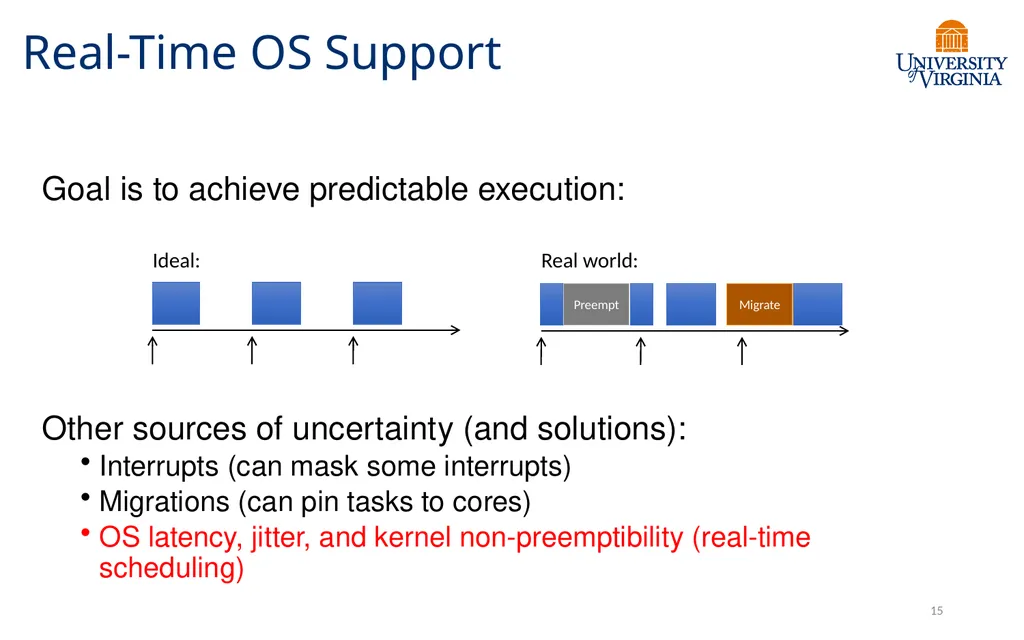
Real-Time OS Support Goal is to achieve predictable execution:
Other sources of uncertainty (and solutions):
Interrupts (can mask some interrupts)
Migrations (can pin tasks to cores)
OS latency, jitter, and kernel non-preemptibility (real-time scheduling) 15<br>
Other sources of uncertainty (and solutions):
Interrupts (can mask some interrupts)
Migrations (can pin tasks to cores)
OS latency, jitter, and kernel non-preemptibility (real-time scheduling) 15<br>
16
Five real-time scheduling classes First-in, First-out scheduling
Round robin scheduling
Preemptive fixed priority scheduling
Most frequent first
Earliest deadline first 16<br>
Round robin scheduling
Preemptive fixed priority scheduling
Most frequent first
Earliest deadline first 16<br>
17
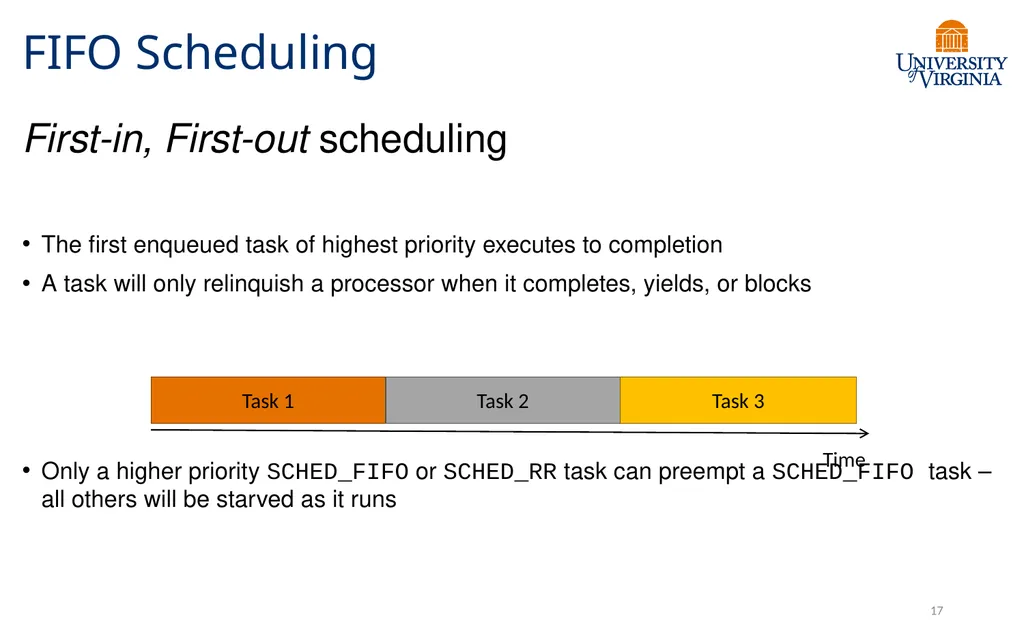
FIFO Scheduling First-in, First-out scheduling
The first enqueued task of highest priority executes to completion
A task will only relinquish a processor when it completes, yields, or blocks
Only a higher priority SCHED_FIFO or SCHED_RR task can preempt a SCHED_FIFO task – all others will be starved as it runs 17<br>
The first enqueued task of highest priority executes to completion
A task will only relinquish a processor when it completes, yields, or blocks
Only a higher priority SCHED_FIFO or SCHED_RR task can preempt a SCHED_FIFO task – all others will be starved as it runs 17<br>
18
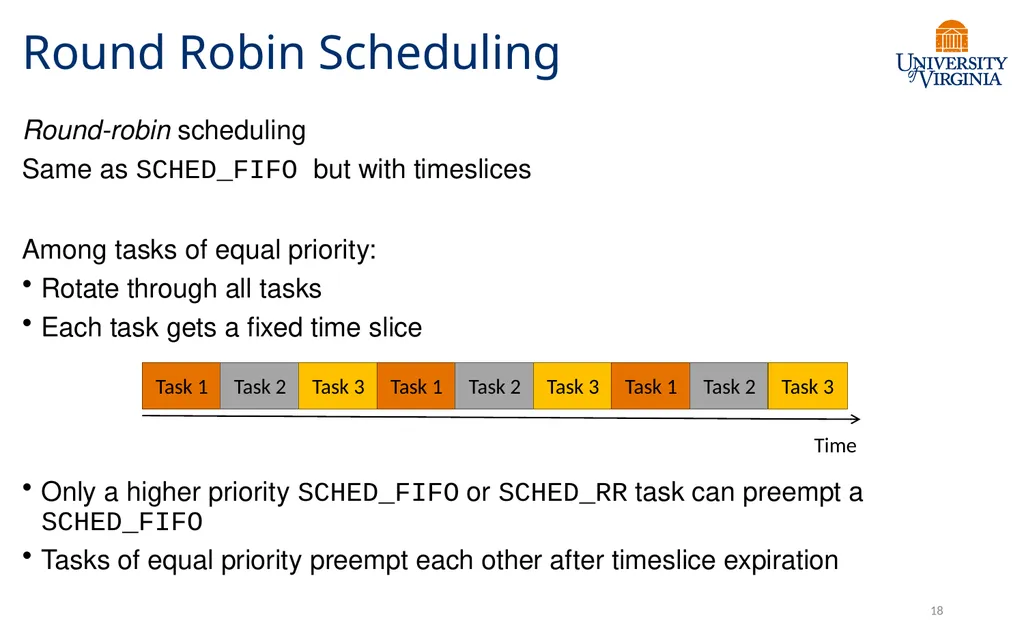
Round Robin Scheduling Round-robin scheduling
Same as SCHED_FIFO but with timeslices
Among tasks of equal priority:
Rotate through all tasks
Each task gets a fixed time slice
Only a higher priority SCHED_FIFO or SCHED_RR task can preempt a SCHED_FIFO
Tasks of equal priority preempt each other after timeslice expiration 18<br>
Same as SCHED_FIFO but with timeslices
Among tasks of equal priority:
Rotate through all tasks
Each task gets a fixed time slice
Only a higher priority SCHED_FIFO or SCHED_RR task can preempt a SCHED_FIFO
Tasks of equal priority preempt each other after timeslice expiration 18<br>
19
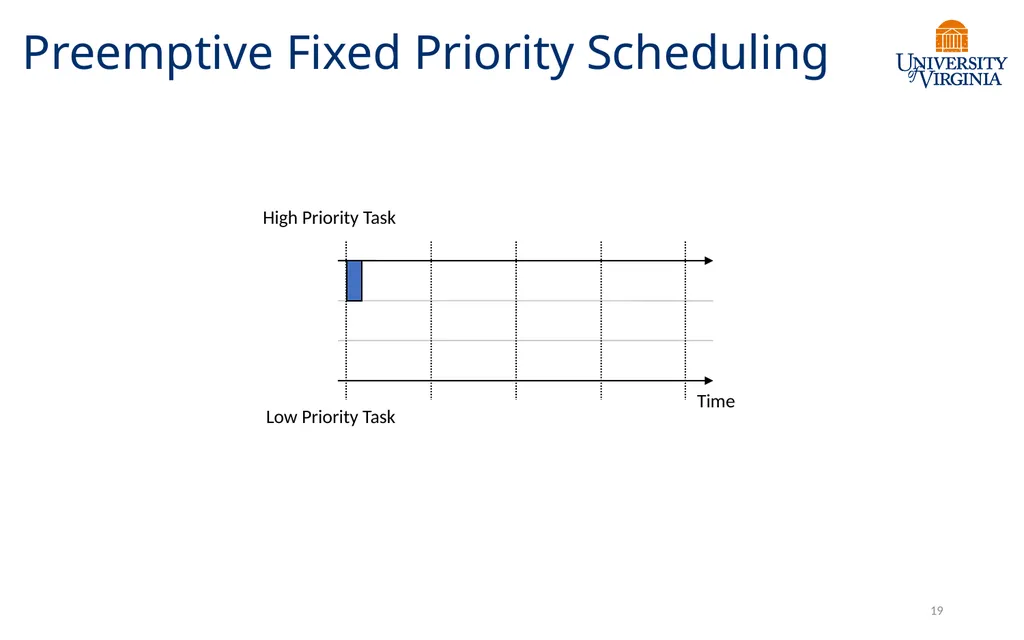
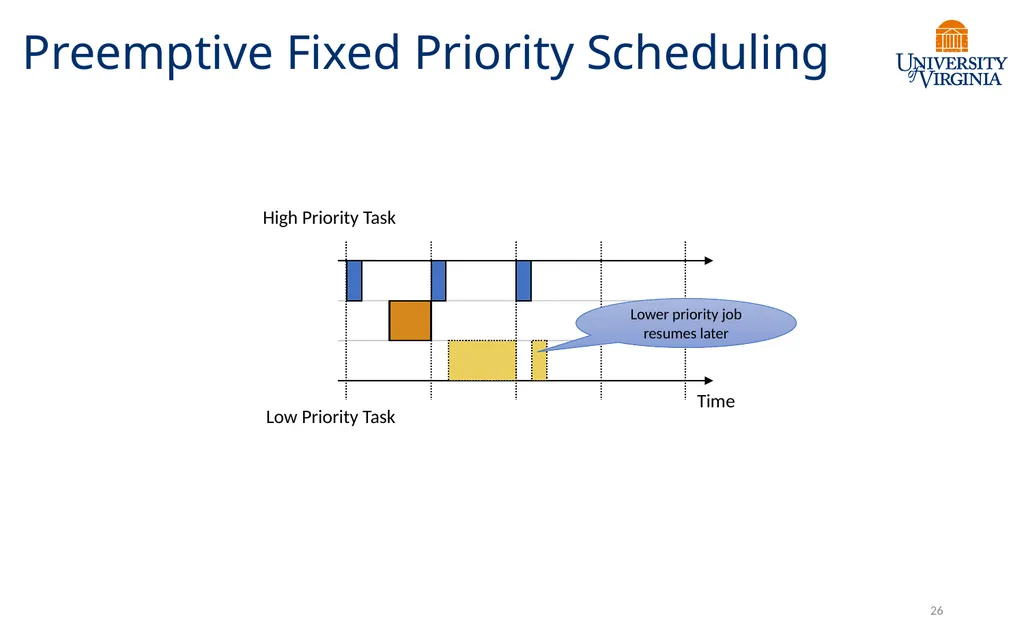
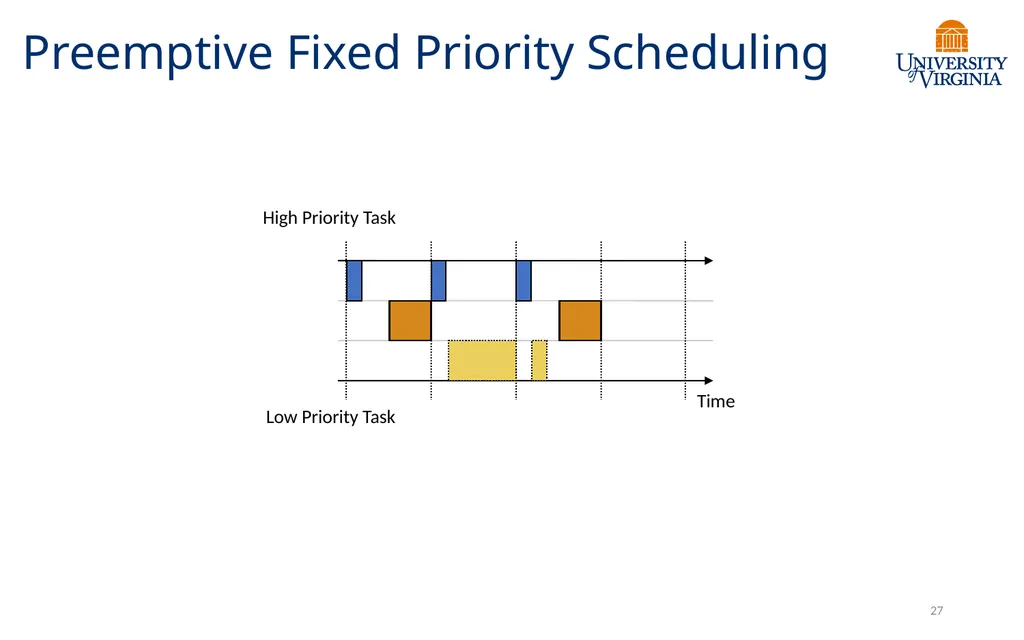
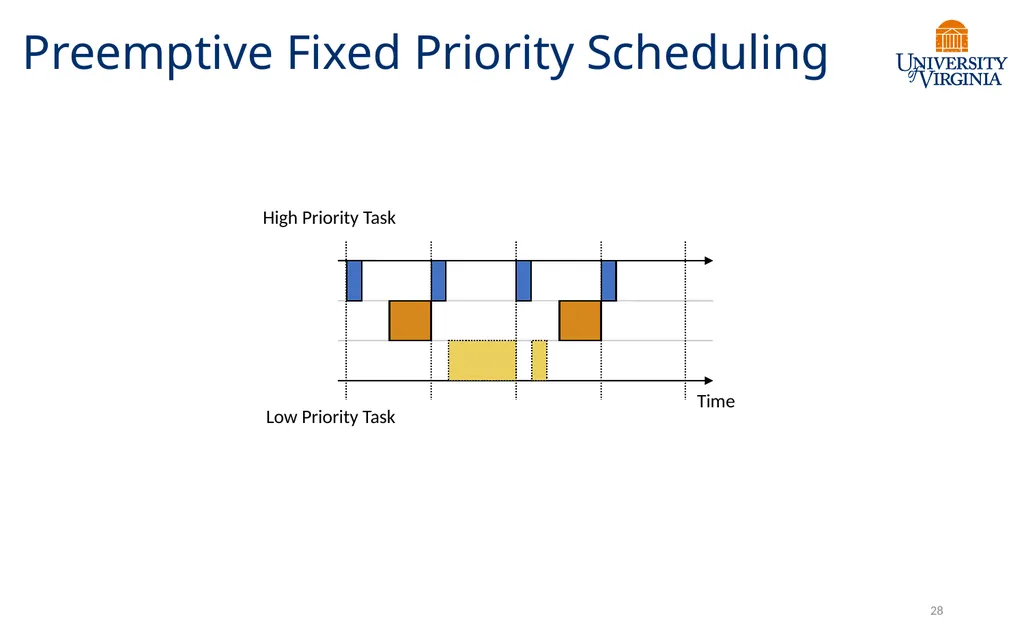
Preemptive Fixed Priority Scheduling High Priority Task Low Priority Task Time 19<br>
20
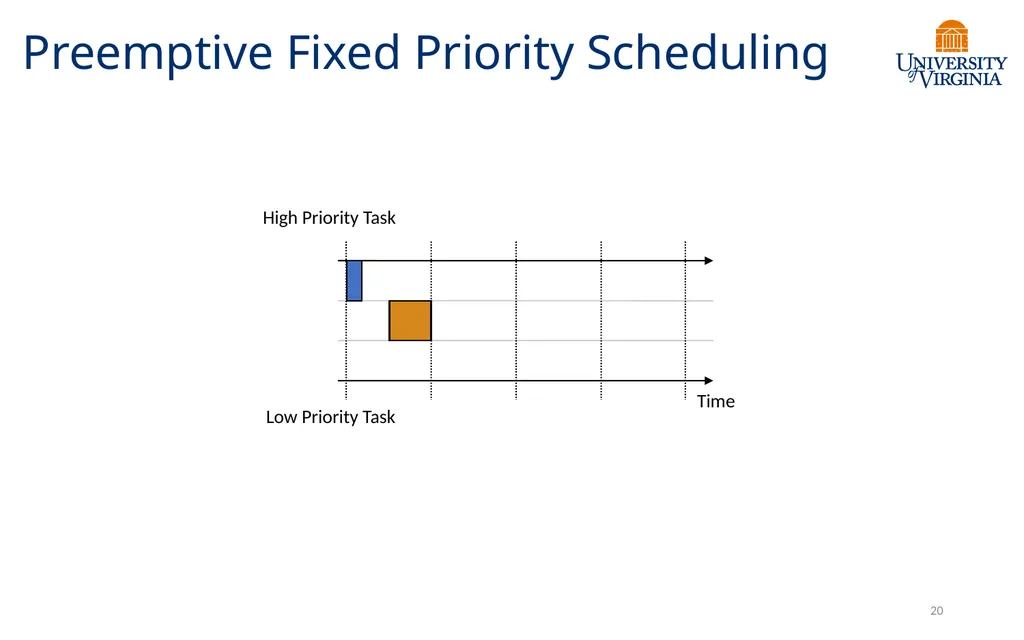
Preemptive Fixed Priority Scheduling High Priority Task Low Priority Task Time 20<br>
21
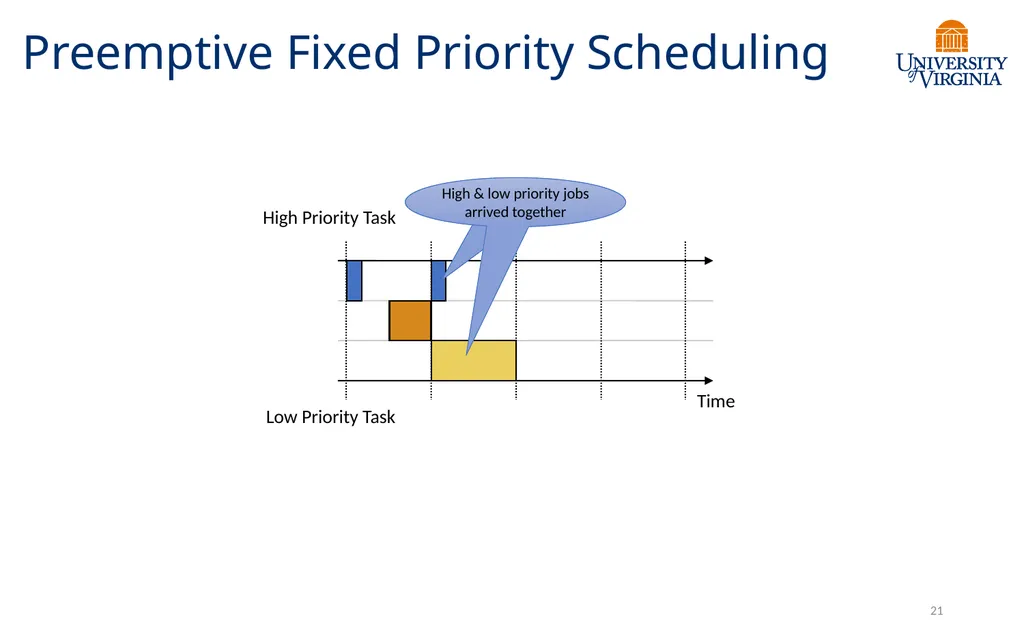
High & low priority jobs arrived together High & low priority jobs arrived together Preemptive Fixed Priority Scheduling High Priority Task Low Priority Task Time 21<br>
22
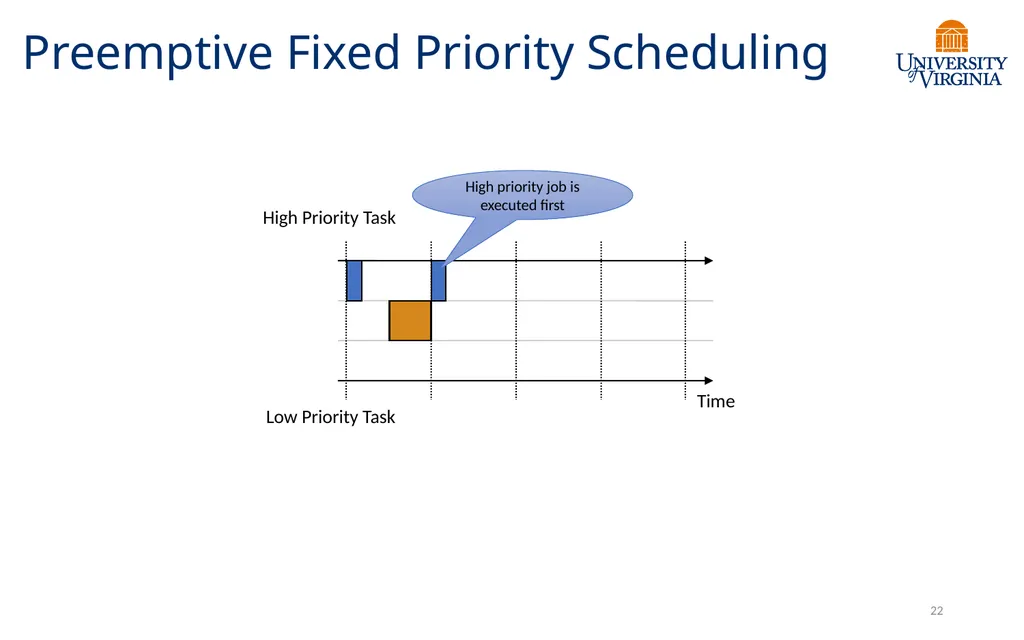
High priority job is executed first Preemptive Fixed Priority Scheduling High Priority Task Low Priority Task Time 22<br>
23
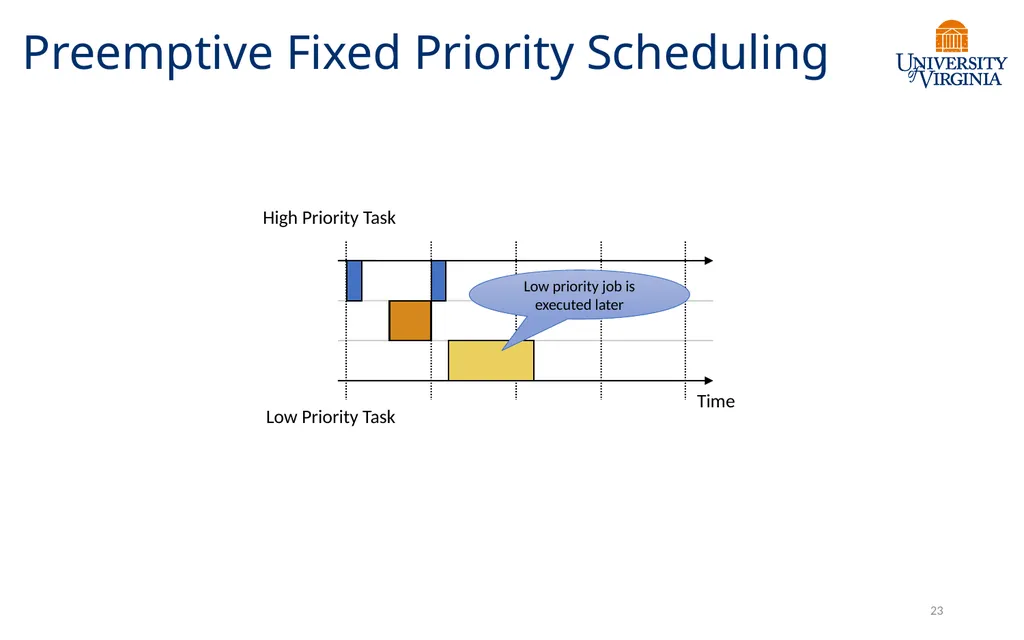
Low priority job is executed later Preemptive Fixed Priority Scheduling High Priority Task Low Priority Task Time 23<br>
24
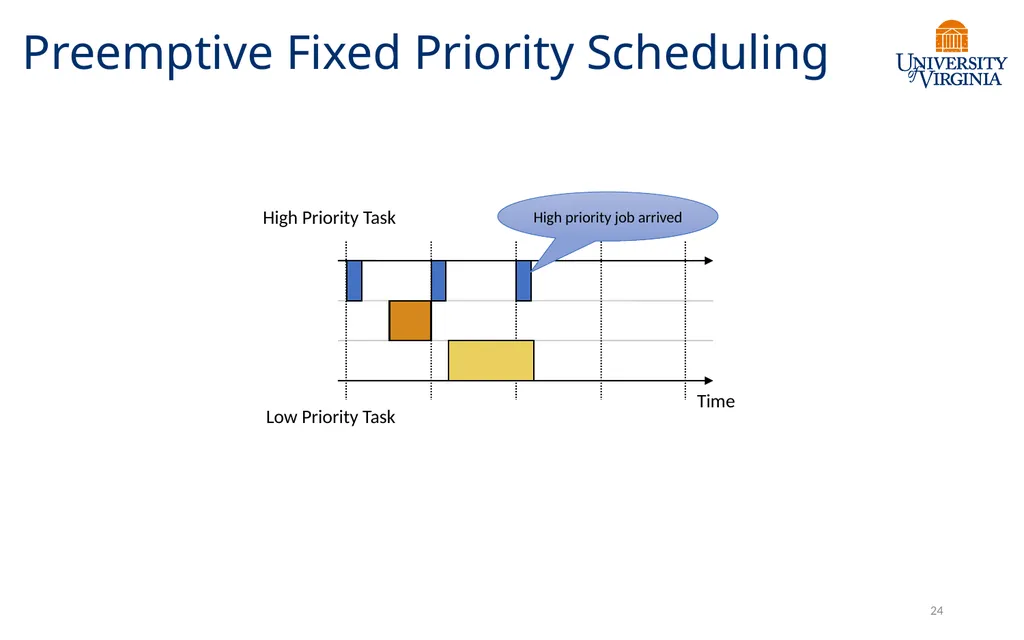
High priority job arrived Preemptive Fixed Priority Scheduling High Priority Task Low Priority Task Time 24<br>
25
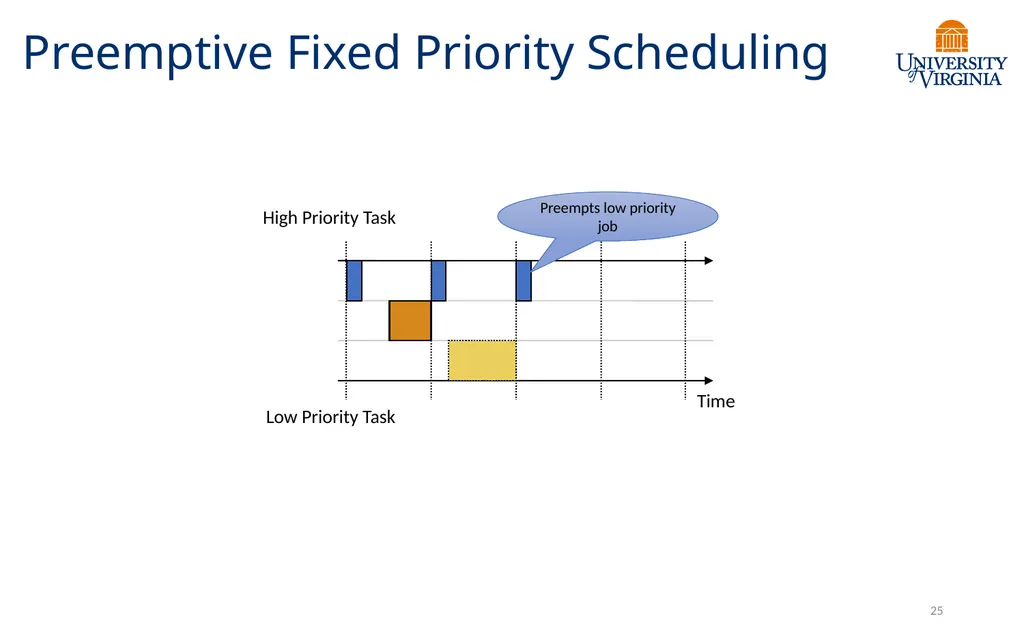
Preempts low priority job Preemptive Fixed Priority Scheduling High Priority Task Low Priority Task Time 25<br>
26
Lower priority job resumes later Preemptive Fixed Priority Scheduling High Priority Task Low Priority Task Time 26<br>
27
Preemptive Fixed Priority Scheduling High Priority Task Low Priority Task Time 27<br>
28
Preemptive Fixed Priority Scheduling High Priority Task Low Priority Task Time 28<br>
29
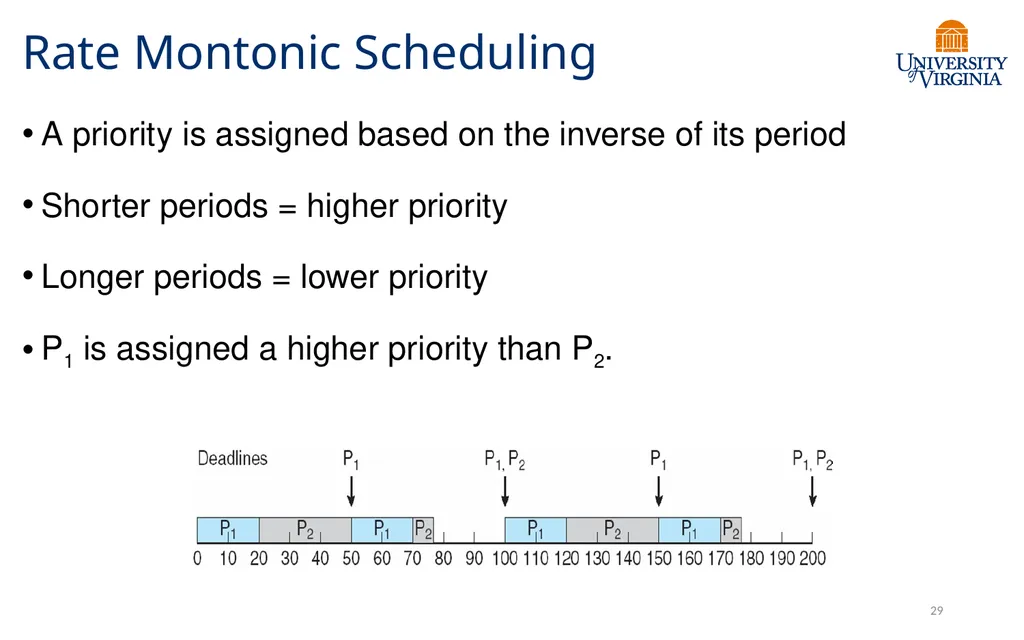
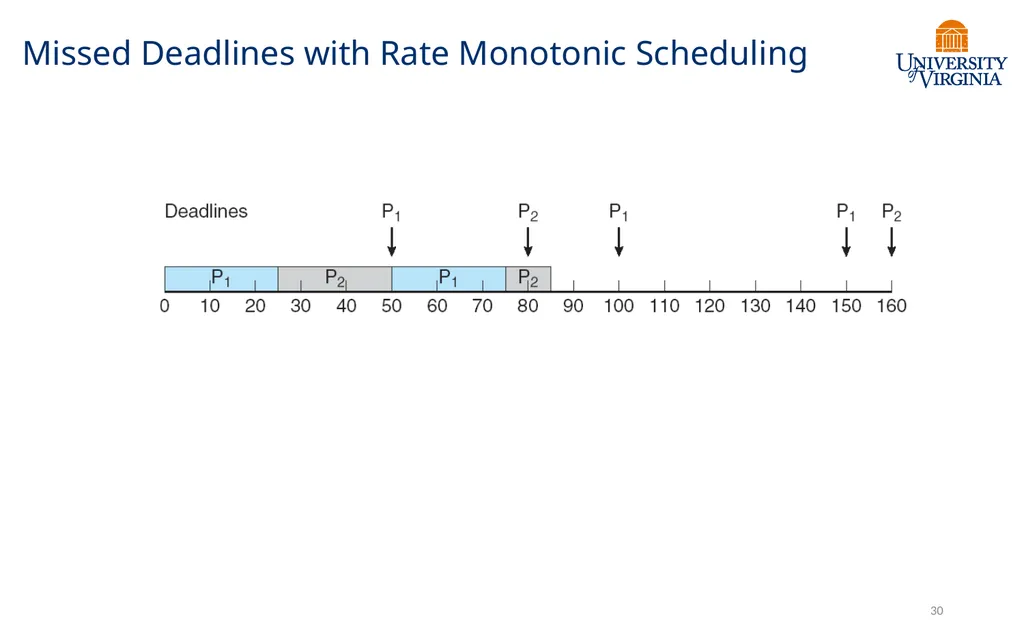
Rate Montonic Scheduling A priority is assigned based on the inverse of its period
Shorter periods = higher priority
Longer periods = lower priority
P1 is assigned a higher priority than P2. 29<br>
Shorter periods = higher priority
Longer periods = lower priority
P1 is assigned a higher priority than P2. 29<br>
30
Missed Deadlines with Rate Monotonic Scheduling 30<br>
31
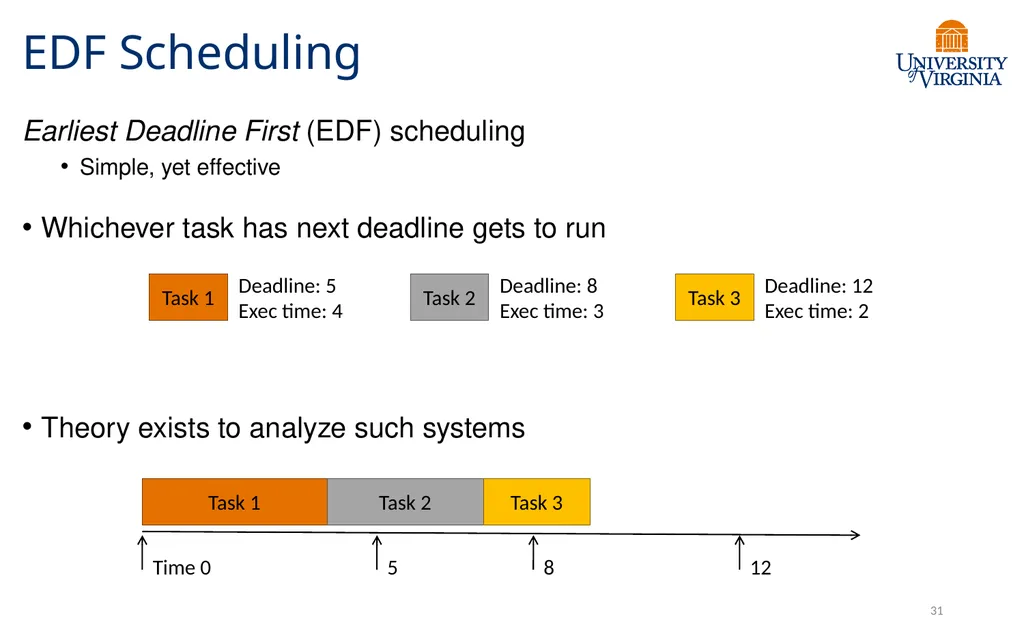
EDF Scheduling Earliest Deadline First (EDF) scheduling
Simple, yet effective
Whichever task has next deadline gets to run
Theory exists to analyze such systems 31<br>
Simple, yet effective
Whichever task has next deadline gets to run
Theory exists to analyze such systems 31<br>
32
32<br>
33
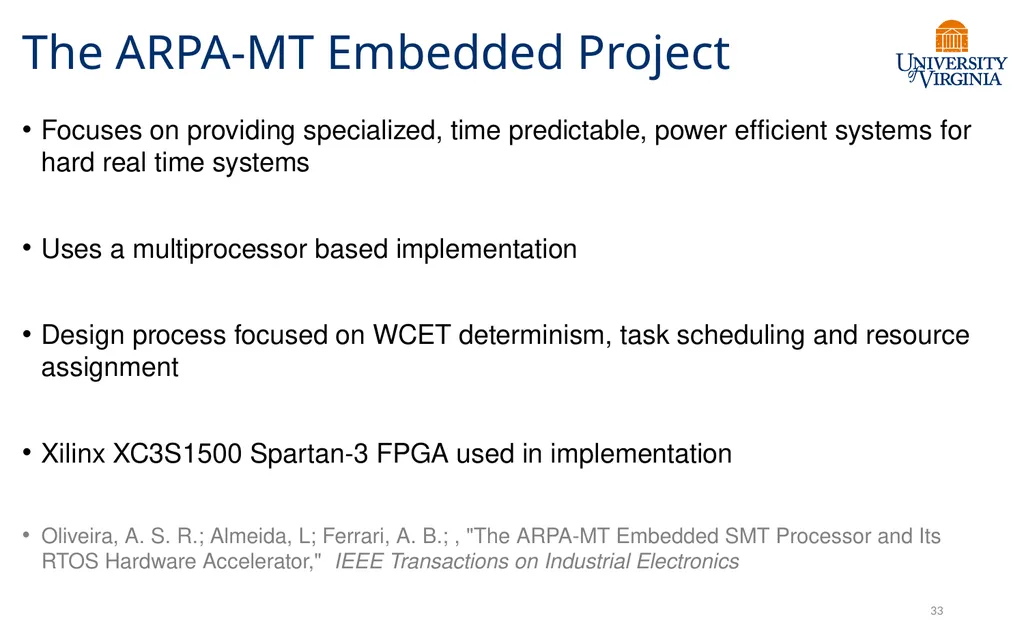
The ARPA-MT Embedded Project Focuses on providing specialized, time predictable, power efficient systems for hard real time systems
Uses a multiprocessor based implementation
Design process focused on WCET determinism, task scheduling and resource assignment
Xilinx XC3S1500 Spartan-3 FPGA used in implementation
Oliveira, A. S. R.; Almeida, L; Ferrari, A. B.; , "The ARPA-MT Embedded SMT Processor and Its RTOS Hardware Accelerator," IEEE Transactions on Industrial Electronics 33<br>
Uses a multiprocessor based implementation
Design process focused on WCET determinism, task scheduling and resource assignment
Xilinx XC3S1500 Spartan-3 FPGA used in implementation
Oliveira, A. S. R.; Almeida, L; Ferrari, A. B.; , "The ARPA-MT Embedded SMT Processor and Its RTOS Hardware Accelerator," IEEE Transactions on Industrial Electronics 33<br>
34
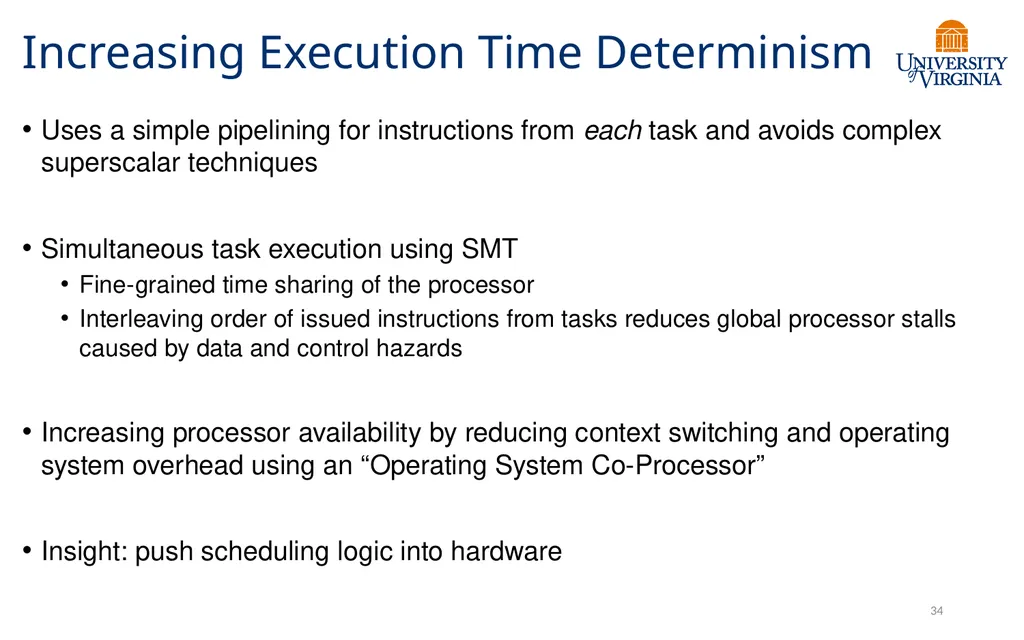
Increasing Execution Time Determinism Uses a simple pipelining for instructions from each task and avoids complex superscalar techniques
Simultaneous task execution using SMT
Fine-grained time sharing of the processor
Interleaving order of issued instructions from tasks reduces global processor stalls caused by data and control hazards
Increasing processor availability by reducing context switching and operating system overhead using an “Operating System Co-Processor”
Insight: push scheduling logic into hardware 34<br>
Simultaneous task execution using SMT
Fine-grained time sharing of the processor
Interleaving order of issued instructions from tasks reduces global processor stalls caused by data and control hazards
Increasing processor availability by reducing context switching and operating system overhead using an “Operating System Co-Processor”
Insight: push scheduling logic into hardware 34<br>
35
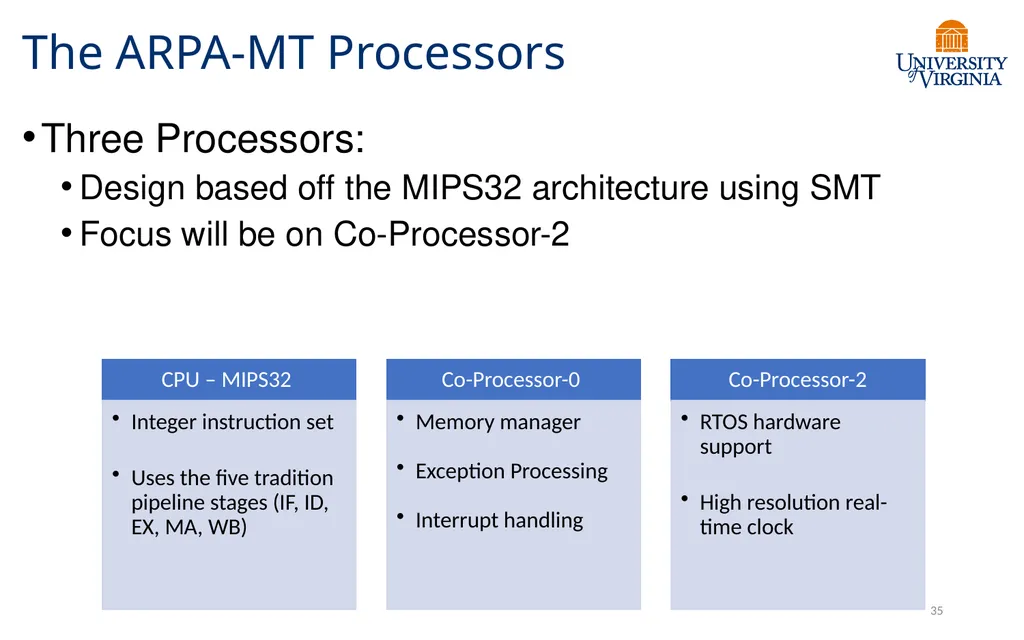
The ARPA-MT Processors Three Processors:
Design based off the MIPS32 architecture using SMT
Focus will be on Co-Processor-2 35<br>
Design based off the MIPS32 architecture using SMT
Focus will be on Co-Processor-2 35<br>
36
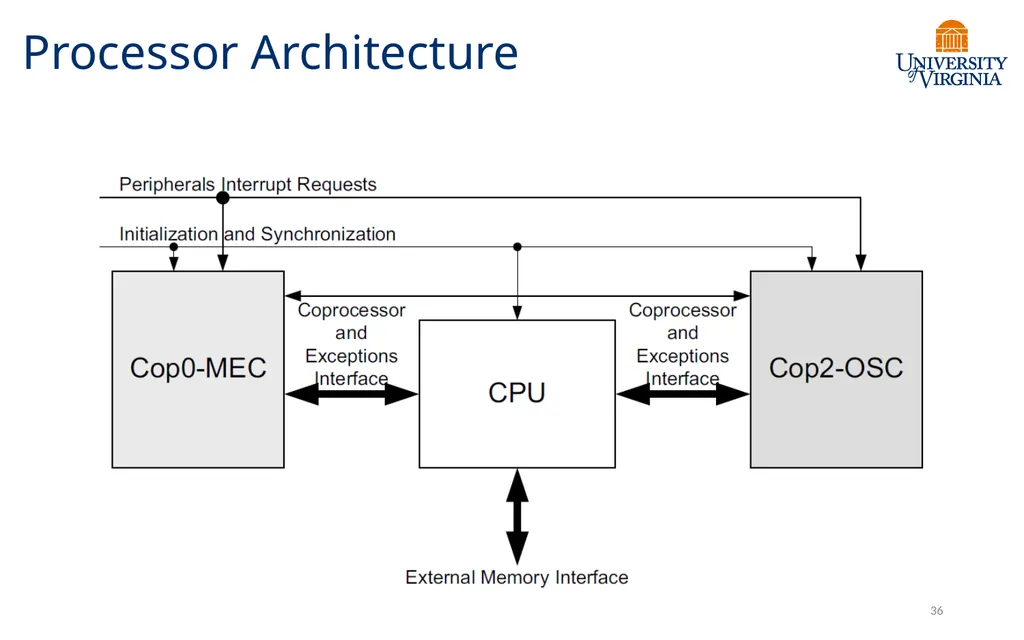
Processor Architecture 36<br>
37
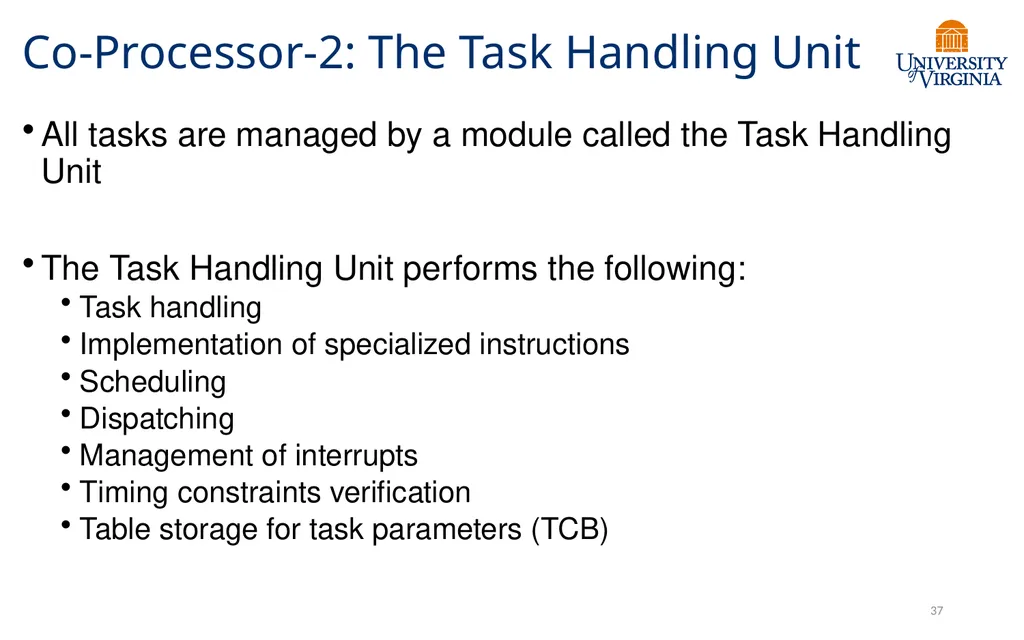
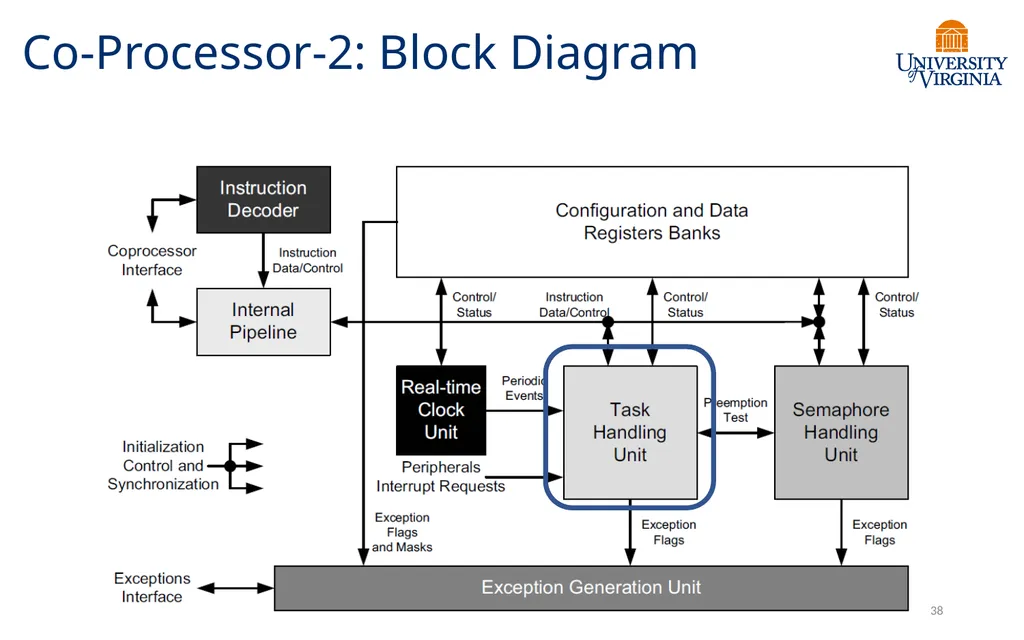
Co-Processor-2: The Task Handling Unit All tasks are managed by a module called the Task Handling Unit
The Task Handling Unit performs the following:
Task handling
Implementation of specialized instructions
Scheduling
Dispatching
Management of interrupts
Timing constraints verification
Table storage for task parameters (TCB) 37<br>
The Task Handling Unit performs the following:
Task handling
Implementation of specialized instructions
Scheduling
Dispatching
Management of interrupts
Timing constraints verification
Table storage for task parameters (TCB) 37<br>
38
Co-Processor-2: Block Diagram 38<br>
39
Co-Processor-2: Time & Event Management A task can be event or time triggered
The Real-time Clock Unit
Generates periodic events assigned by the programmer
Triggers other scheduled tasks (most likely garbage handling)
External events are managed again by the Task Handling unit 39<br>
The Real-time Clock Unit
Generates periodic events assigned by the programmer
Triggers other scheduled tasks (most likely garbage handling)
External events are managed again by the Task Handling unit 39<br>
40
Co-Processor-2: Task Management [5] Application timing constraints are transparent to this processor allowing for real-time task management
Hard real-time tasks can be periodic or aperiodic
Task are synchronized using:
Pre-emption (LIFO or stack resource synchronization)
Binary semaphores (for simple access to shared resources) 40<br>
Hard real-time tasks can be periodic or aperiodic
Task are synchronized using:
Pre-emption (LIFO or stack resource synchronization)
Binary semaphores (for simple access to shared resources) 40<br>
41
Co-Processor-2: Task States and Transitions [5] Two important states are excluded from this processors design
Blocked
Suspended/sleeping
Blocking is bad
Wait/Sleep states can be simulated using timers 41<br>
Blocked
Suspended/sleeping
Blocking is bad
Wait/Sleep states can be simulated using timers 41<br>
42
Co-Processor-2: Scheduling [5] Scheduling is done in hardware using priority criticality
Scheduling Decisions (in ascending order of priority):
Non real-time: First Come First Serve (FCFS)
Soft real-time: Rate Monotonic policy (RM)
Hard real-time: Earliest Deadline First (EDF)
In the case of EDF:
As a task comes closer to its deadline, its priority is raised
Maximizes processor utilization and ensure deadlines met 42<br>
Scheduling Decisions (in ascending order of priority):
Non real-time: First Come First Serve (FCFS)
Soft real-time: Rate Monotonic policy (RM)
Hard real-time: Earliest Deadline First (EDF)
In the case of EDF:
As a task comes closer to its deadline, its priority is raised
Maximizes processor utilization and ensure deadlines met 42<br>
43
Co-Processor-2: Time & Event Management [5] A task can be event or time triggered
The Real-time Clock Unit
Generates periodic events assigned by the programmer
Triggers other scheduled tasks (most likely garbage handling)
External events are managed again by the Task Handling unit 43<br>
The Real-time Clock Unit
Generates periodic events assigned by the programmer
Triggers other scheduled tasks (most likely garbage handling)
External events are managed again by the Task Handling unit 43<br>
44
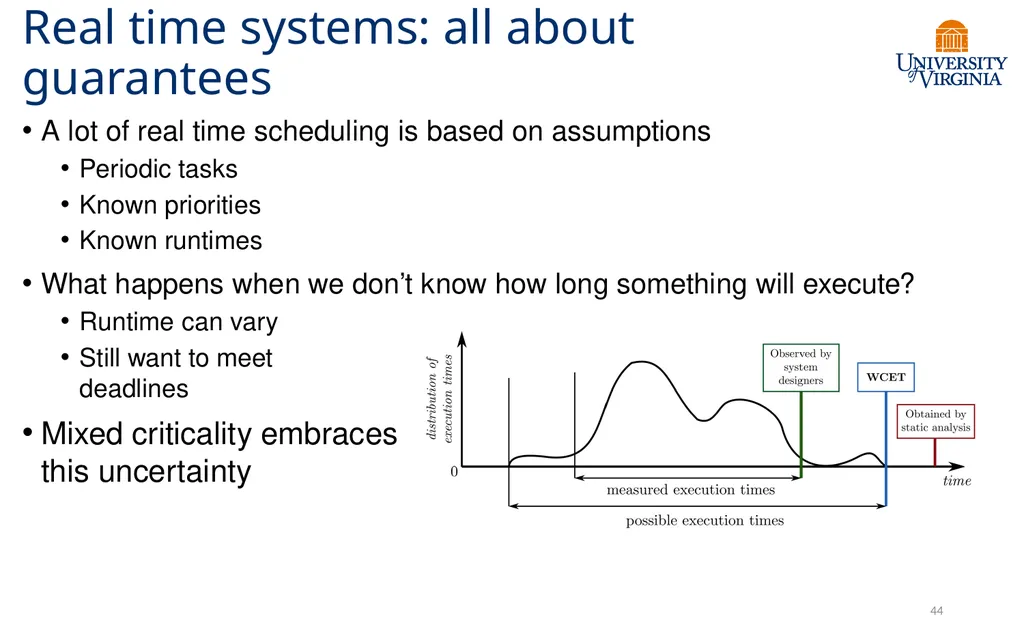
Real time systems: all about guarantees A lot of real time scheduling is based on assumptions
Periodic tasks
Known priorities
Known runtimes
What happens when we don’t know how long something will execute?
Runtime can vary
Still want to meet deadlines
Mixed criticality embraces this uncertainty 44<br>
Periodic tasks
Known priorities
Known runtimes
What happens when we don’t know how long something will execute?
Runtime can vary
Still want to meet deadlines
Mixed criticality embraces this uncertainty 44<br>
45
Mixed Criticality - The Vestal Model Introduces the notion that confidence in a software task’s
Worst Case Execution Time (WCET) – C – is proportional to its criticality
Higher criticality. Higher analysis effort. More pessimistic WCET
CA ≥ CB ≥ CC ≥ CD ≥ CE
Focusing on a dual criticality system…academic works and models that build off Vestal’s seminal work essentially treat each task as having a WCET for each criticality
High DAL tasks => CHI and CLO
Low DAL tasks => CLO
The question is how to utilise the spare execution time – [CHI - CLO] 45<br>
Higher criticality. Higher analysis effort. More pessimistic WCET
CA ≥ CB ≥ CC ≥ CD ≥ CE
Focusing on a dual criticality system…academic works and models that build off Vestal’s seminal work essentially treat each task as having a WCET for each criticality
High DAL tasks => CHI and CLO
Low DAL tasks => CLO
The question is how to utilise the spare execution time – [CHI - CLO] 45<br>
46
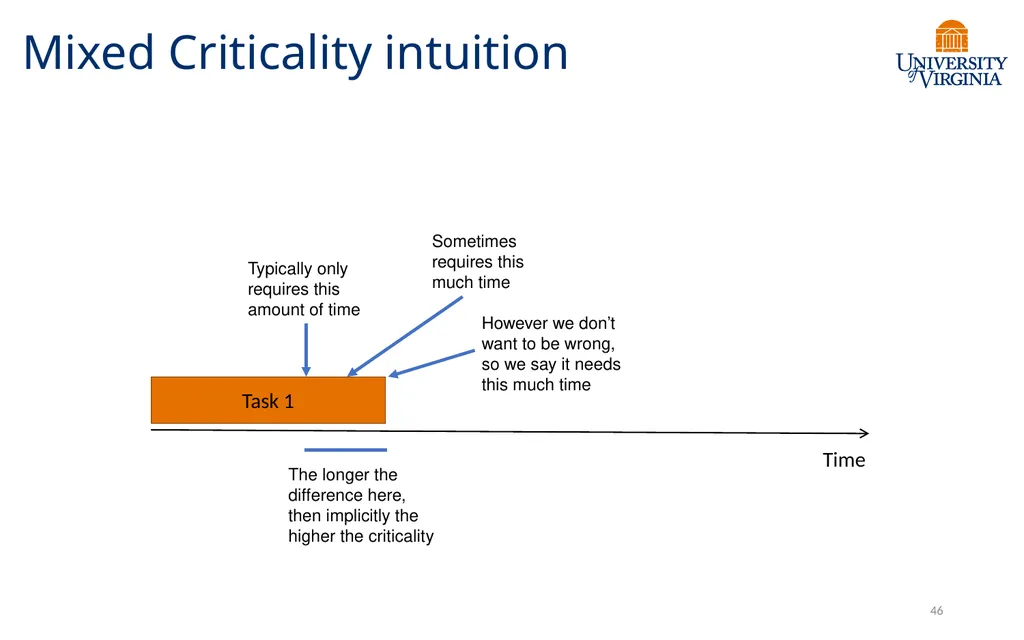
Mixed Criticality intuition 46 Task 1 Time Typically only requires this amount of time Sometimes requires this much time However we don’t want to be wrong, so we say it needs this much time The longer the difference here, then implicitly the higher the criticality<br>
47
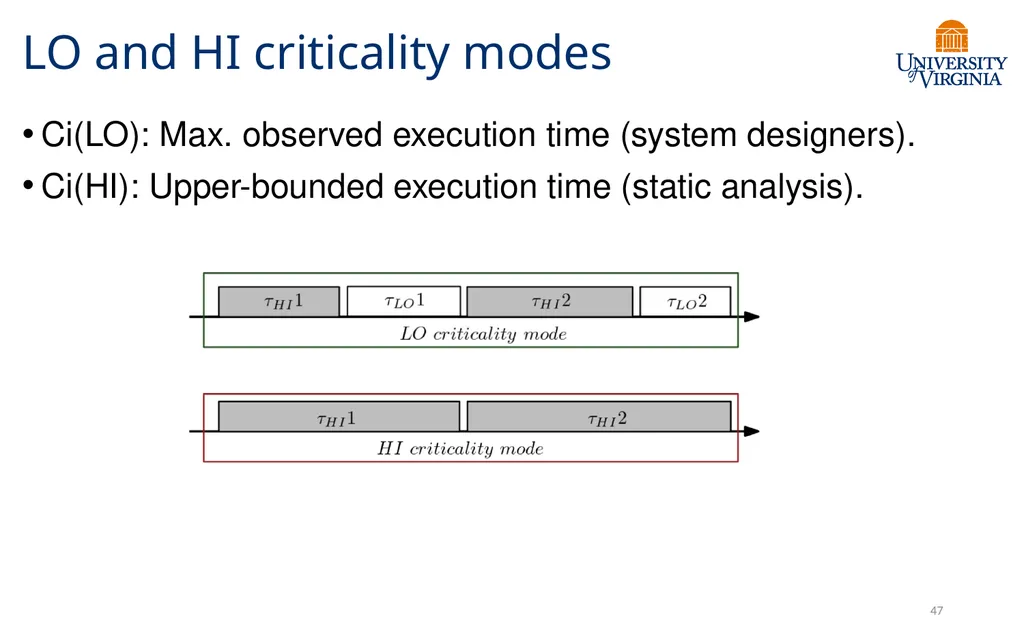
LO and HI criticality modes Ci(LO): Max. observed execution time (system designers).
Ci(HI): Upper-bounded execution time (static analysis). 47<br>
Ci(HI): Upper-bounded execution time (static analysis). 47<br>
48
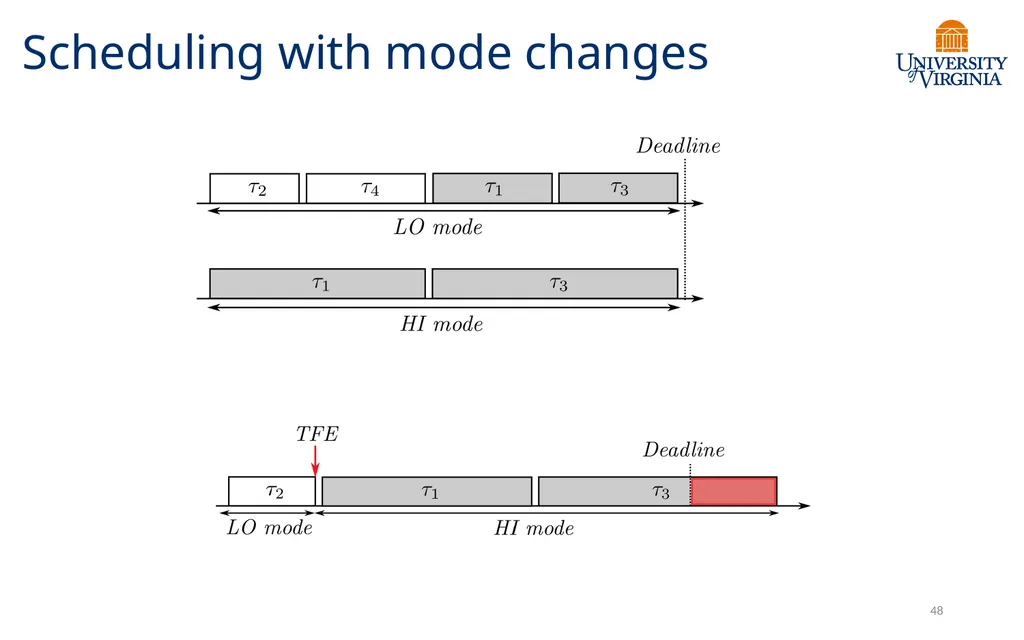
Scheduling with mode changes 48<br>
49
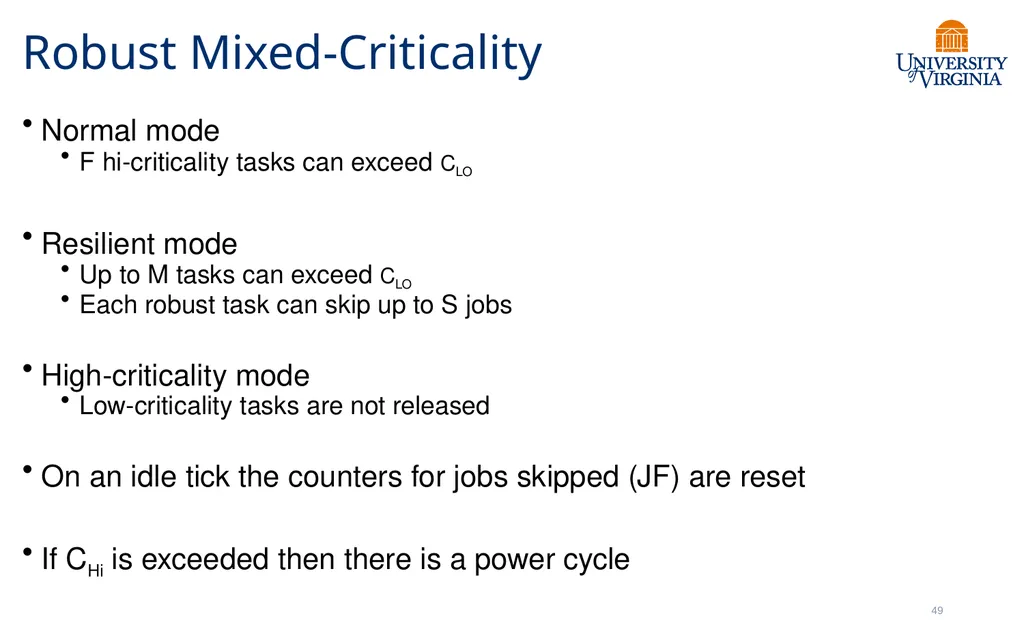
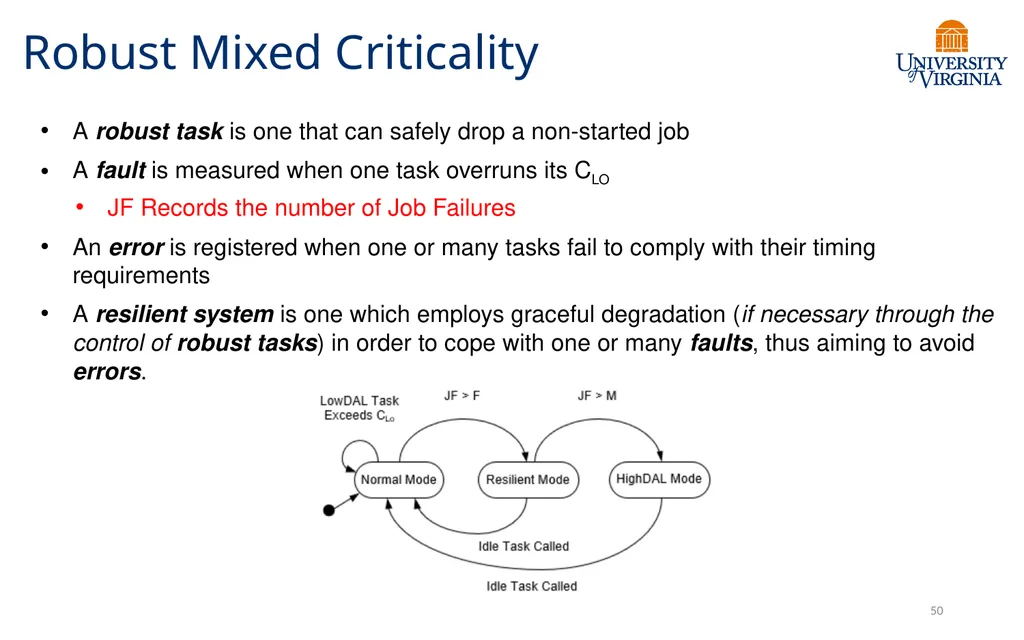
Robust Mixed-Criticality Normal mode
F hi-criticality tasks can exceed CLO
Resilient mode
Up to M tasks can exceed CLO
Each robust task can skip up to S jobs
High-criticality mode
Low-criticality tasks are not released
On an idle tick the counters for jobs skipped (JF) are reset
If CHi is exceeded then there is a power cycle 49<br>
F hi-criticality tasks can exceed CLO
Resilient mode
Up to M tasks can exceed CLO
Each robust task can skip up to S jobs
High-criticality mode
Low-criticality tasks are not released
On an idle tick the counters for jobs skipped (JF) are reset
If CHi is exceeded then there is a power cycle 49<br>
50
Robust Mixed Criticality A robust task is one that can safely drop a non-started job
A fault is measured when one task overruns its CLO
JF Records the number of Job Failures
An error is registered when one or many tasks fail to comply with their timing requirements
A resilient system is one which employs graceful degradation (if necessary through the control of robust tasks) in order to cope with one or many faults, thus aiming to avoid errors. 50<br>
A fault is measured when one task overruns its CLO
JF Records the number of Job Failures
An error is registered when one or many tasks fail to comply with their timing requirements
A resilient system is one which employs graceful degradation (if necessary through the control of robust tasks) in order to cope with one or many faults, thus aiming to avoid errors. 50<br>
51
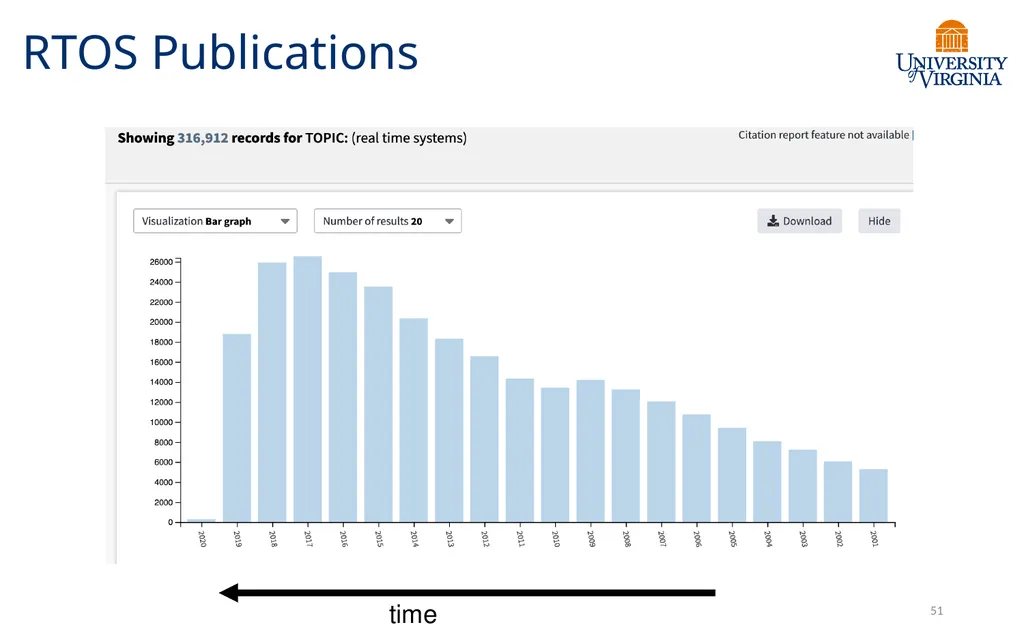
RTOS Publications 51 time<br>