
CSE 374 Programming Concepts & Tools Hal Perkins

Description: CSE 374 Programming Concepts Tools Hal Perkins Fall 2015 Lecture 1 Course Introduction Welcome! We have 10 weeks to move to a level well above novice programmer: Command-line toolsscripts to automate tasks C programming (lower level
Related Topics
Download Presentation
"CSE 374 Programming Concepts & Tools Hal Perkins" is the property of its rightful owner. Permission is granted to download and print the materials on this website for personal, non-commercial use only, and to display it on your personal computer provided you do not modify the materials and that you retain all copyright notices contained in the materials. By downloading content from our website, you accept the terms of this agreement.
Presentation Transcript
slide1. CSE 374
Programming Concepts & Tools Hal Perkins
Fall 2015
Lecture 1 – Course Introduction<br>
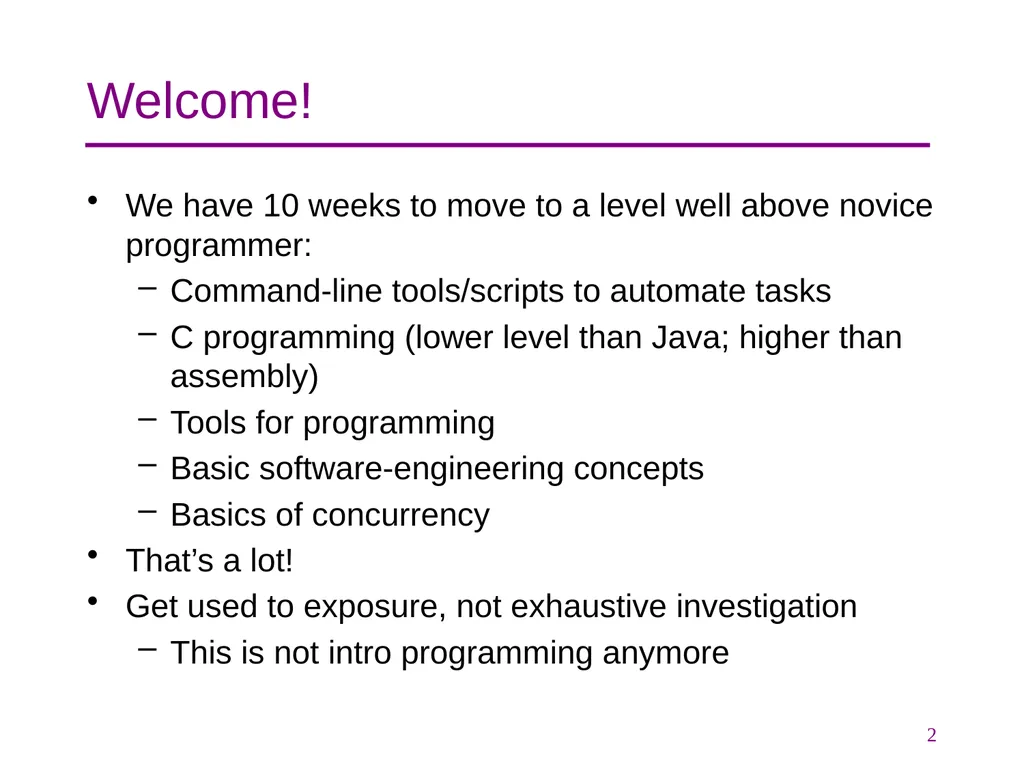
slide2. Welcome! We have 10 weeks to move to a level well above novice programmer:
Command-line tools/scripts to automate tasks
C programming (lower level than Java; higher than assembly)
Tools for programming
Basic software-engineering concepts
Basics of concurrency
That’s a lot!
Get used to exposure, not exhaustive investigation
This is not intro programming anymore 2<br>
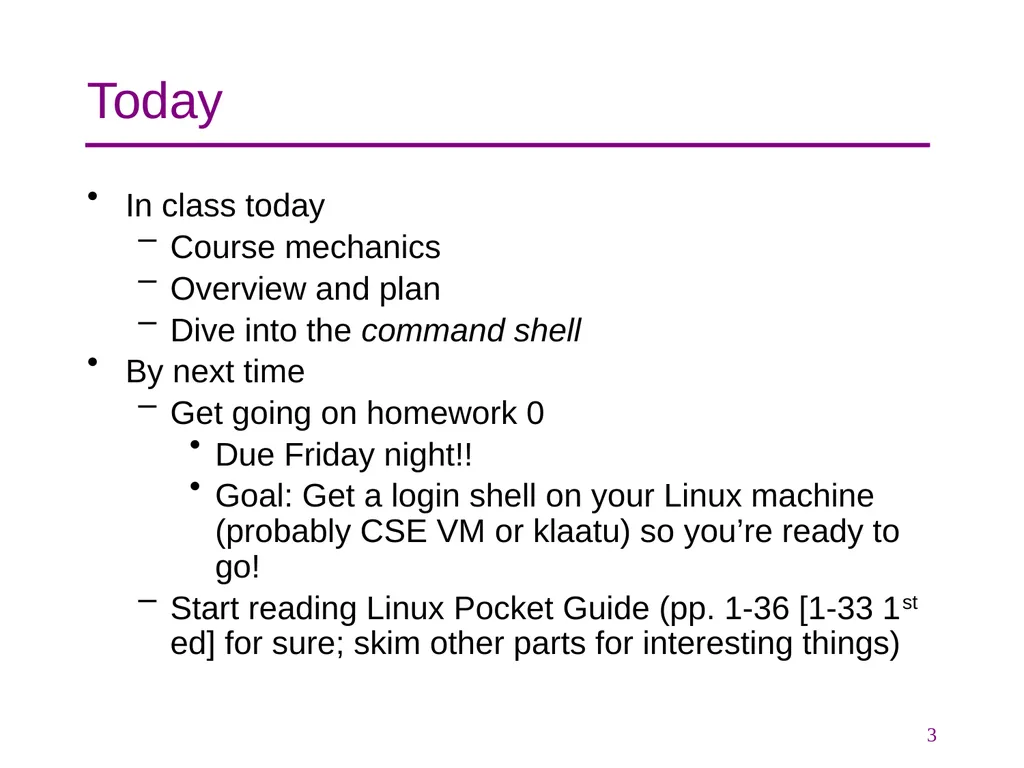
slide3. Today In class today
Course mechanics
Overview and plan
Dive into the command shell
By next time
Get going on homework 0
Due Friday night!!
Goal: Get a login shell on your Linux machine (probably CSE VM or klaatu) so you’re ready to go!
Start reading Linux Pocket Guide (pp. 1-36 [1-33 1st ed] for sure; skim other parts for interesting things) 3<br>
slide4. Who Staff
Hal Perkins, instructor
Irene Liu
Kuikui Liu
Josh Nazarian
Soumya Vasisht
Jack Zhang
Office hours posted now. Use them to get “unstuck” so you can make progress on your own.
You!
Over 70 people(!)
Who has used Linux before?
Who has written a C program before?
Beyond hello world? 4<br>
slide5. If you’re trying to add the course… Watch for positions to open up in the next couple of days as people adjust their schedules
Fill out the online “I went to the first lecture and want to add the class” form
Instructions at the end of class 5<br>
slide6. What 3 classes/week (slides, code, demos, questions)
Material online (often after class), but TAKE NOTES!
Advice: jot down keywords and ideas; look up details later
Advice: use class for concepts (you can do this); use documentation for details (how)
Advice: experiment, try things later that day
Warning: the slides are not nearly enough to learn everything you need. They are an outline, tour guide, orientation only. 6<br>
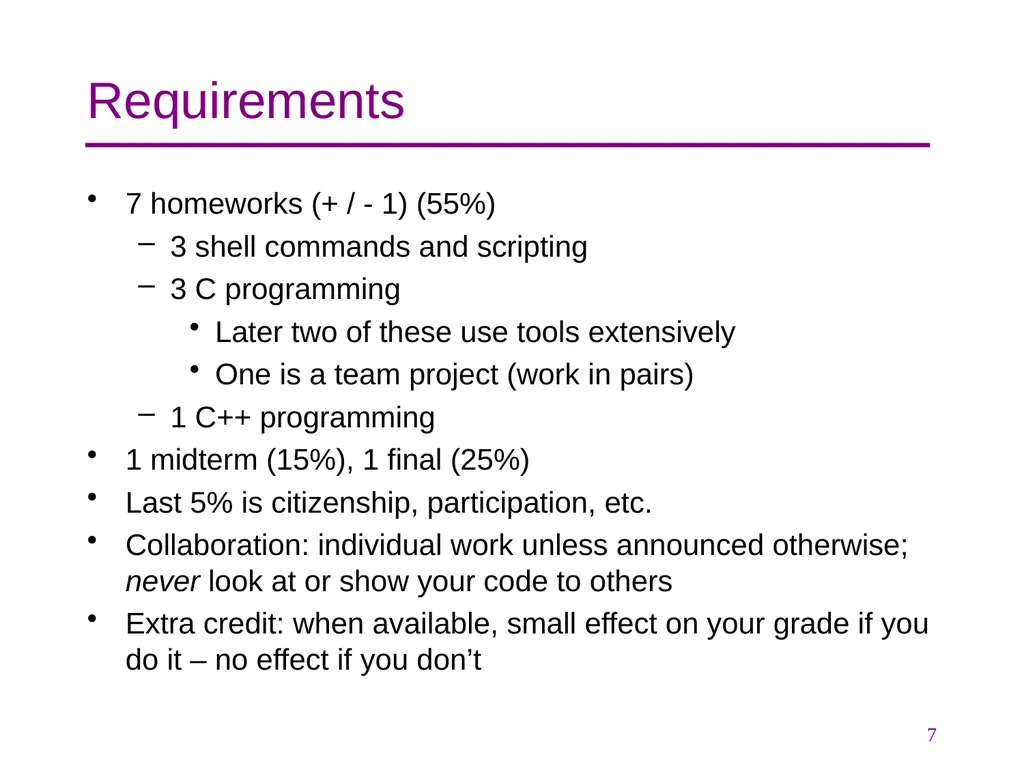
slide7. Requirements 7 homeworks (+ / - 1) (55%)
3 shell commands and scripting
3 C programming
Later two of these use tools extensively
One is a team project (work in pairs)
1 C++ programming
1 midterm (15%), 1 final (25%)
Last 5% is citizenship, participation, etc.
Collaboration: individual work unless announced otherwise; never look at or show your code to others
Extra credit: when available, small effect on your grade if you do it – no effect if you don’t 7<br>
slide8. Academic Integrity Policy on the course web. Read it!
Do your own work – always explain any unconventional action on your part
I trust you completely
I have no sympathy for trust violations – nor should you
Honest work is the most important feature of a university. It shows respect for your colleagues and yourself. 8<br>
slide9. Deadlines Turn things in on time!
But things happen, so …
You have 4 late days to use this quarter
No more than 2 late days per assignment
Counted in 24 hour chunks (10 min = 24 hours)
On group projects, can only use if both partners have late days and both partners are charged
That’s it. No other extensions (but contact instructor if you are hospitalized)
Advice: Save late days for the end of quarter when you (might) really need them 9<br>
slide10. What to Expect Assignments may be less structured than you’re used to
“Write a program that does this”
You need to figure out if you’re getting the right output
Usually no “sample solution” to compare with
Learning how to deal with this is part of the plan
Learning how to learn things is part of the plan
Learn your way around man pages, books, online documents (Google is your friend – but only one of them)
But don’t just cut-n-paste code to “get it to work”
You must understand why your code does what it does, and be able to explain it!
Tinker – try things. Write toy programs
The course is much harder if you only do the assigned work
Don’t avoid learning new tools 10<br>
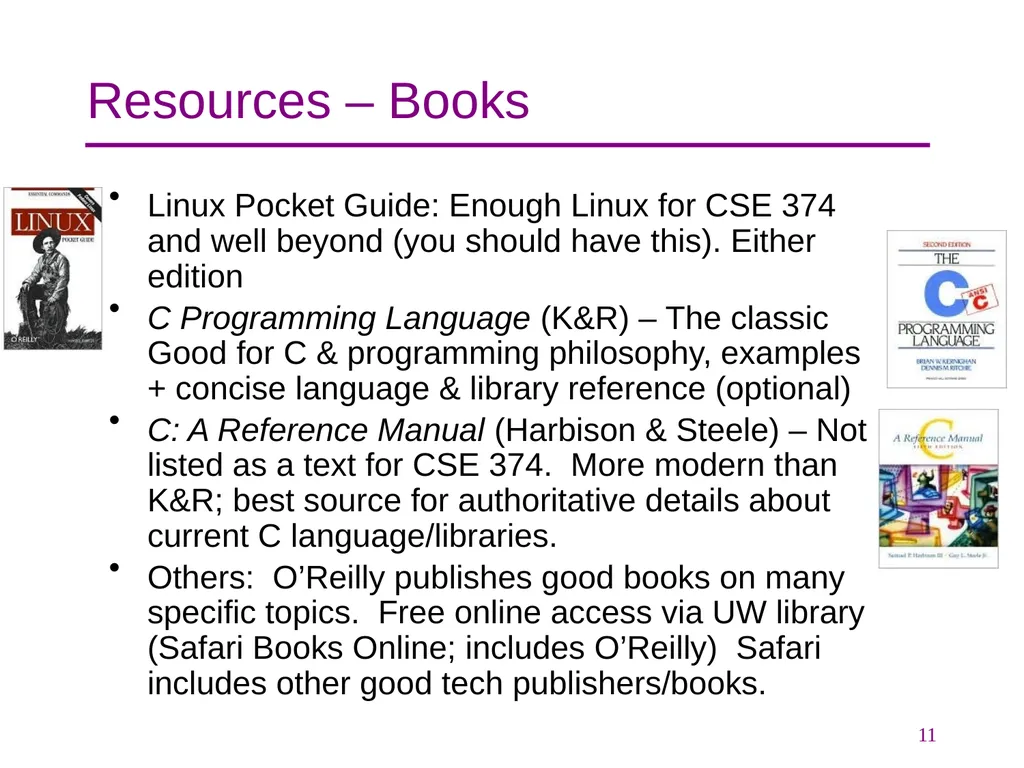
slide11. Resources – Books Linux Pocket Guide: Enough Linux for CSE 374 and well beyond (you should have this). Either edition
C Programming Language (K&R) – The classic Good for C & programming philosophy, examples + concise language & library reference (optional)
C: A Reference Manual (Harbison & Steele) – Not listed as a text for CSE 374. More modern than K&R; best source for authoritative details about current C language/libraries.
Others: O’Reilly publishes good books on many specific topics. Free online access via UW library (Safari Books Online; includes O’Reilly) Safari includes other good tech publishers/books. 11<br>
slide12. Books? In the 21st Century?? Why not just use Google, Stack Overflow, Reddit, Quora, …?
Web-search good for:
Quick reference (What is the name of the function that does …? What are its parameters?)
Links to a good reference
(can be) Bad for:
Why does it work this way?
What is the intended use?
How does my issue fit into the bigger picture?
Beware:
Random code blobs cut-and-paste into your code (why does it work? what does it do?)
This inscrutable incantation solved my problem on an unstated version for no known reason 12<br>
slide13. So What is CSE 374? Something of a “laundry list of everything else”, but…
There is an amorphous set of things computer scientists know about and novice programmers don’t. Knowing them empowers you in computing, lessens the “friction” of learning in other classes, and makes you a mature programmer.
The goal is to give you a sense of what’s out there and what you can expect – and how you can learn more later when you need to 13<br>
slide14. 5 General Areas The command line
Text-based manipulation of the computing environment
Automating (scripting) this manipulation
Using powerful utility programs
Let the computer do what it’s good at so you don’t have to!
We’ll use Linux (an operating system) and bash (a shell) – but the concepts are not tied to these
Idea: Knowing the name of what “ought to exist”
Idea: Programming in a language designed for interaction 14<br>
slide15. 5 General Areas C (and a little C++)
“The” programming language for operating systems, networking, embedded devices, …
Manual resource management
Trust the programmer: a “correct” C implementation will run a program with an array-bounds error and whatever happens, happens
A “lower level” view of programming: all code and data sits together in a “big array of bits”
Idea: Parts look like Java – don’t let that deceive you!
Idea: Learn to think before you write, and test often 15<br>
slide16. 5 General Areas Programming tools – so far you have written programs and run them. There are programs for programming you should know about:
Compilers (vs interpreters)
Debuggers
Linkers
Recompilation managers
Version-control systems
Profilers
… 16<br>
slide17. 5 General Areas Software development concepts – what do you need to know to write a million lines of code*?
Testing strategies
Team-programming concepts
Software specifications and their limits
…
*No, you will not write a million lines of code for CSE 374 this quarter, although it may seem like it at times… 17<br>
slide18. 5 General Areas Basics of concurrency – what happens when more than one thing can happen at once in a program?
Brand-new kinds of bugs (e.g., races)
Approaches to synchronization
And it matters – most computers you can buy have (at least) 2 processors
How do we run enough stuff concurrently to keep all the processors busy? 18<br>
slide19. Perspective “There is more to programming than Java methods”
“There is more to software development than programming”
“There is more to computer science than software development”
So let’s get started. . . 19<br>
slide20. The O/S, the Filesystem, the Shell Some things you might have a sense of but never were told precisely (may as well start at the beginning). . .
The file-system is a tree
(Actually it’s a dag)
The top is /
Interior nodes are directories (displayed as folders in GUIs)
Users log-in, which for Linux means getting a shell
They have permissions to access certain files/directories
They have a “home directory” somewhere in the file-system
They can run programs. A running program is a process. (Actually could be more than one.) 20<br>
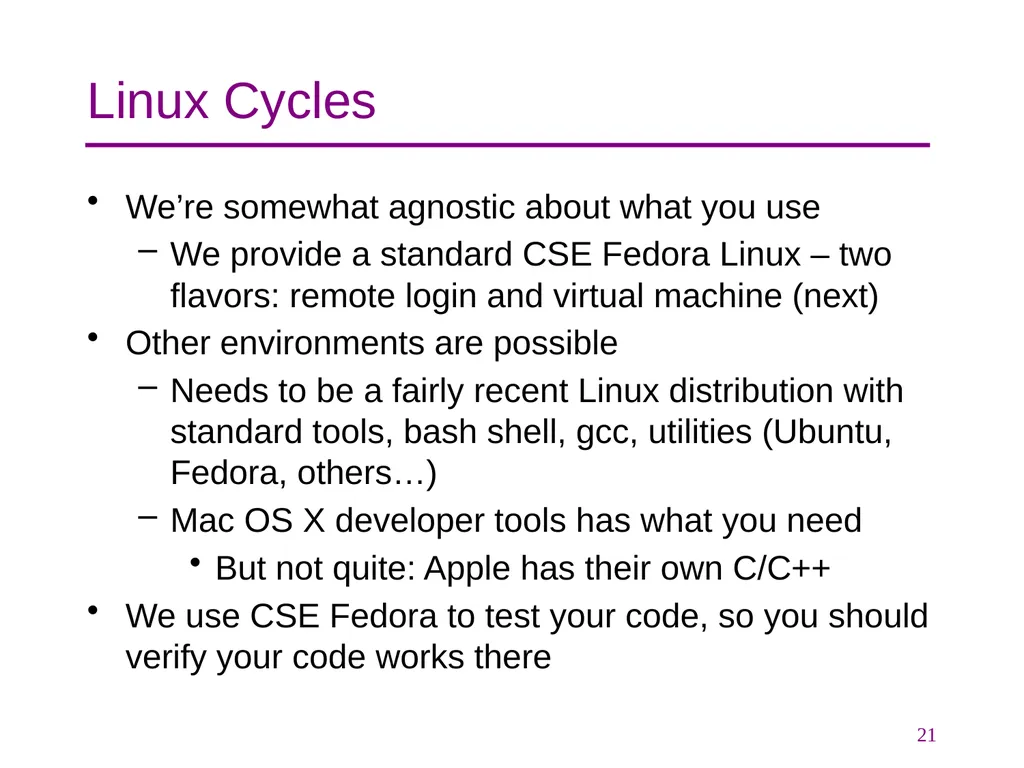
slide21. Linux Cycles We’re somewhat agnostic about what you use
We provide a standard CSE Fedora Linux – two flavors: remote login and virtual machine (next)
Other environments are possible
Needs to be a fairly recent Linux distribution with standard tools, bash shell, gcc, utilities (Ubuntu, Fedora, others…)
Mac OS X developer tools has what you need
But not quite: Apple has their own C/C++
We use CSE Fedora to test your code, so you should verify your code works there 21<br>
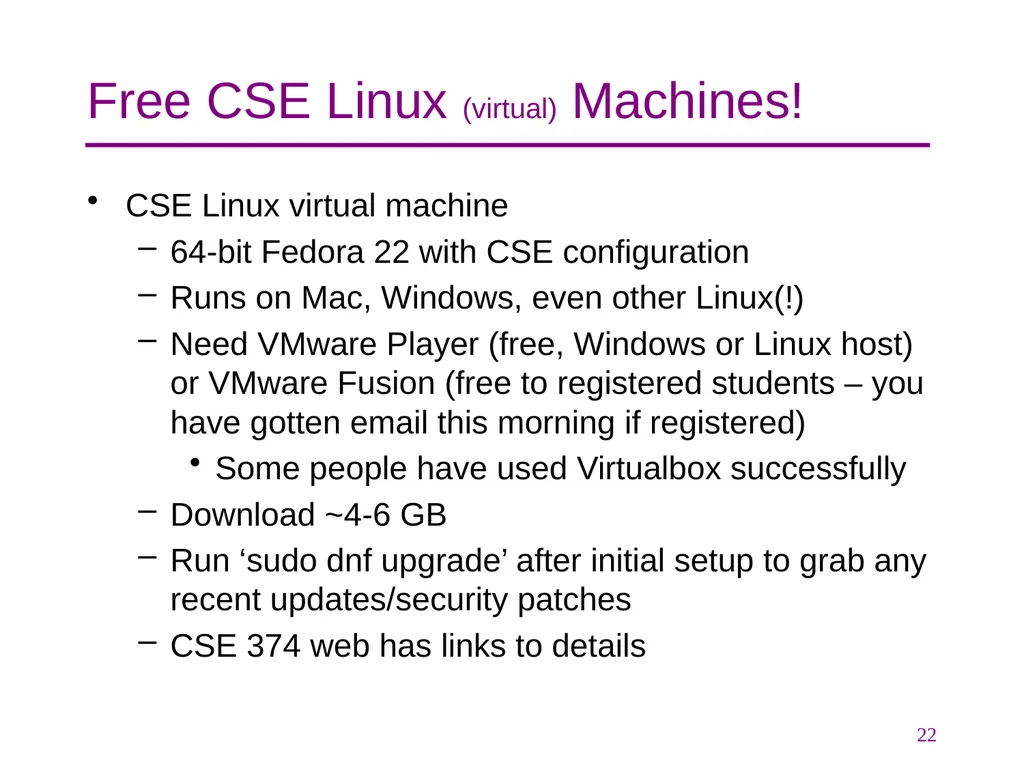
slide22. Free CSE Linux (virtual) Machines! CSE Linux virtual machine
64-bit Fedora 22 with CSE configuration
Runs on Mac, Windows, even other Linux(!)
Need VMware Player (free, Windows or Linux host) or VMware Fusion (free to registered students – you have gotten email this morning if registered)
Some people have used Virtualbox successfully
Download ~4-6 GB
Run ‘sudo dnf upgrade’ after initial setup to grab any recent updates/security patches
CSE 374 web has links to details 22<br>
slide23. UW CSE Linux Virtual Machine Startup
Configure user account name and user/superuser passwords
Shell window
Demo 23<br>
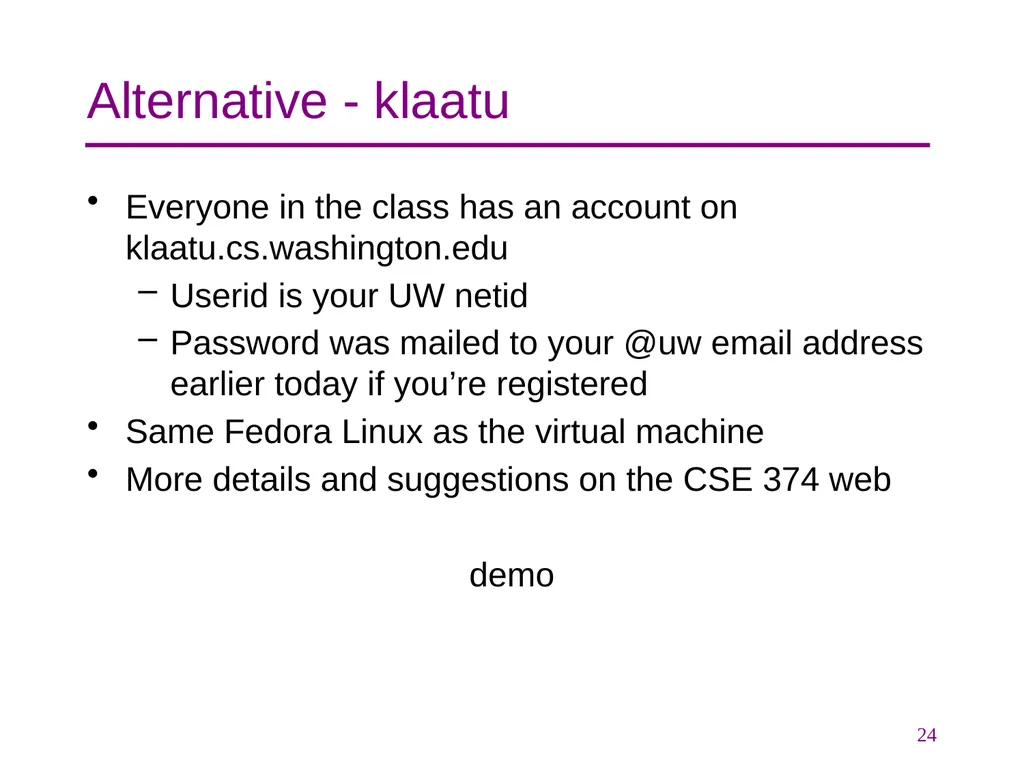
slide24. Alternative - klaatu Everyone in the class has an account on klaatu.cs.washington.edu
Userid is your UW netid
Password was mailed to your @uw email address earlier today if you’re registered
Same Fedora Linux as the virtual machine
More details and suggestions on the CSE 374 web
demo 24<br>
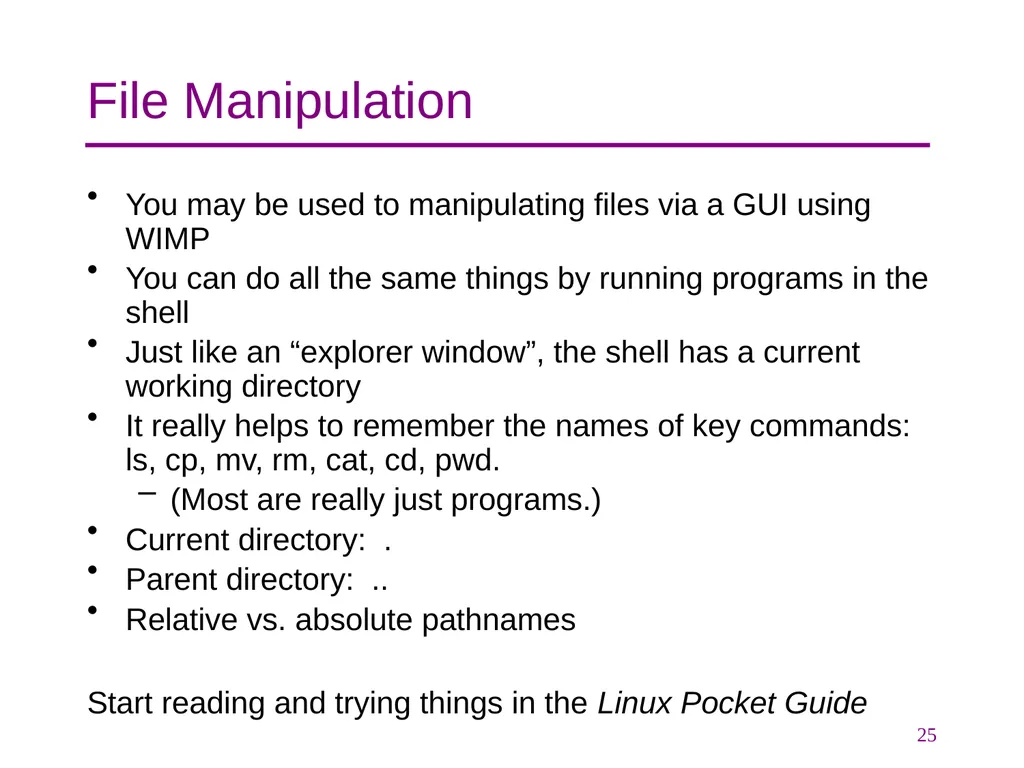
slide25. File Manipulation You may be used to manipulating files via a GUI using WIMP
You can do all the same things by running programs in the shell
Just like an “explorer window”, the shell has a current working directory
It really helps to remember the names of key commands: ls, cp, mv, rm, cat, cd, pwd.
(Most are really just programs.)
Current directory: .
Parent directory: ..
Relative vs. absolute pathnames
Start reading and trying things in the Linux Pocket Guide 25<br>
slide26. What? Why would anyone want to interact like this?
Old people who remember life before GUIs :-)
Power users who can go faster
Users who want easy logging
Users who want easy instructions
Users who want programmability (scripting!)
The last one will be the core of the first assignments
Most computer scientists use GUIs and shells, depending what they’re doing.
Linux has GUIs and Windows has shells 26<br>
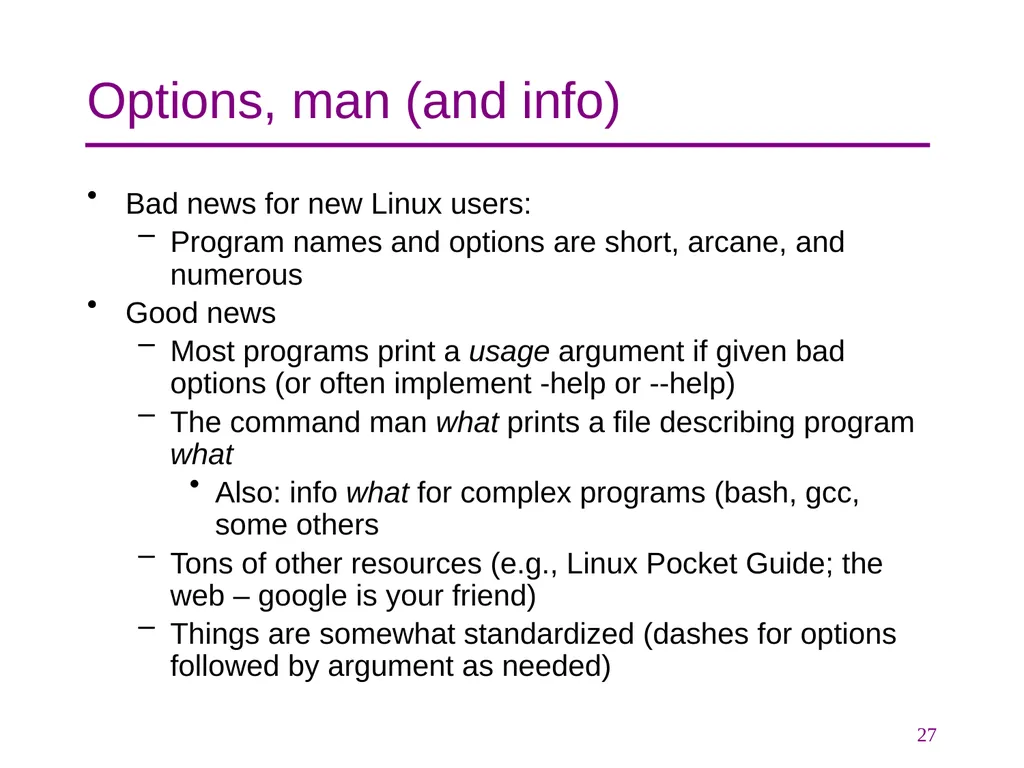
slide27. Options, man (and info) Bad news for new Linux users:
Program names and options are short, arcane, and numerous
Good news
Most programs print a usage argument if given bad options (or often implement -help or --help)
The command man what prints a file describing program what
Also: info what for complex programs (bash, gcc, some others
Tons of other resources (e.g., Linux Pocket Guide; the web – google is your friend)
Things are somewhat standardized (dashes for options followed by argument as needed) 27<br>
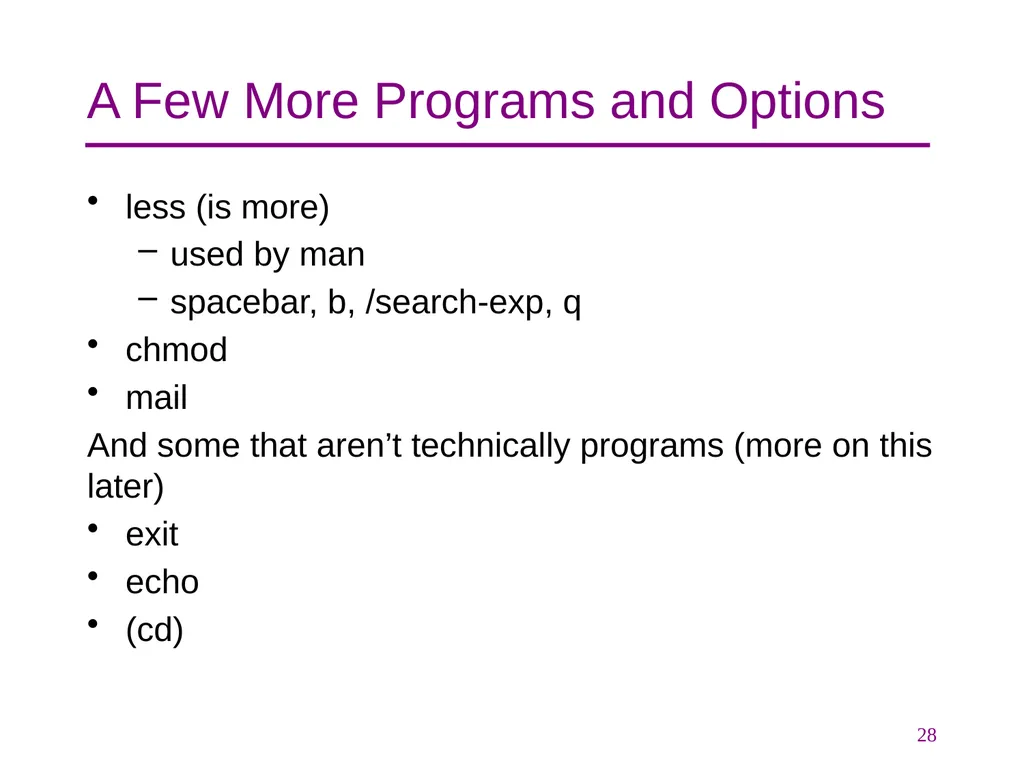
slide28. A Few More Programs and Options less (is more)
used by man
spacebar, b, /search-exp, q
chmod
mail
And some that aren’t technically programs (more on this later)
exit
echo
(cd) 28<br>
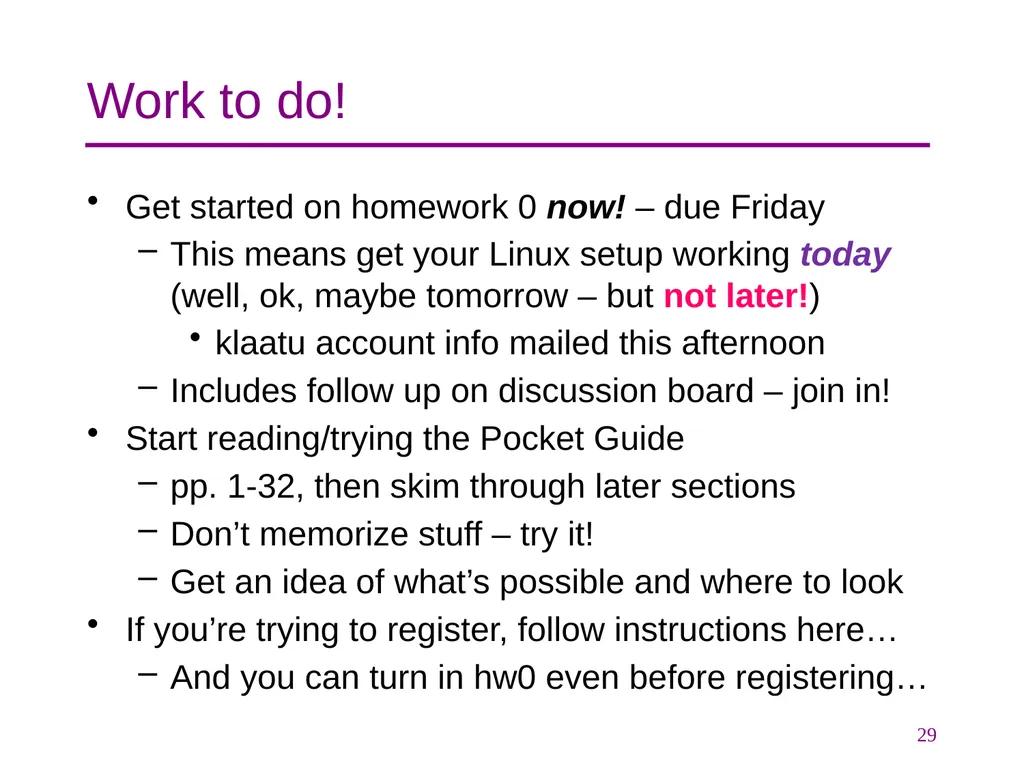
slide29. Work to do! Get started on homework 0 now! – due Friday
This means get your Linux setup working today (well, ok, maybe tomorrow – but not later!)
klaatu account info mailed this afternoon
Includes follow up on discussion board – join in!
Start reading/trying the Pocket Guide
pp. 1-32, then skim through later sections
Don’t memorize stuff – try it!
Get an idea of what’s possible and where to look
If you’re trying to register, follow instructions here…
And you can turn in hw0 even before registering… 29<br>
Fall 2015
Lecture 1 – Course Introduction<br>
slide2. Welcome! We have 10 weeks to move to a level well above novice programmer:
Command-line tools/scripts to automate tasks
C programming (lower level than Java; higher than assembly)
Tools for programming
Basic software-engineering concepts
Basics of concurrency
That’s a lot!
Get used to exposure, not exhaustive investigation
This is not intro programming anymore 2<br>
slide3. Today In class today
Course mechanics
Overview and plan
Dive into the command shell
By next time
Get going on homework 0
Due Friday night!!
Goal: Get a login shell on your Linux machine (probably CSE VM or klaatu) so you’re ready to go!
Start reading Linux Pocket Guide (pp. 1-36 [1-33 1st ed] for sure; skim other parts for interesting things) 3<br>
slide4. Who Staff
Hal Perkins, instructor
Irene Liu
Kuikui Liu
Josh Nazarian
Soumya Vasisht
Jack Zhang
Office hours posted now. Use them to get “unstuck” so you can make progress on your own.
You!
Over 70 people(!)
Who has used Linux before?
Who has written a C program before?
Beyond hello world? 4<br>
slide5. If you’re trying to add the course… Watch for positions to open up in the next couple of days as people adjust their schedules
Fill out the online “I went to the first lecture and want to add the class” form
Instructions at the end of class 5<br>
slide6. What 3 classes/week (slides, code, demos, questions)
Material online (often after class), but TAKE NOTES!
Advice: jot down keywords and ideas; look up details later
Advice: use class for concepts (you can do this); use documentation for details (how)
Advice: experiment, try things later that day
Warning: the slides are not nearly enough to learn everything you need. They are an outline, tour guide, orientation only. 6<br>
slide7. Requirements 7 homeworks (+ / - 1) (55%)
3 shell commands and scripting
3 C programming
Later two of these use tools extensively
One is a team project (work in pairs)
1 C++ programming
1 midterm (15%), 1 final (25%)
Last 5% is citizenship, participation, etc.
Collaboration: individual work unless announced otherwise; never look at or show your code to others
Extra credit: when available, small effect on your grade if you do it – no effect if you don’t 7<br>
slide8. Academic Integrity Policy on the course web. Read it!
Do your own work – always explain any unconventional action on your part
I trust you completely
I have no sympathy for trust violations – nor should you
Honest work is the most important feature of a university. It shows respect for your colleagues and yourself. 8<br>
slide9. Deadlines Turn things in on time!
But things happen, so …
You have 4 late days to use this quarter
No more than 2 late days per assignment
Counted in 24 hour chunks (10 min = 24 hours)
On group projects, can only use if both partners have late days and both partners are charged
That’s it. No other extensions (but contact instructor if you are hospitalized)
Advice: Save late days for the end of quarter when you (might) really need them 9<br>
slide10. What to Expect Assignments may be less structured than you’re used to
“Write a program that does this”
You need to figure out if you’re getting the right output
Usually no “sample solution” to compare with
Learning how to deal with this is part of the plan
Learning how to learn things is part of the plan
Learn your way around man pages, books, online documents (Google is your friend – but only one of them)
But don’t just cut-n-paste code to “get it to work”
You must understand why your code does what it does, and be able to explain it!
Tinker – try things. Write toy programs
The course is much harder if you only do the assigned work
Don’t avoid learning new tools 10<br>
slide11. Resources – Books Linux Pocket Guide: Enough Linux for CSE 374 and well beyond (you should have this). Either edition
C Programming Language (K&R) – The classic Good for C & programming philosophy, examples + concise language & library reference (optional)
C: A Reference Manual (Harbison & Steele) – Not listed as a text for CSE 374. More modern than K&R; best source for authoritative details about current C language/libraries.
Others: O’Reilly publishes good books on many specific topics. Free online access via UW library (Safari Books Online; includes O’Reilly) Safari includes other good tech publishers/books. 11<br>
slide12. Books? In the 21st Century?? Why not just use Google, Stack Overflow, Reddit, Quora, …?
Web-search good for:
Quick reference (What is the name of the function that does …? What are its parameters?)
Links to a good reference
(can be) Bad for:
Why does it work this way?
What is the intended use?
How does my issue fit into the bigger picture?
Beware:
Random code blobs cut-and-paste into your code (why does it work? what does it do?)
This inscrutable incantation solved my problem on an unstated version for no known reason 12<br>
slide13. So What is CSE 374? Something of a “laundry list of everything else”, but…
There is an amorphous set of things computer scientists know about and novice programmers don’t. Knowing them empowers you in computing, lessens the “friction” of learning in other classes, and makes you a mature programmer.
The goal is to give you a sense of what’s out there and what you can expect – and how you can learn more later when you need to 13<br>
slide14. 5 General Areas The command line
Text-based manipulation of the computing environment
Automating (scripting) this manipulation
Using powerful utility programs
Let the computer do what it’s good at so you don’t have to!
We’ll use Linux (an operating system) and bash (a shell) – but the concepts are not tied to these
Idea: Knowing the name of what “ought to exist”
Idea: Programming in a language designed for interaction 14<br>
slide15. 5 General Areas C (and a little C++)
“The” programming language for operating systems, networking, embedded devices, …
Manual resource management
Trust the programmer: a “correct” C implementation will run a program with an array-bounds error and whatever happens, happens
A “lower level” view of programming: all code and data sits together in a “big array of bits”
Idea: Parts look like Java – don’t let that deceive you!
Idea: Learn to think before you write, and test often 15<br>
slide16. 5 General Areas Programming tools – so far you have written programs and run them. There are programs for programming you should know about:
Compilers (vs interpreters)
Debuggers
Linkers
Recompilation managers
Version-control systems
Profilers
… 16<br>
slide17. 5 General Areas Software development concepts – what do you need to know to write a million lines of code*?
Testing strategies
Team-programming concepts
Software specifications and their limits
…
*No, you will not write a million lines of code for CSE 374 this quarter, although it may seem like it at times… 17<br>
slide18. 5 General Areas Basics of concurrency – what happens when more than one thing can happen at once in a program?
Brand-new kinds of bugs (e.g., races)
Approaches to synchronization
And it matters – most computers you can buy have (at least) 2 processors
How do we run enough stuff concurrently to keep all the processors busy? 18<br>
slide19. Perspective “There is more to programming than Java methods”
“There is more to software development than programming”
“There is more to computer science than software development”
So let’s get started. . . 19<br>
slide20. The O/S, the Filesystem, the Shell Some things you might have a sense of but never were told precisely (may as well start at the beginning). . .
The file-system is a tree
(Actually it’s a dag)
The top is /
Interior nodes are directories (displayed as folders in GUIs)
Users log-in, which for Linux means getting a shell
They have permissions to access certain files/directories
They have a “home directory” somewhere in the file-system
They can run programs. A running program is a process. (Actually could be more than one.) 20<br>
slide21. Linux Cycles We’re somewhat agnostic about what you use
We provide a standard CSE Fedora Linux – two flavors: remote login and virtual machine (next)
Other environments are possible
Needs to be a fairly recent Linux distribution with standard tools, bash shell, gcc, utilities (Ubuntu, Fedora, others…)
Mac OS X developer tools has what you need
But not quite: Apple has their own C/C++
We use CSE Fedora to test your code, so you should verify your code works there 21<br>
slide22. Free CSE Linux (virtual) Machines! CSE Linux virtual machine
64-bit Fedora 22 with CSE configuration
Runs on Mac, Windows, even other Linux(!)
Need VMware Player (free, Windows or Linux host) or VMware Fusion (free to registered students – you have gotten email this morning if registered)
Some people have used Virtualbox successfully
Download ~4-6 GB
Run ‘sudo dnf upgrade’ after initial setup to grab any recent updates/security patches
CSE 374 web has links to details 22<br>
slide23. UW CSE Linux Virtual Machine Startup
Configure user account name and user/superuser passwords
Shell window
Demo 23<br>
slide24. Alternative - klaatu Everyone in the class has an account on klaatu.cs.washington.edu
Userid is your UW netid
Password was mailed to your @uw email address earlier today if you’re registered
Same Fedora Linux as the virtual machine
More details and suggestions on the CSE 374 web
demo 24<br>
slide25. File Manipulation You may be used to manipulating files via a GUI using WIMP
You can do all the same things by running programs in the shell
Just like an “explorer window”, the shell has a current working directory
It really helps to remember the names of key commands: ls, cp, mv, rm, cat, cd, pwd.
(Most are really just programs.)
Current directory: .
Parent directory: ..
Relative vs. absolute pathnames
Start reading and trying things in the Linux Pocket Guide 25<br>
slide26. What? Why would anyone want to interact like this?
Old people who remember life before GUIs :-)
Power users who can go faster
Users who want easy logging
Users who want easy instructions
Users who want programmability (scripting!)
The last one will be the core of the first assignments
Most computer scientists use GUIs and shells, depending what they’re doing.
Linux has GUIs and Windows has shells 26<br>
slide27. Options, man (and info) Bad news for new Linux users:
Program names and options are short, arcane, and numerous
Good news
Most programs print a usage argument if given bad options (or often implement -help or --help)
The command man what prints a file describing program what
Also: info what for complex programs (bash, gcc, some others
Tons of other resources (e.g., Linux Pocket Guide; the web – google is your friend)
Things are somewhat standardized (dashes for options followed by argument as needed) 27<br>
slide28. A Few More Programs and Options less (is more)
used by man
spacebar, b, /search-exp, q
chmod
And some that aren’t technically programs (more on this later)
exit
echo
(cd) 28<br>
slide29. Work to do! Get started on homework 0 now! – due Friday
This means get your Linux setup working today (well, ok, maybe tomorrow – but not later!)
klaatu account info mailed this afternoon
Includes follow up on discussion board – join in!
Start reading/trying the Pocket Guide
pp. 1-32, then skim through later sections
Don’t memorize stuff – try it!
Get an idea of what’s possible and where to look
If you’re trying to register, follow instructions here…
And you can turn in hw0 even before registering… 29<br>