
CSE341: Programming Languages Lecture 1 Course
Description: CSE341: Programming Languages Lecture 1 Course Mechanics ML Variable Bindings Dan Grossman Winter 2013 Welcome! We have 10 weeks to learn the fundamental concepts of programming languages With hard work, patience, and an open mind, this
Related Topics
Download Presentation
"CSE341: Programming Languages Lecture 1 Course" is the property of its rightful owner. Permission is granted to download and print the materials on this website for personal, non-commercial use only, and to display it on your personal computer provided you do not modify the materials and that you retain all copyright notices contained in the materials. By downloading content from our website, you accept the terms of this agreement.
Presentation Transcript
slide1. CSE341: Programming Languages
Lecture 1
Course Mechanics
ML Variable Bindings Dan Grossman
Winter 2013<br>
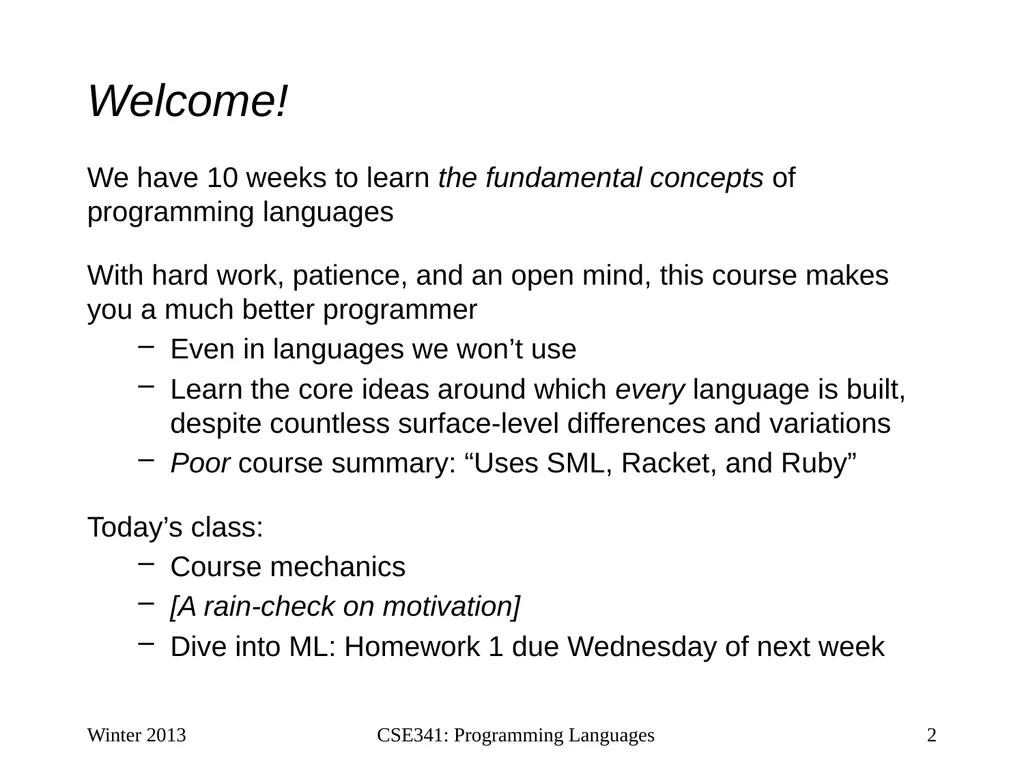
slide2. Welcome! We have 10 weeks to learn the fundamental concepts of programming languages
With hard work, patience, and an open mind, this course makes you a much better programmer
Even in languages we won’t use
Learn the core ideas around which every language is built, despite countless surface-level differences and variations
Poor course summary: “Uses SML, Racket, and Ruby”
Today’s class:
Course mechanics
[A rain-check on motivation]
Dive into ML: Homework 1 due Wednesday of next week Winter 2013 2 CSE341: Programming Languages<br>
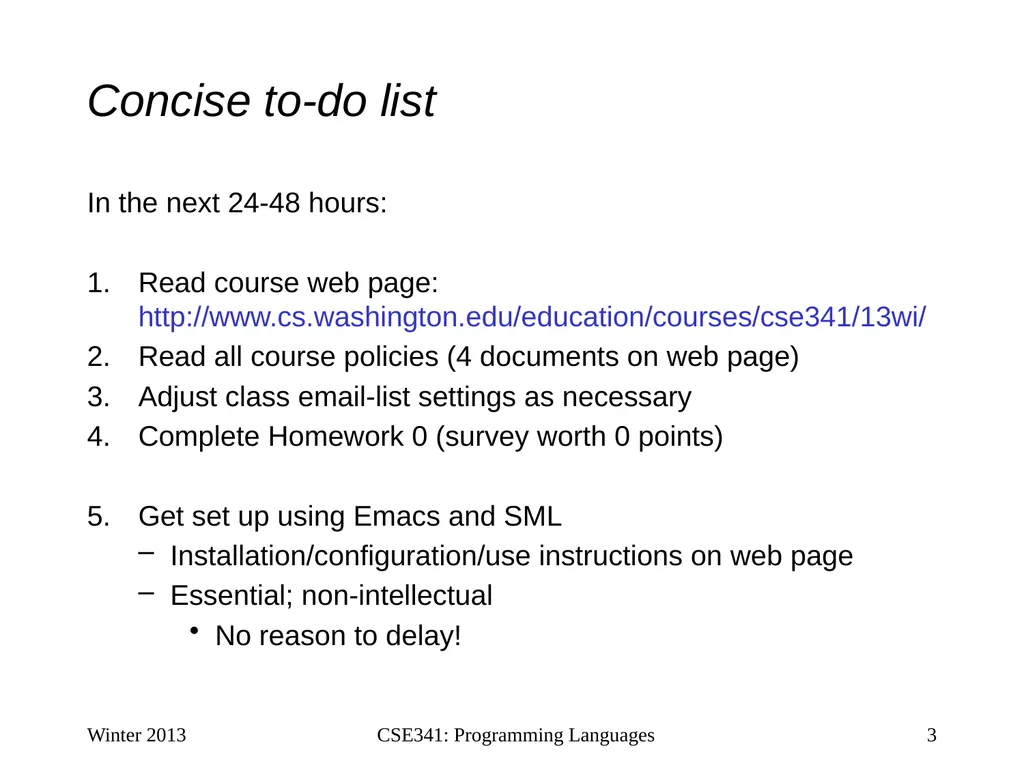
slide3. Concise to-do list In the next 24-48 hours:
Read course web page: http://www.cs.washington.edu/education/courses/cse341/13wi/
Read all course policies (4 documents on web page)
Adjust class email-list settings as necessary
Complete Homework 0 (survey worth 0 points)
Get set up using Emacs and SML
Installation/configuration/use instructions on web page
Essential; non-intellectual
No reason to delay! Winter 2013 3 CSE341: Programming Languages<br>
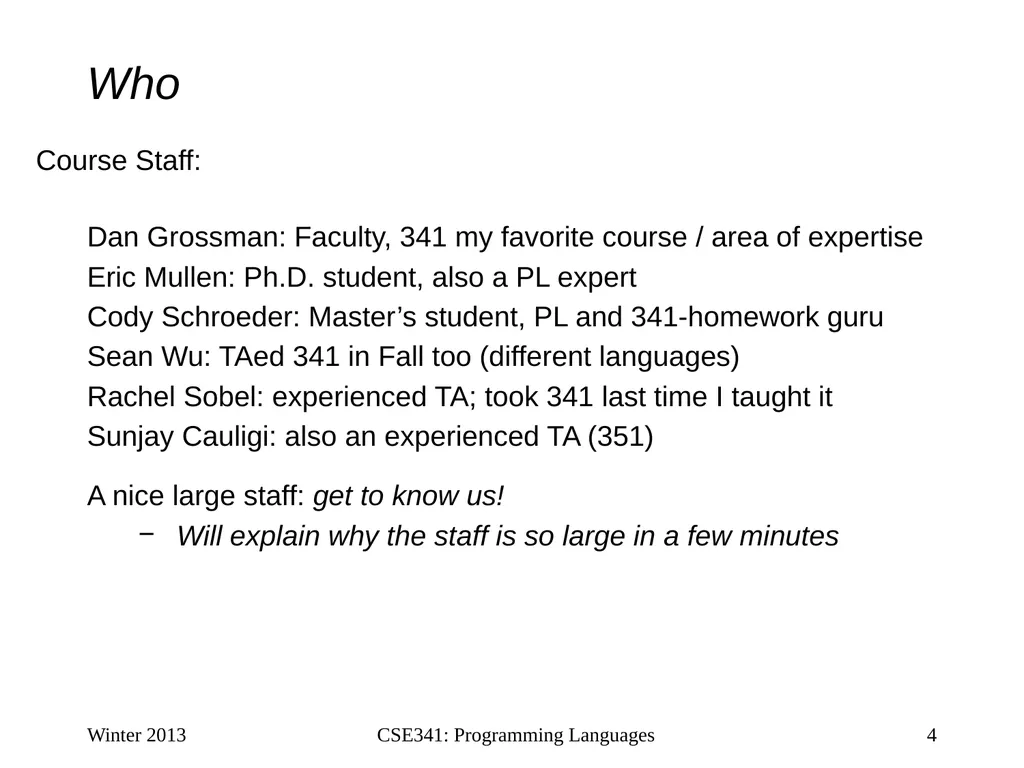
slide4. Who Course Staff: Winter 2013 4 CSE341: Programming Languages Dan Grossman: Faculty, 341 my favorite course / area of expertise
Eric Mullen: Ph.D. student, also a PL expert
Cody Schroeder: Master’s student, PL and 341-homework guru
Sean Wu: TAed 341 in Fall too (different languages)
Rachel Sobel: experienced TA; took 341 last time I taught it
Sunjay Cauligi: also an experienced TA (351)
A nice large staff: get to know us!
Will explain why the staff is so large in a few minutes<br>
slide5. Staying in touch Course email list: cse341a_wi13@u.washington.edu
Students and staff already subscribed
You must get announcements sent there
Fairly low traffic
Course staff: cse341-staff@cs.washington.edu plus individual emails
Message Board
For appropriate discussions; TAs will monitor
Optional, won’t use for important announcements
Anonymous feedback link on webpage
For good and bad: If you don’t tell me, I don’t know Winter 2013 5 CSE341: Programming Languages<br>
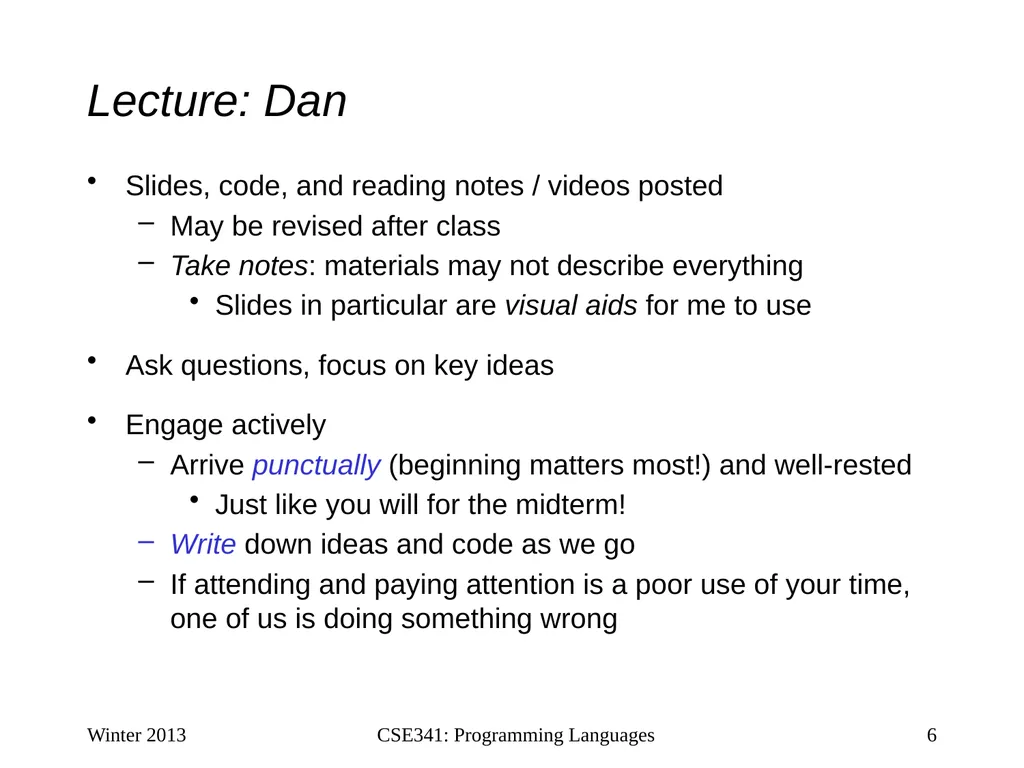
slide6. Lecture: Dan Slides, code, and reading notes / videos posted
May be revised after class
Take notes: materials may not describe everything
Slides in particular are visual aids for me to use
Ask questions, focus on key ideas
Engage actively
Arrive punctually (beginning matters most!) and well-rested
Just like you will for the midterm!
Write down ideas and code as we go
If attending and paying attention is a poor use of your time, one of us is doing something wrong Winter 2013 6 CSE341: Programming Languages<br>
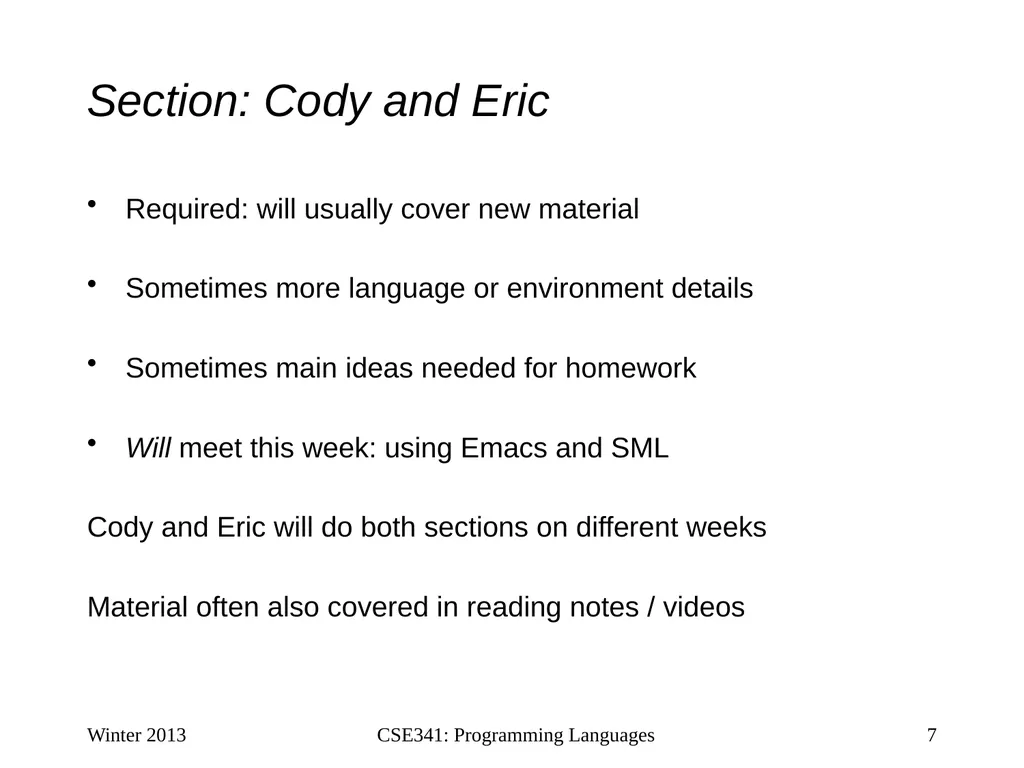
slide7. Section: Cody and Eric Required: will usually cover new material
Sometimes more language or environment details
Sometimes main ideas needed for homework
Will meet this week: using Emacs and SML
Cody and Eric will do both sections on different weeks
Material often also covered in reading notes / videos Winter 2013 7 CSE341: Programming Languages<br>
slide8. Reading Notes and Videos Posted for each “course unit:” reading notes and videos that go over most (all?) of the material (and some extra stuff?)
So why come to class?
Because having these materials lets us make class-time much more useful
Answer your questions without being rushed because occasionally “didn’t get to X; read about it”
Can point to occasional optional topics/videos
Can try different things in class, not just recite things Winter 2013 8 CSE341: Programming Languages<br>
slide9. Textbooks, or lack thereof Will treat the “textbooks” as optional, useful references
Look up details you want/need to know, but often in free online resources too
Can provide good second explanations, but (because!) they often take a fairly different approach
If “Dan’s view” confuses you, lecture, reading notes, and video might all confuse you
Some topics aren’t in the texts
Don’t be surprised when I essentially ignore the texts
List on web page what sections are most relevant
Some but maybe not all of you will do fine without the texts
Would love your feedback on how they are useful Winter 2013 9 CSE341: Programming Languages<br>
slide10. Office hours Regular hours and locations on course web [soon]
Changes as necessary announced on email list
Use them
Please visit me
Ideally not just for homework questions (but that’s good too) Winter 2013 10 CSE341: Programming Languages<br>
slide11. Homework Seven total
To be done individually
Doing the homework involves:
Understanding the concepts being addressed
Writing code demonstrating understanding of the concepts
Testing your code to ensure you understand and have correct programs
“Playing around” with variations, incorrect answers, etc.
Only (2) is graded, but focusing on (2) makes homework harder
Challenge problems: Low points/difficulty ratio Winter 2013 11 CSE341: Programming Languages<br>
slide12. Note my writing style Homeworks tend to be worded very precisely and concisely
I’m a computer scientist and I write like one (a good thing!)
Technical issues deserve precise technical writing
Conciseness values your time as a reader
You should try to be precise too
Skimming or not understanding why a word or phrase was chosen can make the homework harder
By all means ask if a problem is confusing
Being confused is normal and understandable
And I may have made a mistake
Once you’re unconfused, you might agree the problem wording didn’t cause the confusion Winter 2013 12 CSE341: Programming Languages<br>
slide13. Academic Integrity Read the course policy carefully
Clearly explains how you can and cannot get/provide help on homework and projects
Always explain any unconventional action
I have promoted and enforced academic integrity since I was a freshman
Great trust with little sympathy for violations
Honest work is the most important feature of a university Winter 2013 13 CSE341: Programming Languages<br>
slide14. Exams Midterm: Friday February 8, in class
Final: Thursday March 21, 8:30-10:20
Yes, late in finals week
Yes, you have to be here
No, this was not my choice
Same concepts, but different format from homework
More conceptual (but write code too)
Will post old exams
Closed book/notes, but you bring one sheet with whatever you want on it Winter 2013 14 CSE341: Programming Languages<br>
slide15. Coursera (more info in document) Course staff of 5 TAs because we are also running a free, online version of the course for thousands of people around the world
Starts next week
You are not allowed to participate in that class!
Do not web-search related to homework problems!
This should have little impact on you
Two courses are separate
341 is a great class and staff is committed to this offering being the best ever
But this is an exciting new thing you are likely curious about… Winter 2013 15 CSE341: Programming Languages<br>
slide16. More Coursera Why are we doing this?
Dan’s answers:
Have more impact (like a textbook)
Experiment with where higher-ed might be going
CSE / UW answers: Gain experience, be leaders
So why are you paying tuition?
Personal attention from humans
Homeworks/exams with open-ended questions
Class will adjust as needed
We can be sure you actually learned
Course is part of a coherent curriculum
Beyond the classroom: job fairs, advisors, social, … Winter 2013 16 CSE341: Programming Languages<br>
slide17. Will Coursera help/hurt 341? The risk for 341 is the staff (me) will be distracted, overburdened, and on 2 schedules
We hope not!
There are benefits too
The videos
More office hours
More robust grading scripts
Easier software installation (new SML Mode)
Taking the “VIP version” of a more well-known course Winter 2013 17 CSE341: Programming Languages<br>
slide18. Questions? Anything I forgot about course mechanics before we discuss, you know, programming languages? Winter 2013 18 CSE341: Programming Languages<br>
slide19. What this course is about Many essential concepts relevant in any programming language
And how these pieces fit together
Use ML, Racket, and Ruby languages:
They let many of the concepts “shine”
Using multiple languages shows how the same concept can “look different” or actually be slightly different
In many ways simpler than Java
Big focus on functional programming
Not using mutation (assignment statements) (!)
Using first-class functions (can’t explain that yet)
But many other topics too Winter 2013 19 CSE341: Programming Languages<br>
slide20. Why learn this? This is the “normal” place for course motivation
Why learn this material?
But in my experience, we don’t have enough shared vocabulary
So 2-week delay on motivation for functional programming
I promise full motivation: delay is worth it
(Will motivate immutable data at end of section 1) Winter 2013 20 CSE341: Programming Languages<br>
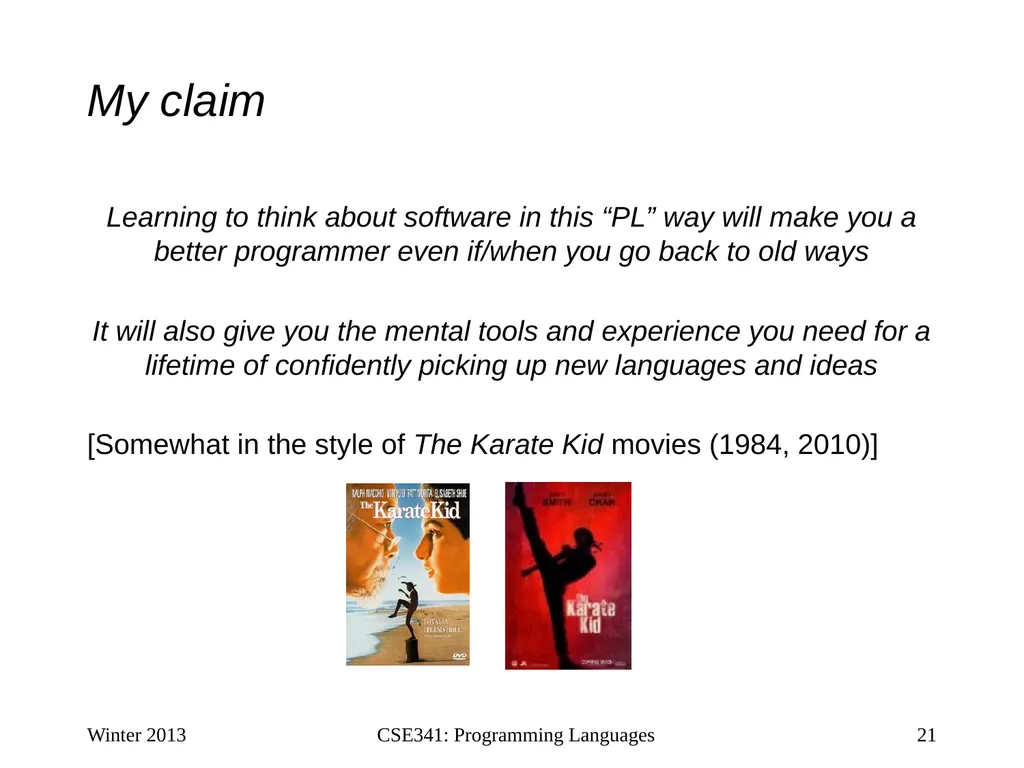
slide21. My claim Learning to think about software in this “PL” way will make you a better programmer even if/when you go back to old ways
It will also give you the mental tools and experience you need for a lifetime of confidently picking up new languages and ideas
[Somewhat in the style of The Karate Kid movies (1984, 2010)] Winter 2013 21 CSE341: Programming Languages<br>
slide22. A strange environment The next 4-5 weeks will use
ML language
Emacs editor
Read-eval-print-loop (REPL) for evaluating programs
You need to get things installed and configured
Either in the department labs or your own machine
We’ve written thorough instructions (questions welcome)
Only then can you focus on the content of Homework 1
Working in strange environments is a CS life skill Winter 2013 22 CSE341: Programming Languages<br>
slide23. Mindset “Let go” of all programming languages you already know
For now, treat ML as a “totally new thing”
Time later to compare/contrast to what you know
For now, “oh that seems kind of like this thing in [Java]” will confuse you, slow you down, and you will learn less
Start from a blank file… Winter 2013 23 CSE341: Programming Languages<br>
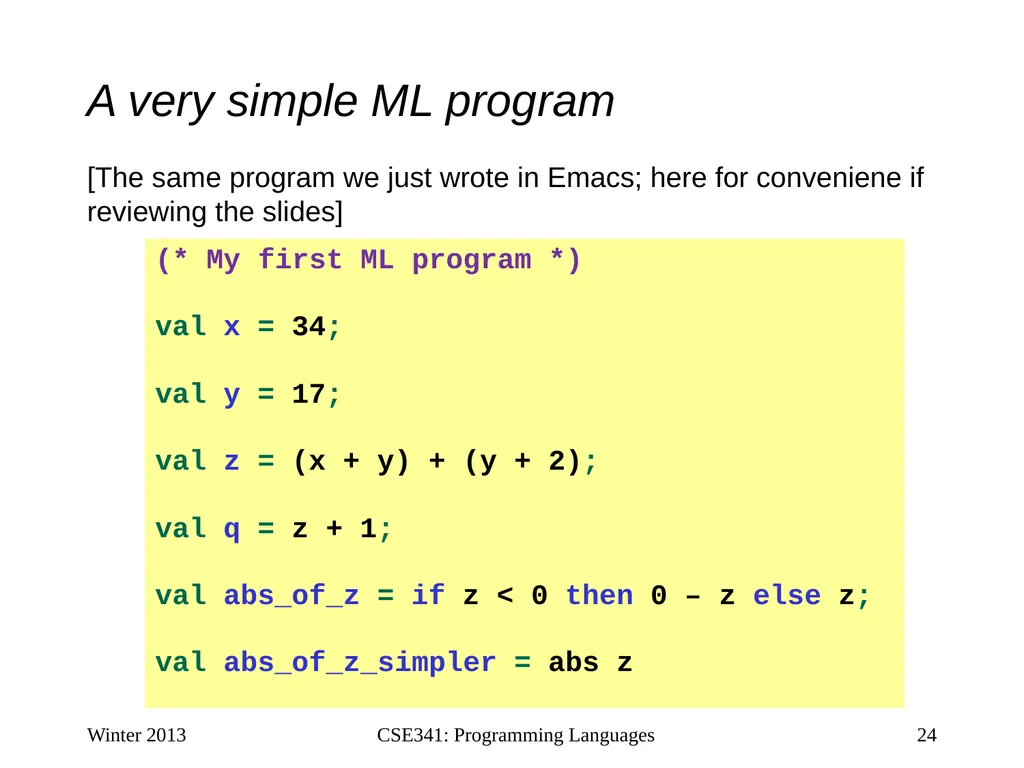
slide24. A very simple ML program [The same program we just wrote in Emacs; here for conveniene if reviewing the slides] Winter 2013 24 CSE341: Programming Languages (* My first ML program *)
val x = 34;
val y = 17;
val z = (x + y) + (y + 2);
val q = z + 1;
val abs_of_z = if z < 0 then 0 – z else z;
val abs_of_z_simpler = abs z<br>
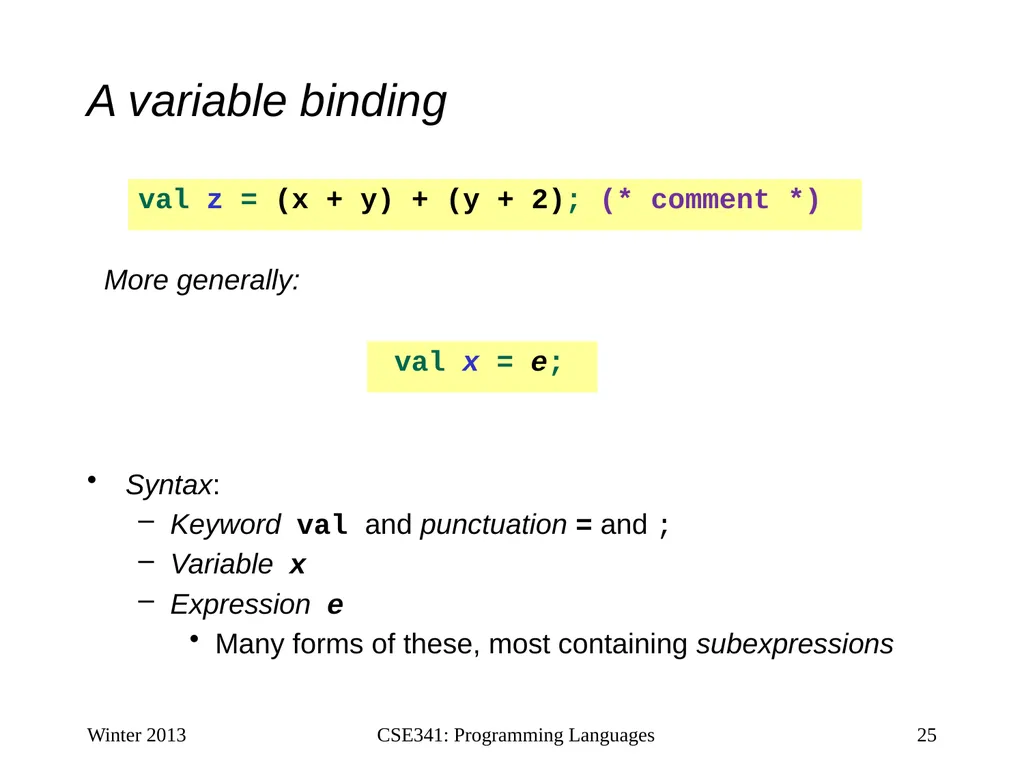
slide25. A variable binding Syntax:
Keyword val and punctuation = and ;
Variable x
Expression e
Many forms of these, most containing subexpressions Winter 2013 25 CSE341: Programming Languages val z = (x + y) + (y + 2); (* comment *) More generally: val x = e;<br>
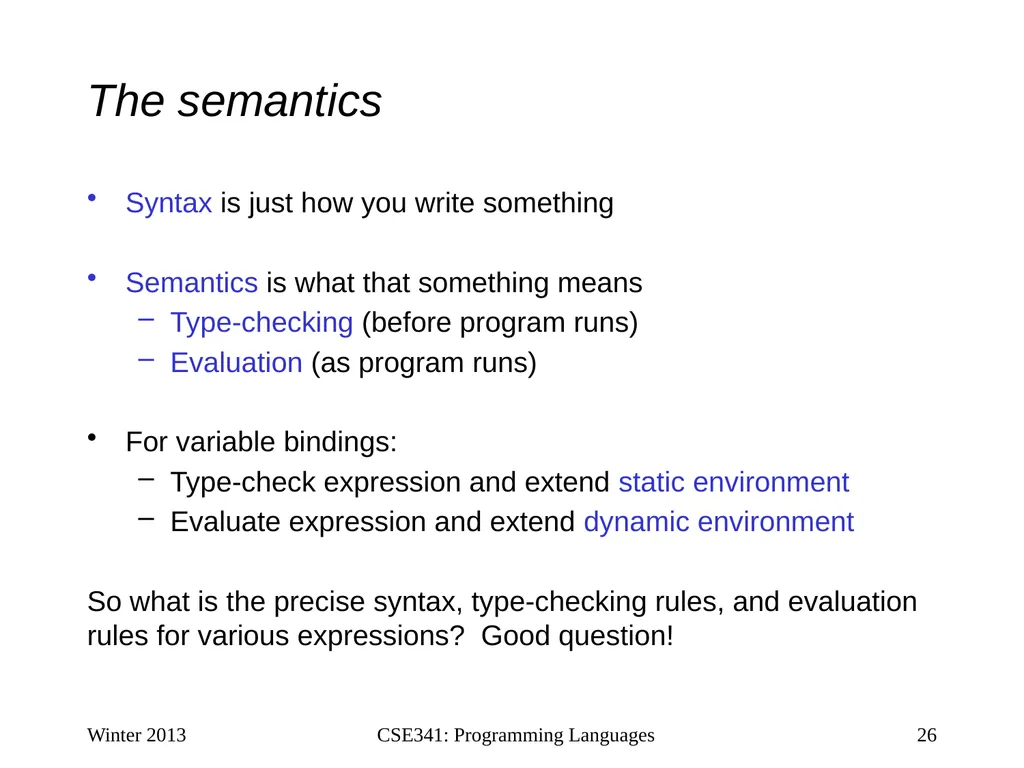
slide26. The semantics Syntax is just how you write something
Semantics is what that something means
Type-checking (before program runs)
Evaluation (as program runs)
For variable bindings:
Type-check expression and extend static environment
Evaluate expression and extend dynamic environment
So what is the precise syntax, type-checking rules, and evaluation rules for various expressions? Good question! Winter 2013 26 CSE341: Programming Languages<br>
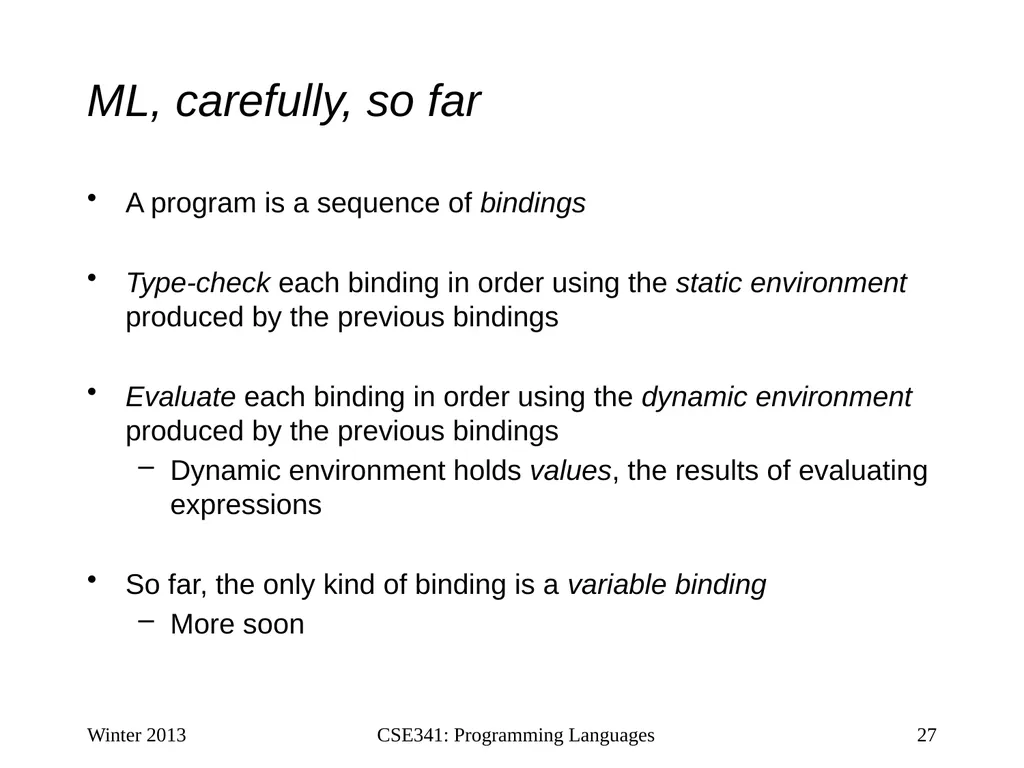
slide27. ML, carefully, so far A program is a sequence of bindings
Type-check each binding in order using the static environment produced by the previous bindings
Evaluate each binding in order using the dynamic environment produced by the previous bindings
Dynamic environment holds values, the results of evaluating expressions
So far, the only kind of binding is a variable binding
More soon Winter 2013 27 CSE341: Programming Languages<br>
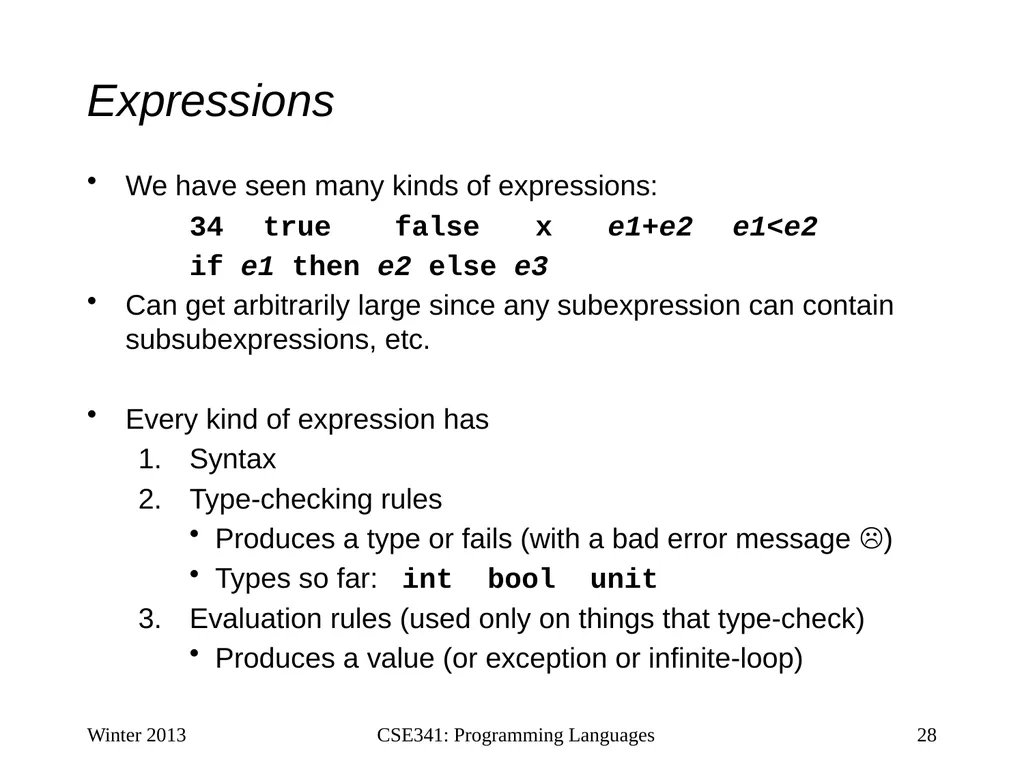
slide28. Expressions We have seen many kinds of expressions:
34 true false x e1+e2 e1<e2
if e1 then e2 else e3
Can get arbitrarily large since any subexpression can contain subsubexpressions, etc.
Every kind of expression has
Syntax
Type-checking rules
Produces a type or fails (with a bad error message )
Types so far: int bool unit
Evaluation rules (used only on things that type-check)
Produces a value (or exception or infinite-loop) Winter 2013 28 CSE341: Programming Languages<br>
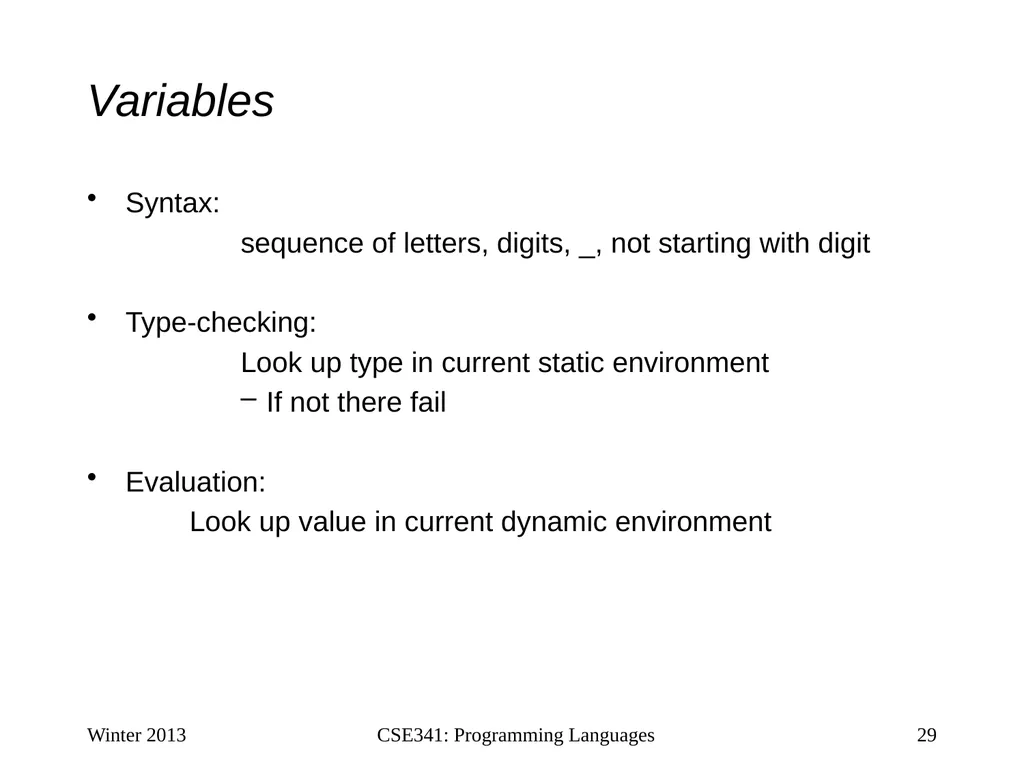
slide29. Variables Syntax:
sequence of letters, digits, _, not starting with digit
Type-checking:
Look up type in current static environment
If not there fail
Evaluation:
Look up value in current dynamic environment Winter 2013 29 CSE341: Programming Languages<br>
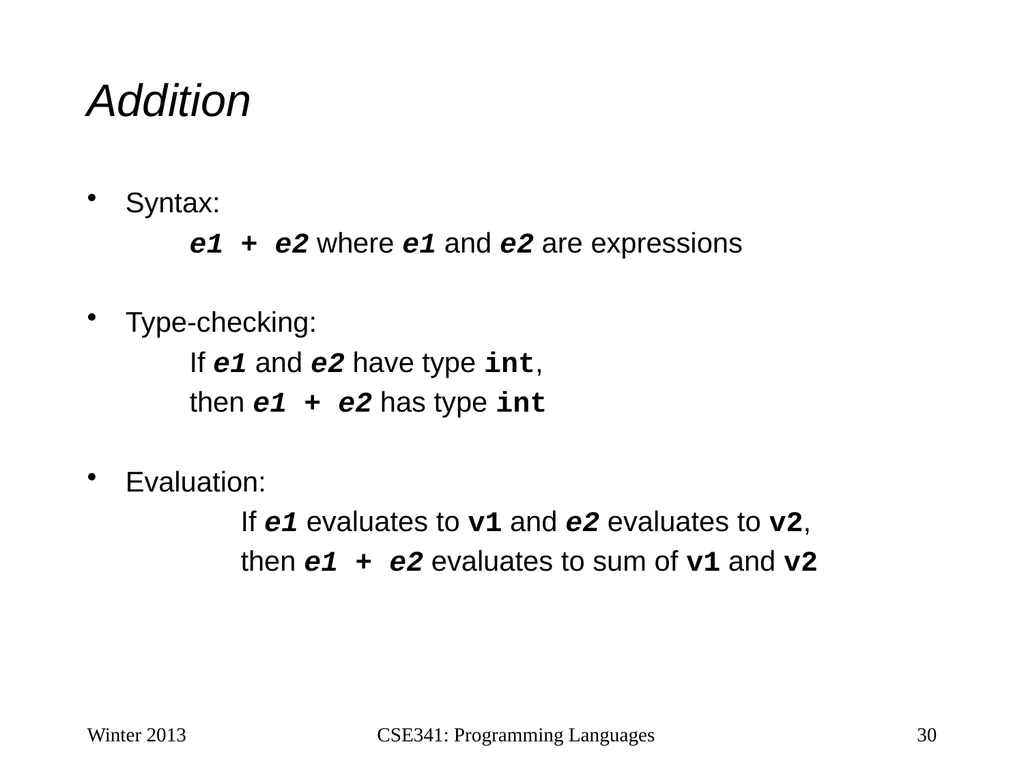
slide30. Addition Syntax:
e1 + e2 where e1 and e2 are expressions
Type-checking:
If e1 and e2 have type int,
then e1 + e2 has type int
Evaluation:
If e1 evaluates to v1 and e2 evaluates to v2,
then e1 + e2 evaluates to sum of v1 and v2 Winter 2013 30 CSE341: Programming Languages<br>
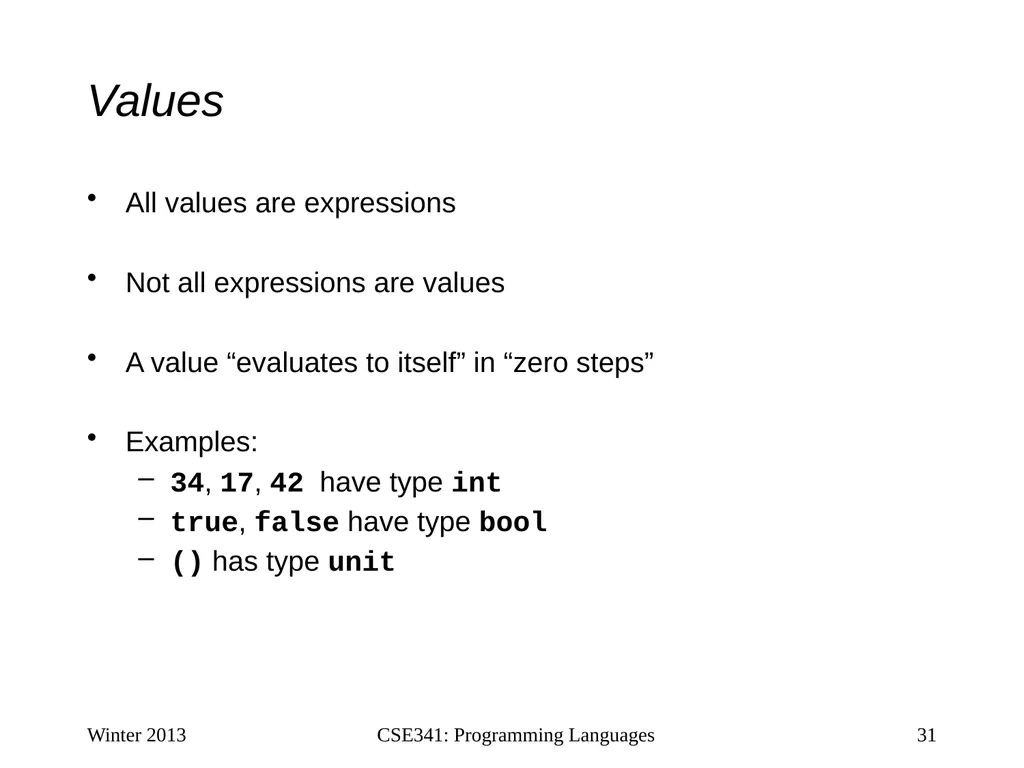
slide31. Values All values are expressions
Not all expressions are values
A value “evaluates to itself” in “zero steps”
Examples:
34, 17, 42 have type int
true, false have type bool
() has type unit Winter 2013 31 CSE341: Programming Languages<br>
slide32. Slightly tougher ones What are the syntax, typing rules, and evaluation rules for conditional expressions?
What are the syntax, typing rules, and evaluation rules for
less-than expressions? Winter 2013 32 CSE341: Programming Languages<br>
slide33. The foundation we need We have many more types, expression forms, and binding forms to learn before we can write “anything interesting”
Syntax, typing rules, evaluation rules will guide us the whole way!
For homework 1: functions, pairs, conditionals, lists, options, and local bindings
Earlier problems require less
Will not add (or need):
Mutation (a.k.a. assignment): use new bindings instead
Statements: everything is an expression
Loops: use recursion instead Winter 2013 33 CSE341: Programming Languages<br>
Winter 2013<br>
slide2. Welcome! We have 10 weeks to learn the fundamental concepts of programming languages
With hard work, patience, and an open mind, this course makes you a much better programmer
Even in languages we won’t use
Learn the core ideas around which every language is built, despite countless surface-level differences and variations
Poor course summary: “Uses SML, Racket, and Ruby”
Today’s class:
Course mechanics
[A rain-check on motivation]
Dive into ML: Homework 1 due Wednesday of next week Winter 2013 2 CSE341: Programming Languages<br>
slide3. Concise to-do list In the next 24-48 hours:
Read course web page: http://www.cs.washington.edu/education/courses/cse341/13wi/
Read all course policies (4 documents on web page)
Adjust class email-list settings as necessary
Complete Homework 0 (survey worth 0 points)
Get set up using Emacs and SML
Installation/configuration/use instructions on web page
Essential; non-intellectual
No reason to delay! Winter 2013 3 CSE341: Programming Languages<br>
slide4. Who Course Staff: Winter 2013 4 CSE341: Programming Languages Dan Grossman: Faculty, 341 my favorite course / area of expertise
Eric Mullen: Ph.D. student, also a PL expert
Cody Schroeder: Master’s student, PL and 341-homework guru
Sean Wu: TAed 341 in Fall too (different languages)
Rachel Sobel: experienced TA; took 341 last time I taught it
Sunjay Cauligi: also an experienced TA (351)
A nice large staff: get to know us!
Will explain why the staff is so large in a few minutes<br>
slide5. Staying in touch Course email list: cse341a_wi13@u.washington.edu
Students and staff already subscribed
You must get announcements sent there
Fairly low traffic
Course staff: cse341-staff@cs.washington.edu plus individual emails
Message Board
For appropriate discussions; TAs will monitor
Optional, won’t use for important announcements
Anonymous feedback link on webpage
For good and bad: If you don’t tell me, I don’t know Winter 2013 5 CSE341: Programming Languages<br>
slide6. Lecture: Dan Slides, code, and reading notes / videos posted
May be revised after class
Take notes: materials may not describe everything
Slides in particular are visual aids for me to use
Ask questions, focus on key ideas
Engage actively
Arrive punctually (beginning matters most!) and well-rested
Just like you will for the midterm!
Write down ideas and code as we go
If attending and paying attention is a poor use of your time, one of us is doing something wrong Winter 2013 6 CSE341: Programming Languages<br>
slide7. Section: Cody and Eric Required: will usually cover new material
Sometimes more language or environment details
Sometimes main ideas needed for homework
Will meet this week: using Emacs and SML
Cody and Eric will do both sections on different weeks
Material often also covered in reading notes / videos Winter 2013 7 CSE341: Programming Languages<br>
slide8. Reading Notes and Videos Posted for each “course unit:” reading notes and videos that go over most (all?) of the material (and some extra stuff?)
So why come to class?
Because having these materials lets us make class-time much more useful
Answer your questions without being rushed because occasionally “didn’t get to X; read about it”
Can point to occasional optional topics/videos
Can try different things in class, not just recite things Winter 2013 8 CSE341: Programming Languages<br>
slide9. Textbooks, or lack thereof Will treat the “textbooks” as optional, useful references
Look up details you want/need to know, but often in free online resources too
Can provide good second explanations, but (because!) they often take a fairly different approach
If “Dan’s view” confuses you, lecture, reading notes, and video might all confuse you
Some topics aren’t in the texts
Don’t be surprised when I essentially ignore the texts
List on web page what sections are most relevant
Some but maybe not all of you will do fine without the texts
Would love your feedback on how they are useful Winter 2013 9 CSE341: Programming Languages<br>
slide10. Office hours Regular hours and locations on course web [soon]
Changes as necessary announced on email list
Use them
Please visit me
Ideally not just for homework questions (but that’s good too) Winter 2013 10 CSE341: Programming Languages<br>
slide11. Homework Seven total
To be done individually
Doing the homework involves:
Understanding the concepts being addressed
Writing code demonstrating understanding of the concepts
Testing your code to ensure you understand and have correct programs
“Playing around” with variations, incorrect answers, etc.
Only (2) is graded, but focusing on (2) makes homework harder
Challenge problems: Low points/difficulty ratio Winter 2013 11 CSE341: Programming Languages<br>
slide12. Note my writing style Homeworks tend to be worded very precisely and concisely
I’m a computer scientist and I write like one (a good thing!)
Technical issues deserve precise technical writing
Conciseness values your time as a reader
You should try to be precise too
Skimming or not understanding why a word or phrase was chosen can make the homework harder
By all means ask if a problem is confusing
Being confused is normal and understandable
And I may have made a mistake
Once you’re unconfused, you might agree the problem wording didn’t cause the confusion Winter 2013 12 CSE341: Programming Languages<br>
slide13. Academic Integrity Read the course policy carefully
Clearly explains how you can and cannot get/provide help on homework and projects
Always explain any unconventional action
I have promoted and enforced academic integrity since I was a freshman
Great trust with little sympathy for violations
Honest work is the most important feature of a university Winter 2013 13 CSE341: Programming Languages<br>
slide14. Exams Midterm: Friday February 8, in class
Final: Thursday March 21, 8:30-10:20
Yes, late in finals week
Yes, you have to be here
No, this was not my choice
Same concepts, but different format from homework
More conceptual (but write code too)
Will post old exams
Closed book/notes, but you bring one sheet with whatever you want on it Winter 2013 14 CSE341: Programming Languages<br>
slide15. Coursera (more info in document) Course staff of 5 TAs because we are also running a free, online version of the course for thousands of people around the world
Starts next week
You are not allowed to participate in that class!
Do not web-search related to homework problems!
This should have little impact on you
Two courses are separate
341 is a great class and staff is committed to this offering being the best ever
But this is an exciting new thing you are likely curious about… Winter 2013 15 CSE341: Programming Languages<br>
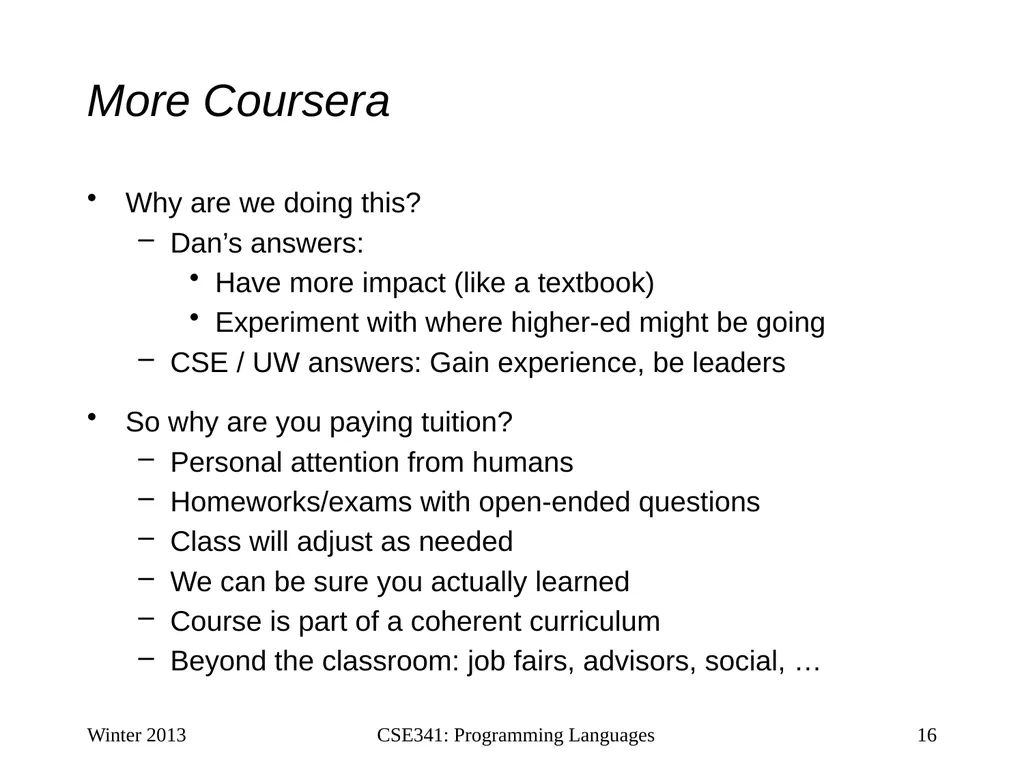
slide16. More Coursera Why are we doing this?
Dan’s answers:
Have more impact (like a textbook)
Experiment with where higher-ed might be going
CSE / UW answers: Gain experience, be leaders
So why are you paying tuition?
Personal attention from humans
Homeworks/exams with open-ended questions
Class will adjust as needed
We can be sure you actually learned
Course is part of a coherent curriculum
Beyond the classroom: job fairs, advisors, social, … Winter 2013 16 CSE341: Programming Languages<br>
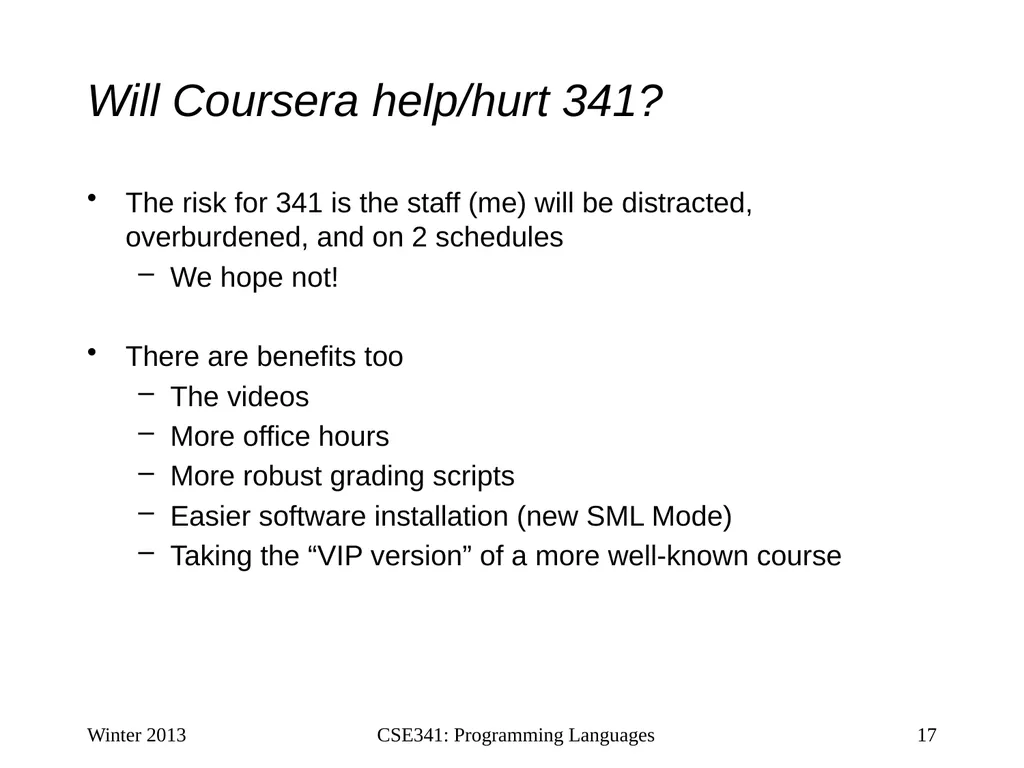
slide17. Will Coursera help/hurt 341? The risk for 341 is the staff (me) will be distracted, overburdened, and on 2 schedules
We hope not!
There are benefits too
The videos
More office hours
More robust grading scripts
Easier software installation (new SML Mode)
Taking the “VIP version” of a more well-known course Winter 2013 17 CSE341: Programming Languages<br>
slide18. Questions? Anything I forgot about course mechanics before we discuss, you know, programming languages? Winter 2013 18 CSE341: Programming Languages<br>
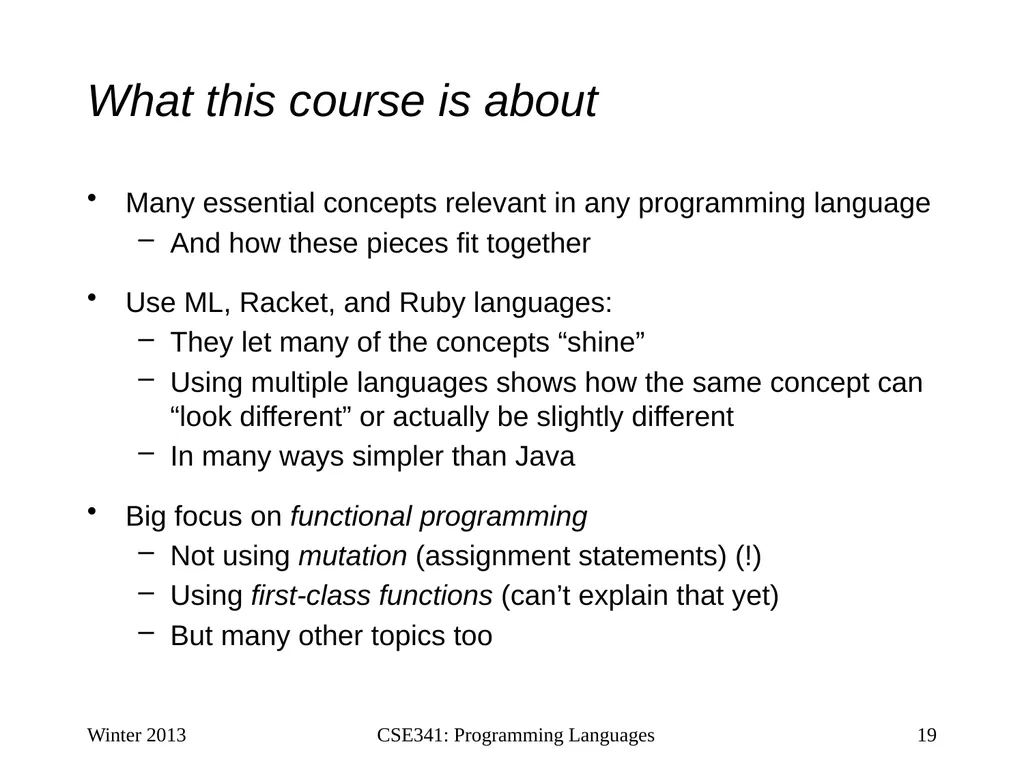
slide19. What this course is about Many essential concepts relevant in any programming language
And how these pieces fit together
Use ML, Racket, and Ruby languages:
They let many of the concepts “shine”
Using multiple languages shows how the same concept can “look different” or actually be slightly different
In many ways simpler than Java
Big focus on functional programming
Not using mutation (assignment statements) (!)
Using first-class functions (can’t explain that yet)
But many other topics too Winter 2013 19 CSE341: Programming Languages<br>
slide20. Why learn this? This is the “normal” place for course motivation
Why learn this material?
But in my experience, we don’t have enough shared vocabulary
So 2-week delay on motivation for functional programming
I promise full motivation: delay is worth it
(Will motivate immutable data at end of section 1) Winter 2013 20 CSE341: Programming Languages<br>
slide21. My claim Learning to think about software in this “PL” way will make you a better programmer even if/when you go back to old ways
It will also give you the mental tools and experience you need for a lifetime of confidently picking up new languages and ideas
[Somewhat in the style of The Karate Kid movies (1984, 2010)] Winter 2013 21 CSE341: Programming Languages<br>
slide22. A strange environment The next 4-5 weeks will use
ML language
Emacs editor
Read-eval-print-loop (REPL) for evaluating programs
You need to get things installed and configured
Either in the department labs or your own machine
We’ve written thorough instructions (questions welcome)
Only then can you focus on the content of Homework 1
Working in strange environments is a CS life skill Winter 2013 22 CSE341: Programming Languages<br>
slide23. Mindset “Let go” of all programming languages you already know
For now, treat ML as a “totally new thing”
Time later to compare/contrast to what you know
For now, “oh that seems kind of like this thing in [Java]” will confuse you, slow you down, and you will learn less
Start from a blank file… Winter 2013 23 CSE341: Programming Languages<br>
slide24. A very simple ML program [The same program we just wrote in Emacs; here for conveniene if reviewing the slides] Winter 2013 24 CSE341: Programming Languages (* My first ML program *)
val x = 34;
val y = 17;
val z = (x + y) + (y + 2);
val q = z + 1;
val abs_of_z = if z < 0 then 0 – z else z;
val abs_of_z_simpler = abs z<br>
slide25. A variable binding Syntax:
Keyword val and punctuation = and ;
Variable x
Expression e
Many forms of these, most containing subexpressions Winter 2013 25 CSE341: Programming Languages val z = (x + y) + (y + 2); (* comment *) More generally: val x = e;<br>
slide26. The semantics Syntax is just how you write something
Semantics is what that something means
Type-checking (before program runs)
Evaluation (as program runs)
For variable bindings:
Type-check expression and extend static environment
Evaluate expression and extend dynamic environment
So what is the precise syntax, type-checking rules, and evaluation rules for various expressions? Good question! Winter 2013 26 CSE341: Programming Languages<br>
slide27. ML, carefully, so far A program is a sequence of bindings
Type-check each binding in order using the static environment produced by the previous bindings
Evaluate each binding in order using the dynamic environment produced by the previous bindings
Dynamic environment holds values, the results of evaluating expressions
So far, the only kind of binding is a variable binding
More soon Winter 2013 27 CSE341: Programming Languages<br>
slide28. Expressions We have seen many kinds of expressions:
34 true false x e1+e2 e1<e2
if e1 then e2 else e3
Can get arbitrarily large since any subexpression can contain subsubexpressions, etc.
Every kind of expression has
Syntax
Type-checking rules
Produces a type or fails (with a bad error message )
Types so far: int bool unit
Evaluation rules (used only on things that type-check)
Produces a value (or exception or infinite-loop) Winter 2013 28 CSE341: Programming Languages<br>
slide29. Variables Syntax:
sequence of letters, digits, _, not starting with digit
Type-checking:
Look up type in current static environment
If not there fail
Evaluation:
Look up value in current dynamic environment Winter 2013 29 CSE341: Programming Languages<br>
slide30. Addition Syntax:
e1 + e2 where e1 and e2 are expressions
Type-checking:
If e1 and e2 have type int,
then e1 + e2 has type int
Evaluation:
If e1 evaluates to v1 and e2 evaluates to v2,
then e1 + e2 evaluates to sum of v1 and v2 Winter 2013 30 CSE341: Programming Languages<br>
slide31. Values All values are expressions
Not all expressions are values
A value “evaluates to itself” in “zero steps”
Examples:
34, 17, 42 have type int
true, false have type bool
() has type unit Winter 2013 31 CSE341: Programming Languages<br>
slide32. Slightly tougher ones What are the syntax, typing rules, and evaluation rules for conditional expressions?
What are the syntax, typing rules, and evaluation rules for
less-than expressions? Winter 2013 32 CSE341: Programming Languages<br>
slide33. The foundation we need We have many more types, expression forms, and binding forms to learn before we can write “anything interesting”
Syntax, typing rules, evaluation rules will guide us the whole way!
For homework 1: functions, pairs, conditionals, lists, options, and local bindings
Earlier problems require less
Will not add (or need):
Mutation (a.k.a. assignment): use new bindings instead
Statements: everything is an expression
Loops: use recursion instead Winter 2013 33 CSE341: Programming Languages<br>