
CSE390 – Advanced Computer Networks Lecture 20:
PM
Published · 55 slides · 0 views
1 / 1
Description
CSE390 Advanced Computer Networks Lecture 20: Routing Security (Hijacking the Internet for fun and profit!) Based on slides from J. Rexford Princeton U. Revised Fall 2014 by P. Gill BGP: The Internets Routing Protocol (1) ISP 1 Verizon
Related Topics
Share
Embed code
Download this presentation From Below
"CSE390 – Advanced Computer Networks Lecture 20:" is the property of its rightful owner. Permission is granted to download and print the materials on this website for personal, non-commercial use only, and to display it on your personal computer provided you do not modify the materials and that you retain all copyright notices contained in the materials. By downloading content from our website, you accept the terms of this agreement.
Presentation Transcript
01
CSE390 – Advanced Computer Networks Lecture 20: Routing Security
(Hijacking the Internet for fun and profit!) Based on slides from J. Rexford @ Princeton U. Revised Fall 2014 by P. Gill<br>
(Hijacking the Internet for fun and profit!) Based on slides from J. Rexford @ Princeton U. Revised Fall 2014 by P. Gill<br>
02
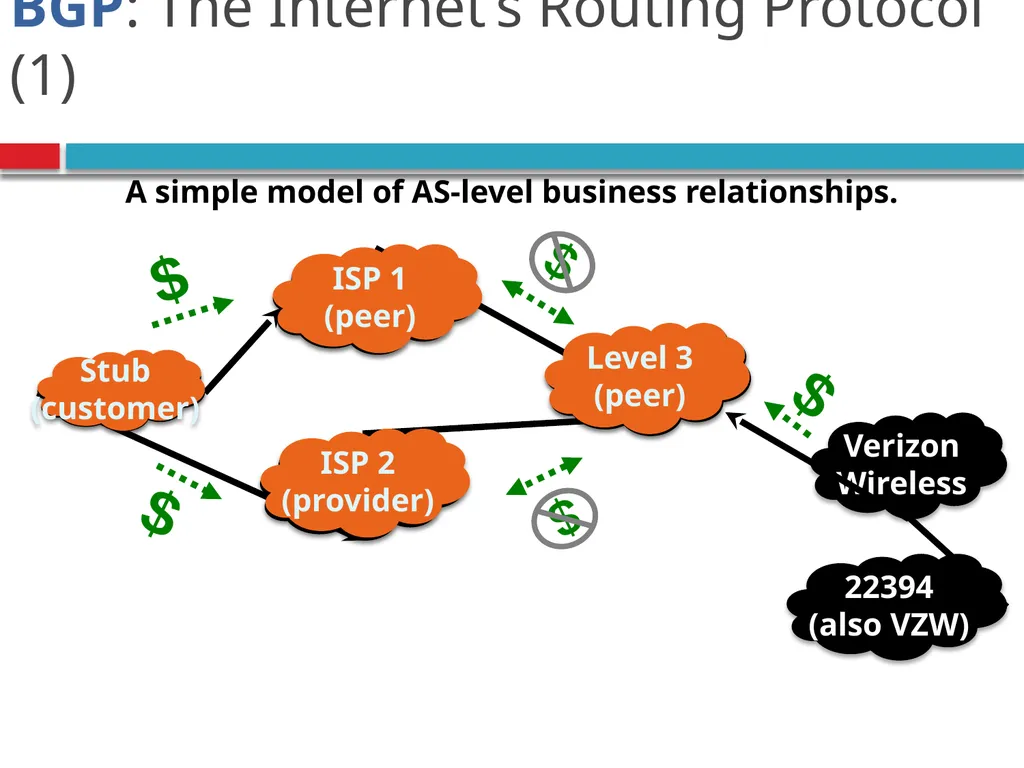
BGP: The Internet’s Routing Protocol (1) ISP 1 Verizon
Wireless stub ISP 2 Level 3 Stub
(customer) ISP 2
(provider) ISP 1
(peer) Level 3
(peer) 22394
(also VZW) A simple model of AS-level business relationships.<br>
Wireless stub ISP 2 Level 3 Stub
(customer) ISP 2
(provider) ISP 1
(peer) Level 3
(peer) 22394
(also VZW) A simple model of AS-level business relationships.<br>
03
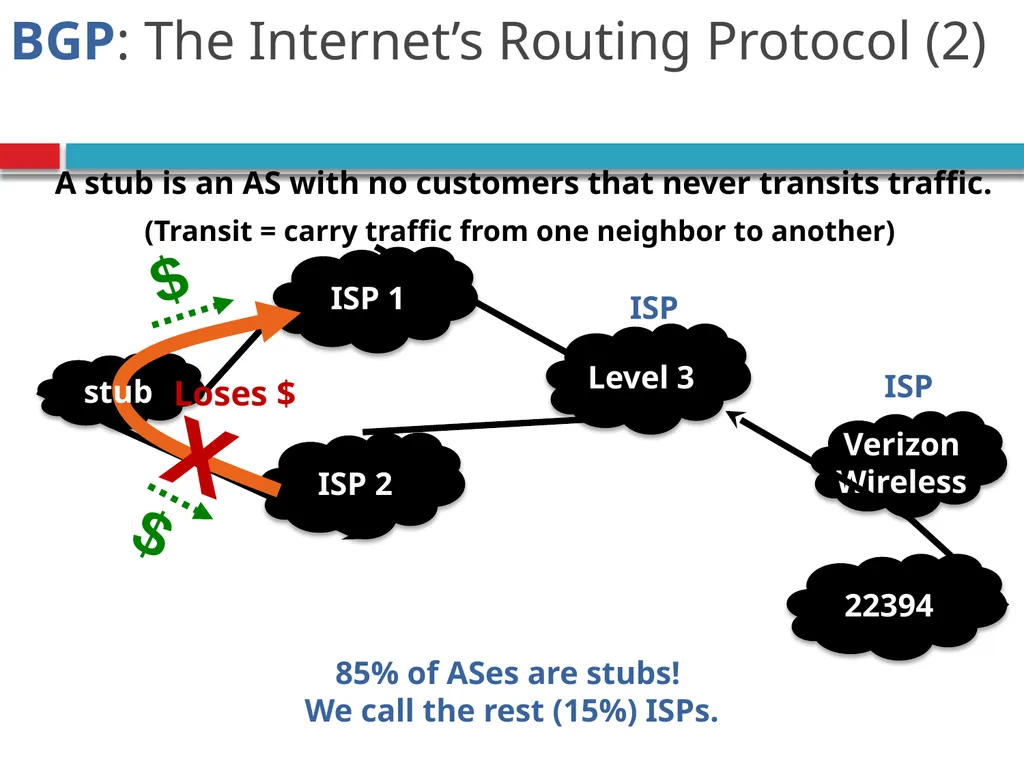
BGP: The Internet’s Routing Protocol (2) ISP 1 Verizon
Wireless ISP 2 Level 3 ISP ISP 22394 A stub is an AS with no customers that never transits traffic.
(Transit = carry traffic from one neighbor to another) 85% of ASes are stubs!
We call the rest (15%) ISPs. stub<br>
Wireless ISP 2 Level 3 ISP ISP 22394 A stub is an AS with no customers that never transits traffic.
(Transit = carry traffic from one neighbor to another) 85% of ASes are stubs!
We call the rest (15%) ISPs. stub<br>
04
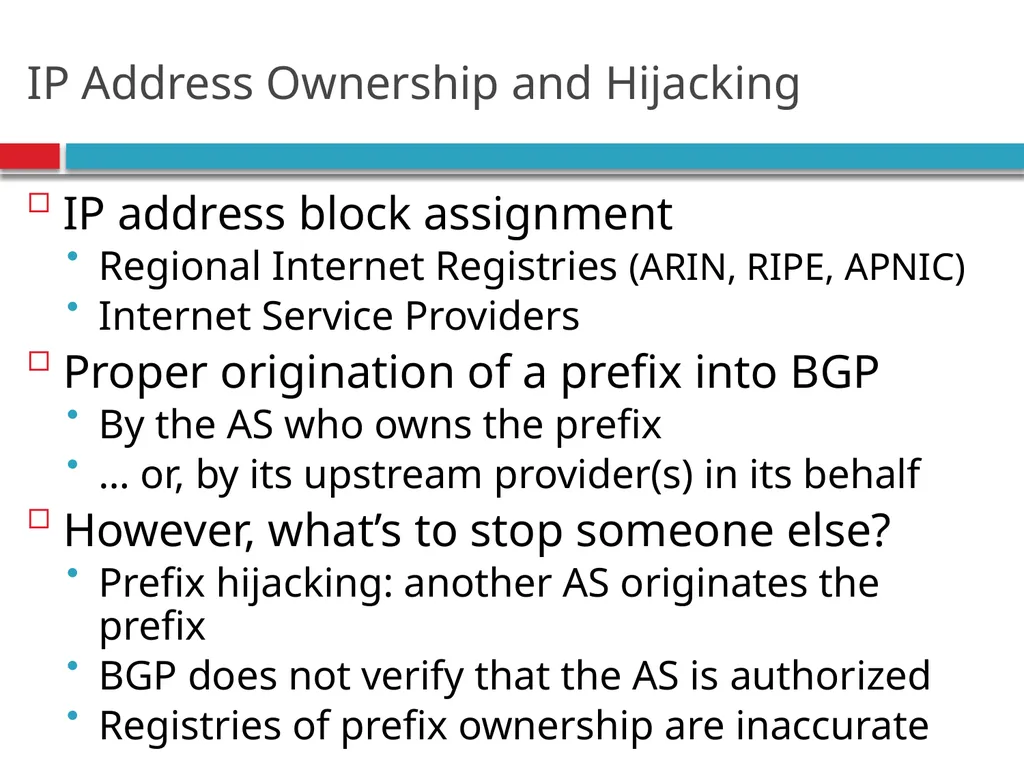
4 IP Address Ownership and Hijacking IP address block assignment
Regional Internet Registries (ARIN, RIPE, APNIC)
Internet Service Providers
Proper origination of a prefix into BGP
By the AS who owns the prefix
… or, by its upstream provider(s) in its behalf
However, what’s to stop someone else?
Prefix hijacking: another AS originates the prefix
BGP does not verify that the AS is authorized
Registries of prefix ownership are inaccurate<br>
Regional Internet Registries (ARIN, RIPE, APNIC)
Internet Service Providers
Proper origination of a prefix into BGP
By the AS who owns the prefix
… or, by its upstream provider(s) in its behalf
However, what’s to stop someone else?
Prefix hijacking: another AS originates the prefix
BGP does not verify that the AS is authorized
Registries of prefix ownership are inaccurate<br>
05
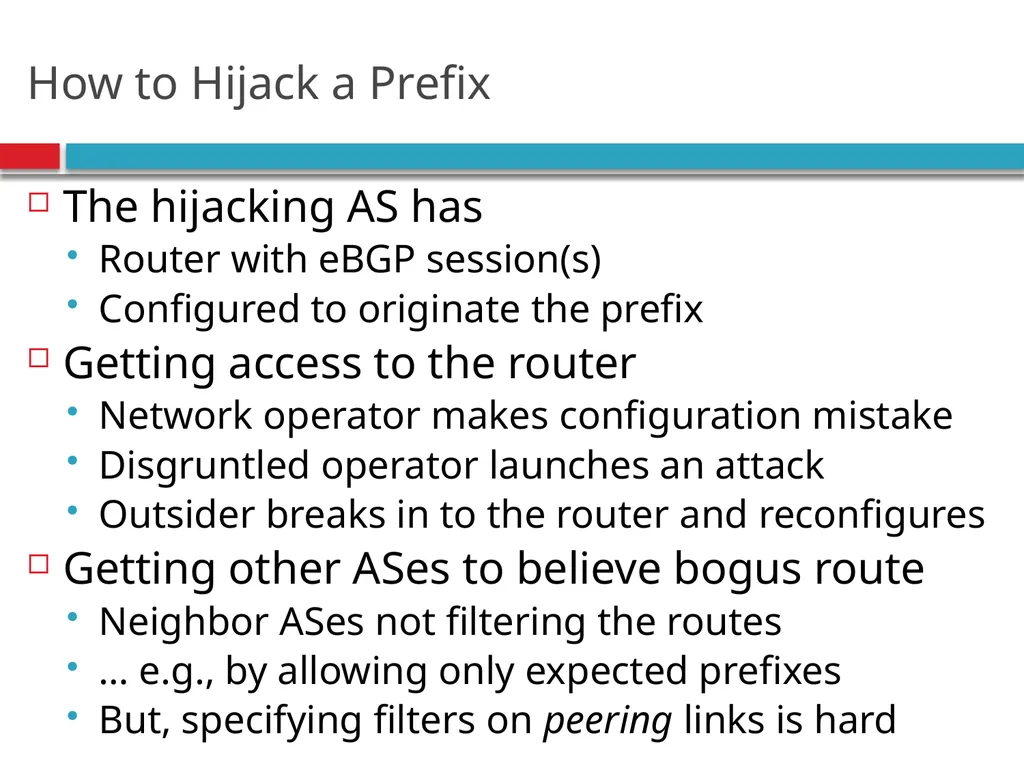
5 How to Hijack a Prefix The hijacking AS has
Router with eBGP session(s)
Configured to originate the prefix
Getting access to the router
Network operator makes configuration mistake
Disgruntled operator launches an attack
Outsider breaks in to the router and reconfigures
Getting other ASes to believe bogus route
Neighbor ASes not filtering the routes
… e.g., by allowing only expected prefixes
But, specifying filters on peering links is hard<br>
Router with eBGP session(s)
Configured to originate the prefix
Getting access to the router
Network operator makes configuration mistake
Disgruntled operator launches an attack
Outsider breaks in to the router and reconfigures
Getting other ASes to believe bogus route
Neighbor ASes not filtering the routes
… e.g., by allowing only expected prefixes
But, specifying filters on peering links is hard<br>
06
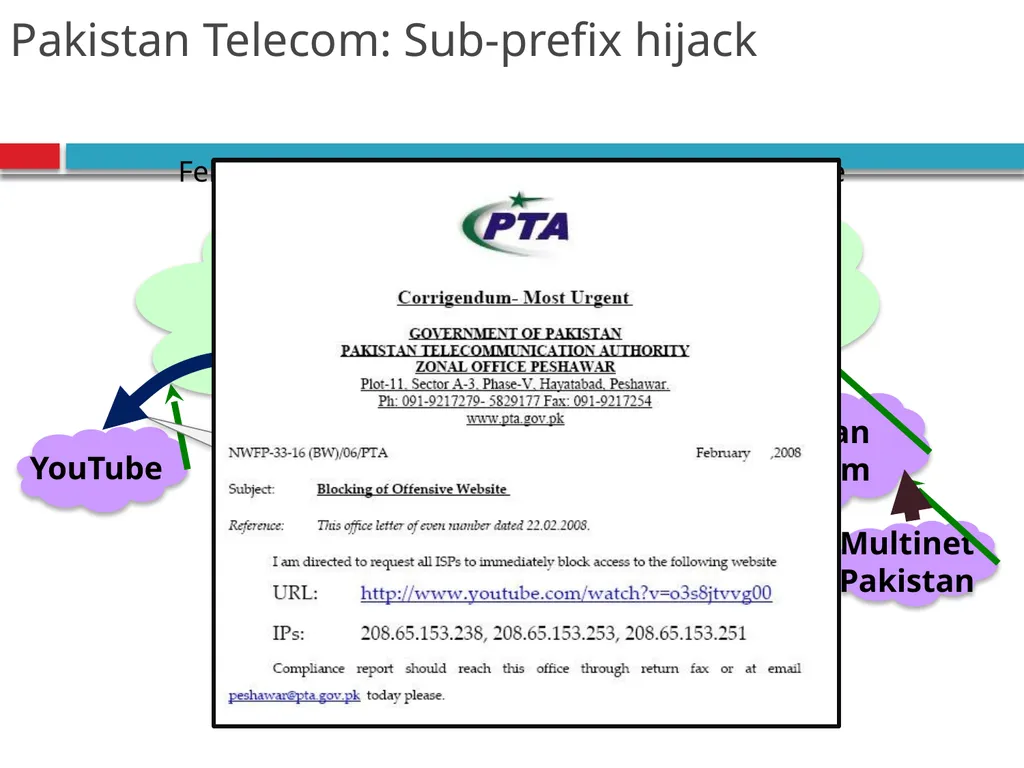
Pakistan Telecom: Sub-prefix hijack I’m YouTube:
IP 208.65.153.0 / 22 February 2008 : Pakistan Telecom hijacks YouTube<br>
IP 208.65.153.0 / 22 February 2008 : Pakistan Telecom hijacks YouTube<br>
07
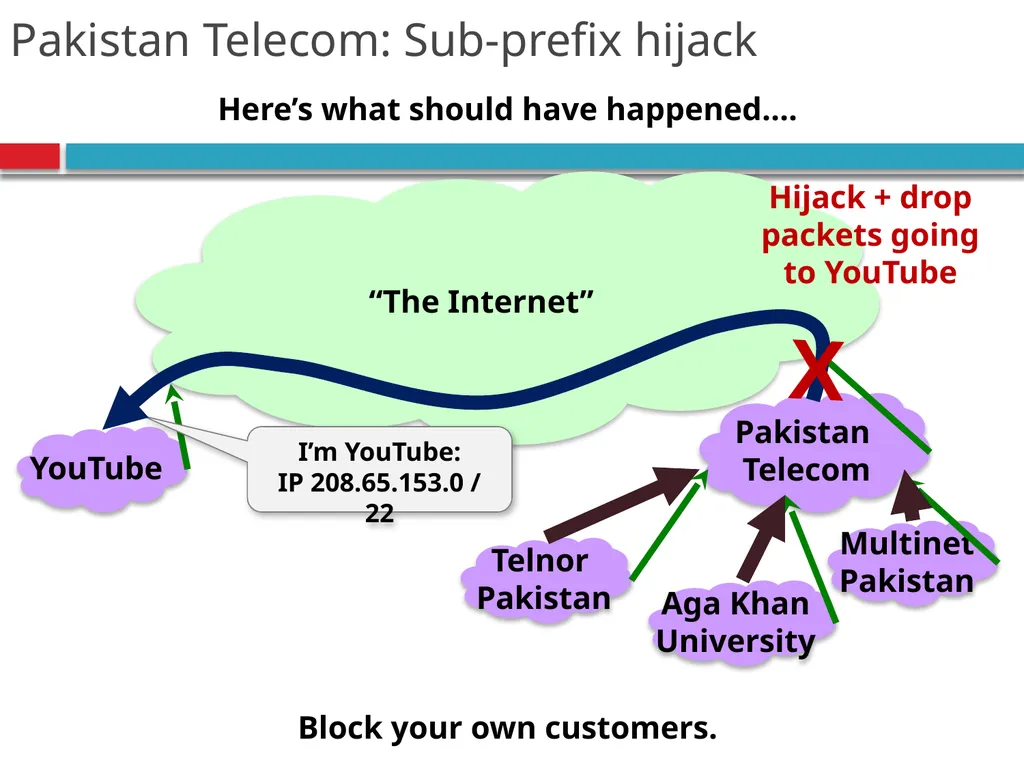
Pakistan Telecom: Sub-prefix hijack Here’s what should have happened…. I’m YouTube:
IP 208.65.153.0 / 22 X Hijack + drop packets going to YouTube Block your own customers.<br>
IP 208.65.153.0 / 22 X Hijack + drop packets going to YouTube Block your own customers.<br>
08
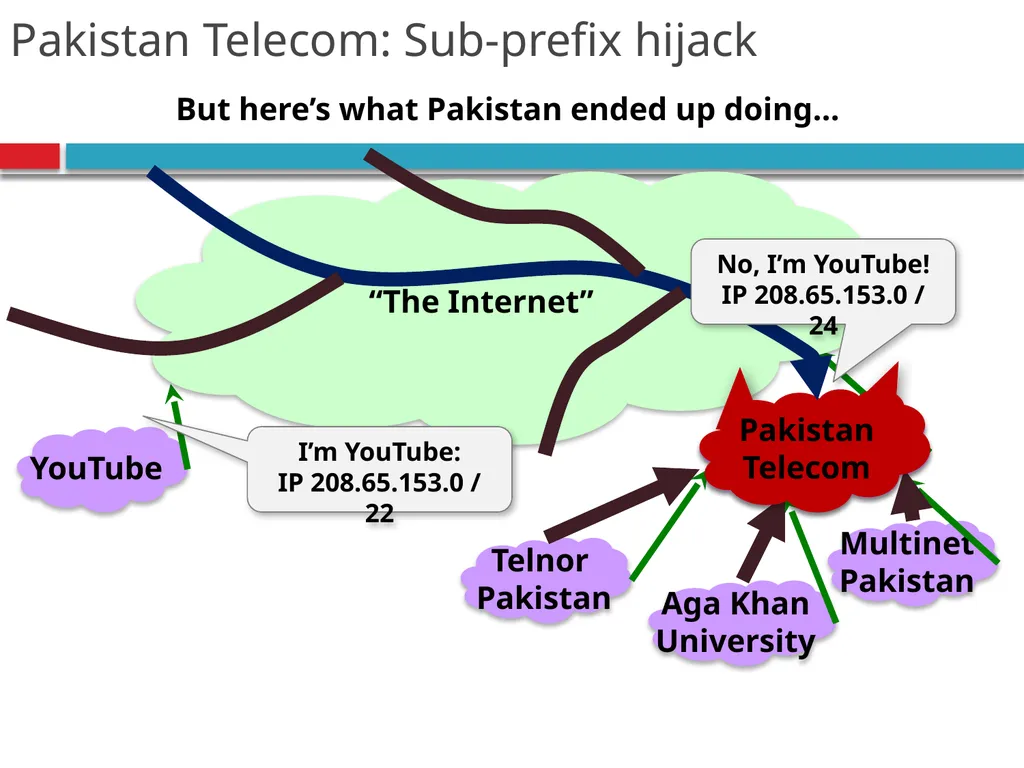
Pakistan Telecom: Sub-prefix hijack But here’s what Pakistan ended up doing… I’m YouTube:
IP 208.65.153.0 / 22 No, I’m YouTube!
IP 208.65.153.0 / 24<br>
IP 208.65.153.0 / 22 No, I’m YouTube!
IP 208.65.153.0 / 24<br>
09
China
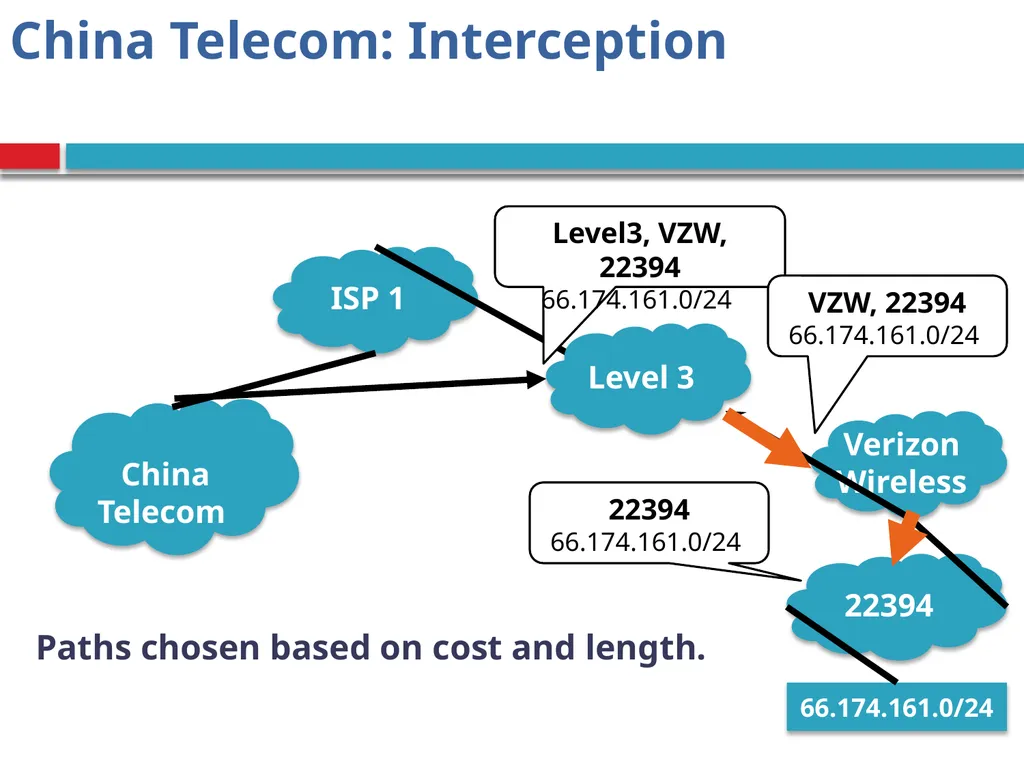
Telecom China Telecom: Interception ISP 1 Verizon
Wireless Level 3 Level3, VZW, 22394 66.174.161.0/24 22394 66.174.161.0/24 VZW, 22394 66.174.161.0/24 22394 66.174.161.0/24 Paths chosen based on cost and length.<br>
Telecom China Telecom: Interception ISP 1 Verizon
Wireless Level 3 Level3, VZW, 22394 66.174.161.0/24 22394 66.174.161.0/24 VZW, 22394 66.174.161.0/24 22394 66.174.161.0/24 Paths chosen based on cost and length.<br>
10
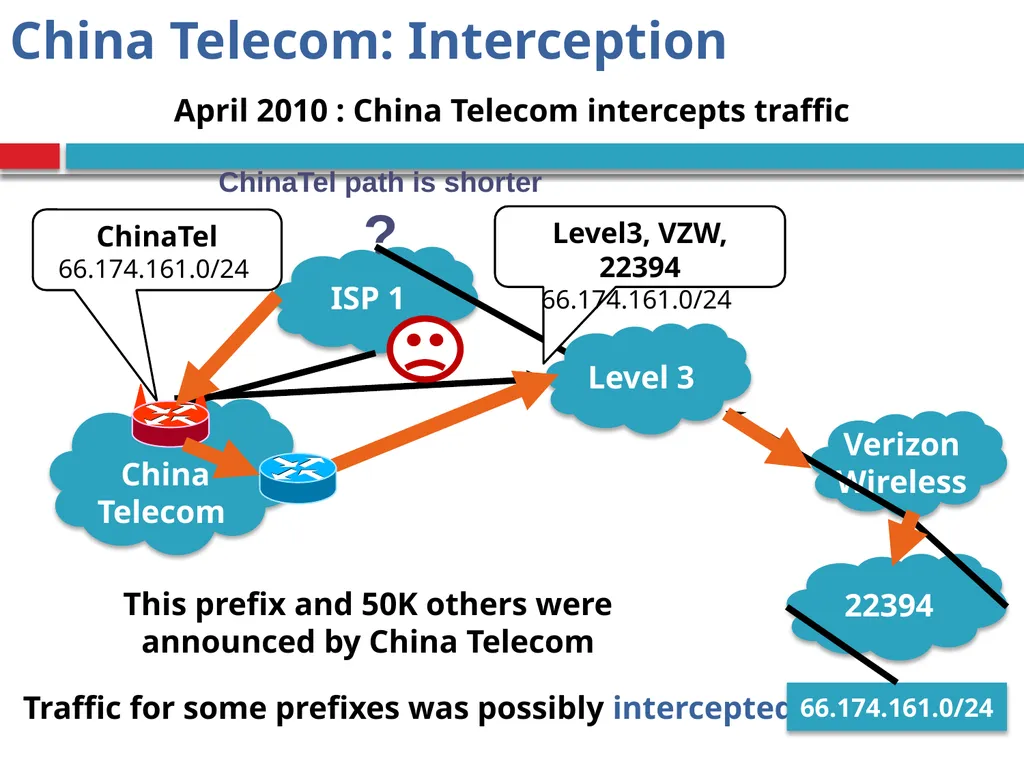
ChinaTel path is shorter
? China
Telecom China Telecom: Interception ISP 1 Verizon
Wireless Level 3 ChinaTel 66.174.161.0/24 Level3, VZW, 22394 66.174.161.0/24 22394 This prefix and 50K others were announced by China Telecom Traffic for some prefixes was possibly intercepted April 2010 : China Telecom intercepts traffic 66.174.161.0/24<br>
? China
Telecom China Telecom: Interception ISP 1 Verizon
Wireless Level 3 ChinaTel 66.174.161.0/24 Level3, VZW, 22394 66.174.161.0/24 22394 This prefix and 50K others were announced by China Telecom Traffic for some prefixes was possibly intercepted April 2010 : China Telecom intercepts traffic 66.174.161.0/24<br>
11
Canadian Bitcoin hijack (2/3/2014) 11 Bitcoin Background
Miners solve cryptographic puzzles using their computing power
Once the puzzle is solved new bitcoins are created and the miner gets some reward
Mining is generic: mining pool dictates currency
E.g., dogecoin, bitcoin etc.
Miners communicate with pool server using a protocol called ‘stratum’
Mining server can redirect user to a different server (e.g., for load balancing) http://www.secureworks.com/cyber-threat-intelligence/threats/bgp-hijacking-for-cryptocurrency-profit/<br>
Miners solve cryptographic puzzles using their computing power
Once the puzzle is solved new bitcoins are created and the miner gets some reward
Mining is generic: mining pool dictates currency
E.g., dogecoin, bitcoin etc.
Miners communicate with pool server using a protocol called ‘stratum’
Mining server can redirect user to a different server (e.g., for load balancing) http://www.secureworks.com/cyber-threat-intelligence/threats/bgp-hijacking-for-cryptocurrency-profit/<br>
12
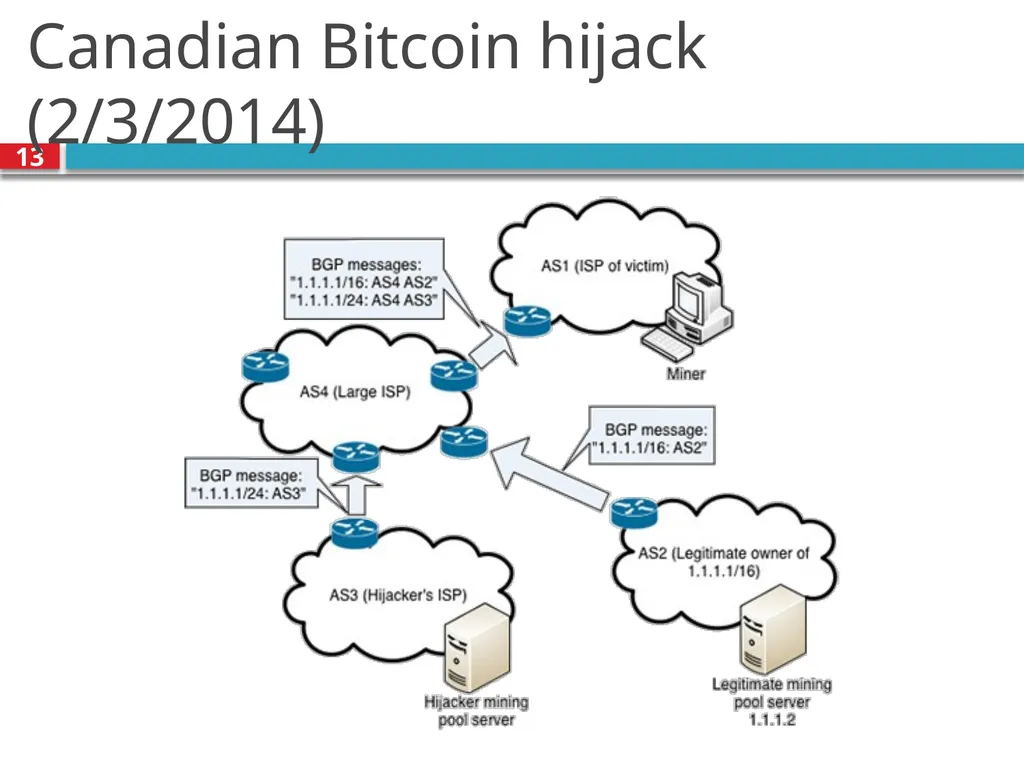
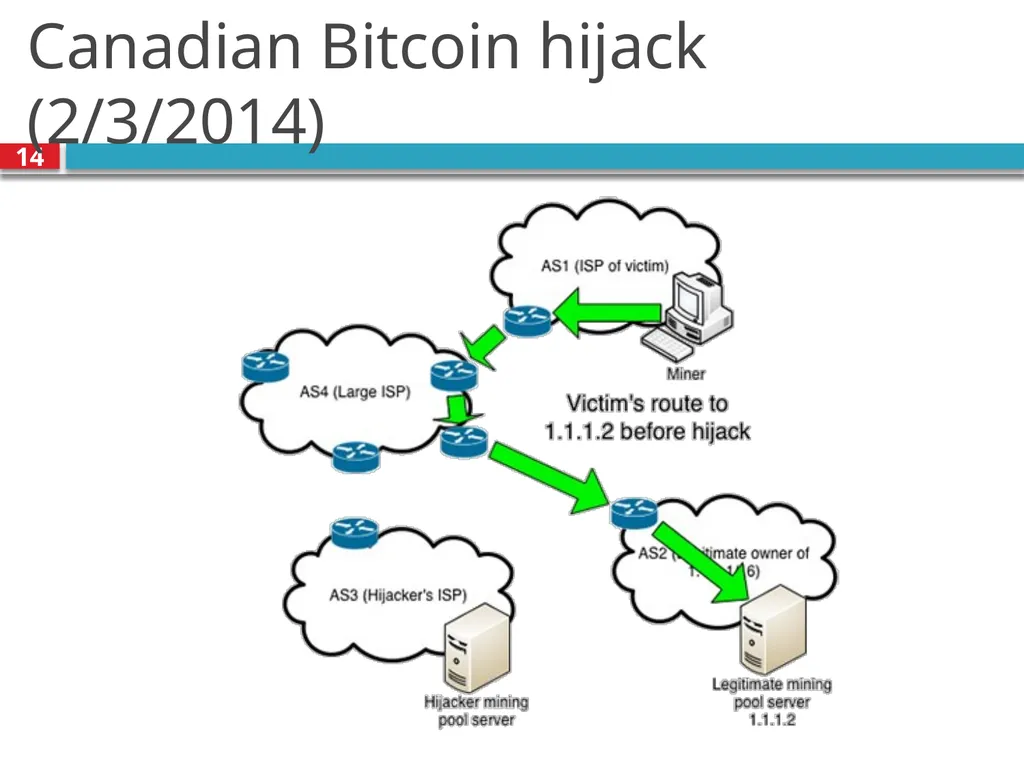
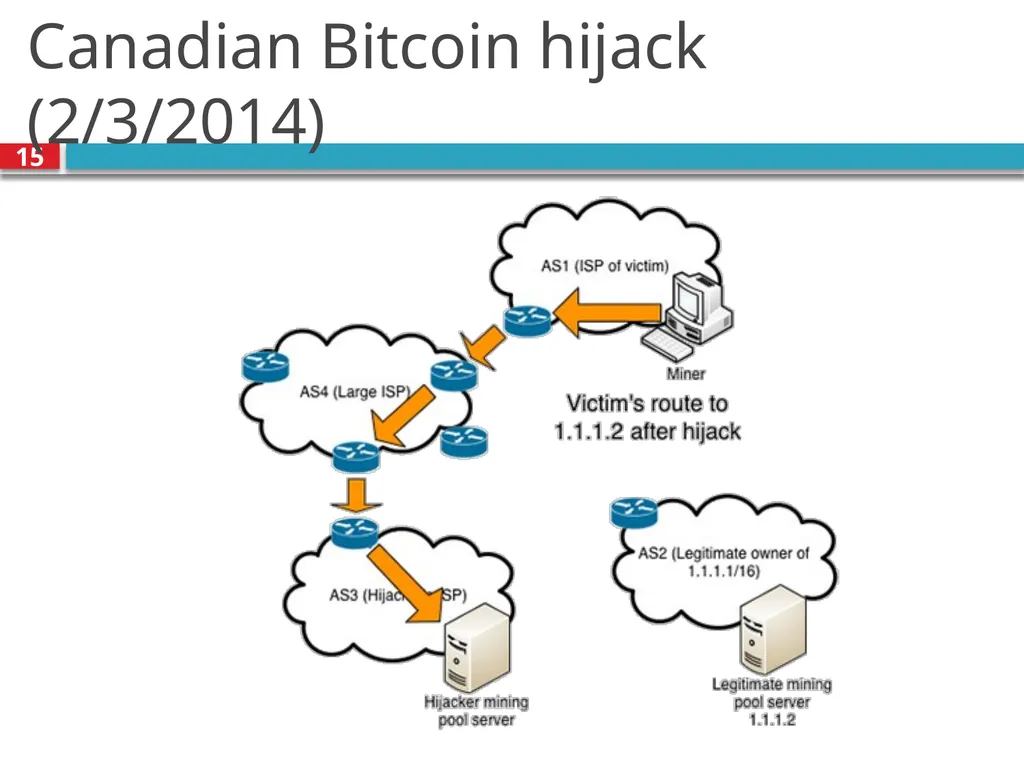
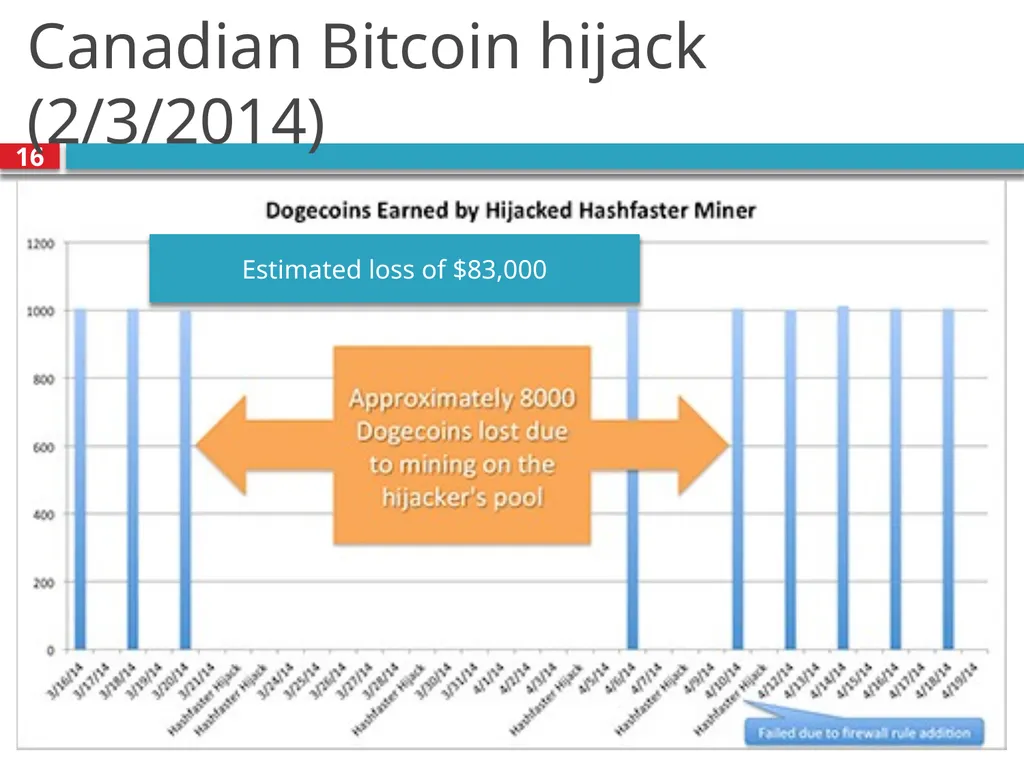
Canadian Bitcoin hijack (2/3/2014) 12 Hijacked users got directed to a mining server IP that was under the control of the hijacker and redirects them to a malicious mining pool.
Miners continue to receive tasks and solve puzzles but don’t get compensated. http://www.secureworks.com/cyber-threat-intelligence/threats/bgp-hijacking-for-cryptocurrency-profit/<br>
Miners continue to receive tasks and solve puzzles but don’t get compensated. http://www.secureworks.com/cyber-threat-intelligence/threats/bgp-hijacking-for-cryptocurrency-profit/<br>
13
Canadian Bitcoin hijack (2/3/2014) 13<br>
14
Canadian Bitcoin hijack (2/3/2014) 14<br>
15
Canadian Bitcoin hijack (2/3/2014) 15<br>
16
Canadian Bitcoin hijack (2/3/2014) 16 Estimated loss of $83,000<br>
17
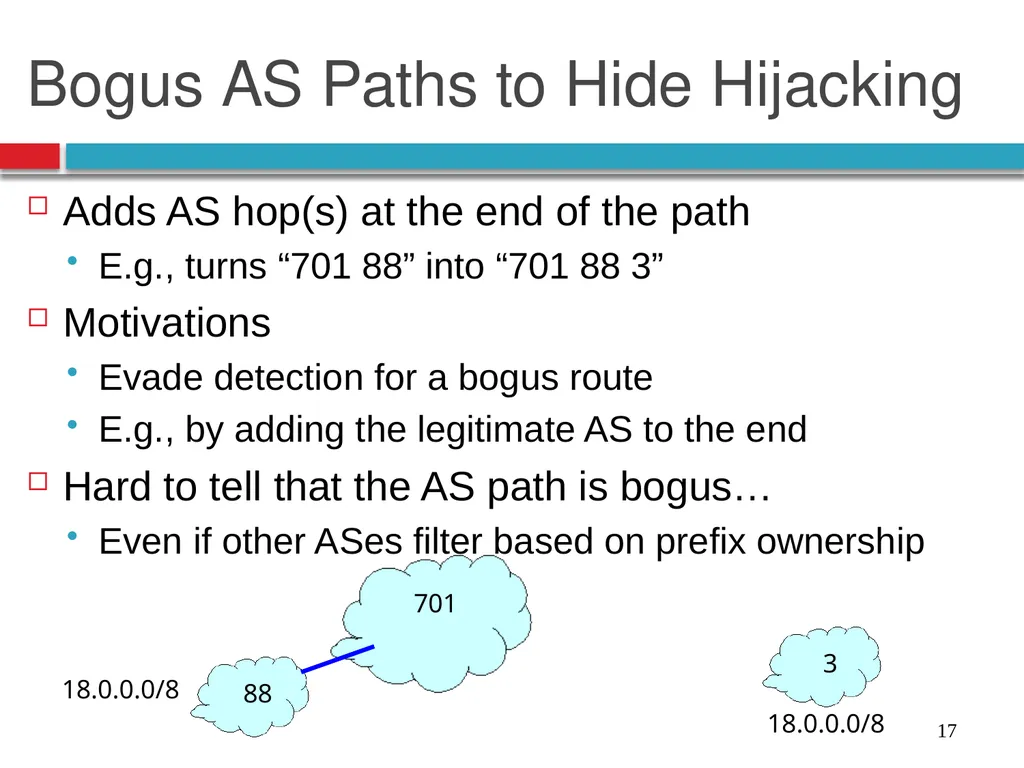
17 Bogus AS Paths to Hide Hijacking Adds AS hop(s) at the end of the path
E.g., turns “701 88” into “701 88 3”
Motivations
Evade detection for a bogus route
E.g., by adding the legitimate AS to the end
Hard to tell that the AS path is bogus…
Even if other ASes filter based on prefix ownership 701 88 3 18.0.0.0/8 18.0.0.0/8<br>
E.g., turns “701 88” into “701 88 3”
Motivations
Evade detection for a bogus route
E.g., by adding the legitimate AS to the end
Hard to tell that the AS path is bogus…
Even if other ASes filter based on prefix ownership 701 88 3 18.0.0.0/8 18.0.0.0/8<br>
18
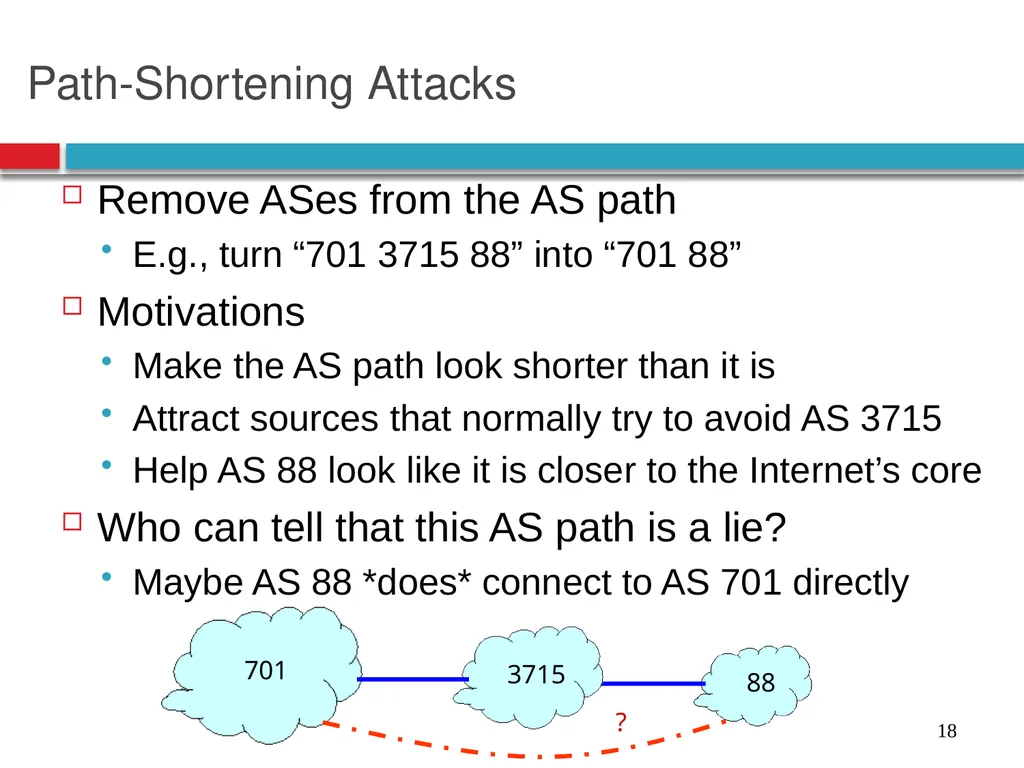
18 Path-Shortening Attacks Remove ASes from the AS path
E.g., turn “701 3715 88” into “701 88”
Motivations
Make the AS path look shorter than it is
Attract sources that normally try to avoid AS 3715
Help AS 88 look like it is closer to the Internet’s core
Who can tell that this AS path is a lie?
Maybe AS 88 *does* connect to AS 701 directly 701 88 3715 ?<br>
E.g., turn “701 3715 88” into “701 88”
Motivations
Make the AS path look shorter than it is
Attract sources that normally try to avoid AS 3715
Help AS 88 look like it is closer to the Internet’s core
Who can tell that this AS path is a lie?
Maybe AS 88 *does* connect to AS 701 directly 701 88 3715 ?<br>
19
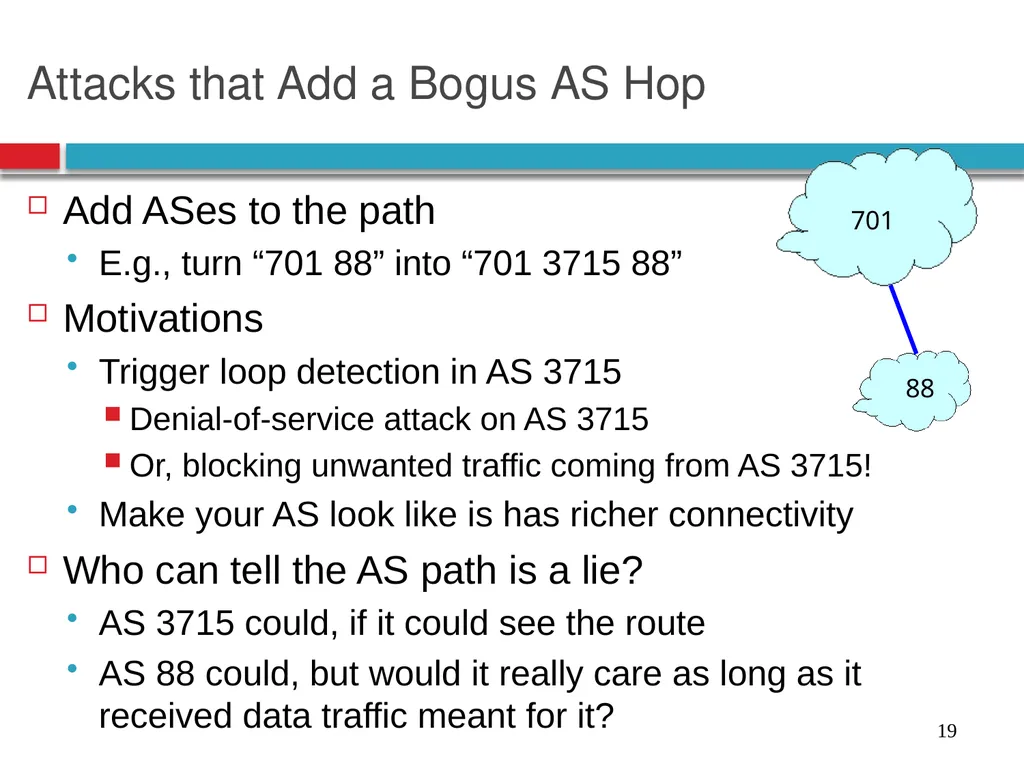
19 Attacks that Add a Bogus AS Hop Add ASes to the path
E.g., turn “701 88” into “701 3715 88”
Motivations
Trigger loop detection in AS 3715
Denial-of-service attack on AS 3715
Or, blocking unwanted traffic coming from AS 3715!
Make your AS look like is has richer connectivity
Who can tell the AS path is a lie?
AS 3715 could, if it could see the route
AS 88 could, but would it really care as long as it received data traffic meant for it? 701 88<br>
E.g., turn “701 88” into “701 3715 88”
Motivations
Trigger loop detection in AS 3715
Denial-of-service attack on AS 3715
Or, blocking unwanted traffic coming from AS 3715!
Make your AS look like is has richer connectivity
Who can tell the AS path is a lie?
AS 3715 could, if it could see the route
AS 88 could, but would it really care as long as it received data traffic meant for it? 701 88<br>
20
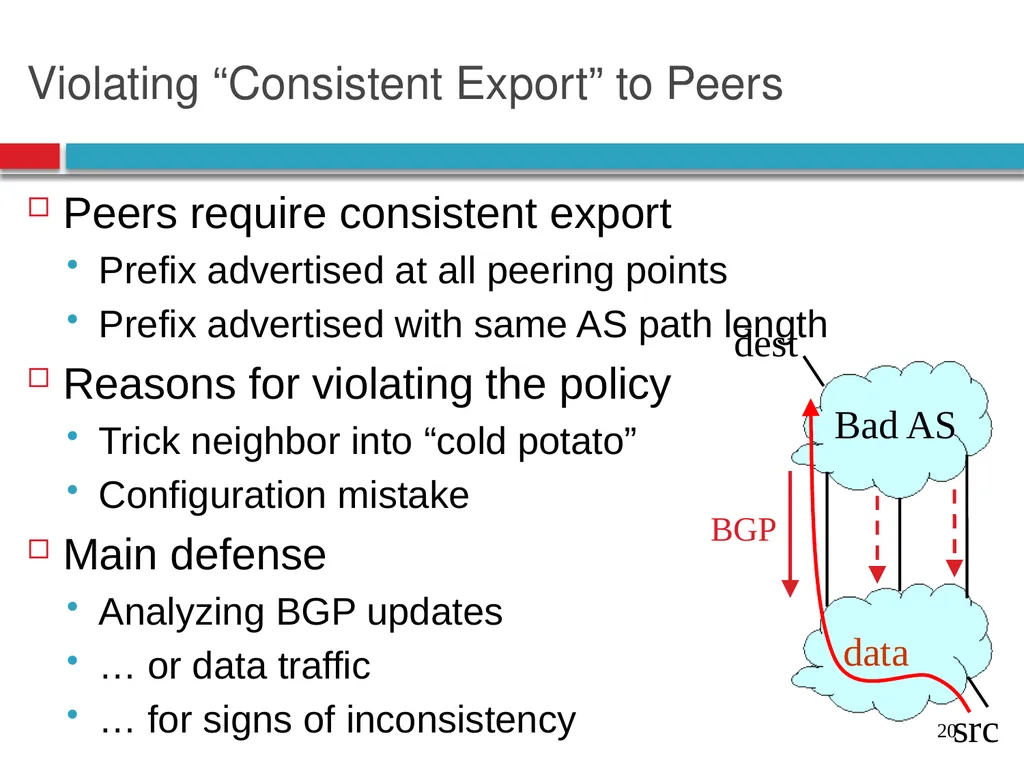
20 Violating “Consistent Export” to Peers Peers require consistent export
Prefix advertised at all peering points
Prefix advertised with same AS path length
Reasons for violating the policy
Trick neighbor into “cold potato”
Configuration mistake
Main defense
Analyzing BGP updates
… or data traffic
… for signs of inconsistency src dest Bad AS data BGP<br>
Prefix advertised at all peering points
Prefix advertised with same AS path length
Reasons for violating the policy
Trick neighbor into “cold potato”
Configuration mistake
Main defense
Analyzing BGP updates
… or data traffic
… for signs of inconsistency src dest Bad AS data BGP<br>
21
21 Hijacking is Hard to Debug Real origin AS doesn’t see the problem
Picks its own route
Might not even learn the bogus route
May not cause loss of connectivity
E.g., if the bogus AS snoops and redirects
… may only cause performance degradation
Or, loss of connectivity is isolated
E.g., only for sources in parts of the Internet
Diagnosing prefix hijacking
Analyzing updates from many vantage points
Launching traceroute from many vantage points<br>
Picks its own route
Might not even learn the bogus route
May not cause loss of connectivity
E.g., if the bogus AS snoops and redirects
… may only cause performance degradation
Or, loss of connectivity is isolated
E.g., only for sources in parts of the Internet
Diagnosing prefix hijacking
Analyzing updates from many vantage points
Launching traceroute from many vantage points<br>
22
Other Attacks Attacks on BGP sessions
Confidentiality of BGP messages
Denial-of-service on BGP session
Inserting, deleting, modifying, or replaying messages
Resource exhaustion attacks
Too many IP prefixes (e.g., BGP “512K Day”)
Too many BGP update messages
Data-plane attacks
Announce one BGP routes, but use another 22<br>
Confidentiality of BGP messages
Denial-of-service on BGP session
Inserting, deleting, modifying, or replaying messages
Resource exhaustion attacks
Too many IP prefixes (e.g., BGP “512K Day”)
Too many BGP update messages
Data-plane attacks
Announce one BGP routes, but use another 22<br>
23
Control plane attacks on routing
Attacks on the BGP Session
Solutions to prevent prefix hijacks
Solutions to detect prefix hijacks
Data plane attacks
Wrap up Outline 23<br>
Attacks on the BGP Session
Solutions to prevent prefix hijacks
Solutions to detect prefix hijacks
Data plane attacks
Wrap up Outline 23<br>
24
24 TCP Connection Underlying BGP Session BGP session runs over TCP
TCP connection between neighboring routers
BGP messages sent over TCP connection
Makes BGP vulnerable to attacks on TCP
Main kinds of attacks
Against confidentiality: eavesdropping
Against integrity: tampering
Against performance: denial-of-service
Main defenses
Message authentication or encryption
Limiting access to physical path between routers
Defensive filtering to block unexpected packets<br>
TCP connection between neighboring routers
BGP messages sent over TCP connection
Makes BGP vulnerable to attacks on TCP
Main kinds of attacks
Against confidentiality: eavesdropping
Against integrity: tampering
Against performance: denial-of-service
Main defenses
Message authentication or encryption
Limiting access to physical path between routers
Defensive filtering to block unexpected packets<br>
25
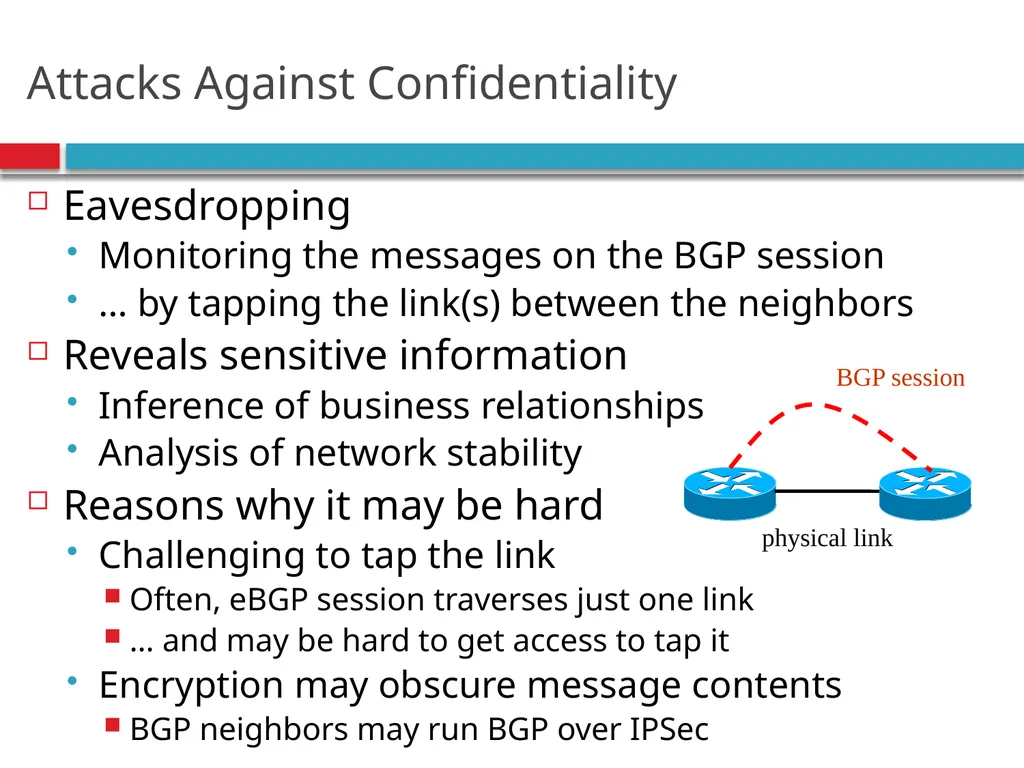
25 Attacks Against Confidentiality Eavesdropping
Monitoring the messages on the BGP session
… by tapping the link(s) between the neighbors
Reveals sensitive information
Inference of business relationships
Analysis of network stability
Reasons why it may be hard
Challenging to tap the link
Often, eBGP session traverses just one link
… and may be hard to get access to tap it
Encryption may obscure message contents
BGP neighbors may run BGP over IPSec BGP session physical link<br>
Monitoring the messages on the BGP session
… by tapping the link(s) between the neighbors
Reveals sensitive information
Inference of business relationships
Analysis of network stability
Reasons why it may be hard
Challenging to tap the link
Often, eBGP session traverses just one link
… and may be hard to get access to tap it
Encryption may obscure message contents
BGP neighbors may run BGP over IPSec BGP session physical link<br>
26
26 Attacking Message Integrity Tampering
Man-in-the-middle tampers with the messages
Insert, delete, modify, or replay messages
Leads to incorrect BGP behavior
Delete: neighbor doesn’t learn the new route
Insert/modify: neighbor learns bogus route
Reasons why it may be hard
Getting in-between the two routers is hard
Use of authentication (signatures) or encryption
Spoofing TCP packets the right way is hard
Getting past source-address packet filters
Generating the right TCP sequence number<br>
Man-in-the-middle tampers with the messages
Insert, delete, modify, or replay messages
Leads to incorrect BGP behavior
Delete: neighbor doesn’t learn the new route
Insert/modify: neighbor learns bogus route
Reasons why it may be hard
Getting in-between the two routers is hard
Use of authentication (signatures) or encryption
Spoofing TCP packets the right way is hard
Getting past source-address packet filters
Generating the right TCP sequence number<br>
27
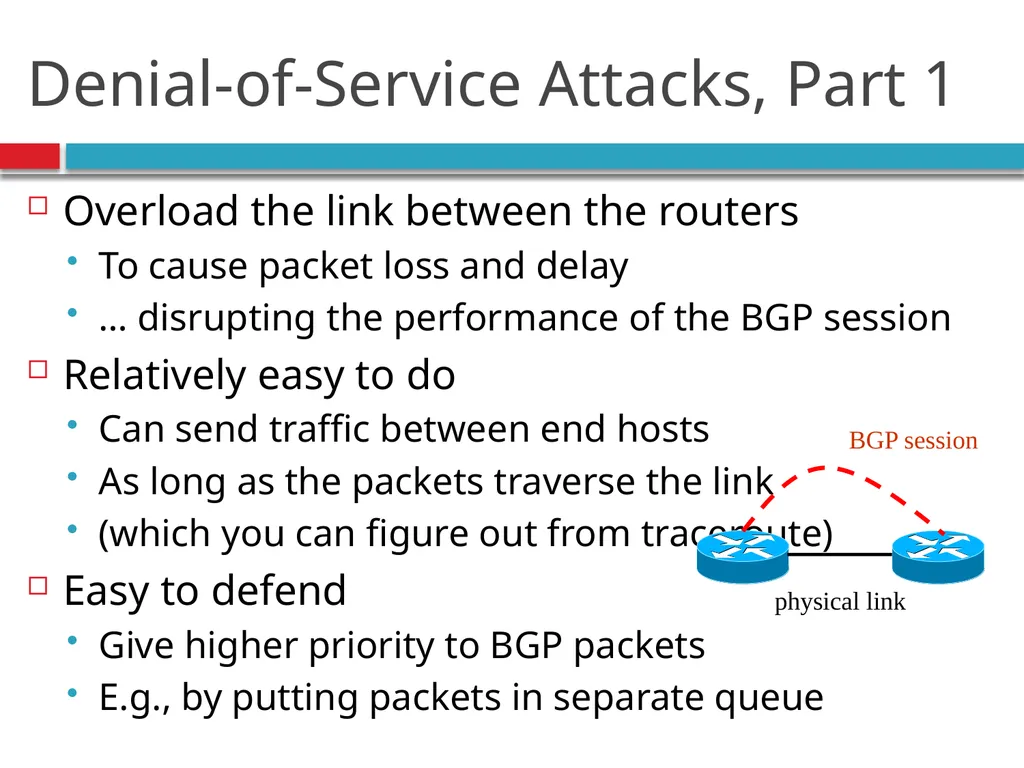
27 Denial-of-Service Attacks, Part 1 Overload the link between the routers
To cause packet loss and delay
… disrupting the performance of the BGP session
Relatively easy to do
Can send traffic between end hosts
As long as the packets traverse the link
(which you can figure out from traceroute)
Easy to defend
Give higher priority to BGP packets
E.g., by putting packets in separate queue BGP session physical link<br>
To cause packet loss and delay
… disrupting the performance of the BGP session
Relatively easy to do
Can send traffic between end hosts
As long as the packets traverse the link
(which you can figure out from traceroute)
Easy to defend
Give higher priority to BGP packets
E.g., by putting packets in separate queue BGP session physical link<br>
28
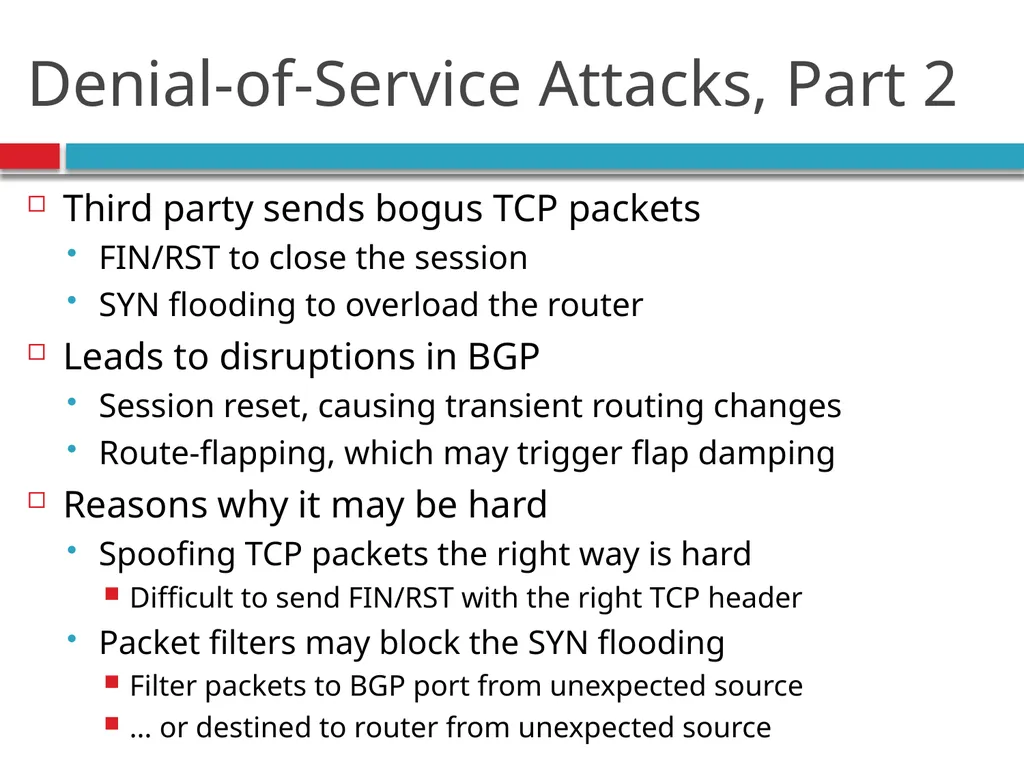
28 Denial-of-Service Attacks, Part 2 Third party sends bogus TCP packets
FIN/RST to close the session
SYN flooding to overload the router
Leads to disruptions in BGP
Session reset, causing transient routing changes
Route-flapping, which may trigger flap damping
Reasons why it may be hard
Spoofing TCP packets the right way is hard
Difficult to send FIN/RST with the right TCP header
Packet filters may block the SYN flooding
Filter packets to BGP port from unexpected source
… or destined to router from unexpected source<br>
FIN/RST to close the session
SYN flooding to overload the router
Leads to disruptions in BGP
Session reset, causing transient routing changes
Route-flapping, which may trigger flap damping
Reasons why it may be hard
Spoofing TCP packets the right way is hard
Difficult to send FIN/RST with the right TCP header
Packet filters may block the SYN flooding
Filter packets to BGP port from unexpected source
… or destined to router from unexpected source<br>
29
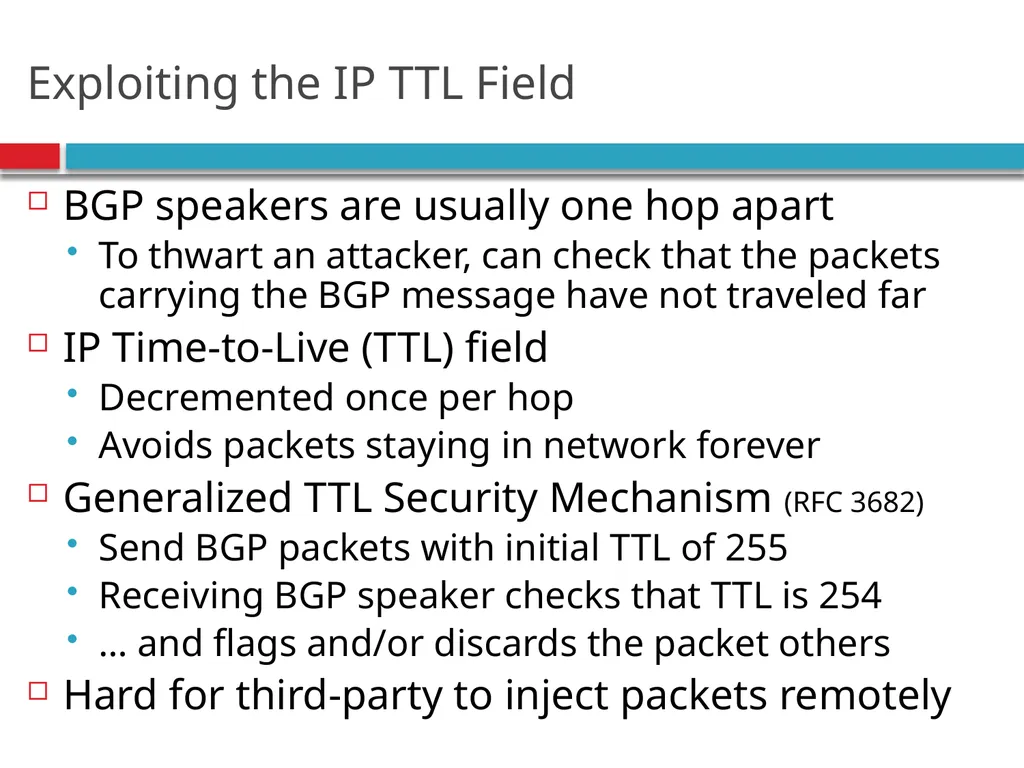
29 Exploiting the IP TTL Field BGP speakers are usually one hop apart
To thwart an attacker, can check that the packets carrying the BGP message have not traveled far
IP Time-to-Live (TTL) field
Decremented once per hop
Avoids packets staying in network forever
Generalized TTL Security Mechanism (RFC 3682)
Send BGP packets with initial TTL of 255
Receiving BGP speaker checks that TTL is 254
… and flags and/or discards the packet others
Hard for third-party to inject packets remotely<br>
To thwart an attacker, can check that the packets carrying the BGP message have not traveled far
IP Time-to-Live (TTL) field
Decremented once per hop
Avoids packets staying in network forever
Generalized TTL Security Mechanism (RFC 3682)
Send BGP packets with initial TTL of 255
Receiving BGP speaker checks that TTL is 254
… and flags and/or discards the packet others
Hard for third-party to inject packets remotely<br>
30
Control plane attacks on routing
Attacks on the BGP Session
Solutions to prevent prefix hijacks
Solutions to detect prefix hijacks
Data plane attacks
Wrap up Outline 30<br>
Attacks on the BGP Session
Solutions to prevent prefix hijacks
Solutions to detect prefix hijacks
Data plane attacks
Wrap up Outline 30<br>
31
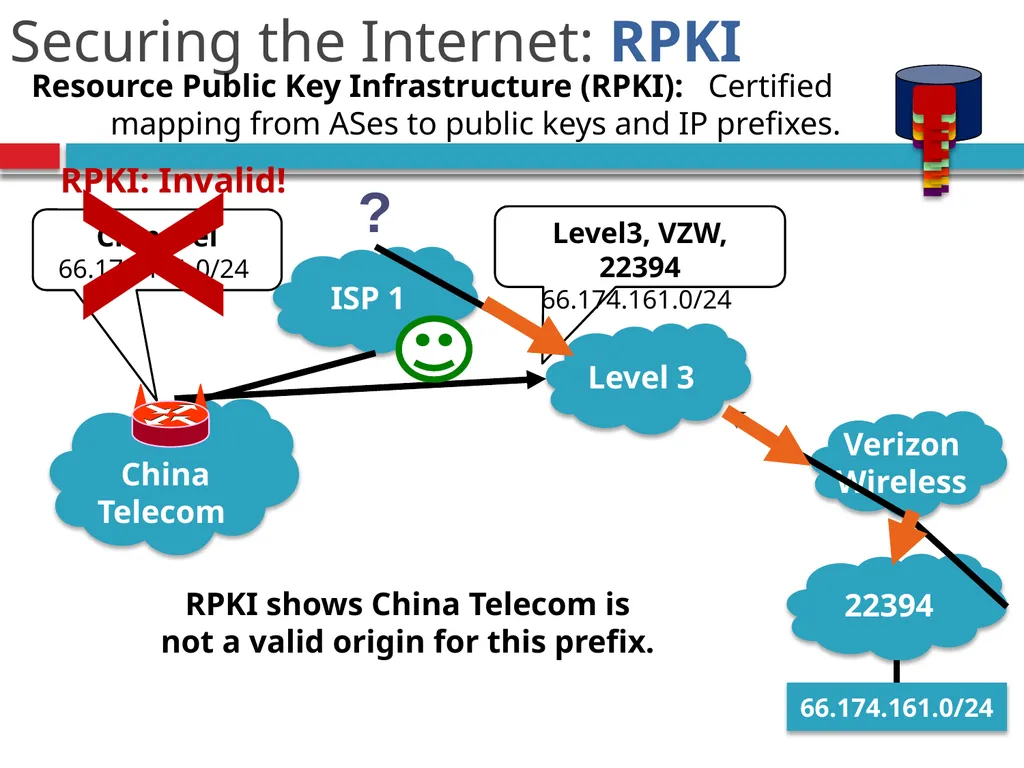
Securing the Internet: RPKI China
Telecom ISP 1 Verizon
Wireless Level 3 ChinaTel 66.174.161.0/24 ? Level3, VZW, 22394 66.174.161.0/24 22394 RPKI shows China Telecom is not a valid origin for this prefix. 66.174.161.0/24<br>
Telecom ISP 1 Verizon
Wireless Level 3 ChinaTel 66.174.161.0/24 ? Level3, VZW, 22394 66.174.161.0/24 22394 RPKI shows China Telecom is not a valid origin for this prefix. 66.174.161.0/24<br>
32
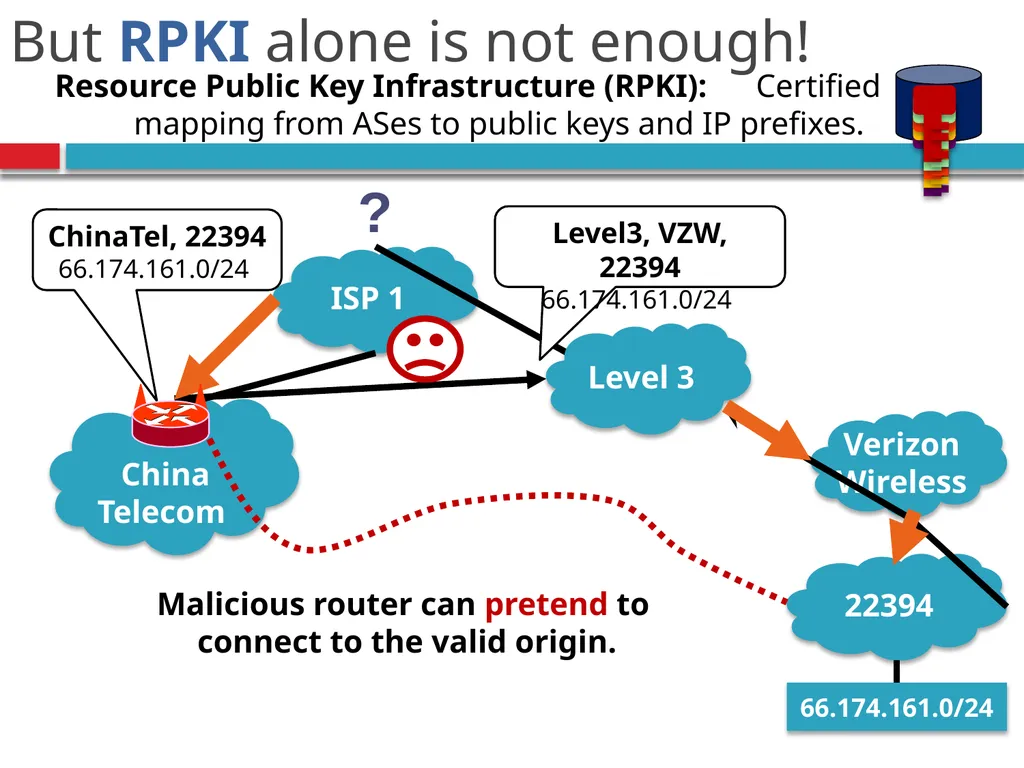
But RPKI alone is not enough! China
Telecom ISP 1 Verizon
Wireless Level 3 ChinaTel, 22394 66.174.161.0/24 ? Level3, VZW, 22394 66.174.161.0/24 22394 Malicious router can pretend to connect to the valid origin. 66.174.161.0/24<br>
Telecom ISP 1 Verizon
Wireless Level 3 ChinaTel, 22394 66.174.161.0/24 ? Level3, VZW, 22394 66.174.161.0/24 22394 Malicious router can pretend to connect to the valid origin. 66.174.161.0/24<br>
33
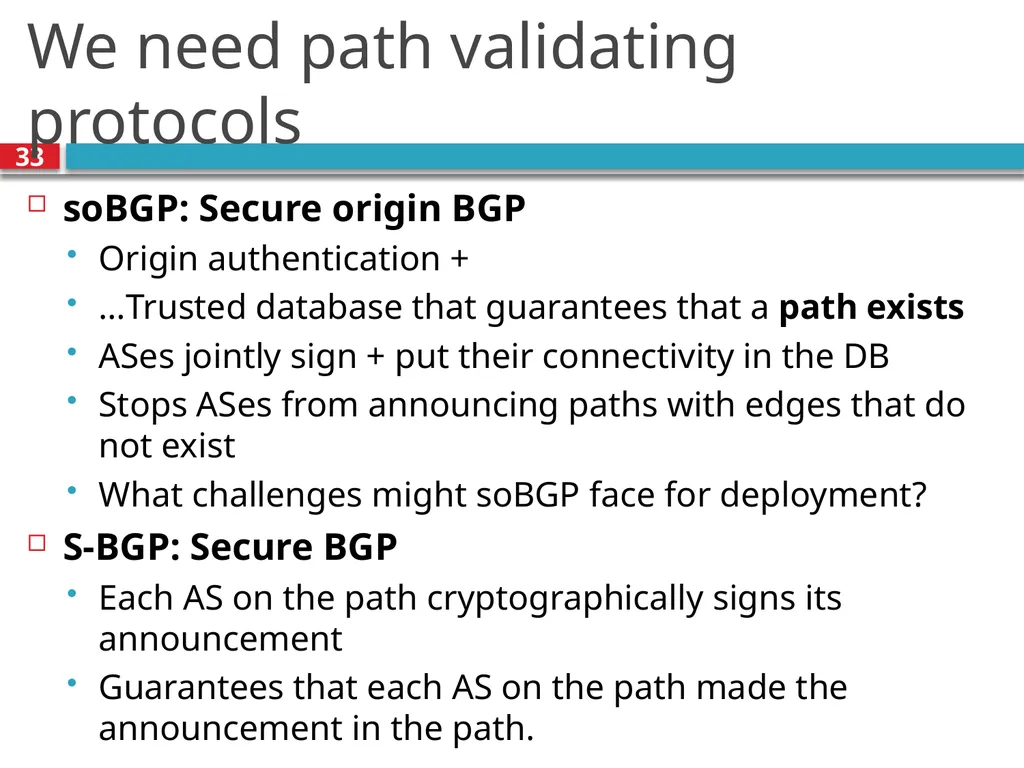
We need path validating protocols 33 soBGP: Secure origin BGP
Origin authentication +
…Trusted database that guarantees that a path exists
ASes jointly sign + put their connectivity in the DB
Stops ASes from announcing paths with edges that do not exist
What challenges might soBGP face for deployment?
S-BGP: Secure BGP
Each AS on the path cryptographically signs its announcement
Guarantees that each AS on the path made the announcement in the path.<br>
Origin authentication +
…Trusted database that guarantees that a path exists
ASes jointly sign + put their connectivity in the DB
Stops ASes from announcing paths with edges that do not exist
What challenges might soBGP face for deployment?
S-BGP: Secure BGP
Each AS on the path cryptographically signs its announcement
Guarantees that each AS on the path made the announcement in the path.<br>
34
China
Telecom ISP 1 Verizon
Wireless Level 3 22394<br>
Telecom ISP 1 Verizon
Wireless Level 3 22394<br>
35
China
Telecom ISP 1 Verizon
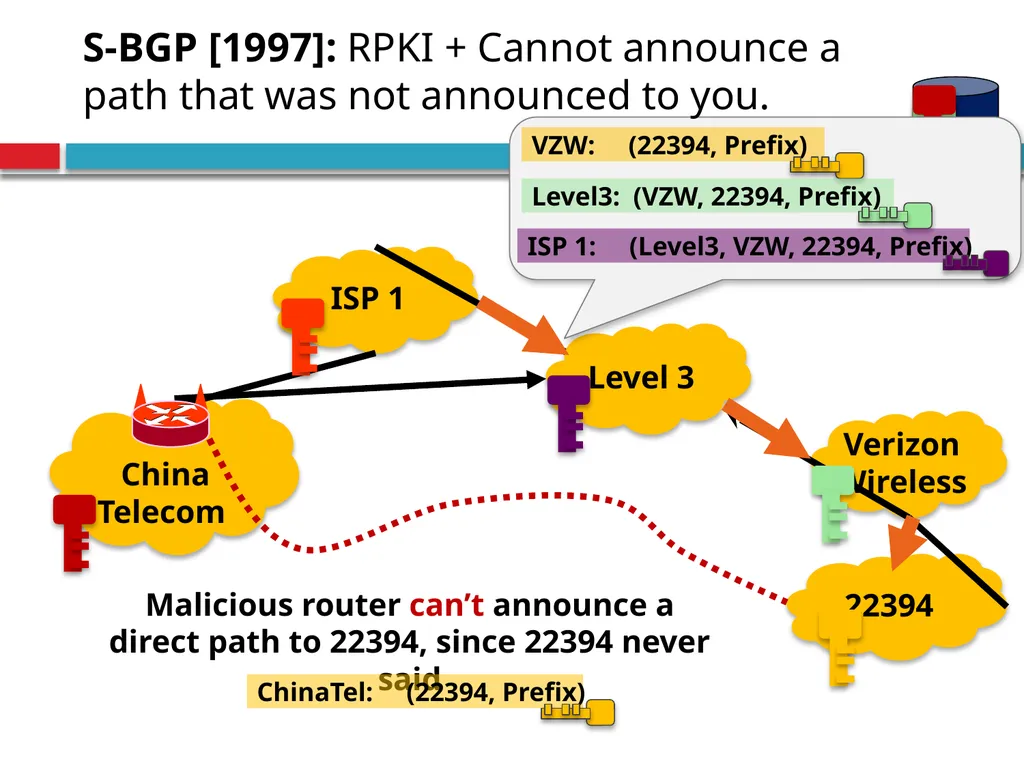
Wireless Level 3 22394 Malicious router can’t announce a direct path to 22394, since 22394 never said ChinaTel: (22394, Prefix) S-BGP [1997]: RPKI + Cannot announce a path that was not announced to you.<br>
Telecom ISP 1 Verizon
Wireless Level 3 22394 Malicious router can’t announce a direct path to 22394, since 22394 never said ChinaTel: (22394, Prefix) S-BGP [1997]: RPKI + Cannot announce a path that was not announced to you.<br>
36
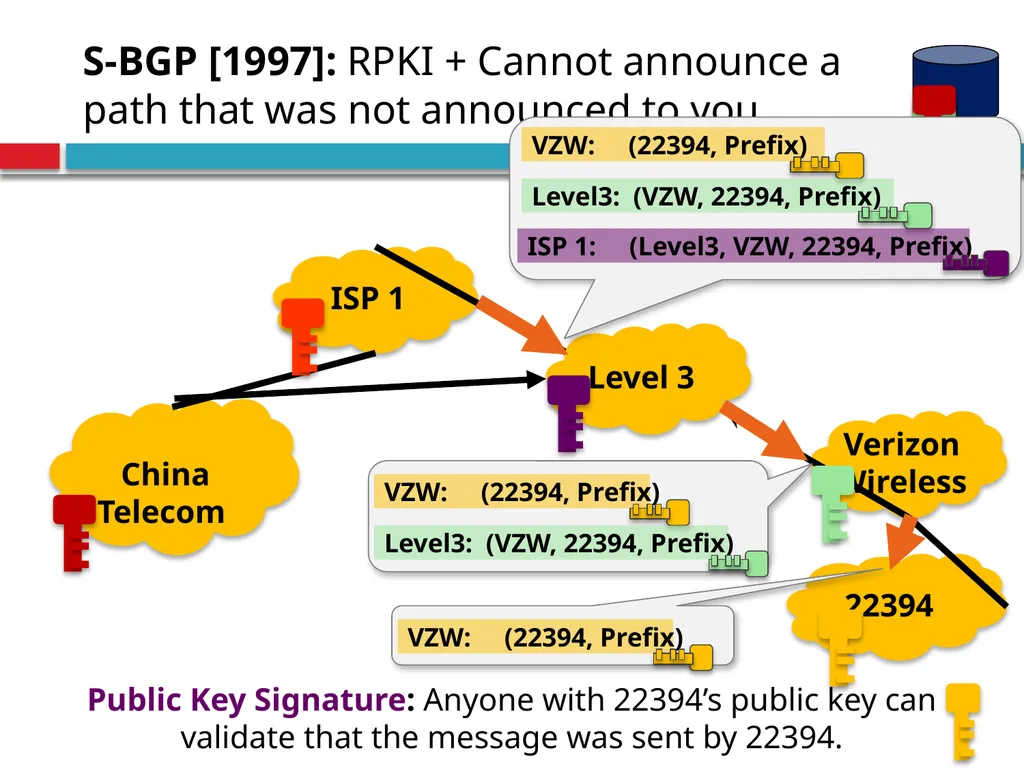
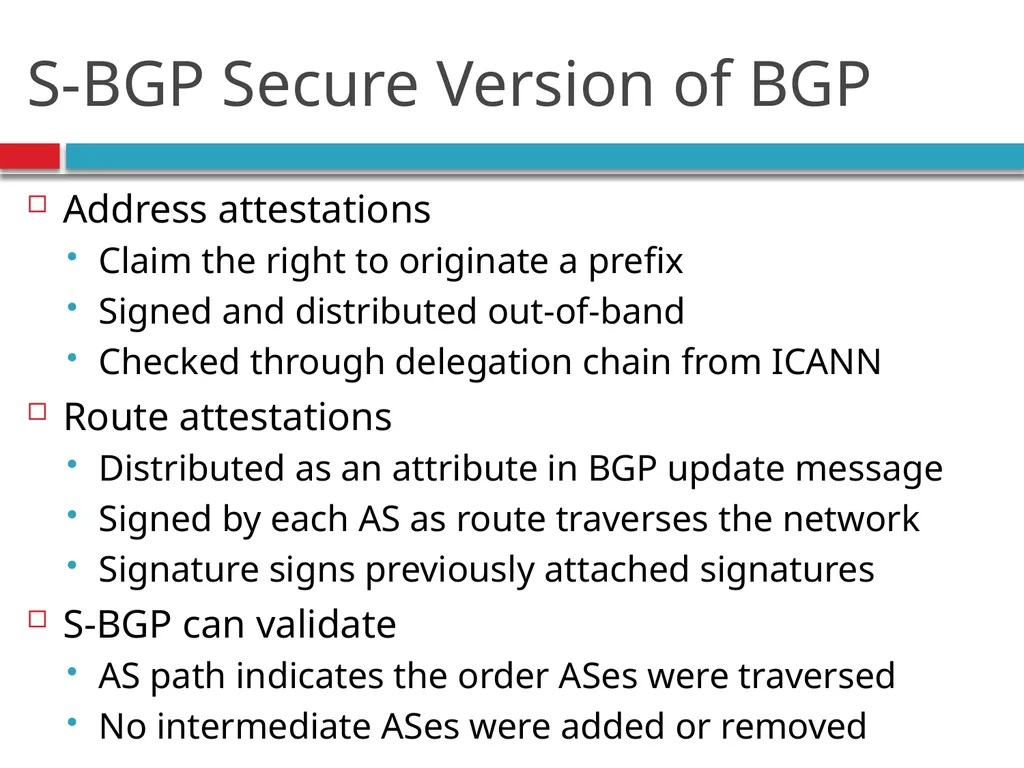
36 S-BGP Secure Version of BGP Address attestations
Claim the right to originate a prefix
Signed and distributed out-of-band
Checked through delegation chain from ICANN
Route attestations
Distributed as an attribute in BGP update message
Signed by each AS as route traverses the network
Signature signs previously attached signatures
S-BGP can validate
AS path indicates the order ASes were traversed
No intermediate ASes were added or removed<br>
Claim the right to originate a prefix
Signed and distributed out-of-band
Checked through delegation chain from ICANN
Route attestations
Distributed as an attribute in BGP update message
Signed by each AS as route traverses the network
Signature signs previously attached signatures
S-BGP can validate
AS path indicates the order ASes were traversed
No intermediate ASes were added or removed<br>
37
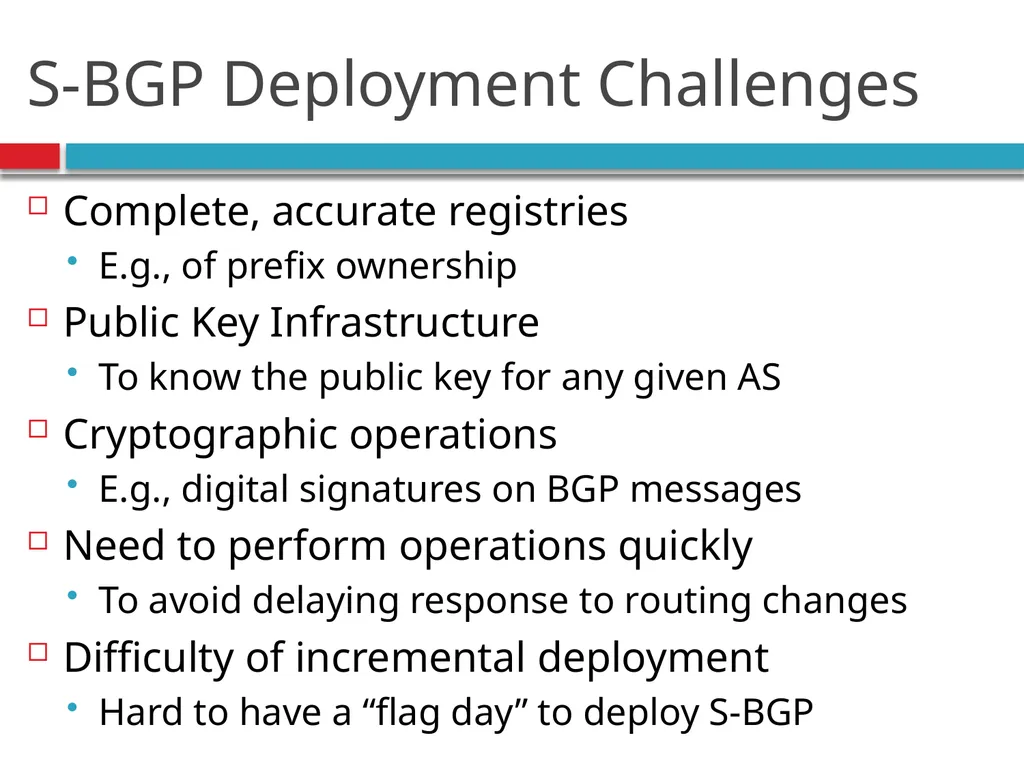
37 S-BGP Deployment Challenges Complete, accurate registries
E.g., of prefix ownership
Public Key Infrastructure
To know the public key for any given AS
Cryptographic operations
E.g., digital signatures on BGP messages
Need to perform operations quickly
To avoid delaying response to routing changes
Difficulty of incremental deployment
Hard to have a “flag day” to deploy S-BGP<br>
E.g., of prefix ownership
Public Key Infrastructure
To know the public key for any given AS
Cryptographic operations
E.g., digital signatures on BGP messages
Need to perform operations quickly
To avoid delaying response to routing changes
Difficulty of incremental deployment
Hard to have a “flag day” to deploy S-BGP<br>
38
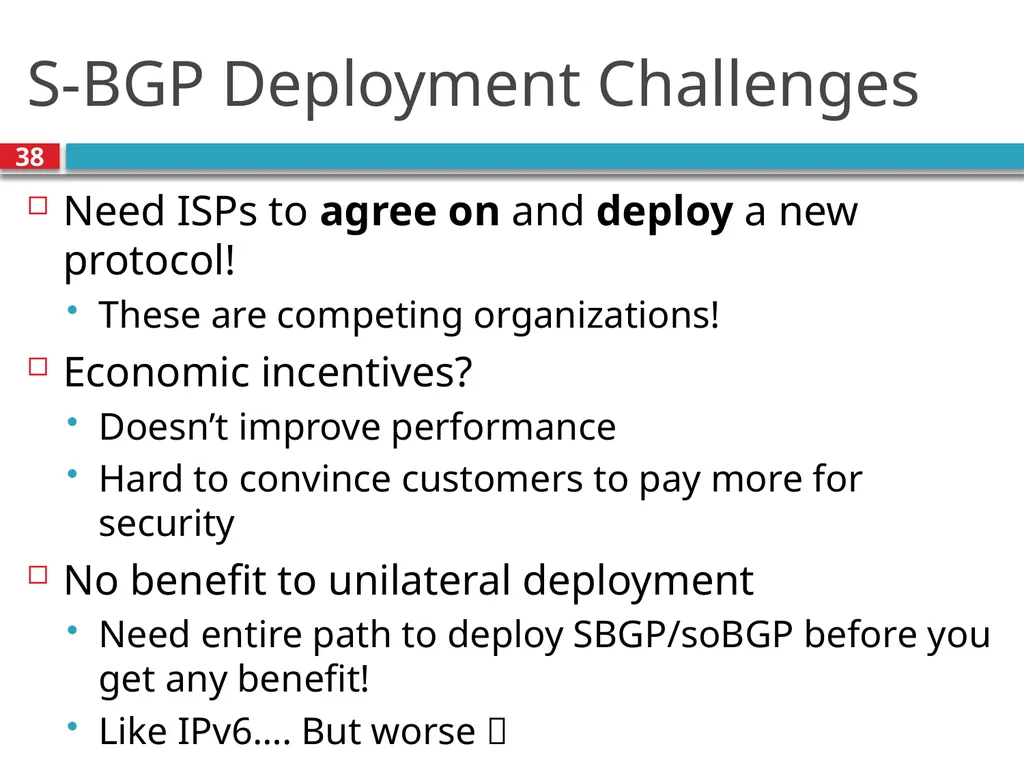
S-BGP Deployment Challenges 38 Need ISPs to agree on and deploy a new protocol!
These are competing organizations!
Economic incentives?
Doesn’t improve performance
Hard to convince customers to pay more for security
No benefit to unilateral deployment
Need entire path to deploy SBGP/soBGP before you get any benefit!
Like IPv6…. But worse <br>
These are competing organizations!
Economic incentives?
Doesn’t improve performance
Hard to convince customers to pay more for security
No benefit to unilateral deployment
Need entire path to deploy SBGP/soBGP before you get any benefit!
Like IPv6…. But worse <br>
39
Control plane attacks on routing
Attacks on the BGP Session
Solutions to prevent prefix hijacks
Solutions to detect prefix hijacks
Data plane attacks
Wrap up Outline 39<br>
Attacks on the BGP Session
Solutions to prevent prefix hijacks
Solutions to detect prefix hijacks
Data plane attacks
Wrap up Outline 39<br>
40
40 Incrementally Deployable Schemes Monitoring BGP update messages
Use past history as an implicit registry
E.g., AS that announces each address block
E.g., AS-level edges and paths
Out-of-band detection mechanism
Generate reports and alerts
Internet Alert Registry: http://iar.cs.unm.edu/
Prefix Hijack Alert System: http://phas.netsec.colostate.edu/
Soft response to suspicious routes
Prefer routes that agree with the past
Delay adoption of unfamiliar routes when possible
Some (e.g., misconfiguration) will disappear on their own<br>
Use past history as an implicit registry
E.g., AS that announces each address block
E.g., AS-level edges and paths
Out-of-band detection mechanism
Generate reports and alerts
Internet Alert Registry: http://iar.cs.unm.edu/
Prefix Hijack Alert System: http://phas.netsec.colostate.edu/
Soft response to suspicious routes
Prefer routes that agree with the past
Delay adoption of unfamiliar routes when possible
Some (e.g., misconfiguration) will disappear on their own<br>
41
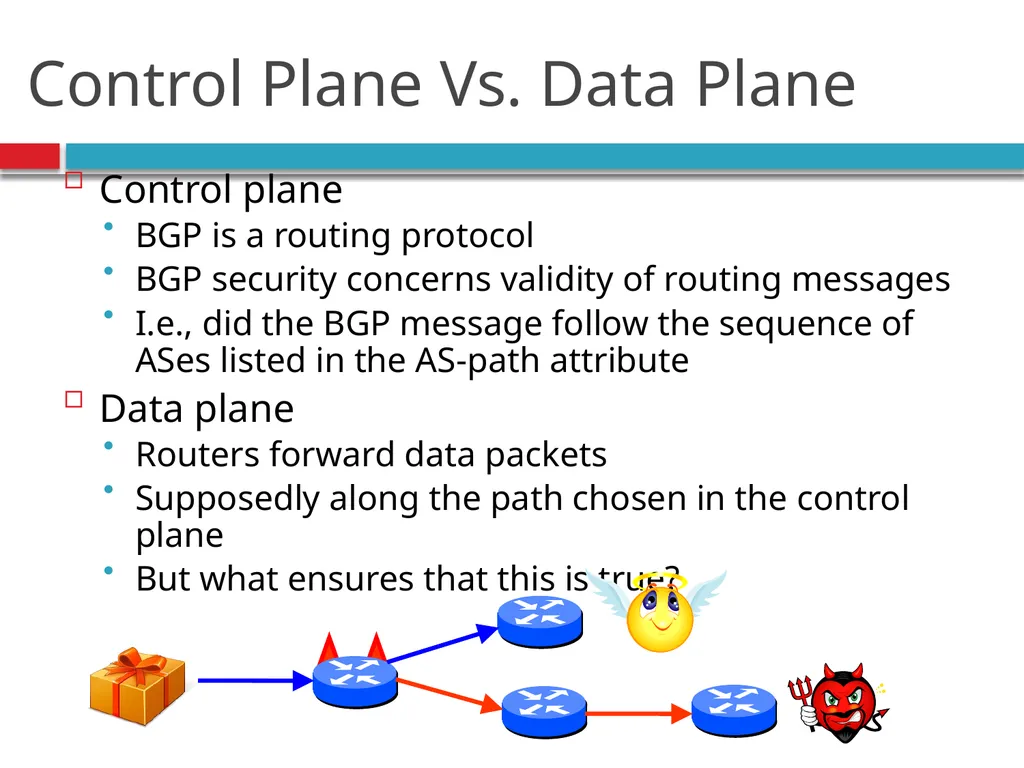
41 Control Plane Vs. Data Plane Control plane
BGP is a routing protocol
BGP security concerns validity of routing messages
I.e., did the BGP message follow the sequence of ASes listed in the AS-path attribute
Data plane
Routers forward data packets
Supposedly along the path chosen in the control plane
But what ensures that this is true?<br>
BGP is a routing protocol
BGP security concerns validity of routing messages
I.e., did the BGP message follow the sequence of ASes listed in the AS-path attribute
Data plane
Routers forward data packets
Supposedly along the path chosen in the control plane
But what ensures that this is true?<br>
42
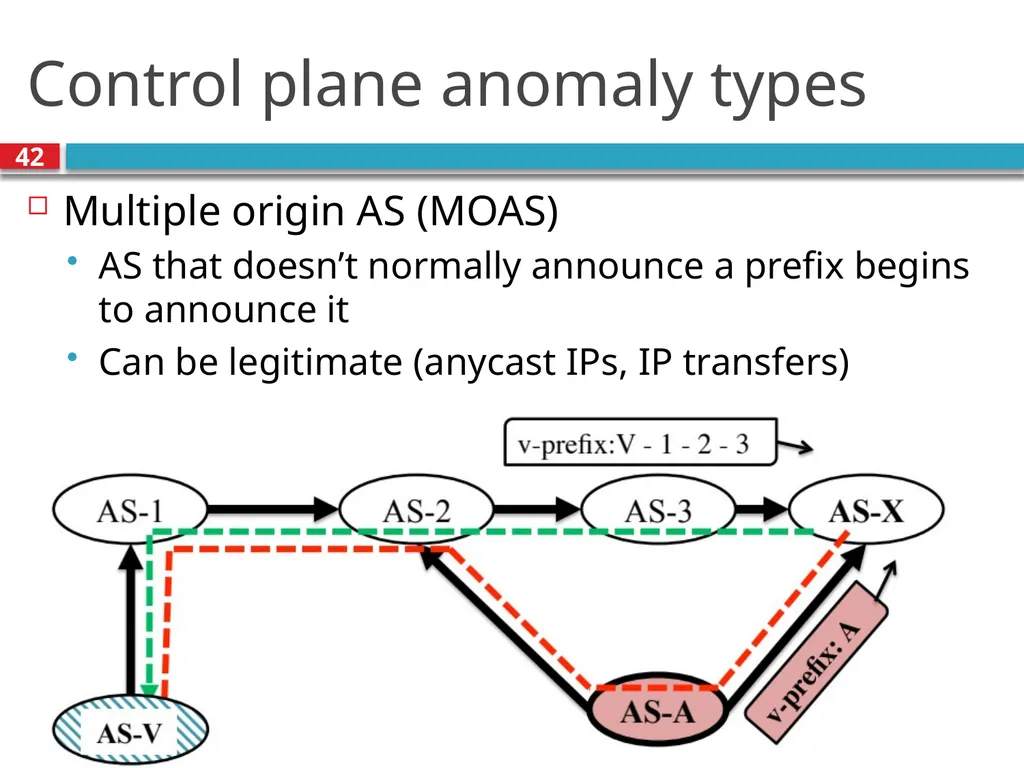
Control plane anomaly types 42 Multiple origin AS (MOAS)
AS that doesn’t normally announce a prefix begins to announce it
Can be legitimate (anycast IPs, IP transfers)<br>
AS that doesn’t normally announce a prefix begins to announce it
Can be legitimate (anycast IPs, IP transfers)<br>
43
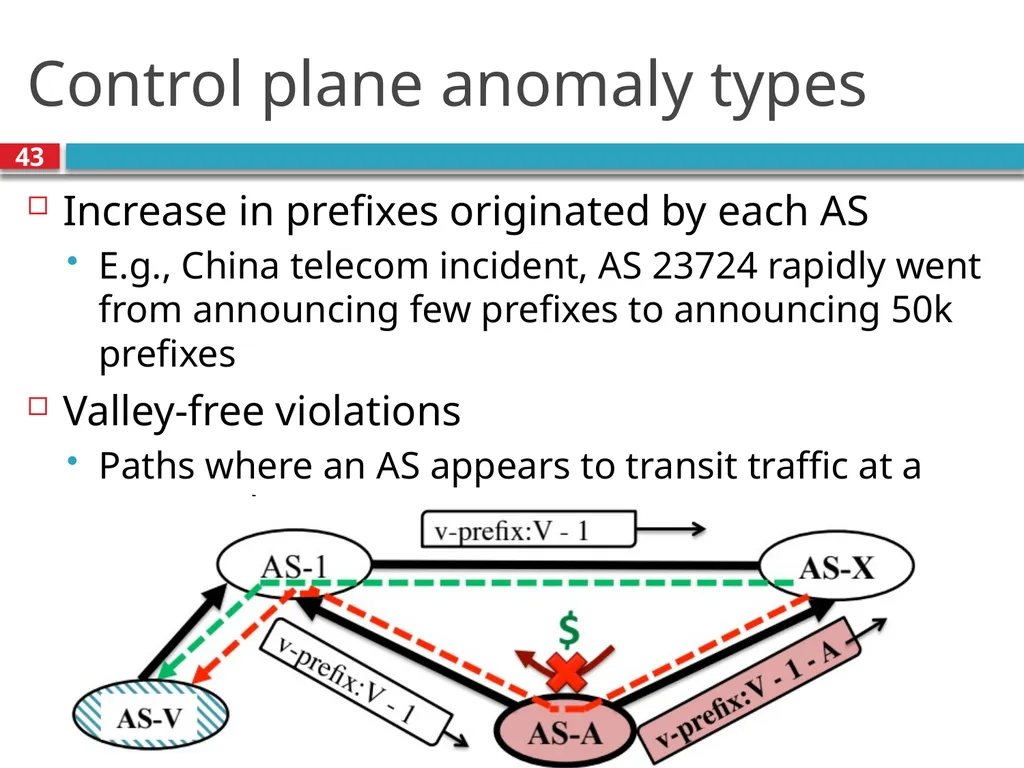
Control plane anomaly types 43 Increase in prefixes originated by each AS
E.g., China telecom incident, AS 23724 rapidly went from announcing few prefixes to announcing 50k prefixes
Valley-free violations
Paths where an AS appears to transit traffic at a revenue loss.<br>
E.g., China telecom incident, AS 23724 rapidly went from announcing few prefixes to announcing 50k prefixes
Valley-free violations
Paths where an AS appears to transit traffic at a revenue loss.<br>
44
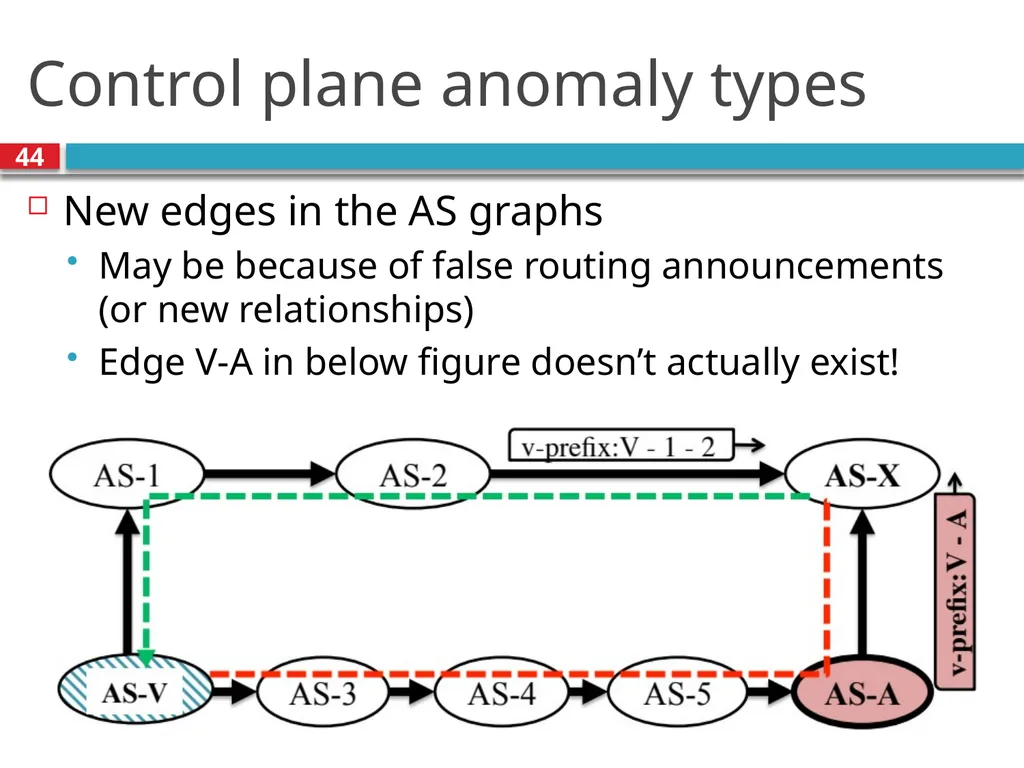
Control plane anomaly types 44 New edges in the AS graphs
May be because of false routing announcements (or new relationships)
Edge V-A in below figure doesn’t actually exist!<br>
May be because of false routing announcements (or new relationships)
Edge V-A in below figure doesn’t actually exist!<br>
45
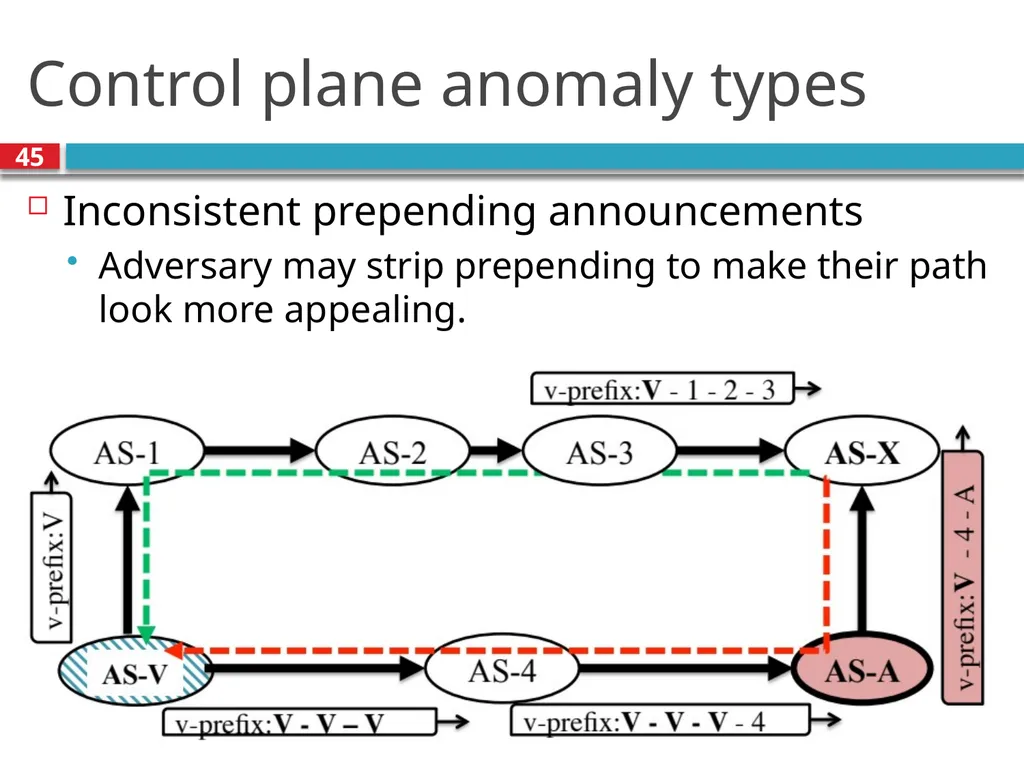
Control plane anomaly types 45 Inconsistent prepending announcements
Adversary may strip prepending to make their path look more appealing.<br>
Adversary may strip prepending to make their path look more appealing.<br>
46
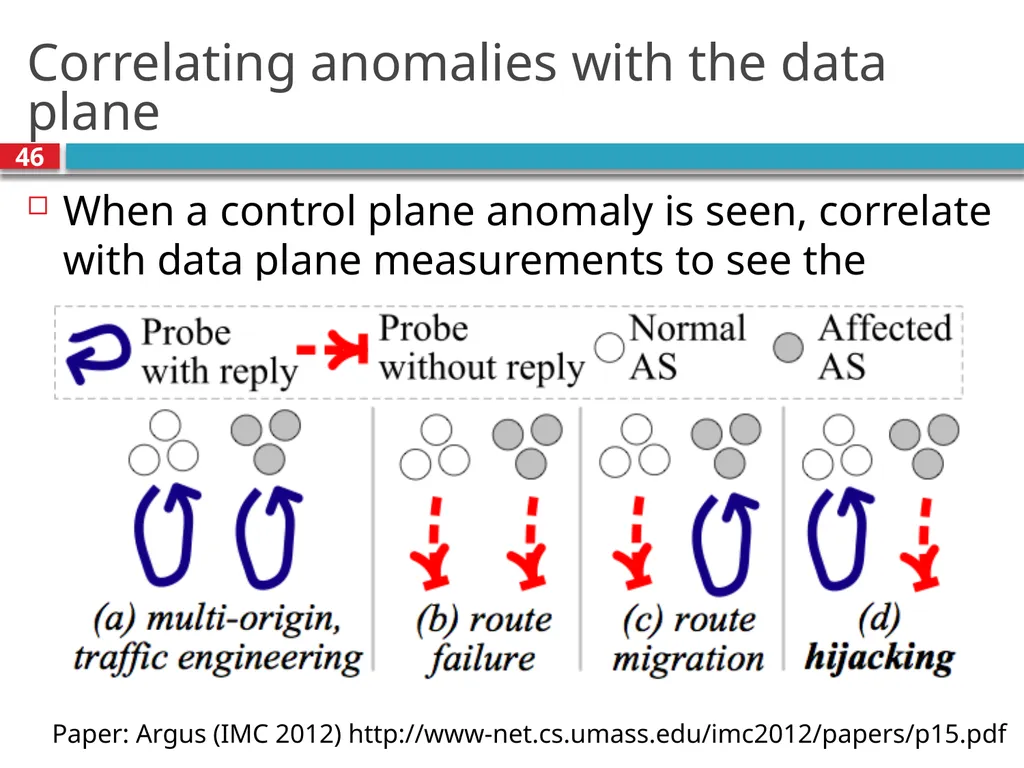
Correlating anomalies with the data plane 46 When a control plane anomaly is seen, correlate with data plane measurements to see the impact. Paper: Argus (IMC 2012) http://www-net.cs.umass.edu/imc2012/papers/p15.pdf<br>
47
Control plane attacks on routing
Attacks on the BGP Session
Solutions to prevent prefix hijacks
Solutions to detect prefix hijacks
Data plane attacks
Wrap up Outline 47<br>
Attacks on the BGP Session
Solutions to prevent prefix hijacks
Solutions to detect prefix hijacks
Data plane attacks
Wrap up Outline 47<br>
48
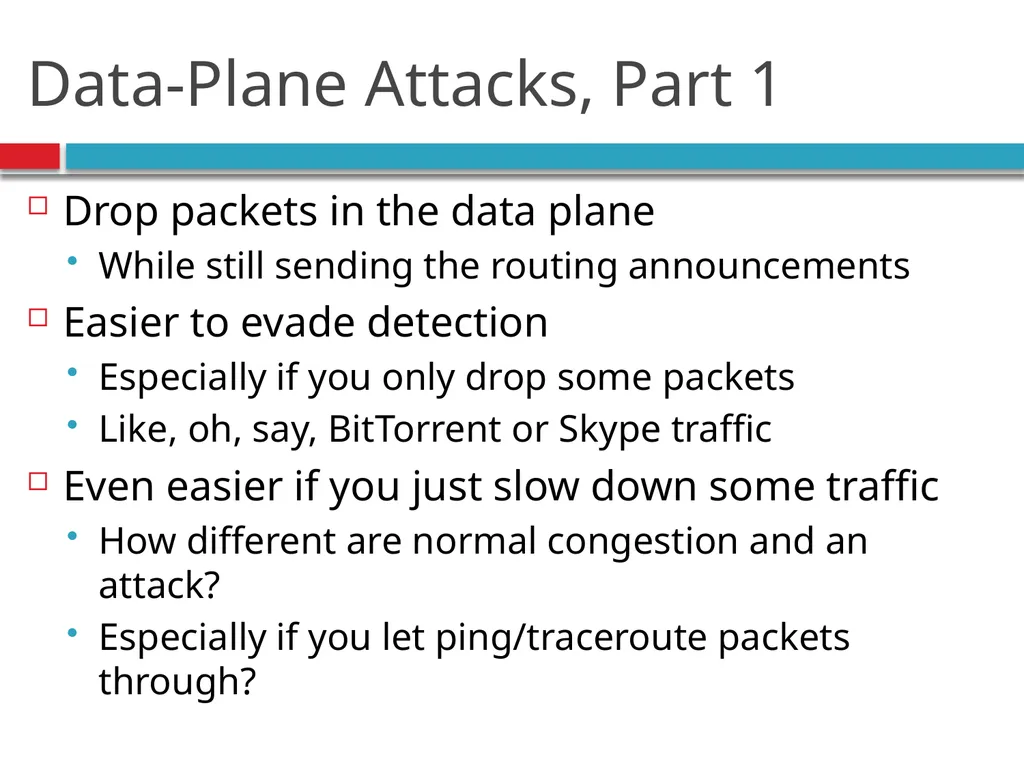
48 Data-Plane Attacks, Part 1 Drop packets in the data plane
While still sending the routing announcements
Easier to evade detection
Especially if you only drop some packets
Like, oh, say, BitTorrent or Skype traffic
Even easier if you just slow down some traffic
How different are normal congestion and an attack?
Especially if you let ping/traceroute packets through?<br>
While still sending the routing announcements
Easier to evade detection
Especially if you only drop some packets
Like, oh, say, BitTorrent or Skype traffic
Even easier if you just slow down some traffic
How different are normal congestion and an attack?
Especially if you let ping/traceroute packets through?<br>
49
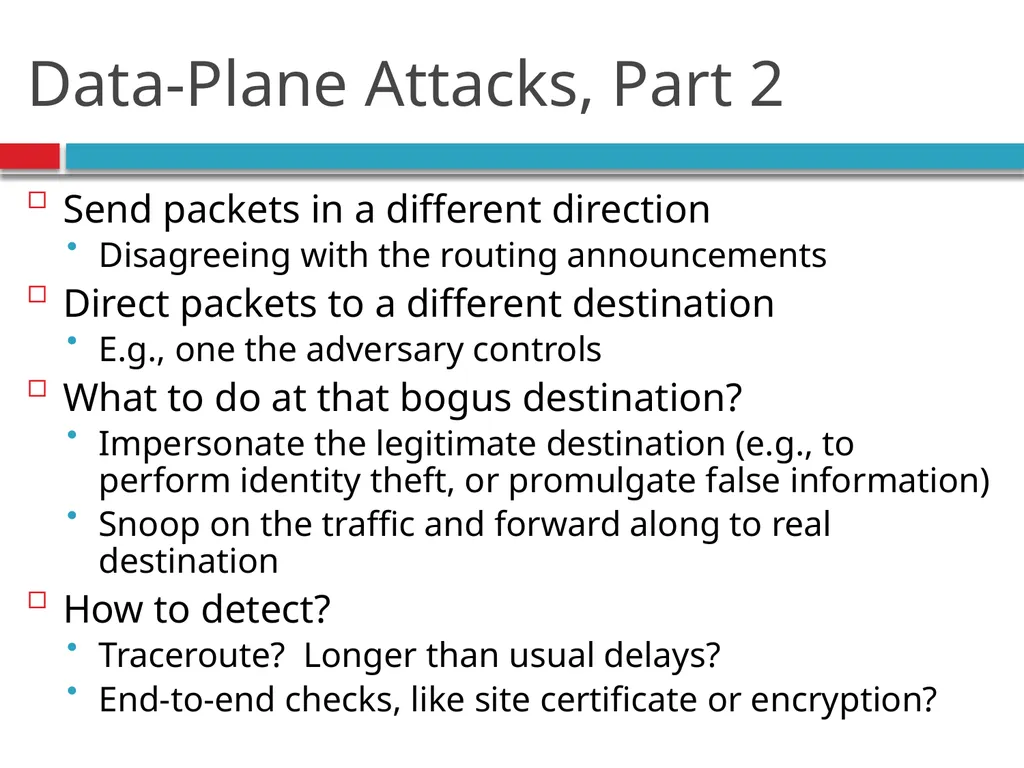
49 Data-Plane Attacks, Part 2 Send packets in a different direction
Disagreeing with the routing announcements
Direct packets to a different destination
E.g., one the adversary controls
What to do at that bogus destination?
Impersonate the legitimate destination (e.g., to perform identity theft, or promulgate false information)
Snoop on the traffic and forward along to real destination
How to detect?
Traceroute? Longer than usual delays?
End-to-end checks, like site certificate or encryption?<br>
Disagreeing with the routing announcements
Direct packets to a different destination
E.g., one the adversary controls
What to do at that bogus destination?
Impersonate the legitimate destination (e.g., to perform identity theft, or promulgate false information)
Snoop on the traffic and forward along to real destination
How to detect?
Traceroute? Longer than usual delays?
End-to-end checks, like site certificate or encryption?<br>
50
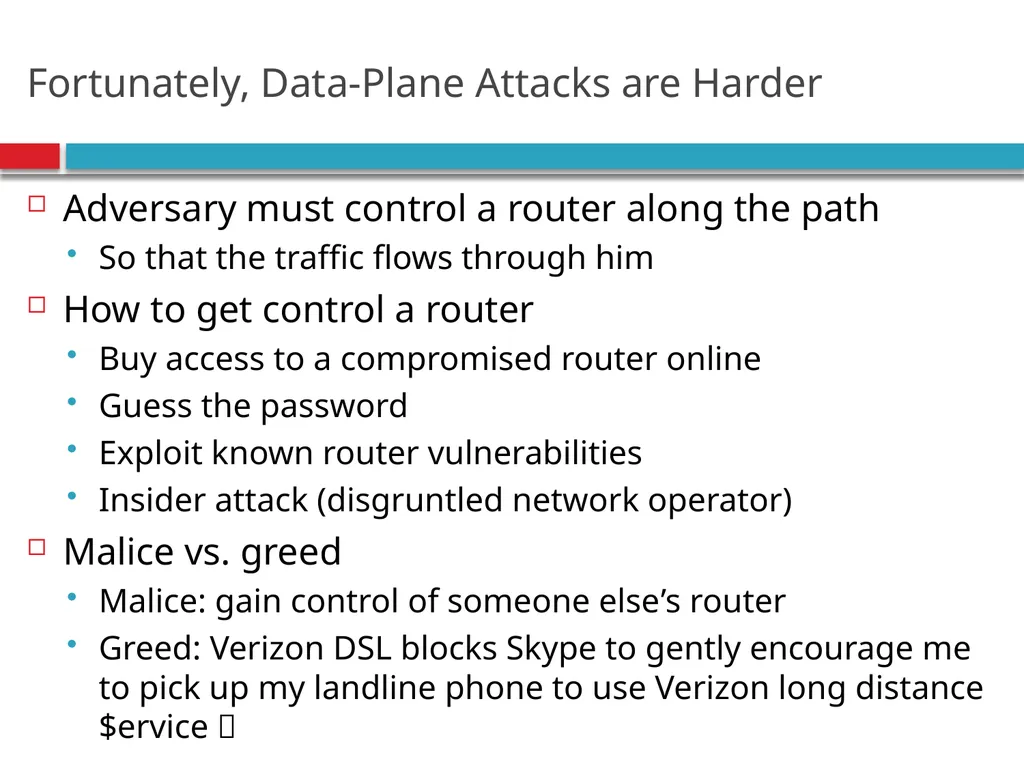
50 Fortunately, Data-Plane Attacks are Harder Adversary must control a router along the path
So that the traffic flows through him
How to get control a router
Buy access to a compromised router online
Guess the password
Exploit known router vulnerabilities
Insider attack (disgruntled network operator)
Malice vs. greed
Malice: gain control of someone else’s router
Greed: Verizon DSL blocks Skype to gently encourage me to pick up my landline phone to use Verizon long distance $ervice <br>
So that the traffic flows through him
How to get control a router
Buy access to a compromised router online
Guess the password
Exploit known router vulnerabilities
Insider attack (disgruntled network operator)
Malice vs. greed
Malice: gain control of someone else’s router
Greed: Verizon DSL blocks Skype to gently encourage me to pick up my landline phone to use Verizon long distance $ervice <br>
51
Control plane attacks on routing
Attacks on the BGP Session
Solutions to prevent prefix hijacks
Solutions to detect prefix hijacks
Data plane attacks
Wrap up Outline 51<br>
Attacks on the BGP Session
Solutions to prevent prefix hijacks
Solutions to detect prefix hijacks
Data plane attacks
Wrap up Outline 51<br>
52
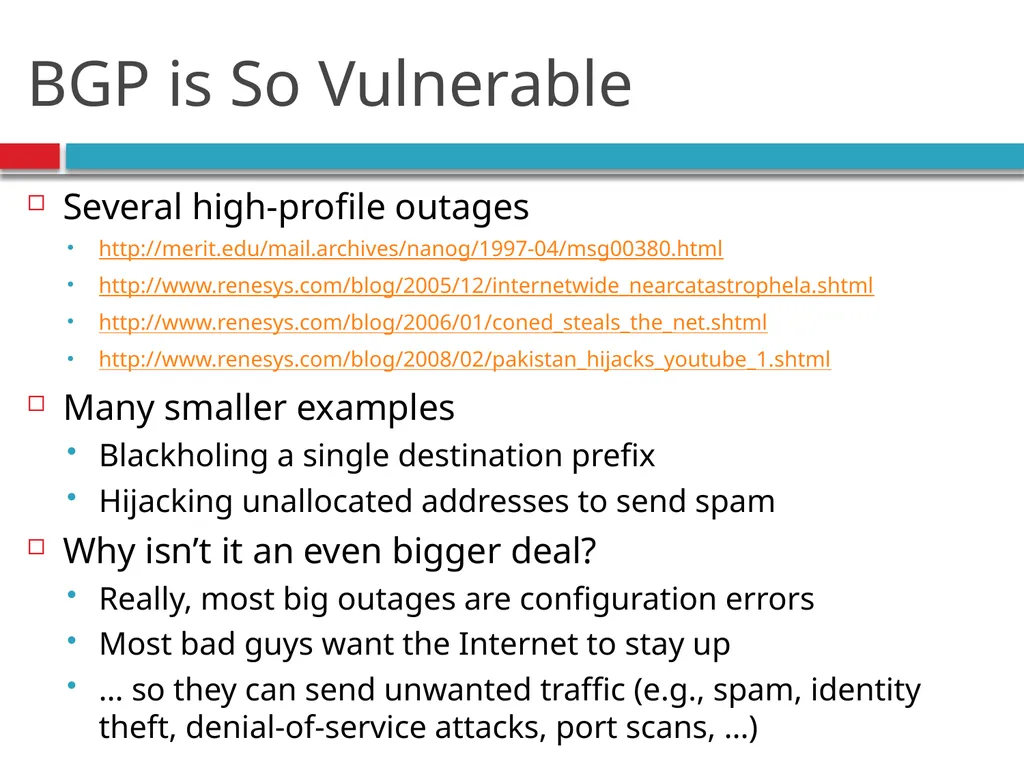
52 BGP is So Vulnerable Several high-profile outages
http://merit.edu/mail.archives/nanog/1997-04/msg00380.html
http://www.renesys.com/blog/2005/12/internetwide_nearcatastrophela.shtml
http://www.renesys.com/blog/2006/01/coned_steals_the_net.shtml
http://www.renesys.com/blog/2008/02/pakistan_hijacks_youtube_1.shtml
Many smaller examples
Blackholing a single destination prefix
Hijacking unallocated addresses to send spam
Why isn’t it an even bigger deal?
Really, most big outages are configuration errors
Most bad guys want the Internet to stay up
… so they can send unwanted traffic (e.g., spam, identity theft, denial-of-service attacks, port scans, …)<br>
http://merit.edu/mail.archives/nanog/1997-04/msg00380.html
http://www.renesys.com/blog/2005/12/internetwide_nearcatastrophela.shtml
http://www.renesys.com/blog/2006/01/coned_steals_the_net.shtml
http://www.renesys.com/blog/2008/02/pakistan_hijacks_youtube_1.shtml
Many smaller examples
Blackholing a single destination prefix
Hijacking unallocated addresses to send spam
Why isn’t it an even bigger deal?
Really, most big outages are configuration errors
Most bad guys want the Internet to stay up
… so they can send unwanted traffic (e.g., spam, identity theft, denial-of-service attacks, port scans, …)<br>
53
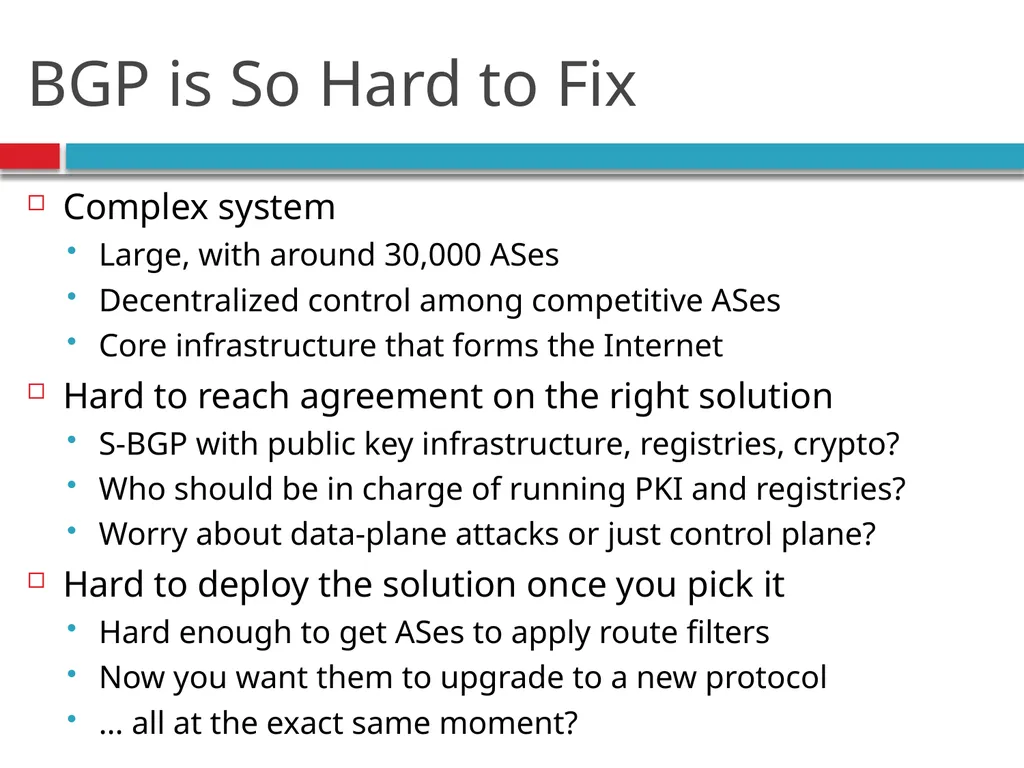
53 BGP is So Hard to Fix Complex system
Large, with around 30,000 ASes
Decentralized control among competitive ASes
Core infrastructure that forms the Internet
Hard to reach agreement on the right solution
S-BGP with public key infrastructure, registries, crypto?
Who should be in charge of running PKI and registries?
Worry about data-plane attacks or just control plane?
Hard to deploy the solution once you pick it
Hard enough to get ASes to apply route filters
Now you want them to upgrade to a new protocol
… all at the exact same moment?<br>
Large, with around 30,000 ASes
Decentralized control among competitive ASes
Core infrastructure that forms the Internet
Hard to reach agreement on the right solution
S-BGP with public key infrastructure, registries, crypto?
Who should be in charge of running PKI and registries?
Worry about data-plane attacks or just control plane?
Hard to deploy the solution once you pick it
Hard enough to get ASes to apply route filters
Now you want them to upgrade to a new protocol
… all at the exact same moment?<br>
54
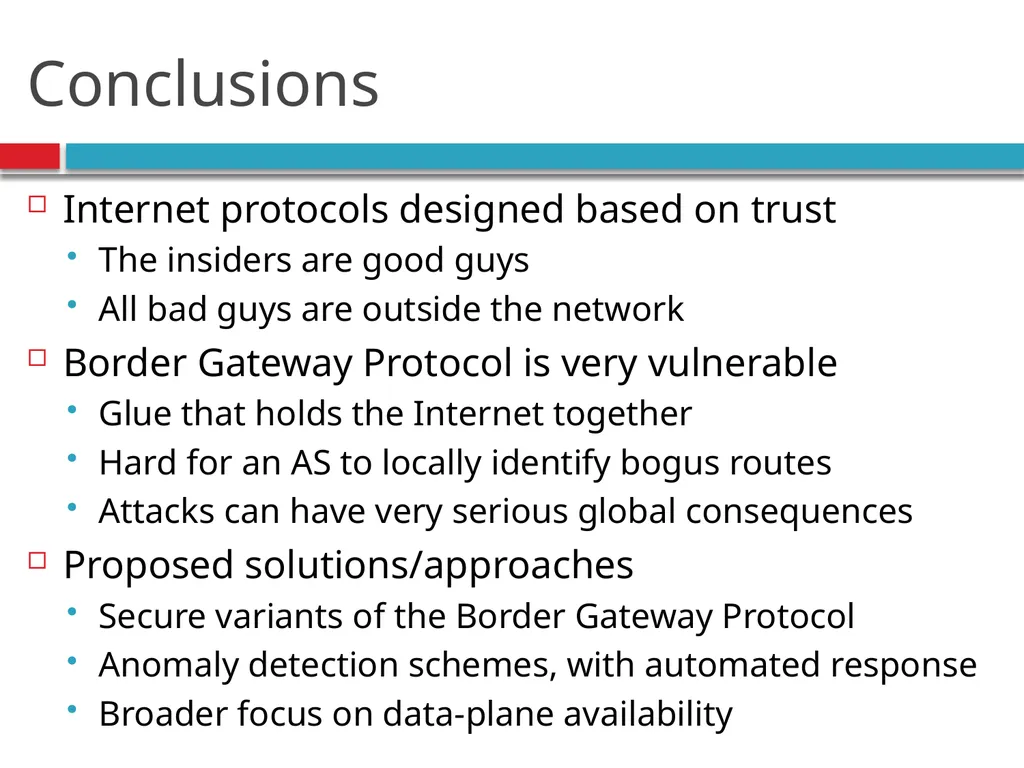
54 Conclusions Internet protocols designed based on trust
The insiders are good guys
All bad guys are outside the network
Border Gateway Protocol is very vulnerable
Glue that holds the Internet together
Hard for an AS to locally identify bogus routes
Attacks can have very serious global consequences
Proposed solutions/approaches
Secure variants of the Border Gateway Protocol
Anomaly detection schemes, with automated response
Broader focus on data-plane availability<br>
The insiders are good guys
All bad guys are outside the network
Border Gateway Protocol is very vulnerable
Glue that holds the Internet together
Hard for an AS to locally identify bogus routes
Attacks can have very serious global consequences
Proposed solutions/approaches
Secure variants of the Border Gateway Protocol
Anomaly detection schemes, with automated response
Broader focus on data-plane availability<br>
55
End. 55<br>