04
This is not a hacking course
This is not an introduction course
This is not a course where we will only deal will the operating system itself in isolation<br>
05
What This Course IS<br>
06
A course on operating system security concepts, techniques and applications including MS Windows and LINUX/UNIX platforms. Course Discription for CSIS 3756<br>
07
In my opinion this can not be done by only looking at the operating system in isolation
Today’s enterprise environments are comprised of multiple systems interconnected providing services to companies customers
It is these interconnections that has changed the world of computing and security today
It is all about the data! My opinion of what CSIS 3756 is…<br>
08
You can only learn how to design a security environment if you understand how it should be configured and how to determine what it is you are protecting
You must understand risk and how it REALLY can be of use
You need to understand how things REALLY work (theory is nice but you better know how to apply it)
“A wise man walks with his head bowed, humble like the dust” Pilot episode of Kung Fu My opinion of what CSIS 3756 is…<br>
09
To be a security professional you must understand not only the previous concepts but you must understand that…. Lastly….<br>
10
It is called
penetration testing
Penetration testers have permission to test the systems hackers don’t<br>
11
Security is the process of maintaining an acceptable level of perceived risk
Dr. Mitch Kabay, wrote that “security is a process, not an end state.”
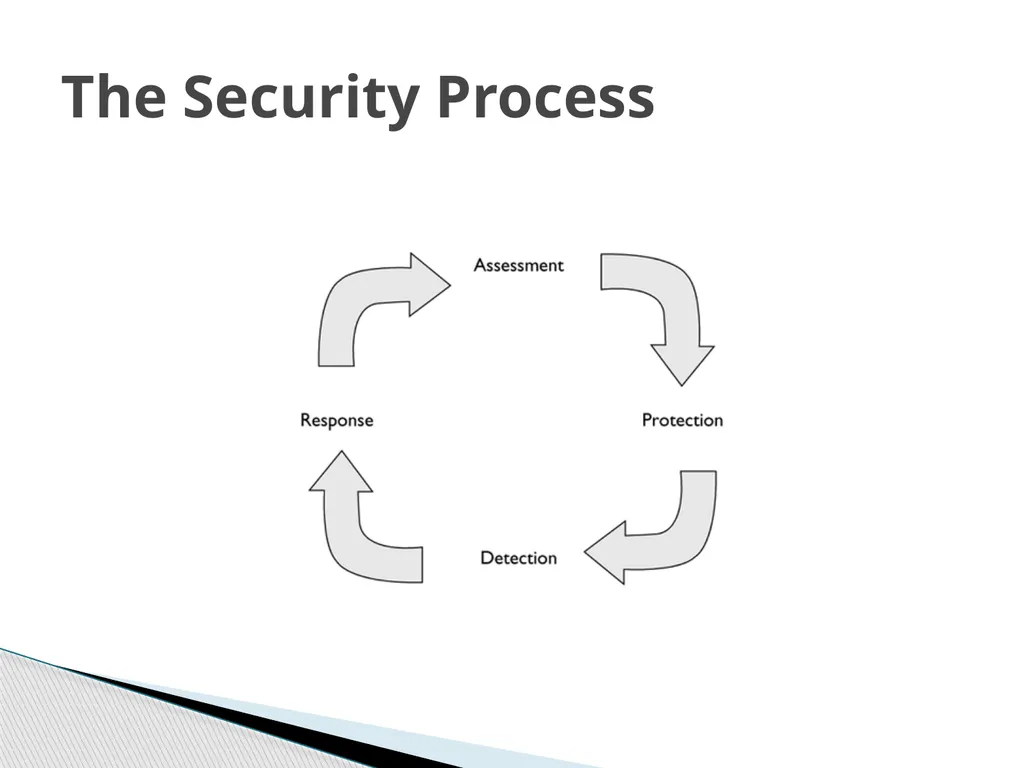
So what is the process… What is Security?<br>
12
The Security Process<br>
13
Assessment is preparation for the other three components
deals with policies, procedures, laws, regulations, budgeting, and other managerial duties, plus technical evaluation of one’s security posture
Failure to account for any of these elements harms all of the operations that follow
Why is this? Assessment<br>
14
Protection is the application of countermeasures to reduce the likelihood of compromise
What are some of these countermeasures and why do we use them? Protection<br>
15
Detection is the process of identifying intrusions
Intrusions are policy violations or computer security incidents
Kevin Mandia and Chris Prosise define an incident as any “unlawful, unauthorized, or unacceptable action that involves a computer system or a computer network.”
What are some examples? Detection<br>
16
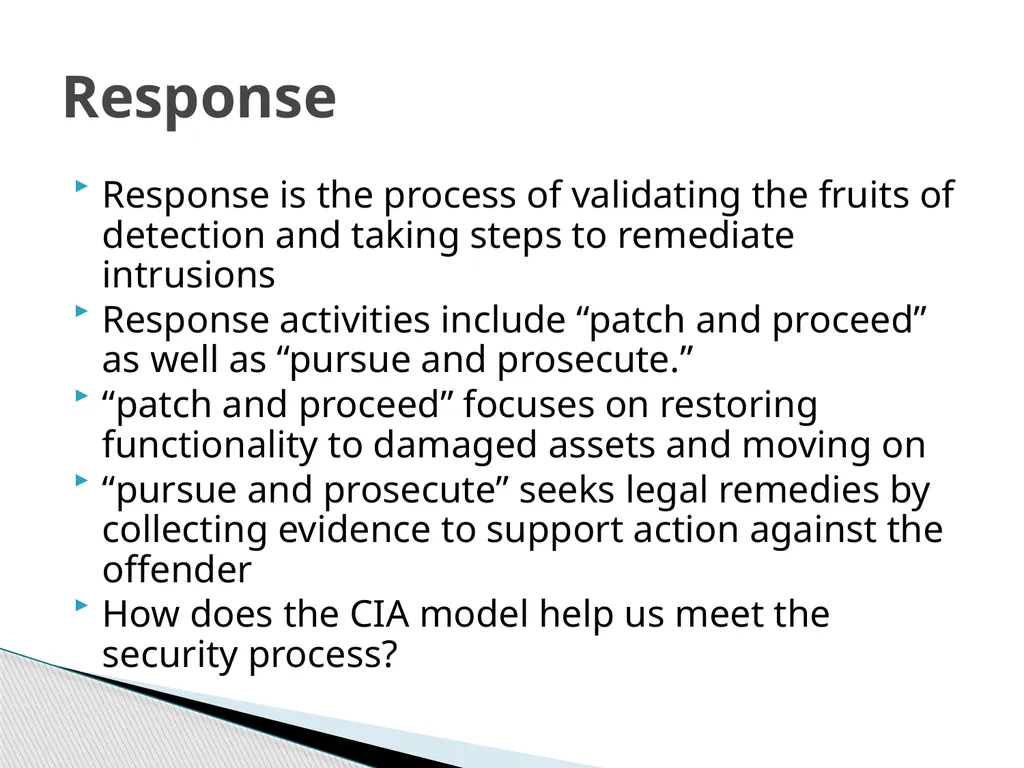
Response is the process of validating the fruits of detection and taking steps to remediate intrusions
Response activities include “patch and proceed” as well as “pursue and prosecute.”
“patch and proceed” focuses on restoring functionality to damaged assets and moving on
“pursue and prosecute” seeks legal remedies by collecting evidence to support action against the offender
How does the CIA model help us meet the security process? Response<br>
17
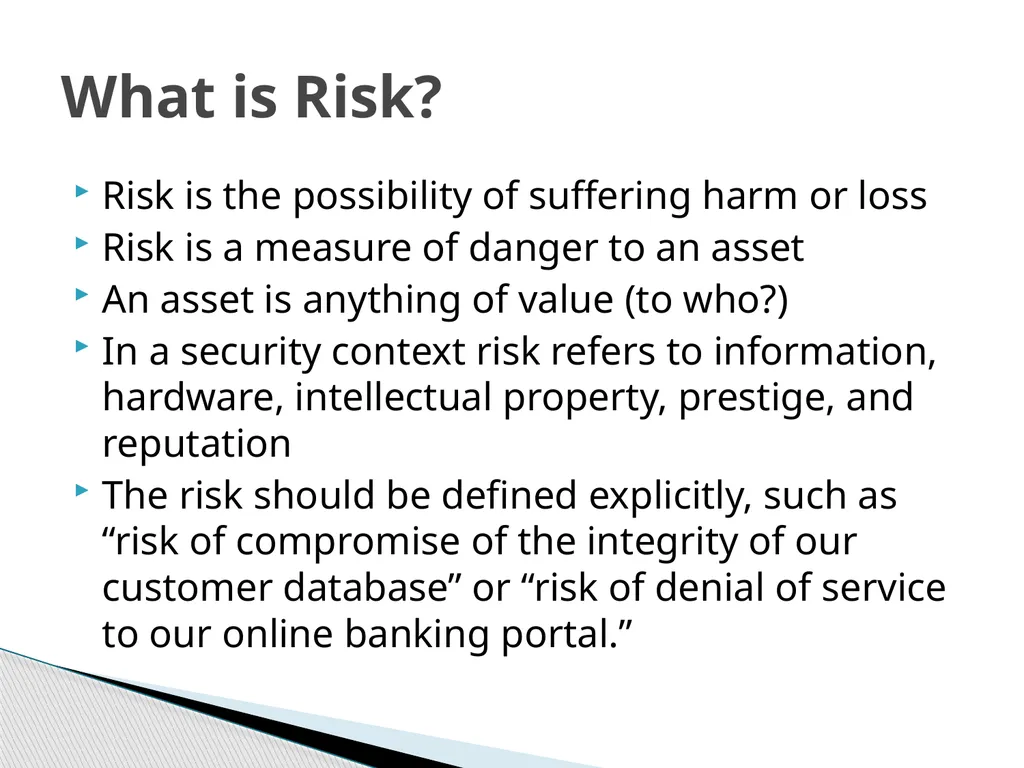
Risk is the possibility of suffering harm or loss
Risk is a measure of danger to an asset
An asset is anything of value (to who?)
In a security context risk refers to information, hardware, intellectual property, prestige, and reputation
The risk should be defined explicitly, such as “risk of compromise of the integrity of our customer database” or “risk of denial of service to our online banking portal.” What is Risk?<br>
18
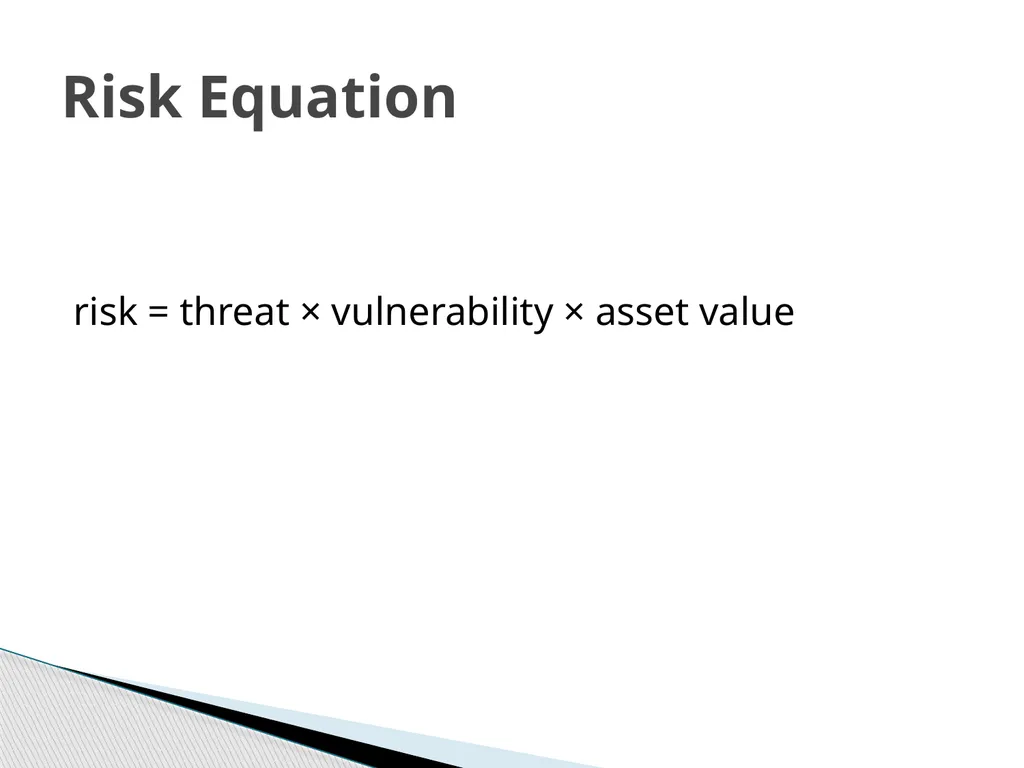
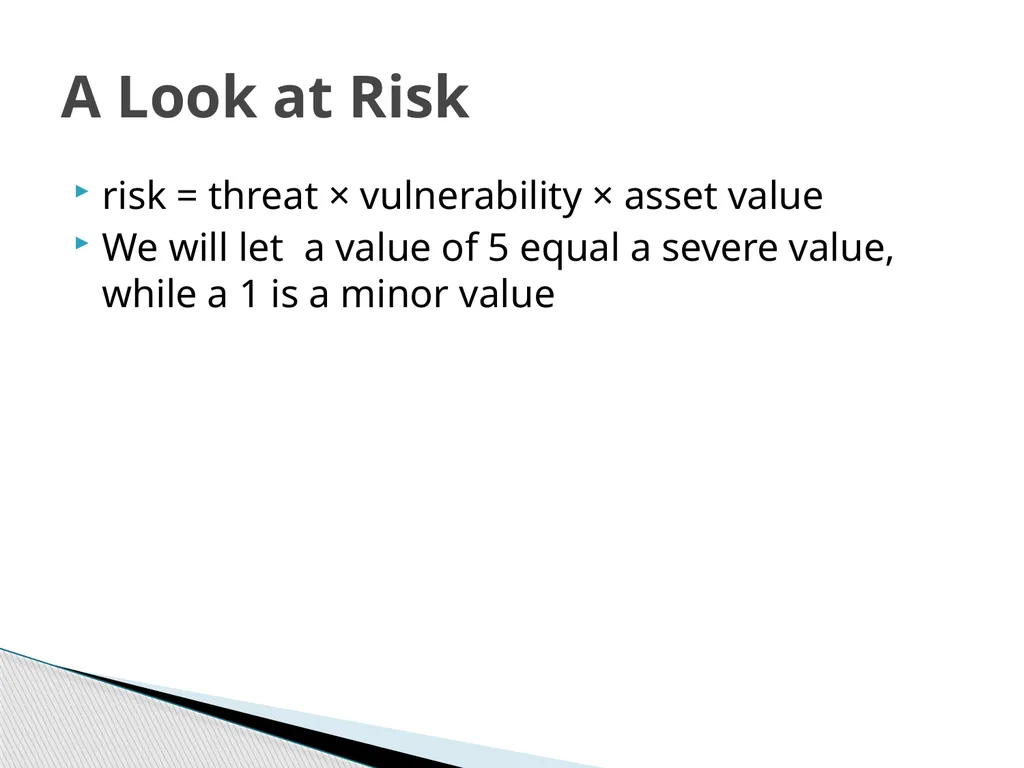
risk = threat × vulnerability × asset value Risk Equation<br>
19
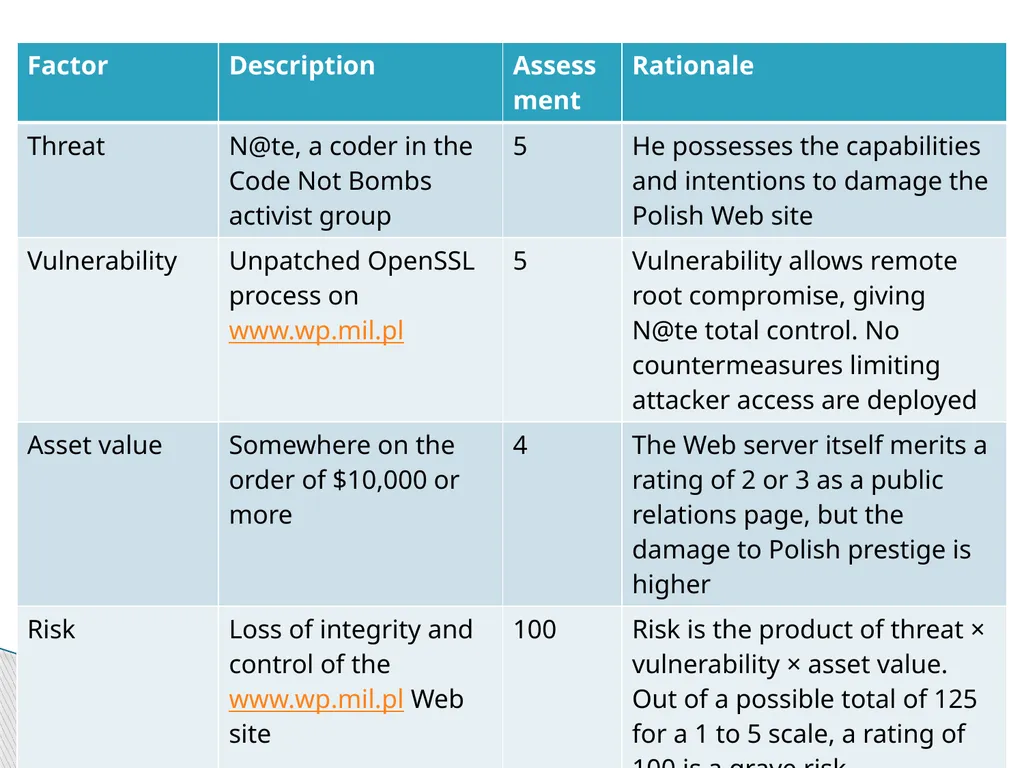
A threat is a party with the capabilities and intentions to exploit a vulnerability in an asset
Structured threats are adversaries with a formal methodology, a financial sponsor, and a defined objective
include economic spies, organized criminals, terrorists, foreign intelligence agencies, and so-called information warriors
Unstructured threats lack the methodology, money, and objective of structured threats
include “recreational” crackers, malware without a defined object beyond widespread infection, and malicious insiders who abuse their status Threat<br>
20
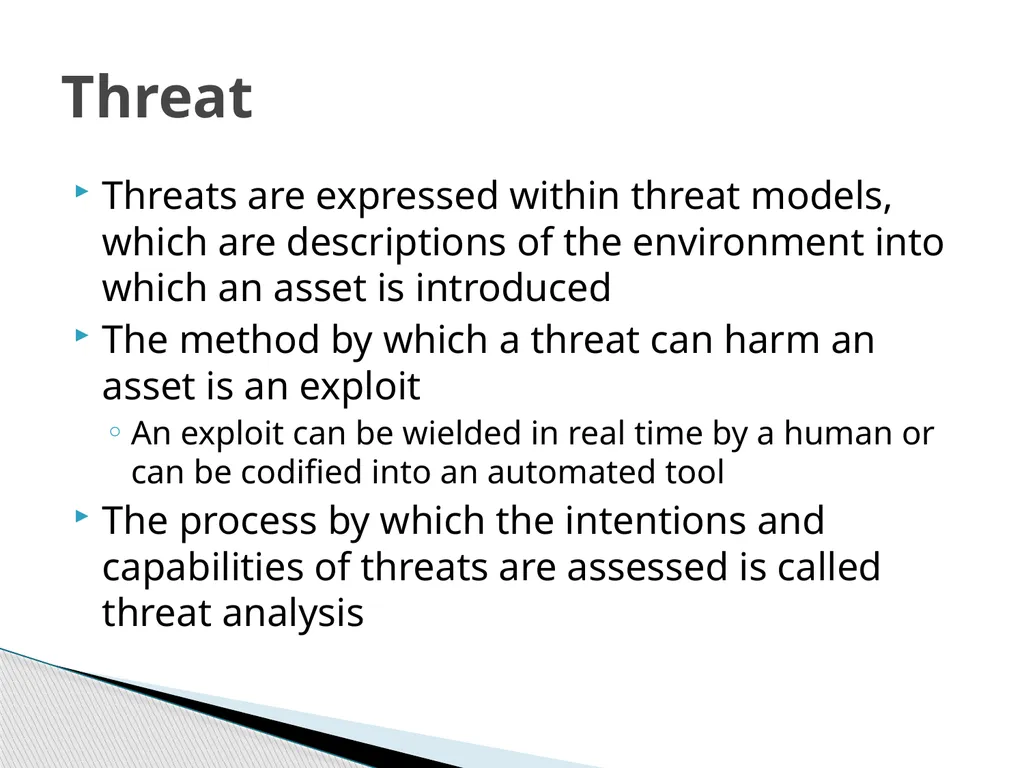
Threats are expressed within threat models, which are descriptions of the environment into which an asset is introduced
The method by which a threat can harm an asset is an exploit
An exploit can be wielded in real time by a human or can be codified into an automated tool
The process by which the intentions and capabilities of threats are assessed is called threat analysis Threat<br>
21
A vulnerability is a weakness in an asset that could lead to exploitation
A well-designed software product should perform its intended function and do no more
A Web server intended to publish pages in the inetpub/wwwroot directory should not allow users to escape that folder and access the command shell or other files on the system Vulnerability<br>
22
The asset value is a measurement of the time and resources needed to replace an asset or restore it to its former state
Cost of replacement is an equivalent term
A database server hosting client credit card information is assumed to have a higher value or cost of replacement than a workstation in a testing laboratory (Why?)
Cost can also refer to the value of an organization's reputation, brand, or trust held by the public Asset<br>
23
Security Policies only deal with the business processes that are important to the company
“…the process of transaction for purchase must meet compliance of PCI, …”
“…Managed antivirus software must be run and monitored on each system…”
Does it really tell us where we need to put firewall, IDS, how servers should be configured, what defines manage antivirus?
Would it matter if it did? What About the Security Policy?<br>
24
let's consider the risk to a public Web server operated by the Polish Ministry of Defense (www.wp.mil.pl)
On September 3, 2003, Polish army forces assumed control of the Multinational Division Central South in Iraq
A hypothetical anti–Iraq war hacker group, Code Not Bombs, reads the press release at www.nato.int and is angry about Poland's involvement in the war
One of their young coders, N@te, doesn't like Poland's involvement and wants to embarrass the Polish military by placing false news stories on the Ministry of Defense's Web site A Look at Risk<br>
25
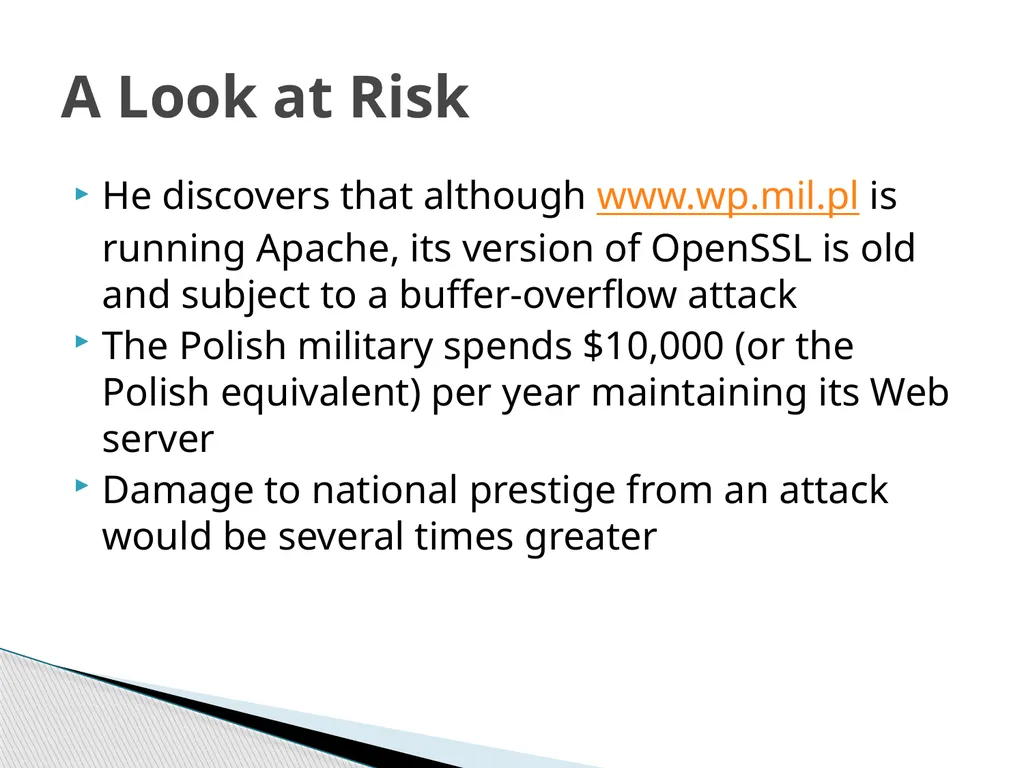
He discovers that although www.wp.mil.pl is running Apache, its version of OpenSSL is old and subject to a buffer-overflow attack
The Polish military spends $10,000 (or the Polish equivalent) per year maintaining its Web server
Damage to national prestige from an attack would be several times greater A Look at Risk<br>
26
risk = threat × vulnerability × asset value
We will let a value of 5 equal a severe value, while a 1 is a minor value A Look at Risk<br>
27
Remember that security is the process of maintaining an acceptable level of perceived risk
?????????? So What is the Security of the Web Server?<br>
28
What if the Polish military is unaware that anyone would think to harm its Web server?
0 X 5 X 4 = 0
What if the security administrators believe the threat to www.wp.mil.pl is zero?
Then the perceived risk of loss is zero
Perception is a key to understanding security
How can we deal with this perception problem? So What is the Security of the Web Server?<br>
29
Once threat are identified, the presence of vulnerability takes on new importance
Vulnerabilities only have value if there is a threat to use it
If we identify threats correctly as they relate to an asset value then as vulnerabilities change we will then know where to place our resources So What is the Security of the Web Server?<br>
30
If the threat to the asset is high
likelihood of a threat to want to use the vulnerability and the higher value of the asset
Then if the SSL vulnerability is announced you can use countermeasures on the asset
Countermeasures are steps to limit the possibility of an incident or the effects of compromise
What are the countermeasures that can be used on the web server? So What is the Security of the Web Server?<br>
31
It make you look at your environment like “they” would not how you would (what does this mean?)
Security policies do not tell us the assets that are important just the business practices that is important. We need to relate these practices to the assets
When new vulnerabilities come out you want to KNOW what assets are important
It should have a direct impact on your security design (we do not have unlimited money and resources) So why do we care about risk then?<br>