CSSE 304 Day 9 Two A6A7 solutions OOP in Scheme? ArrayList exercise Live coding today! You may want to get the starting code from live-in-classDay09-array-list Scheme-a-thon is Done! Congratulations. You made it through! 3 assignments
"CSSE 304 Day 9 Two A6/A7 solutions "OOP" in" is the property of its rightful owner. Permission is granted to
download and print the materials on this website for personal, non-commercial use only, and to display it
on your personal computer provided you do not modify the materials and that you retain all copyright
notices contained in the materials. By downloading content from our website, you accept the terms of this
agreement.
Presentation Transcript
01
CSSE 304 Day 9 Two A6/A7 solutions
"OOP" in Scheme?
ArrayList exercise Live coding today! You may want to get the starting code from live-in-class/Day09-array-list<br>
02
Scheme-a-thon is Done! Congratulations. You made it through!
3 assignments this week (7b today, 8 Wednesday, 9 Friday)
1 week 4 (A10 due after the break, Thursday January 7)
3 week 5 (A11a, A11b (team) , A12 (written, no code)
2 week 6 (A13 (team), A14 (team))
2 week 7 (A15, A16 (team))
1 week 8 (A17a (team))
2 week 9 (A17b (team), A18a (team))
2 week 10 (A18b (team), A 19)<br>
03
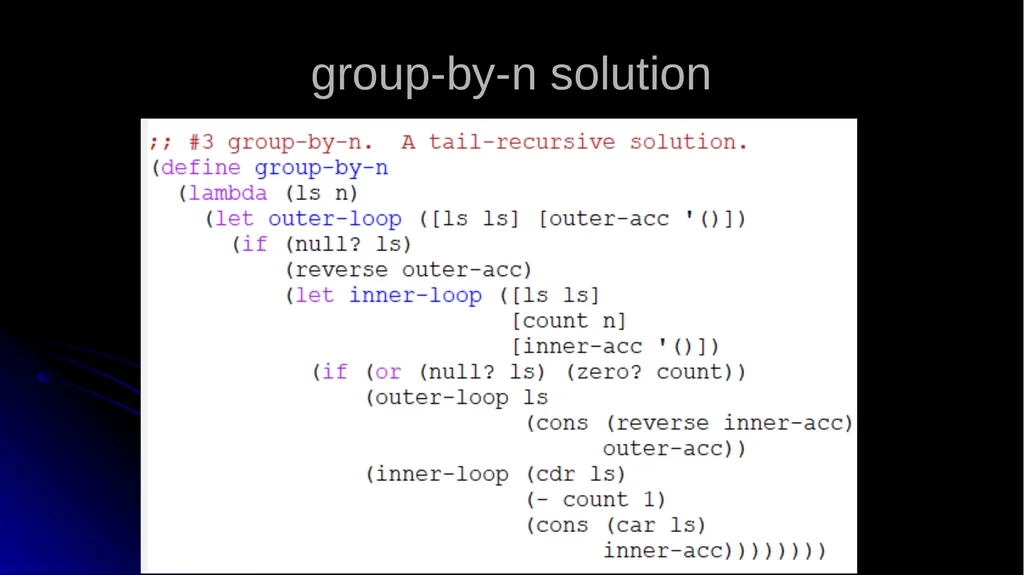
group-by-n solution<br>
04
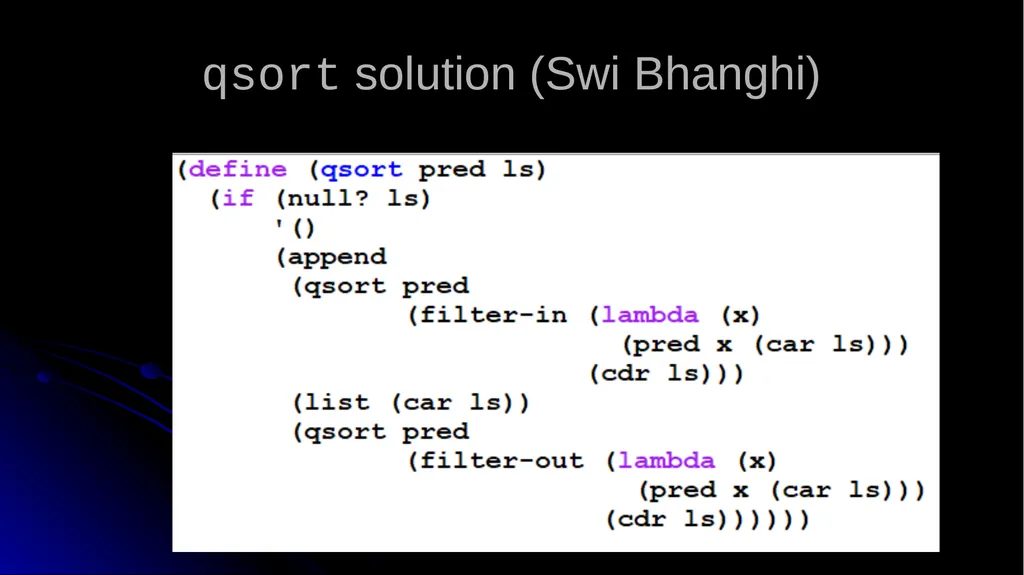
qsort solution (Swi Bhanghi)<br>
05
How might we do OOP IN SCHEME, using only things that we have seen so far? Constructing objects
"fields"
"methods"
method arguments http://community.schemewiki.org/?object-oriented-programming<br>
06
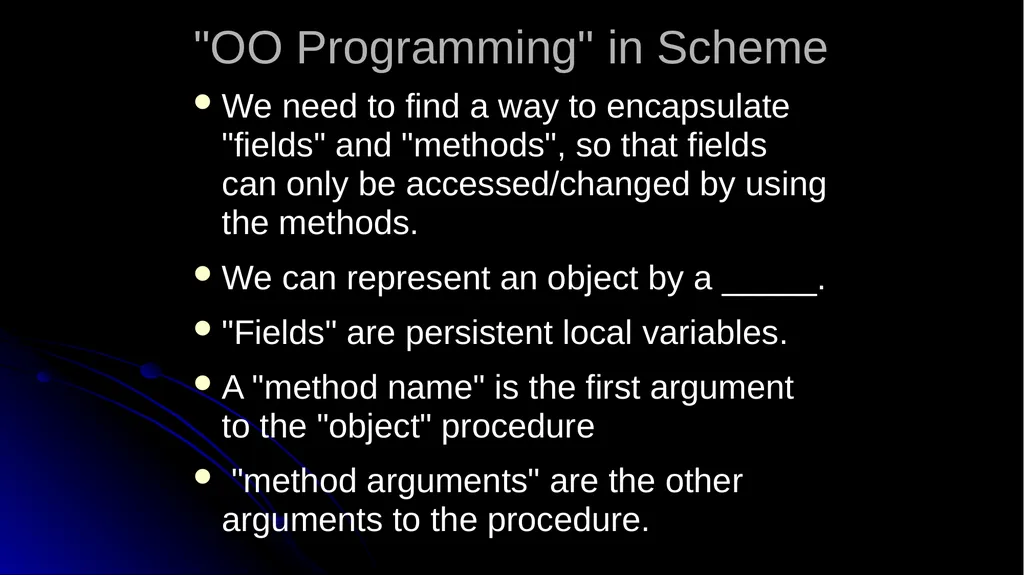
"OO Programming" in Scheme We need to find a way to encapsulate "fields" and "methods", so that fields can only be accessed/changed by using the methods.
We can represent an object by a _____.
"Fields" are persistent local variables.
A "method name" is the first argument to the "object" procedure
"method arguments" are the other arguments to the procedure.<br>
07
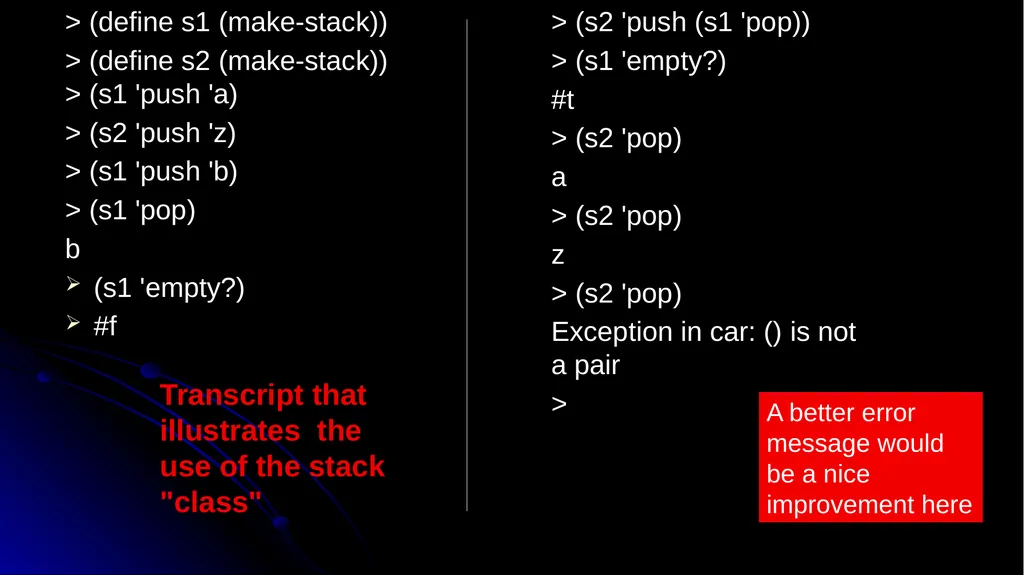
> (define s1 (make-stack))
> (define s2 (make-stack)) > (s1 'push 'a)
> (s2 'push 'z)
> (s1 'push 'b)
> (s1 'pop)
b
(s1 'empty?)
#f > (s2 'push (s1 'pop))
> (s1 'empty?)
#t
> (s2 'pop)
a
> (s2 'pop)
z
> (s2 'pop)
Exception in car: () is not a pair
> Transcript that illustrates the use of the stack "class" A better error message would be a nice improvement here<br>
08
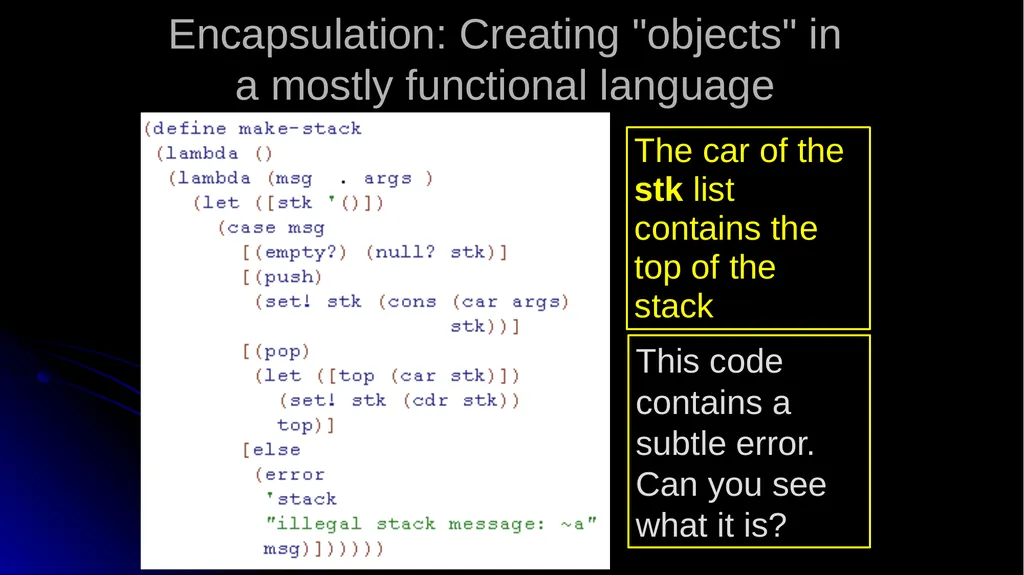
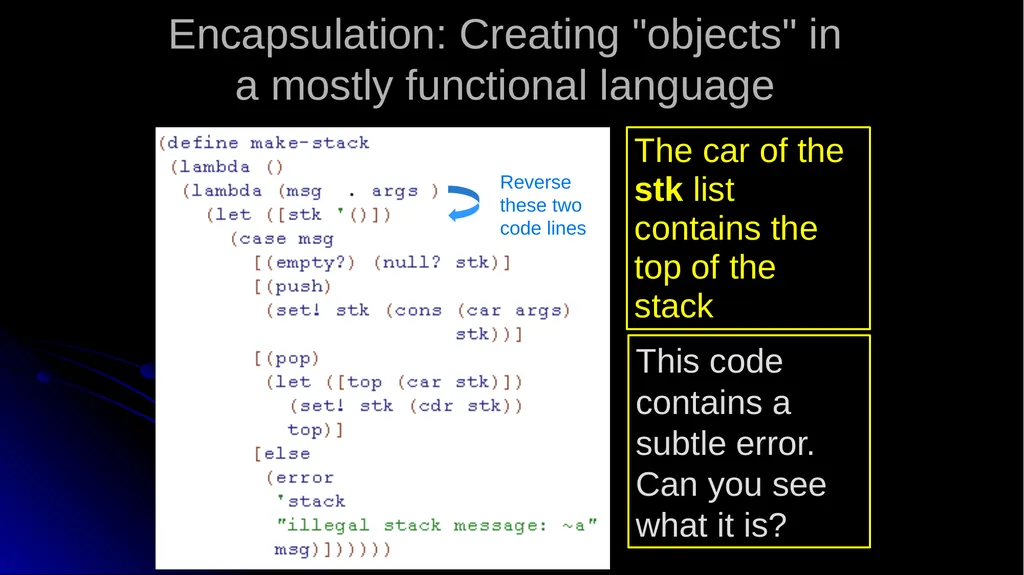
Encapsulation: Creating "objects" in a mostly functional language What is the problem with this code? How to fix it? The car of the stk list contains the top of the stack This code contains a subtle error. Can you see what it is?<br>
09
Encapsulation: Creating "objects" in a mostly functional language What is the problem with this code? How to fix it? The car of the stk list contains the top of the stack This code contains a subtle error. Can you see what it is? Reverse these two code lines<br>
10
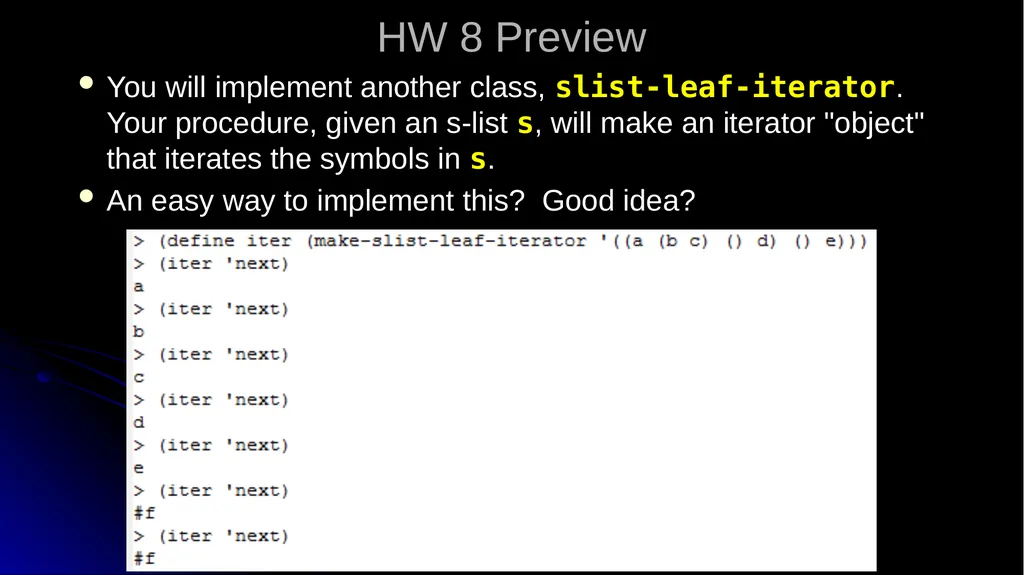
HW 8 Preview You will implement another class, slist-leaf-iterator. Your procedure, given an s-list s, will make an iterator "object" that iterates the symbols in s.
An easy way to implement this? Good idea?<br>
11
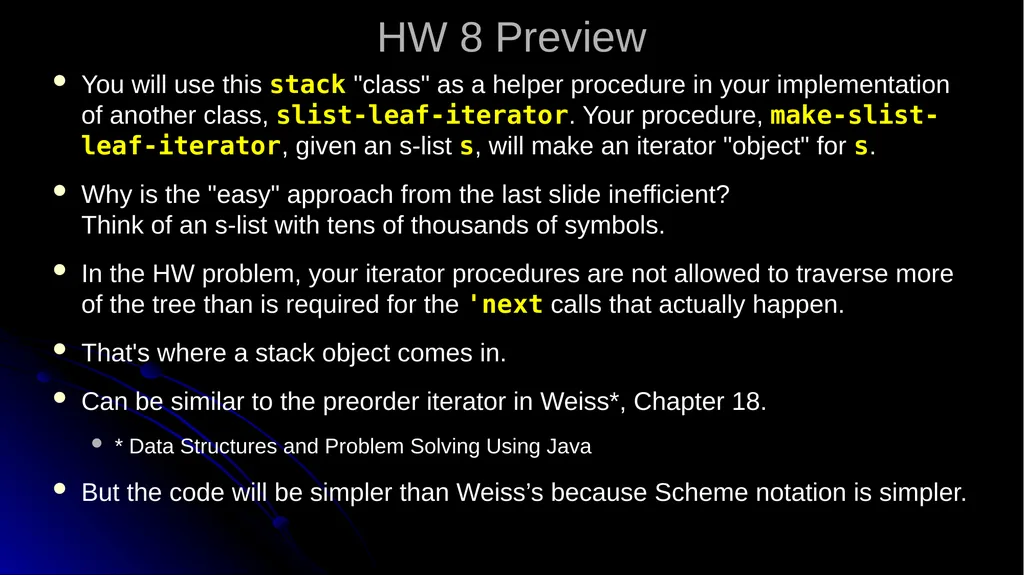
HW 8 Preview You will use this stack "class" as a helper procedure in your implementation of another class, slist-leaf-iterator. Your procedure, make-slist-leaf-iterator, given an s-list s, will make an iterator "object" for s.
Why is the "easy" approach from the last slide inefficient? Think of an s-list with tens of thousands of symbols.
In the HW problem, your iterator procedures are not allowed to traverse more of the tree than is required for the 'next calls that actually happen.
That's where a stack object comes in.
Can be similar to the preorder iterator in Weiss*, Chapter 18.
* Data Structures and Problem Solving Using Java
But the code will be simpler than Weiss’s because Scheme notation is simpler.<br>
12
Interlude<br>
13
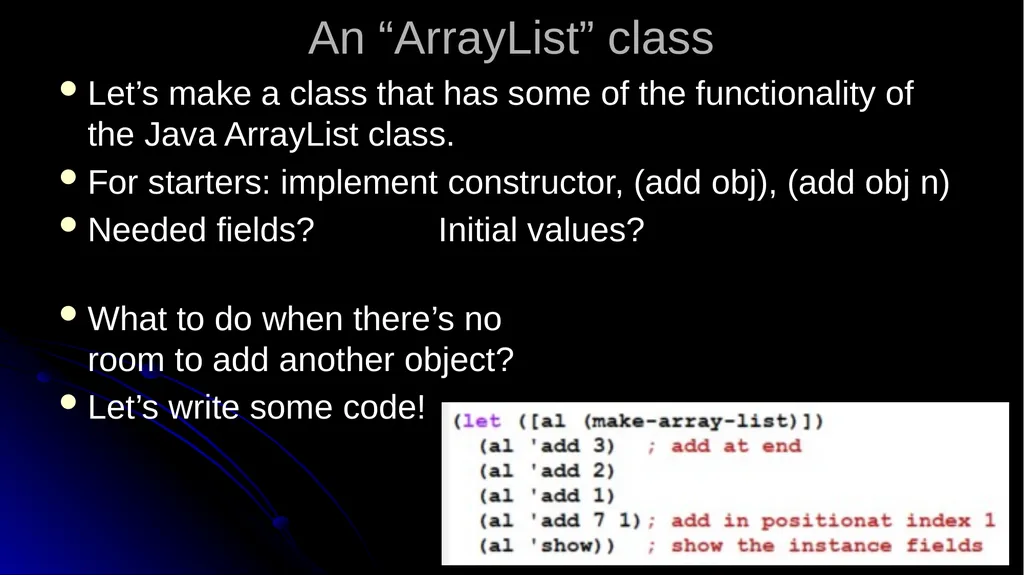
An “ArrayList” class Let’s make a class that has some of the functionality of the Java ArrayList class.
For starters: implement constructor, (add obj), (add obj n)
Needed fields? Initial values?
What to do when there’s no room to add another object?
Let’s write some code!<br>