
Cultural Transmission and Individual Development



Description: Cultural Transmission and Individual Development Cultural and biological transmission Cultural transmission: certain features of a population are perpetuated (devam ettirmek) over time across generations. Cultural transmission involve two
Related Topics
Download Presentation
"Cultural Transmission and Individual Development" is the property of its rightful owner. Permission is granted to download and print the materials on this website for personal, non-commercial use only, and to display it on your personal computer provided you do not modify the materials and that you retain all copyright notices contained in the materials. By downloading content from our website, you accept the terms of this agreement.
Presentation Transcript
slide1. Cultural Transmission and
Individual Development<br>
slide2. Cultural and biological transmission Cultural transmission: certain features of a population are perpetuated (devam ettirmek) over time across generations.
Cultural transmission involve two processes:
Enculturation
Socialization 2<br>
slide3. Cultural and biological transmission Enculturation takes place by the “enfolding” (katlama) of individuals by their culture, leading them to incorporate appropriate behavior into their repertoires.
Socialization takes place by more specific instruction and training, again leading to the acquisition of culture-appropriate behavior. 3<br>
slide4. Cultural and biological transmission In transmission, parents transmit cultural values, skills, beliefs, and motives to their offspring.
In this case it is difficult to distinguish between cultural and biological transmission, since we typically learn from the very people who are responsible for our conception; and biological parents and cultural parents are very often the same. 4<br>
slide5. Cultural and biological transmission In cultural transmission, we learn from our peers in day-to-day interactions during the course of development from birth to adulthood.
In this case, there is no confounding of biological and cultural transmission. 5<br>
slide6. Cultural and biological transmission In cultural transmission, we learn from other adults and institutions (for example in formal schooling), either in our own culture or from other cultures.
If the process takes place entirely within our own or primary culture, then cultural transmission is the appropriate term. 6<br>
slide7. Cultural and biological transmission However, if the process derives from contact with another or secondary culture, the term acculturation is employed.
Acculturation refers to the form of transmission experienced by individuals that results from contact with, and influence from, persons and institutions belonging to cultures other than their own. 7<br>
slide8. Cultural and biological transmission Individual development can be considered as the outcome of interactions between a biological organism and environmental influences.
A starting point for the discussion the distinction between nature and nurture. 8<br>
slide9. Cultural and biological transmission Thus, there are maturational theories that place great emphasis on biological factors.
In contrast, traditional learning theory emphasizes the role of the environment.
In other theories more attention is paid to the interaction between the organism and the environment. 9<br>
slide10. Infant development Among human nomadic hunters weaning (sütten kesme) takes place around three or four years of age (later if there is no new baby).
Most sedentary (yerleşik) agricultural societies have a birth spacing (corresponding to the age of weaning) of two to three years.
In recent decades, early weaning and bottle feeding have spread to much of the world’s population. 10<br>
slide11. Infant development The first cross-cultural study of infant performance, one that has had important influence, was carried out by Geber and Dean (1957).
They examined full-term neonates (yenidoğan) who weighed more than 2,500 grams in the maternity hospital in Kampala, Uganda.
They found a marked precocity (gelişmişlik) in development in relation to Western pediatric norms: an advance of two to six weeks in holding the head, and a nearly complete absence of the archaic reflexes (indicating an advanced state of development).
This has come to be known as African infant precocity. (ethnocentrism?) 11<br>
slide12. Attachment patterns Bowlby derived the idea that behaviors of human infants such as crying and smiling will elicit care-giving reactions from adults.
As a result of such interactions, especially with the mother, attachment develops.
This provides the child with a secure base from which it can explore the world. 12<br>
slide13. Attachment patterns Although attachment theory was originally largely rooted in field observations, the most frequent method of assessment is by means of a standard procedure called the ‘strange situation’
The cross-cultural equivalence of the strange situation as an assessment procedure is questionable. 13<br>
slide14. Attachment patterns For example, among the Aka Pygmies, the father spends considerable time with the baby of a few months old.
In some settings, children become part of an extended family or village community in which many adults and other children assume caretaking roles.
In urban Western settings, bringing children from a few months of age onward to a day care center. 14<br>
slide15. Attachment patterns What are the consequences of these differences in cultural practices?
The question is not easy to answer, because not only the social settings per se, but also socialization goals, may differ across cultures.
Thus, it has been argued that two orientations can be distinguished:
In Western societies, socialization may be more oriented toward self-regulation and autonomy
While in many non-Western countries the orientation is more toward social interdependencies. 15<br>
slide16. Enculturation and socialization An individual is encompassed or surrounded by a culture; the individual acquires, by learning, what the culture deems to be necessary.
There is not necessarily anything deliberate or didactic about this process; often there is learning without specific teaching. 16<br>
slide17. Enculturation and socialization The process of enculturation involves parents, and other adults and peers, in a network of influences all of which can limit, shape, and direct the developing individual.
The end result (if enculturation is successful) is a person who is competent in the culture, including its language, its rituals, its values, and so on. 17<br>
slide18. Enculturation and socialization The concept of socialization refer to the process of deliberate shaping, by way of tutelage (himaye), of the individual.
It is generally employed in cross-cultural psychology in the same way.
When cultural transmission involves deliberate teaching from within a group, we are dealing with the process of socialization. 18<br>
slide19. Enculturation and socialization The process of cultural transmission does not necessarily lead to exact replication of successive generations; it falls somewhere between an exact transmission (with hardly any differences between parents and offspring) and a complete failure of transmission (with offspring who are unlike their parents). 19<br>
slide20. Enculturation and socialization Functionally, either extreme would be problematic for a society:
Exact transmission would not allow for novelty and change, and hence the ability to respond to new situations,
While failure of transmission would not permit coordinated action between generations. 20<br>
slide21. Enculturation and socialization By the mid-1950s, on six central dimensions of child rearing thought to be common to all societies:
obedience training
responsibility training
nurturance training
achievement training
self-reliance
general independence training 21<br>
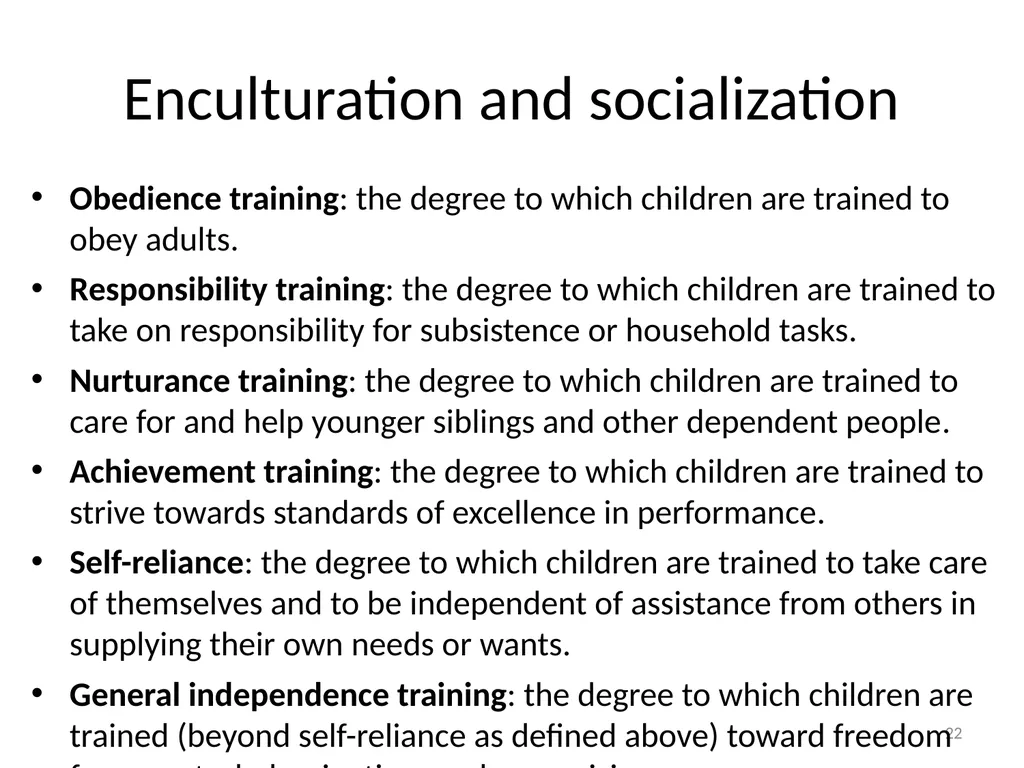
slide22. Enculturation and socialization Obedience training: the degree to which children are trained to obey adults.
Responsibility training: the degree to which children are trained to take on responsibility for subsistence or household tasks.
Nurturance training: the degree to which children are trained to care for and help younger siblings and other dependent people.
Achievement training: the degree to which children are trained to strive towards standards of excellence in performance.
Self-reliance: the degree to which children are trained to take care of themselves and to be independent of assistance from others in supplying their own needs or wants.
General independence training: the degree to which children are trained (beyond self-reliance as defined above) toward freedom from control, domination, and supervision. 22<br>
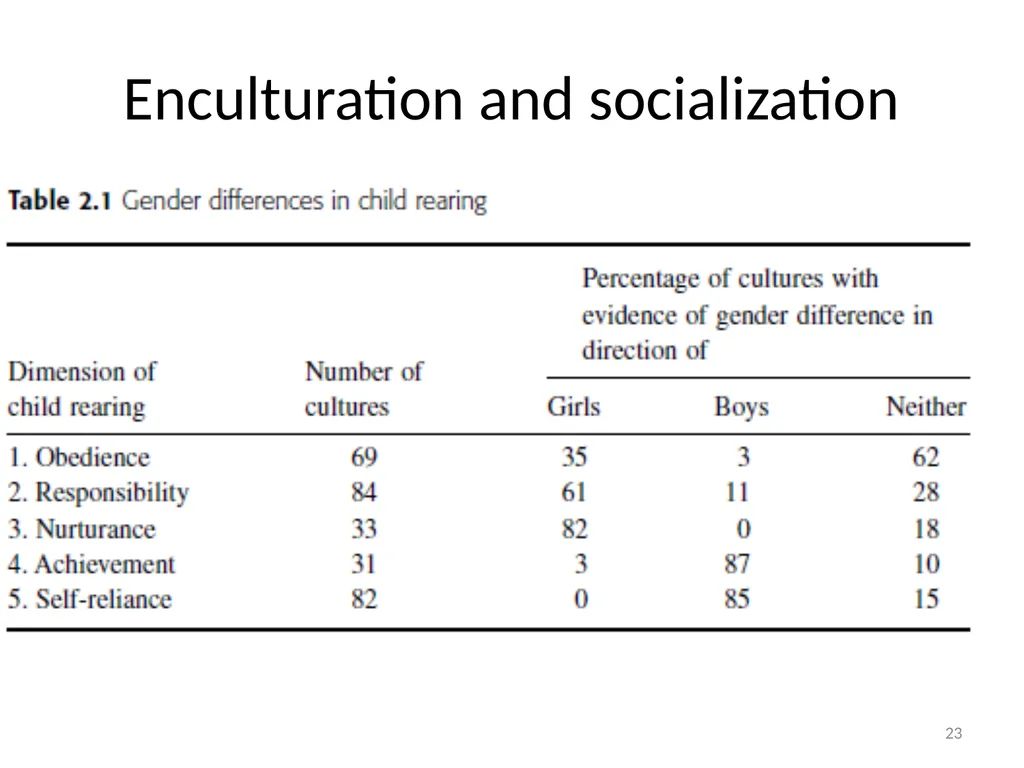
slide23. Enculturation and socialization 23<br>
slide24. Enculturation and socialization With the exception of the dimension of obedience training, girls were socialized more often for “compliance”; conversely, boys were socialized more for “assertion” 24<br>
slide25. Gender differences The issue of gender differences in socialization has received extensive treatment in the cross-cultural literature about gender differences in behavior.
There are gender differences in behavior in every society, and that every society has some division of labor by gender. 25<br>
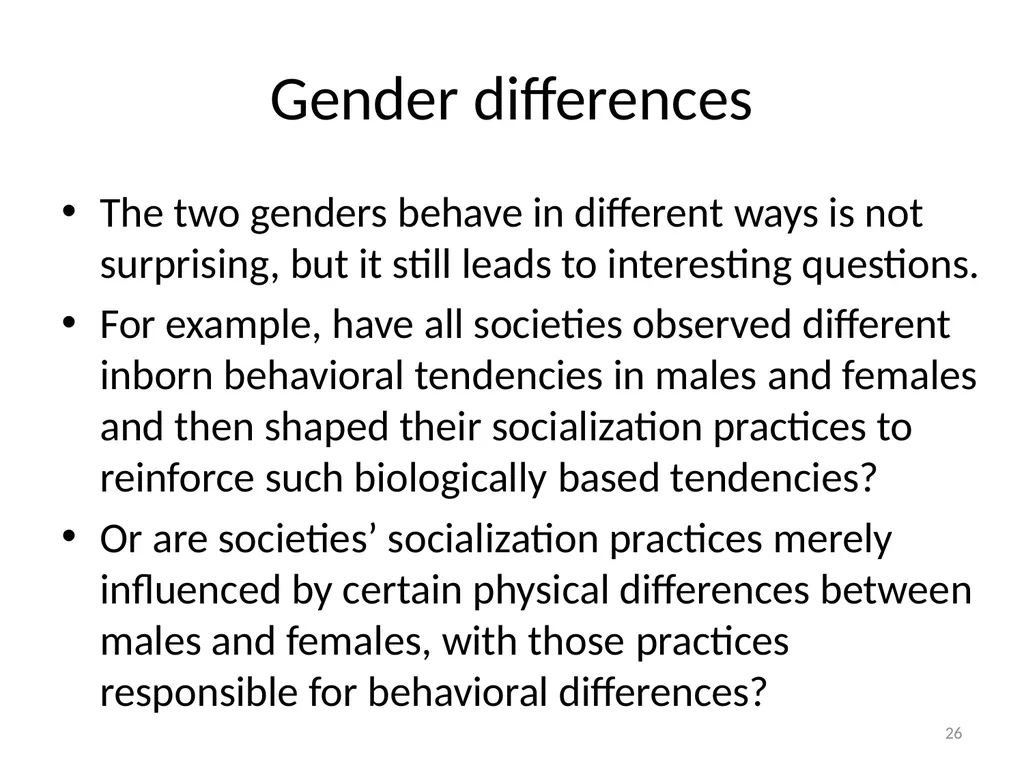
slide26. Gender differences The two genders behave in different ways is not surprising, but it still leads to interesting questions.
For example, have all societies observed different inborn behavioral tendencies in males and females and then shaped their socialization practices to reinforce such biologically based tendencies?
Or are societies’ socialization practices merely influenced by certain physical differences between males and females, with those practices responsible for behavioral differences? 26<br>
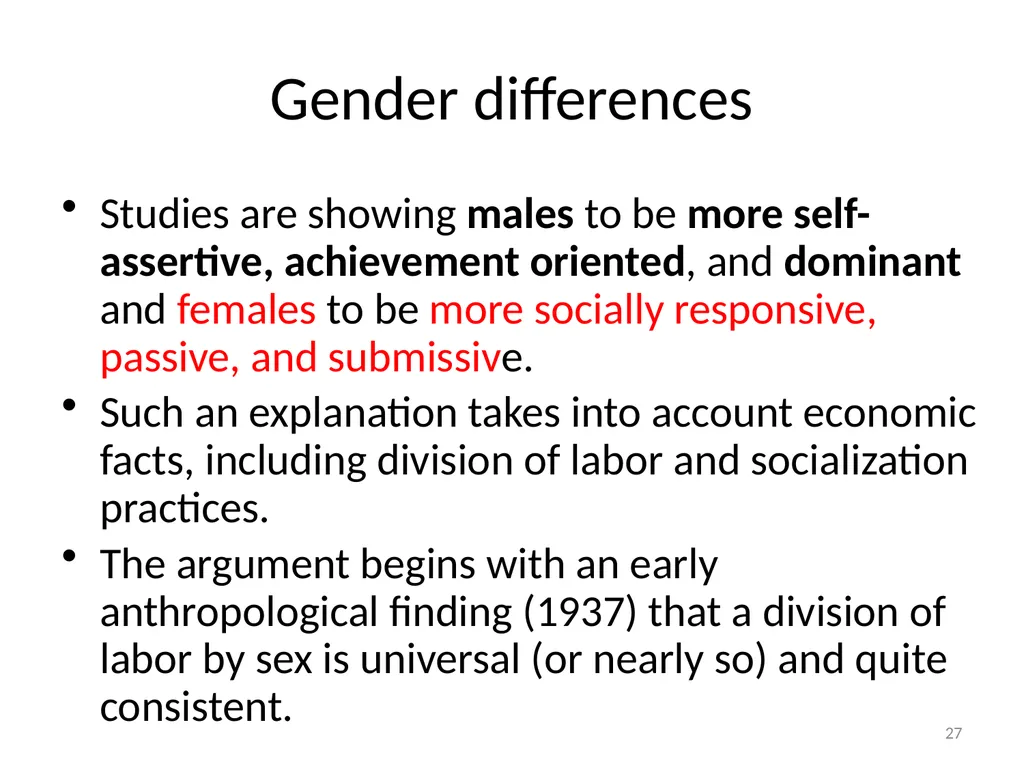
slide27. Gender differences Studies are showing males to be more self-assertive, achievement oriented, and dominant and females to be more socially responsive, passive, and submissive.
Such an explanation takes into account economic facts, including division of labor and socialization practices.
The argument begins with an early anthropological finding (1937) that a division of labor by sex is universal (or nearly so) and quite consistent. 27<br>
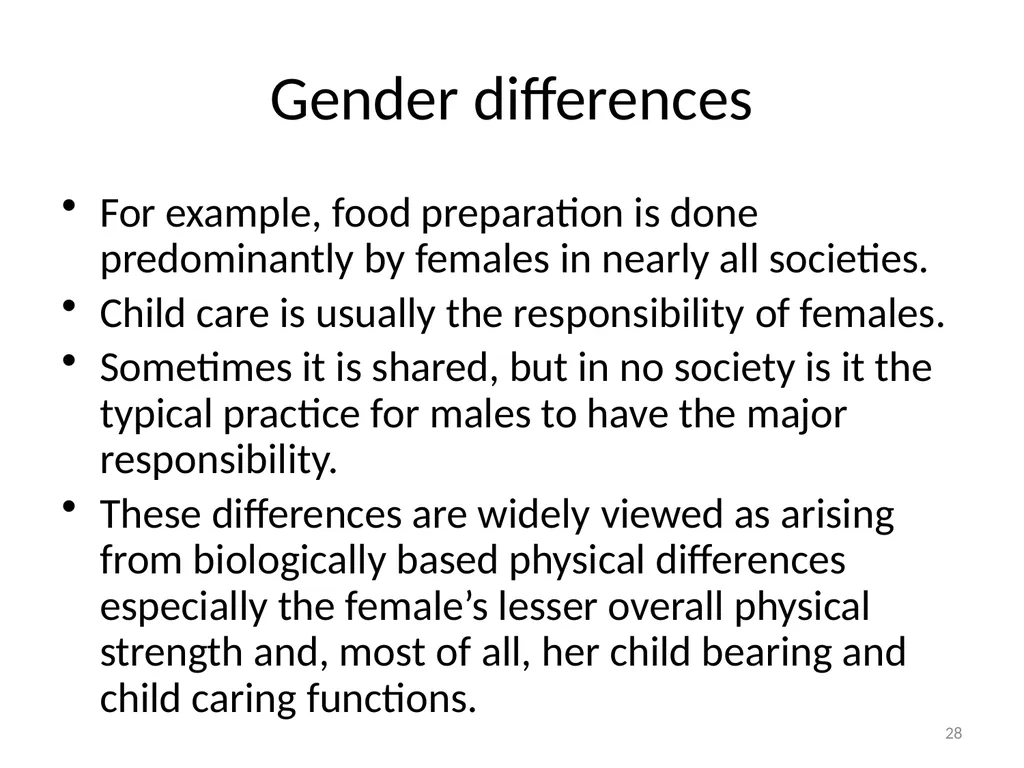
slide28. Gender differences For example, food preparation is done predominantly by females in nearly all societies.
Child care is usually the responsibility of females.
Sometimes it is shared, but in no society is it the typical practice for males to have the major responsibility.
These differences are widely viewed as arising from biologically based physical differences especially the female’s lesser overall physical strength and, most of all, her child bearing and child caring functions. 28<br>
slide29. https://www.youtube.com/watch?v=km5ZO64EmjE 29<br>
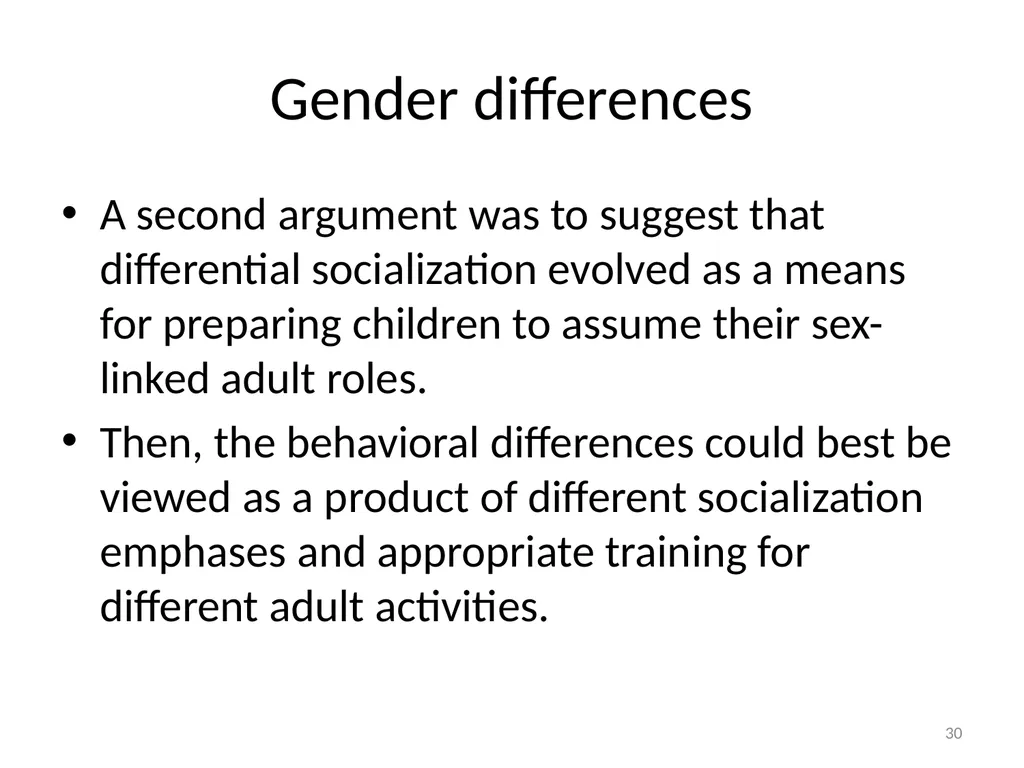
slide30. Gender differences A second argument was to suggest that differential socialization evolved as a means for preparing children to assume their sex-linked adult roles.
Then, the behavioral differences could best be viewed as a product of different socialization emphases and appropriate training for different adult activities. 30<br>
slide31. Gender differences High food accumulating societies not only will females be subjected to more training to be nurturant and compliant, but the degree of the difference between the sexes’ training will also be high.
In low food accumulating societies, such as gathering or hunting societies, there will be less division of labor by sex and little need for either sex to be trained to be compliant.
Hence, women’s work is valued by the men, who are then not inclined to derogate women or to insist on subservience from them. 31<br>
slide32. Gender differences One of the ways in which division of labor varies across cultures is in the degree to which women contribute to subsistence (geçim).
For example, if food is acquired by gathering, women’s participation is usually high; in eleven of fourteen (79 percent) gathering societies for which women were high contributors.
By contrast, in only two of sixteen (13 percent) hunting societies did women make a high contribution. 32<br>
slide33. Gender differences Where women played a relatively large subsistence role, the features of polygyny (çok kadınla evlilik), exogamy (dış evlilik), brideprice (başlık parası), birth control, and work orientation training for girls prevailed.
And under these same conditions (high contribution by females to subsistence), females were relatively highly valued, allowed freedoms, and were generally less likely to be perceived as objects for male sexual and reproductive needs. 33<br>
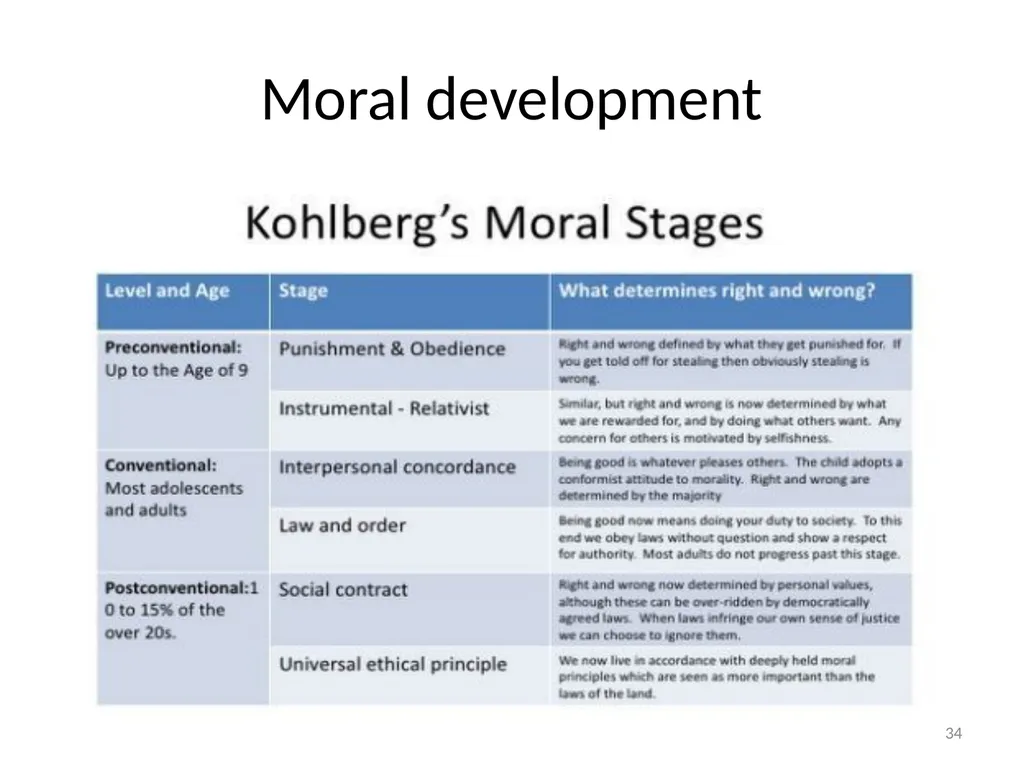
slide34. Moral development 34<br>
slide35. Moral development At the pre-conventional level, moral conduct is in the interest of individuals themselves, or in the interest of relatives; reasons for doing right are the avoidance of punishment and the principle of fairness in an exchange. 35<br>
slide36. Moral development At the conventional level, concern about loyalty and about the welfare of other persons and society at large are given as reasons to justify one’s actions.
At the post-conventional level, actions are based on ethical principles to which individuals have committed themselves, and that serve as absolute standards, even taking priority over the laws of society that may violate these principles. 36<br>
slide37. Moral development Cultural groups can be expected to differ in the modal stage or level of moral reasoning because of differences in values and social organization.
To assess whether they were “universal,” Kohlberg proposed three different criteria:
the first was whether the stages could be identified (empirically) in all cultures;
the second was whether the same “operations” applied to all human beings;
the third was whether all people acted in a specific way in similar situations. 37<br>
slide38. Moral development With these distinctions in mind, “universality” does not mean that morality is completely invariant or shows identical manifestations in all cultures.
Rather, levels and stages in various cultures reveal «local adaptations» 38<br>
slide39. Moral development Overall, what can be concluded about the universality of Kohlberg’s stage theory of moral development?
There are some culture-specific moral principles like “respect for older people,” “obligation,” “harmony,” and “non-violence.” 39<br>
slide40. Key Words acculturation
attachment
child training
cultural transmission
enculturation
gender
moral development
socialization 40<br>
slide2. Cultural and biological transmission Cultural transmission: certain features of a population are perpetuated (devam ettirmek) over time across generations.
Cultural transmission involve two processes:
Enculturation
Socialization 2<br>
slide3. Cultural and biological transmission Enculturation takes place by the “enfolding” (katlama) of individuals by their culture, leading them to incorporate appropriate behavior into their repertoires.
Socialization takes place by more specific instruction and training, again leading to the acquisition of culture-appropriate behavior. 3<br>
slide4. Cultural and biological transmission In transmission, parents transmit cultural values, skills, beliefs, and motives to their offspring.
In this case it is difficult to distinguish between cultural and biological transmission, since we typically learn from the very people who are responsible for our conception; and biological parents and cultural parents are very often the same. 4<br>
slide5. Cultural and biological transmission In cultural transmission, we learn from our peers in day-to-day interactions during the course of development from birth to adulthood.
In this case, there is no confounding of biological and cultural transmission. 5<br>
slide6. Cultural and biological transmission In cultural transmission, we learn from other adults and institutions (for example in formal schooling), either in our own culture or from other cultures.
If the process takes place entirely within our own or primary culture, then cultural transmission is the appropriate term. 6<br>
slide7. Cultural and biological transmission However, if the process derives from contact with another or secondary culture, the term acculturation is employed.
Acculturation refers to the form of transmission experienced by individuals that results from contact with, and influence from, persons and institutions belonging to cultures other than their own. 7<br>
slide8. Cultural and biological transmission Individual development can be considered as the outcome of interactions between a biological organism and environmental influences.
A starting point for the discussion the distinction between nature and nurture. 8<br>
slide9. Cultural and biological transmission Thus, there are maturational theories that place great emphasis on biological factors.
In contrast, traditional learning theory emphasizes the role of the environment.
In other theories more attention is paid to the interaction between the organism and the environment. 9<br>
slide10. Infant development Among human nomadic hunters weaning (sütten kesme) takes place around three or four years of age (later if there is no new baby).
Most sedentary (yerleşik) agricultural societies have a birth spacing (corresponding to the age of weaning) of two to three years.
In recent decades, early weaning and bottle feeding have spread to much of the world’s population. 10<br>
slide11. Infant development The first cross-cultural study of infant performance, one that has had important influence, was carried out by Geber and Dean (1957).
They examined full-term neonates (yenidoğan) who weighed more than 2,500 grams in the maternity hospital in Kampala, Uganda.
They found a marked precocity (gelişmişlik) in development in relation to Western pediatric norms: an advance of two to six weeks in holding the head, and a nearly complete absence of the archaic reflexes (indicating an advanced state of development).
This has come to be known as African infant precocity. (ethnocentrism?) 11<br>
slide12. Attachment patterns Bowlby derived the idea that behaviors of human infants such as crying and smiling will elicit care-giving reactions from adults.
As a result of such interactions, especially with the mother, attachment develops.
This provides the child with a secure base from which it can explore the world. 12<br>
slide13. Attachment patterns Although attachment theory was originally largely rooted in field observations, the most frequent method of assessment is by means of a standard procedure called the ‘strange situation’
The cross-cultural equivalence of the strange situation as an assessment procedure is questionable. 13<br>
slide14. Attachment patterns For example, among the Aka Pygmies, the father spends considerable time with the baby of a few months old.
In some settings, children become part of an extended family or village community in which many adults and other children assume caretaking roles.
In urban Western settings, bringing children from a few months of age onward to a day care center. 14<br>
slide15. Attachment patterns What are the consequences of these differences in cultural practices?
The question is not easy to answer, because not only the social settings per se, but also socialization goals, may differ across cultures.
Thus, it has been argued that two orientations can be distinguished:
In Western societies, socialization may be more oriented toward self-regulation and autonomy
While in many non-Western countries the orientation is more toward social interdependencies. 15<br>
slide16. Enculturation and socialization An individual is encompassed or surrounded by a culture; the individual acquires, by learning, what the culture deems to be necessary.
There is not necessarily anything deliberate or didactic about this process; often there is learning without specific teaching. 16<br>
slide17. Enculturation and socialization The process of enculturation involves parents, and other adults and peers, in a network of influences all of which can limit, shape, and direct the developing individual.
The end result (if enculturation is successful) is a person who is competent in the culture, including its language, its rituals, its values, and so on. 17<br>
slide18. Enculturation and socialization The concept of socialization refer to the process of deliberate shaping, by way of tutelage (himaye), of the individual.
It is generally employed in cross-cultural psychology in the same way.
When cultural transmission involves deliberate teaching from within a group, we are dealing with the process of socialization. 18<br>
slide19. Enculturation and socialization The process of cultural transmission does not necessarily lead to exact replication of successive generations; it falls somewhere between an exact transmission (with hardly any differences between parents and offspring) and a complete failure of transmission (with offspring who are unlike their parents). 19<br>
slide20. Enculturation and socialization Functionally, either extreme would be problematic for a society:
Exact transmission would not allow for novelty and change, and hence the ability to respond to new situations,
While failure of transmission would not permit coordinated action between generations. 20<br>
slide21. Enculturation and socialization By the mid-1950s, on six central dimensions of child rearing thought to be common to all societies:
obedience training
responsibility training
nurturance training
achievement training
self-reliance
general independence training 21<br>
slide22. Enculturation and socialization Obedience training: the degree to which children are trained to obey adults.
Responsibility training: the degree to which children are trained to take on responsibility for subsistence or household tasks.
Nurturance training: the degree to which children are trained to care for and help younger siblings and other dependent people.
Achievement training: the degree to which children are trained to strive towards standards of excellence in performance.
Self-reliance: the degree to which children are trained to take care of themselves and to be independent of assistance from others in supplying their own needs or wants.
General independence training: the degree to which children are trained (beyond self-reliance as defined above) toward freedom from control, domination, and supervision. 22<br>
slide23. Enculturation and socialization 23<br>
slide24. Enculturation and socialization With the exception of the dimension of obedience training, girls were socialized more often for “compliance”; conversely, boys were socialized more for “assertion” 24<br>
slide25. Gender differences The issue of gender differences in socialization has received extensive treatment in the cross-cultural literature about gender differences in behavior.
There are gender differences in behavior in every society, and that every society has some division of labor by gender. 25<br>
slide26. Gender differences The two genders behave in different ways is not surprising, but it still leads to interesting questions.
For example, have all societies observed different inborn behavioral tendencies in males and females and then shaped their socialization practices to reinforce such biologically based tendencies?
Or are societies’ socialization practices merely influenced by certain physical differences between males and females, with those practices responsible for behavioral differences? 26<br>
slide27. Gender differences Studies are showing males to be more self-assertive, achievement oriented, and dominant and females to be more socially responsive, passive, and submissive.
Such an explanation takes into account economic facts, including division of labor and socialization practices.
The argument begins with an early anthropological finding (1937) that a division of labor by sex is universal (or nearly so) and quite consistent. 27<br>
slide28. Gender differences For example, food preparation is done predominantly by females in nearly all societies.
Child care is usually the responsibility of females.
Sometimes it is shared, but in no society is it the typical practice for males to have the major responsibility.
These differences are widely viewed as arising from biologically based physical differences especially the female’s lesser overall physical strength and, most of all, her child bearing and child caring functions. 28<br>
slide29. https://www.youtube.com/watch?v=km5ZO64EmjE 29<br>
slide30. Gender differences A second argument was to suggest that differential socialization evolved as a means for preparing children to assume their sex-linked adult roles.
Then, the behavioral differences could best be viewed as a product of different socialization emphases and appropriate training for different adult activities. 30<br>
slide31. Gender differences High food accumulating societies not only will females be subjected to more training to be nurturant and compliant, but the degree of the difference between the sexes’ training will also be high.
In low food accumulating societies, such as gathering or hunting societies, there will be less division of labor by sex and little need for either sex to be trained to be compliant.
Hence, women’s work is valued by the men, who are then not inclined to derogate women or to insist on subservience from them. 31<br>
slide32. Gender differences One of the ways in which division of labor varies across cultures is in the degree to which women contribute to subsistence (geçim).
For example, if food is acquired by gathering, women’s participation is usually high; in eleven of fourteen (79 percent) gathering societies for which women were high contributors.
By contrast, in only two of sixteen (13 percent) hunting societies did women make a high contribution. 32<br>
slide33. Gender differences Where women played a relatively large subsistence role, the features of polygyny (çok kadınla evlilik), exogamy (dış evlilik), brideprice (başlık parası), birth control, and work orientation training for girls prevailed.
And under these same conditions (high contribution by females to subsistence), females were relatively highly valued, allowed freedoms, and were generally less likely to be perceived as objects for male sexual and reproductive needs. 33<br>
slide34. Moral development 34<br>
slide35. Moral development At the pre-conventional level, moral conduct is in the interest of individuals themselves, or in the interest of relatives; reasons for doing right are the avoidance of punishment and the principle of fairness in an exchange. 35<br>
slide36. Moral development At the conventional level, concern about loyalty and about the welfare of other persons and society at large are given as reasons to justify one’s actions.
At the post-conventional level, actions are based on ethical principles to which individuals have committed themselves, and that serve as absolute standards, even taking priority over the laws of society that may violate these principles. 36<br>
slide37. Moral development Cultural groups can be expected to differ in the modal stage or level of moral reasoning because of differences in values and social organization.
To assess whether they were “universal,” Kohlberg proposed three different criteria:
the first was whether the stages could be identified (empirically) in all cultures;
the second was whether the same “operations” applied to all human beings;
the third was whether all people acted in a specific way in similar situations. 37<br>
slide38. Moral development With these distinctions in mind, “universality” does not mean that morality is completely invariant or shows identical manifestations in all cultures.
Rather, levels and stages in various cultures reveal «local adaptations» 38<br>
slide39. Moral development Overall, what can be concluded about the universality of Kohlberg’s stage theory of moral development?
There are some culture-specific moral principles like “respect for older people,” “obligation,” “harmony,” and “non-violence.” 39<br>
slide40. Key Words acculturation
attachment
child training
cultural transmission
enculturation
gender
moral development
socialization 40<br>