
Current Developments in Theory and Research on
PC
Published · 59 slides · 0 views
1 / 1


Description
Current Developments in Theory and Research on Human Resource Management David Guest Professor of Organizational Psychology and Human Resource Management Kings College, London Aims of presentation Review progress Point to areas needing
Related Topics
Share
Embed code
Download this presentation From Below
"Current Developments in Theory and Research on" is the property of its rightful owner. Permission is granted to download and print the materials on this website for personal, non-commercial use only, and to display it on your personal computer provided you do not modify the materials and that you retain all copyright notices contained in the materials. By downloading content from our website, you accept the terms of this agreement.
Presentation Transcript
01
Current Developments in Theory and Research on Human Resource Management David Guest
Professor of Organizational Psychology and Human Resource Management
King’s College, London<br>
Professor of Organizational Psychology and Human Resource Management
King’s College, London<br>
02
Aims of presentation Review progress
Point to areas needing development
Set some research agendas
Start with definition of HRM<br>
Point to areas needing development
Set some research agendas
Start with definition of HRM<br>
03
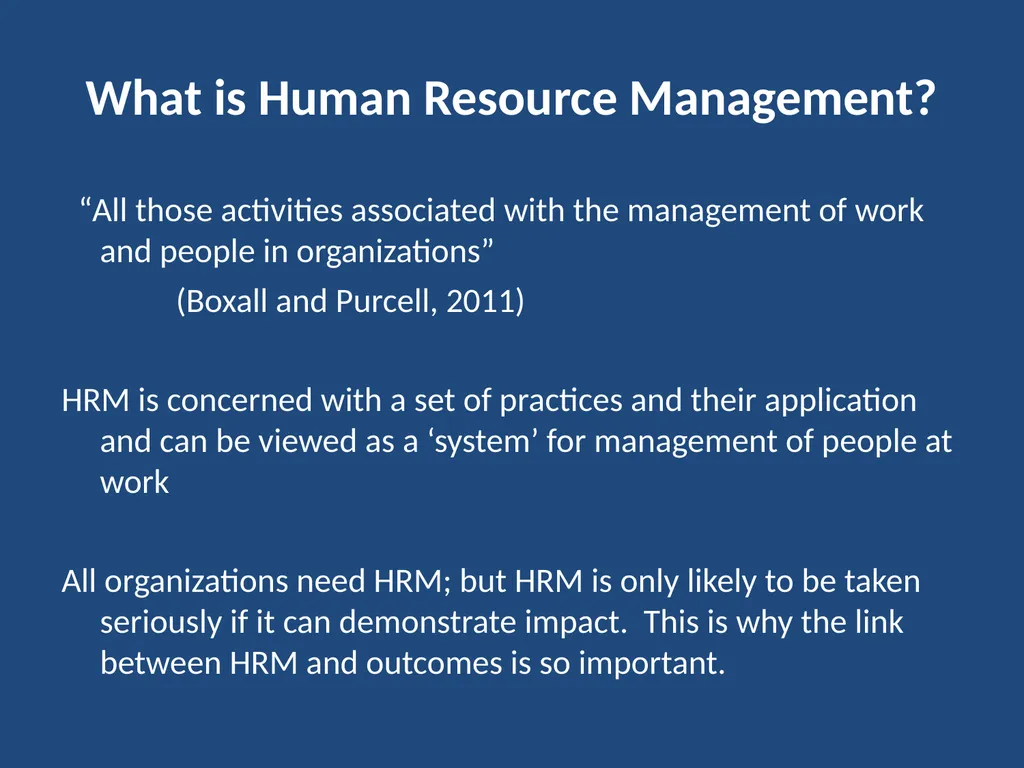
What is Human Resource Management? “All those activities associated with the management of work and people in organizations”
(Boxall and Purcell, 2011)
HRM is concerned with a set of practices and their application and can be viewed as a ‘system’ for management of people at work
All organizations need HRM; but HRM is only likely to be taken seriously if it can demonstrate impact. This is why the link between HRM and outcomes is so important.<br>
(Boxall and Purcell, 2011)
HRM is concerned with a set of practices and their application and can be viewed as a ‘system’ for management of people at work
All organizations need HRM; but HRM is only likely to be taken seriously if it can demonstrate impact. This is why the link between HRM and outcomes is so important.<br>
04
The Good News: Impressive Progress After 25 years of ‘contemporary’ research and writing, we are much more knowledgeable about HRM:
Strong evidence of a link between HRM and performance
Advances in understanding role of “external fit”
Advances in understanding “internal fit”
Recognition that HRM operates as some kind of system
Evidence that HRM can have a positive link with employee well-being
Advances in understanding linkages between HRM and performance and determinants of effective implementation
Adoption of multi-level models of analysis and sophisticated research methodology
BUT – still a lot of unanswered questions<br>
Strong evidence of a link between HRM and performance
Advances in understanding role of “external fit”
Advances in understanding “internal fit”
Recognition that HRM operates as some kind of system
Evidence that HRM can have a positive link with employee well-being
Advances in understanding linkages between HRM and performance and determinants of effective implementation
Adoption of multi-level models of analysis and sophisticated research methodology
BUT – still a lot of unanswered questions<br>
05
Recognise the Challenges of a Maturing Field:
Stages in the Development of HRM Research The promise of HRM and mapping the field: concern for strategy and commitment
Early empiricism: demonstration of link between HRM and performance – Huselid, MacDuffie, Arthur etc.
Backlash: conceptual critique (Legge, Keenoy); empirical critique (Dyer & Reeves, Becker & Gerhart)
Conceptual refinement: AMO model: resource-based view; Institutional perspective
Focus on worker: employee accounts of HRM and employee attitudes and behaviour as central to impact
Growing sophistication: complex models and multi-level analysis<br>
Early empiricism: demonstration of link between HRM and performance – Huselid, MacDuffie, Arthur etc.
Backlash: conceptual critique (Legge, Keenoy); empirical critique (Dyer & Reeves, Becker & Gerhart)
Conceptual refinement: AMO model: resource-based view; Institutional perspective
Focus on worker: employee accounts of HRM and employee attitudes and behaviour as central to impact
Growing sophistication: complex models and multi-level analysis<br>
06
Research Challenges Defining the nature of HRM and measuring it
Defining performance and other outcomes and measuring them
Theorising and operationalising the process whereby HRM and outcomes (performance) might be linked
Establishing the evidence<br>
Defining performance and other outcomes and measuring them
Theorising and operationalising the process whereby HRM and outcomes (performance) might be linked
Establishing the evidence<br>
07
The First Research Challenge Defining Human Resource Management and Measuring It
Link between external and internal fit
Deciding on the particular model of HRM
Determining sources of information<br>
Link between external and internal fit
Deciding on the particular model of HRM
Determining sources of information<br>
08
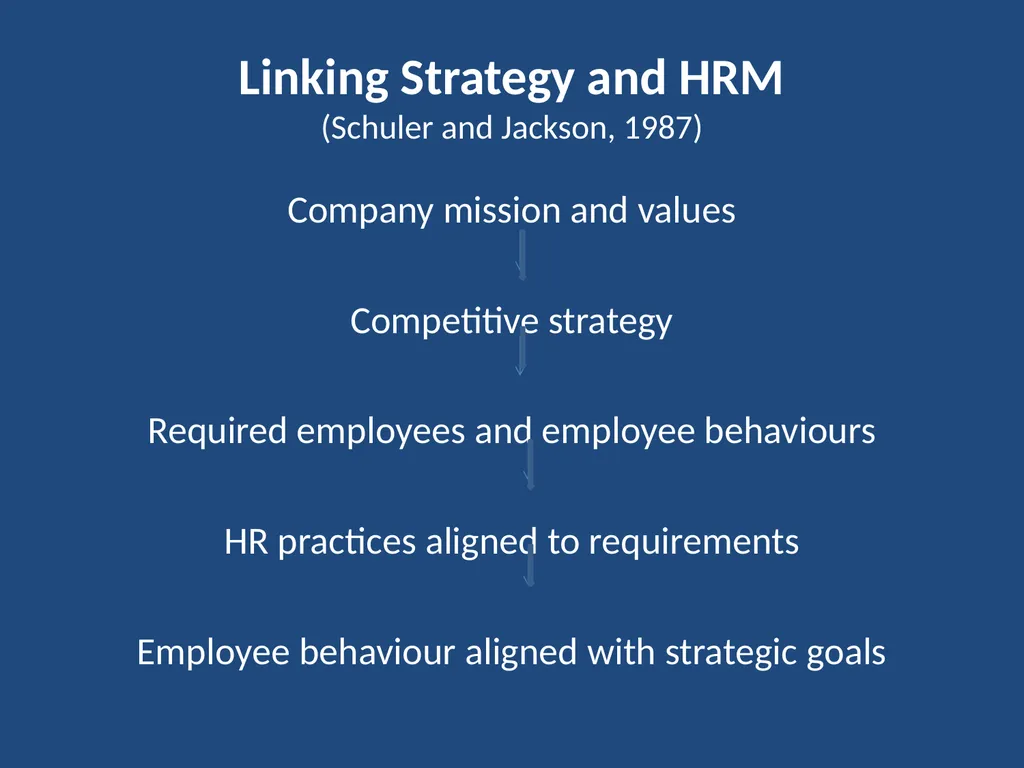
Linking Strategy and HRM
(Schuler and Jackson, 1987) Company mission and values
Competitive strategy
Required employees and employee behaviours
HR practices aligned to requirements
Employee behaviour aligned with strategic goals<br>
Competitive strategy
Required employees and employee behaviours
HR practices aligned to requirements
Employee behaviour aligned with strategic goals<br>
09
Clarifying HRM Systems Much contemporary research and writing is trying to describe human resource systems
Special issue of Human Resource Management Review (Vol 22: Issue 1) addresses this.
Posthuma et al (2013) in JoM offer an empirical taxonomy, sorting 61 practices into 9 categories
But all are operating within a high performance work systems paradigm<br>
Special issue of Human Resource Management Review (Vol 22: Issue 1) addresses this.
Posthuma et al (2013) in JoM offer an empirical taxonomy, sorting 61 practices into 9 categories
But all are operating within a high performance work systems paradigm<br>
10
Nature of HRM: Alternative Models Dominance of concept of HPWS – a misnomer. Need alternatives that recognise range of stakeholders in outcomes
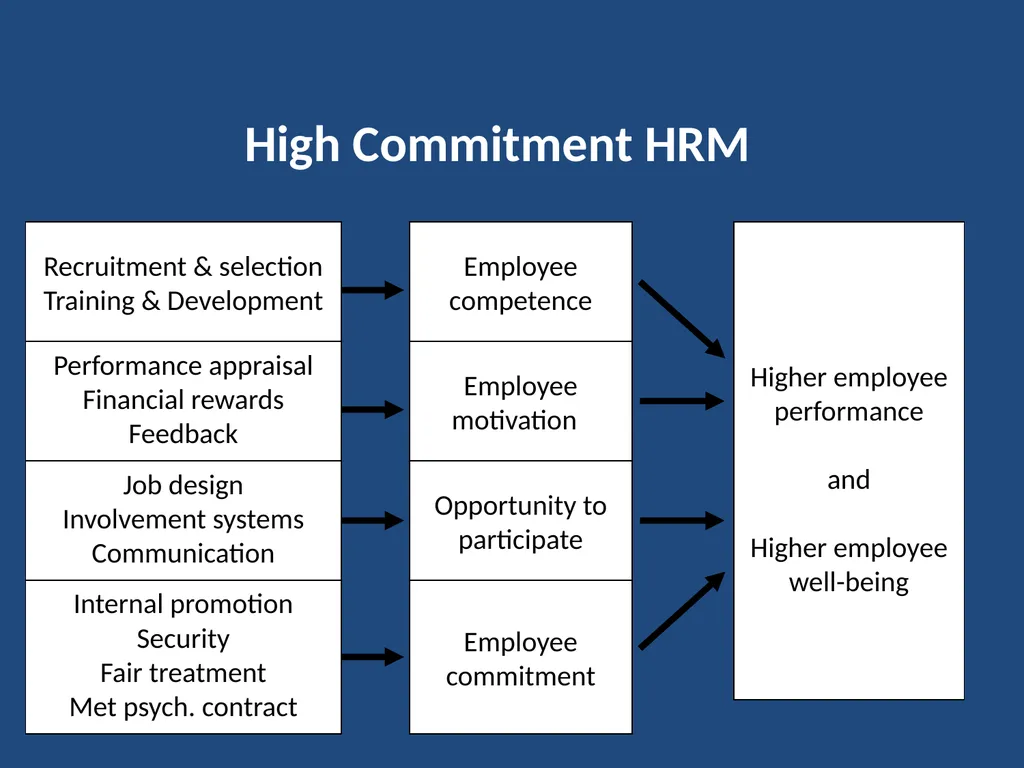
High commitment HRM
High involvement HRM
High partnership HRM
And their opposites; so commitment vs compliance (control in Walton)
Boxall and Macky 2009 distinguish focus on work practices from focus on employment practices; show their link and argue for neglect of many aspects of employment in HPWS
Cultural factors European and Australian legislation requires certain employment practices<br>
High commitment HRM
High involvement HRM
High partnership HRM
And their opposites; so commitment vs compliance (control in Walton)
Boxall and Macky 2009 distinguish focus on work practices from focus on employment practices; show their link and argue for neglect of many aspects of employment in HPWS
Cultural factors European and Australian legislation requires certain employment practices<br>
11
High Performance Work Systems (HPWS) HRM Focus on human capital and mechanisms for leveraging it to enhance performance: neglects employee outcomes
Note weakness of measures of human capital and neglect of much of HRM
Tendency to focus on incentives as motivators and controls
Meta-analyses show:
Human capital considered alone has an association with financial performance (Crook et al)
Human capital and incentive based motivation combine additively to affect performance (Jiang et al)
Limited attention paid to ‘Contribution’ dimension – because often neglected in research<br>
Note weakness of measures of human capital and neglect of much of HRM
Tendency to focus on incentives as motivators and controls
Meta-analyses show:
Human capital considered alone has an association with financial performance (Crook et al)
Human capital and incentive based motivation combine additively to affect performance (Jiang et al)
Limited attention paid to ‘Contribution’ dimension – because often neglected in research<br>
12
High Commitment HRM Opportunity to participate Employee motivation Employee competence Employee commitment<br>
13
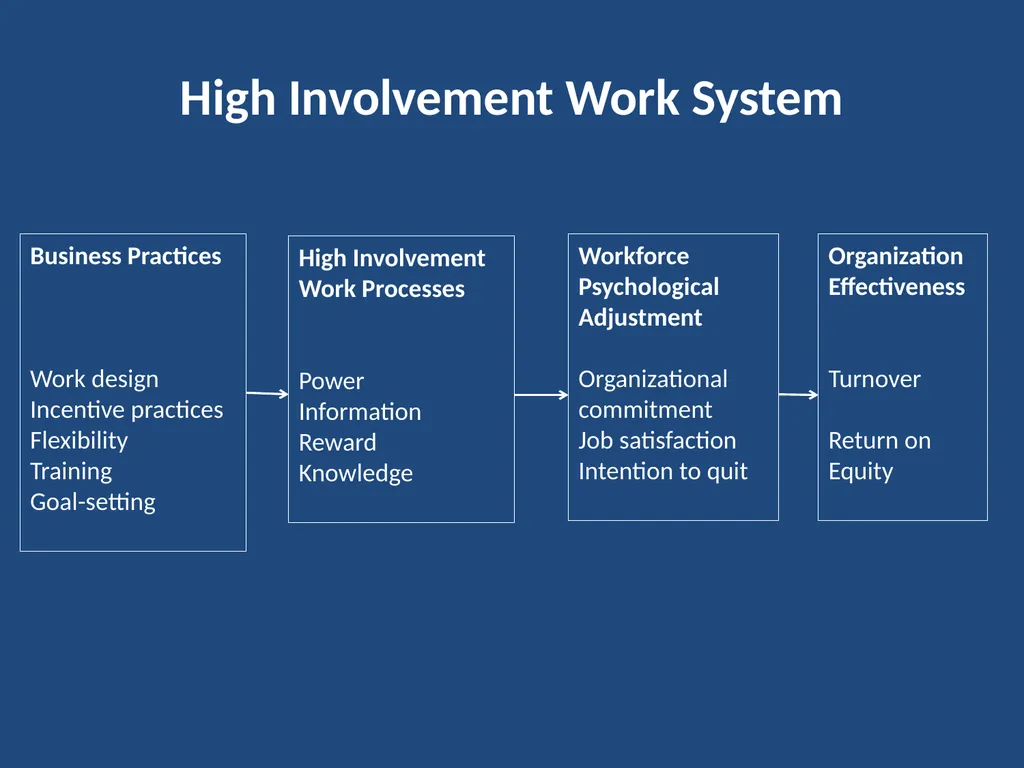
High Involvement Work System Business Practices
Work design
Incentive practices
Flexibility
Training
Goal-setting High Involvement Work Processes
Power
Information
Reward
Knowledge Workforce
Psychological Adjustment
Organizational commitment
Job satisfaction
Intention to quit Organization Effectiveness
Turnover
Return on Equity<br>
Work design
Incentive practices
Flexibility
Training
Goal-setting High Involvement Work Processes
Power
Information
Reward
Knowledge Workforce
Psychological Adjustment
Organizational commitment
Job satisfaction
Intention to quit Organization Effectiveness
Turnover
Return on Equity<br>
14
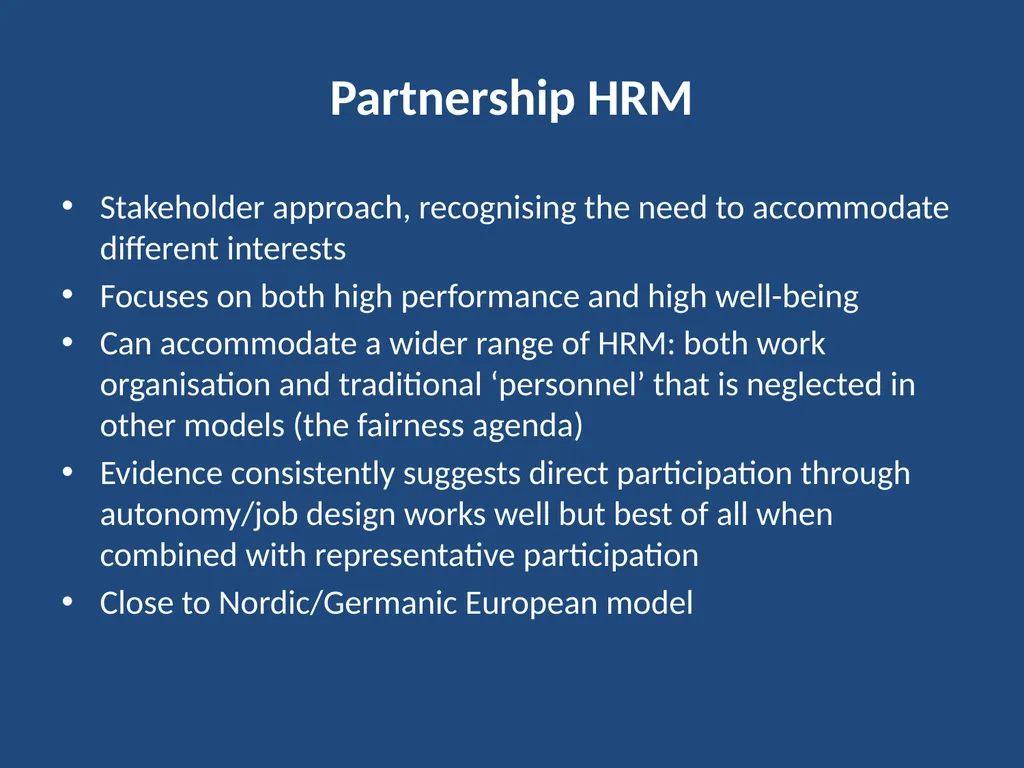
Partnership HRM Stakeholder approach, recognising the need to accommodate different interests
Focuses on both high performance and high well-being
Can accommodate a wider range of HRM: both work organisation and traditional ‘personnel’ that is neglected in other models (the fairness agenda)
Evidence consistently suggests direct participation through autonomy/job design works well but best of all when combined with representative participation
Close to Nordic/Germanic European model<br>
Focuses on both high performance and high well-being
Can accommodate a wider range of HRM: both work organisation and traditional ‘personnel’ that is neglected in other models (the fairness agenda)
Evidence consistently suggests direct participation through autonomy/job design works well but best of all when combined with representative participation
Close to Nordic/Germanic European model<br>
15
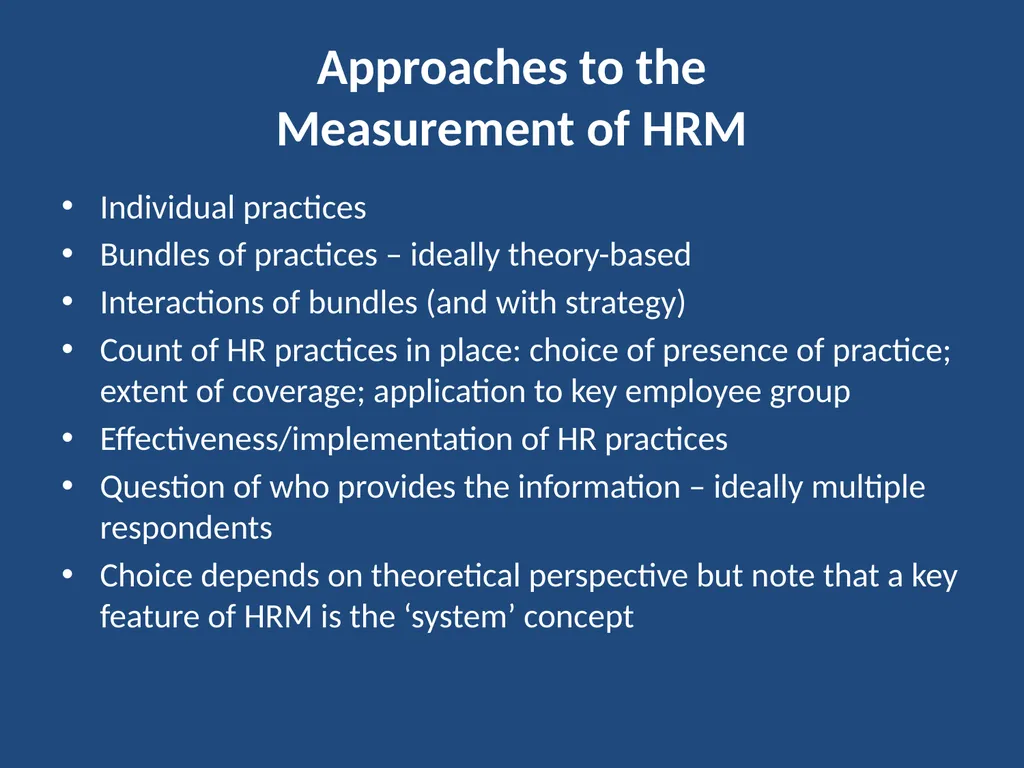
Approaches to the
Measurement of HRM Individual practices
Bundles of practices – ideally theory-based
Interactions of bundles (and with strategy)
Count of HR practices in place: choice of presence of practice; extent of coverage; application to key employee group
Effectiveness/implementation of HR practices
Question of who provides the information – ideally multiple respondents
Choice depends on theoretical perspective but note that a key feature of HRM is the ‘system’ concept<br>
Bundles of practices – ideally theory-based
Interactions of bundles (and with strategy)
Count of HR practices in place: choice of presence of practice; extent of coverage; application to key employee group
Effectiveness/implementation of HR practices
Question of who provides the information – ideally multiple respondents
Choice depends on theoretical perspective but note that a key feature of HRM is the ‘system’ concept<br>
16
The Second Research Challenge: Measuring Outcomes
Focus has been mainly on performance
In the case of performance, need to distinguish proximal and distal outcomes
Need to broaden to consider a stakeholder perspective<br>
Focus has been mainly on performance
In the case of performance, need to distinguish proximal and distal outcomes
Need to broaden to consider a stakeholder perspective<br>
17
Approaches to the Measurement of Performance Standard performance indicators: financial, productivity quits etc – both proximal and distal
Goal-based perspectives – manage a merger
Resource acquisition models – unions and universities
Bench-marking and ratios – popular but limited
Process models; effectiveness of policies
Stakeholder perspectives – subjective outcomes<br>
Goal-based perspectives – manage a merger
Resource acquisition models – unions and universities
Bench-marking and ratios – popular but limited
Process models; effectiveness of policies
Stakeholder perspectives – subjective outcomes<br>
18
What Outcomes do Workers Want? Job satisfaction
Work-related well-being
Work-life balance
Adequate and fair rewards
Good employment relations
High quality of working life
Health
Life satisfaction
Raises the question of what employers are obliged to provide – what is the psychological contract?<br>
Work-related well-being
Work-life balance
Adequate and fair rewards
Good employment relations
High quality of working life
Health
Life satisfaction
Raises the question of what employers are obliged to provide – what is the psychological contract?<br>
19
The Third Research Challenge Understanding and Exploring the Implementation of HRM
Extent of implementation
Influences on implementation
Key actors in implementation<br>
Extent of implementation
Influences on implementation
Key actors in implementation<br>
20
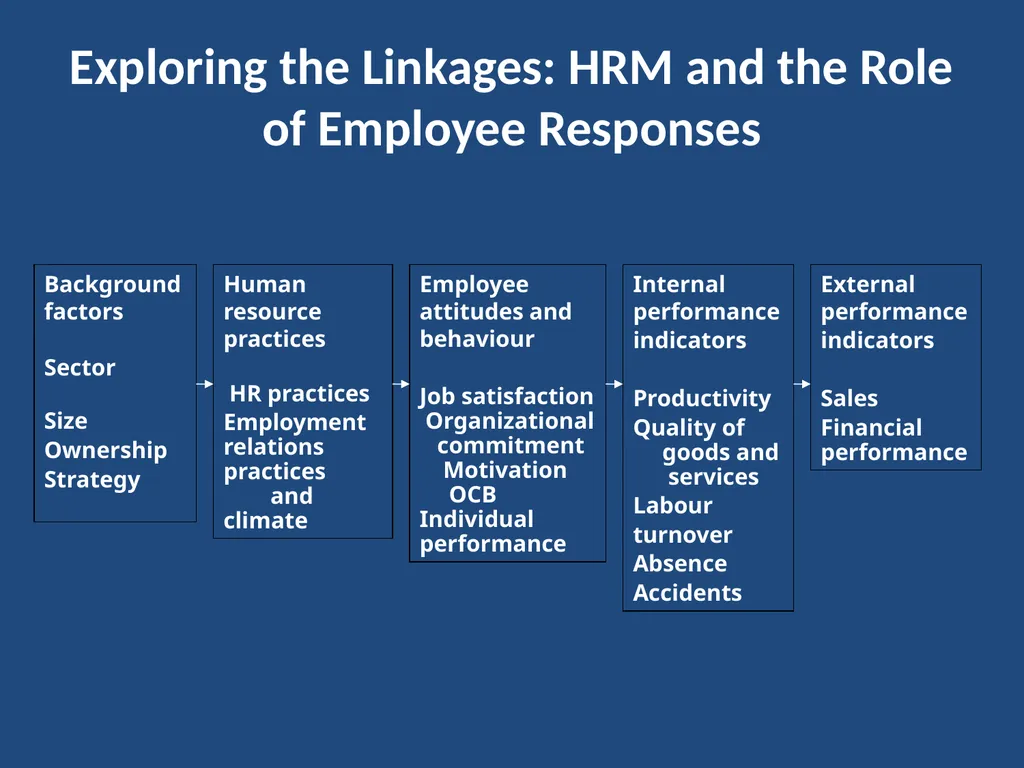
Exploring the Linkages: HRM and the Role of Employee Responses Background factors
Sector
Size
Ownership
Strategy Human resource practices HR practices
Employment relations practices and climate Employee attitudes and behaviour
Job satisfaction Organizational commitment Motivation OCB Individual performance Internal performance
indicators
Productivity
Quality of goods and services
Labour
turnover
Absence
Accidents External performance
indicators
Sales
Financial performance<br>
Sector
Size
Ownership
Strategy Human resource practices HR practices
Employment relations practices and climate Employee attitudes and behaviour
Job satisfaction Organizational commitment Motivation OCB Individual performance Internal performance
indicators
Productivity
Quality of goods and services
Labour
turnover
Absence
Accidents External performance
indicators
Sales
Financial performance<br>
21
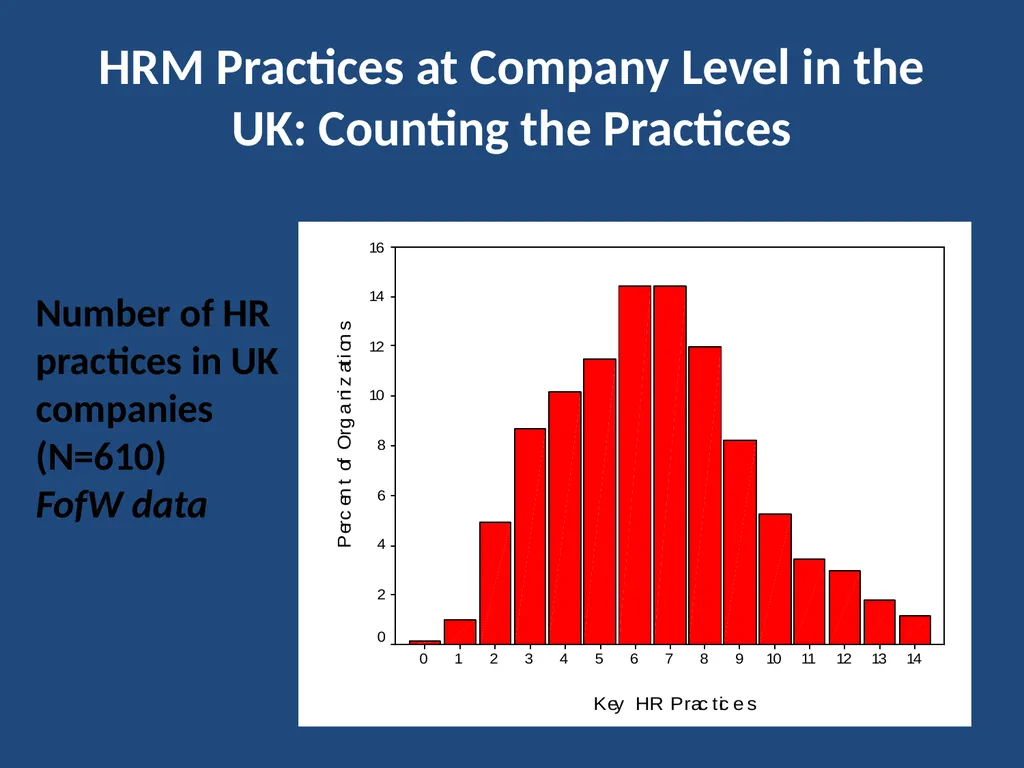
HRM Practices at Company Level in the UK: Counting the Practices Number of HR practices in UK companies (N=610)
FofW data<br>
FofW data<br>
22
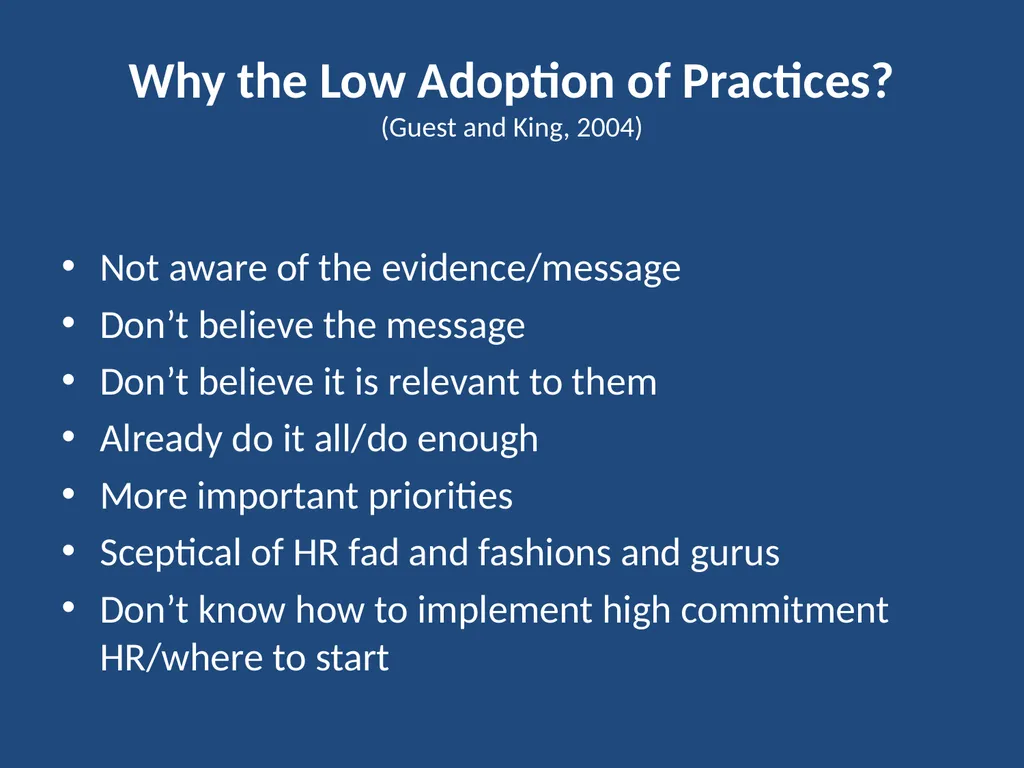
Why the Low Adoption of Practices?
(Guest and King, 2004) Not aware of the evidence/message
Don’t believe the message
Don’t believe it is relevant to them
Already do it all/do enough
More important priorities
Sceptical of HR fad and fashions and gurus
Don’t know how to implement high commitment HR/where to start<br>
Don’t believe the message
Don’t believe it is relevant to them
Already do it all/do enough
More important priorities
Sceptical of HR fad and fashions and gurus
Don’t know how to implement high commitment HR/where to start<br>
23
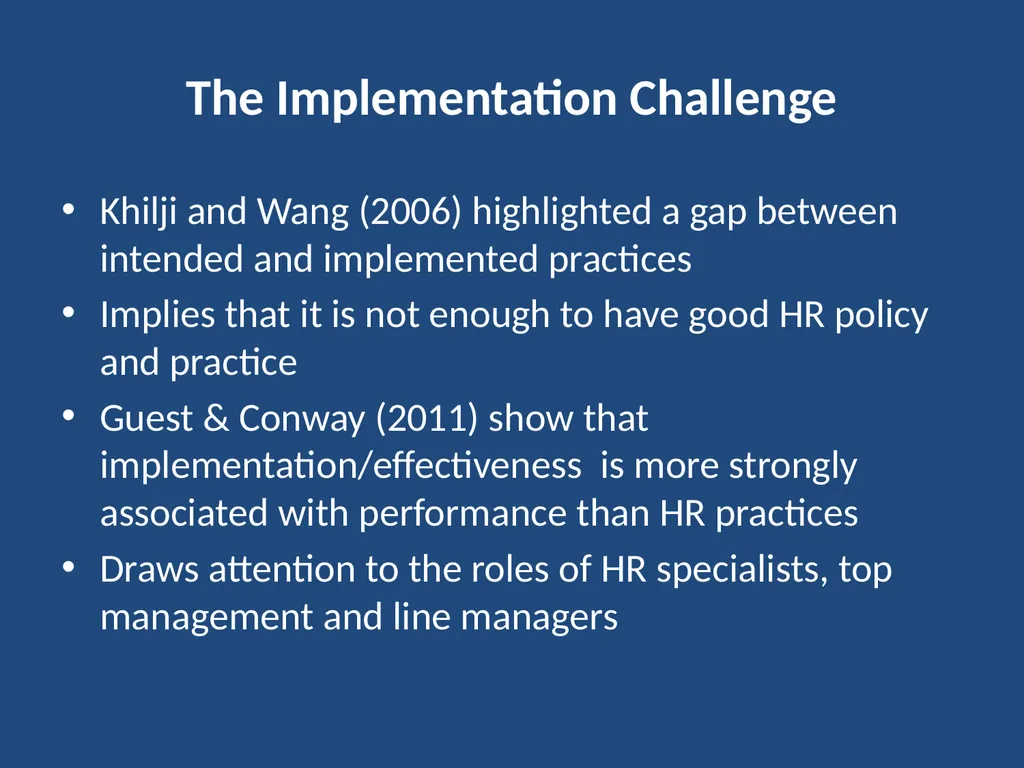
The Implementation Challenge Khilji and Wang (2006) highlighted a gap between intended and implemented practices
Implies that it is not enough to have good HR policy and practice
Guest & Conway (2011) show that implementation/effectiveness is more strongly associated with performance than HR practices
Draws attention to the roles of HR specialists, top management and line managers<br>
Implies that it is not enough to have good HR policy and practice
Guest & Conway (2011) show that implementation/effectiveness is more strongly associated with performance than HR practices
Draws attention to the roles of HR specialists, top management and line managers<br>
24
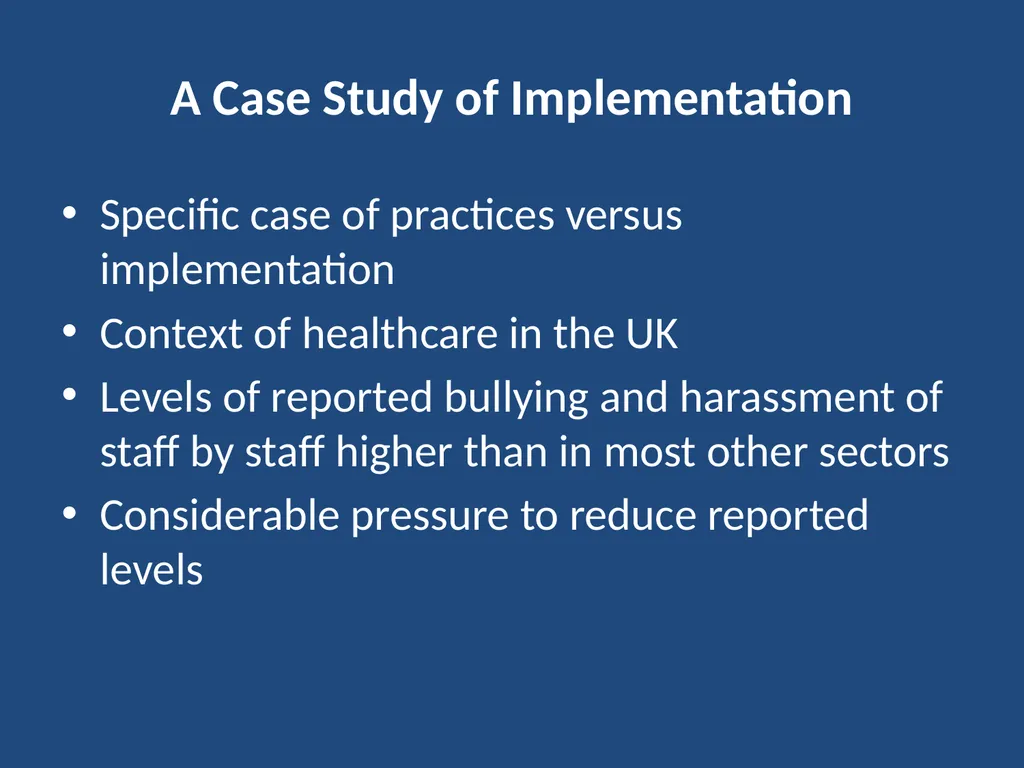
A Case Study of Implementation Specific case of practices versus implementation
Context of healthcare in the UK
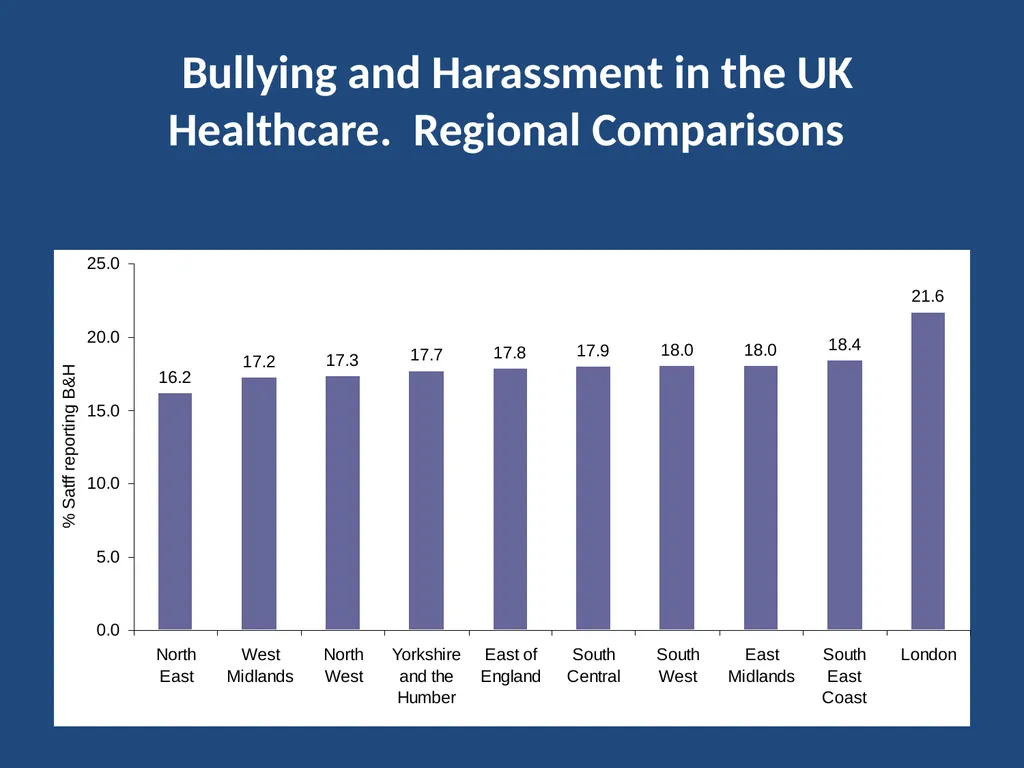
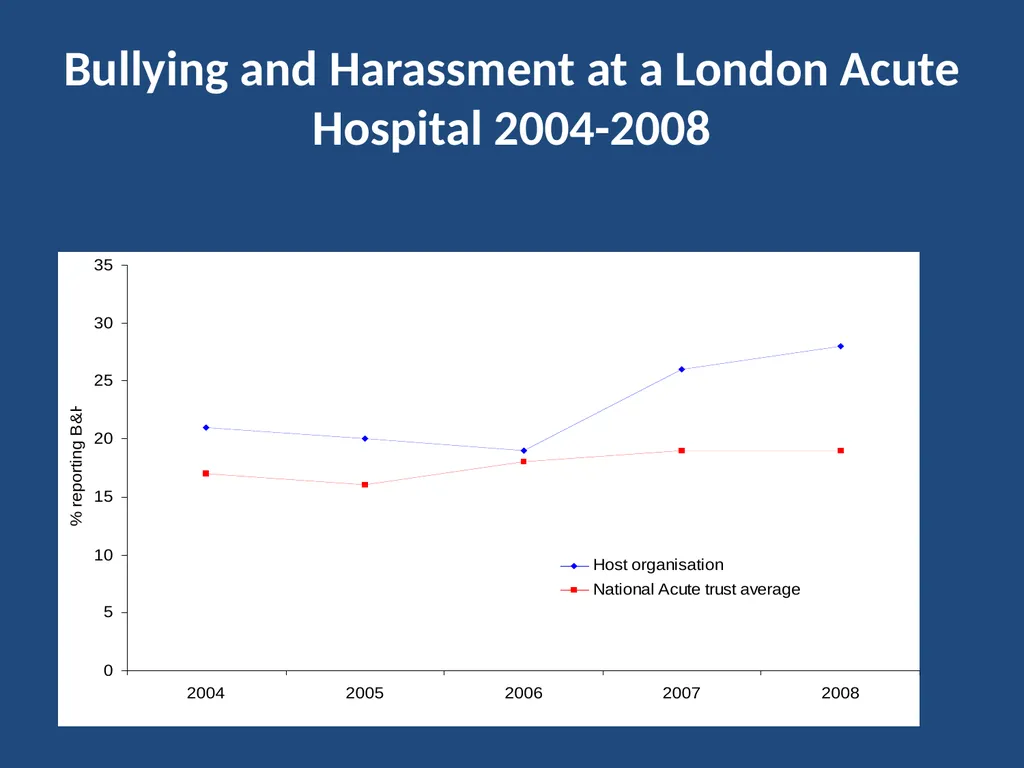
Levels of reported bullying and harassment of staff by staff higher than in most other sectors
Considerable pressure to reduce reported levels<br>
Context of healthcare in the UK
Levels of reported bullying and harassment of staff by staff higher than in most other sectors
Considerable pressure to reduce reported levels<br>
25
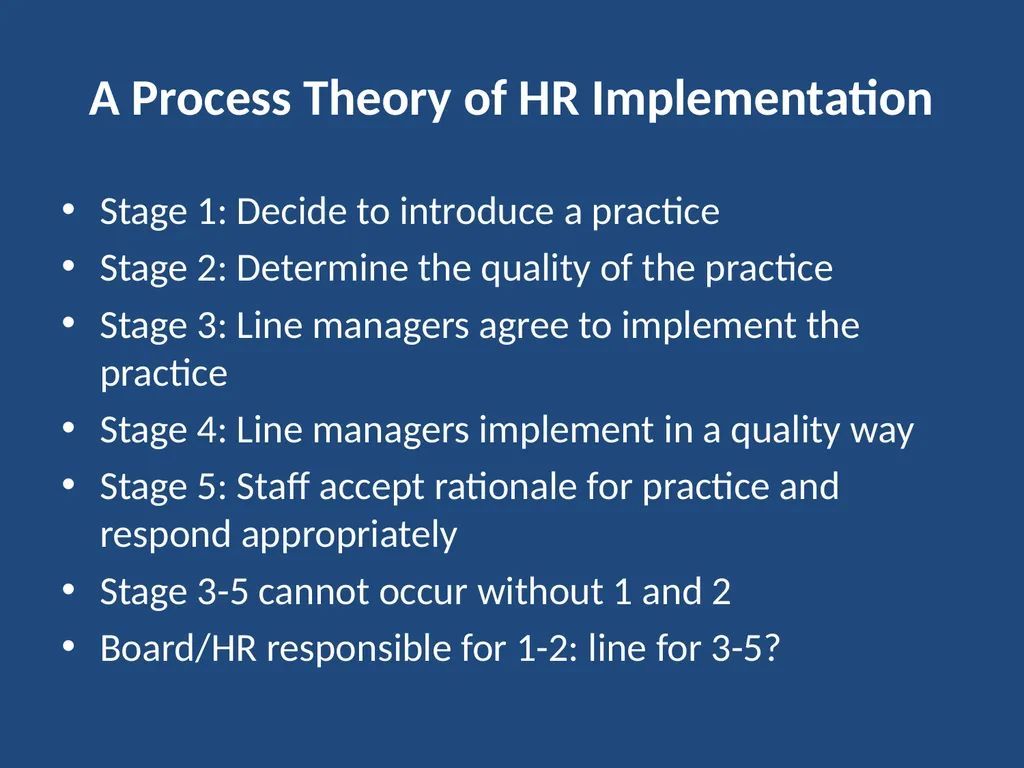
A Process Theory of HR Implementation Stage 1: Decide to introduce a practice
Stage 2: Determine the quality of the practice
Stage 3: Line managers agree to implement the practice
Stage 4: Line managers implement in a quality way
Stage 5: Staff accept rationale for practice and respond appropriately
Stage 3-5 cannot occur without 1 and 2
Board/HR responsible for 1-2: line for 3-5?<br>
Stage 2: Determine the quality of the practice
Stage 3: Line managers agree to implement the practice
Stage 4: Line managers implement in a quality way
Stage 5: Staff accept rationale for practice and respond appropriately
Stage 3-5 cannot occur without 1 and 2
Board/HR responsible for 1-2: line for 3-5?<br>
26
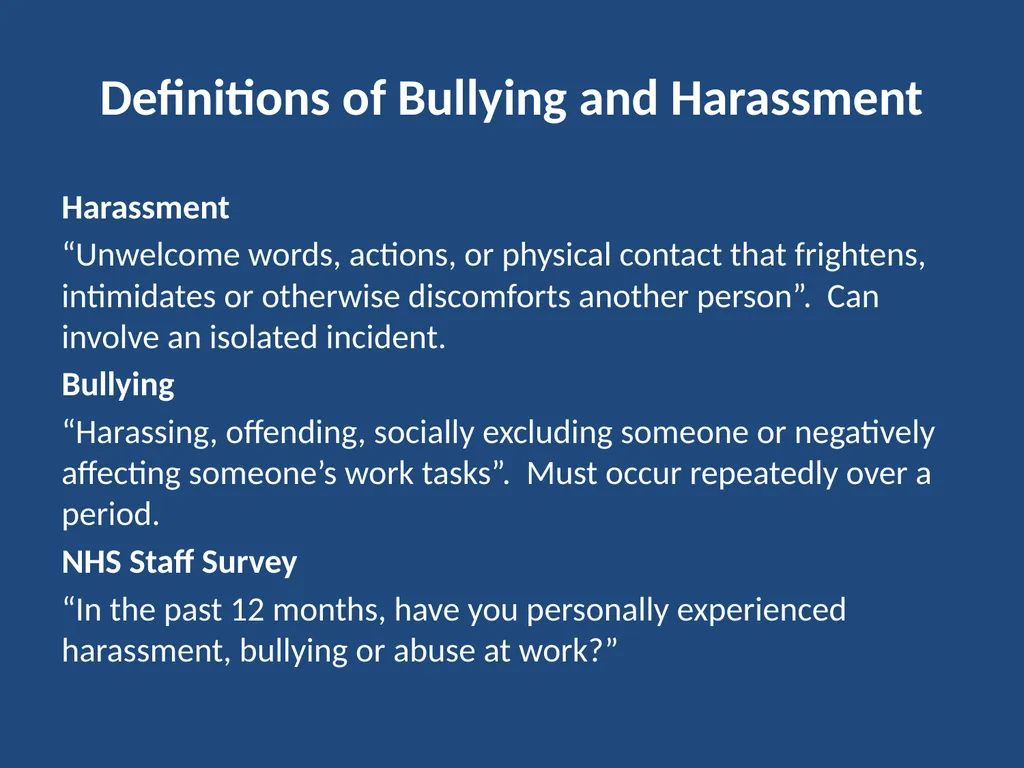
Definitions of Bullying and Harassment Harassment
“Unwelcome words, actions, or physical contact that frightens, intimidates or otherwise discomforts another person”. Can involve an isolated incident.
Bullying
“Harassing, offending, socially excluding someone or negatively affecting someone’s work tasks”. Must occur repeatedly over a period.
NHS Staff Survey
“In the past 12 months, have you personally experienced harassment, bullying or abuse at work?”<br>
“Unwelcome words, actions, or physical contact that frightens, intimidates or otherwise discomforts another person”. Can involve an isolated incident.
Bullying
“Harassing, offending, socially excluding someone or negatively affecting someone’s work tasks”. Must occur repeatedly over a period.
NHS Staff Survey
“In the past 12 months, have you personally experienced harassment, bullying or abuse at work?”<br>
27
Bullying and Harassment in the UK Healthcare. Regional Comparisons<br>
28
Bullying and Harassment at a London Acute Hospital 2004-2008<br>
29
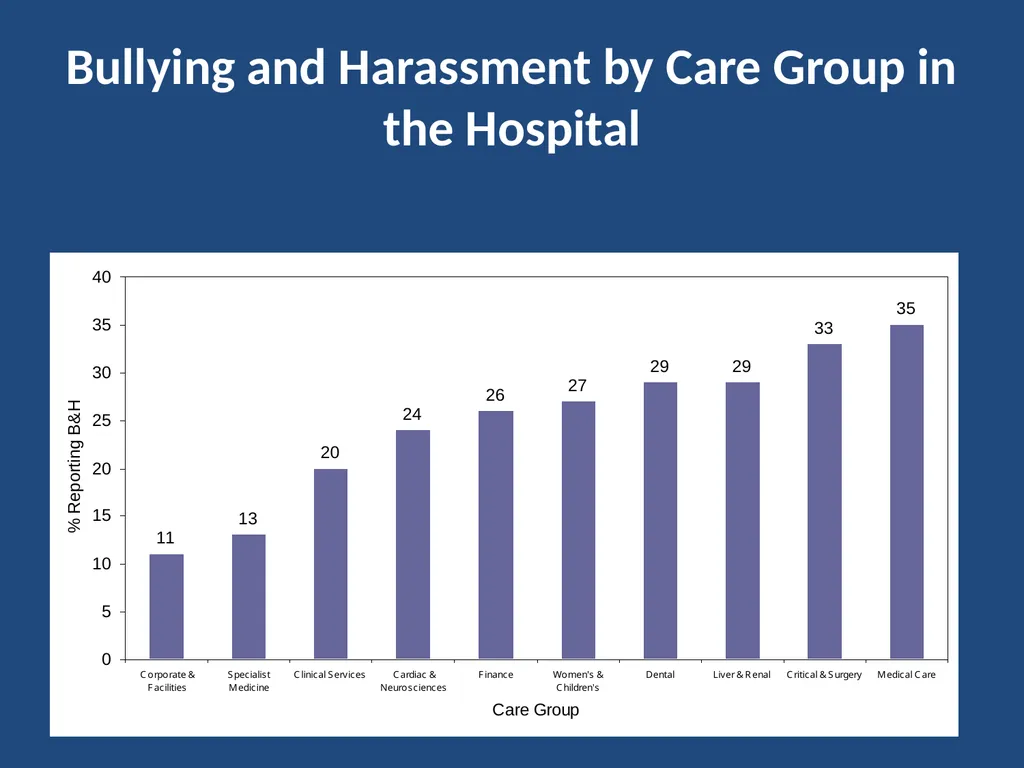
Bullying and Harassment by Care Group in the Hospital<br>
30
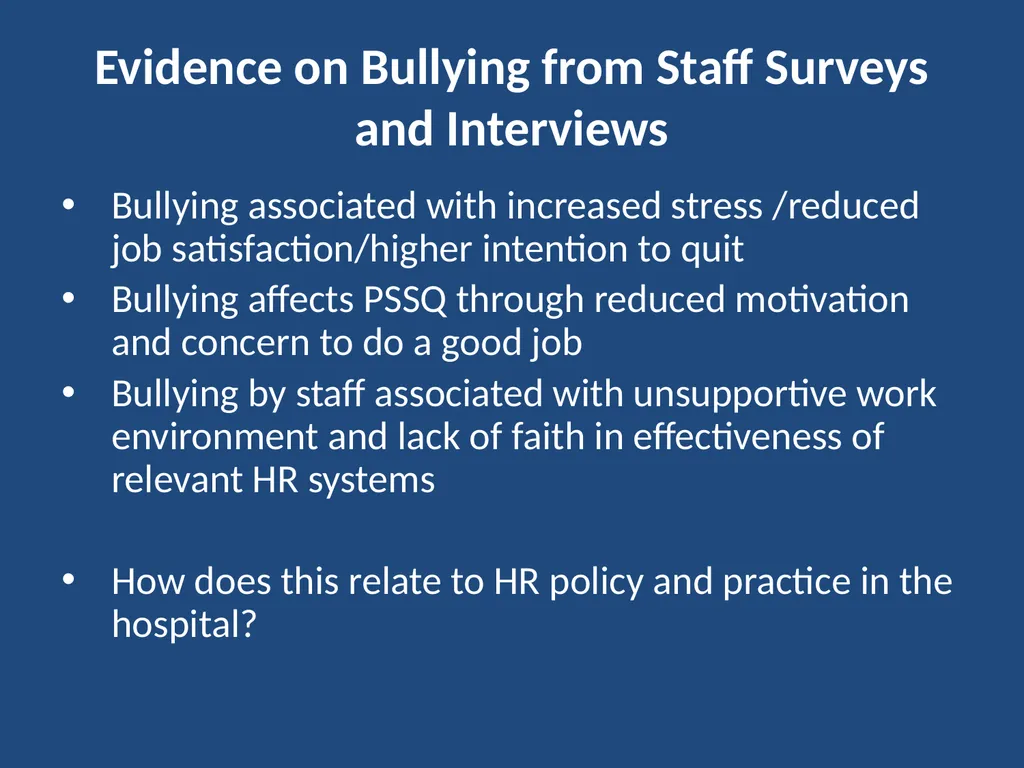
Evidence on Bullying from Staff Surveys and Interviews Bullying associated with increased stress /reduced job satisfaction/higher intention to quit
Bullying affects PSSQ through reduced motivation and concern to do a good job
Bullying by staff associated with unsupportive work environment and lack of faith in effectiveness of relevant HR systems
How does this relate to HR policy and practice in the hospital?<br>
Bullying affects PSSQ through reduced motivation and concern to do a good job
Bullying by staff associated with unsupportive work environment and lack of faith in effectiveness of relevant HR systems
How does this relate to HR policy and practice in the hospital?<br>
31
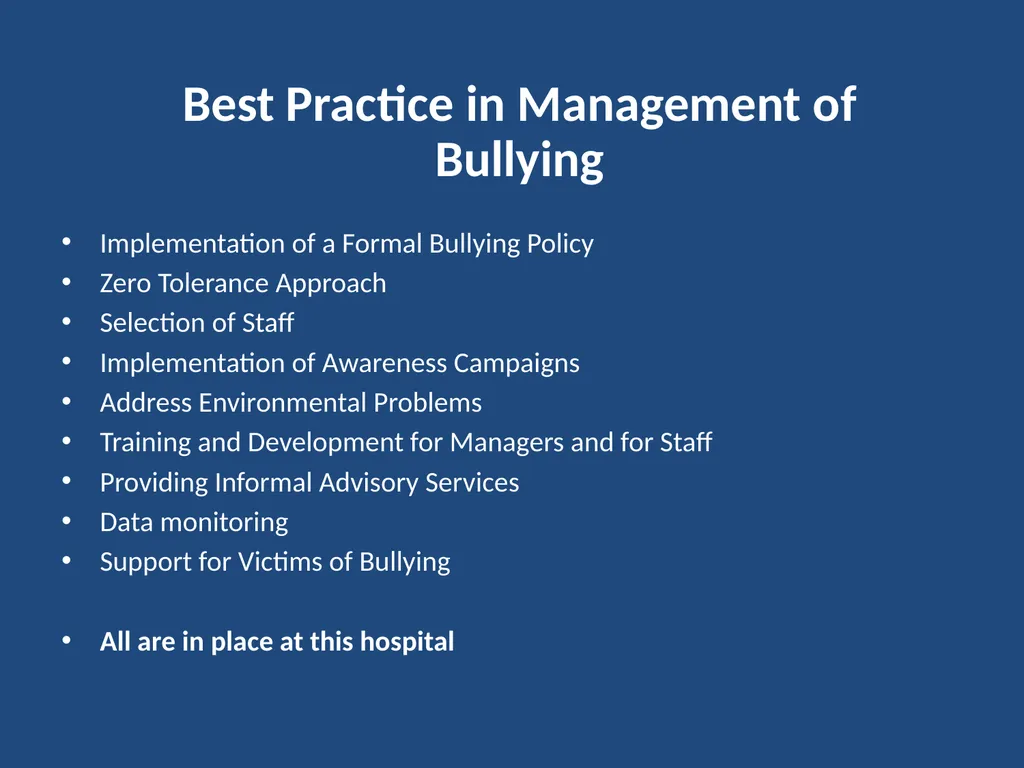
Best Practice in Management of Bullying Implementation of a Formal Bullying Policy
Zero Tolerance Approach
Selection of Staff
Implementation of Awareness Campaigns
Address Environmental Problems
Training and Development for Managers and for Staff
Providing Informal Advisory Services
Data monitoring
Support for Victims of Bullying
All are in place at this hospital<br>
Zero Tolerance Approach
Selection of Staff
Implementation of Awareness Campaigns
Address Environmental Problems
Training and Development for Managers and for Staff
Providing Informal Advisory Services
Data monitoring
Support for Victims of Bullying
All are in place at this hospital<br>
32
Implications for HRM The hospital has all the right policies and practices in place but B&H still very high. Why?
Clear gap between ‘intended’ and ‘implemented’ practice
In this context, seemingly good HR can get bad results because of a poor implementation climate
Implementation may be particularly challenging in public sector professional bureaucracies
Implies need to focus in implementation on roles of key actors – line, senior and HR management<br>
Clear gap between ‘intended’ and ‘implemented’ practice
In this context, seemingly good HR can get bad results because of a poor implementation climate
Implementation may be particularly challenging in public sector professional bureaucracies
Implies need to focus in implementation on roles of key actors – line, senior and HR management<br>
33
The Boundaries of HR Functional Responsibility What can the HR function be expected to contribute?
The function has the promise of exerting distinctive influence through three main routes
Through the Ulrich model of structure and function
Through promoting the link between HR and performance
Through the traditional role of ensuring fair treatment
The evidence suggests that the HR function has failed on all three counts, partly because of problems of implementation
As a result, it is unrealistic to expect a major independent HR contribution. The HR function cannot do it on its own.<br>
The function has the promise of exerting distinctive influence through three main routes
Through the Ulrich model of structure and function
Through promoting the link between HR and performance
Through the traditional role of ensuring fair treatment
The evidence suggests that the HR function has failed on all three counts, partly because of problems of implementation
As a result, it is unrealistic to expect a major independent HR contribution. The HR function cannot do it on its own.<br>
34
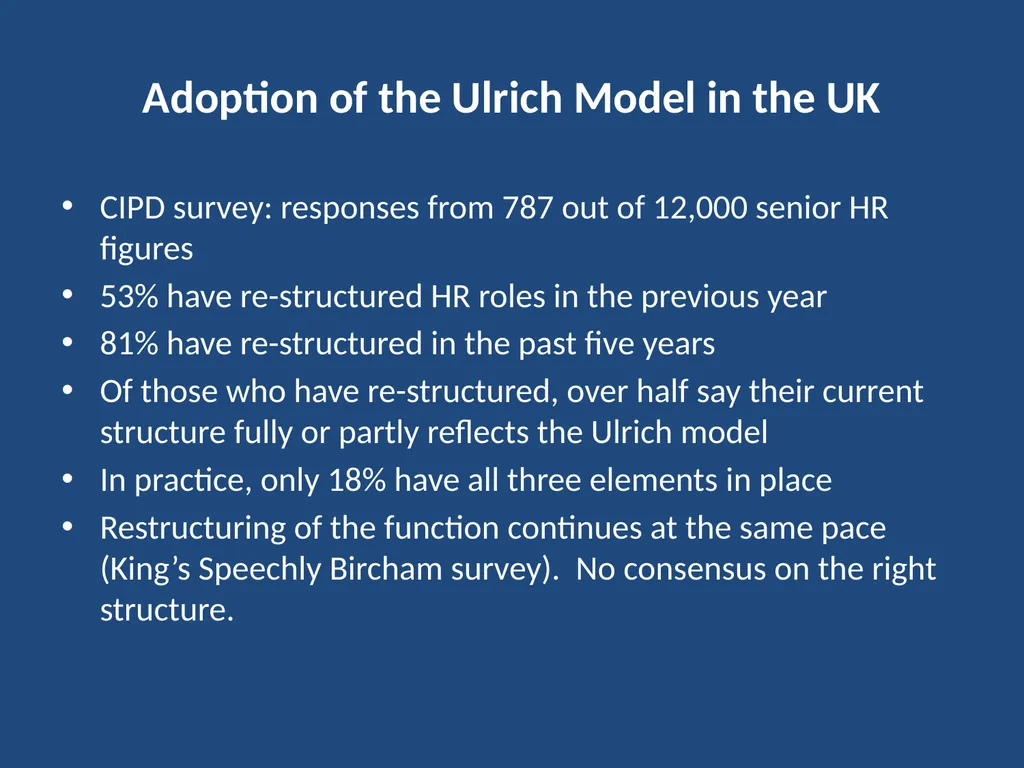
Adoption of the Ulrich Model in the UK CIPD survey: responses from 787 out of 12,000 senior HR figures
53% have re-structured HR roles in the previous year
81% have re-structured in the past five years
Of those who have re-structured, over half say their current structure fully or partly reflects the Ulrich model
In practice, only 18% have all three elements in place
Restructuring of the function continues at the same pace (King’s Speechly Bircham survey). No consensus on the right structure.<br>
53% have re-structured HR roles in the previous year
81% have re-structured in the past five years
Of those who have re-structured, over half say their current structure fully or partly reflects the Ulrich model
In practice, only 18% have all three elements in place
Restructuring of the function continues at the same pace (King’s Speechly Bircham survey). No consensus on the right structure.<br>
35
Evaluating the Ulrich Framework:
Evidence from the CIPD/IES Survey No evidence that organisations using the full model report better performance
Some indication that those concentrating on the use of business partners have poorer performance
Issues of cause and effect; are poorer performing organisations more likely to adopt a new model?<br>
Some indication that those concentrating on the use of business partners have poorer performance
Issues of cause and effect; are poorer performing organisations more likely to adopt a new model?<br>
36
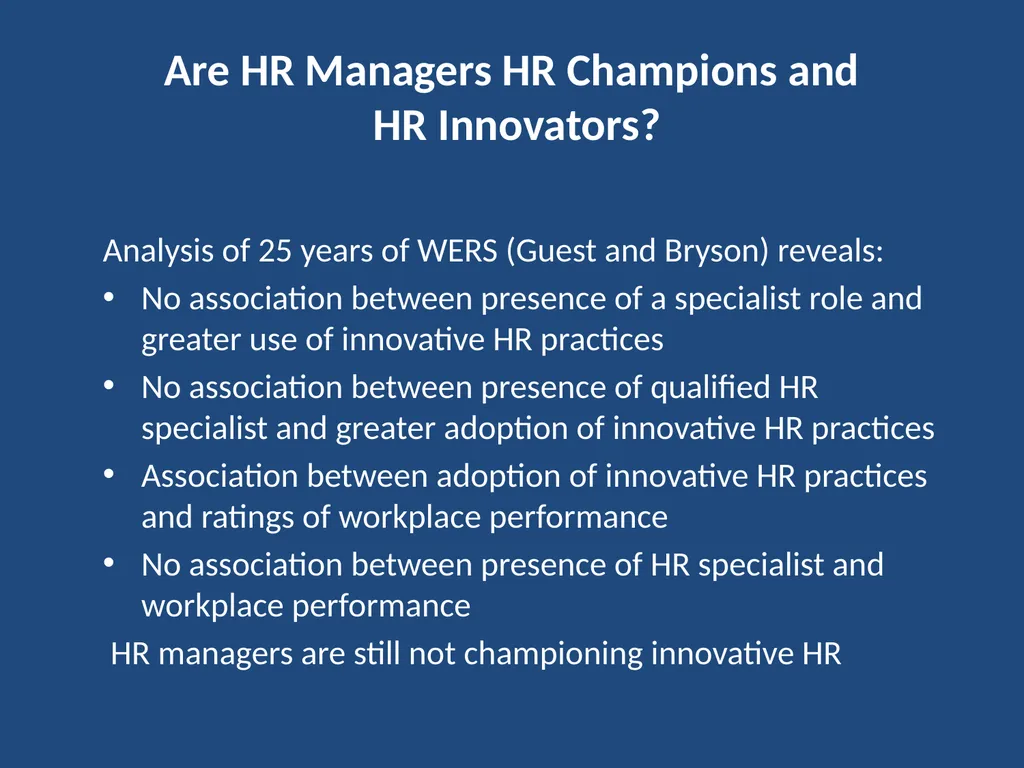
Are HR Managers HR Champions and
HR Innovators? Analysis of 25 years of WERS (Guest and Bryson) reveals:
No association between presence of a specialist role and greater use of innovative HR practices
No association between presence of qualified HR specialist and greater adoption of innovative HR practices
Association between adoption of innovative HR practices and ratings of workplace performance
No association between presence of HR specialist and workplace performance
HR managers are still not championing innovative HR<br>
No association between presence of a specialist role and greater use of innovative HR practices
No association between presence of qualified HR specialist and greater adoption of innovative HR practices
Association between adoption of innovative HR practices and ratings of workplace performance
No association between presence of HR specialist and workplace performance
HR managers are still not championing innovative HR<br>
37
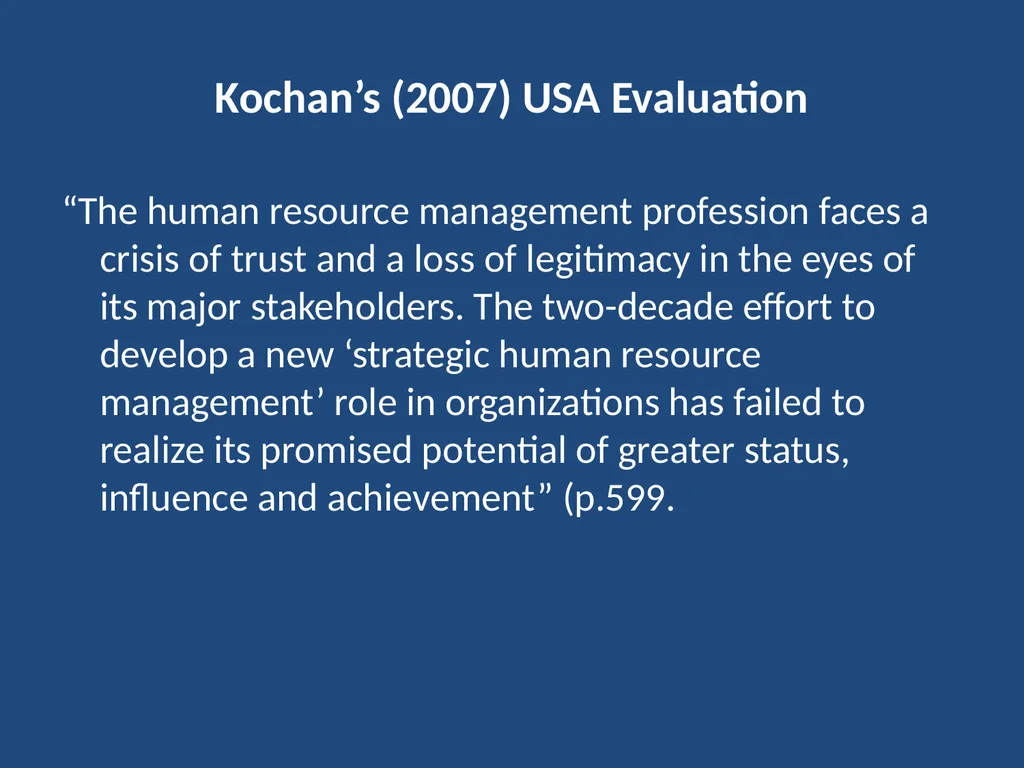
Kochan’s (2007) USA Evaluation “The human resource management profession faces a crisis of trust and a loss of legitimacy in the eyes of its major stakeholders. The two-decade effort to develop a new ‘strategic human resource management’ role in organizations has failed to realize its promised potential of greater status, influence and achievement” (p.599.<br>
38
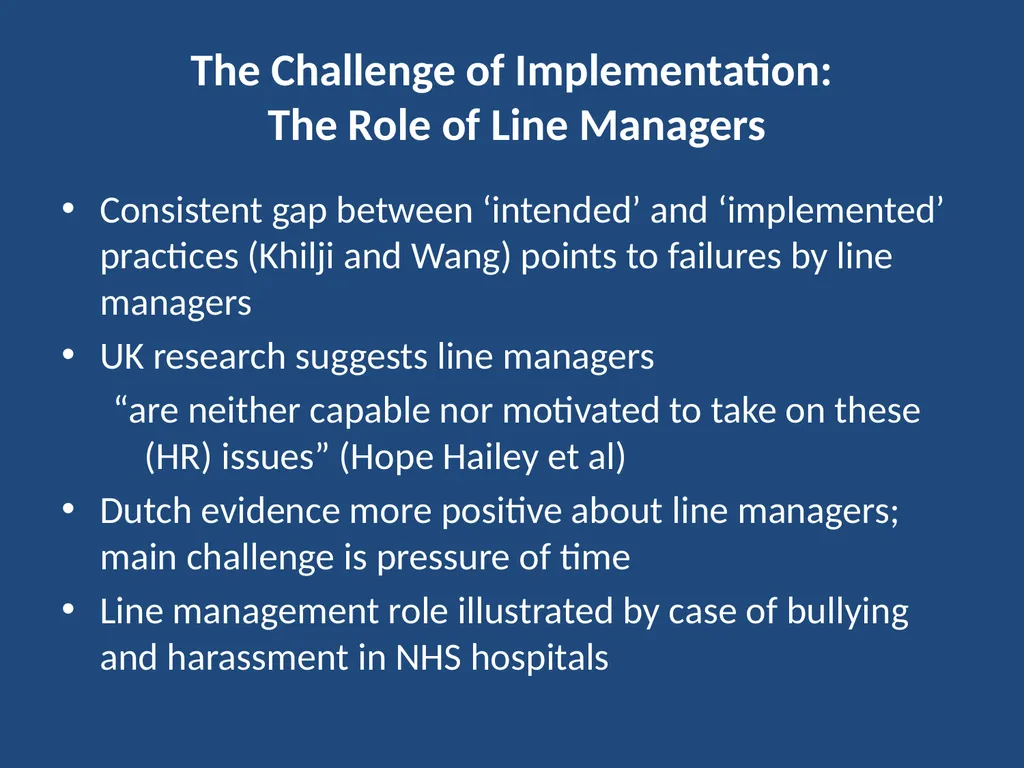
The Challenge of Implementation:
The Role of Line Managers Consistent gap between ‘intended’ and ‘implemented’ practices (Khilji and Wang) points to failures by line managers
UK research suggests line managers
“are neither capable nor motivated to take on these (HR) issues” (Hope Hailey et al)
Dutch evidence more positive about line managers; main challenge is pressure of time
Line management role illustrated by case of bullying and harassment in NHS hospitals<br>
UK research suggests line managers
“are neither capable nor motivated to take on these (HR) issues” (Hope Hailey et al)
Dutch evidence more positive about line managers; main challenge is pressure of time
Line management role illustrated by case of bullying and harassment in NHS hospitals<br>
39
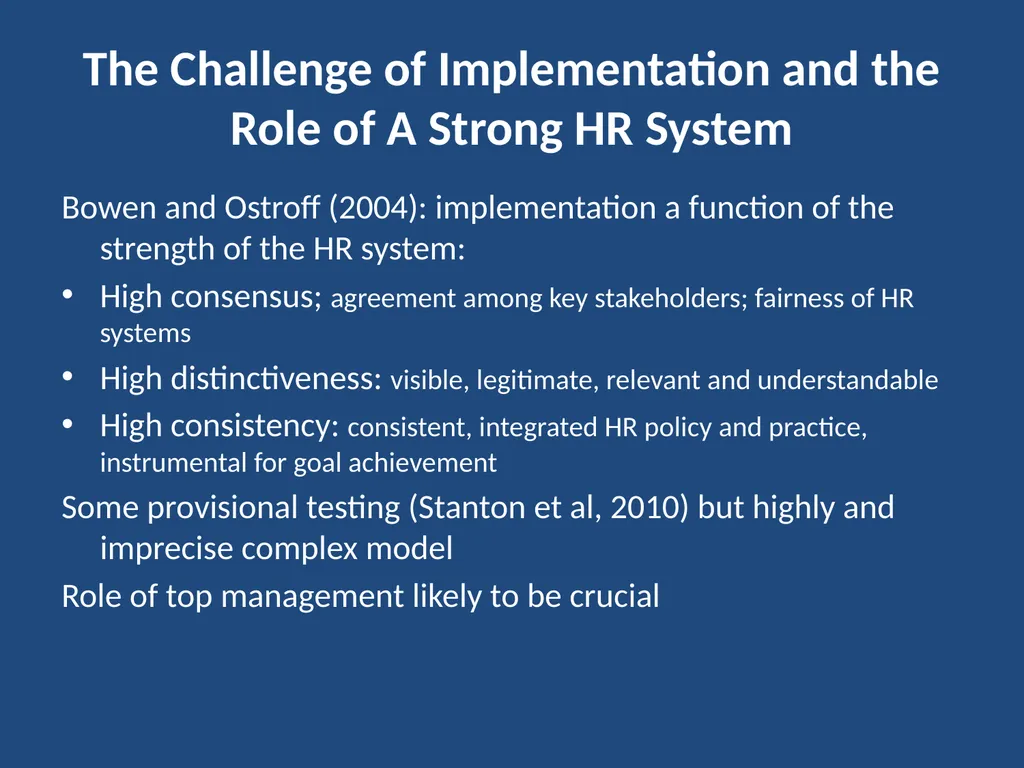
The Challenge of Implementation and the Role of A Strong HR System Bowen and Ostroff (2004): implementation a function of the strength of the HR system:
High consensus; agreement among key stakeholders; fairness of HR systems
High distinctiveness: visible, legitimate, relevant and understandable
High consistency: consistent, integrated HR policy and practice, instrumental for goal achievement
Some provisional testing (Stanton et al, 2010) but highly and imprecise complex model
Role of top management likely to be crucial<br>
High consensus; agreement among key stakeholders; fairness of HR systems
High distinctiveness: visible, legitimate, relevant and understandable
High consistency: consistent, integrated HR policy and practice, instrumental for goal achievement
Some provisional testing (Stanton et al, 2010) but highly and imprecise complex model
Role of top management likely to be crucial<br>
40
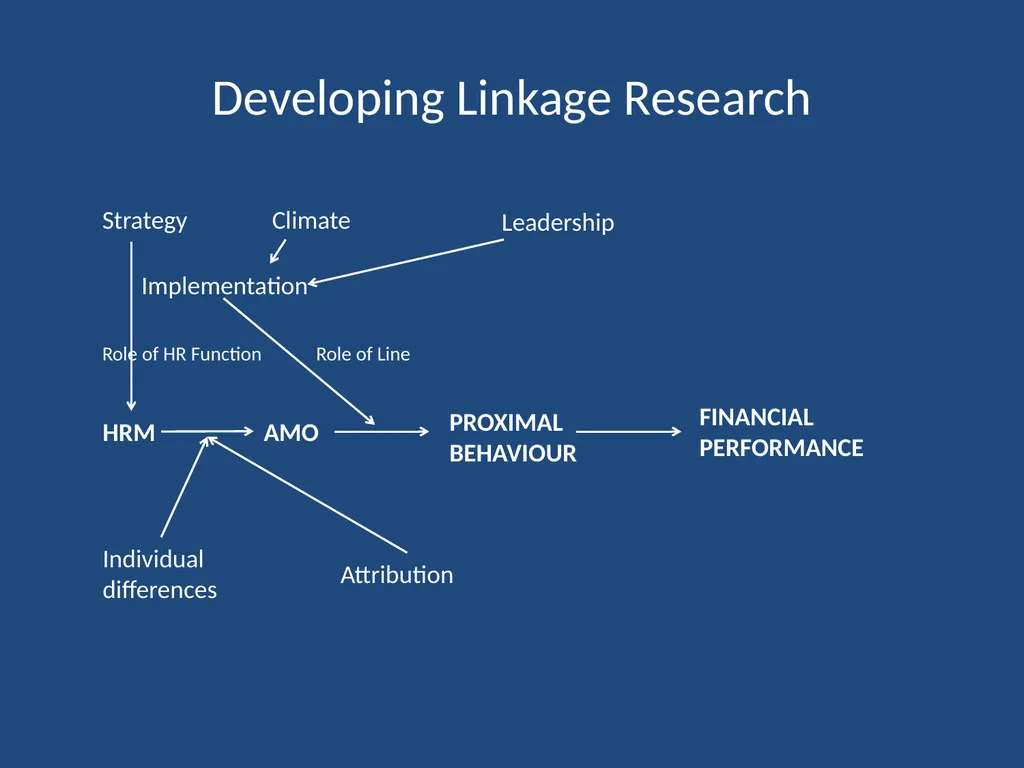
Developing Linkage Research HRM PROXIMAL BEHAVIOUR AMO FINANCIAL PERFORMANCE Individual differences Attribution Strategy Climate Implementation Leadership Role of HR Function Role of Line<br>
41
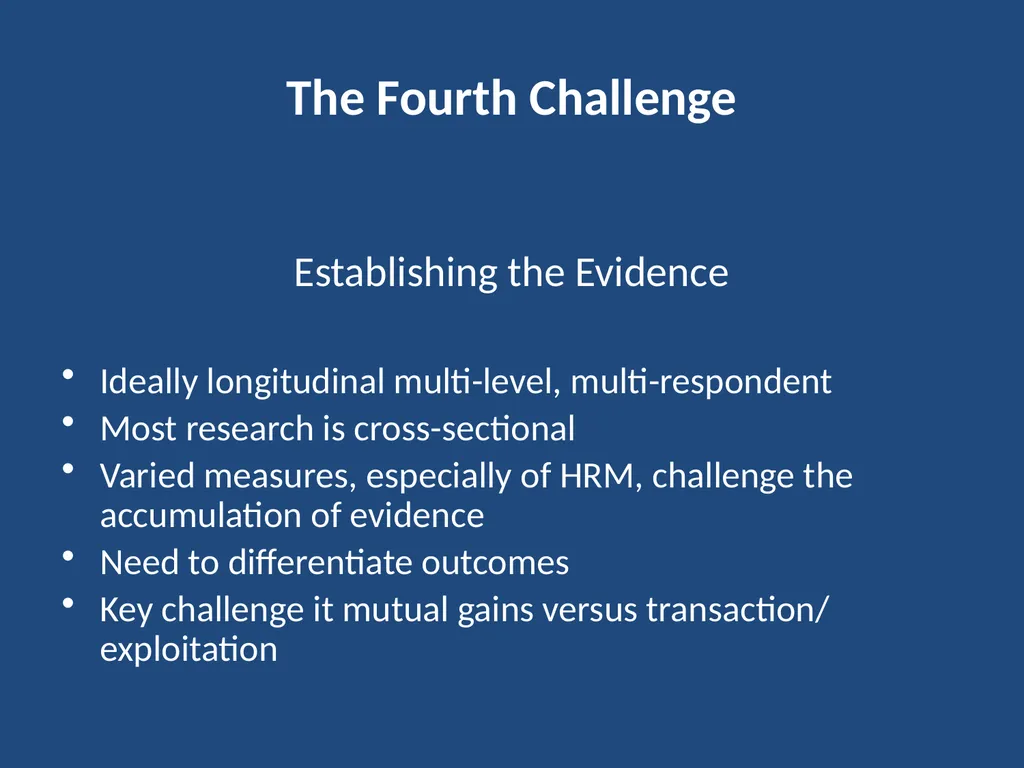
The Fourth Challenge Establishing the Evidence
Ideally longitudinal multi-level, multi-respondent
Most research is cross-sectional
Varied measures, especially of HRM, challenge the accumulation of evidence
Need to differentiate outcomes
Key challenge it mutual gains versus transaction/ exploitation<br>
Ideally longitudinal multi-level, multi-respondent
Most research is cross-sectional
Varied measures, especially of HRM, challenge the accumulation of evidence
Need to differentiate outcomes
Key challenge it mutual gains versus transaction/ exploitation<br>
42
HRM and Performance:
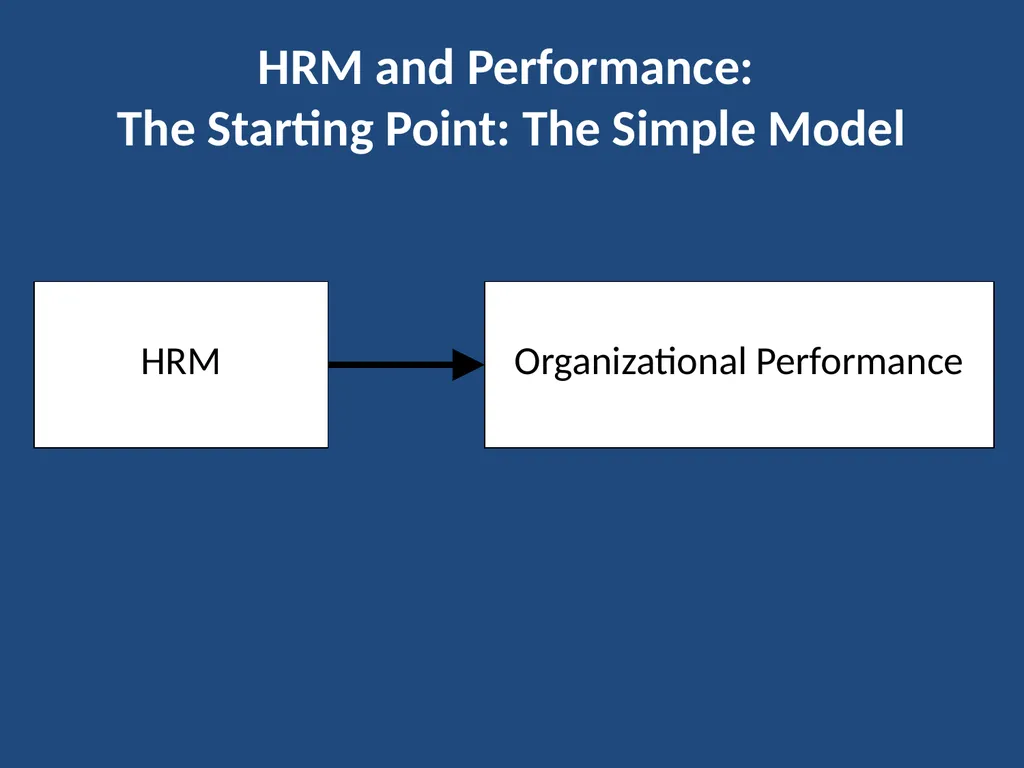
The Starting Point: The Simple Model HRM Organizational Performance<br>
43
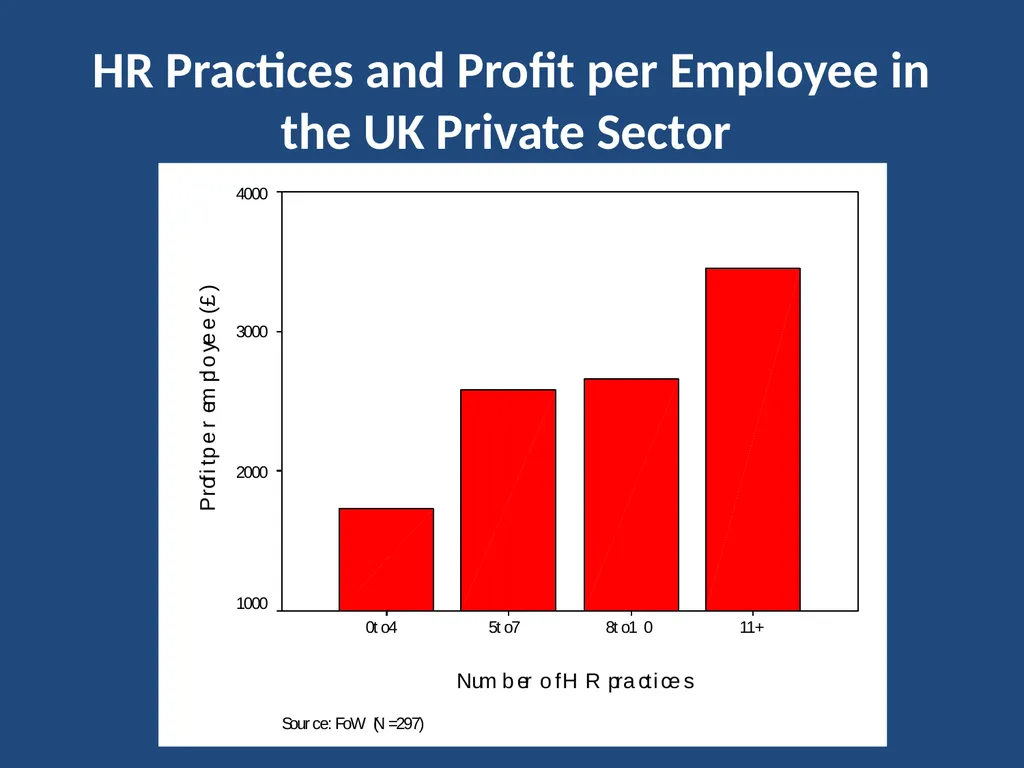
HR Practices and Profit per Employee in the UK Private Sector<br>
44
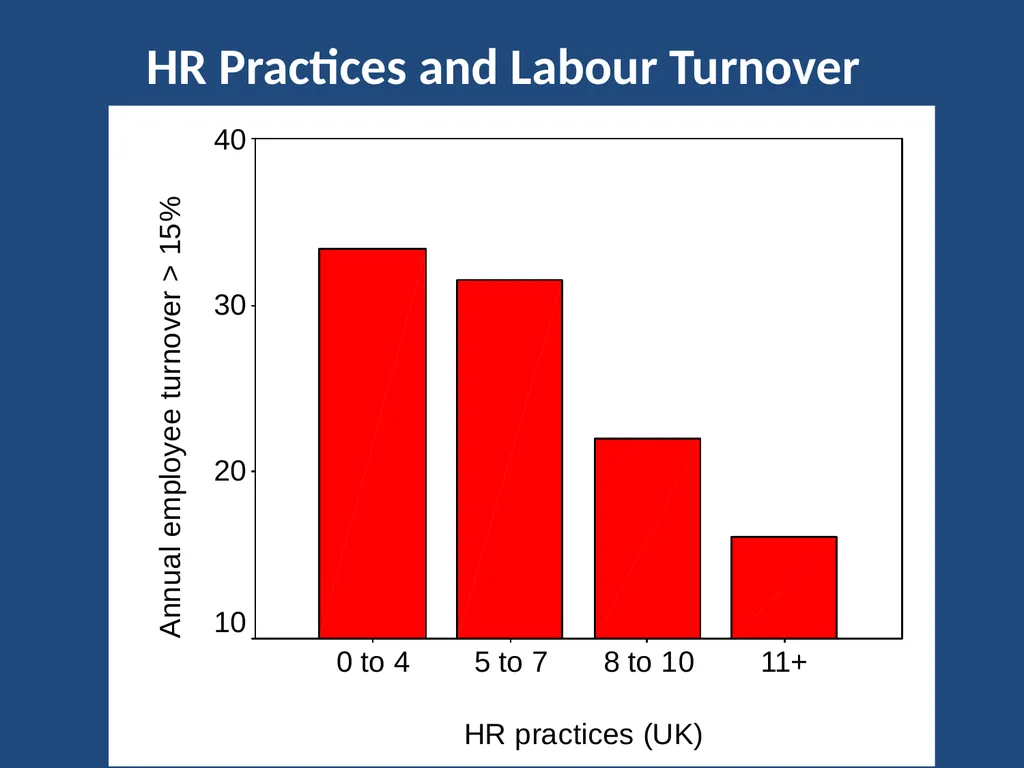
HR Practices and Labour Turnover<br>
45
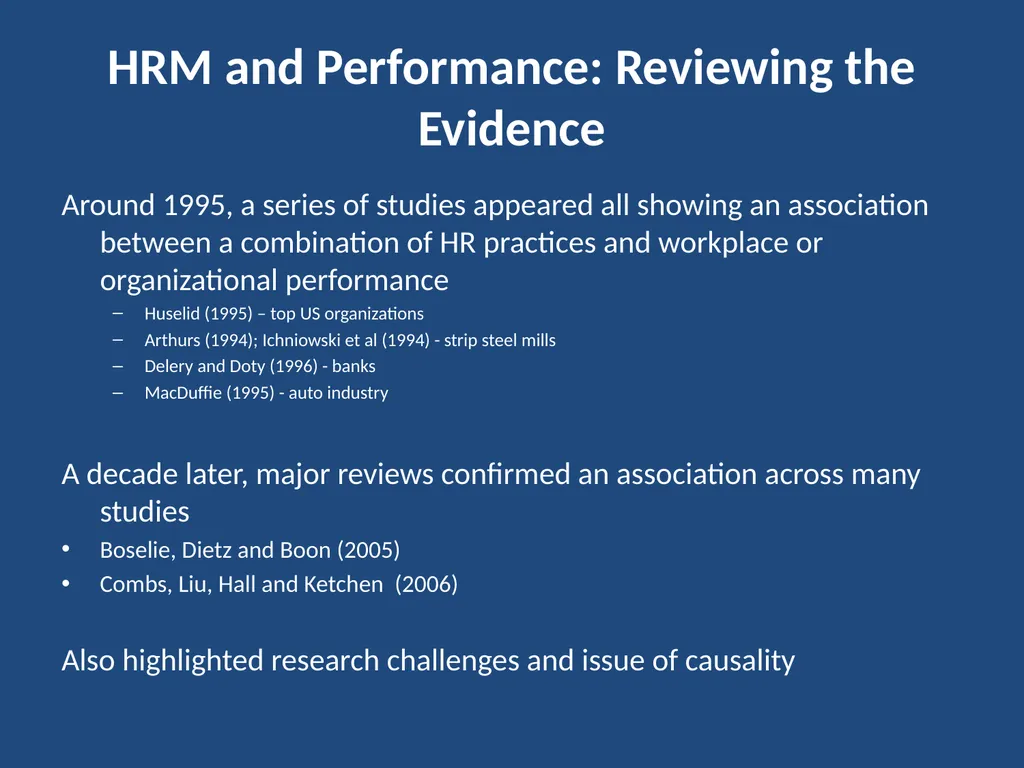
HRM and Performance: Reviewing the Evidence Around 1995, a series of studies appeared all showing an association between a combination of HR practices and workplace or organizational performance
Huselid (1995) – top US organizations
Arthurs (1994); Ichniowski et al (1994) - strip steel mills
Delery and Doty (1996) - banks
MacDuffie (1995) - auto industry
A decade later, major reviews confirmed an association across many studies
Boselie, Dietz and Boon (2005)
Combs, Liu, Hall and Ketchen (2006)
Also highlighted research challenges and issue of causality<br>
Huselid (1995) – top US organizations
Arthurs (1994); Ichniowski et al (1994) - strip steel mills
Delery and Doty (1996) - banks
MacDuffie (1995) - auto industry
A decade later, major reviews confirmed an association across many studies
Boselie, Dietz and Boon (2005)
Combs, Liu, Hall and Ketchen (2006)
Also highlighted research challenges and issue of causality<br>
46
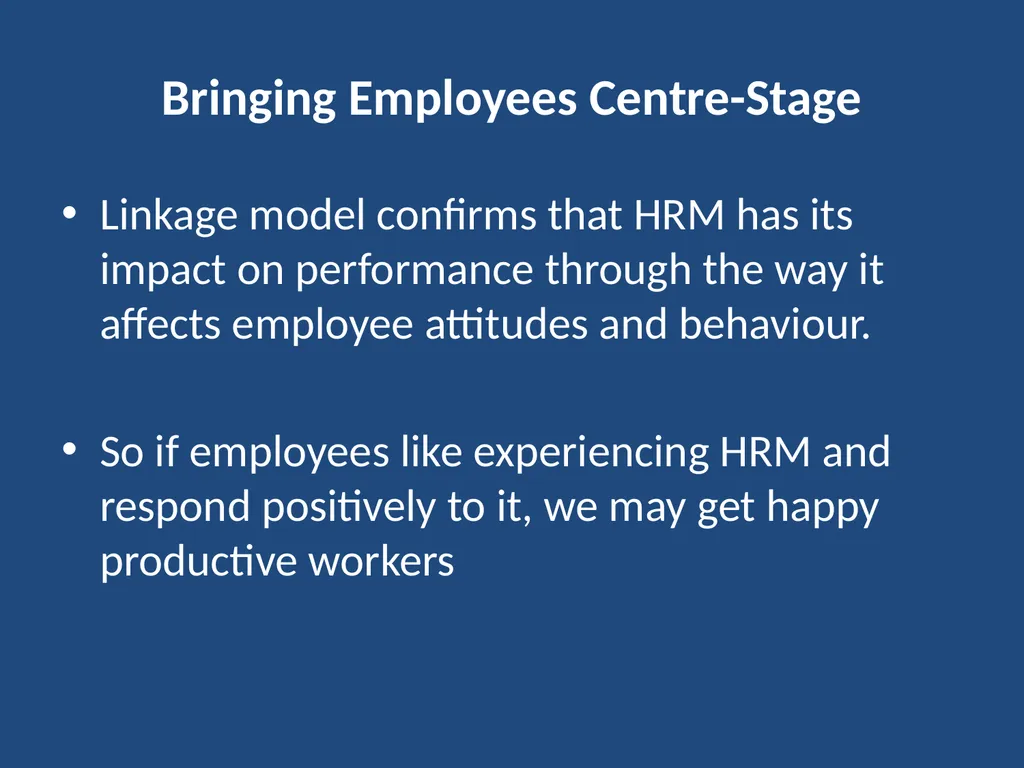
Bringing Employees Centre-Stage Linkage model confirms that HRM has its impact on performance through the way it affects employee attitudes and behaviour.
So if employees like experiencing HRM and respond positively to it, we may get happy productive workers<br>
So if employees like experiencing HRM and respond positively to it, we may get happy productive workers<br>
47
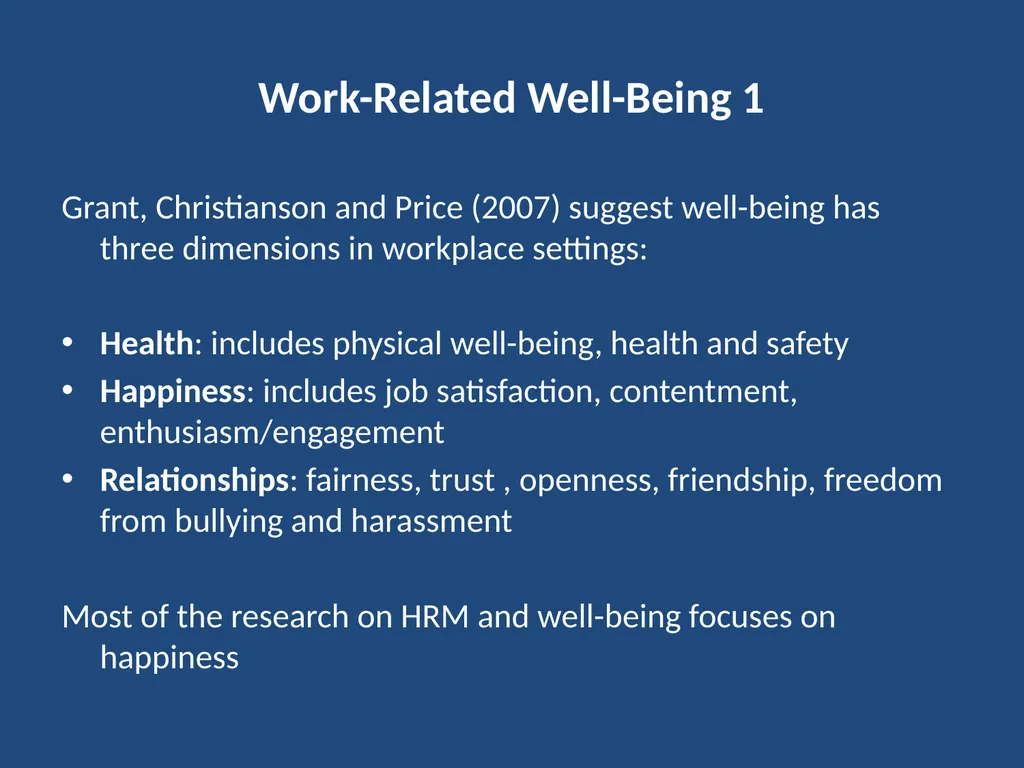
Work-Related Well-Being 1 Grant, Christianson and Price (2007) suggest well-being has three dimensions in workplace settings:
Health: includes physical well-being, health and safety
Happiness: includes job satisfaction, contentment, enthusiasm/engagement
Relationships: fairness, trust , openness, friendship, freedom from bullying and harassment
Most of the research on HRM and well-being focuses on happiness<br>
Health: includes physical well-being, health and safety
Happiness: includes job satisfaction, contentment, enthusiasm/engagement
Relationships: fairness, trust , openness, friendship, freedom from bullying and harassment
Most of the research on HRM and well-being focuses on happiness<br>
48
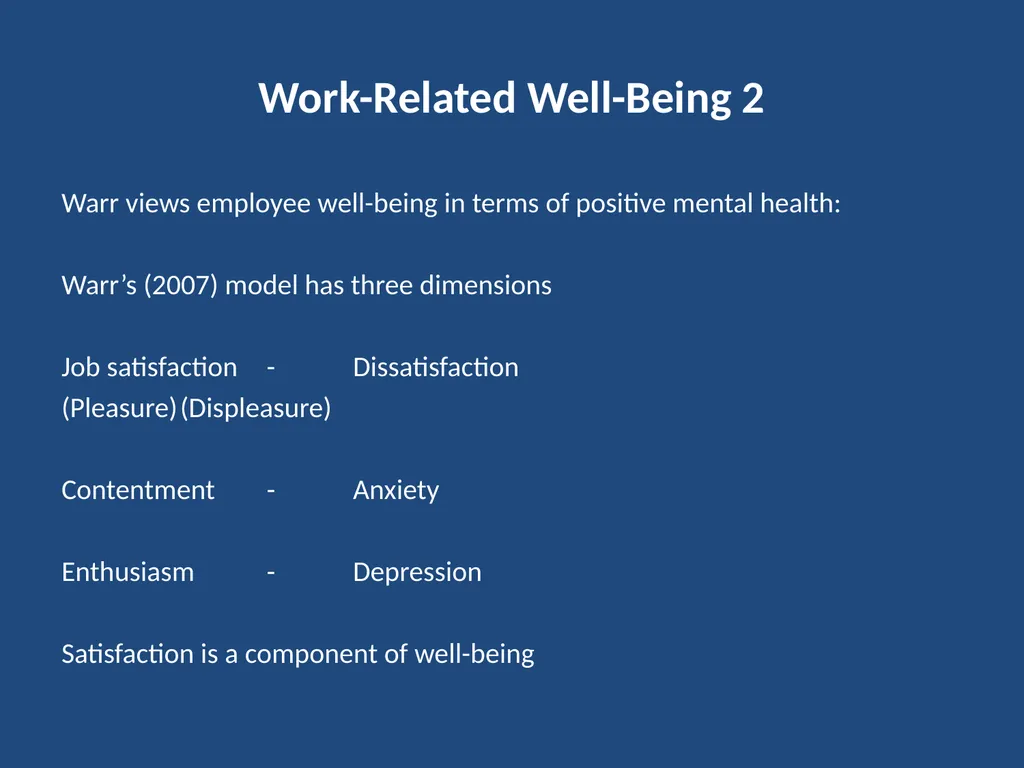
Work-Related Well-Being 2 Warr views employee well-being in terms of positive mental health:
Warr’s (2007) model has three dimensions
Job satisfaction - Dissatisfaction
(Pleasure) (Displeasure)
Contentment - Anxiety
Enthusiasm - Depression
Satisfaction is a component of well-being<br>
Warr’s (2007) model has three dimensions
Job satisfaction - Dissatisfaction
(Pleasure) (Displeasure)
Contentment - Anxiety
Enthusiasm - Depression
Satisfaction is a component of well-being<br>
49
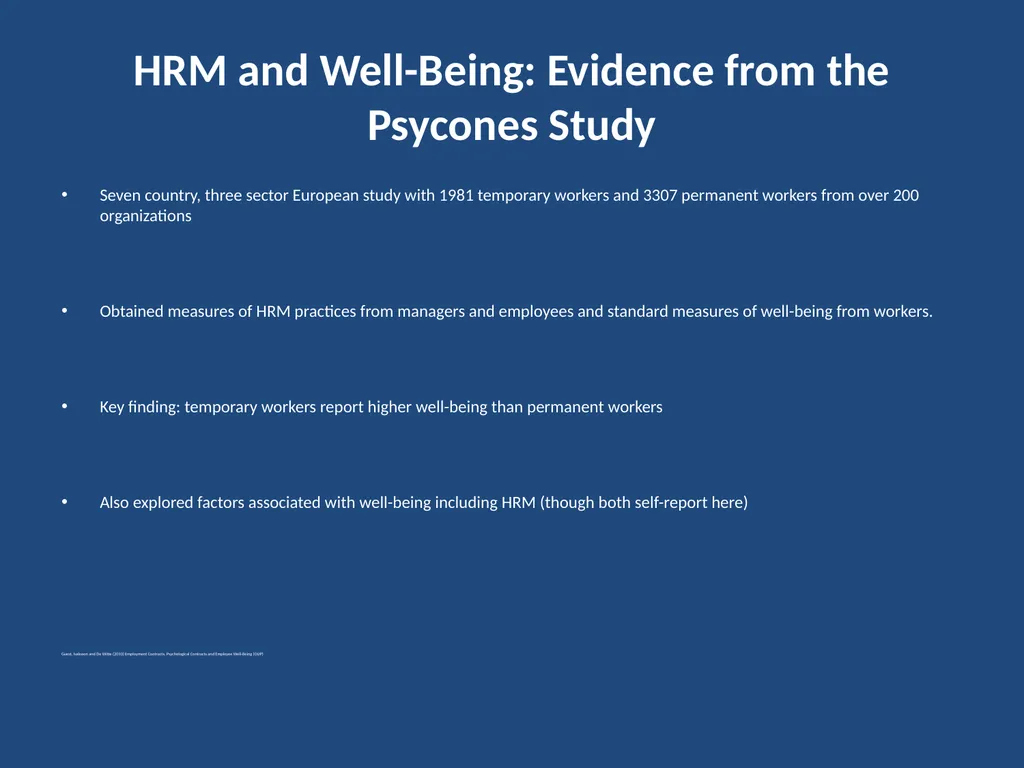
HRM and Well-Being: Evidence from the Psycones Study Seven country, three sector European study with 1981 temporary workers and 3307 permanent workers from over 200 organizations
Obtained measures of HRM practices from managers and employees and standard measures of well-being from workers.
Key finding: temporary workers report higher well-being than permanent workers
Also explored factors associated with well-being including HRM (though both self-report here)
Guest, Isaksson and De Witte (2010) Employment Contracts, Psychological Contracts and Employee Well-Being (OUP)<br>
Obtained measures of HRM practices from managers and employees and standard measures of well-being from workers.
Key finding: temporary workers report higher well-being than permanent workers
Also explored factors associated with well-being including HRM (though both self-report here)
Guest, Isaksson and De Witte (2010) Employment Contracts, Psychological Contracts and Employee Well-Being (OUP)<br>
50
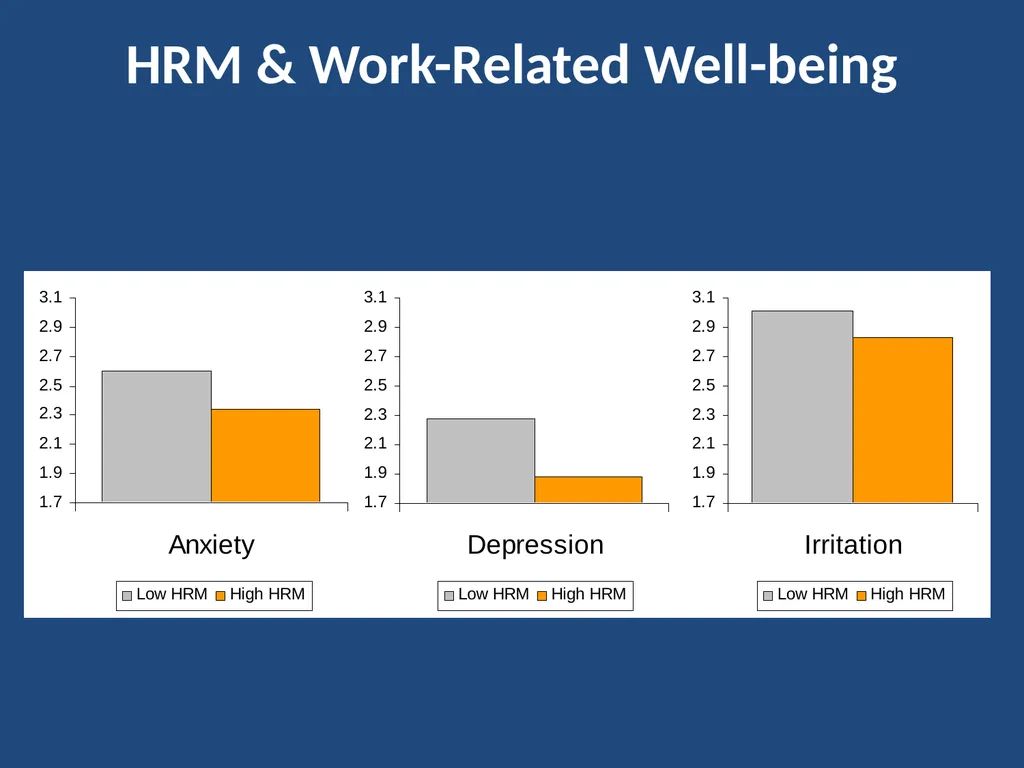
HRM & Work-Related Well-being<br>
51
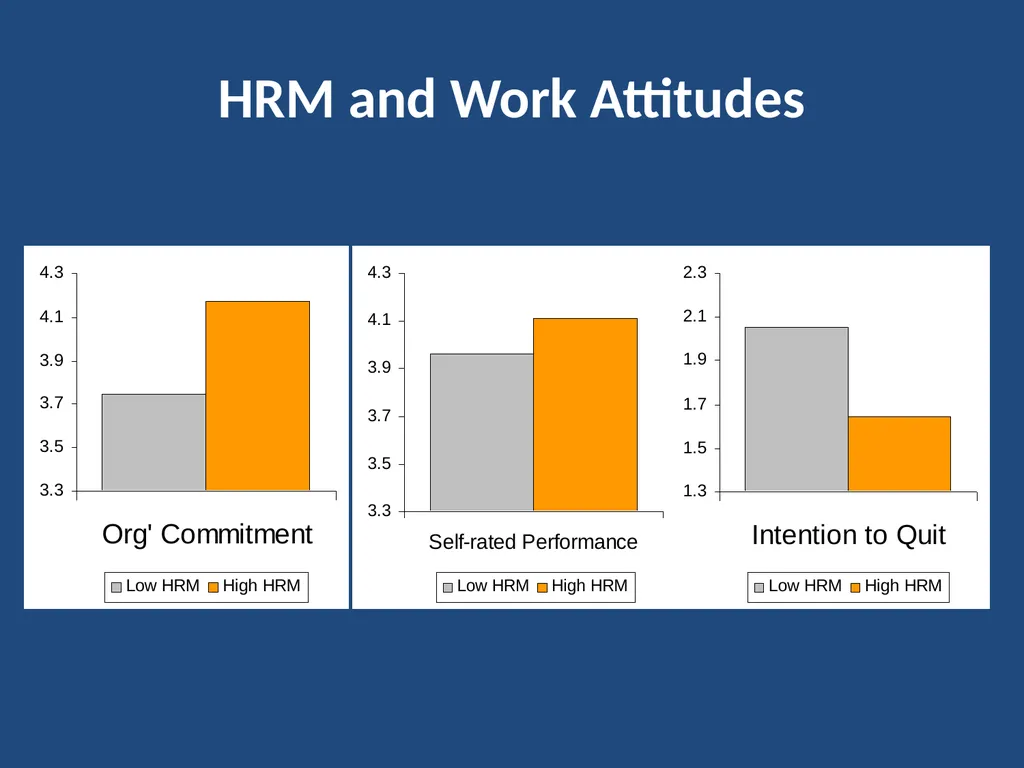
HRM and Work Attitudes<br>
52
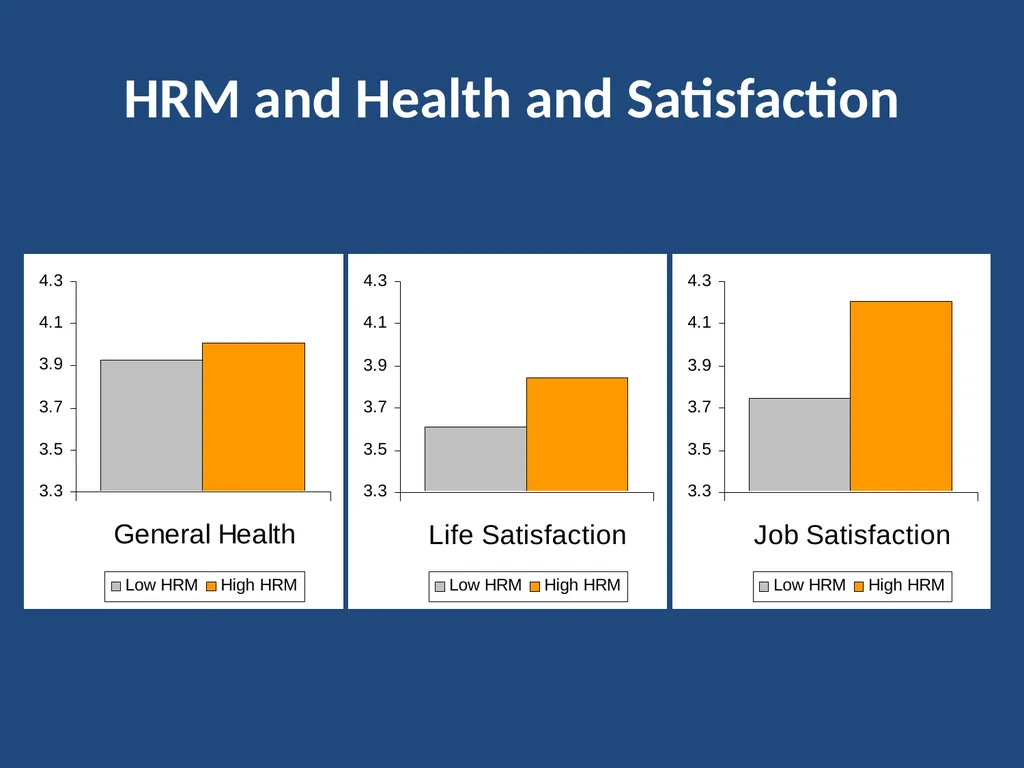
HRM and Health and Satisfaction<br>
53
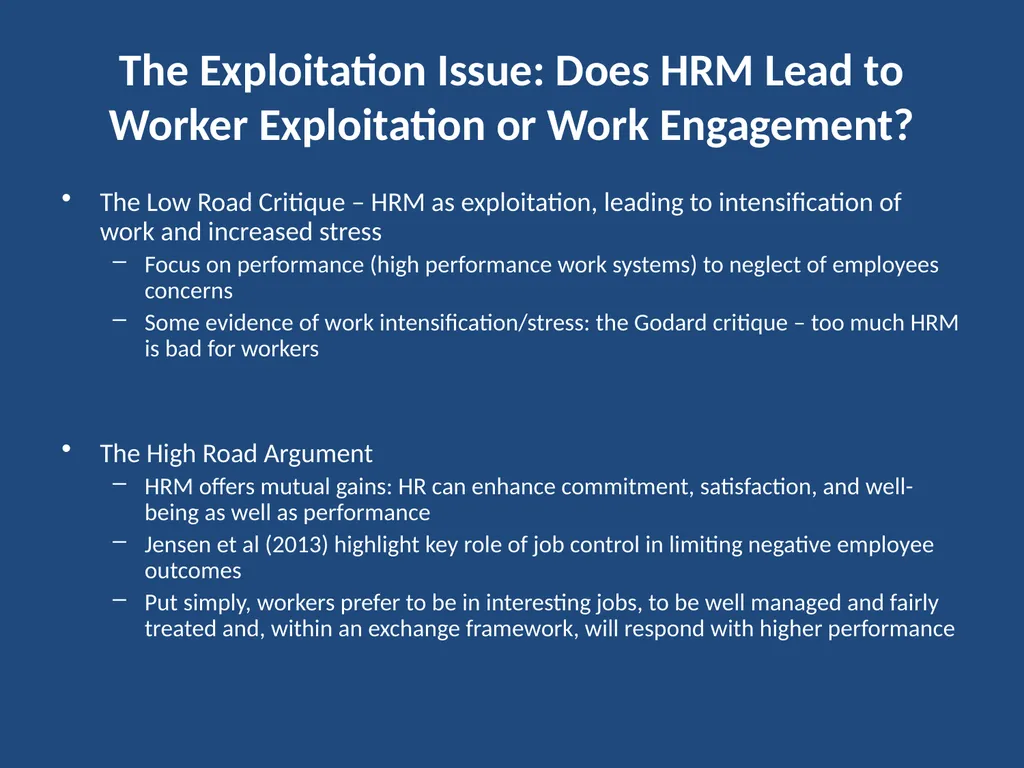
The Exploitation Issue: Does HRM Lead to Worker Exploitation or Work Engagement? The Low Road Critique – HRM as exploitation, leading to intensification of work and increased stress
Focus on performance (high performance work systems) to neglect of employees concerns
Some evidence of work intensification/stress: the Godard critique – too much HRM is bad for workers
The High Road Argument
HRM offers mutual gains: HR can enhance commitment, satisfaction, and well-being as well as performance
Jensen et al (2013) highlight key role of job control in limiting negative employee outcomes
Put simply, workers prefer to be in interesting jobs, to be well managed and fairly treated and, within an exchange framework, will respond with higher performance<br>
Focus on performance (high performance work systems) to neglect of employees concerns
Some evidence of work intensification/stress: the Godard critique – too much HRM is bad for workers
The High Road Argument
HRM offers mutual gains: HR can enhance commitment, satisfaction, and well-being as well as performance
Jensen et al (2013) highlight key role of job control in limiting negative employee outcomes
Put simply, workers prefer to be in interesting jobs, to be well managed and fairly treated and, within an exchange framework, will respond with higher performance<br>
54
HRM and Well-Being: The Wider Survey Evidence Few studies exploring HRM and both performance and well-being (due to bias for performance)
Review* exploring the ‘mutual gains’ hypothesis distinguished “happiness” (21 studies) from “health” (6 studies)
Most happiness studies report an association between HRM, satisfaction/commitment and performance.
Most studies of health show no clear association with HRM; two are negative, showing higher performance and higher stress
Reviews fail to distinguish ‘type’ of HRM
Responses depend on source of information about HRM; workers accounts show positive happiness and health outcomes
* Peccei, Van De Voorde and van Veldhoven* In Paauwe, Guest & Wright (2013): “HRM and Performance: Achievements and Challenges” (Wiley).<br>
Review* exploring the ‘mutual gains’ hypothesis distinguished “happiness” (21 studies) from “health” (6 studies)
Most happiness studies report an association between HRM, satisfaction/commitment and performance.
Most studies of health show no clear association with HRM; two are negative, showing higher performance and higher stress
Reviews fail to distinguish ‘type’ of HRM
Responses depend on source of information about HRM; workers accounts show positive happiness and health outcomes
* Peccei, Van De Voorde and van Veldhoven* In Paauwe, Guest & Wright (2013): “HRM and Performance: Achievements and Challenges” (Wiley).<br>
55
Mutual Gains or Exploitation: An Assessment The rationale for a mutual gains approach is that everyone wins and it is ethical. Counter is that it is costly
Offers a strong case for a stakeholder perspective
Much research ignores employees except as means to high performance. Reflects a USA vs. Europe (and Australia?) perspective
Case against mutual gains may be based on narrow view of HRM (HPWS)
Autonomy can be associated with stress through high involvement
Key question of causality remain unaddressed<br>
Offers a strong case for a stakeholder perspective
Much research ignores employees except as means to high performance. Reflects a USA vs. Europe (and Australia?) perspective
Case against mutual gains may be based on narrow view of HRM (HPWS)
Autonomy can be associated with stress through high involvement
Key question of causality remain unaddressed<br>
56
Summary: The Contemporary Research Agenda Start by celebrating progress
Avoid ‘complexification’ as reflected in ever more complex models, the call for often unrealistic multi-level longitudinal studies and use of ever more complex statistical analysis
Compare different HRM “systems”
Study origins of/changes in HRM – why they occur, who drives them and what their impact is
Study contingent factors in implementation and role of actors
Broaden outcomes to incorporate a stakeholder perspective
Adopt an ethical research perspective that focuses on ‘good’ HRM and mutual gains<br>
Avoid ‘complexification’ as reflected in ever more complex models, the call for often unrealistic multi-level longitudinal studies and use of ever more complex statistical analysis
Compare different HRM “systems”
Study origins of/changes in HRM – why they occur, who drives them and what their impact is
Study contingent factors in implementation and role of actors
Broaden outcomes to incorporate a stakeholder perspective
Adopt an ethical research perspective that focuses on ‘good’ HRM and mutual gains<br>
57
Thank you
For
Listening
david.guest@kcl.ac.uk<br>
For
Listening
david.guest@kcl.ac.uk<br>
58
Some References Boxall, P. & Macky, K. (2009). “Research and theory on high-performance work systems: progressing the high involvement stream”. Human Resource Management Journal, 19: 3-23.
Crook, T.R. et al (2011). “Does human capital matter? A meta-analysis of the relationship between human capital and firm performance”. Journal of Applied Psychology, 96: 443-56.
Godard, J. (2004). “A critical assessment of the high-performance paradigm”. British Journal of Industrial Relations, 42: 249-78.
Jensen, J. et al (2013). “High performance work systems and job control: Consequences for anxiety, role overload and turnover intentions”. Journal of Management, 39: 1699-1724.
Kaufman, B. (2012). “Strategic human resource management research in the United States: A failing grade after 30 years?” Academy of Management Perspectives, 26: 12-36.
Posthuma, R. et al (2013). “A high performance work practices taxonomy…” Journal of Management, 39: 1184-1220.<br>
Crook, T.R. et al (2011). “Does human capital matter? A meta-analysis of the relationship between human capital and firm performance”. Journal of Applied Psychology, 96: 443-56.
Godard, J. (2004). “A critical assessment of the high-performance paradigm”. British Journal of Industrial Relations, 42: 249-78.
Jensen, J. et al (2013). “High performance work systems and job control: Consequences for anxiety, role overload and turnover intentions”. Journal of Management, 39: 1699-1724.
Kaufman, B. (2012). “Strategic human resource management research in the United States: A failing grade after 30 years?” Academy of Management Perspectives, 26: 12-36.
Posthuma, R. et al (2013). “A high performance work practices taxonomy…” Journal of Management, 39: 1184-1220.<br>
59
More References Guest, D. (2011). “Human resource management and performance: Still searching for some answers”. Human Resource Management Journal, 21:3-13.
Guest, D. & Bos-Nehles, A. (2013). “HRM and performance: The role of effective implementation”. In Paauwe, J., Guest, D. & Wright, P. (eds). HRM and Performance: Achievements and Challenges. Wiley
Guest, D. & Bryson, A. (2009) “From industrial relations to human resource management: The changing role of the personnel function”. In Brown, W et al (eds). The Evolution of the Modern Workplace. Cambridge: CUP.
Guest, D. & Conway, N. (2011). “The impact of HR practices, HR effectiveness and a strong HR system on organizational outcomes: A stakeholder perspective”. International Journal of Human Resource Management, 22: 1686-1702.
Woodrow, C. & Guest, D. (2013 in press) “When good HR gets bad results”. Human Resource Management Journal.<br>
Guest, D. & Bos-Nehles, A. (2013). “HRM and performance: The role of effective implementation”. In Paauwe, J., Guest, D. & Wright, P. (eds). HRM and Performance: Achievements and Challenges. Wiley
Guest, D. & Bryson, A. (2009) “From industrial relations to human resource management: The changing role of the personnel function”. In Brown, W et al (eds). The Evolution of the Modern Workplace. Cambridge: CUP.
Guest, D. & Conway, N. (2011). “The impact of HR practices, HR effectiveness and a strong HR system on organizational outcomes: A stakeholder perspective”. International Journal of Human Resource Management, 22: 1686-1702.
Woodrow, C. & Guest, D. (2013 in press) “When good HR gets bad results”. Human Resource Management Journal.<br>