
Current Progress in computational metabolomics
CM
Published · 33 slides · 0 views
1 / 1


Description
Current Progress in computational metabolomics 2007 Briefings in Bioinformatics Presenters Alan Baer Sumana Kalyanasundaram Adam Fleming Introduction: Overview of metabolomics Introduction to computational metabolomics Metabolomics (i)
Related Topics
Share
Embed code
Download this presentation From Below
"Current Progress in computational metabolomics" is the property of its rightful owner. Permission is granted to download and print the materials on this website for personal, non-commercial use only, and to display it on your personal computer provided you do not modify the materials and that you retain all copyright notices contained in the materials. By downloading content from our website, you accept the terms of this agreement.
Presentation Transcript
01
Current Progress in computational metabolomics
2007 Briefings in Bioinformatics Presenters
Alan Baer
Sumana Kalyanasundaram
Adam Fleming<br>
Alan Baer
Sumana Kalyanasundaram
Adam Fleming<br>
02
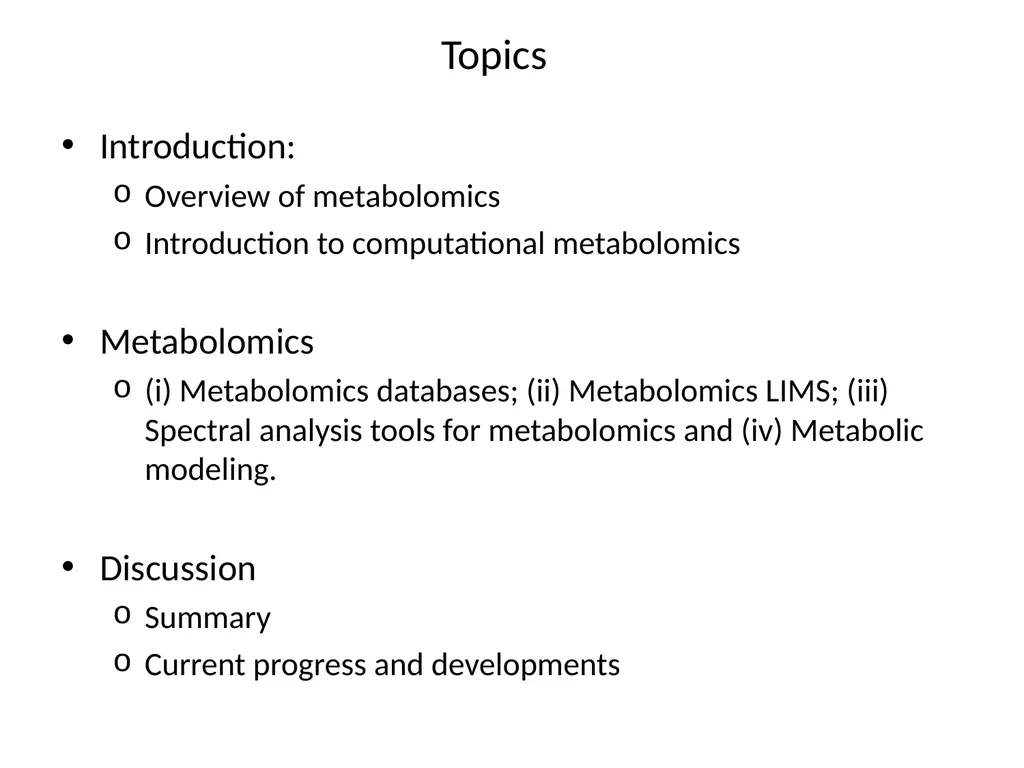
Introduction:
Overview of metabolomics
Introduction to computational metabolomics
Metabolomics
(i) Metabolomics databases; (ii) Metabolomics LIMS; (iii) Spectral analysis tools for metabolomics and (iv) Metabolic modeling.
Discussion
Summary
Current progress and developments Topics<br>
Overview of metabolomics
Introduction to computational metabolomics
Metabolomics
(i) Metabolomics databases; (ii) Metabolomics LIMS; (iii) Spectral analysis tools for metabolomics and (iv) Metabolic modeling.
Discussion
Summary
Current progress and developments Topics<br>
03
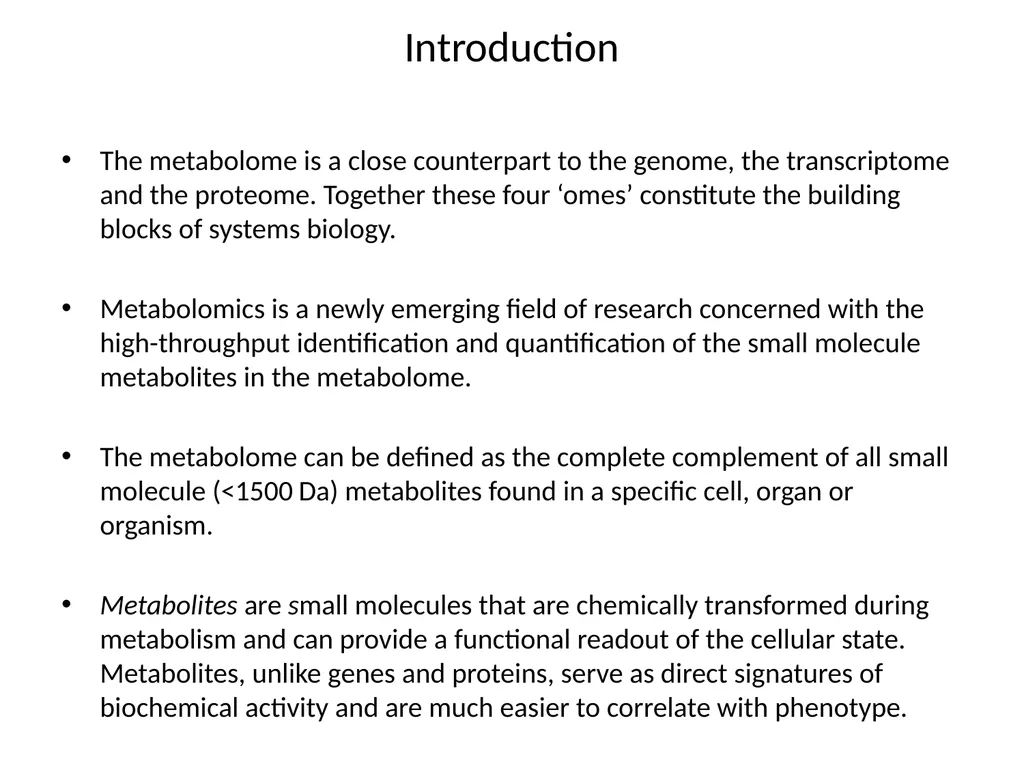
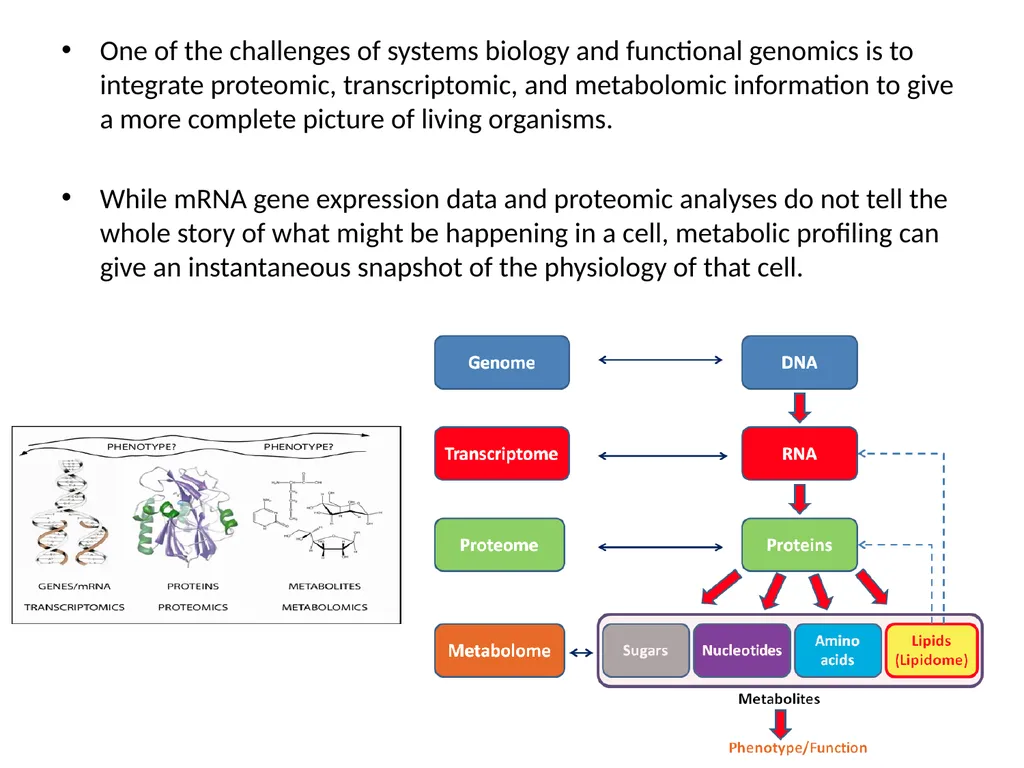
Introduction The metabolome is a close counterpart to the genome, the transcriptome and the proteome. Together these four ‘omes’ constitute the building blocks of systems biology.
Metabolomics is a newly emerging field of research concerned with the high-throughput identification and quantification of the small molecule metabolites in the metabolome.
The metabolome can be defined as the complete complement of all small molecule (<1500 Da) metabolites found in a specific cell, organ or organism.
Metabolites are small molecules that are chemically transformed during metabolism and can provide a functional readout of the cellular state. Metabolites, unlike genes and proteins, serve as direct signatures of biochemical activity and are much easier to correlate with phenotype.<br>
Metabolomics is a newly emerging field of research concerned with the high-throughput identification and quantification of the small molecule metabolites in the metabolome.
The metabolome can be defined as the complete complement of all small molecule (<1500 Da) metabolites found in a specific cell, organ or organism.
Metabolites are small molecules that are chemically transformed during metabolism and can provide a functional readout of the cellular state. Metabolites, unlike genes and proteins, serve as direct signatures of biochemical activity and are much easier to correlate with phenotype.<br>
04
One of the challenges of systems biology and functional genomics is to integrate proteomic, transcriptomic, and metabolomic information to give a more complete picture of living organisms.
While mRNA gene expression data and proteomic analyses do not tell the whole story of what might be happening in a cell, metabolic profiling can give an instantaneous snapshot of the physiology of that cell.<br>
While mRNA gene expression data and proteomic analyses do not tell the whole story of what might be happening in a cell, metabolic profiling can give an instantaneous snapshot of the physiology of that cell.<br>
05
Metabolomic Experimental Design Considerations
Targeted vs Untargeted Identifying the number and type of metabolites to be measured.
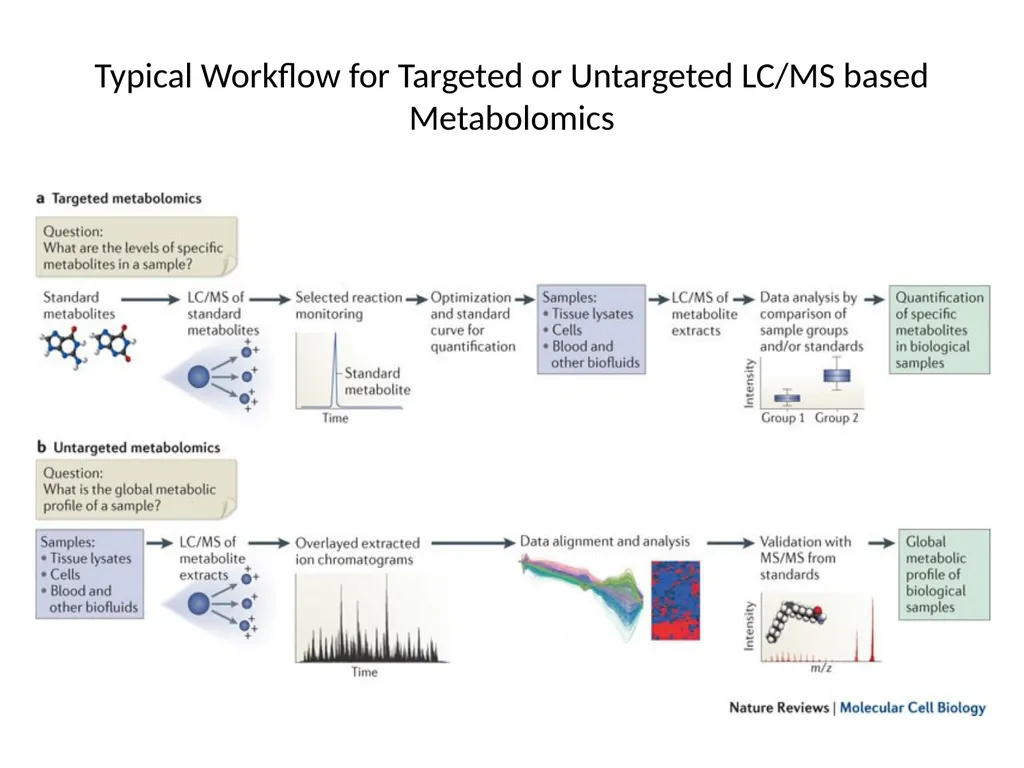
In targeted metabolomics, known metabolites for specific pathways are targeted. This approach typically used to answer specific biochemical questions in pharmokinetic studies of drug metabolism as well as for measuring the influence of theraputics or genetic modifications on a specific enzyme.
Untargeted metabolomics are global in scale and have the goal of simultaneously measuring as many metabolites as possible from biological samples without bias in order to generate a metabolic profile of a sample.<br>
In targeted metabolomics, known metabolites for specific pathways are targeted. This approach typically used to answer specific biochemical questions in pharmokinetic studies of drug metabolism as well as for measuring the influence of theraputics or genetic modifications on a specific enzyme.
Untargeted metabolomics are global in scale and have the goal of simultaneously measuring as many metabolites as possible from biological samples without bias in order to generate a metabolic profile of a sample.<br>
06
Typical Workflow for Targeted or Untargeted LC/MS based Metabolomics<br>
07
Comparisons and Challenges Specific to Metabolomics Whereas most data in the field of proteomics, genomics or transcriptomics is readily available and analyzed through electronic databases, most metabolomic data is still resident in books, journals and other paper archives.
Metabolomics differs from other ‘omics’ fields because of its strong emphasis on chemicals and analytical chemistry techniques such as (nuclear magnetic resonance) NMR, mass spectrometry MS and chromatographic separations LC, this along with the need for the de novo characterization of unknown metabolites through traditional means represents unique challenges.
Issues
Complex profiles: Differentiating metabolomic profiles from often heterogeneous tissue samples.
Multiple identifying peaks (m/z values) for the same metabolite.
Validation and identification of thousands of LC/MS identified metabolites with known reference standards via MS/MS.
Standardization of sample preparation and reads along with unifying data obtained from different instruments.
Sample collection bias.<br>
Metabolomics differs from other ‘omics’ fields because of its strong emphasis on chemicals and analytical chemistry techniques such as (nuclear magnetic resonance) NMR, mass spectrometry MS and chromatographic separations LC, this along with the need for the de novo characterization of unknown metabolites through traditional means represents unique challenges.
Issues
Complex profiles: Differentiating metabolomic profiles from often heterogeneous tissue samples.
Multiple identifying peaks (m/z values) for the same metabolite.
Validation and identification of thousands of LC/MS identified metabolites with known reference standards via MS/MS.
Standardization of sample preparation and reads along with unifying data obtained from different instruments.
Sample collection bias.<br>
08
Challenges
Metabolomics is not only concerned with the identification and quantification of metabolites, it is also concerned with relating metabolite data to biology and metabolism. As a result, metabolomics requires that whatever chemical information it generates must be linked to both biochemical causes and physiological consequences. This means that metabolomics must combine the two very different fields of informatics: bioinformatics and cheminformatics.
As a result, the analytical software used in metabolomics is fundamentally different from any of the software used in genomics, proteomics or transcriptomics.
As in all fields, metabolomics require electronically accessible and searchable databases, all of them require software to handle or process data from their own high-throughput instruments (DNA sequencers for genomics, microarrays for transcriptomics, mass spectra (MS) for proteomics), all of them require laboratory information management systems (LIMS) to manage their data, and all require software tools to predict or model properties, pathways, relationships and processes.<br>
Metabolomics is not only concerned with the identification and quantification of metabolites, it is also concerned with relating metabolite data to biology and metabolism. As a result, metabolomics requires that whatever chemical information it generates must be linked to both biochemical causes and physiological consequences. This means that metabolomics must combine the two very different fields of informatics: bioinformatics and cheminformatics.
As a result, the analytical software used in metabolomics is fundamentally different from any of the software used in genomics, proteomics or transcriptomics.
As in all fields, metabolomics require electronically accessible and searchable databases, all of them require software to handle or process data from their own high-throughput instruments (DNA sequencers for genomics, microarrays for transcriptomics, mass spectra (MS) for proteomics), all of them require laboratory information management systems (LIMS) to manage their data, and all require software tools to predict or model properties, pathways, relationships and processes.<br>
09
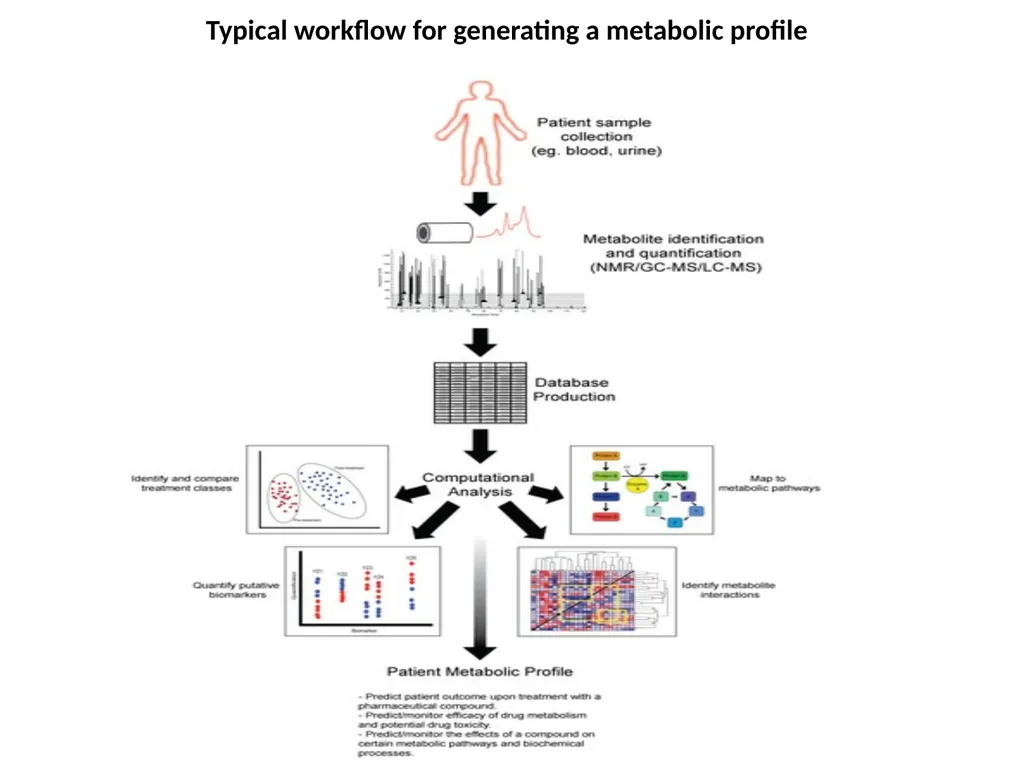
Typical workflow for generating a metabolic profile<br>
10
Metabolomic LIMS and Data Standards<br>
11
To make metabolomics fully integrated with omics the data has to be:
Managed
Stored
Standardized
Standardization efforts proved to be critical to the success and growing uniformity of many techniques in genomics, transcriptomics and proteomics
Achieving data standardization through the development, distribution and widespread use of mark-up languages (XML, CellML, SBML) and bio-ontologies<br>
Managed
Stored
Standardized
Standardization efforts proved to be critical to the success and growing uniformity of many techniques in genomics, transcriptomics and proteomics
Achieving data standardization through the development, distribution and widespread use of mark-up languages (XML, CellML, SBML) and bio-ontologies<br>
12
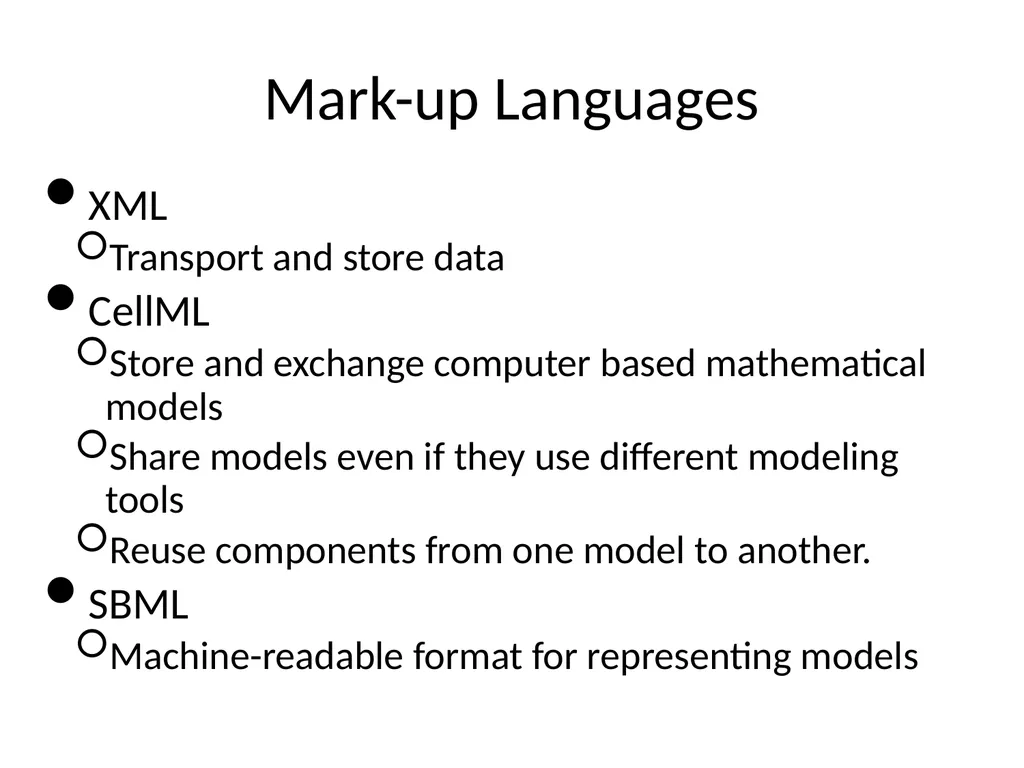
Mark-up Languages XML
Transport and store data
CellML
Store and exchange computer based mathematical models
Share models even if they use different modeling tools
Reuse components from one model to another.
SBML
Machine-readable format for representing models<br>
Transport and store data
CellML
Store and exchange computer based mathematical models
Share models even if they use different modeling tools
Reuse components from one model to another.
SBML
Machine-readable format for representing models<br>
13
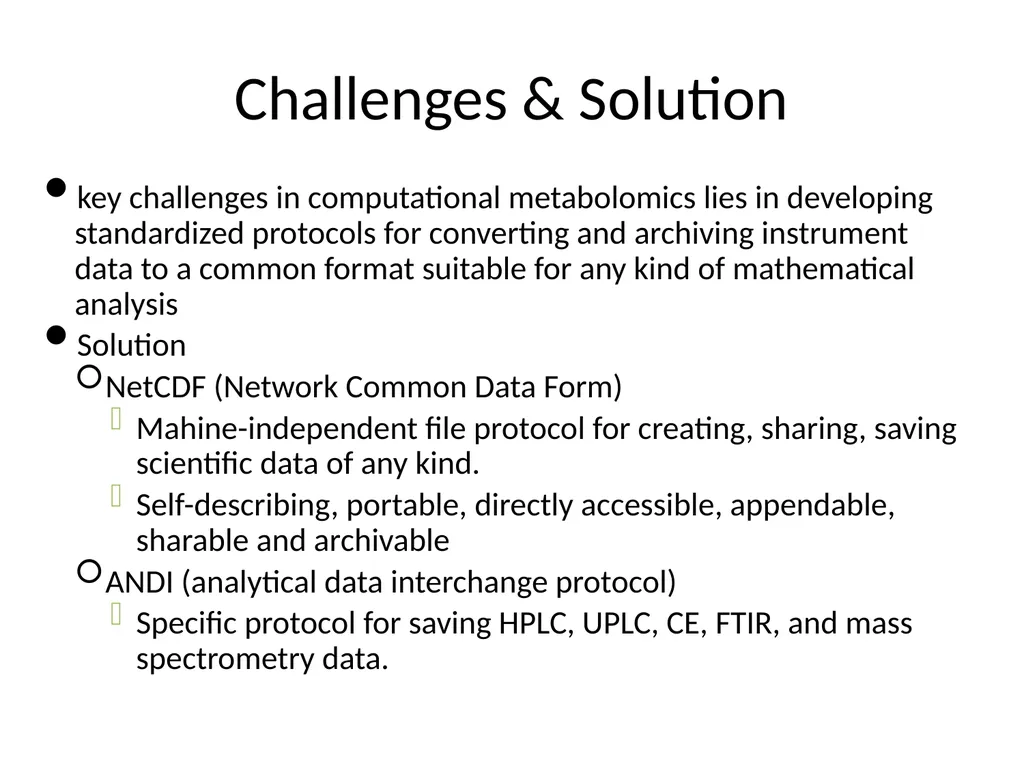
Challenges & Solution key challenges in computational metabolomics lies in developing standardized protocols for converting and archiving instrument data to a common format suitable for any kind of mathematical analysis
Solution
NetCDF (Network Common Data Form)
Mahine-independent file protocol for creating, sharing, saving scientific data of any kind.
Self-describing, portable, directly accessible, appendable, sharable and archivable
ANDI (analytical data interchange protocol)
Specific protocol for saving HPLC, UPLC, CE, FTIR, and mass spectrometry data.<br>
Solution
NetCDF (Network Common Data Form)
Mahine-independent file protocol for creating, sharing, saving scientific data of any kind.
Self-describing, portable, directly accessible, appendable, sharable and archivable
ANDI (analytical data interchange protocol)
Specific protocol for saving HPLC, UPLC, CE, FTIR, and mass spectrometry data.<br>
14
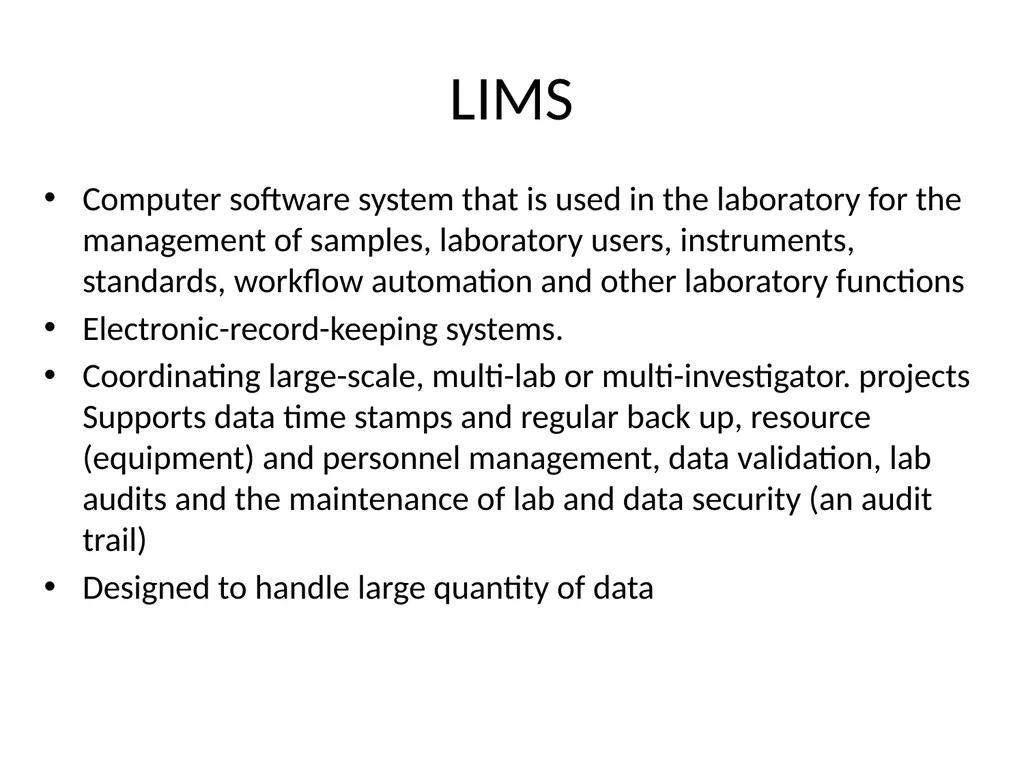
LIMS Computer software system that is used in the laboratory for the management of samples, laboratory users, instruments, standards, workflow automation and other laboratory functions
Electronic-record-keeping systems.
Coordinating large-scale, multi-lab or multi-investigator. projects Supports data time stamps and regular back up, resource (equipment) and personnel management, data validation, lab audits and the maintenance of lab and data security (an audit trail)
Designed to handle large quantity of data<br>
Electronic-record-keeping systems.
Coordinating large-scale, multi-lab or multi-investigator. projects Supports data time stamps and regular back up, resource (equipment) and personnel management, data validation, lab audits and the maintenance of lab and data security (an audit trail)
Designed to handle large quantity of data<br>
15
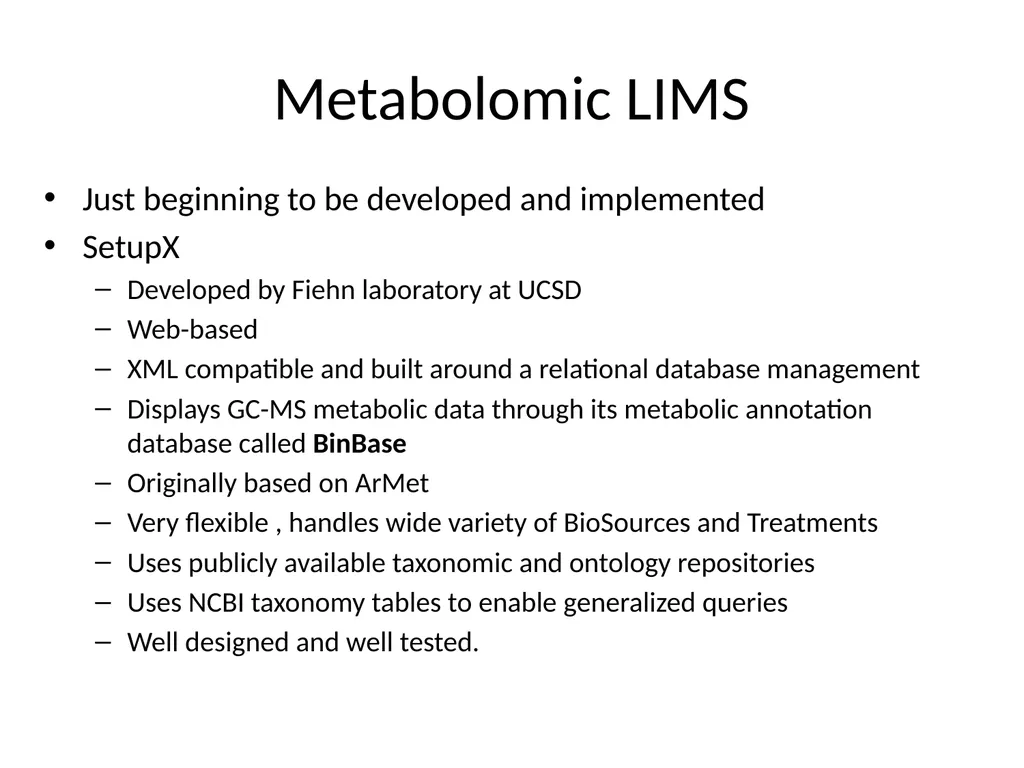
Metabolomic LIMS Just beginning to be developed and implemented
SetupX
Developed by Fiehn laboratory at UCSD
Web-based
XML compatible and built around a relational database management
Displays GC-MS metabolic data through its metabolic annotation database called BinBase
Originally based on ArMet
Very flexible , handles wide variety of BioSources and Treatments
Uses publicly available taxonomic and ontology repositories
Uses NCBI taxonomy tables to enable generalized queries
Well designed and well tested.<br>
SetupX
Developed by Fiehn laboratory at UCSD
Web-based
XML compatible and built around a relational database management
Displays GC-MS metabolic data through its metabolic annotation database called BinBase
Originally based on ArMet
Very flexible , handles wide variety of BioSources and Treatments
Uses publicly available taxonomic and ontology repositories
Uses NCBI taxonomy tables to enable generalized queries
Well designed and well tested.<br>
16
Metabolomic LIMS Sesame
Web-based, platform-independent metabolomic LIMS
RDMS (SQL and JAVA)
NMR-based structural genomics studies
Tools to facilitate collaborative analysis, access and visualization of data
Sample tracking and bar coding , SOP or procedures
‘Lamp’ for metabolomics- Arabadopsis using NMR
Flexible and adaptable to other biological systems
Has several ‘Views’- components found in metabolomic experiments
Facilitates data capture, editing , process analysis, retrieval and report generation<br>
Web-based, platform-independent metabolomic LIMS
RDMS (SQL and JAVA)
NMR-based structural genomics studies
Tools to facilitate collaborative analysis, access and visualization of data
Sample tracking and bar coding , SOP or procedures
‘Lamp’ for metabolomics- Arabadopsis using NMR
Flexible and adaptable to other biological systems
Has several ‘Views’- components found in metabolomic experiments
Facilitates data capture, editing , process analysis, retrieval and report generation<br>
17
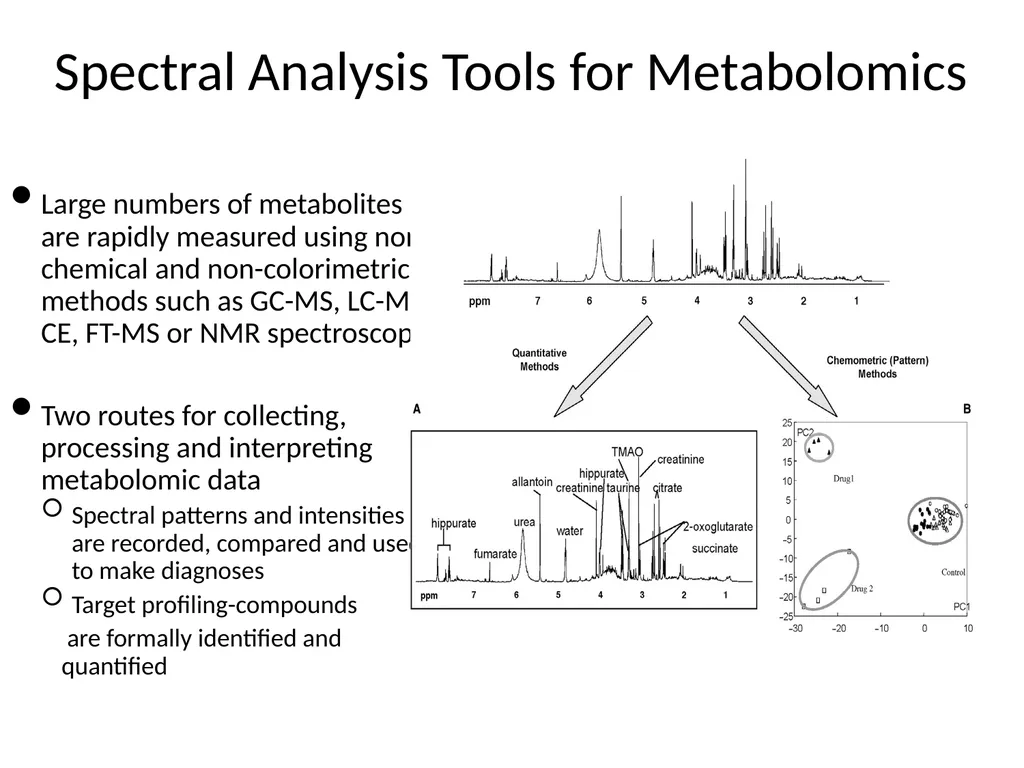
Spectral Analysis Tools for Metabolomics Large numbers of metabolites are rapidly measured using non-chemical and non-colorimetric methods such as GC-MS, LC-Ms, CE, FT-MS or NMR spectroscopy
Two routes for collecting, processing and interpreting metabolomic data
Spectral patterns and intensities are recorded, compared and used to make diagnoses
Target profiling-compounds
are formally identified and quantified<br>
Two routes for collecting, processing and interpreting metabolomic data
Spectral patterns and intensities are recorded, compared and used to make diagnoses
Target profiling-compounds
are formally identified and quantified<br>
18
Chemometrics and metabolomic data Application of mathematical, statistical, graphical or symbolic methods to maximize information that can be extracted from chemical or spectral data.
Extract useful info from complex spectra
Identifies statistically significant differences between large groups of spectra.
Uses divide and conquer approach using binned spectrum<br>
Extract useful info from complex spectra
Identifies statistically significant differences between large groups of spectra.
Uses divide and conquer approach using binned spectrum<br>
19
Principal Component Analysis(PCA) Data reduction technique- optimal linear transformation for a collection of data points
Difference between two samples
Quantifies the amount of useful info or signal in the data
Sensitive to experimental noise
Higher order arrays using PARAFAC (parallel factor analysis)
Other techniques SIMAC, PLS-DA, k-means clustering.<br>
Difference between two samples
Quantifies the amount of useful info or signal in the data
Sensitive to experimental noise
Higher order arrays using PARAFAC (parallel factor analysis)
Other techniques SIMAC, PLS-DA, k-means clustering.<br>
20
SIMCA Soft independent modeling of class analogy
Maps data onto lower dimensional subspace
Uses cross validation or training to perform classification
Sensitive to quality of the data
Examples: classify teas, different types of whiskeys, metabolic phenotyping of nude and normal mice using NMR.<br>
Maps data onto lower dimensional subspace
Uses cross validation or training to perform classification
Sensitive to quality of the data
Examples: classify teas, different types of whiskeys, metabolic phenotyping of nude and normal mice using NMR.<br>
21
PLS-DA Information about class identities has to be provided by the user.
Sharpens the separation between groups by rotating PCA components.
Regression or categorical extension of PCA in attempt to maximize the separation.
In combination with infrared spectroscopy is used to classify geographic location of wines, to look at gender differences in urinary glucuronides via MS-TOF studies, and to identify biomarkers in cerebrospinal fluid via SELDI-MS<br>
Sharpens the separation between groups by rotating PCA components.
Regression or categorical extension of PCA in attempt to maximize the separation.
In combination with infrared spectroscopy is used to classify geographic location of wines, to look at gender differences in urinary glucuronides via MS-TOF studies, and to identify biomarkers in cerebrospinal fluid via SELDI-MS<br>
22
TARGETED METABOLIC PROFILING The compounds in biofluid or tissue extract is identified and quantifies by comparing the biofluid spectrum to a library of reference spectra of pure compound.
Spectra from biofluid is sum of all the individual spectra
Use of NMR-curve fitting software and special database
Most metabolites have unique chemical shift fingerprints that helps reduce redundancy.
It is not restricted to NMR or GC-MS.
MS fingerprint library determined from a triple-quad instrument
LC-MS requires soiking with isotopically labeled derivatives<br>
Spectra from biofluid is sum of all the individual spectra
Use of NMR-curve fitting software and special database
Most metabolites have unique chemical shift fingerprints that helps reduce redundancy.
It is not restricted to NMR or GC-MS.
MS fingerprint library determined from a triple-quad instrument
LC-MS requires soiking with isotopically labeled derivatives<br>
23
Advantage:
Does not require collection of identical data so more amenable to human studies
Large range of statistical and machine learning approach like artificial neural networks(ANNs), support vector machines(SVMs) and Decision Trees(DTs)
ANNs: used to identify action of herbicides on plant biochemical pathways.
Disadvantage
Limited size of current spectral libraries<br>
Does not require collection of identical data so more amenable to human studies
Large range of statistical and machine learning approach like artificial neural networks(ANNs), support vector machines(SVMs) and Decision Trees(DTs)
ANNs: used to identify action of herbicides on plant biochemical pathways.
Disadvantage
Limited size of current spectral libraries<br>
24
Metabolic Modeling Necessity for connecting metabolic data with biological causes
Metabolic models traditionally done by solving ordinary differential equations (ODEs)
These describe the chemical reactions and the system of interest
Many metabolic models exist to do this
GEPASI, CellDesigner, SCAMP, and Cellerator<br>
Metabolic models traditionally done by solving ordinary differential equations (ODEs)
These describe the chemical reactions and the system of interest
Many metabolic models exist to do this
GEPASI, CellDesigner, SCAMP, and Cellerator<br>
25
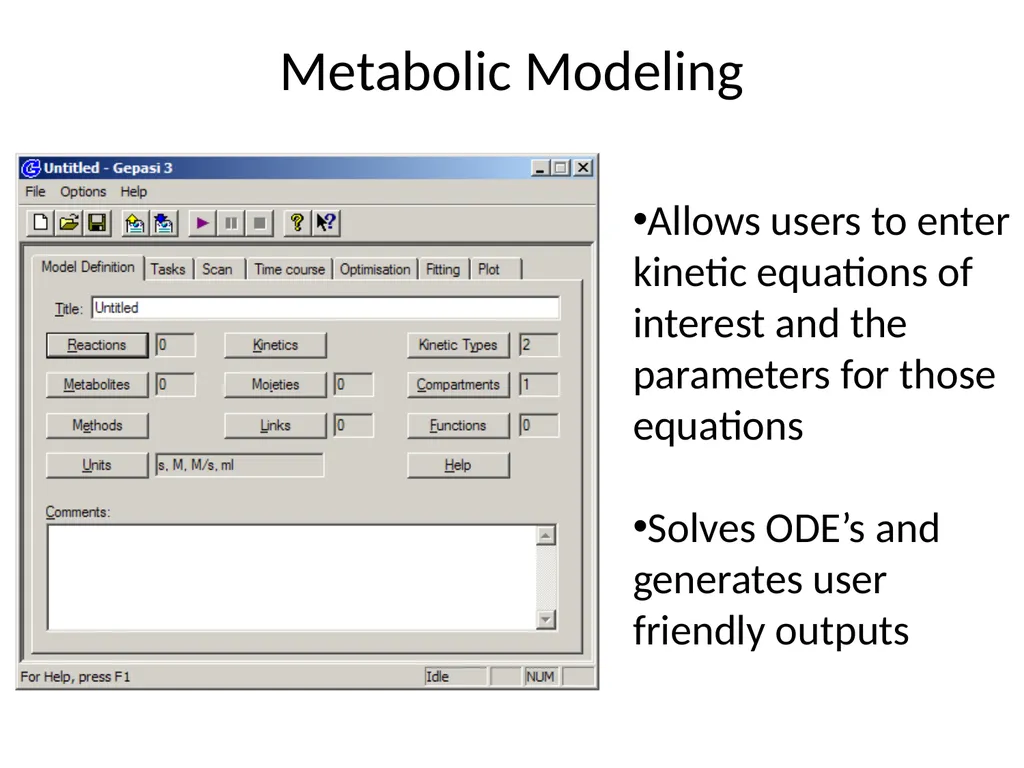
Allows users to enter kinetic equations of interest and the parameters for those equations
Solves ODE’s and generates user friendly outputs Metabolic Modeling<br>
Solves ODE’s and generates user friendly outputs Metabolic Modeling<br>
26
Metabolic Modeling Alternatively constraint-based modeling can be used
Uses physiochemical constraints (mass balance, energy balance, or flux limitations) to describe a large system
Time and rate constraints can be ignored in these models, interested in steady state conditions that meet physiochemical criteria
Useful for large-scale studies
Flux-based analysis (FBA) commonly used for this<br>
Uses physiochemical constraints (mass balance, energy balance, or flux limitations) to describe a large system
Time and rate constraints can be ignored in these models, interested in steady state conditions that meet physiochemical criteria
Useful for large-scale studies
Flux-based analysis (FBA) commonly used for this<br>
27
Metabolic Analysis FBA requires knowledge of stoichiometry of reactions involved
These sets of reaction are used to define the metabolic network
Assumes steady state will be reached constrained by stoichiometry of reactions
Normally not enough stoichiometric constraints
Addition of information of all feasible metabolite fluxes and specific min/max fluxes for each reaction
FBA can further be refined by using experimental data<br>
These sets of reaction are used to define the metabolic network
Assumes steady state will be reached constrained by stoichiometry of reactions
Normally not enough stoichiometric constraints
Addition of information of all feasible metabolite fluxes and specific min/max fluxes for each reaction
FBA can further be refined by using experimental data<br>
28
Metabolic Analysis Once the model is optimized using the stoichiometric constraints it can be used to generate predictive models of cellular metabolism
Mass balance is key to FBA model success
Flux of metabolites through each reaction and stoichiometry of that reaction
FBA’s have been used in a variety of metabolomic studies, and have been used in genome scale modeling of many bacterial systems
Lactococcus lactis, Helicobacter pylori, Escherichia coli, etc.<br>
Mass balance is key to FBA model success
Flux of metabolites through each reaction and stoichiometry of that reaction
FBA’s have been used in a variety of metabolomic studies, and have been used in genome scale modeling of many bacterial systems
Lactococcus lactis, Helicobacter pylori, Escherichia coli, etc.<br>
29
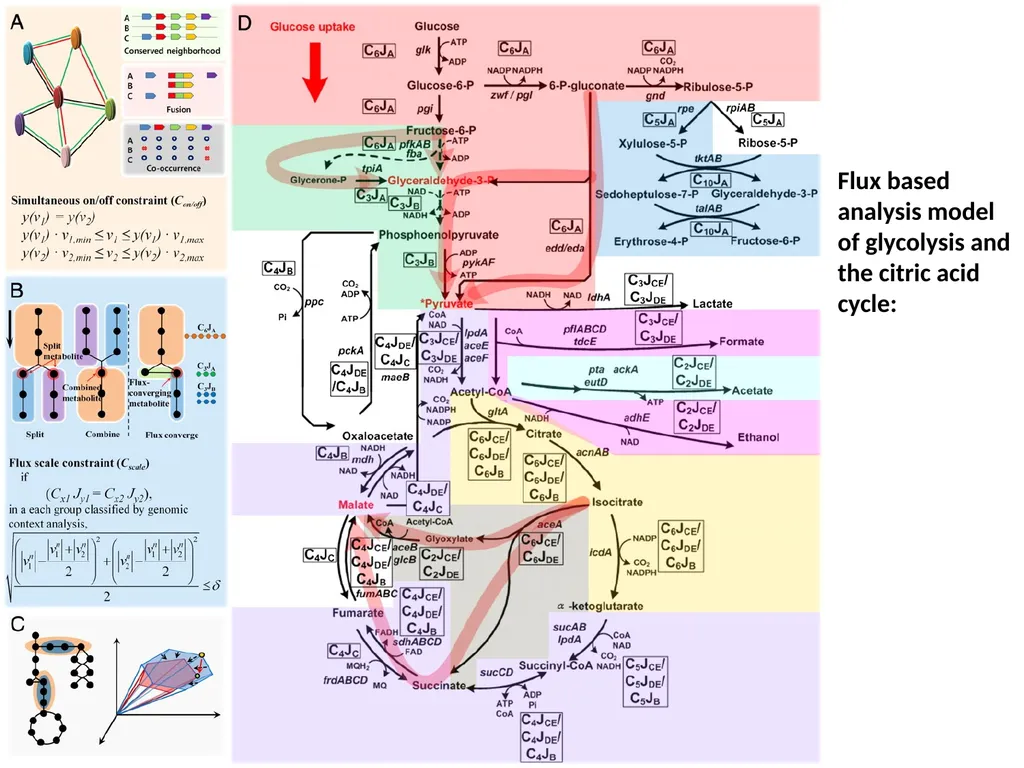
Flux based analysis model of glycolysis and the citric acid cycle:<br>
30
Conclusions Computational metabolomics will integrate more and more with systems biology
Focus on quantitative with a focus on temporal and spatial data
Trend towards rapid/high throughput identification and quantification
Rise of organism specific metabolite databases
Just as with genome and proteome databases
Basically follow in the footsteps of genomics and proteomics<br>
Focus on quantitative with a focus on temporal and spatial data
Trend towards rapid/high throughput identification and quantification
Rise of organism specific metabolite databases
Just as with genome and proteome databases
Basically follow in the footsteps of genomics and proteomics<br>
31
New Developments Rise of species specific metabolite data bases as predicted
ECMDB: E. coli metabolome database
YMDB: Yeast metabolome database
HMDB: Human metabolome database
Increased application of new techniques to oncology and disease profiling
Cancer metabolite profiling already exists<br>
ECMDB: E. coli metabolome database
YMDB: Yeast metabolome database
HMDB: Human metabolome database
Increased application of new techniques to oncology and disease profiling
Cancer metabolite profiling already exists<br>
32
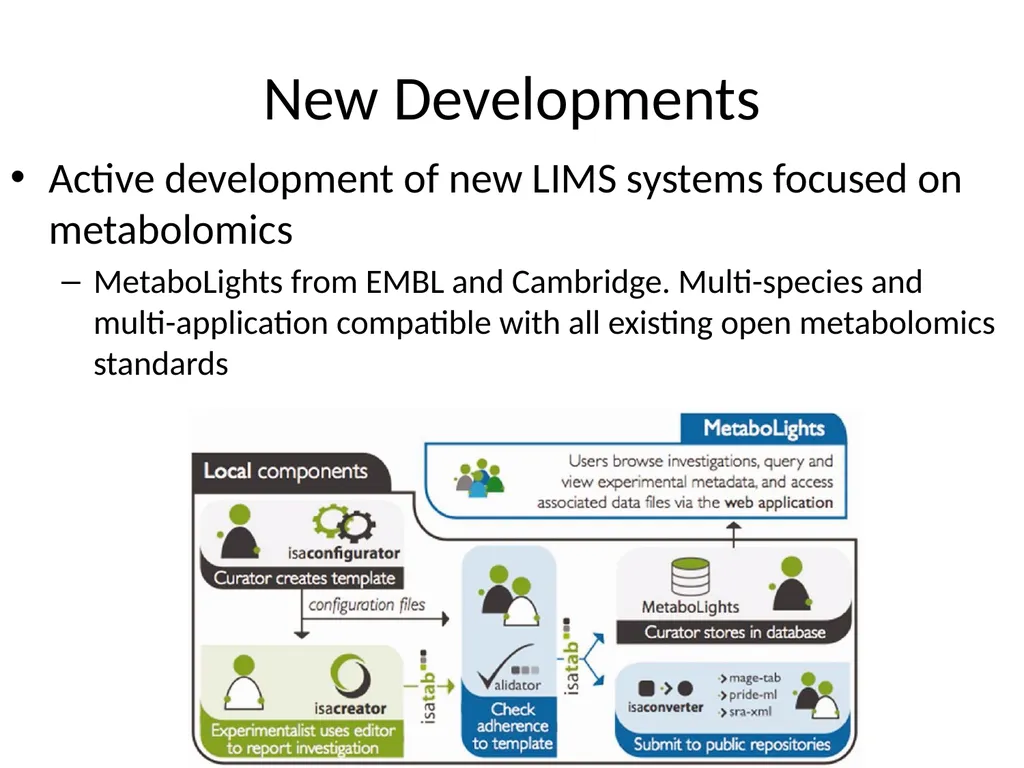
New Developments Active development of new LIMS systems focused on metabolomics
MetaboLights from EMBL and Cambridge. Multi-species and multi-application compatible with all existing open metabolomics standards<br>
MetaboLights from EMBL and Cambridge. Multi-species and multi-application compatible with all existing open metabolomics standards<br>
33
Questions?<br>