
Curriculum Adaptions Ordinarily Available
Description: Curriculum Adaptions Ordinarily Available provision for learners includes: Engaging in a TRUE Classroom environment Access to a robust curriculum meticulously crafted by subject leaders to be inclusive, meaningful, and imbued with challenge
Related Topics
Download Presentation
"Curriculum Adaptions Ordinarily Available" is the property of its rightful owner. Permission is granted to download and print the materials on this website for personal, non-commercial use only, and to display it on your personal computer provided you do not modify the materials and that you retain all copyright notices contained in the materials. By downloading content from our website, you accept the terms of this agreement.
Presentation Transcript
slide1. Curriculum Adaptions<br>
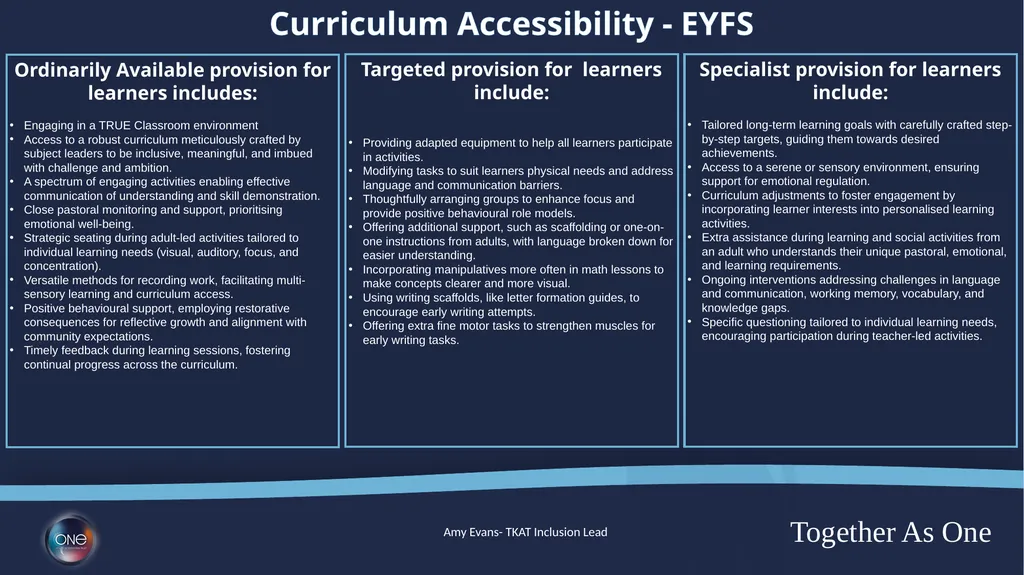
slide2. Ordinarily Available provision for learners includes:
Engaging in a TRUE Classroom environment
Access to a robust curriculum meticulously crafted by subject leaders to be inclusive, meaningful, and imbued with challenge and ambition.
A spectrum of engaging activities enabling effective communication of understanding and skill demonstration.
Close pastoral monitoring and support, prioritising emotional well-being.
Strategic seating during adult-led activities tailored to individual learning needs (visual, auditory, focus, and concentration).
Versatile methods for recording work, facilitating multi-sensory learning and curriculum access.
Positive behavioural support, employing restorative consequences for reflective growth and alignment with community expectations.
Timely feedback during learning sessions, fostering continual progress across the curriculum. Targeted provision for learners include:
Providing adapted equipment to help all learners participate in activities.
Modifying tasks to suit learners physical needs and address language and communication barriers.
Thoughtfully arranging groups to enhance focus and provide positive behavioural role models.
Offering additional support, such as scaffolding or one-on-one instructions from adults, with language broken down for easier understanding.
Incorporating manipulatives more often in math lessons to make concepts clearer and more visual.
Using writing scaffolds, like letter formation guides, to encourage early writing attempts.
Offering extra fine motor tasks to strengthen muscles for early writing tasks. Specialist provision for learners include:
Tailored long-term learning goals with carefully crafted step-by-step targets, guiding them towards desired achievements.
Access to a serene or sensory environment, ensuring support for emotional regulation.
Curriculum adjustments to foster engagement by incorporating learner interests into personalised learning activities.
Extra assistance during learning and social activities from an adult who understands their unique pastoral, emotional, and learning requirements.
Ongoing interventions addressing challenges in language and communication, working memory, vocabulary, and knowledge gaps.
Specific questioning tailored to individual learning needs, encouraging participation during teacher-led activities. Curriculum Accessibility - EYFS<br>
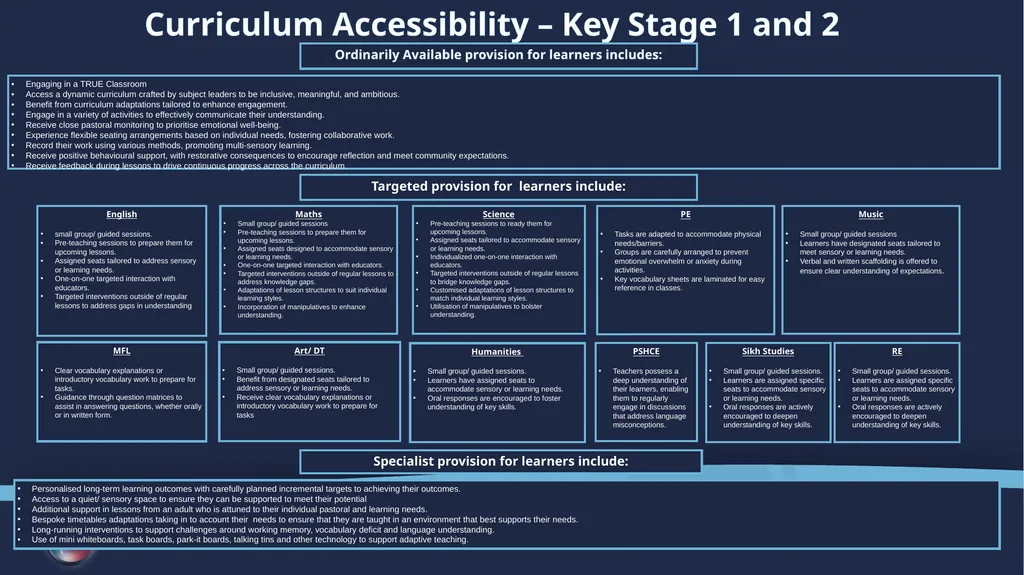
slide3. Engaging in a TRUE Classroom
Access a dynamic curriculum crafted by subject leaders to be inclusive, meaningful, and ambitious.
Benefit from curriculum adaptations tailored to enhance engagement.
Engage in a variety of activities to effectively communicate their understanding.
Receive close pastoral monitoring to prioritise emotional well-being.
Experience flexible seating arrangements based on individual needs, fostering collaborative work.
Record their work using various methods, promoting multi-sensory learning.
Receive positive behavioural support, with restorative consequences to encourage reflection and meet community expectations.
Receive feedback during lessons to drive continuous progress across the curriculum. English
small group/ guided sessions.
Pre-teaching sessions to prepare them for upcoming lessons.
Assigned seats tailored to address sensory or learning needs.
One-on-one targeted interaction with educators.
Targeted interventions outside of regular lessons to address gaps in understanding Curriculum Accessibility – Key Stage 1 and 2 Maths
Small group/ guided sessions
Pre-teaching sessions to prepare them for upcoming lessons.
Assigned seats designed to accommodate sensory or learning needs.
One-on-one targeted interaction with educators.
Targeted interventions outside of regular lessons to address knowledge gaps.
Adaptations of lesson structures to suit individual learning styles.
Incorporation of manipulatives to enhance understanding. MFL
Clear vocabulary explanations or introductory vocabulary work to prepare for tasks.
Guidance through question matrices to assist in answering questions, whether orally or in written form. Art/ DT
Small group/ guided sessions.
Benefit from designated seats tailored to address sensory or learning needs.
Receive clear vocabulary explanations or introductory vocabulary work to prepare for tasks Humanities
Small group/ guided sessions.
Learners have assigned seats to accommodate sensory or learning needs.
Oral responses are encouraged to foster understanding of key skills. Science
Pre-teaching sessions to ready them for upcoming lessons.
Assigned seats tailored to accommodate sensory or learning needs.
Individualized one-on-one interaction with educators.
Targeted interventions outside of regular lessons to bridge knowledge gaps.
Customised adaptations of lesson structures to match individual learning styles.
Utilisation of manipulatives to bolster understanding. PE
Tasks are adapted to accommodate physical needs/barriers.
Groups are carefully arranged to prevent emotional overwhelm or anxiety during activities.
Key vocabulary sheets are laminated for easy reference in classes. Music
Small group/ guided sessions
Learners have designated seats tailored to meet sensory or learning needs.
Verbal and written scaffolding is offered to ensure clear understanding of expectations. PSHCE
Teachers possess a deep understanding of their learners, enabling them to regularly engage in discussions that address language misconceptions. RE
Small group/ guided sessions.
Learners are assigned specific seats to accommodate sensory or learning needs.
Oral responses are actively encouraged to deepen understanding of key skills. Personalised long-term learning outcomes with carefully planned incremental targets to achieving their outcomes.
Access to a quiet/ sensory space to ensure they can be supported to meet their potential
Additional support in lessons from an adult who is attuned to their individual pastoral and learning needs.
Bespoke timetables adaptations taking in to account their needs to ensure that they are taught in an environment that best supports their needs.
Long-running interventions to support challenges around working memory, vocabulary deficit and language understanding.
Use of mini whiteboards, task boards, park-it boards, talking tins and other technology to support adaptive teaching. Targeted provision for learners include: Ordinarily Available provision for learners includes: Specialist provision for learners include: Sikh Studies
Small group/ guided sessions.
Learners are assigned specific seats to accommodate sensory or learning needs.
Oral responses are actively encouraged to deepen understanding of key skills.<br>
slide4. KS3, KS4 & KS5<br>
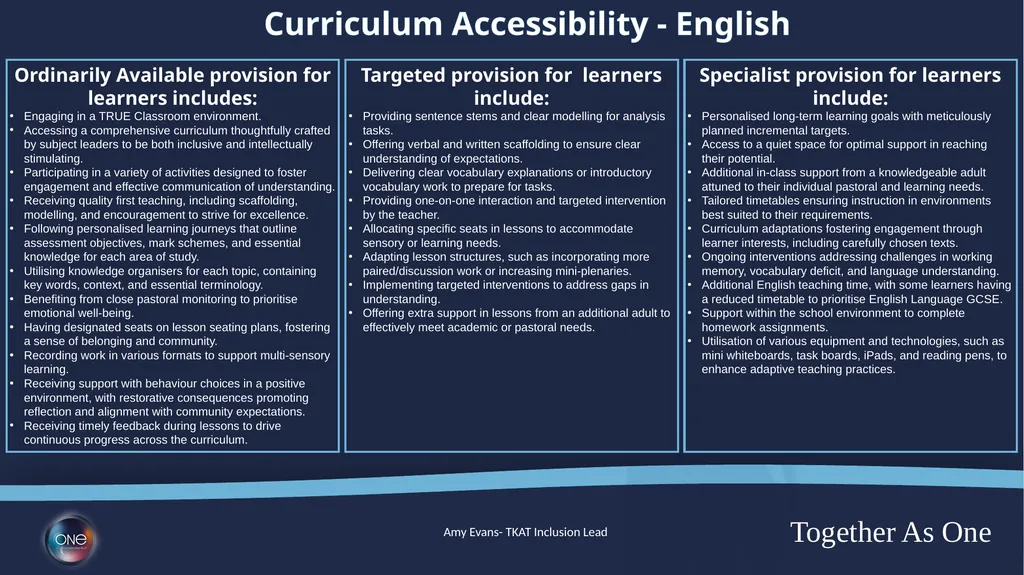
slide5. Ordinarily Available provision for learners includes:
Engaging in a TRUE Classroom environment.
Accessing a comprehensive curriculum thoughtfully crafted by subject leaders to be both inclusive and intellectually stimulating.
Participating in a variety of activities designed to foster engagement and effective communication of understanding.
Receiving quality first teaching, including scaffolding, modelling, and encouragement to strive for excellence.
Following personalised learning journeys that outline assessment objectives, mark schemes, and essential knowledge for each area of study.
Utilising knowledge organisers for each topic, containing key words, context, and essential terminology.
Benefiting from close pastoral monitoring to prioritise emotional well-being.
Having designated seats on lesson seating plans, fostering a sense of belonging and community.
Recording work in various formats to support multi-sensory learning.
Receiving support with behaviour choices in a positive environment, with restorative consequences promoting reflection and alignment with community expectations.
Receiving timely feedback during lessons to drive continuous progress across the curriculum. Targeted provision for learners include:
Providing sentence stems and clear modelling for analysis tasks.
Offering verbal and written scaffolding to ensure clear understanding of expectations.
Delivering clear vocabulary explanations or introductory vocabulary work to prepare for tasks.
Providing one-on-one interaction and targeted intervention by the teacher.
Allocating specific seats in lessons to accommodate sensory or learning needs.
Adapting lesson structures, such as incorporating more paired/discussion work or increasing mini-plenaries.
Implementing targeted interventions to address gaps in understanding.
Offering extra support in lessons from an additional adult to effectively meet academic or pastoral needs. Specialist provision for learners include:
Personalised long-term learning goals with meticulously planned incremental targets.
Access to a quiet space for optimal support in reaching their potential.
Additional in-class support from a knowledgeable adult attuned to their individual pastoral and learning needs.
Tailored timetables ensuring instruction in environments best suited to their requirements.
Curriculum adaptations fostering engagement through learner interests, including carefully chosen texts.
Ongoing interventions addressing challenges in working memory, vocabulary deficit, and language understanding.
Additional English teaching time, with some learners having a reduced timetable to prioritise English Language GCSE.
Support within the school environment to complete homework assignments.
Utilisation of various equipment and technologies, such as mini whiteboards, task boards, iPads, and reading pens, to enhance adaptive teaching practices. Curriculum Accessibility - English<br>
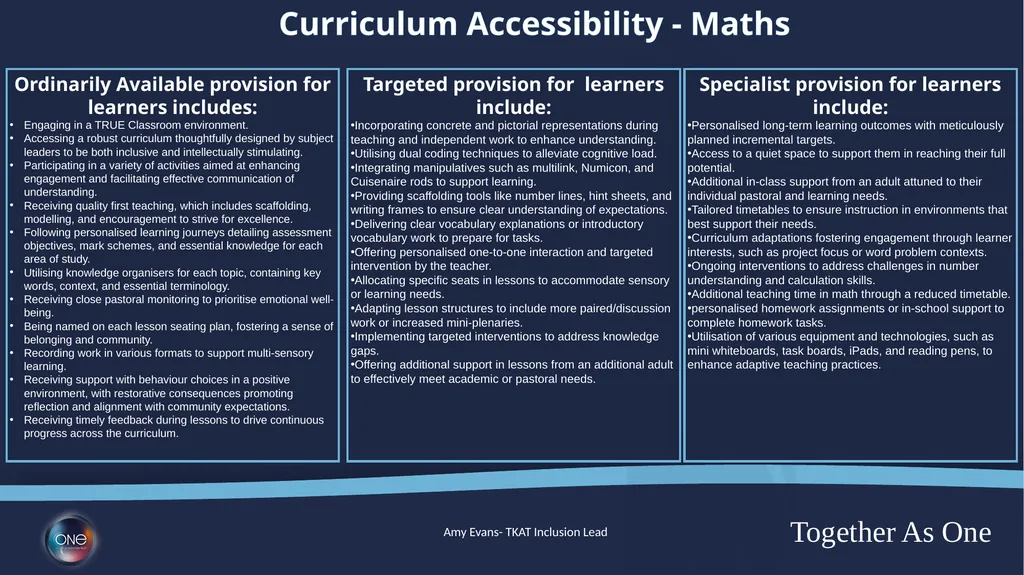
slide6. Ordinarily Available provision for learners includes:
Engaging in a TRUE Classroom environment.
Accessing a robust curriculum thoughtfully designed by subject leaders to be both inclusive and intellectually stimulating.
Participating in a variety of activities aimed at enhancing engagement and facilitating effective communication of understanding.
Receiving quality first teaching, which includes scaffolding, modelling, and encouragement to strive for excellence.
Following personalised learning journeys detailing assessment objectives, mark schemes, and essential knowledge for each area of study.
Utilising knowledge organisers for each topic, containing key words, context, and essential terminology.
Receiving close pastoral monitoring to prioritise emotional well-being.
Being named on each lesson seating plan, fostering a sense of belonging and community.
Recording work in various formats to support multi-sensory learning.
Receiving support with behaviour choices in a positive environment, with restorative consequences promoting reflection and alignment with community expectations.
Receiving timely feedback during lessons to drive continuous progress across the curriculum. Targeted provision for learners include:
Incorporating concrete and pictorial representations during teaching and independent work to enhance understanding.
Utilising dual coding techniques to alleviate cognitive load.
Integrating manipulatives such as multilink, Numicon, and Cuisenaire rods to support learning.
Providing scaffolding tools like number lines, hint sheets, and writing frames to ensure clear understanding of expectations.
Delivering clear vocabulary explanations or introductory vocabulary work to prepare for tasks.
Offering personalised one-to-one interaction and targeted intervention by the teacher.
Allocating specific seats in lessons to accommodate sensory or learning needs.
Adapting lesson structures to include more paired/discussion work or increased mini-plenaries.
Implementing targeted interventions to address knowledge gaps.
Offering additional support in lessons from an additional adult to effectively meet academic or pastoral needs. Specialist provision for learners include:
Personalised long-term learning outcomes with meticulously planned incremental targets.
Access to a quiet space to support them in reaching their full potential.
Additional in-class support from an adult attuned to their individual pastoral and learning needs.
Tailored timetables to ensure instruction in environments that best support their needs.
Curriculum adaptations fostering engagement through learner interests, such as project focus or word problem contexts.
Ongoing interventions to address challenges in number understanding and calculation skills.
Additional teaching time in math through a reduced timetable.
personalised homework assignments or in-school support to complete homework tasks.
Utilisation of various equipment and technologies, such as mini whiteboards, task boards, iPads, and reading pens, to enhance adaptive teaching practices. Curriculum Accessibility - Maths<br>
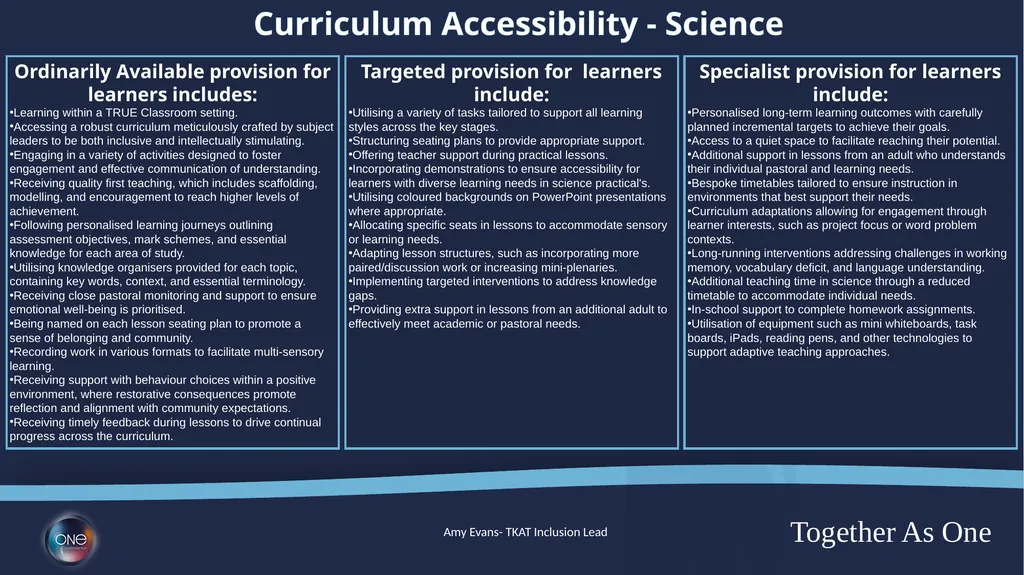
slide7. Ordinarily Available provision for learners includes:
Learning within a TRUE Classroom setting.
Accessing a robust curriculum meticulously crafted by subject leaders to be both inclusive and intellectually stimulating.
Engaging in a variety of activities designed to foster engagement and effective communication of understanding.
Receiving quality first teaching, which includes scaffolding, modelling, and encouragement to reach higher levels of achievement.
Following personalised learning journeys outlining assessment objectives, mark schemes, and essential knowledge for each area of study.
Utilising knowledge organisers provided for each topic, containing key words, context, and essential terminology.
Receiving close pastoral monitoring and support to ensure emotional well-being is prioritised.
Being named on each lesson seating plan to promote a sense of belonging and community.
Recording work in various formats to facilitate multi-sensory learning.
Receiving support with behaviour choices within a positive environment, where restorative consequences promote reflection and alignment with community expectations.
Receiving timely feedback during lessons to drive continual progress across the curriculum. Targeted provision for learners include:
Utilising a variety of tasks tailored to support all learning styles across the key stages.
Structuring seating plans to provide appropriate support.
Offering teacher support during practical lessons.
Incorporating demonstrations to ensure accessibility for learners with diverse learning needs in science practical's.
Utilising coloured backgrounds on PowerPoint presentations where appropriate.
Allocating specific seats in lessons to accommodate sensory or learning needs.
Adapting lesson structures, such as incorporating more paired/discussion work or increasing mini-plenaries.
Implementing targeted interventions to address knowledge gaps.
Providing extra support in lessons from an additional adult to effectively meet academic or pastoral needs. Specialist provision for learners include:
Personalised long-term learning outcomes with carefully planned incremental targets to achieve their goals.
Access to a quiet space to facilitate reaching their potential.
Additional support in lessons from an adult who understands their individual pastoral and learning needs.
Bespoke timetables tailored to ensure instruction in environments that best support their needs.
Curriculum adaptations allowing for engagement through learner interests, such as project focus or word problem contexts.
Long-running interventions addressing challenges in working memory, vocabulary deficit, and language understanding.
Additional teaching time in science through a reduced timetable to accommodate individual needs.
In-school support to complete homework assignments.
Utilisation of equipment such as mini whiteboards, task boards, iPads, reading pens, and other technologies to support adaptive teaching approaches. Curriculum Accessibility - Science<br>
slide8. Ordinarily Available provision for learners includes:
Learning within a TRUE Classroom setting.
Accessing a robust curriculum thoughtfully designed by subject leaders to be both inclusive and intellectually stimulating.
Engaging in a variety of activities aimed at enhancing engagement and facilitating effective communication of understanding.
Receiving quality first teaching, which includes scaffolding, modelling, and encouragement to strive for excellence.
Following personalised learning journeys that outline assessment objectives, mark schemes, and essential knowledge for each area of study.
Utilising knowledge organisers provided for each topic, containing key words, context, and essential terminology.
Receiving close pastoral monitoring and support to ensure emotional well-being is prioritised.
Being named on each lesson seating plan to foster a sense of belonging and community.
Recording work in various formats to support multi-sensory learning.
Receiving support with behaviour choices within a positive environment, where restorative consequences promote reflection and alignment with community expectations.
Receiving timely feedback during lessons to drive continuous progress across the curriculum. Targeted provision for learners include:
Utilisation of a variety of tasks across key stages to accommodate different learning styles.
Structured seating plans to provide appropriate support.
Teacher support during practical lessons to enhance learning.
Integration of demonstrations to ensure accessibility for learners with diverse needs.
Use of coloured backgrounds on PowerPoint presentations and computer screens as needed.
Allocation of specific seating arrangements to address sensory or learning needs.
Adaptation of lesson structures, such as incorporating more paired/discussion work or increased mini-plenaries.
Implementation of targeted interventions to address knowledge gaps.
Provision of extra support in lessons from an additional adult to effectively meet academic or pastoral needs. Specialist provision for learners include:
Personalised long-term learning outcomes with meticulously planned incremental targets to achieve their goals.
Access to a quiet space to ensure optimal support for reaching their potential.
Additional in-class support from an adult who understands their individual pastoral and learning needs.
Customised timetables tailored to ensure instruction in environments that best support their needs.
Curriculum adaptations allowing for engagement through learner interests, including carefully chosen text choices.
Long-term interventions addressing challenges in working memory, vocabulary deficit, and language understanding.
In-school support to complete homework assignments.
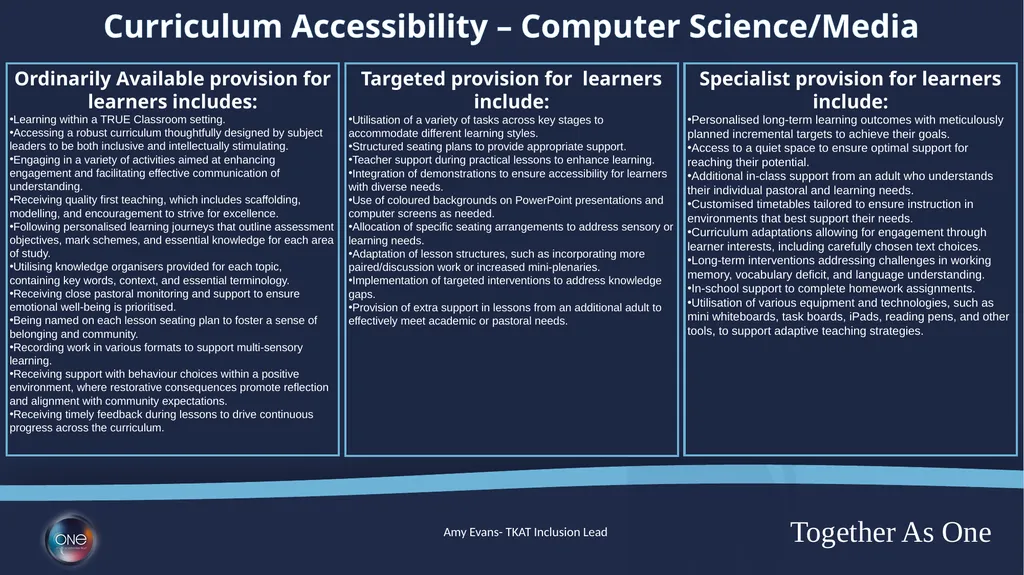
Utilisation of various equipment and technologies, such as mini whiteboards, task boards, iPads, reading pens, and other tools, to support adaptive teaching strategies. Curriculum Accessibility – Computer Science/Media<br>
slide9. Ordinarily Available provision for learners includes:
Learning within a TRUE Classroom setting.
Accessing a robust curriculum thoughtfully designed by subject leaders to be both inclusive and intellectually stimulating.
Engaging in a variety of activities aimed at enhancing engagement and facilitating effective communication of understanding.
Receiving quality first teaching, which includes scaffolding, modelling, and encouragement to strive for excellence.
Following personalised learning journeys that outline assessment objectives, mark schemes, and essential knowledge for each area of study.
Utilising knowledge organisers provided for each topic, containing key words, context, and essential terminology.
Receiving close pastoral monitoring and support to ensure emotional well-being is prioritised.
Being named on each lesson seating plan to foster a sense of belonging and community.
Recording work in various formats to support multi-sensory learning.
Receiving support with behaviour choices within a positive environment, where restorative consequences promote reflection and alignment with community expectations.
Receiving timely feedback during lessons to drive continuous progress across the curriculum. Targeted provision for learners include:
Utilisation of a variety of tasks across key stages to accommodate different learning styles.
Structured seating plans to provide appropriate support.
Teacher support during practical lessons to enhance learning.
Integration of demonstrations to ensure accessibility for learners with diverse needs.
Use of coloured backgrounds on PowerPoint presentations and computer screens as needed.
Allocation of specific seating arrangements to address sensory or learning needs.
Adaptation of lesson structures, such as incorporating more paired/discussion work or increased mini-plenaries.
Implementation of targeted interventions to address knowledge gaps.
Provision of extra support in lessons from an additional adult to effectively meet academic or pastoral needs. Specialist provision for learners include:
Personalised long-term learning outcomes with meticulously planned incremental targets to achieve their goals.
Access to a quiet space to ensure optimal support for reaching their potential.
Additional in-class support from an adult who understands their individual pastoral and learning needs.
Customised timetables tailored to ensure instruction in environments that best support their needs.
Curriculum adaptations allowing for engagement through learner interests, including carefully chosen text choices.
Long-term interventions addressing challenges in working memory, vocabulary deficit, and language understanding.
In-school support to complete homework assignments.
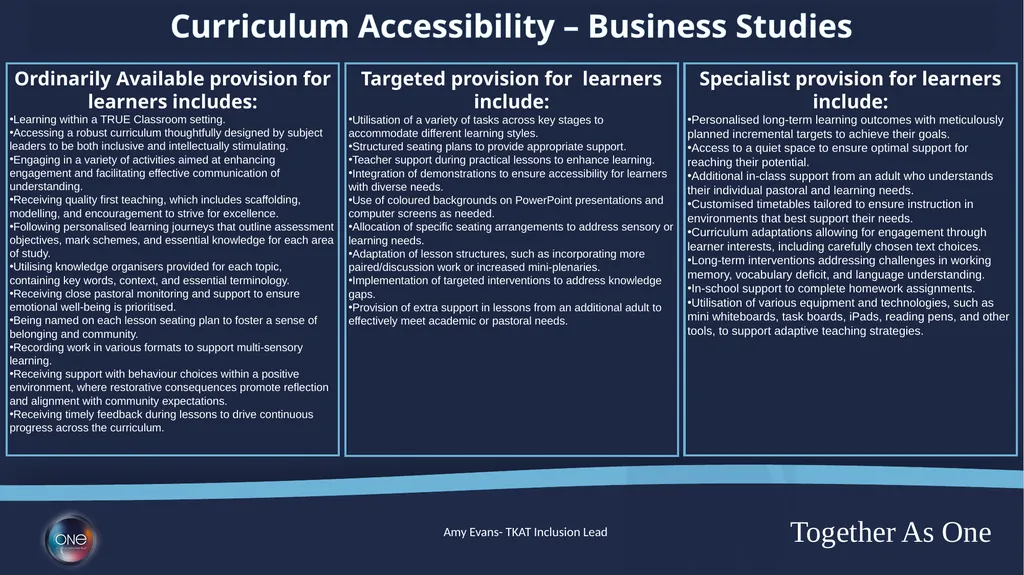
Utilisation of various equipment and technologies, such as mini whiteboards, task boards, iPads, reading pens, and other tools, to support adaptive teaching strategies. Curriculum Accessibility – Business Studies<br>
slide10. Ordinarily Available provision for learners includes:
Engaging in a TRUE Classroom environment.
Accessing a robust curriculum meticulously designed by subject leaders to be both inclusive and intellectually stimulating.
Participating in a variety of activities aimed at fostering engagement and effective communication of understanding.
Receiving quality first teaching, which includes scaffolding, modelling, and encouragement to excel.
Following personalised learning journeys outlining assessment objectives, mark schemes, and essential knowledge for each area of study.
Utilising knowledge organisers provided for each topic, containing key words, context, and essential terminology.
Receiving close pastoral monitoring and support to prioritise emotional well-being.
Being named on each lesson seating plan to promote a sense of belonging and community.
Recording work in various formats to support multi-sensory learning.
Receiving support with behaviour choices within a positive environment, where restorative consequences promote reflection and alignment with community expectations.
Receiving timely feedback during lessons to drive continuous progress across the curriculum. Targeted provision for learners include:
Providing verbal and written scaffolding to ensure clear understanding of expectations.
Offering clear vocabulary explanations and introductory vocabulary work to prepare for tasks.
Facilitating one-to-one interaction and targeted intervention by the teacher.
Providing laminated and differently coloured specialist vocabulary sheets with music terminology explained.
Allocating specific seats in lessons to accommodate sensory or learning needs.
Adapting lesson structures, such as incorporating more paired/discussion work or increasing mini-plenaries.
Implementing targeted interventions to address knowledge gaps.
Offering extra support in lessons from an additional adult to effectively meet academic or pastoral needs.
Providing the use of headphones for keyboard work or ear defenders for practical tasks.
Using wider spaced manuscript paper for improved writing clarity. Specialist provision for learners include:
Personalised long-term learning outcomes with meticulously planned incremental targets to achieve their goals.
Access to a quiet space, particularly crucial during practical tasks, to support them in reaching their full potential.
Additional in-class support from an adult who understands their individual pastoral and learning needs.
Customised timetables tailored to ensure instruction in environments that best support their needs.
Curriculum adaptations allowing for engagement through learner interests, including carefully selected musical choices.
Long-term interventions addressing challenges in working memory, vocabulary deficit, and language understanding.
In-school support to complete homework assignments.
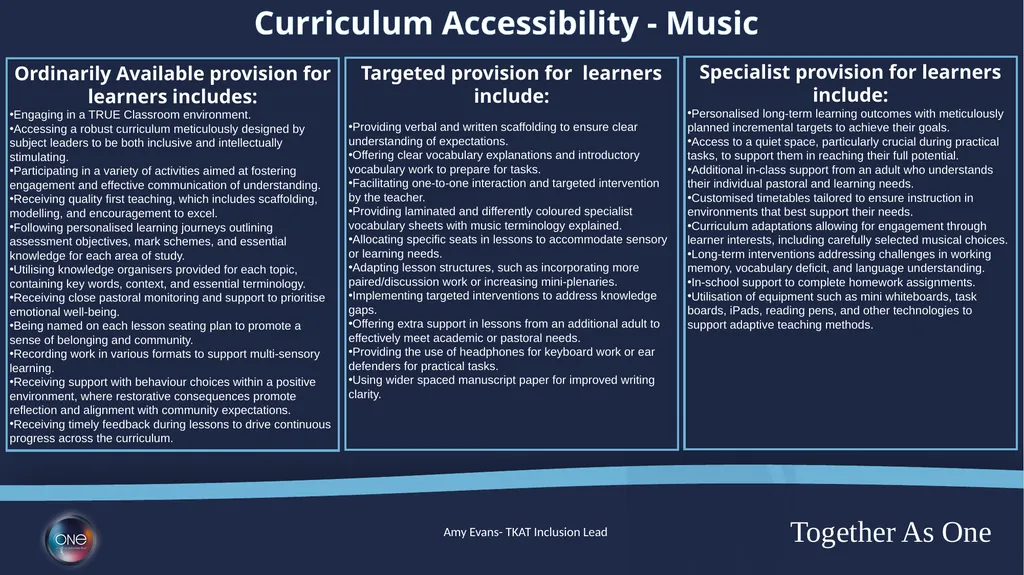
Utilisation of equipment such as mini whiteboards, task boards, iPads, reading pens, and other technologies to support adaptive teaching methods. Curriculum Accessibility - Music<br>
slide11. Ordinarily Available provision for learners includes:
Engaging in a TRUE Classroom setting.
Accessing a robust curriculum meticulously crafted by the subject leader to be both inclusive and intellectually stimulating.
Participating in a variety of activities aimed at fostering engagement and effective communication of understanding.
Receiving quality first teaching, which encompasses scaffolding, modelling, and instruction aimed at achieving excellence.
Following personalised learning journeys outlining assessment objectives, mark schemes, and essential knowledge for each area of study.
Utilising knowledge organisers provided for each topic, containing key words, context, and essential terminology.
Receiving close pastoral monitoring and support to prioritise emotional well-being.
Being named on each lesson seating plan to promote a sense of belonging and community.
Recording work in various formats to support multi-sensory learning.
Receiving support with behaviour choices within a positive environment, where restorative consequences promote reflection and alignment with community expectations.
Receiving timely feedback during lessons to drive continuous progress across the curriculum. Targeted provision for learners include:
Utilising concrete and pictorial representations during teaching and independent work to enhance understanding.
Providing clear vocabulary explanations and introductory vocabulary work to prepare for tasks.
Facilitating one-to-one interaction and targeted intervention by the teacher.
Allocating specific seating arrangements in lessons to accommodate sensory or learning needs.
Adapting lesson structures, such as incorporating more paired/discussion work or increasing mini-plenaries.
Implementing targeted interventions to address knowledge gaps.
Offering extra support in lessons from an additional adult to effectively meet academic or pastoral needs.
Providing laminated and differently coloured specialist vocabulary sheets with phonetic breakdowns for enhanced learning. Specialist provision for learners include:
Personalised long-term learning outcomes with carefully planned incremental targets to achieving their outcomes.
Access to a quiet space to ensure they can be supported to meet their potential.
Additional support in lessons from an adult who is attuned to their individual pastoral and learning needs.
Bespoke timetables taking in to account their needs to ensure that they are taught in an environment that best supports their needs.
Curriculum adaptations to allow for engagement through learner interests (project focus or word problem context).
Long-running interventions to support challenges around number understanding and understanding of calculations.
Personalised homework to be set or support in school to complete homework.
Additional adult support in practical lessons.
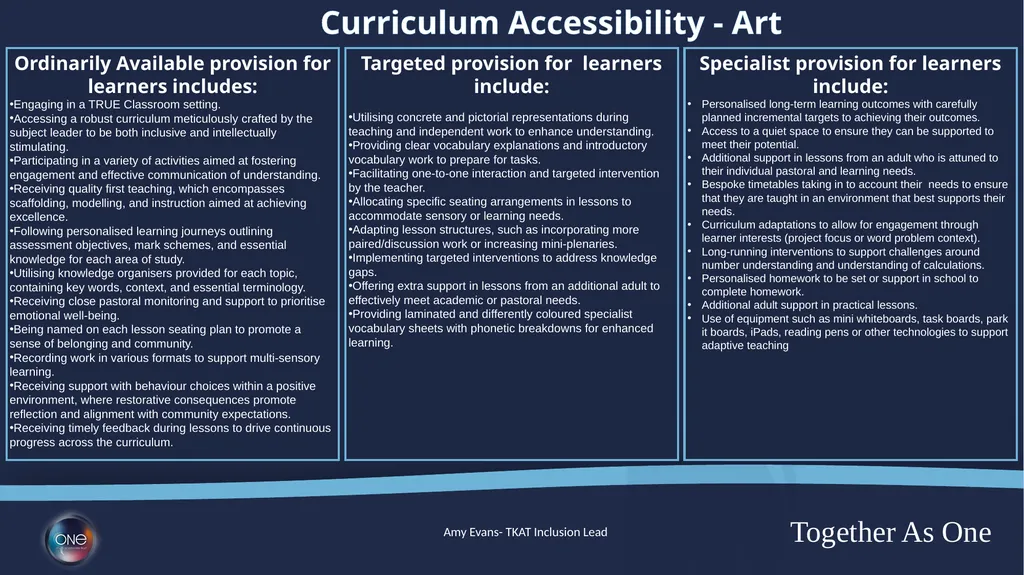
Use of equipment such as mini whiteboards, task boards, park it boards, iPads, reading pens or other technologies to support adaptive teaching Curriculum Accessibility - Art<br>
slide12. Ordinarily Available provision for learners includes:
Engaging in a TRUE Classroom environment.
Accessing a robust curriculum meticulously designed by the subject leader to be both meaningful, challenging, and ambitious.
Participating in a variety of activities aimed at fostering engagement and effective communication of understanding.
Receiving quality first teaching, which includes scaffolding, modelling, and instruction aimed at achieving excellence.
Following personalised learning journeys detailing assessment objectives, mark schemes, and essential knowledge for each area of study.
Utilising knowledge organisers provided for each topic, containing key words, context, and essential terminology.
Receiving close pastoral monitoring and support to prioritise emotional well-being.
Being named on each lesson seating plan to promote a sense of belonging and community.
Recording work in various formats to support multi-sensory learning.
Receiving support with behaviour choices within a positive environment, where restorative consequences promote reflection and alignment with community expectations.
Receiving timely feedback during lessons to drive continuous progress across the curriculum. Targeted provision for learners include:
Utilising concrete and pictorial representations during teaching and independent work to enhance understanding.
Providing clear vocabulary explanations and introductory vocabulary work to prepare for tasks.
Facilitating one-to-one interaction and targeted intervention by the teacher.
Allocating specific seating arrangements in lessons to accommodate sensory or learning needs.
Adapting lesson structures, such as incorporating more paired/discussion work or increasing mini-plenaries.
Implementing targeted interventions to address knowledge gaps.
Offering extra support in lessons from an additional adult to effectively meet academic or pastoral needs.
Providing laminated and differently coloured specialist vocabulary sheets with phonetic breakdowns.
Using ear defenders during practical work to minimize distractions and enhance focus. Specialist provision for learners include:
Personalised long-term learning outcomes with meticulously planned incremental targets to achieve their educational goals.
Access to a quiet space to facilitate focused learning and support their academic potential.
Additional in-class support from an adult who understands their individual pastoral and learning needs.
Customised timetables tailored to ensure instruction in environments that optimise support for their needs.
Curriculum adaptations allowing for engagement through learner interests, such as project-focused or word problem contexts.
Long-term interventions addressing challenges related to number understanding and calculations.
Provision of personalised homework assignments or in-school support to complete homework tasks.
Additional adult support in practical lessons to adhere to health and safety guidelines.
Utilisation of various teaching aids and technologies, including mini whiteboards, task boards, iPads, and reading pens, to facilitate adaptive teaching strategies. Curriculum Accessibility - DT<br>
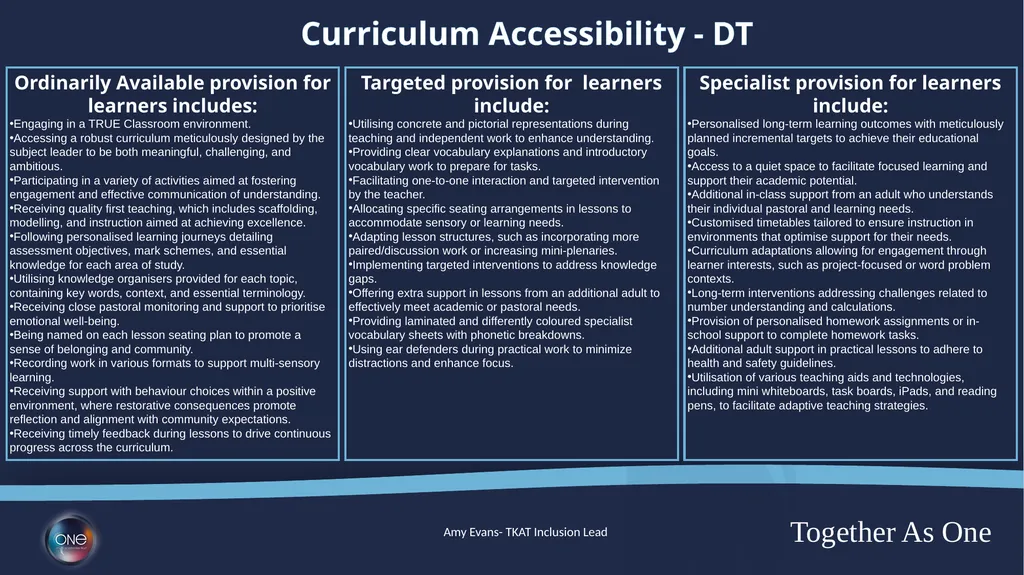
slide13. Ordinarily Available provision for learners includes:
Engaging in a TRUE Classroom environment.
Accessing a robust curriculum meticulously designed by the subject leader to be both meaningful, challenging, and ambitious.
Participating in a variety of activities aimed at fostering engagement and effective communication of understanding.
Receiving quality first teaching, which includes scaffolding, modelling, and instruction aimed at achieving excellence.
Following personalised learning journeys detailing assessment objectives, mark schemes, and essential knowledge for each area of study.
Utilising knowledge organisers provided for each topic, containing key words, context, and essential terminology.
Receiving close pastoral monitoring and support to prioritise emotional well-being.
Being named on each lesson seating plan to promote a sense of belonging and community.
Recording work in various formats to support multi-sensory learning.
Receiving support with behaviour choices within a positive environment, where restorative consequences promote reflection and alignment with community expectations.
Receiving timely feedback during lessons to drive continuous progress across the curriculum. Targeted provision for learners include:
Utilising concrete and pictorial representations during teaching and independent work to enhance understanding.
Providing clear vocabulary explanations and introductory vocabulary work to prepare for tasks.
Facilitating one-to-one interaction and targeted intervention by the teacher.
Allocating specific seating arrangements in lessons to accommodate sensory or learning needs.
Adapting lesson structures, such as incorporating more paired/discussion work or increasing mini-plenaries.
Implementing targeted interventions to address knowledge gaps.
Offering extra support in lessons from an additional adult to effectively meet academic or pastoral needs.
Providing laminated and differently coloured specialist vocabulary sheets with phonetic breakdowns.
Using ear defenders during practical work to minimize distractions and enhance focus. Specialist provision for learners include:
Personalised long-term learning outcomes with meticulously planned incremental targets to achieve their educational goals.
Access to a quiet space to facilitate focused learning and support their academic potential.
Additional in-class support from an adult who understands their individual pastoral and learning needs.
Customised timetables tailored to ensure instruction in environments that optimise support for their needs.
Curriculum adaptations allowing for engagement through learner interests, such as project-focused or word problem contexts.
Long-term interventions addressing challenges related to number understanding and calculations for measuring.
Provision of personalised homework assignments or in-school support to complete homework tasks.
Additional adult support in practical lessons to adhere to health and safety guidelines.
Utilisation of various teaching aids and technologies, including mini whiteboards, task boards, iPads, and reading pens, to facilitate adaptive teaching strategies. Curriculum Accessibility – Food Technology<br>
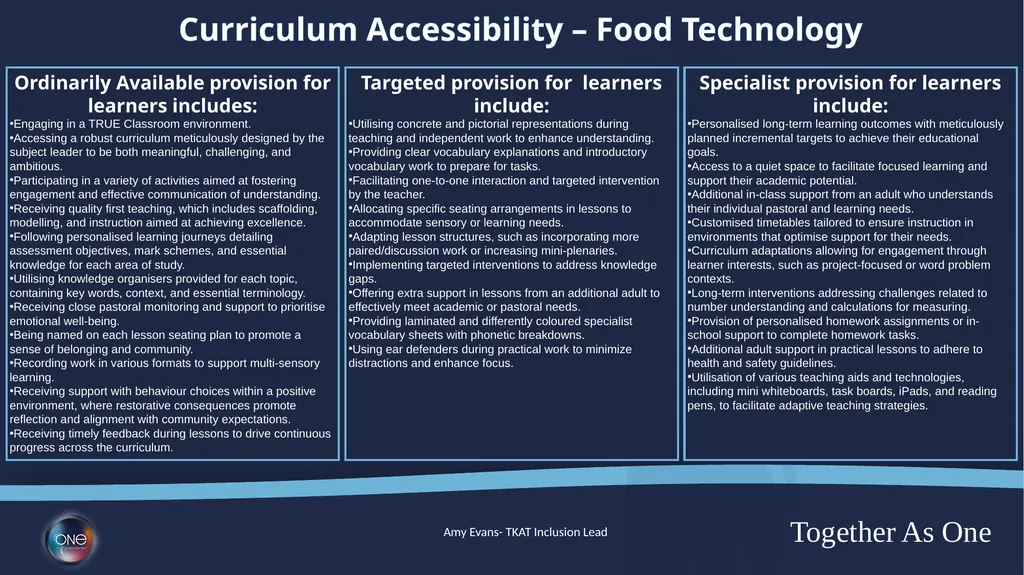
slide14. Ordinarily Available provision for learners includes:
Participation in a TRUE Classroom setting.
Access to a comprehensive curriculum meticulously crafted by the subject leader, ensuring it is not only suitable for all learners but also engaging, meaningful, and intellectually stimulating.
Engagement in a variety of activities aimed at promoting active participation and effective communication of knowledge.
Receipt of quality first teaching, which incorporates scaffolding, modelling, and instruction tailored to each student's needs.
Provision of learning journeys detailing assessment objectives, mark schemes, and essential knowledge required for each area of study. (Knowledge booklets to support learning)
Availability of knowledge organisers, (in the form of sentence builders) for each topic/ key questions, containing key vocabulary and grMMER, contextual information, and essential terminology.
Close pastoral monitoring and support to prioritise emotional well-being.
Inclusion on lesson seating plans to foster a sense of belonging and community among learners.
Opportunities to document work in various formats, promoting access to the curriculum through multi-sensory learning.
Support in making positive behaviour choices within a nurturing environment, with the use of restorative consequences to foster reflection and alignment with community expectations.
Provision of feedback during lessons aimed at driving continuous progress across the curriculum. Targeted provision for learners include:
Verbal and written scaffolding techniques employed to ensure learners grasp expectations clearly.
Utilisation of varied colours in worksheets and presentations as needed for enhanced visual comprehension.
Support with phonics through a blend of actions and imagery to reinforce understanding (using mnemonics to enhance phonics practice in French)
Clear vocabulary explanations and introductory activities to prepare learners for upcoming tasks.
One-on-one interaction and personalised interventions delivered by the teacher.
Implementation of diverse strategies such as different font sizes, cloze activities, and writing or speaking frames to facilitate learning (sentence builders booklets).
Allocation of specific seating arrangements in lessons to cater to sensory or learning needs.
Adaptation of lesson structures, including increased paired or discussion work and more frequent mini-plenaries.
Targeted interventions aimed at addressing specific knowledge gaps.
Provision of additional support during lessons from an extra adult to effectively address the learner's academic or pastoral requirements. Specialist provision for learners include:
Personalised long-term learning outcomes with meticulously planned incremental targets to guide them towards their goals.
Access to a serene environment conducive to concentration, facilitating their ability to reach their full potential.
Additional support during lessons provided by an adult who is finely attuned to their individual pastoral and learning needs.
Curriculum adaptations tailored to spark engagement by incorporating learner interests through thoughtfully selected text choices.
Long-term interventions aimed at addressing challenges related to working memory, vocabulary deficit, and language understanding.
Personalised homework assignments tailored to individual learning needs, supplemented by in-school support to ensure completion (use of online tools to personalise homework).
Utilisation of various equipment such as mini whiteboards, task boards, iPads, and reading pens, among other technologies, to facilitate adaptive teaching methods. Curriculum Accessibility - MFL<br>
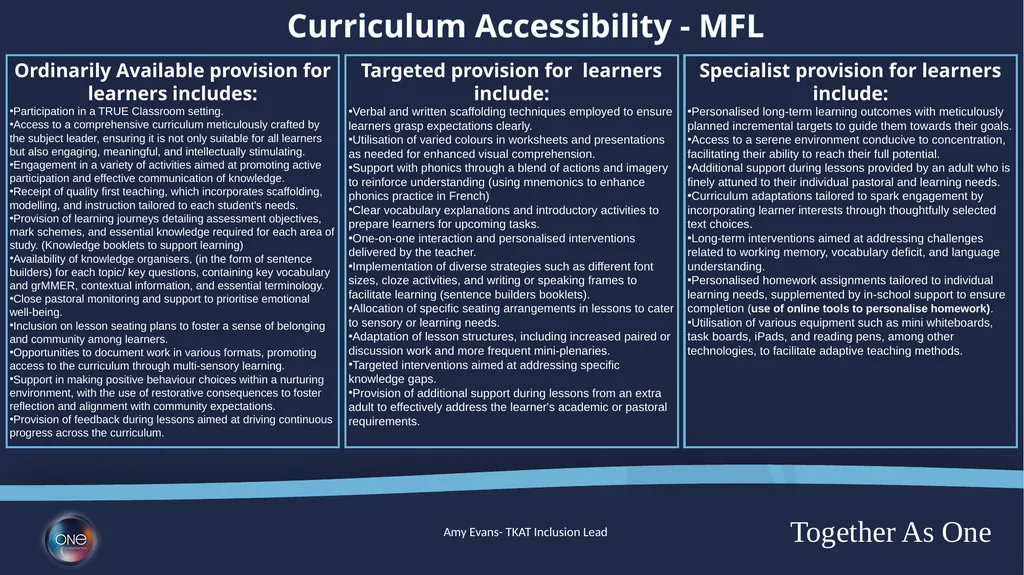
slide15. Ordinarily Available provision for learners includes:
Engaging in a TRUE Classroom
Access to a robust curriculum meticulously crafted by subject experts, ensuring it's both accessible and intellectually stimulating.
Engagement in a variety of activities fostering effective communication of their understanding.
Quality first teaching incorporating scaffolding, modelling, and a focus on reaching the highest standards.
Detailed learning journeys outlining assessment objectives and marking schemes, along with the requisite knowledge for each objective.
Provision of knowledge organisers for every topic, containing essential keywords, contextual information, and key terminology.
Ongoing pastoral support to prioritise emotional well-being.
Individualized recognition through inclusion in lesson seating plans, fostering a sense of belonging within the community.
Opportunities to express learning through diverse mediums, facilitating multi-sensory engagement.
Positive reinforcement for behaviour, with restorative consequences encouraging reflection and alignment with community expectations.
Regular feedback during lessons to drive continuous progress across all areas of the curriculum. Targeted provision for learners include:
Utilisation of a diverse array of tasks tailored to accommodate various learning styles across key stages.
Structured seating plans designed to facilitate appropriate support for each student.
Implementation of sentence starters and writing frames to bolster extended writing endeavours.
Clear success criteria embedded within assessments to aid progression for learners of all abilities.
Inclusion of relevant materials within KS4 geography lesson packs.
Provision of colour paper sheets upon request.
On-demand assistance with colour identification on maps.
Access to textbooks for home use, aiding with homework tasks and revision. Specialist provision for learners include:
Personalised long-term learning outcomes with meticulously planned incremental targets guiding their journey toward achievement.
Provision of a quiet space to ensure optimal support in reaching their full potential.
Dedicated assistance within lessons from a knowledgeable adult attuned to their unique pastoral and learning requirements.
Assigned seating within the classroom tailored to their needs, facilitating seamless access to lesson content.
Targeted teacher support to clarify expectations surrounding written tasks, ensuring comprehension and success.
Strategic employment of questioning techniques to reinforce understanding of lesson objectives.
In-school support for completing homework assignments.
Utilisation of various tools and technologies such as mini whiteboards, task boards, park it boards, iPads, and reading pens to enhance adaptive teaching methodologies. Curriculum Accessibility - Geography<br>
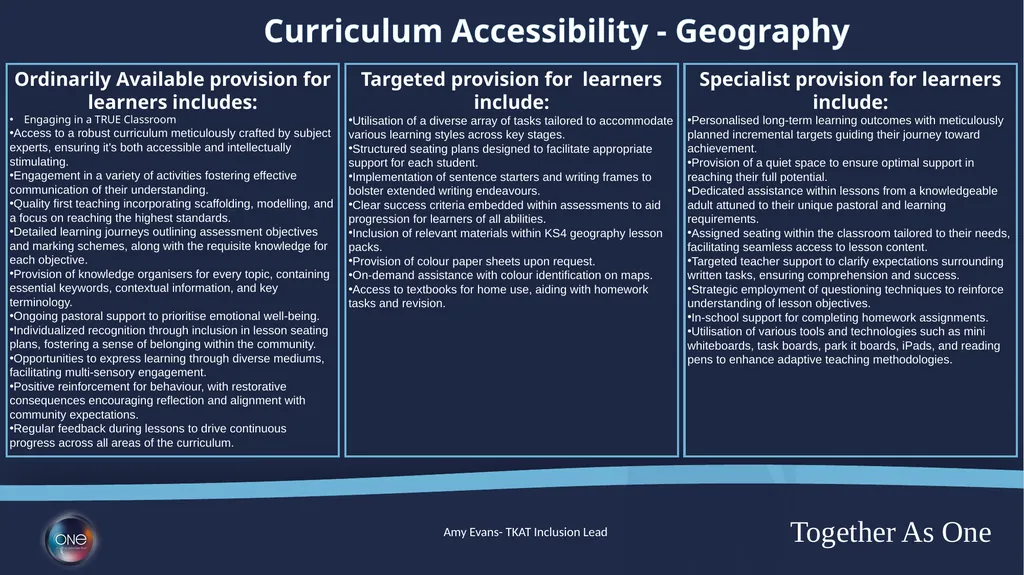
slide16. Ordinarily Available provision for learners includes:
Engaging in a TRUE Classroom
Access to a robust curriculum meticulously designed by subject leaders to be inclusive, meaningful, and intellectually stimulating.
Engagement through a variety of activities promoting effective communication of understanding.
Delivery of quality first teaching, encompassing scaffolding, modelling, and a commitment to reaching the highest standards.
Guidance through detailed learning journeys outlining assessment objectives, mark schemes, and essential knowledge for each learning objective.
Provision of knowledge organisers for each topic, containing key terms, contextual information, and essential terminology.
Ongoing pastoral support ensuring emotional well-being is a priority.
Inclusion in lesson seating plans, fostering a sense of belonging within the community.
Opportunities to document work in various formats, facilitating access to the curriculum through multi-sensory learning.
Positive reinforcement for behaviour choices within a supportive environment, Utilising restorative consequences for reflection and growth.
Regular feedback during lessons driving continuous progress across all areas of the curriculum.
Provision of glossary of key subject terms ( Tier 3).
Low stakes tests which facilitate ALL learners needs. Targeted provision for learners include:
Project-specific booklets are provided, offering structured support for tasks.
Colour paper sheets are available upon request, catering to individual preferences.
Seating plans are carefully organized to facilitate appropriate support.
Question matrices are utilized to aid learners in both oral and written responses.
Learners receive specific feedback, tailored to their development needs, with exam board language broken down for accessibility in KS4 and KS5.
Structure strips are provided for all question types in GCSE examinations.
A balanced mix of cooperative, independent, and teacher-led activities is employed to challenge and support learners effectively.
Targeted interventions are tailored to address specific areas of need.
Key words and vocabulary are identified and discussed to enhance understanding.
Sentence starters and writing frames are utilized to scaffold extended writing tasks.
Model answers utilised frequently to enable all learners to see/model good pupil responses. Specialist provision for learners include:
Personalised long-term learning outcomes are established, with meticulously planned incremental targets guiding their progress.
Access to a tranquil space is provided to ensure optimal support in reaching their full potential.
Additional support in lessons is available, whenever possible, from a dedicated adult who understands their individual pastoral and learning needs.
Bespoke timetables are crafted to accommodate their needs, ensuring they are taught in an environment conducive to their success.
Curriculum adaptations are made to align with learner interests, including carefully selected texts to enhance engagement.
Long-term interventions are implemented to address challenges related to working memory, retrieval, and understanding of key concepts.
Support is offered within the school setting to assist with homework completion.
Various tools and technologies, such as mini whiteboards, task boards, park-it boards, iPads, and reading pens, are utilised to support adaptive teaching methods.
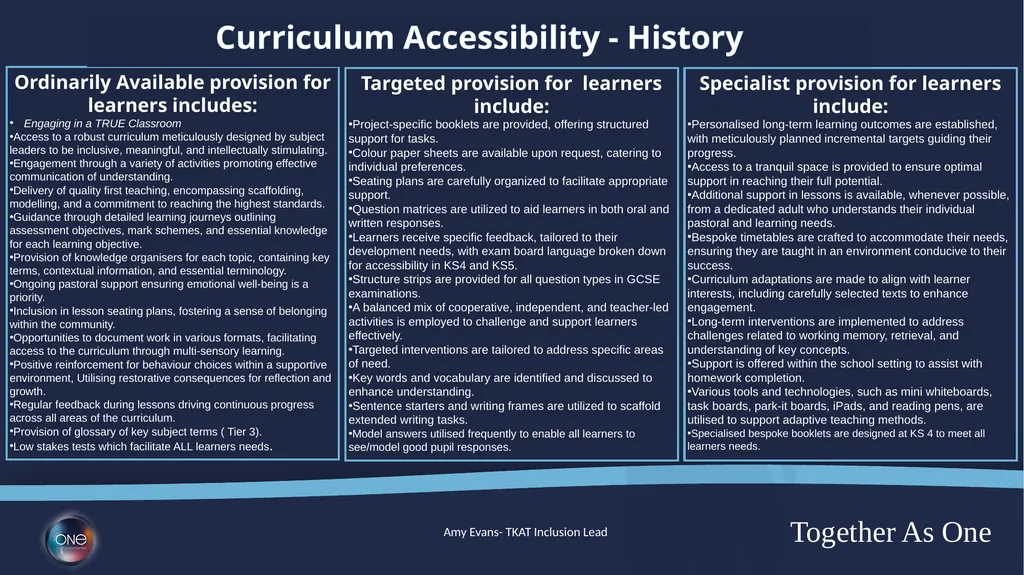
Specialised bespoke booklets are designed at KS 4 to meet all learners needs. Curriculum Accessibility - History<br>
slide17. Ordinarily Available provision for learners includes:
Engaging in a TRUE Classroom
Access to a robust curriculum thoughtfully crafted by subject leaders to be both inclusive and intellectually stimulating.
Engagement through a diverse range of activities designed to foster effective communication of understanding.
Delivery of quality first teaching, which incorporates scaffolding, modelling, and an emphasis on reaching high standards.
Provision of detailed learning journeys outlining assessment objectives, mark schemes, and essential knowledge for each learning objective.
Provision of knowledge organisers for each topic, containing key words, contextual information, and essential terminology.
Ongoing pastoral monitoring and support to ensure the prioritisation of emotional well-being.
Inclusion in lesson seating plans, fostering a sense of belonging within the community.
Flexibility in recording work through various methods, facilitating access to the curriculum through multi-sensory learning.
Positive reinforcement for behaviour choices within a supportive environment, Utilising restorative consequences to encourage reflection and alignment with community expectations.
Regular feedback during lessons, driving continuous progress across the curriculum. Targeted provision for learners include:
Scaffolded tasks, including sentence starters, are provided to support learning progression.
Coloured paper sheets are available upon request, accommodating individual preferences.
Seating plans are carefully arranged to provide appropriate support and facilitate engagement.
Learners have access to specialist vocabulary glossaries, ensuring clarity, particularly with complex religious terminology.
Specific feedback is provided to aid development in both KS3 and KS4, with exam board language broken down for accessibility.
Structured booklets are utilised to organize and support work completion.
One-on-one sessions are offered to those encountering difficulties, delivered by either the teacher or targeted adult support. Specialist provision for learners include:
Personalised long-term learning outcomes are established, with meticulously planned incremental targets guiding progress.
Access to a quiet space ensures optimal support in reaching their full potential.
Additional support in lessons is provided by an adult attuned to individual pastoral and learning needs.
Bespoke timetables are created to ensure learners are taught in an environment that best supports their needs.
Curriculum adaptations allow for engagement through learner interests, particularly within the ethics element of the GCSE course and at KS3.
Long-running interventions address challenges related to working memory, vocabulary, knowledge deficit, and specialist religious language understanding.
Interventions are provided for learners who joined the GCSE course late or are underperforming.
Support is offered within the school environment to assist with homework completion.
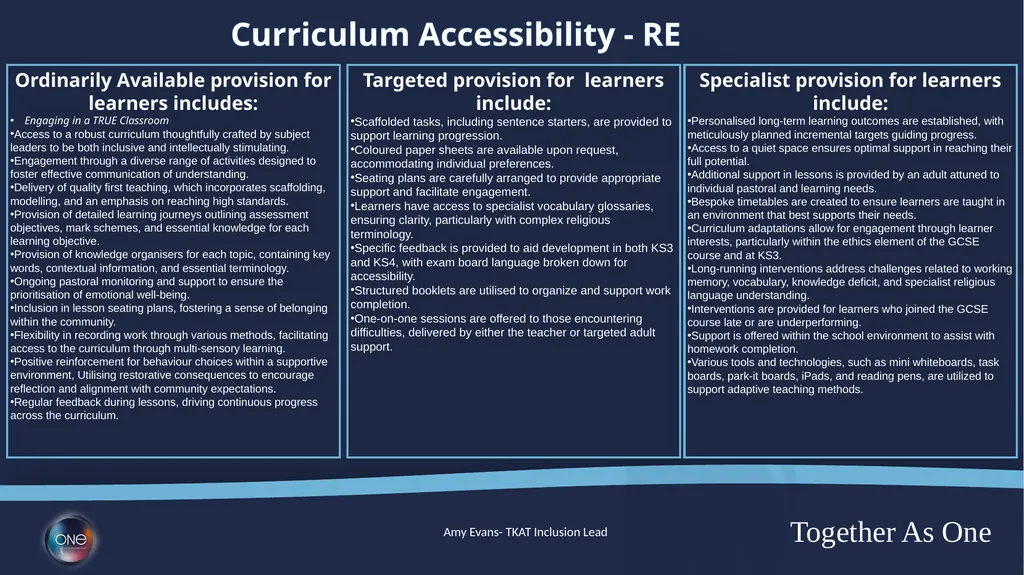
Various tools and technologies, such as mini whiteboards, task boards, park-it boards, iPads, and reading pens, are utilized to support adaptive teaching methods. Curriculum Accessibility - RE<br>
slide18. Ordinarily Available provision for learners includes:
Engaging in a TRUE Classroom
Access to a robust curriculum thoughtfully crafted by subject leaders to be both inclusive and intellectually stimulating.
Engagement through a diverse range of activities designed to foster effective communication of understanding.
Delivery of quality first teaching, which incorporates scaffolding, modelling, and an emphasis on reaching high standards.
Provision of detailed learning journeys outlining assessment objectives, mark schemes, and essential knowledge for each learning objective.
Provision of knowledge organisers for each topic, containing key words, contextual information, and essential terminology.
Ongoing pastoral monitoring and support to ensure the prioritisation of emotional well-being.
Inclusion in lesson seating plans, fostering a sense of belonging within the community.
Flexibility in recording work through various methods, facilitating access to the curriculum through multi-sensory learning.
Positive reinforcement for behaviour choices within a supportive environment, Utilising restorative consequences to encourage reflection and alignment with community expectations.
Regular feedback during lessons, driving continuous progress across the curriculum. Targeted provision for learners include:
Scaffolded tasks, including sentence starters, are provided to support learning progression.
Coloured paper sheets are available upon request, accommodating individual preferences.
Seating plans are carefully arranged to provide appropriate support and facilitate engagement.
Learners have access to specialist vocabulary glossaries, ensuring clarity, particularly with complex religious terminology.
Specific feedback is provided to aid development in both KS3 and KS4, with exam board language broken down for accessibility.
Structured booklets are utilised to organize and support work completion.
One-on-one sessions are offered to those encountering difficulties, delivered by either the teacher or targeted adult support. Specialist provision for learners include:
Personalised long-term learning outcomes are established, with meticulously planned incremental targets guiding progress.
Access to a quiet space ensures optimal support in reaching their full potential.
Additional support in lessons is provided by an adult attuned to individual pastoral and learning needs.
Bespoke timetables are created to ensure learners are taught in an environment that best supports their needs.
Curriculum adaptations allow for engagement through learner interests, particularly within the ethics element of the GCSE course and at KS3.
Long-running interventions address challenges related to working memory, vocabulary, knowledge deficit, and specialist religious language understanding.
Interventions are provided for learners who joined the GCSE course late or are underperforming.
Support is offered within the school environment to assist with homework completion.
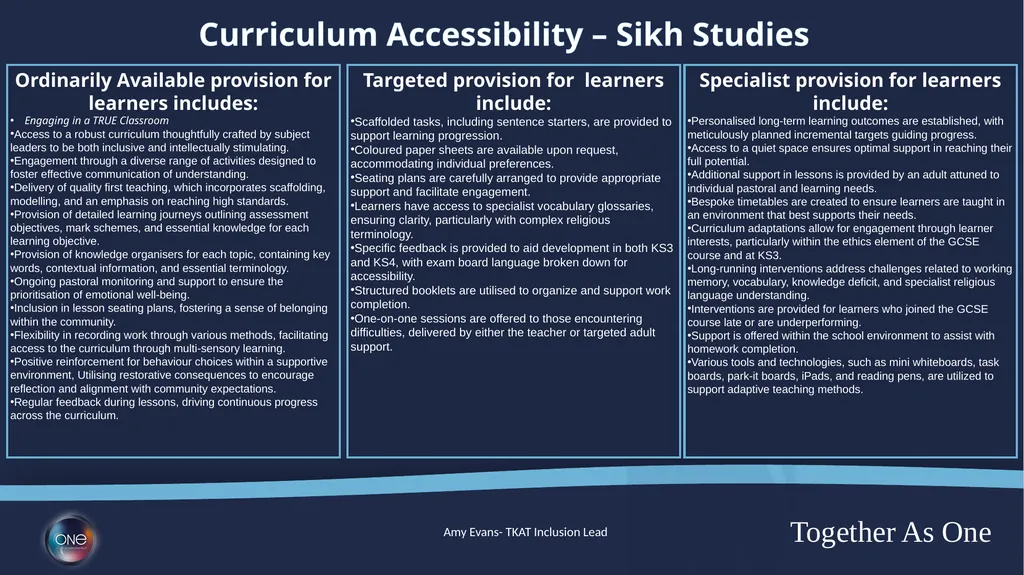
Various tools and technologies, such as mini whiteboards, task boards, park-it boards, iPads, and reading pens, are utilized to support adaptive teaching methods. Curriculum Accessibility – Sikh Studies<br>
slide19. Ordinarily Available provision for learners includes:
An engaging TRUE Classroom
Access to a robust curriculum meticulously crafted by subject leaders to be both comprehensive and intellectually stimulating.
Engagement in a diverse range of activities designed to promote active participation and effective communication of ideas.
Quality first teaching, incorporating scaffolding, modelling, and a commitment to academic excellence.
Detailed learning journeys outlining assessment objectives, mark schemes, and essential knowledge for each learning objective.
Provision of knowledge organisers for each topic, containing key words, contextual information, and essential terminology.
Close pastoral monitoring and support to ensure the prioritisation of emotional well-being.
Inclusion in lesson seating plans, fostering a sense of belonging and individual recognition within the classroom community.
Flexible recording of work to accommodate various learning styles and facilitate multi-sensory learning experiences.
Positive behaviour reinforcement within a supportive environment, Utilising restorative consequences to encourage self-reflection and alignment with community standards.
Regular feedback during lessons aimed at fostering continuous progress and improvement across all areas of the curriculum. Targeted provision for learners include:
Adapted equipment, such as balls with bells and brightly coloured materials, enables them to fully participate in activities.
Activities are arranged in different areas to provide appropriate space for learning access.
Tasks are modified to accommodate their physical needs or barriers.
Groupings are carefully considered to prevent emotional overwhelm or anxiety during activities.
Additional scaffolding or one-on-one instruction from the teacher aids in completing tasks.
Laminated key vocabulary sheets are provided in classes for easy reference.
Specific bespoke feedback is offered to assist in developing exam answers, with language broken down for accessibility.
Structured booklets support the organization of their work, providing a clear framework for tasks. Specialist provision for learners include:
Personalised long-term learning outcomes are established, with carefully planned incremental targets that progressively lead towards desired achievements.
Access to one-on-one PE lessons in a quiet space enables support in regulating emotions.
Curriculum adaptations allow for engagement through learner interests, with a focus on project-based learning or real-world problem contexts.
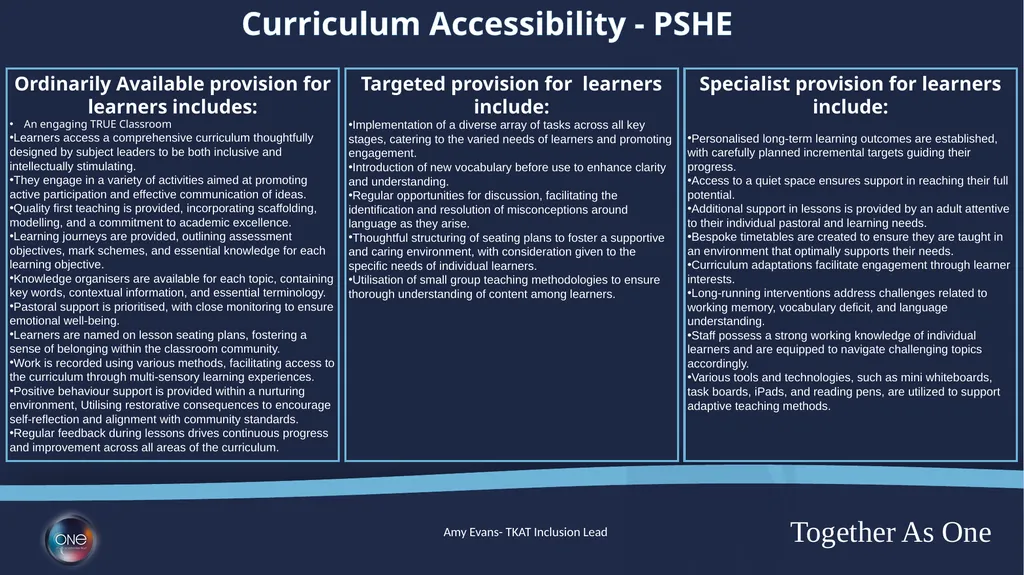
Additional support in lessons is provided by an adult who is attentive to individual pastoral, emotional, and learning needs.
Bespoke timetables, possibly with reduced access to lessons, are designed to accommodate their needs and ensure holistic attainment across the curriculum.
Long-term interventions address challenges related to working memory, vocabulary, knowledge deficit, and specialist language understanding.
Targeted questioning techniques are employed to reinforce understanding of lesson tasks.
Support is offered within the school environment to assist with homework completion.
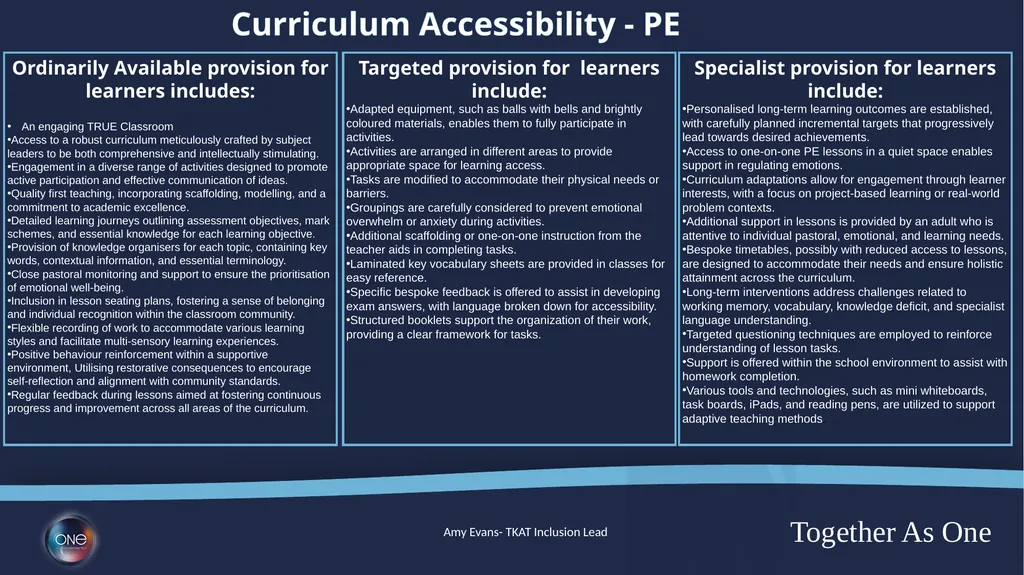
Various tools and technologies, such as mini whiteboards, task boards, iPads, and reading pens, are utilized to support adaptive teaching methods. Curriculum Accessibility - PE<br>
slide20. Ordinarily Available provision for learners includes:
An engaging TRUE Classroom
Learners access a comprehensive curriculum thoughtfully designed by subject leaders to be both inclusive and intellectually stimulating.
They engage in a variety of activities aimed at promoting active participation and effective communication of ideas.
Quality first teaching is provided, incorporating scaffolding, modelling, and a commitment to academic excellence.
Learning journeys are provided, outlining assessment objectives, mark schemes, and essential knowledge for each learning objective.
Knowledge organisers are available for each topic, containing key words, contextual information, and essential terminology.
Pastoral support is prioritised, with close monitoring to ensure emotional well-being.
Learners are named on lesson seating plans, fostering a sense of belonging within the classroom community.
Work is recorded using various methods, facilitating access to the curriculum through multi-sensory learning experiences.
Positive behaviour support is provided within a nurturing environment, Utilising restorative consequences to encourage self-reflection and alignment with community standards.
Regular feedback during lessons drives continuous progress and improvement across all areas of the curriculum. Targeted provision for learners include:
Implementation of a diverse array of tasks across all key stages, catering to the varied needs of learners and promoting engagement.
Introduction of new vocabulary before use to enhance clarity and understanding.
Regular opportunities for discussion, facilitating the identification and resolution of misconceptions around language as they arise.
Thoughtful structuring of seating plans to foster a supportive and caring environment, with consideration given to the specific needs of individual learners.
Utilisation of small group teaching methodologies to ensure thorough understanding of content among learners. Specialist provision for learners include:
Personalised long-term learning outcomes are established, with carefully planned incremental targets guiding their progress.
Access to a quiet space ensures support in reaching their full potential.
Additional support in lessons is provided by an adult attentive to their individual pastoral and learning needs.
Bespoke timetables are created to ensure they are taught in an environment that optimally supports their needs.
Curriculum adaptations facilitate engagement through learner interests.
Long-running interventions address challenges related to working memory, vocabulary deficit, and language understanding.
Staff possess a strong working knowledge of individual learners and are equipped to navigate challenging topics accordingly.
Various tools and technologies, such as mini whiteboards, task boards, iPads, and reading pens, are utilized to support adaptive teaching methods. Curriculum Accessibility - PSHE<br>
slide21. Ordinarily Available provision for learners includes:
An engaging TRUE Classroom
Access to a robust curriculum meticulously crafted by subject leaders to be both comprehensive and stimulating, catering to all levels of ability while also fostering meaning, challenge, and ambition.
Engaging in a diverse range of activities designed to promote active participation and effective communication of their understanding.
Receiving quality first teaching, which incorporates scaffolding, modelling, and instruction tailored to individual needs, ensuring that every learner reaches their full potential.
Embarking on learning journeys that provide detailed roadmaps outlining assessment objectives, mark schemes, and the essential knowledge required for each objective.
Utilising knowledge organisers for each topic, which contain key terms, contextual information, and essential terminology to enhance understanding.
Receiving close pastoral monitoring and support, prioritizing emotional well-being to ensure a nurturing learning environment.
Being named on lesson seating plans, fostering a sense of belonging and individual recognition within the classroom community.
Employing varied methods to record work, facilitating access to the curriculum through multi-sensory learning experiences.
Benefitting from positive behaviour support within a supportive environment, Utilising restorative consequences to promote reflection and meet community behaviour expectations.
Receiving regular feedback during lessons, driving continuous progress and improvement across all areas of the curriculum. Targeted provision for learners include:
Paired peer support involves learners of varying ability levels, fostering scaffolding and peer mediation.
Model answers provided after each assessment empower all learners to refine their work and access higher levels in the mark scheme, irrespective of their current level.
Targeted questioning based on retrieval and linking to current topics enables interleaving, enhancing understanding.
Materials printed on coloured paper are provided to facilitate access to written content for learners with literacy or language needs, as required.
Access to specialist vocabulary glossaries supports comprehension and language acquisition.
Specific feedback is tailored to align with the language of the examination mark scheme, aiding in understanding and improvement.
KS5 booklets offer structured support for organising work, promoting efficiency and effectiveness. Specialist provision for learners include:
Providing access to a quiet space to ensure optimal support for reaching their full potential.
Implementing long-running interventions targeting challenges related to working memory, vocabulary deficit, and language understanding.
Offering one-on-one support from their teacher during lessons to facilitate work completion.
Providing additional support outside of lessons from an adult who understands their individual pastoral and learning needs.
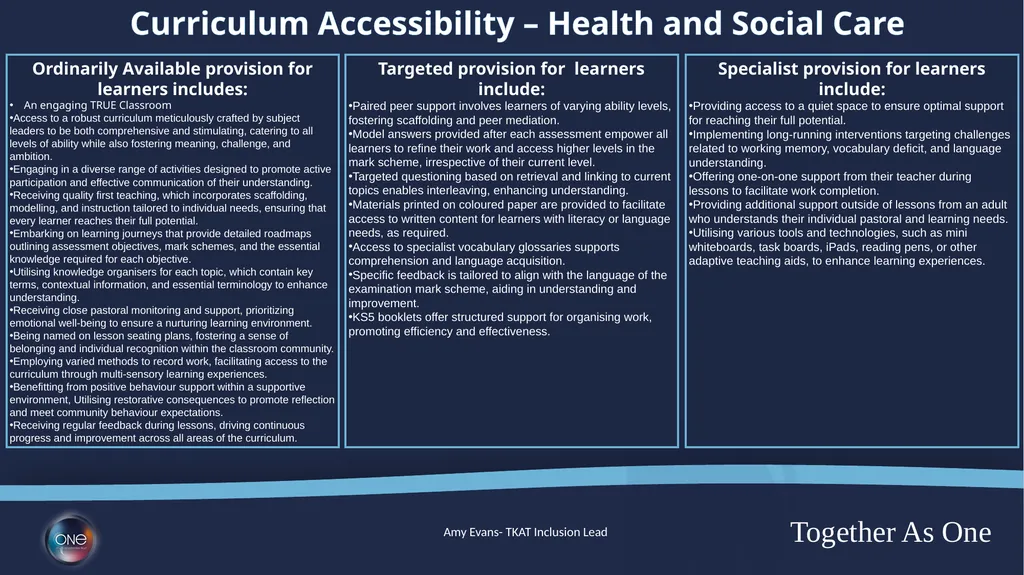
Utilising various tools and technologies, such as mini whiteboards, task boards, iPads, reading pens, or other adaptive teaching aids, to enhance learning experiences. Curriculum Accessibility – Health and Social Care<br>
slide22. Ordinarily Available provision for learners includes:
An engaging TRUE Classroom
Access to a robust curriculum meticulously designed by subject leaders to be both comprehensive and engaging, fostering meaning, challenge, and ambition for all.
Engaging in a diverse range of activities aimed at promoting active participation and effective communication of their understanding.
Receiving quality first teaching, which encompasses scaffolding, modelling, and instruction tailored to individual needs, ensuring every learner reaches their full potential.
Being guided through learning journeys that provide detailed roadmaps outlining assessment objectives, mark schemes, and the essential knowledge required for each objective.
Utilising knowledge organisers for each topic, which contain key terms, contextual information, and essential terminology to enhance understanding.
Receiving close pastoral monitoring and support to prioritise emotional well-being, fostering a nurturing learning environment.
Being named on lesson seating plans to foster a sense of belonging and individual recognition within the classroom community.
Employing varied methods to record work, facilitating access to the curriculum through multi-sensory learning experiences.
Benefiting from positive behaviour support within a nurturing environment, Utilising restorative consequences to promote reflection and meet community behaviour expectations.
Receiving regular feedback during lessons to drive continuous progress and improvement across all areas of the curriculum. Targeted provision for learners include:
Paired peer support involving learners of varying ability levels, facilitating scaffolding and peer mediation.
Provision of model answers after each assessment, empowering all learners to refine their work and access higher levels in the mark scheme, irrespective of their current level.
Targeted questioning based on Bloom's taxonomy, directed at previous topics and linking to current ones, facilitating interleaving.
Materials printed on coloured paper to aid learners with literacy or language needs in accessing written content.
Access to specialist vocabulary glossaries to support comprehension and language acquisition.
Specific feedback structured in the language of the examination mark scheme to aid understanding and improvement.
Provision of booklets in KS5 offering structured support for organising work efficiently. Specialist provision for learners include:
Providing access to a quiet space to ensure optimal support for reaching their full potential.
Implementing long-term interventions to address challenges related to working memory, vocabulary deficit, and language understanding.
Offering personalised one-on-one support from their teacher during lessons to facilitate work completion.
Providing additional support outside of lessons from an adult who understands their individual pastoral and learning needs.
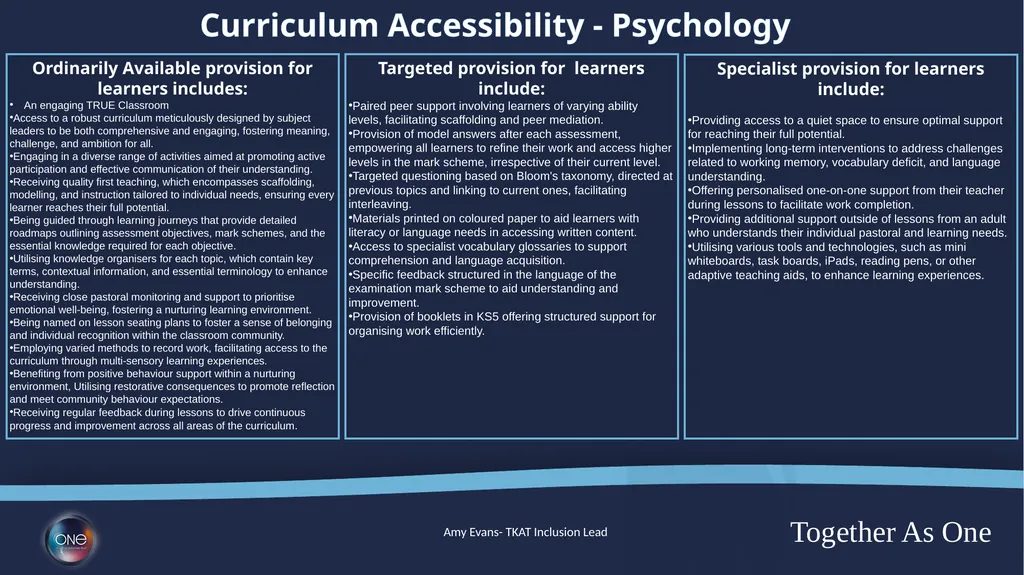
Utilising various tools and technologies, such as mini whiteboards, task boards, iPads, reading pens, or other adaptive teaching aids, to enhance learning experiences. Curriculum Accessibility - Psychology<br>
slide23. Ordinarily Available provision for learners includes:
An engaging TRUE Classroom
. Access to a robust curriculum meticulously designed by subject leaders to be both inclusive and intellectually stimulating.
Engagement in a diverse range of activities aimed at promoting active participation and effective communication.
Quality first teaching, incorporating scaffolding, modelling, and instruction tailored to each learner's needs.
Guidance through learning journeys detailing assessment objectives, mark schemes, and essential knowledge for each objective.
Utilisation of knowledge organisers for each topic, providing key words, context, and essential terminology.
Close pastoral monitoring and support to prioritise emotional well-being.
Inclusion on lesson seating plans, fostering a sense of belonging within the community.
Flexible recording methods to accommodate diverse learning styles.
Positive behaviour support within a nurturing environment, Utilising restorative consequences.
Regular feedback during lessons to drive continuous progress and improvement across the curriculum. Targeted provision for learners include:
Paired peer support involving students of varying abilities, fostering scaffolding and peer mediation.
Provision of model answers after each assessment, empowering all students to refine their work and access higher levels in the mark scheme, regardless of their current level.
Targeted questioning based on Bloom's taxonomy, directed at previous topics and linking to current ones, facilitating interleaving.
Materials printed on coloured paper to assist students with literacy or language needs in accessing written content.
Access to specialist vocabulary glossaries to support comprehension and language acquisition.
Specific feedback tailored to the language of the examination mark scheme.
Provision of booklets in KS5 providing structured support for organising work efficiently. Specialist provision for learners include:
Providing access to a quiet space to ensure optimal support for realizing their potential.
Implementing long-term interventions to address challenges related to working memory, vocabulary deficit, and language understanding.
Offering personalised one-on-one support from their teacher during lessons to facilitate work completion.
Providing additional support outside of lessons from an adult who understands their individual pastoral and learning needs.
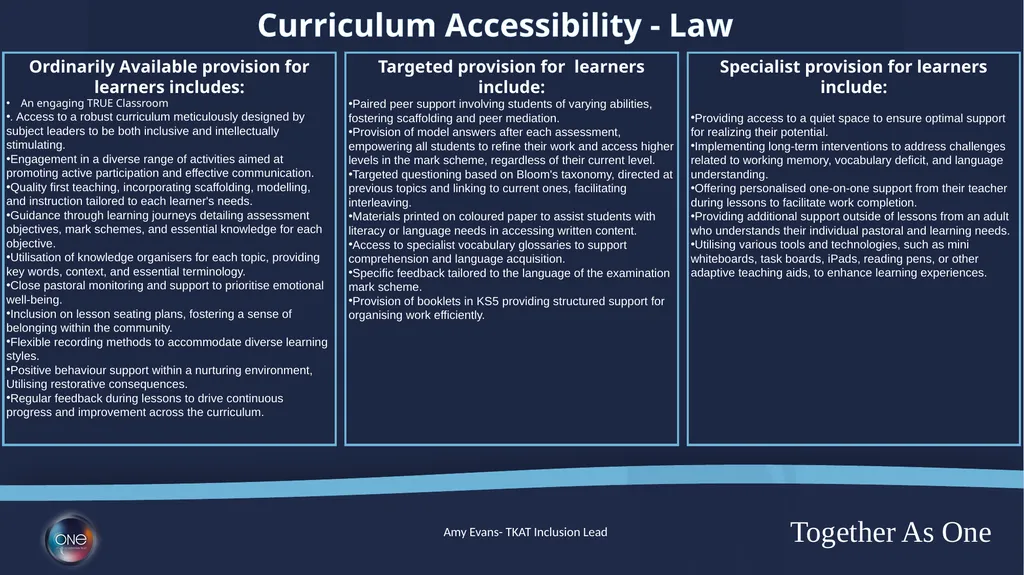
Utilising various tools and technologies, such as mini whiteboards, task boards, iPads, reading pens, or other adaptive teaching aids, to enhance learning experiences. Curriculum Accessibility - Law<br>
slide2. Ordinarily Available provision for learners includes:
Engaging in a TRUE Classroom environment
Access to a robust curriculum meticulously crafted by subject leaders to be inclusive, meaningful, and imbued with challenge and ambition.
A spectrum of engaging activities enabling effective communication of understanding and skill demonstration.
Close pastoral monitoring and support, prioritising emotional well-being.
Strategic seating during adult-led activities tailored to individual learning needs (visual, auditory, focus, and concentration).
Versatile methods for recording work, facilitating multi-sensory learning and curriculum access.
Positive behavioural support, employing restorative consequences for reflective growth and alignment with community expectations.
Timely feedback during learning sessions, fostering continual progress across the curriculum. Targeted provision for learners include:
Providing adapted equipment to help all learners participate in activities.
Modifying tasks to suit learners physical needs and address language and communication barriers.
Thoughtfully arranging groups to enhance focus and provide positive behavioural role models.
Offering additional support, such as scaffolding or one-on-one instructions from adults, with language broken down for easier understanding.
Incorporating manipulatives more often in math lessons to make concepts clearer and more visual.
Using writing scaffolds, like letter formation guides, to encourage early writing attempts.
Offering extra fine motor tasks to strengthen muscles for early writing tasks. Specialist provision for learners include:
Tailored long-term learning goals with carefully crafted step-by-step targets, guiding them towards desired achievements.
Access to a serene or sensory environment, ensuring support for emotional regulation.
Curriculum adjustments to foster engagement by incorporating learner interests into personalised learning activities.
Extra assistance during learning and social activities from an adult who understands their unique pastoral, emotional, and learning requirements.
Ongoing interventions addressing challenges in language and communication, working memory, vocabulary, and knowledge gaps.
Specific questioning tailored to individual learning needs, encouraging participation during teacher-led activities. Curriculum Accessibility - EYFS<br>
slide3. Engaging in a TRUE Classroom
Access a dynamic curriculum crafted by subject leaders to be inclusive, meaningful, and ambitious.
Benefit from curriculum adaptations tailored to enhance engagement.
Engage in a variety of activities to effectively communicate their understanding.
Receive close pastoral monitoring to prioritise emotional well-being.
Experience flexible seating arrangements based on individual needs, fostering collaborative work.
Record their work using various methods, promoting multi-sensory learning.
Receive positive behavioural support, with restorative consequences to encourage reflection and meet community expectations.
Receive feedback during lessons to drive continuous progress across the curriculum. English
small group/ guided sessions.
Pre-teaching sessions to prepare them for upcoming lessons.
Assigned seats tailored to address sensory or learning needs.
One-on-one targeted interaction with educators.
Targeted interventions outside of regular lessons to address gaps in understanding Curriculum Accessibility – Key Stage 1 and 2 Maths
Small group/ guided sessions
Pre-teaching sessions to prepare them for upcoming lessons.
Assigned seats designed to accommodate sensory or learning needs.
One-on-one targeted interaction with educators.
Targeted interventions outside of regular lessons to address knowledge gaps.
Adaptations of lesson structures to suit individual learning styles.
Incorporation of manipulatives to enhance understanding. MFL
Clear vocabulary explanations or introductory vocabulary work to prepare for tasks.
Guidance through question matrices to assist in answering questions, whether orally or in written form. Art/ DT
Small group/ guided sessions.
Benefit from designated seats tailored to address sensory or learning needs.
Receive clear vocabulary explanations or introductory vocabulary work to prepare for tasks Humanities
Small group/ guided sessions.
Learners have assigned seats to accommodate sensory or learning needs.
Oral responses are encouraged to foster understanding of key skills. Science
Pre-teaching sessions to ready them for upcoming lessons.
Assigned seats tailored to accommodate sensory or learning needs.
Individualized one-on-one interaction with educators.
Targeted interventions outside of regular lessons to bridge knowledge gaps.
Customised adaptations of lesson structures to match individual learning styles.
Utilisation of manipulatives to bolster understanding. PE
Tasks are adapted to accommodate physical needs/barriers.
Groups are carefully arranged to prevent emotional overwhelm or anxiety during activities.
Key vocabulary sheets are laminated for easy reference in classes. Music
Small group/ guided sessions
Learners have designated seats tailored to meet sensory or learning needs.
Verbal and written scaffolding is offered to ensure clear understanding of expectations. PSHCE
Teachers possess a deep understanding of their learners, enabling them to regularly engage in discussions that address language misconceptions. RE
Small group/ guided sessions.
Learners are assigned specific seats to accommodate sensory or learning needs.
Oral responses are actively encouraged to deepen understanding of key skills. Personalised long-term learning outcomes with carefully planned incremental targets to achieving their outcomes.
Access to a quiet/ sensory space to ensure they can be supported to meet their potential
Additional support in lessons from an adult who is attuned to their individual pastoral and learning needs.
Bespoke timetables adaptations taking in to account their needs to ensure that they are taught in an environment that best supports their needs.
Long-running interventions to support challenges around working memory, vocabulary deficit and language understanding.
Use of mini whiteboards, task boards, park-it boards, talking tins and other technology to support adaptive teaching. Targeted provision for learners include: Ordinarily Available provision for learners includes: Specialist provision for learners include: Sikh Studies
Small group/ guided sessions.
Learners are assigned specific seats to accommodate sensory or learning needs.
Oral responses are actively encouraged to deepen understanding of key skills.<br>
slide4. KS3, KS4 & KS5<br>
slide5. Ordinarily Available provision for learners includes:
Engaging in a TRUE Classroom environment.
Accessing a comprehensive curriculum thoughtfully crafted by subject leaders to be both inclusive and intellectually stimulating.
Participating in a variety of activities designed to foster engagement and effective communication of understanding.
Receiving quality first teaching, including scaffolding, modelling, and encouragement to strive for excellence.
Following personalised learning journeys that outline assessment objectives, mark schemes, and essential knowledge for each area of study.
Utilising knowledge organisers for each topic, containing key words, context, and essential terminology.
Benefiting from close pastoral monitoring to prioritise emotional well-being.
Having designated seats on lesson seating plans, fostering a sense of belonging and community.
Recording work in various formats to support multi-sensory learning.
Receiving support with behaviour choices in a positive environment, with restorative consequences promoting reflection and alignment with community expectations.
Receiving timely feedback during lessons to drive continuous progress across the curriculum. Targeted provision for learners include:
Providing sentence stems and clear modelling for analysis tasks.
Offering verbal and written scaffolding to ensure clear understanding of expectations.
Delivering clear vocabulary explanations or introductory vocabulary work to prepare for tasks.
Providing one-on-one interaction and targeted intervention by the teacher.
Allocating specific seats in lessons to accommodate sensory or learning needs.
Adapting lesson structures, such as incorporating more paired/discussion work or increasing mini-plenaries.
Implementing targeted interventions to address gaps in understanding.
Offering extra support in lessons from an additional adult to effectively meet academic or pastoral needs. Specialist provision for learners include:
Personalised long-term learning goals with meticulously planned incremental targets.
Access to a quiet space for optimal support in reaching their potential.
Additional in-class support from a knowledgeable adult attuned to their individual pastoral and learning needs.
Tailored timetables ensuring instruction in environments best suited to their requirements.
Curriculum adaptations fostering engagement through learner interests, including carefully chosen texts.
Ongoing interventions addressing challenges in working memory, vocabulary deficit, and language understanding.
Additional English teaching time, with some learners having a reduced timetable to prioritise English Language GCSE.
Support within the school environment to complete homework assignments.
Utilisation of various equipment and technologies, such as mini whiteboards, task boards, iPads, and reading pens, to enhance adaptive teaching practices. Curriculum Accessibility - English<br>
slide6. Ordinarily Available provision for learners includes:
Engaging in a TRUE Classroom environment.
Accessing a robust curriculum thoughtfully designed by subject leaders to be both inclusive and intellectually stimulating.
Participating in a variety of activities aimed at enhancing engagement and facilitating effective communication of understanding.
Receiving quality first teaching, which includes scaffolding, modelling, and encouragement to strive for excellence.
Following personalised learning journeys detailing assessment objectives, mark schemes, and essential knowledge for each area of study.
Utilising knowledge organisers for each topic, containing key words, context, and essential terminology.
Receiving close pastoral monitoring to prioritise emotional well-being.
Being named on each lesson seating plan, fostering a sense of belonging and community.
Recording work in various formats to support multi-sensory learning.
Receiving support with behaviour choices in a positive environment, with restorative consequences promoting reflection and alignment with community expectations.
Receiving timely feedback during lessons to drive continuous progress across the curriculum. Targeted provision for learners include:
Incorporating concrete and pictorial representations during teaching and independent work to enhance understanding.
Utilising dual coding techniques to alleviate cognitive load.
Integrating manipulatives such as multilink, Numicon, and Cuisenaire rods to support learning.
Providing scaffolding tools like number lines, hint sheets, and writing frames to ensure clear understanding of expectations.
Delivering clear vocabulary explanations or introductory vocabulary work to prepare for tasks.
Offering personalised one-to-one interaction and targeted intervention by the teacher.
Allocating specific seats in lessons to accommodate sensory or learning needs.
Adapting lesson structures to include more paired/discussion work or increased mini-plenaries.
Implementing targeted interventions to address knowledge gaps.
Offering additional support in lessons from an additional adult to effectively meet academic or pastoral needs. Specialist provision for learners include:
Personalised long-term learning outcomes with meticulously planned incremental targets.
Access to a quiet space to support them in reaching their full potential.
Additional in-class support from an adult attuned to their individual pastoral and learning needs.
Tailored timetables to ensure instruction in environments that best support their needs.
Curriculum adaptations fostering engagement through learner interests, such as project focus or word problem contexts.
Ongoing interventions to address challenges in number understanding and calculation skills.
Additional teaching time in math through a reduced timetable.
personalised homework assignments or in-school support to complete homework tasks.
Utilisation of various equipment and technologies, such as mini whiteboards, task boards, iPads, and reading pens, to enhance adaptive teaching practices. Curriculum Accessibility - Maths<br>
slide7. Ordinarily Available provision for learners includes:
Learning within a TRUE Classroom setting.
Accessing a robust curriculum meticulously crafted by subject leaders to be both inclusive and intellectually stimulating.
Engaging in a variety of activities designed to foster engagement and effective communication of understanding.
Receiving quality first teaching, which includes scaffolding, modelling, and encouragement to reach higher levels of achievement.
Following personalised learning journeys outlining assessment objectives, mark schemes, and essential knowledge for each area of study.
Utilising knowledge organisers provided for each topic, containing key words, context, and essential terminology.
Receiving close pastoral monitoring and support to ensure emotional well-being is prioritised.
Being named on each lesson seating plan to promote a sense of belonging and community.
Recording work in various formats to facilitate multi-sensory learning.
Receiving support with behaviour choices within a positive environment, where restorative consequences promote reflection and alignment with community expectations.
Receiving timely feedback during lessons to drive continual progress across the curriculum. Targeted provision for learners include:
Utilising a variety of tasks tailored to support all learning styles across the key stages.
Structuring seating plans to provide appropriate support.
Offering teacher support during practical lessons.
Incorporating demonstrations to ensure accessibility for learners with diverse learning needs in science practical's.
Utilising coloured backgrounds on PowerPoint presentations where appropriate.
Allocating specific seats in lessons to accommodate sensory or learning needs.
Adapting lesson structures, such as incorporating more paired/discussion work or increasing mini-plenaries.
Implementing targeted interventions to address knowledge gaps.
Providing extra support in lessons from an additional adult to effectively meet academic or pastoral needs. Specialist provision for learners include:
Personalised long-term learning outcomes with carefully planned incremental targets to achieve their goals.
Access to a quiet space to facilitate reaching their potential.
Additional support in lessons from an adult who understands their individual pastoral and learning needs.
Bespoke timetables tailored to ensure instruction in environments that best support their needs.
Curriculum adaptations allowing for engagement through learner interests, such as project focus or word problem contexts.
Long-running interventions addressing challenges in working memory, vocabulary deficit, and language understanding.
Additional teaching time in science through a reduced timetable to accommodate individual needs.
In-school support to complete homework assignments.
Utilisation of equipment such as mini whiteboards, task boards, iPads, reading pens, and other technologies to support adaptive teaching approaches. Curriculum Accessibility - Science<br>
slide8. Ordinarily Available provision for learners includes:
Learning within a TRUE Classroom setting.
Accessing a robust curriculum thoughtfully designed by subject leaders to be both inclusive and intellectually stimulating.
Engaging in a variety of activities aimed at enhancing engagement and facilitating effective communication of understanding.
Receiving quality first teaching, which includes scaffolding, modelling, and encouragement to strive for excellence.
Following personalised learning journeys that outline assessment objectives, mark schemes, and essential knowledge for each area of study.
Utilising knowledge organisers provided for each topic, containing key words, context, and essential terminology.
Receiving close pastoral monitoring and support to ensure emotional well-being is prioritised.
Being named on each lesson seating plan to foster a sense of belonging and community.
Recording work in various formats to support multi-sensory learning.
Receiving support with behaviour choices within a positive environment, where restorative consequences promote reflection and alignment with community expectations.
Receiving timely feedback during lessons to drive continuous progress across the curriculum. Targeted provision for learners include:
Utilisation of a variety of tasks across key stages to accommodate different learning styles.
Structured seating plans to provide appropriate support.
Teacher support during practical lessons to enhance learning.
Integration of demonstrations to ensure accessibility for learners with diverse needs.
Use of coloured backgrounds on PowerPoint presentations and computer screens as needed.
Allocation of specific seating arrangements to address sensory or learning needs.
Adaptation of lesson structures, such as incorporating more paired/discussion work or increased mini-plenaries.
Implementation of targeted interventions to address knowledge gaps.
Provision of extra support in lessons from an additional adult to effectively meet academic or pastoral needs. Specialist provision for learners include:
Personalised long-term learning outcomes with meticulously planned incremental targets to achieve their goals.
Access to a quiet space to ensure optimal support for reaching their potential.
Additional in-class support from an adult who understands their individual pastoral and learning needs.
Customised timetables tailored to ensure instruction in environments that best support their needs.
Curriculum adaptations allowing for engagement through learner interests, including carefully chosen text choices.
Long-term interventions addressing challenges in working memory, vocabulary deficit, and language understanding.
In-school support to complete homework assignments.
Utilisation of various equipment and technologies, such as mini whiteboards, task boards, iPads, reading pens, and other tools, to support adaptive teaching strategies. Curriculum Accessibility – Computer Science/Media<br>
slide9. Ordinarily Available provision for learners includes:
Learning within a TRUE Classroom setting.
Accessing a robust curriculum thoughtfully designed by subject leaders to be both inclusive and intellectually stimulating.
Engaging in a variety of activities aimed at enhancing engagement and facilitating effective communication of understanding.
Receiving quality first teaching, which includes scaffolding, modelling, and encouragement to strive for excellence.
Following personalised learning journeys that outline assessment objectives, mark schemes, and essential knowledge for each area of study.
Utilising knowledge organisers provided for each topic, containing key words, context, and essential terminology.
Receiving close pastoral monitoring and support to ensure emotional well-being is prioritised.
Being named on each lesson seating plan to foster a sense of belonging and community.
Recording work in various formats to support multi-sensory learning.
Receiving support with behaviour choices within a positive environment, where restorative consequences promote reflection and alignment with community expectations.
Receiving timely feedback during lessons to drive continuous progress across the curriculum. Targeted provision for learners include:
Utilisation of a variety of tasks across key stages to accommodate different learning styles.
Structured seating plans to provide appropriate support.
Teacher support during practical lessons to enhance learning.
Integration of demonstrations to ensure accessibility for learners with diverse needs.
Use of coloured backgrounds on PowerPoint presentations and computer screens as needed.
Allocation of specific seating arrangements to address sensory or learning needs.
Adaptation of lesson structures, such as incorporating more paired/discussion work or increased mini-plenaries.
Implementation of targeted interventions to address knowledge gaps.
Provision of extra support in lessons from an additional adult to effectively meet academic or pastoral needs. Specialist provision for learners include:
Personalised long-term learning outcomes with meticulously planned incremental targets to achieve their goals.
Access to a quiet space to ensure optimal support for reaching their potential.
Additional in-class support from an adult who understands their individual pastoral and learning needs.
Customised timetables tailored to ensure instruction in environments that best support their needs.
Curriculum adaptations allowing for engagement through learner interests, including carefully chosen text choices.
Long-term interventions addressing challenges in working memory, vocabulary deficit, and language understanding.
In-school support to complete homework assignments.
Utilisation of various equipment and technologies, such as mini whiteboards, task boards, iPads, reading pens, and other tools, to support adaptive teaching strategies. Curriculum Accessibility – Business Studies<br>
slide10. Ordinarily Available provision for learners includes:
Engaging in a TRUE Classroom environment.
Accessing a robust curriculum meticulously designed by subject leaders to be both inclusive and intellectually stimulating.
Participating in a variety of activities aimed at fostering engagement and effective communication of understanding.
Receiving quality first teaching, which includes scaffolding, modelling, and encouragement to excel.
Following personalised learning journeys outlining assessment objectives, mark schemes, and essential knowledge for each area of study.
Utilising knowledge organisers provided for each topic, containing key words, context, and essential terminology.
Receiving close pastoral monitoring and support to prioritise emotional well-being.
Being named on each lesson seating plan to promote a sense of belonging and community.
Recording work in various formats to support multi-sensory learning.
Receiving support with behaviour choices within a positive environment, where restorative consequences promote reflection and alignment with community expectations.
Receiving timely feedback during lessons to drive continuous progress across the curriculum. Targeted provision for learners include:
Providing verbal and written scaffolding to ensure clear understanding of expectations.
Offering clear vocabulary explanations and introductory vocabulary work to prepare for tasks.
Facilitating one-to-one interaction and targeted intervention by the teacher.
Providing laminated and differently coloured specialist vocabulary sheets with music terminology explained.
Allocating specific seats in lessons to accommodate sensory or learning needs.
Adapting lesson structures, such as incorporating more paired/discussion work or increasing mini-plenaries.
Implementing targeted interventions to address knowledge gaps.
Offering extra support in lessons from an additional adult to effectively meet academic or pastoral needs.
Providing the use of headphones for keyboard work or ear defenders for practical tasks.
Using wider spaced manuscript paper for improved writing clarity. Specialist provision for learners include:
Personalised long-term learning outcomes with meticulously planned incremental targets to achieve their goals.
Access to a quiet space, particularly crucial during practical tasks, to support them in reaching their full potential.
Additional in-class support from an adult who understands their individual pastoral and learning needs.
Customised timetables tailored to ensure instruction in environments that best support their needs.
Curriculum adaptations allowing for engagement through learner interests, including carefully selected musical choices.
Long-term interventions addressing challenges in working memory, vocabulary deficit, and language understanding.
In-school support to complete homework assignments.
Utilisation of equipment such as mini whiteboards, task boards, iPads, reading pens, and other technologies to support adaptive teaching methods. Curriculum Accessibility - Music<br>
slide11. Ordinarily Available provision for learners includes:
Engaging in a TRUE Classroom setting.
Accessing a robust curriculum meticulously crafted by the subject leader to be both inclusive and intellectually stimulating.
Participating in a variety of activities aimed at fostering engagement and effective communication of understanding.
Receiving quality first teaching, which encompasses scaffolding, modelling, and instruction aimed at achieving excellence.
Following personalised learning journeys outlining assessment objectives, mark schemes, and essential knowledge for each area of study.
Utilising knowledge organisers provided for each topic, containing key words, context, and essential terminology.
Receiving close pastoral monitoring and support to prioritise emotional well-being.
Being named on each lesson seating plan to promote a sense of belonging and community.
Recording work in various formats to support multi-sensory learning.
Receiving support with behaviour choices within a positive environment, where restorative consequences promote reflection and alignment with community expectations.
Receiving timely feedback during lessons to drive continuous progress across the curriculum. Targeted provision for learners include:
Utilising concrete and pictorial representations during teaching and independent work to enhance understanding.
Providing clear vocabulary explanations and introductory vocabulary work to prepare for tasks.
Facilitating one-to-one interaction and targeted intervention by the teacher.
Allocating specific seating arrangements in lessons to accommodate sensory or learning needs.
Adapting lesson structures, such as incorporating more paired/discussion work or increasing mini-plenaries.
Implementing targeted interventions to address knowledge gaps.
Offering extra support in lessons from an additional adult to effectively meet academic or pastoral needs.
Providing laminated and differently coloured specialist vocabulary sheets with phonetic breakdowns for enhanced learning. Specialist provision for learners include:
Personalised long-term learning outcomes with carefully planned incremental targets to achieving their outcomes.
Access to a quiet space to ensure they can be supported to meet their potential.
Additional support in lessons from an adult who is attuned to their individual pastoral and learning needs.
Bespoke timetables taking in to account their needs to ensure that they are taught in an environment that best supports their needs.
Curriculum adaptations to allow for engagement through learner interests (project focus or word problem context).
Long-running interventions to support challenges around number understanding and understanding of calculations.
Personalised homework to be set or support in school to complete homework.
Additional adult support in practical lessons.
Use of equipment such as mini whiteboards, task boards, park it boards, iPads, reading pens or other technologies to support adaptive teaching Curriculum Accessibility - Art<br>
slide12. Ordinarily Available provision for learners includes:
Engaging in a TRUE Classroom environment.
Accessing a robust curriculum meticulously designed by the subject leader to be both meaningful, challenging, and ambitious.
Participating in a variety of activities aimed at fostering engagement and effective communication of understanding.
Receiving quality first teaching, which includes scaffolding, modelling, and instruction aimed at achieving excellence.
Following personalised learning journeys detailing assessment objectives, mark schemes, and essential knowledge for each area of study.
Utilising knowledge organisers provided for each topic, containing key words, context, and essential terminology.
Receiving close pastoral monitoring and support to prioritise emotional well-being.
Being named on each lesson seating plan to promote a sense of belonging and community.
Recording work in various formats to support multi-sensory learning.
Receiving support with behaviour choices within a positive environment, where restorative consequences promote reflection and alignment with community expectations.
Receiving timely feedback during lessons to drive continuous progress across the curriculum. Targeted provision for learners include:
Utilising concrete and pictorial representations during teaching and independent work to enhance understanding.
Providing clear vocabulary explanations and introductory vocabulary work to prepare for tasks.
Facilitating one-to-one interaction and targeted intervention by the teacher.
Allocating specific seating arrangements in lessons to accommodate sensory or learning needs.
Adapting lesson structures, such as incorporating more paired/discussion work or increasing mini-plenaries.
Implementing targeted interventions to address knowledge gaps.
Offering extra support in lessons from an additional adult to effectively meet academic or pastoral needs.
Providing laminated and differently coloured specialist vocabulary sheets with phonetic breakdowns.
Using ear defenders during practical work to minimize distractions and enhance focus. Specialist provision for learners include:
Personalised long-term learning outcomes with meticulously planned incremental targets to achieve their educational goals.
Access to a quiet space to facilitate focused learning and support their academic potential.
Additional in-class support from an adult who understands their individual pastoral and learning needs.
Customised timetables tailored to ensure instruction in environments that optimise support for their needs.
Curriculum adaptations allowing for engagement through learner interests, such as project-focused or word problem contexts.
Long-term interventions addressing challenges related to number understanding and calculations.
Provision of personalised homework assignments or in-school support to complete homework tasks.
Additional adult support in practical lessons to adhere to health and safety guidelines.
Utilisation of various teaching aids and technologies, including mini whiteboards, task boards, iPads, and reading pens, to facilitate adaptive teaching strategies. Curriculum Accessibility - DT<br>
slide13. Ordinarily Available provision for learners includes:
Engaging in a TRUE Classroom environment.
Accessing a robust curriculum meticulously designed by the subject leader to be both meaningful, challenging, and ambitious.
Participating in a variety of activities aimed at fostering engagement and effective communication of understanding.
Receiving quality first teaching, which includes scaffolding, modelling, and instruction aimed at achieving excellence.
Following personalised learning journeys detailing assessment objectives, mark schemes, and essential knowledge for each area of study.
Utilising knowledge organisers provided for each topic, containing key words, context, and essential terminology.
Receiving close pastoral monitoring and support to prioritise emotional well-being.
Being named on each lesson seating plan to promote a sense of belonging and community.
Recording work in various formats to support multi-sensory learning.
Receiving support with behaviour choices within a positive environment, where restorative consequences promote reflection and alignment with community expectations.
Receiving timely feedback during lessons to drive continuous progress across the curriculum. Targeted provision for learners include:
Utilising concrete and pictorial representations during teaching and independent work to enhance understanding.
Providing clear vocabulary explanations and introductory vocabulary work to prepare for tasks.
Facilitating one-to-one interaction and targeted intervention by the teacher.
Allocating specific seating arrangements in lessons to accommodate sensory or learning needs.
Adapting lesson structures, such as incorporating more paired/discussion work or increasing mini-plenaries.
Implementing targeted interventions to address knowledge gaps.
Offering extra support in lessons from an additional adult to effectively meet academic or pastoral needs.
Providing laminated and differently coloured specialist vocabulary sheets with phonetic breakdowns.
Using ear defenders during practical work to minimize distractions and enhance focus. Specialist provision for learners include:
Personalised long-term learning outcomes with meticulously planned incremental targets to achieve their educational goals.
Access to a quiet space to facilitate focused learning and support their academic potential.
Additional in-class support from an adult who understands their individual pastoral and learning needs.
Customised timetables tailored to ensure instruction in environments that optimise support for their needs.
Curriculum adaptations allowing for engagement through learner interests, such as project-focused or word problem contexts.
Long-term interventions addressing challenges related to number understanding and calculations for measuring.
Provision of personalised homework assignments or in-school support to complete homework tasks.
Additional adult support in practical lessons to adhere to health and safety guidelines.
Utilisation of various teaching aids and technologies, including mini whiteboards, task boards, iPads, and reading pens, to facilitate adaptive teaching strategies. Curriculum Accessibility – Food Technology<br>
slide14. Ordinarily Available provision for learners includes:
Participation in a TRUE Classroom setting.
Access to a comprehensive curriculum meticulously crafted by the subject leader, ensuring it is not only suitable for all learners but also engaging, meaningful, and intellectually stimulating.
Engagement in a variety of activities aimed at promoting active participation and effective communication of knowledge.
Receipt of quality first teaching, which incorporates scaffolding, modelling, and instruction tailored to each student's needs.
Provision of learning journeys detailing assessment objectives, mark schemes, and essential knowledge required for each area of study. (Knowledge booklets to support learning)
Availability of knowledge organisers, (in the form of sentence builders) for each topic/ key questions, containing key vocabulary and grMMER, contextual information, and essential terminology.
Close pastoral monitoring and support to prioritise emotional well-being.
Inclusion on lesson seating plans to foster a sense of belonging and community among learners.
Opportunities to document work in various formats, promoting access to the curriculum through multi-sensory learning.
Support in making positive behaviour choices within a nurturing environment, with the use of restorative consequences to foster reflection and alignment with community expectations.
Provision of feedback during lessons aimed at driving continuous progress across the curriculum. Targeted provision for learners include:
Verbal and written scaffolding techniques employed to ensure learners grasp expectations clearly.
Utilisation of varied colours in worksheets and presentations as needed for enhanced visual comprehension.
Support with phonics through a blend of actions and imagery to reinforce understanding (using mnemonics to enhance phonics practice in French)
Clear vocabulary explanations and introductory activities to prepare learners for upcoming tasks.
One-on-one interaction and personalised interventions delivered by the teacher.
Implementation of diverse strategies such as different font sizes, cloze activities, and writing or speaking frames to facilitate learning (sentence builders booklets).
Allocation of specific seating arrangements in lessons to cater to sensory or learning needs.
Adaptation of lesson structures, including increased paired or discussion work and more frequent mini-plenaries.
Targeted interventions aimed at addressing specific knowledge gaps.
Provision of additional support during lessons from an extra adult to effectively address the learner's academic or pastoral requirements. Specialist provision for learners include:
Personalised long-term learning outcomes with meticulously planned incremental targets to guide them towards their goals.
Access to a serene environment conducive to concentration, facilitating their ability to reach their full potential.
Additional support during lessons provided by an adult who is finely attuned to their individual pastoral and learning needs.
Curriculum adaptations tailored to spark engagement by incorporating learner interests through thoughtfully selected text choices.
Long-term interventions aimed at addressing challenges related to working memory, vocabulary deficit, and language understanding.
Personalised homework assignments tailored to individual learning needs, supplemented by in-school support to ensure completion (use of online tools to personalise homework).
Utilisation of various equipment such as mini whiteboards, task boards, iPads, and reading pens, among other technologies, to facilitate adaptive teaching methods. Curriculum Accessibility - MFL<br>
slide15. Ordinarily Available provision for learners includes:
Engaging in a TRUE Classroom
Access to a robust curriculum meticulously crafted by subject experts, ensuring it's both accessible and intellectually stimulating.
Engagement in a variety of activities fostering effective communication of their understanding.
Quality first teaching incorporating scaffolding, modelling, and a focus on reaching the highest standards.
Detailed learning journeys outlining assessment objectives and marking schemes, along with the requisite knowledge for each objective.
Provision of knowledge organisers for every topic, containing essential keywords, contextual information, and key terminology.
Ongoing pastoral support to prioritise emotional well-being.
Individualized recognition through inclusion in lesson seating plans, fostering a sense of belonging within the community.
Opportunities to express learning through diverse mediums, facilitating multi-sensory engagement.
Positive reinforcement for behaviour, with restorative consequences encouraging reflection and alignment with community expectations.
Regular feedback during lessons to drive continuous progress across all areas of the curriculum. Targeted provision for learners include:
Utilisation of a diverse array of tasks tailored to accommodate various learning styles across key stages.
Structured seating plans designed to facilitate appropriate support for each student.
Implementation of sentence starters and writing frames to bolster extended writing endeavours.
Clear success criteria embedded within assessments to aid progression for learners of all abilities.
Inclusion of relevant materials within KS4 geography lesson packs.
Provision of colour paper sheets upon request.
On-demand assistance with colour identification on maps.
Access to textbooks for home use, aiding with homework tasks and revision. Specialist provision for learners include:
Personalised long-term learning outcomes with meticulously planned incremental targets guiding their journey toward achievement.
Provision of a quiet space to ensure optimal support in reaching their full potential.
Dedicated assistance within lessons from a knowledgeable adult attuned to their unique pastoral and learning requirements.
Assigned seating within the classroom tailored to their needs, facilitating seamless access to lesson content.
Targeted teacher support to clarify expectations surrounding written tasks, ensuring comprehension and success.
Strategic employment of questioning techniques to reinforce understanding of lesson objectives.
In-school support for completing homework assignments.
Utilisation of various tools and technologies such as mini whiteboards, task boards, park it boards, iPads, and reading pens to enhance adaptive teaching methodologies. Curriculum Accessibility - Geography<br>
slide16. Ordinarily Available provision for learners includes:
Engaging in a TRUE Classroom
Access to a robust curriculum meticulously designed by subject leaders to be inclusive, meaningful, and intellectually stimulating.
Engagement through a variety of activities promoting effective communication of understanding.
Delivery of quality first teaching, encompassing scaffolding, modelling, and a commitment to reaching the highest standards.
Guidance through detailed learning journeys outlining assessment objectives, mark schemes, and essential knowledge for each learning objective.
Provision of knowledge organisers for each topic, containing key terms, contextual information, and essential terminology.
Ongoing pastoral support ensuring emotional well-being is a priority.
Inclusion in lesson seating plans, fostering a sense of belonging within the community.
Opportunities to document work in various formats, facilitating access to the curriculum through multi-sensory learning.
Positive reinforcement for behaviour choices within a supportive environment, Utilising restorative consequences for reflection and growth.
Regular feedback during lessons driving continuous progress across all areas of the curriculum.
Provision of glossary of key subject terms ( Tier 3).
Low stakes tests which facilitate ALL learners needs. Targeted provision for learners include:
Project-specific booklets are provided, offering structured support for tasks.
Colour paper sheets are available upon request, catering to individual preferences.
Seating plans are carefully organized to facilitate appropriate support.
Question matrices are utilized to aid learners in both oral and written responses.
Learners receive specific feedback, tailored to their development needs, with exam board language broken down for accessibility in KS4 and KS5.
Structure strips are provided for all question types in GCSE examinations.
A balanced mix of cooperative, independent, and teacher-led activities is employed to challenge and support learners effectively.
Targeted interventions are tailored to address specific areas of need.
Key words and vocabulary are identified and discussed to enhance understanding.
Sentence starters and writing frames are utilized to scaffold extended writing tasks.
Model answers utilised frequently to enable all learners to see/model good pupil responses. Specialist provision for learners include:
Personalised long-term learning outcomes are established, with meticulously planned incremental targets guiding their progress.
Access to a tranquil space is provided to ensure optimal support in reaching their full potential.
Additional support in lessons is available, whenever possible, from a dedicated adult who understands their individual pastoral and learning needs.
Bespoke timetables are crafted to accommodate their needs, ensuring they are taught in an environment conducive to their success.
Curriculum adaptations are made to align with learner interests, including carefully selected texts to enhance engagement.
Long-term interventions are implemented to address challenges related to working memory, retrieval, and understanding of key concepts.
Support is offered within the school setting to assist with homework completion.
Various tools and technologies, such as mini whiteboards, task boards, park-it boards, iPads, and reading pens, are utilised to support adaptive teaching methods.
Specialised bespoke booklets are designed at KS 4 to meet all learners needs. Curriculum Accessibility - History<br>
slide17. Ordinarily Available provision for learners includes:
Engaging in a TRUE Classroom
Access to a robust curriculum thoughtfully crafted by subject leaders to be both inclusive and intellectually stimulating.
Engagement through a diverse range of activities designed to foster effective communication of understanding.
Delivery of quality first teaching, which incorporates scaffolding, modelling, and an emphasis on reaching high standards.
Provision of detailed learning journeys outlining assessment objectives, mark schemes, and essential knowledge for each learning objective.
Provision of knowledge organisers for each topic, containing key words, contextual information, and essential terminology.
Ongoing pastoral monitoring and support to ensure the prioritisation of emotional well-being.
Inclusion in lesson seating plans, fostering a sense of belonging within the community.
Flexibility in recording work through various methods, facilitating access to the curriculum through multi-sensory learning.
Positive reinforcement for behaviour choices within a supportive environment, Utilising restorative consequences to encourage reflection and alignment with community expectations.
Regular feedback during lessons, driving continuous progress across the curriculum. Targeted provision for learners include:
Scaffolded tasks, including sentence starters, are provided to support learning progression.
Coloured paper sheets are available upon request, accommodating individual preferences.
Seating plans are carefully arranged to provide appropriate support and facilitate engagement.
Learners have access to specialist vocabulary glossaries, ensuring clarity, particularly with complex religious terminology.
Specific feedback is provided to aid development in both KS3 and KS4, with exam board language broken down for accessibility.
Structured booklets are utilised to organize and support work completion.
One-on-one sessions are offered to those encountering difficulties, delivered by either the teacher or targeted adult support. Specialist provision for learners include:
Personalised long-term learning outcomes are established, with meticulously planned incremental targets guiding progress.
Access to a quiet space ensures optimal support in reaching their full potential.
Additional support in lessons is provided by an adult attuned to individual pastoral and learning needs.
Bespoke timetables are created to ensure learners are taught in an environment that best supports their needs.
Curriculum adaptations allow for engagement through learner interests, particularly within the ethics element of the GCSE course and at KS3.
Long-running interventions address challenges related to working memory, vocabulary, knowledge deficit, and specialist religious language understanding.
Interventions are provided for learners who joined the GCSE course late or are underperforming.
Support is offered within the school environment to assist with homework completion.
Various tools and technologies, such as mini whiteboards, task boards, park-it boards, iPads, and reading pens, are utilized to support adaptive teaching methods. Curriculum Accessibility - RE<br>
slide18. Ordinarily Available provision for learners includes:
Engaging in a TRUE Classroom
Access to a robust curriculum thoughtfully crafted by subject leaders to be both inclusive and intellectually stimulating.
Engagement through a diverse range of activities designed to foster effective communication of understanding.
Delivery of quality first teaching, which incorporates scaffolding, modelling, and an emphasis on reaching high standards.
Provision of detailed learning journeys outlining assessment objectives, mark schemes, and essential knowledge for each learning objective.
Provision of knowledge organisers for each topic, containing key words, contextual information, and essential terminology.
Ongoing pastoral monitoring and support to ensure the prioritisation of emotional well-being.
Inclusion in lesson seating plans, fostering a sense of belonging within the community.
Flexibility in recording work through various methods, facilitating access to the curriculum through multi-sensory learning.
Positive reinforcement for behaviour choices within a supportive environment, Utilising restorative consequences to encourage reflection and alignment with community expectations.
Regular feedback during lessons, driving continuous progress across the curriculum. Targeted provision for learners include:
Scaffolded tasks, including sentence starters, are provided to support learning progression.
Coloured paper sheets are available upon request, accommodating individual preferences.
Seating plans are carefully arranged to provide appropriate support and facilitate engagement.
Learners have access to specialist vocabulary glossaries, ensuring clarity, particularly with complex religious terminology.
Specific feedback is provided to aid development in both KS3 and KS4, with exam board language broken down for accessibility.
Structured booklets are utilised to organize and support work completion.
One-on-one sessions are offered to those encountering difficulties, delivered by either the teacher or targeted adult support. Specialist provision for learners include:
Personalised long-term learning outcomes are established, with meticulously planned incremental targets guiding progress.
Access to a quiet space ensures optimal support in reaching their full potential.
Additional support in lessons is provided by an adult attuned to individual pastoral and learning needs.
Bespoke timetables are created to ensure learners are taught in an environment that best supports their needs.
Curriculum adaptations allow for engagement through learner interests, particularly within the ethics element of the GCSE course and at KS3.
Long-running interventions address challenges related to working memory, vocabulary, knowledge deficit, and specialist religious language understanding.
Interventions are provided for learners who joined the GCSE course late or are underperforming.
Support is offered within the school environment to assist with homework completion.
Various tools and technologies, such as mini whiteboards, task boards, park-it boards, iPads, and reading pens, are utilized to support adaptive teaching methods. Curriculum Accessibility – Sikh Studies<br>
slide19. Ordinarily Available provision for learners includes:
An engaging TRUE Classroom
Access to a robust curriculum meticulously crafted by subject leaders to be both comprehensive and intellectually stimulating.
Engagement in a diverse range of activities designed to promote active participation and effective communication of ideas.
Quality first teaching, incorporating scaffolding, modelling, and a commitment to academic excellence.
Detailed learning journeys outlining assessment objectives, mark schemes, and essential knowledge for each learning objective.
Provision of knowledge organisers for each topic, containing key words, contextual information, and essential terminology.
Close pastoral monitoring and support to ensure the prioritisation of emotional well-being.
Inclusion in lesson seating plans, fostering a sense of belonging and individual recognition within the classroom community.
Flexible recording of work to accommodate various learning styles and facilitate multi-sensory learning experiences.
Positive behaviour reinforcement within a supportive environment, Utilising restorative consequences to encourage self-reflection and alignment with community standards.
Regular feedback during lessons aimed at fostering continuous progress and improvement across all areas of the curriculum. Targeted provision for learners include:
Adapted equipment, such as balls with bells and brightly coloured materials, enables them to fully participate in activities.
Activities are arranged in different areas to provide appropriate space for learning access.
Tasks are modified to accommodate their physical needs or barriers.
Groupings are carefully considered to prevent emotional overwhelm or anxiety during activities.
Additional scaffolding or one-on-one instruction from the teacher aids in completing tasks.
Laminated key vocabulary sheets are provided in classes for easy reference.
Specific bespoke feedback is offered to assist in developing exam answers, with language broken down for accessibility.
Structured booklets support the organization of their work, providing a clear framework for tasks. Specialist provision for learners include:
Personalised long-term learning outcomes are established, with carefully planned incremental targets that progressively lead towards desired achievements.
Access to one-on-one PE lessons in a quiet space enables support in regulating emotions.
Curriculum adaptations allow for engagement through learner interests, with a focus on project-based learning or real-world problem contexts.
Additional support in lessons is provided by an adult who is attentive to individual pastoral, emotional, and learning needs.
Bespoke timetables, possibly with reduced access to lessons, are designed to accommodate their needs and ensure holistic attainment across the curriculum.
Long-term interventions address challenges related to working memory, vocabulary, knowledge deficit, and specialist language understanding.
Targeted questioning techniques are employed to reinforce understanding of lesson tasks.
Support is offered within the school environment to assist with homework completion.
Various tools and technologies, such as mini whiteboards, task boards, iPads, and reading pens, are utilized to support adaptive teaching methods. Curriculum Accessibility - PE<br>
slide20. Ordinarily Available provision for learners includes:
An engaging TRUE Classroom
Learners access a comprehensive curriculum thoughtfully designed by subject leaders to be both inclusive and intellectually stimulating.
They engage in a variety of activities aimed at promoting active participation and effective communication of ideas.
Quality first teaching is provided, incorporating scaffolding, modelling, and a commitment to academic excellence.
Learning journeys are provided, outlining assessment objectives, mark schemes, and essential knowledge for each learning objective.
Knowledge organisers are available for each topic, containing key words, contextual information, and essential terminology.
Pastoral support is prioritised, with close monitoring to ensure emotional well-being.
Learners are named on lesson seating plans, fostering a sense of belonging within the classroom community.
Work is recorded using various methods, facilitating access to the curriculum through multi-sensory learning experiences.
Positive behaviour support is provided within a nurturing environment, Utilising restorative consequences to encourage self-reflection and alignment with community standards.
Regular feedback during lessons drives continuous progress and improvement across all areas of the curriculum. Targeted provision for learners include:
Implementation of a diverse array of tasks across all key stages, catering to the varied needs of learners and promoting engagement.
Introduction of new vocabulary before use to enhance clarity and understanding.
Regular opportunities for discussion, facilitating the identification and resolution of misconceptions around language as they arise.
Thoughtful structuring of seating plans to foster a supportive and caring environment, with consideration given to the specific needs of individual learners.
Utilisation of small group teaching methodologies to ensure thorough understanding of content among learners. Specialist provision for learners include:
Personalised long-term learning outcomes are established, with carefully planned incremental targets guiding their progress.
Access to a quiet space ensures support in reaching their full potential.
Additional support in lessons is provided by an adult attentive to their individual pastoral and learning needs.
Bespoke timetables are created to ensure they are taught in an environment that optimally supports their needs.
Curriculum adaptations facilitate engagement through learner interests.
Long-running interventions address challenges related to working memory, vocabulary deficit, and language understanding.
Staff possess a strong working knowledge of individual learners and are equipped to navigate challenging topics accordingly.
Various tools and technologies, such as mini whiteboards, task boards, iPads, and reading pens, are utilized to support adaptive teaching methods. Curriculum Accessibility - PSHE<br>
slide21. Ordinarily Available provision for learners includes:
An engaging TRUE Classroom
Access to a robust curriculum meticulously crafted by subject leaders to be both comprehensive and stimulating, catering to all levels of ability while also fostering meaning, challenge, and ambition.
Engaging in a diverse range of activities designed to promote active participation and effective communication of their understanding.
Receiving quality first teaching, which incorporates scaffolding, modelling, and instruction tailored to individual needs, ensuring that every learner reaches their full potential.
Embarking on learning journeys that provide detailed roadmaps outlining assessment objectives, mark schemes, and the essential knowledge required for each objective.
Utilising knowledge organisers for each topic, which contain key terms, contextual information, and essential terminology to enhance understanding.
Receiving close pastoral monitoring and support, prioritizing emotional well-being to ensure a nurturing learning environment.
Being named on lesson seating plans, fostering a sense of belonging and individual recognition within the classroom community.
Employing varied methods to record work, facilitating access to the curriculum through multi-sensory learning experiences.
Benefitting from positive behaviour support within a supportive environment, Utilising restorative consequences to promote reflection and meet community behaviour expectations.
Receiving regular feedback during lessons, driving continuous progress and improvement across all areas of the curriculum. Targeted provision for learners include:
Paired peer support involves learners of varying ability levels, fostering scaffolding and peer mediation.
Model answers provided after each assessment empower all learners to refine their work and access higher levels in the mark scheme, irrespective of their current level.
Targeted questioning based on retrieval and linking to current topics enables interleaving, enhancing understanding.
Materials printed on coloured paper are provided to facilitate access to written content for learners with literacy or language needs, as required.
Access to specialist vocabulary glossaries supports comprehension and language acquisition.
Specific feedback is tailored to align with the language of the examination mark scheme, aiding in understanding and improvement.
KS5 booklets offer structured support for organising work, promoting efficiency and effectiveness. Specialist provision for learners include:
Providing access to a quiet space to ensure optimal support for reaching their full potential.
Implementing long-running interventions targeting challenges related to working memory, vocabulary deficit, and language understanding.
Offering one-on-one support from their teacher during lessons to facilitate work completion.
Providing additional support outside of lessons from an adult who understands their individual pastoral and learning needs.
Utilising various tools and technologies, such as mini whiteboards, task boards, iPads, reading pens, or other adaptive teaching aids, to enhance learning experiences. Curriculum Accessibility – Health and Social Care<br>
slide22. Ordinarily Available provision for learners includes:
An engaging TRUE Classroom
Access to a robust curriculum meticulously designed by subject leaders to be both comprehensive and engaging, fostering meaning, challenge, and ambition for all.
Engaging in a diverse range of activities aimed at promoting active participation and effective communication of their understanding.
Receiving quality first teaching, which encompasses scaffolding, modelling, and instruction tailored to individual needs, ensuring every learner reaches their full potential.
Being guided through learning journeys that provide detailed roadmaps outlining assessment objectives, mark schemes, and the essential knowledge required for each objective.
Utilising knowledge organisers for each topic, which contain key terms, contextual information, and essential terminology to enhance understanding.
Receiving close pastoral monitoring and support to prioritise emotional well-being, fostering a nurturing learning environment.
Being named on lesson seating plans to foster a sense of belonging and individual recognition within the classroom community.
Employing varied methods to record work, facilitating access to the curriculum through multi-sensory learning experiences.
Benefiting from positive behaviour support within a nurturing environment, Utilising restorative consequences to promote reflection and meet community behaviour expectations.
Receiving regular feedback during lessons to drive continuous progress and improvement across all areas of the curriculum. Targeted provision for learners include:
Paired peer support involving learners of varying ability levels, facilitating scaffolding and peer mediation.
Provision of model answers after each assessment, empowering all learners to refine their work and access higher levels in the mark scheme, irrespective of their current level.
Targeted questioning based on Bloom's taxonomy, directed at previous topics and linking to current ones, facilitating interleaving.
Materials printed on coloured paper to aid learners with literacy or language needs in accessing written content.
Access to specialist vocabulary glossaries to support comprehension and language acquisition.
Specific feedback structured in the language of the examination mark scheme to aid understanding and improvement.
Provision of booklets in KS5 offering structured support for organising work efficiently. Specialist provision for learners include:
Providing access to a quiet space to ensure optimal support for reaching their full potential.
Implementing long-term interventions to address challenges related to working memory, vocabulary deficit, and language understanding.
Offering personalised one-on-one support from their teacher during lessons to facilitate work completion.
Providing additional support outside of lessons from an adult who understands their individual pastoral and learning needs.
Utilising various tools and technologies, such as mini whiteboards, task boards, iPads, reading pens, or other adaptive teaching aids, to enhance learning experiences. Curriculum Accessibility - Psychology<br>
slide23. Ordinarily Available provision for learners includes:
An engaging TRUE Classroom
. Access to a robust curriculum meticulously designed by subject leaders to be both inclusive and intellectually stimulating.
Engagement in a diverse range of activities aimed at promoting active participation and effective communication.
Quality first teaching, incorporating scaffolding, modelling, and instruction tailored to each learner's needs.
Guidance through learning journeys detailing assessment objectives, mark schemes, and essential knowledge for each objective.
Utilisation of knowledge organisers for each topic, providing key words, context, and essential terminology.
Close pastoral monitoring and support to prioritise emotional well-being.
Inclusion on lesson seating plans, fostering a sense of belonging within the community.
Flexible recording methods to accommodate diverse learning styles.
Positive behaviour support within a nurturing environment, Utilising restorative consequences.
Regular feedback during lessons to drive continuous progress and improvement across the curriculum. Targeted provision for learners include:
Paired peer support involving students of varying abilities, fostering scaffolding and peer mediation.
Provision of model answers after each assessment, empowering all students to refine their work and access higher levels in the mark scheme, regardless of their current level.
Targeted questioning based on Bloom's taxonomy, directed at previous topics and linking to current ones, facilitating interleaving.
Materials printed on coloured paper to assist students with literacy or language needs in accessing written content.
Access to specialist vocabulary glossaries to support comprehension and language acquisition.
Specific feedback tailored to the language of the examination mark scheme.
Provision of booklets in KS5 providing structured support for organising work efficiently. Specialist provision for learners include:
Providing access to a quiet space to ensure optimal support for realizing their potential.
Implementing long-term interventions to address challenges related to working memory, vocabulary deficit, and language understanding.
Offering personalised one-on-one support from their teacher during lessons to facilitate work completion.
Providing additional support outside of lessons from an adult who understands their individual pastoral and learning needs.
Utilising various tools and technologies, such as mini whiteboards, task boards, iPads, reading pens, or other adaptive teaching aids, to enhance learning experiences. Curriculum Accessibility - Law<br>