
Curriculum Core FOSS Compliance Version 1 Designed

Description: Curriculum Core FOSS Compliance Version 1 Designed for Version 1 of the OpenChain Specification Released under the Creative Commons CC0 1.0 Universal license. This is not legal advice Contents What is Intellectual Property? Introduction to
Related Topics
Download Presentation
"Curriculum Core FOSS Compliance Version 1 Designed" is the property of its rightful owner. Permission is granted to download and print the materials on this website for personal, non-commercial use only, and to display it on your personal computer provided you do not modify the materials and that you retain all copyright notices contained in the materials. By downloading content from our website, you accept the terms of this agreement.
Presentation Transcript
slide1. Curriculum Core FOSS Compliance Version 1
Designed for Version 1 of the OpenChain Specification
Released under the Creative Commons CC0 1.0 Universal license. This is not legal advice<br>
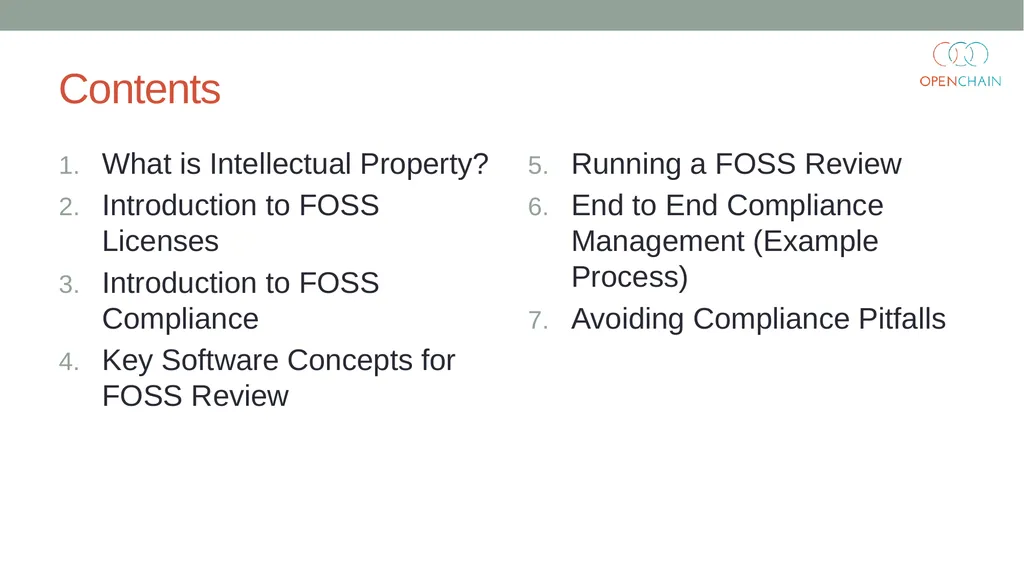
slide2. Contents What is Intellectual Property?
Introduction to FOSS Licenses
Introduction to FOSS Compliance
Key Software Concepts for FOSS Review Running a FOSS Review
End to End Compliance Management (Example Process)
Avoiding Compliance Pitfalls<br>
slide3. Chapter 1 What is Intellectual Property?<br>
slide4. What is “Intellectual Property”? Copyright: protects original works of authorship
Protects expression (not the underlying idea)
Software, books, audiovisual materials, semiconductor masks
Patents: useful inventions that are novel, useful, non-obvious
Limited monopoly to incentivize innovation
Trade secrets: protects confidential and valuable information
Trademarks: protects marks (word, logos, slogans, color, etc.) that identify the source of the product
Consumer and brand protection; avoid consumer confusion and brand dilution
This chapter will focus on copyright and patents, the areas most relevant to FOSS compliance<br>
slide5. Copyright concepts in software Basic rule = copyright protects creative works
Copyright generally applies to literary works, such as books, movies, pictures, music, maps
Software is protected by copyright, not the functionality (that’s protected by patents) but the expression (creativity in implementation details)
The copyright owner only has control over the work that he or she created, not someone else’s independent creation<br>
slide6. Copyright rights most relevant to software The right to reproduce the software – making copies
The right to create "derivative works" – making modifications
The term derivative work refers to a new work based upon an original work to which enough original creative work has been added so that the new work represents an original work of authorship rather than a copy (note that this is a term of art under US law)
The right to distribute
Distribution is generally viewed as the provision of a copy of a piece of software in binary or source code form to another entity (an individual or organization outside your company or organization)
Note: The interpretation of what constitutes a “derivative work” or a “distribution” is subject to debate in the FOSS community and within FOSS legal circles<br>
slide7. Patent concepts in software Patents protect functionality - this can include a method of operation, such as a computer program
Does not protect abstract ideas, laws of nature
The patent owner has the right to stop anybody from exercising that functionality, regardless of independent creation
Other parties who want to use the technology may seek a patent license (which may grant rights to use, make, have made, sell, offer for sale, and import the technology)<br>
slide8. Licenses A "license" is the way a copyright or patent holder gives permission or rights to someone else
The license can be limited to:
Types of use allowed (distribution, derivative works / to make, have made, manufacture)
Exclusive or non-exclusive terms
Geographical scope
Perpetual or time limited duration
The license can have conditions on the grants, meaning you only get the license if you comply with certain obligations
E.g, provide attribution, give a reciprocal license
May also include contractual terms regarding warranties, indemnification, support, upgrade, maintenance<br>
slide9. Check Your Understanding What type of material does copyright law protect?
What copyright rights are most important for software?
Can software be subject to a patent?
Does a patent give rights to the patent owner?
If you independently develop your own software, is it possible that you might need a copyright license from a third party for that software? A patent license?<br>
slide10. Chapter 2 Introduction to FOSS Licenses<br>
slide11. FOSS Licenses Free and Open Source Software (FOSS) licenses generally make source code available under terms that allow for modification and redistribution
FOSS licenses may have conditions related to providing attributions, copyright statement preservation, or a written offer to make the source code available
One popular set of FOSS licenses are those approved by the Open Source Initiative (OSI) based on their Open Source Definition (OSD). A complete list of OSI-approved FOSS licenses is available at http://www.opensource.org/licenses/<br>
slide12. Permissive FOSS Licenses Permissive FOSS license - a term used often to describe minimally restrictive FOSS licenses
Example: BSD-3-Clause
The BSD license is an example of a permissive license that allows unlimited redistribution for any purpose as long as its copyright notices and the license's disclaimers of warranty are maintained
The license contains a clause restricting use of the names of contributors for endorsement of a derived work without specific permission
Other examples: MIT, Apache-2.0<br>
slide13. License Reciprocity & Copyleft Licenses Some licenses require the distribution of derivative works (or software in the same file, same program or other boundary) under the same terms as the original work
This is referred to as a "copyleft", "reciprocal", or "hereditary" effect
Example of license reciprocity from the GPL-2.0:
"You must cause any work that you distribute or publish, that in whole or in part contains or is derived from the Program or any part thereof, to be licensed...under the terms of this License."
Examples: all versions of GPL, LGPL, AGPL, MPL, CDDL<br>
slide14. Proprietary License A proprietary software license (or commercial license or EULA) has restrictions on the usage, modification or distribution of the software
Proprietary licenses often involve payment or a license fee
Proprietary licenses are unique to each vendor - there are as many variations of proprietary licenses as there are vendors and each must be evaluated individually
FOSS developers often use the term "proprietary license" to describe a commercial non-FOSS license<br>
slide15. Other Licensing Situations Freeware - software distributed under a proprietary license at no or very low cost
The source code may or may not be available, and creation of derivative works is usually restricted
Freeware software is usually fully functional (no locked features) and available for unlimited use (no locking on days of usage)
Freeware software licenses usually impose restrictions in relation to copying, distributing, and making derivative works of the software, as well as restrictions on the type of usage (personal, commercial, academic, etc.)
Shareware - proprietary software provided to users on a trial basis, for a limited time, free of charge and with limited functionalities or features
The goal of shareware is to give potential buyers the opportunity to use the program and judge its usefulness before purchasing a license for the full version of the software
Most companies are very leery of Shareware, because Shareware vendors often approach companies for large license payments after the software has freely propagated within their organizations.
Freeware and Shareware are not FOSS<br>
slide16. Public Domain The term public domain refers to intellectual property not protected by law and therefore usable by the public without requiring a license
Developers may include a public domain declaration with their software
E. g., "All of the code and documentation in this software has been dedicated to the public domain by the authors."
The public domain declaration is not the same as a FOSS license
Often the public domain declaration is accompanied by other terms, such as warranty disclaimers. In such cases, the software may be viewed as being under a license rather than being in the public domain<br>
slide17. License Compatibility License compatibility is the process of ensuring that license terms do not conflict. If one license requires you to do something and another prohibits doing that, the licenses conflict and are not compatible
The Free Software Foundation provides the following example to illustrate a case of license compatibility:
A license p is compatible with a license q (or is q-compatible) if
A work licensed under p can be distributed under the terms of q.
Example: GPL compatibility
Many of the FOSS licenses, such as the MIT license and the LGPL, are GPL-compatible, meaning that their source code can be combined with source code that is licensed under the GPL without conflict; the new program resulting from the combination would have to be licensed under the GPL
Other FOSS and proprietary software licenses are not GPL-compatible since they have conflicting terms and conditions
Reference: http://www.fsf.org/licensing/licenses/<br>
slide18. Notices Notices, such as text in comments in file headers, often provide authorship and licensing information. FOSS licenses may also require the placement of notices in source code or documentation to give credit to the author (an attribution) or to make it clear the software includes modifications.
Copyright notice - an identifier placed on copies of the work to inform the world of copyright ownership. Example: Copyright © A. Person (2016).
License notice - a notice that acknowledges the license terms and conditions of the FOSS included in the product.
Attribution notice - a notice included in the product release that acknowledges the identity of the original authors of the FOSS included in the product.
Modification notice – a notice that you have made modifications to the source code of a file, such as adding your copyright notice to the top of the file.<br>
slide19. Multi-Licensing Multi-licensing refers to the practice of distributing software under two or more different sets of terms and conditions
E.g., when software is “dual licensed,” recipients can choose to use or distribute the software under a choice of two licenses
Note: This should not be confused for situations in which a licensor imposes more than one license, and you must comply with all of them<br>
slide20. Check Your Understanding What is a FOSS license?
What are typical obligations of a permissive FOSS license?
Name some permissive FOSS licenses.
What does license reciprocity mean?
Name some copyleft-style licenses.
Are Freeware and Shareware software considered FOSS?
What is a multi-license?<br>
slide21. Chapter 3 Introduction to FOSS Compliance<br>
slide22. FOSS Compliance Goals Know your obligations (detect and track use of FOSS). You should have a process for identifying, tracking and archiving a list of all FOSS components (and their respective identified licenses) from which your software is comprised.
Satisfy all the license obligations for the FOSS that is used. Your program should identify and handle typical FOSS use cases that result from your organization’s business practices.<br>
slide23. What Compliance Obligations Must Be Satisfied? Depending on the license(s) involved, obligations could consist of:
Attribution and Notices. Inclusion of copyright and license text in the source code and/or product documentation or user interface, so that downstream users know the origin of the software and their rights under the licenses
Source code availability. Providing source code for original work, for combined work or modifications, as well as build scripts (scripts that control the build process)
These obligations may trigger upon key events, such as:
External distribution
Whether you have made modifications<br>
slide24. FOSS Conditions & Restrictions Depending on the FOSS license used, you may need to comply with one or more of the following types of conditions and restrictions:
Retain copyright (and other) notices
Provide a copy of the license
Provide notice of modifications
Modified versions must have a different name to avoid confusion
Provide access to source code (whether you modified it or not)
Maintain modified versions (derivative works) under the same license
Provide attribution
Do not use the project or copyright holder name or trademark
Do not restrict others of the rights granted under the original license
Termination clauses (if you breach, you lose license)<br>
slide25. FOSS Compliance Triggers: Distribution Dissemination of material to an outside entity
Applications downloaded to a user’s machine or mobile device
Javascript, web client, or other code that is downloaded to the user’s machine
For some FOSS licenses, access via a computer network can be a “distribution”
Some licenses define distribution to include permitting access to software running on a server (e.g., all versions of the Affero GPL)<br>
slide26. FOSS Compliance Triggers: Modification Changes to the existing program (e.g., additions, deletions of code in a file, combining components together)
Modifications may constitute a derivative work, and FOSS authors may limit or place obligations on modifications
Modifications may trigger FOSS obligations, such as:
Notice of modification
Providing accompanying source code<br>
slide27. FOSS Compliance Program Organizations who have been successful at FOSS compliance have created their own FOSS Compliance Programs (consisting of policies, processes, training and tools) to:
Facilitate effective usage of FOSS in commercial products
Respect FOSS developer rights and comply with license obligations
Contribute and participate in open communities<br>
slide28. Implementing Compliance Practices Prepare business processes and sufficient staff to handle:
Identification of the origin and license of FOSS software
Tracking FOSS software within the development process
Performing FOSS review and identifying license obligations
Fulfillment of license obligations when product ships
Oversight for FOSS Compliance Program, creation of policy, and compliance decisions
Training<br>
slide29. Compliance Benefits Benefits of a robust FOSS Compliance program include:
Increased understanding of the benefits of FOSS and how it impacts your organization
Increased understanding of the costs and risks associated with using FOSS
Better relations with the FOSS community and FOSS organizations
Increased knowledge of available FOSS solutions<br>
slide30. Check Your Understanding What does FOSS compliance mean?
What are two main goals of a FOSS Compliance Program?
List and describe important business practices of a FOSS Compliance Program.
What are some benefits of a FOSS Compliance Program?<br>
slide31. Chapter 4 Key Software Concepts for FOSS Review<br>
slide32. What information do you need to gather? When analyzing FOSS usage, collect information about the identity of the FOSS component, its origin, and how the FOSS component will be used. This may include: Package name
Version
Original download URL
License and License URL
Description
Description of modifications
List of dependencies
Intended use in your product
First product release that will include the package
Availability of source code
Where the source code will be maintained
Whether the package had previously been approved for use in another context
Inclusion of technology subject to export control
If from an external vendor:
Development team's point of contact
Copyright notices, attribution, source code for vendor modifications if needed to satisfy license obligations<br>
slide33. How do you want to use to the component? Common scenarios include:
Incorporation
Linking
Modification
Translation<br>
slide34. Incorporation A developer may copy portions of a FOSS component into your software product.
Relevant terms include:
Integrating
Merging
Pasting
Adapting
Inserting<br>
slide35. Linking A developer may link or join a FOSS component with your software product.
Relevant terms include:
Static/Dynamic Linking
Pairing
Combining
Utilizing
Packaging
Creating interdependency<br>
slide36. Modification A developer may make changes to a FOSS component, including:
Adding/injecting new code into the FOSS component
Fixing, optimizing or making changes to the FOSS component
Deleting or removing code Fixing
Optimizing
Changing Adding
Injecting Deleting<br>
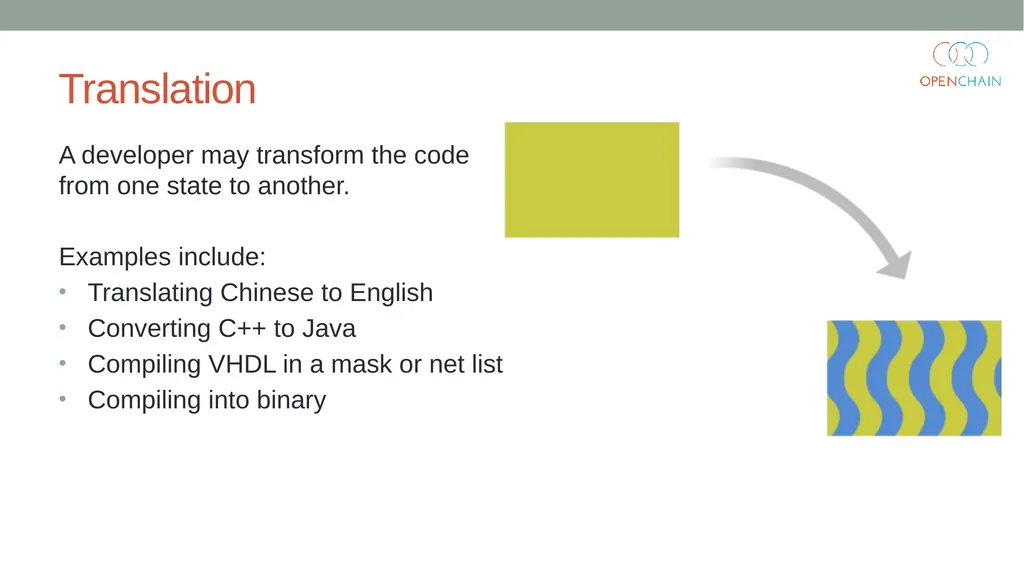
slide37. Translation A developer may transform the code from one state to another.
Examples include:
Translating Chinese to English
Converting C++ to Java
Compiling VHDL in a mask or net list
Compiling into binary<br>
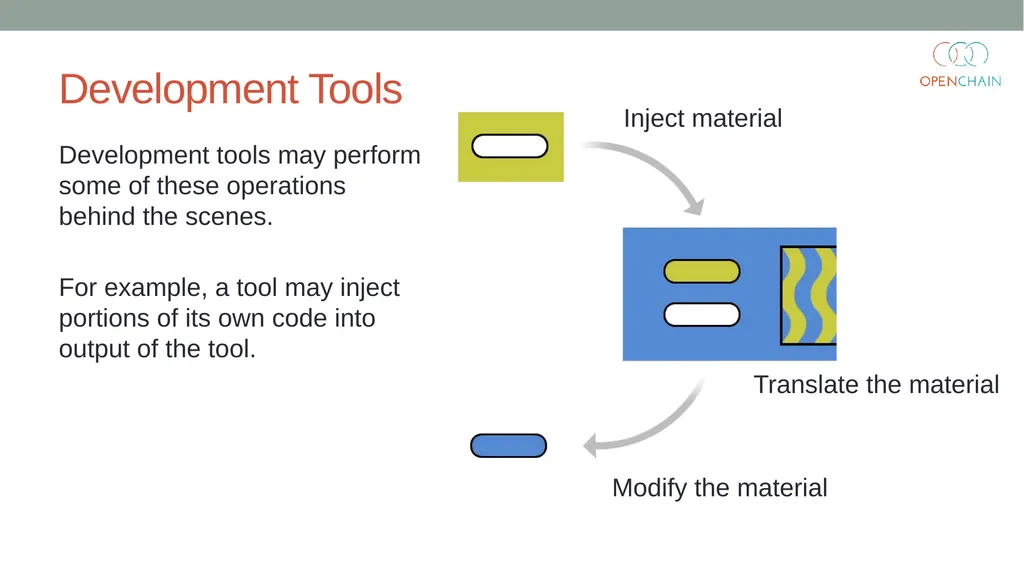
slide38. Development Tools Development tools may perform some of these operations behind the scenes.
For example, a tool may inject portions of its own code into output of the tool. Inject material Modify the material Translate the material<br>
slide39. How is the FOSS component distributed? Who receives the software?
Customer/Partner
Community project
What format for delivery?
Source code delivery
Binary delivery
Pre-loaded onto hardware<br>
slide40. Check Your Understanding What information is helpful in understanding how software is licensed?
What information helps identify who is licensing the software?
What is incorporation?
What is modification?
What is linking?
What is translation?
What factors are important in assessing a distribution?<br>
slide41. Chapter 5 Running a FOSS Review<br>
slide42. FOSS Review A key element to a FOSS Compliance Program is a FOSS Review process, through which a company can analyze and determine its FOSS obligations
The FOSS Review process includes the following steps:
Gather relevant information
Analyze and determine license obligations
Provide guidance in light of company policy and business objectives<br>
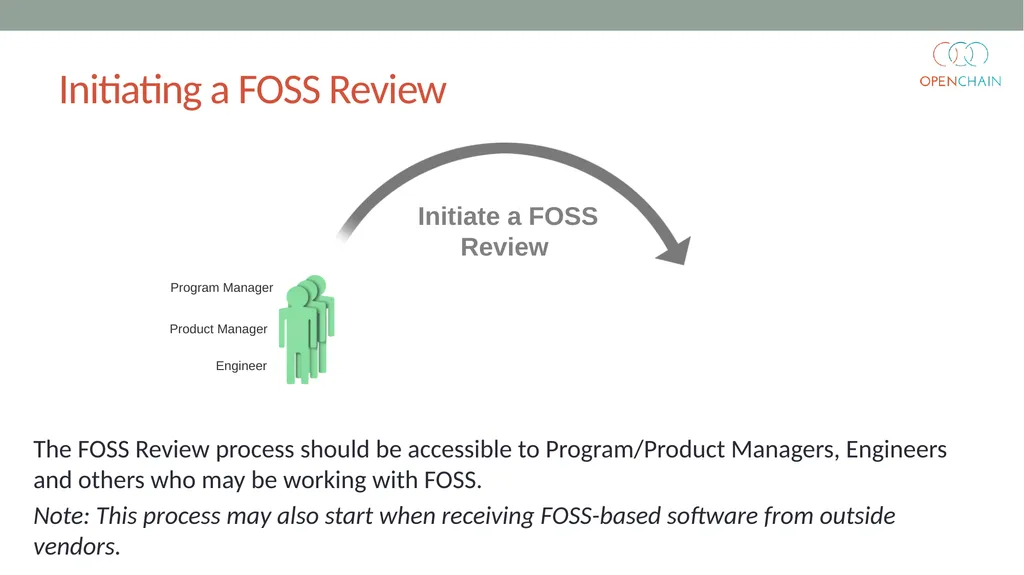
slide43. Initiating a FOSS Review The FOSS Review process should be accessible to Program/Product Managers, Engineers and others who may be working with FOSS.
Note: This process may also start when receiving FOSS-based software from outside vendors. Initiate a FOSS Review<br>
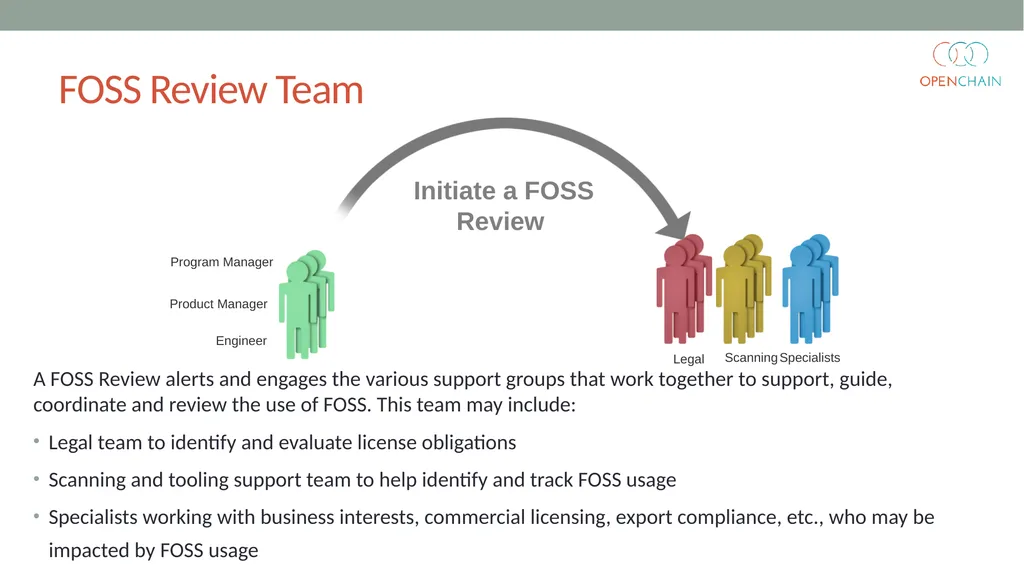
slide44. FOSS Review Team A FOSS Review alerts and engages the various support groups that work together to support, guide, coordinate and review the use of FOSS. This team may include:
Legal team to identify and evaluate license obligations
Scanning and tooling support team to help identify and track FOSS usage
Specialists working with business interests, commercial licensing, export compliance, etc., who may be impacted by FOSS usage Initiate a FOSS Review Legal Scanning Specialists<br>
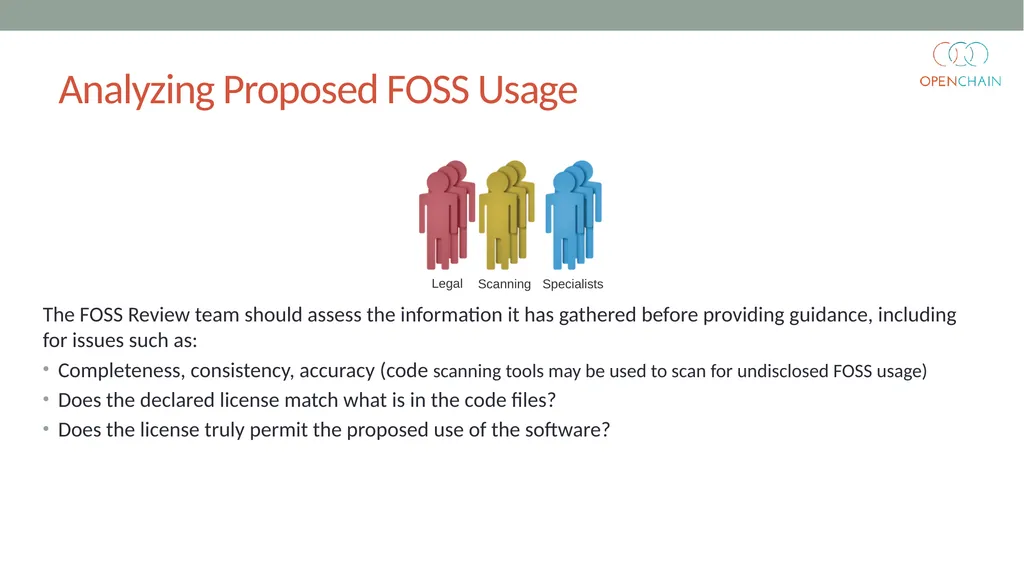
slide45. Analyzing Proposed FOSS Usage The FOSS Review team should assess the information it has gathered before providing guidance, including for issues such as:
Completeness, consistency, accuracy (code scanning tools may be used to scan for undisclosed FOSS usage)
Does the declared license match what is in the code files?
Does the license truly permit the proposed use of the software? Legal Scanning Specialists<br>
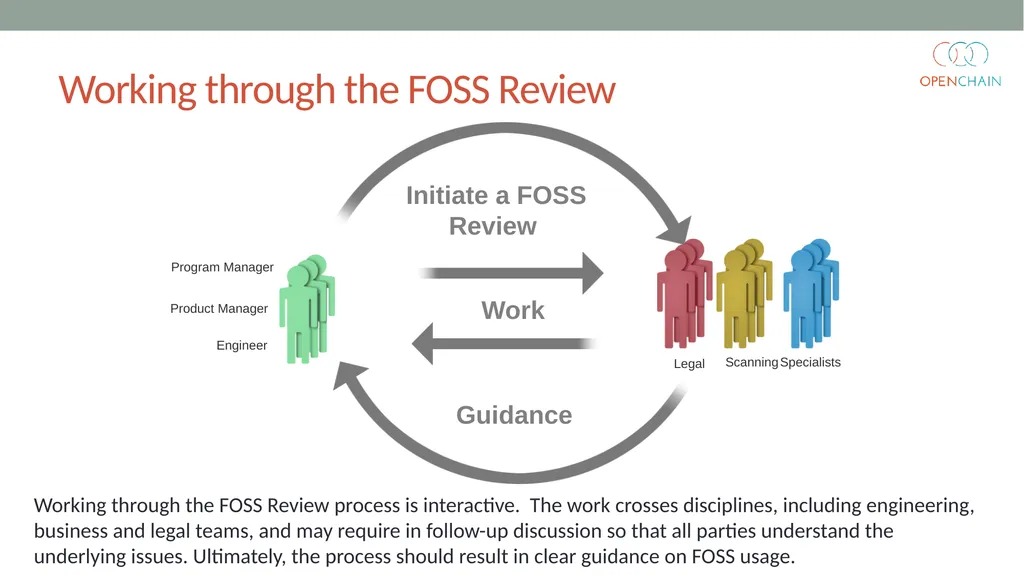
slide46. Working through the FOSS Review Working through the FOSS Review process is interactive. The work crosses disciplines, including engineering, business and legal teams, and may require in follow-up discussion so that all parties understand the underlying issues. Ultimately, the process should result in clear guidance on FOSS usage. Initiate a FOSS Review Legal Scanning Specialists Work Guidance<br>
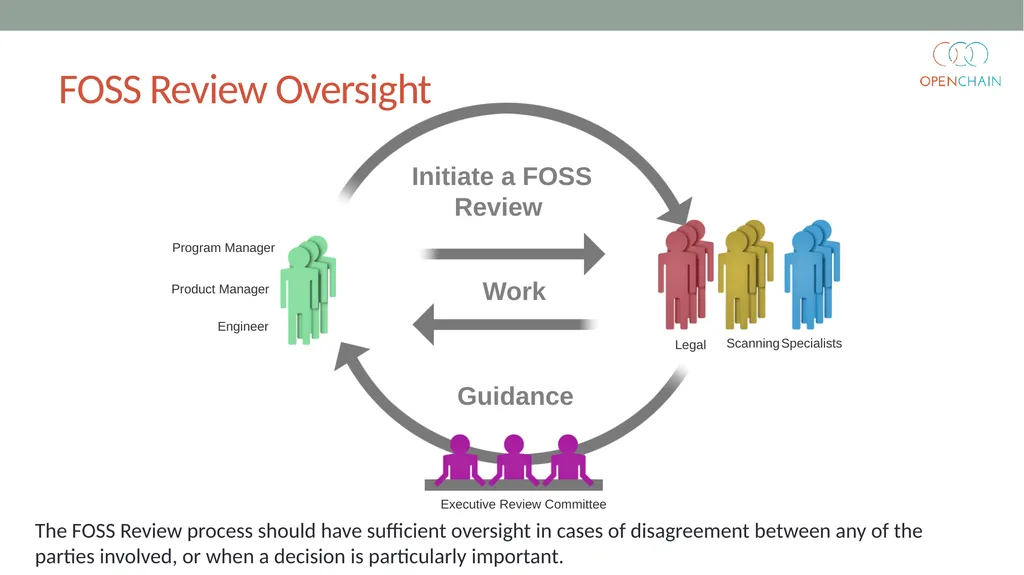
slide47. FOSS Review Oversight The FOSS Review process should have sufficient oversight in cases of disagreement between any of the parties involved, or when a decision is particularly important. Initiate a FOSS Review Legal Scanning Specialists Work Guidance<br>
slide48. Check Your Understanding What is the purpose of a FOSS Review?
What is the first action you should take if you want to use FOSS components?
What kinds of information might you collect for a FOSS review?
What additional information is important when reviewing a FOSS component from an outside vendor?
What steps can be taken to assess the quality of this information?
What should you do if you have a question about using FOSS?<br>
slide49. Chapter 6 End to End Compliance Management (Example Process)<br>
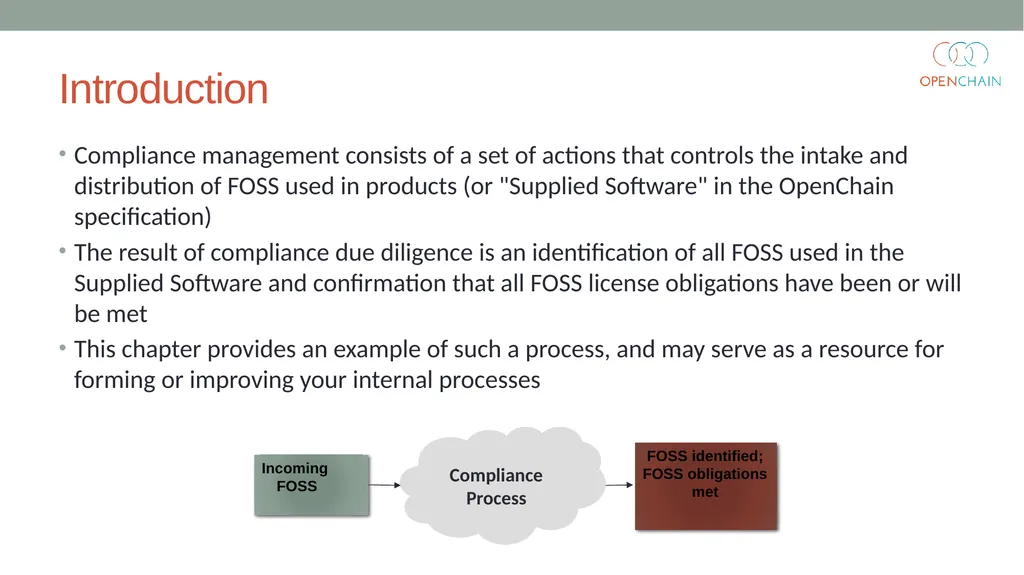
slide50. Introduction Compliance management consists of a set of actions that controls the intake and distribution of FOSS used in products (or "Supplied Software" in the OpenChain specification)
The result of compliance due diligence is an identification of all FOSS used in the Supplied Software and confirmation that all FOSS license obligations have been or will be met
This chapter provides an example of such a process, and may serve as a resource for forming or improving your internal processes Incoming
FOSS FOSS identified;
FOSS obligations met Compliance Process<br>
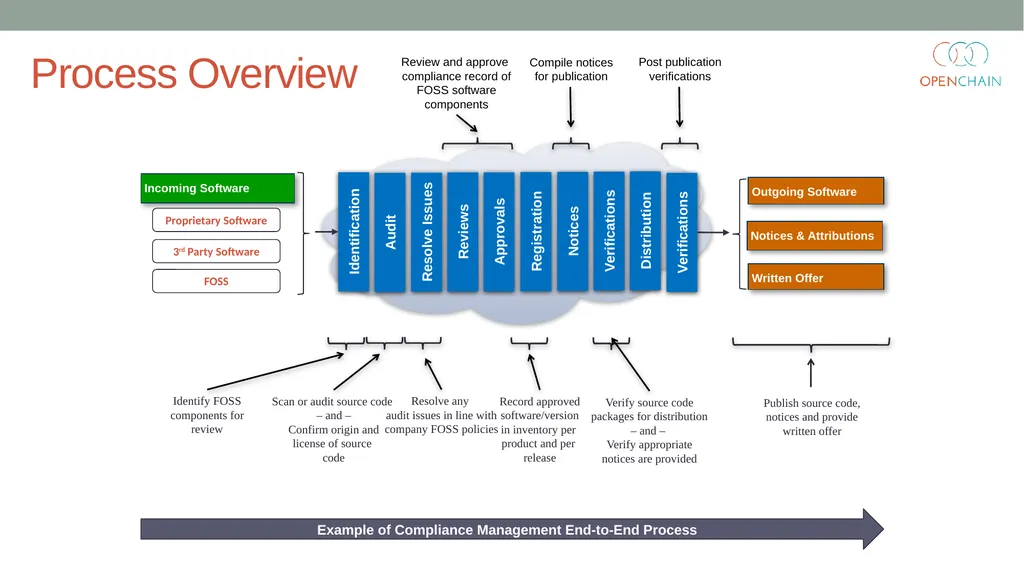
slide51. Incoming Software Identification Audit Resolve Issues Reviews Approvals Registration Notices Verifications Distribution Verifications Proprietary Software 3rd Party Software FOSS Outgoing Software Notices & Attributions Written Offer Scan or audit source code
– and –
Confirm origin and
license of source
code Resolve any
audit issues in line with
company FOSS policies Identify FOSS components for review Verify source code packages for distribution
– and –
Verify appropriate notices are provided Record approved
software/version
in inventory per
product and per
release Publish source code,
notices and provide written offer Review and approve
compliance record of FOSS software components Compile notices
for publication Post publication
verifications Example of Compliance Management End-to-End Process Process Overview<br>
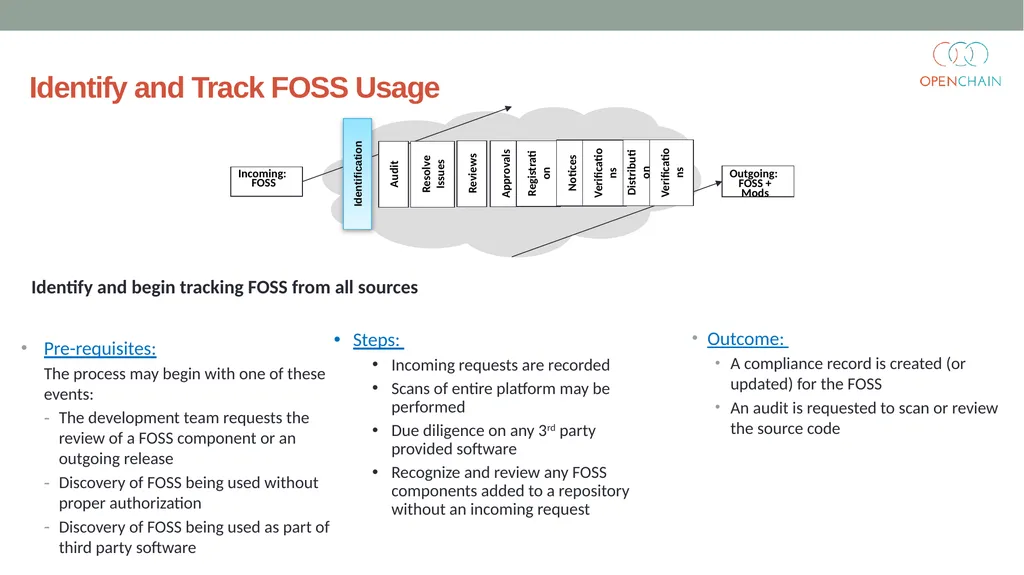
slide52. Pre-requisites:
The process may begin with one of these events:
The development team requests the review of a FOSS component or an outgoing release
Discovery of FOSS being used without proper authorization
Discovery of FOSS being used as part of third party software Outcome:
A compliance record is created (or updated) for the FOSS
An audit is requested to scan or review the source code Incoming:
FOSS Outgoing:
FOSS + Mods Identification Audit Resolve Issues Reviews Approvals Registration Notices Verifications Distribution Verifications Steps:
Incoming requests are recorded
Scans of entire platform may be performed
Due diligence on any 3rd party provided software
Recognize and review any FOSS components added to a repository without an incoming request Identify and begin tracking FOSS from all sources Identify and Track FOSS Usage<br>
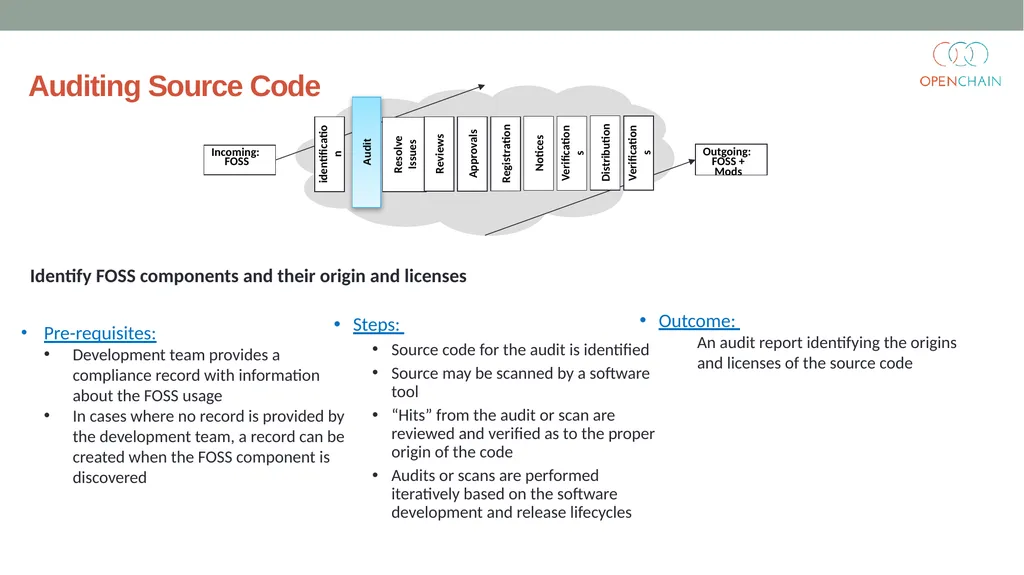
slide53. Incoming:
FOSS Outgoing:
FOSS + Mods Audit identification Resolve Issues Reviews Approvals Registration Notices Verifications Distribution Verifications Pre-requisites:
Development team provides a compliance record with information about the FOSS usage
In cases where no record is provided by the development team, a record can be created when the FOSS component is discovered Outcome:
An audit report identifying the origins and licenses of the source code Steps:
Source code for the audit is identified
Source may be scanned by a software tool
“Hits” from the audit or scan are reviewed and verified as to the proper origin of the code
Audits or scans are performed iteratively based on the software development and release lifecycles Identify FOSS components and their origin and licenses Auditing Source Code<br>
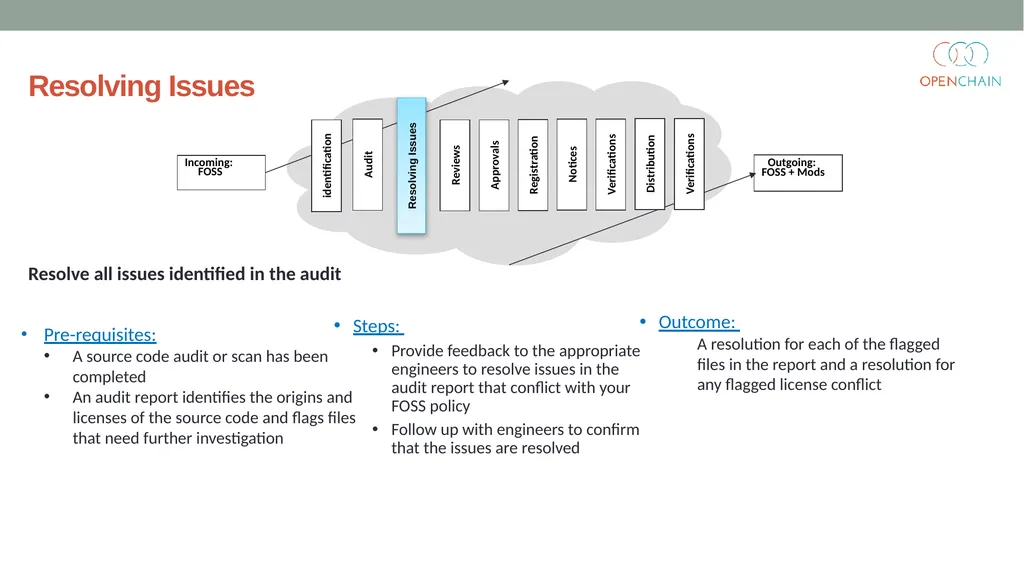
slide54. Pre-requisites:
A source code audit or scan has been completed
An audit report identifies the origins and licenses of the source code and flags files that need further investigation Outcome:
A resolution for each of the flagged files in the report and a resolution for any flagged license conflict Steps:
Provide feedback to the appropriate engineers to resolve issues in the audit report that conflict with your FOSS policy
Follow up with engineers to confirm that the issues are resolved Resolve all issues identified in the audit Resolving Issues<br>
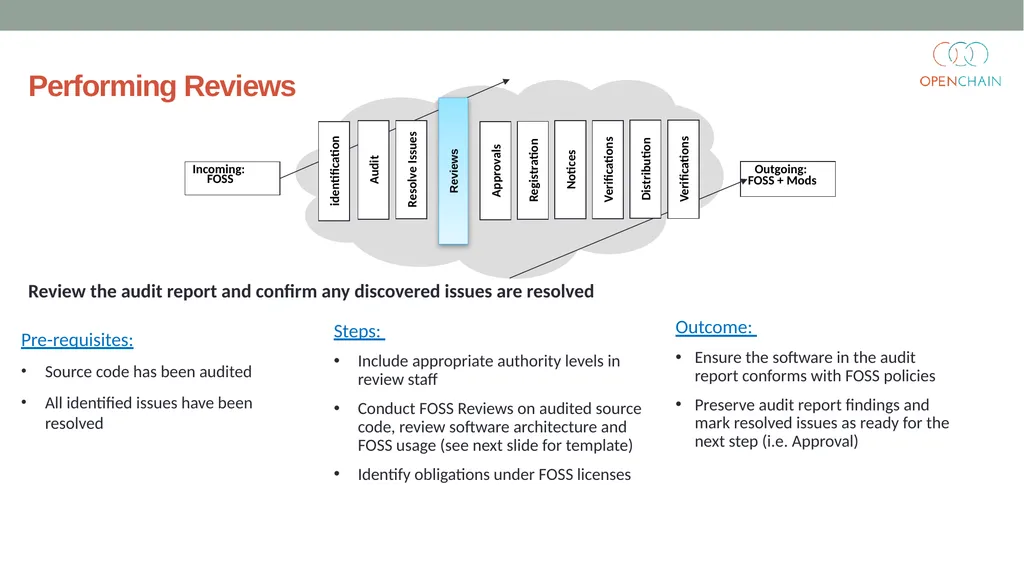
slide55. Pre-requisites:
Source code has been audited
All identified issues have been resolved Outcome:
Ensure the software in the audit report conforms with FOSS policies
Preserve audit report findings and mark resolved issues as ready for the next step (i.e. Approval) Steps:
Include appropriate authority levels in review staff
Conduct FOSS Reviews on audited source code, review software architecture and FOSS usage (see next slide for template)
Identify obligations under FOSS licenses Review the audit report and confirm any discovered issues are resolved Performing Reviews<br>
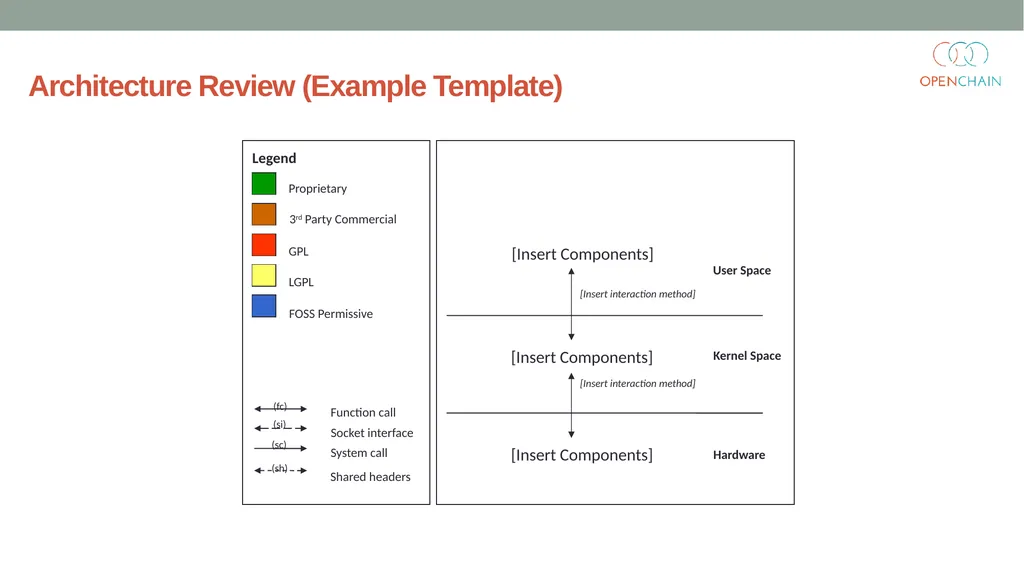
slide56. Proprietary Legend 3rd Party Commercial GPL LGPL FOSS Permissive Function call Socket interface (fc) (si) System call (sc) Shared headers (sh) User Space Kernel Space Hardware [Insert Components] [Insert Components] [Insert Components] [Insert interaction method] [Insert interaction method] Architecture Review (Example Template)<br>
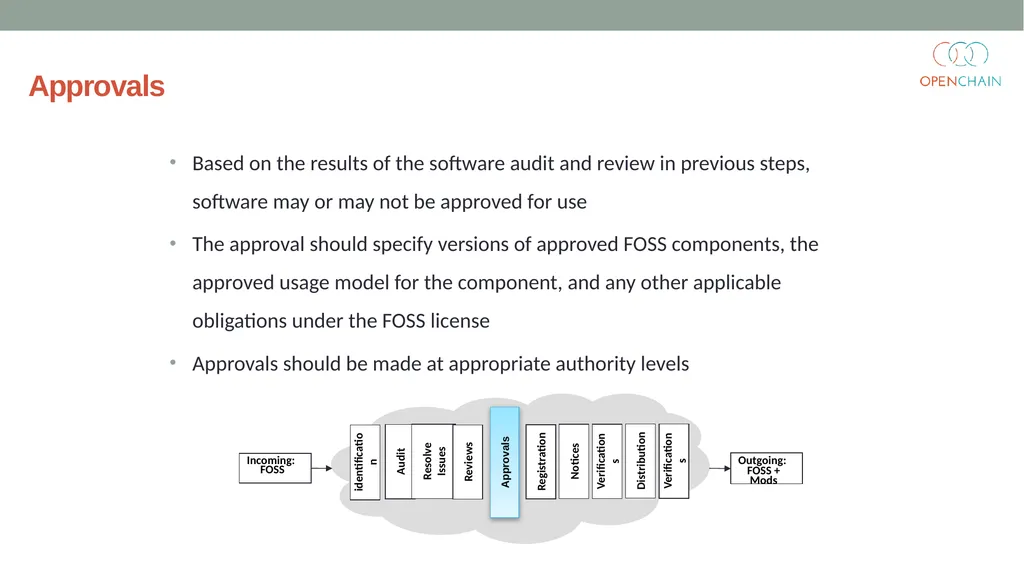
slide57. Based on the results of the software audit and review in previous steps, software may or may not be approved for use
The approval should specify versions of approved FOSS components, the approved usage model for the component, and any other applicable obligations under the FOSS license
Approvals should be made at appropriate authority levels Incoming:
FOSS Outgoing:
FOSS + Mods Approvals identification Audit Resolve Issues Reviews Registration Notices Verifications Distribution Verifications Approvals<br>
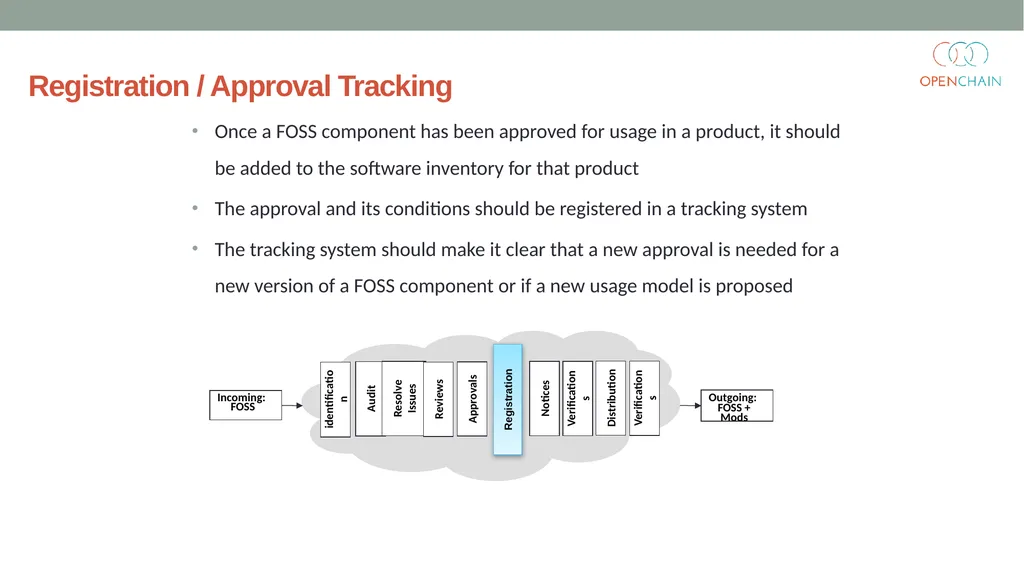
slide58. Once a FOSS component has been approved for usage in a product, it should be added to the software inventory for that product
The approval and its conditions should be registered in a tracking system
The tracking system should make it clear that a new approval is needed for a new version of a FOSS component or if a new usage model is proposed Incoming:
FOSS Outgoing:
FOSS + Mods Registration identification Audit Resolve Issues Reviews Approvals Notices Verifications Distribution Verifications Registration / Approval Tracking<br>
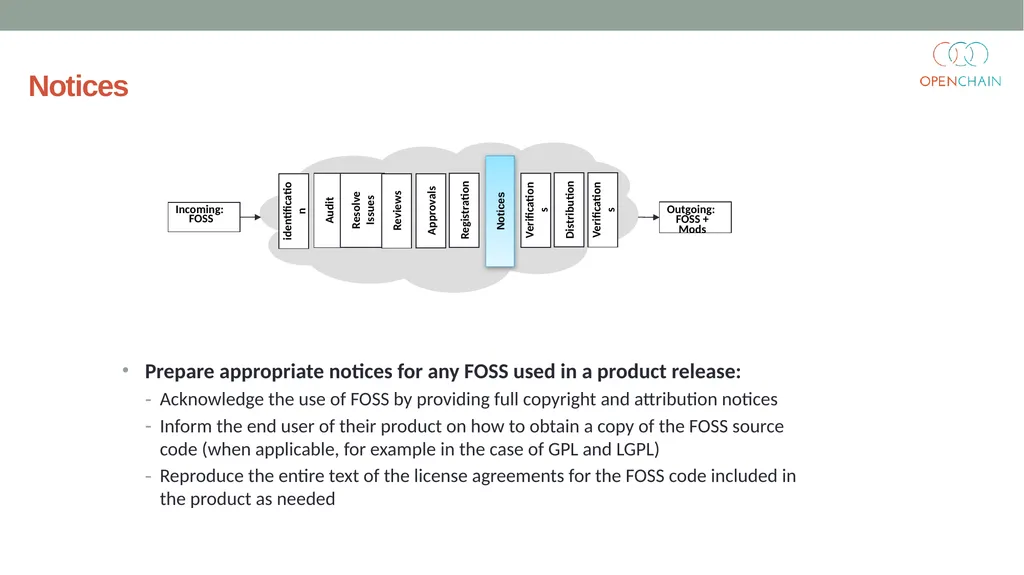
slide59. Prepare appropriate notices for any FOSS used in a product release:
Acknowledge the use of FOSS by providing full copyright and attribution notices
Inform the end user of their product on how to obtain a copy of the FOSS source code (when applicable, for example in the case of GPL and LGPL)
Reproduce the entire text of the license agreements for the FOSS code included in the product as needed Incoming:
FOSS Outgoing:
FOSS + Mods Notices identification Audit Resolve Issues Reviews Approvals Registration Verifications Distribution Verifications Notices<br>
slide60. Incoming:
FOSS Outgoing:
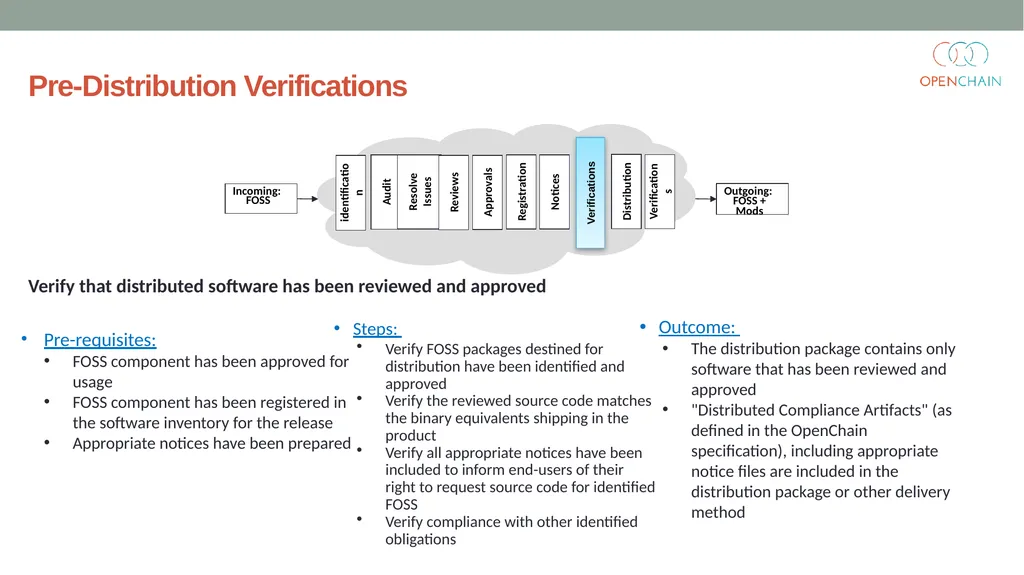
FOSS + Mods Verifications identification Audit Resolve Issues Reviews Approvals Registration Notices Distribution Verifications Pre-requisites:
FOSS component has been approved for usage
FOSS component has been registered in the software inventory for the release
Appropriate notices have been prepared Outcome:
The distribution package contains only software that has been reviewed and approved
"Distributed Compliance Artifacts" (as defined in the OpenChain specification), including appropriate notice files are included in the distribution package or other delivery method Steps:
Verify FOSS packages destined for distribution have been identified and approved
Verify the reviewed source code matches the binary equivalents shipping in the product
Verify all appropriate notices have been included to inform end-users of their right to request source code for identified FOSS
Verify compliance with other identified obligations Verify that distributed software has been reviewed and approved Pre-Distribution Verifications<br>
slide61. Incoming:
FOSS Outgoing:
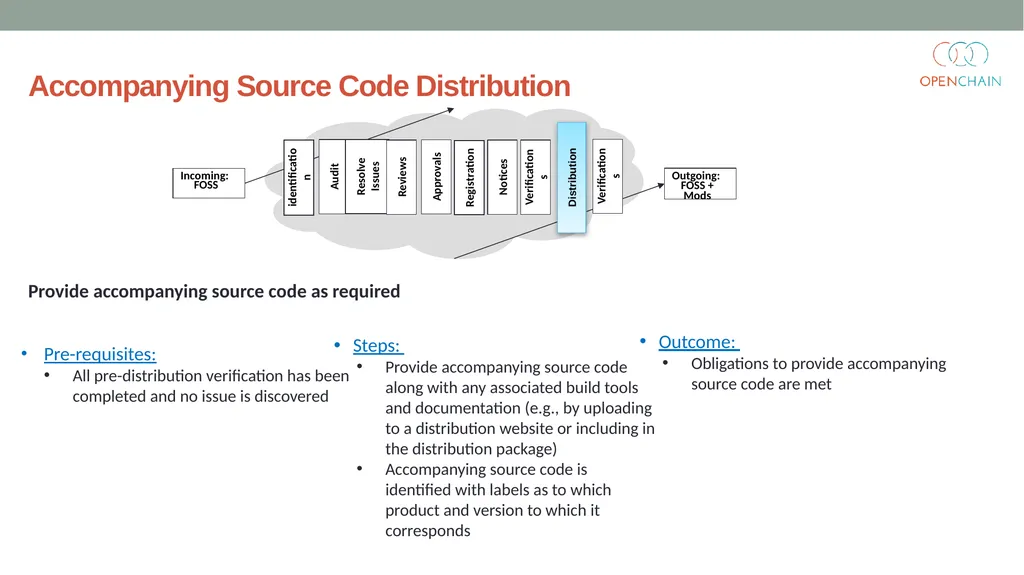
FOSS + Mods Distribution identification Audit Resolve Issues Reviews Registration Notices Verifications Approvals Verifications Pre-requisites:
All pre-distribution verification has been completed and no issue is discovered Outcome:
Obligations to provide accompanying source code are met Steps:
Provide accompanying source code along with any associated build tools and documentation (e.g., by uploading to a distribution website or including in the distribution package)
Accompanying source code is identified with labels as to which product and version to which it corresponds Provide accompanying source code as required Accompanying Source Code Distribution<br>
slide62. Incoming:
FOSS Outgoing:
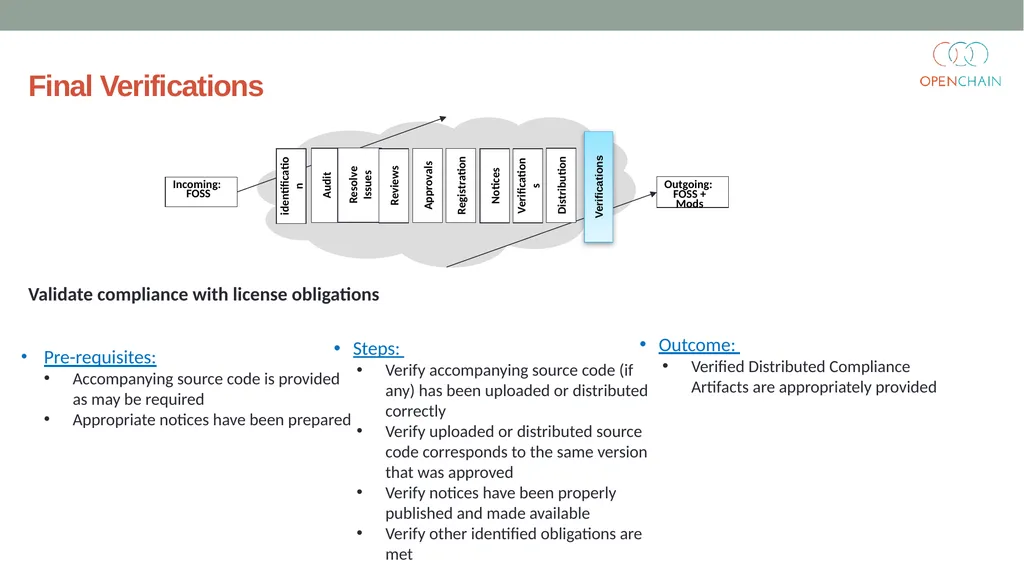
FOSS + Mods Verifications identification Audit Resolve Issues Reviews Approvals Notices Verifications Distribution Registration Pre-requisites:
Accompanying source code is provided as may be required
Appropriate notices have been prepared Outcome:
Verified Distributed Compliance Artifacts are appropriately provided Steps:
Verify accompanying source code (if any) has been uploaded or distributed correctly
Verify uploaded or distributed source code corresponds to the same version that was approved
Verify notices have been properly published and made available
Verify other identified obligations are met Validate compliance with license obligations Final Verifications<br>
slide63. Check Your Understanding What is involved in compliance due diligence (describe the steps at a high level)?
What types of issues may need to be resolved as part of compliance management?
Who should be involved in reviewing audit results?
What does an architecture review look for?
What should be included in the FOSS Notices?
What needs to be distributed for code used under a copyleft license?<br>
slide64. Chapter 7 Avoiding Compliance Pitfalls<br>
slide65. Compliance Pitfalls This chapter will describe some potential pitfalls to avoid in the compliance process:
Intellectual Property (IP) pitfalls
License Compliance pitfalls
Compliance Process pitfalls<br>
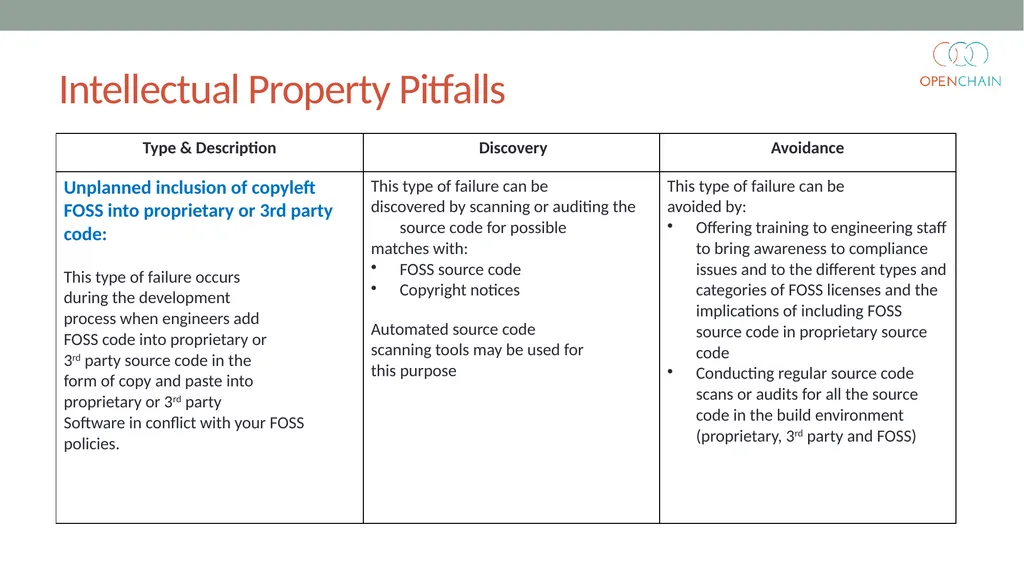
slide66. Intellectual Property Pitfalls<br>
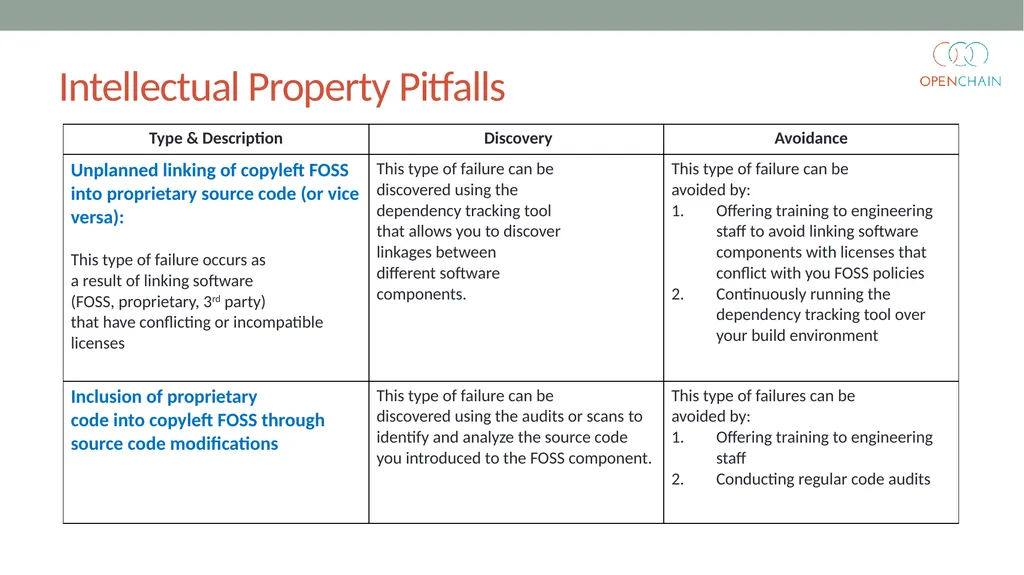
slide67. Intellectual Property Pitfalls<br>
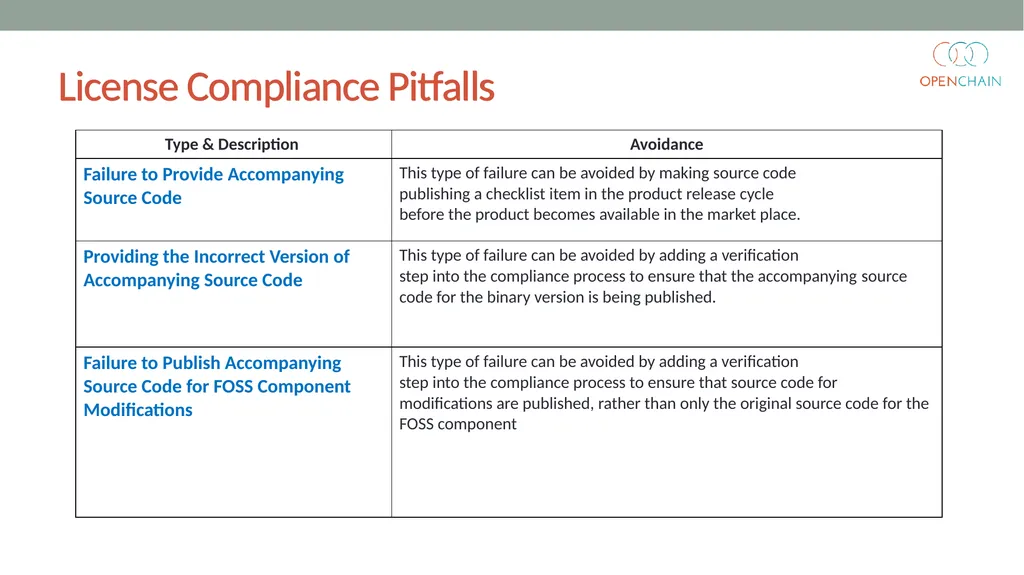
slide68. License Compliance Pitfalls License Compliance Pitfalls<br>
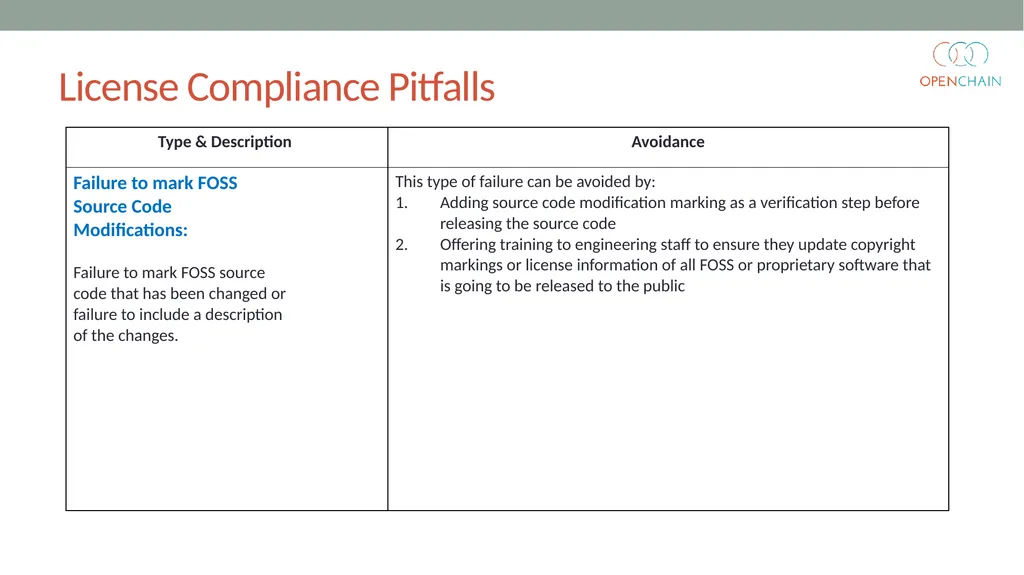
slide69. License Compliance Pitfalls<br>
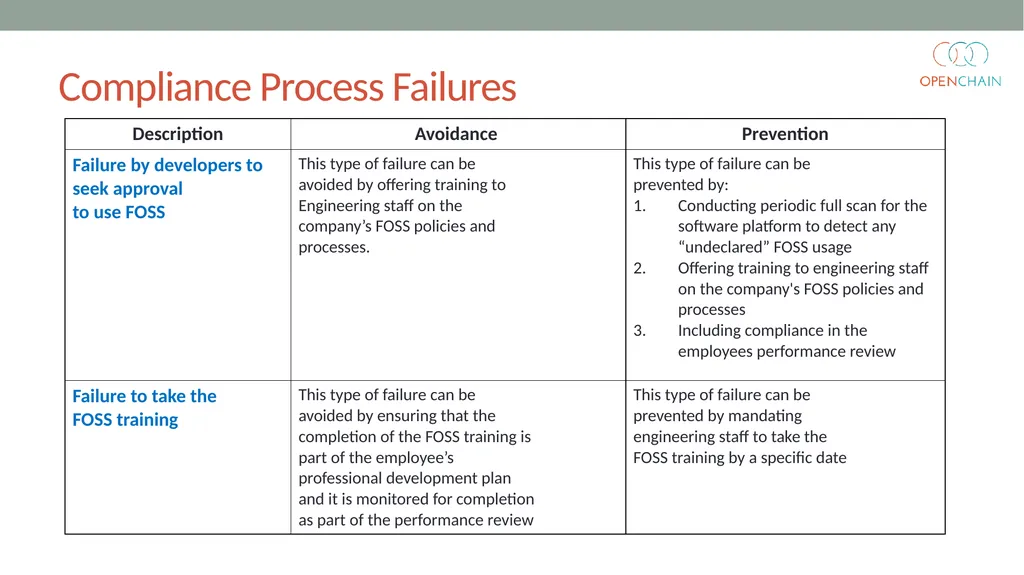
slide70. Compliance Process Failures<br>
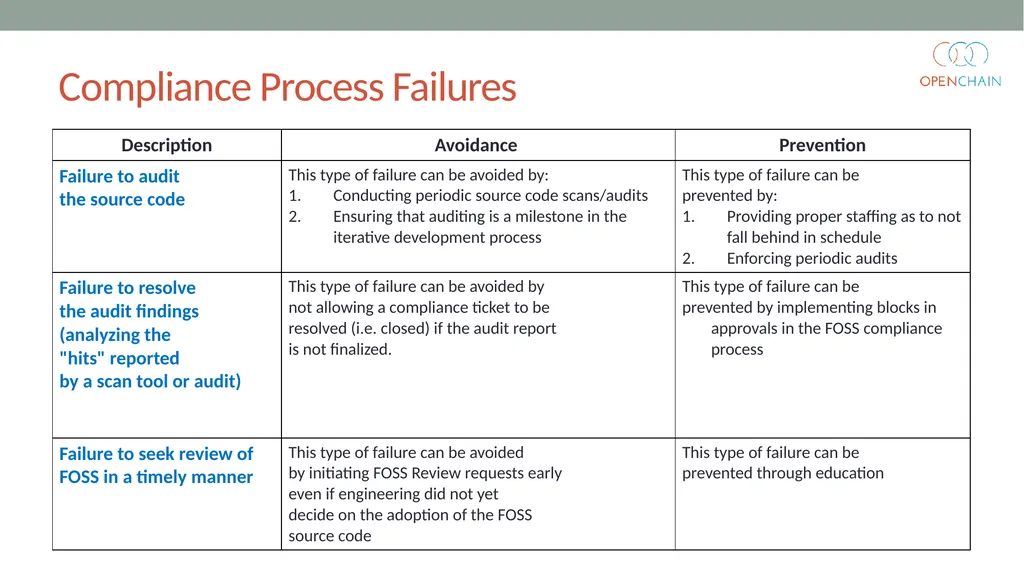
slide71. Compliance Process Failures<br>
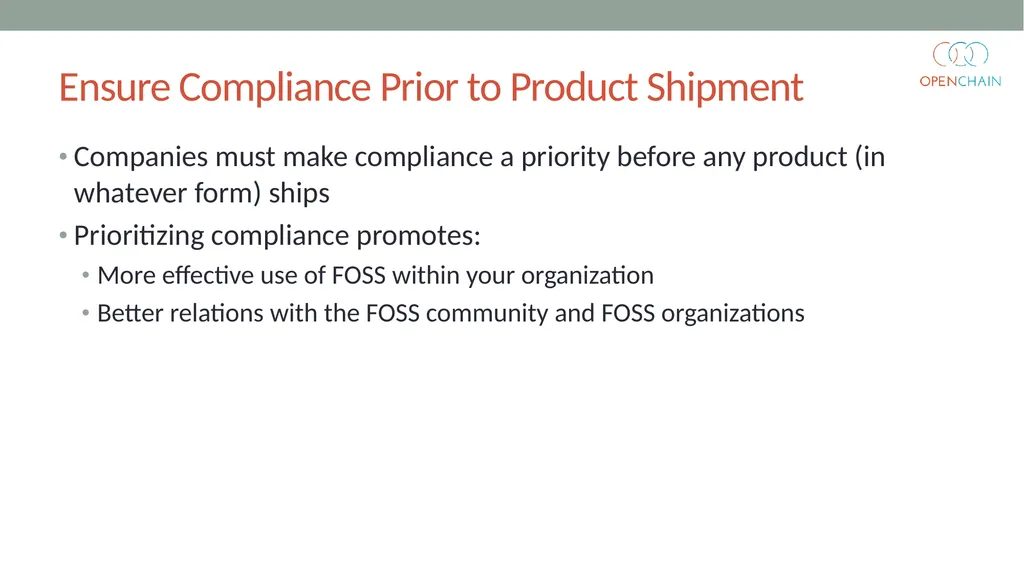
slide72. Ensure Compliance Prior to Product Shipment Companies must make compliance a priority before any product (in whatever form) ships
Prioritizing compliance promotes:
More effective use of FOSS within your organization
Better relations with the FOSS community and FOSS organizations<br>
slide73. Establishing Community Relationships As a company that uses FOSS in commercial product, it is best to create and maintain a good relationship with the FOSS community, in particular, the specific communities related to the FOSS projects you use and deploy in your commercial product. In addition, good relationships with FOSS organizations can be very helpful in advising on best way to be compliant and also help out if you experience a compliance issue.
Good relationships with the software communities may also be helpful for two-way communication: upstreaming improvements and getting support from the software developers.<br>
slide74. Check Your Understanding What types of pitfalls can occur in FOSS compliance?
Give an example of an intellectual property failure.
Give an example of a license compliance failure.
Give an example of an compliance process failure.
What are the benefits of prioritizing compliance?
What are the benefits of maintaining a good community relationship?<br>
Released under the Creative Commons CC0 1.0 Universal license. This is not legal advice<br>
slide2. Contents What is Intellectual Property?
Introduction to FOSS Licenses
Introduction to FOSS Compliance
Key Software Concepts for FOSS Review Running a FOSS Review
End to End Compliance Management (Example Process)
Avoiding Compliance Pitfalls<br>
slide3. Chapter 1 What is Intellectual Property?<br>
slide4. What is “Intellectual Property”? Copyright: protects original works of authorship
Protects expression (not the underlying idea)
Software, books, audiovisual materials, semiconductor masks
Patents: useful inventions that are novel, useful, non-obvious
Limited monopoly to incentivize innovation
Trade secrets: protects confidential and valuable information
Trademarks: protects marks (word, logos, slogans, color, etc.) that identify the source of the product
Consumer and brand protection; avoid consumer confusion and brand dilution
This chapter will focus on copyright and patents, the areas most relevant to FOSS compliance<br>
slide5. Copyright concepts in software Basic rule = copyright protects creative works
Copyright generally applies to literary works, such as books, movies, pictures, music, maps
Software is protected by copyright, not the functionality (that’s protected by patents) but the expression (creativity in implementation details)
The copyright owner only has control over the work that he or she created, not someone else’s independent creation<br>
slide6. Copyright rights most relevant to software The right to reproduce the software – making copies
The right to create "derivative works" – making modifications
The term derivative work refers to a new work based upon an original work to which enough original creative work has been added so that the new work represents an original work of authorship rather than a copy (note that this is a term of art under US law)
The right to distribute
Distribution is generally viewed as the provision of a copy of a piece of software in binary or source code form to another entity (an individual or organization outside your company or organization)
Note: The interpretation of what constitutes a “derivative work” or a “distribution” is subject to debate in the FOSS community and within FOSS legal circles<br>
slide7. Patent concepts in software Patents protect functionality - this can include a method of operation, such as a computer program
Does not protect abstract ideas, laws of nature
The patent owner has the right to stop anybody from exercising that functionality, regardless of independent creation
Other parties who want to use the technology may seek a patent license (which may grant rights to use, make, have made, sell, offer for sale, and import the technology)<br>
slide8. Licenses A "license" is the way a copyright or patent holder gives permission or rights to someone else
The license can be limited to:
Types of use allowed (distribution, derivative works / to make, have made, manufacture)
Exclusive or non-exclusive terms
Geographical scope
Perpetual or time limited duration
The license can have conditions on the grants, meaning you only get the license if you comply with certain obligations
E.g, provide attribution, give a reciprocal license
May also include contractual terms regarding warranties, indemnification, support, upgrade, maintenance<br>
slide9. Check Your Understanding What type of material does copyright law protect?
What copyright rights are most important for software?
Can software be subject to a patent?
Does a patent give rights to the patent owner?
If you independently develop your own software, is it possible that you might need a copyright license from a third party for that software? A patent license?<br>
slide10. Chapter 2 Introduction to FOSS Licenses<br>
slide11. FOSS Licenses Free and Open Source Software (FOSS) licenses generally make source code available under terms that allow for modification and redistribution
FOSS licenses may have conditions related to providing attributions, copyright statement preservation, or a written offer to make the source code available
One popular set of FOSS licenses are those approved by the Open Source Initiative (OSI) based on their Open Source Definition (OSD). A complete list of OSI-approved FOSS licenses is available at http://www.opensource.org/licenses/<br>
slide12. Permissive FOSS Licenses Permissive FOSS license - a term used often to describe minimally restrictive FOSS licenses
Example: BSD-3-Clause
The BSD license is an example of a permissive license that allows unlimited redistribution for any purpose as long as its copyright notices and the license's disclaimers of warranty are maintained
The license contains a clause restricting use of the names of contributors for endorsement of a derived work without specific permission
Other examples: MIT, Apache-2.0<br>
slide13. License Reciprocity & Copyleft Licenses Some licenses require the distribution of derivative works (or software in the same file, same program or other boundary) under the same terms as the original work
This is referred to as a "copyleft", "reciprocal", or "hereditary" effect
Example of license reciprocity from the GPL-2.0:
"You must cause any work that you distribute or publish, that in whole or in part contains or is derived from the Program or any part thereof, to be licensed...under the terms of this License."
Examples: all versions of GPL, LGPL, AGPL, MPL, CDDL<br>
slide14. Proprietary License A proprietary software license (or commercial license or EULA) has restrictions on the usage, modification or distribution of the software
Proprietary licenses often involve payment or a license fee
Proprietary licenses are unique to each vendor - there are as many variations of proprietary licenses as there are vendors and each must be evaluated individually
FOSS developers often use the term "proprietary license" to describe a commercial non-FOSS license<br>
slide15. Other Licensing Situations Freeware - software distributed under a proprietary license at no or very low cost
The source code may or may not be available, and creation of derivative works is usually restricted
Freeware software is usually fully functional (no locked features) and available for unlimited use (no locking on days of usage)
Freeware software licenses usually impose restrictions in relation to copying, distributing, and making derivative works of the software, as well as restrictions on the type of usage (personal, commercial, academic, etc.)
Shareware - proprietary software provided to users on a trial basis, for a limited time, free of charge and with limited functionalities or features
The goal of shareware is to give potential buyers the opportunity to use the program and judge its usefulness before purchasing a license for the full version of the software
Most companies are very leery of Shareware, because Shareware vendors often approach companies for large license payments after the software has freely propagated within their organizations.
Freeware and Shareware are not FOSS<br>
slide16. Public Domain The term public domain refers to intellectual property not protected by law and therefore usable by the public without requiring a license
Developers may include a public domain declaration with their software
E. g., "All of the code and documentation in this software has been dedicated to the public domain by the authors."
The public domain declaration is not the same as a FOSS license
Often the public domain declaration is accompanied by other terms, such as warranty disclaimers. In such cases, the software may be viewed as being under a license rather than being in the public domain<br>
slide17. License Compatibility License compatibility is the process of ensuring that license terms do not conflict. If one license requires you to do something and another prohibits doing that, the licenses conflict and are not compatible
The Free Software Foundation provides the following example to illustrate a case of license compatibility:
A license p is compatible with a license q (or is q-compatible) if
A work licensed under p can be distributed under the terms of q.
Example: GPL compatibility
Many of the FOSS licenses, such as the MIT license and the LGPL, are GPL-compatible, meaning that their source code can be combined with source code that is licensed under the GPL without conflict; the new program resulting from the combination would have to be licensed under the GPL
Other FOSS and proprietary software licenses are not GPL-compatible since they have conflicting terms and conditions
Reference: http://www.fsf.org/licensing/licenses/<br>
slide18. Notices Notices, such as text in comments in file headers, often provide authorship and licensing information. FOSS licenses may also require the placement of notices in source code or documentation to give credit to the author (an attribution) or to make it clear the software includes modifications.
Copyright notice - an identifier placed on copies of the work to inform the world of copyright ownership. Example: Copyright © A. Person (2016).
License notice - a notice that acknowledges the license terms and conditions of the FOSS included in the product.
Attribution notice - a notice included in the product release that acknowledges the identity of the original authors of the FOSS included in the product.
Modification notice – a notice that you have made modifications to the source code of a file, such as adding your copyright notice to the top of the file.<br>
slide19. Multi-Licensing Multi-licensing refers to the practice of distributing software under two or more different sets of terms and conditions
E.g., when software is “dual licensed,” recipients can choose to use or distribute the software under a choice of two licenses
Note: This should not be confused for situations in which a licensor imposes more than one license, and you must comply with all of them<br>
slide20. Check Your Understanding What is a FOSS license?
What are typical obligations of a permissive FOSS license?
Name some permissive FOSS licenses.
What does license reciprocity mean?
Name some copyleft-style licenses.
Are Freeware and Shareware software considered FOSS?
What is a multi-license?<br>
slide21. Chapter 3 Introduction to FOSS Compliance<br>
slide22. FOSS Compliance Goals Know your obligations (detect and track use of FOSS). You should have a process for identifying, tracking and archiving a list of all FOSS components (and their respective identified licenses) from which your software is comprised.
Satisfy all the license obligations for the FOSS that is used. Your program should identify and handle typical FOSS use cases that result from your organization’s business practices.<br>
slide23. What Compliance Obligations Must Be Satisfied? Depending on the license(s) involved, obligations could consist of:
Attribution and Notices. Inclusion of copyright and license text in the source code and/or product documentation or user interface, so that downstream users know the origin of the software and their rights under the licenses
Source code availability. Providing source code for original work, for combined work or modifications, as well as build scripts (scripts that control the build process)
These obligations may trigger upon key events, such as:
External distribution
Whether you have made modifications<br>
slide24. FOSS Conditions & Restrictions Depending on the FOSS license used, you may need to comply with one or more of the following types of conditions and restrictions:
Retain copyright (and other) notices
Provide a copy of the license
Provide notice of modifications
Modified versions must have a different name to avoid confusion
Provide access to source code (whether you modified it or not)
Maintain modified versions (derivative works) under the same license
Provide attribution
Do not use the project or copyright holder name or trademark
Do not restrict others of the rights granted under the original license
Termination clauses (if you breach, you lose license)<br>
slide25. FOSS Compliance Triggers: Distribution Dissemination of material to an outside entity
Applications downloaded to a user’s machine or mobile device
Javascript, web client, or other code that is downloaded to the user’s machine
For some FOSS licenses, access via a computer network can be a “distribution”
Some licenses define distribution to include permitting access to software running on a server (e.g., all versions of the Affero GPL)<br>
slide26. FOSS Compliance Triggers: Modification Changes to the existing program (e.g., additions, deletions of code in a file, combining components together)
Modifications may constitute a derivative work, and FOSS authors may limit or place obligations on modifications
Modifications may trigger FOSS obligations, such as:
Notice of modification
Providing accompanying source code<br>
slide27. FOSS Compliance Program Organizations who have been successful at FOSS compliance have created their own FOSS Compliance Programs (consisting of policies, processes, training and tools) to:
Facilitate effective usage of FOSS in commercial products
Respect FOSS developer rights and comply with license obligations
Contribute and participate in open communities<br>
slide28. Implementing Compliance Practices Prepare business processes and sufficient staff to handle:
Identification of the origin and license of FOSS software
Tracking FOSS software within the development process
Performing FOSS review and identifying license obligations
Fulfillment of license obligations when product ships
Oversight for FOSS Compliance Program, creation of policy, and compliance decisions
Training<br>
slide29. Compliance Benefits Benefits of a robust FOSS Compliance program include:
Increased understanding of the benefits of FOSS and how it impacts your organization
Increased understanding of the costs and risks associated with using FOSS
Better relations with the FOSS community and FOSS organizations
Increased knowledge of available FOSS solutions<br>
slide30. Check Your Understanding What does FOSS compliance mean?
What are two main goals of a FOSS Compliance Program?
List and describe important business practices of a FOSS Compliance Program.
What are some benefits of a FOSS Compliance Program?<br>
slide31. Chapter 4 Key Software Concepts for FOSS Review<br>
slide32. What information do you need to gather? When analyzing FOSS usage, collect information about the identity of the FOSS component, its origin, and how the FOSS component will be used. This may include: Package name
Version
Original download URL
License and License URL
Description
Description of modifications
List of dependencies
Intended use in your product
First product release that will include the package
Availability of source code
Where the source code will be maintained
Whether the package had previously been approved for use in another context
Inclusion of technology subject to export control
If from an external vendor:
Development team's point of contact
Copyright notices, attribution, source code for vendor modifications if needed to satisfy license obligations<br>
slide33. How do you want to use to the component? Common scenarios include:
Incorporation
Linking
Modification
Translation<br>
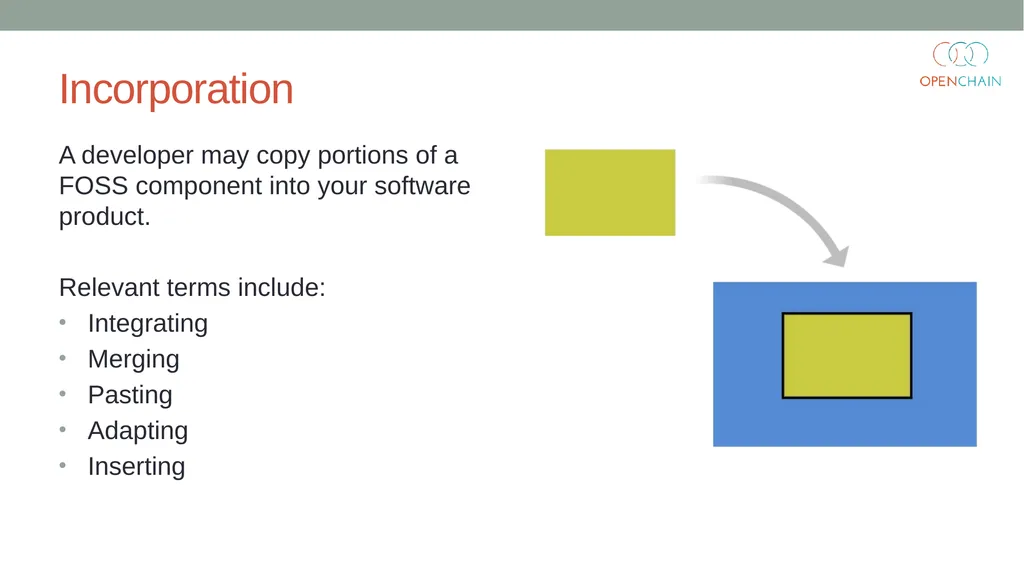
slide34. Incorporation A developer may copy portions of a FOSS component into your software product.
Relevant terms include:
Integrating
Merging
Pasting
Adapting
Inserting<br>
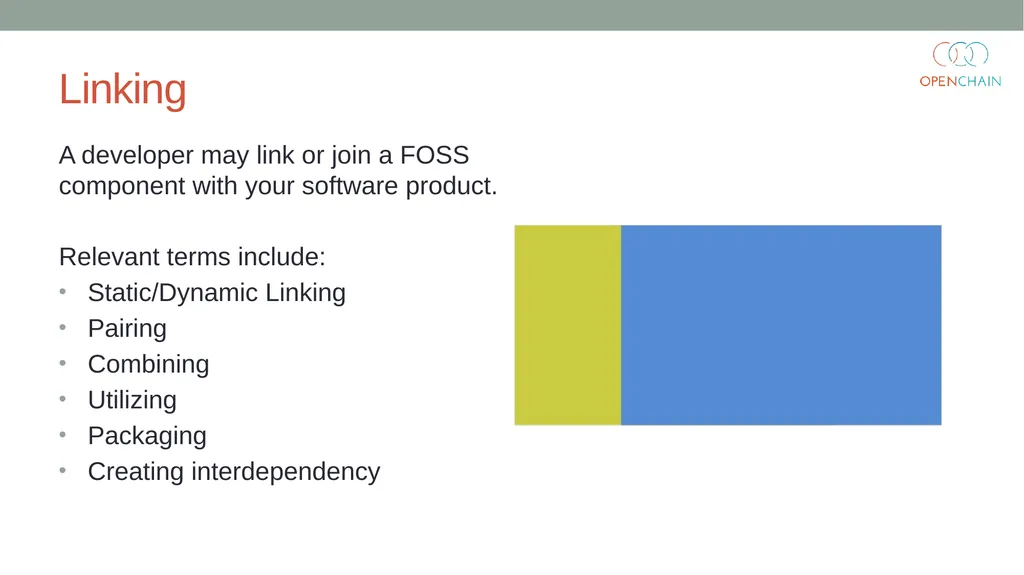
slide35. Linking A developer may link or join a FOSS component with your software product.
Relevant terms include:
Static/Dynamic Linking
Pairing
Combining
Utilizing
Packaging
Creating interdependency<br>
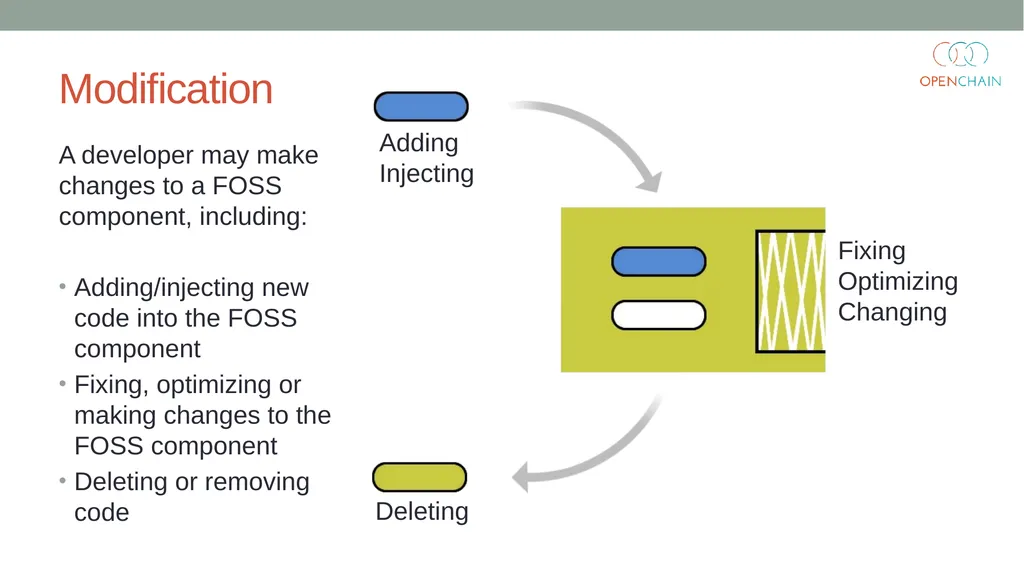
slide36. Modification A developer may make changes to a FOSS component, including:
Adding/injecting new code into the FOSS component
Fixing, optimizing or making changes to the FOSS component
Deleting or removing code Fixing
Optimizing
Changing Adding
Injecting Deleting<br>
slide37. Translation A developer may transform the code from one state to another.
Examples include:
Translating Chinese to English
Converting C++ to Java
Compiling VHDL in a mask or net list
Compiling into binary<br>
slide38. Development Tools Development tools may perform some of these operations behind the scenes.
For example, a tool may inject portions of its own code into output of the tool. Inject material Modify the material Translate the material<br>
slide39. How is the FOSS component distributed? Who receives the software?
Customer/Partner
Community project
What format for delivery?
Source code delivery
Binary delivery
Pre-loaded onto hardware<br>
slide40. Check Your Understanding What information is helpful in understanding how software is licensed?
What information helps identify who is licensing the software?
What is incorporation?
What is modification?
What is linking?
What is translation?
What factors are important in assessing a distribution?<br>
slide41. Chapter 5 Running a FOSS Review<br>
slide42. FOSS Review A key element to a FOSS Compliance Program is a FOSS Review process, through which a company can analyze and determine its FOSS obligations
The FOSS Review process includes the following steps:
Gather relevant information
Analyze and determine license obligations
Provide guidance in light of company policy and business objectives<br>
slide43. Initiating a FOSS Review The FOSS Review process should be accessible to Program/Product Managers, Engineers and others who may be working with FOSS.
Note: This process may also start when receiving FOSS-based software from outside vendors. Initiate a FOSS Review<br>
slide44. FOSS Review Team A FOSS Review alerts and engages the various support groups that work together to support, guide, coordinate and review the use of FOSS. This team may include:
Legal team to identify and evaluate license obligations
Scanning and tooling support team to help identify and track FOSS usage
Specialists working with business interests, commercial licensing, export compliance, etc., who may be impacted by FOSS usage Initiate a FOSS Review Legal Scanning Specialists<br>
slide45. Analyzing Proposed FOSS Usage The FOSS Review team should assess the information it has gathered before providing guidance, including for issues such as:
Completeness, consistency, accuracy (code scanning tools may be used to scan for undisclosed FOSS usage)
Does the declared license match what is in the code files?
Does the license truly permit the proposed use of the software? Legal Scanning Specialists<br>
slide46. Working through the FOSS Review Working through the FOSS Review process is interactive. The work crosses disciplines, including engineering, business and legal teams, and may require in follow-up discussion so that all parties understand the underlying issues. Ultimately, the process should result in clear guidance on FOSS usage. Initiate a FOSS Review Legal Scanning Specialists Work Guidance<br>
slide47. FOSS Review Oversight The FOSS Review process should have sufficient oversight in cases of disagreement between any of the parties involved, or when a decision is particularly important. Initiate a FOSS Review Legal Scanning Specialists Work Guidance<br>
slide48. Check Your Understanding What is the purpose of a FOSS Review?
What is the first action you should take if you want to use FOSS components?
What kinds of information might you collect for a FOSS review?
What additional information is important when reviewing a FOSS component from an outside vendor?
What steps can be taken to assess the quality of this information?
What should you do if you have a question about using FOSS?<br>
slide49. Chapter 6 End to End Compliance Management (Example Process)<br>
slide50. Introduction Compliance management consists of a set of actions that controls the intake and distribution of FOSS used in products (or "Supplied Software" in the OpenChain specification)
The result of compliance due diligence is an identification of all FOSS used in the Supplied Software and confirmation that all FOSS license obligations have been or will be met
This chapter provides an example of such a process, and may serve as a resource for forming or improving your internal processes Incoming
FOSS FOSS identified;
FOSS obligations met Compliance Process<br>
slide51. Incoming Software Identification Audit Resolve Issues Reviews Approvals Registration Notices Verifications Distribution Verifications Proprietary Software 3rd Party Software FOSS Outgoing Software Notices & Attributions Written Offer Scan or audit source code
– and –
Confirm origin and
license of source
code Resolve any
audit issues in line with
company FOSS policies Identify FOSS components for review Verify source code packages for distribution
– and –
Verify appropriate notices are provided Record approved
software/version
in inventory per
product and per
release Publish source code,
notices and provide written offer Review and approve
compliance record of FOSS software components Compile notices
for publication Post publication
verifications Example of Compliance Management End-to-End Process Process Overview<br>
slide52. Pre-requisites:
The process may begin with one of these events:
The development team requests the review of a FOSS component or an outgoing release
Discovery of FOSS being used without proper authorization
Discovery of FOSS being used as part of third party software Outcome:
A compliance record is created (or updated) for the FOSS
An audit is requested to scan or review the source code Incoming:
FOSS Outgoing:
FOSS + Mods Identification Audit Resolve Issues Reviews Approvals Registration Notices Verifications Distribution Verifications Steps:
Incoming requests are recorded
Scans of entire platform may be performed
Due diligence on any 3rd party provided software
Recognize and review any FOSS components added to a repository without an incoming request Identify and begin tracking FOSS from all sources Identify and Track FOSS Usage<br>
slide53. Incoming:
FOSS Outgoing:
FOSS + Mods Audit identification Resolve Issues Reviews Approvals Registration Notices Verifications Distribution Verifications Pre-requisites:
Development team provides a compliance record with information about the FOSS usage
In cases where no record is provided by the development team, a record can be created when the FOSS component is discovered Outcome:
An audit report identifying the origins and licenses of the source code Steps:
Source code for the audit is identified
Source may be scanned by a software tool
“Hits” from the audit or scan are reviewed and verified as to the proper origin of the code
Audits or scans are performed iteratively based on the software development and release lifecycles Identify FOSS components and their origin and licenses Auditing Source Code<br>
slide54. Pre-requisites:
A source code audit or scan has been completed
An audit report identifies the origins and licenses of the source code and flags files that need further investigation Outcome:
A resolution for each of the flagged files in the report and a resolution for any flagged license conflict Steps:
Provide feedback to the appropriate engineers to resolve issues in the audit report that conflict with your FOSS policy
Follow up with engineers to confirm that the issues are resolved Resolve all issues identified in the audit Resolving Issues<br>
slide55. Pre-requisites:
Source code has been audited
All identified issues have been resolved Outcome:
Ensure the software in the audit report conforms with FOSS policies
Preserve audit report findings and mark resolved issues as ready for the next step (i.e. Approval) Steps:
Include appropriate authority levels in review staff
Conduct FOSS Reviews on audited source code, review software architecture and FOSS usage (see next slide for template)
Identify obligations under FOSS licenses Review the audit report and confirm any discovered issues are resolved Performing Reviews<br>
slide56. Proprietary Legend 3rd Party Commercial GPL LGPL FOSS Permissive Function call Socket interface (fc) (si) System call (sc) Shared headers (sh) User Space Kernel Space Hardware [Insert Components] [Insert Components] [Insert Components] [Insert interaction method] [Insert interaction method] Architecture Review (Example Template)<br>
slide57. Based on the results of the software audit and review in previous steps, software may or may not be approved for use
The approval should specify versions of approved FOSS components, the approved usage model for the component, and any other applicable obligations under the FOSS license
Approvals should be made at appropriate authority levels Incoming:
FOSS Outgoing:
FOSS + Mods Approvals identification Audit Resolve Issues Reviews Registration Notices Verifications Distribution Verifications Approvals<br>
slide58. Once a FOSS component has been approved for usage in a product, it should be added to the software inventory for that product
The approval and its conditions should be registered in a tracking system
The tracking system should make it clear that a new approval is needed for a new version of a FOSS component or if a new usage model is proposed Incoming:
FOSS Outgoing:
FOSS + Mods Registration identification Audit Resolve Issues Reviews Approvals Notices Verifications Distribution Verifications Registration / Approval Tracking<br>
slide59. Prepare appropriate notices for any FOSS used in a product release:
Acknowledge the use of FOSS by providing full copyright and attribution notices
Inform the end user of their product on how to obtain a copy of the FOSS source code (when applicable, for example in the case of GPL and LGPL)
Reproduce the entire text of the license agreements for the FOSS code included in the product as needed Incoming:
FOSS Outgoing:
FOSS + Mods Notices identification Audit Resolve Issues Reviews Approvals Registration Verifications Distribution Verifications Notices<br>
slide60. Incoming:
FOSS Outgoing:
FOSS + Mods Verifications identification Audit Resolve Issues Reviews Approvals Registration Notices Distribution Verifications Pre-requisites:
FOSS component has been approved for usage
FOSS component has been registered in the software inventory for the release
Appropriate notices have been prepared Outcome:
The distribution package contains only software that has been reviewed and approved
"Distributed Compliance Artifacts" (as defined in the OpenChain specification), including appropriate notice files are included in the distribution package or other delivery method Steps:
Verify FOSS packages destined for distribution have been identified and approved
Verify the reviewed source code matches the binary equivalents shipping in the product
Verify all appropriate notices have been included to inform end-users of their right to request source code for identified FOSS
Verify compliance with other identified obligations Verify that distributed software has been reviewed and approved Pre-Distribution Verifications<br>
slide61. Incoming:
FOSS Outgoing:
FOSS + Mods Distribution identification Audit Resolve Issues Reviews Registration Notices Verifications Approvals Verifications Pre-requisites:
All pre-distribution verification has been completed and no issue is discovered Outcome:
Obligations to provide accompanying source code are met Steps:
Provide accompanying source code along with any associated build tools and documentation (e.g., by uploading to a distribution website or including in the distribution package)
Accompanying source code is identified with labels as to which product and version to which it corresponds Provide accompanying source code as required Accompanying Source Code Distribution<br>
slide62. Incoming:
FOSS Outgoing:
FOSS + Mods Verifications identification Audit Resolve Issues Reviews Approvals Notices Verifications Distribution Registration Pre-requisites:
Accompanying source code is provided as may be required
Appropriate notices have been prepared Outcome:
Verified Distributed Compliance Artifacts are appropriately provided Steps:
Verify accompanying source code (if any) has been uploaded or distributed correctly
Verify uploaded or distributed source code corresponds to the same version that was approved
Verify notices have been properly published and made available
Verify other identified obligations are met Validate compliance with license obligations Final Verifications<br>
slide63. Check Your Understanding What is involved in compliance due diligence (describe the steps at a high level)?
What types of issues may need to be resolved as part of compliance management?
Who should be involved in reviewing audit results?
What does an architecture review look for?
What should be included in the FOSS Notices?
What needs to be distributed for code used under a copyleft license?<br>
slide64. Chapter 7 Avoiding Compliance Pitfalls<br>
slide65. Compliance Pitfalls This chapter will describe some potential pitfalls to avoid in the compliance process:
Intellectual Property (IP) pitfalls
License Compliance pitfalls
Compliance Process pitfalls<br>
slide66. Intellectual Property Pitfalls<br>
slide67. Intellectual Property Pitfalls<br>
slide68. License Compliance Pitfalls License Compliance Pitfalls<br>
slide69. License Compliance Pitfalls<br>
slide70. Compliance Process Failures<br>
slide71. Compliance Process Failures<br>
slide72. Ensure Compliance Prior to Product Shipment Companies must make compliance a priority before any product (in whatever form) ships
Prioritizing compliance promotes:
More effective use of FOSS within your organization
Better relations with the FOSS community and FOSS organizations<br>
slide73. Establishing Community Relationships As a company that uses FOSS in commercial product, it is best to create and maintain a good relationship with the FOSS community, in particular, the specific communities related to the FOSS projects you use and deploy in your commercial product. In addition, good relationships with FOSS organizations can be very helpful in advising on best way to be compliant and also help out if you experience a compliance issue.
Good relationships with the software communities may also be helpful for two-way communication: upstreaming improvements and getting support from the software developers.<br>
slide74. Check Your Understanding What types of pitfalls can occur in FOSS compliance?
Give an example of an intellectual property failure.
Give an example of a license compliance failure.
Give an example of an compliance process failure.
What are the benefits of prioritizing compliance?
What are the benefits of maintaining a good community relationship?<br>