Curriculum Fundamentals Curriculum RegionalMerritt College November 16, 2024 Presenters Karen Chow, ASCCC At-large Representative Erik D. Reese, ASCCC Area C Representative 2 Outline Legal foundation Curriculum processes Courses,
"Curriculum Fundamentals Curriculum" is the property of its rightful owner. Permission is granted to
download and print the materials on this website for personal, non-commercial use only, and to display it
on your personal computer provided you do not modify the materials and that you retain all copyright
notices contained in the materials. By downloading content from our website, you accept the terms of this
agreement.
Presentation Transcript
01
Curriculum Fundamentals Curriculum Regional—Merritt College
November 16, 2024<br>
02
Presenters Karen Chow, ASCCC At-large Representative
Erik D. Reese, ASCCC Area C Representative 2<br>
03
Outline Legal foundation
Curriculum processes
Courses, disciplines, departments, divisions, and more
A few reminders 3<br>
04
Legal Foundation 4<br>
05
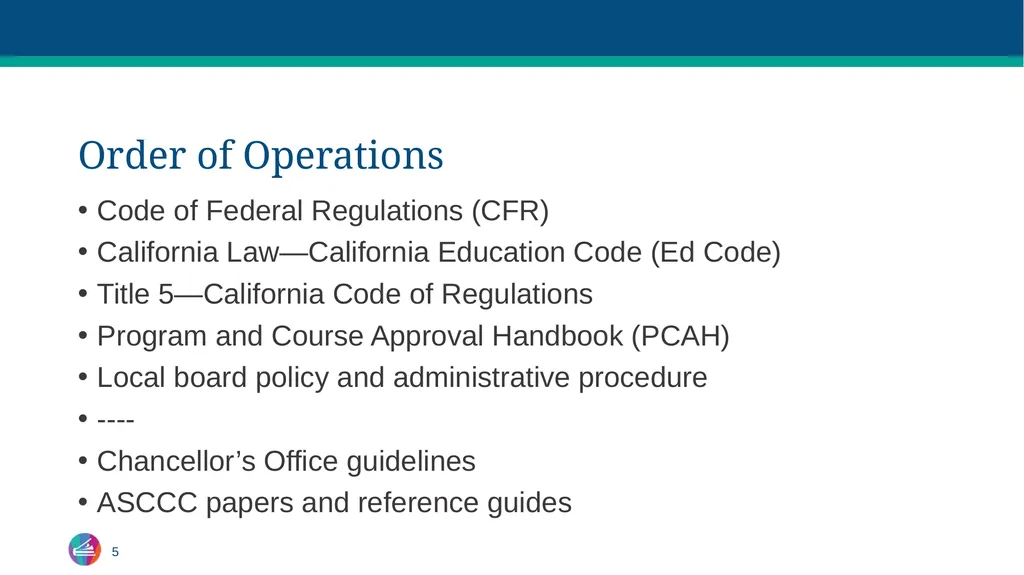
Order of Operations Code of Federal Regulations (CFR)
California Law—California Education Code (Ed Code)
Title 5—California Code of Regulations
Program and Course Approval Handbook (PCAH)
Local board policy and administrative procedure
----
Chancellor’s Office guidelines
ASCCC papers and reference guides 5<br>
06
Legislation Legislature may direct California Community Colleges
AB—Assembly Bill
SB—Senate Bill 6<br>
07
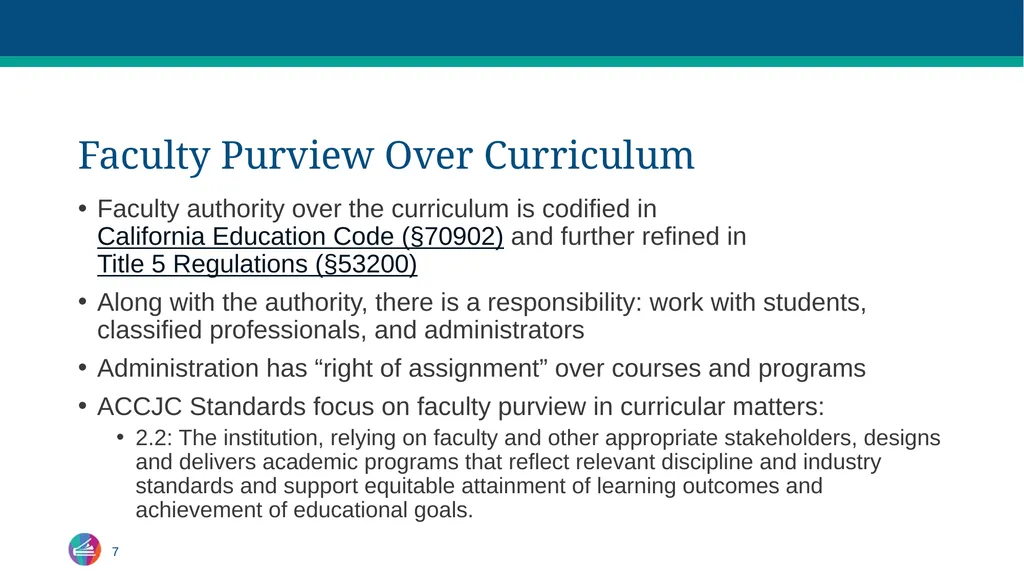
Faculty Purview Over Curriculum Faculty authority over the curriculum is codified in California Education Code (§70902) and further refined in Title 5 Regulations (§53200)
Along with the authority, there is a responsibility: work with students, classified professionals, and administrators
Administration has “right of assignment” over courses and programs
ACCJC Standards focus on faculty purview in curricular matters:
2.2: The institution, relying on faculty and other appropriate stakeholders, designs and delivers academic programs that reflect relevant discipline and industry standards and support equitable attainment of learning outcomes and achievement of educational goals. 7<br>
08
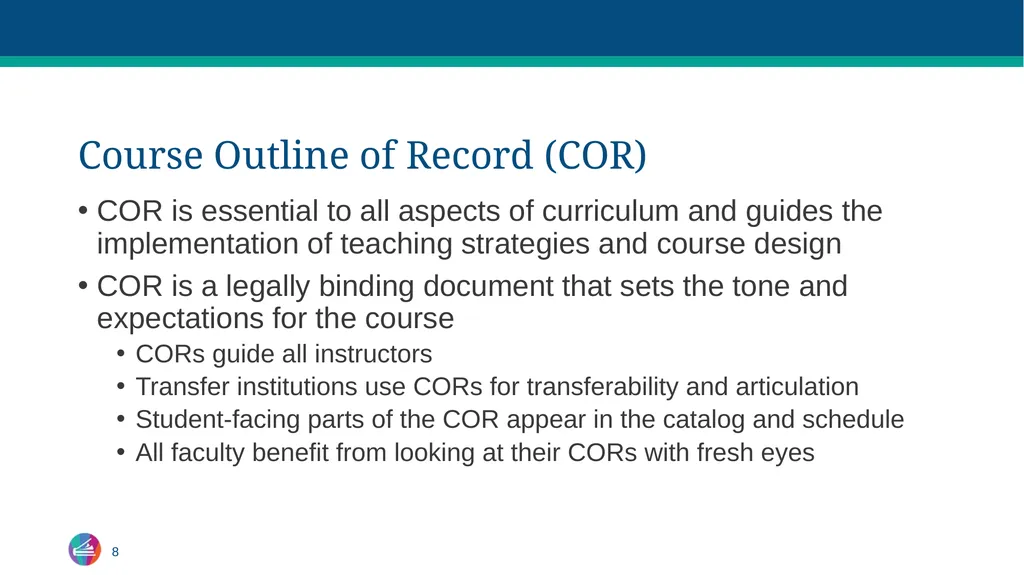
Course Outline of Record (COR) COR is essential to all aspects of curriculum and guides the implementation of teaching strategies and course design
COR is a legally binding document that sets the tone and expectations for the course
CORs guide all instructors
Transfer institutions use CORs for transferability and articulation
Student-facing parts of the COR appear in the catalog and schedule
All faculty benefit from looking at their CORs with fresh eyes 8<br>
09
Curriculum Processes 9<br>
10
Curriculum Committee Expectations One of very few committees named in Title 5
Many legal/regulatory requirements
Committee training to take advantage of the CO streamlined approval processes 10<br>
11
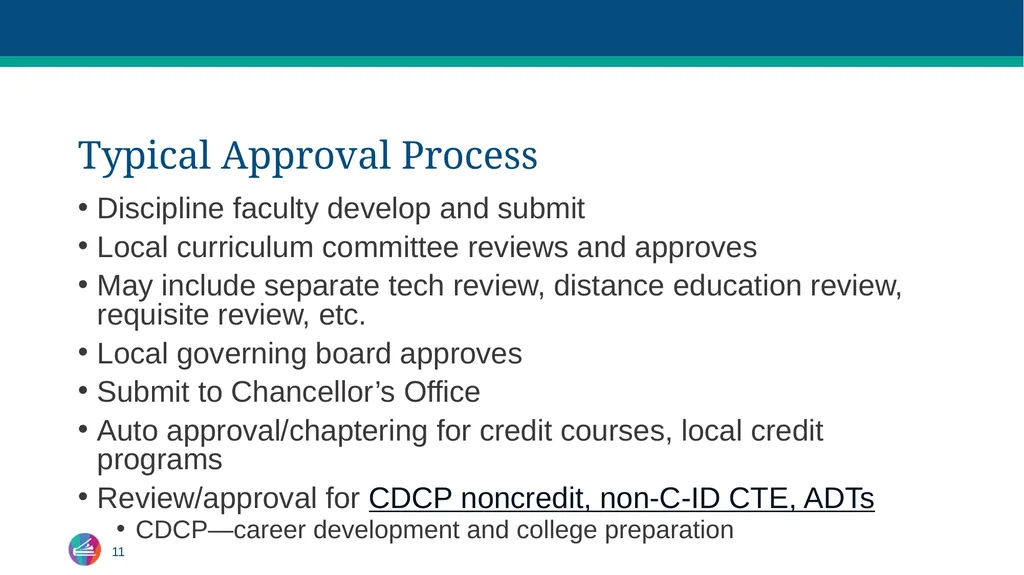
Typical Approval Process Discipline faculty develop and submit
Local curriculum committee reviews and approves
May include separate tech review, distance education review, requisite review, etc.
Local governing board approves
Submit to Chancellor’s Office
Auto approval/chaptering for credit courses, local credit programs
Review/approval for CDCP noncredit, non-C-ID CTE, ADTs
CDCP—career development and college preparation 11<br>
12
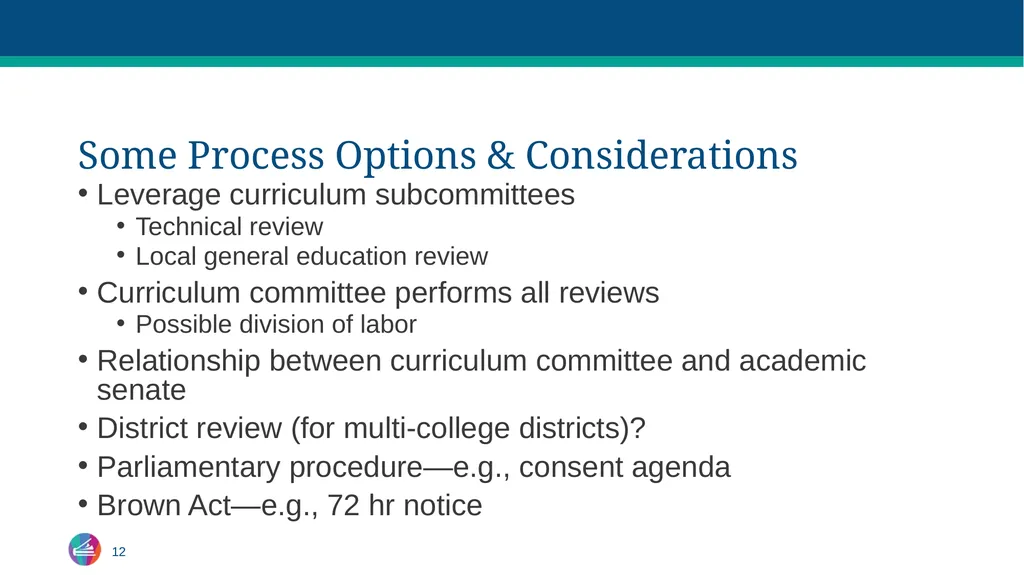
Some Process Options & Considerations Leverage curriculum subcommittees
Technical review
Local general education review
Curriculum committee performs all reviews
Possible division of labor
Relationship between curriculum committee and academic senate
District review (for multi-college districts)?
Parliamentary procedure—e.g., consent agenda
Brown Act—e.g., 72 hr notice 12<br>
13
Courses, Disciplines, Departments, Divisions, and more 13<br>
14
Minimum Qualifications Minimum qualifications necessary to teach within a discipline
Minimum Qualifications Handbook adopted by the BOG and maintained by the CCCCO 14<br>
15
Assigning Courses to Disciplines Title 5 §53200(c): Academic and professional matters (also known as the 10+1)
(1) Curriculum, including establishing prerequisites and placing courses within disciplines”
Multiple disciplines:
And
Or 15<br>
16
Subject Code Abbreviation of the subject
For example,
ENGL for English
PHYS for physics 16<br>
17
Disciplines, Departments, and Divisions Administrative organization
Independent of assigning courses to disciplines and subject code 17<br>
18
Example STAT C1000 Introduction to Statistics
What min quals are most appropriate?
In what department might this course reside? 18<br>
19
A Few Reminders 19<br>
20
Center Students Put the needs of students and the college first
Consider student perspectives and experiences
Collaborate with local student government 20<br>
21
Mission All our work ought to be aligned with the college mission
Curriculum included 21<br>
22
Discussion What is the membership of your local curriculum committee?
And possible district curriculum committee?
What is the relationship between curriculum committee and academic senate for CORs? Policies and procedures?
What is your local curricular process?
Where is minimum qualification information recorded?
How are your disciplines, departments, and divisions structured? 22<br>
23
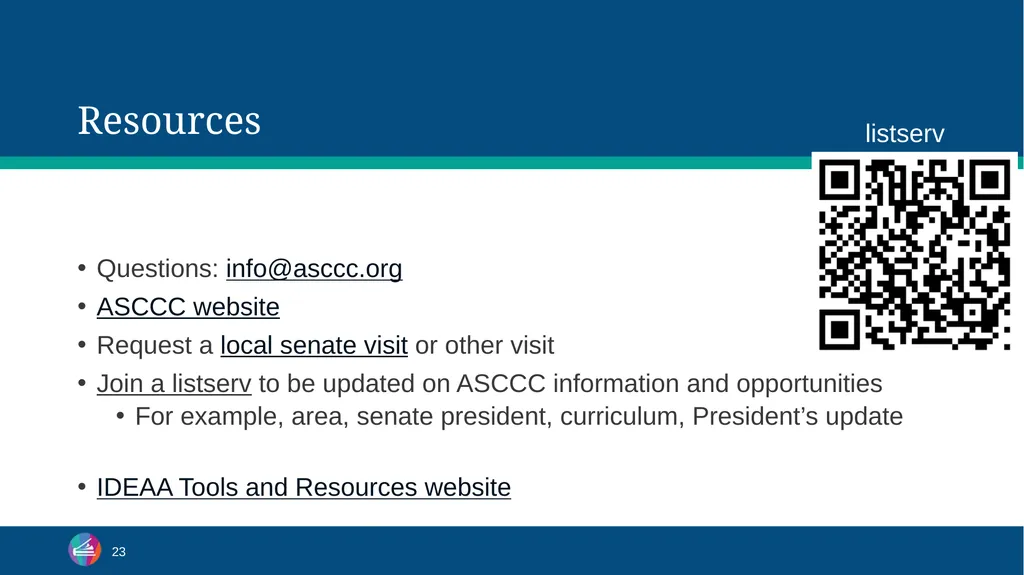
Resources listserv Questions: info@asccc.org
ASCCC website
Request a local senate visit or other visit
Join a listserv to be updated on ASCCC information and opportunities
For example, area, senate president, curriculum, President’s update
IDEAA Tools and Resources website 23<br>
24
Resources—Curriculum Committee & Processes Some ASCCC papers:
The Course Outline of Record: A Curriculum Reference Guide Revisited (2017)
Ensuring Effective Curriculum Approval Processes: A Guide for Local Senates (2016)
Curriculum Committee: Role, Structure, Duties and Standards of Good Practice (1996) 24<br>