
Custom: as a Source of law Sneha Singh “Basic
CB
Published · 18 slides · 0 views
1 / 1


Description
Custom: as a Source of law Sneha Singh Basic ground of source of law is inherent in human beings. Customs are the earliest sources of law and form the basis of the English Common Law system as we see it today. They can be described as
Related Topics
Share
Embed code
Download this presentation From Below
"Custom: as a Source of law Sneha Singh “Basic" is the property of its rightful owner. Permission is granted to download and print the materials on this website for personal, non-commercial use only, and to display it on your personal computer provided you do not modify the materials and that you retain all copyright notices contained in the materials. By downloading content from our website, you accept the terms of this agreement.
Presentation Transcript
01
Custom: as a Source of law Sneha Singh<br>
02
“Basic ground of source of law is inherent in human beings.”
Customs are the earliest sources of law and form the basis of the English Common Law system as we see it today. They can be described as cultural practises which have become definite and backed by obligation or sanction just by virtue of widespread practise and continue presence.
Custom is considered as the ancient source of law; as Manusmiriti, Mahabharata have instances which depict that customs have been considered as source of law. The idea behind customs is that we must not deviate from the way which has been followed by our ancestors. INTRODUCTION:<br>
03
The word ‘custom’ is derived from an old French word ‘Coustume’. Some say that the word ‘custom’ is based on Latin word ‘Consuetudo, others say that the word ‘Custom’ is derived from the word ‘Consuetus’, while others say that it is the part participate of word ‘Consuescere’ which means ‘accustom’. Some says that it is derived from two words ‘con’ means ‘expressing intensive force’ and ‘suescere’ means ‘become accustomed’. In Hindi the word ‘custom’ means ‘reeti’,‘vyavahar’,‘rasm’, or ‘riwaj’.
The word ‘custom’ literally, grammatically, or ordinarily means; tradition, practice; usage; observance; way; convention; procedure; ceremony; ritual; ordinance; form; formality; fashion; mode; manner; shibboleth; unwritten rule; way of doing things; formal; style; etiquette; routine; habit; usual; rite, etc. MEANING:<br>
The word ‘custom’ literally, grammatically, or ordinarily means; tradition, practice; usage; observance; way; convention; procedure; ceremony; ritual; ordinance; form; formality; fashion; mode; manner; shibboleth; unwritten rule; way of doing things; formal; style; etiquette; routine; habit; usual; rite, etc. MEANING:<br>
04
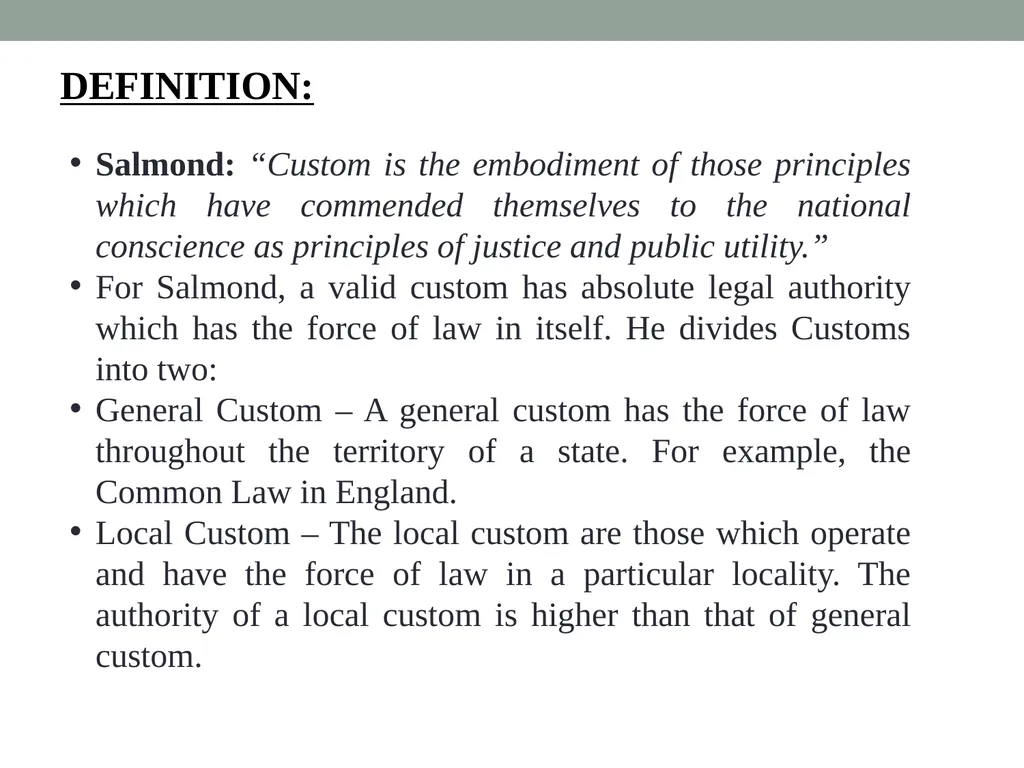
Salmond: “Custom is the embodiment of those principles which have commended themselves to the national conscience as principles of justice and public utility.”
For Salmond, a valid custom has absolute legal authority which has the force of law in itself. He divides Customs into two:
General Custom – A general custom has the force of law throughout the territory of a state. For example, the Common Law in England.
Local Custom – The local custom are those which operate and have the force of law in a particular locality. The authority of a local custom is higher than that of general custom. DEFINITION:<br>
05
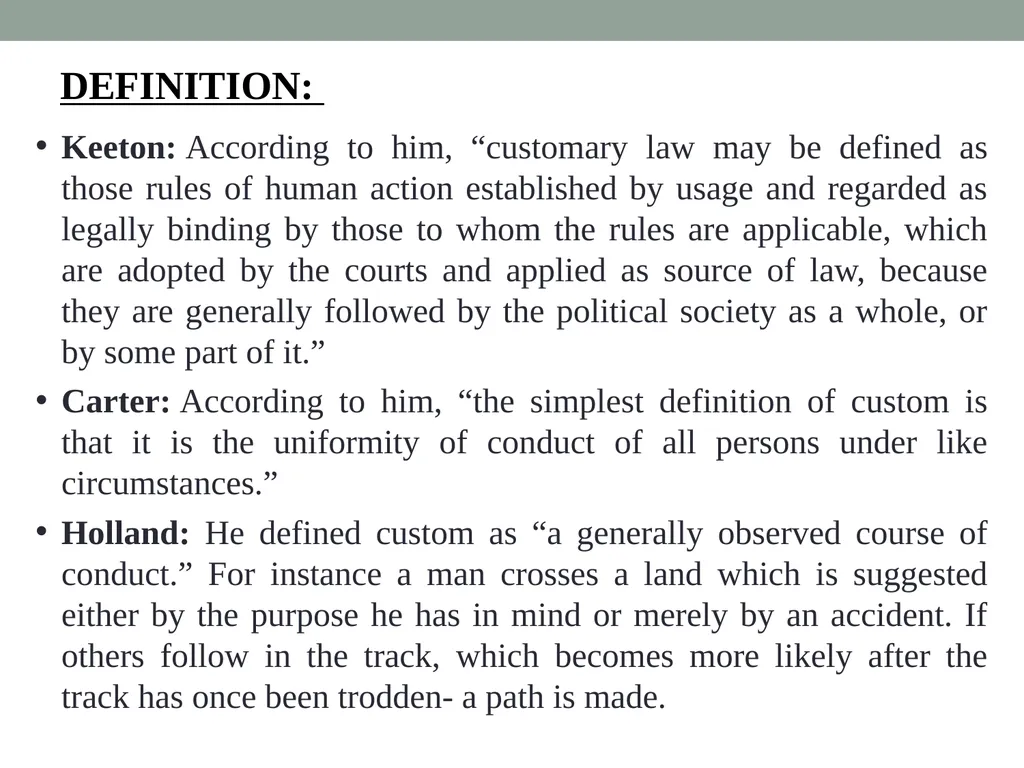
Keeton: According to him, “customary law may be defined as those rules of human action established by usage and regarded as legally binding by those to whom the rules are applicable, which are adopted by the courts and applied as source of law, because they are generally followed by the political society as a whole, or by some part of it.”
Carter: According to him, “the simplest definition of custom is that it is the uniformity of conduct of all persons under like circumstances.”
Holland: He defined custom as “a generally observed course of conduct.” For instance a man crosses a land which is suggested either by the purpose he has in mind or merely by an accident. If others follow in the track, which becomes more likely after the track has once been trodden- a path is made. DEFINITION:<br>
06
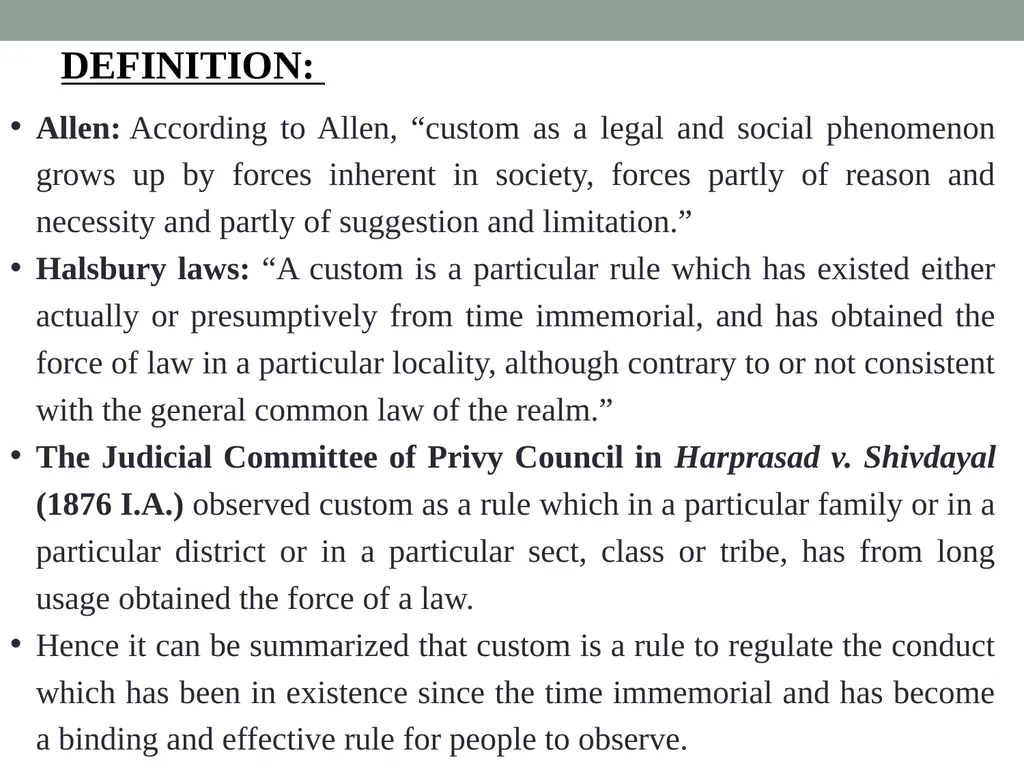
Allen: According to Allen, “custom as a legal and social phenomenon grows up by forces inherent in society, forces partly of reason and necessity and partly of suggestion and limitation.”
Halsbury laws: “A custom is a particular rule which has existed either actually or presumptively from time immemorial, and has obtained the force of law in a particular locality, although contrary to or not consistent with the general common law of the realm.”
The Judicial Committee of Privy Council in Harprasad v. Shivdayal (1876 I.A.) observed custom as a rule which in a particular family or in a particular district or in a particular sect, class or tribe, has from long usage obtained the force of a law.
Hence it can be summarized that custom is a rule to regulate the conduct which has been in existence since the time immemorial and has become a binding and effective rule for people to observe. DEFINITION:<br>
07
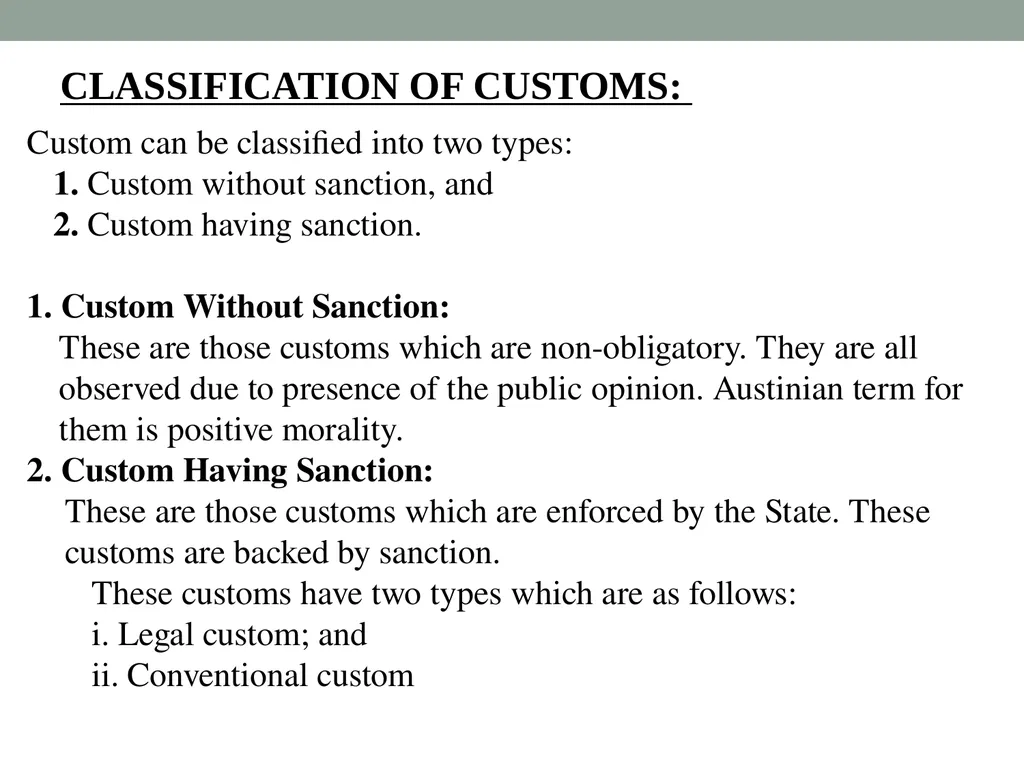
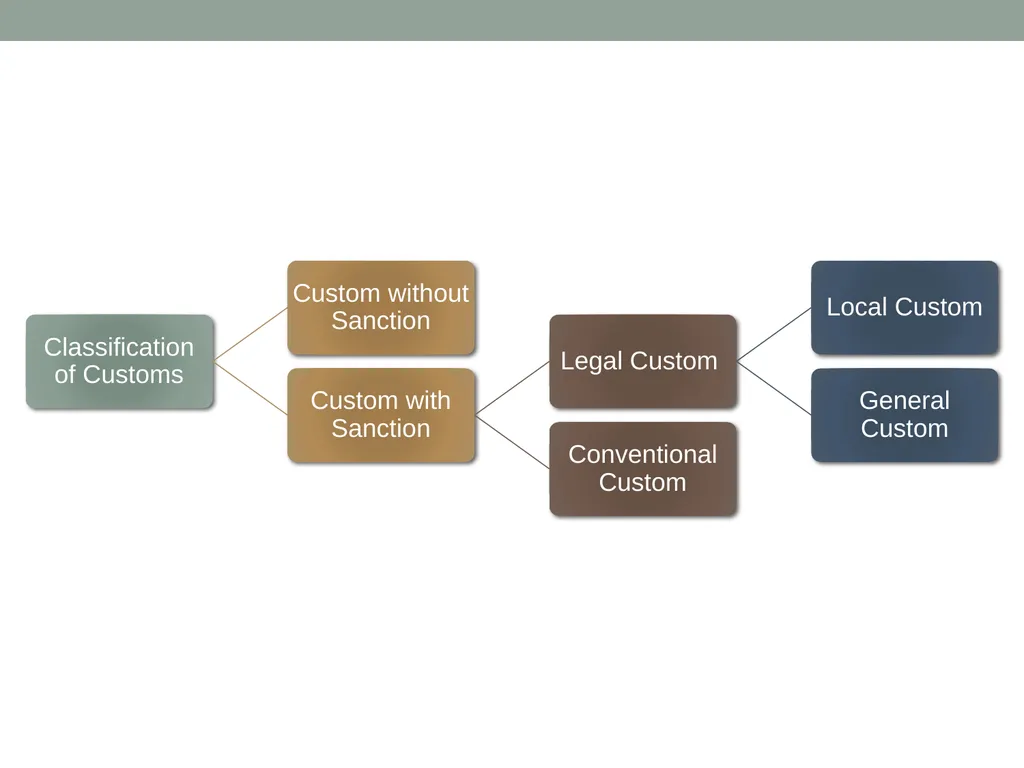
Custom can be classified into two types:
1. Custom without sanction, and
2. Custom having sanction.
1. Custom Without Sanction:
These are those customs which are non-obligatory. They are all observed due to presence of the public opinion. Austinian term for them is positive morality.
2. Custom Having Sanction:
These are those customs which are enforced by the State. These customs are backed by sanction.
These customs have two types which are as follows:
i. Legal custom; and
ii. Conventional custom CLASSIFICATION OF CUSTOMS:<br>
08
i. Legal custom: - The legal customs are those whose legal authority is absolute and unconditional. These customs operate as a binding rule of law. They have been recognized by the courts and have become a part of the law of the land. They are enforced by the courts. Legal customs are of two types:-
a. Local custom
b. General custom
a. LOCAL CUSTOM
A local custom is that which prevails in some defined locality, that is, to a district, town or an area. But they do not imply geographical locality only. Sometimes, certain sects or families take their customs with them wherever they go. They too are called local customs. Therefore, in India, local customs may be divided into two classes; Geographical local custom and personal local custom. These customs are law only for a particular locality, set or family.<br>
09
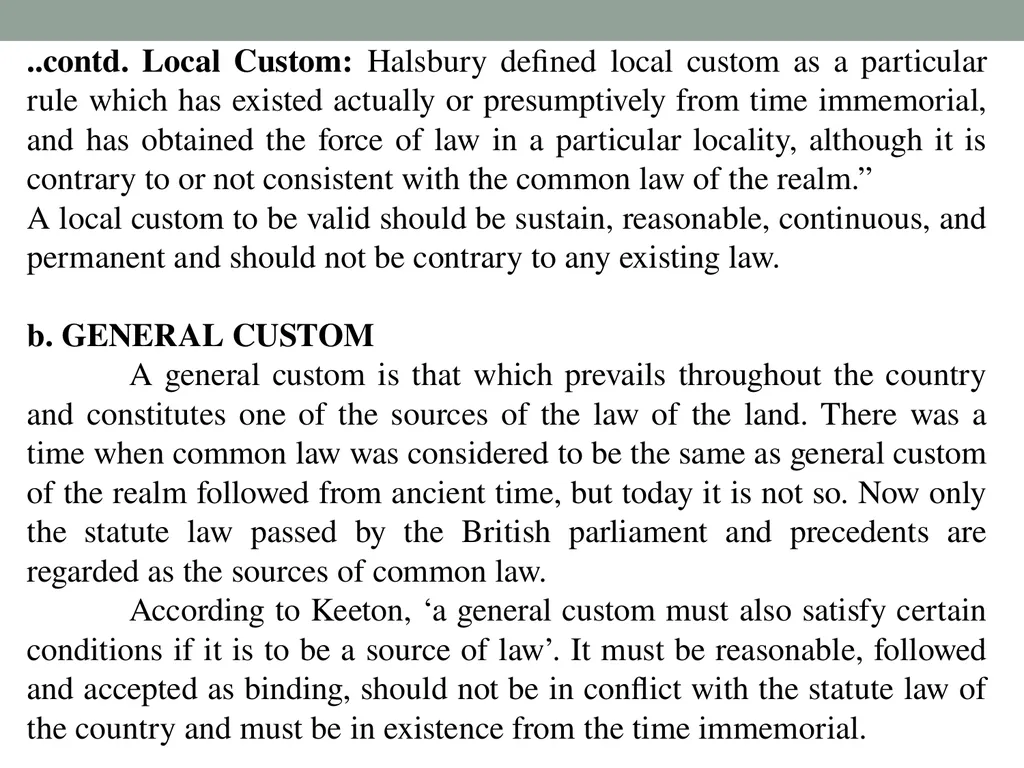
..contd. Local Custom: Halsbury defined local custom as a particular rule which has existed actually or presumptively from time immemorial, and has obtained the force of law in a particular locality, although it is contrary to or not consistent with the common law of the realm.”
A local custom to be valid should be sustain, reasonable, continuous, and permanent and should not be contrary to any existing law.
b. GENERAL CUSTOM
A general custom is that which prevails throughout the country and constitutes one of the sources of the law of the land. There was a time when common law was considered to be the same as general custom of the realm followed from ancient time, but today it is not so. Now only the statute law passed by the British parliament and precedents are regarded as the sources of common law.
According to Keeton, ‘a general custom must also satisfy certain conditions if it is to be a source of law’. It must be reasonable, followed and accepted as binding, should not be in conflict with the statute law of the country and must be in existence from the time immemorial.<br>
10
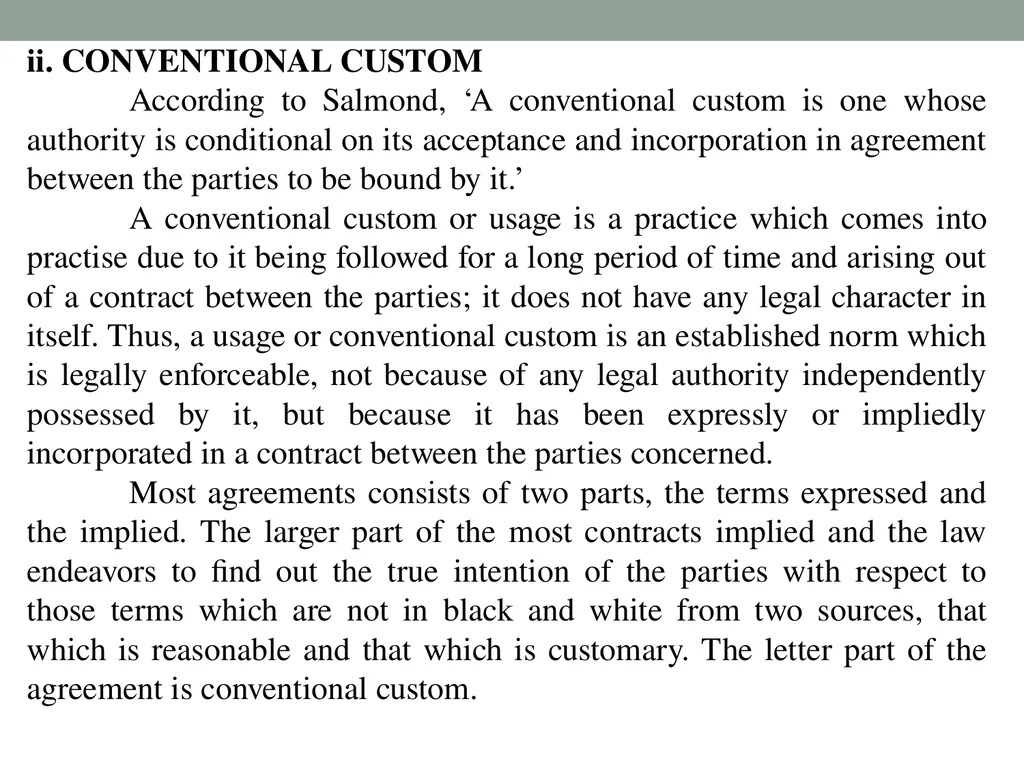
ii. CONVENTIONAL CUSTOM
According to Salmond, ‘A conventional custom is one whose authority is conditional on its acceptance and incorporation in agreement between the parties to be bound by it.’
A conventional custom or usage is a practice which comes into practise due to it being followed for a long period of time and arising out of a contract between the parties; it does not have any legal character in itself. Thus, a usage or conventional custom is an established norm which is legally enforceable, not because of any legal authority independently possessed by it, but because it has been expressly or impliedly incorporated in a contract between the parties concerned.
Most agreements consists of two parts, the terms expressed and the implied. The larger part of the most contracts implied and the law endeavors to find out the true intention of the parties with respect to those terms which are not in black and white from two sources, that which is reasonable and that which is customary. The letter part of the agreement is conventional custom.<br>
11
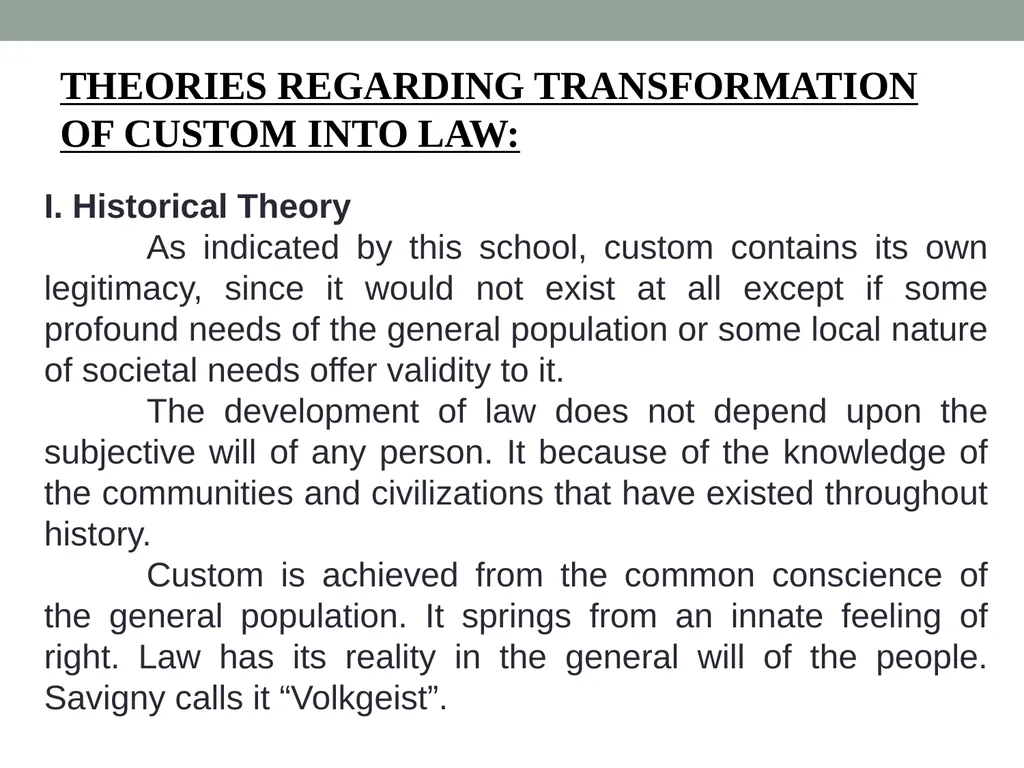
I. Historical Theory
As indicated by this school, custom contains its own legitimacy, since it would not exist at all except if some profound needs of the general population or some local nature of societal needs offer validity to it.
The development of law does not depend upon the subjective will of any person. It because of the knowledge of the communities and civilizations that have existed throughout history.
Custom is achieved from the common conscience of the general population. It springs from an innate feeling of right. Law has its reality in the general will of the people. Savigny calls it “Volkgeist”. THEORIES REGARDING TRANSFORMATION OF CUSTOM INTO LAW:<br>
12
II. Analytical (Positivist) Theory
Austin was the main proponent of the Analytical theory. For him, Customs did not have any legally binding force in themselves. Their legal character is always subject to the assent of the Sovereign. For him, customs were merely reflection of law, and were not ‘real law’. Customs need the modification and the approval of judges, jurists or rulers for them to have any binding force on people. This is in consonance with his idea that all law is the ‘Will of the Sovereign”.<br>
Austin was the main proponent of the Analytical theory. For him, Customs did not have any legally binding force in themselves. Their legal character is always subject to the assent of the Sovereign. For him, customs were merely reflection of law, and were not ‘real law’. Customs need the modification and the approval of judges, jurists or rulers for them to have any binding force on people. This is in consonance with his idea that all law is the ‘Will of the Sovereign”.<br>
13
Immemorial antiquity: Recent and modern custom is of no account. It must have been observed for such a long time that " the memory of man runneth not to contrary". In other words, it must be immemorial antiquity, i.e., its origin is so ancient that no living man can testify its beginning.
Continuity: Only that custom is valid which has been continuously observed without any interruption from time immemorial . If a custom has not been followed continuously and uninterruptedly for a long time, the presumption is that it never be exist.
Peaceable enjoyment: The enjoyment of a custom must be a peaceable one. If that is not so, consent is presumed to be wanting in it. ESSENTIALS/REQUISITES OF A VALID CUSTOM:<br>
14
4. Reasonable: A custom must be reasonable. Its authority is not absolute, but conditional on certain measure of conformity with the prevailing view of usefulness, justice and public policy. It is reasonable if found to be in consonance with reason and its origin and continuance are capable of being explained. Thus, the 'sati pratha' could not take the place of a legal Custom due to its being repugnant to the logical sense of justice and goodness in man. A custom of burying or cremating the dead bodies of the people of the locality on an abandoned land is not unreasonable. It is however, not necessary that in order to be reasonable, a custom must fulfill the test of absolute rectitude and wisdom. The true rule is, observes Salmond that a custom in order to be deprived of legal efficacy must be so obviously and seriously repugnant to right and reason, that to enforce it as law would do more mischief than that which result from the overturning of the expectations and arrangements based on its presumed continuance and legal validity. ESSENTIALS/REQUISITES OF A VALID CUSTOM:<br>
15
Certainty: A custom must be certain and the court must Satisfied by Clear and unambiguous proof that the custom exists as a matter of fact or legal presumption of fact. A custom, however ancient, must not be indefinite and uncertain, and as Willes C.J. observed in Broadbent vs. Wilkes(1742) Willes,360. " a custom custom must be certain because, if it be not certain it cannot be proved to have been time out of mind, for how can anything be said to have been time out of mind when it is not certain what is?”
Compulsory Observance: For a custom to be considered valid, it must have been observed since ancient times without any interruptions and must be considered by the people following it as a binding rule of law and not optional. ESSENTIALS/REQUISITES OF A VALID CUSTOM:<br>
Compulsory Observance: For a custom to be considered valid, it must have been observed since ancient times without any interruptions and must be considered by the people following it as a binding rule of law and not optional. ESSENTIALS/REQUISITES OF A VALID CUSTOM:<br>
16
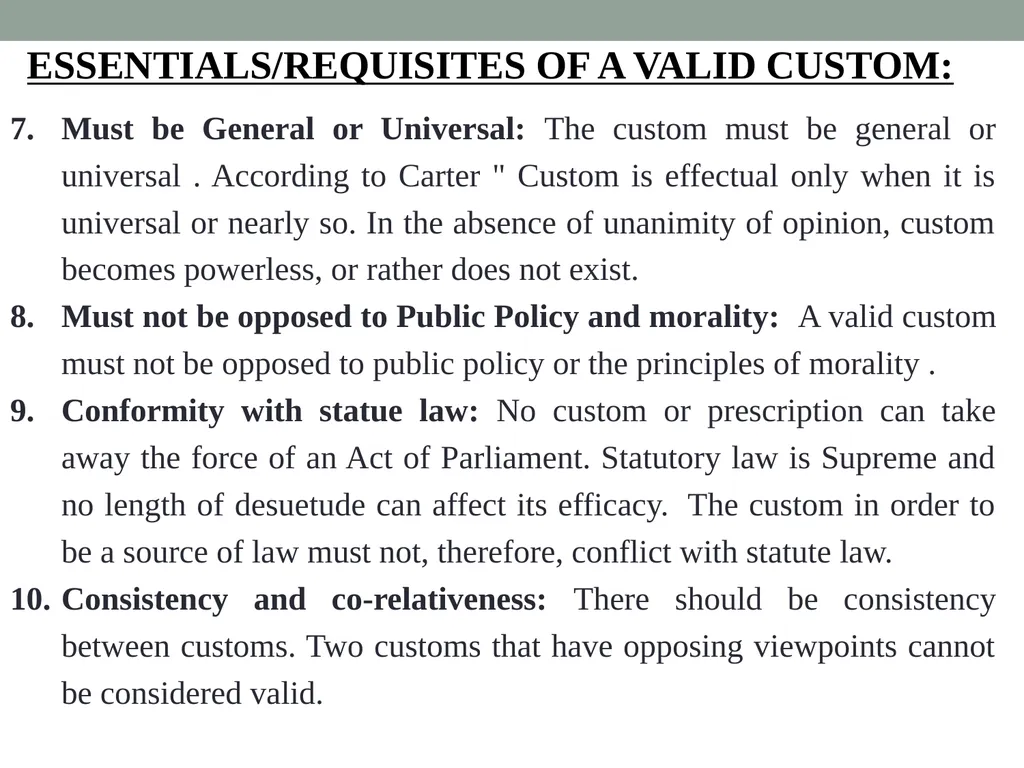
Must be General or Universal: The custom must be general or universal . According to Carter " Custom is effectual only when it is universal or nearly so. In the absence of unanimity of opinion, custom becomes powerless, or rather does not exist.
Must not be opposed to Public Policy and morality: A valid custom must not be opposed to public policy or the principles of morality .
Conformity with statue law: No custom or prescription can take away the force of an Act of Parliament. Statutory law is Supreme and no length of desuetude can affect its efficacy. The custom in order to be a source of law must not, therefore, conflict with statute law.
Consistency and co-relativeness: There should be consistency between customs. Two customs that have opposing viewpoints cannot be considered valid. ESSENTIALS/REQUISITES OF A VALID CUSTOM:<br>
17
THANK YOU<br>