
Cytology sample taker trainee internal mentor
MJ
Published · 12 slides · 0 views
1 / 1
Description
This presentation contains informative slides with valuable content.
Related Topics
Share
Embed code
Download this presentation From Below
"Cytology sample taker trainee internal mentor" is the property of its rightful owner. Permission is granted to download and print the materials on this website for personal, non-commercial use only, and to display it on your personal computer provided you do not modify the materials and that you retain all copyright notices contained in the materials. By downloading content from our website, you accept the terms of this agreement.
Presentation Transcript
01
Cytology sample taker trainee internal mentor guidance<br>
02
https://www.gov.uk/government/publications/cervical-screening-cervical-sample-taker-training/training-for-cervical-sample-takers-education-pathway?fbclid=IwAR1j7yEKbkq3kHPQ79JWHKIoMvuuk49KQFfzGJsuyoVIkN2p-J0I5zkkc2U#interim<br>
03
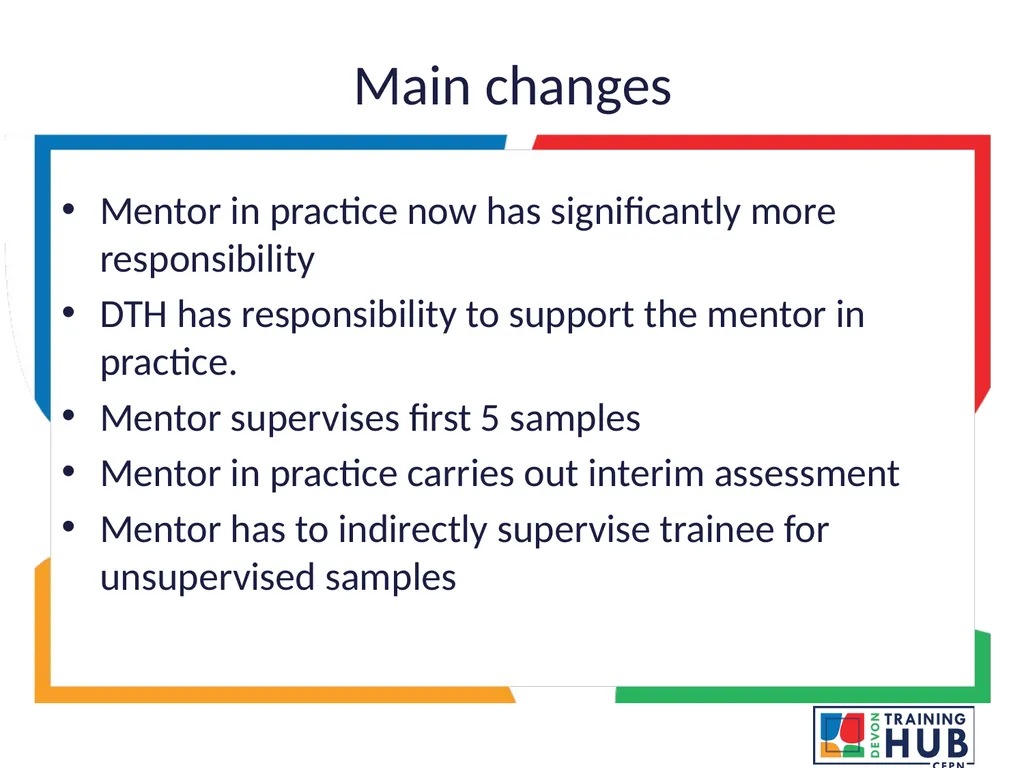
Main changes Mentor in practice now has significantly more responsibility
DTH has responsibility to support the mentor in practice.
Mentor supervises first 5 samples
Mentor in practice carries out interim assessment
Mentor has to indirectly supervise trainee for unsupervised samples<br>
DTH has responsibility to support the mentor in practice.
Mentor supervises first 5 samples
Mentor in practice carries out interim assessment
Mentor has to indirectly supervise trainee for unsupervised samples<br>
04
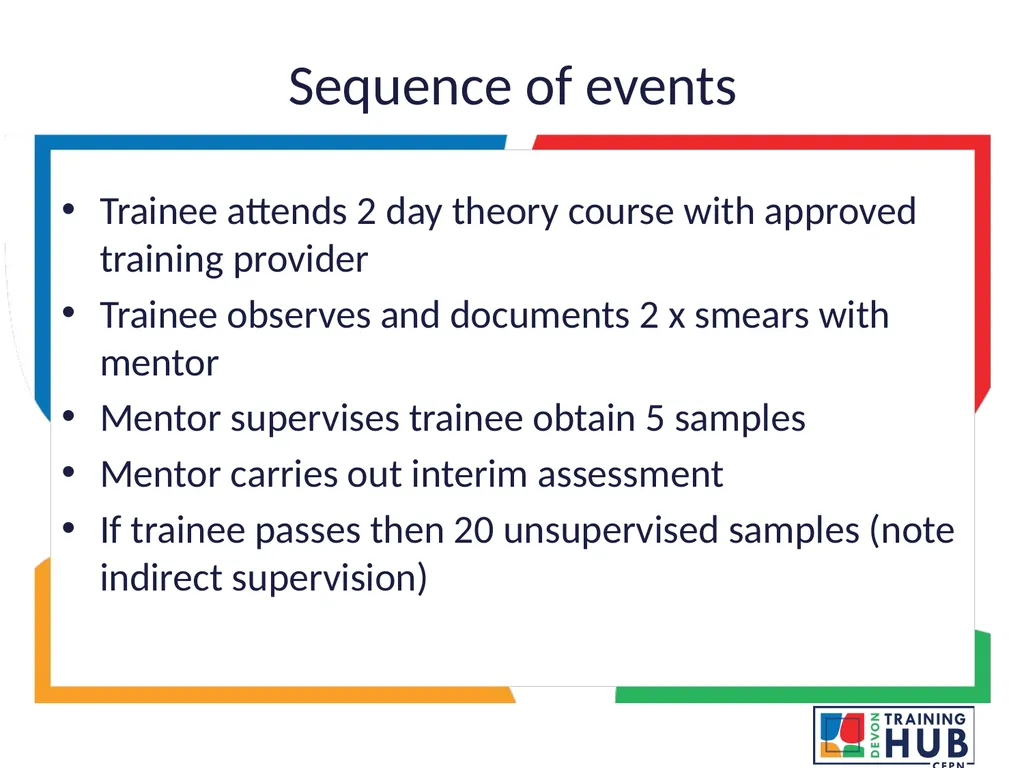
Sequence of events Trainee attends 2 day theory course with approved training provider
Trainee observes and documents 2 x smears with mentor
Mentor supervises trainee obtain 5 samples
Mentor carries out interim assessment
If trainee passes then 20 unsupervised samples (note indirect supervision)<br>
Trainee observes and documents 2 x smears with mentor
Mentor supervises trainee obtain 5 samples
Mentor carries out interim assessment
If trainee passes then 20 unsupervised samples (note indirect supervision)<br>
05
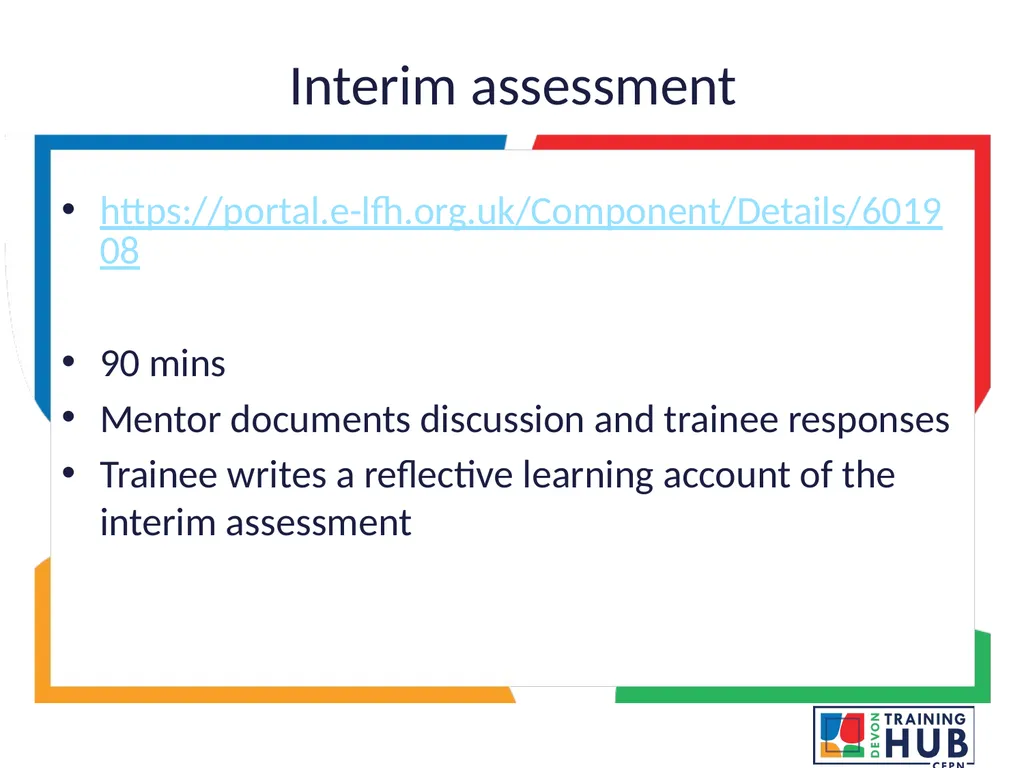
Interim assessment https://portal.e-lfh.org.uk/Component/Details/601908
90 mins
Mentor documents discussion and trainee responses
Trainee writes a reflective learning account of the interim assessment<br>
90 mins
Mentor documents discussion and trainee responses
Trainee writes a reflective learning account of the interim assessment<br>
06
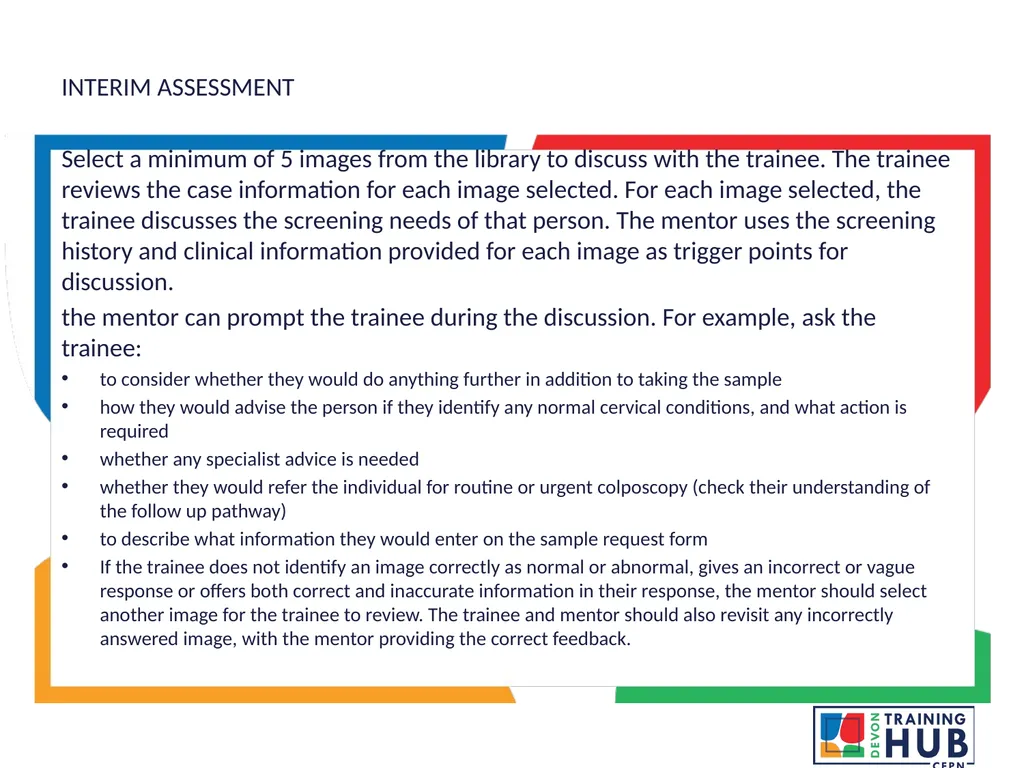
INTERIM ASSESSMENT
Select a minimum of 5 images from the library to discuss with the trainee. The trainee reviews the case information for each image selected. For each image selected, the trainee discusses the screening needs of that person. The mentor uses the screening history and clinical information provided for each image as trigger points for discussion.
the mentor can prompt the trainee during the discussion. For example, ask the trainee:
to consider whether they would do anything further in addition to taking the sample
how they would advise the person if they identify any normal cervical conditions, and what action is required
whether any specialist advice is needed
whether they would refer the individual for routine or urgent colposcopy (check their understanding of the follow up pathway)
to describe what information they would enter on the sample request form
If the trainee does not identify an image correctly as normal or abnormal, gives an incorrect or vague response or offers both correct and inaccurate information in their response, the mentor should select another image for the trainee to review. The trainee and mentor should also revisit any incorrectly answered image, with the mentor providing the correct feedback.<br>
Select a minimum of 5 images from the library to discuss with the trainee. The trainee reviews the case information for each image selected. For each image selected, the trainee discusses the screening needs of that person. The mentor uses the screening history and clinical information provided for each image as trigger points for discussion.
the mentor can prompt the trainee during the discussion. For example, ask the trainee:
to consider whether they would do anything further in addition to taking the sample
how they would advise the person if they identify any normal cervical conditions, and what action is required
whether any specialist advice is needed
whether they would refer the individual for routine or urgent colposcopy (check their understanding of the follow up pathway)
to describe what information they would enter on the sample request form
If the trainee does not identify an image correctly as normal or abnormal, gives an incorrect or vague response or offers both correct and inaccurate information in their response, the mentor should select another image for the trainee to review. The trainee and mentor should also revisit any incorrectly answered image, with the mentor providing the correct feedback.<br>
07
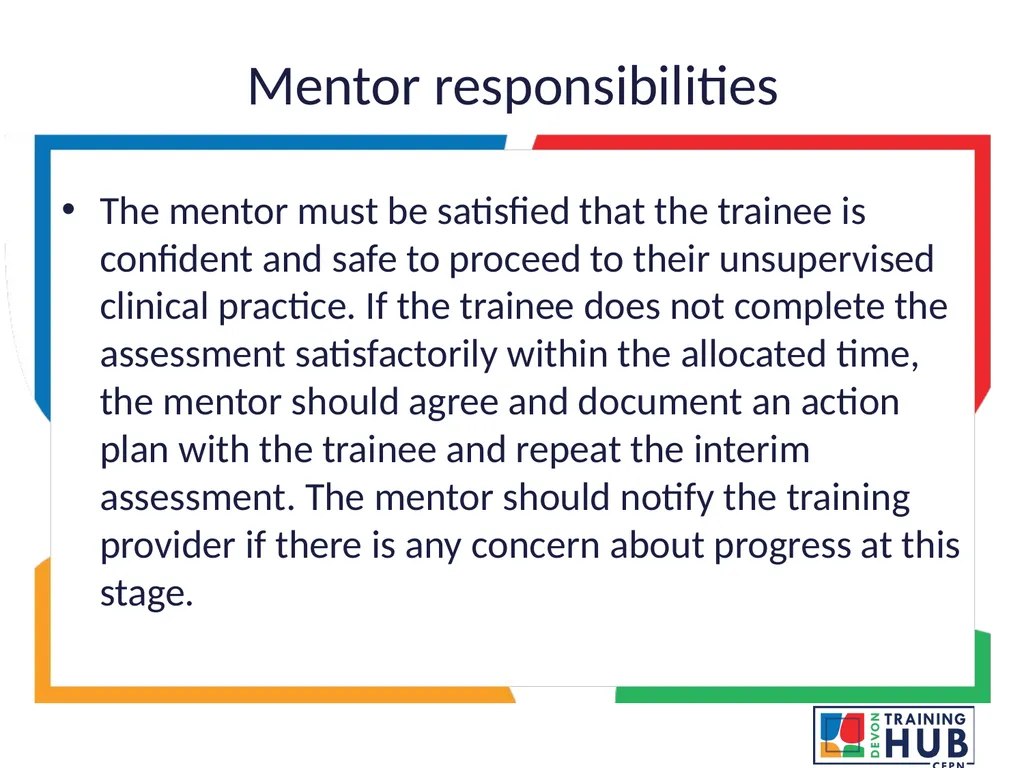
Mentor responsibilities The mentor must be satisfied that the trainee is confident and safe to proceed to their unsupervised clinical practice. If the trainee does not complete the assessment satisfactorily within the allocated time, the mentor should agree and document an action plan with the trainee and repeat the interim assessment. The mentor should notify the training provider if there is any concern about progress at this stage.<br>
08
External assessor Must have 12 months experience or 50 samples.
Only one visit to practice to supervise 3 x smears and final assessment.
Note minimum of 3 x smears.
Each external assessor could now have several trainees?<br>
Only one visit to practice to supervise 3 x smears and final assessment.
Note minimum of 3 x smears.
Each external assessor could now have several trainees?<br>
09
Unsupervised (indirectly supervised) clinical practice Once the trainee has satisfactorily completed the interim assessment and the mentor is confident the trainee can proceed safely, the trainee should arrange to take and document 20 samples without direct supervision. Allow at least 30 minutes per appointment to take the sample and complete the paperwork. Easy access to an experienced sample taker is essential throughout this period.
The trainee must maintain regular contact with their mentor to:
identify and discuss any emerging training issues or problems
discuss progress towards meeting identified training needs
review their progress throughout their unsupervised practice
prepare for the final evaluation session and clinical assessment<br>
The trainee must maintain regular contact with their mentor to:
identify and discuss any emerging training issues or problems
discuss progress towards meeting identified training needs
review their progress throughout their unsupervised practice
prepare for the final evaluation session and clinical assessment<br>
10
Review of the first 20 unsupervised cervical samples The trainee must review their first 20 unsupervised cervical samples and discuss the results with their mentor.
If the review identifies any rejected samples, including those inadequate for cytology, the trainee writes a reflective learning account and discusses this with the mentor. Both parties must agree an action plan and notify the training provider at the earliest opportunity.
The trainee can take up to 5 additional samples to meet the target of 20 acceptable samples (there must be no further rejected samples) before proceeding to the final assessment.
The trainee must not take more than 25 cervical samples without further reviewing their progress with their mentor.
If the mentor is satisfied that the trainee is competent to proceed once they have taken 20 or 25 acceptable samples, the trainee can complete their final assessment.<br>
If the review identifies any rejected samples, including those inadequate for cytology, the trainee writes a reflective learning account and discusses this with the mentor. Both parties must agree an action plan and notify the training provider at the earliest opportunity.
The trainee can take up to 5 additional samples to meet the target of 20 acceptable samples (there must be no further rejected samples) before proceeding to the final assessment.
The trainee must not take more than 25 cervical samples without further reviewing their progress with their mentor.
If the mentor is satisfied that the trainee is competent to proceed once they have taken 20 or 25 acceptable samples, the trainee can complete their final assessment.<br>
11
Formal evaluation and final clinical assessment The trainee and assessor plan and arrange a formal evaluation session which includes a final clinical assessment.
The trainee must provide evidence of having taken and reviewed 20 acceptable cervical samples before proceeding to the final clinical assessment. We advise the trainee to book in at least 5 people for their cervical screening test.
The assessor observes and assesses the trainee taking a minimum of 3 samples.
The assessment will focus on the trainee’s:
professional conduct
knowledge and communication skills
cervical sampling technique
adherence to infection control measures
accurate and timely completion of the request form
reflection and evaluation of own practice
The assessor will stop the assessment immediately if they see the trainee engaging in unsafe or unprofessional practice.
The assessor can engage the trainee in professional discussion on other aspects of practice not necessarily covered during the consultation (once the person having screening has left).
The assessor documents their observations and completes a report on the trainee’s clinical competence to practice.
The trainee submits their completed portfolio to the training provider after the final assessment.<br>
The trainee must provide evidence of having taken and reviewed 20 acceptable cervical samples before proceeding to the final clinical assessment. We advise the trainee to book in at least 5 people for their cervical screening test.
The assessor observes and assesses the trainee taking a minimum of 3 samples.
The assessment will focus on the trainee’s:
professional conduct
knowledge and communication skills
cervical sampling technique
adherence to infection control measures
accurate and timely completion of the request form
reflection and evaluation of own practice
The assessor will stop the assessment immediately if they see the trainee engaging in unsafe or unprofessional practice.
The assessor can engage the trainee in professional discussion on other aspects of practice not necessarily covered during the consultation (once the person having screening has left).
The assessor documents their observations and completes a report on the trainee’s clinical competence to practice.
The trainee submits their completed portfolio to the training provider after the final assessment.<br>
12
The sign off process The training provider reviews the trainee’s completed portfolio and final clinical assessment report. The training provider checks the portfolio for completeness and accuracy and determines whether or not the trainee has achieved the required standard of knowledge and understanding.
The training provider raises any record keeping issues with the trainee if their portfolio is incomplete. The trainee must address these issues before the training provider can validate their training record.
Assessment decisions must be valid and reliable. Following a successful final clinical assessment:
the assessor confirms the trainee as being competent and proficient in cervical screening clinical practice
the training provider confirms the trainee has achieved the required level of knowledge and understanding of cervical screening theory
the training provider confirms the trainee is eligible to request their pin code is updated (to remove ‘trainee’ status)<br>
The training provider raises any record keeping issues with the trainee if their portfolio is incomplete. The trainee must address these issues before the training provider can validate their training record.
Assessment decisions must be valid and reliable. Following a successful final clinical assessment:
the assessor confirms the trainee as being competent and proficient in cervical screening clinical practice
the training provider confirms the trainee has achieved the required level of knowledge and understanding of cervical screening theory
the training provider confirms the trainee is eligible to request their pin code is updated (to remove ‘trainee’ status)<br>