
Darwin Consultation Summary Fourth Action Plan of
LO
Published · 11 slides · 0 views
1 / 1

Description
Darwin Consultation Summary Fourth Action Plan of the National Plan to Reduce Violence against Women and their Children 2010-2022 Summary of Consultation - 03 September 2018 Community engagement workshops facilitated by ThinkPlace, and
Related Topics
Share
Embed code
Download this presentation From Below
"Darwin Consultation Summary Fourth Action Plan of" is the property of its rightful owner. Permission is granted to download and print the materials on this website for personal, non-commercial use only, and to display it on your personal computer provided you do not modify the materials and that you retain all copyright notices contained in the materials. By downloading content from our website, you accept the terms of this agreement.
Presentation Transcript
01
Darwin Consultation Summary Fourth Action Plan of the National Plan to Reduce Violence against Women and their Children 2010-2022
Summary of Consultation - 03 September 2018 Community engagement workshops facilitated by ThinkPlace, and report written in collaboration between ThinkPlace and DSS.<br>
Summary of Consultation - 03 September 2018 Community engagement workshops facilitated by ThinkPlace, and report written in collaboration between ThinkPlace and DSS.<br>
02
The Department of Social Services acknowledges the traditional owners of country throughout Australia, and their continuing connection to land, water and community.
We pay our respects to them and their cultures, and to Elders past, present and emerging.<br>
03
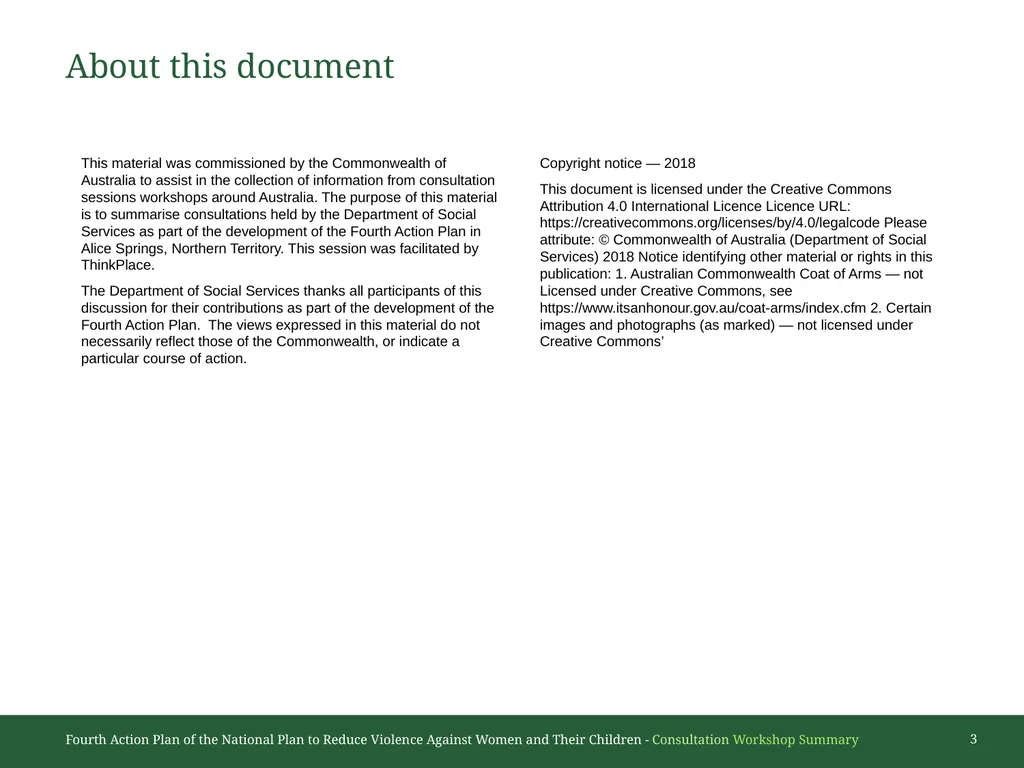
Fourth Action Plan of the National Plan to Reduce Violence Against Women and Their Children - Consultation Workshop Summary About this document This material was commissioned by the Commonwealth of Australia to assist in the collection of information from consultation sessions workshops around Australia. The purpose of this material is to summarise consultations held by the Department of Social Services as part of the development of the Fourth Action Plan in Alice Springs, Northern Territory. This session was facilitated by ThinkPlace.
The Department of Social Services thanks all participants of this discussion for their contributions as part of the development of the Fourth Action Plan. The views expressed in this material do not necessarily reflect those of the Commonwealth, or indicate a particular course of action.
Copyright notice — 2018
This document is licensed under the Creative Commons Attribution 4.0 International Licence Licence URL: https://creativecommons.org/licenses/by/4.0/legalcode Please attribute: © Commonwealth of Australia (Department of Social Services) 2018 Notice identifying other material or rights in this publication: 1. Australian Commonwealth Coat of Arms — not Licensed under Creative Commons, see https://www.itsanhonour.gov.au/coat-arms/index.cfm 2. Certain images and photographs (as marked) — not licensed under Creative Commons’ 3<br>
The Department of Social Services thanks all participants of this discussion for their contributions as part of the development of the Fourth Action Plan. The views expressed in this material do not necessarily reflect those of the Commonwealth, or indicate a particular course of action.
Copyright notice — 2018
This document is licensed under the Creative Commons Attribution 4.0 International Licence Licence URL: https://creativecommons.org/licenses/by/4.0/legalcode Please attribute: © Commonwealth of Australia (Department of Social Services) 2018 Notice identifying other material or rights in this publication: 1. Australian Commonwealth Coat of Arms — not Licensed under Creative Commons, see https://www.itsanhonour.gov.au/coat-arms/index.cfm 2. Certain images and photographs (as marked) — not licensed under Creative Commons’ 3<br>
04
Key themes 4<br>
05
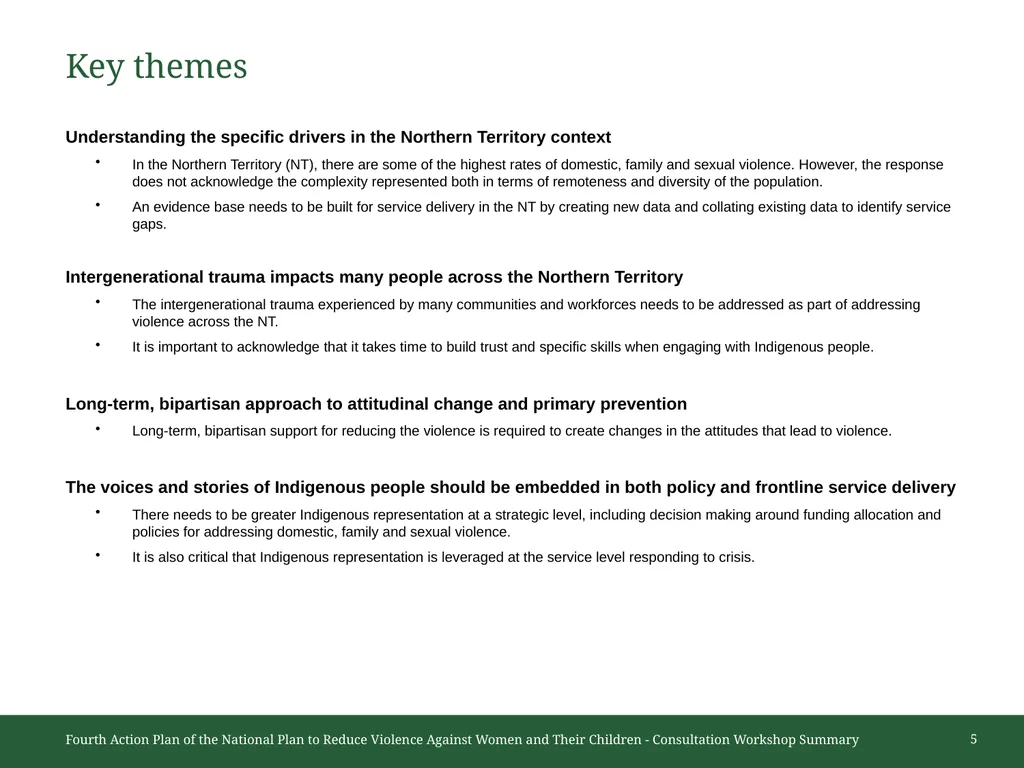
Fourth Action Plan of the National Plan to Reduce Violence Against Women and Their Children - Consultation Workshop Summary Key themes Understanding the specific drivers in the Northern Territory context
In the Northern Territory (NT), there are some of the highest rates of domestic, family and sexual violence. However, the response does not acknowledge the complexity represented both in terms of remoteness and diversity of the population.
An evidence base needs to be built for service delivery in the NT by creating new data and collating existing data to identify service gaps.
Intergenerational trauma impacts many people across the Northern Territory
The intergenerational trauma experienced by many communities and workforces needs to be addressed as part of addressing violence across the NT.
It is important to acknowledge that it takes time to build trust and specific skills when engaging with Indigenous people.
Long-term, bipartisan approach to attitudinal change and primary prevention
Long-term, bipartisan support for reducing the violence is required to create changes in the attitudes that lead to violence.
The voices and stories of Indigenous people should be embedded in both policy and frontline service delivery
There needs to be greater Indigenous representation at a strategic level, including decision making around funding allocation and policies for addressing domestic, family and sexual violence.
It is also critical that Indigenous representation is leveraged at the service level responding to crisis. 5<br>
In the Northern Territory (NT), there are some of the highest rates of domestic, family and sexual violence. However, the response does not acknowledge the complexity represented both in terms of remoteness and diversity of the population.
An evidence base needs to be built for service delivery in the NT by creating new data and collating existing data to identify service gaps.
Intergenerational trauma impacts many people across the Northern Territory
The intergenerational trauma experienced by many communities and workforces needs to be addressed as part of addressing violence across the NT.
It is important to acknowledge that it takes time to build trust and specific skills when engaging with Indigenous people.
Long-term, bipartisan approach to attitudinal change and primary prevention
Long-term, bipartisan support for reducing the violence is required to create changes in the attitudes that lead to violence.
The voices and stories of Indigenous people should be embedded in both policy and frontline service delivery
There needs to be greater Indigenous representation at a strategic level, including decision making around funding allocation and policies for addressing domestic, family and sexual violence.
It is also critical that Indigenous representation is leveraged at the service level responding to crisis. 5<br>
06
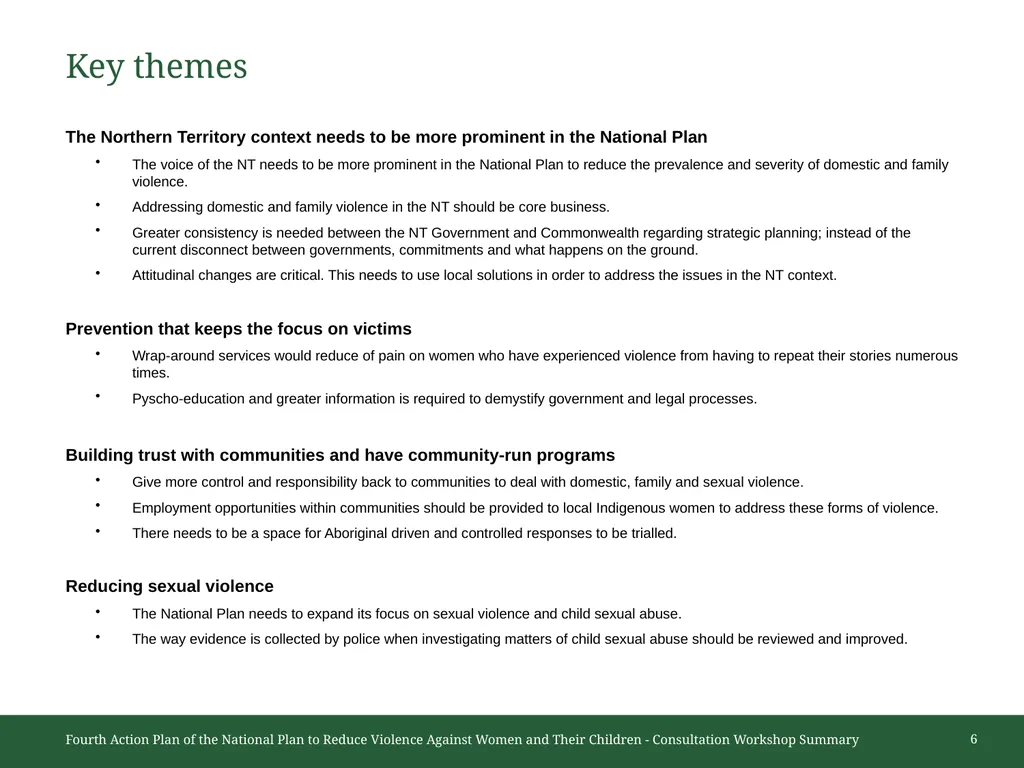
Fourth Action Plan of the National Plan to Reduce Violence Against Women and Their Children - Consultation Workshop Summary Key themes The Northern Territory context needs to be more prominent in the National Plan
The voice of the NT needs to be more prominent in the National Plan to reduce the prevalence and severity of domestic and family violence.
Addressing domestic and family violence in the NT should be core business.
Greater consistency is needed between the NT Government and Commonwealth regarding strategic planning; instead of the current disconnect between governments, commitments and what happens on the ground.
Attitudinal changes are critical. This needs to use local solutions in order to address the issues in the NT context.
Prevention that keeps the focus on victims
Wrap-around services would reduce of pain on women who have experienced violence from having to repeat their stories numerous times.
Pyscho-education and greater information is required to demystify government and legal processes.
Building trust with communities and have community-run programs
Give more control and responsibility back to communities to deal with domestic, family and sexual violence.
Employment opportunities within communities should be provided to local Indigenous women to address these forms of violence.
There needs to be a space for Aboriginal driven and controlled responses to be trialled.
Reducing sexual violence
The National Plan needs to expand its focus on sexual violence and child sexual abuse.
The way evidence is collected by police when investigating matters of child sexual abuse should be reviewed and improved. 6<br>
The voice of the NT needs to be more prominent in the National Plan to reduce the prevalence and severity of domestic and family violence.
Addressing domestic and family violence in the NT should be core business.
Greater consistency is needed between the NT Government and Commonwealth regarding strategic planning; instead of the current disconnect between governments, commitments and what happens on the ground.
Attitudinal changes are critical. This needs to use local solutions in order to address the issues in the NT context.
Prevention that keeps the focus on victims
Wrap-around services would reduce of pain on women who have experienced violence from having to repeat their stories numerous times.
Pyscho-education and greater information is required to demystify government and legal processes.
Building trust with communities and have community-run programs
Give more control and responsibility back to communities to deal with domestic, family and sexual violence.
Employment opportunities within communities should be provided to local Indigenous women to address these forms of violence.
There needs to be a space for Aboriginal driven and controlled responses to be trialled.
Reducing sexual violence
The National Plan needs to expand its focus on sexual violence and child sexual abuse.
The way evidence is collected by police when investigating matters of child sexual abuse should be reviewed and improved. 6<br>
07
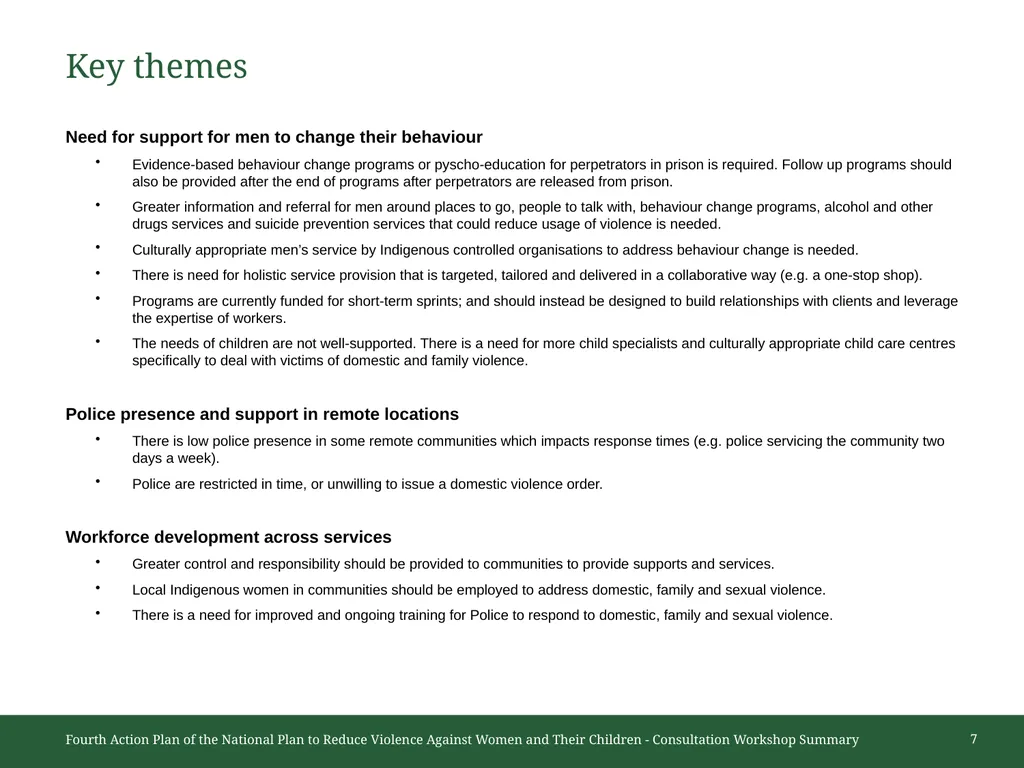
Fourth Action Plan of the National Plan to Reduce Violence Against Women and Their Children - Consultation Workshop Summary Key themes Need for support for men to change their behaviour
Evidence-based behaviour change programs or pyscho-education for perpetrators in prison is required. Follow up programs should also be provided after the end of programs after perpetrators are released from prison.
Greater information and referral for men around places to go, people to talk with, behaviour change programs, alcohol and other drugs services and suicide prevention services that could reduce usage of violence is needed.
Culturally appropriate men’s service by Indigenous controlled organisations to address behaviour change is needed.
There is need for holistic service provision that is targeted, tailored and delivered in a collaborative way (e.g. a one-stop shop).
Programs are currently funded for short-term sprints; and should instead be designed to build relationships with clients and leverage the expertise of workers.
The needs of children are not well-supported. There is a need for more child specialists and culturally appropriate child care centres specifically to deal with victims of domestic and family violence.
Police presence and support in remote locations
There is low police presence in some remote communities which impacts response times (e.g. police servicing the community two days a week).
Police are restricted in time, or unwilling to issue a domestic violence order.
Workforce development across services
Greater control and responsibility should be provided to communities to provide supports and services.
Local Indigenous women in communities should be employed to address domestic, family and sexual violence.
There is a need for improved and ongoing training for Police to respond to domestic, family and sexual violence. 7<br>
Evidence-based behaviour change programs or pyscho-education for perpetrators in prison is required. Follow up programs should also be provided after the end of programs after perpetrators are released from prison.
Greater information and referral for men around places to go, people to talk with, behaviour change programs, alcohol and other drugs services and suicide prevention services that could reduce usage of violence is needed.
Culturally appropriate men’s service by Indigenous controlled organisations to address behaviour change is needed.
There is need for holistic service provision that is targeted, tailored and delivered in a collaborative way (e.g. a one-stop shop).
Programs are currently funded for short-term sprints; and should instead be designed to build relationships with clients and leverage the expertise of workers.
The needs of children are not well-supported. There is a need for more child specialists and culturally appropriate child care centres specifically to deal with victims of domestic and family violence.
Police presence and support in remote locations
There is low police presence in some remote communities which impacts response times (e.g. police servicing the community two days a week).
Police are restricted in time, or unwilling to issue a domestic violence order.
Workforce development across services
Greater control and responsibility should be provided to communities to provide supports and services.
Local Indigenous women in communities should be employed to address domestic, family and sexual violence.
There is a need for improved and ongoing training for Police to respond to domestic, family and sexual violence. 7<br>
08
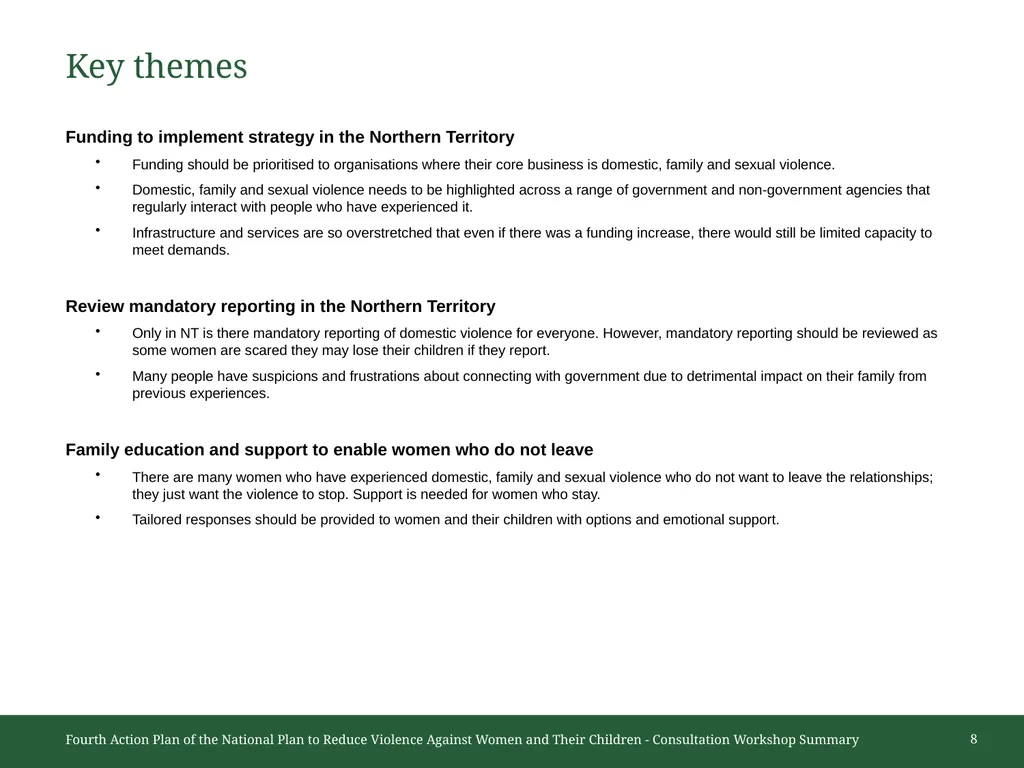
Fourth Action Plan of the National Plan to Reduce Violence Against Women and Their Children - Consultation Workshop Summary Key themes Funding to implement strategy in the Northern Territory
Funding should be prioritised to organisations where their core business is domestic, family and sexual violence.
Domestic, family and sexual violence needs to be highlighted across a range of government and non-government agencies that regularly interact with people who have experienced it.
Infrastructure and services are so overstretched that even if there was a funding increase, there would still be limited capacity to meet demands.
Review mandatory reporting in the Northern Territory
Only in NT is there mandatory reporting of domestic violence for everyone. However, mandatory reporting should be reviewed as some women are scared they may lose their children if they report.
Many people have suspicions and frustrations about connecting with government due to detrimental impact on their family from previous experiences.
Family education and support to enable women who do not leave
There are many women who have experienced domestic, family and sexual violence who do not want to leave the relationships; they just want the violence to stop. Support is needed for women who stay.
Tailored responses should be provided to women and their children with options and emotional support. 8<br>
Funding should be prioritised to organisations where their core business is domestic, family and sexual violence.
Domestic, family and sexual violence needs to be highlighted across a range of government and non-government agencies that regularly interact with people who have experienced it.
Infrastructure and services are so overstretched that even if there was a funding increase, there would still be limited capacity to meet demands.
Review mandatory reporting in the Northern Territory
Only in NT is there mandatory reporting of domestic violence for everyone. However, mandatory reporting should be reviewed as some women are scared they may lose their children if they report.
Many people have suspicions and frustrations about connecting with government due to detrimental impact on their family from previous experiences.
Family education and support to enable women who do not leave
There are many women who have experienced domestic, family and sexual violence who do not want to leave the relationships; they just want the violence to stop. Support is needed for women who stay.
Tailored responses should be provided to women and their children with options and emotional support. 8<br>
09
Fourth Action Plan of the National Plan to Reduce Violence Against Women and Their Children - Consultation Workshop Summary Priority actions 9<br>
10
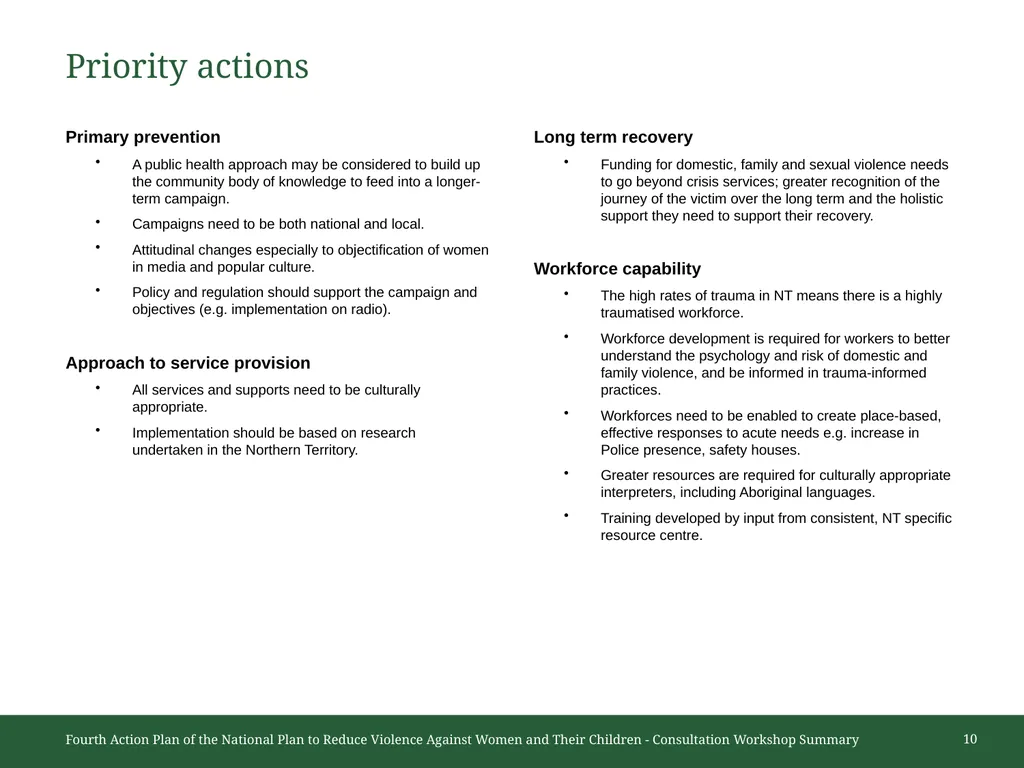
Fourth Action Plan of the National Plan to Reduce Violence Against Women and Their Children - Consultation Workshop Summary Priority actions Primary prevention
A public health approach may be considered to build up the community body of knowledge to feed into a longer-term campaign.
Campaigns need to be both national and local.
Attitudinal changes especially to objectification of women in media and popular culture.
Policy and regulation should support the campaign and objectives (e.g. implementation on radio).
Approach to service provision
All services and supports need to be culturally appropriate.
Implementation should be based on research undertaken in the Northern Territory. 10 Long term recovery
Funding for domestic, family and sexual violence needs to go beyond crisis services; greater recognition of the journey of the victim over the long term and the holistic support they need to support their recovery.
Workforce capability
The high rates of trauma in NT means there is a highly traumatised workforce.
Workforce development is required for workers to better understand the psychology and risk of domestic and family violence, and be informed in trauma-informed practices.
Workforces need to be enabled to create place-based, effective responses to acute needs e.g. increase in Police presence, safety houses.
Greater resources are required for culturally appropriate interpreters, including Aboriginal languages.
Training developed by input from consistent, NT specific resource centre.<br>
A public health approach may be considered to build up the community body of knowledge to feed into a longer-term campaign.
Campaigns need to be both national and local.
Attitudinal changes especially to objectification of women in media and popular culture.
Policy and regulation should support the campaign and objectives (e.g. implementation on radio).
Approach to service provision
All services and supports need to be culturally appropriate.
Implementation should be based on research undertaken in the Northern Territory. 10 Long term recovery
Funding for domestic, family and sexual violence needs to go beyond crisis services; greater recognition of the journey of the victim over the long term and the holistic support they need to support their recovery.
Workforce capability
The high rates of trauma in NT means there is a highly traumatised workforce.
Workforce development is required for workers to better understand the psychology and risk of domestic and family violence, and be informed in trauma-informed practices.
Workforces need to be enabled to create place-based, effective responses to acute needs e.g. increase in Police presence, safety houses.
Greater resources are required for culturally appropriate interpreters, including Aboriginal languages.
Training developed by input from consistent, NT specific resource centre.<br>
11
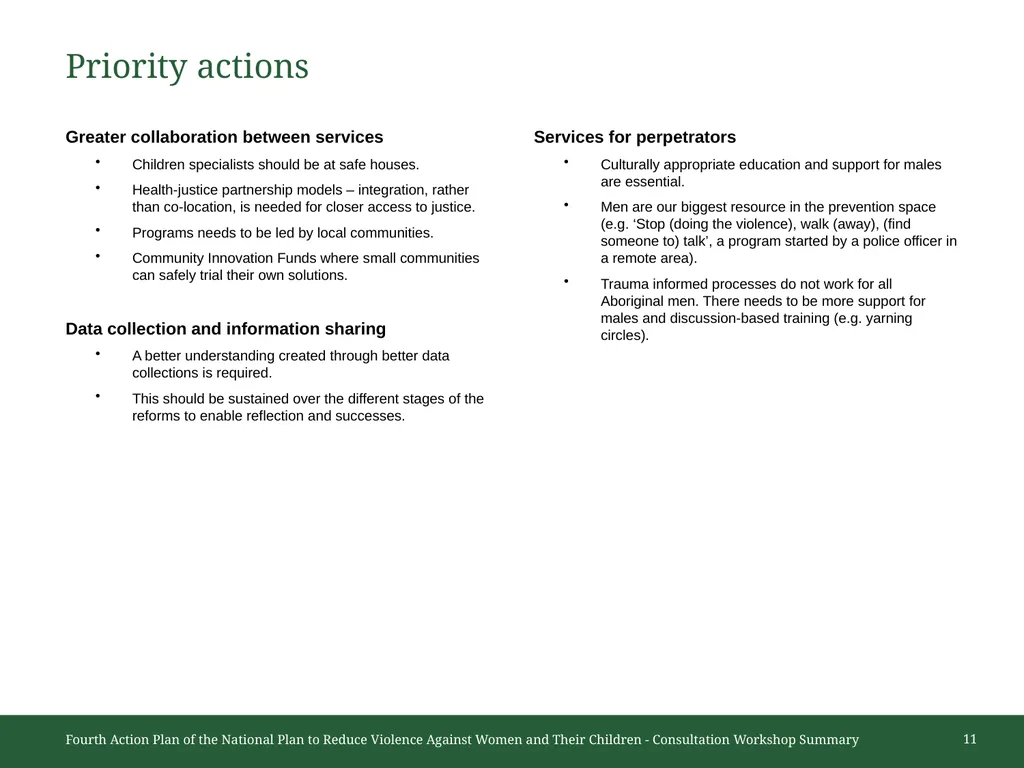
Fourth Action Plan of the National Plan to Reduce Violence Against Women and Their Children - Consultation Workshop Summary Priority actions Greater collaboration between services
Children specialists should be at safe houses.
Health-justice partnership models – integration, rather than co-location, is needed for closer access to justice.
Programs needs to be led by local communities.
Community Innovation Funds where small communities can safely trial their own solutions.
Data collection and information sharing
A better understanding created through better data collections is required.
This should be sustained over the different stages of the reforms to enable reflection and successes. 11 Services for perpetrators
Culturally appropriate education and support for males are essential.
Men are our biggest resource in the prevention space (e.g. ‘Stop (doing the violence), walk (away), (find someone to) talk’, a program started by a police officer in a remote area).
Trauma informed processes do not work for all Aboriginal men. There needs to be more support for males and discussion-based training (e.g. yarning circles).<br>
Children specialists should be at safe houses.
Health-justice partnership models – integration, rather than co-location, is needed for closer access to justice.
Programs needs to be led by local communities.
Community Innovation Funds where small communities can safely trial their own solutions.
Data collection and information sharing
A better understanding created through better data collections is required.
This should be sustained over the different stages of the reforms to enable reflection and successes. 11 Services for perpetrators
Culturally appropriate education and support for males are essential.
Men are our biggest resource in the prevention space (e.g. ‘Stop (doing the violence), walk (away), (find someone to) talk’, a program started by a police officer in a remote area).
Trauma informed processes do not work for all Aboriginal men. There needs to be more support for males and discussion-based training (e.g. yarning circles).<br>