Data analysis and machine learning workflows on Redivis REDIVIS Ian Mathews ianredivis.com Todays agenda Brief introduction of Redivis at Stanford Redivis core concepts and analysis walkthrough Lets do some Machine Learning! QA Our
"Data analysis and machine learning workflows on" is the property of its rightful owner. Permission is granted to
download and print the materials on this website for personal, non-commercial use only, and to display it
on your personal computer provided you do not modify the materials and that you retain all copyright
notices contained in the materials. By downloading content from our website, you accept the terms of this
agreement.
Presentation Transcript
01
Data analysis and machine learning workflows on Redivis REDIVIS Ian Mathews · ian@redivis.com<br>
02
Today’s agenda Brief introduction of Redivis at Stanford
Redivis core concepts and analysis walkthrough
Let’s do some Machine Learning!
Q&A<br>
03
Our mission Redivis enables research centers to distribute rich datasets, and provides scientists with the means to understand them.
We strive to reduce barriers in working with data, and to create intuitive tools that make data science accessible and reproducible.<br>
04
Redivis, a.k.a “The Stanford Data Farm” The deployment of Redivis at Stanford: https://redivis.com/Stanford
Home to 12 organizations, 363 datasets, 194 TB of data.
Groups from medicine, sustainability, business, education, and more.<br>
05
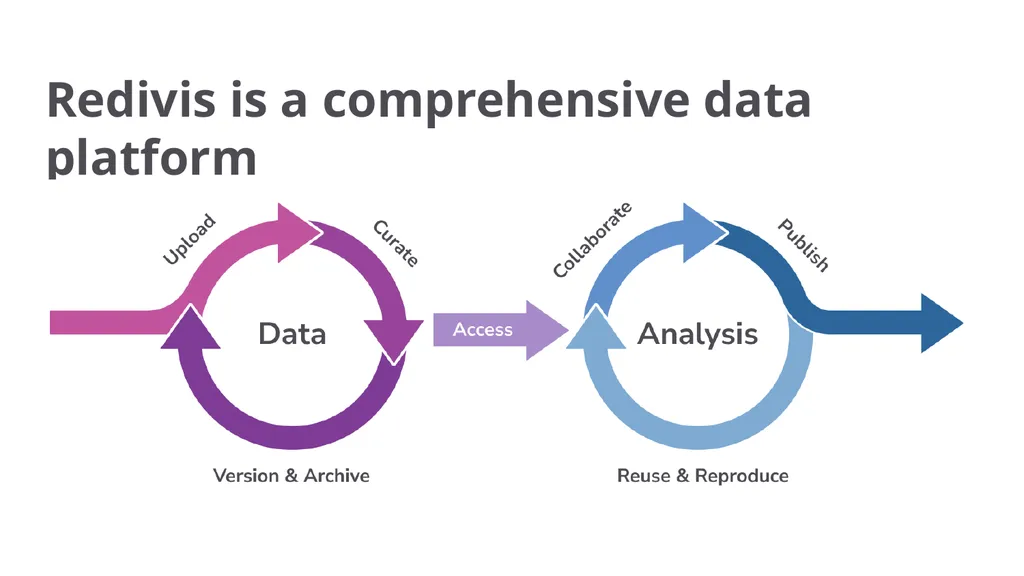
Redivis is a comprehensive data platform<br>
06
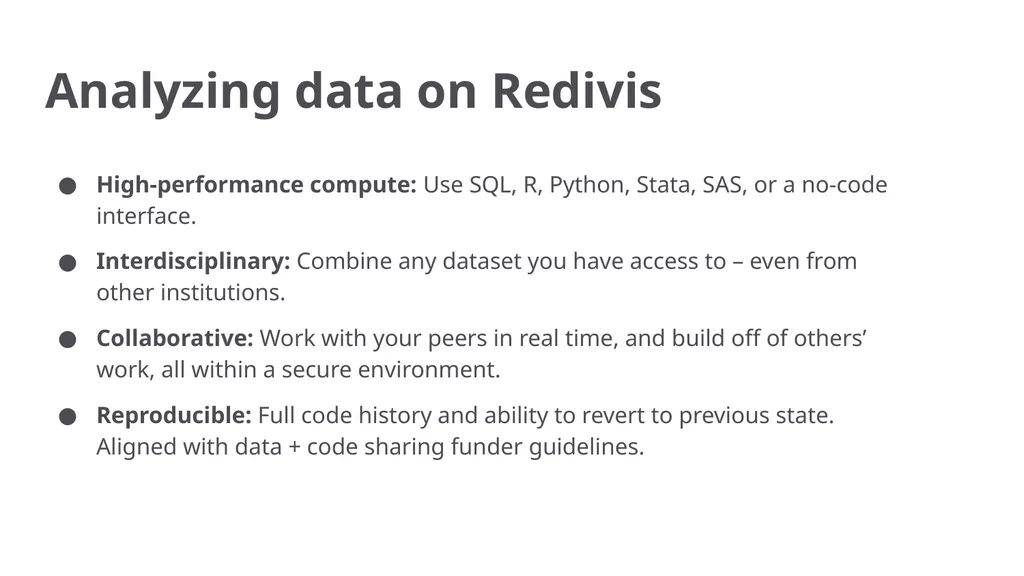
Analyzing data on Redivis High-performance compute: Use SQL, R, Python, Stata, SAS, or a no-code interface.
Interdisciplinary: Combine any dataset you have access to – even from other institutions.
Collaborative: Work with your peers in real time, and build off of others’ work, all within a secure environment.
Reproducible: Full code history and ability to revert to previous state. Aligned with data + code sharing funder guidelines.<br>
07
Data analysis walkthrough<br>
08
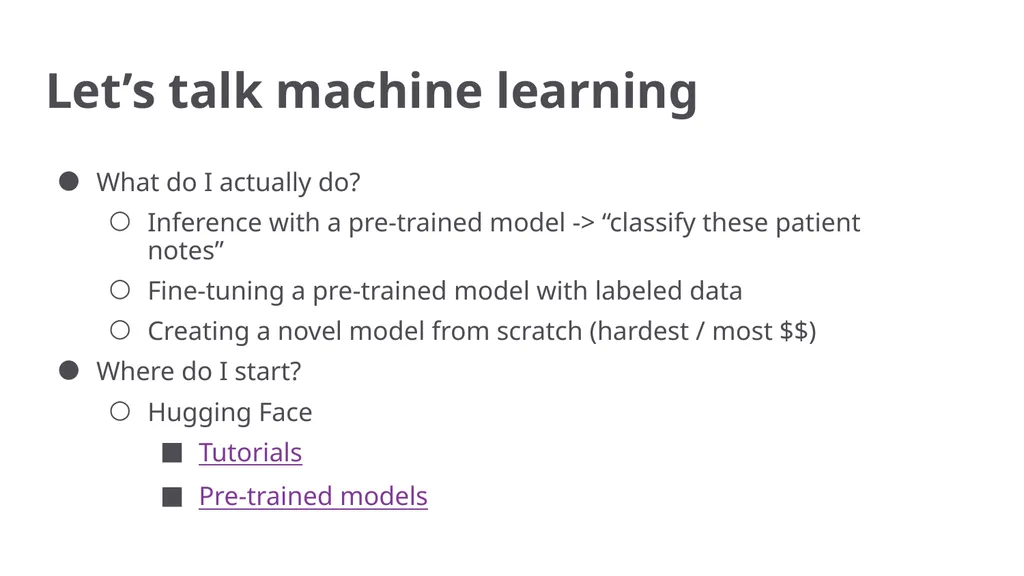
Let’s talk machine learning What do I actually do?
Inference with a pre-trained model -> “classify these patient notes”
Fine-tuning a pre-trained model with labeled data
Creating a novel model from scratch (hardest / most $$)
Where do I start?
Hugging Face
Tutorials
Pre-trained models<br>
09
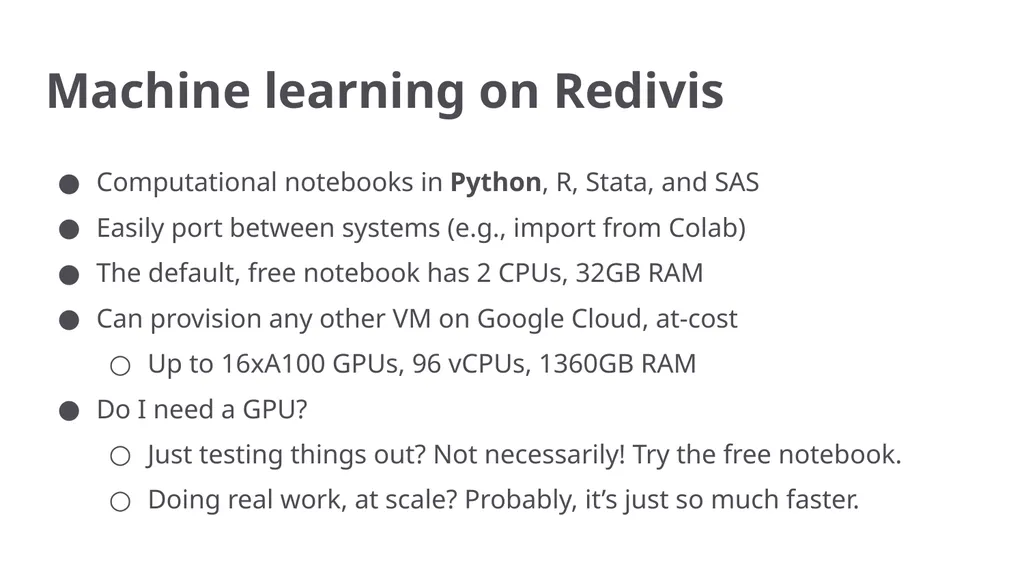
Machine learning on Redivis Computational notebooks in Python, R, Stata, and SAS
Easily port between systems (e.g., import from Colab)
The default, free notebook has 2 CPUs, 32GB RAM
Can provision any other VM on Google Cloud, at-cost
Up to 16xA100 GPUs, 96 vCPUs, 1360GB RAM
Do I need a GPU?
Just testing things out? Not necessarily! Try the free notebook.
Doing real work, at scale? Probably, it’s just so much faster.<br>
10
Machine learning walkthrough<br>
11
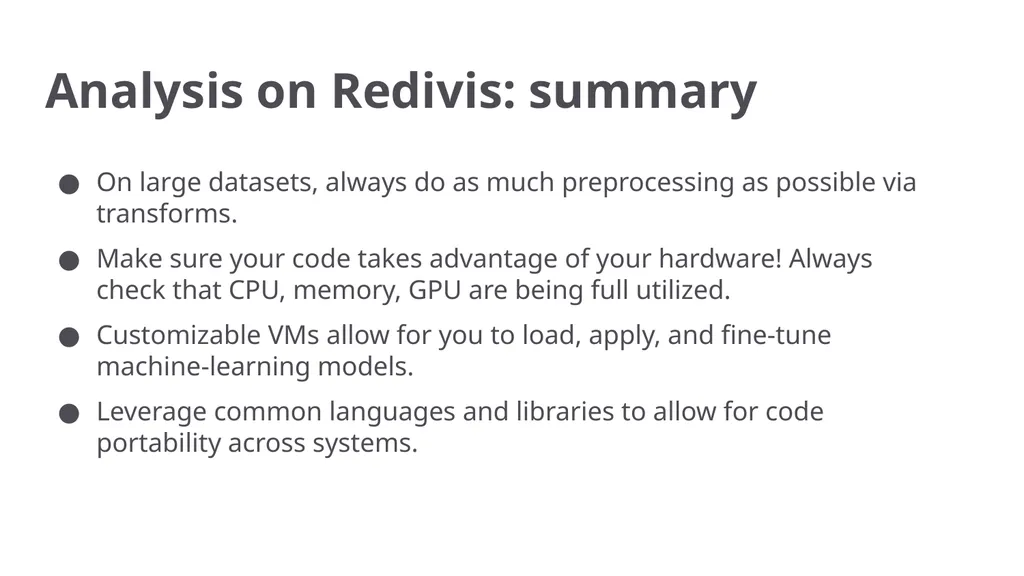
Analysis on Redivis: summary On large datasets, always do as much preprocessing as possible via transforms.
Make sure your code takes advantage of your hardware! Always check that CPU, memory, GPU are being full utilized.
Customizable VMs allow for you to load, apply, and fine-tune machine-learning models.
Leverage common languages and libraries to allow for code portability across systems.<br>
12
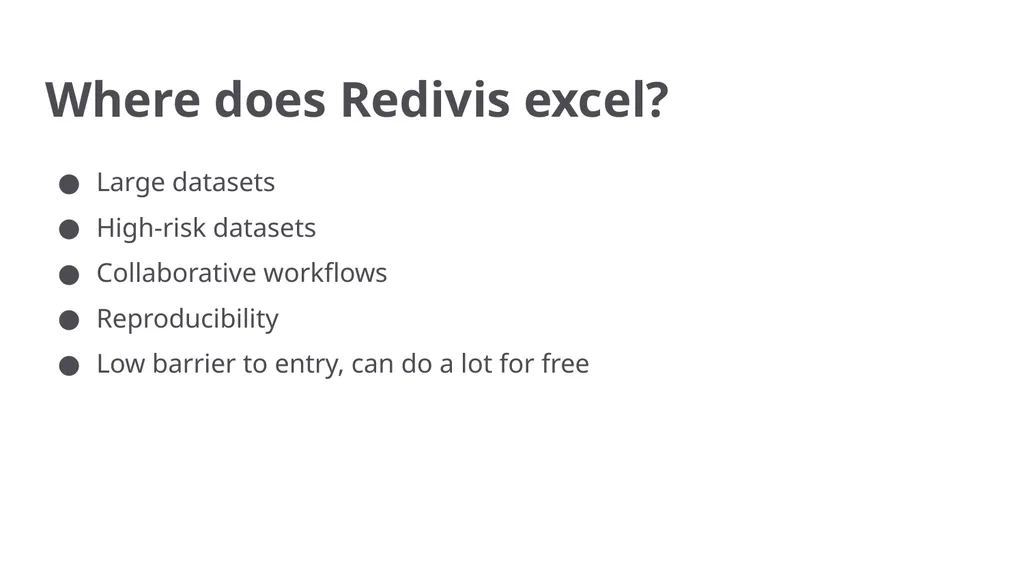
Where does Redivis excel? Large datasets
High-risk datasets
Collaborative workflows
Reproducibility
Low barrier to entry, can do a lot for free<br>
13
Q&A 05<br>
14
Additional resources 06<br>
15
Learn more Redivis for researchers Redivis for organizations Additional resources<br>
16
Support materials Documentation API documentation Security overview Additional resources<br>