
Data handling in Safeguarding Madi McAllister May

Description: Data handling in Safeguarding Madi McAllister May 2021 Topics What people should be thinking about when handling personal data How we can prevent data breaches What do we do if you identify a breach Handling personal data 1 Be clear about
Related Topics
Download Presentation
"Data handling in Safeguarding Madi McAllister May" is the property of its rightful owner. Permission is granted to download and print the materials on this website for personal, non-commercial use only, and to display it on your personal computer provided you do not modify the materials and that you retain all copyright notices contained in the materials. By downloading content from our website, you accept the terms of this agreement.
Presentation Transcript
slide1. Data handling in Safeguarding
Madi McAllister
May 2021<br>
slide2. Topics
What people should be thinking about when handling personal data
How we can prevent data breaches
What do we do if you identify a breach<br>
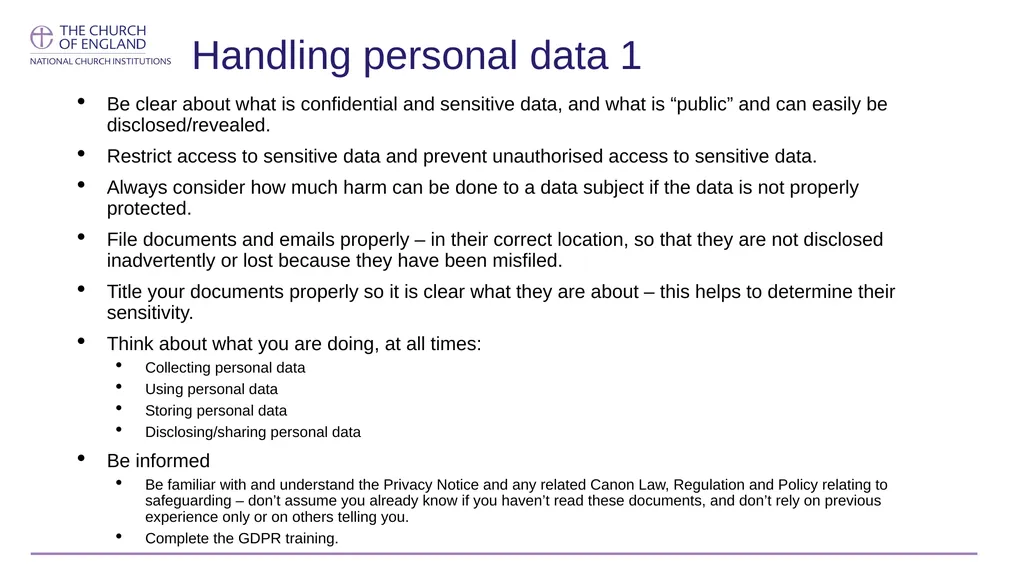
slide3. Handling personal data 1 Be clear about what is confidential and sensitive data, and what is “public” and can easily be disclosed/revealed.
Restrict access to sensitive data and prevent unauthorised access to sensitive data.
Always consider how much harm can be done to a data subject if the data is not properly protected.
File documents and emails properly – in their correct location, so that they are not disclosed inadvertently or lost because they have been misfiled.
Title your documents properly so it is clear what they are about – this helps to determine their sensitivity.
Think about what you are doing, at all times:
Collecting personal data
Using personal data
Storing personal data
Disclosing/sharing personal data
Be informed
Be familiar with and understand the Privacy Notice and any related Canon Law, Regulation and Policy relating to safeguarding – don’t assume you already know if you haven’t read these documents, and don’t rely on previous experience only or on others telling you.
Complete the GDPR training.<br>
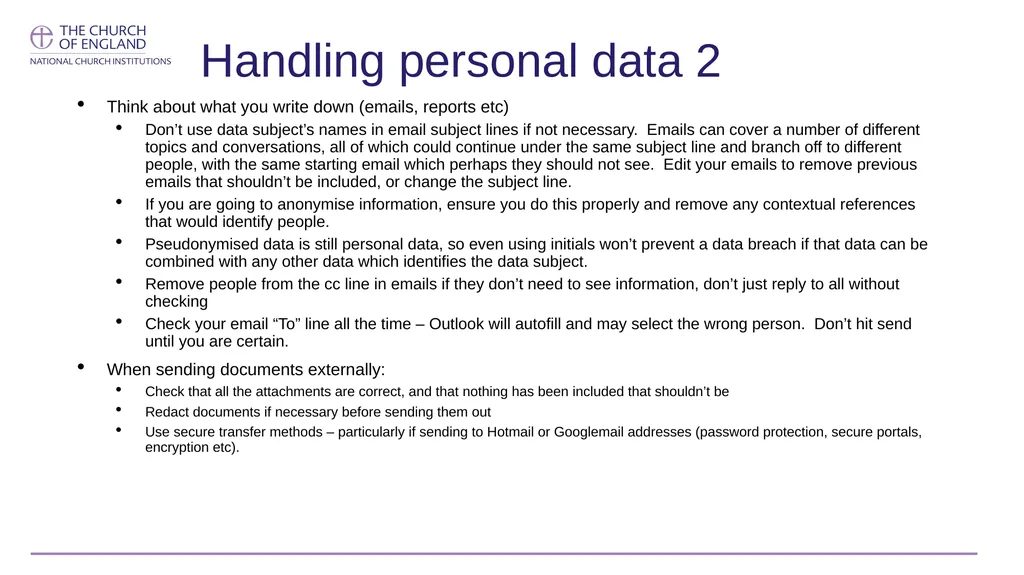
slide4. Handling personal data 2 Think about what you write down (emails, reports etc)
Don’t use data subject’s names in email subject lines if not necessary. Emails can cover a number of different topics and conversations, all of which could continue under the same subject line and branch off to different people, with the same starting email which perhaps they should not see. Edit your emails to remove previous emails that shouldn’t be included, or change the subject line.
If you are going to anonymise information, ensure you do this properly and remove any contextual references that would identify people.
Pseudonymised data is still personal data, so even using initials won’t prevent a data breach if that data can be combined with any other data which identifies the data subject.
Remove people from the cc line in emails if they don’t need to see information, don’t just reply to all without checking
Check your email “To” line all the time – Outlook will autofill and may select the wrong person. Don’t hit send until you are certain.
When sending documents externally:
Check that all the attachments are correct, and that nothing has been included that shouldn’t be
Redact documents if necessary before sending them out
Use secure transfer methods – particularly if sending to Hotmail or Googlemail addresses (password protection, secure portals, encryption etc).<br>
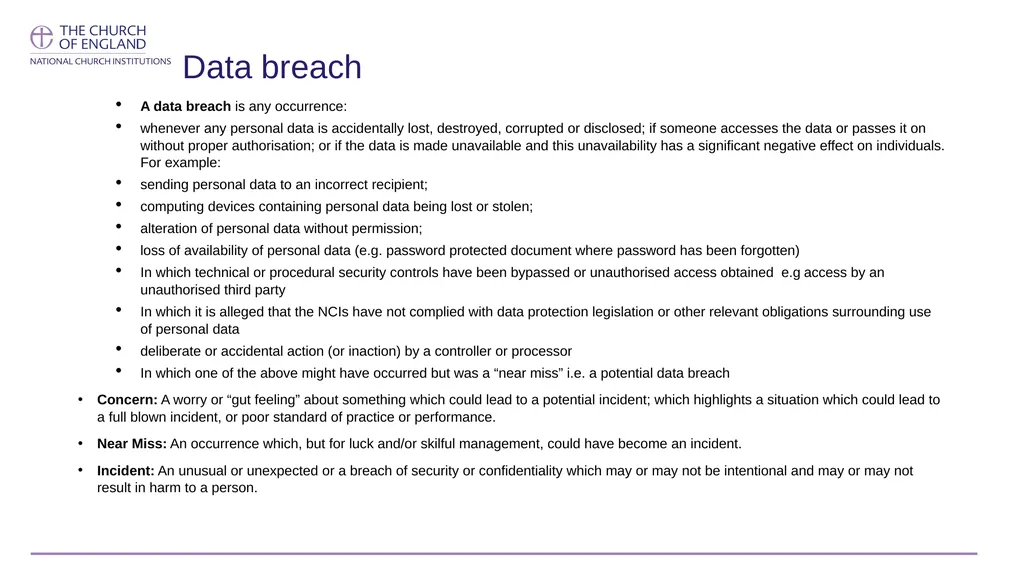
slide5. Data breach A data breach is any occurrence:
whenever any personal data is accidentally lost, destroyed, corrupted or disclosed; if someone accesses the data or passes it on without proper authorisation; or if the data is made unavailable and this unavailability has a significant negative effect on individuals. For example:
sending personal data to an incorrect recipient;
computing devices containing personal data being lost or stolen;
alteration of personal data without permission;
loss of availability of personal data (e.g. password protected document where password has been forgotten)
In which technical or procedural security controls have been bypassed or unauthorised access obtained e.g access by an unauthorised third party
In which it is alleged that the NCIs have not complied with data protection legislation or other relevant obligations surrounding use of personal data
deliberate or accidental action (or inaction) by a controller or processor
In which one of the above might have occurred but was a “near miss” i.e. a potential data breach
Concern: A worry or “gut feeling” about something which could lead to a potential incident; which highlights a situation which could lead to a full blown incident, or poor standard of practice or performance.
Near Miss: An occurrence which, but for luck and/or skilful management, could have become an incident.
Incident: An unusual or unexpected or a breach of security or confidentiality which may or may not be intentional and may or may not result in harm to a person.<br>
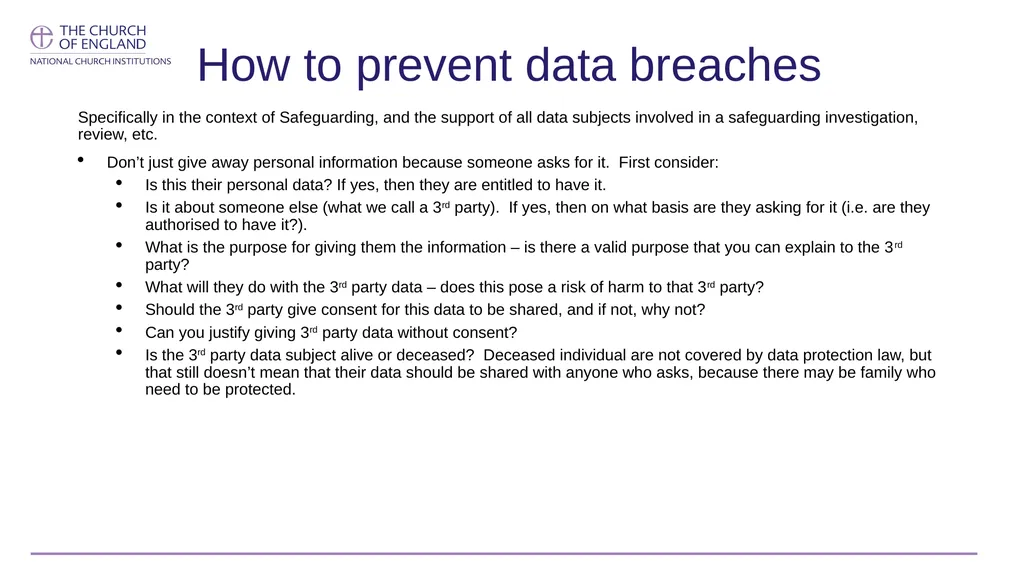
slide6. How to prevent data breaches Specifically in the context of Safeguarding, and the support of all data subjects involved in a safeguarding investigation, review, etc.
Don’t just give away personal information because someone asks for it. First consider:
Is this their personal data? If yes, then they are entitled to have it.
Is it about someone else (what we call a 3rd party). If yes, then on what basis are they asking for it (i.e. are they authorised to have it?).
What is the purpose for giving them the information – is there a valid purpose that you can explain to the 3rd party?
What will they do with the 3rd party data – does this pose a risk of harm to that 3rd party?
Should the 3rd party give consent for this data to be shared, and if not, why not?
Can you justify giving 3rd party data without consent?
Is the 3rd party data subject alive or deceased? Deceased individual are not covered by data protection law, but that still doesn’t mean that their data should be shared with anyone who asks, because there may be family who need to be protected.<br>
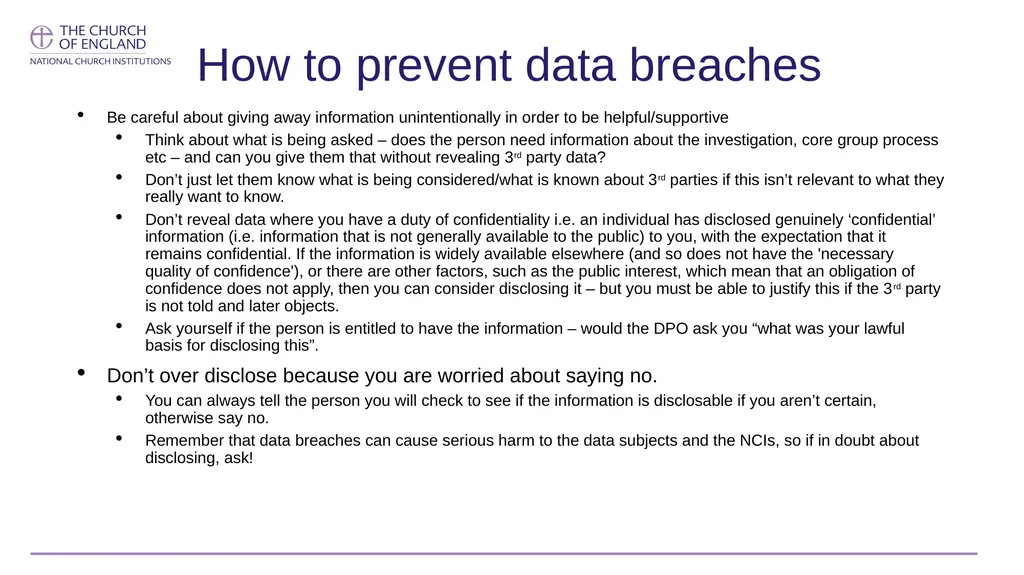
slide7. How to prevent data breaches Be careful about giving away information unintentionally in order to be helpful/supportive
Think about what is being asked – does the person need information about the investigation, core group process etc – and can you give them that without revealing 3rd party data?
Don’t just let them know what is being considered/what is known about 3rd parties if this isn’t relevant to what they really want to know.
Don’t reveal data where you have a duty of confidentiality i.e. an individual has disclosed genuinely ‘confidential’ information (i.e. information that is not generally available to the public) to you, with the expectation that it remains confidential. If the information is widely available elsewhere (and so does not have the 'necessary quality of confidence'), or there are other factors, such as the public interest, which mean that an obligation of confidence does not apply, then you can consider disclosing it – but you must be able to justify this if the 3rd party is not told and later objects.
Ask yourself if the person is entitled to have the information – would the DPO ask you “what was your lawful basis for disclosing this”.
Don’t over disclose because you are worried about saying no.
You can always tell the person you will check to see if the information is disclosable if you aren’t certain, otherwise say no.
Remember that data breaches can cause serious harm to the data subjects and the NCIs, so if in doubt about disclosing, ask!<br>
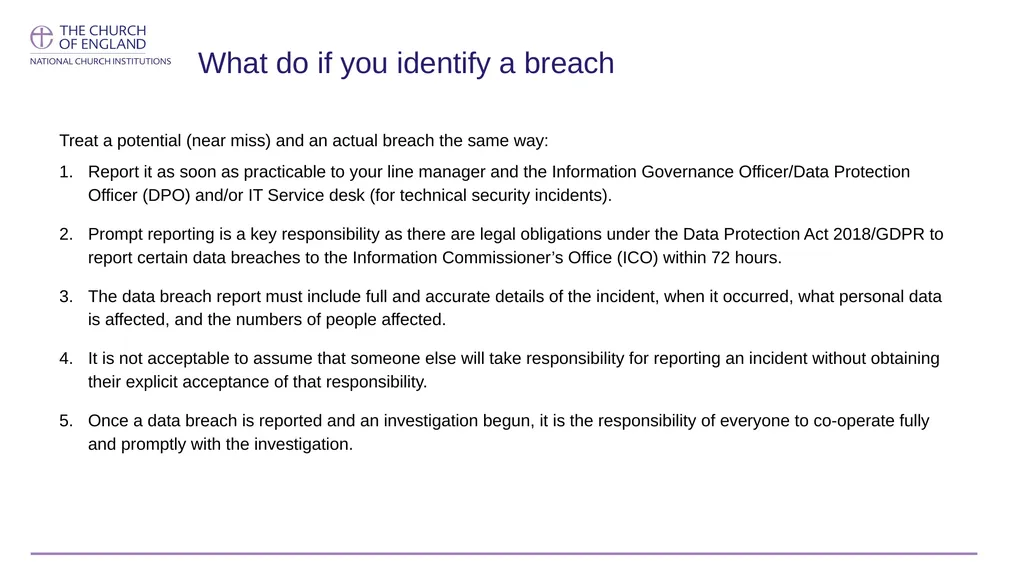
slide8. What do if you identify a breach Treat a potential (near miss) and an actual breach the same way:
Report it as soon as practicable to your line manager and the Information Governance Officer/Data Protection Officer (DPO) and/or IT Service desk (for technical security incidents).
Prompt reporting is a key responsibility as there are legal obligations under the Data Protection Act 2018/GDPR to report certain data breaches to the Information Commissioner’s Office (ICO) within 72 hours.
The data breach report must include full and accurate details of the incident, when it occurred, what personal data is affected, and the numbers of people affected.
It is not acceptable to assume that someone else will take responsibility for reporting an incident without obtaining their explicit acceptance of that responsibility.
Once a data breach is reported and an investigation begun, it is the responsibility of everyone to co-operate fully and promptly with the investigation.<br>
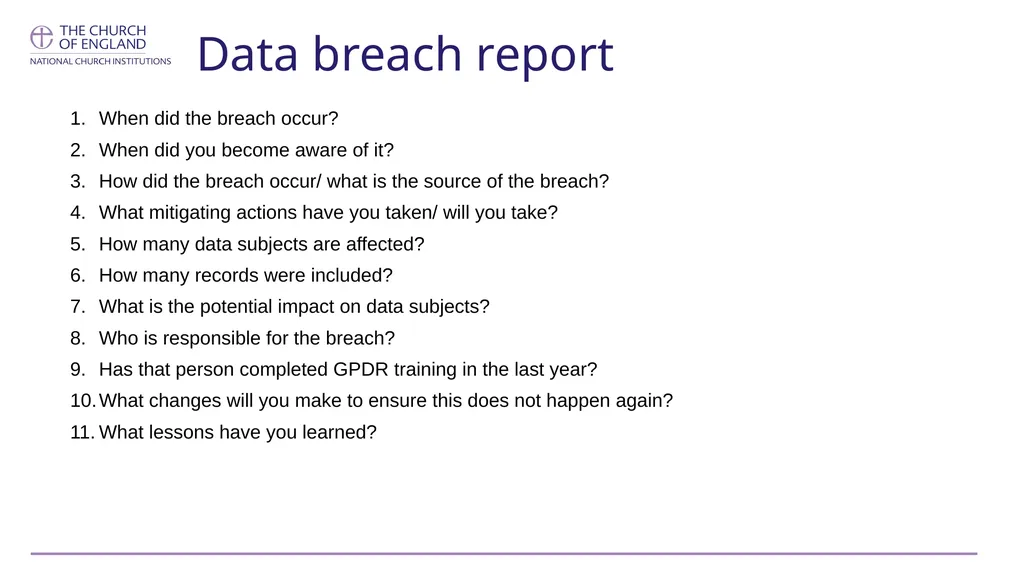
slide9. Data breach report When did the breach occur?
When did you become aware of it?
How did the breach occur/ what is the source of the breach?
What mitigating actions have you taken/ will you take?
How many data subjects are affected?
How many records were included?
What is the potential impact on data subjects?
Who is responsible for the breach?
Has that person completed GPDR training in the last year?
What changes will you make to ensure this does not happen again?
What lessons have you learned?<br>
Madi McAllister
May 2021<br>
slide2. Topics
What people should be thinking about when handling personal data
How we can prevent data breaches
What do we do if you identify a breach<br>
slide3. Handling personal data 1 Be clear about what is confidential and sensitive data, and what is “public” and can easily be disclosed/revealed.
Restrict access to sensitive data and prevent unauthorised access to sensitive data.
Always consider how much harm can be done to a data subject if the data is not properly protected.
File documents and emails properly – in their correct location, so that they are not disclosed inadvertently or lost because they have been misfiled.
Title your documents properly so it is clear what they are about – this helps to determine their sensitivity.
Think about what you are doing, at all times:
Collecting personal data
Using personal data
Storing personal data
Disclosing/sharing personal data
Be informed
Be familiar with and understand the Privacy Notice and any related Canon Law, Regulation and Policy relating to safeguarding – don’t assume you already know if you haven’t read these documents, and don’t rely on previous experience only or on others telling you.
Complete the GDPR training.<br>
slide4. Handling personal data 2 Think about what you write down (emails, reports etc)
Don’t use data subject’s names in email subject lines if not necessary. Emails can cover a number of different topics and conversations, all of which could continue under the same subject line and branch off to different people, with the same starting email which perhaps they should not see. Edit your emails to remove previous emails that shouldn’t be included, or change the subject line.
If you are going to anonymise information, ensure you do this properly and remove any contextual references that would identify people.
Pseudonymised data is still personal data, so even using initials won’t prevent a data breach if that data can be combined with any other data which identifies the data subject.
Remove people from the cc line in emails if they don’t need to see information, don’t just reply to all without checking
Check your email “To” line all the time – Outlook will autofill and may select the wrong person. Don’t hit send until you are certain.
When sending documents externally:
Check that all the attachments are correct, and that nothing has been included that shouldn’t be
Redact documents if necessary before sending them out
Use secure transfer methods – particularly if sending to Hotmail or Googlemail addresses (password protection, secure portals, encryption etc).<br>
slide5. Data breach A data breach is any occurrence:
whenever any personal data is accidentally lost, destroyed, corrupted or disclosed; if someone accesses the data or passes it on without proper authorisation; or if the data is made unavailable and this unavailability has a significant negative effect on individuals. For example:
sending personal data to an incorrect recipient;
computing devices containing personal data being lost or stolen;
alteration of personal data without permission;
loss of availability of personal data (e.g. password protected document where password has been forgotten)
In which technical or procedural security controls have been bypassed or unauthorised access obtained e.g access by an unauthorised third party
In which it is alleged that the NCIs have not complied with data protection legislation or other relevant obligations surrounding use of personal data
deliberate or accidental action (or inaction) by a controller or processor
In which one of the above might have occurred but was a “near miss” i.e. a potential data breach
Concern: A worry or “gut feeling” about something which could lead to a potential incident; which highlights a situation which could lead to a full blown incident, or poor standard of practice or performance.
Near Miss: An occurrence which, but for luck and/or skilful management, could have become an incident.
Incident: An unusual or unexpected or a breach of security or confidentiality which may or may not be intentional and may or may not result in harm to a person.<br>
slide6. How to prevent data breaches Specifically in the context of Safeguarding, and the support of all data subjects involved in a safeguarding investigation, review, etc.
Don’t just give away personal information because someone asks for it. First consider:
Is this their personal data? If yes, then they are entitled to have it.
Is it about someone else (what we call a 3rd party). If yes, then on what basis are they asking for it (i.e. are they authorised to have it?).
What is the purpose for giving them the information – is there a valid purpose that you can explain to the 3rd party?
What will they do with the 3rd party data – does this pose a risk of harm to that 3rd party?
Should the 3rd party give consent for this data to be shared, and if not, why not?
Can you justify giving 3rd party data without consent?
Is the 3rd party data subject alive or deceased? Deceased individual are not covered by data protection law, but that still doesn’t mean that their data should be shared with anyone who asks, because there may be family who need to be protected.<br>
slide7. How to prevent data breaches Be careful about giving away information unintentionally in order to be helpful/supportive
Think about what is being asked – does the person need information about the investigation, core group process etc – and can you give them that without revealing 3rd party data?
Don’t just let them know what is being considered/what is known about 3rd parties if this isn’t relevant to what they really want to know.
Don’t reveal data where you have a duty of confidentiality i.e. an individual has disclosed genuinely ‘confidential’ information (i.e. information that is not generally available to the public) to you, with the expectation that it remains confidential. If the information is widely available elsewhere (and so does not have the 'necessary quality of confidence'), or there are other factors, such as the public interest, which mean that an obligation of confidence does not apply, then you can consider disclosing it – but you must be able to justify this if the 3rd party is not told and later objects.
Ask yourself if the person is entitled to have the information – would the DPO ask you “what was your lawful basis for disclosing this”.
Don’t over disclose because you are worried about saying no.
You can always tell the person you will check to see if the information is disclosable if you aren’t certain, otherwise say no.
Remember that data breaches can cause serious harm to the data subjects and the NCIs, so if in doubt about disclosing, ask!<br>
slide8. What do if you identify a breach Treat a potential (near miss) and an actual breach the same way:
Report it as soon as practicable to your line manager and the Information Governance Officer/Data Protection Officer (DPO) and/or IT Service desk (for technical security incidents).
Prompt reporting is a key responsibility as there are legal obligations under the Data Protection Act 2018/GDPR to report certain data breaches to the Information Commissioner’s Office (ICO) within 72 hours.
The data breach report must include full and accurate details of the incident, when it occurred, what personal data is affected, and the numbers of people affected.
It is not acceptable to assume that someone else will take responsibility for reporting an incident without obtaining their explicit acceptance of that responsibility.
Once a data breach is reported and an investigation begun, it is the responsibility of everyone to co-operate fully and promptly with the investigation.<br>
slide9. Data breach report When did the breach occur?
When did you become aware of it?
How did the breach occur/ what is the source of the breach?
What mitigating actions have you taken/ will you take?
How many data subjects are affected?
How many records were included?
What is the potential impact on data subjects?
Who is responsible for the breach?
Has that person completed GPDR training in the last year?
What changes will you make to ensure this does not happen again?
What lessons have you learned?<br>