Data Linkages for DaVINCI Objectives Describe patient identifier linkages. Identify linking methodologies for direct care data. Describe Patient Linkages Patient Linkages While the EDIPN is the official identifier for DoD beneficiaries,
"Data Linkages for DaVINCI Objectives Describe" is the property of its rightful owner. Permission is granted to
download and print the materials on this website for personal, non-commercial use only, and to display it
on your personal computer provided you do not modify the materials and that you retain all copyright
notices contained in the materials. By downloading content from our website, you accept the terms of this
agreement.
Presentation Transcript
01
Data Linkages for DaVINCI<br>
02
Objectives Describe patient identifier linkages.
Identify linking methodologies for direct care data.
Describe<br>
03
Patient Linkages<br>
04
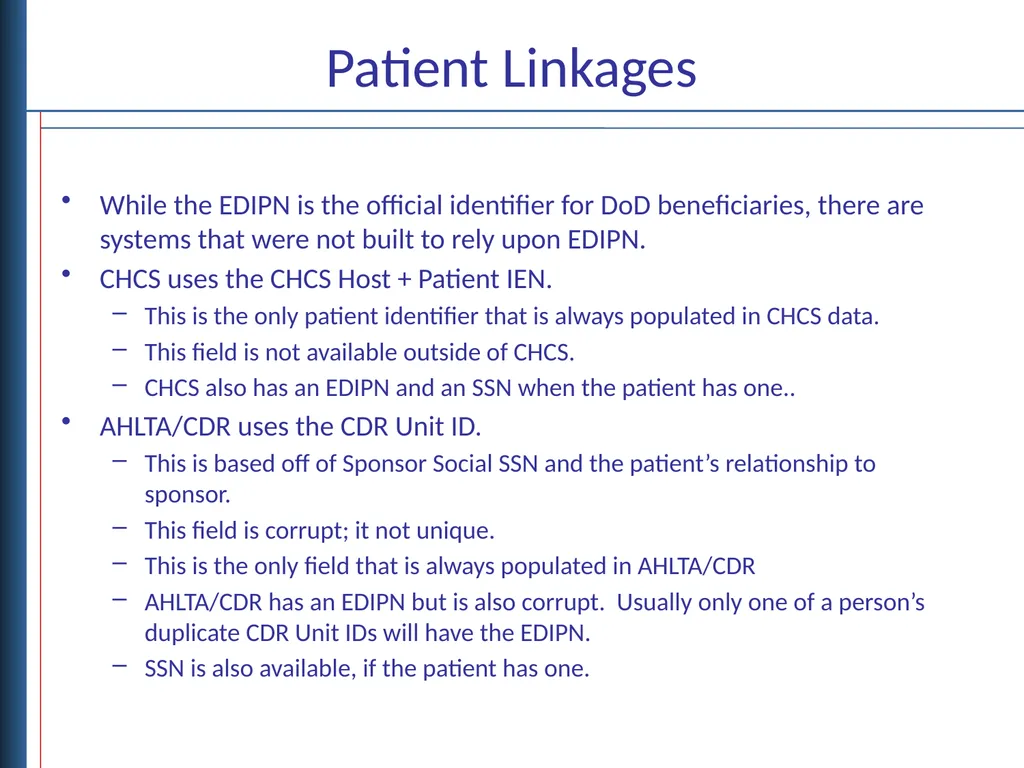
Patient Linkages While the EDIPN is the official identifier for DoD beneficiaries, there are systems that were not built to rely upon EDIPN.
CHCS uses the CHCS Host + Patient IEN.
This is the only patient identifier that is always populated in CHCS data.
This field is not available outside of CHCS.
CHCS also has an EDIPN and an SSN when the patient has one..
AHLTA/CDR uses the CDR Unit ID.
This is based off of Sponsor Social SSN and the patient’s relationship to sponsor.
This field is corrupt; it not unique.
This is the only field that is always populated in AHLTA/CDR
AHLTA/CDR has an EDIPN but is also corrupt. Usually only one of a person’s duplicate CDR Unit IDs will have the EDIPN.
SSN is also available, if the patient has one.<br>
05
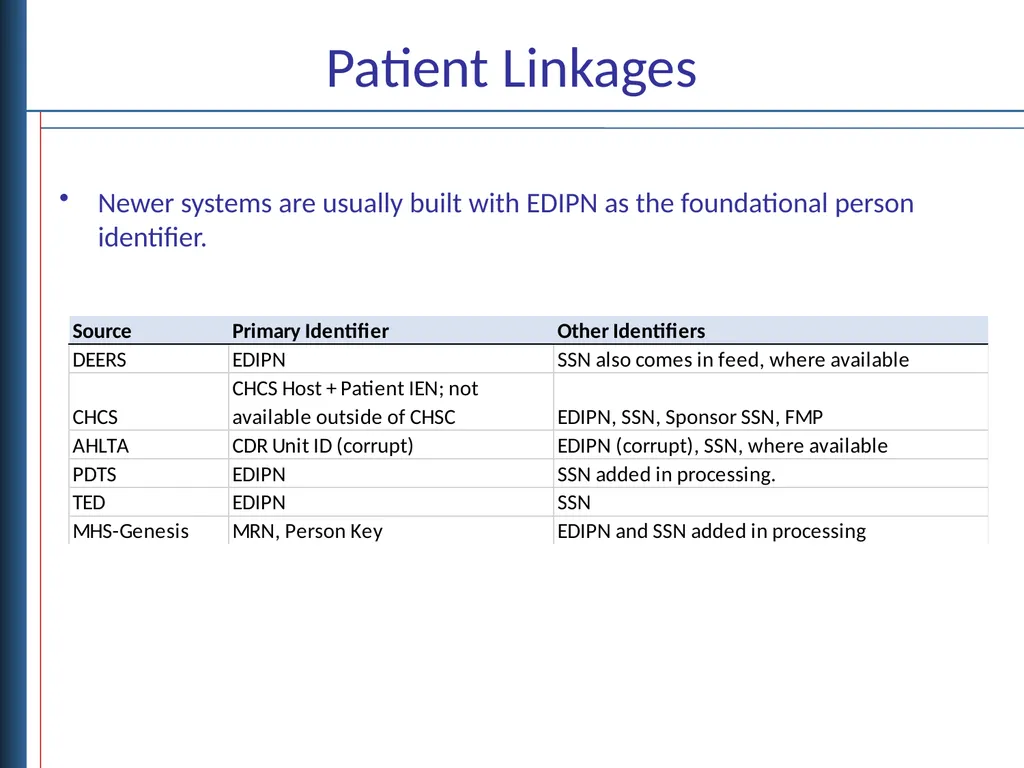
Patient Linkages Newer systems are usually built with EDIPN as the foundational person identifier.<br>
06
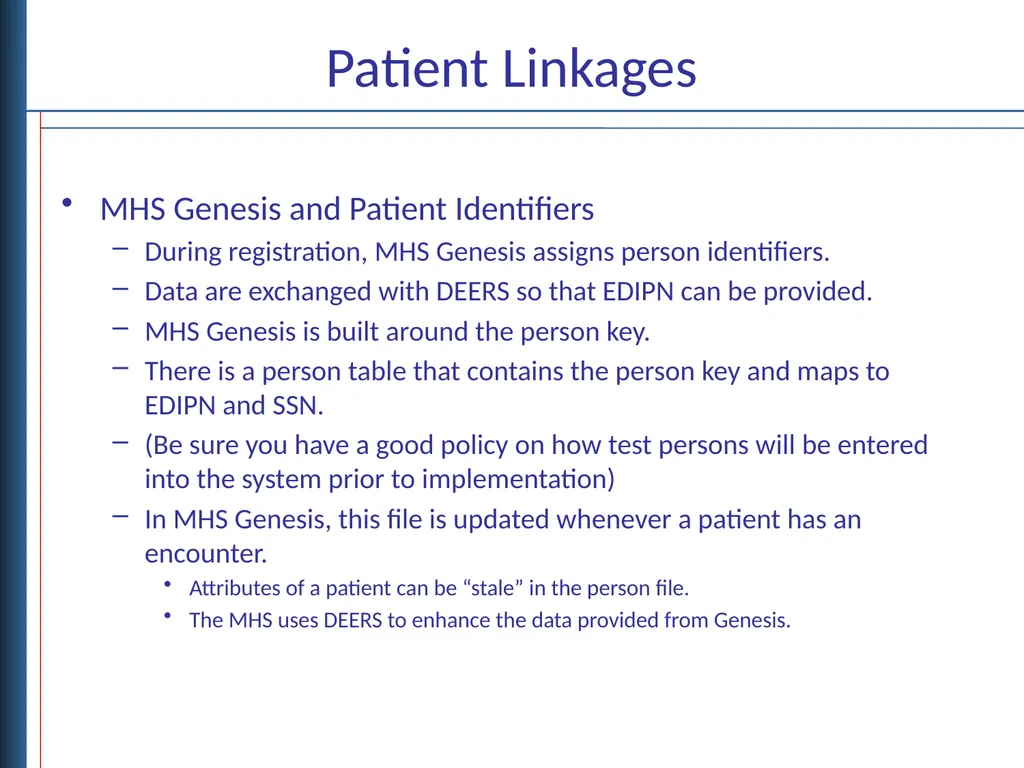
Patient Linkages MHS Genesis and Patient Identifiers
During registration, MHS Genesis assigns person identifiers.
Data are exchanged with DEERS so that EDIPN can be provided.
MHS Genesis is built around the person key.
There is a person table that contains the person key and maps to EDIPN and SSN.
(Be sure you have a good policy on how test persons will be entered into the system prior to implementation)
In MHS Genesis, this file is updated whenever a patient has an encounter.
Attributes of a patient can be “stale” in the person file.
The MHS uses DEERS to enhance the data provided from Genesis.<br>
07
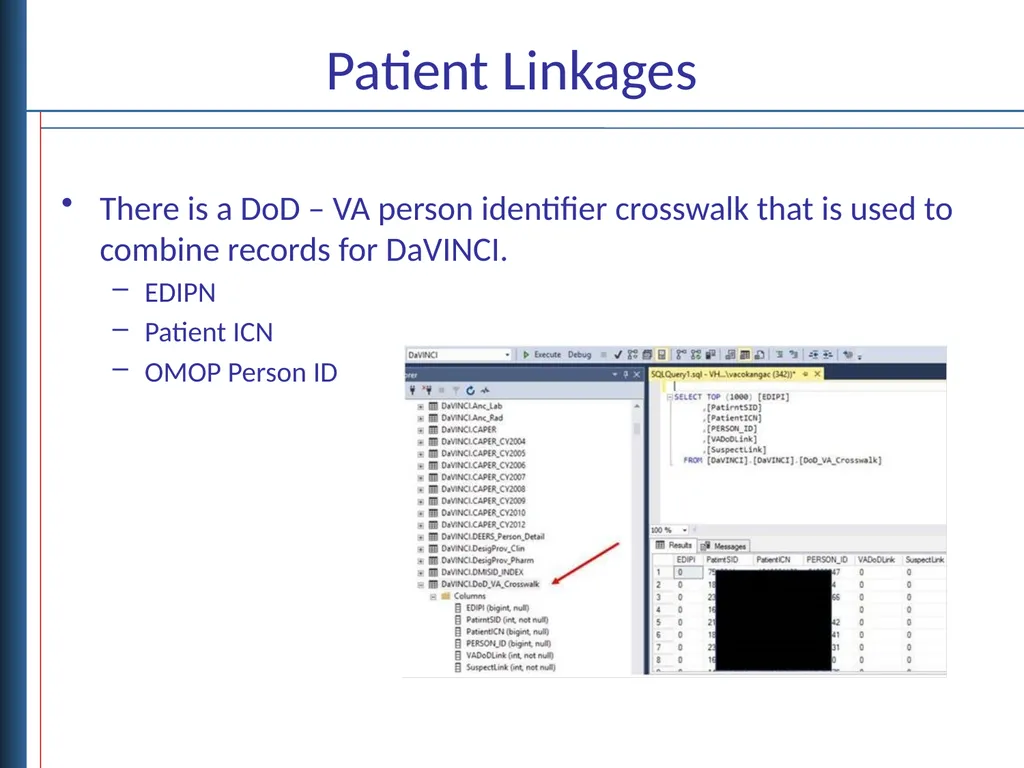
Patient Linkages There is a DoD – VA person identifier crosswalk that is used to combine records for DaVINCI.
EDIPN
Patient ICN
OMOP Person ID<br>
08
Direct Care Linkages<br>
09
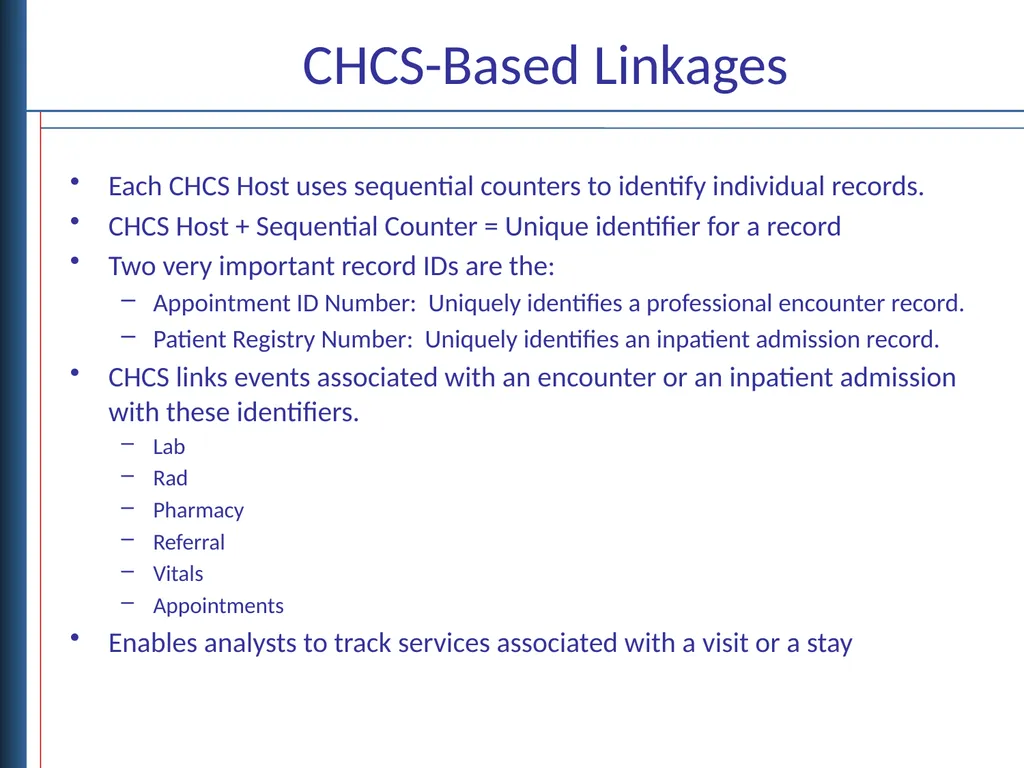
CHCS-Based Linkages Each CHCS Host uses sequential counters to identify individual records.
CHCS Host + Sequential Counter = Unique identifier for a record
Two very important record IDs are the:
Appointment ID Number: Uniquely identifies a professional encounter record.
Patient Registry Number: Uniquely identifies an inpatient admission record.
CHCS links events associated with an encounter or an inpatient admission with these identifiers.
Lab
Rad
Pharmacy
Referral
Vitals
Appointments
Enables analysts to track services associated with a visit or a stay<br>
10
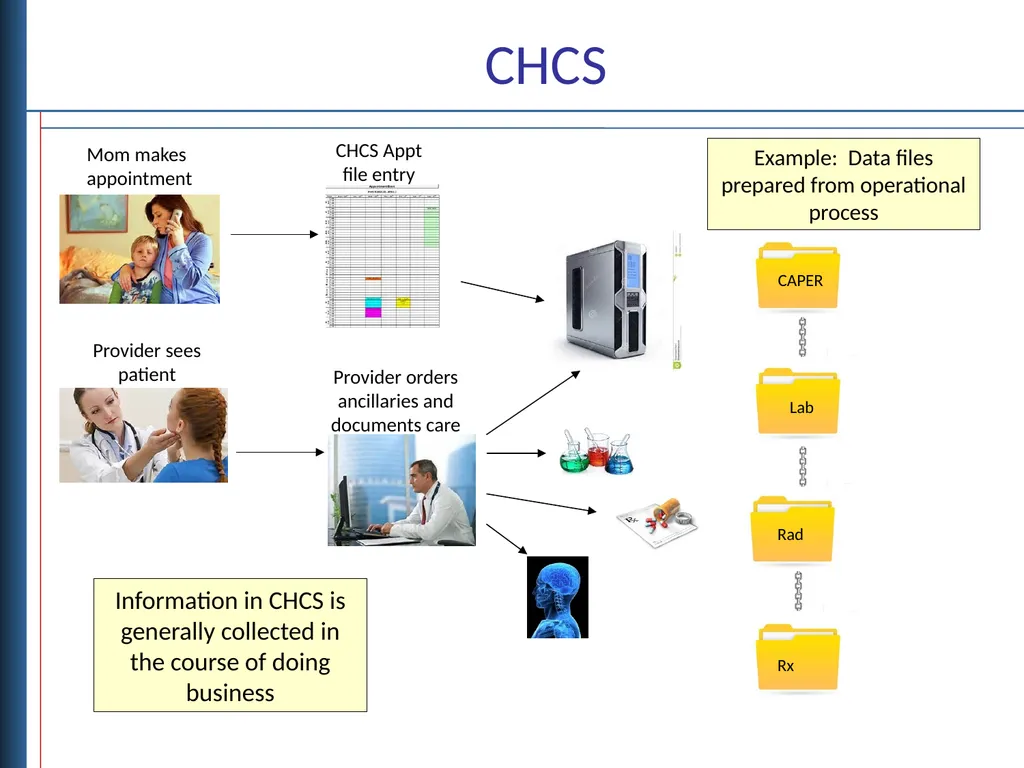
CHCS Mom makes appointment CHCS Appt file entry Provider sees patient Provider orders ancillaries and documents care CAPER Lab Rad Rx Information in CHCS is generally collected in the course of doing business Example: Data files prepared from operational process<br>
11
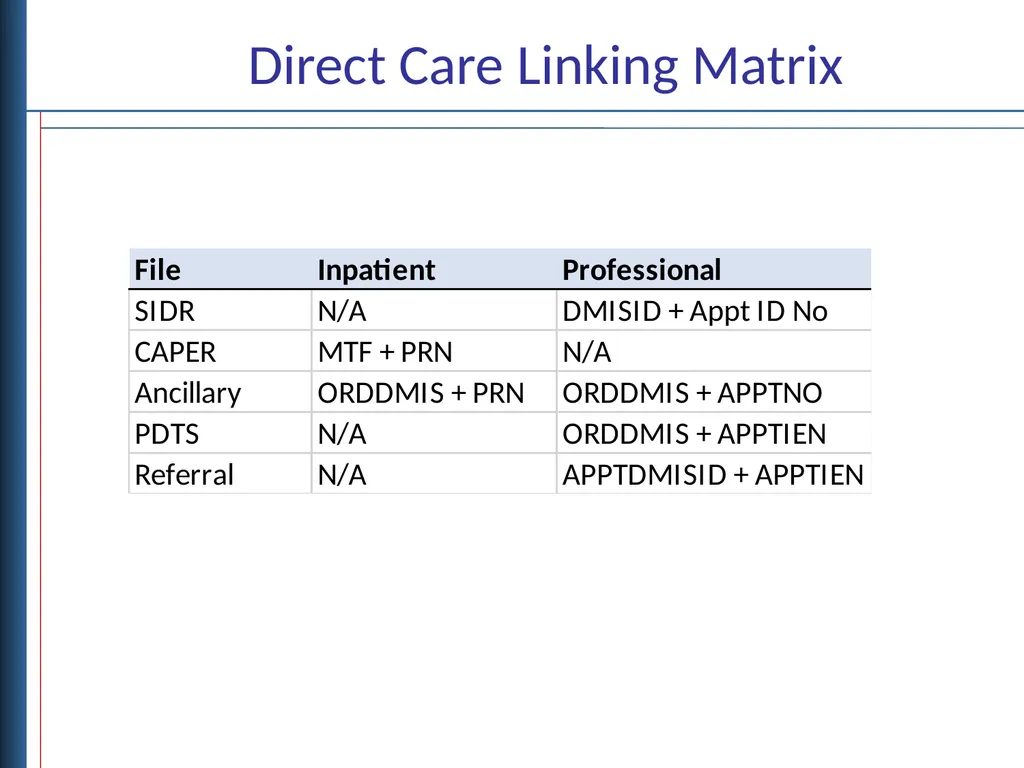
Direct Care Linking Matrix<br>
12
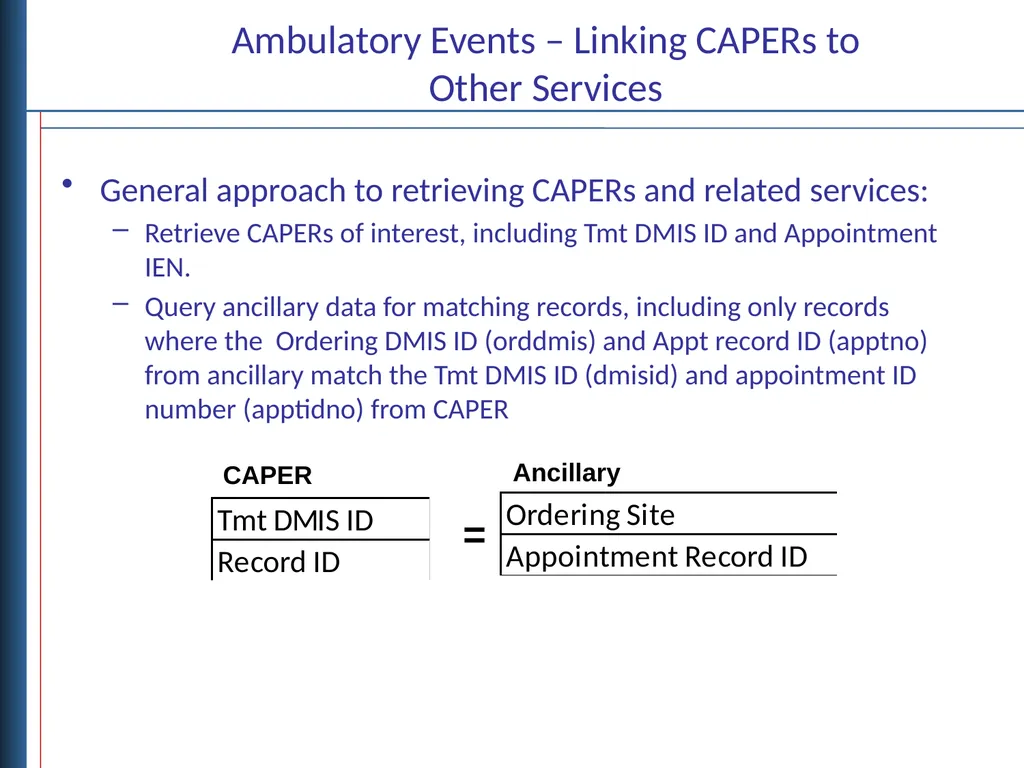
Ambulatory Events – Linking CAPERs to Other Services General approach to retrieving CAPERs and related services:
Retrieve CAPERs of interest, including Tmt DMIS ID and Appointment IEN.
Query ancillary data for matching records, including only records where the Ordering DMIS ID (orddmis) and Appt record ID (apptno) from ancillary match the Tmt DMIS ID (dmisid) and appointment ID number (apptidno) from CAPER = CAPER Ancillary<br>
13
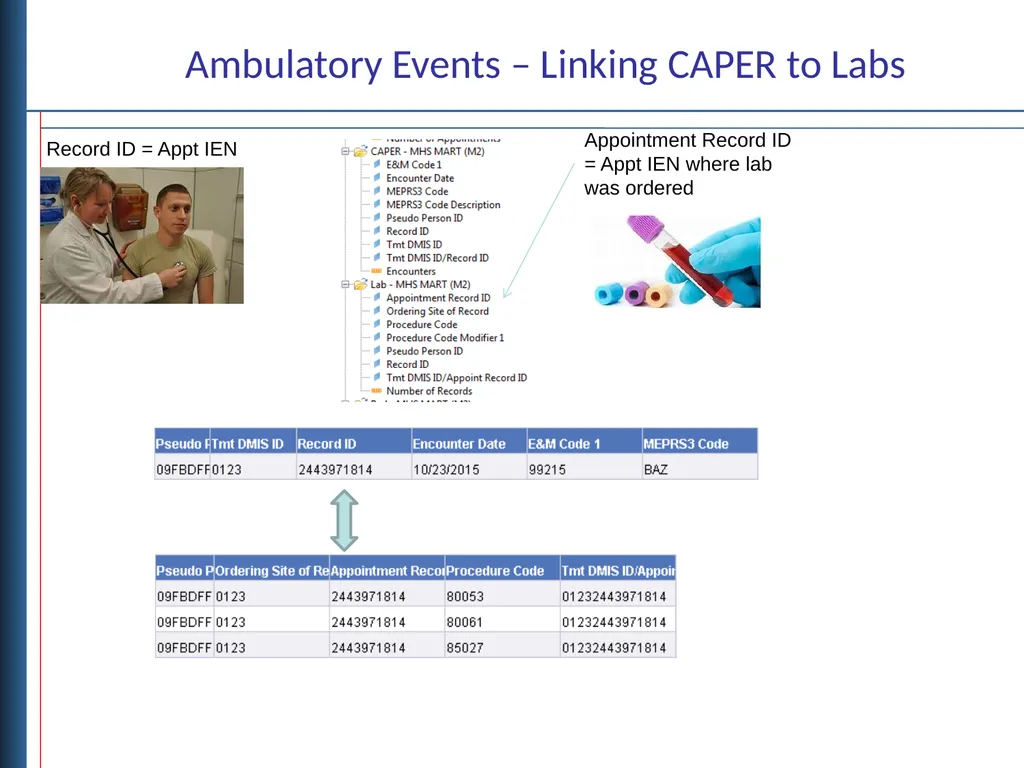
Ambulatory Events – Linking CAPER to Labs Record ID = Appt IEN Appointment Record ID = Appt IEN where lab was ordered<br>
14
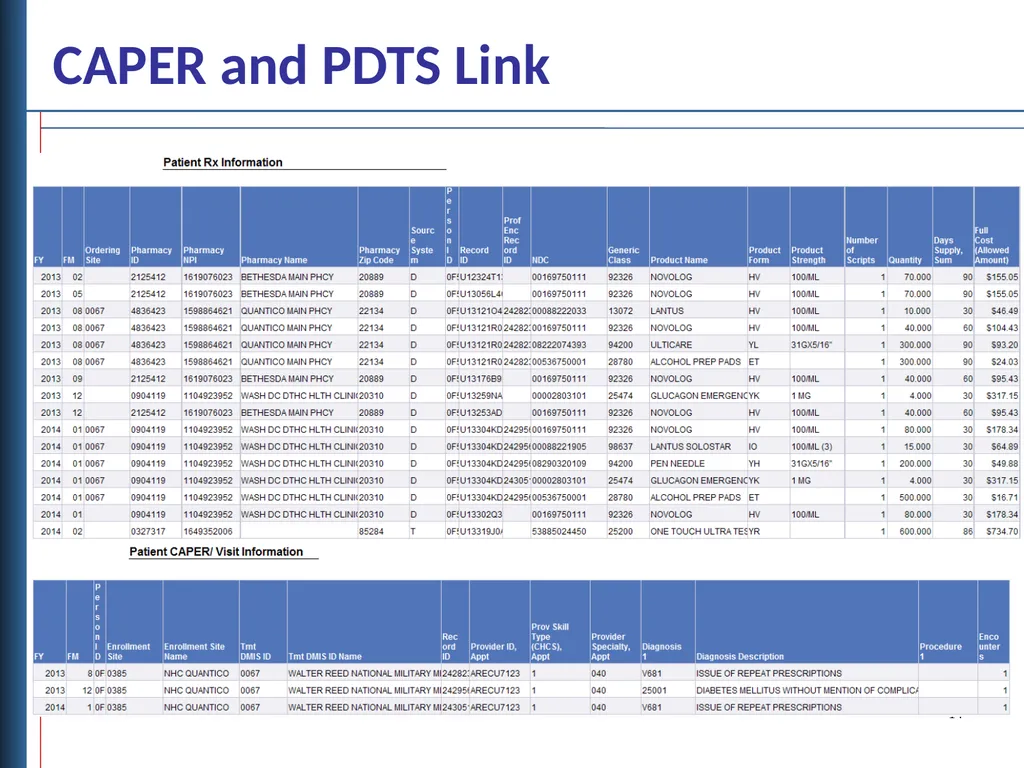
CAPER and PDTS Link 14<br>
15
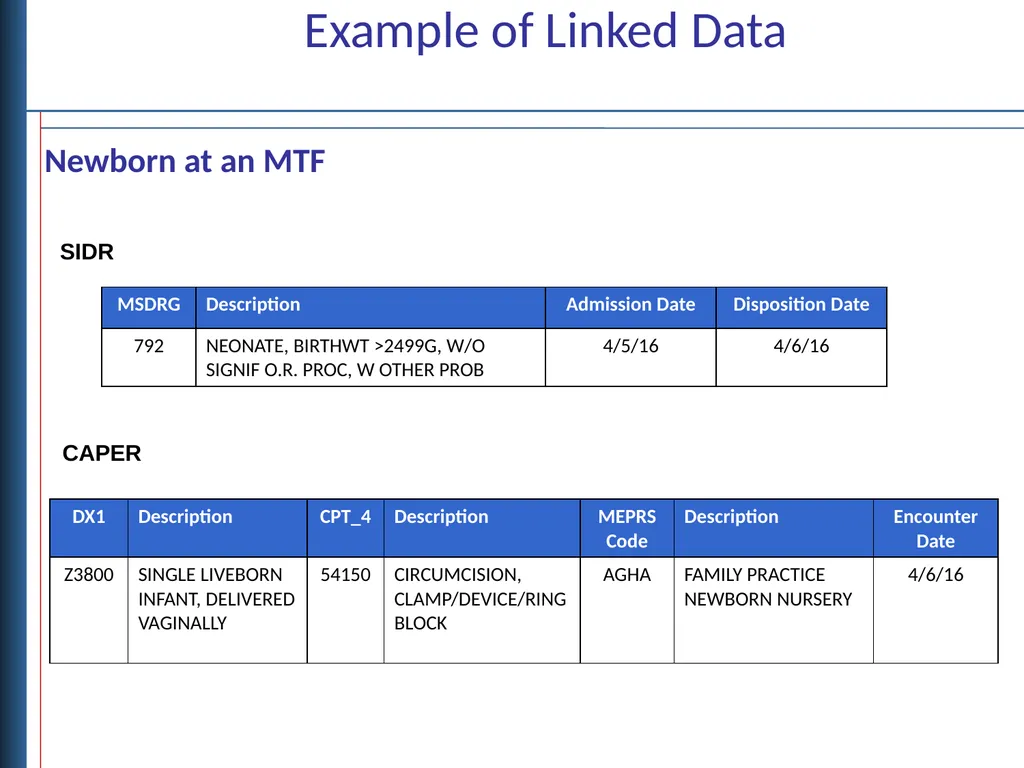
Example of Linked Data Newborn at an MTF SIDR CAPER<br>
16
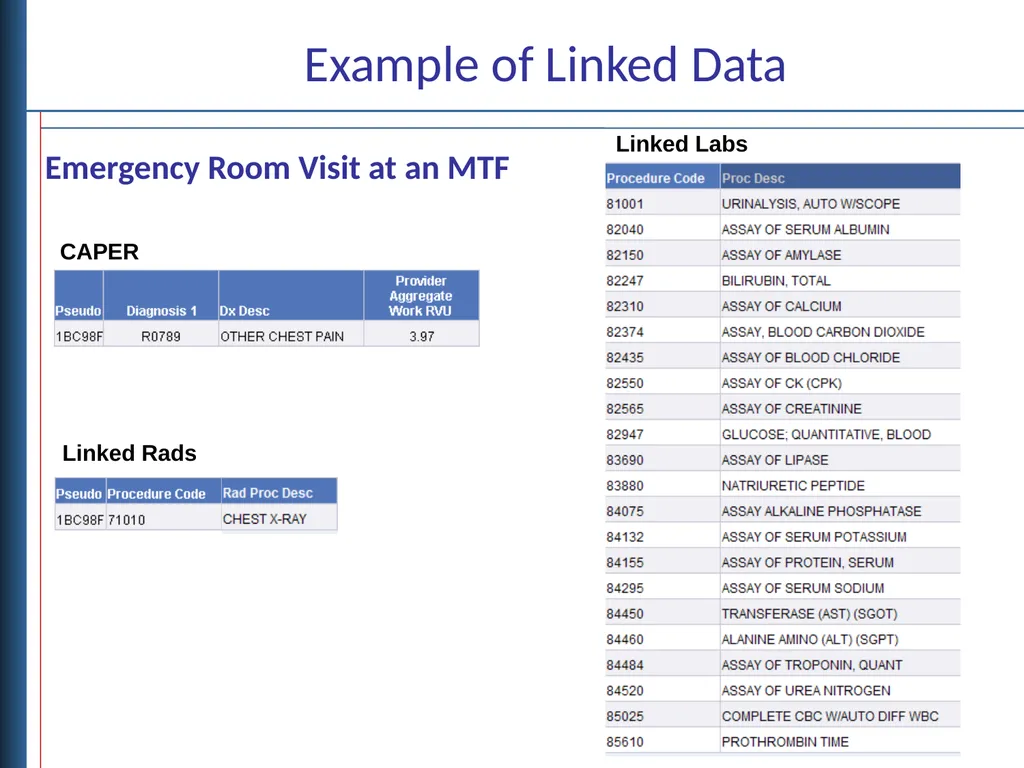
Example of Linked Data Emergency Room Visit at an MTF Linked Labs CAPER Linked Rads<br>
17
CDR Linkages<br>
18
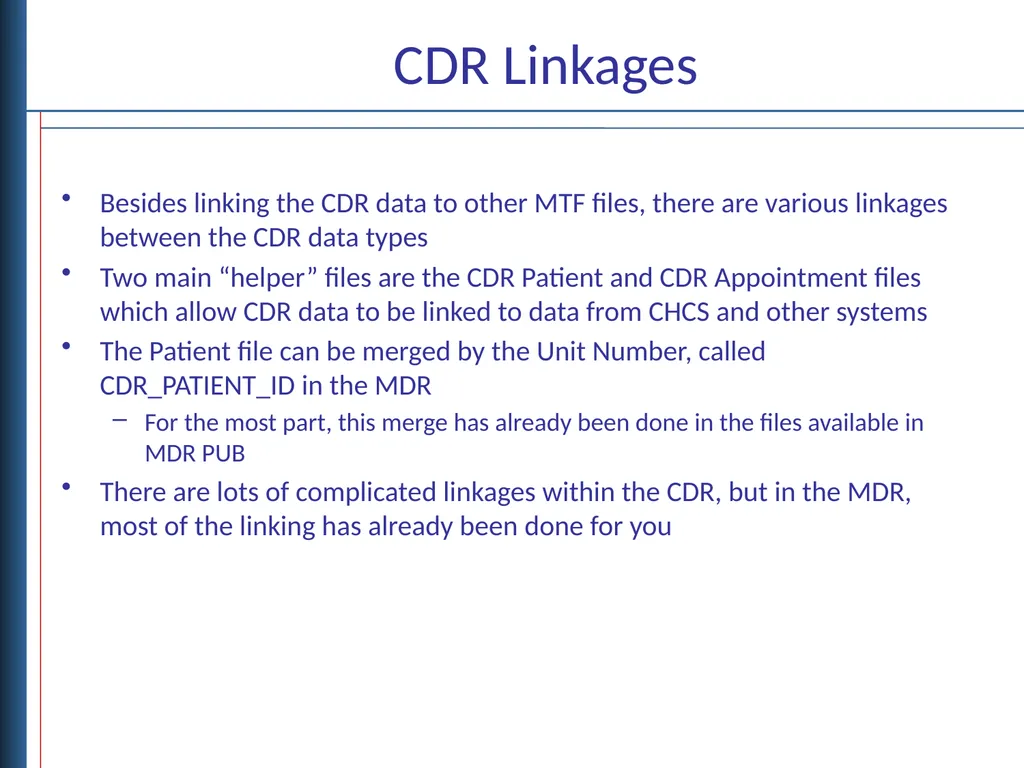
CDR Linkages Besides linking the CDR data to other MTF files, there are various linkages between the CDR data types
Two main “helper” files are the CDR Patient and CDR Appointment files which allow CDR data to be linked to data from CHCS and other systems
The Patient file can be merged by the Unit Number, called CDR_PATIENT_ID in the MDR
For the most part, this merge has already been done in the files available in MDR PUB
There are lots of complicated linkages within the CDR, but in the MDR, most of the linking has already been done for you<br>
19
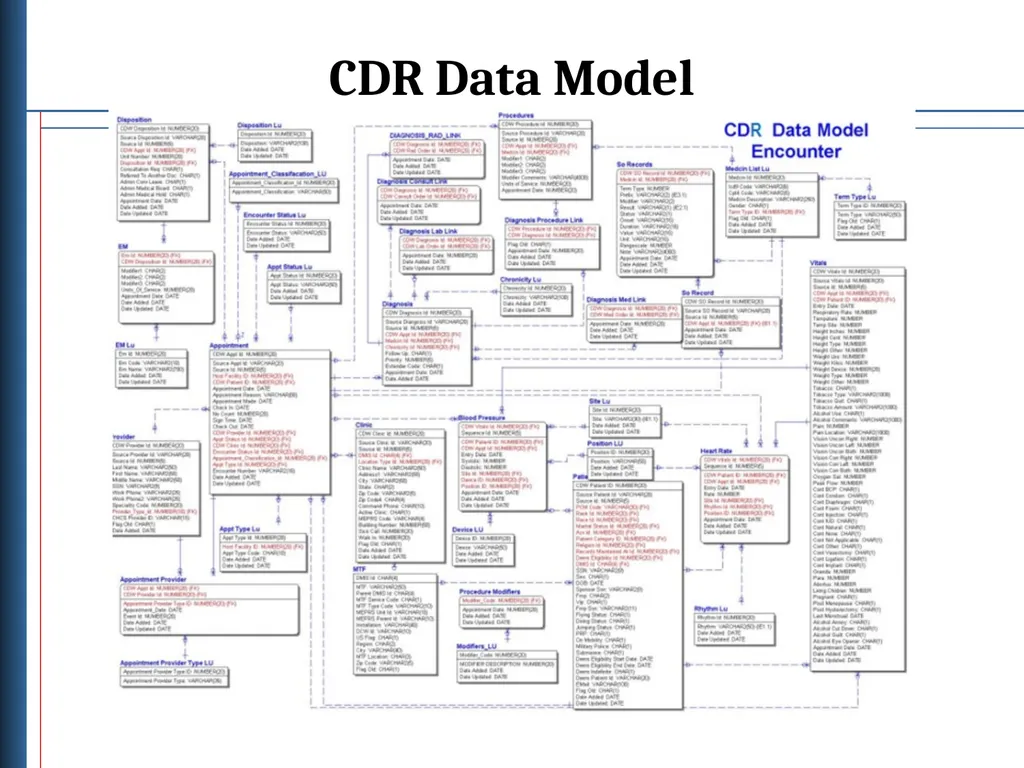
CDR Data Model<br>
20
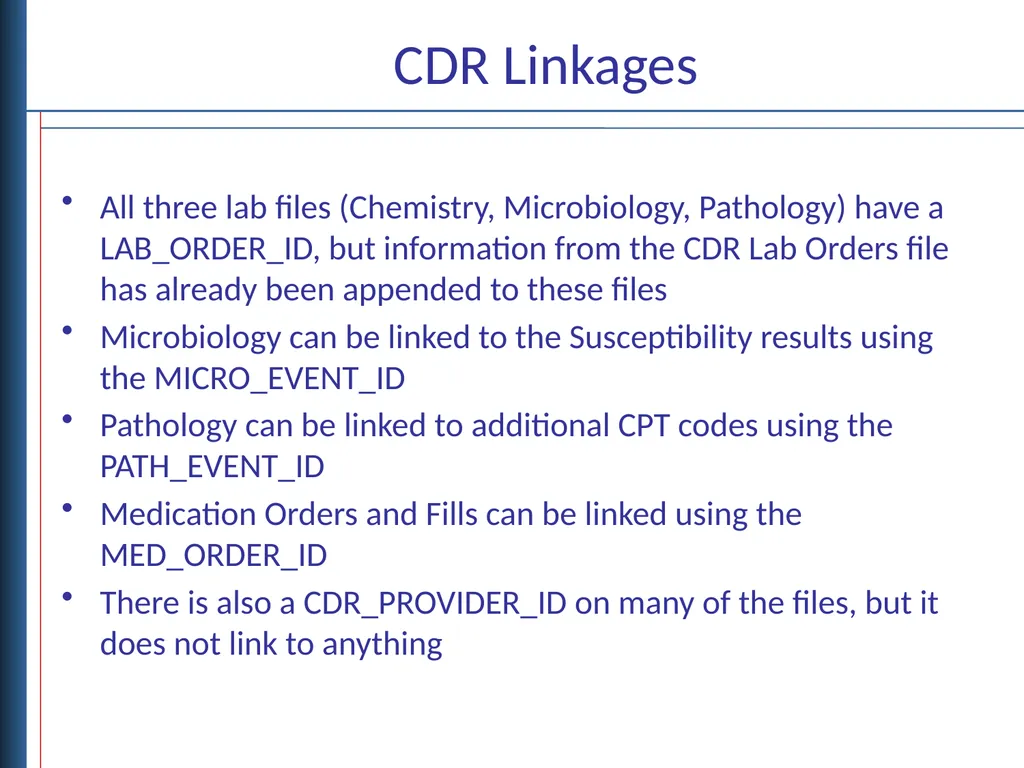
CDR Linkages All three lab files (Chemistry, Microbiology, Pathology) have a LAB_ORDER_ID, but information from the CDR Lab Orders file has already been appended to these files
Microbiology can be linked to the Susceptibility results using the MICRO_EVENT_ID
Pathology can be linked to additional CPT codes using the PATH_EVENT_ID
Medication Orders and Fills can be linked using the MED_ORDER_ID
There is also a CDR_PROVIDER_ID on many of the files, but it does not link to anything<br>
21
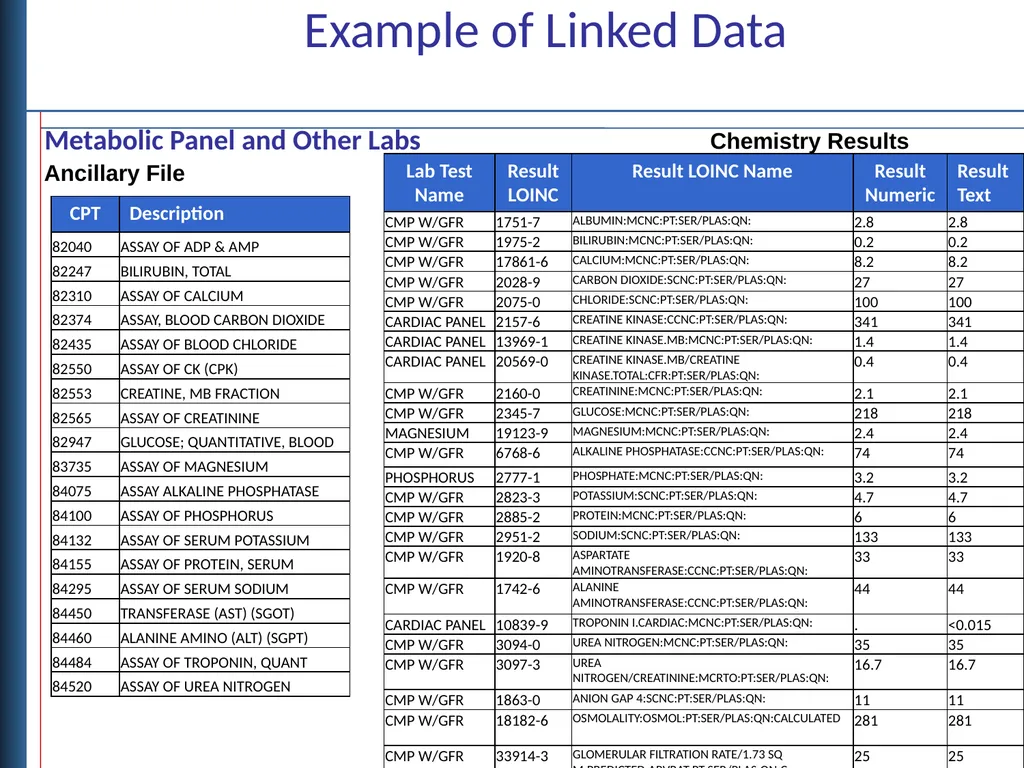
Example of Linked Data Metabolic Panel and Other Labs Ancillary File Chemistry Results<br>
22
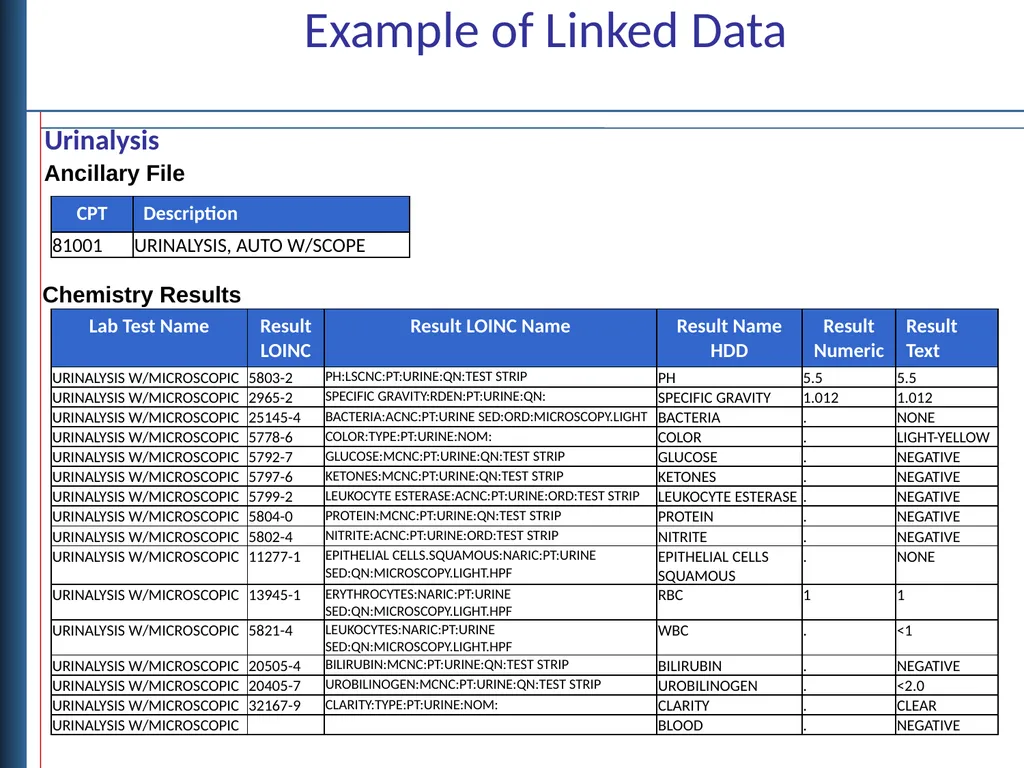
Example of Linked Data Urinalysis Ancillary File Chemistry Results<br>
23
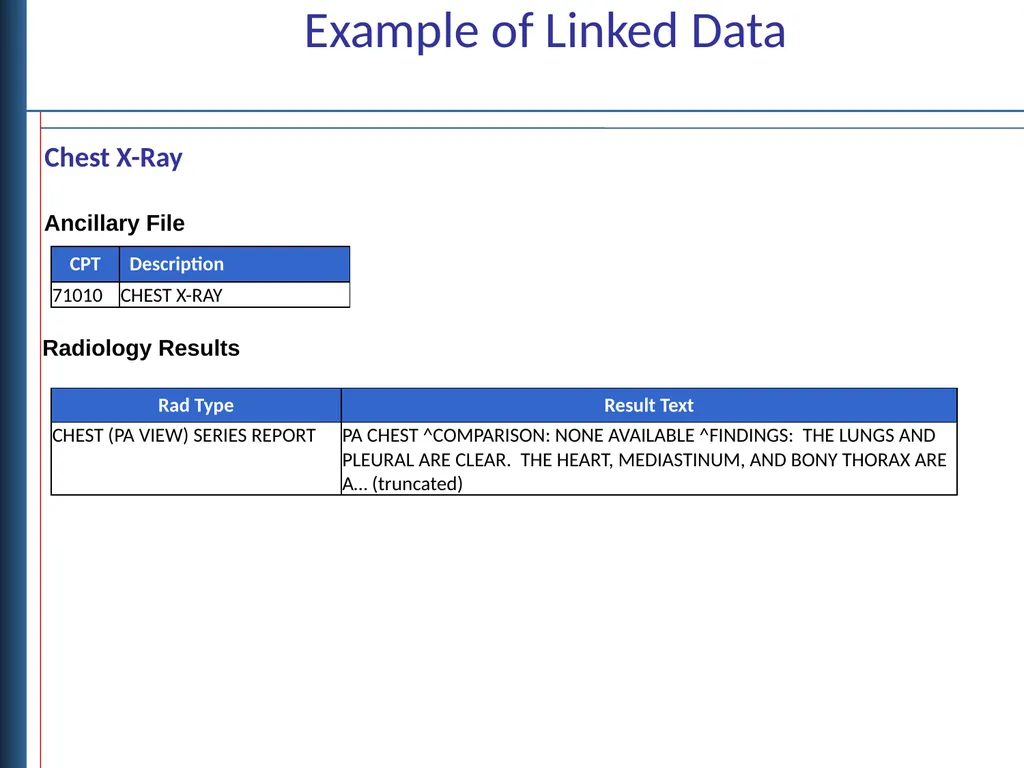
Example of Linked Data Chest X-Ray Ancillary File Radiology Results<br>
24
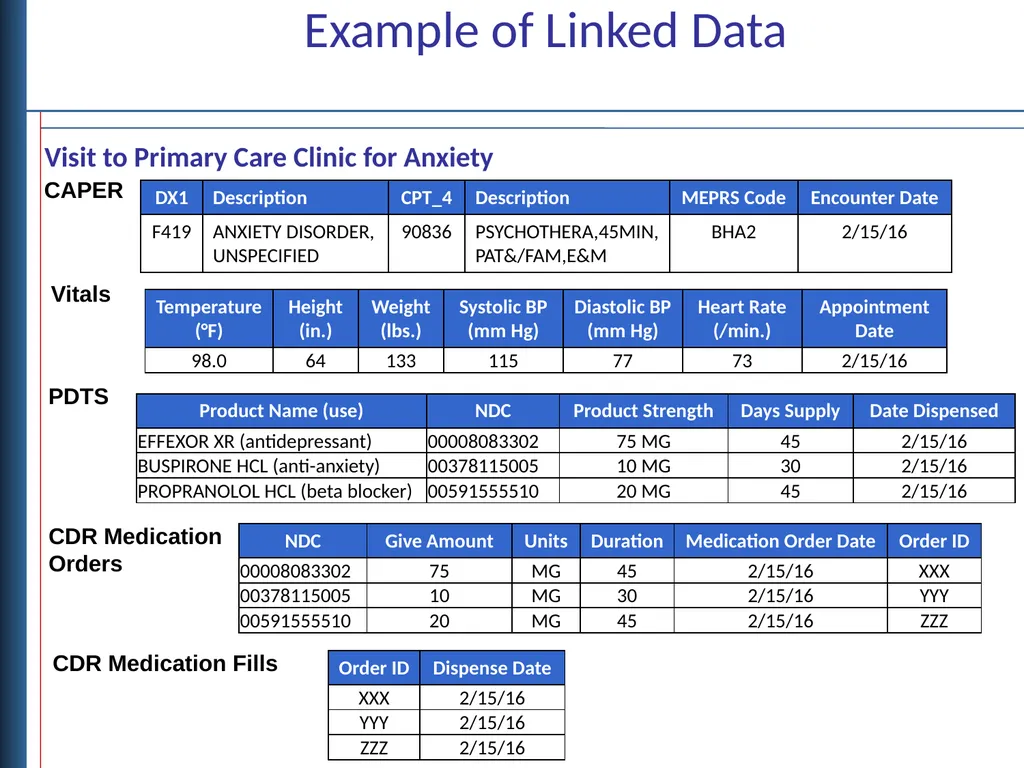
Example of Linked Data Visit to Primary Care Clinic for Anxiety CAPER Vitals PDTS CDR Medication
Orders CDR Medication Fills<br>
25
Purchased Care Linkages<br>
26
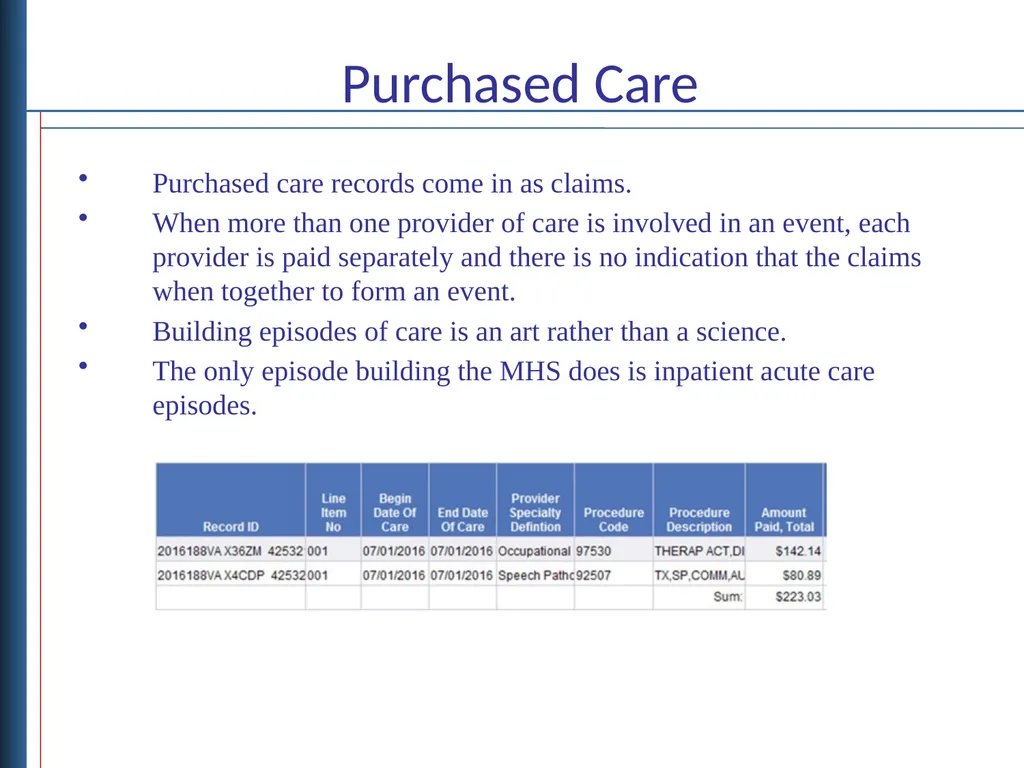
Purchased Care Purchased care records come in as claims.
When more than one provider of care is involved in an event, each provider is paid separately and there is no indication that the claims when together to form an event.
Building episodes of care is an art rather than a science.
The only episode building the MHS does is inpatient acute care episodes.<br>
27
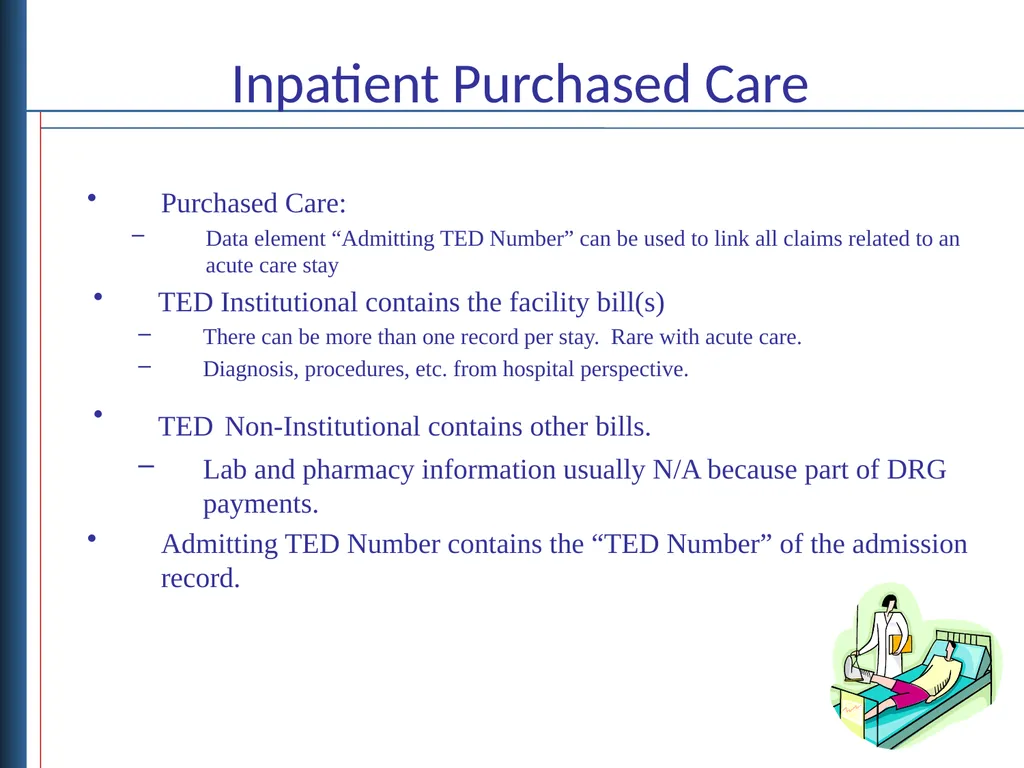
Inpatient Purchased Care Purchased Care:
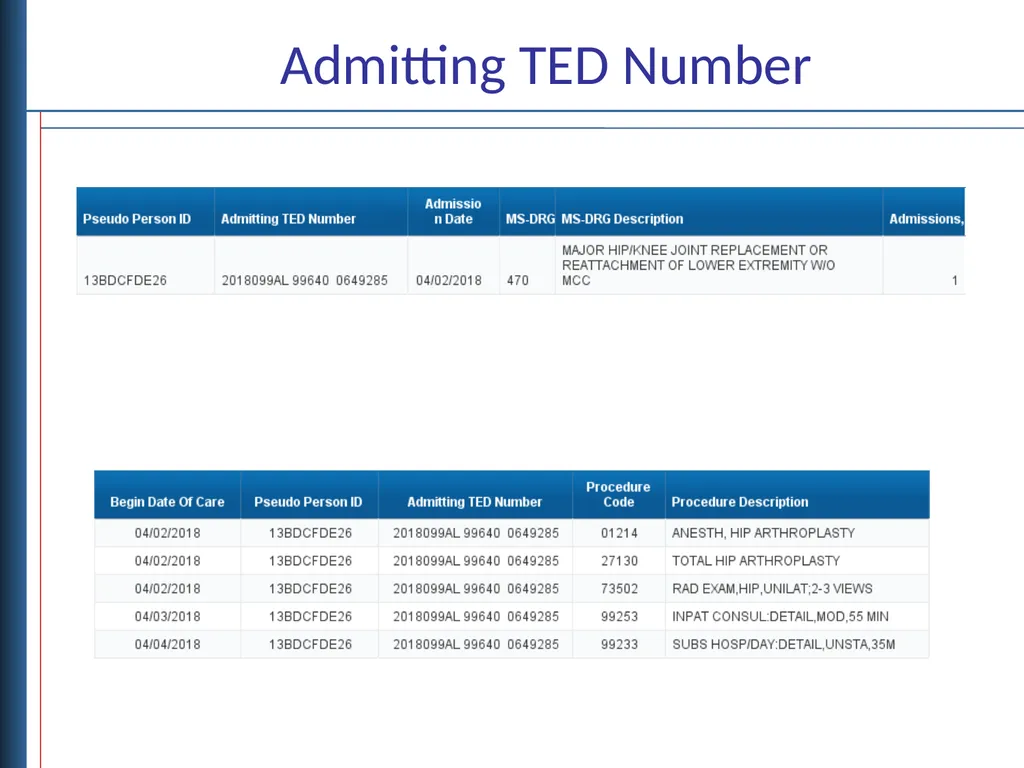
Data element “Admitting TED Number” can be used to link all claims related to an acute care stay
TED Institutional contains the facility bill(s)
There can be more than one record per stay. Rare with acute care.
Diagnosis, procedures, etc. from hospital perspective.
TED Non-Institutional contains other bills.
Lab and pharmacy information usually N/A because part of DRG payments.
Admitting TED Number contains the “TED Number” of the admission record.<br>
28
Admitting TED Number<br>
29
Caveats Sometimes an acute stay will have a non-acute component to it.
The Admitting TED Number will not incorporate that part of a stay.
Example: Patient is treated for a stroke, then goes to a rehab facility.
This information could be obtained by retrieving records for persons with inpatient stays beyond the period of stay.
There are also entirely non-acute stays which the admitting TED number does not address.
i.e. mental health institutions
Resource Sharing stays are not included. For those, there will be an institutional TED record but a CAPER to indicate the professional service.<br>