04
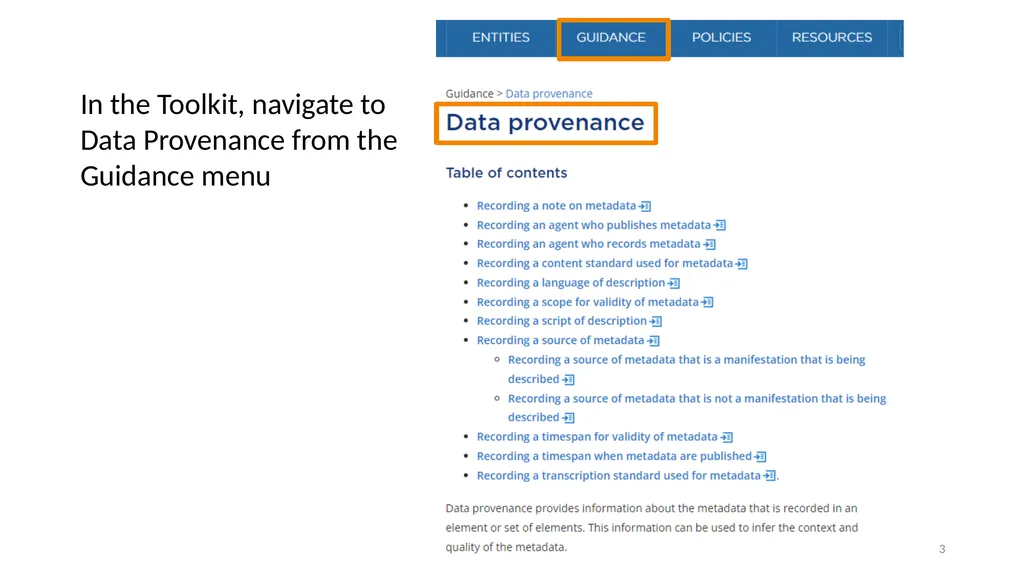
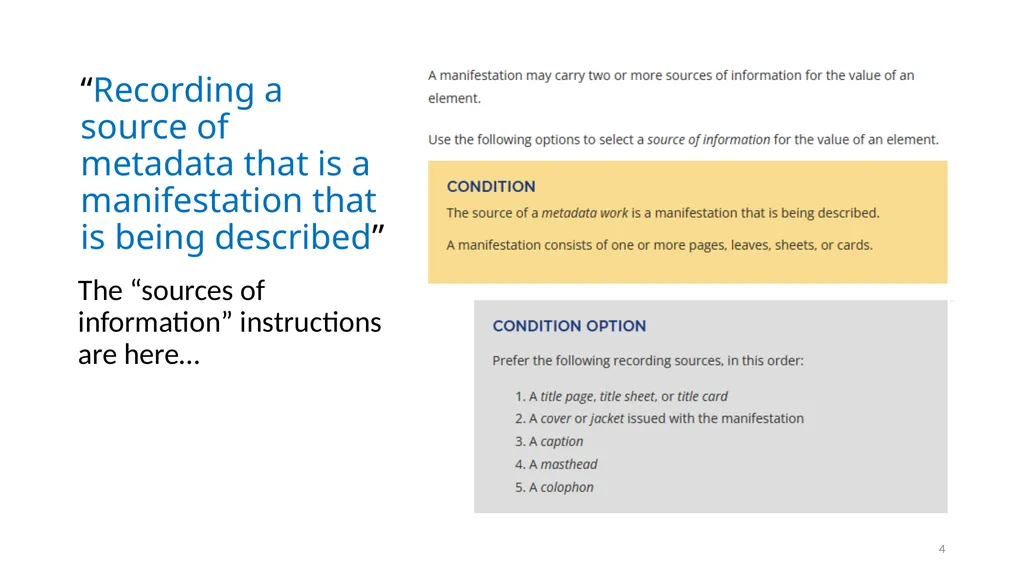
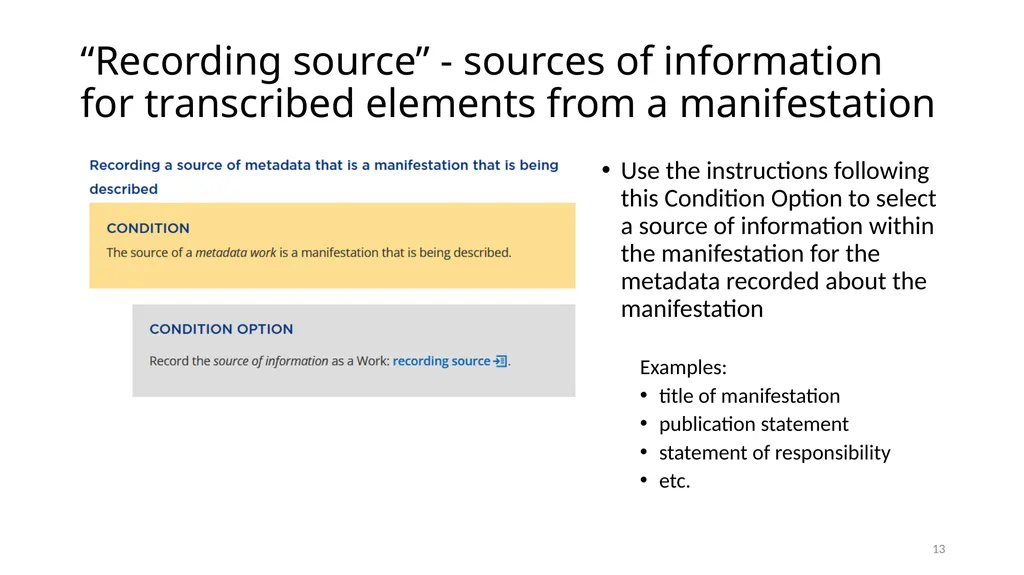
“Recording a source of metadata that is a manifestation that is being described” The “sources of information” instructions are here… 4<br>
05
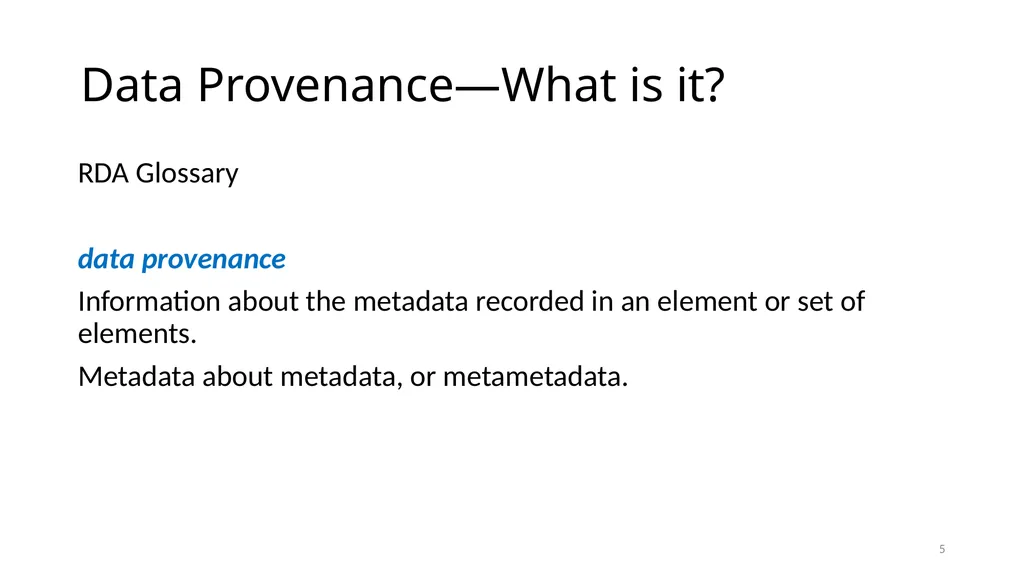
Data Provenance—What is it? RDA Glossary
data provenance
Information about the metadata recorded in an element or set of elements.
Metadata about metadata, or metametadata. 5<br>
06
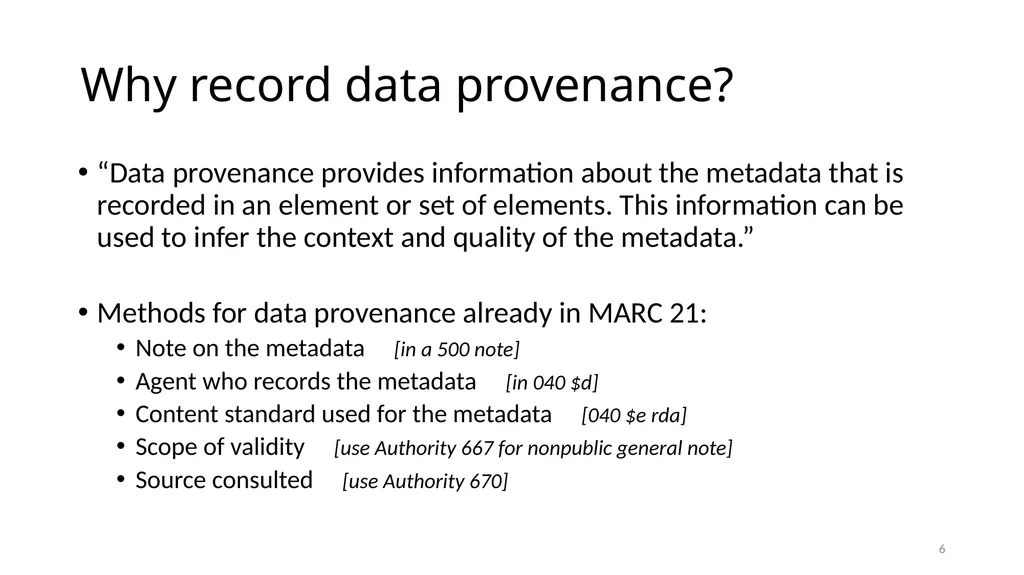
Why record data provenance? “Data provenance provides information about the metadata that is recorded in an element or set of elements. This information can be used to infer the context and quality of the metadata.”
Methods for data provenance already in MARC 21:
Note on the metadata [in a 500 note]
Agent who records the metadata [in 040 $d]
Content standard used for the metadata [040 $e rda]
Scope of validity [use Authority 667 for nonpublic general note]
Source consulted [use Authority 670] 6<br>
07
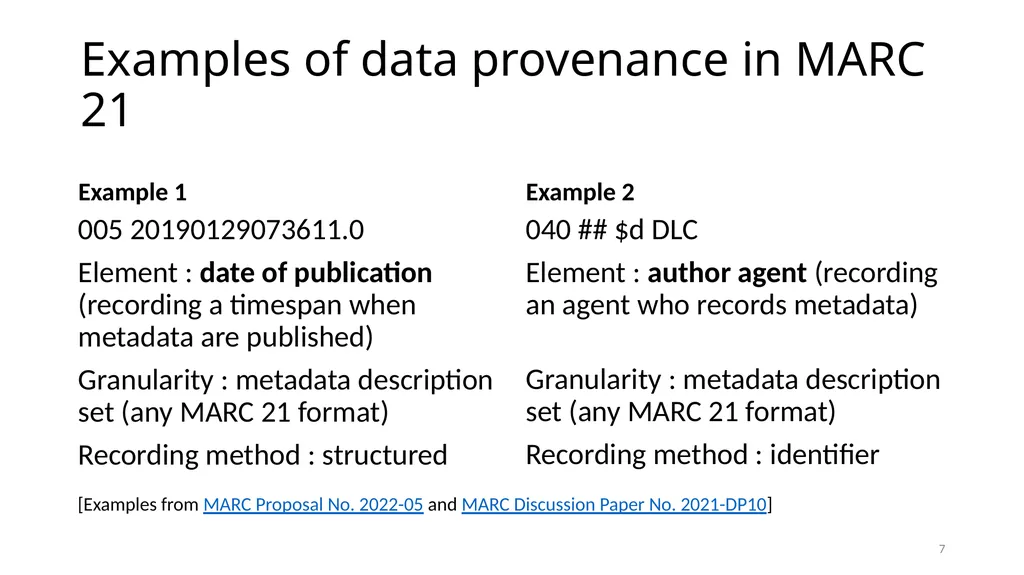
Examples of data provenance in MARC 21 Example 1 005 20190129073611.0
Element : date of publication (recording a timespan when metadata are published)
Granularity : metadata description set (any MARC 21 format)
Recording method : structured Example 2 040 ## $d DLC
Element : author agent (recording an agent who records metadata)�
Granularity : metadata description set (any MARC 21 format)
Recording method : identifier 7 [Examples from MARC Proposal No. 2022-05 and MARC Discussion Paper No. 2021-DP10]<br>
08
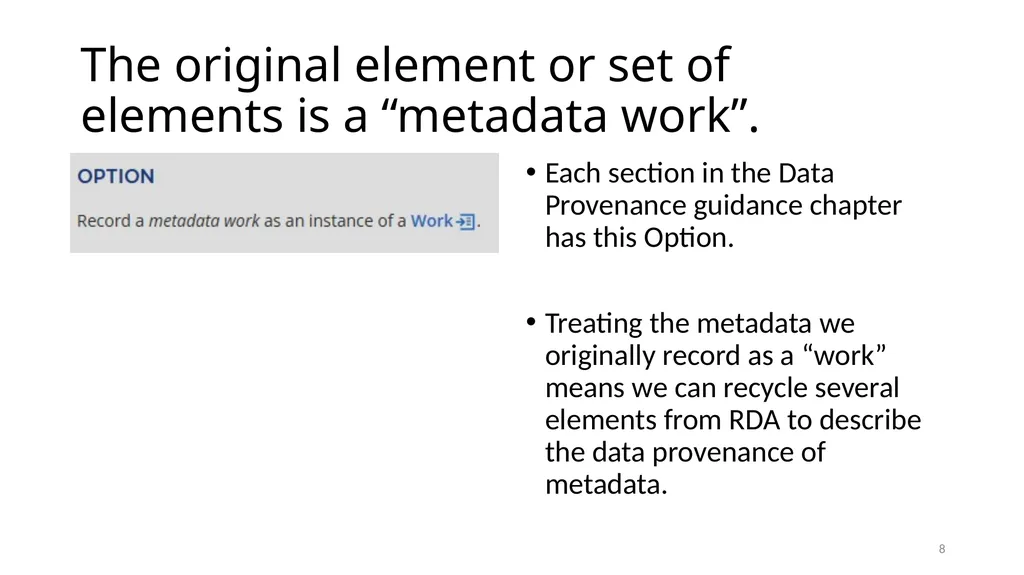
The original element or set of elements is a “metadata work”. Each section in the Data Provenance guidance chapter has this Option.
Treating the metadata we originally record as a “work” means we can recycle several elements from RDA to describe the data provenance of metadata. 8<br>
09
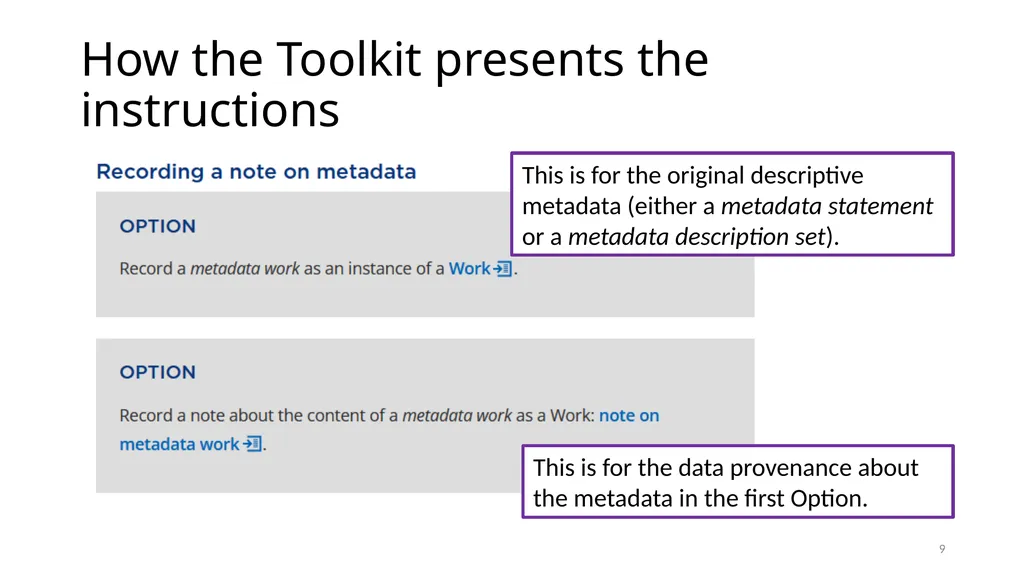
How the Toolkit presents the instructions 9 This is for the original descriptive metadata (either a metadata statement or a metadata description set). This is for the data provenance about the metadata in the first Option.<br>
10
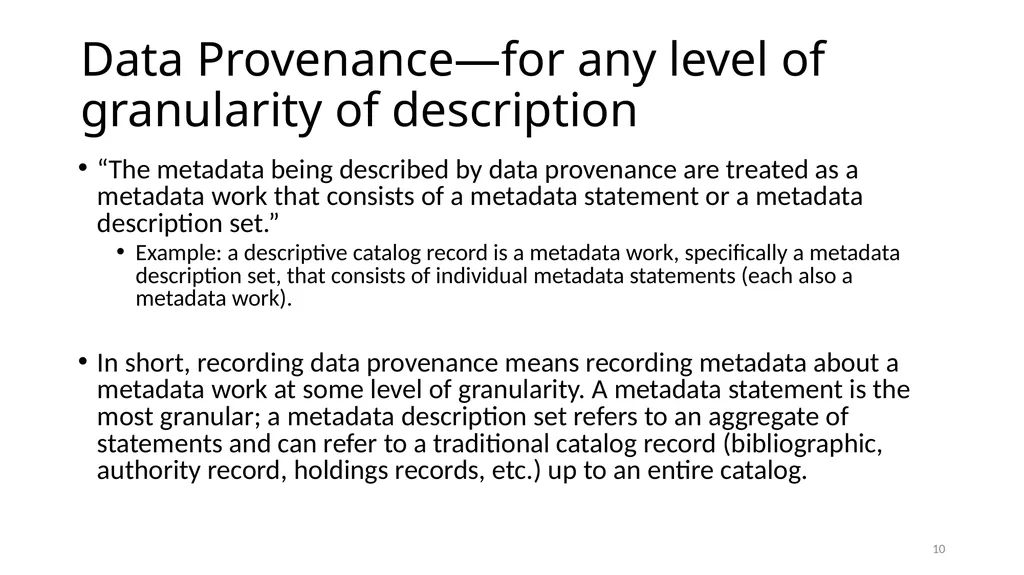
Data Provenance—for any level of granularity of description “The metadata being described by data provenance are treated as a metadata work that consists of a metadata statement or a metadata description set.”
Example: a descriptive catalog record is a metadata work, specifically a metadata description set, that consists of individual metadata statements (each also a metadata work).
In short, recording data provenance means recording metadata about a metadata work at some level of granularity. A metadata statement is the most granular; a metadata description set refers to an aggregate of statements and can refer to a traditional catalog record (bibliographic, authority record, holdings records, etc.) up to an entire catalog. 10<br>
11
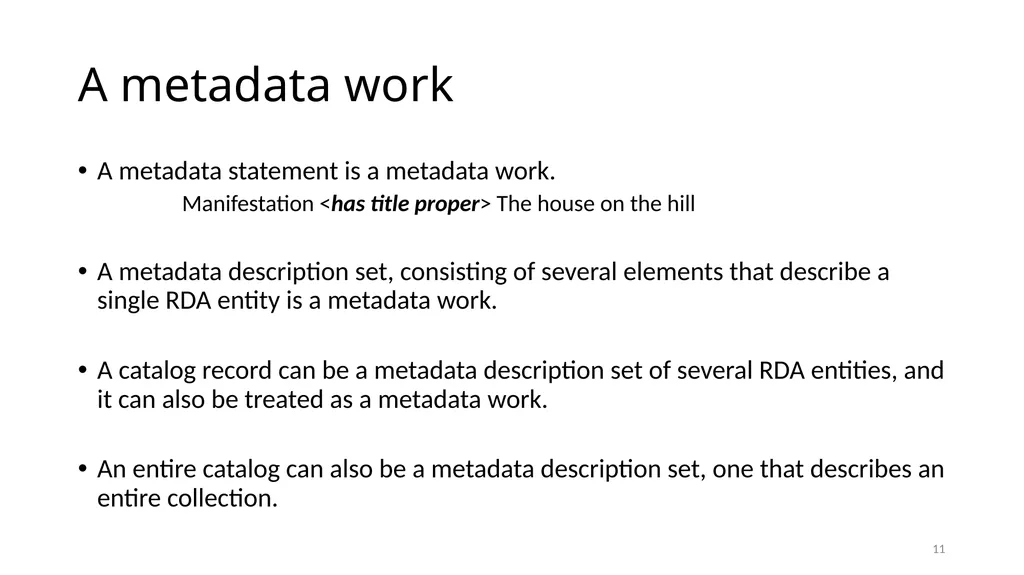
A metadata work A metadata statement is a metadata work.
Manifestation <has title proper> The house on the hill
A metadata description set, consisting of several elements that describe a single RDA entity is a metadata work.
A catalog record can be a metadata description set of several RDA entities, and it can also be treated as a metadata work.
An entire catalog can also be a metadata description set, one that describes an entire collection. 11<br>
12
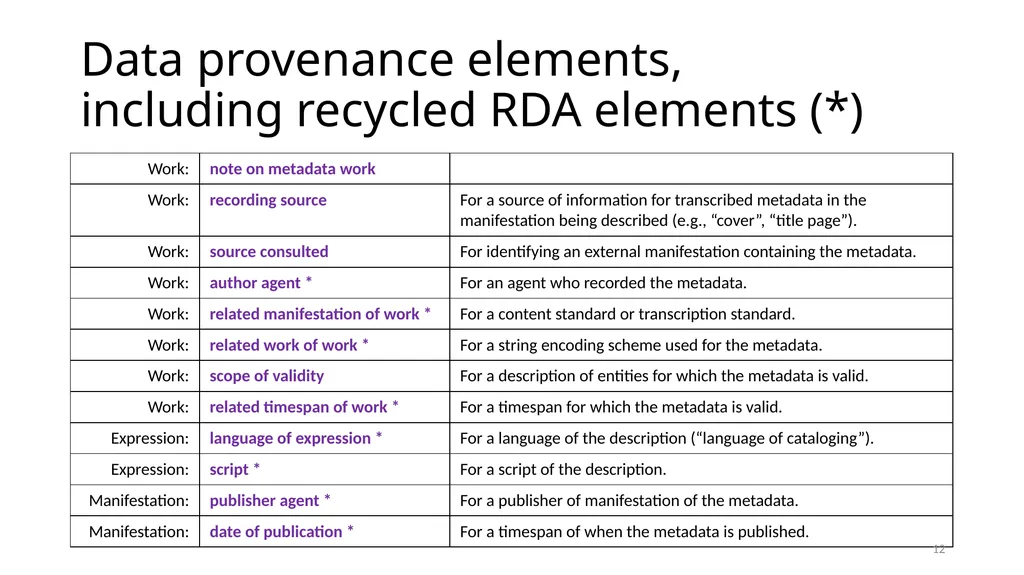
Data provenance elements,�including recycled RDA elements (*) 12<br>
13
“Recording source” - sources of information for transcribed elements from a manifestation Use the instructions following this Condition Option to select a source of information within the manifestation for the metadata recorded about the manifestation
Examples:
title of manifestation
publication statement
statement of responsibility
etc. 13<br>
14
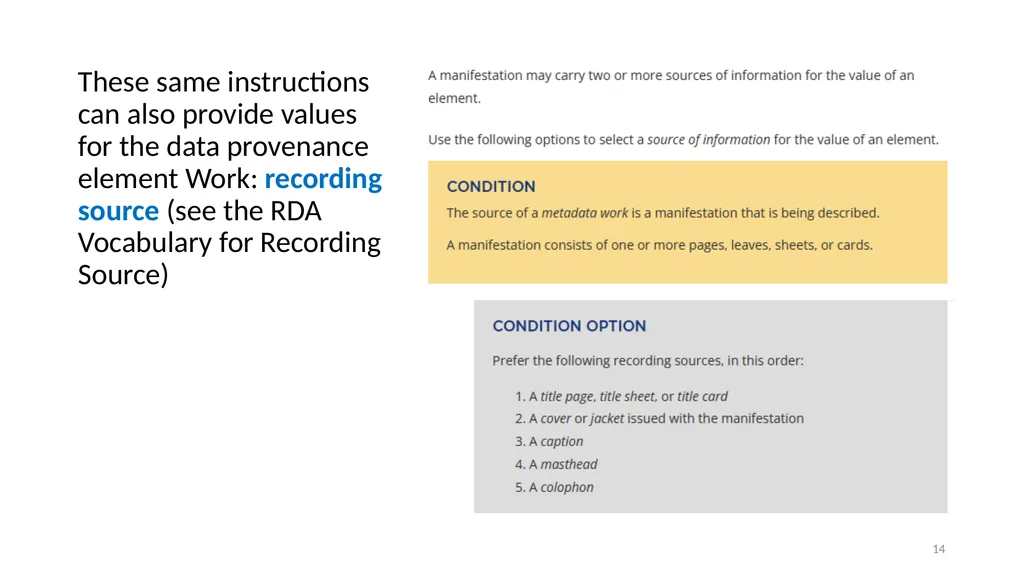
These same instructions can also provide values for the data provenance element Work: recording source (see the RDA Vocabulary for Recording Source) 14<br>
15
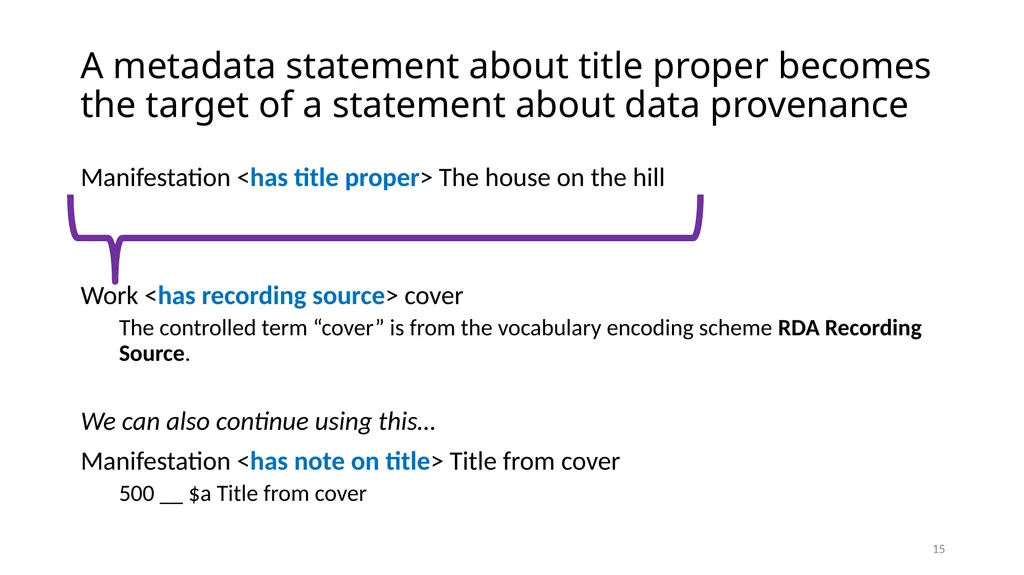
A metadata statement about title proper becomes the target of a statement about data provenance Manifestation <has title proper> The house on the hill
Work <has recording source> cover
The controlled term “cover” is from the vocabulary encoding scheme RDA Recording Source.
We can also continue using this…
Manifestation <has note on title> Title from cover
500 __ $a Title from cover 15<br>
16
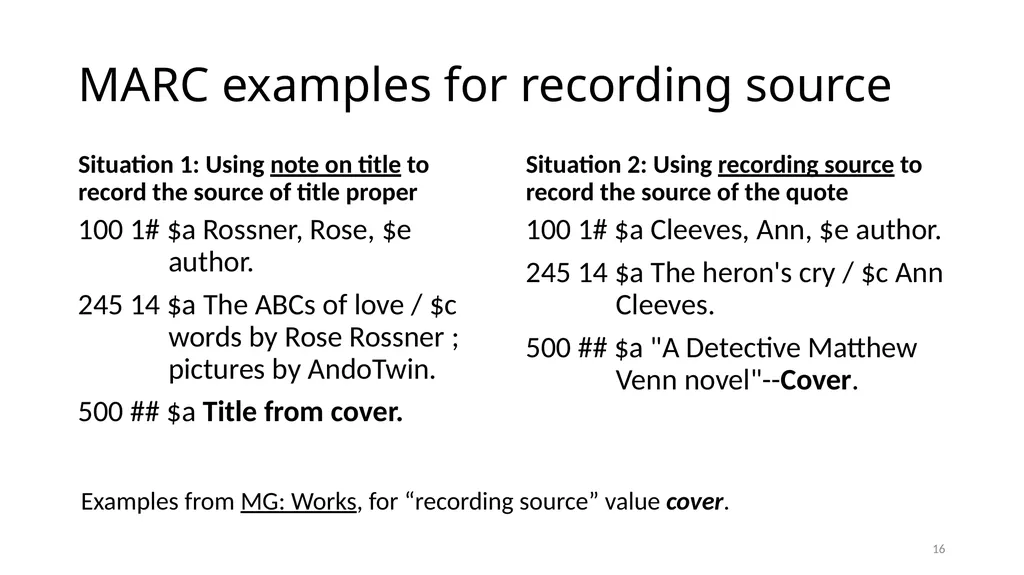
MARC examples for recording source Situation 1: Using note on title to record the source of title proper 100 1# $a Rossner, Rose, $e author.
245 14 $a The ABCs of love / $c words by Rose Rossner ; pictures by AndoTwin.
500 ## $a Title from cover. Situation 2: Using recording source to record the source of the quote 100 1# $a Cleeves, Ann, $e author.
245 14 $a The heron's cry / $c Ann Cleeves.
500 ## $a "A Detective Matthew Venn novel"--Cover. 16 Examples from MG: Works, for “recording source” value cover.<br>
17
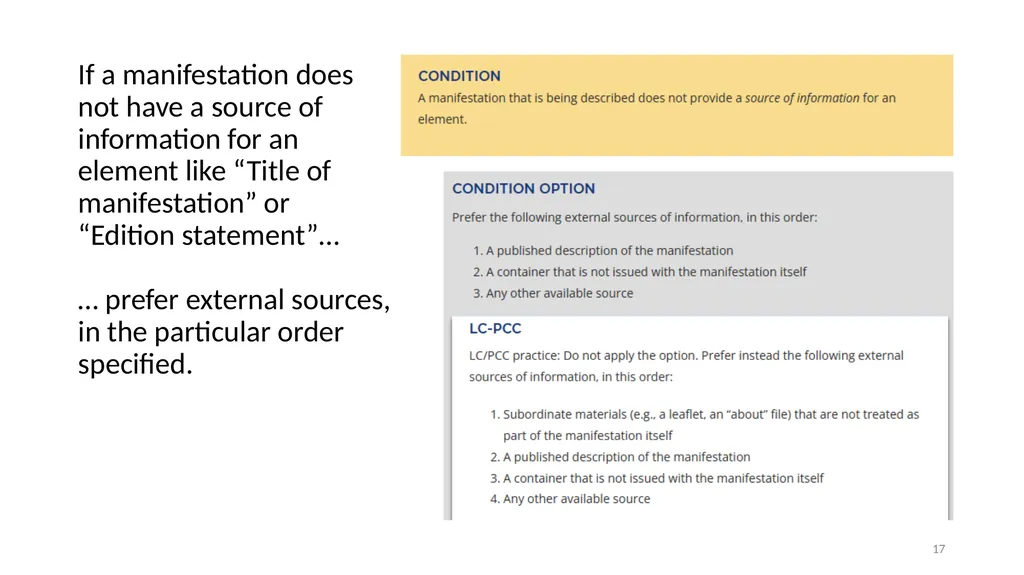
If a manifestation does not have a source of information for an element like “Title of manifestation” or “Edition statement”…��… prefer external sources, in the particular order specified. 17<br>
18
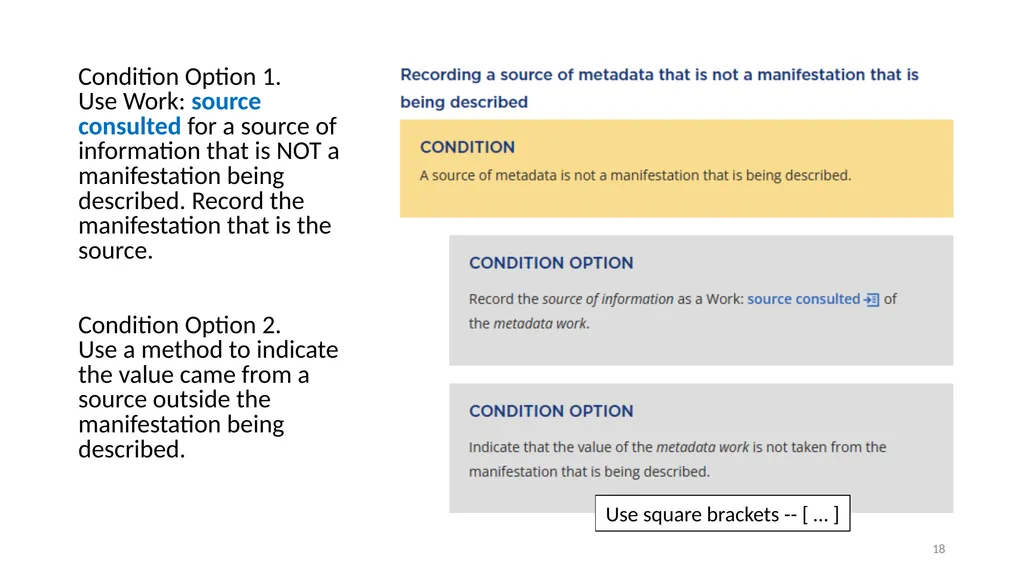
Condition Option 1.�Use Work: source consulted for a source of information that is NOT a manifestation being described. Record the manifestation that is the source.���Condition Option 2.�Use a method to indicate the value came from a source outside the manifestation being described. 18 Use square brackets -- [ … ]<br>
19
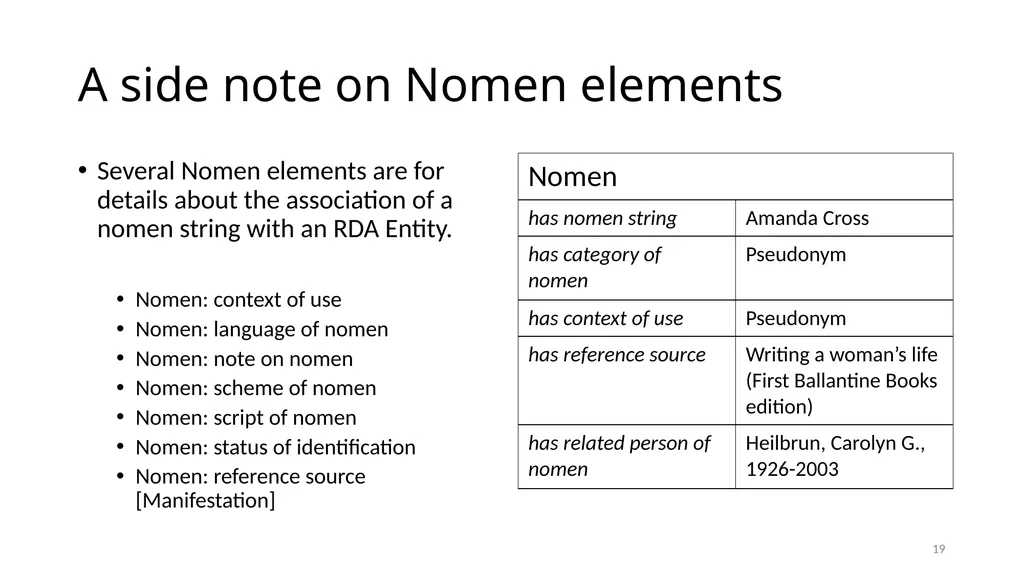
A side note on Nomen elements Several Nomen elements are for details about the association of a nomen string with an RDA Entity.
Nomen: context of use
Nomen: language of nomen
Nomen: note on nomen
Nomen: scheme of nomen
Nomen: script of nomen
Nomen: status of identification
Nomen: reference source [Manifestation] 19<br>
20
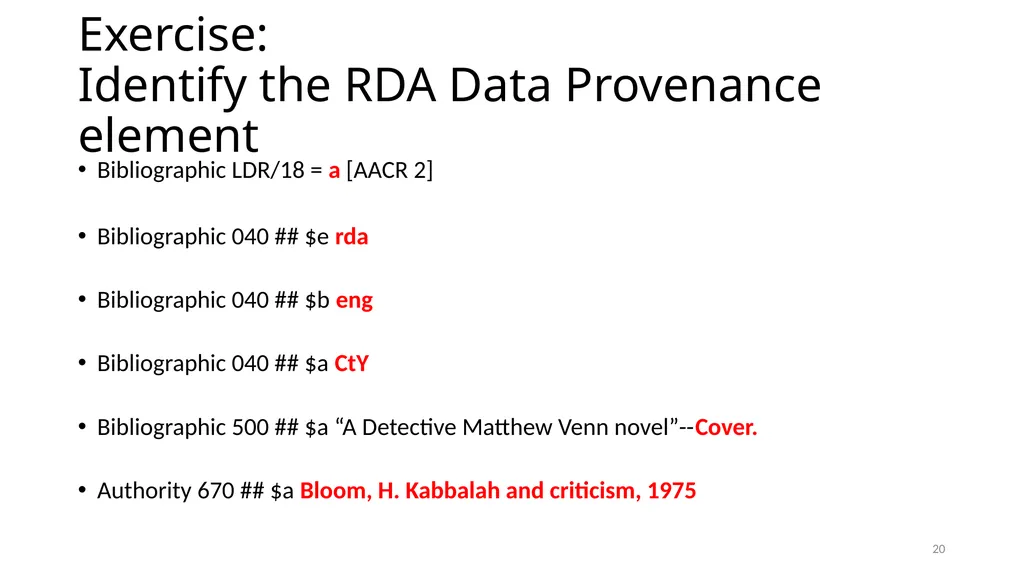
Exercise:�Identify the RDA Data Provenance element Bibliographic LDR/18 = a [AACR 2]�
Bibliographic 040 ## $e rda�
Bibliographic 040 ## $b eng�
Bibliographic 040 ## $a CtY�
Bibliographic 500 ## $a “A Detective Matthew Venn novel”--Cover.�
Authority 670 ## $a Bloom, H. Kabbalah and criticism, 1975 20<br>
21
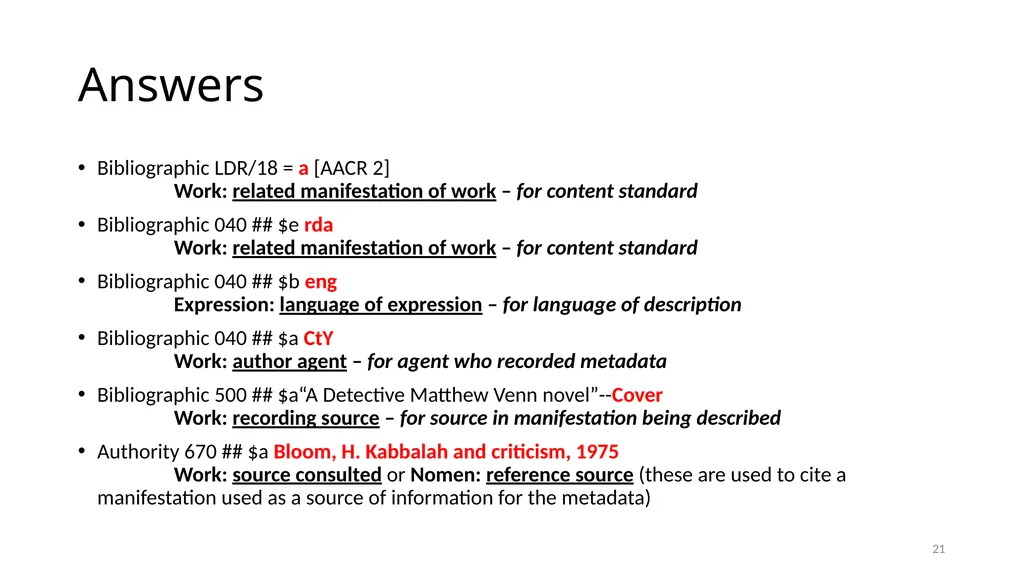
Answers Bibliographic LDR/18 = a [AACR 2]� Work: related manifestation of work – for content standard
Bibliographic 040 ## $e rda� Work: related manifestation of work – for content standard
Bibliographic 040 ## $b eng� Expression: language of expression – for language of description
Bibliographic 040 ## $a CtY� Work: author agent – for agent who recorded metadata
Bibliographic 500 ## $a“A Detective Matthew Venn novel”--Cover� Work: recording source – for source in manifestation being described
Authority 670 ## $a Bloom, H. Kabbalah and criticism, 1975� Work: source consulted or Nomen: reference source (these are used to cite a manifestation used as a source of information for the metadata) 21<br>
22
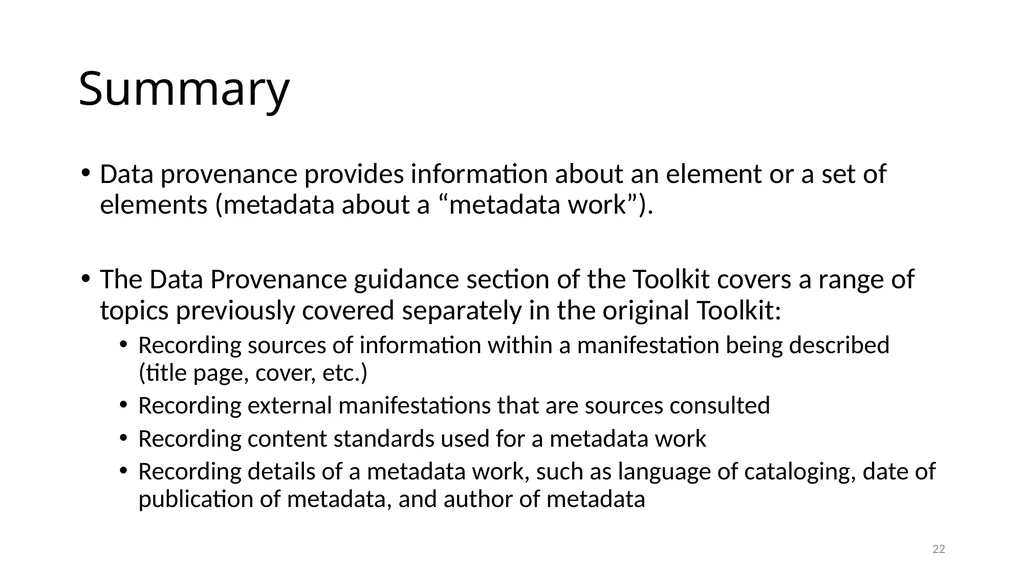
Data provenance provides information about an element or a set of elements (metadata about a “metadata work”).
The Data Provenance guidance section of the Toolkit covers a range of topics previously covered separately in the original Toolkit:
Recording sources of information within a manifestation being described (title page, cover, etc.)
Recording external manifestations that are sources consulted
Recording content standards used for a metadata work
Recording details of a metadata work, such as language of cataloging, date of publication of metadata, and author of metadata 22<br>