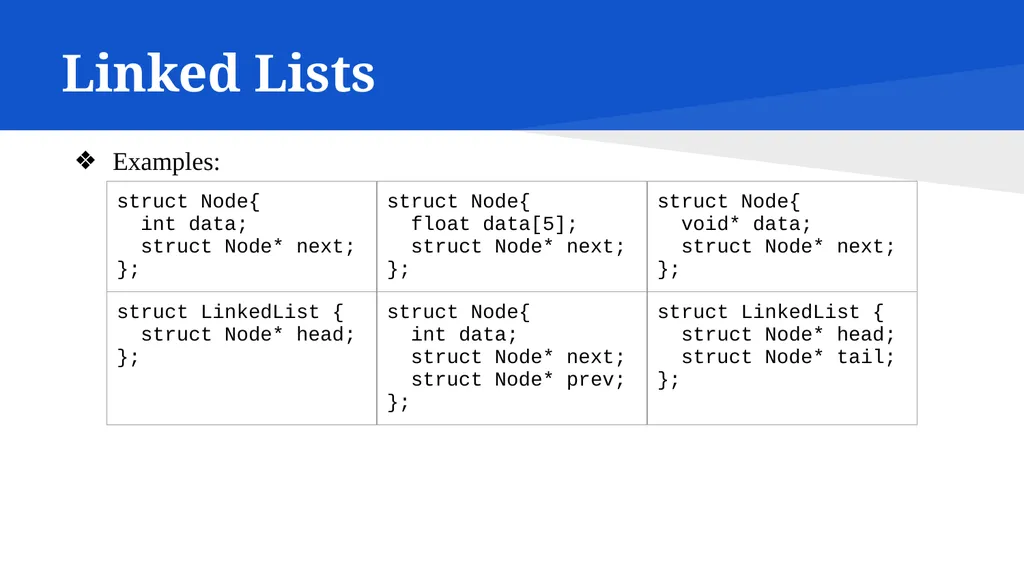
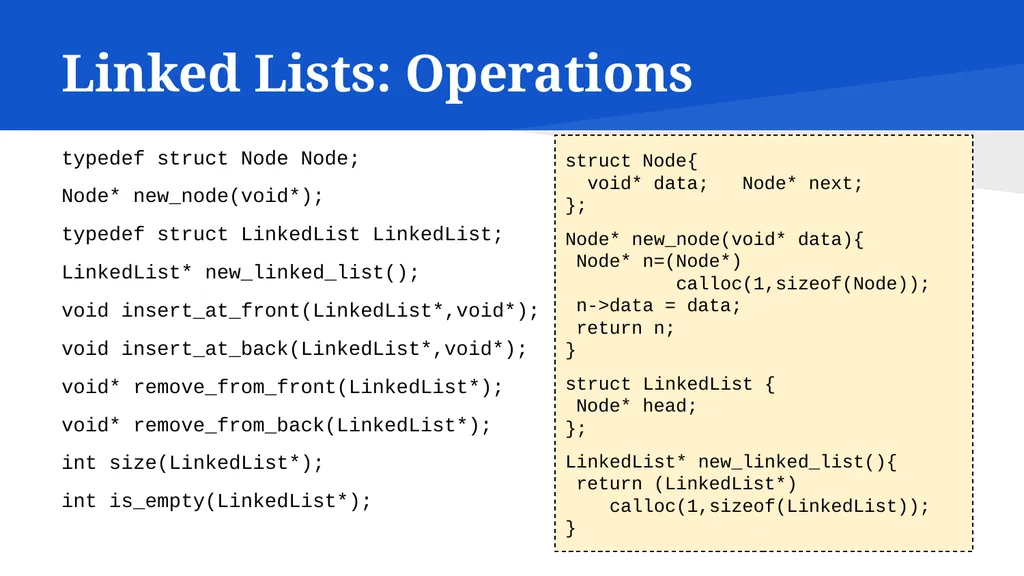
Data Structures in C CSC215 Lecture Outline Linked Lists Binary Trees Stacks Queues Hash Tables Linked Lists Linked List: A dynamic data structure that consists of a sequence of nodes each element contains a link or more to the next node(s)
"Data Structures in C CSC215 Lecture Outline Linked" is the property of its rightful owner. Permission is granted to
download and print the materials on this website for personal, non-commercial use only, and to display it
on your personal computer provided you do not modify the materials and that you retain all copyright
notices contained in the materials. By downloading content from our website, you accept the terms of this
agreement.
Presentation Transcript
01
Data Structures in C CSC215
Lecture<br>
02
Outline Linked Lists
Binary Trees
Stacks
Queues
Hash Tables<br>
03
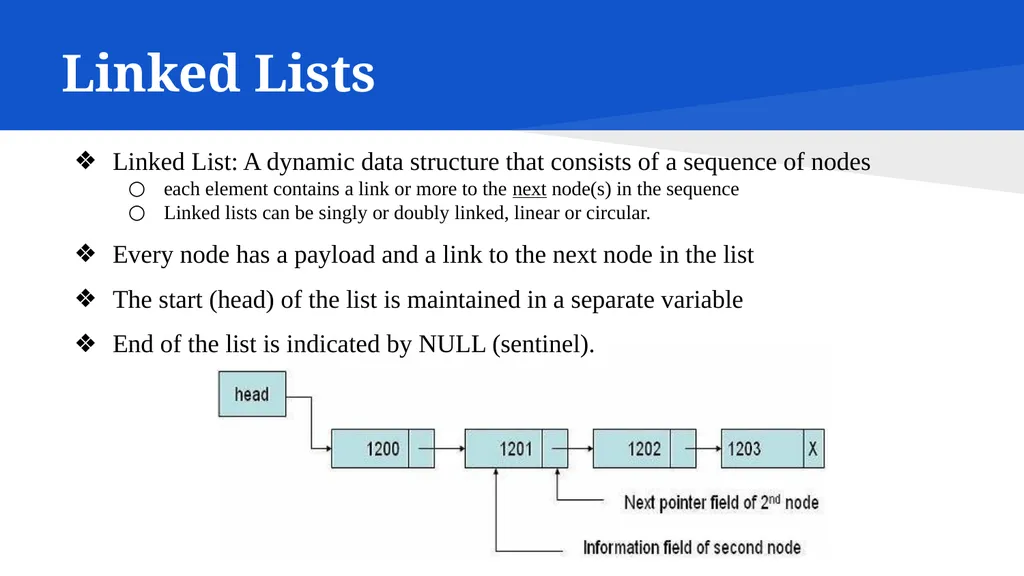
Linked Lists Linked List: A dynamic data structure that consists of a sequence of nodes
each element contains a link or more to the next node(s) in the sequence
Linked lists can be singly or doubly linked, linear or circular.
Every node has a payload and a link to the next node in the list
The start (head) of the list is maintained in a separate variable
End of the list is indicated by NULL (sentinel).<br>
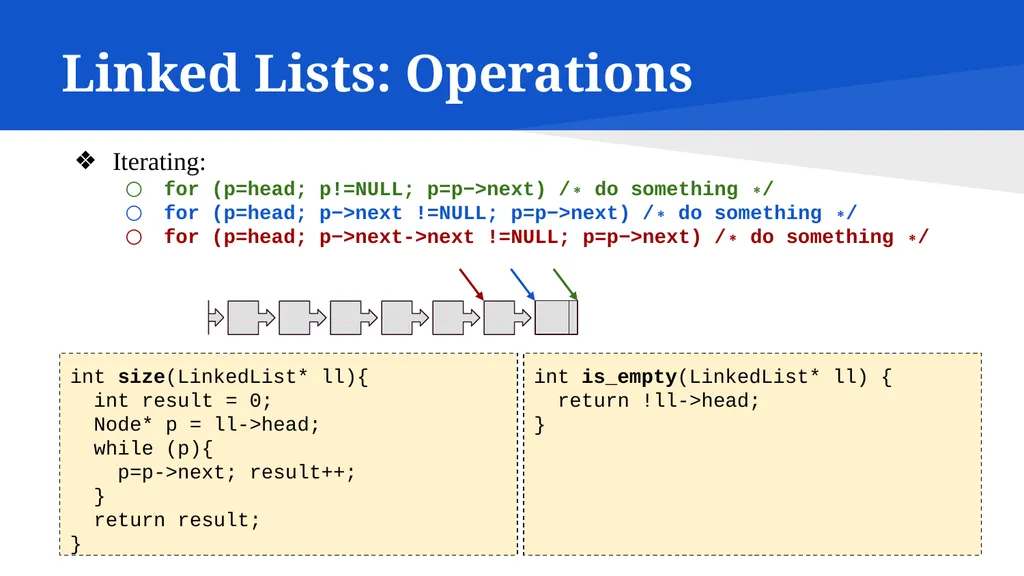
Linked Lists: Operations Iterating:
for (p=head; p!=NULL; p=p−>next) /∗ do something ∗/
for (p=head; p−>next !=NULL; p=p−>next) /∗ do something ∗/
for (p=head; p−>next->next !=NULL; p=p−>next) /∗ do something ∗/ int size(LinkedList* ll){ int result = 0; Node* p = ll->head; while (p){ p=p->next; result++; } return result; } int is_empty(LinkedList* ll) { return !ll->head; }<br>
07
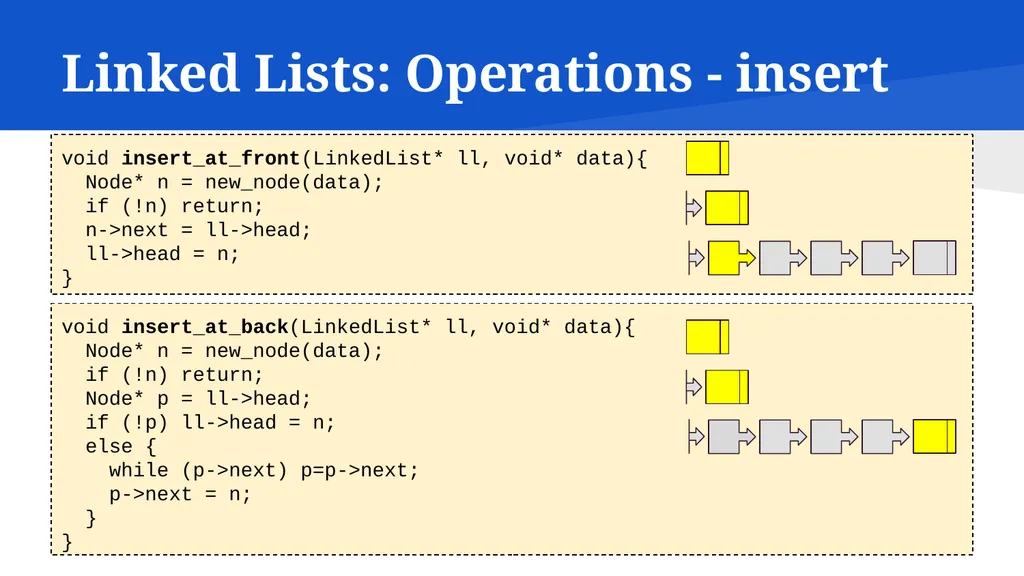
Linked Lists: Operations - insert void insert_at_front(LinkedList* ll, void* data){
Node* n = new_node(data);
if (!n) return;
n->next = ll->head;
ll->head = n;
} void insert_at_back(LinkedList* ll, void* data){
Node* n = new_node(data);
if (!n) return;
Node* p = ll->head;
if (!p) ll->head = n;
else {
while (p->next) p=p->next;
p->next = n;
}
}<br>
08
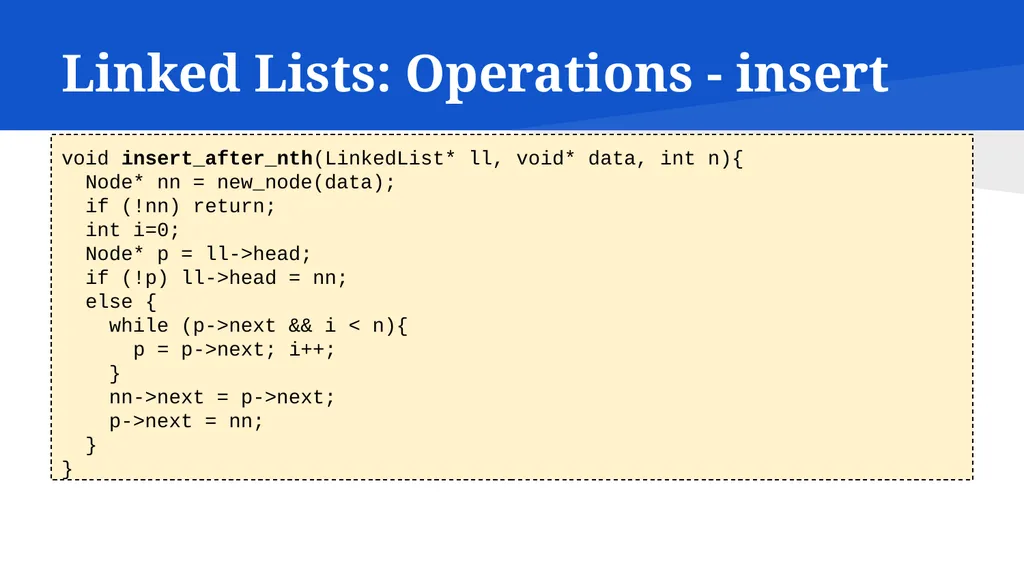
Linked Lists: Operations - insert void insert_after_nth(LinkedList* ll, void* data, int n){
Node* nn = new_node(data);
if (!nn) return;
int i=0;
Node* p = ll->head;
if (!p) ll->head = nn;
else {
while (p->next && i < n){
p = p->next; i++;
}
nn->next = p->next;
p->next = nn;
}
}<br>
09
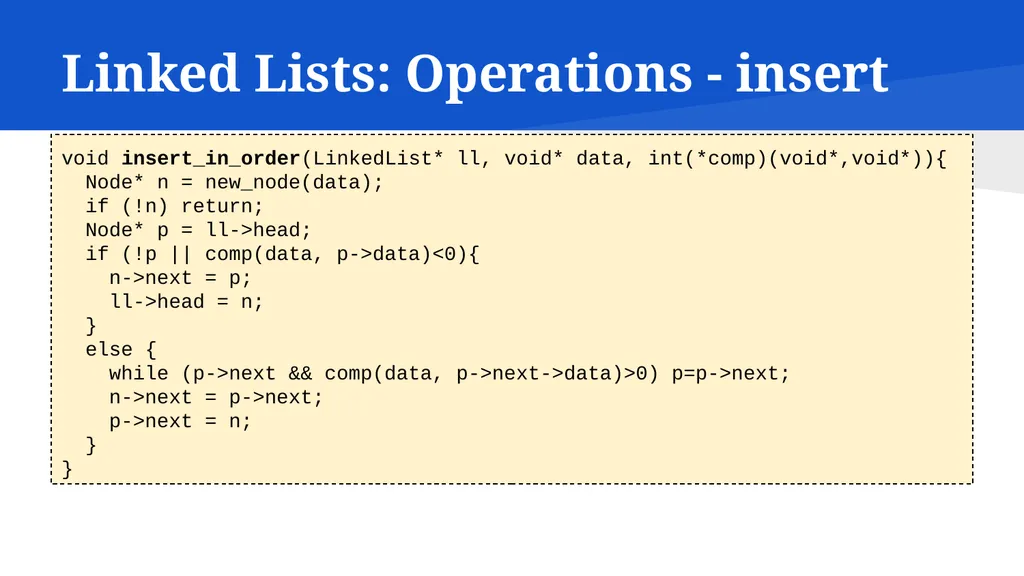
Linked Lists: Operations - insert void insert_in_order(LinkedList* ll, void* data, int(*comp)(void*,void*)){
Node* n = new_node(data);
if (!n) return;
Node* p = ll->head;
if (!p || comp(data, p->data)<0){
n->next = p;
ll->head = n;
}
else {
while (p->next && comp(data, p->next->data)>0) p=p->next;
n->next = p->next;
p->next = n;
}
}<br>
10
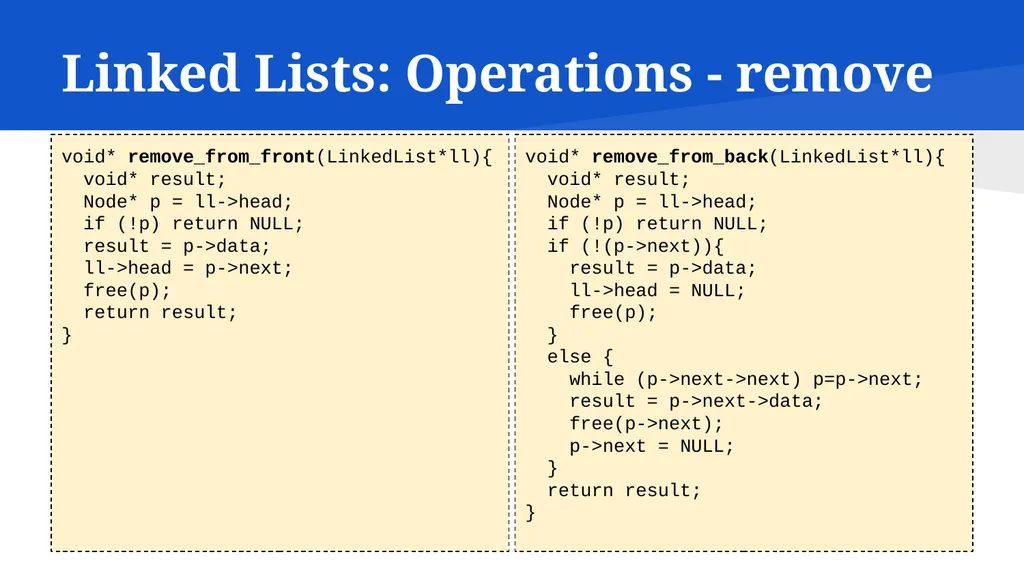
Linked Lists: Operations - remove void* remove_from_front(LinkedList*ll){
void* result;
Node* p = ll->head;
if (!p) return NULL;
result = p->data;
ll->head = p->next;
free(p);
return result;
} void* remove_from_back(LinkedList*ll){
void* result;
Node* p = ll->head;
if (!p) return NULL;
if (!(p->next)){
result = p->data;
ll->head = NULL;
free(p);
}
else {
while (p->next->next) p=p->next;
result = p->next->data;
free(p->next);
p->next = NULL;
}
return result;
}<br>
11
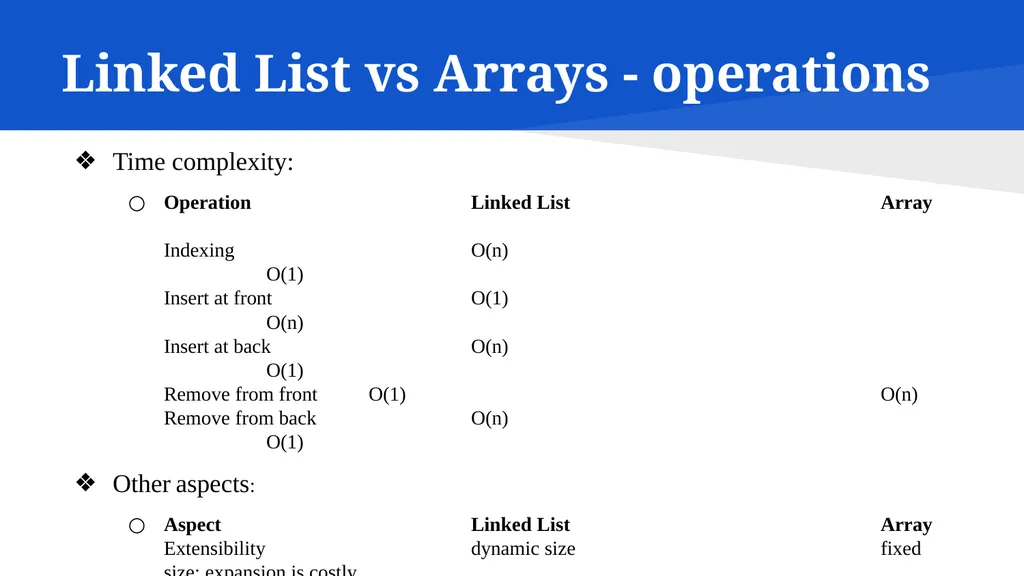
Linked List vs Arrays - operations Time complexity:
Operation Linked List Array Indexing O(n) O(1) Insert at front O(1) O(n) Insert at back O(n) O(1) Remove from front O(1) O(n) Remove from back O(n) O(1)
Other aspects:
Aspect Linked List Array Extensibility dynamic size fixed size: expansion is costly Shifting not required some operations (discuss) Random access inefficient efficient Sequential access slow fast (discuss) Memory use efficient inefficient for large arrays and few data<br>
12
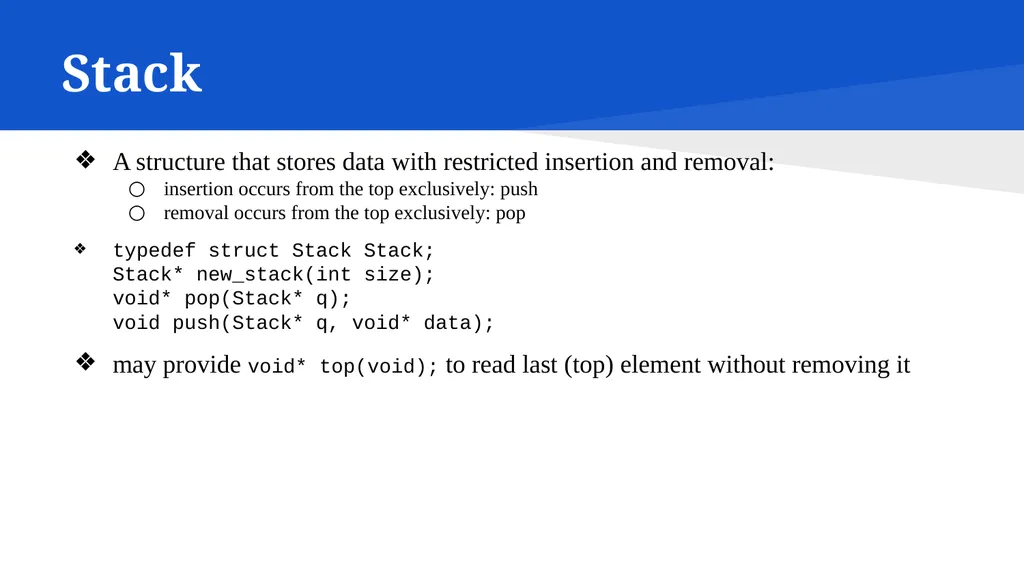
Stack A structure that stores data with restricted insertion and removal:
insertion occurs from the top exclusively: push
removal occurs from the top exclusively: pop
typedef struct Stack Stack; Stack* new_stack(int size); void* pop(Stack* q); void push(Stack* q, void* data);
may provide void* top(void); to read last (top) element without removing it<br>
13
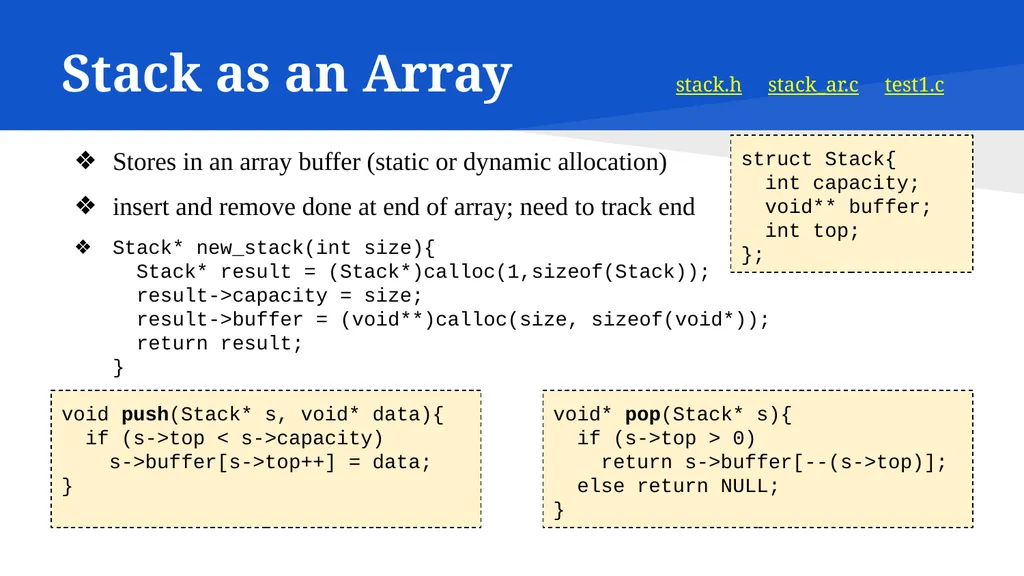
Stack as an Array stack.h stack_ar.c test1.c Stores in an array buffer (static or dynamic allocation)
insert and remove done at end of array; need to track end
Stack* new_stack(int size){ Stack* result = (Stack*)calloc(1,sizeof(Stack)); result->capacity = size; result->buffer = (void**)calloc(size, sizeof(void*)); return result; } struct Stack{
int capacity;
void** buffer;
int top;
}; void* pop(Stack* s){ if (s->top > 0) return s->buffer[--(s->top)]; else return NULL; } void push(Stack* s, void* data){ if (s->top < s->capacity) s->buffer[s->top++] = data; }<br>
14
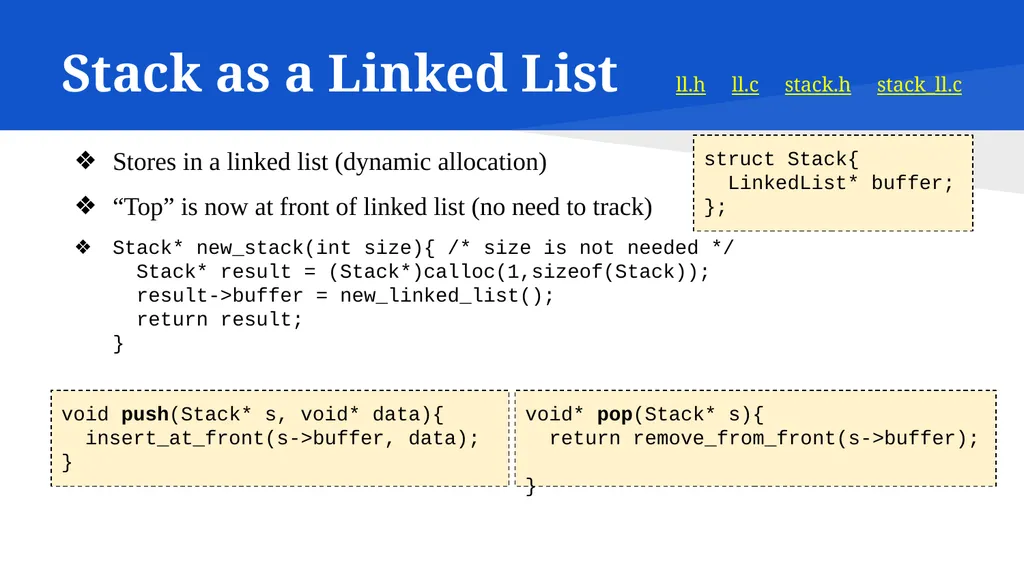
Stack as a Linked List ll.h ll.c stack.h stack_ll.c Stores in a linked list (dynamic allocation)
“Top” is now at front of linked list (no need to track)
Stack* new_stack(int size){ /* size is not needed */ Stack* result = (Stack*)calloc(1,sizeof(Stack)); result->buffer = new_linked_list(); return result; } struct Stack{
LinkedList* buffer;
}; void* pop(Stack* s){ return remove_from_front(s->buffer); } void push(Stack* s, void* data){ insert_at_front(s->buffer, data); }<br>
15
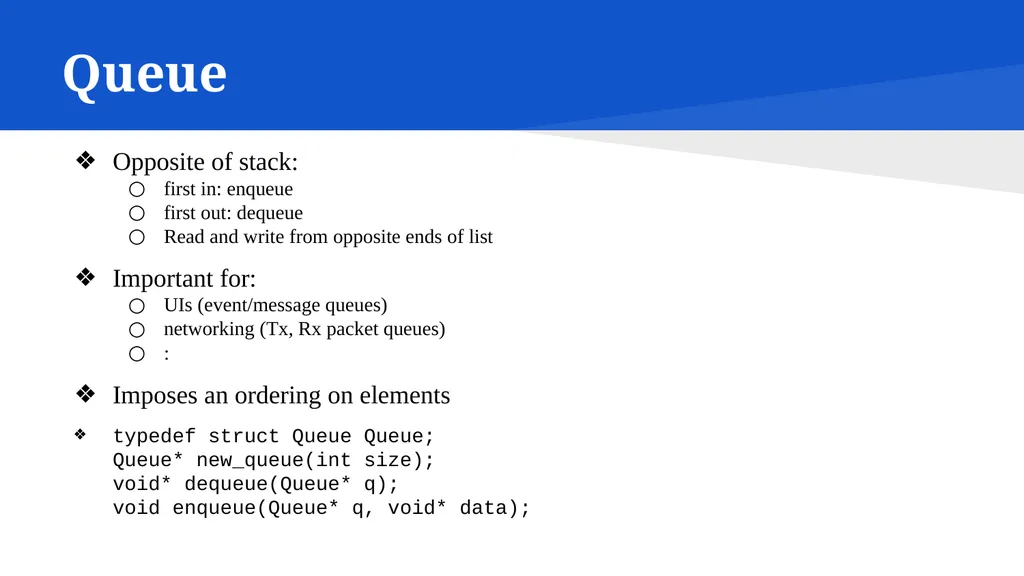
Queue Opposite of stack:
first in: enqueue
first out: dequeue
Read and write from opposite ends of list
Important for:
UIs (event/message queues)
networking (Tx, Rx packet queues)
:
Imposes an ordering on elements
typedef struct Queue Queue; Queue* new_queue(int size); void* dequeue(Queue* q); void enqueue(Queue* q, void* data);<br>
16
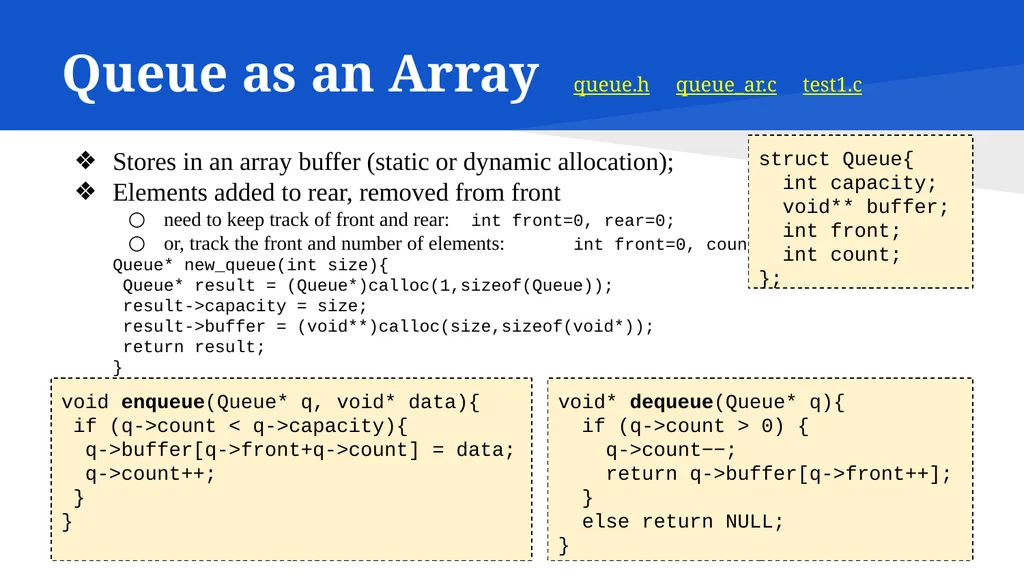
Queue as an Array queue.h queue_ar.c test1.c Stores in an array buffer (static or dynamic allocation);
Elements added to rear, removed from front
need to keep track of front and rear: int front=0, rear=0;
or, track the front and number of elements: int front=0, count=0;
Queue* new_queue(int size){ Queue* result = (Queue*)calloc(1,sizeof(Queue)); result->capacity = size; result->buffer = (void**)calloc(size,sizeof(void*)); return result; } void enqueue(Queue* q, void* data){ if (q->count < q->capacity){ q->buffer[q->front+q->count] = data; q->count++; } } void* dequeue(Queue* q){ if (q->count > 0) { q->count−−; return q->buffer[q->front++]; }
else return NULL; } struct Queue{
int capacity;
void** buffer;
int front;
int count;
};<br>
17
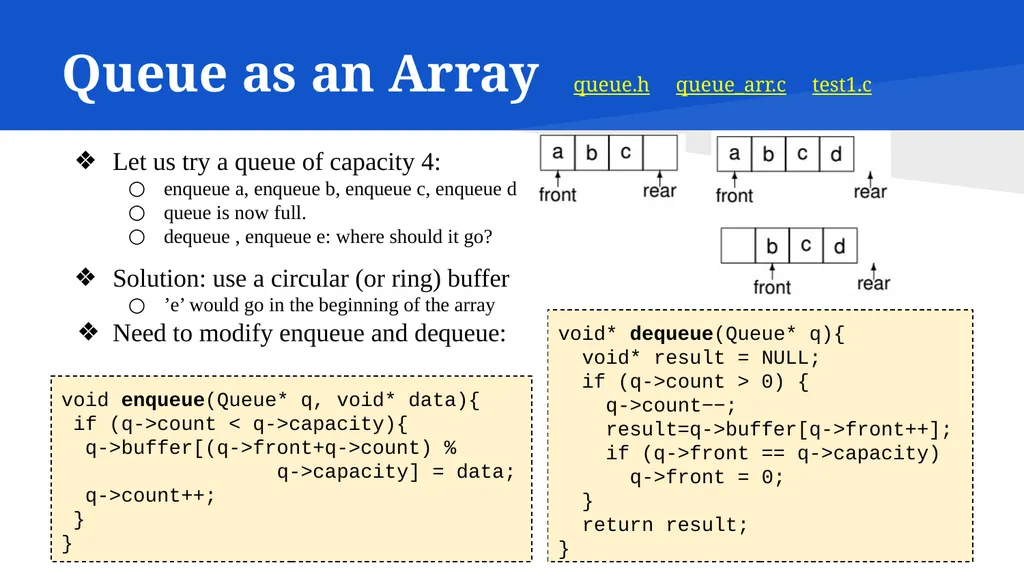
Queue as an Array queue.h queue_arr.c test1.c Let us try a queue of capacity 4:
enqueue a, enqueue b, enqueue c, enqueue d
queue is now full.
dequeue , enqueue e: where should it go?
Solution: use a circular (or ring) buffer
’e’ would go in the beginning of the array
Need to modify enqueue and dequeue: void enqueue(Queue* q, void* data){ if (q->count < q->capacity){ q->buffer[(q->front+q->count) %
q->capacity] = data; q->count++; } } void* dequeue(Queue* q){
void* result = NULL; if (q->count > 0) { q->count−−;
result=q->buffer[q->front++];
if (q->front == q->capacity)
q->front = 0; }
return result; }<br>
18
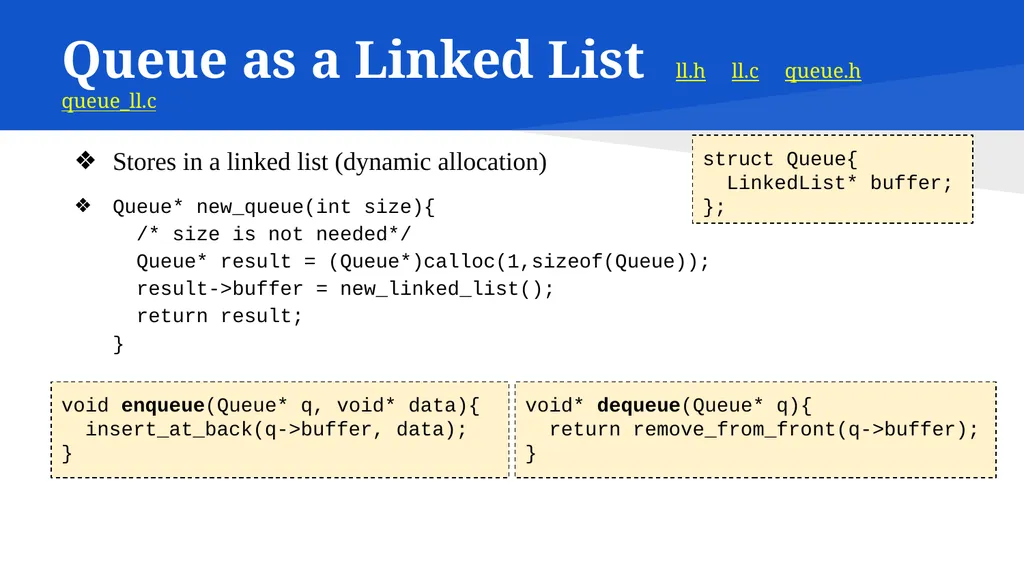
Queue as a Linked List ll.h ll.c queue.h queue_ll.c Stores in a linked list (dynamic allocation)
Queue* new_queue(int size){ /* size is not needed*/ Queue* result = (Queue*)calloc(1,sizeof(Queue)); result->buffer = new_linked_list(); return result; } struct Queue{
LinkedList* buffer;
}; void* dequeue(Queue* q){ return remove_from_front(q->buffer); } void enqueue(Queue* q, void* data){ insert_at_back(q->buffer, data);
}<br>