Database Design and the E-R Model CHAPTER 7 SOURCE :- Database System concepts , 6ed , Silberschatz, Korth, Sudarshan Database Design Design of the database schema Design of the programs that access and update the data, and Design of a
"Database Design and the E-R Model CHAPTER 7 SOURCE" is the property of its rightful owner. Permission is granted to
download and print the materials on this website for personal, non-commercial use only, and to display it
on your personal computer provided you do not modify the materials and that you retain all copyright
notices contained in the materials. By downloading content from our website, you accept the terms of this
agreement.
Presentation Transcript
01
Database Design and the E-R Model CHAPTER 7 SOURCE :- Database System concepts , 6ed , Silberschatz, Korth, Sudarshan<br>
02
Database Design Design of the database schema
Design of the programs that access and update the data, and
Design of a security scheme to control access to data
The needs of the users play a central role in the design process Database Design and the E-R Model Sudha Bhagavatheeswaran, Department of Information Technology,
SIES College of Arts, Science & Commerce (Autonomous)<br>
03
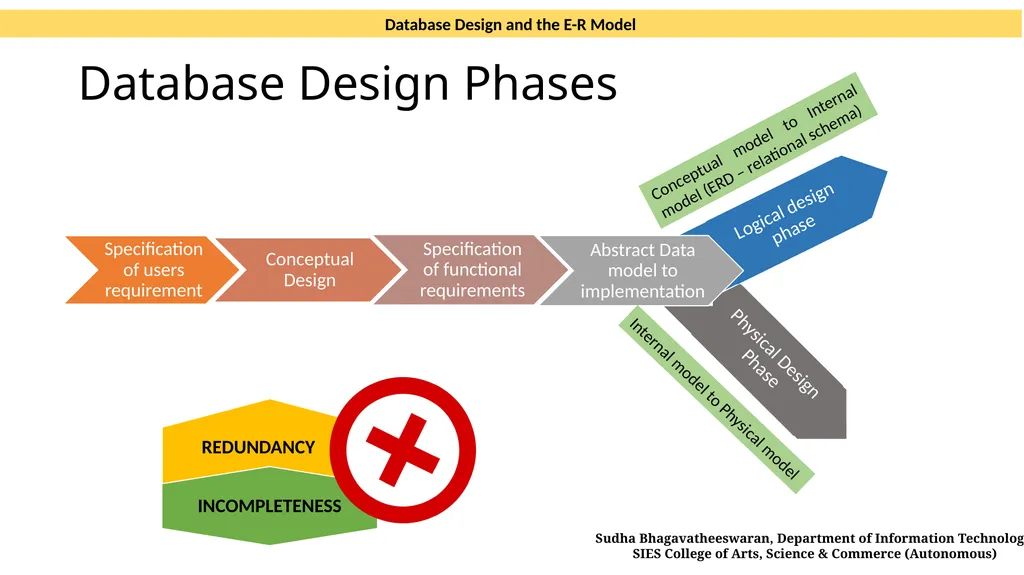
Database Design Phases Specification of users requirement Conceptual Design Specification of functional requirements Abstract Data model to implementation Database Design and the E-R Model Sudha Bhagavatheeswaran, Department of Information Technology,
SIES College of Arts, Science & Commerce (Autonomous) Conceptual model to Internal model (ERD – relational schema) Internal model to Physical model<br>
04
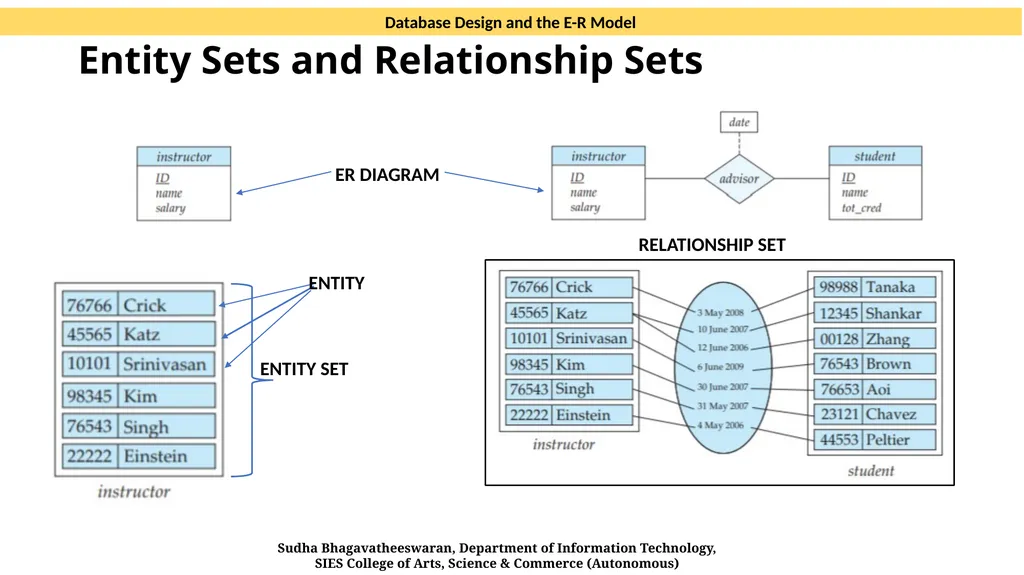
ENTITY SET ENTITY RELATIONSHIP SET ER DIAGRAM Entity Sets and Relationship Sets Database Design and the E-R Model Sudha Bhagavatheeswaran, Department of Information Technology,
SIES College of Arts, Science & Commerce (Autonomous)<br>
05
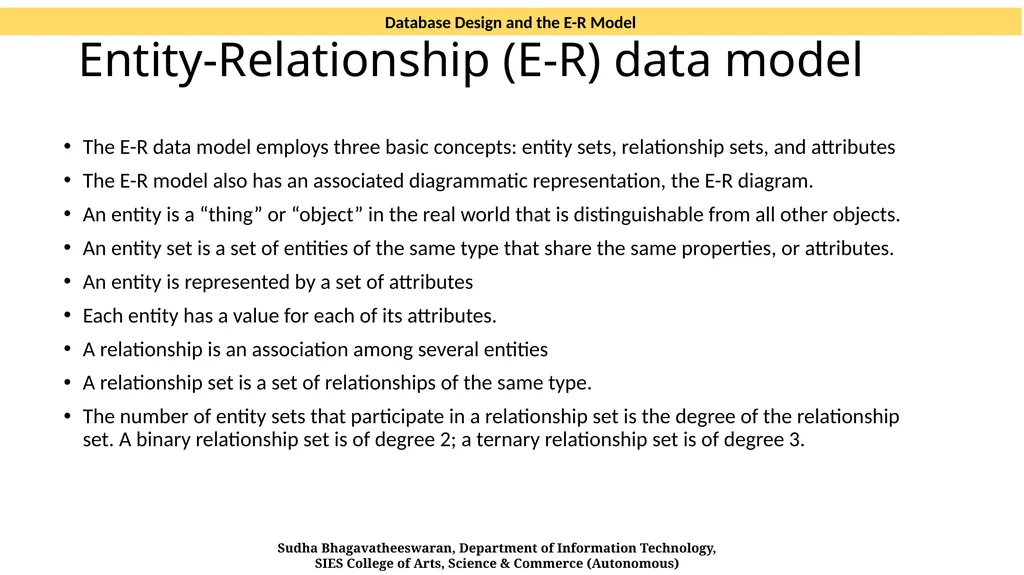
Entity-Relationship (E-R) data model The E-R data model employs three basic concepts: entity sets, relationship sets, and attributes
The E-R model also has an associated diagrammatic representation, the E-R diagram.
An entity is a “thing” or “object” in the real world that is distinguishable from all other objects.
An entity set is a set of entities of the same type that share the same properties, or attributes.
An entity is represented by a set of attributes
Each entity has a value for each of its attributes.
A relationship is an association among several entities
A relationship set is a set of relationships of the same type.
The number of entity sets that participate in a relationship set is the degree of the relationship set. A binary relationship set is of degree 2; a ternary relationship set is of degree 3. Database Design and the E-R Model Sudha Bhagavatheeswaran, Department of Information Technology,
SIES College of Arts, Science & Commerce (Autonomous)<br>
06
Attributes Database Design and the E-R Model Sudha Bhagavatheeswaran, Department of Information Technology,
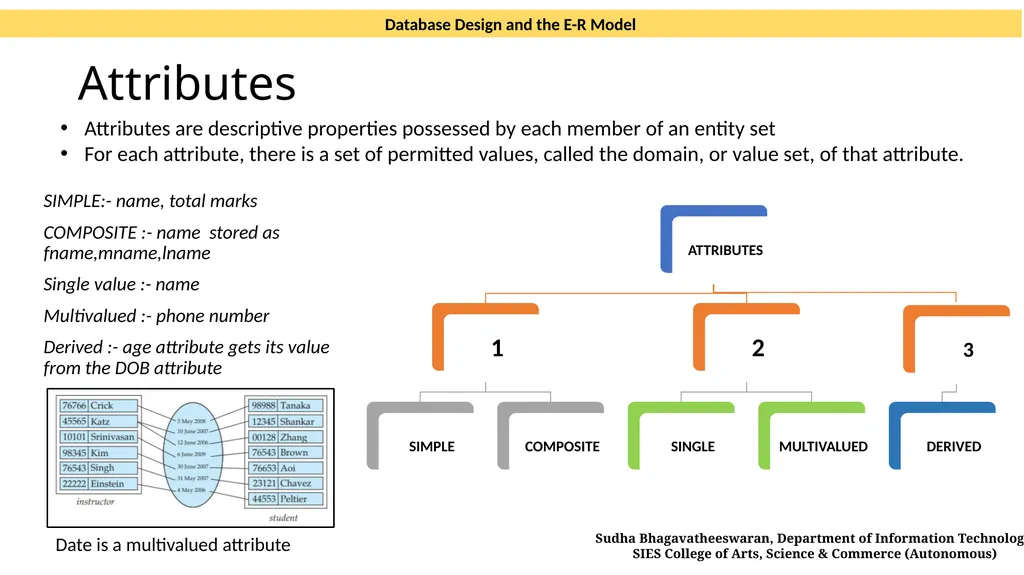
SIES College of Arts, Science & Commerce (Autonomous) SIMPLE:- name, total marks
COMPOSITE :- name stored as fname,mname,lname
Single value :- name
Multivalued :- phone number
Derived :- age attribute gets its value from the DOB attribute ATTRIBUTES 1 SIMPLE COMPOSITE 2 SINGLE MULTIVALUED 3 DERIVED Attributes are descriptive properties possessed by each member of an entity set
For each attribute, there is a set of permitted values, called the domain, or value set, of that attribute. Date is a multivalued attribute<br>
07
Mapping Cardinalities Database Design and the E-R Model Sudha Bhagavatheeswaran, Department of Information Technology,
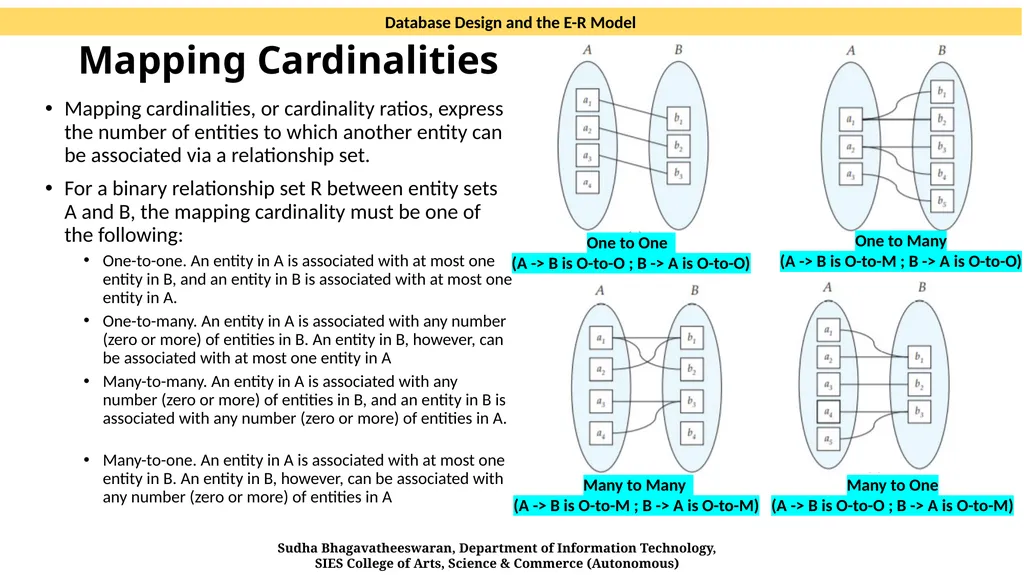
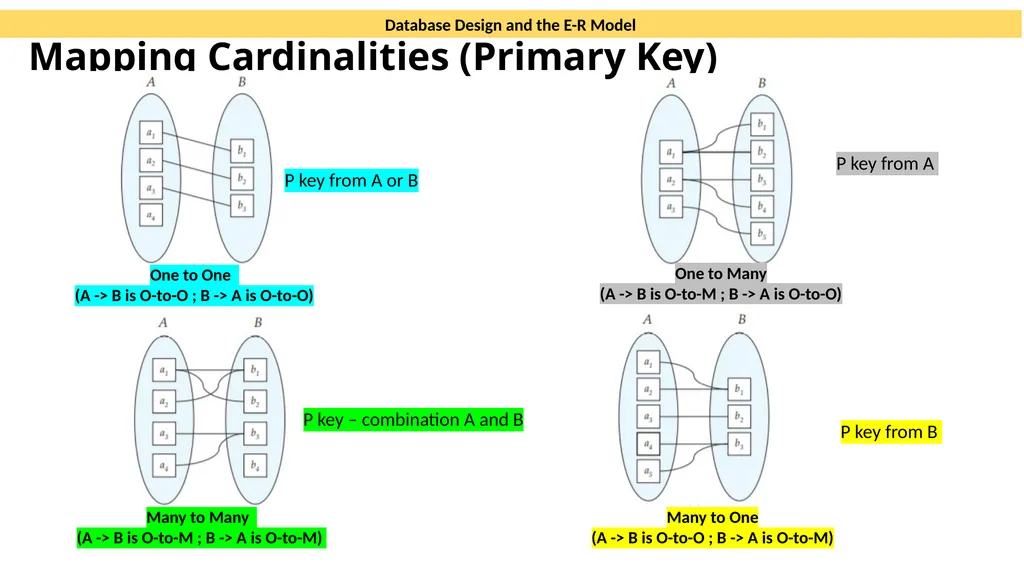
SIES College of Arts, Science & Commerce (Autonomous) Mapping cardinalities, or cardinality ratios, express the number of entities to which another entity can be associated via a relationship set.
For a binary relationship set R between entity sets A and B, the mapping cardinality must be one of the following:
One-to-one. An entity in A is associated with at most one entity in B, and an entity in B is associated with at most one entity in A.
One-to-many. An entity in A is associated with any number (zero or more) of entities in B. An entity in B, however, can be associated with at most one entity in A
Many-to-many. An entity in A is associated with any number (zero or more) of entities in B, and an entity in B is associated with any number (zero or more) of entities in A.
Many-to-one. An entity in A is associated with at most one entity in B. An entity in B, however, can be associated with any number (zero or more) of entities in A One to One
(A -> B is O-to-O ; B -> A is O-to-O) One to Many
(A -> B is O-to-M ; B -> A is O-to-O) Many to Many
(A -> B is O-to-M ; B -> A is O-to-M) Many to One
(A -> B is O-to-O ; B -> A is O-to-M)<br>
08
Mapping Cardinalities (Primary Key) Database Design and the E-R Model Sudha Bhagavatheeswaran, Department of Information Technology,
SIES College of Arts, Science & Commerce (Autonomous) One to One
(A -> B is O-to-O ; B -> A is O-to-O) One to Many
(A -> B is O-to-M ; B -> A is O-to-O) Many to Many
(A -> B is O-to-M ; B -> A is O-to-M) Many to One
(A -> B is O-to-O ; B -> A is O-to-M) P key from A or B P key – combination A and B P key from A P key from B<br>
09
Participation Constraints Database Design and the E-R Model Sudha Bhagavatheeswaran, Department of Information Technology,
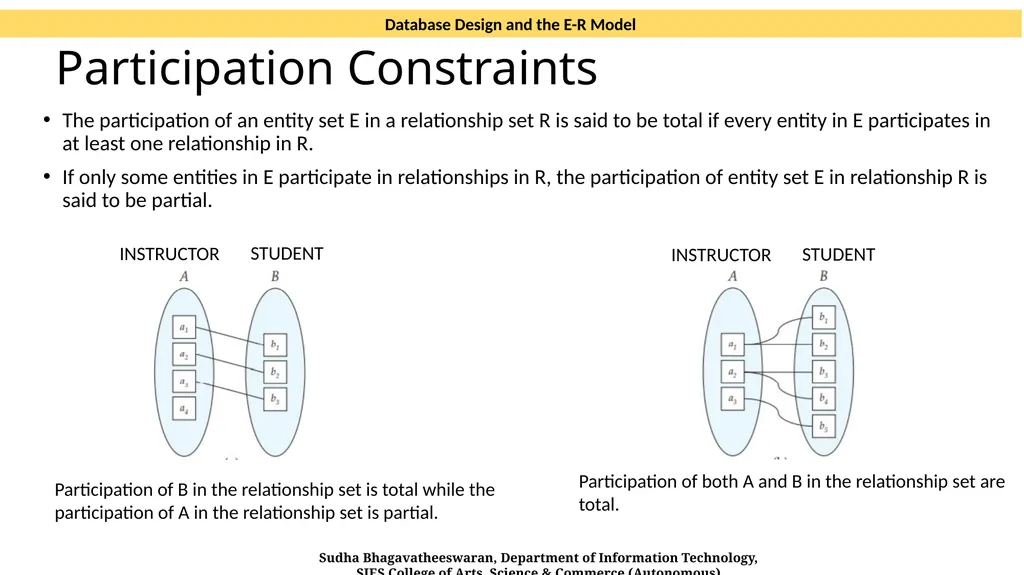
SIES College of Arts, Science & Commerce (Autonomous) The participation of an entity set E in a relationship set R is said to be total if every entity in E participates in at least one relationship in R.
If only some entities in E participate in relationships in R, the participation of entity set E in relationship R is said to be partial. Participation of B in the relationship set is total while the participation of A in the relationship set is partial. Participation of both A and B in the relationship set are total. STUDENT INSTRUCTOR STUDENT INSTRUCTOR<br>
10
Weak Entity Sets Database Design and the E-R Model Sudha Bhagavatheeswaran, Department of Information Technology,
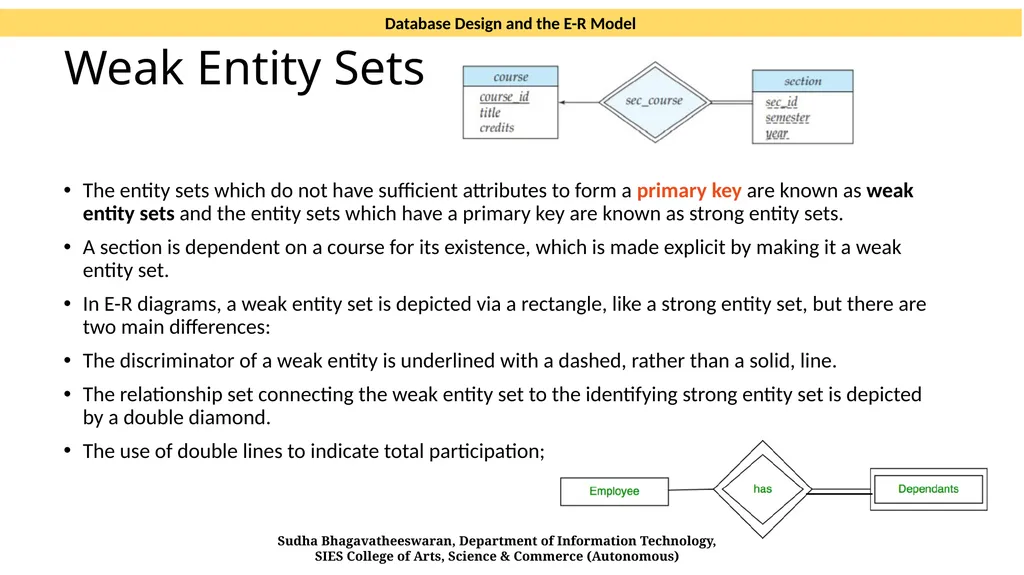
SIES College of Arts, Science & Commerce (Autonomous) The entity sets which do not have sufficient attributes to form a primary key are known as weak entity sets and the entity sets which have a primary key are known as strong entity sets.
A section is dependent on a course for its existence, which is made explicit by making it a weak entity set.
In E-R diagrams, a weak entity set is depicted via a rectangle, like a strong entity set, but there are two main differences:
The discriminator of a weak entity is underlined with a dashed, rather than a solid, line.
The relationship set connecting the weak entity set to the identifying strong entity set is depicted by a double diamond.
The use of double lines to indicate total participation;<br>
11
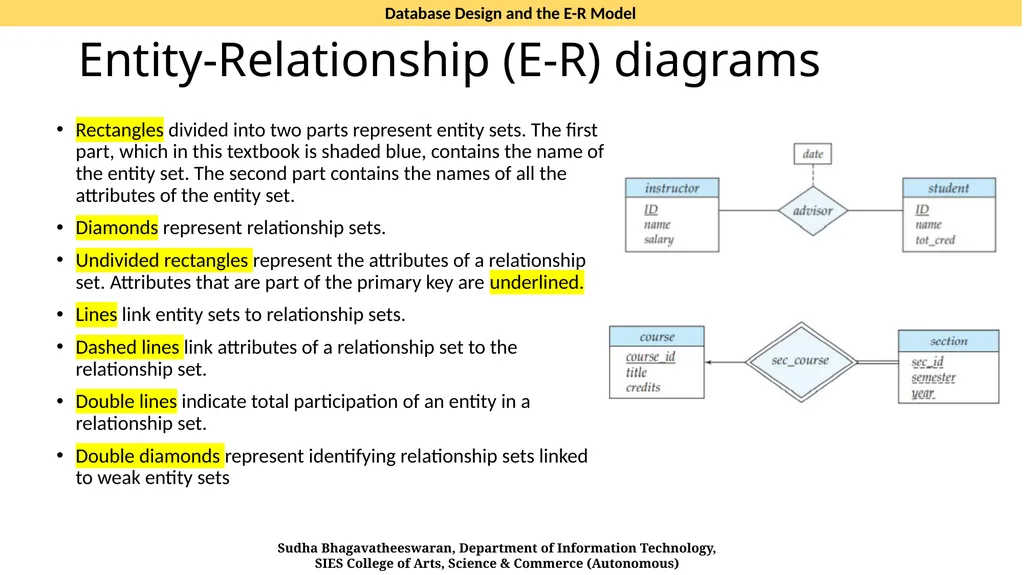
Entity-Relationship (E-R) diagrams Rectangles divided into two parts represent entity sets. The first part, which in this textbook is shaded blue, contains the name of the entity set. The second part contains the names of all the attributes of the entity set.
Diamonds represent relationship sets.
Undivided rectangles represent the attributes of a relationship set. Attributes that are part of the primary key are underlined.
Lines link entity sets to relationship sets.
Dashed lines link attributes of a relationship set to the relationship set.
Double lines indicate total participation of an entity in a relationship set.
Double diamonds represent identifying relationship sets linked to weak entity sets Database Design and the E-R Model Sudha Bhagavatheeswaran, Department of Information Technology,
SIES College of Arts, Science & Commerce (Autonomous)<br>
12
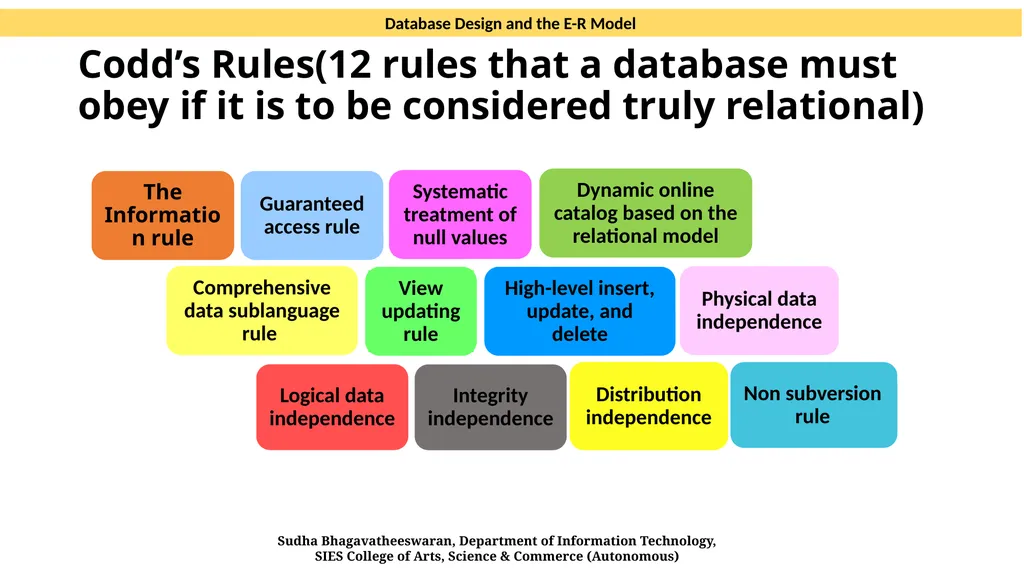
Codd’s Rules(12 rules that a database must obey if it is to be considered truly relational) Database Design and the E-R Model Sudha Bhagavatheeswaran, Department of Information Technology,
SIES College of Arts, Science & Commerce (Autonomous)<br>