
David Phillips Associate Director, Institute for
DP
Published · 31 slides · 0 views
1 / 1






Description
David Phillips Associate Director, Institute for Fiscal Studies Sustaining Wales Public Services: Austerity and Beyond Cardiff, July 12th 2018 Remember to look to your left and right: cross-border lessons for local government finance Big
Related Topics
Share
Embed code
Download this presentation From Below
"David Phillips Associate Director, Institute for" is the property of its rightful owner. Permission is granted to download and print the materials on this website for personal, non-commercial use only, and to display it on your personal computer provided you do not modify the materials and that you retain all copyright notices contained in the materials. By downloading content from our website, you accept the terms of this agreement.
Presentation Transcript
01
David Phillips
Associate Director, Institute for Fiscal Studies
Sustaining Wales’ Public Services: Austerity and Beyond
Cardiff, July 12th 2018 Remember to look to your left and right: cross-border lessons for local government finance<br>
Associate Director, Institute for Fiscal Studies
Sustaining Wales’ Public Services: Austerity and Beyond
Cardiff, July 12th 2018 Remember to look to your left and right: cross-border lessons for local government finance<br>
02
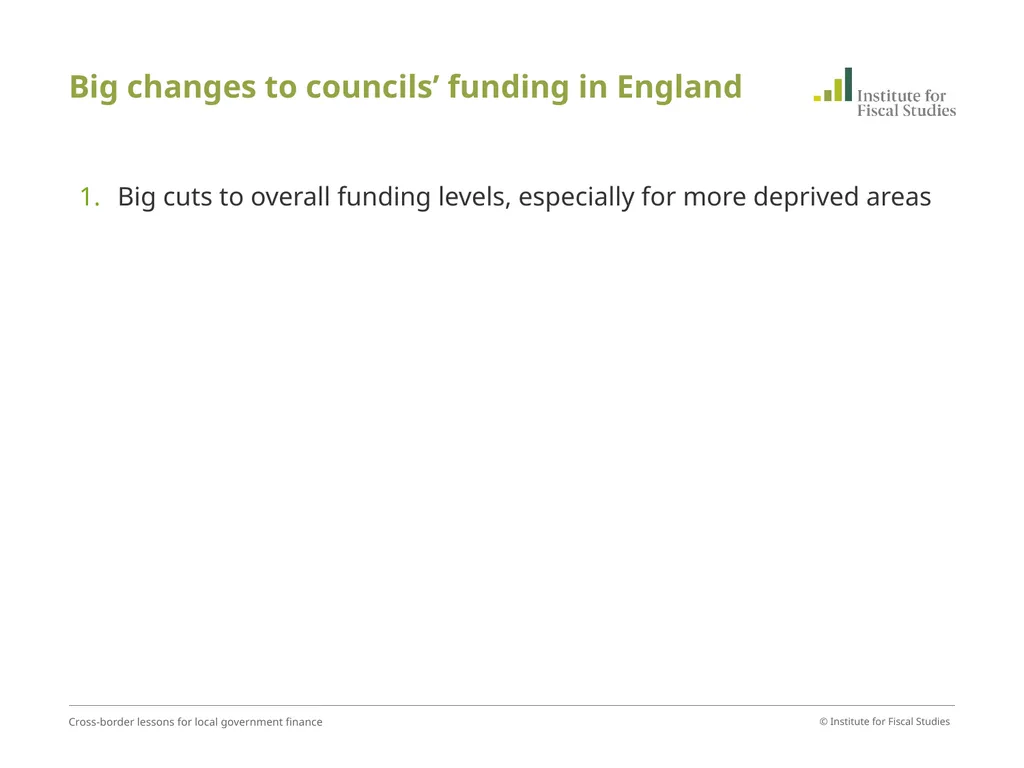
Big changes to councils’ funding in England Big cuts to overall funding levels, especially for more deprived areas © Institute for Fiscal Studies Cross-border lessons for local government finance<br>
03
Change to non-education spending
Real-terms (2009-10 = 100) © Institute for Fiscal Studies Cross-border lessons for local government finance England Wales<br>
04
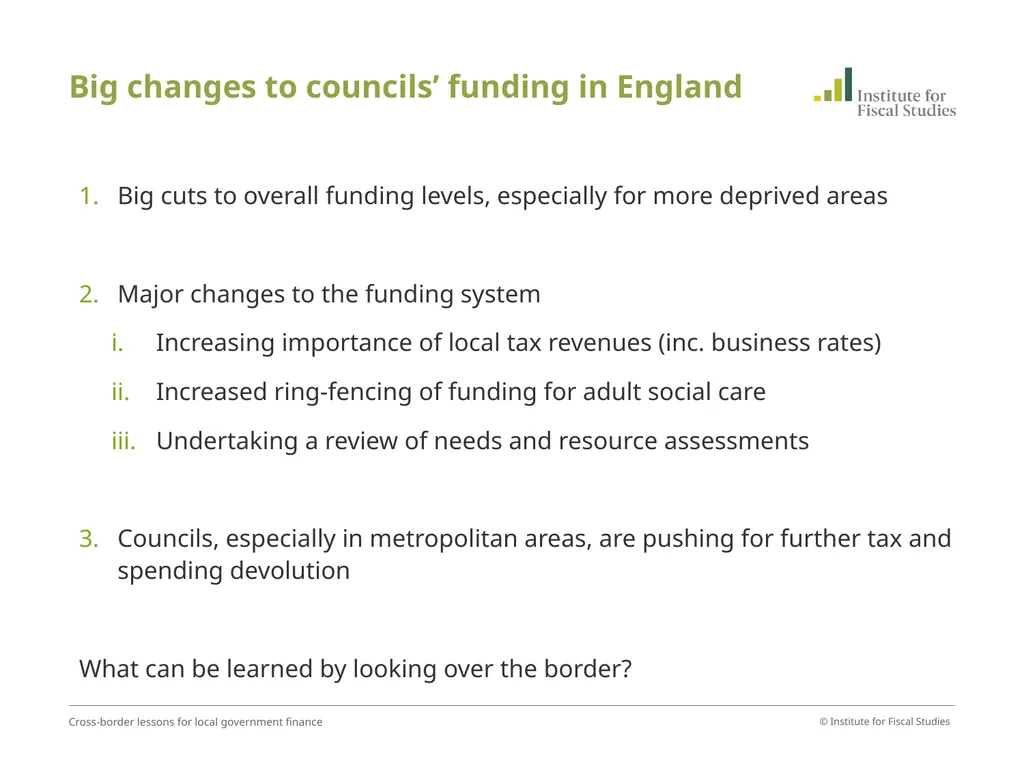
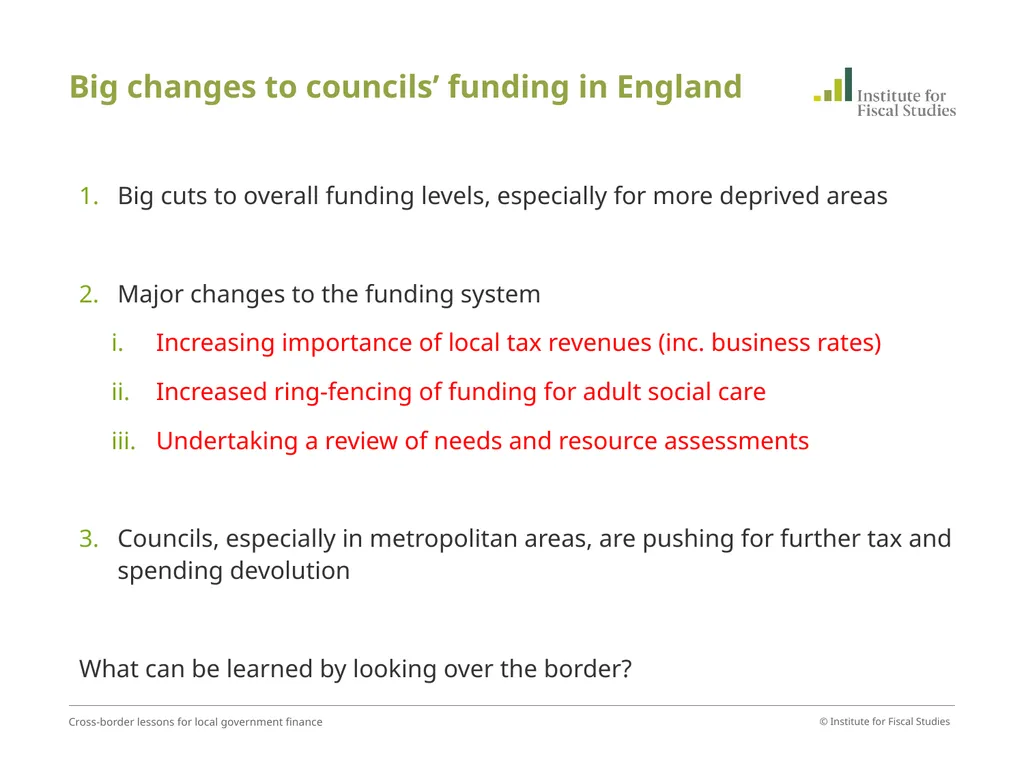
Big changes to councils’ funding in England Big cuts to overall funding levels, especially for more deprived areas
Major changes to the funding system
Increasing importance of local tax revenues (inc. business rates)
Increased ring-fencing of funding for adult social care
Undertaking a review of needs and resource assessments
Councils, especially in metropolitan areas, are pushing for further tax and spending devolution
What can be learned by looking over the border? © Institute for Fiscal Studies Cross-border lessons for local government finance<br>
Major changes to the funding system
Increasing importance of local tax revenues (inc. business rates)
Increased ring-fencing of funding for adult social care
Undertaking a review of needs and resource assessments
Councils, especially in metropolitan areas, are pushing for further tax and spending devolution
What can be learned by looking over the border? © Institute for Fiscal Studies Cross-border lessons for local government finance<br>
05
Big changes to councils’ funding in England Big cuts to overall funding levels, especially for more deprived areas
Major changes to the funding system
Increasing importance of local tax revenues (inc. business rates)
Increased ring-fencing of funding for adult social care
Undertaking a review of needs and resource assessments
Councils, especially in metropolitan areas, are pushing for further tax and spending devolution
What can be learned by looking over the border? © Institute for Fiscal Studies Cross-border lessons for local government finance<br>
Major changes to the funding system
Increasing importance of local tax revenues (inc. business rates)
Increased ring-fencing of funding for adult social care
Undertaking a review of needs and resource assessments
Councils, especially in metropolitan areas, are pushing for further tax and spending devolution
What can be learned by looking over the border? © Institute for Fiscal Studies Cross-border lessons for local government finance<br>
06
The Business Rates Retention Scheme (BRRS) © Institute for Fiscal Studies Cross-border lessons for local government finance<br>
07
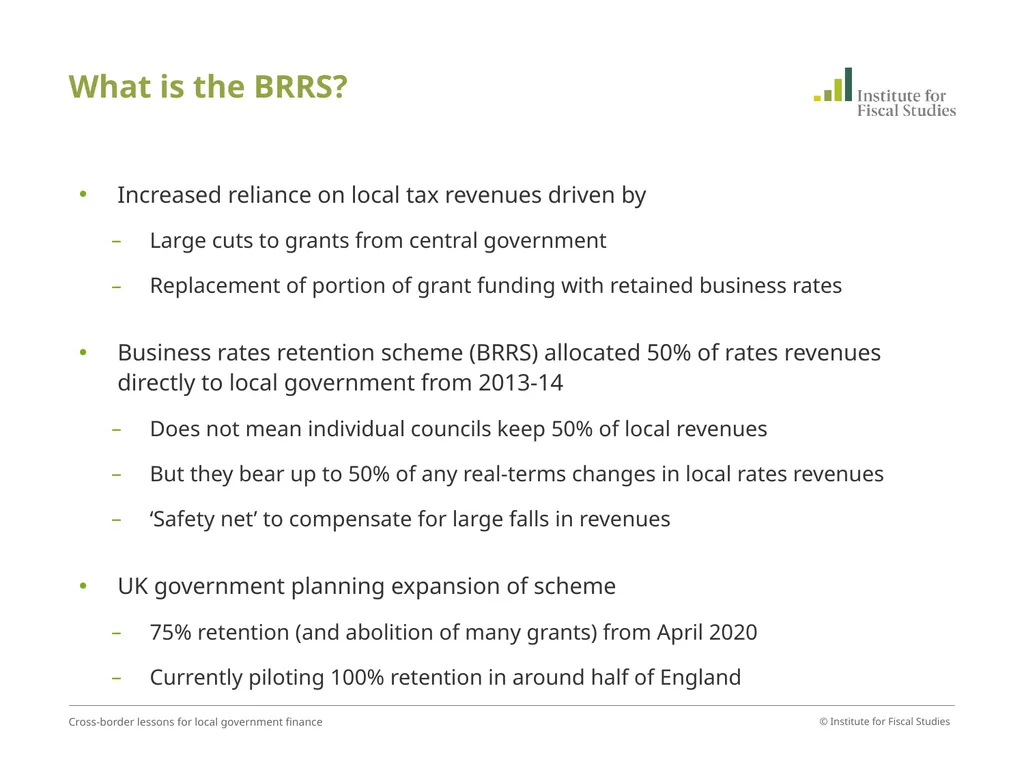
What is the BRRS? Increased reliance on local tax revenues driven by
Large cuts to grants from central government
Replacement of portion of grant funding with retained business rates
Business rates retention scheme (BRRS) allocated 50% of rates revenues directly to local government from 2013-14
Does not mean individual councils keep 50% of local revenues
But they bear up to 50% of any real-terms changes in local rates revenues
‘Safety net’ to compensate for large falls in revenues
UK government planning expansion of scheme
75% retention (and abolition of many grants) from April 2020
Currently piloting 100% retention in around half of England © Institute for Fiscal Studies Cross-border lessons for local government finance<br>
Large cuts to grants from central government
Replacement of portion of grant funding with retained business rates
Business rates retention scheme (BRRS) allocated 50% of rates revenues directly to local government from 2013-14
Does not mean individual councils keep 50% of local revenues
But they bear up to 50% of any real-terms changes in local rates revenues
‘Safety net’ to compensate for large falls in revenues
UK government planning expansion of scheme
75% retention (and abolition of many grants) from April 2020
Currently piloting 100% retention in around half of England © Institute for Fiscal Studies Cross-border lessons for local government finance<br>
08
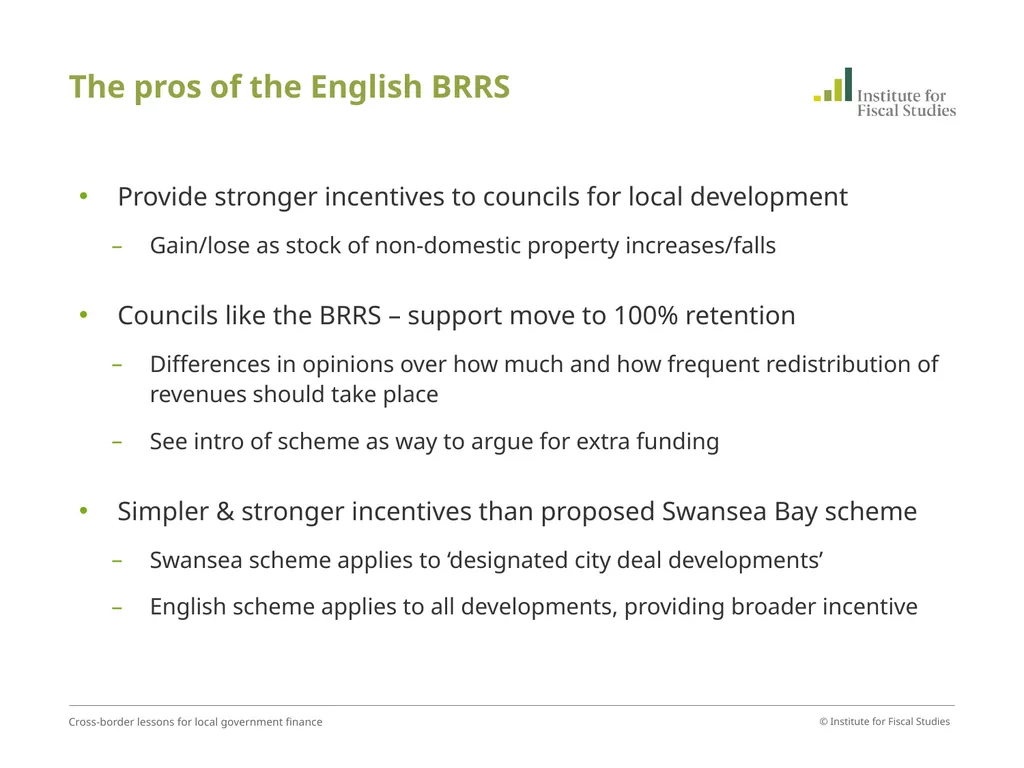
The pros of the English BRRS Provide stronger incentives to councils for local development
Gain/lose as stock of non-domestic property increases/falls
Councils like the BRRS – support move to 100% retention
Differences in opinions over how much and how frequent redistribution of revenues should take place
See intro of scheme as way to argue for extra funding
Simpler & stronger incentives than proposed Swansea Bay scheme
Swansea scheme applies to ‘designated city deal developments’
English scheme applies to all developments, providing broader incentive © Institute for Fiscal Studies Cross-border lessons for local government finance<br>
Gain/lose as stock of non-domestic property increases/falls
Councils like the BRRS – support move to 100% retention
Differences in opinions over how much and how frequent redistribution of revenues should take place
See intro of scheme as way to argue for extra funding
Simpler & stronger incentives than proposed Swansea Bay scheme
Swansea scheme applies to ‘designated city deal developments’
English scheme applies to all developments, providing broader incentive © Institute for Fiscal Studies Cross-border lessons for local government finance<br>
09
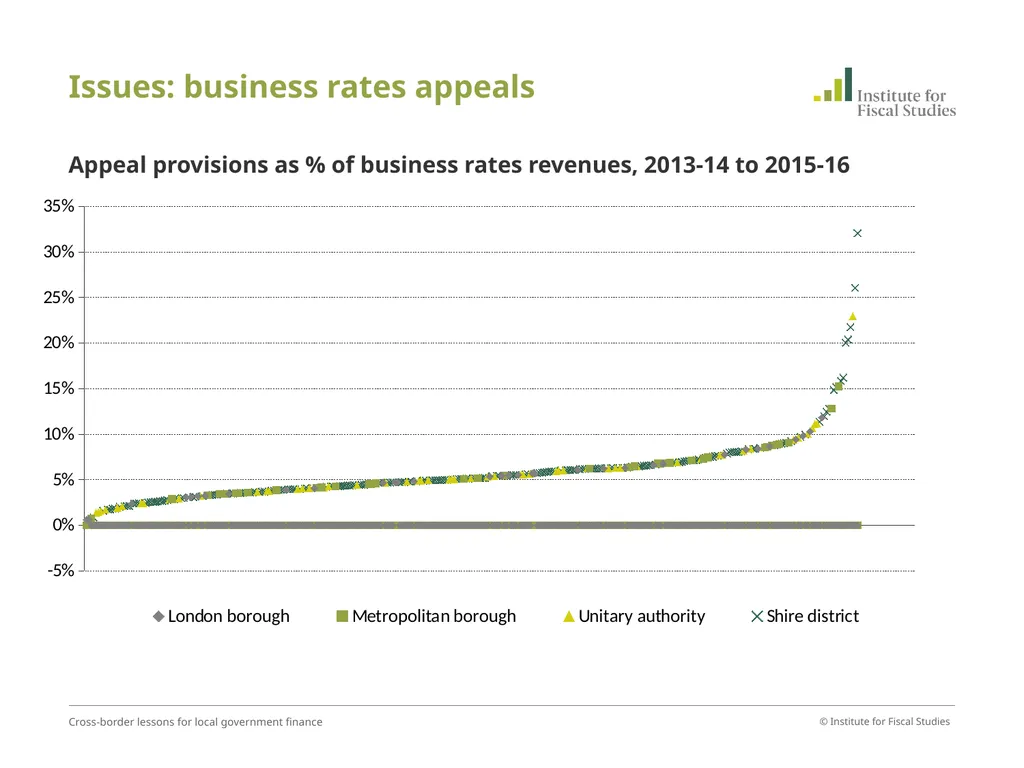
Issues: business rates appeals © Institute for Fiscal Studies Cross-border lessons for local government finance Appeal provisions as % of business rates revenues, 2013-14 to 2015-16<br>
10
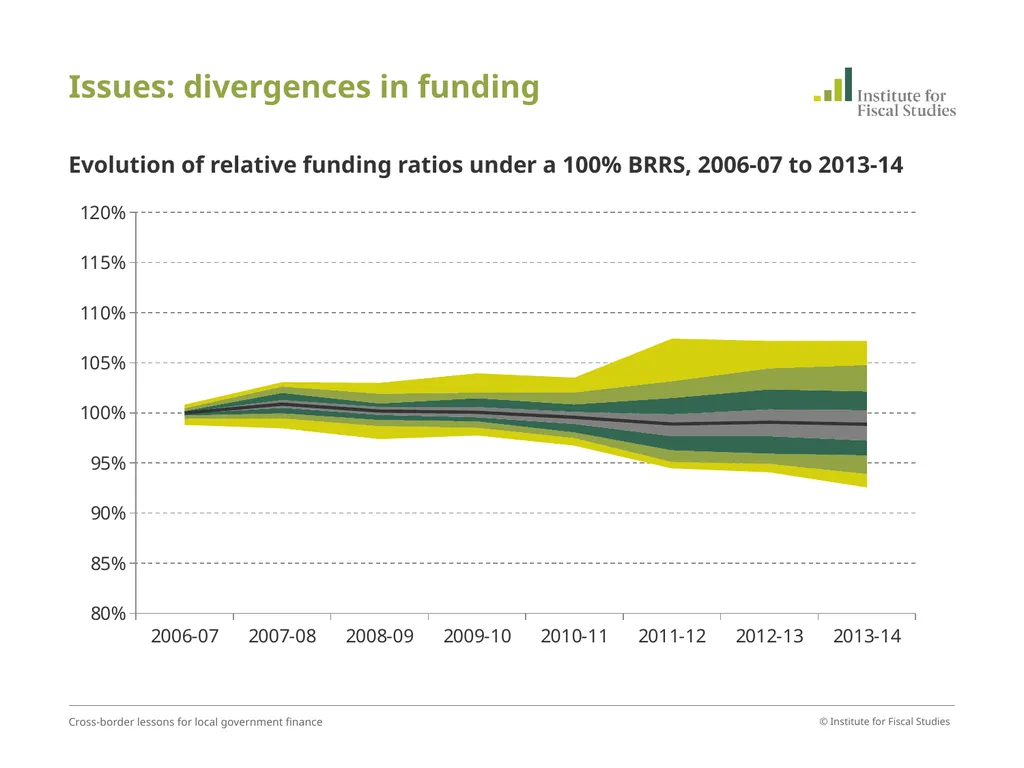
Issues: divergences in funding © Institute for Fiscal Studies Cross-border lessons for local government finance Evolution of relative funding ratios under a 100% BRRS, 2006-07 to 2013-14<br>
11
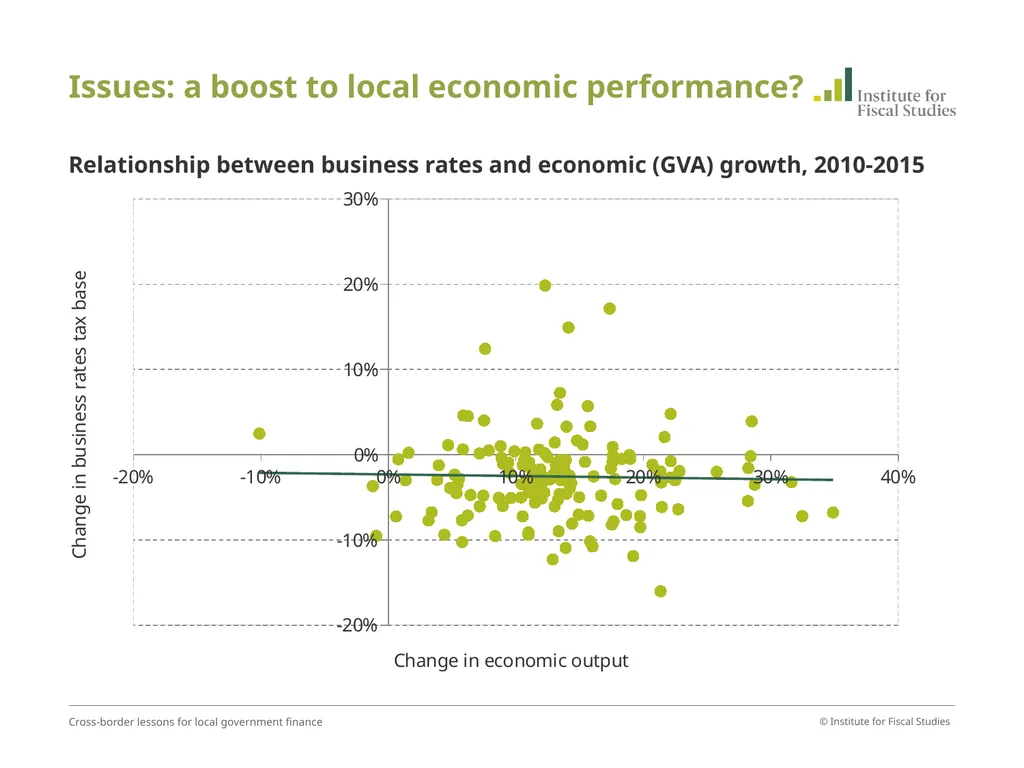
Issues: a boost to local economic performance? © Institute for Fiscal Studies Cross-border lessons for local government finance Relationship between business rates and economic (GVA) growth, 2010-2015<br>
12
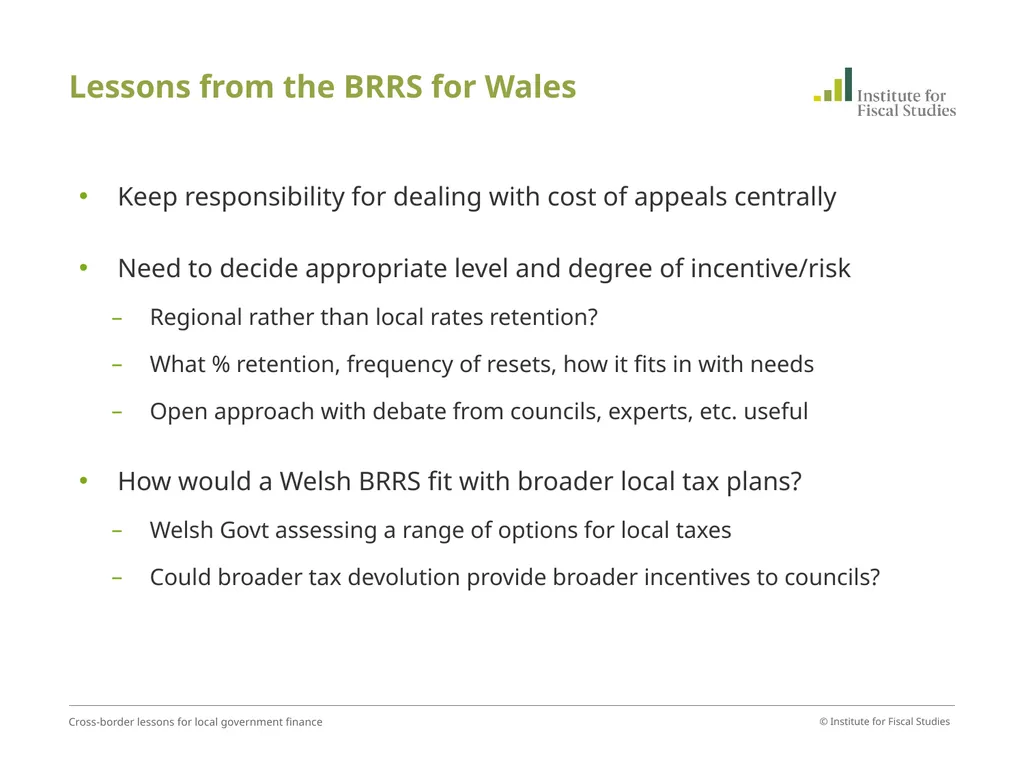
Lessons from the BRRS for Wales Keep responsibility for dealing with cost of appeals centrally
Need to decide appropriate level and degree of incentive/risk
Regional rather than local rates retention?
What % retention, frequency of resets, how it fits in with needs
Open approach with debate from councils, experts, etc. useful
How would a Welsh BRRS fit with broader local tax plans?
Welsh Govt assessing a range of options for local taxes
Could broader tax devolution provide broader incentives to councils? © Institute for Fiscal Studies Cross-border lessons for local government finance<br>
Need to decide appropriate level and degree of incentive/risk
Regional rather than local rates retention?
What % retention, frequency of resets, how it fits in with needs
Open approach with debate from councils, experts, etc. useful
How would a Welsh BRRS fit with broader local tax plans?
Welsh Govt assessing a range of options for local taxes
Could broader tax devolution provide broader incentives to councils? © Institute for Fiscal Studies Cross-border lessons for local government finance<br>
13
How does Adult Social Care fit in? © Institute for Fiscal Studies Cross-border lessons for local government finance<br>
14
National and local funding tensions Shift towards greater local responsibility for funding services via local taxes conflicts with adult social care policy aims
Nationally, council tax and rates revenues won’t keep pace with costs © Institute for Fiscal Studies Cross-border lessons for local government finance<br>
Nationally, council tax and rates revenues won’t keep pace with costs © Institute for Fiscal Studies Cross-border lessons for local government finance<br>
15
Projections of adult social care spending as % of council tax and business rates revenues © Institute for Fiscal Studies Adult social care: a local or national responsibility? CT up 3% a year, BR base falls 0.4% a year
CT up 4% a year, BR base up 0.3% a year
CT up 5% a year, BR base up 1% a year Source: Authors’ calculations MHCLG revenue data and Wittenburg and Hu (2015) cost projections.<br>
CT up 4% a year, BR base up 0.3% a year
CT up 5% a year, BR base up 1% a year Source: Authors’ calculations MHCLG revenue data and Wittenburg and Hu (2015) cost projections.<br>
16
National and local funding tensions Shift towards greater local responsibility for funding services via local taxes conflicts with adult social care policy aims
Nationally, council tax and rates revenues won’t keep pace with costs
Locally, needs/tax revenues may evolve in very different ways © Institute for Fiscal Studies Cross-border lessons for local government finance<br>
Nationally, council tax and rates revenues won’t keep pace with costs
Locally, needs/tax revenues may evolve in very different ways © Institute for Fiscal Studies Cross-border lessons for local government finance<br>
17
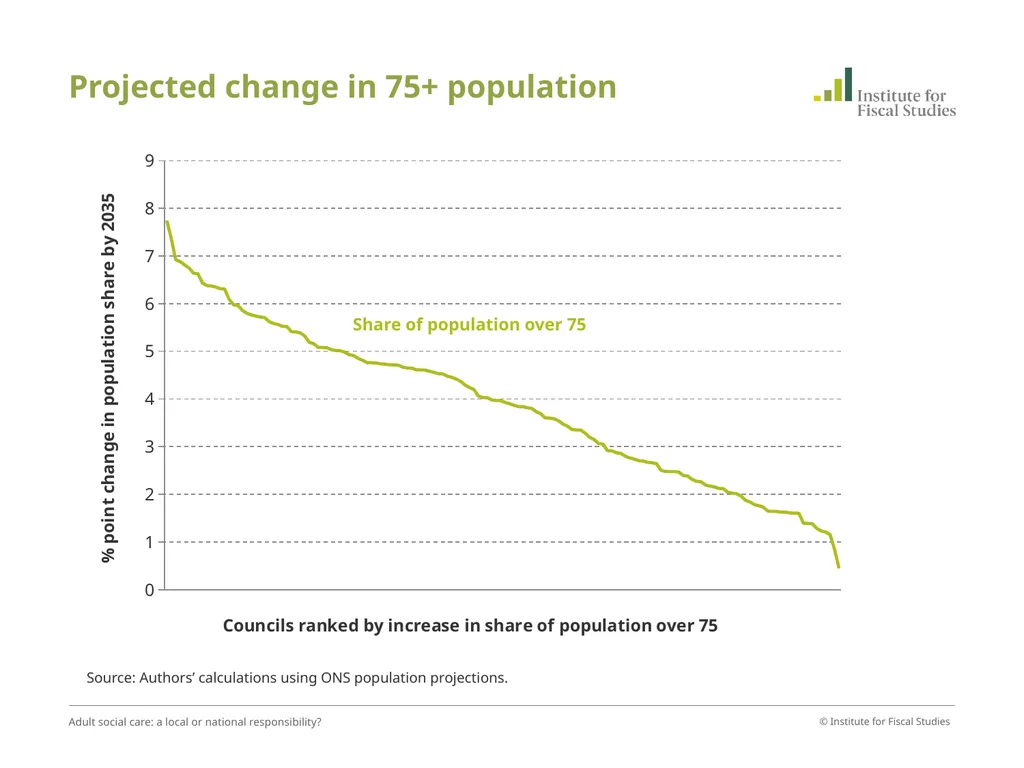
Projected change in 75+ population © Institute for Fiscal Studies Adult social care: a local or national responsibility? Share of population over 75 Source: Authors’ calculations using ONS population projections.<br>
18
National and local funding tensions Shift towards greater local responsibility for funding services via local taxes conflicts with adult social care policy aims
Nationally, council tax and rates revenues won’t keep pace with costs
Locally, needs/tax revenues may evolve in very different ways © Institute for Fiscal Studies Cross-border lessons for local government finance Jeremy Hunt,
Health and Social Care Secretary Part of [our plan] will be tackling the unacceptable variations in quality and outcomes between different services and different parts of the country<br>
Nationally, council tax and rates revenues won’t keep pace with costs
Locally, needs/tax revenues may evolve in very different ways © Institute for Fiscal Studies Cross-border lessons for local government finance Jeremy Hunt,
Health and Social Care Secretary Part of [our plan] will be tackling the unacceptable variations in quality and outcomes between different services and different parts of the country<br>
19
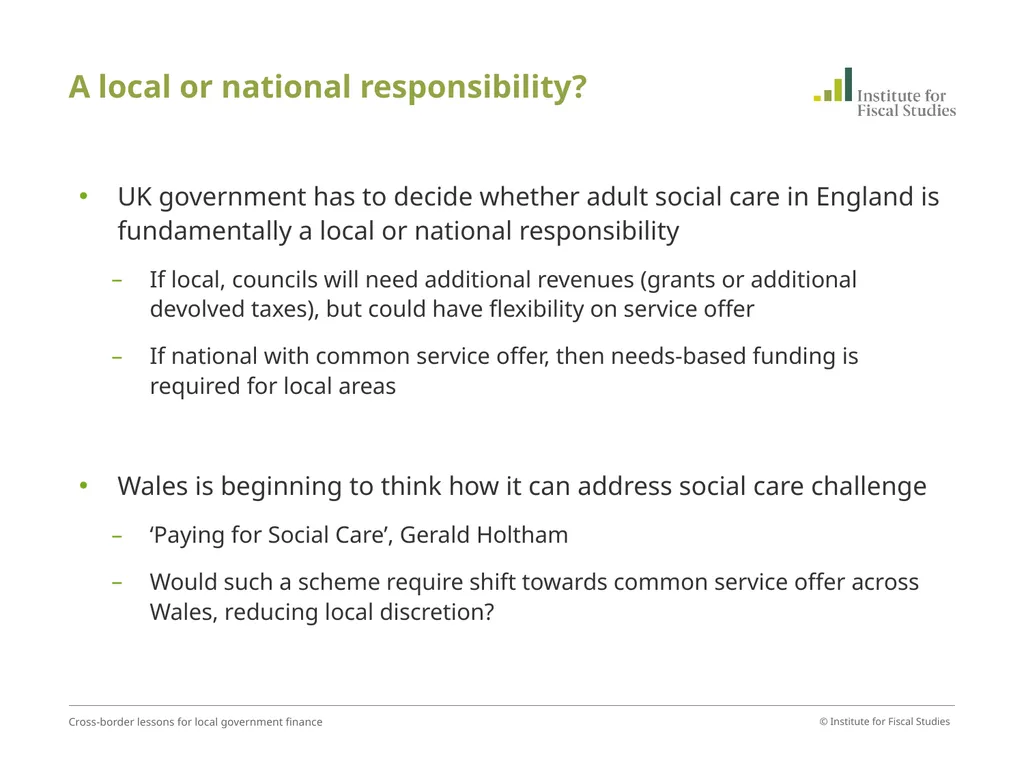
A local or national responsibility? UK government has to decide whether adult social care in England is fundamentally a local or national responsibility
If local, councils will need additional revenues (grants or additional devolved taxes), but could have flexibility on service offer
If national with common service offer, then needs-based funding is required for local areas
Wales is beginning to think how it can address social care challenge
‘Paying for Social Care’, Gerald Holtham
Would such a scheme require shift towards common service offer across Wales, reducing local discretion? © Institute for Fiscal Studies Cross-border lessons for local government finance<br>
If local, councils will need additional revenues (grants or additional devolved taxes), but could have flexibility on service offer
If national with common service offer, then needs-based funding is required for local areas
Wales is beginning to think how it can address social care challenge
‘Paying for Social Care’, Gerald Holtham
Would such a scheme require shift towards common service offer across Wales, reducing local discretion? © Institute for Fiscal Studies Cross-border lessons for local government finance<br>
20
What is Fair Funding for councils? © Institute for Fiscal Studies Cross-border lessons for local government finance<br>
21
Revenue-raising capacity and spending needs English and Welsh council funding systems tried to offset differences in
Revenue-raising capacity
Cost/need for council services © Institute for Fiscal Studies Cross-border lessons for local government finance England Wales<br>
Revenue-raising capacity
Cost/need for council services © Institute for Fiscal Studies Cross-border lessons for local government finance England Wales<br>
22
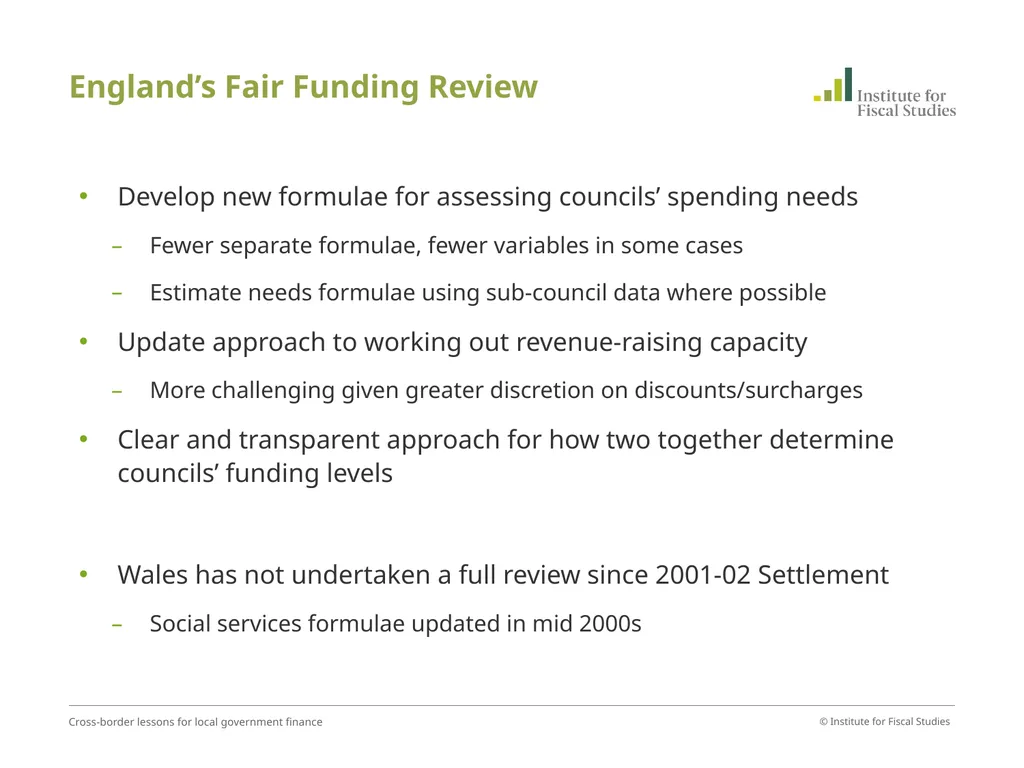
England’s Fair Funding Review Develop new formulae for assessing councils’ spending needs
Fewer separate formulae, fewer variables in some cases
Estimate needs formulae using sub-council data where possible
Update approach to working out revenue-raising capacity
More challenging given greater discretion on discounts/surcharges
Clear and transparent approach for how two together determine councils’ funding levels
Wales has not undertaken a full review since 2001-02 Settlement
Social services formulae updated in mid 2000s © Institute for Fiscal Studies Cross-border lessons for local government finance<br>
Fewer separate formulae, fewer variables in some cases
Estimate needs formulae using sub-council data where possible
Update approach to working out revenue-raising capacity
More challenging given greater discretion on discounts/surcharges
Clear and transparent approach for how two together determine councils’ funding levels
Wales has not undertaken a full review since 2001-02 Settlement
Social services formulae updated in mid 2000s © Institute for Fiscal Studies Cross-border lessons for local government finance<br>
23
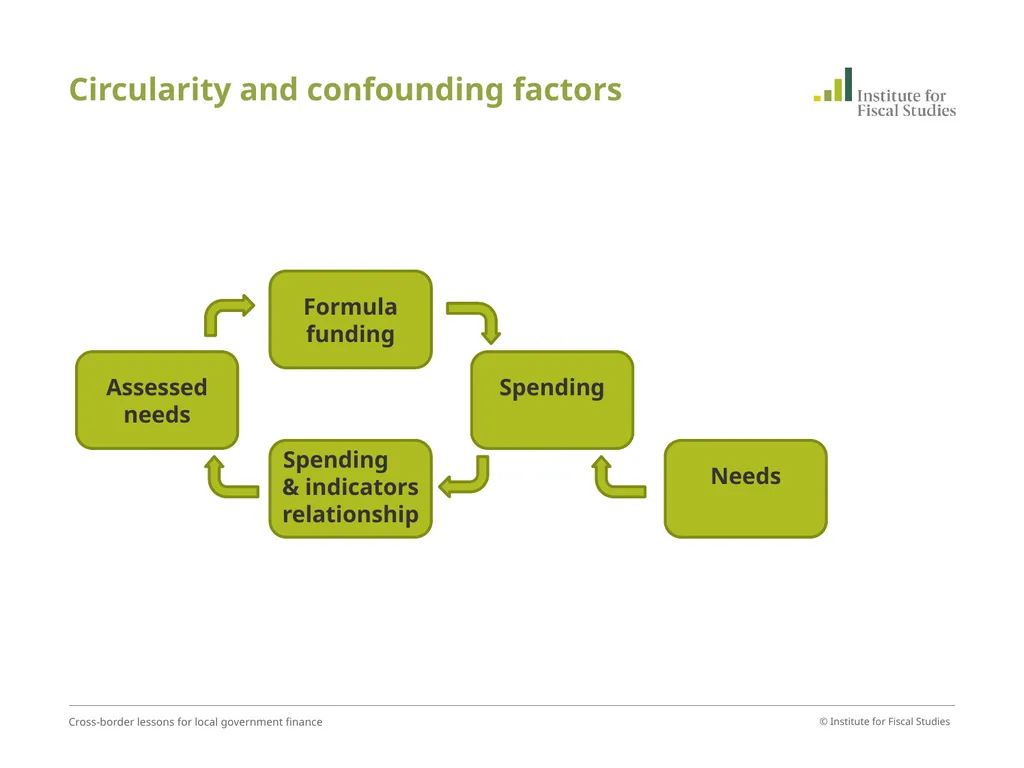
Circularity and confounding factors Formula funding Spending Spending & indicators relationship Assessed needs Needs © Institute for Fiscal Studies Cross-border lessons for local government finance<br>
24
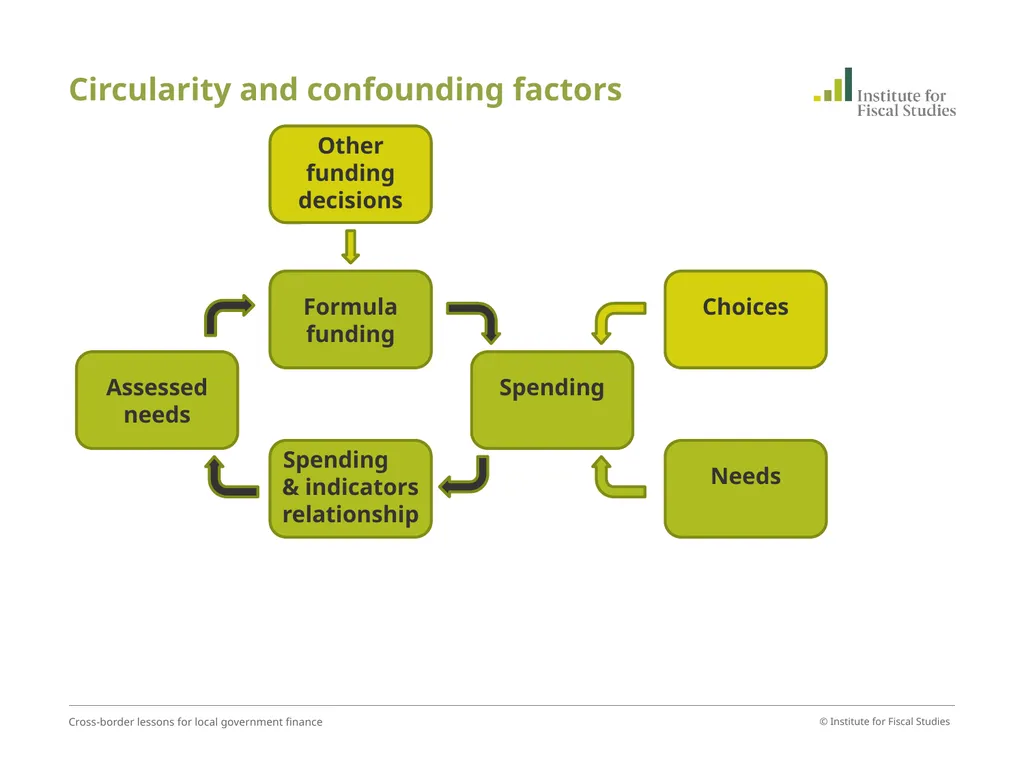
Circularity and confounding factors Other funding decisions Formula funding Spending Spending & indicators relationship Assessed needs Needs Choices © Institute for Fiscal Studies Cross-border lessons for local government finance<br>
25
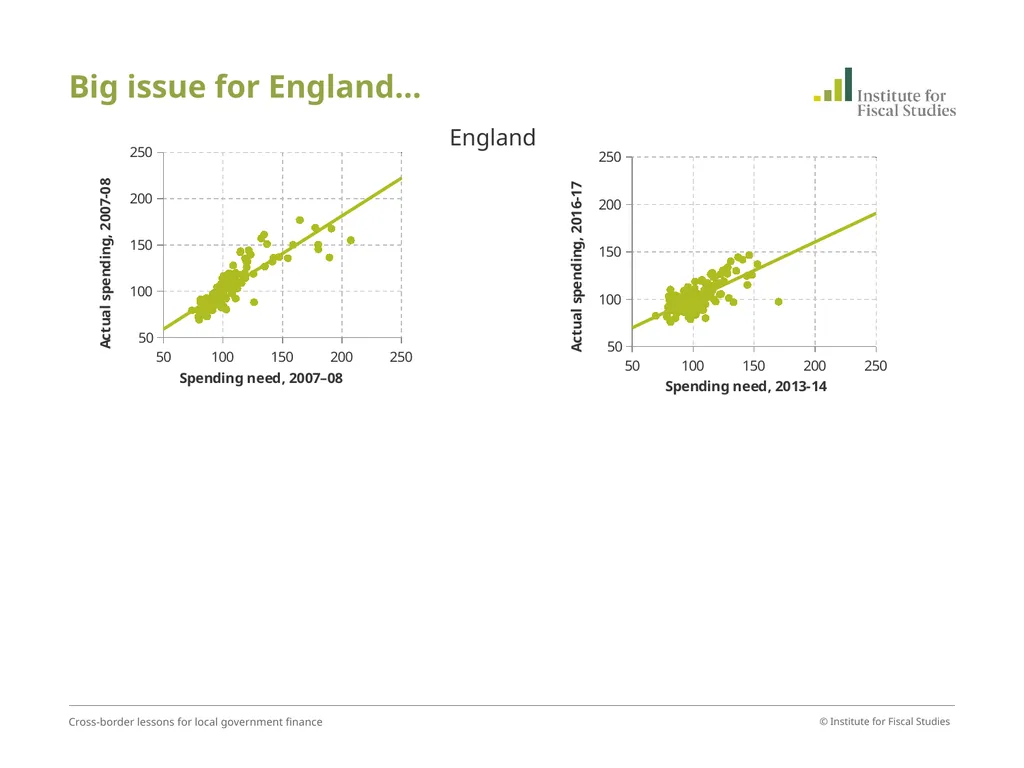
Big issue for England… © Institute for Fiscal Studies Cross-border lessons for local government finance England<br>
26
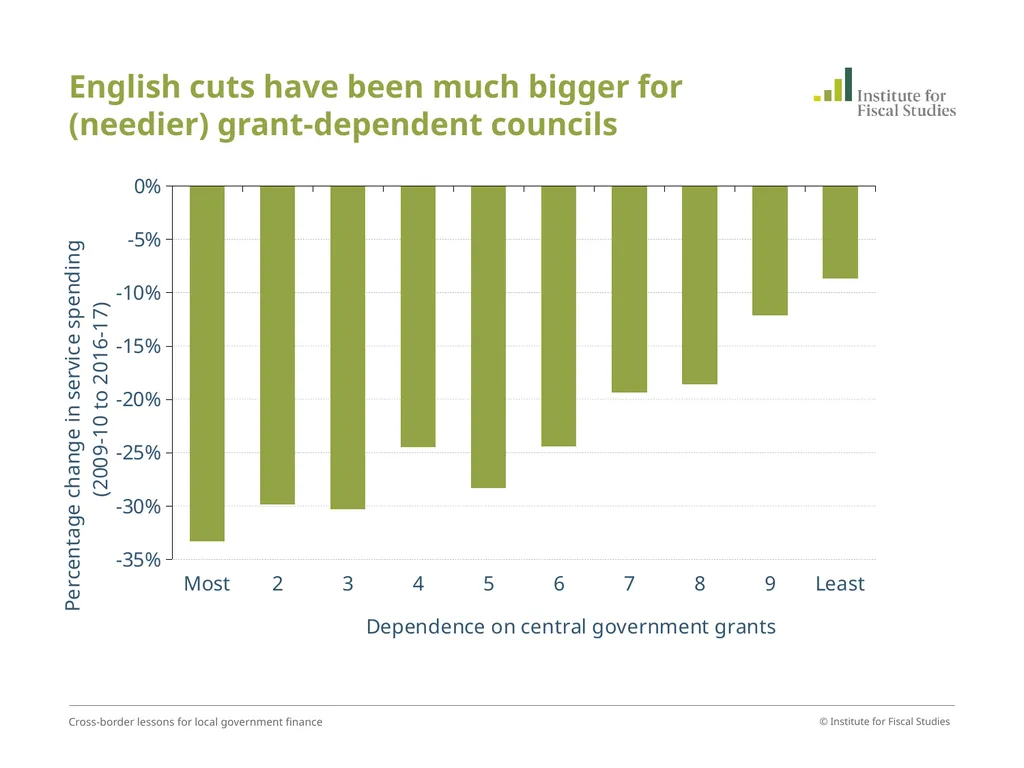
English cuts have been much bigger for (needier) grant-dependent councils © Institute for Fiscal Studies Cross-border lessons for local government finance<br>
27
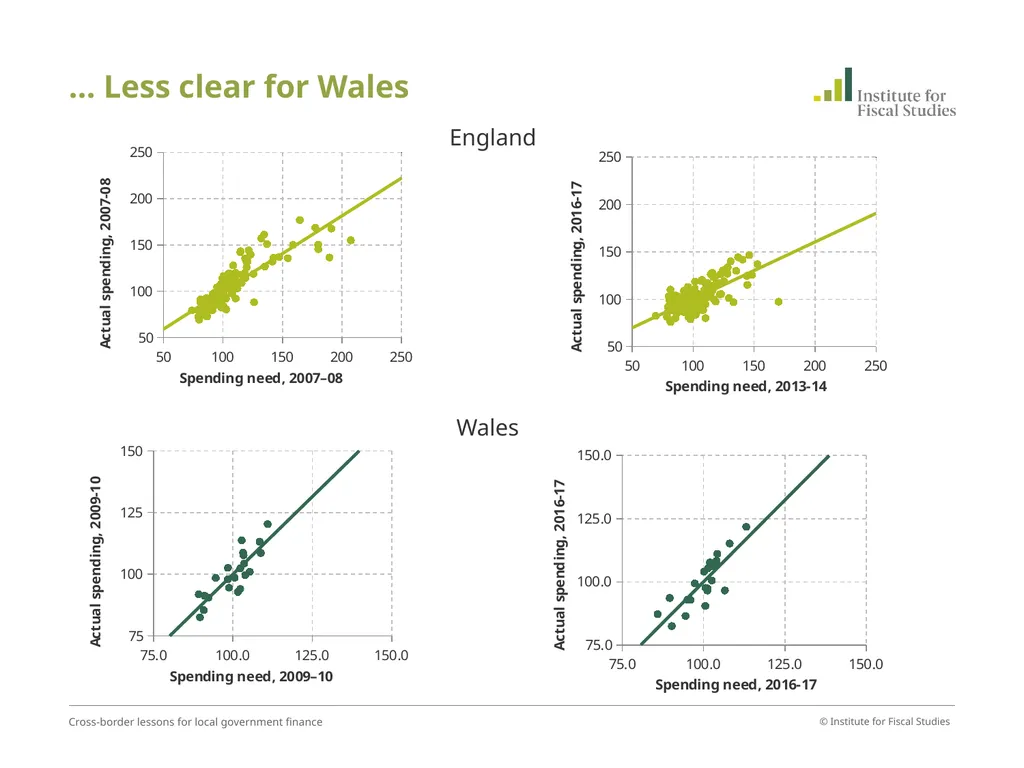
… Less clear for Wales © Institute for Fiscal Studies Cross-border lessons for local government finance England Wales<br>
28
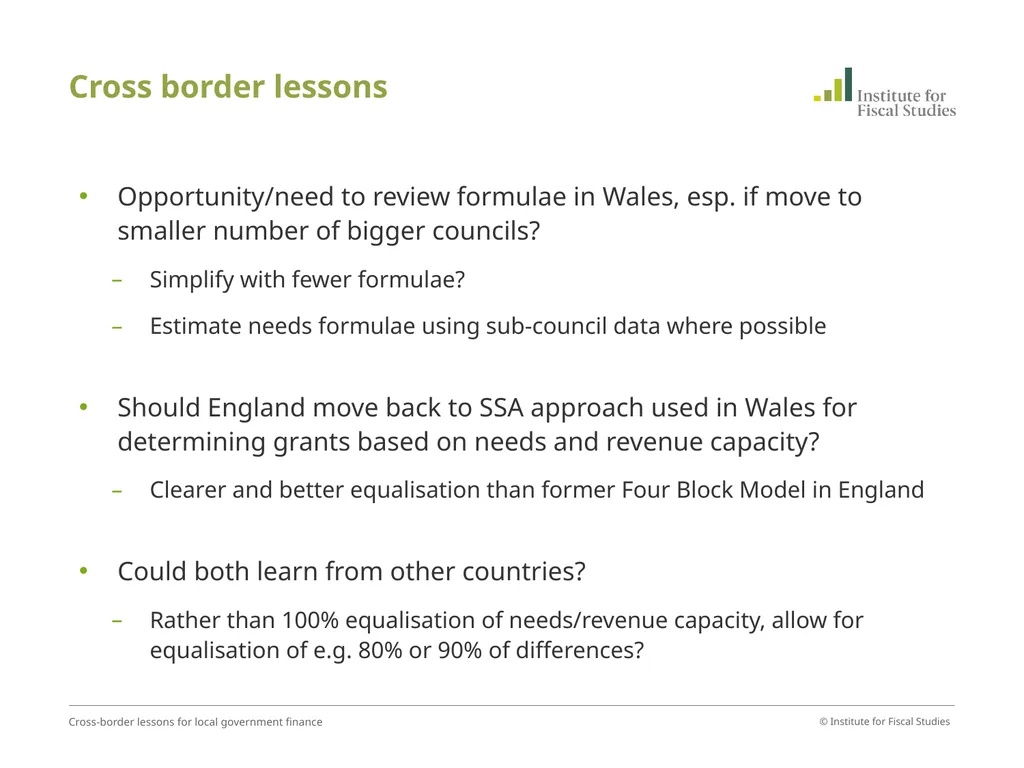
Cross border lessons Opportunity/need to review formulae in Wales, esp. if move to smaller number of bigger councils?
Simplify with fewer formulae?
Estimate needs formulae using sub-council data where possible
Should England move back to SSA approach used in Wales for determining grants based on needs and revenue capacity?
Clearer and better equalisation than former Four Block Model in England
Could both learn from other countries?
Rather than 100% equalisation of needs/revenue capacity, allow for equalisation of e.g. 80% or 90% of differences? © Institute for Fiscal Studies Cross-border lessons for local government finance<br>
Simplify with fewer formulae?
Estimate needs formulae using sub-council data where possible
Should England move back to SSA approach used in Wales for determining grants based on needs and revenue capacity?
Clearer and better equalisation than former Four Block Model in England
Could both learn from other countries?
Rather than 100% equalisation of needs/revenue capacity, allow for equalisation of e.g. 80% or 90% of differences? © Institute for Fiscal Studies Cross-border lessons for local government finance<br>
29
Summary © Institute for Fiscal Studies Cross-border lessons for local government finance<br>
30
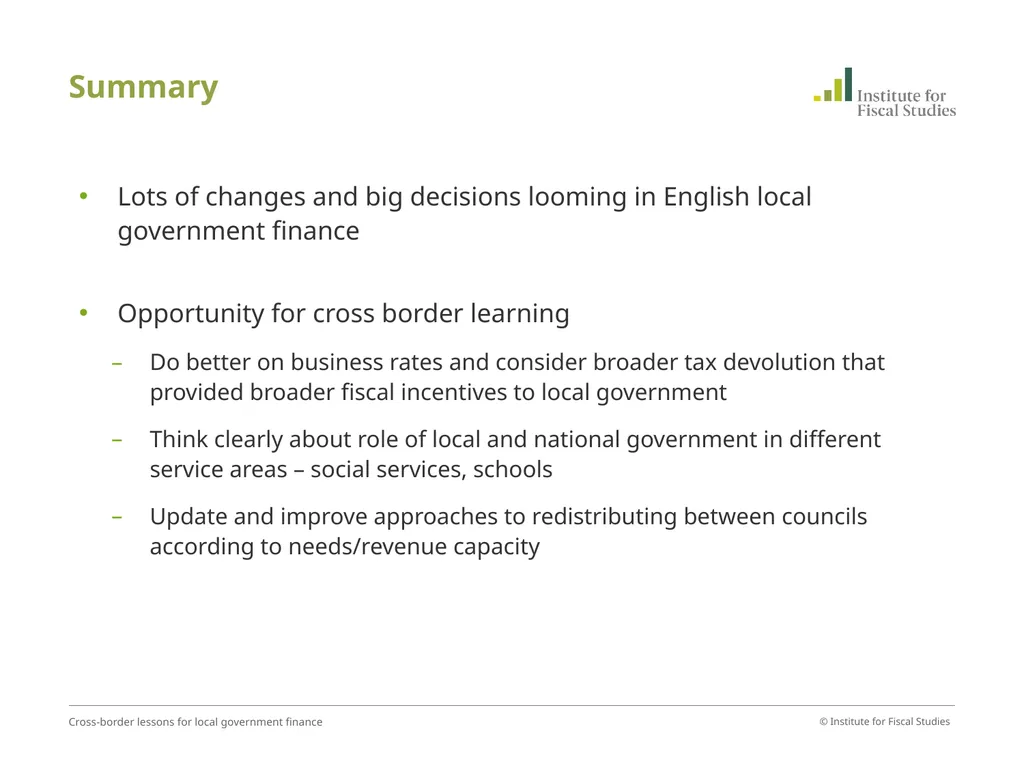
Summary Lots of changes and big decisions looming in English local government finance
Opportunity for cross border learning
Do better on business rates and consider broader tax devolution that provided broader fiscal incentives to local government
Think clearly about role of local and national government in different service areas – social services, schools
Update and improve approaches to redistributing between councils according to needs/revenue capacity © Institute for Fiscal Studies Cross-border lessons for local government finance<br>
Opportunity for cross border learning
Do better on business rates and consider broader tax devolution that provided broader fiscal incentives to local government
Think clearly about role of local and national government in different service areas – social services, schools
Update and improve approaches to redistributing between councils according to needs/revenue capacity © Institute for Fiscal Studies Cross-border lessons for local government finance<br>
31
David Phillips
Associate Director, Institute for Fiscal Studies
Cardiff, July 12th 2018 Remember to look to your left and right: cross-border lessons for local government finance<br>
Associate Director, Institute for Fiscal Studies
Cardiff, July 12th 2018 Remember to look to your left and right: cross-border lessons for local government finance<br>