
DCU Student Learning Critical Writing for MA


Description: DCU Student Learning Critical Writing for MA Students Critical Thinking at MA Level Whats An Argument? Critical Reading Critical Writing Workshop ExercisesDiscussion Learning Aims Developing a questioning attitude towards what you read
Related Topics
Download Presentation
"DCU Student Learning Critical Writing for MA" is the property of its rightful owner. Permission is granted to download and print the materials on this website for personal, non-commercial use only, and to display it on your personal computer provided you do not modify the materials and that you retain all copyright notices contained in the materials. By downloading content from our website, you accept the terms of this agreement.
Presentation Transcript
slide1. DCU Student Learning Critical Writing for MA Students<br>
slide2. Critical Thinking at MA Level
What’s An Argument?
Critical Reading
Critical Writing
Workshop Exercises/Discussion Learning Aims<br>
slide3. Developing a questioning attitude towards what you read
Looking for alternatives in what you read:
Asking why/how something happens
Asking why something is important
Asking …… ??
In order to engage in analysis of what you read and to write critically Critical Thinking involves<br>
slide4. Show understanding of topic
(ie) relevant reading, summarising main
points, identifying key information
Apply knowledge
(ie) selecting only relevant information
Original ideas
(ie) your analysis of topic
Valid argument
(ie) your position on topic, supported by
evidence Being Critical In Assignments<br>
slide5. An essay usually requires an argument
You are being asked to present a position on an issue and support this position with reasons (evidence) What’s an Argument?<br>
slide6. Genetic Engineering really worries me. I don’t think it should be allowed
That doesn’t convince me. I think genetic engineering is really exciting Is It An Argument?<br>
slide7. Genetic engineering should be curtailed because there has not been sufficient research into what happens when new varieties are created without natural predators to hold them in check. Is it an argument?<br>
slide8. Is a technique for discovering information and ideas in a text
Involves reading with a purpose: to fully understand the merits and limitations of what a text says and does
Examines what a text means in order to draw a conclusion
… Refers to careful, active, reflective, analytic reading Critical Reading…<br>
slide9. Mary had a little lamb, Its fleece was white as snow, and everywhere that Mary went The lamb was sure to go Workshop Exercise…<br>
slide10. Restatement … A restatement would simply talk about Mary and the lamb
“Mary had a lamb that followed her
everywhere”
When is this kind of writing useful?<br>
slide11. Description….. A description would talk about the story within the fairy tale
“The nursery rhyme describes a pet
that followed its mistress everywhere”
When is this kind of writing useful?<br>
slide12. Evaluation involves deconstructing ideas in texts in order to come to your own conclusion about the text
(eg) the nursery rhyme conveys the idea of innocent devotion
When is this kind of writing useful? Evaluation…..<br>
slide13. Discuss/Critically evaluate the themes …..
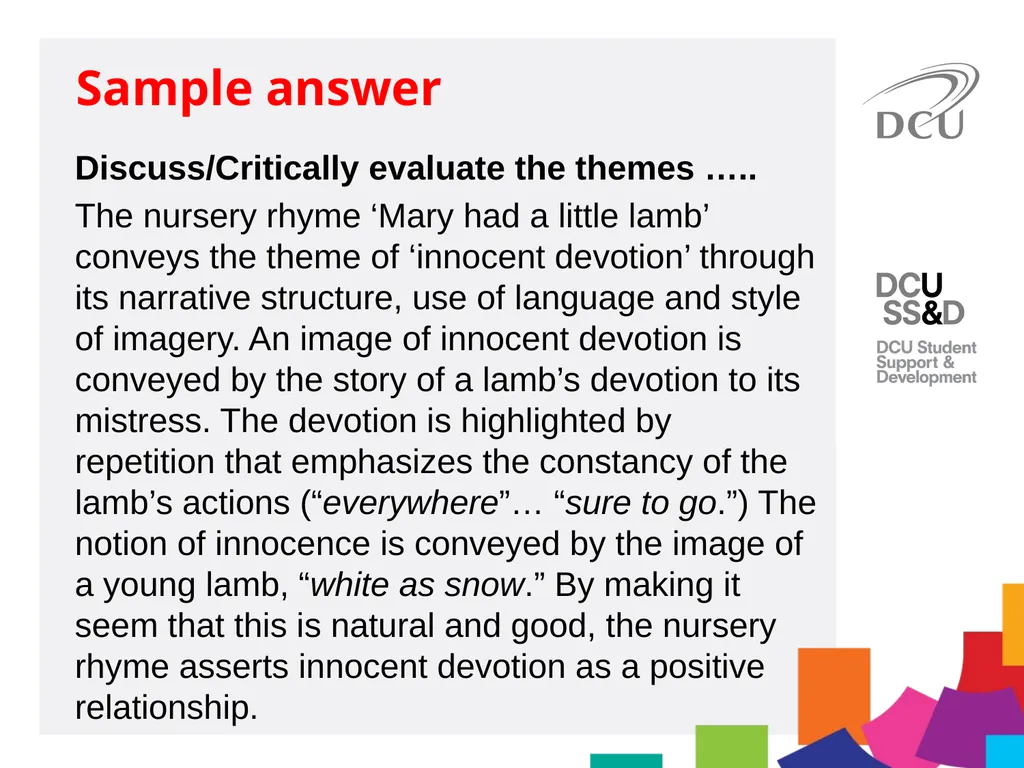
The nursery rhyme ‘Mary had a little lamb’ conveys the theme of ‘innocent devotion’ through its narrative structure, use of language and style of imagery. An image of innocent devotion is conveyed by the story of a lamb’s devotion to its mistress. The devotion is highlighted by repetition that emphasizes the constancy of the lamb’s actions (“everywhere”… “sure to go.”) The notion of innocence is conveyed by the image of a young lamb, “white as snow.” By making it seem that this is natural and good, the nursery rhyme asserts innocent devotion as a positive relationship. Sample answer<br>
slide14. Clear and confident refusal to accept conclusions of other writers without evaluating the arguments and evidence
Clear presentation of your own evidence and argument, leading to your conclusion
Recognition of the limitations in your own evidence, argument, and conclusion What is Critical Writing?<br>
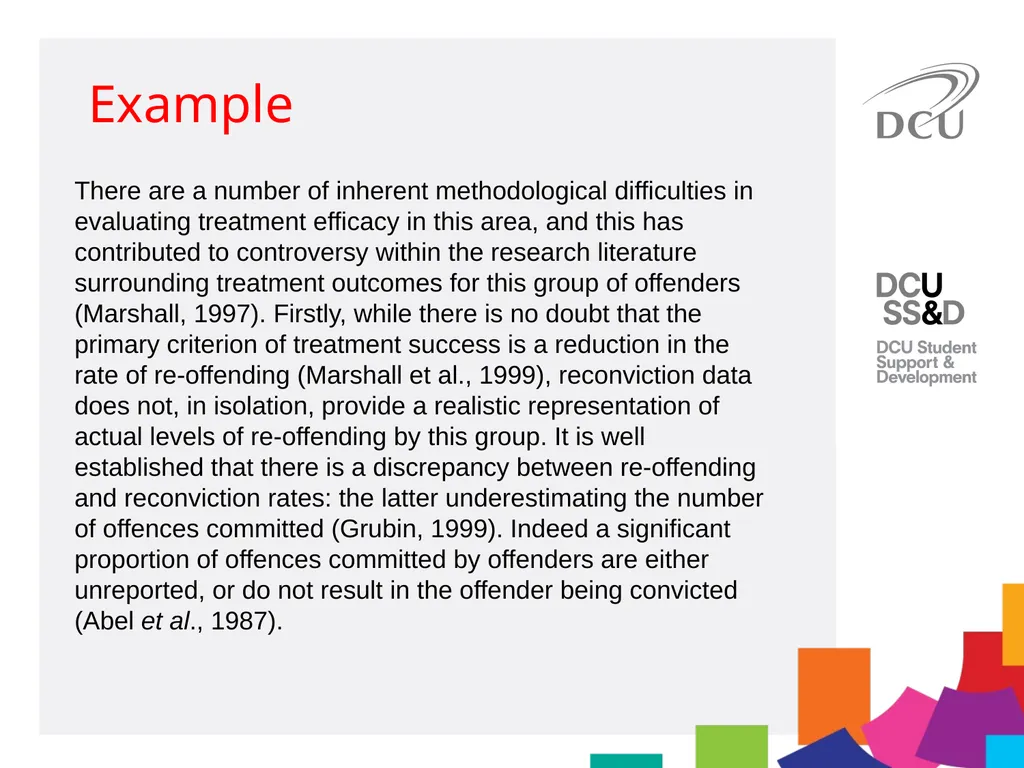
slide15. Example There are a number of inherent methodological difficulties in evaluating treatment efficacy in this area, and this has contributed to controversy within the research literature surrounding treatment outcomes for this group of offenders (Marshall, 1997). Firstly, while there is no doubt that the primary criterion of treatment success is a reduction in the rate of re-offending (Marshall et al., 1999), reconviction data does not, in isolation, provide a realistic representation of actual levels of re-offending by this group. It is well established that there is a discrepancy between re-offending and reconviction rates: the latter underestimating the number of offences committed (Grubin, 1999). Indeed a significant proportion of offences committed by offenders are either unreported, or do not result in the offender being convicted (Abel et al., 1987).<br>
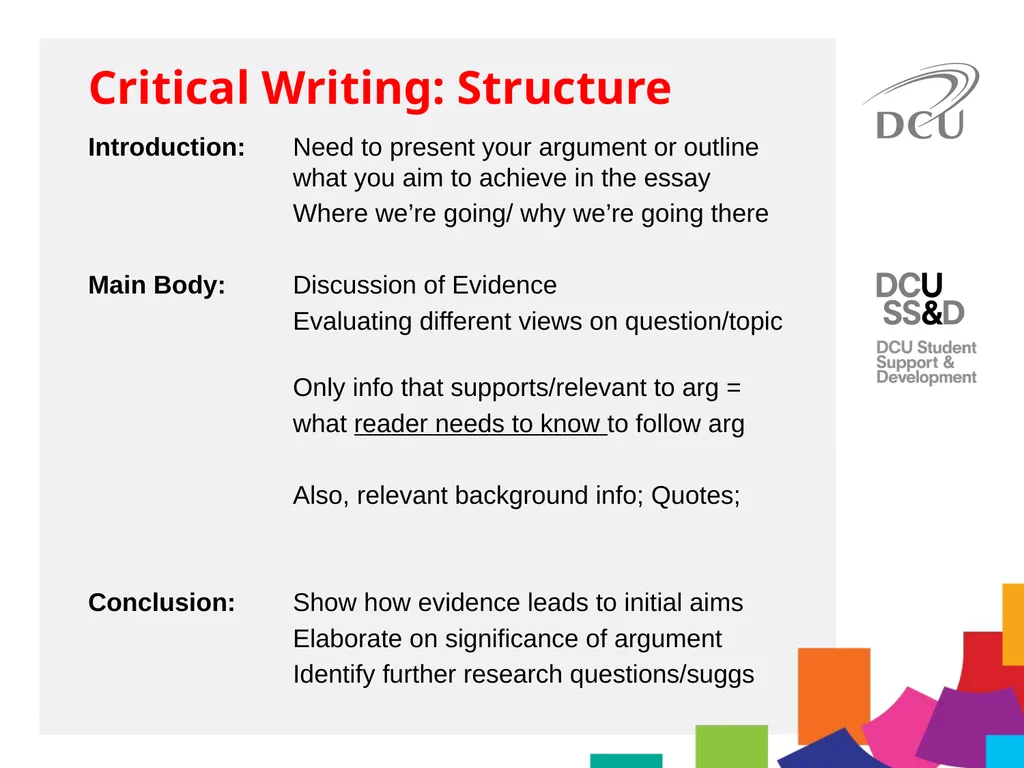
slide16. Introduction: Need to present your argument or outline what you aim to achieve in the essay
Where we’re going/ why we’re going there
Main Body: Discussion of Evidence
Evaluating different views on question/topic
Only info that supports/relevant to arg =
what reader needs to know to follow arg
Also, relevant background info; Quotes;
Conclusion: Show how evidence leads to initial aims
Elaborate on significance of argument
Identify further research questions/suggs Critical Writing: Structure<br>
slide17. Your essay should persuade your reader to accept your position/argument on the topic.
You must show how you’ve arrived at your position/argument in order to come to a conclusion
In other words:
Main body of the essay is the presentation and evaluation of reasons to support your argument Critical Writing: Structure<br>
slide18. Avoid stringing quotes together – highlight relevance
If it’s worth including, it’s worth telling us why
Balance between descriptive/critical writing
Be ‘fair’: assess strengths/weaknesses of other people’s ideas and writing … without prejudice
Make judgements based on considerable thought of all available evidence … as opposed to assertions without reason
Check
- unsubstantiated statements
- have I included sufficient evidence/arguments
to convince critical readers Critical Writing: Content<br>
slide19. Brown (2005) maintains that leadership is an essential quality in nursing. This is confirmed by the recent requirements of the NHS Plan (DOH, 2002). This Plan has emphasized the importance of introducing the transformational model of leadership. Smith (2001) explains that this is a leadership which involves the use of charisma and interpersonal skills to enable achievement. Jones (2004) argues that the key characteristic of transformational leadership is empowering others to achieve. In my own experience, a leader with transformational qualities can make any team member feel that they have a useful part to play in the organization. This is confirmed by Fea (2001) who argues that transformational leadership increases feelings of self-worth and capability in their team members. Workshop Exercise<br>
slide20. Is this piece an example of good academic writing?
How well does it use literature to back up statements being made?
Where and to what extent is it reflective?
Where and to what extent is it analytical and critical? Workshop Discussion<br>
slide2. Critical Thinking at MA Level
What’s An Argument?
Critical Reading
Critical Writing
Workshop Exercises/Discussion Learning Aims<br>
slide3. Developing a questioning attitude towards what you read
Looking for alternatives in what you read:
Asking why/how something happens
Asking why something is important
Asking …… ??
In order to engage in analysis of what you read and to write critically Critical Thinking involves<br>
slide4. Show understanding of topic
(ie) relevant reading, summarising main
points, identifying key information
Apply knowledge
(ie) selecting only relevant information
Original ideas
(ie) your analysis of topic
Valid argument
(ie) your position on topic, supported by
evidence Being Critical In Assignments<br>
slide5. An essay usually requires an argument
You are being asked to present a position on an issue and support this position with reasons (evidence) What’s an Argument?<br>
slide6. Genetic Engineering really worries me. I don’t think it should be allowed
That doesn’t convince me. I think genetic engineering is really exciting Is It An Argument?<br>
slide7. Genetic engineering should be curtailed because there has not been sufficient research into what happens when new varieties are created without natural predators to hold them in check. Is it an argument?<br>
slide8. Is a technique for discovering information and ideas in a text
Involves reading with a purpose: to fully understand the merits and limitations of what a text says and does
Examines what a text means in order to draw a conclusion
… Refers to careful, active, reflective, analytic reading Critical Reading…<br>
slide9. Mary had a little lamb, Its fleece was white as snow, and everywhere that Mary went The lamb was sure to go Workshop Exercise…<br>
slide10. Restatement … A restatement would simply talk about Mary and the lamb
“Mary had a lamb that followed her
everywhere”
When is this kind of writing useful?<br>
slide11. Description….. A description would talk about the story within the fairy tale
“The nursery rhyme describes a pet
that followed its mistress everywhere”
When is this kind of writing useful?<br>
slide12. Evaluation involves deconstructing ideas in texts in order to come to your own conclusion about the text
(eg) the nursery rhyme conveys the idea of innocent devotion
When is this kind of writing useful? Evaluation…..<br>
slide13. Discuss/Critically evaluate the themes …..
The nursery rhyme ‘Mary had a little lamb’ conveys the theme of ‘innocent devotion’ through its narrative structure, use of language and style of imagery. An image of innocent devotion is conveyed by the story of a lamb’s devotion to its mistress. The devotion is highlighted by repetition that emphasizes the constancy of the lamb’s actions (“everywhere”… “sure to go.”) The notion of innocence is conveyed by the image of a young lamb, “white as snow.” By making it seem that this is natural and good, the nursery rhyme asserts innocent devotion as a positive relationship. Sample answer<br>
slide14. Clear and confident refusal to accept conclusions of other writers without evaluating the arguments and evidence
Clear presentation of your own evidence and argument, leading to your conclusion
Recognition of the limitations in your own evidence, argument, and conclusion What is Critical Writing?<br>
slide15. Example There are a number of inherent methodological difficulties in evaluating treatment efficacy in this area, and this has contributed to controversy within the research literature surrounding treatment outcomes for this group of offenders (Marshall, 1997). Firstly, while there is no doubt that the primary criterion of treatment success is a reduction in the rate of re-offending (Marshall et al., 1999), reconviction data does not, in isolation, provide a realistic representation of actual levels of re-offending by this group. It is well established that there is a discrepancy between re-offending and reconviction rates: the latter underestimating the number of offences committed (Grubin, 1999). Indeed a significant proportion of offences committed by offenders are either unreported, or do not result in the offender being convicted (Abel et al., 1987).<br>
slide16. Introduction: Need to present your argument or outline what you aim to achieve in the essay
Where we’re going/ why we’re going there
Main Body: Discussion of Evidence
Evaluating different views on question/topic
Only info that supports/relevant to arg =
what reader needs to know to follow arg
Also, relevant background info; Quotes;
Conclusion: Show how evidence leads to initial aims
Elaborate on significance of argument
Identify further research questions/suggs Critical Writing: Structure<br>
slide17. Your essay should persuade your reader to accept your position/argument on the topic.
You must show how you’ve arrived at your position/argument in order to come to a conclusion
In other words:
Main body of the essay is the presentation and evaluation of reasons to support your argument Critical Writing: Structure<br>
slide18. Avoid stringing quotes together – highlight relevance
If it’s worth including, it’s worth telling us why
Balance between descriptive/critical writing
Be ‘fair’: assess strengths/weaknesses of other people’s ideas and writing … without prejudice
Make judgements based on considerable thought of all available evidence … as opposed to assertions without reason
Check
- unsubstantiated statements
- have I included sufficient evidence/arguments
to convince critical readers Critical Writing: Content<br>
slide19. Brown (2005) maintains that leadership is an essential quality in nursing. This is confirmed by the recent requirements of the NHS Plan (DOH, 2002). This Plan has emphasized the importance of introducing the transformational model of leadership. Smith (2001) explains that this is a leadership which involves the use of charisma and interpersonal skills to enable achievement. Jones (2004) argues that the key characteristic of transformational leadership is empowering others to achieve. In my own experience, a leader with transformational qualities can make any team member feel that they have a useful part to play in the organization. This is confirmed by Fea (2001) who argues that transformational leadership increases feelings of self-worth and capability in their team members. Workshop Exercise<br>
slide20. Is this piece an example of good academic writing?
How well does it use literature to back up statements being made?
Where and to what extent is it reflective?
Where and to what extent is it analytical and critical? Workshop Discussion<br>