
Death: A Propitious Misfortune William Ferraiolo





Description: Death: A Propitious Misfortune William Ferraiolo As early as Thales, philosophers have argued that death is nothing to fear because the dead no longer exist and, therefore, cannot suffer or be harmed. If death is a misfortune at all, it
Related Topics
Download Presentation
"Death: A Propitious Misfortune William Ferraiolo" is the property of its rightful owner. Permission is granted to download and print the materials on this website for personal, non-commercial use only, and to display it on your personal computer provided you do not modify the materials and that you retain all copyright notices contained in the materials. By downloading content from our website, you accept the terms of this agreement.
Presentation Transcript
slide1. Death: A Propitious Misfortune William Ferraiolo<br>
slide2. As early as Thales, philosophers have argued that death is nothing to fear because the dead no longer exist and, therefore, cannot suffer or be harmed.<br>
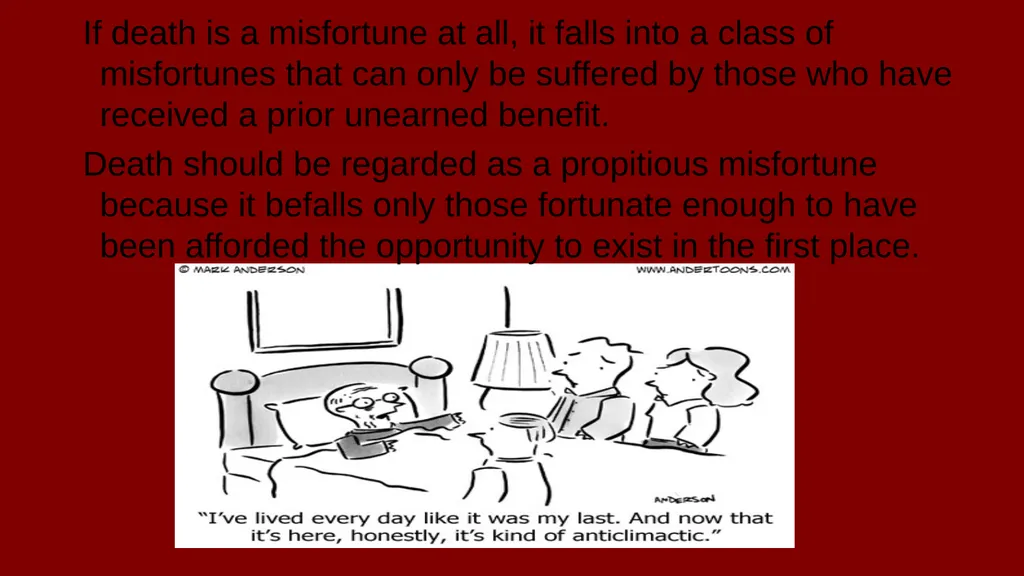
slide3. If death is a misfortune at all, it falls into a class of misfortunes that can only be suffered by those who have received a prior unearned benefit.
Death should be regarded as a propitious misfortune because it befalls only those fortunate enough to have been afforded the opportunity to exist in the first place.<br>
slide4. If there is a God, then human existence is literally a miracle.
It is the product of the divine or, at least, divine design and intention. We are here because God decreed that it be so.<br>
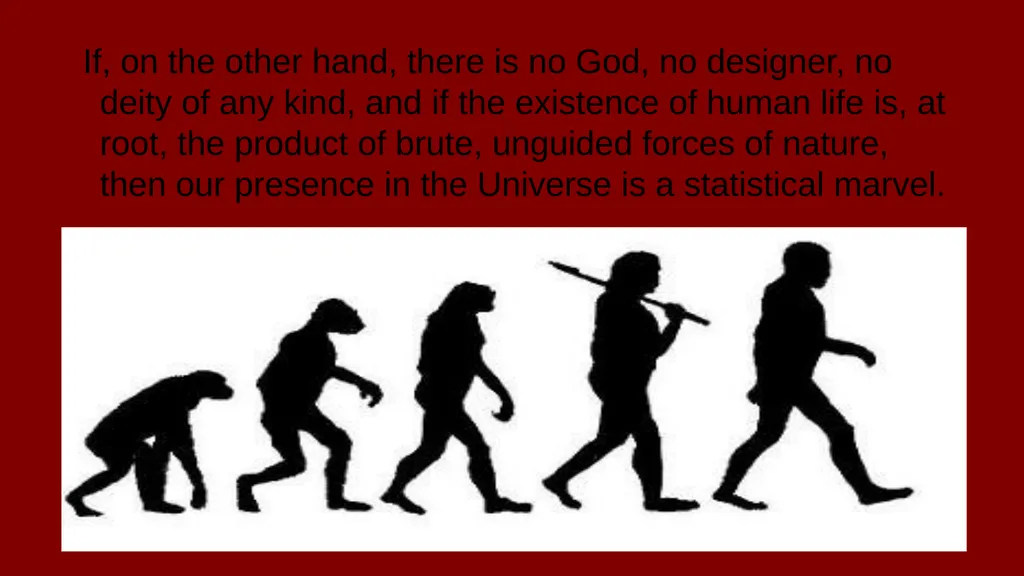
slide5. If, on the other hand, there is no God, no designer, no deity of any kind, and if the existence of human life is, at root, the product of brute, unguided forces of nature, then our presence in the Universe is a statistical marvel.<br>
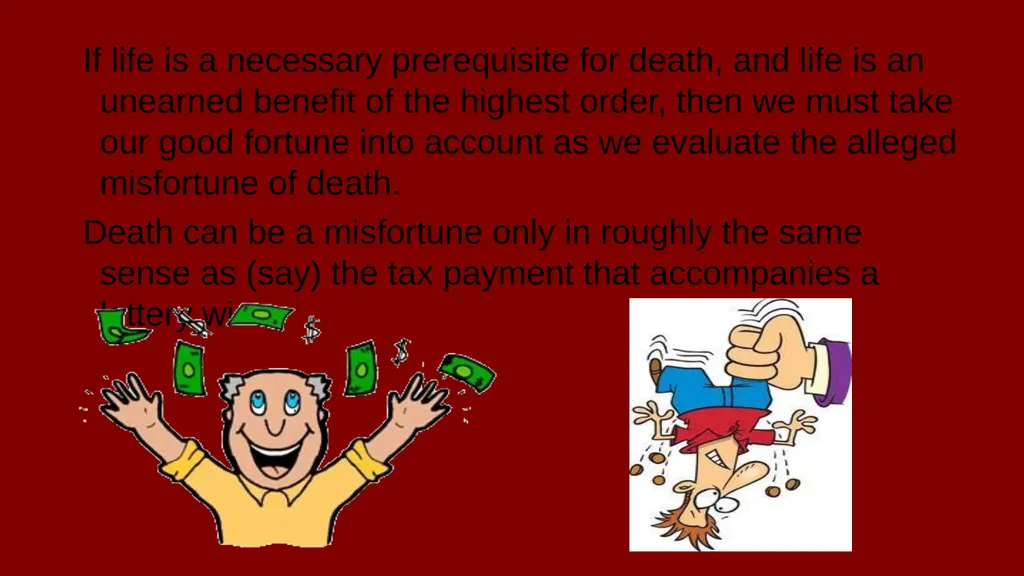
slide6. If life is a necessary prerequisite for death, and life is an unearned benefit of the highest order, then we must take our good fortune into account as we evaluate the alleged misfortune of death.
Death can be a misfortune only in roughly the same sense as (say) the tax payment that accompanies a lottery win.<br>
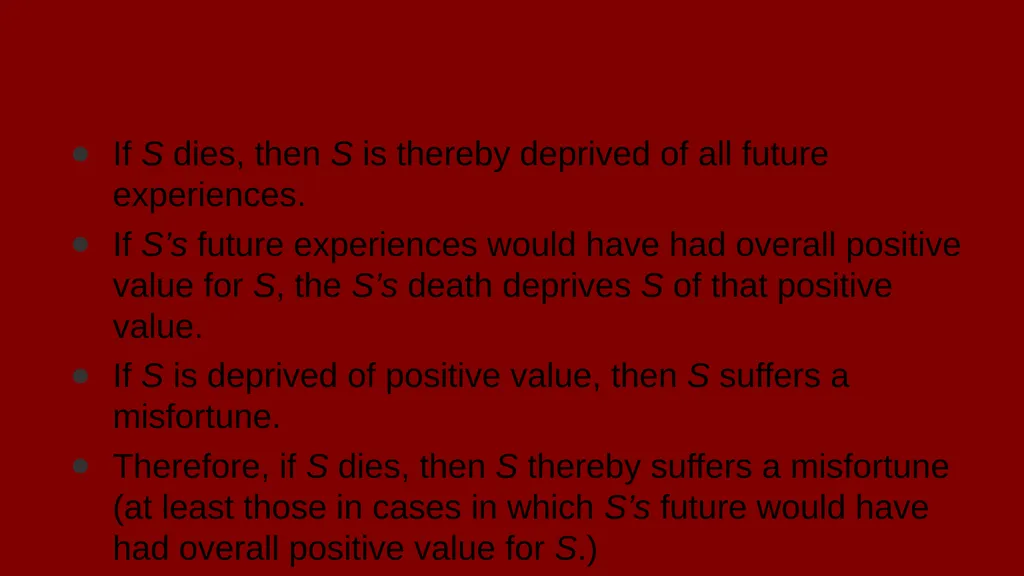
slide7. The Argument From Deprivation If S dies, then S is thereby deprived of all future experiences.
If S’s future experiences would have had overall positive value for S, the S’s death deprives S of that positive value.
If S is deprived of positive value, then S suffers a misfortune.
Therefore, if S dies, then S thereby suffers a misfortune (at least those in cases in which S’s future would have had overall positive value for S.)<br>
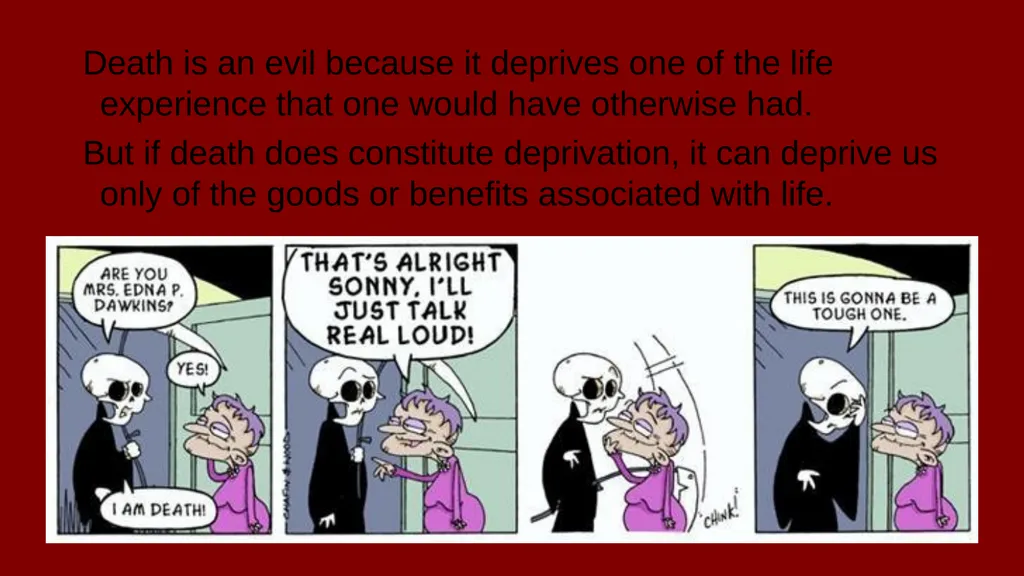
slide8. Death is an evil because it deprives one of the life experience that one would have otherwise had.
But if death does constitute deprivation, it can deprive us only of the goods or benefits associated with life.<br>
slide9. The Evolution and Birth Lotteries If organic life is the outcome of an unguided process of evolution, then the existence of the human species is a propitious accident.
We are all, therefore, fortunate that the wildly improbable appearance of the human species has actually, against all odds, occurred.<br>
slide10. The Evolution and Birth Lotteries In addition to this good fortune, however, there is an additional stroke of luck, for each individual of member of a species, that that particular individual came to exist.<br>
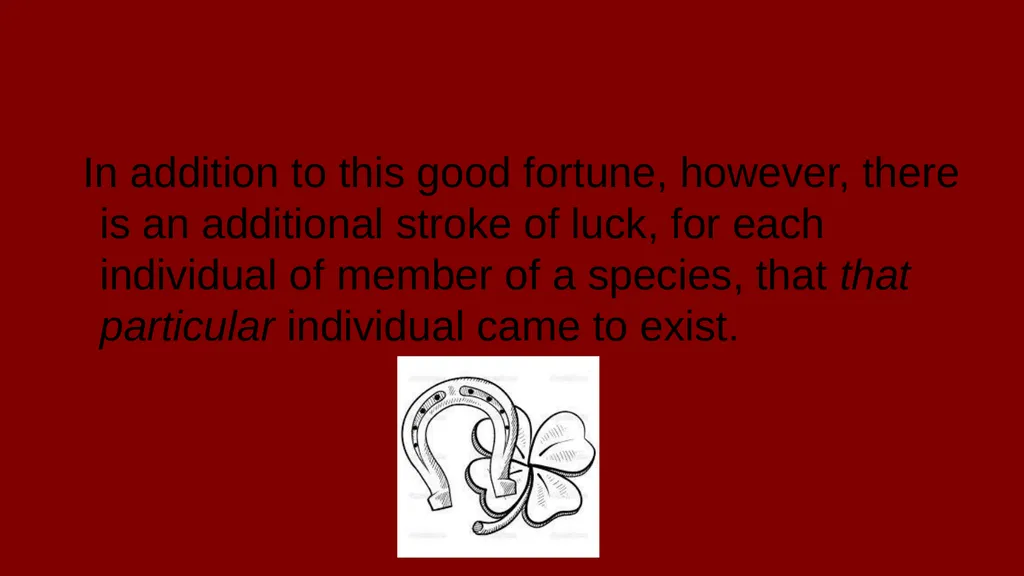
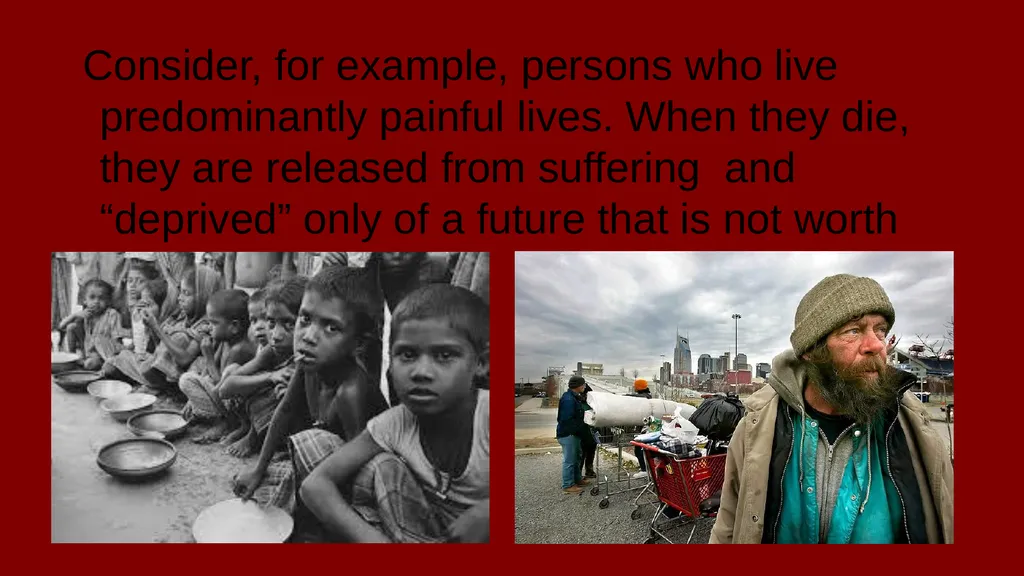
slide11. Consider, for example, persons who live predominantly painful lives. When they die, they are released from suffering and “deprived” only of a future that is not worth having.<br>
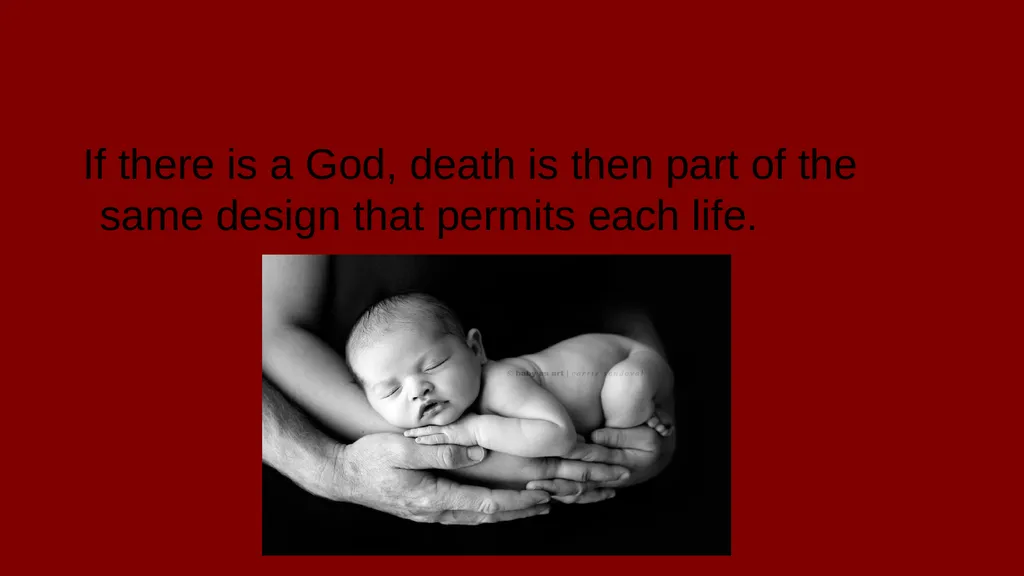
slide12. The Creation Lottery If there is a God, death is then part of the same design that permits each life.<br>
slide13. The Creation Lottery Each of us is tremendously fortunate that:
1. the evolution of the human species is a part of the creator’s chosen design plan.
2. we, as particular individuals, are a part of the human species within the chosen design plan.
God has scripted a play in which each performer runs out of lines before the final curtain.<br>
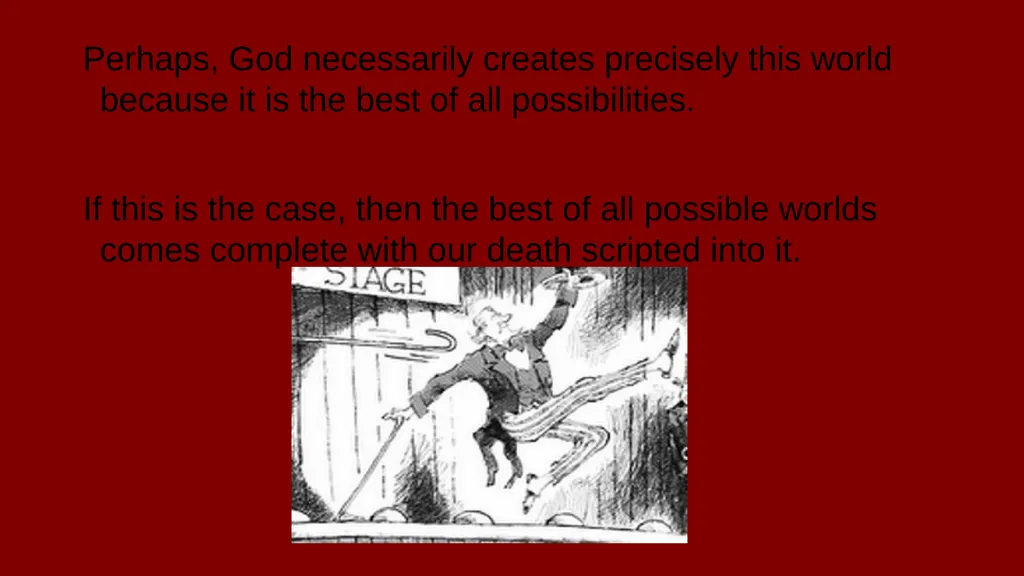
slide14. Perhaps, God necessarily creates precisely this world because it is the best of all possibilities.
If this is the case, then the best of all possible worlds comes complete with our death scripted into it.<br>
slide15. Death and Taxes: Some Analogies Imagine a world in which lottery winners are allowed to enjoy their winnings for an unspecified amount of time, but are forced to return, without warning, the entire unused portion to the state.<br>
slide16. The whole of life is either miraculous, or it is a stroke of almost unimaginable good fortune.
To parody Tennyson, ‘tis (at least in most cases) better to have lived and lost, than to have never lived at all.<br>
slide2. As early as Thales, philosophers have argued that death is nothing to fear because the dead no longer exist and, therefore, cannot suffer or be harmed.<br>
slide3. If death is a misfortune at all, it falls into a class of misfortunes that can only be suffered by those who have received a prior unearned benefit.
Death should be regarded as a propitious misfortune because it befalls only those fortunate enough to have been afforded the opportunity to exist in the first place.<br>
slide4. If there is a God, then human existence is literally a miracle.
It is the product of the divine or, at least, divine design and intention. We are here because God decreed that it be so.<br>
slide5. If, on the other hand, there is no God, no designer, no deity of any kind, and if the existence of human life is, at root, the product of brute, unguided forces of nature, then our presence in the Universe is a statistical marvel.<br>
slide6. If life is a necessary prerequisite for death, and life is an unearned benefit of the highest order, then we must take our good fortune into account as we evaluate the alleged misfortune of death.
Death can be a misfortune only in roughly the same sense as (say) the tax payment that accompanies a lottery win.<br>
slide7. The Argument From Deprivation If S dies, then S is thereby deprived of all future experiences.
If S’s future experiences would have had overall positive value for S, the S’s death deprives S of that positive value.
If S is deprived of positive value, then S suffers a misfortune.
Therefore, if S dies, then S thereby suffers a misfortune (at least those in cases in which S’s future would have had overall positive value for S.)<br>
slide8. Death is an evil because it deprives one of the life experience that one would have otherwise had.
But if death does constitute deprivation, it can deprive us only of the goods or benefits associated with life.<br>
slide9. The Evolution and Birth Lotteries If organic life is the outcome of an unguided process of evolution, then the existence of the human species is a propitious accident.
We are all, therefore, fortunate that the wildly improbable appearance of the human species has actually, against all odds, occurred.<br>
slide10. The Evolution and Birth Lotteries In addition to this good fortune, however, there is an additional stroke of luck, for each individual of member of a species, that that particular individual came to exist.<br>
slide11. Consider, for example, persons who live predominantly painful lives. When they die, they are released from suffering and “deprived” only of a future that is not worth having.<br>
slide12. The Creation Lottery If there is a God, death is then part of the same design that permits each life.<br>
slide13. The Creation Lottery Each of us is tremendously fortunate that:
1. the evolution of the human species is a part of the creator’s chosen design plan.
2. we, as particular individuals, are a part of the human species within the chosen design plan.
God has scripted a play in which each performer runs out of lines before the final curtain.<br>
slide14. Perhaps, God necessarily creates precisely this world because it is the best of all possibilities.
If this is the case, then the best of all possible worlds comes complete with our death scripted into it.<br>
slide15. Death and Taxes: Some Analogies Imagine a world in which lottery winners are allowed to enjoy their winnings for an unspecified amount of time, but are forced to return, without warning, the entire unused portion to the state.<br>
slide16. The whole of life is either miraculous, or it is a stroke of almost unimaginable good fortune.
To parody Tennyson, ‘tis (at least in most cases) better to have lived and lost, than to have never lived at all.<br>