
Debasis Samanta Computer Science & Engineering

Description: Debasis Samanta Computer Science Engineering Indian Institute of Technology Kharagpur Spring-2017 Programming and Data Structures Lecture 7 Sorting algorithms Lecture 07: DSamanta CS 10001 : Programming and Data Structures 2
Related Topics
Download Presentation
"Debasis Samanta Computer Science & Engineering" is the property of its rightful owner. Permission is granted to download and print the materials on this website for personal, non-commercial use only, and to display it on your personal computer provided you do not modify the materials and that you retain all copyright notices contained in the materials. By downloading content from our website, you accept the terms of this agreement.
Presentation Transcript
slide1. Debasis Samanta
Computer Science & Engineering
Indian Institute of Technology Kharagpur
Spring-2017 Programming and Data Structures<br>
slide2. Lecture #7
Sorting algorithms Lecture #07: © DSamanta CS 10001 : Programming and Data Structures 2<br>
slide3. Introduction
Different sorting algorithms
Sorting by distribution Today’s Discussion… CS 10001 : Programming and Data Structures 3 Lecture #07: © DSamanta<br>
slide4. Introduction CS 11001 : Programming and Data Structures 4 Lecture #11: © DSamanta<br>
slide5. Sorting – The Task CS 10001 : Programming and Data Structures 5 Lecture #07: © DSamanta Given an array
x[0], x[1], … , x[size-1]
reorder entries so that
x[0] <= x[1] <= . . . <= x[size-1]
Here, List is in non-decreasing order.
We can also sort a list of elements in non-increasing order.<br>
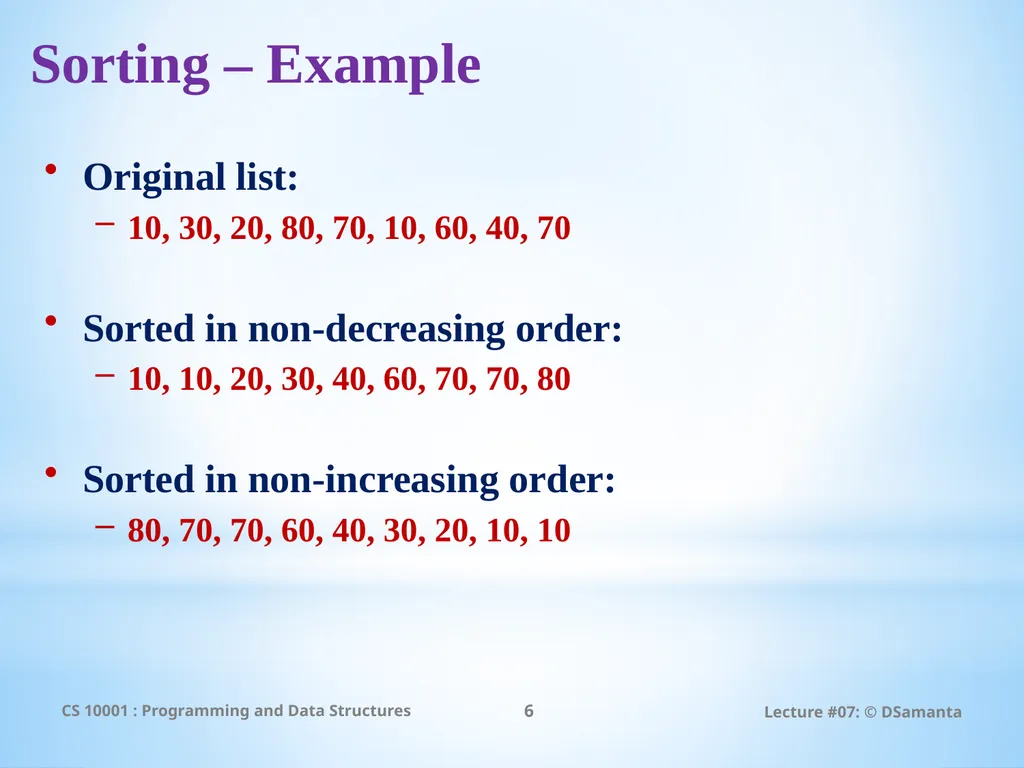
slide6. Sorting – Example CS 10001 : Programming and Data Structures 6 Lecture #07: © DSamanta Original list:
10, 30, 20, 80, 70, 10, 60, 40, 70
Sorted in non-decreasing order:
10, 10, 20, 30, 40, 60, 70, 70, 80
Sorted in non-increasing order:
80, 70, 70, 60, 40, 30, 20, 10, 10<br>
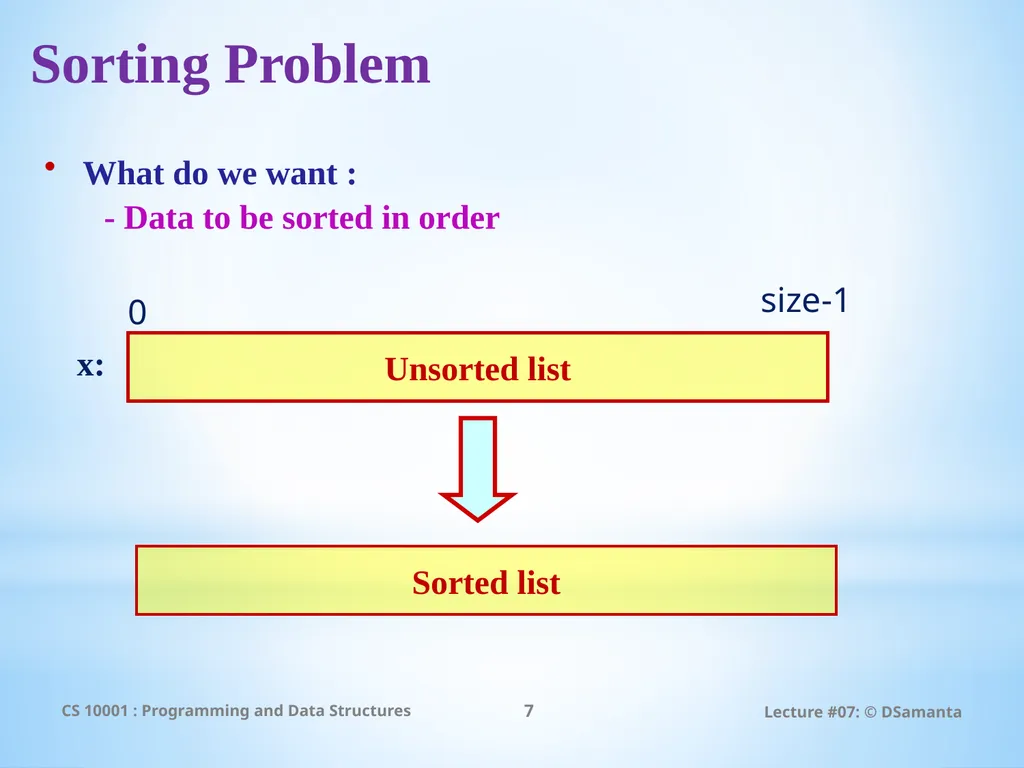
slide7. Sorting Problem CS 10001 : Programming and Data Structures 7 Lecture #07: © DSamanta Unsorted list What do we want :
- Data to be sorted in order x: 0 size-1 Sorted list<br>
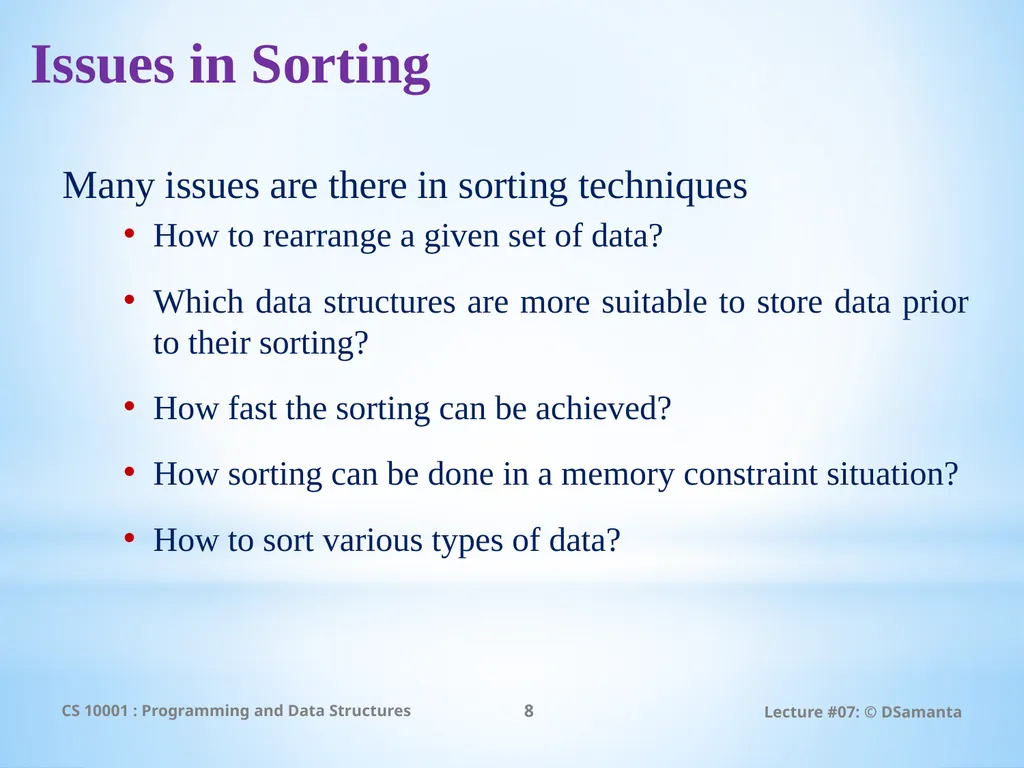
slide8. Issues in Sorting CS 10001 : Programming and Data Structures 8 Lecture #07: © DSamanta Many issues are there in sorting techniques
How to rearrange a given set of data?
Which data structures are more suitable to store data prior to their sorting?
How fast the sorting can be achieved?
How sorting can be done in a memory constraint situation?
How to sort various types of data?<br>
slide9. Sorting Algorithms CS 11001 : Programming and Data Structures 9 Lecture #11: © DSamanta<br>
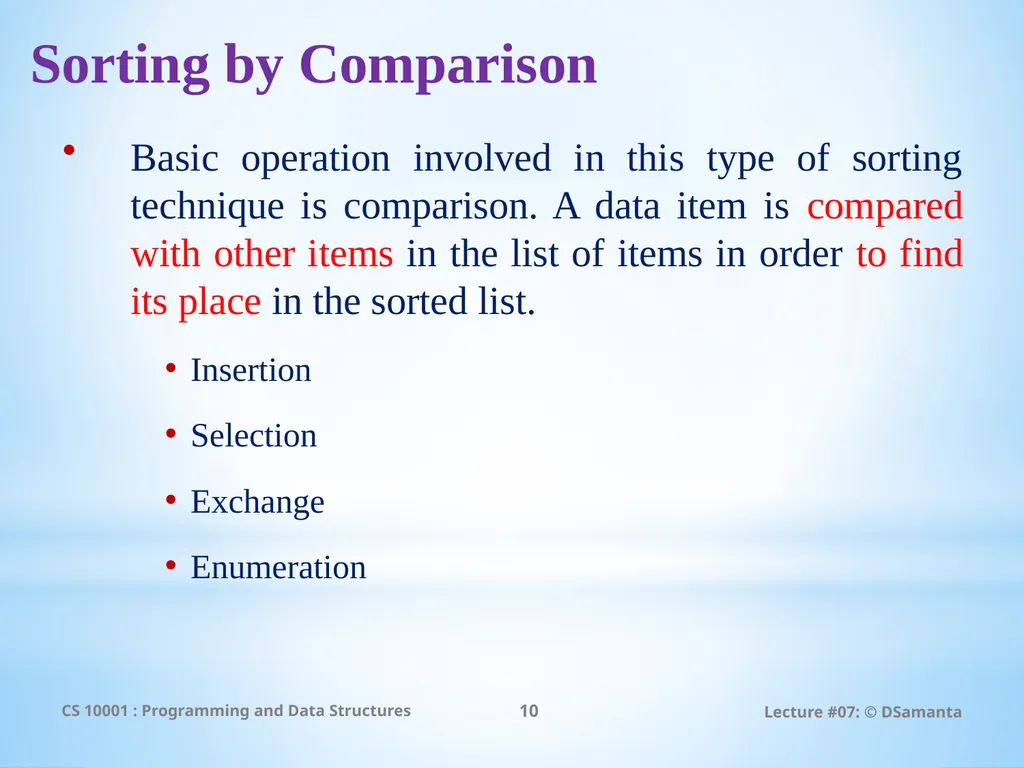
slide10. Sorting by Comparison CS 10001 : Programming and Data Structures 10 Lecture #07: © DSamanta Basic operation involved in this type of sorting technique is comparison. A data item is compared with other items in the list of items in order to find its place in the sorted list.
Insertion
Selection
Exchange
Enumeration<br>
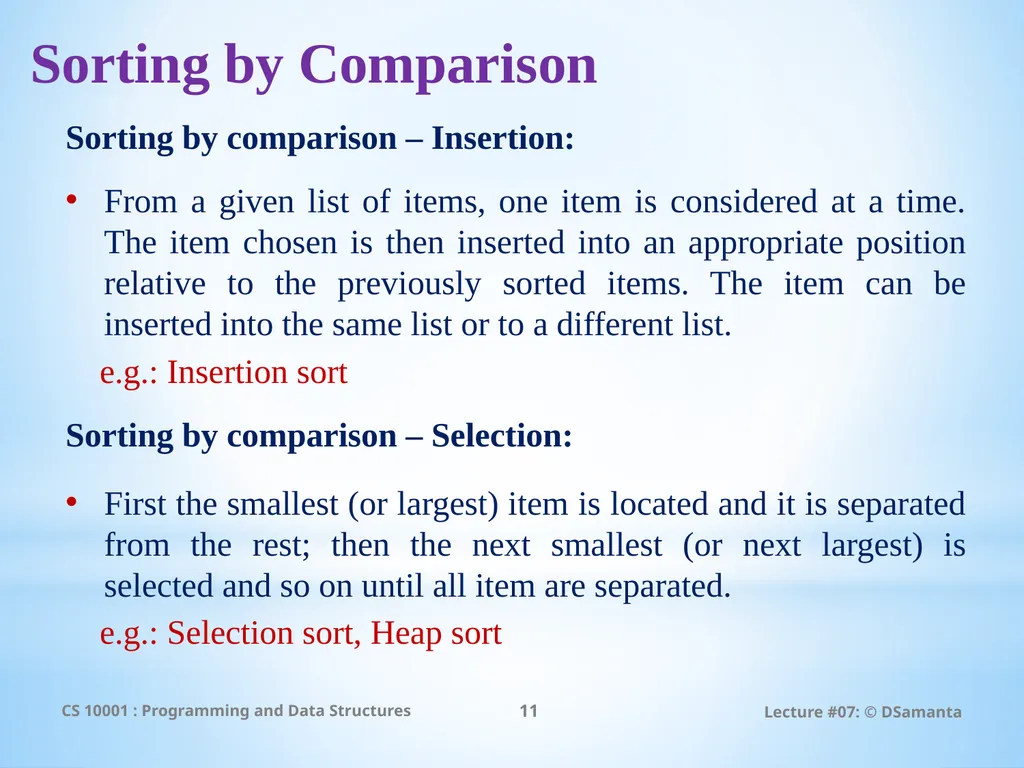
slide11. Sorting by Comparison CS 10001 : Programming and Data Structures 11 Lecture #07: © DSamanta Sorting by comparison – Insertion:
From a given list of items, one item is considered at a time. The item chosen is then inserted into an appropriate position relative to the previously sorted items. The item can be inserted into the same list or to a different list.
e.g.: Insertion sort
Sorting by comparison – Selection:
First the smallest (or largest) item is located and it is separated from the rest; then the next smallest (or next largest) is selected and so on until all item are separated.
e.g.: Selection sort, Heap sort<br>
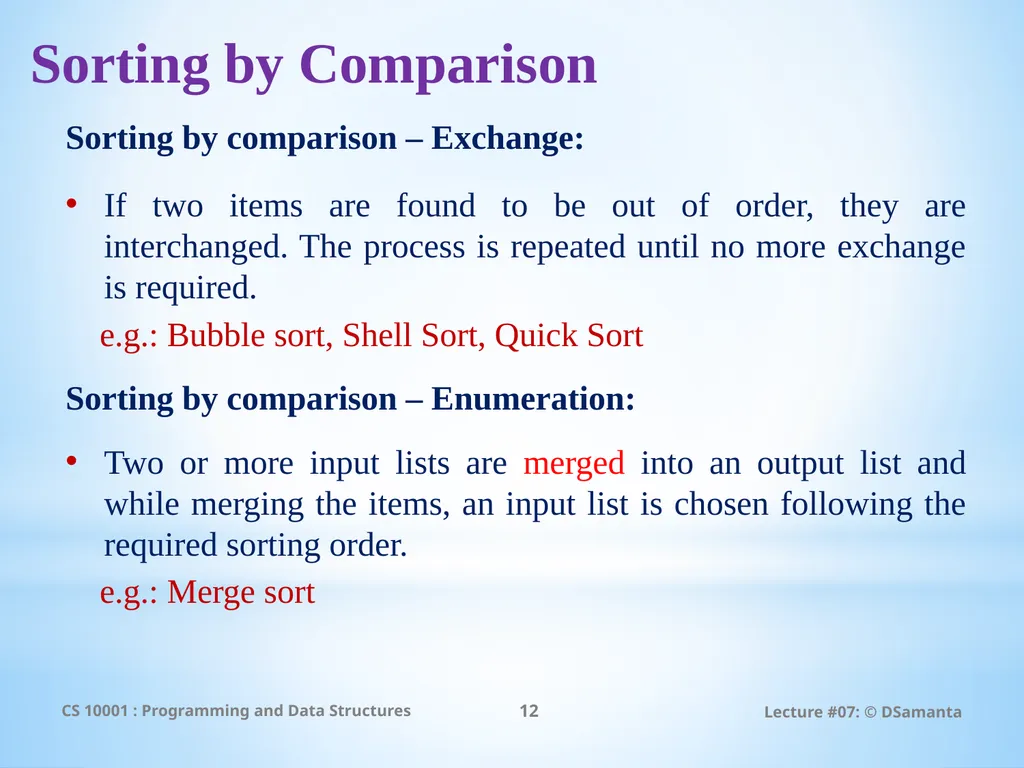
slide12. Sorting by Comparison CS 10001 : Programming and Data Structures 12 Lecture #07: © DSamanta Sorting by comparison – Exchange:
If two items are found to be out of order, they are interchanged. The process is repeated until no more exchange is required.
e.g.: Bubble sort, Shell Sort, Quick Sort
Sorting by comparison – Enumeration:
Two or more input lists are merged into an output list and while merging the items, an input list is chosen following the required sorting order.
e.g.: Merge sort<br>
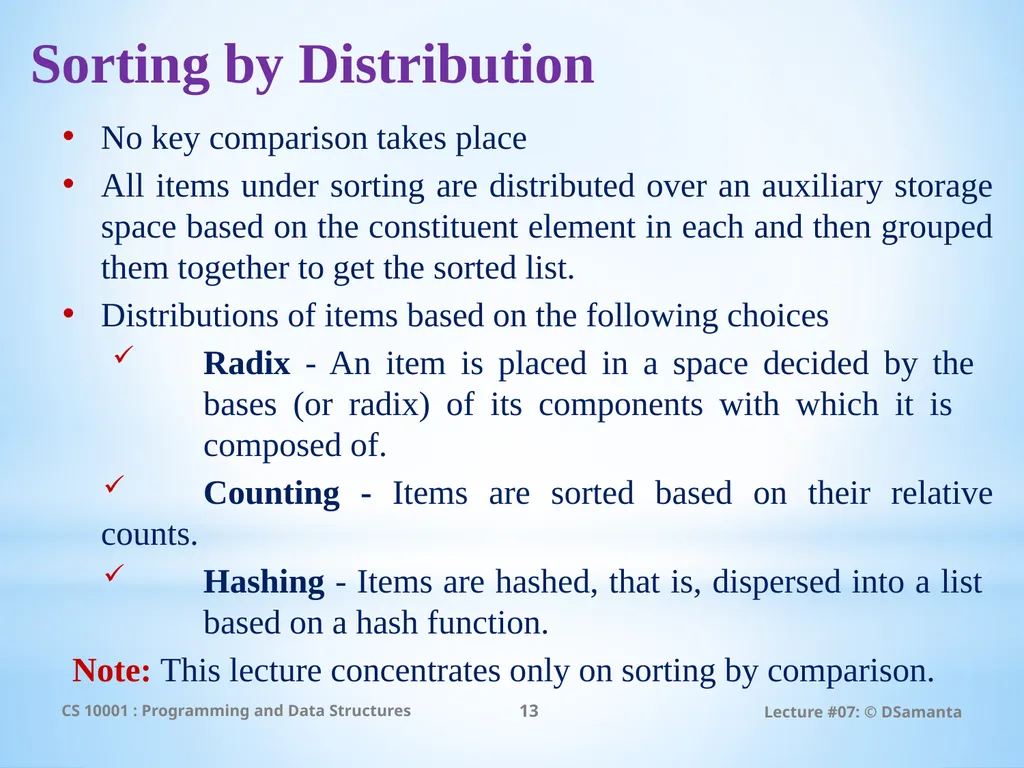
slide13. Sorting by Distribution CS 10001 : Programming and Data Structures 13 Lecture #07: © DSamanta No key comparison takes place
All items under sorting are distributed over an auxiliary storage space based on the constituent element in each and then grouped them together to get the sorted list.
Distributions of items based on the following choices
Radix - An item is placed in a space decided by the bases (or radix) of its components with which it is composed of.
Counting - Items are sorted based on their relative counts.
Hashing - Items are hashed, that is, dispersed into a list based on a hash function.
Note: This lecture concentrates only on sorting by comparison.<br>
slide14. Insertion Sort CS 10001 : Programming and Data Structures 14 Lecture #07: © DSamanta<br>
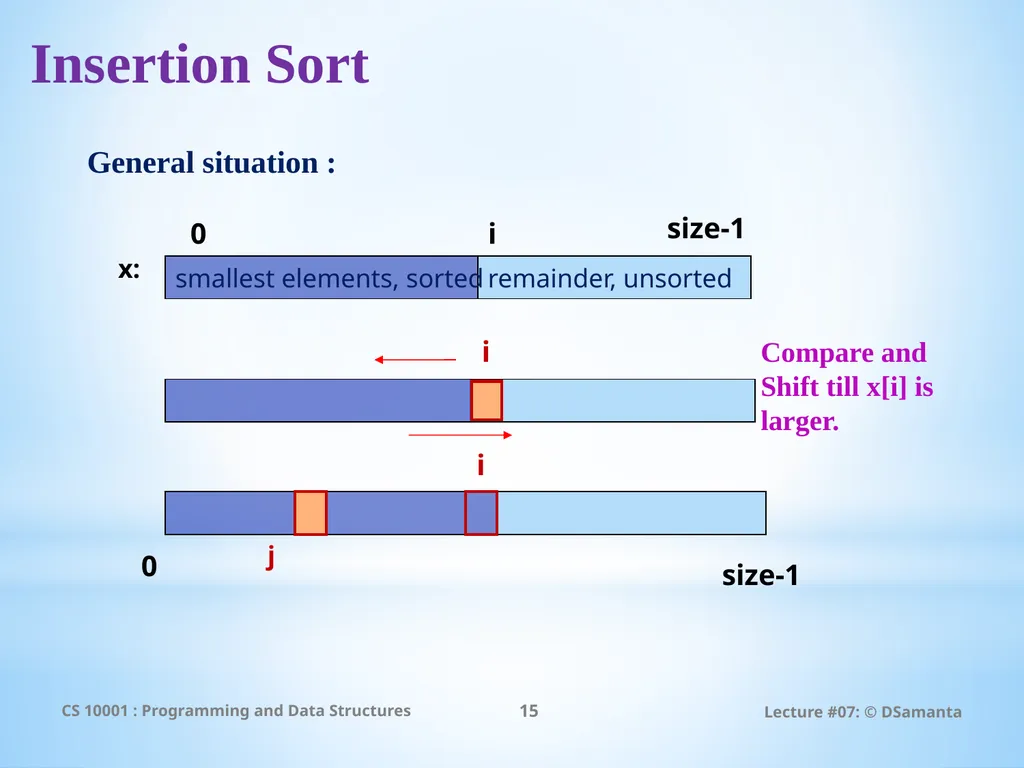
slide15. Insertion Sort CS 10001 : Programming and Data Structures 15 Lecture #07: © DSamanta General situation : remainder, unsorted smallest elements, sorted 0 size-1 i x: i j Compare and
Shift till x[i] is
larger.<br>
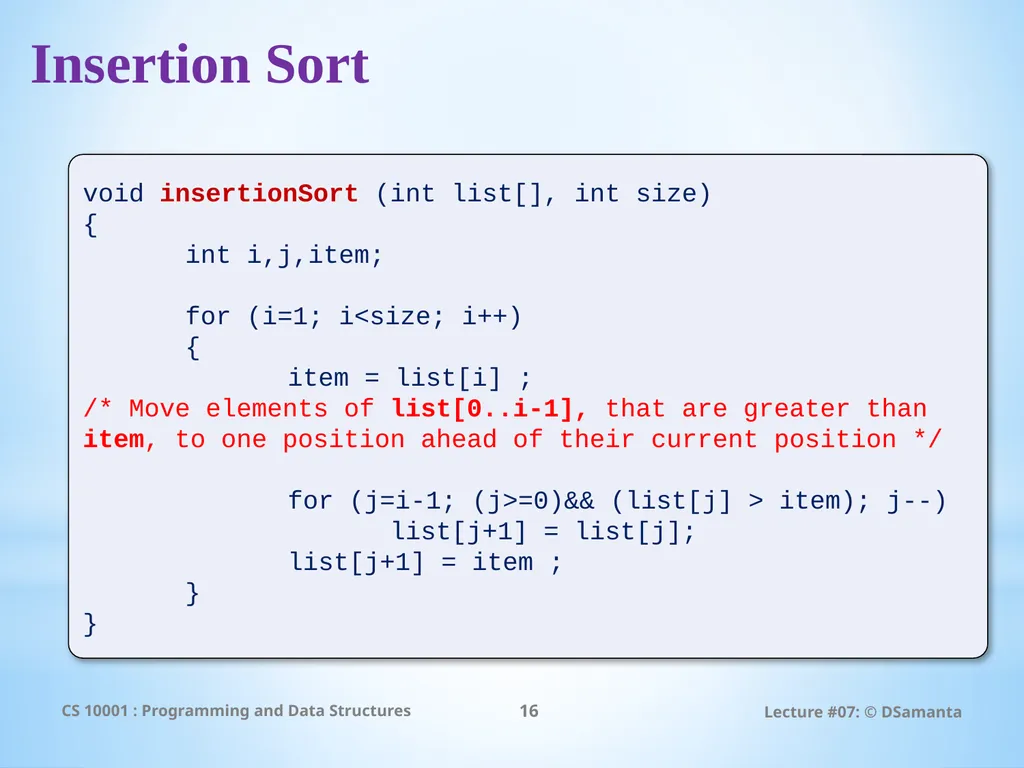
slide16. Insertion Sort CS 10001 : Programming and Data Structures 16 Lecture #07: © DSamanta void insertionSort (int list[], int size)
{
int i,j,item;
for (i=1; i<size; i++)
{
item = list[i] ;
/* Move elements of list[0..i-1], that are greater than item, to one position ahead of their current position */
for (j=i-1; (j>=0)&& (list[j] > item); j--)
list[j+1] = list[j];
list[j+1] = item ;
}
}<br>
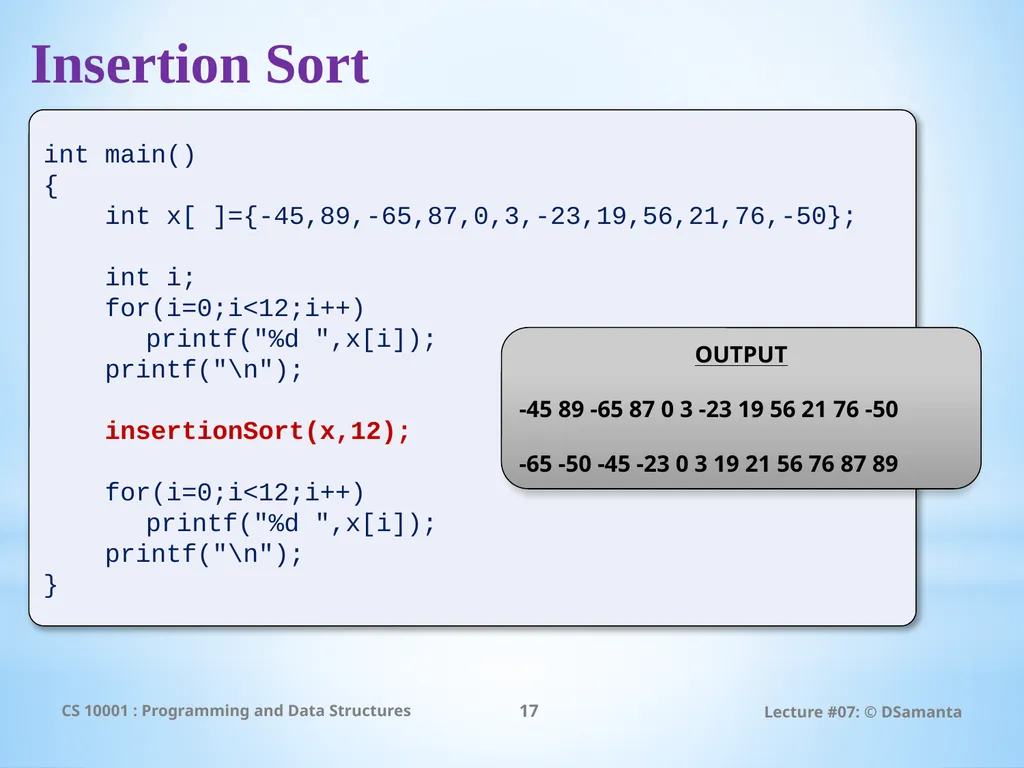
slide17. Insertion Sort CS 10001 : Programming and Data Structures 17 Lecture #07: © DSamanta int main()
{
int x[ ]={-45,89,-65,87,0,3,-23,19,56,21,76,-50};
int i;
for(i=0;i<12;i++)
printf("%d ",x[i]);
printf("\n");
insertionSort(x,12);
for(i=0;i<12;i++)
printf("%d ",x[i]);
printf("\n");
} OUTPUT
-45 89 -65 87 0 3 -23 19 56 21 76 -50
-65 -50 -45 -23 0 3 19 21 56 76 87 89<br>
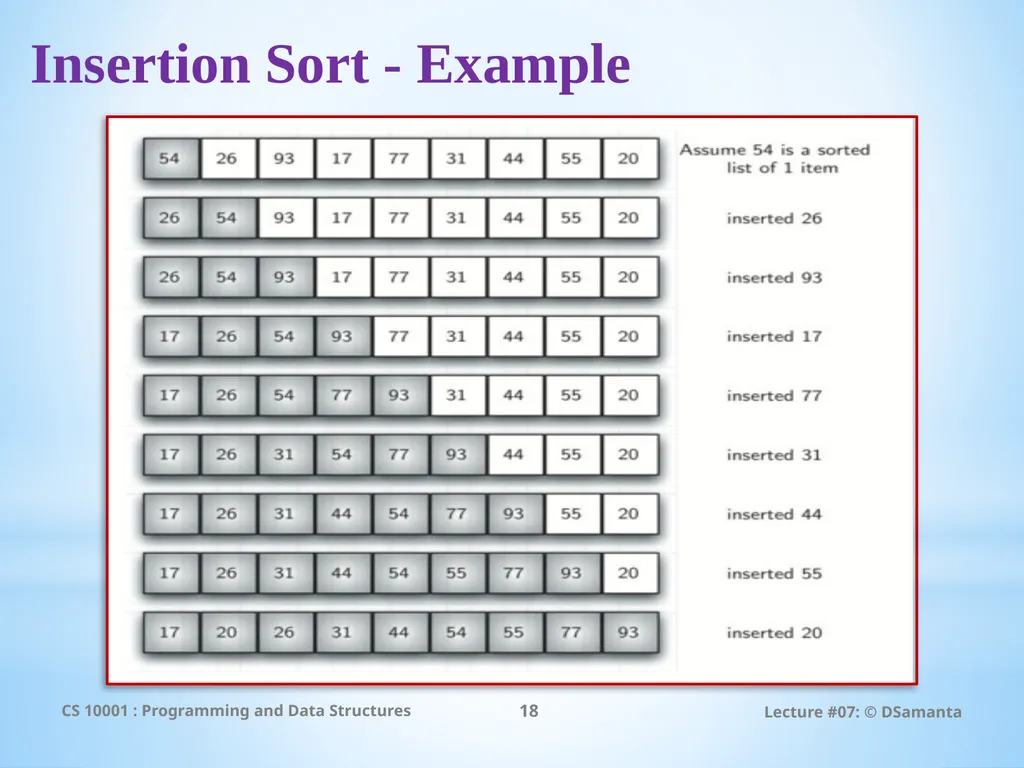
slide18. Lecture #07: © DSamanta CS 10001 : Programming and Data Structures 18 Insertion Sort - Example<br>
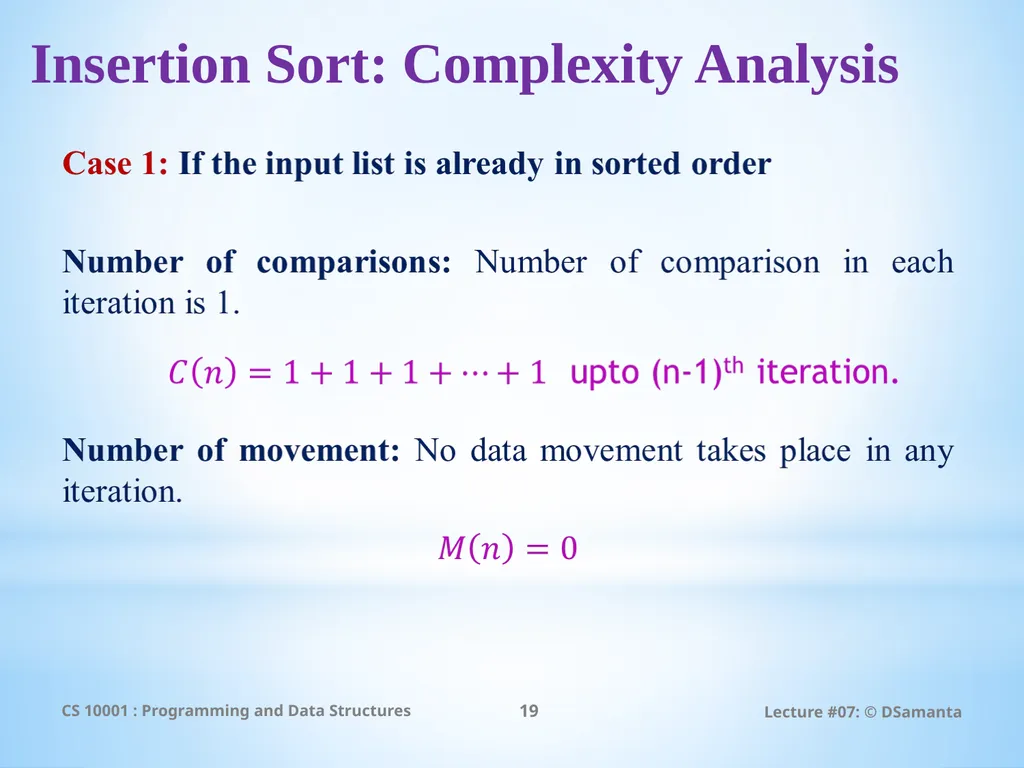
slide19. Insertion Sort: Complexity Analysis CS 10001 : Programming and Data Structures 19 Lecture #07: © DSamanta<br>
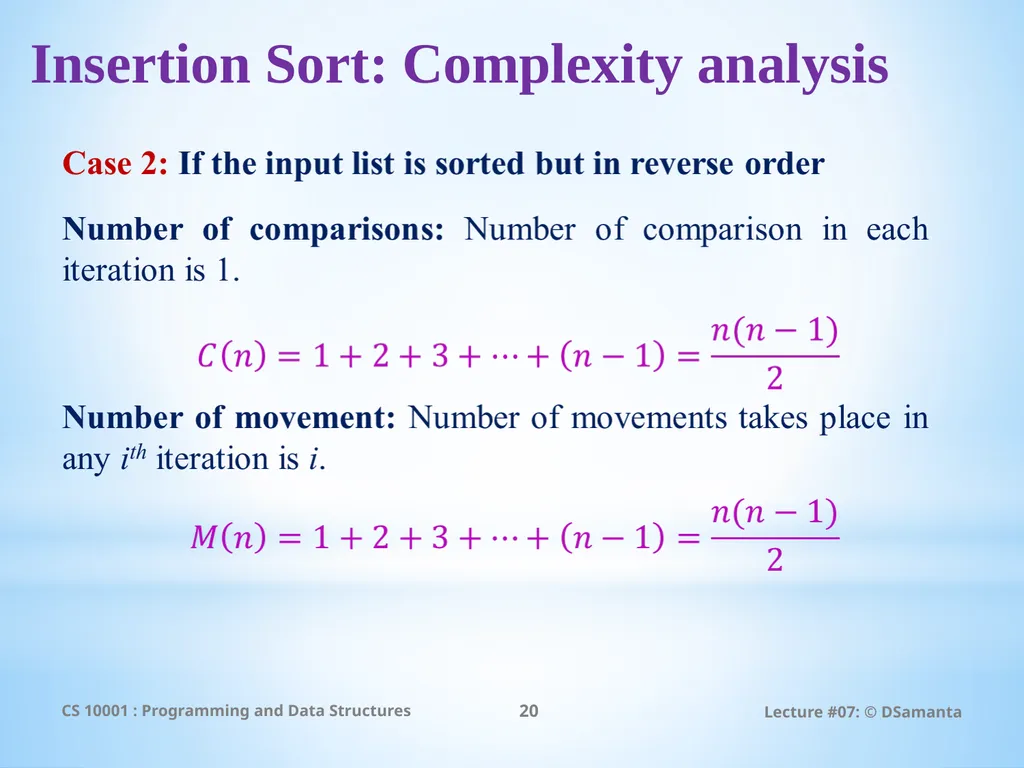
slide20. Insertion Sort: Complexity analysis CS 10001 : Programming and Data Structures 20 Lecture #07: © DSamanta<br>
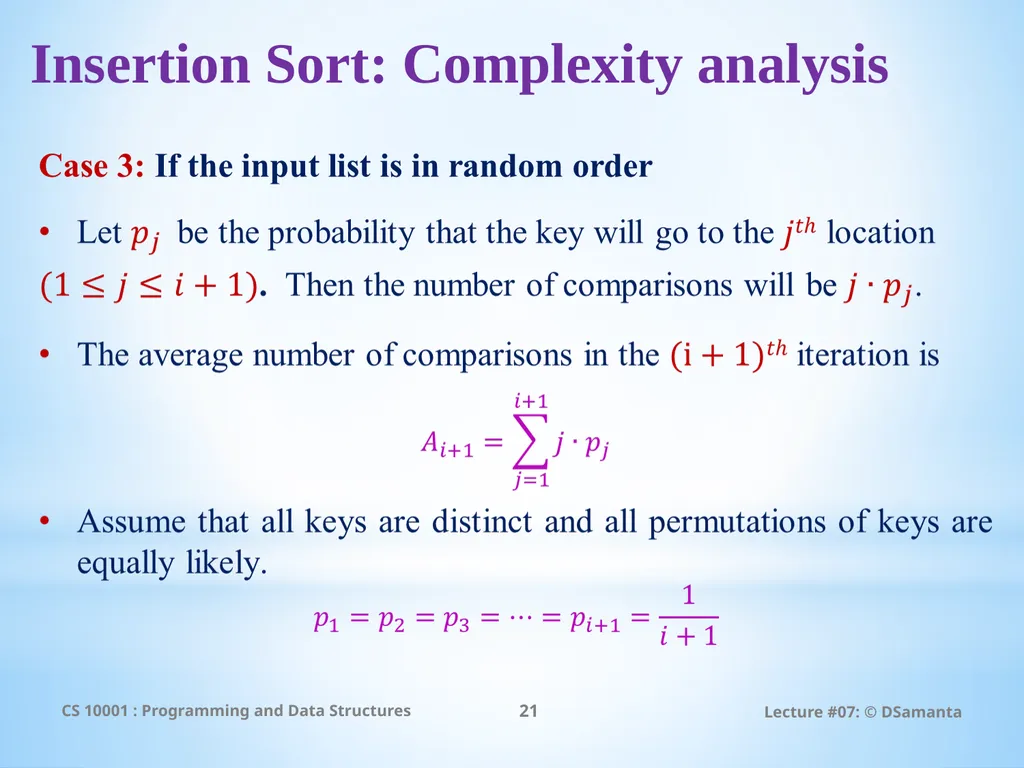
slide21. Insertion Sort: Complexity analysis CS 10001 : Programming and Data Structures 21 Lecture #07: © DSamanta<br>
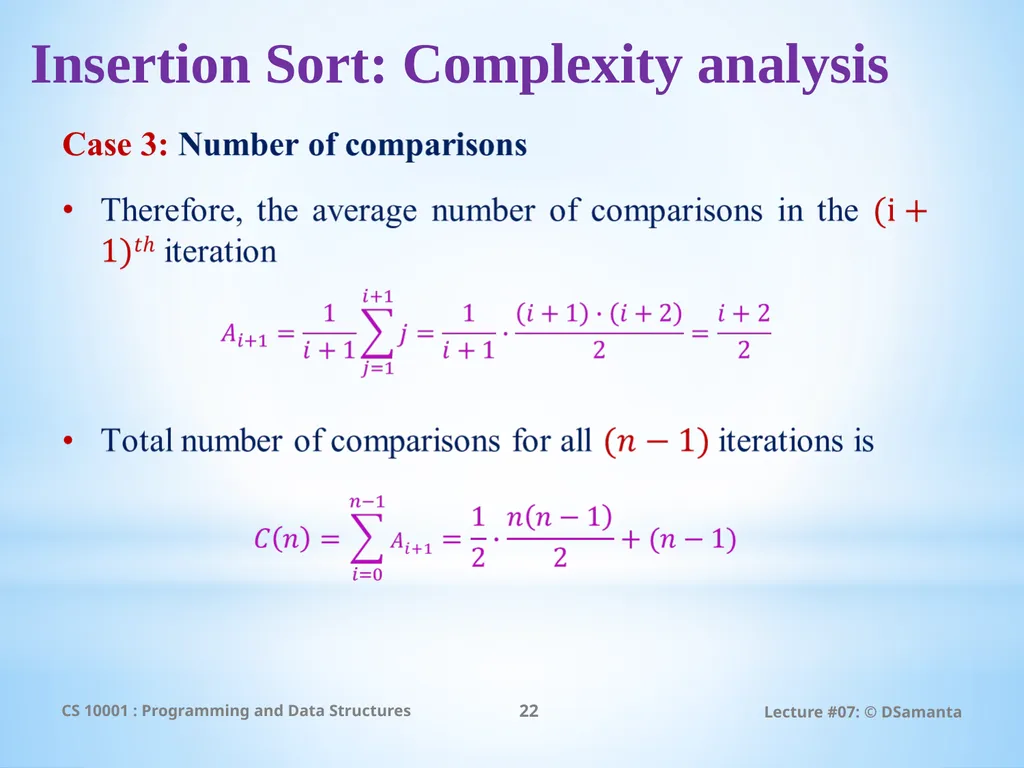
slide22. Insertion Sort: Complexity analysis CS 10001 : Programming and Data Structures 22 Lecture #07: © DSamanta<br>
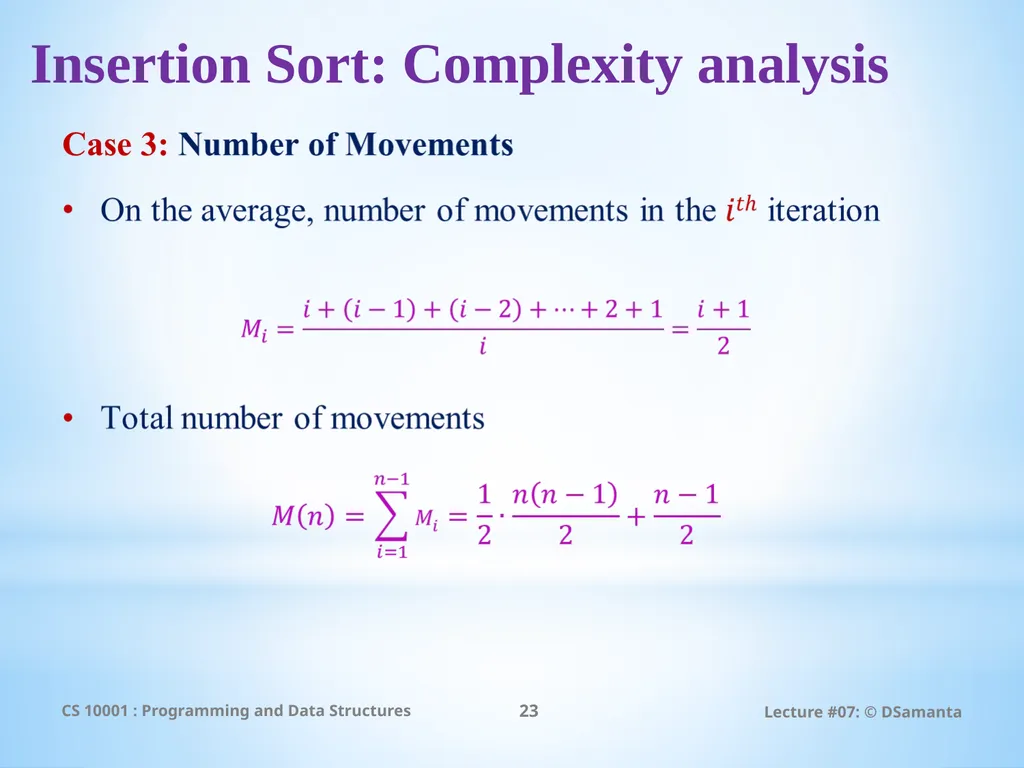
slide23. Insertion Sort: Complexity analysis CS 10001 : Programming and Data Structures 23 Lecture #07: © DSamanta<br>
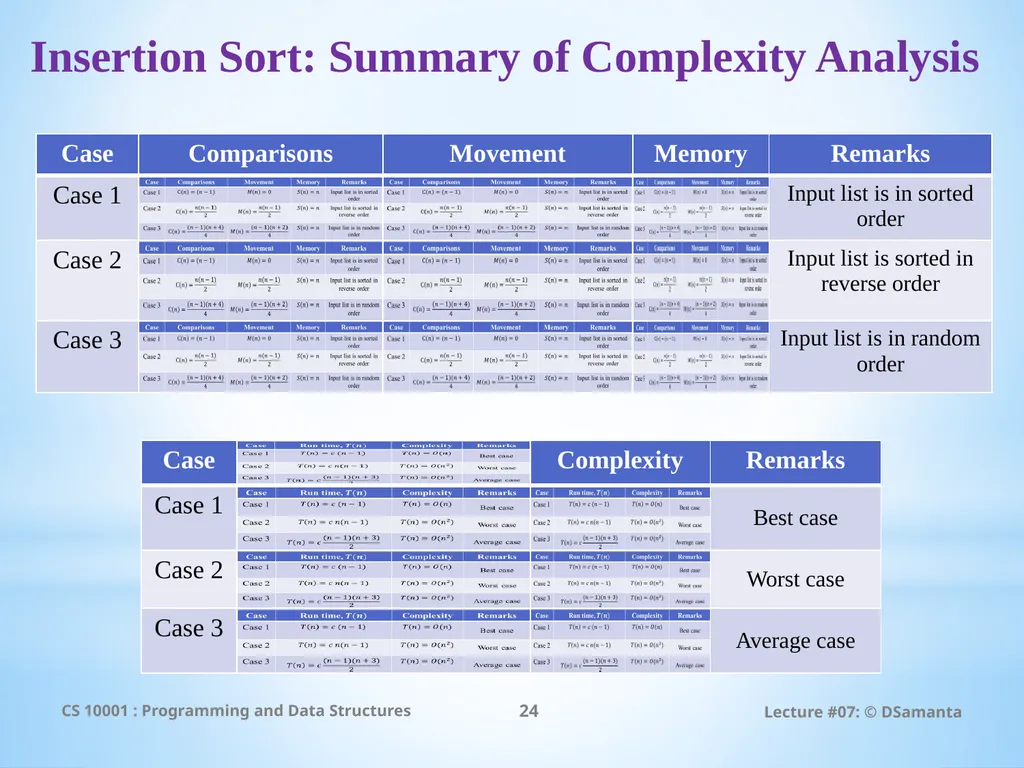
slide24. Insertion Sort: Summary of Complexity Analysis CS 10001 : Programming and Data Structures 24 Lecture #07: © DSamanta<br>
slide25. Selection Sort CS 10001 : Programming and Data Structures 25 Lecture #07: © DSamanta<br>
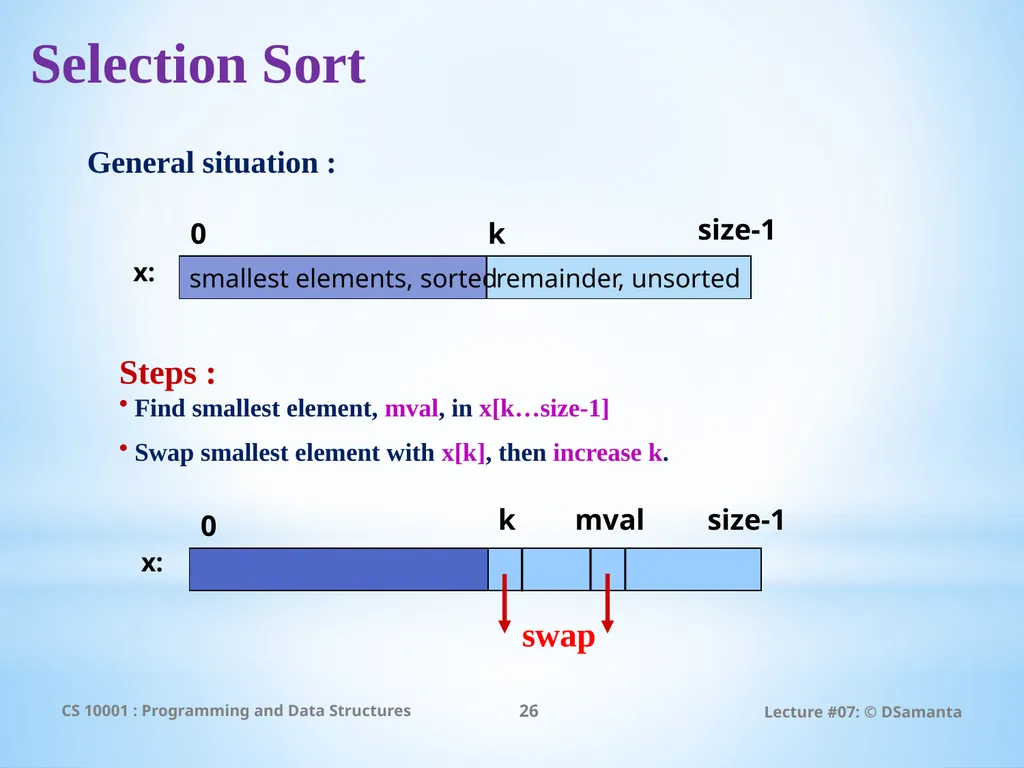
slide26. Selection Sort CS 10001 : Programming and Data Structures 26 Lecture #07: © DSamanta General situation : remainder, unsorted smallest elements, sorted 0 size-1 k x: Steps :
Find smallest element, mval, in x[k…size-1]
Swap smallest element with x[k], then increase k. 0 k size-1 mval swap x:<br>
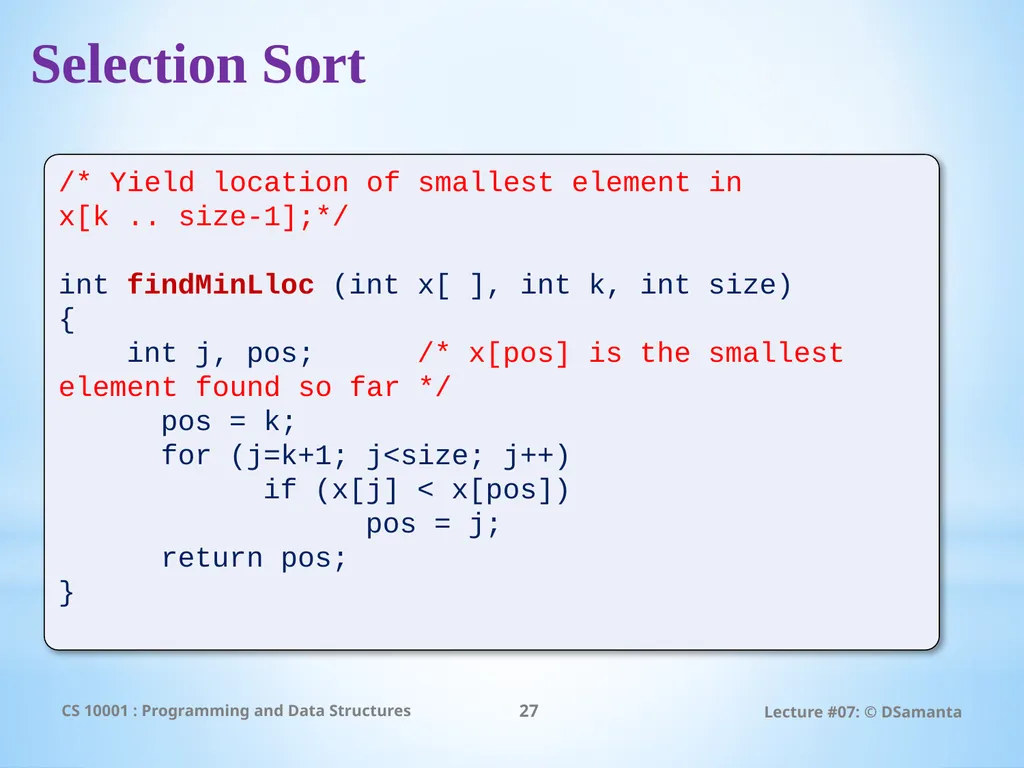
slide27. Selection Sort CS 10001 : Programming and Data Structures 27 Lecture #07: © DSamanta /* Yield location of smallest element in
x[k .. size-1];*/
int findMinLloc (int x[ ], int k, int size)
{
int j, pos; /* x[pos] is the smallest element found so far */
pos = k;
for (j=k+1; j<size; j++)
if (x[j] < x[pos])
pos = j;
return pos;
}<br>
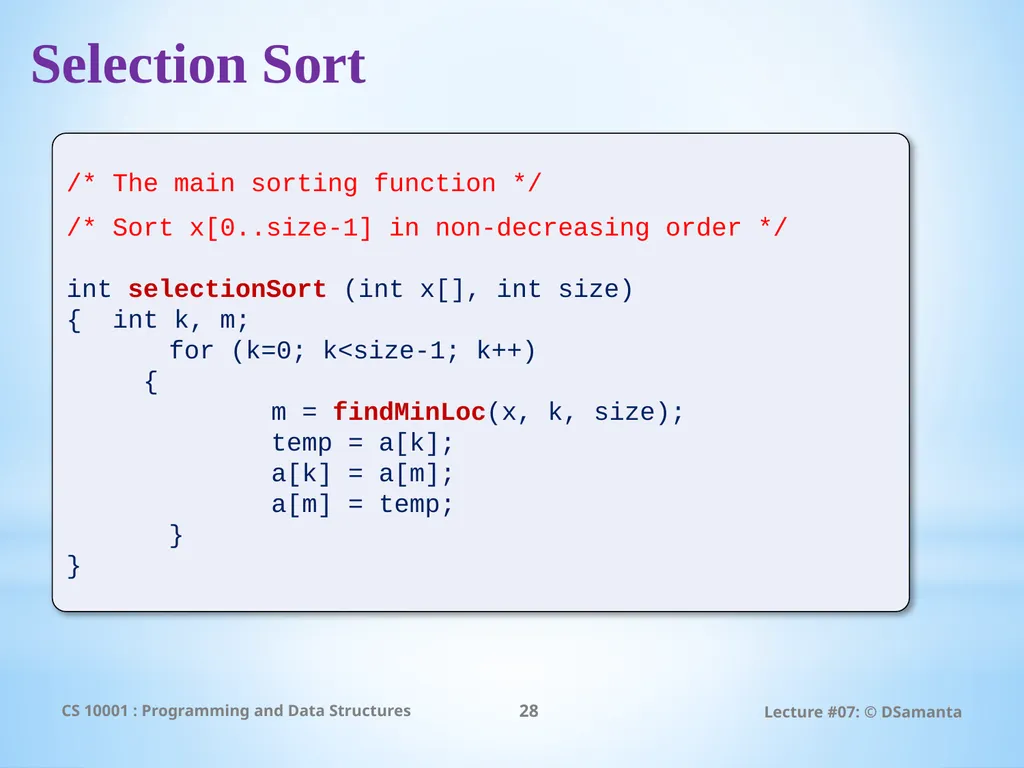
slide28. Selection Sort CS 10001 : Programming and Data Structures 28 Lecture #07: © DSamanta /* The main sorting function */
/* Sort x[0..size-1] in non-decreasing order */
int selectionSort (int x[], int size)
{ int k, m;
for (k=0; k<size-1; k++)
{
m = findMinLoc(x, k, size);
temp = a[k];
a[k] = a[m];
a[m] = temp;
}
}<br>
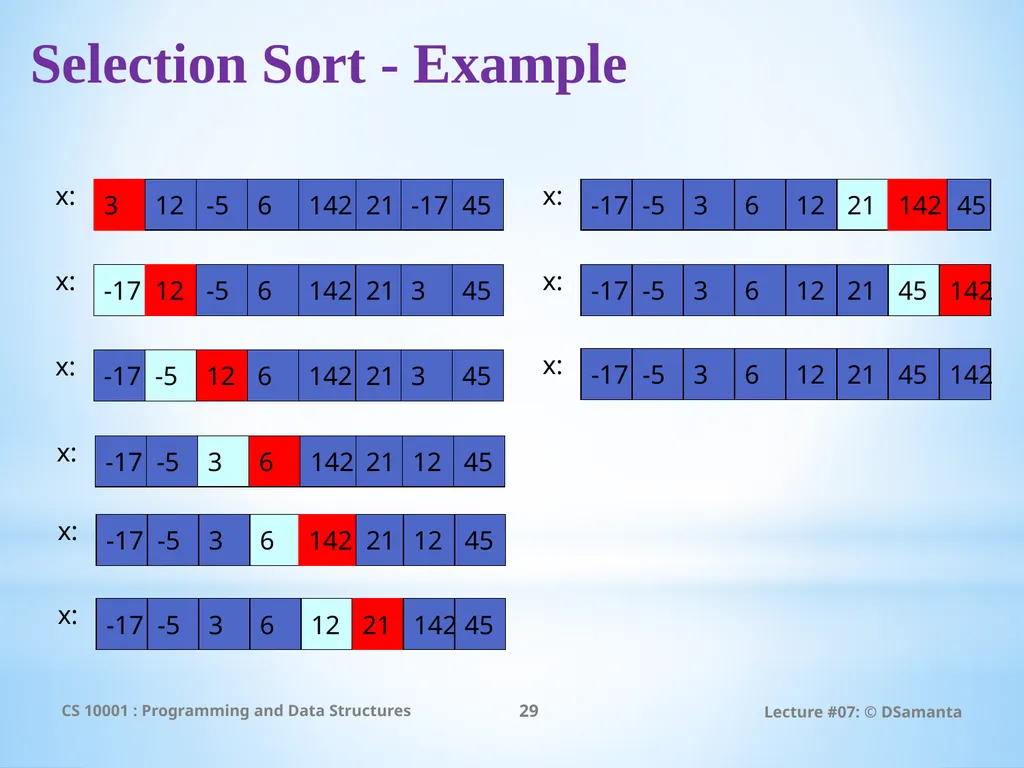
slide29. Selection Sort - Example CS 10001 : Programming and Data Structures 29 Lecture #07: © DSamanta 3 12 -5 6 142 21 -17 45 x: 12<br>
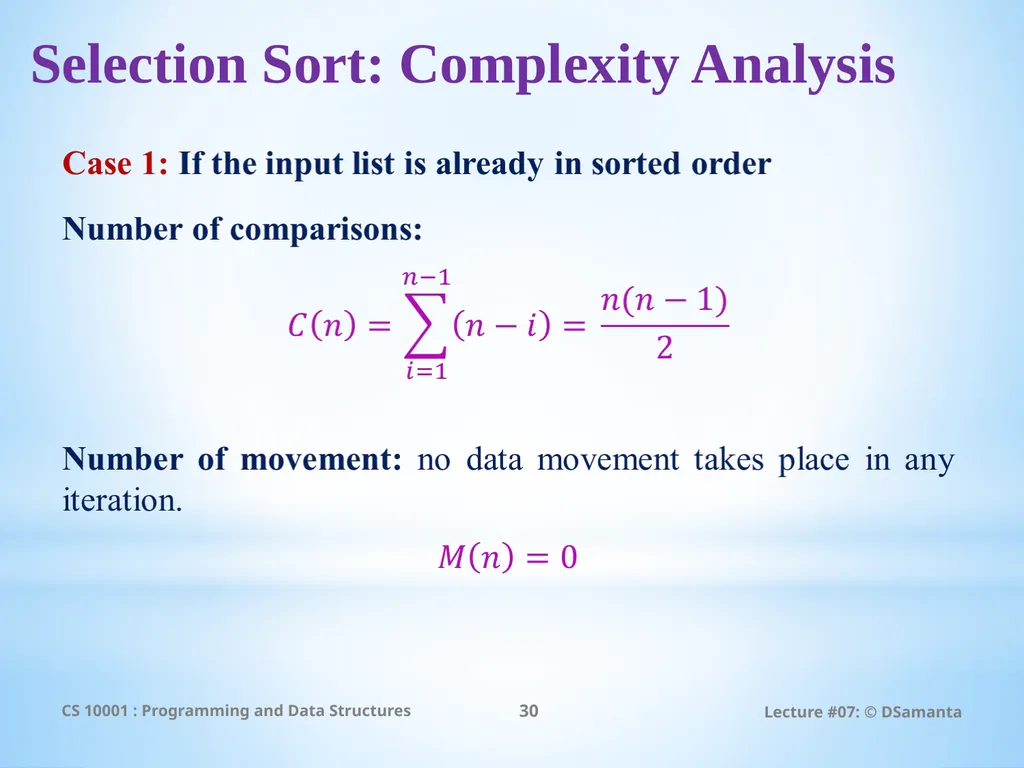
slide30. Selection Sort: Complexity Analysis CS 10001 : Programming and Data Structures 30 Lecture #07: © DSamanta<br>
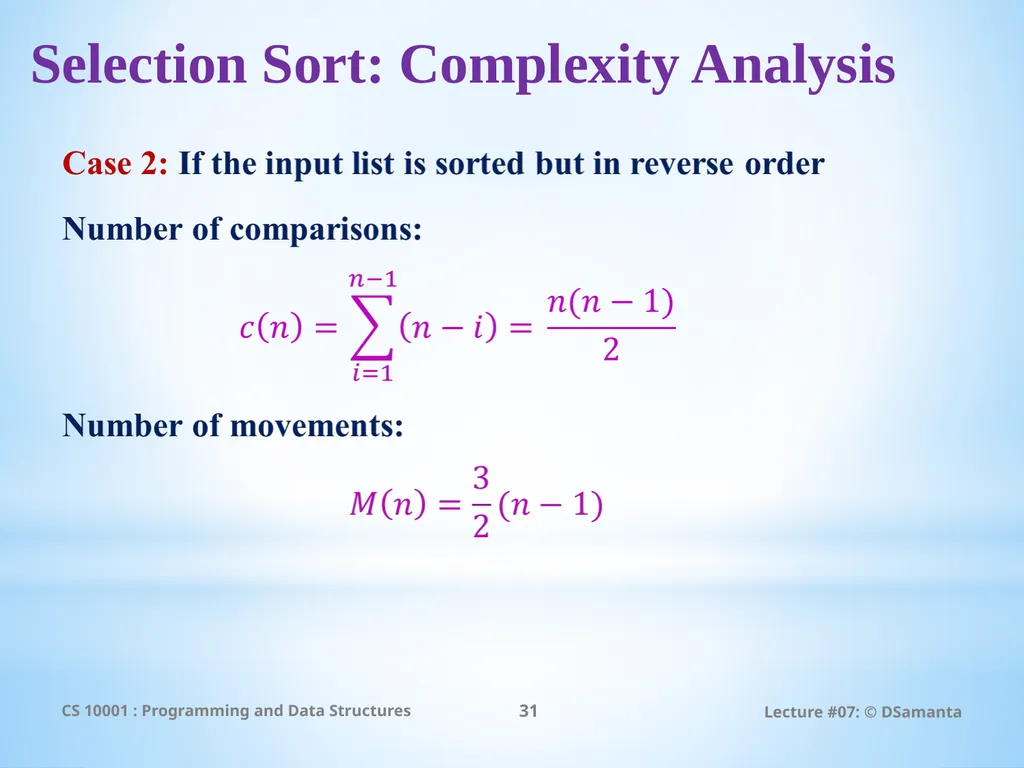
slide31. Selection Sort: Complexity Analysis CS 10001 : Programming and Data Structures 31 Lecture #07: © DSamanta<br>
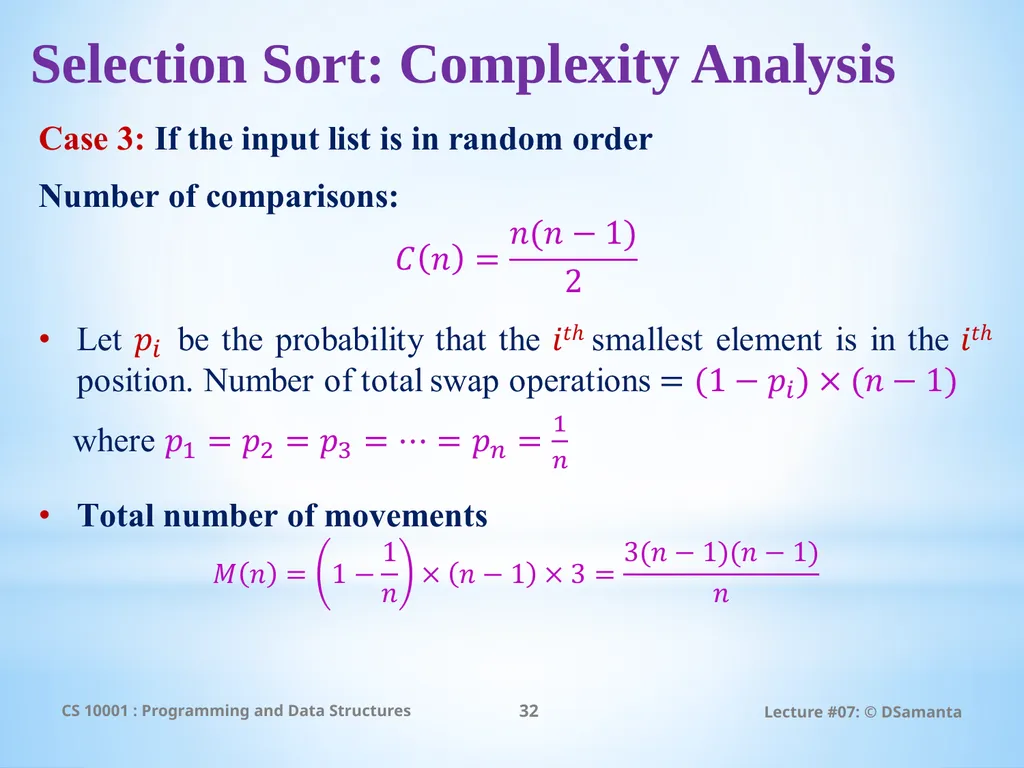
slide32. Selection Sort: Complexity Analysis CS 10001 : Programming and Data Structures 32 Lecture #07: © DSamanta<br>
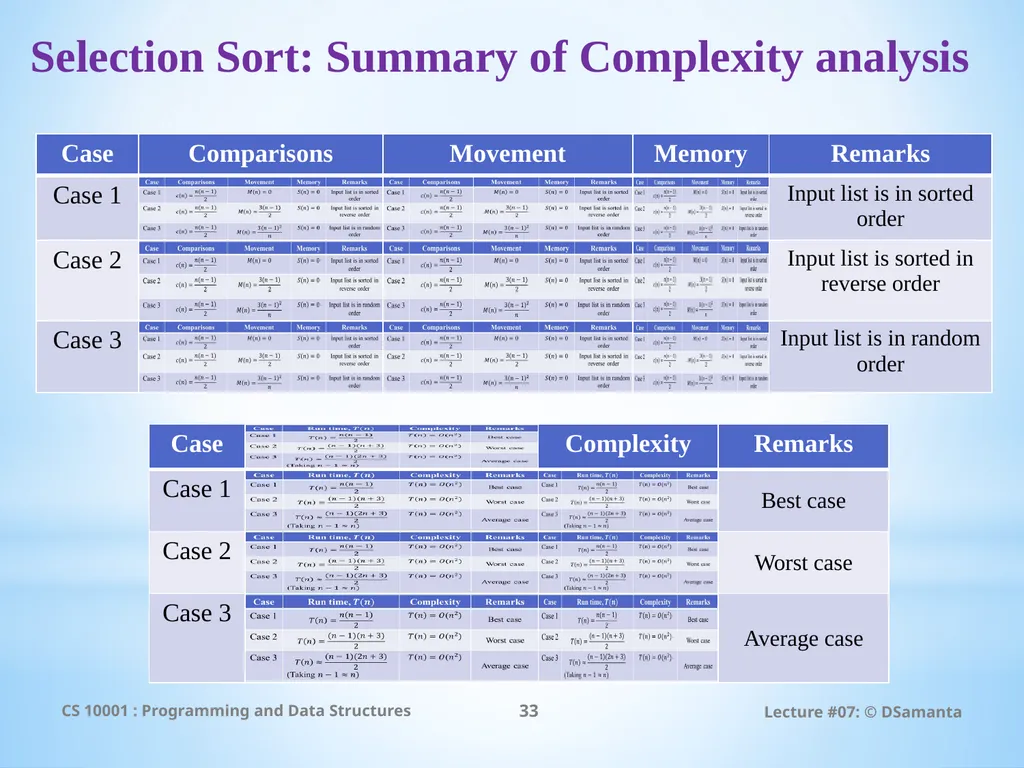
slide33. Selection Sort: Summary of Complexity analysis CS 10001 : Programming and Data Structures 33 Lecture #07: © DSamanta<br>
slide34. Bubble Sort CS 10001 : Programming and Data Structures 34 Lecture #07: © DSamanta<br>
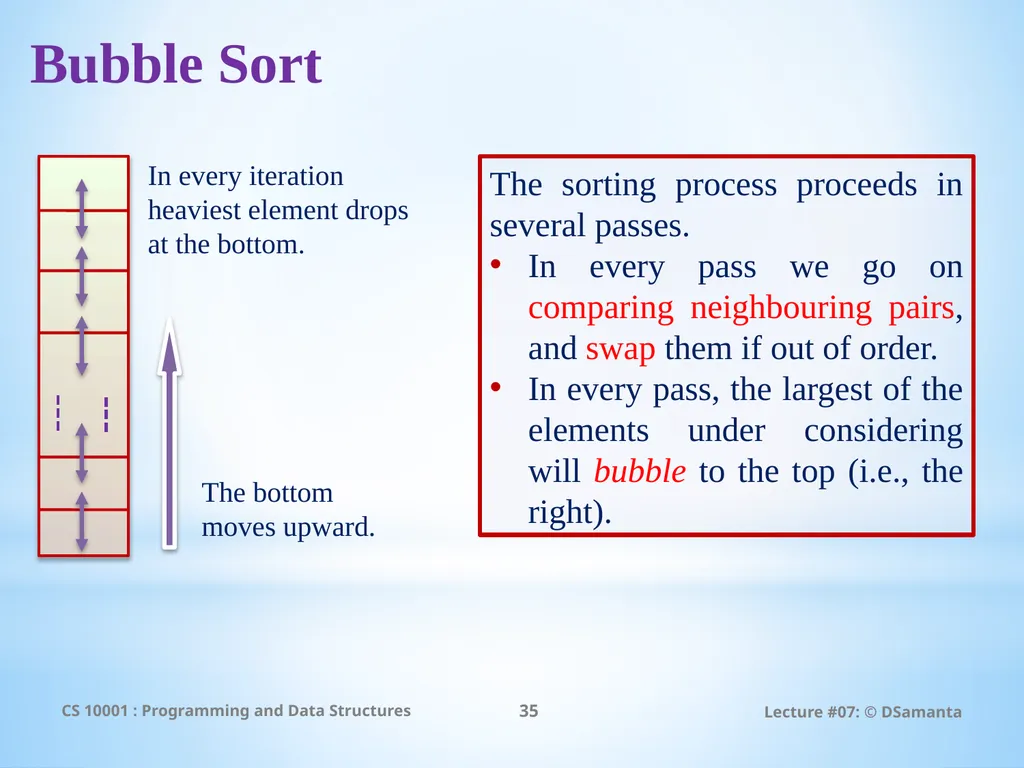
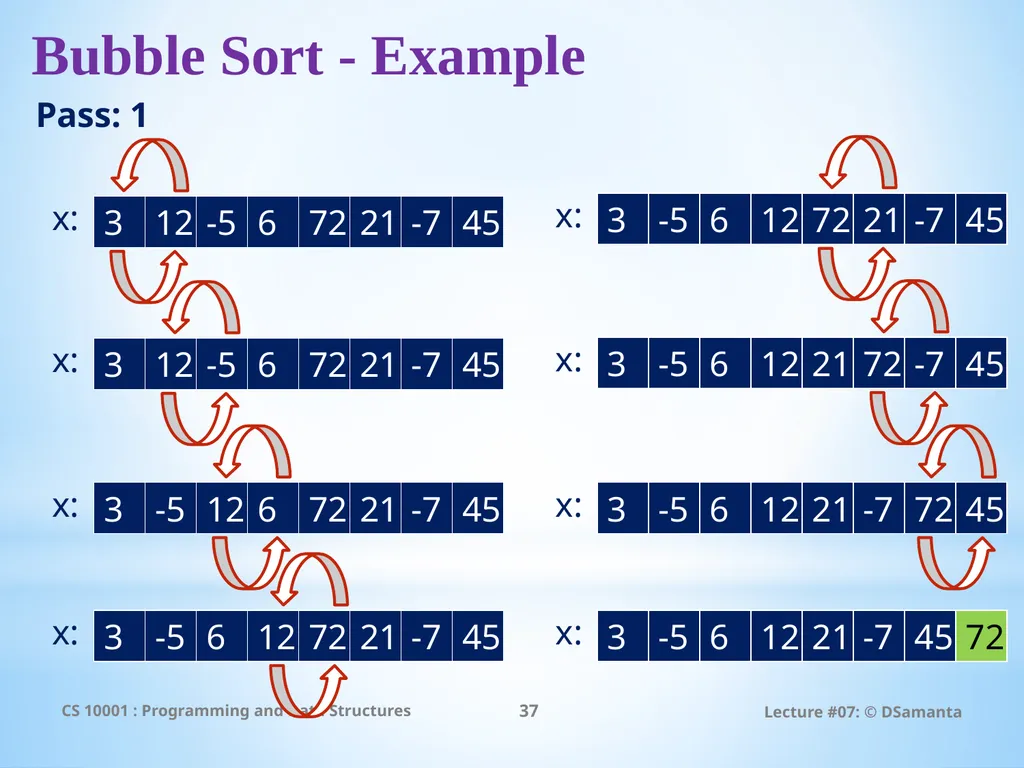
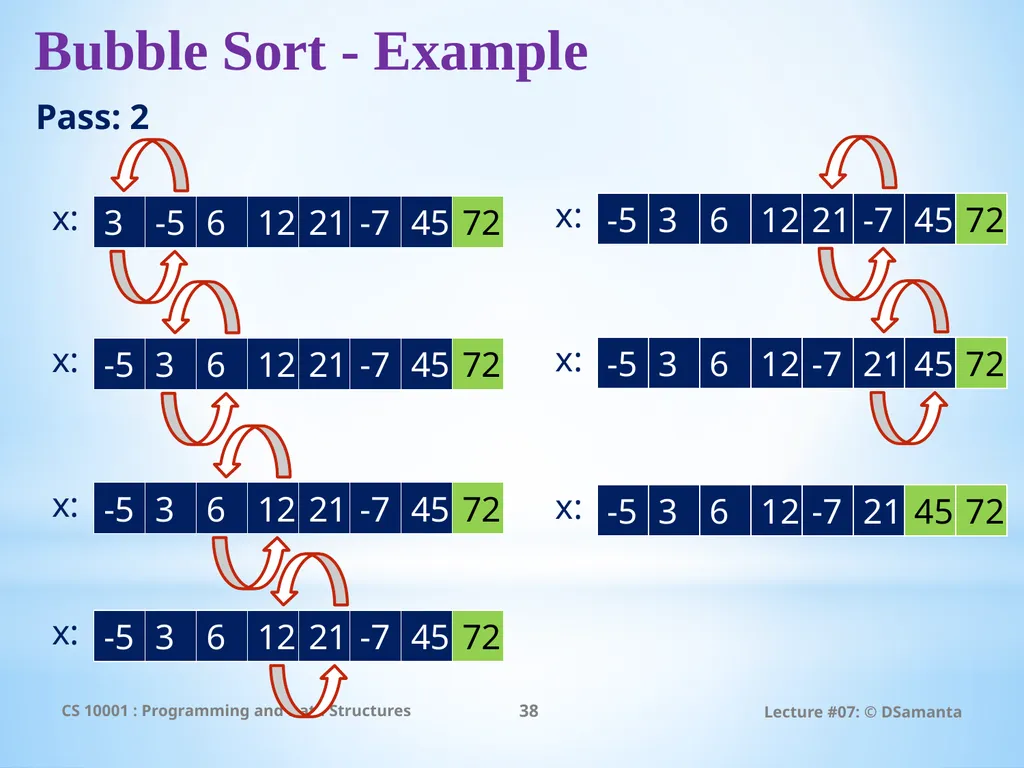
slide35. Bubble Sort CS 10001 : Programming and Data Structures 35 Lecture #07: © DSamanta The sorting process proceeds in several passes.
In every pass we go on comparing neighbouring pairs, and swap them if out of order.
In every pass, the largest of the elements under considering will bubble to the top (i.e., the right). In every iteration heaviest element drops at the bottom. The bottom moves upward.<br>
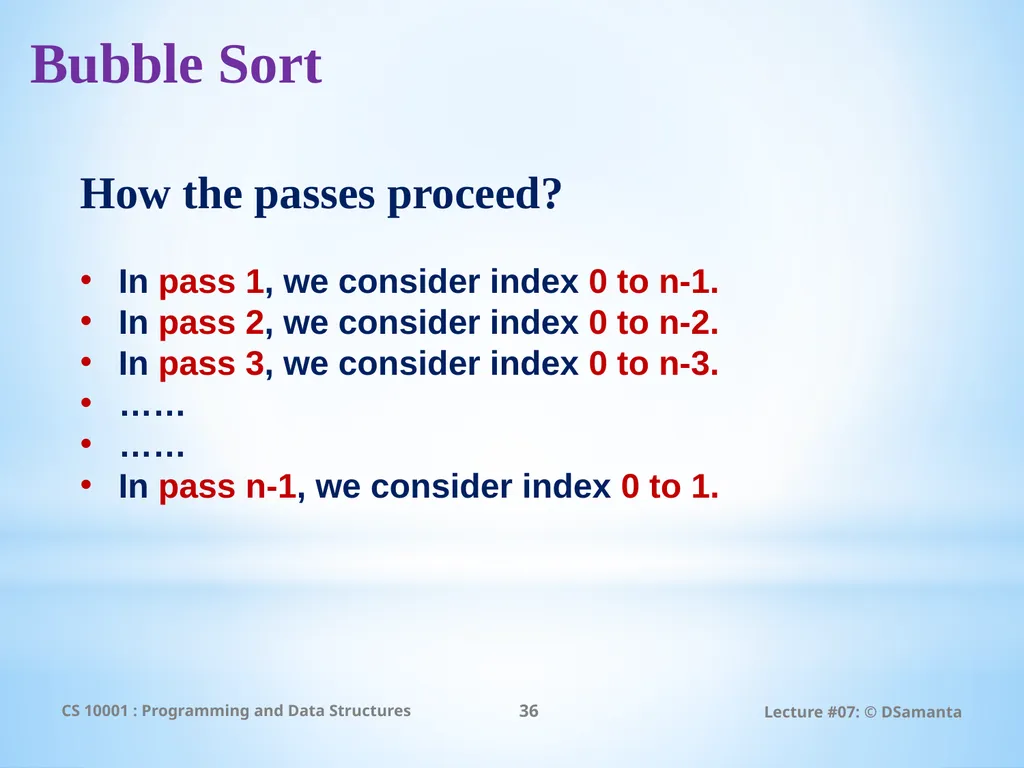
slide36. Bubble Sort CS 10001 : Programming and Data Structures 36 Lecture #07: © DSamanta How the passes proceed?
In pass 1, we consider index 0 to n-1.
In pass 2, we consider index 0 to n-2.
In pass 3, we consider index 0 to n-3.
……
……
In pass n-1, we consider index 0 to 1.<br>
slide37. Bubble Sort - Example CS 10001 : Programming and Data Structures 37 Lecture #07: © DSamanta Pass: 1<br>
slide38. Bubble Sort - Example CS 10001 : Programming and Data Structures 38 Lecture #07: © DSamanta Pass: 2<br>
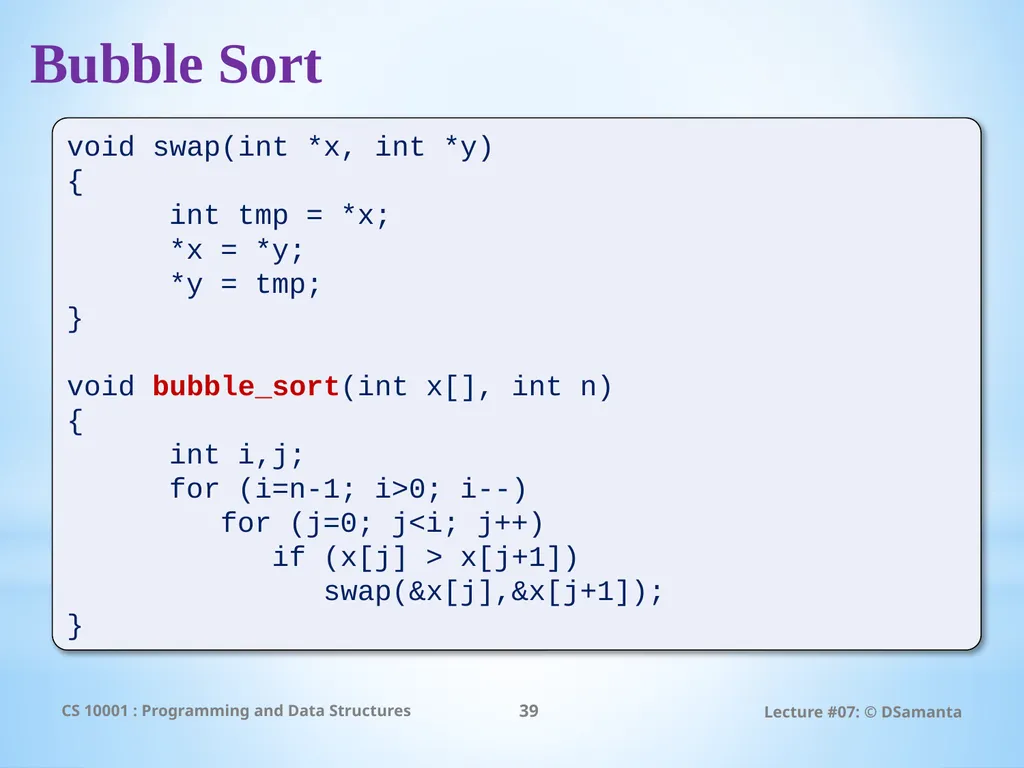
slide39. Bubble Sort CS 10001 : Programming and Data Structures 39 Lecture #07: © DSamanta void swap(int *x, int *y)
{
int tmp = *x;
*x = *y;
*y = tmp;
}
void bubble_sort(int x[], int n)
{
int i,j;
for (i=n-1; i>0; i--)
for (j=0; j<i; j++)
if (x[j] > x[j+1])
swap(&x[j],&x[j+1]);
}<br>
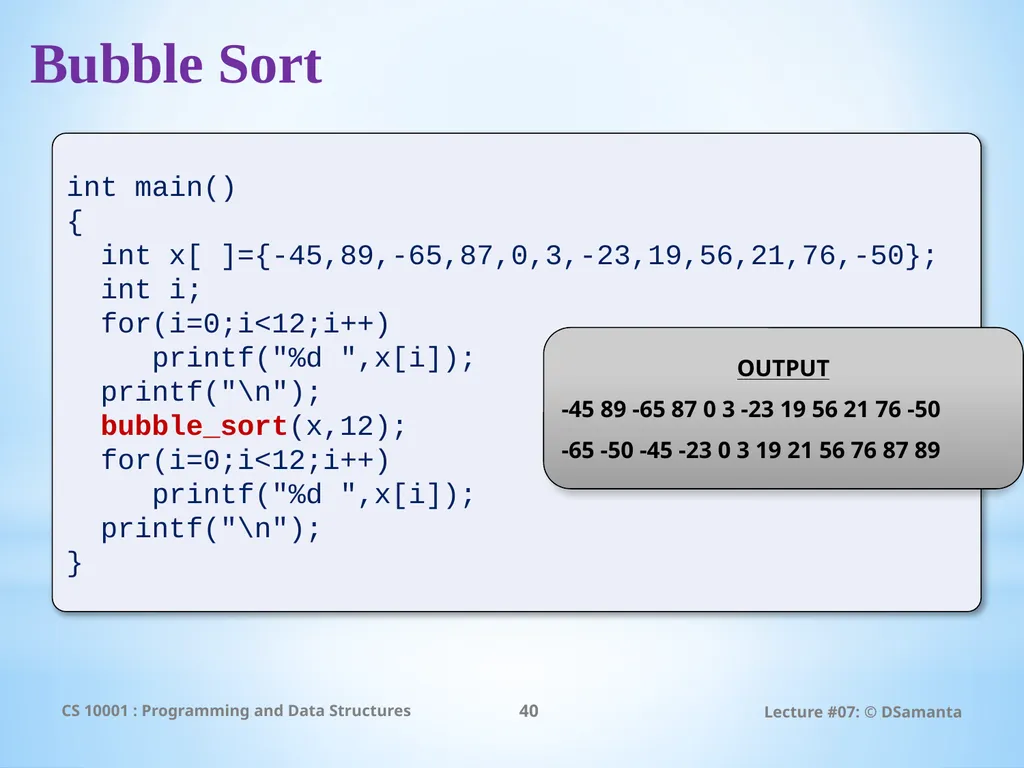
slide40. Bubble Sort CS 10001 : Programming and Data Structures 40 Lecture #07: © DSamanta int main()
{
int x[ ]={-45,89,-65,87,0,3,-23,19,56,21,76,-50};
int i;
for(i=0;i<12;i++)
printf("%d ",x[i]);
printf("\n");
bubble_sort(x,12);
for(i=0;i<12;i++)
printf("%d ",x[i]);
printf("\n");
} OUTPUT
-45 89 -65 87 0 3 -23 19 56 21 76 -50
-65 -50 -45 -23 0 3 19 21 56 76 87 89<br>
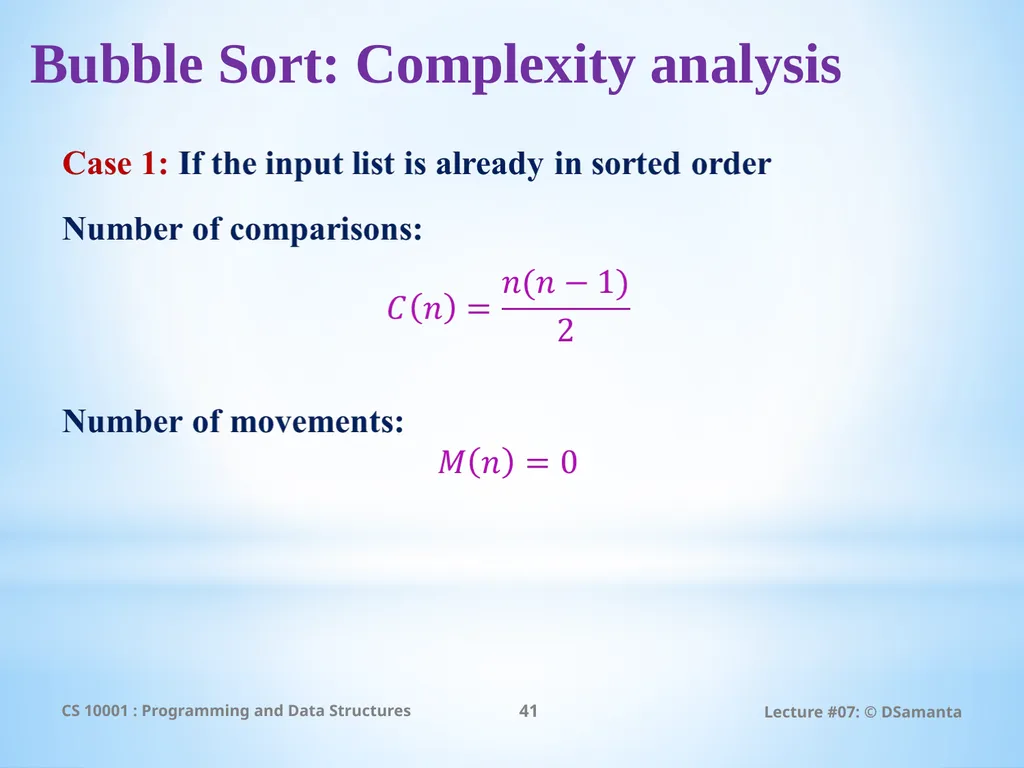
slide41. Bubble Sort: Complexity analysis CS 10001 : Programming and Data Structures 41 Lecture #07: © DSamanta<br>
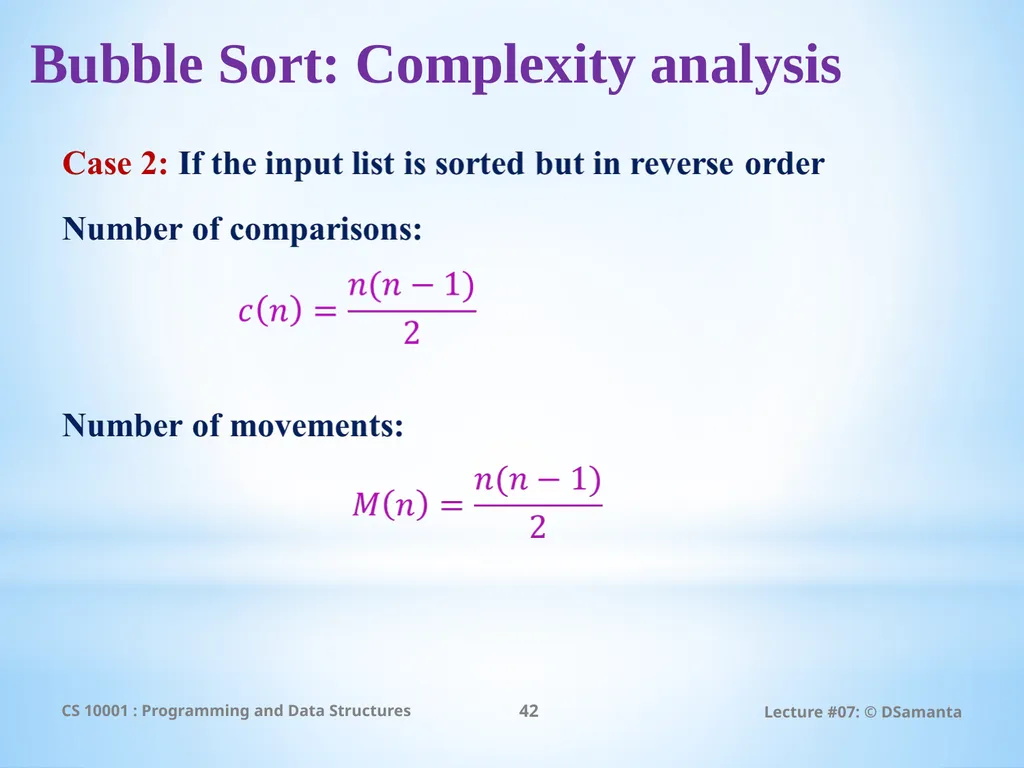
slide42. Bubble Sort: Complexity analysis CS 10001 : Programming and Data Structures 42 Lecture #07: © DSamanta<br>
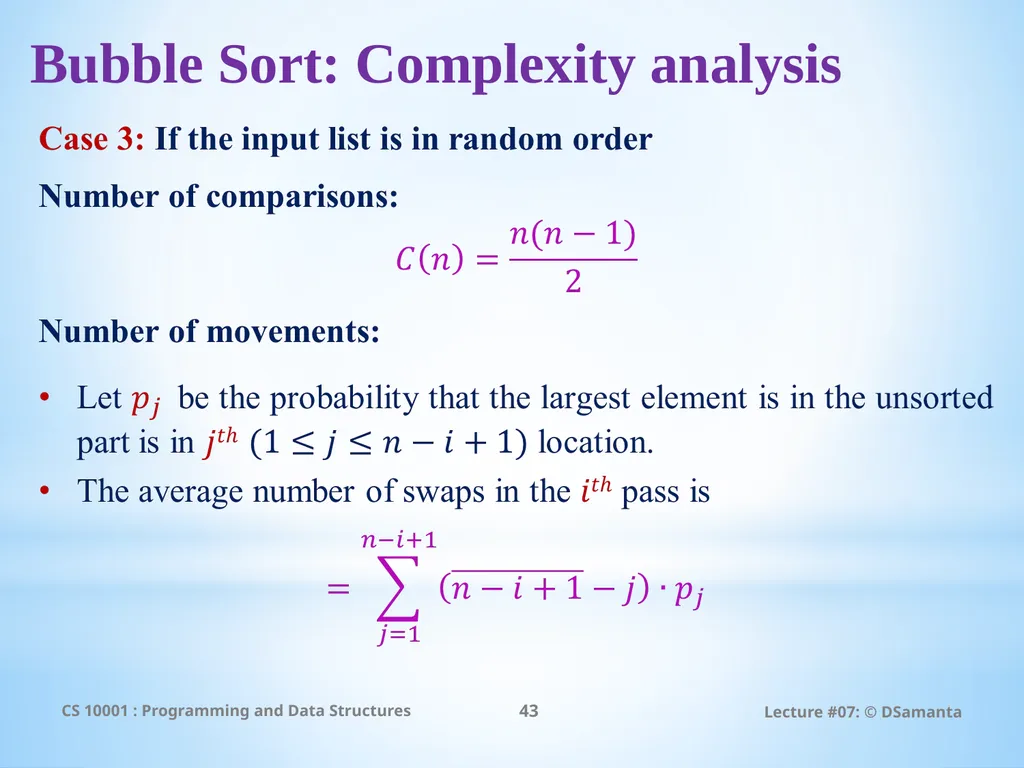
slide43. Bubble Sort: Complexity analysis CS 10001 : Programming and Data Structures 43 Lecture #07: © DSamanta<br>
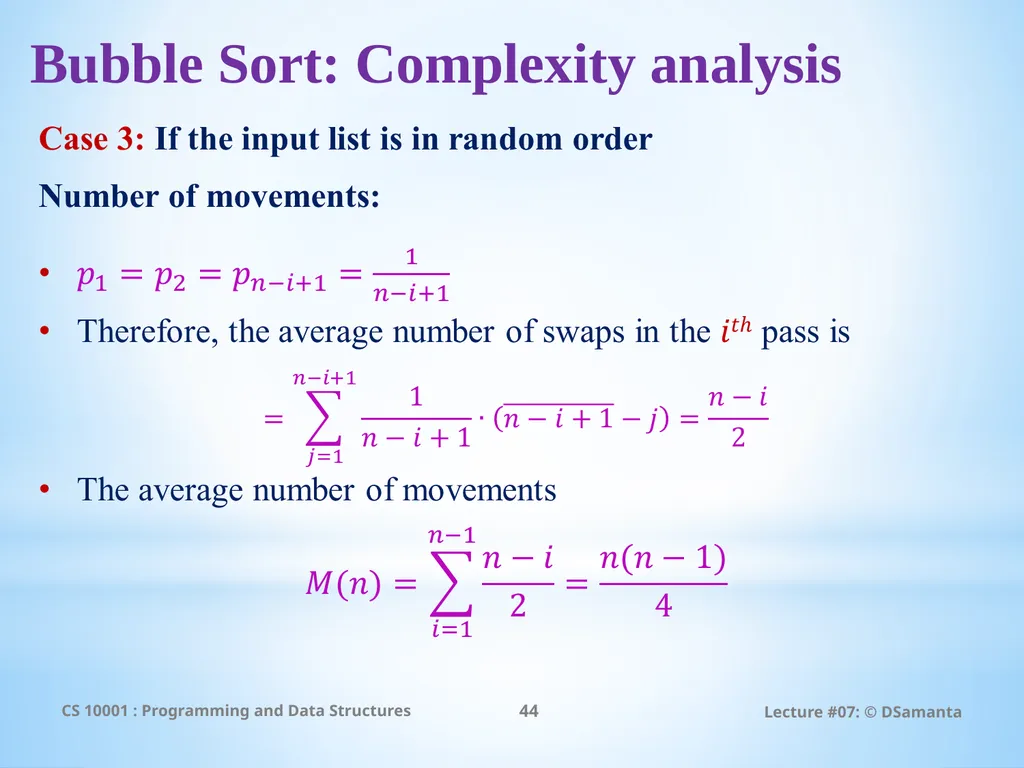
slide44. Bubble Sort: Complexity analysis CS 10001 : Programming and Data Structures 44 Lecture #07: © DSamanta<br>
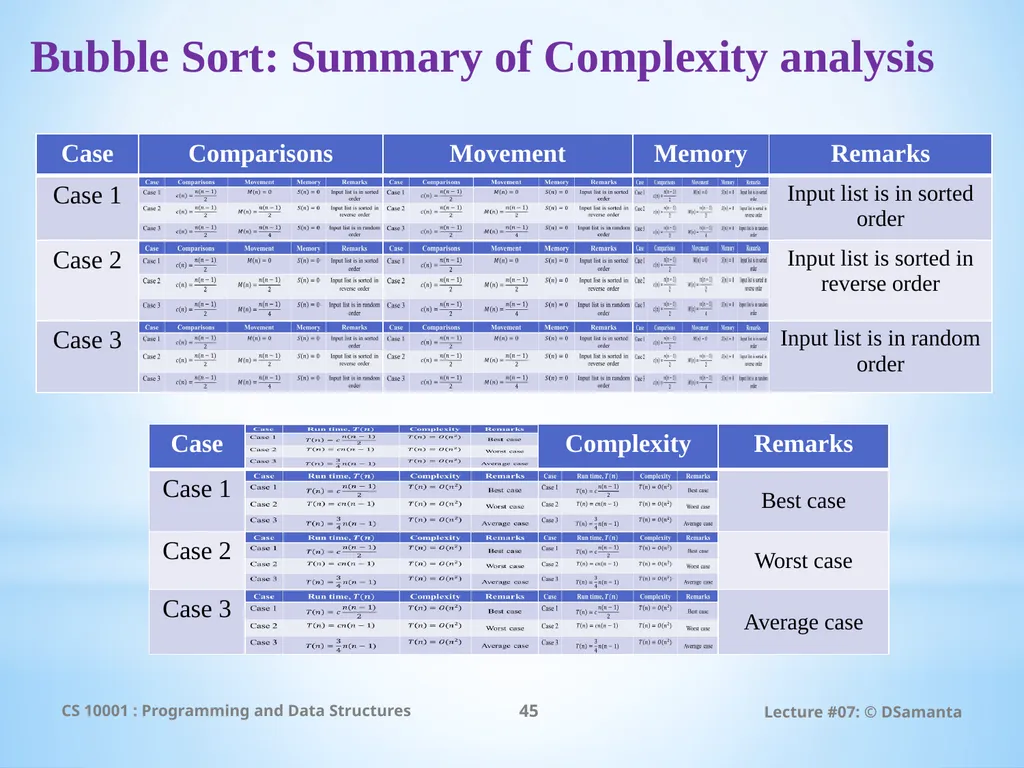
slide45. Bubble Sort: Summary of Complexity analysis CS 10001 : Programming and Data Structures 45 Lecture #07: © DSamanta<br>
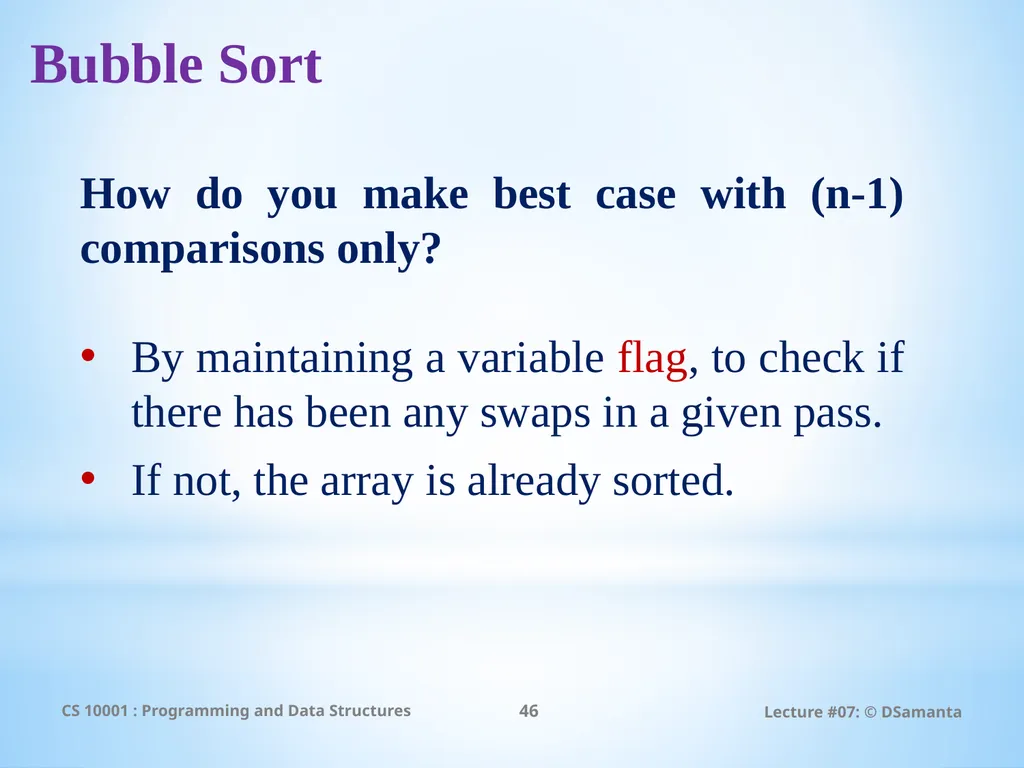
slide46. Bubble Sort CS 10001 : Programming and Data Structures 46 Lecture #07: © DSamanta How do you make best case with (n-1) comparisons only?
By maintaining a variable flag, to check if there has been any swaps in a given pass.
If not, the array is already sorted.<br>
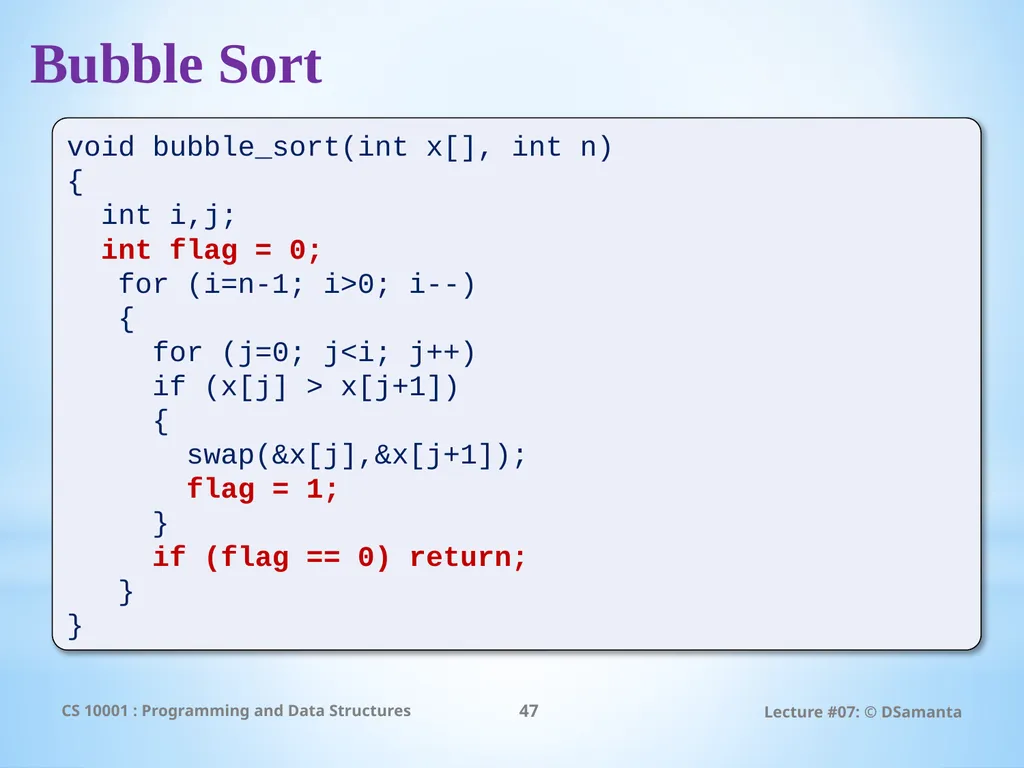
slide47. Bubble Sort CS 10001 : Programming and Data Structures 47 Lecture #07: © DSamanta void bubble_sort(int x[], int n)
{
int i,j;
int flag = 0;
for (i=n-1; i>0; i--)
{
for (j=0; j<i; j++)
if (x[j] > x[j+1])
{
swap(&x[j],&x[j+1]);
flag = 1;
}
if (flag == 0) return;
}
}<br>
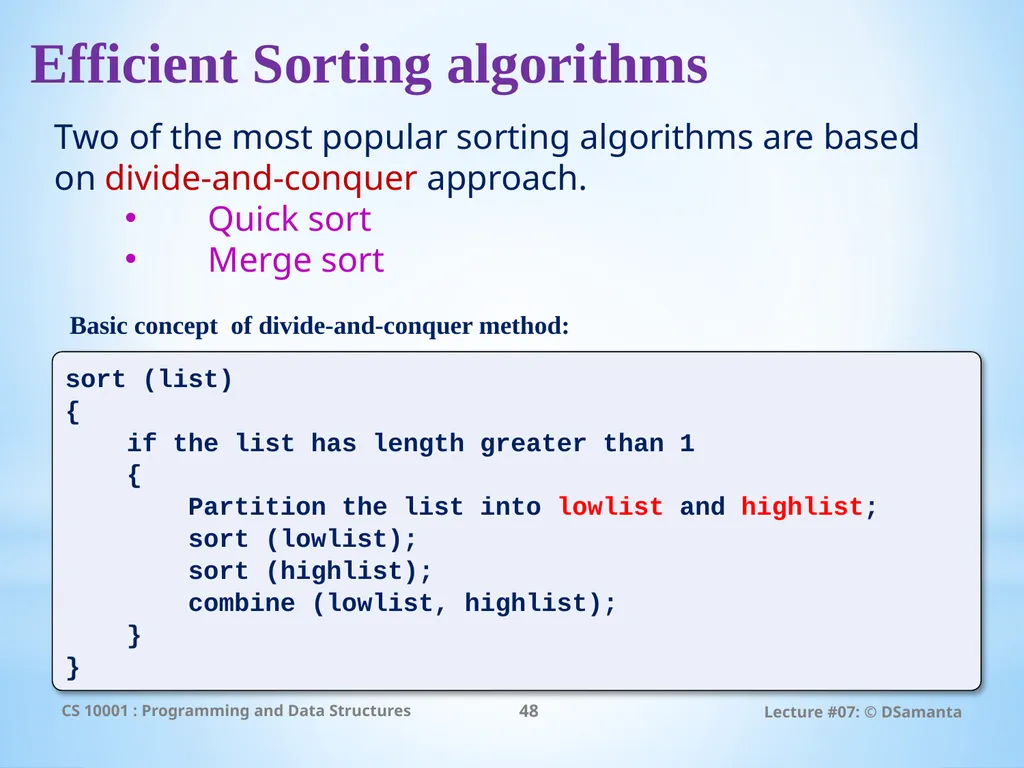
slide48. Efficient Sorting algorithms CS 10001 : Programming and Data Structures 48 Lecture #07: © DSamanta Two of the most popular sorting algorithms are based on divide-and-conquer approach.
Quick sort
Merge sort sort (list)
{
if the list has length greater than 1
{
Partition the list into lowlist and highlist;
sort (lowlist);
sort (highlist);
combine (lowlist, highlist);
}
} Basic concept of divide-and-conquer method:<br>
slide49. Quick Sort CS 10001 : Programming and Data Structures 49 Lecture #07: © DSamanta<br>
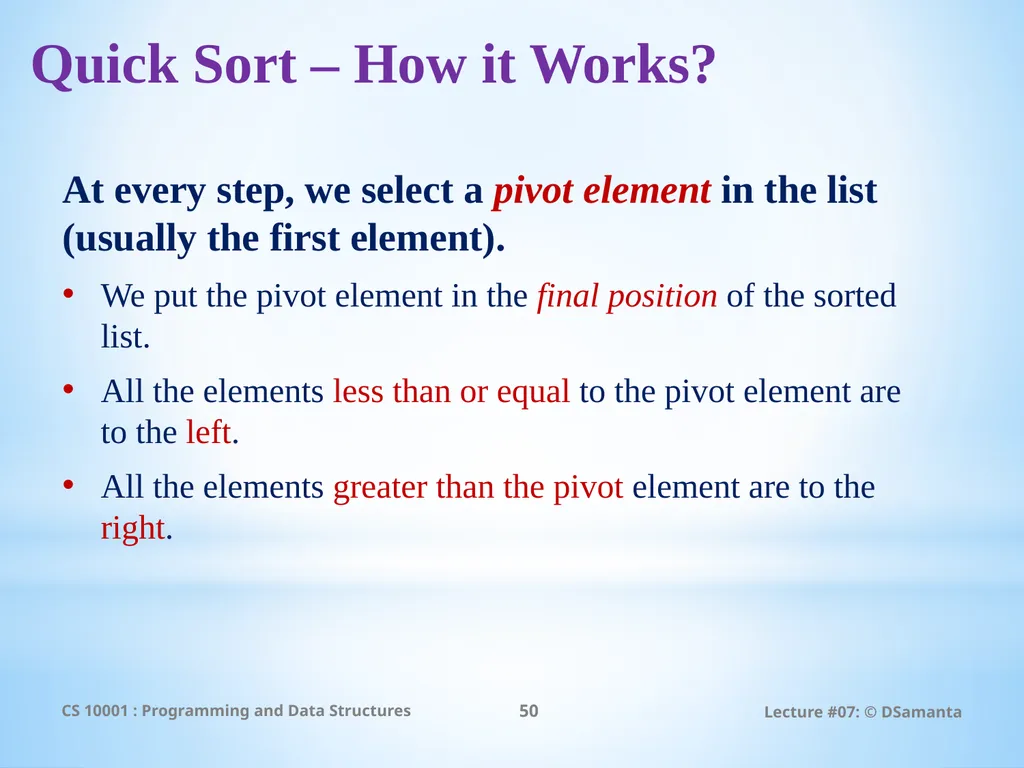
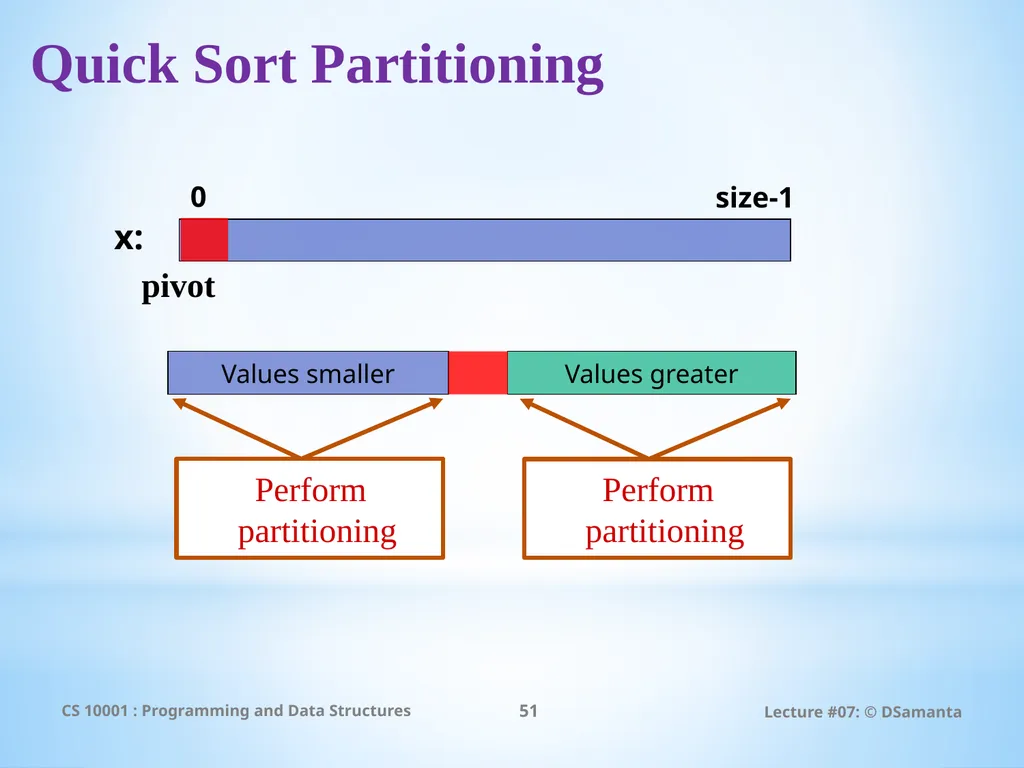
slide50. Quick Sort – How it Works? CS 10001 : Programming and Data Structures 50 Lecture #07: © DSamanta At every step, we select a pivot element in the list (usually the first element).
We put the pivot element in the final position of the sorted list.
All the elements less than or equal to the pivot element are to the left.
All the elements greater than the pivot element are to the right.<br>
slide51. Quick Sort Partitioning CS 10001 : Programming and Data Structures 51 Lecture #07: © DSamanta 0 size-1 x: pivot<br>
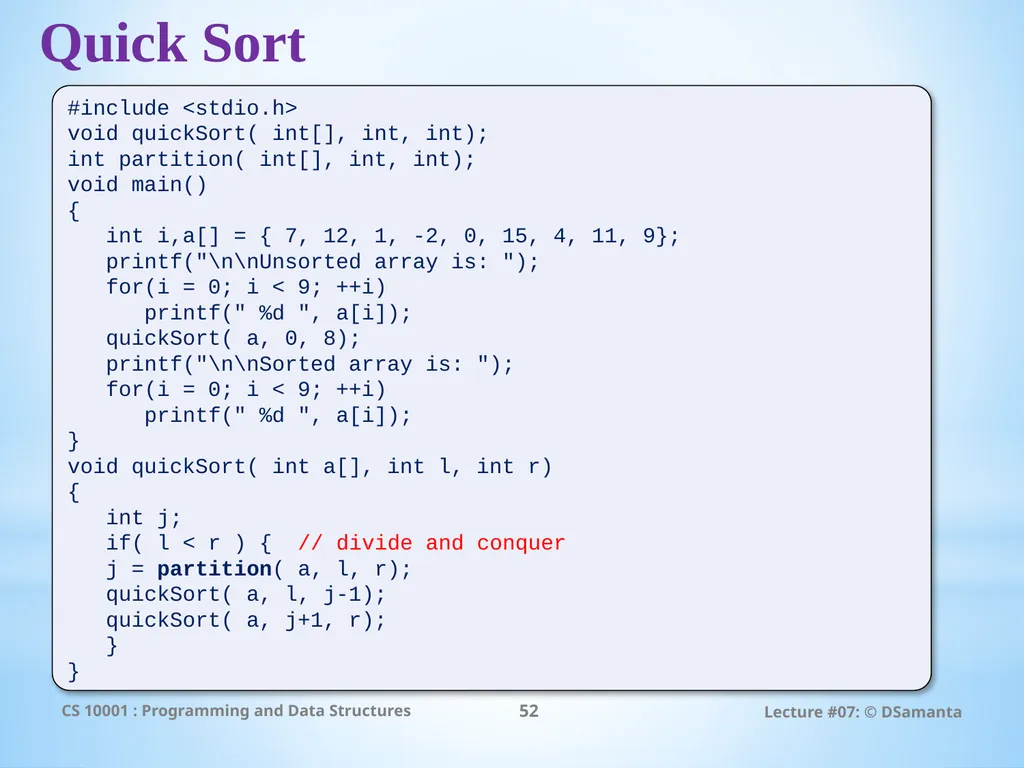
slide52. Quick Sort CS 10001 : Programming and Data Structures 52 Lecture #07: © DSamanta #include <stdio.h>
void quickSort( int[], int, int);
int partition( int[], int, int);
void main()
{
int i,a[] = { 7, 12, 1, -2, 0, 15, 4, 11, 9};
printf("\n\nUnsorted array is: ");
for(i = 0; i < 9; ++i)
printf(" %d ", a[i]);
quickSort( a, 0, 8);
printf("\n\nSorted array is: ");
for(i = 0; i < 9; ++i)
printf(" %d ", a[i]);
}
void quickSort( int a[], int l, int r)
{
int j;
if( l < r ) { // divide and conquer
j = partition( a, l, r);
quickSort( a, l, j-1);
quickSort( a, j+1, r);
}
}<br>
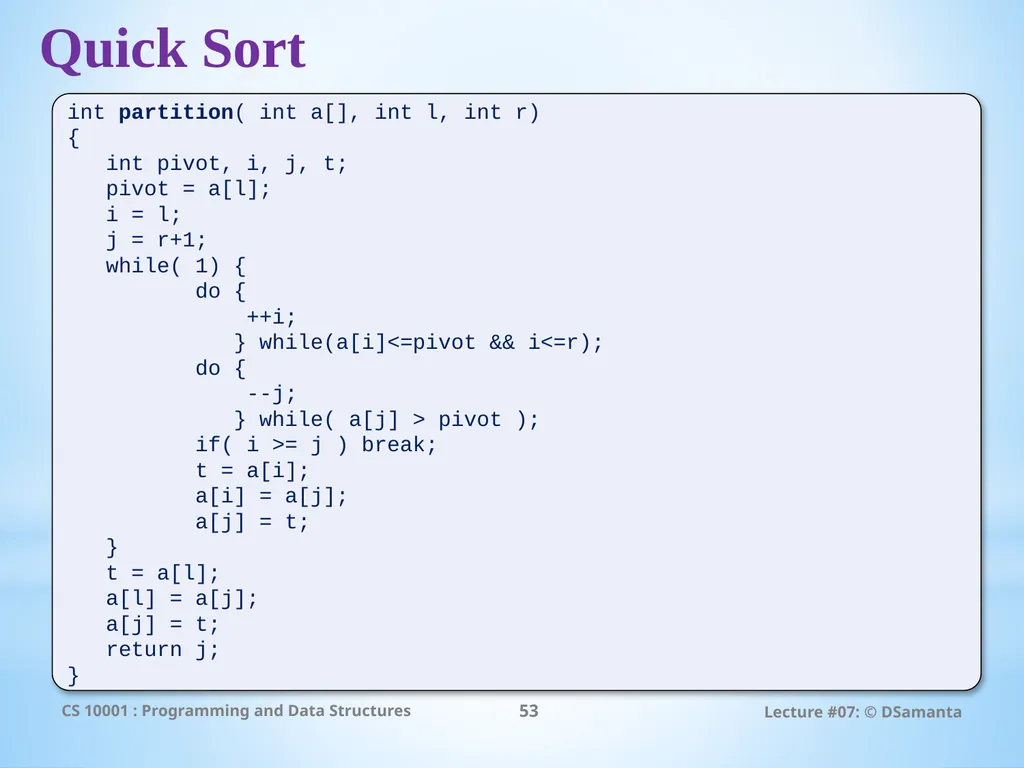
slide53. Quick Sort CS 10001 : Programming and Data Structures 53 Lecture #07: © DSamanta int partition( int a[], int l, int r)
{
int pivot, i, j, t;
pivot = a[l];
i = l;
j = r+1;
while( 1) {
do {
++i;
} while(a[i]<=pivot && i<=r);
do {
--j;
} while( a[j] > pivot );
if( i >= j ) break;
t = a[i];
a[i] = a[j];
a[j] = t;
}
t = a[l];
a[l] = a[j];
a[j] = t;
return j;
}<br>
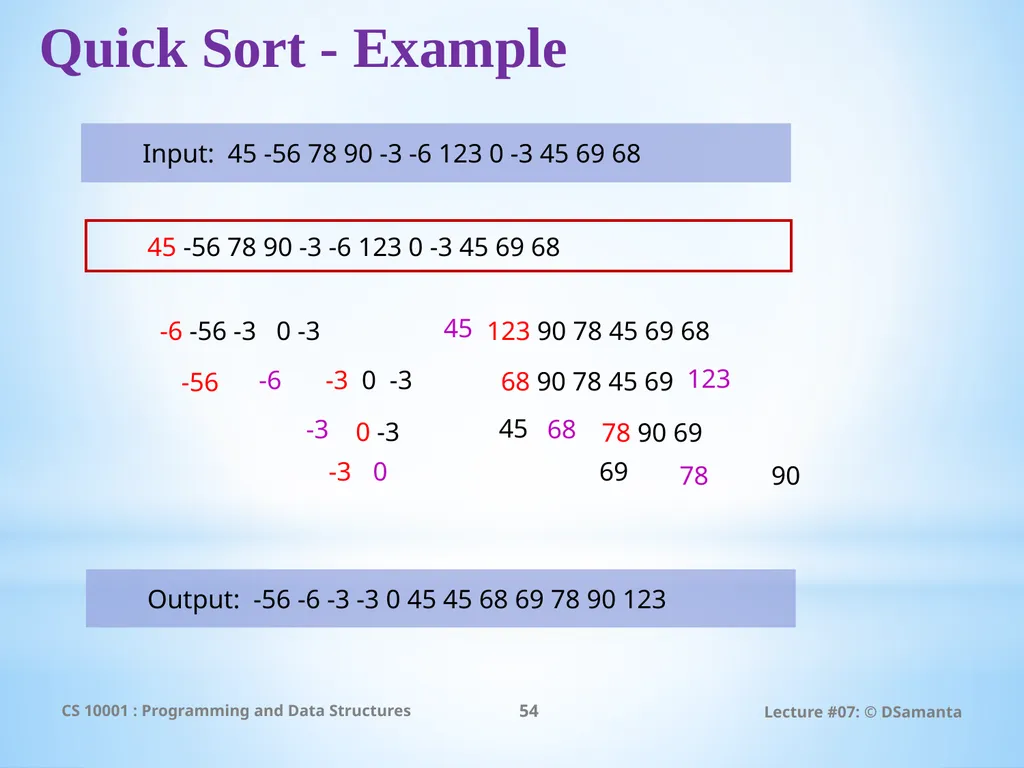
slide54. Lecture #07: © DSamanta CS 10001 : Programming and Data Structures 54 Input: 45 -56 78 90 -3 -6 123 0 -3 45 69 68 Output: -56 -6 -3 -3 0 45 45 68 69 78 90 123 45 -56 78 90 -3 -6 123 0 -3 45 69 68 -6 -56 -3 0 -3 45 123 90 78 45 69 68 -3 0 -3 -6 -56 0 -3 -3 -3 0 68 90 78 45 69 123 78 90 69 68 45 78 69 90 Quick Sort - Example<br>
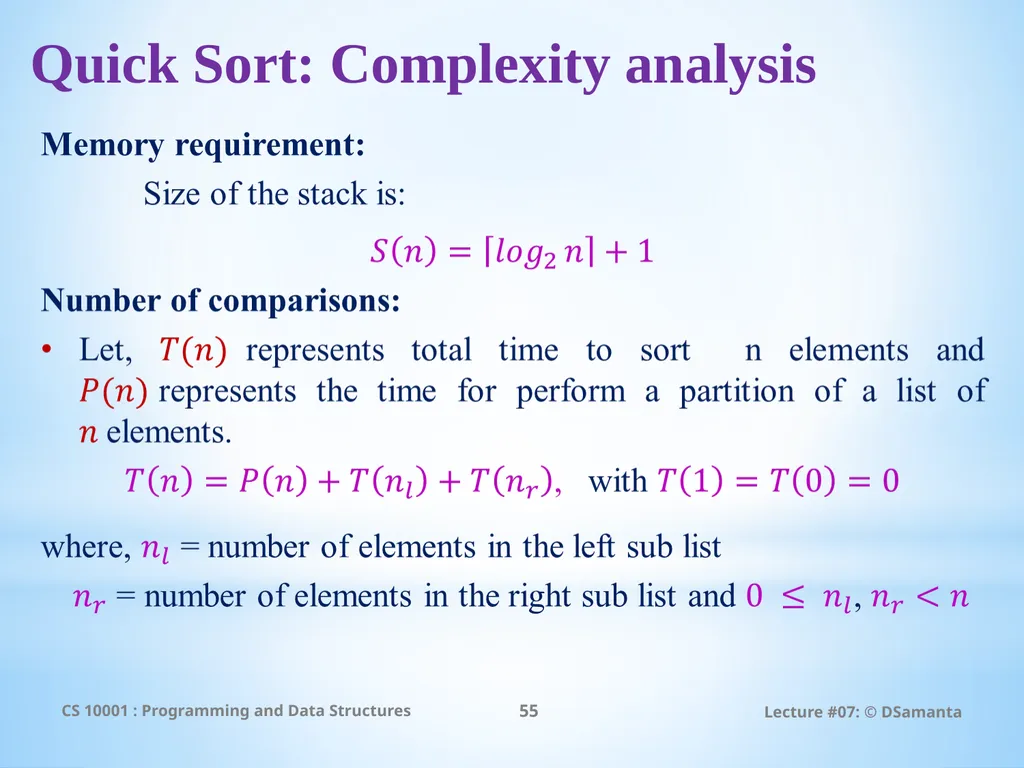
slide55. Quick Sort: Complexity analysis CS 10001 : Programming and Data Structures 55 Lecture #07: © DSamanta<br>
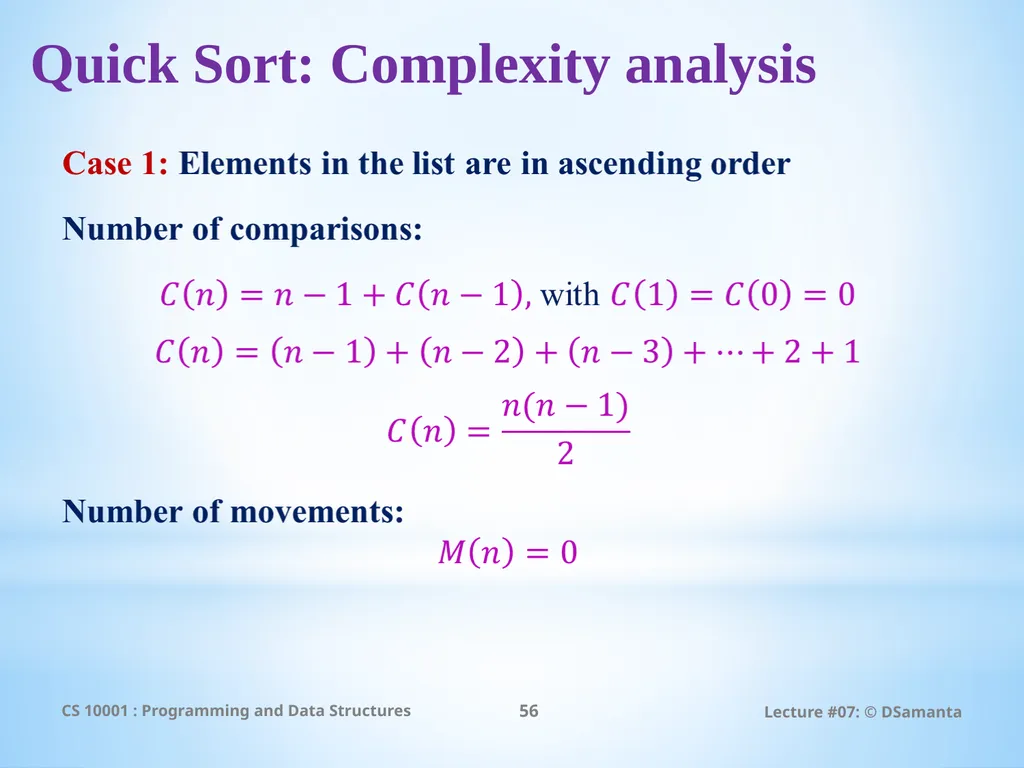
slide56. Quick Sort: Complexity analysis CS 10001 : Programming and Data Structures 56 Lecture #07: © DSamanta<br>
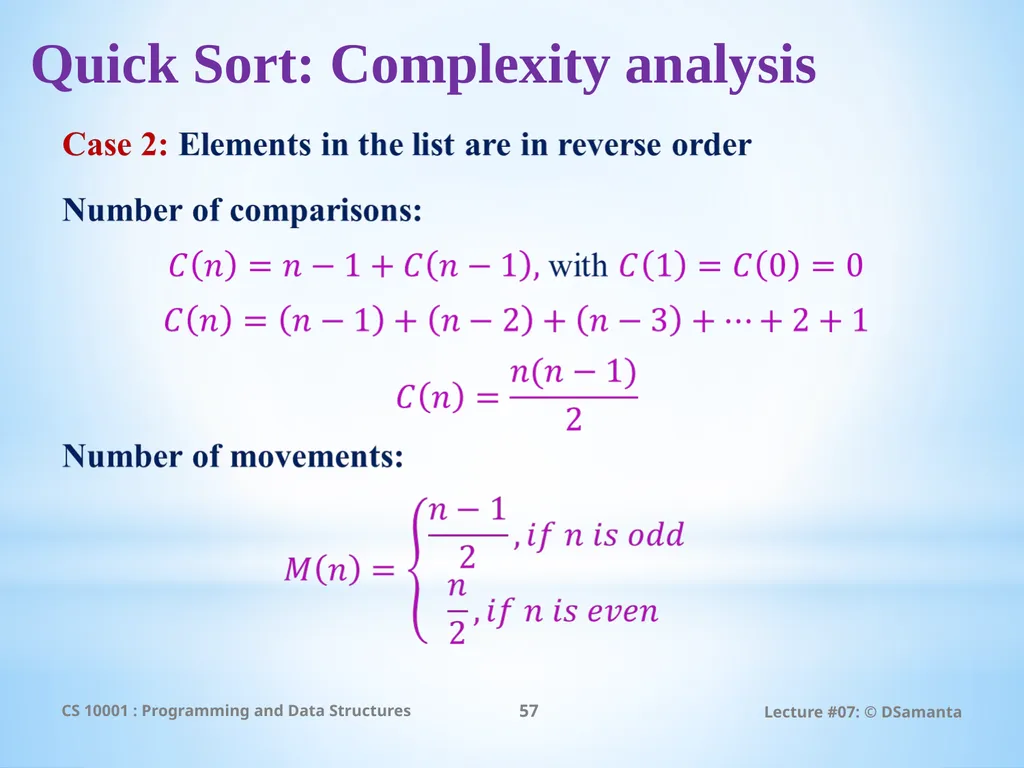
slide57. Quick Sort: Complexity analysis CS 10001 : Programming and Data Structures 57 Lecture #07: © DSamanta<br>
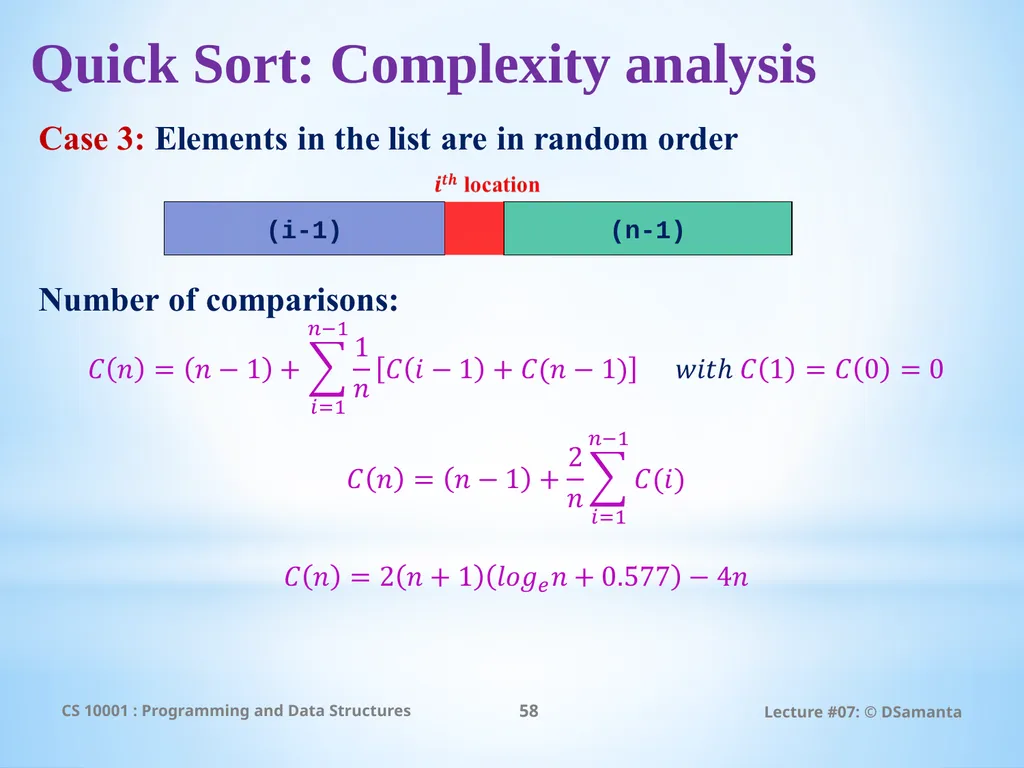
slide58. Quick Sort: Complexity analysis CS 10001 : Programming and Data Structures 58 Lecture #07: © DSamanta<br>
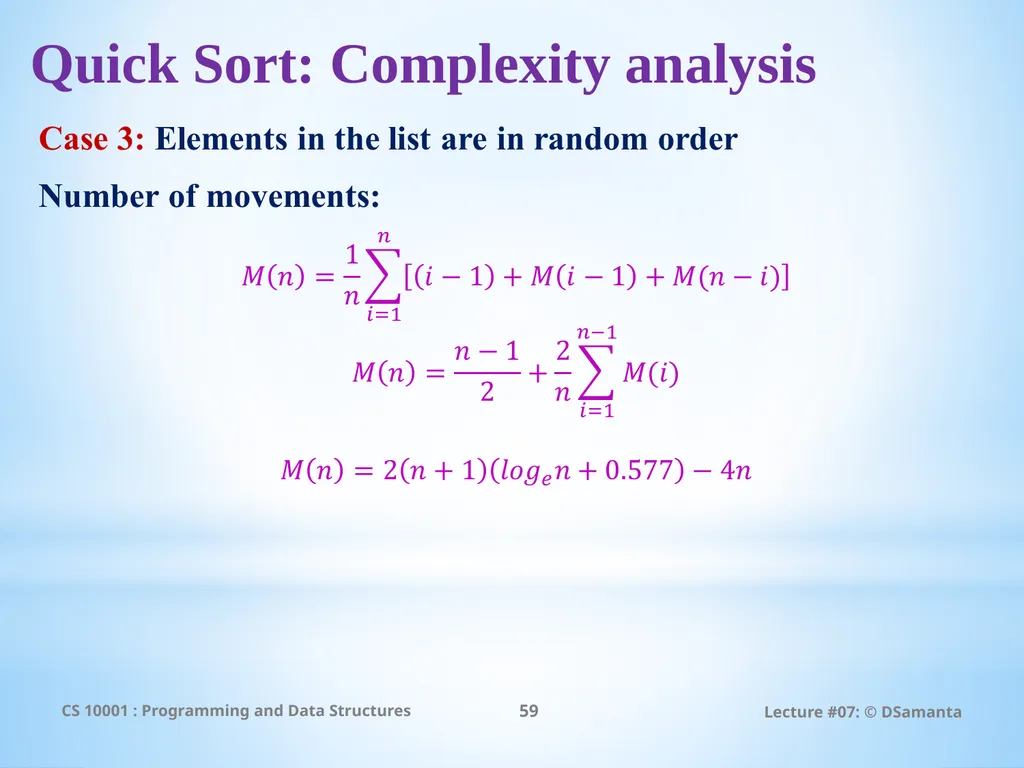
slide59. Quick Sort: Complexity analysis CS 10001 : Programming and Data Structures 59 Lecture #07: © DSamanta<br>
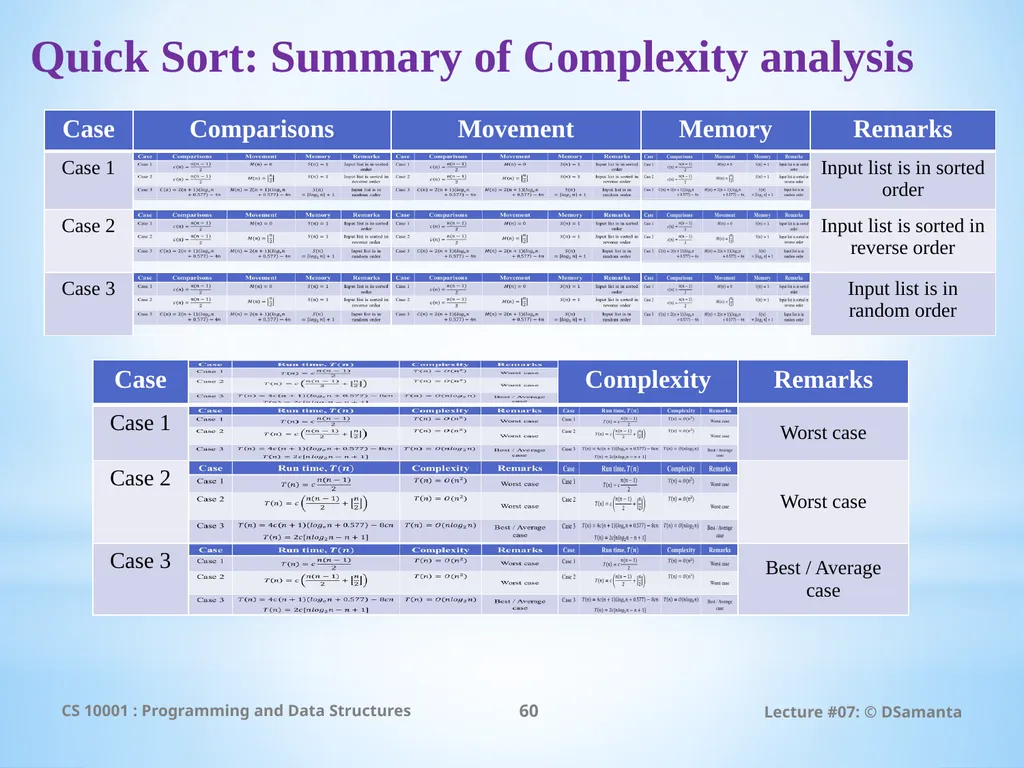
slide60. Quick Sort: Summary of Complexity analysis CS 10001 : Programming and Data Structures 60 Lecture #07: © DSamanta<br>
slide61. Merge Sort CS 10001 : Programming and Data Structures 61 Lecture #07: © DSamanta<br>
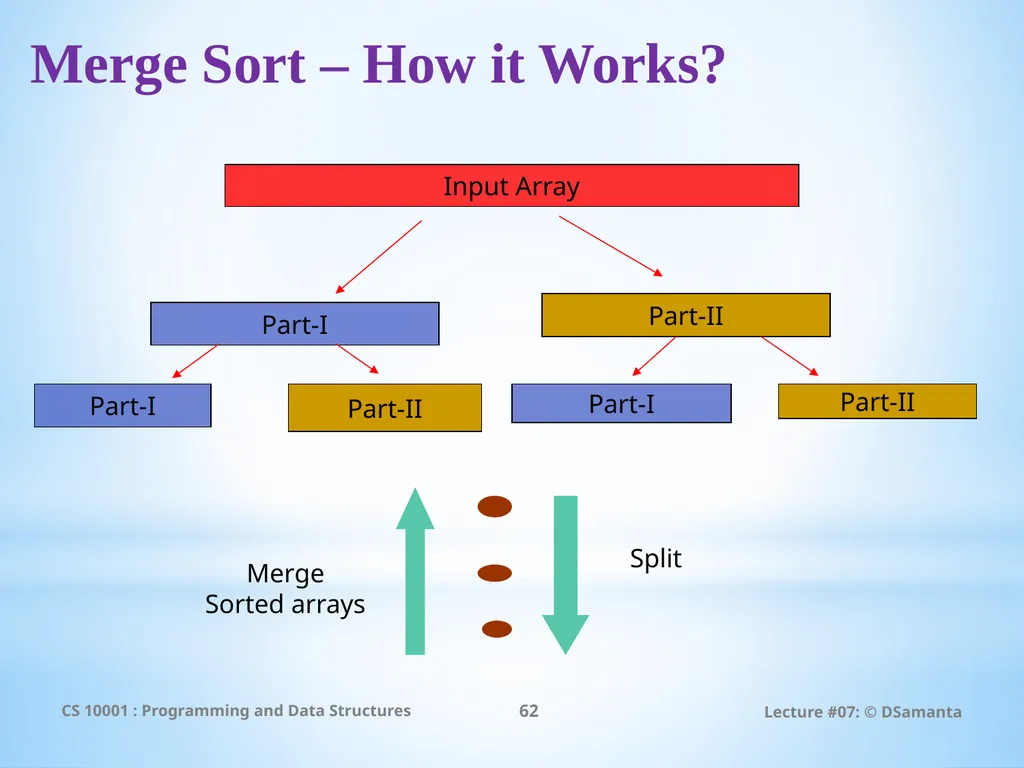
slide62. Merge Sort – How it Works? CS 10001 : Programming and Data Structures 62 Lecture #07: © DSamanta Input Array Split Merge
Sorted arrays<br>
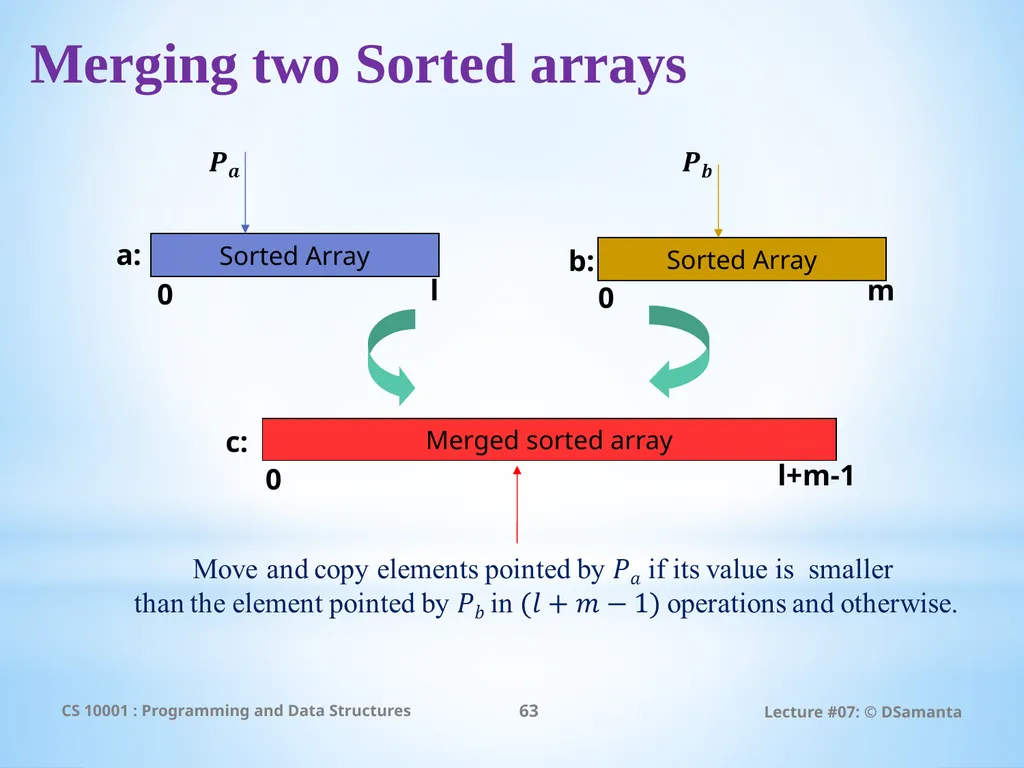
slide63. Merging two Sorted arrays CS 10001 : Programming and Data Structures 63 Lecture #07: © DSamanta 0 Sorted Array Sorted Array 0 l m a: b:<br>
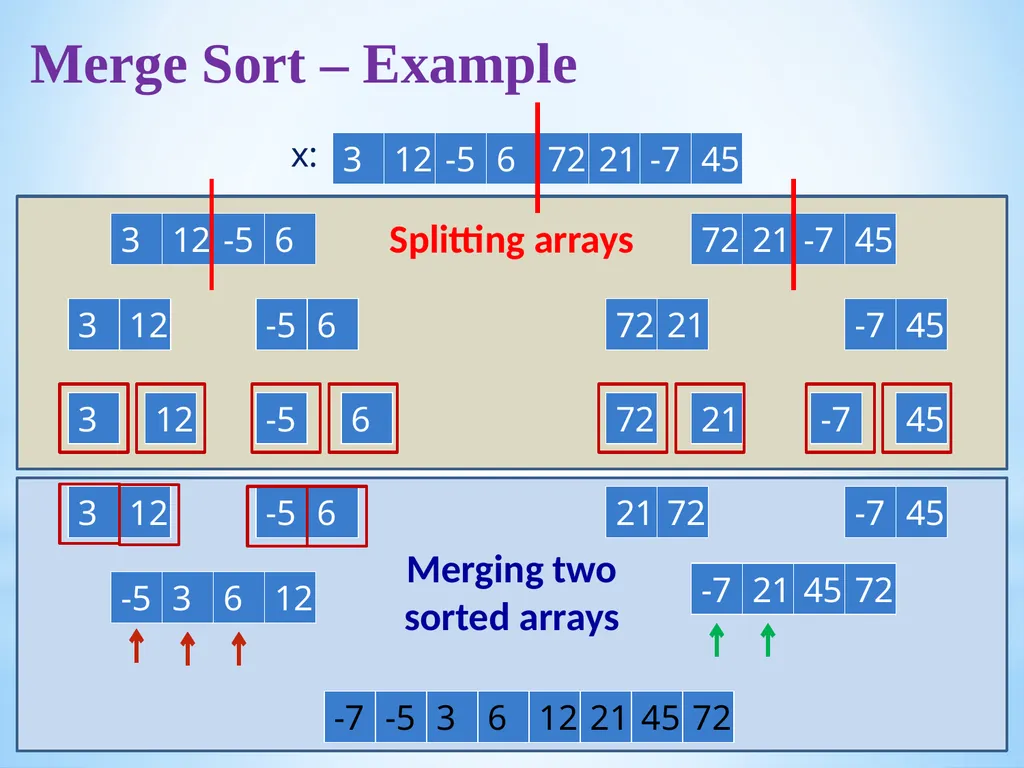
slide64. Merge Sort – Example CS 10001 : Programming and Data Structures 64 Lecture #07: © DSamanta Merging two
sorted arrays Splitting arrays 3 12 -5 6 72 21 -7 45 -5 3 6 12 -7 -5 3<br>
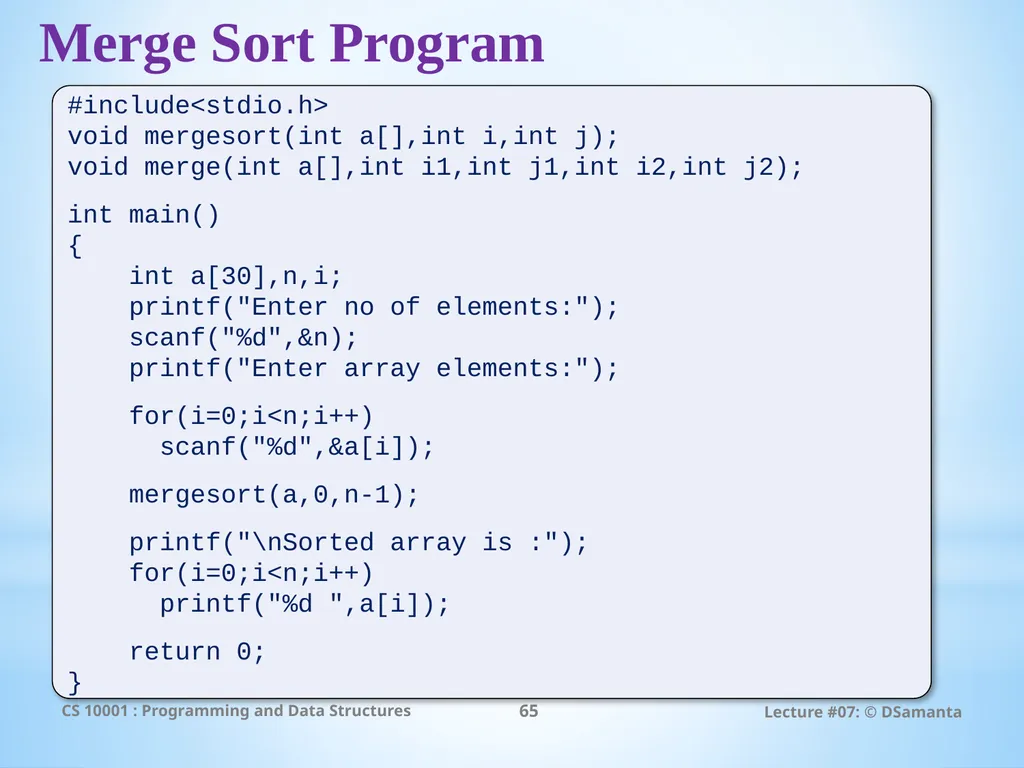
slide65. Merge Sort Program CS 10001 : Programming and Data Structures 65 Lecture #07: © DSamanta #include<stdio.h>
void mergesort(int a[],int i,int j);
void merge(int a[],int i1,int j1,int i2,int j2);
int main()
{
int a[30],n,i;
printf("Enter no of elements:");
scanf("%d",&n);
printf("Enter array elements:");
for(i=0;i<n;i++)
scanf("%d",&a[i]);
mergesort(a,0,n-1);
printf("\nSorted array is :");
for(i=0;i<n;i++)
printf("%d ",a[i]);
return 0;
}<br>
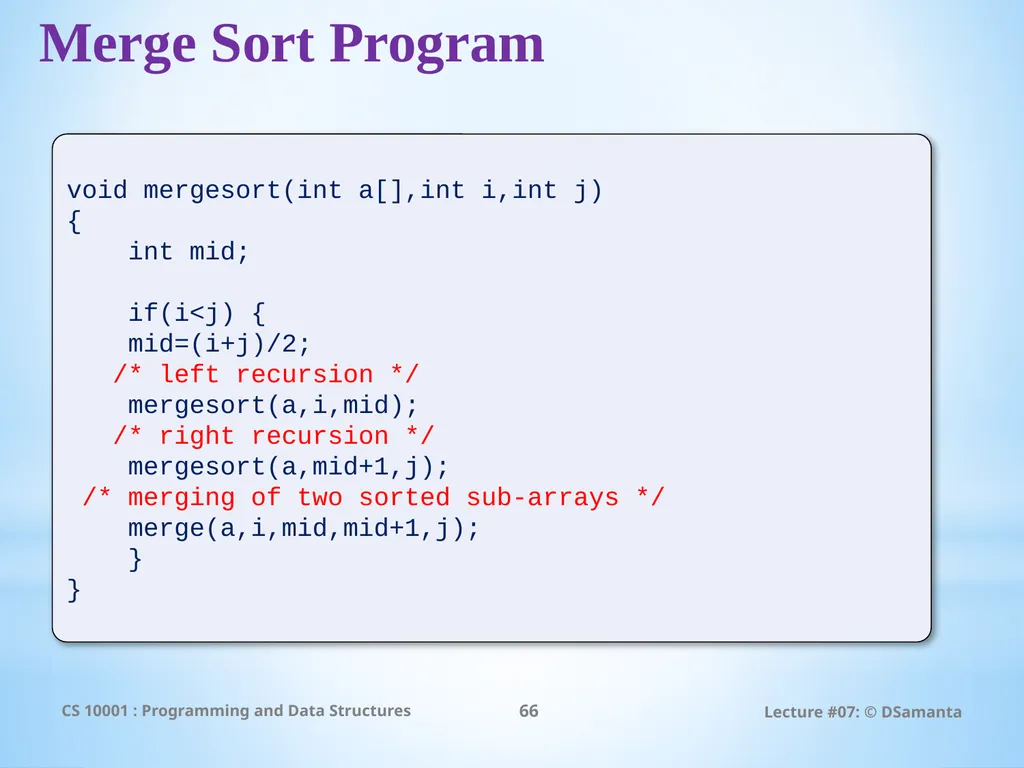
slide66. Merge Sort Program CS 10001 : Programming and Data Structures 66 Lecture #07: © DSamanta void mergesort(int a[],int i,int j)
{
int mid;
if(i<j) {
mid=(i+j)/2;
/* left recursion */
mergesort(a,i,mid);
/* right recursion */
mergesort(a,mid+1,j);
/* merging of two sorted sub-arrays */
merge(a,i,mid,mid+1,j);
}
}<br>
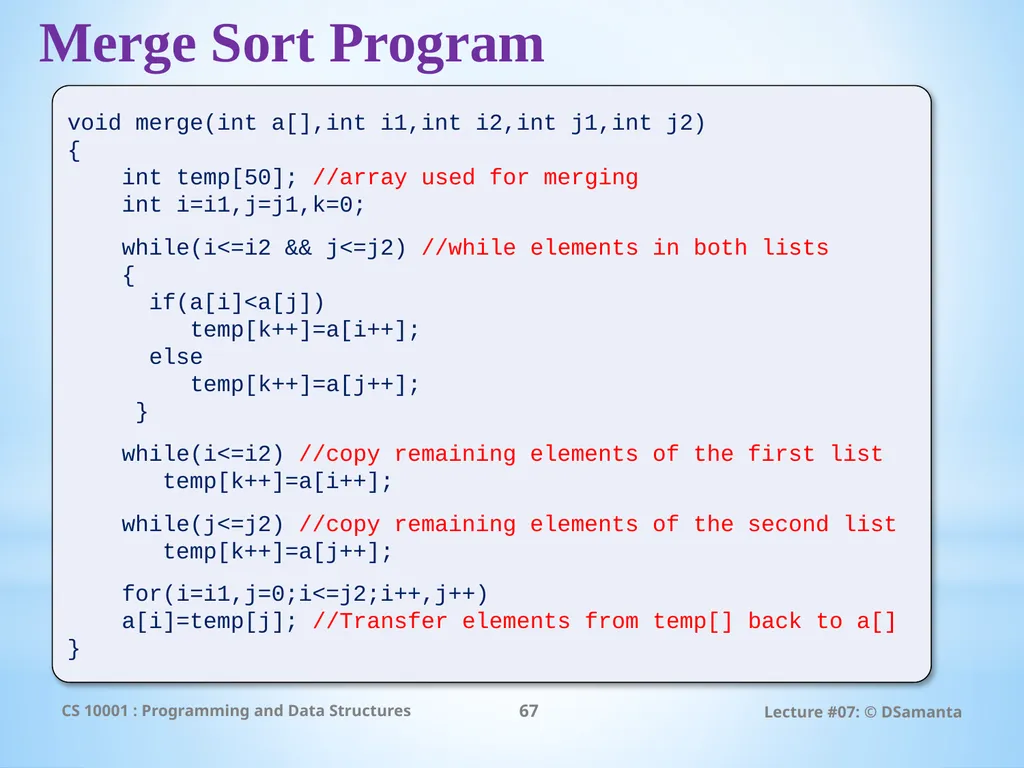
slide67. Merge Sort Program CS 10001 : Programming and Data Structures 67 Lecture #07: © DSamanta void merge(int a[],int i1,int i2,int j1,int j2)
{
int temp[50]; //array used for merging
int i=i1,j=j1,k=0;
while(i<=i2 && j<=j2) //while elements in both lists
{
if(a[i]<a[j])
temp[k++]=a[i++];
else
temp[k++]=a[j++];
}
while(i<=i2) //copy remaining elements of the first list
temp[k++]=a[i++];
while(j<=j2) //copy remaining elements of the second list
temp[k++]=a[j++];
for(i=i1,j=0;i<=j2;i++,j++)
a[i]=temp[j]; //Transfer elements from temp[] back to a[]
}<br>
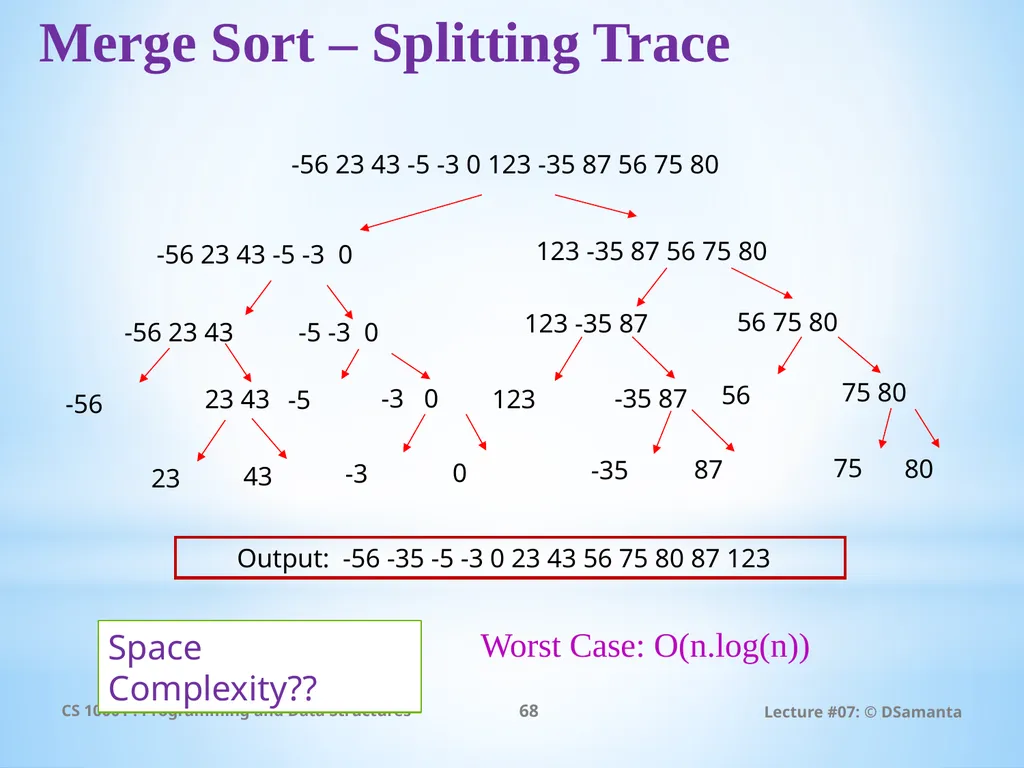
slide68. Merge Sort – Splitting Trace CS 10001 : Programming and Data Structures 68 Lecture #07: © DSamanta -56 23 43 -5 -3 0 123 -35 87 56 75 80 Output: -56 -35 -5 -3 0 23 43 56 75 80 87 123 -5 Worst Case: O(n.log(n)) Space Complexity??<br>
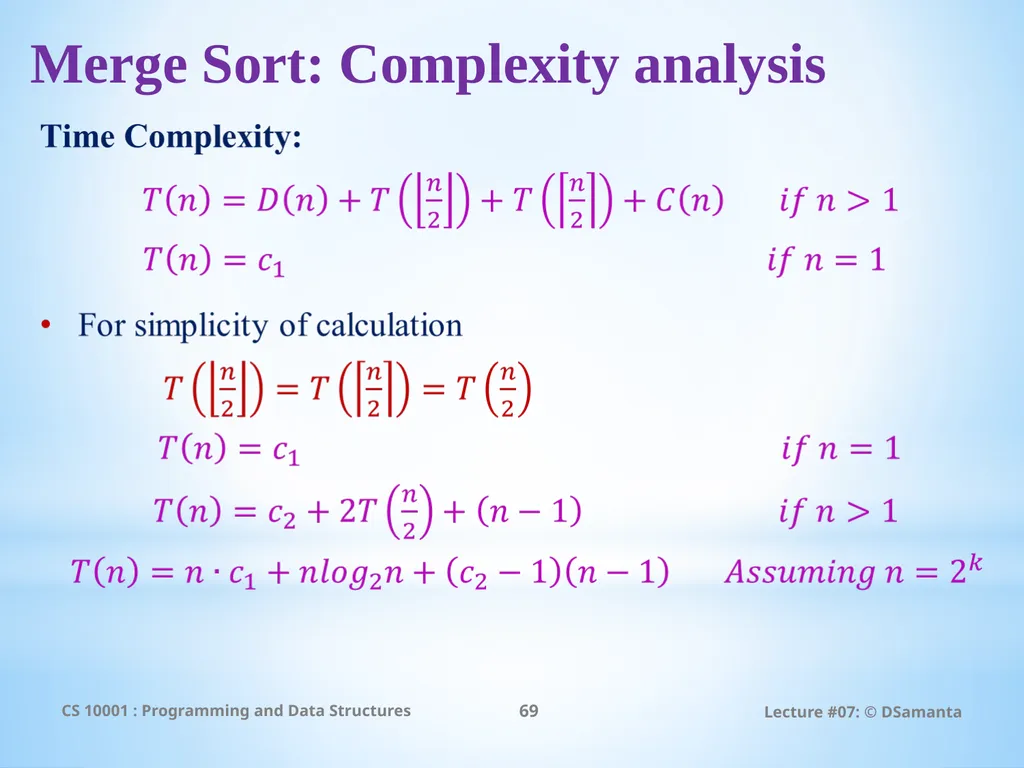
slide69. Merge Sort: Complexity analysis CS 10001 : Programming and Data Structures 69 Lecture #07: © DSamanta<br>
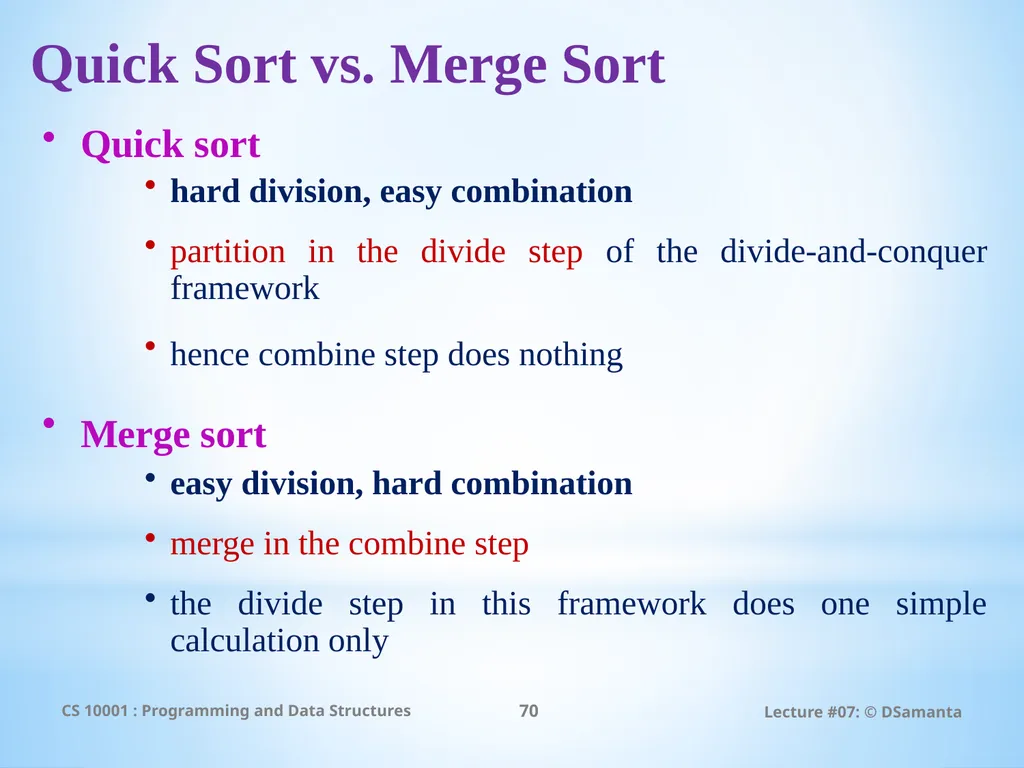
slide70. Quick Sort vs. Merge Sort CS 10001 : Programming and Data Structures 70 Lecture #07: © DSamanta Quick sort
hard division, easy combination
partition in the divide step of the divide-and-conquer framework
hence combine step does nothing
Merge sort
easy division, hard combination
merge in the combine step
the divide step in this framework does one simple calculation only<br>
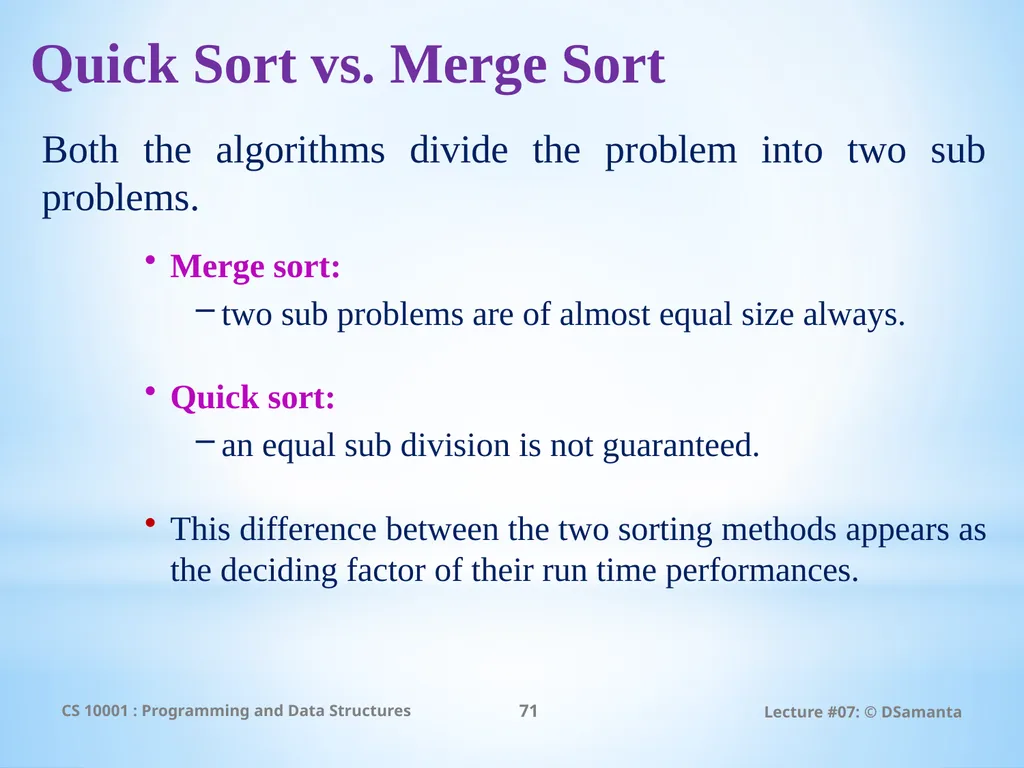
slide71. Quick Sort vs. Merge Sort CS 10001 : Programming and Data Structures 71 Lecture #07: © DSamanta Both the algorithms divide the problem into two sub problems.
Merge sort:
two sub problems are of almost equal size always.
Quick sort:
an equal sub division is not guaranteed.
This difference between the two sorting methods appears as the deciding factor of their run time performances.<br>
slide72. Any question? You may post your question(s) at the “Discussion Forum” maintained in the course Web page. CS 10001 : Programming and Data Structures 72 Lecture #07: © DSamanta<br>
slide73. Problems to Ponder… CS 10001 : Programming and Data Structures 73 Lecture #07: © DSamanta<br>
slide74. Problems for Practice… CS 10001 : Programming and Data Structures 74 Lecture #07: © DSamanta You can check the Moodle course management system for a set of problems for your own practice.
Login to the Moodle system at http://cse.iitkgp.ac.in/
Select “PDS Spring-2017 (Theory) in the link “My Courses”
Go to Topic 7: Practice Sheet #07 : Pointer in C
Solutions to the problems in Practice Sheet #07 will be uploaded in due time.<br>
slide75. Lecture #07: © DSamanta CS 10001 : Programming and Data Structures 75 If you try to solve problems yourself, then you will learn many things automatically.
Spend few minutes and then enjoy the study.<br>
Computer Science & Engineering
Indian Institute of Technology Kharagpur
Spring-2017 Programming and Data Structures<br>
slide2. Lecture #7
Sorting algorithms Lecture #07: © DSamanta CS 10001 : Programming and Data Structures 2<br>
slide3. Introduction
Different sorting algorithms
Sorting by distribution Today’s Discussion… CS 10001 : Programming and Data Structures 3 Lecture #07: © DSamanta<br>
slide4. Introduction CS 11001 : Programming and Data Structures 4 Lecture #11: © DSamanta<br>
slide5. Sorting – The Task CS 10001 : Programming and Data Structures 5 Lecture #07: © DSamanta Given an array
x[0], x[1], … , x[size-1]
reorder entries so that
x[0] <= x[1] <= . . . <= x[size-1]
Here, List is in non-decreasing order.
We can also sort a list of elements in non-increasing order.<br>
slide6. Sorting – Example CS 10001 : Programming and Data Structures 6 Lecture #07: © DSamanta Original list:
10, 30, 20, 80, 70, 10, 60, 40, 70
Sorted in non-decreasing order:
10, 10, 20, 30, 40, 60, 70, 70, 80
Sorted in non-increasing order:
80, 70, 70, 60, 40, 30, 20, 10, 10<br>
slide7. Sorting Problem CS 10001 : Programming and Data Structures 7 Lecture #07: © DSamanta Unsorted list What do we want :
- Data to be sorted in order x: 0 size-1 Sorted list<br>
slide8. Issues in Sorting CS 10001 : Programming and Data Structures 8 Lecture #07: © DSamanta Many issues are there in sorting techniques
How to rearrange a given set of data?
Which data structures are more suitable to store data prior to their sorting?
How fast the sorting can be achieved?
How sorting can be done in a memory constraint situation?
How to sort various types of data?<br>
slide9. Sorting Algorithms CS 11001 : Programming and Data Structures 9 Lecture #11: © DSamanta<br>
slide10. Sorting by Comparison CS 10001 : Programming and Data Structures 10 Lecture #07: © DSamanta Basic operation involved in this type of sorting technique is comparison. A data item is compared with other items in the list of items in order to find its place in the sorted list.
Insertion
Selection
Exchange
Enumeration<br>
slide11. Sorting by Comparison CS 10001 : Programming and Data Structures 11 Lecture #07: © DSamanta Sorting by comparison – Insertion:
From a given list of items, one item is considered at a time. The item chosen is then inserted into an appropriate position relative to the previously sorted items. The item can be inserted into the same list or to a different list.
e.g.: Insertion sort
Sorting by comparison – Selection:
First the smallest (or largest) item is located and it is separated from the rest; then the next smallest (or next largest) is selected and so on until all item are separated.
e.g.: Selection sort, Heap sort<br>
slide12. Sorting by Comparison CS 10001 : Programming and Data Structures 12 Lecture #07: © DSamanta Sorting by comparison – Exchange:
If two items are found to be out of order, they are interchanged. The process is repeated until no more exchange is required.
e.g.: Bubble sort, Shell Sort, Quick Sort
Sorting by comparison – Enumeration:
Two or more input lists are merged into an output list and while merging the items, an input list is chosen following the required sorting order.
e.g.: Merge sort<br>
slide13. Sorting by Distribution CS 10001 : Programming and Data Structures 13 Lecture #07: © DSamanta No key comparison takes place
All items under sorting are distributed over an auxiliary storage space based on the constituent element in each and then grouped them together to get the sorted list.
Distributions of items based on the following choices
Radix - An item is placed in a space decided by the bases (or radix) of its components with which it is composed of.
Counting - Items are sorted based on their relative counts.
Hashing - Items are hashed, that is, dispersed into a list based on a hash function.
Note: This lecture concentrates only on sorting by comparison.<br>
slide14. Insertion Sort CS 10001 : Programming and Data Structures 14 Lecture #07: © DSamanta<br>
slide15. Insertion Sort CS 10001 : Programming and Data Structures 15 Lecture #07: © DSamanta General situation : remainder, unsorted smallest elements, sorted 0 size-1 i x: i j Compare and
Shift till x[i] is
larger.<br>
slide16. Insertion Sort CS 10001 : Programming and Data Structures 16 Lecture #07: © DSamanta void insertionSort (int list[], int size)
{
int i,j,item;
for (i=1; i<size; i++)
{
item = list[i] ;
/* Move elements of list[0..i-1], that are greater than item, to one position ahead of their current position */
for (j=i-1; (j>=0)&& (list[j] > item); j--)
list[j+1] = list[j];
list[j+1] = item ;
}
}<br>
slide17. Insertion Sort CS 10001 : Programming and Data Structures 17 Lecture #07: © DSamanta int main()
{
int x[ ]={-45,89,-65,87,0,3,-23,19,56,21,76,-50};
int i;
for(i=0;i<12;i++)
printf("%d ",x[i]);
printf("\n");
insertionSort(x,12);
for(i=0;i<12;i++)
printf("%d ",x[i]);
printf("\n");
} OUTPUT
-45 89 -65 87 0 3 -23 19 56 21 76 -50
-65 -50 -45 -23 0 3 19 21 56 76 87 89<br>
slide18. Lecture #07: © DSamanta CS 10001 : Programming and Data Structures 18 Insertion Sort - Example<br>
slide19. Insertion Sort: Complexity Analysis CS 10001 : Programming and Data Structures 19 Lecture #07: © DSamanta<br>
slide20. Insertion Sort: Complexity analysis CS 10001 : Programming and Data Structures 20 Lecture #07: © DSamanta<br>
slide21. Insertion Sort: Complexity analysis CS 10001 : Programming and Data Structures 21 Lecture #07: © DSamanta<br>
slide22. Insertion Sort: Complexity analysis CS 10001 : Programming and Data Structures 22 Lecture #07: © DSamanta<br>
slide23. Insertion Sort: Complexity analysis CS 10001 : Programming and Data Structures 23 Lecture #07: © DSamanta<br>
slide24. Insertion Sort: Summary of Complexity Analysis CS 10001 : Programming and Data Structures 24 Lecture #07: © DSamanta<br>
slide25. Selection Sort CS 10001 : Programming and Data Structures 25 Lecture #07: © DSamanta<br>
slide26. Selection Sort CS 10001 : Programming and Data Structures 26 Lecture #07: © DSamanta General situation : remainder, unsorted smallest elements, sorted 0 size-1 k x: Steps :
Find smallest element, mval, in x[k…size-1]
Swap smallest element with x[k], then increase k. 0 k size-1 mval swap x:<br>
slide27. Selection Sort CS 10001 : Programming and Data Structures 27 Lecture #07: © DSamanta /* Yield location of smallest element in
x[k .. size-1];*/
int findMinLloc (int x[ ], int k, int size)
{
int j, pos; /* x[pos] is the smallest element found so far */
pos = k;
for (j=k+1; j<size; j++)
if (x[j] < x[pos])
pos = j;
return pos;
}<br>
slide28. Selection Sort CS 10001 : Programming and Data Structures 28 Lecture #07: © DSamanta /* The main sorting function */
/* Sort x[0..size-1] in non-decreasing order */
int selectionSort (int x[], int size)
{ int k, m;
for (k=0; k<size-1; k++)
{
m = findMinLoc(x, k, size);
temp = a[k];
a[k] = a[m];
a[m] = temp;
}
}<br>
slide29. Selection Sort - Example CS 10001 : Programming and Data Structures 29 Lecture #07: © DSamanta 3 12 -5 6 142 21 -17 45 x: 12<br>
slide30. Selection Sort: Complexity Analysis CS 10001 : Programming and Data Structures 30 Lecture #07: © DSamanta<br>
slide31. Selection Sort: Complexity Analysis CS 10001 : Programming and Data Structures 31 Lecture #07: © DSamanta<br>
slide32. Selection Sort: Complexity Analysis CS 10001 : Programming and Data Structures 32 Lecture #07: © DSamanta<br>
slide33. Selection Sort: Summary of Complexity analysis CS 10001 : Programming and Data Structures 33 Lecture #07: © DSamanta<br>
slide34. Bubble Sort CS 10001 : Programming and Data Structures 34 Lecture #07: © DSamanta<br>
slide35. Bubble Sort CS 10001 : Programming and Data Structures 35 Lecture #07: © DSamanta The sorting process proceeds in several passes.
In every pass we go on comparing neighbouring pairs, and swap them if out of order.
In every pass, the largest of the elements under considering will bubble to the top (i.e., the right). In every iteration heaviest element drops at the bottom. The bottom moves upward.<br>
slide36. Bubble Sort CS 10001 : Programming and Data Structures 36 Lecture #07: © DSamanta How the passes proceed?
In pass 1, we consider index 0 to n-1.
In pass 2, we consider index 0 to n-2.
In pass 3, we consider index 0 to n-3.
……
……
In pass n-1, we consider index 0 to 1.<br>
slide37. Bubble Sort - Example CS 10001 : Programming and Data Structures 37 Lecture #07: © DSamanta Pass: 1<br>
slide38. Bubble Sort - Example CS 10001 : Programming and Data Structures 38 Lecture #07: © DSamanta Pass: 2<br>
slide39. Bubble Sort CS 10001 : Programming and Data Structures 39 Lecture #07: © DSamanta void swap(int *x, int *y)
{
int tmp = *x;
*x = *y;
*y = tmp;
}
void bubble_sort(int x[], int n)
{
int i,j;
for (i=n-1; i>0; i--)
for (j=0; j<i; j++)
if (x[j] > x[j+1])
swap(&x[j],&x[j+1]);
}<br>
slide40. Bubble Sort CS 10001 : Programming and Data Structures 40 Lecture #07: © DSamanta int main()
{
int x[ ]={-45,89,-65,87,0,3,-23,19,56,21,76,-50};
int i;
for(i=0;i<12;i++)
printf("%d ",x[i]);
printf("\n");
bubble_sort(x,12);
for(i=0;i<12;i++)
printf("%d ",x[i]);
printf("\n");
} OUTPUT
-45 89 -65 87 0 3 -23 19 56 21 76 -50
-65 -50 -45 -23 0 3 19 21 56 76 87 89<br>
slide41. Bubble Sort: Complexity analysis CS 10001 : Programming and Data Structures 41 Lecture #07: © DSamanta<br>
slide42. Bubble Sort: Complexity analysis CS 10001 : Programming and Data Structures 42 Lecture #07: © DSamanta<br>
slide43. Bubble Sort: Complexity analysis CS 10001 : Programming and Data Structures 43 Lecture #07: © DSamanta<br>
slide44. Bubble Sort: Complexity analysis CS 10001 : Programming and Data Structures 44 Lecture #07: © DSamanta<br>
slide45. Bubble Sort: Summary of Complexity analysis CS 10001 : Programming and Data Structures 45 Lecture #07: © DSamanta<br>
slide46. Bubble Sort CS 10001 : Programming and Data Structures 46 Lecture #07: © DSamanta How do you make best case with (n-1) comparisons only?
By maintaining a variable flag, to check if there has been any swaps in a given pass.
If not, the array is already sorted.<br>
slide47. Bubble Sort CS 10001 : Programming and Data Structures 47 Lecture #07: © DSamanta void bubble_sort(int x[], int n)
{
int i,j;
int flag = 0;
for (i=n-1; i>0; i--)
{
for (j=0; j<i; j++)
if (x[j] > x[j+1])
{
swap(&x[j],&x[j+1]);
flag = 1;
}
if (flag == 0) return;
}
}<br>
slide48. Efficient Sorting algorithms CS 10001 : Programming and Data Structures 48 Lecture #07: © DSamanta Two of the most popular sorting algorithms are based on divide-and-conquer approach.
Quick sort
Merge sort sort (list)
{
if the list has length greater than 1
{
Partition the list into lowlist and highlist;
sort (lowlist);
sort (highlist);
combine (lowlist, highlist);
}
} Basic concept of divide-and-conquer method:<br>
slide49. Quick Sort CS 10001 : Programming and Data Structures 49 Lecture #07: © DSamanta<br>
slide50. Quick Sort – How it Works? CS 10001 : Programming and Data Structures 50 Lecture #07: © DSamanta At every step, we select a pivot element in the list (usually the first element).
We put the pivot element in the final position of the sorted list.
All the elements less than or equal to the pivot element are to the left.
All the elements greater than the pivot element are to the right.<br>
slide51. Quick Sort Partitioning CS 10001 : Programming and Data Structures 51 Lecture #07: © DSamanta 0 size-1 x: pivot<br>
slide52. Quick Sort CS 10001 : Programming and Data Structures 52 Lecture #07: © DSamanta #include <stdio.h>
void quickSort( int[], int, int);
int partition( int[], int, int);
void main()
{
int i,a[] = { 7, 12, 1, -2, 0, 15, 4, 11, 9};
printf("\n\nUnsorted array is: ");
for(i = 0; i < 9; ++i)
printf(" %d ", a[i]);
quickSort( a, 0, 8);
printf("\n\nSorted array is: ");
for(i = 0; i < 9; ++i)
printf(" %d ", a[i]);
}
void quickSort( int a[], int l, int r)
{
int j;
if( l < r ) { // divide and conquer
j = partition( a, l, r);
quickSort( a, l, j-1);
quickSort( a, j+1, r);
}
}<br>
slide53. Quick Sort CS 10001 : Programming and Data Structures 53 Lecture #07: © DSamanta int partition( int a[], int l, int r)
{
int pivot, i, j, t;
pivot = a[l];
i = l;
j = r+1;
while( 1) {
do {
++i;
} while(a[i]<=pivot && i<=r);
do {
--j;
} while( a[j] > pivot );
if( i >= j ) break;
t = a[i];
a[i] = a[j];
a[j] = t;
}
t = a[l];
a[l] = a[j];
a[j] = t;
return j;
}<br>
slide54. Lecture #07: © DSamanta CS 10001 : Programming and Data Structures 54 Input: 45 -56 78 90 -3 -6 123 0 -3 45 69 68 Output: -56 -6 -3 -3 0 45 45 68 69 78 90 123 45 -56 78 90 -3 -6 123 0 -3 45 69 68 -6 -56 -3 0 -3 45 123 90 78 45 69 68 -3 0 -3 -6 -56 0 -3 -3 -3 0 68 90 78 45 69 123 78 90 69 68 45 78 69 90 Quick Sort - Example<br>
slide55. Quick Sort: Complexity analysis CS 10001 : Programming and Data Structures 55 Lecture #07: © DSamanta<br>
slide56. Quick Sort: Complexity analysis CS 10001 : Programming and Data Structures 56 Lecture #07: © DSamanta<br>
slide57. Quick Sort: Complexity analysis CS 10001 : Programming and Data Structures 57 Lecture #07: © DSamanta<br>
slide58. Quick Sort: Complexity analysis CS 10001 : Programming and Data Structures 58 Lecture #07: © DSamanta<br>
slide59. Quick Sort: Complexity analysis CS 10001 : Programming and Data Structures 59 Lecture #07: © DSamanta<br>
slide60. Quick Sort: Summary of Complexity analysis CS 10001 : Programming and Data Structures 60 Lecture #07: © DSamanta<br>
slide61. Merge Sort CS 10001 : Programming and Data Structures 61 Lecture #07: © DSamanta<br>
slide62. Merge Sort – How it Works? CS 10001 : Programming and Data Structures 62 Lecture #07: © DSamanta Input Array Split Merge
Sorted arrays<br>
slide63. Merging two Sorted arrays CS 10001 : Programming and Data Structures 63 Lecture #07: © DSamanta 0 Sorted Array Sorted Array 0 l m a: b:<br>
slide64. Merge Sort – Example CS 10001 : Programming and Data Structures 64 Lecture #07: © DSamanta Merging two
sorted arrays Splitting arrays 3 12 -5 6 72 21 -7 45 -5 3 6 12 -7 -5 3<br>
slide65. Merge Sort Program CS 10001 : Programming and Data Structures 65 Lecture #07: © DSamanta #include<stdio.h>
void mergesort(int a[],int i,int j);
void merge(int a[],int i1,int j1,int i2,int j2);
int main()
{
int a[30],n,i;
printf("Enter no of elements:");
scanf("%d",&n);
printf("Enter array elements:");
for(i=0;i<n;i++)
scanf("%d",&a[i]);
mergesort(a,0,n-1);
printf("\nSorted array is :");
for(i=0;i<n;i++)
printf("%d ",a[i]);
return 0;
}<br>
slide66. Merge Sort Program CS 10001 : Programming and Data Structures 66 Lecture #07: © DSamanta void mergesort(int a[],int i,int j)
{
int mid;
if(i<j) {
mid=(i+j)/2;
/* left recursion */
mergesort(a,i,mid);
/* right recursion */
mergesort(a,mid+1,j);
/* merging of two sorted sub-arrays */
merge(a,i,mid,mid+1,j);
}
}<br>
slide67. Merge Sort Program CS 10001 : Programming and Data Structures 67 Lecture #07: © DSamanta void merge(int a[],int i1,int i2,int j1,int j2)
{
int temp[50]; //array used for merging
int i=i1,j=j1,k=0;
while(i<=i2 && j<=j2) //while elements in both lists
{
if(a[i]<a[j])
temp[k++]=a[i++];
else
temp[k++]=a[j++];
}
while(i<=i2) //copy remaining elements of the first list
temp[k++]=a[i++];
while(j<=j2) //copy remaining elements of the second list
temp[k++]=a[j++];
for(i=i1,j=0;i<=j2;i++,j++)
a[i]=temp[j]; //Transfer elements from temp[] back to a[]
}<br>
slide68. Merge Sort – Splitting Trace CS 10001 : Programming and Data Structures 68 Lecture #07: © DSamanta -56 23 43 -5 -3 0 123 -35 87 56 75 80 Output: -56 -35 -5 -3 0 23 43 56 75 80 87 123 -5 Worst Case: O(n.log(n)) Space Complexity??<br>
slide69. Merge Sort: Complexity analysis CS 10001 : Programming and Data Structures 69 Lecture #07: © DSamanta<br>
slide70. Quick Sort vs. Merge Sort CS 10001 : Programming and Data Structures 70 Lecture #07: © DSamanta Quick sort
hard division, easy combination
partition in the divide step of the divide-and-conquer framework
hence combine step does nothing
Merge sort
easy division, hard combination
merge in the combine step
the divide step in this framework does one simple calculation only<br>
slide71. Quick Sort vs. Merge Sort CS 10001 : Programming and Data Structures 71 Lecture #07: © DSamanta Both the algorithms divide the problem into two sub problems.
Merge sort:
two sub problems are of almost equal size always.
Quick sort:
an equal sub division is not guaranteed.
This difference between the two sorting methods appears as the deciding factor of their run time performances.<br>
slide72. Any question? You may post your question(s) at the “Discussion Forum” maintained in the course Web page. CS 10001 : Programming and Data Structures 72 Lecture #07: © DSamanta<br>
slide73. Problems to Ponder… CS 10001 : Programming and Data Structures 73 Lecture #07: © DSamanta<br>
slide74. Problems for Practice… CS 10001 : Programming and Data Structures 74 Lecture #07: © DSamanta You can check the Moodle course management system for a set of problems for your own practice.
Login to the Moodle system at http://cse.iitkgp.ac.in/
Select “PDS Spring-2017 (Theory) in the link “My Courses”
Go to Topic 7: Practice Sheet #07 : Pointer in C
Solutions to the problems in Practice Sheet #07 will be uploaded in due time.<br>
slide75. Lecture #07: © DSamanta CS 10001 : Programming and Data Structures 75 If you try to solve problems yourself, then you will learn many things automatically.
Spend few minutes and then enjoy the study.<br>