
Debasis Samanta Computer Science & Engineering
CM
Published · 45 slides · 0 views
1 / 1

Description
Debasis Samanta Computer Science Engineering Indian Institute of Technology Kharagpur Spring-2017 Programming and Data Structures Lecture 09 Structures in C Lecture ??: DSamanta CS 11001 : Programming and Data Structures 2 Built-in
Related Topics
Share
Embed code
Download this presentation From Below
"Debasis Samanta Computer Science & Engineering" is the property of its rightful owner. Permission is granted to download and print the materials on this website for personal, non-commercial use only, and to display it on your personal computer provided you do not modify the materials and that you retain all copyright notices contained in the materials. By downloading content from our website, you accept the terms of this agreement.
Presentation Transcript
01
Debasis Samanta
Computer Science & Engineering
Indian Institute of Technology Kharagpur
Spring-2017 Programming and Data Structures<br>
Computer Science & Engineering
Indian Institute of Technology Kharagpur
Spring-2017 Programming and Data Structures<br>
02
Lecture #09
Structures in C Lecture #??: © DSamanta CS 11001 : Programming and Data Structures 2<br>
Structures in C Lecture #??: © DSamanta CS 11001 : Programming and Data Structures 2<br>
03
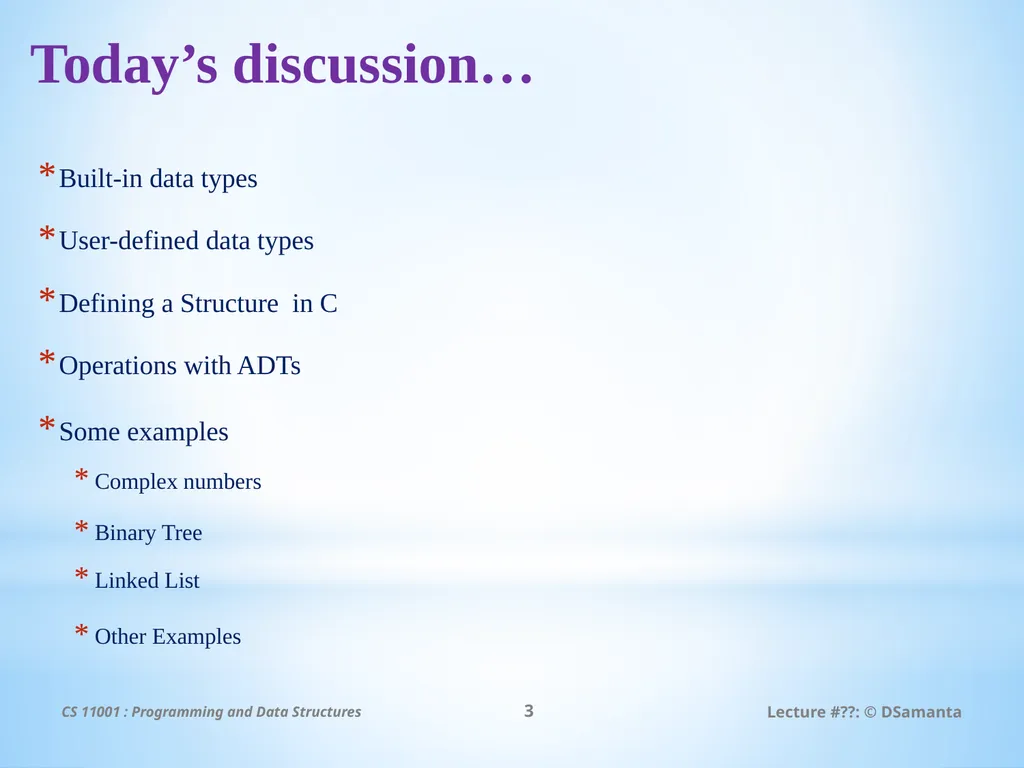
Built-in data types
User-defined data types
Defining a Structure in C
Operations with ADTs
Some examples
Complex numbers
Binary Tree
Linked List
Other Examples Today’s discussion… CS 11001 : Programming and Data Structures 3 Lecture #??: © DSamanta<br>
User-defined data types
Defining a Structure in C
Operations with ADTs
Some examples
Complex numbers
Binary Tree
Linked List
Other Examples Today’s discussion… CS 11001 : Programming and Data Structures 3 Lecture #??: © DSamanta<br>
04
Built-in Data Type CS 11001 : Programming and Data Structures 4 Lecture #??: © DSamanta<br>
05
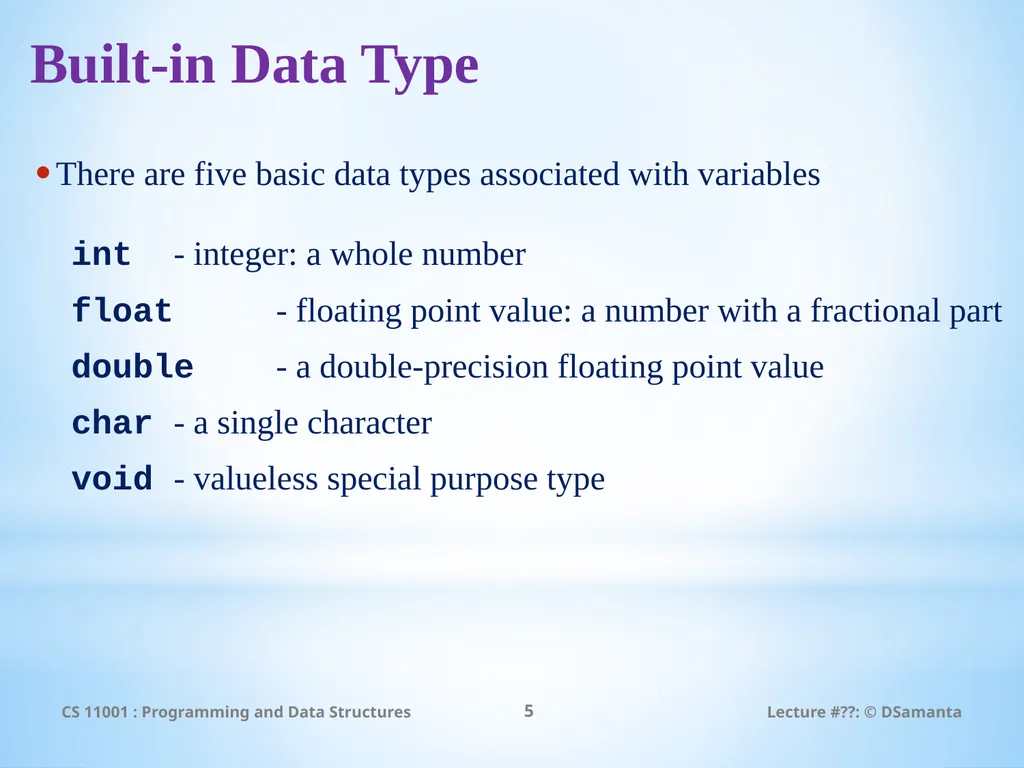
Built-in Data Type There are five basic data types associated with variables
int - integer: a whole number
float - floating point value: a number with a fractional part
double - a double-precision floating point value
char - a single character
void - valueless special purpose type CS 11001 : Programming and Data Structures 5 Lecture #??: © DSamanta<br>
int - integer: a whole number
float - floating point value: a number with a fractional part
double - a double-precision floating point value
char - a single character
void - valueless special purpose type CS 11001 : Programming and Data Structures 5 Lecture #??: © DSamanta<br>
06
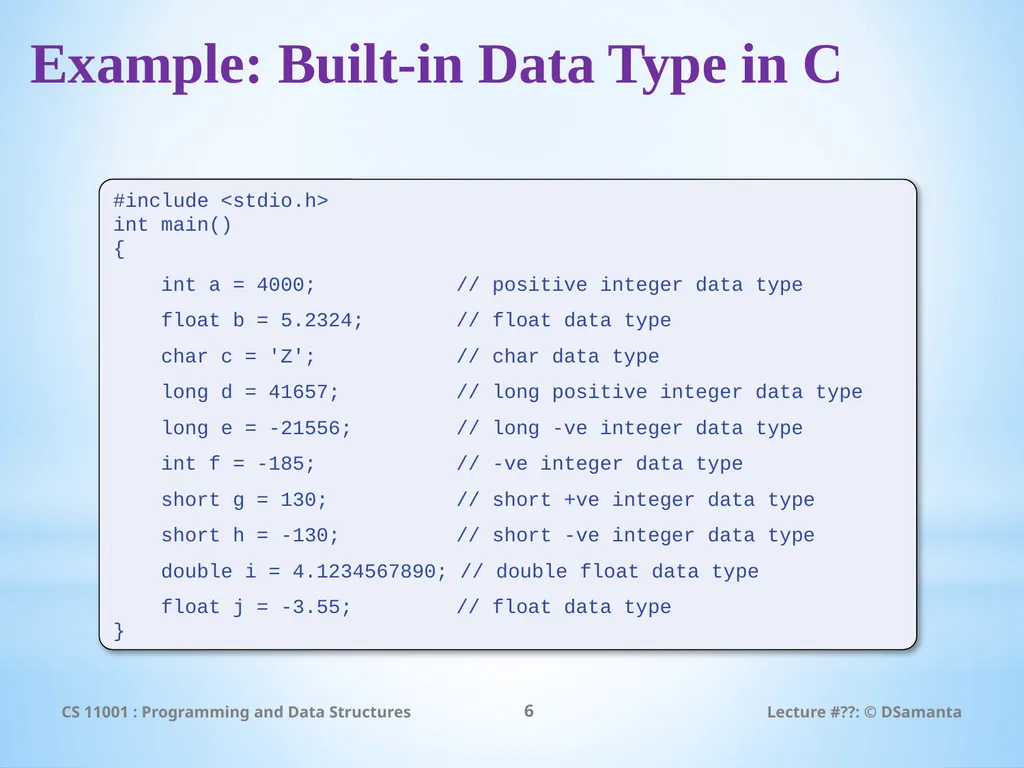
Example: Built-in Data Type in C CS 11001 : Programming and Data Structures 6 Lecture #??: © DSamanta #include <stdio.h>
int main()
{
int a = 4000; // positive integer data type
float b = 5.2324; // float data type
char c = 'Z'; // char data type
long d = 41657; // long positive integer data type
long e = -21556; // long -ve integer data type
int f = -185; // -ve integer data type
short g = 130; // short +ve integer data type
short h = -130; // short -ve integer data type
double i = 4.1234567890; // double float data type
float j = -3.55; // float data type
}<br>
07
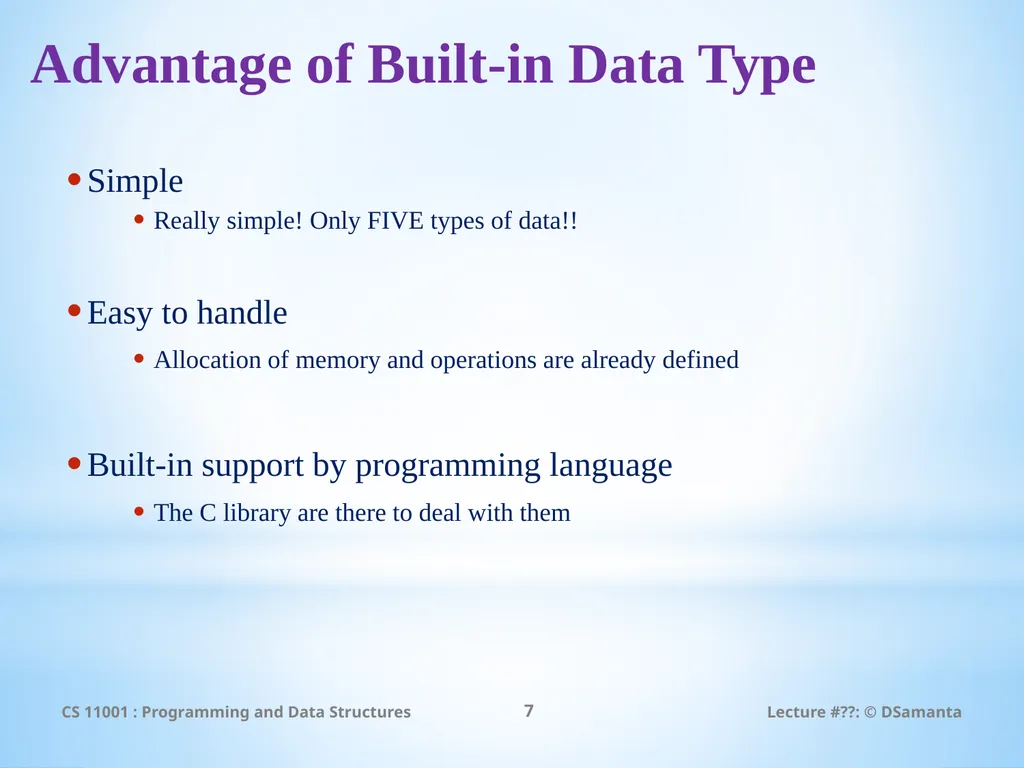
Advantage of Built-in Data Type Simple
Really simple! Only FIVE types of data!!
Easy to handle
Allocation of memory and operations are already defined
Built-in support by programming language
The C library are there to deal with them CS 11001 : Programming and Data Structures 7 Lecture #??: © DSamanta<br>
Really simple! Only FIVE types of data!!
Easy to handle
Allocation of memory and operations are already defined
Built-in support by programming language
The C library are there to deal with them CS 11001 : Programming and Data Structures 7 Lecture #??: © DSamanta<br>
08
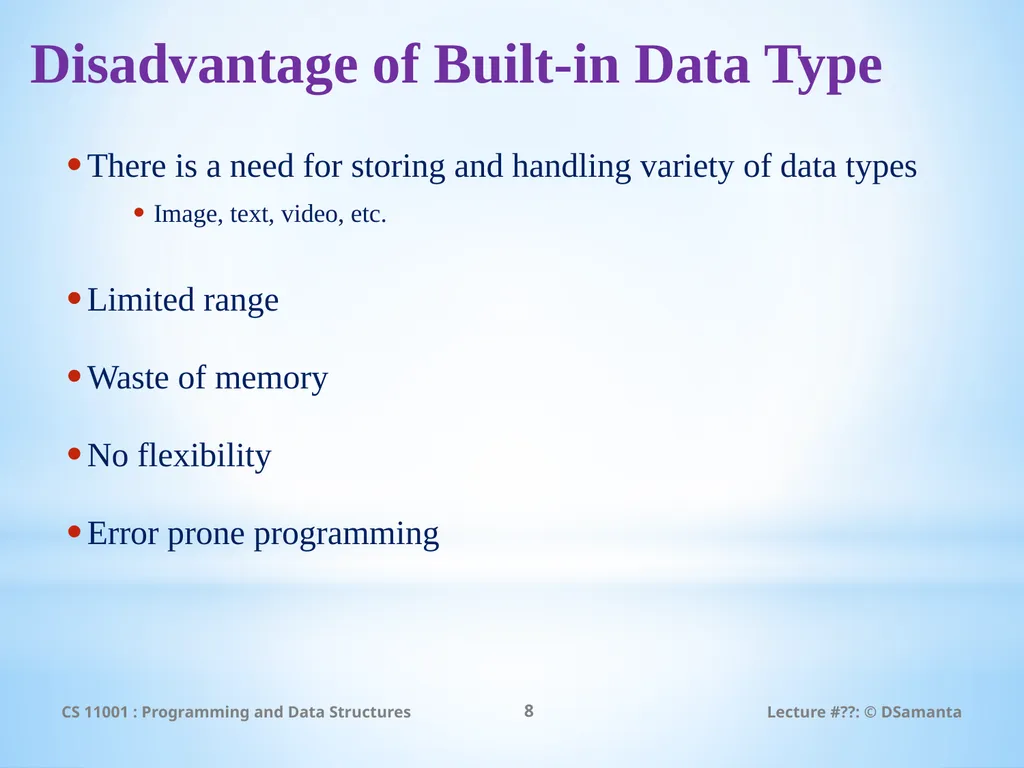
Disadvantage of Built-in Data Type There is a need for storing and handling variety of data types
Image, text, video, etc.
Limited range
Waste of memory
No flexibility
Error prone programming CS 11001 : Programming and Data Structures 8 Lecture #??: © DSamanta<br>
Image, text, video, etc.
Limited range
Waste of memory
No flexibility
Error prone programming CS 11001 : Programming and Data Structures 8 Lecture #??: © DSamanta<br>
09
User-Defined Data Type CS 11001 : Programming and Data Structures 9 Lecture #??: © DSamanta<br>
10
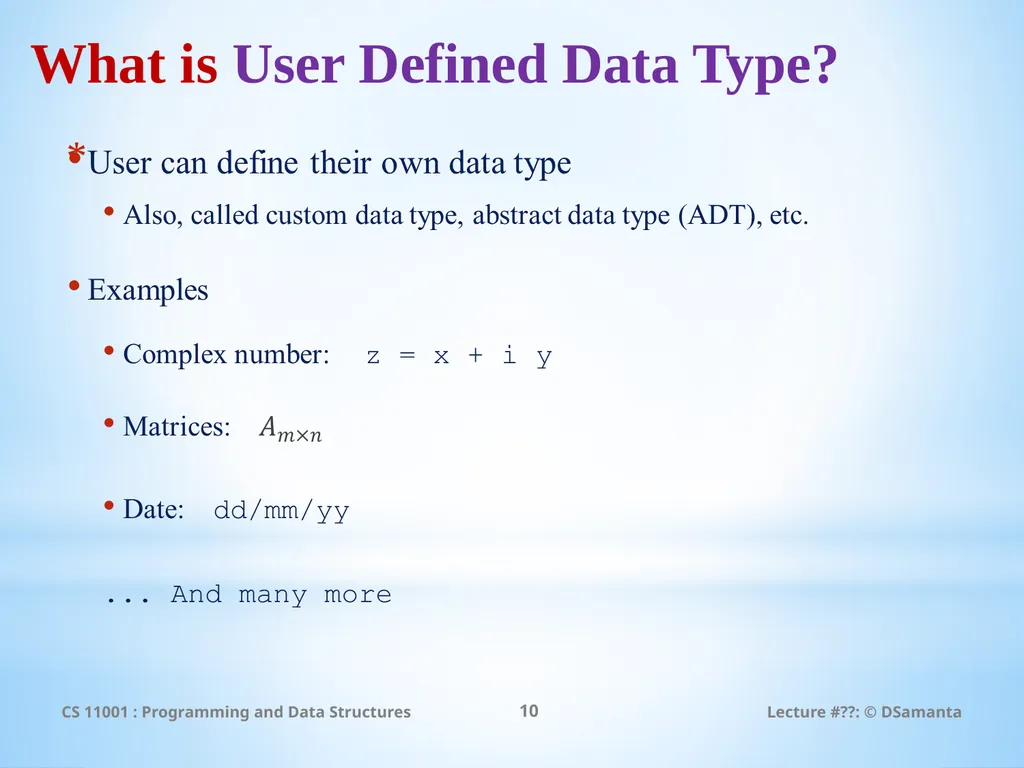
What is User Defined Data Type? CS 11001 : Programming and Data Structures 10 Lecture #??: © DSamanta<br>
11
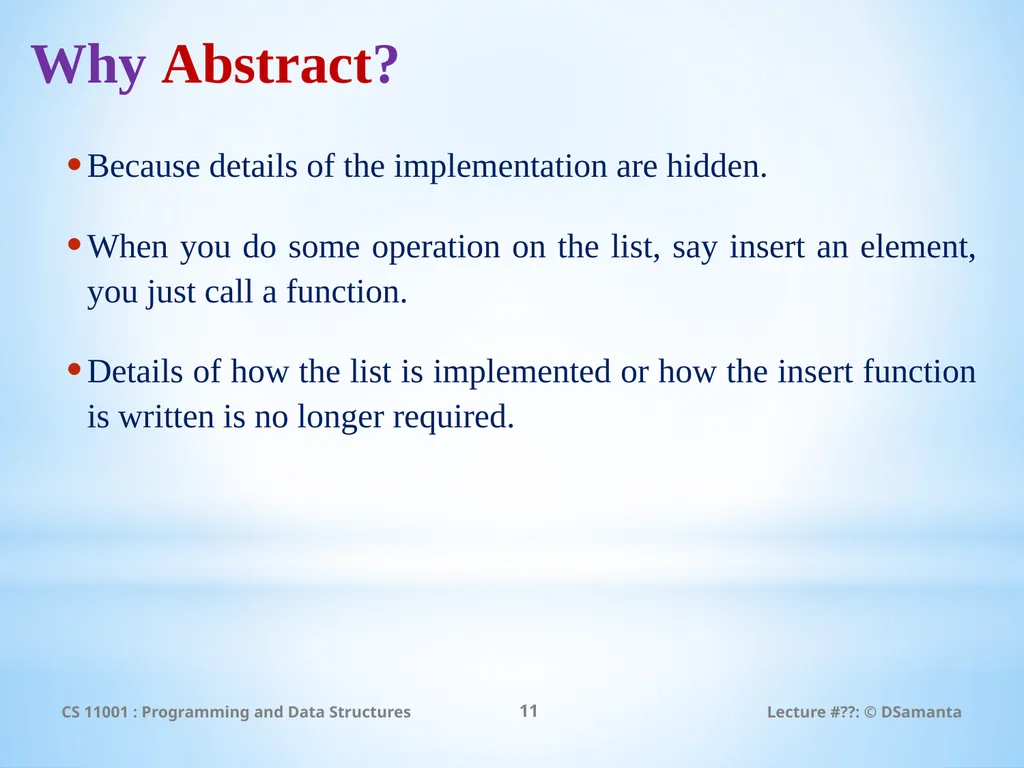
Why Abstract? Because details of the implementation are hidden.
When you do some operation on the list, say insert an element, you just call a function.
Details of how the list is implemented or how the insert function is written is no longer required. CS 11001 : Programming and Data Structures 11 Lecture #??: © DSamanta<br>
When you do some operation on the list, say insert an element, you just call a function.
Details of how the list is implemented or how the insert function is written is no longer required. CS 11001 : Programming and Data Structures 11 Lecture #??: © DSamanta<br>
12
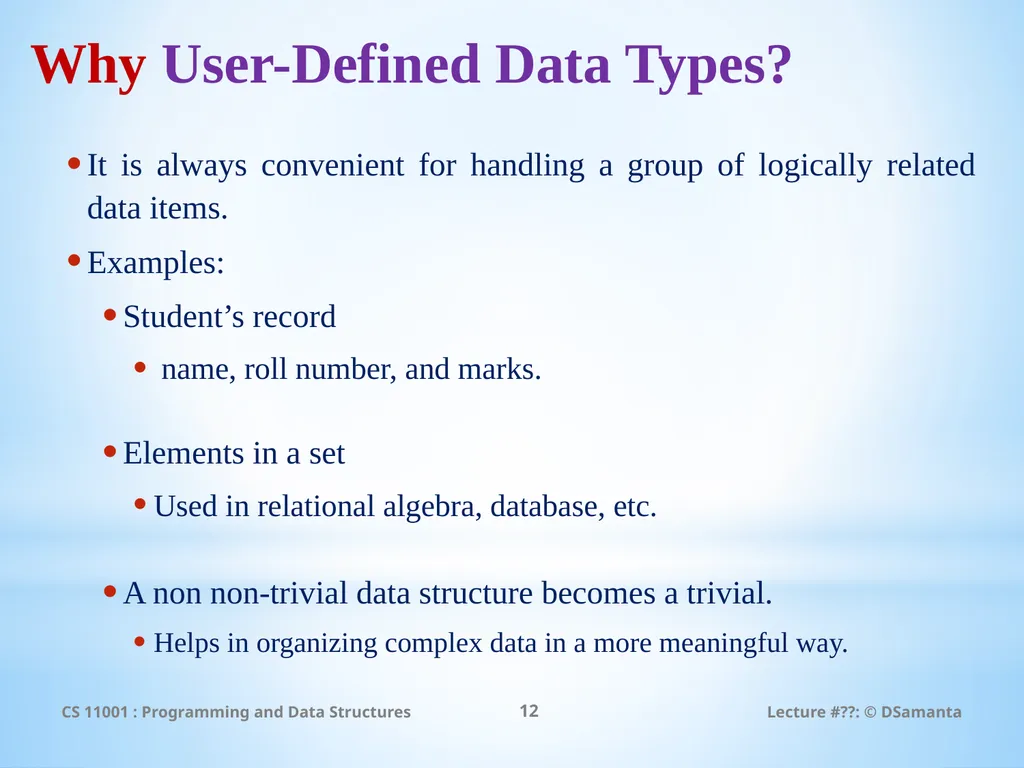
Why User-Defined Data Types? It is always convenient for handling a group of logically related data items.
Examples:
Student’s record
name, roll number, and marks.
Elements in a set
Used in relational algebra, database, etc.
A non non-trivial data structure becomes a trivial.
Helps in organizing complex data in a more meaningful way. CS 11001 : Programming and Data Structures 12 Lecture #??: © DSamanta<br>
13
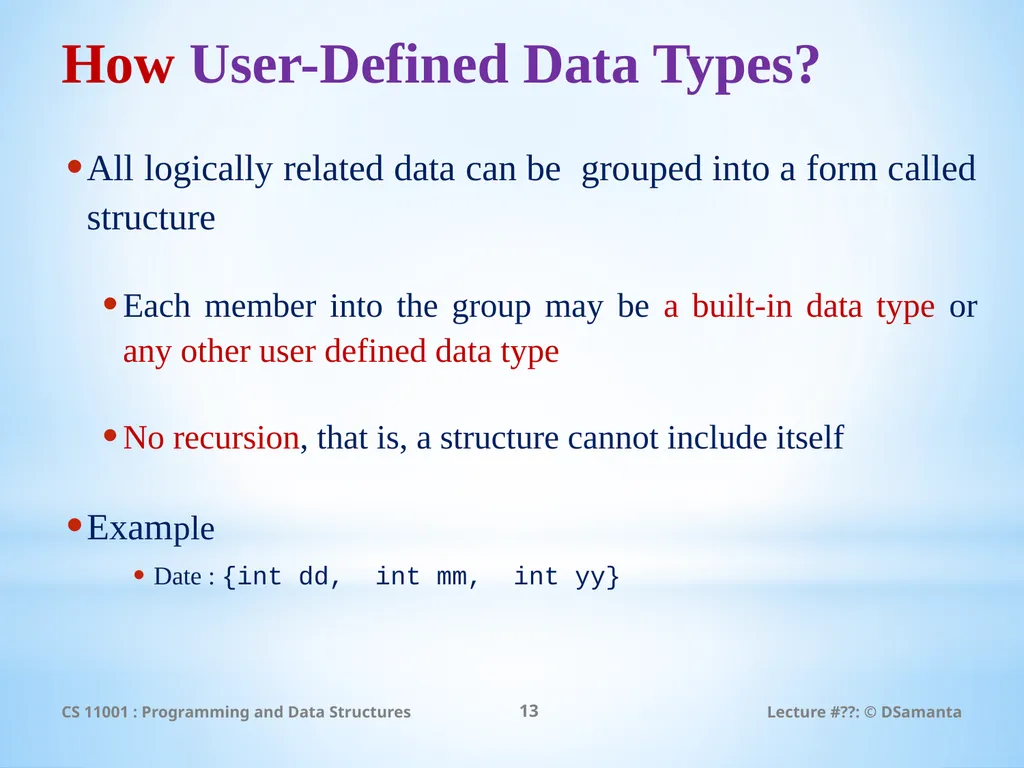
How User-Defined Data Types? All logically related data can be grouped into a form called structure
Each member into the group may be a built-in data type or any other user defined data type
No recursion, that is, a structure cannot include itself
Example
Date : {int dd, int mm, int yy} CS 11001 : Programming and Data Structures 13 Lecture #??: © DSamanta<br>
Each member into the group may be a built-in data type or any other user defined data type
No recursion, that is, a structure cannot include itself
Example
Date : {int dd, int mm, int yy} CS 11001 : Programming and Data Structures 13 Lecture #??: © DSamanta<br>
14
Structure Definition in C CS 11001 : Programming and Data Structures 14 Lecture #??: © DSamanta<br>
15
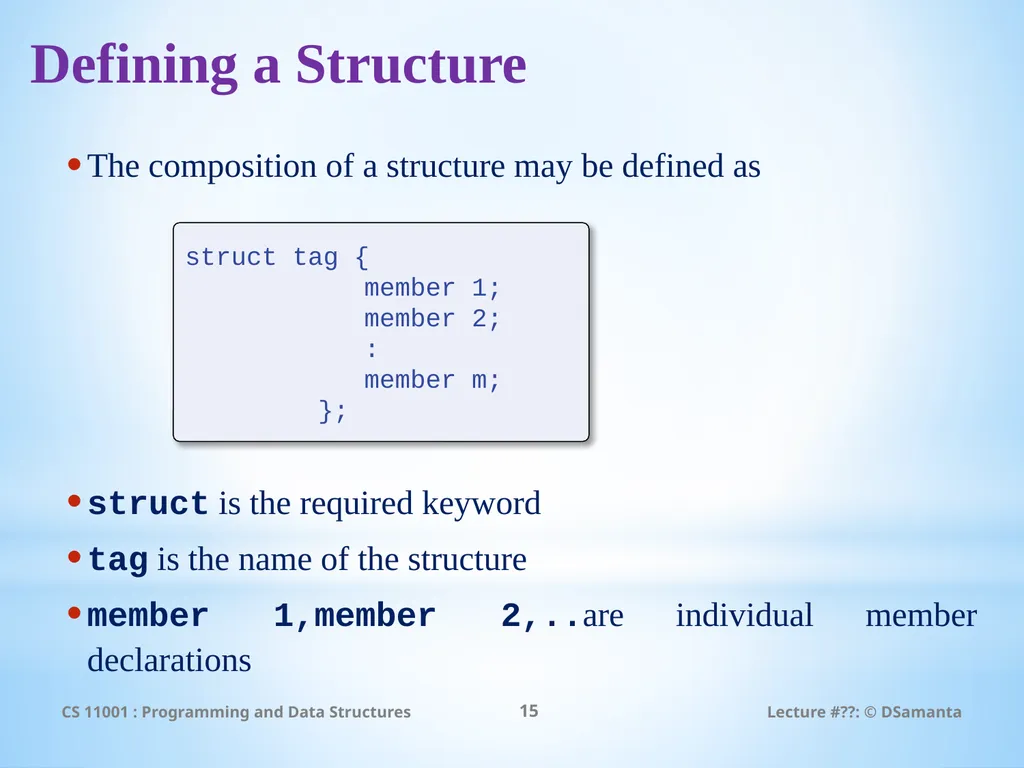
Defining a Structure The composition of a structure may be defined as
struct is the required keyword
tag is the name of the structure
member 1,member 2,..are individual member declarations CS 11001 : Programming and Data Structures 15 Lecture #??: © DSamanta struct tag {
member 1;
member 2;
:
member m;
};<br>
struct is the required keyword
tag is the name of the structure
member 1,member 2,..are individual member declarations CS 11001 : Programming and Data Structures 15 Lecture #??: © DSamanta struct tag {
member 1;
member 2;
:
member m;
};<br>
16
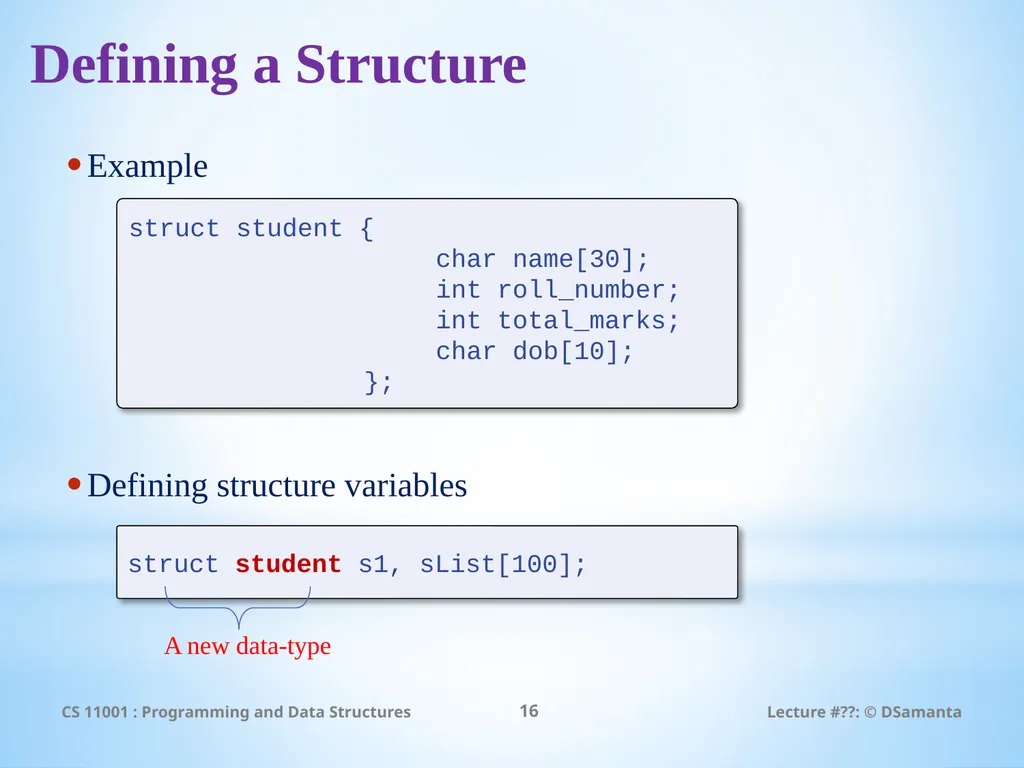
Defining a Structure Example
Defining structure variables
A new data-type CS 11001 : Programming and Data Structures 16 Lecture #??: © DSamanta struct student {
char name[30];
int roll_number;
int total_marks;
char dob[10];
}; struct student s1, sList[100];<br>
Defining structure variables
A new data-type CS 11001 : Programming and Data Structures 16 Lecture #??: © DSamanta struct student {
char name[30];
int roll_number;
int total_marks;
char dob[10];
}; struct student s1, sList[100];<br>
17
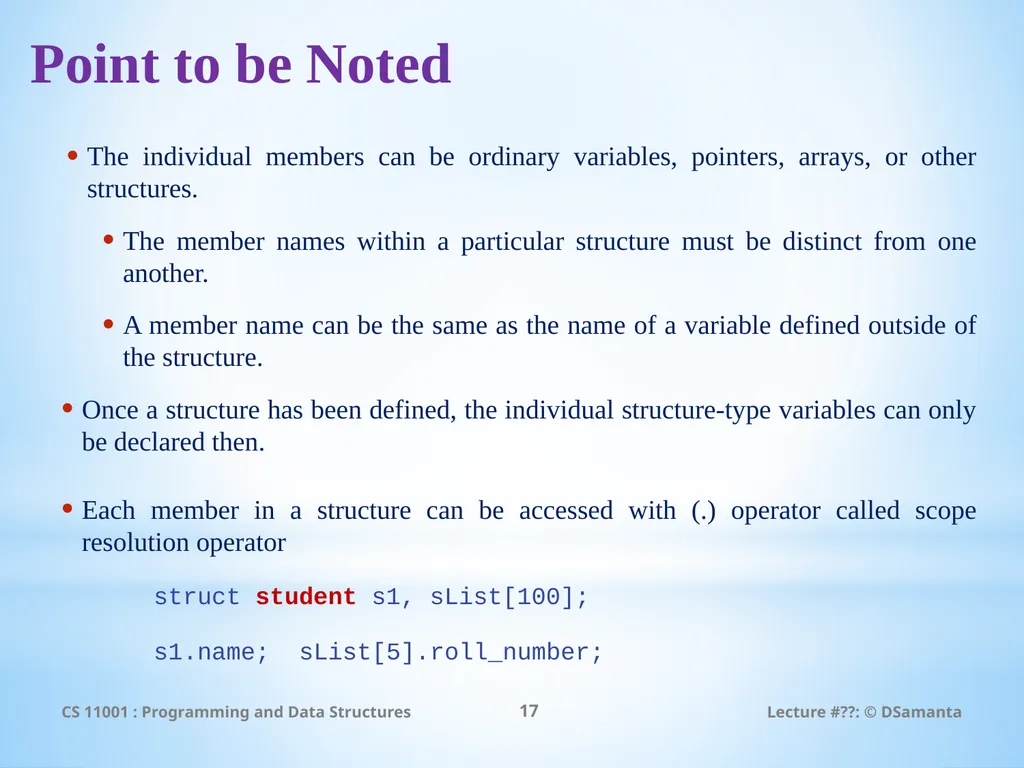
Point to be Noted The individual members can be ordinary variables, pointers, arrays, or other structures.
The member names within a particular structure must be distinct from one another.
A member name can be the same as the name of a variable defined outside of the structure.
Once a structure has been defined, the individual structure-type variables can only be declared then.
Each member in a structure can be accessed with (.) operator called scope resolution operator
struct student s1, sList[100];
s1.name; sList[5].roll_number; CS 11001 : Programming and Data Structures 17 Lecture #??: © DSamanta<br>
18
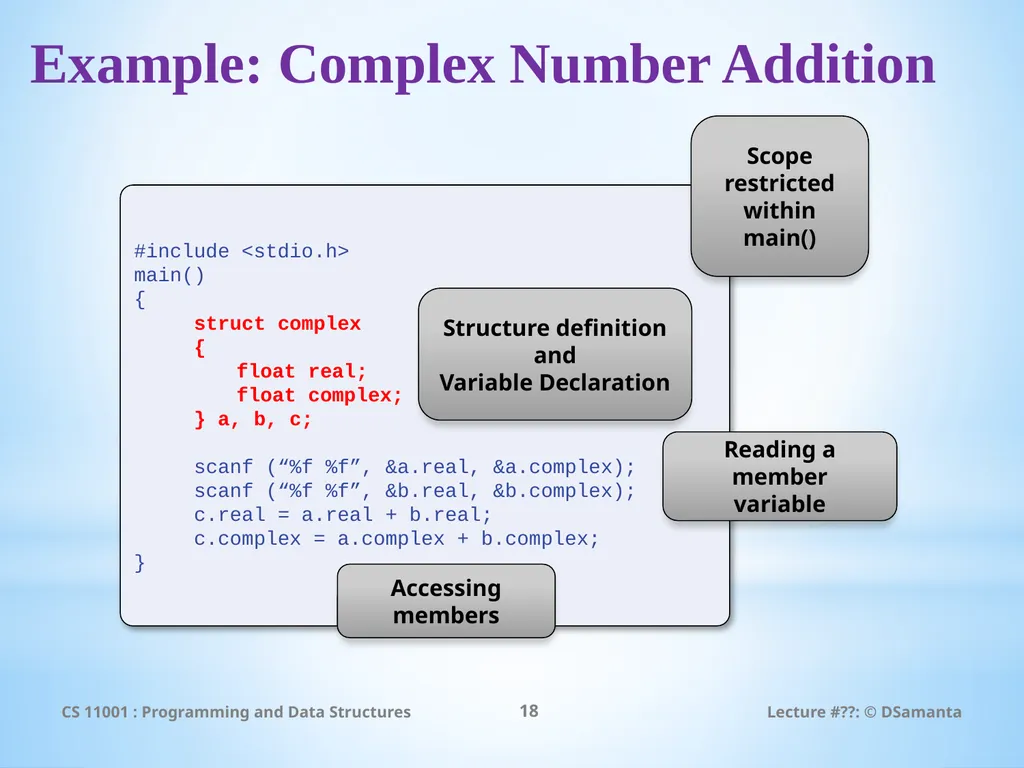
Example: Complex Number Addition CS 11001 : Programming and Data Structures 18 Lecture #??: © DSamanta #include <stdio.h>
main()
{
struct complex
{
float real;
float complex;
} a, b, c;
scanf (“%f %f”, &a.real, &a.complex);
scanf (“%f %f”, &b.real, &b.complex);
c.real = a.real + b.real;
c.complex = a.complex + b.complex;
} Scope
restricted
within
main() Structure definition
and
Variable Declaration Reading a member
variable Accessing members<br>
19
Operations with ADTs CS 11001 : Programming and Data Structures 19 Lecture #??: © DSamanta<br>
20
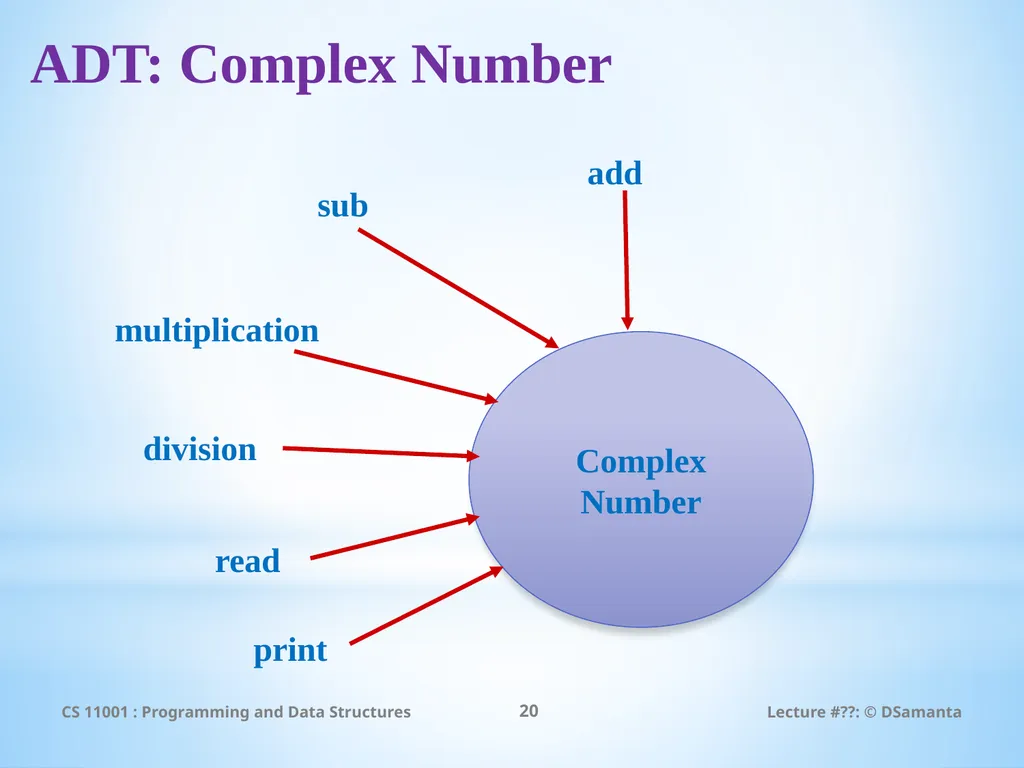
ADT: Complex Number CS 11001 : Programming and Data Structures 20 Lecture #??: © DSamanta Complex
Number add print multiplication sub read division<br>
Number add print multiplication sub read division<br>
21
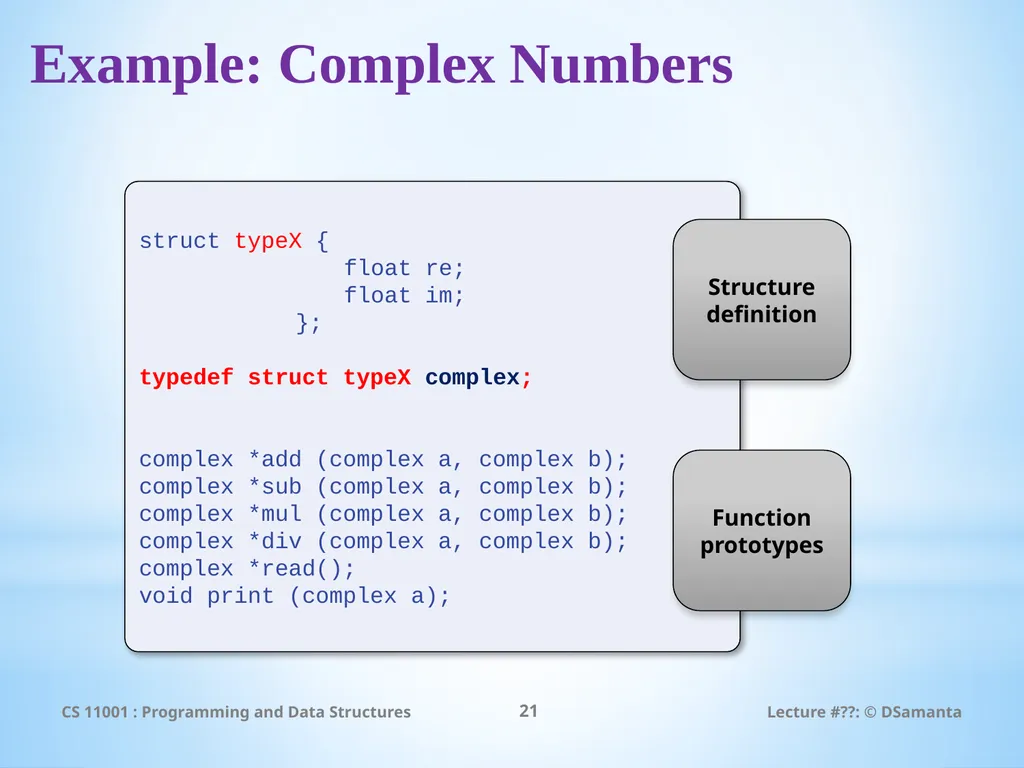
Example: Complex Numbers CS 11001 : Programming and Data Structures 21 Lecture #??: © DSamanta struct typeX {
float re;
float im;
};
typedef struct typeX complex;
complex *add (complex a, complex b);
complex *sub (complex a, complex b);
complex *mul (complex a, complex b);
complex *div (complex a, complex b);
complex *read();
void print (complex a); Function
prototypes Structure
definition<br>
float re;
float im;
};
typedef struct typeX complex;
complex *add (complex a, complex b);
complex *sub (complex a, complex b);
complex *mul (complex a, complex b);
complex *div (complex a, complex b);
complex *read();
void print (complex a); Function
prototypes Structure
definition<br>
22
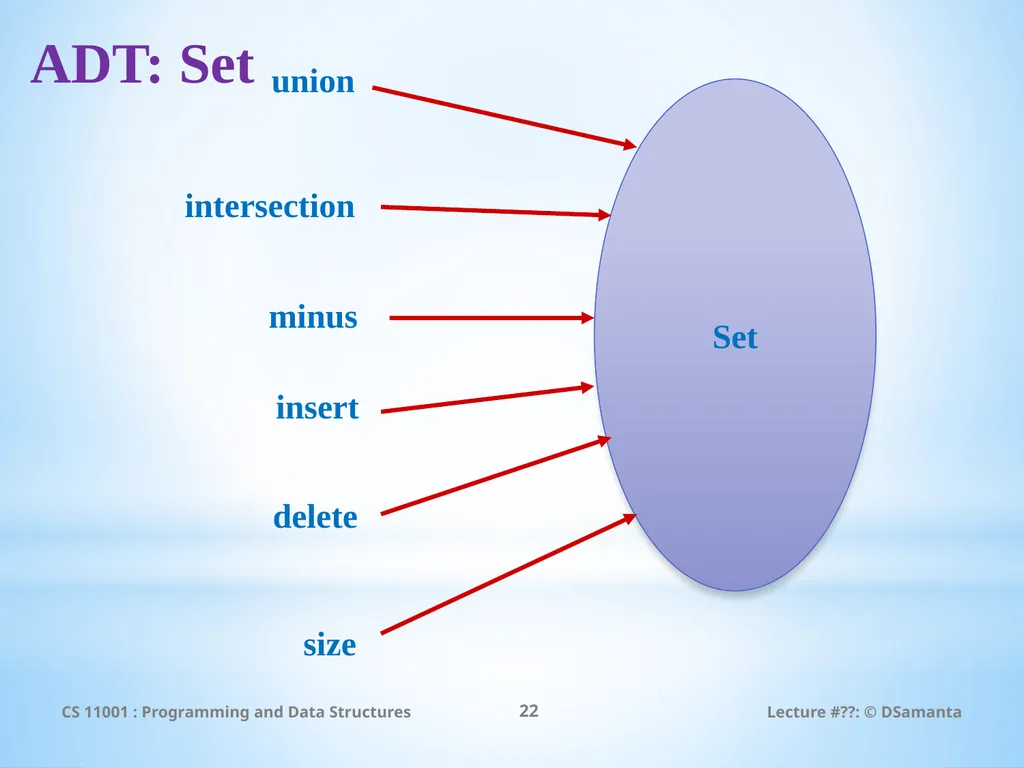
ADT: Set CS 11001 : Programming and Data Structures 22 Lecture #??: © DSamanta Set union size minus intersection delete insert<br>
23
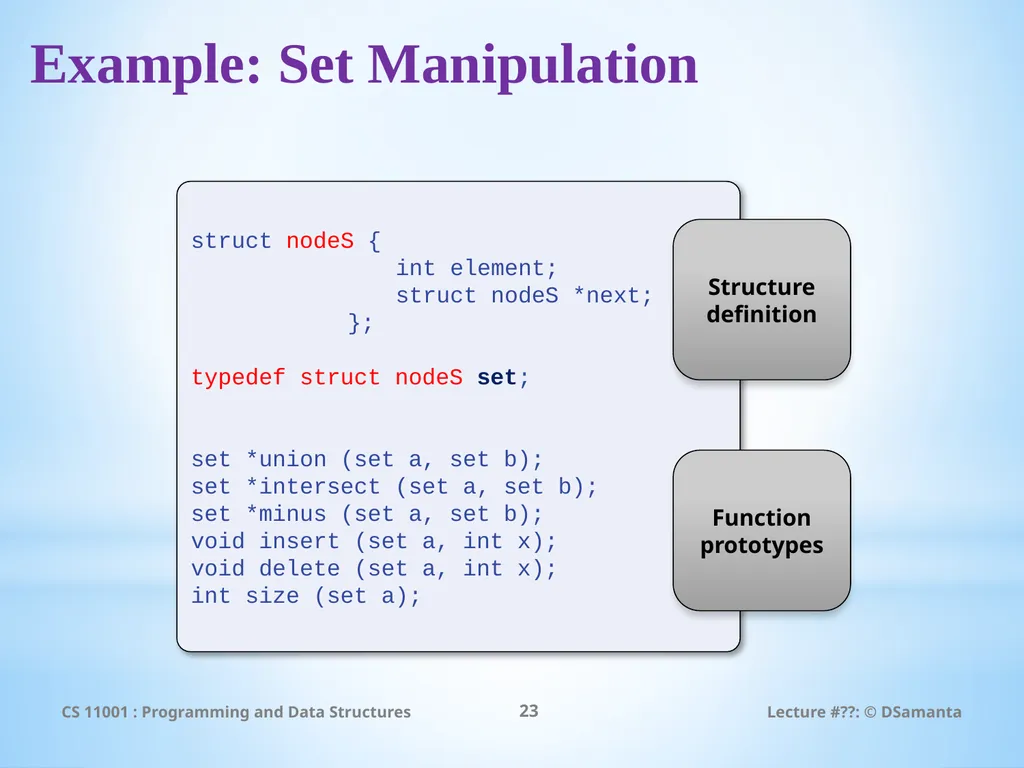
Example: Set Manipulation CS 11001 : Programming and Data Structures 23 Lecture #??: © DSamanta struct nodeS {
int element;
struct nodeS *next;
};
typedef struct nodeS set;
set *union (set a, set b);
set *intersect (set a, set b);
set *minus (set a, set b);
void insert (set a, int x);
void delete (set a, int x);
int size (set a); Function
prototypes Structure
definition<br>
int element;
struct nodeS *next;
};
typedef struct nodeS set;
set *union (set a, set b);
set *intersect (set a, set b);
set *minus (set a, set b);
void insert (set a, int x);
void delete (set a, int x);
int size (set a); Function
prototypes Structure
definition<br>
24
Binary Tree CS 11001 : Programming and Data Structures 24 Lecture #??: © DSamanta<br>
25
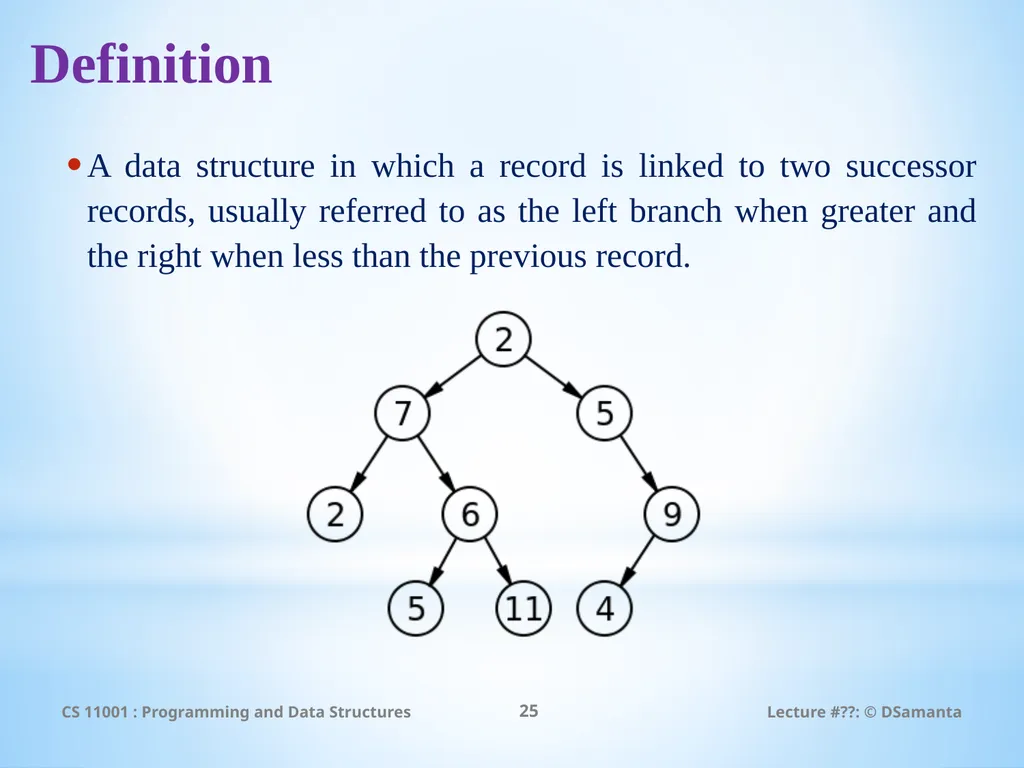
Definition A data structure in which a record is linked to two successor records, usually referred to as the left branch when greater and the right when less than the previous record. CS 11001 : Programming and Data Structures 25 Lecture #??: © DSamanta<br>
26
Tree Terminology A binary tree is made of nodes, where each node contains a "left" reference, a "right" reference, and a data element. The topmost node in the tree is called the root
Every node (excluding a root) in a tree is connected by a directed edge from exactly one other node which is called a parent
On the other hand, each node can be connected to arbitrary number of nodes, called children
Nodes with no children are called leaves or external nodes
Nodes which are not leaves are called internal nodes
Nodes with the same parent are called sibling CS 11001 : Programming and Data Structures 26 Lecture #??: © DSamanta<br>
27
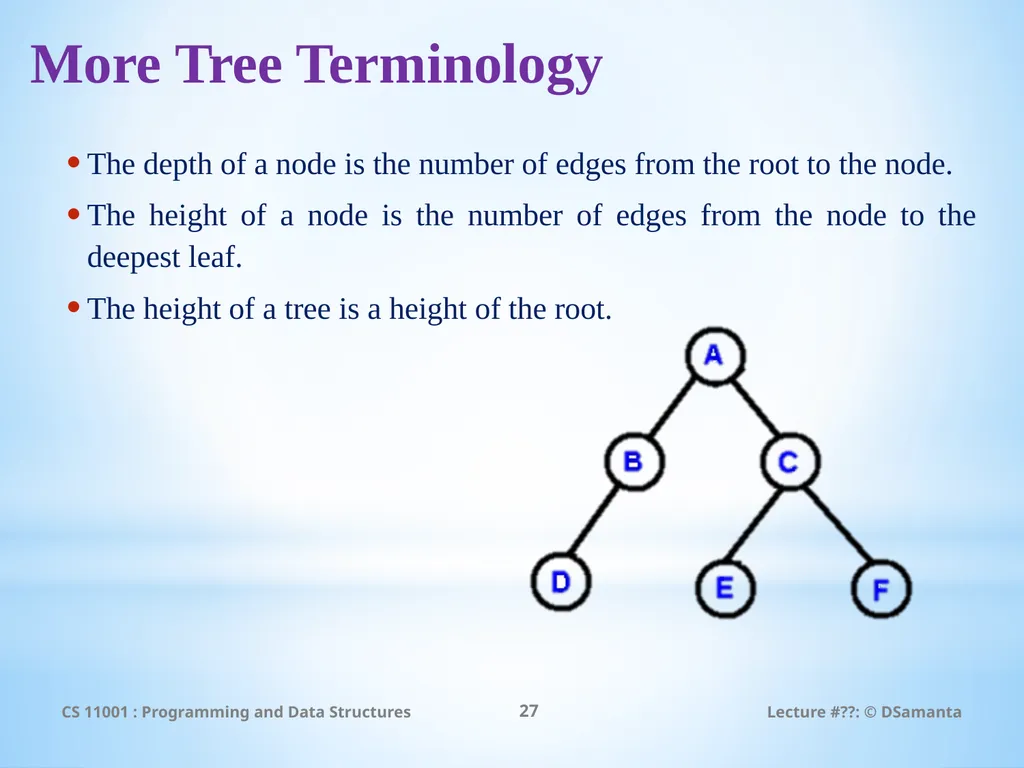
More Tree Terminology The depth of a node is the number of edges from the root to the node.
The height of a node is the number of edges from the node to the deepest leaf.
The height of a tree is a height of the root. CS 11001 : Programming and Data Structures 27 Lecture #??: © DSamanta<br>
The height of a node is the number of edges from the node to the deepest leaf.
The height of a tree is a height of the root. CS 11001 : Programming and Data Structures 27 Lecture #??: © DSamanta<br>
28
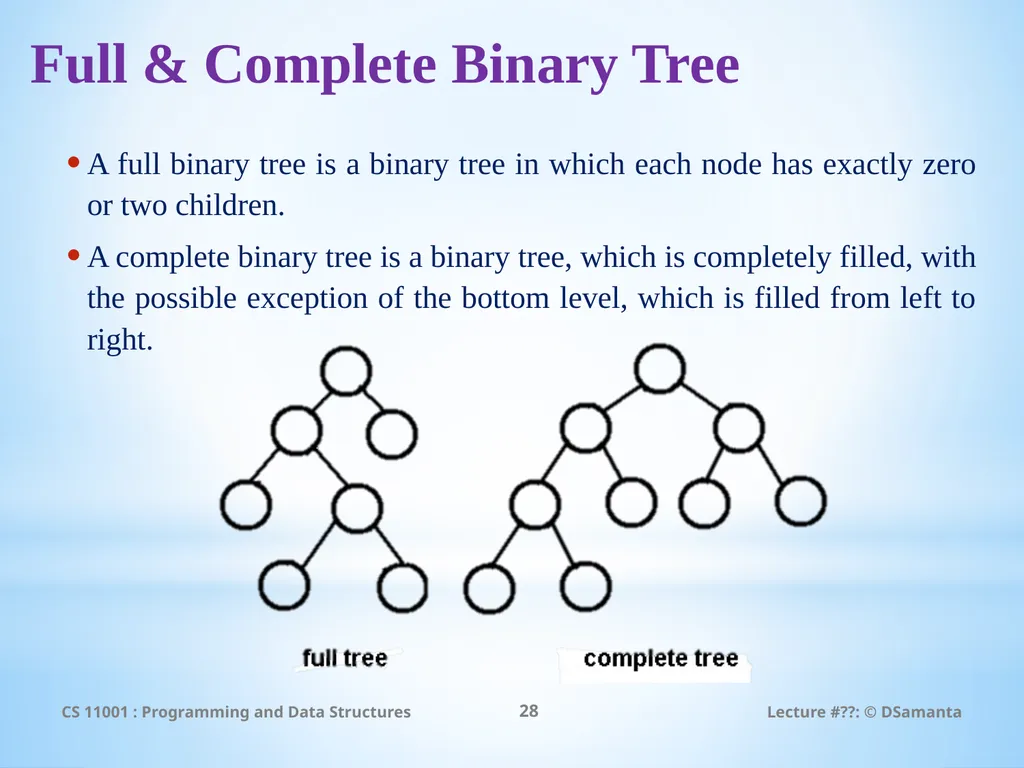
Full & Complete Binary Tree A full binary tree is a binary tree in which each node has exactly zero or two children.
A complete binary tree is a binary tree, which is completely filled, with the possible exception of the bottom level, which is filled from left to right. CS 11001 : Programming and Data Structures 28 Lecture #??: © DSamanta<br>
A complete binary tree is a binary tree, which is completely filled, with the possible exception of the bottom level, which is filled from left to right. CS 11001 : Programming and Data Structures 28 Lecture #??: © DSamanta<br>
29
Advantages of Trees Trees are so useful and frequently used, because they have some very serious advantages:-
Trees reflect structural relationships in the data
Trees are used to represent hierarchies
Trees provide an efficient insertion and searching
Trees are very flexible data, allowing to move subtrees around with minimum effort CS 11001 : Programming and Data Structures 29 Lecture #??: © DSamanta<br>
Trees reflect structural relationships in the data
Trees are used to represent hierarchies
Trees provide an efficient insertion and searching
Trees are very flexible data, allowing to move subtrees around with minimum effort CS 11001 : Programming and Data Structures 29 Lecture #??: © DSamanta<br>
30
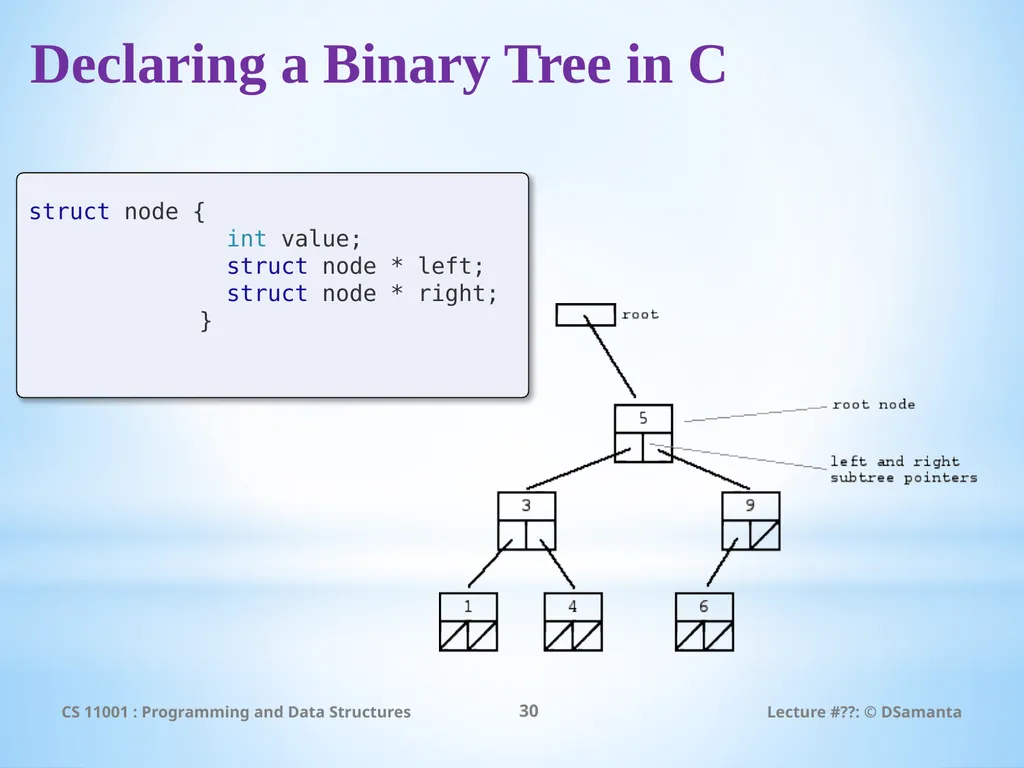
Declaring a Binary Tree in C CS 11001 : Programming and Data Structures 30 Lecture #??: © DSamanta struct node {
int value;
struct node * left;
struct node * right;
}<br>
int value;
struct node * left;
struct node * right;
}<br>
31
Traversals A traversal is a process that visits all the nodes in the tree. Since a tree is a nonlinear data structure, there is no unique traversal. We will consider several traversal algorithms with we group in the following two kinds:-
depth-first traversal
breadth-first traversal
There are three different types of depth-first traversals:-
PreOrder traversal - visit the parent first and then left and right children;
InOrder traversal - visit the left child, then the parent and the right child;
PostOrder traversal - visit left child, then the right child and then the parent; CS 11001 : Programming and Data Structures 31 Lecture #??: © DSamanta<br>
32
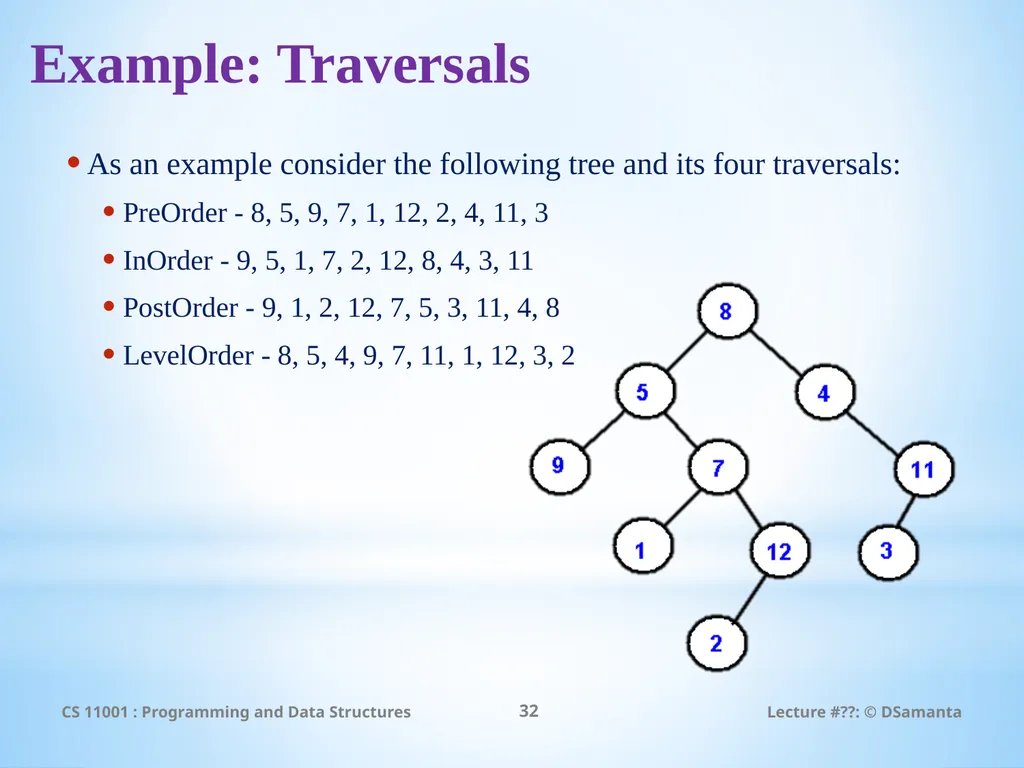
Example: Traversals As an example consider the following tree and its four traversals:
PreOrder - 8, 5, 9, 7, 1, 12, 2, 4, 11, 3
InOrder - 9, 5, 1, 7, 2, 12, 8, 4, 3, 11
PostOrder - 9, 1, 2, 12, 7, 5, 3, 11, 4, 8
LevelOrder - 8, 5, 4, 9, 7, 11, 1, 12, 3, 2 CS 11001 : Programming and Data Structures 32 Lecture #??: © DSamanta<br>
PreOrder - 8, 5, 9, 7, 1, 12, 2, 4, 11, 3
InOrder - 9, 5, 1, 7, 2, 12, 8, 4, 3, 11
PostOrder - 9, 1, 2, 12, 7, 5, 3, 11, 4, 8
LevelOrder - 8, 5, 4, 9, 7, 11, 1, 12, 3, 2 CS 11001 : Programming and Data Structures 32 Lecture #??: © DSamanta<br>
33
Linked List CS 11001 : Programming and Data Structures 33 Lecture #??: © DSamanta<br>
34
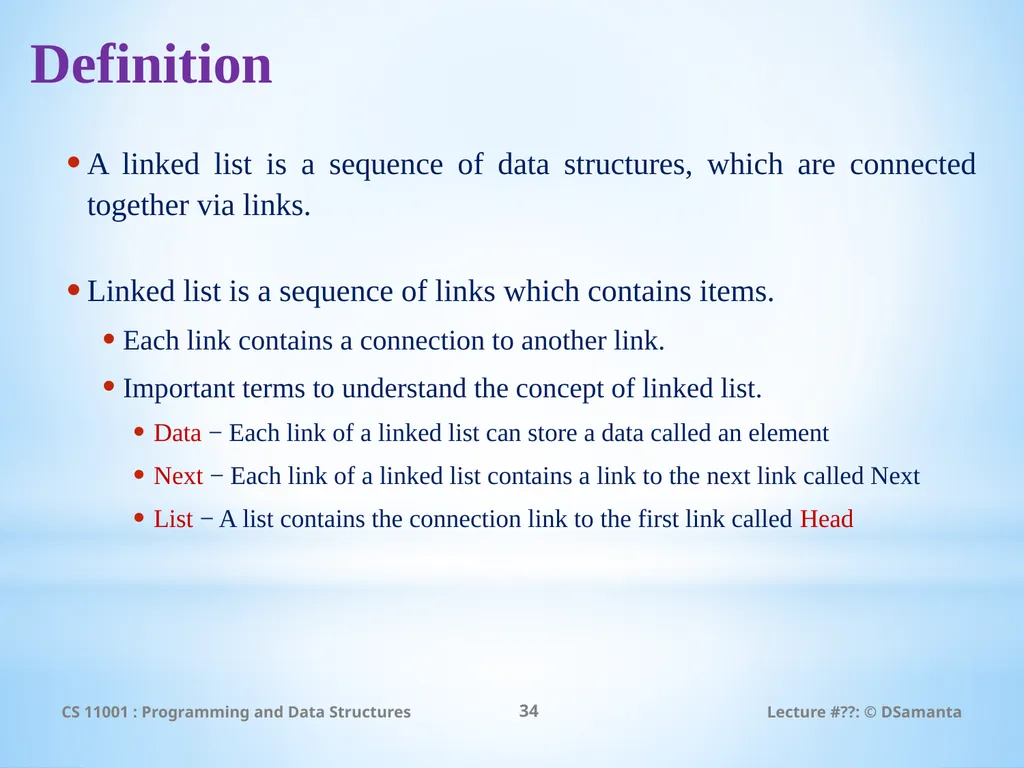
Definition A linked list is a sequence of data structures, which are connected together via links.
Linked list is a sequence of links which contains items.
Each link contains a connection to another link.
Important terms to understand the concept of linked list.
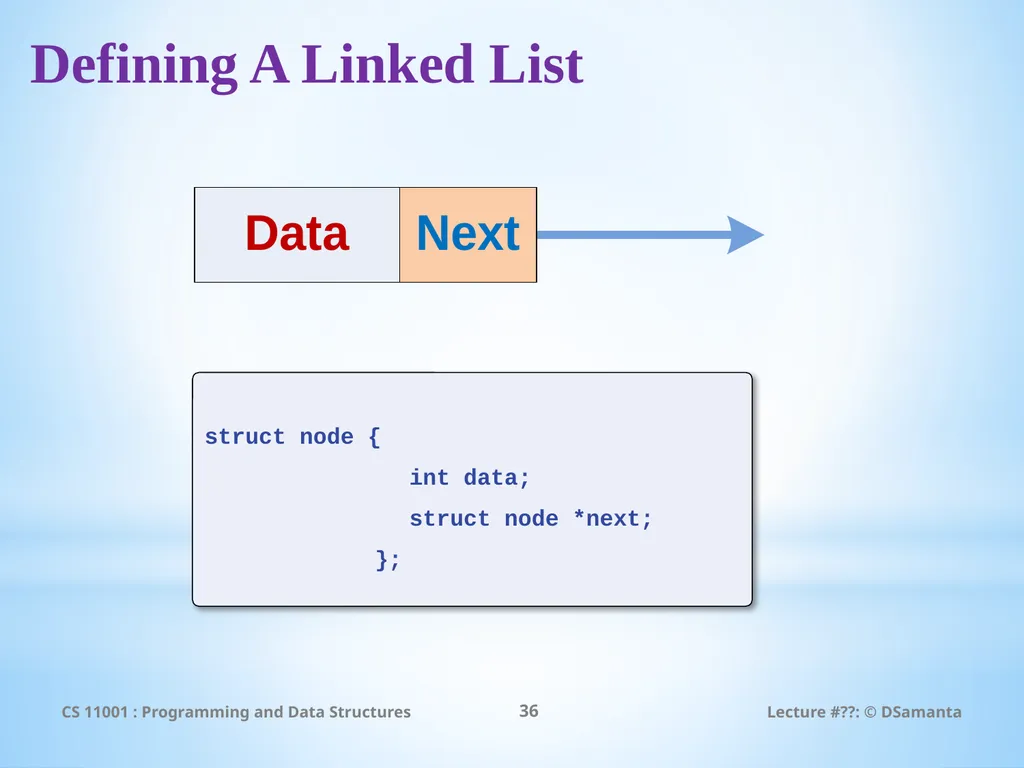
Data − Each link of a linked list can store a data called an element
Next − Each link of a linked list contains a link to the next link called Next
List − A list contains the connection link to the first link called Head CS 11001 : Programming and Data Structures 34 Lecture #??: © DSamanta<br>
35
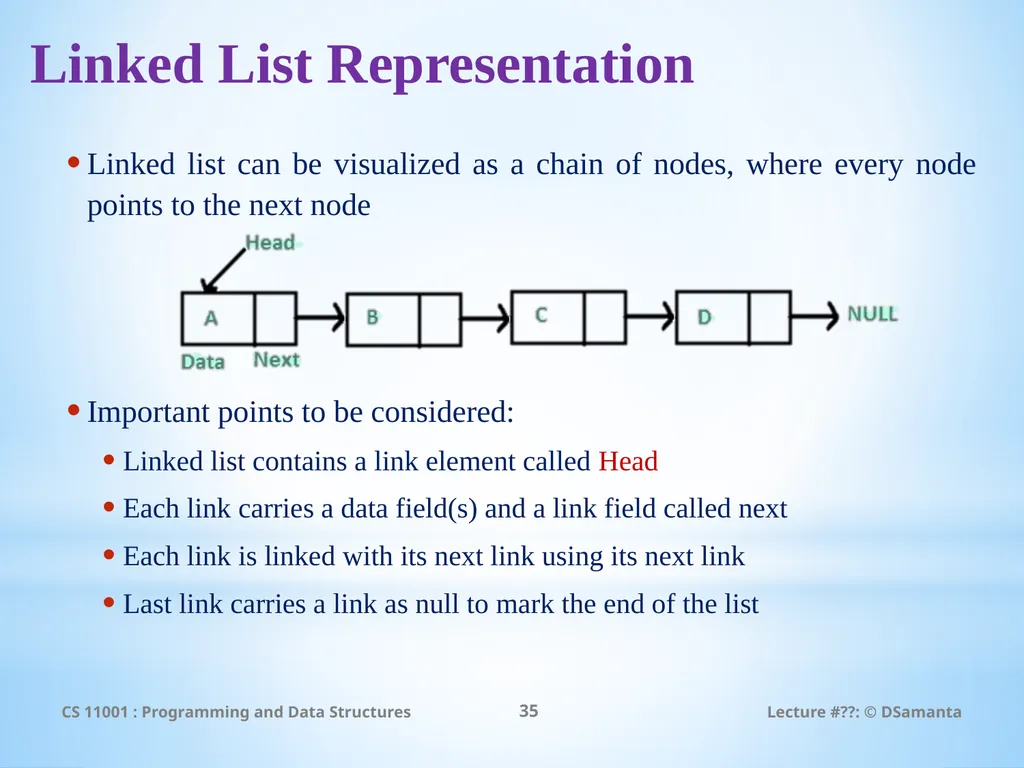
Linked List Representation Linked list can be visualized as a chain of nodes, where every node points to the next node
Important points to be considered:
Linked list contains a link element called Head
Each link carries a data field(s) and a link field called next
Each link is linked with its next link using its next link
Last link carries a link as null to mark the end of the list CS 11001 : Programming and Data Structures 35 Lecture #??: © DSamanta<br>
36
Defining A Linked List CS 11001 : Programming and Data Structures 36 Lecture #??: © DSamanta struct node {
int data;
struct node *next;
};<br>
int data;
struct node *next;
};<br>
37
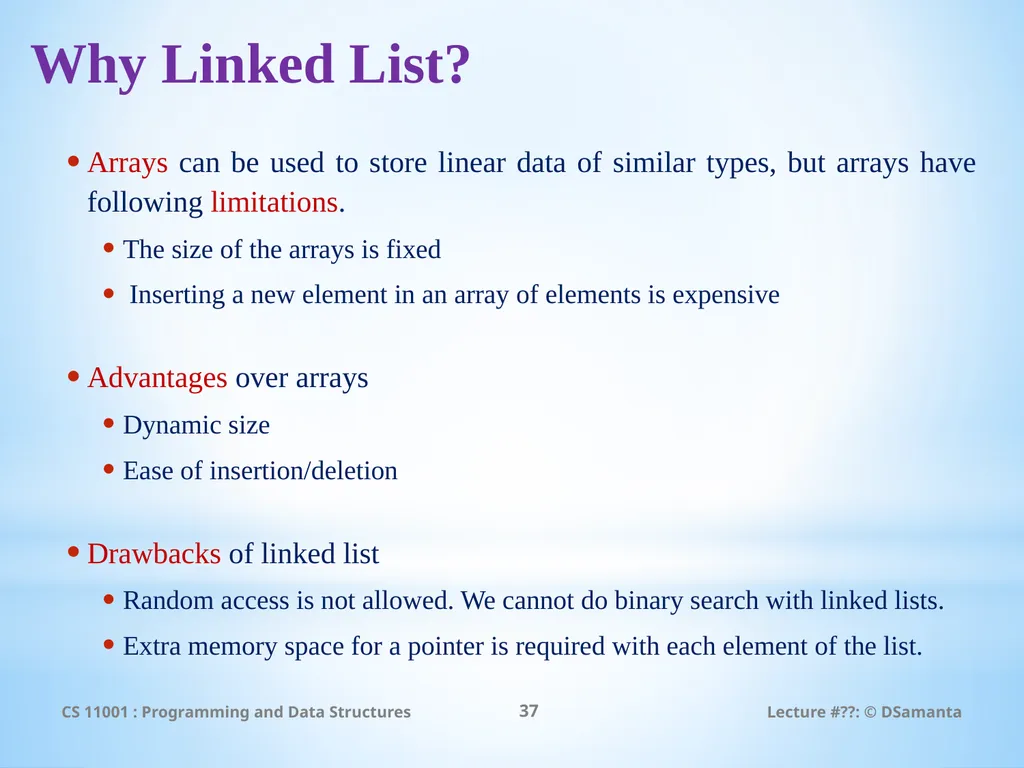
Why Linked List? Arrays can be used to store linear data of similar types, but arrays have following limitations.
The size of the arrays is fixed
Inserting a new element in an array of elements is expensive
Advantages over arrays
Dynamic size
Ease of insertion/deletion
Drawbacks of linked list
Random access is not allowed. We cannot do binary search with linked lists.
Extra memory space for a pointer is required with each element of the list. CS 11001 : Programming and Data Structures 37 Lecture #??: © DSamanta<br>
38
Other Examples CS 11001 : Programming and Data Structures 38 Lecture #??: © DSamanta<br>
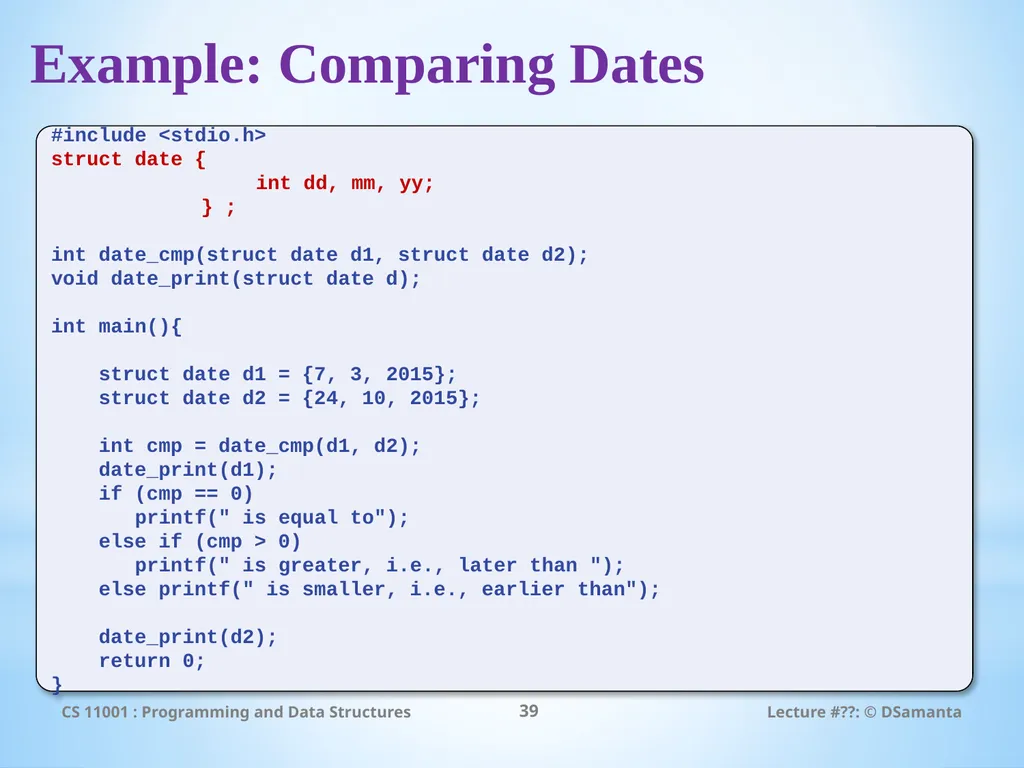
39
Example: Comparing Dates CS 11001 : Programming and Data Structures 39 Lecture #??: © DSamanta #include <stdio.h>
struct date {
int dd, mm, yy;
} ;
int date_cmp(struct date d1, struct date d2);
void date_print(struct date d);
int main(){
struct date d1 = {7, 3, 2015};
struct date d2 = {24, 10, 2015};
int cmp = date_cmp(d1, d2);
date_print(d1);
if (cmp == 0)
printf(" is equal to");
else if (cmp > 0)
printf(" is greater, i.e., later than ");
else printf(" is smaller, i.e., earlier than");
date_print(d2);
return 0;
}<br>
40
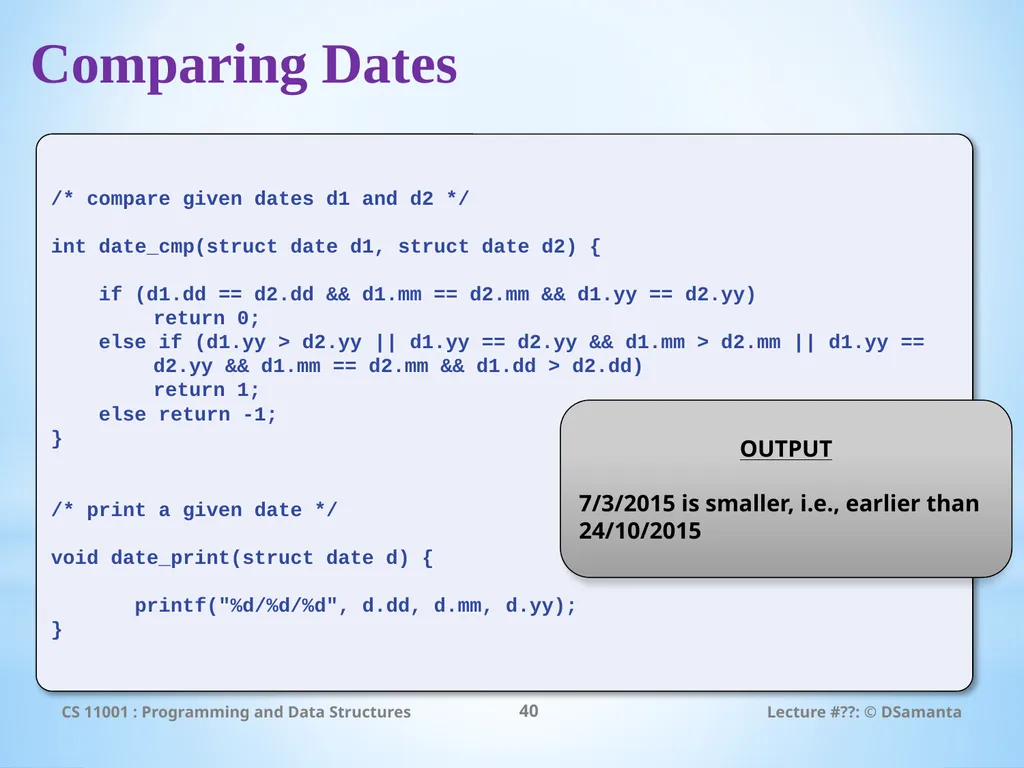
Comparing Dates CS 11001 : Programming and Data Structures 40 Lecture #??: © DSamanta /* compare given dates d1 and d2 */
int date_cmp(struct date d1, struct date d2) {
if (d1.dd == d2.dd && d1.mm == d2.mm && d1.yy == d2.yy)
return 0;
else if (d1.yy > d2.yy || d1.yy == d2.yy && d1.mm > d2.mm || d1.yy == d2.yy && d1.mm == d2.mm && d1.dd > d2.dd)
return 1;
else return -1;
}
/* print a given date */
void date_print(struct date d) {
printf("%d/%d/%d", d.dd, d.mm, d.yy);
} OUTPUT
7/3/2015 is smaller, i.e., earlier than 24/10/2015<br>
41
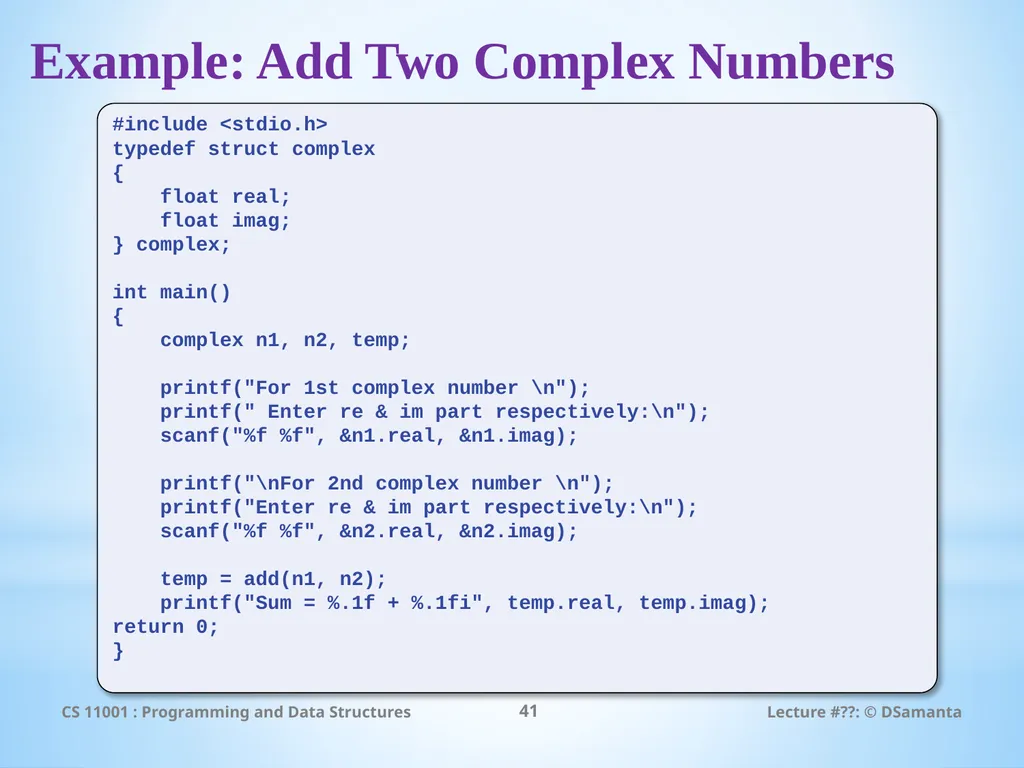
Example: Add Two Complex Numbers CS 11001 : Programming and Data Structures 41 Lecture #??: © DSamanta #include <stdio.h>
typedef struct complex
{
float real;
float imag;
} complex;
int main()
{
complex n1, n2, temp;
printf("For 1st complex number \n");
printf(" Enter re & im part respectively:\n");
scanf("%f %f", &n1.real, &n1.imag);
printf("\nFor 2nd complex number \n");
printf("Enter re & im part respectively:\n");
scanf("%f %f", &n2.real, &n2.imag);
temp = add(n1, n2);
printf("Sum = %.1f + %.1fi", temp.real, temp.imag);
return 0;
}<br>
42
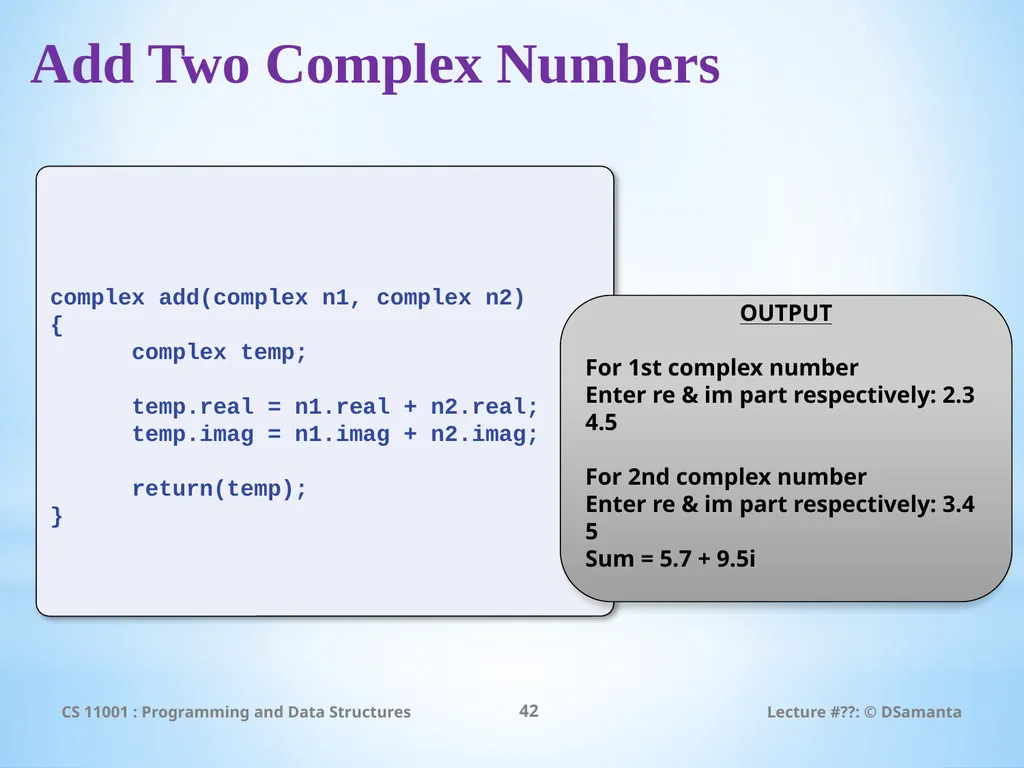
Add Two Complex Numbers CS 11001 : Programming and Data Structures 42 Lecture #??: © DSamanta complex add(complex n1, complex n2)
{
complex temp;
temp.real = n1.real + n2.real;
temp.imag = n1.imag + n2.imag;
return(temp);
} OUTPUT
For 1st complex number
Enter re & im part respectively: 2.3
4.5
For 2nd complex number
Enter re & im part respectively: 3.4
5
Sum = 5.7 + 9.5i<br>
{
complex temp;
temp.real = n1.real + n2.real;
temp.imag = n1.imag + n2.imag;
return(temp);
} OUTPUT
For 1st complex number
Enter re & im part respectively: 2.3
4.5
For 2nd complex number
Enter re & im part respectively: 3.4
5
Sum = 5.7 + 9.5i<br>
43
Any question? You may post your question(s) at the “Discussion Forum” maintained in the course Web page. CS 11001 : Programming and Data Structures 43 Lecture #??: © DSamanta<br>
44
Problems to ponder… CS 11001 : Programming and Data Structures 44 Lecture #??: © DSamanta Will be posted shortly…<br>
45
Problems for practice… CS 11001 : Programming and Data Structures 45 Lecture #??: © DSamanta Will be posted shortly…<br>