
Decarbonisation impacts: Green Industrial Policies

Description: Decarbonisation impacts: Green Industrial Policies Thursday, 29 August 2024 Presentation to Business Unity South Africa (BUSA) Mahendra Shunmoogam Director: International Trade Policy mshunmoogamthedtic.gov.za Trade Branch Agenda Agenda
Related Topics
Download Presentation
"Decarbonisation impacts: Green Industrial Policies" is the property of its rightful owner. Permission is granted to download and print the materials on this website for personal, non-commercial use only, and to display it on your personal computer provided you do not modify the materials and that you retain all copyright notices contained in the materials. By downloading content from our website, you accept the terms of this agreement.
Presentation Transcript
slide1. Decarbonisation impacts:
Green Industrial Policies Thursday, 29 August 2024
Presentation to Business Unity South Africa (BUSA)
Mahendra Shunmoogam Director: International Trade Policy mshunmoogam@thedtic.gov.za Trade Branch<br>
slide2. Agenda Agenda
Global decarbonization trends
CBAM
IRA
Deforestation
Policy tools<br>
slide3. Global Decarbonisation Goals/Committments The United Nations Framework Convention on Climate Change and its Paris Agreement have committed countries to work towards ensuring average global temperatures to well below 2 degree Celsius, above pre-industrial levels and pursuing efforts to limit the temperature increases to 1.5 degree Celsius above pre-industrial levels.
Using Global decarbonisation commitments we are witnessing a rise of unilateral, domestic climate-policy measures that have spill over negative cross border consequences, especially to developing countries.
Green industrial policies on the rise, Unilateral implementation of trade measures under the guise of the environment<br>
slide4. Carbon Border Adjustment Mechanism: risks Both the UK and EU have announced CBAMs
UK CBAM: A total of US$223 million (About R4.3 billion) of South African exports (based on 2023 data) is at risk in the short term. Approximately 4.2% of all South African exports to the UK, and about 0.2% of total South Africa exports to the world, and just 0.1% of total South African gross domestic product (GDP).
EU CBAM, a total of US$2.4 billion (about R45.4 billion) of South African exports (based on 2023 data) is at risk in the short term. This is about 11.3% of all South African exports to the EU, and about 2.2% of total South Africa exports to the world, and 0.7% of total South African GDP.
Total UK & EU CBAM risk of export market for SA: R49.7 billion (or 15.5% total SA exports)
South Africa (and Egypt) in Africa is going to be the hardest impacted by CBAMs.
Ultimately, CBAMs will worsen income inequality and welfare distribution between rich and poor economies<br>
slide5. Carbon Border Adjustment Mechanism: risks Both UK and EU’s CBAMs are also apparently targeting “carbon leakage” but
“The evidence on carbon leakage is mixed. In their analysis of national climate legislation from 111 countries spanning 1996 to 2018, Eskander and Fankhauser (2023) find “no evidence of trade-related carbon leakage” (p. 3). Other studies have reached similar conclusions (Martin et al., 2016; Dechezleprêtre and Sato, 2017).
The EU acknowledges that “evidence of the existence of carbon leakage is not always conclusive” (2021a, p. 7); however, EU legislators argue that the perception of carbon leakage “threatens to undermine popular support for climate agendas” (Blümel et al., 2021) and therefore needs to be addressed in climate legislation” source: Wits School of Governance working paper “ Kathrada, I. (2024) Stick or Twist: Navigating CBAM Challenges and Opportunities for African Exporters.<br>
slide6. Inflation Reduction Act, USA On 06 August 2022, President Biden signed the into US law the Inflation Reduction Act (IRA).
The IRA intent is to give billions of dollars of investments and tax breaks to advance the US’ green energy transition and boost sustainability efforts, including $369B of funding for climate and energy over the next decade, and builds on more than $110B of climate and energy funding in the Infrastructure Investment and Jobs Act (IIJA) adopted in late 2021.
The IRA operationalised through US tax credits and incentive funding.
Ultimately, the IRA intent is to make the US a more attractive investment destination.
The IRA also provides for the promotion of environmentally friendly transport. Existing subsidies for the sale of sustainable fuel will initially be extended, and from 2025 will be extended to all low-emission fuels.
While at first glance the IRA is a USA “reshoring” policy targeting China, it has direct consequences for developing countries.<br>
slide7. Inflation Reduction Act, USA, issues Subsidies on offer in the IRA are categorically prohibited under World Trade Organization (WTO) rules
China requested the establishment of a panel at the DSB meeting of 26 July 2024, the DSB deferred the establishment of a panel.
China alleges that certain subsidies that the United States allegedly provides under the IRA are contingent upon the use of domestic over imported goods or discriminate against goods of Chinese origin
China claimed that the challenged measures appear to be inconsistent with:
Article III:4 of the GATT 1994;
Articles 2.1 and 2.2 of the TRIMS Agreement; and
Articles 3.1(b) and 3.2 of the SCM Agreement.<br>
slide8. Rush for Minerals needed for the decarbonisation goals The (renewed) rush to secure Africa’s natural resources is another scramble for Africa’s resources.
Without use of trade tools to incentivize local value-addition, Africa including SA will participate in the green economy GVC as only suppliers of raw materials and will not capture a significant value in the GVC.
A number of initiatives to secure the minerals for developed countries benefit include
G7 have developed a Climate Club bringing in developed countries with strategic minerals or access to trade agreements that favour developed partners interest.
Countries with little or no mineral resources have developed mineral strategies to gain strategic advantage on access to minerals.
Bilateral MOUs with countries, i.e. Namibia and EU to leverage access to resources.<br>
slide9. Rush for Minerals needed for the decarbonisation goals, Issues Mineral resources offers Africa strategic opportunity to leverage the demand to enable development.
Minerals should and must be developed closed to site “BRICS Contact Group on Trade and Economic Issues 2024 outcome document supports this argument”.
Using our available tools to leverage the opportunities minerals offer to economic development.<br>
slide10. Deforestation EU Deforestation Regulations came into effect on 29 June 2023. Companies will have 18 months (until 30 December 2024) to be compliant.
Seven (7) products are covered by the new legislation: cattle, cocoa, coffee, palm-oil, soya, wood and rubber; including products that contain, have been fed with or have been made using these commodities (such as beef, leather, chocolate, printed paper and furniture).
Based on recent SA exports: export value of R3.7 billion might be impacted, representing 1.1% of average exports to EU over 2020-2022.
Most important SA products:
Pneumatic tyres, of rubber
Wood pulp, paper
Tanned hides and skins; leather
Charcoal, fuelwood
Various articles of wood for building; furniture
Chocolate<br>
slide11. Deforestation The Regulation implies extensive obligations for companies trading in these products.
To export such products into the EU, companies will need to show that these products were not produced on land that was deforested or degraded since 31 December 2020.
Regulation sets out an obligation to obtain geo-localisation co-ordinates of all plots of land from where the commodities or products were produced or harvested in the case of wood products, as well as the date or time range of production.
Companies will also need to prove that the products were produced in compliance with local human rights laws and laws protecting the rights of indigenous peoples.
The intention is to expand these regulations to other products in the future.<br>
slide12. Green Industrial Policy & Trade- Policy Tool box Border measures
Support schemes - subsidies
Standards
Sustainable public procurement and manufacturing - electric vehicles for public transport
Provisions in trade agreements reserving or promoting green industrial policy
Consumer support to stimulate demand - tax credits
Employment-related schemes
re-skilling and up-skilling policies to reduce skill shortages in the future low-carbon industries<br>
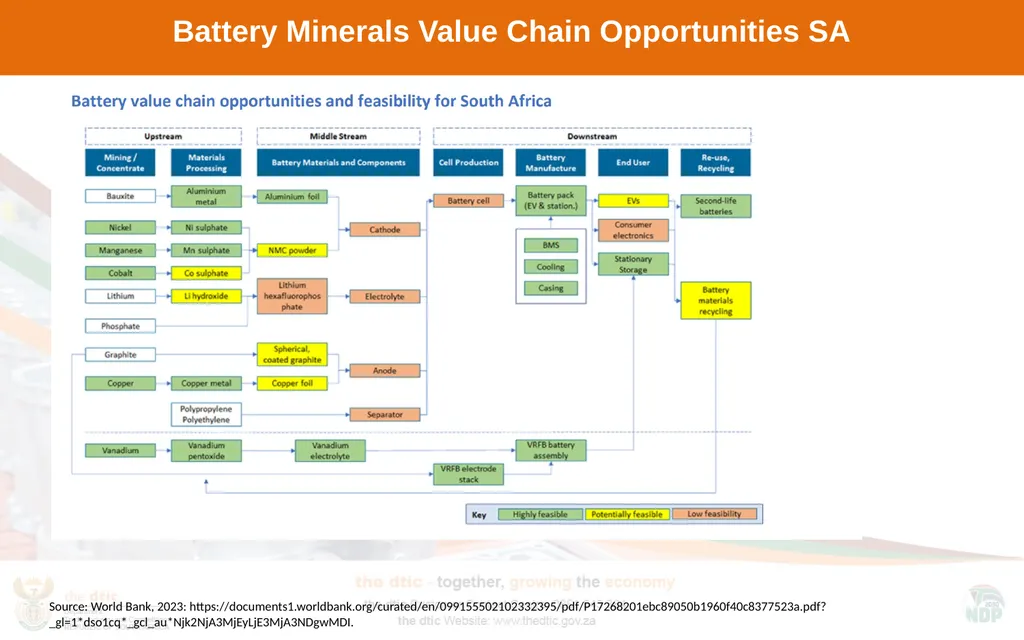
slide13. Battery Minerals Value Chain Opportunities SA Source: World Bank, 2023: https://documents1.worldbank.org/curated/en/099155502102332395/pdf/P17268201ebc89050b1960f40c8377523a.pdf?_gl=1*dso1cq*_gcl_au*Njk2NjA3MjEyLjE3MjA3NDgwMDI.<br>
slide14. Thank you!<br>
Green Industrial Policies Thursday, 29 August 2024
Presentation to Business Unity South Africa (BUSA)
Mahendra Shunmoogam Director: International Trade Policy mshunmoogam@thedtic.gov.za Trade Branch<br>
slide2. Agenda Agenda
Global decarbonization trends
CBAM
IRA
Deforestation
Policy tools<br>
slide3. Global Decarbonisation Goals/Committments The United Nations Framework Convention on Climate Change and its Paris Agreement have committed countries to work towards ensuring average global temperatures to well below 2 degree Celsius, above pre-industrial levels and pursuing efforts to limit the temperature increases to 1.5 degree Celsius above pre-industrial levels.
Using Global decarbonisation commitments we are witnessing a rise of unilateral, domestic climate-policy measures that have spill over negative cross border consequences, especially to developing countries.
Green industrial policies on the rise, Unilateral implementation of trade measures under the guise of the environment<br>
slide4. Carbon Border Adjustment Mechanism: risks Both the UK and EU have announced CBAMs
UK CBAM: A total of US$223 million (About R4.3 billion) of South African exports (based on 2023 data) is at risk in the short term. Approximately 4.2% of all South African exports to the UK, and about 0.2% of total South Africa exports to the world, and just 0.1% of total South African gross domestic product (GDP).
EU CBAM, a total of US$2.4 billion (about R45.4 billion) of South African exports (based on 2023 data) is at risk in the short term. This is about 11.3% of all South African exports to the EU, and about 2.2% of total South Africa exports to the world, and 0.7% of total South African GDP.
Total UK & EU CBAM risk of export market for SA: R49.7 billion (or 15.5% total SA exports)
South Africa (and Egypt) in Africa is going to be the hardest impacted by CBAMs.
Ultimately, CBAMs will worsen income inequality and welfare distribution between rich and poor economies<br>
slide5. Carbon Border Adjustment Mechanism: risks Both UK and EU’s CBAMs are also apparently targeting “carbon leakage” but
“The evidence on carbon leakage is mixed. In their analysis of national climate legislation from 111 countries spanning 1996 to 2018, Eskander and Fankhauser (2023) find “no evidence of trade-related carbon leakage” (p. 3). Other studies have reached similar conclusions (Martin et al., 2016; Dechezleprêtre and Sato, 2017).
The EU acknowledges that “evidence of the existence of carbon leakage is not always conclusive” (2021a, p. 7); however, EU legislators argue that the perception of carbon leakage “threatens to undermine popular support for climate agendas” (Blümel et al., 2021) and therefore needs to be addressed in climate legislation” source: Wits School of Governance working paper “ Kathrada, I. (2024) Stick or Twist: Navigating CBAM Challenges and Opportunities for African Exporters.<br>
slide6. Inflation Reduction Act, USA On 06 August 2022, President Biden signed the into US law the Inflation Reduction Act (IRA).
The IRA intent is to give billions of dollars of investments and tax breaks to advance the US’ green energy transition and boost sustainability efforts, including $369B of funding for climate and energy over the next decade, and builds on more than $110B of climate and energy funding in the Infrastructure Investment and Jobs Act (IIJA) adopted in late 2021.
The IRA operationalised through US tax credits and incentive funding.
Ultimately, the IRA intent is to make the US a more attractive investment destination.
The IRA also provides for the promotion of environmentally friendly transport. Existing subsidies for the sale of sustainable fuel will initially be extended, and from 2025 will be extended to all low-emission fuels.
While at first glance the IRA is a USA “reshoring” policy targeting China, it has direct consequences for developing countries.<br>
slide7. Inflation Reduction Act, USA, issues Subsidies on offer in the IRA are categorically prohibited under World Trade Organization (WTO) rules
China requested the establishment of a panel at the DSB meeting of 26 July 2024, the DSB deferred the establishment of a panel.
China alleges that certain subsidies that the United States allegedly provides under the IRA are contingent upon the use of domestic over imported goods or discriminate against goods of Chinese origin
China claimed that the challenged measures appear to be inconsistent with:
Article III:4 of the GATT 1994;
Articles 2.1 and 2.2 of the TRIMS Agreement; and
Articles 3.1(b) and 3.2 of the SCM Agreement.<br>
slide8. Rush for Minerals needed for the decarbonisation goals The (renewed) rush to secure Africa’s natural resources is another scramble for Africa’s resources.
Without use of trade tools to incentivize local value-addition, Africa including SA will participate in the green economy GVC as only suppliers of raw materials and will not capture a significant value in the GVC.
A number of initiatives to secure the minerals for developed countries benefit include
G7 have developed a Climate Club bringing in developed countries with strategic minerals or access to trade agreements that favour developed partners interest.
Countries with little or no mineral resources have developed mineral strategies to gain strategic advantage on access to minerals.
Bilateral MOUs with countries, i.e. Namibia and EU to leverage access to resources.<br>
slide9. Rush for Minerals needed for the decarbonisation goals, Issues Mineral resources offers Africa strategic opportunity to leverage the demand to enable development.
Minerals should and must be developed closed to site “BRICS Contact Group on Trade and Economic Issues 2024 outcome document supports this argument”.
Using our available tools to leverage the opportunities minerals offer to economic development.<br>
slide10. Deforestation EU Deforestation Regulations came into effect on 29 June 2023. Companies will have 18 months (until 30 December 2024) to be compliant.
Seven (7) products are covered by the new legislation: cattle, cocoa, coffee, palm-oil, soya, wood and rubber; including products that contain, have been fed with or have been made using these commodities (such as beef, leather, chocolate, printed paper and furniture).
Based on recent SA exports: export value of R3.7 billion might be impacted, representing 1.1% of average exports to EU over 2020-2022.
Most important SA products:
Pneumatic tyres, of rubber
Wood pulp, paper
Tanned hides and skins; leather
Charcoal, fuelwood
Various articles of wood for building; furniture
Chocolate<br>
slide11. Deforestation The Regulation implies extensive obligations for companies trading in these products.
To export such products into the EU, companies will need to show that these products were not produced on land that was deforested or degraded since 31 December 2020.
Regulation sets out an obligation to obtain geo-localisation co-ordinates of all plots of land from where the commodities or products were produced or harvested in the case of wood products, as well as the date or time range of production.
Companies will also need to prove that the products were produced in compliance with local human rights laws and laws protecting the rights of indigenous peoples.
The intention is to expand these regulations to other products in the future.<br>
slide12. Green Industrial Policy & Trade- Policy Tool box Border measures
Support schemes - subsidies
Standards
Sustainable public procurement and manufacturing - electric vehicles for public transport
Provisions in trade agreements reserving or promoting green industrial policy
Consumer support to stimulate demand - tax credits
Employment-related schemes
re-skilling and up-skilling policies to reduce skill shortages in the future low-carbon industries<br>
slide13. Battery Minerals Value Chain Opportunities SA Source: World Bank, 2023: https://documents1.worldbank.org/curated/en/099155502102332395/pdf/P17268201ebc89050b1960f40c8377523a.pdf?_gl=1*dso1cq*_gcl_au*Njk2NjA3MjEyLjE3MjA3NDgwMDI.<br>
slide14. Thank you!<br>