December 1, 2012 1 Information Technology and its Role in Indias Economic Development: A Review Nirvikar Singh Department of Economics, University of California, Santa Cruz IGIDR Silver Jubilee International Conference on Development:
"December 1, 2012 1 Information Technology and its" is the property of its rightful owner. Permission is granted to
download and print the materials on this website for personal, non-commercial use only, and to display it
on your personal computer provided you do not modify the materials and that you retain all copyright
notices contained in the materials. By downloading content from our website, you accept the terms of this
agreement.
Presentation Transcript
01
December 1, 2012 1 Information Technology and its Role in India’s Economic Development: A Review Nirvikar Singh
Department of Economics, University of California, Santa Cruz
IGIDR Silver Jubilee International Conference on
“Development: Successes and Challenges:
Achieving Economic, Social and Sustainable Progress”
December 1-3, 2012<br>
02
December 1, 2012 2 Overview Introduction
IT-BPO Industry
Rural Development
E-Commerce
Manufacturing
E-Governance
Conclusions<br>
03
Introduction: Conceptual Issues Why Information Technology (IT)?
Is IT special in theory?
Or is IT just the dynamic sector of the times?
IT in growth models
As a sector amenable to developing dynamic comparative advantage
IT as a General Purpose Technology (GPT)
Pervasiveness
Technological dynamism
Innovational complementarities
Complementarities: horizontal and vertical December 1, 2012 3<br>
04
December 1, 2012 4 Conceptual Issues (contd.) IT and information
Reduce transaction costs
Improve market efficiency
Improve government efficiency
Improve intra-firm resource allocation
IT and innovation
Combinatorics and feedback loops<br>
05
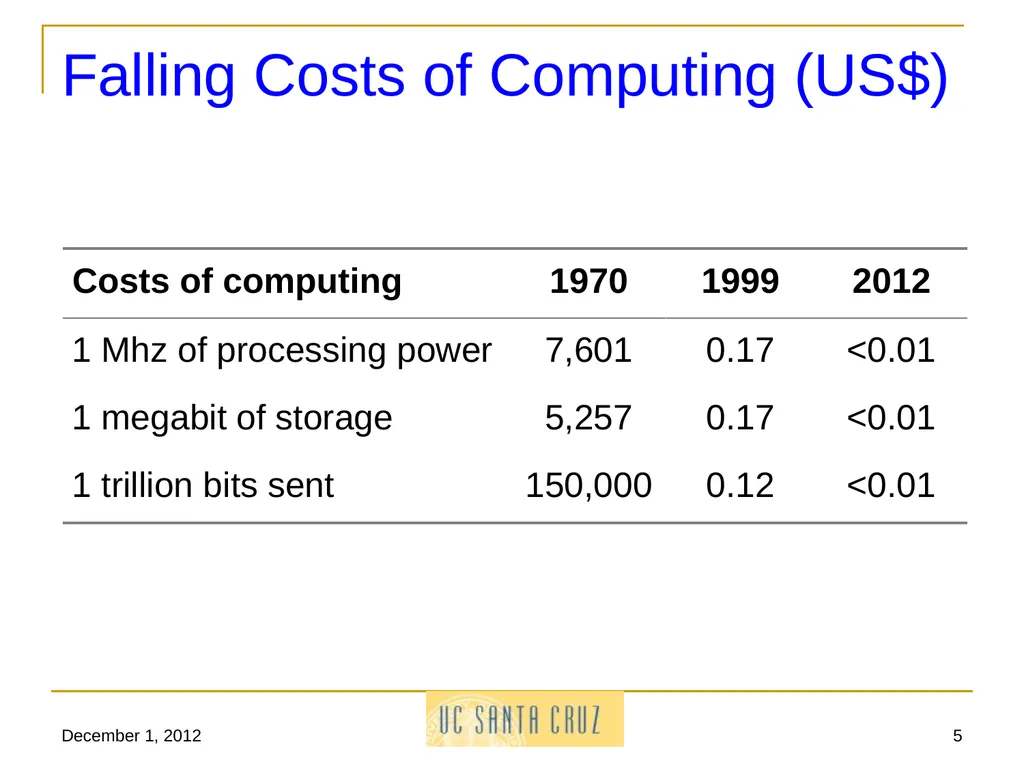
Falling Costs of Computing (US$) December 1, 2012 5<br>
06
IT-BPO Industry Industry components
Software services and products
Business process outsourcing
IT enabled services
Hardware
The story so far
Rapid growth
Upgrading
Diversification
Positive spillovers December 1, 2012 6<br>
07
IT-BPO Industry (contd.) Spillovers
From software to BPO and ITES
Into higher education
National reputation
Attitudes, goals and expectations
Other sectors, e.g., manufacturing
Individuals December 1, 2012 7<br>
08
Rural Development Is IT a luxury?
Not any more
Rapid, long distance communications a necessity
Of course nutrition, health, sanitation, housing, basic education are higher priorities
IT can play an enabling role
Reduce transaction costs
Reduce production costs
Improve allocative efficiency December 1, 2012 8<br>
09
Rural Development (contd.) How well have Indian efforts worked?
Digital mobile telephony for voice communications has done well
Other efforts have been less successful
Delivering Internet services to rural India is difficult precisely because rural India is under-developed
Tightly focused corporate efforts have succeeded the best
Small non-profit efforts require constant subsidies and cannot scale
Hybrid efforts (public/private-for-profit/private-non-profit) have also not taken off
Government efforts have had some impact, but suffer from incentive problems December 1, 2012 9<br>
10
Rural Development (contd. 2) Challenges
Scarcity of organizational and managerial skills
Lack of physical infrastructure
Government is simultaneously overbearing and inefficient
Newness of market
Limitations of existing software applications
Opportunities
Latent demand has been demonstrated
Falling cost of technology hardware
Scaling up to spread fixed costs December 1, 2012 10<br>
11
December 1, 2012 11 E-Commerce B2B and B2C
B2B is still very limited, restricted to larger firms
B2C is large in absolute terms, but a very restricted slice of the economy
Upper income, urban consumers
Travel is by far the biggest segment
Attention economy – time vs. money<br>
12
December 1, 2012 12 E-Commerce (contd.) Infrastructure challenges
Payments systems
Logistics
Broadband
Market access
Small urban enterprises
Rural handicrafts producers
Information on opportunities<br>
13
December 1, 2012 13 Manufacturing Manufacturing sector an underachiever
National Manufacturing Policy wants to change that
Empirical evidence suggests that IT investments in manufacturing have a high payoff
But actual IT investment is limited – Why?
Management quality
Lack of appropriate products for domestic market
Lack of awareness or knowledge
Infrastructure constraints
Coordination failures
Financial constraints<br>
14
Manufacturing (contd.) Where should government policy focus?
Business environment for all manufacturing
Labor laws
Company law
Financial sector reform
IT-specific policies
Tax treatment
Infrastructure
Knowledge dissemination
Standard setting by government December 1, 2012 14<br>
15
E-Governance December 1, 2012 15 General problems of governance
Corruption
Poor implementation
Two complementary areas for IT as a tool for improving governance
Internal systems and processes
Citizen-government interfaces
If one has to prioritize, probably the back-end is more necessary<br>
16
E-Governance (contd.) December 1, 2012 16 What can IT achieve?
Transparency and monitoring, leading to more accountability
Reducing transaction costs
Improving responsiveness (another aspect of accountability)
Better targeting
Indian government policy
Ambitious targets for national e-governance
Some piecemeal improvements<br>
17
Conclusions (1) December 1, 2012 17 Theoretical reasons to consider IT as special
Plausible case for giving it attention, even in a poor economy
IT-BPO (mostly for export) is a continuing success story
Rural adoption of IT has been a mixed bag
E-commerce is a fledgling sector, but with high potential<br>
18
Conclusions (2) Manufacturing is a critical area for improved adoption of IT
E-governance has been limited in its success – need more investment in internal change
Government policy in general has not been optimal with respect to the role of IT in development
Investment in physical networks could have a high payoff for the economy, from top to bottom
Needs to be coupled with better regulation of telecoms
Need a better policy environment for innovation in general December 1, 2012 18<br>