
December 2019 Wouter Dessein Columbia University
LV
Published · 41 slides · 0 views

1 / 1

Description
December 2019 Wouter Dessein Columbia University Chieko Minami Kobe University Coordination and Organization Design: Theory and Micro-Evidence Desmond (Ho-Fu) Lo Santa Clara University Use of authority is a central feature of the way firms
Related Topics
Share
Embed code
Download this presentation From Below
"December 2019 Wouter Dessein Columbia University" is the property of its rightful owner. Permission is granted to download and print the materials on this website for personal, non-commercial use only, and to display it on your personal computer provided you do not modify the materials and that you retain all copyright notices contained in the materials. By downloading content from our website, you accept the terms of this agreement.
Presentation Transcript
01
December 2019 Wouter Dessein
Columbia University Chieko Minami
Kobe University Coordination and Organization Design:
Theory and Micro-Evidence Desmond (Ho-Fu) Lo
Santa Clara University<br>
Columbia University Chieko Minami
Kobe University Coordination and Organization Design:
Theory and Micro-Evidence Desmond (Ho-Fu) Lo
Santa Clara University<br>
02
Use of authority is a central feature of the way firms coordinate the production and provision of goods and services
(Coase 1937; Simon 1951; Williamson 1975).
Numerous case studies of firms that ‘fail’ either because they
do not empower managers close to the facts, or
are too decentralized to realize important synergies (e.g. Roberts 2004; Garicano and Rayo 2016)
Limited empirical evidence on determinants of managerial authority relative to other organizational choices (incentives, firm boundaries)<br>
Numerous case studies of firms that ‘fail’ either because they
do not empower managers close to the facts, or
are too decentralized to realize important synergies (e.g. Roberts 2004; Garicano and Rayo 2016)
Limited empirical evidence on determinants of managerial authority relative to other organizational choices (incentives, firm boundaries)<br>
03
This Paper How does the unpredictability and volatility of a firm’s local environment affects decentralization?
How does this depend on the need for coordination Theory: Model which synthesizes literature (e.g. Alonso, Dessein, Matouschek 2008, 2015), but novel prediction impact local volatility on org design. Micro-evidence on authority of department managers at one of the world’s largest retailer.<br>
How does this depend on the need for coordination Theory: Model which synthesizes literature (e.g. Alonso, Dessein, Matouschek 2008, 2015), but novel prediction impact local volatility on org design. Micro-evidence on authority of department managers at one of the world’s largest retailer.<br>
04
Large theoretical literature on delegation/decentralization, which emphasizes need to adapt to local information
(Hayek 1945, Aghion and Tirole 1997, Dessein 2002)
But need for coordination may prevent a sub-unit from responding to its local environment. (Dessein, Santos 2006; Alonso, Dessein, Matouschek 2008/2015)
Aoki 1986: The ability of sub-units to make use of their on-the-spot knowledge is “limited by their partial understanding of the whole mechanisms operating within the firm”
=> While decentralized organizations are better at autonomous adaptation, centralized organizations may be better at coordinated adaptation This Paper: Theory<br>
But need for coordination may prevent a sub-unit from responding to its local environment. (Dessein, Santos 2006; Alonso, Dessein, Matouschek 2008/2015)
Aoki 1986: The ability of sub-units to make use of their on-the-spot knowledge is “limited by their partial understanding of the whole mechanisms operating within the firm”
=> While decentralized organizations are better at autonomous adaptation, centralized organizations may be better at coordinated adaptation This Paper: Theory<br>
05
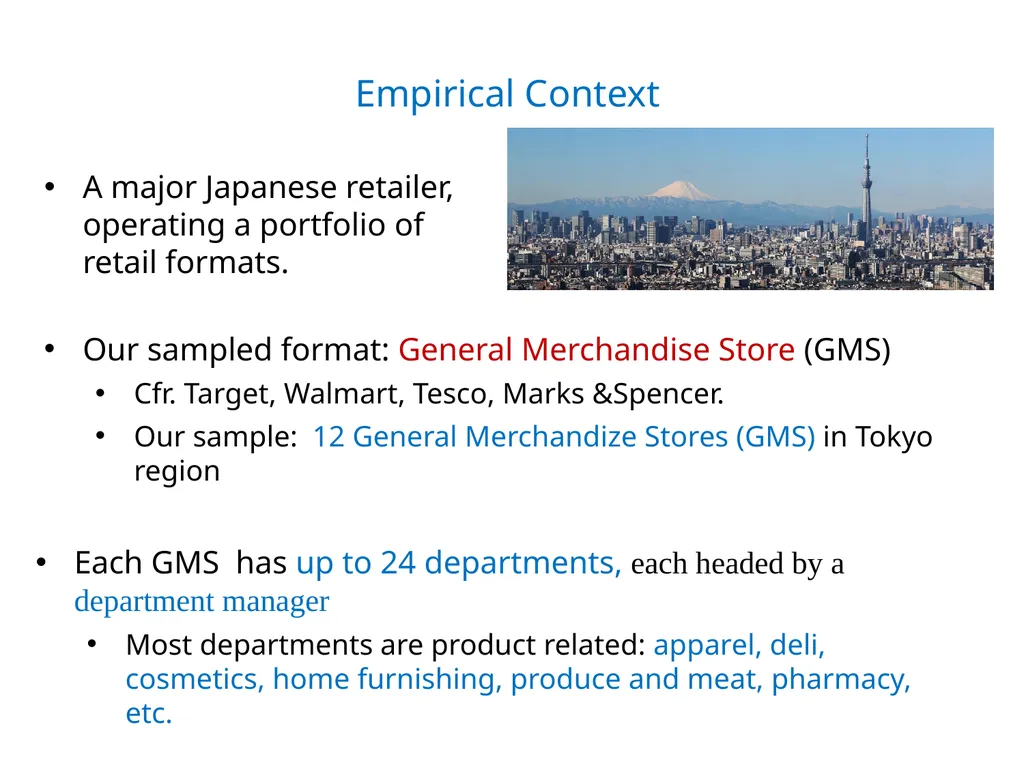
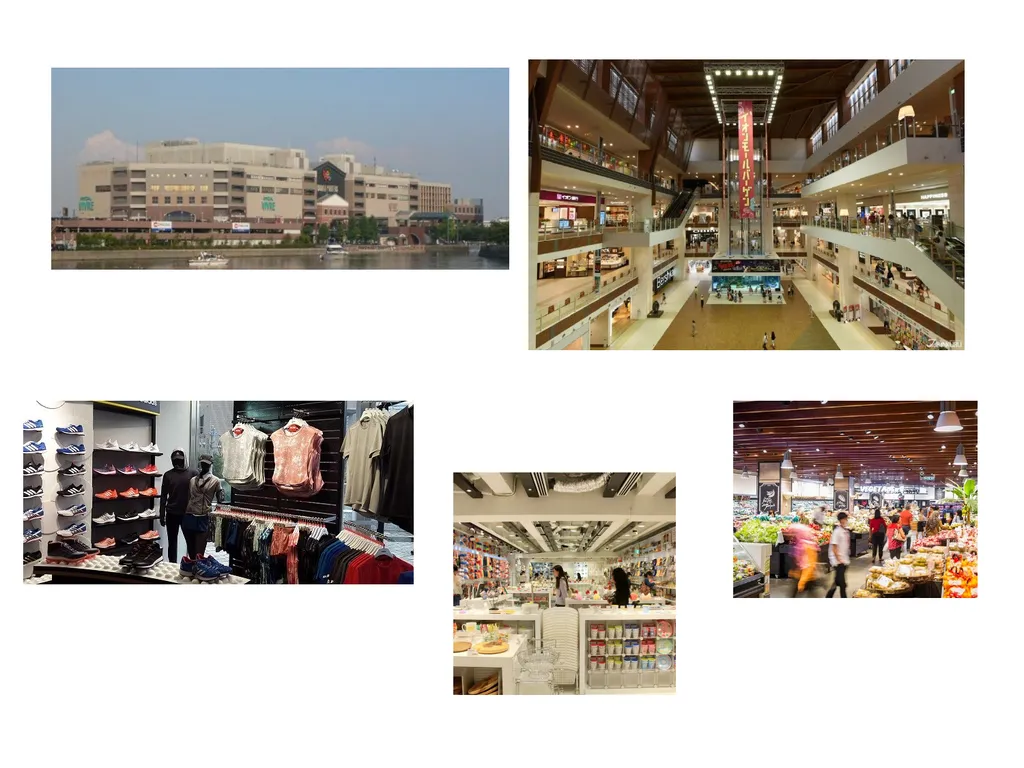
A major Japanese retailer,
operating a portfolio of
retail formats. Empirical Context Our sampled format: General Merchandise Store (GMS)
Cfr. Target, Walmart, Tesco, Marks &Spencer.
Our sample: 12 General Merchandize Stores (GMS) in Tokyo region Each GMS has up to 24 departments, each headed by a department manager
Most departments are product related: apparel, deli, cosmetics, home furnishing, produce and meat, pharmacy, etc.<br>
Cfr. Target, Walmart, Tesco, Marks &Spencer.
Our sample: 12 General Merchandize Stores (GMS) in Tokyo region Each GMS has up to 24 departments, each headed by a department manager
Most departments are product related: apparel, deli, cosmetics, home furnishing, produce and meat, pharmacy, etc.<br>
06
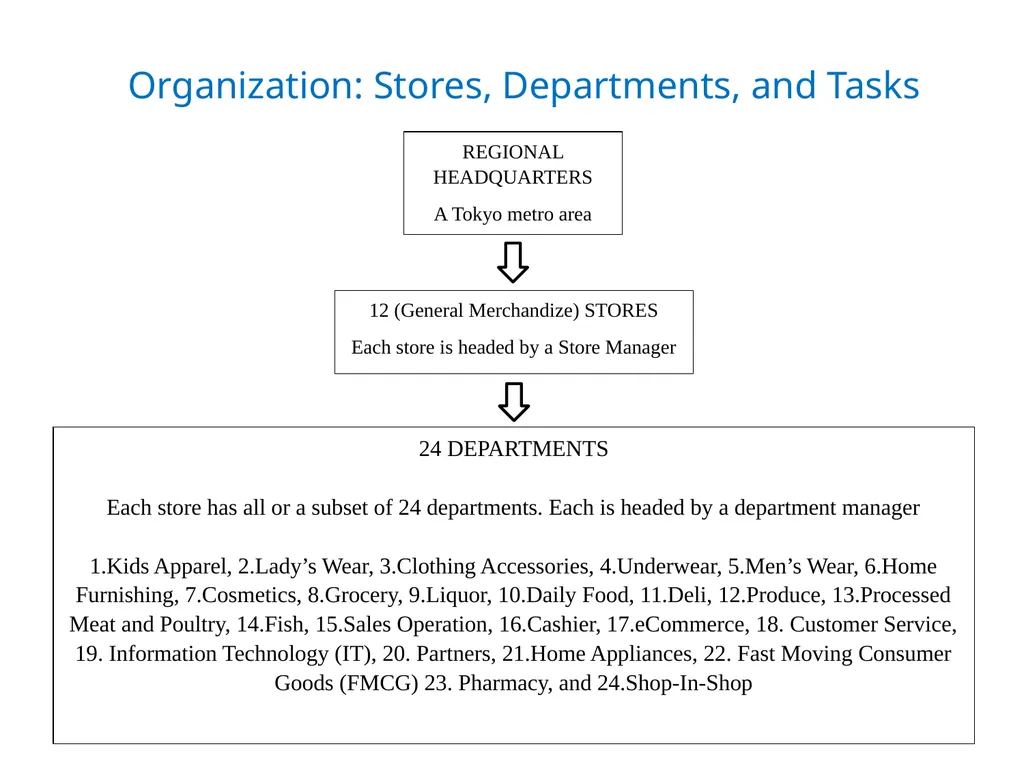
Organization: Stores, Departments, and Tasks REGIONAL HEADQUARTERS
A Tokyo metro area 12 (General Merchandize) STORES
Each store is headed by a Store Manager 24 DEPARTMENTS
Each store has all or a subset of 24 departments. Each is headed by a department manager
1.Kids Apparel, 2.Lady’s Wear, 3.Clothing Accessories, 4.Underwear, 5.Men’s Wear, 6.Home Furnishing, 7.Cosmetics, 8.Grocery, 9.Liquor, 10.Daily Food, 11.Deli, 12.Produce, 13.Processed Meat and Poultry, 14.Fish, 15.Sales Operation, 16.Cashier, 17.eCommerce, 18. Customer Service, 19. Information Technology (IT), 20. Partners, 21.Home Appliances, 22. Fast Moving Consumer Goods (FMCG) 23. Pharmacy, and 24.Shop-In-Shop<br>
A Tokyo metro area 12 (General Merchandize) STORES
Each store is headed by a Store Manager 24 DEPARTMENTS
Each store has all or a subset of 24 departments. Each is headed by a department manager
1.Kids Apparel, 2.Lady’s Wear, 3.Clothing Accessories, 4.Underwear, 5.Men’s Wear, 6.Home Furnishing, 7.Cosmetics, 8.Grocery, 9.Liquor, 10.Daily Food, 11.Deli, 12.Produce, 13.Processed Meat and Poultry, 14.Fish, 15.Sales Operation, 16.Cashier, 17.eCommerce, 18. Customer Service, 19. Information Technology (IT), 20. Partners, 21.Home Appliances, 22. Fast Moving Consumer Goods (FMCG) 23. Pharmacy, and 24.Shop-In-Shop<br>
07
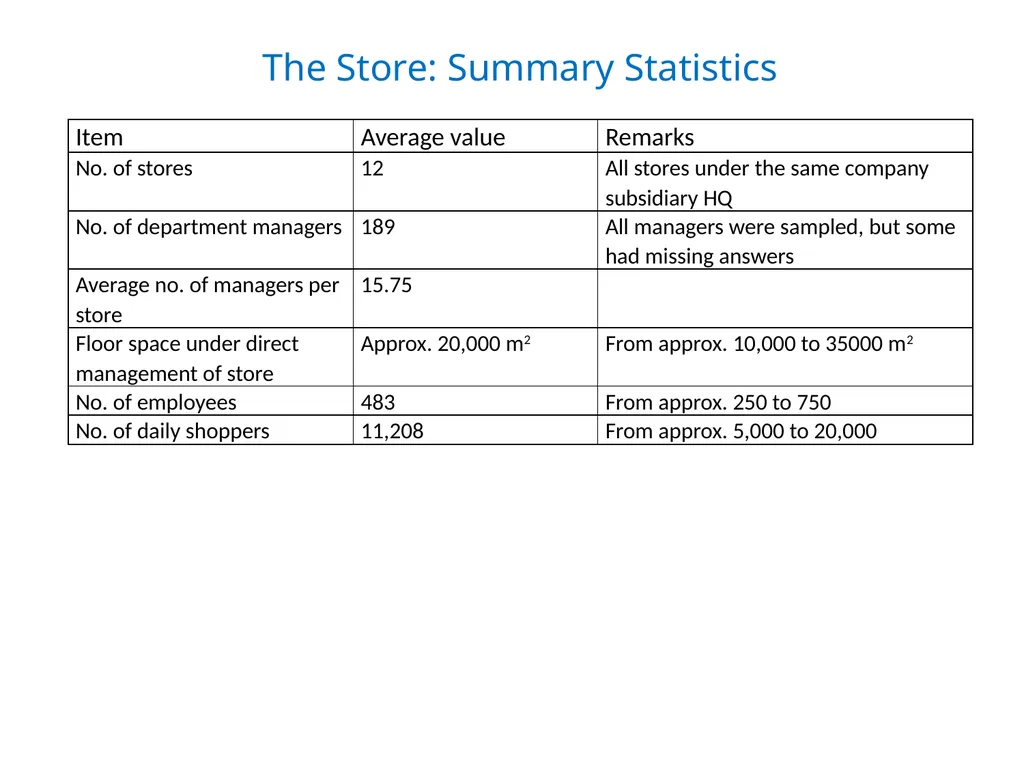
The Store: Summary Statistics<br>
08
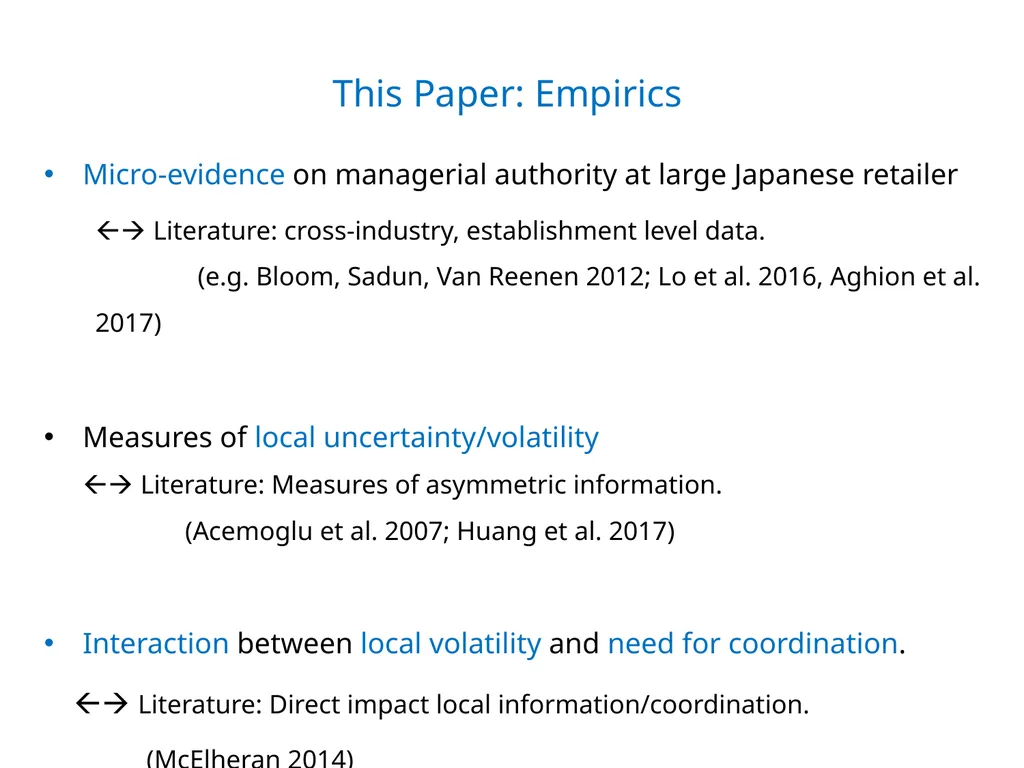
This Paper: Empirics Micro-evidence on managerial authority at large Japanese retailer
Literature: cross-industry, establishment level data. (e.g. Bloom, Sadun, Van Reenen 2012; Lo et al. 2016, Aghion et al. 2017)
Measures of local uncertainty/volatility Literature: Measures of asymmetric information. (Acemoglu et al. 2007; Huang et al. 2017)
Interaction between local volatility and need for coordination.
Literature: Direct impact local information/coordination.
(McElheran 2014)<br>
Literature: cross-industry, establishment level data. (e.g. Bloom, Sadun, Van Reenen 2012; Lo et al. 2016, Aghion et al. 2017)
Measures of local uncertainty/volatility Literature: Measures of asymmetric information. (Acemoglu et al. 2007; Huang et al. 2017)
Interaction between local volatility and need for coordination.
Literature: Direct impact local information/coordination.
(McElheran 2014)<br>
09
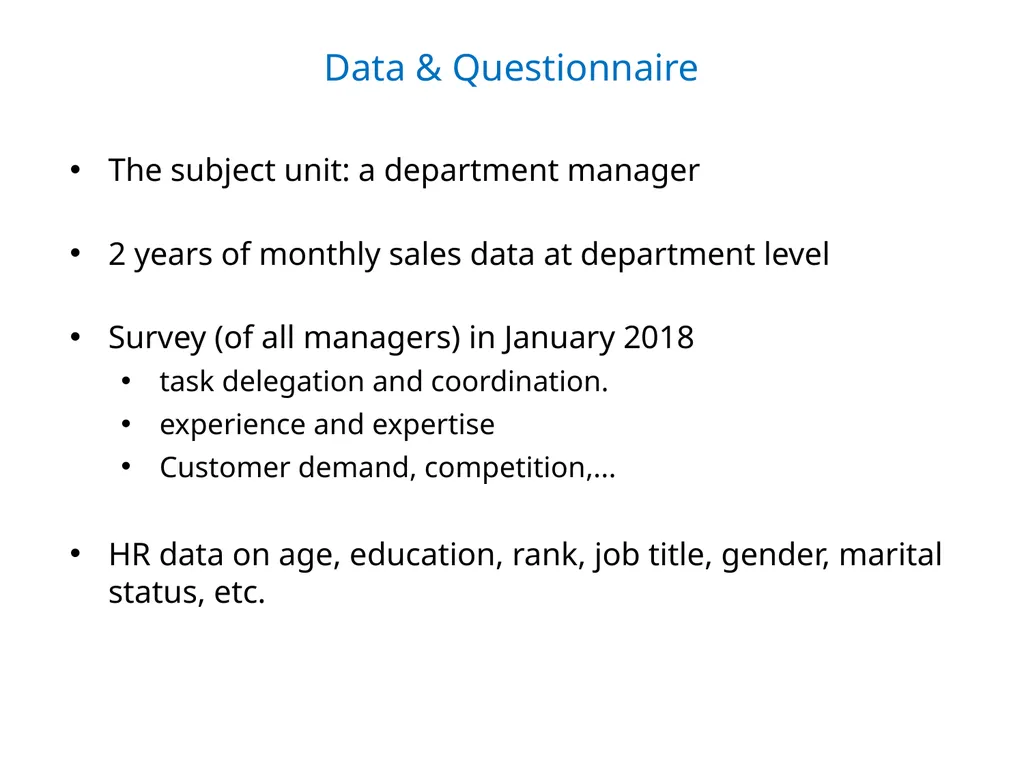
The subject unit: a department manager
2 years of monthly sales data at department level
Survey (of all managers) in January 2018
task delegation and coordination.
experience and expertise
Customer demand, competition,...
HR data on age, education, rank, job title, gender, marital status, etc. Data & Questionnaire<br>
2 years of monthly sales data at department level
Survey (of all managers) in January 2018
task delegation and coordination.
experience and expertise
Customer demand, competition,...
HR data on age, education, rank, job title, gender, marital status, etc. Data & Questionnaire<br>
10
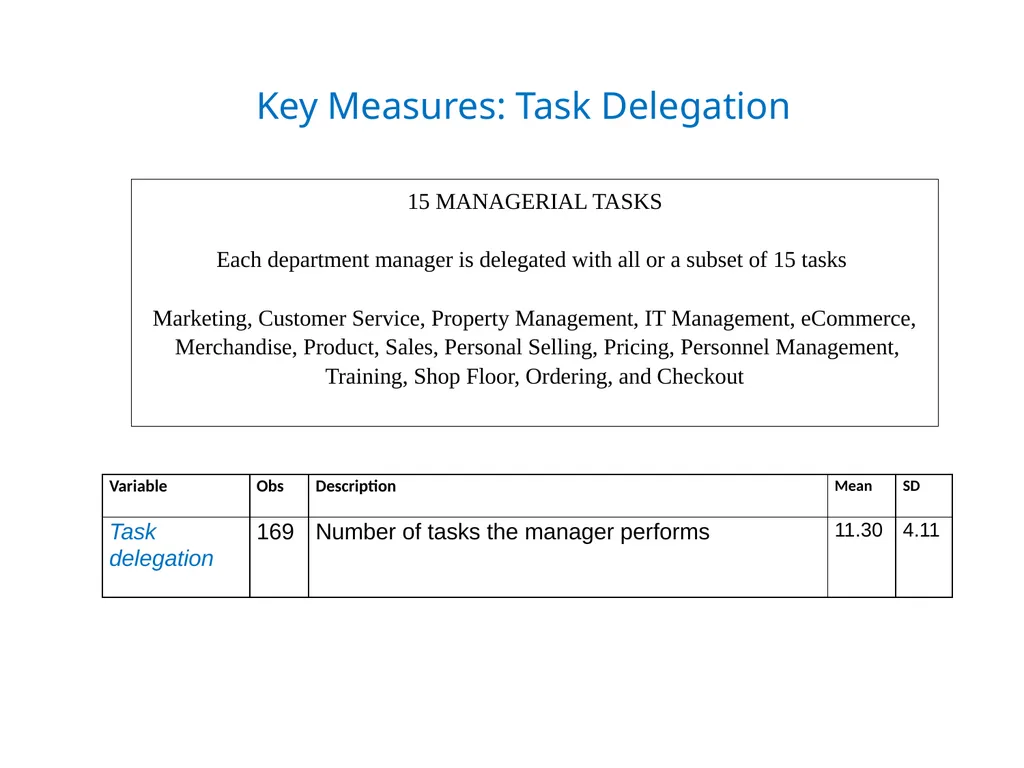
Key Measures: Task Delegation 15 MANAGERIAL TASKS
Each department manager is delegated with all or a subset of 15 tasks
Marketing, Customer Service, Property Management, IT Management, eCommerce,
Merchandise, Product, Sales, Personal Selling, Pricing, Personnel Management, Training, Shop Floor, Ordering, and Checkout<br>
Each department manager is delegated with all or a subset of 15 tasks
Marketing, Customer Service, Property Management, IT Management, eCommerce,
Merchandise, Product, Sales, Personal Selling, Pricing, Personnel Management, Training, Shop Floor, Ordering, and Checkout<br>
11
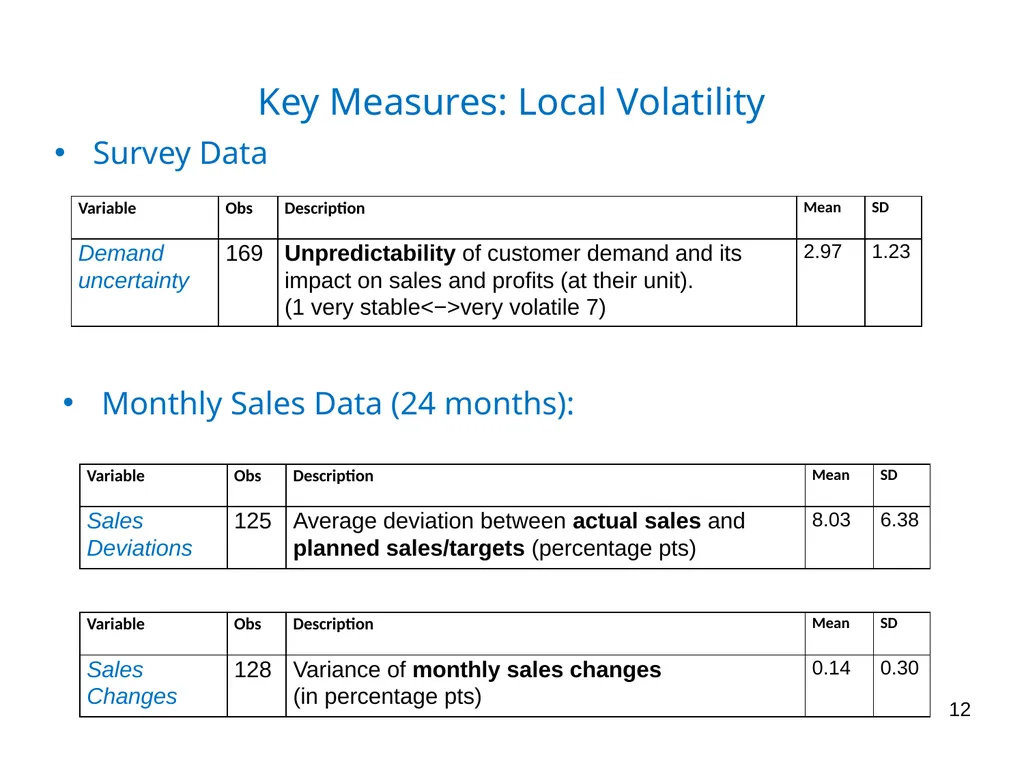
Key Measures: Local Volatility 12 Survey Data Monthly Sales Data (24 months):<br>
12
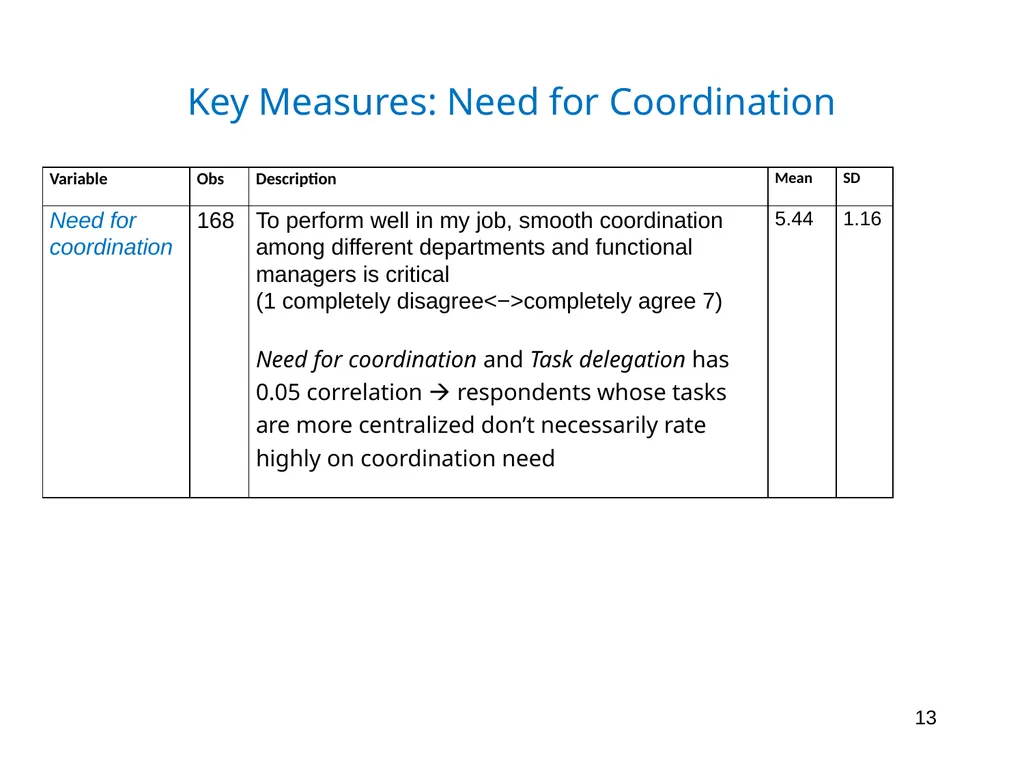
Key Measures: Need for Coordination 13<br>
13
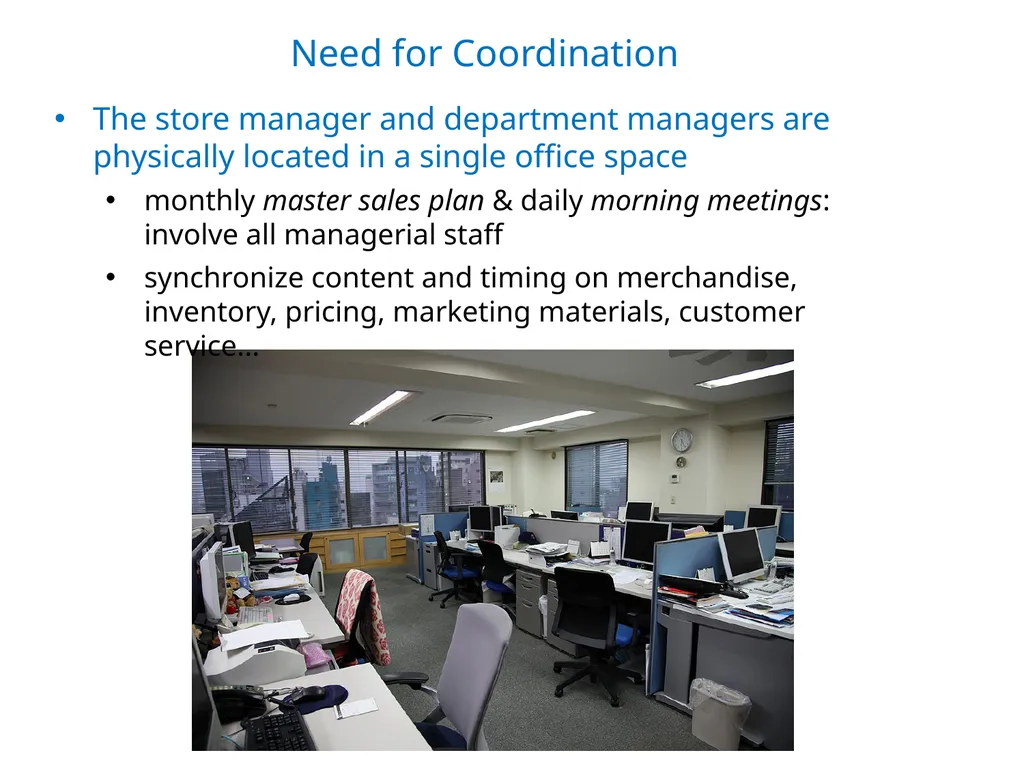
Need for Coordination The store manager and department managers are physically located in a single office space
monthly master sales plan & daily morning meetings: involve all managerial staff
synchronize content and timing on merchandise, inventory, pricing, marketing materials, customer service...<br>
monthly master sales plan & daily morning meetings: involve all managerial staff
synchronize content and timing on merchandise, inventory, pricing, marketing materials, customer service...<br>
14
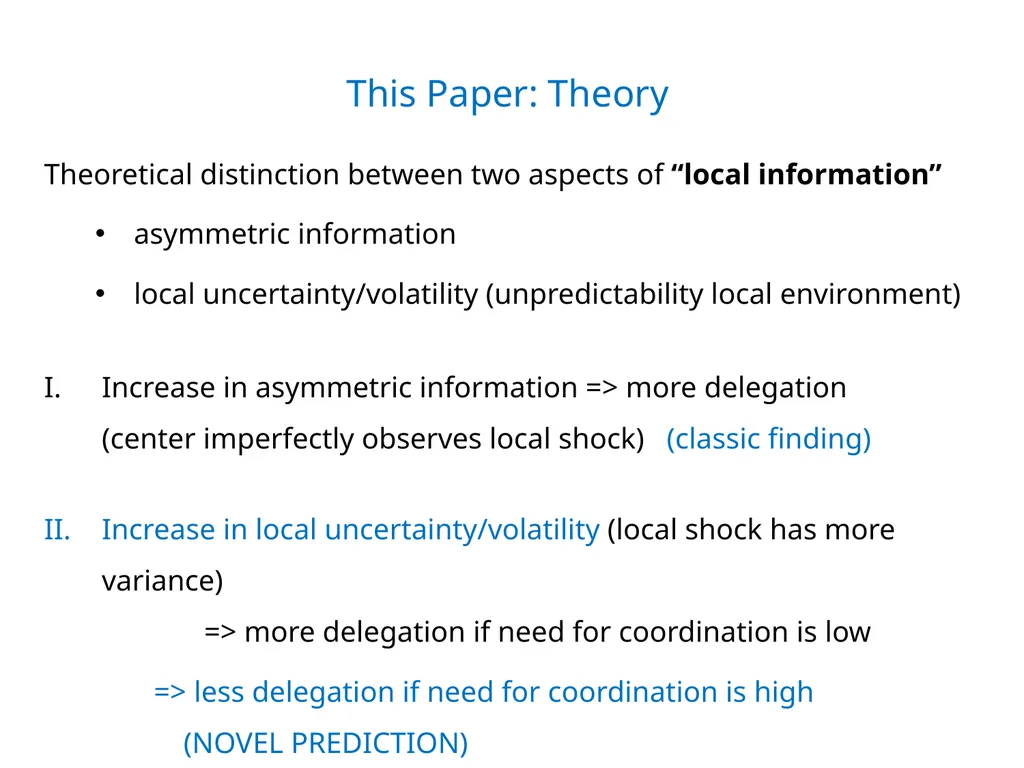
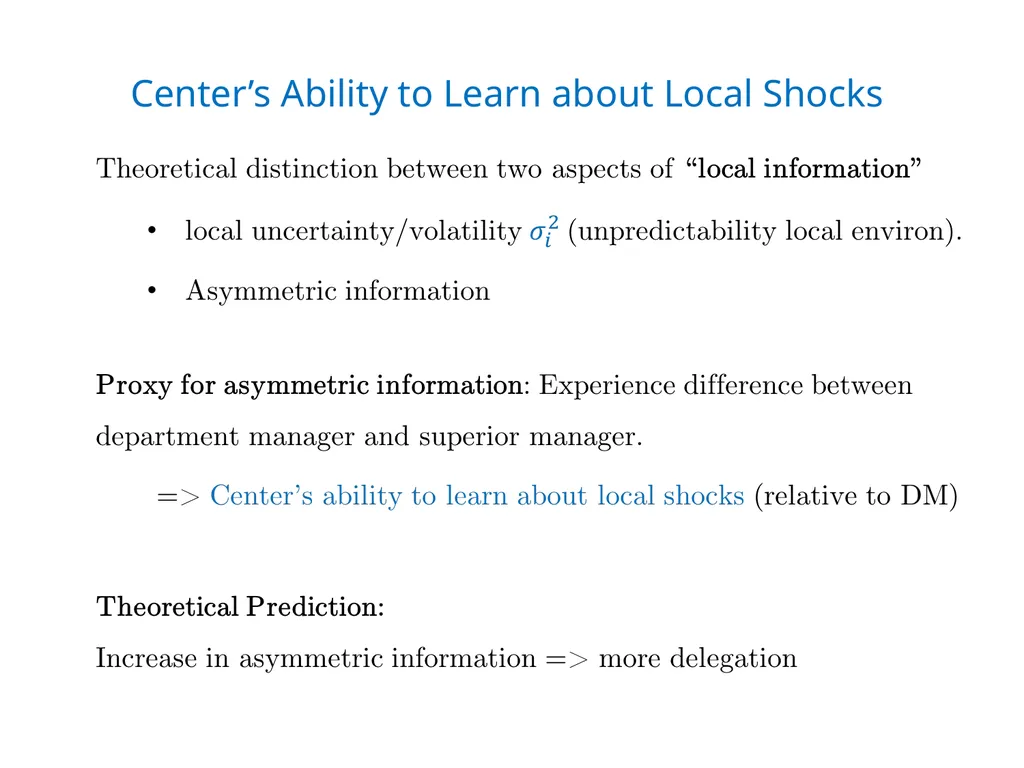
This Paper: Theory Theoretical distinction between two aspects of “local information”
asymmetric information
local uncertainty/volatility (unpredictability local environment)
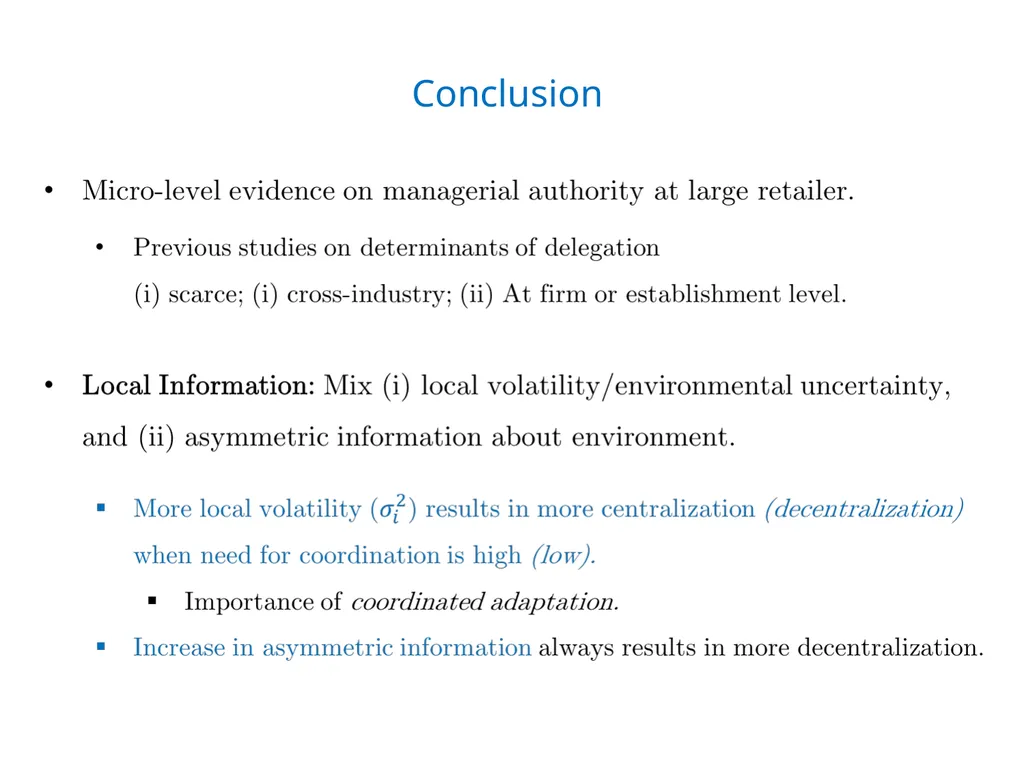
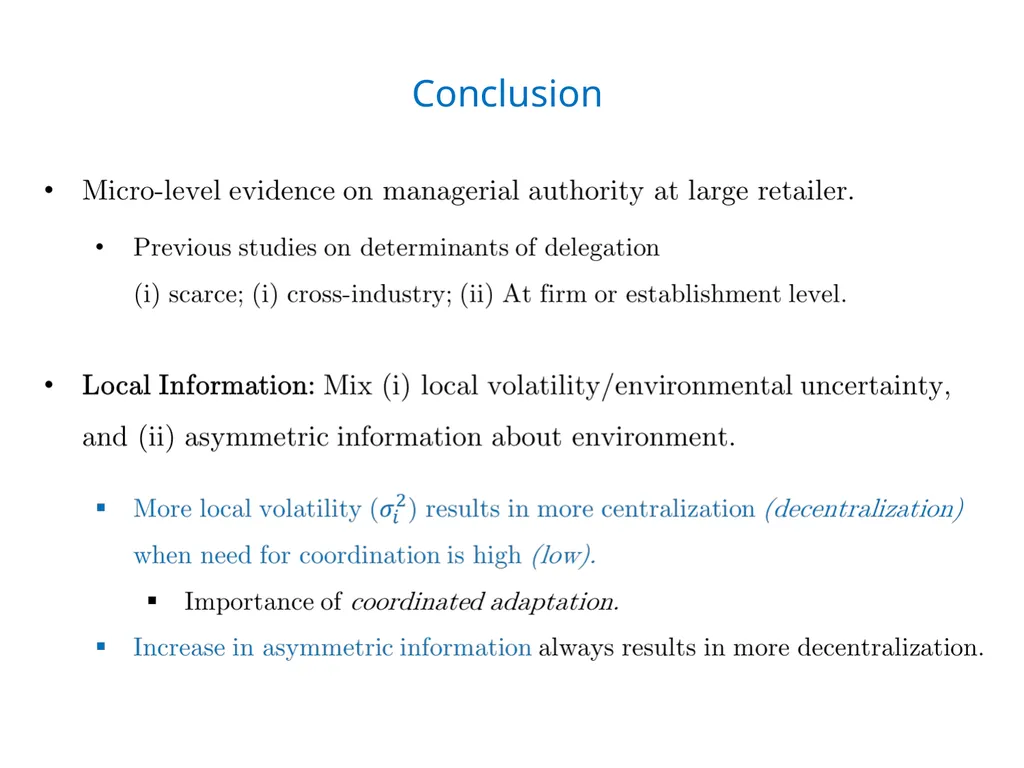
Increase in asymmetric information => more delegation (center imperfectly observes local shock) (classic finding)
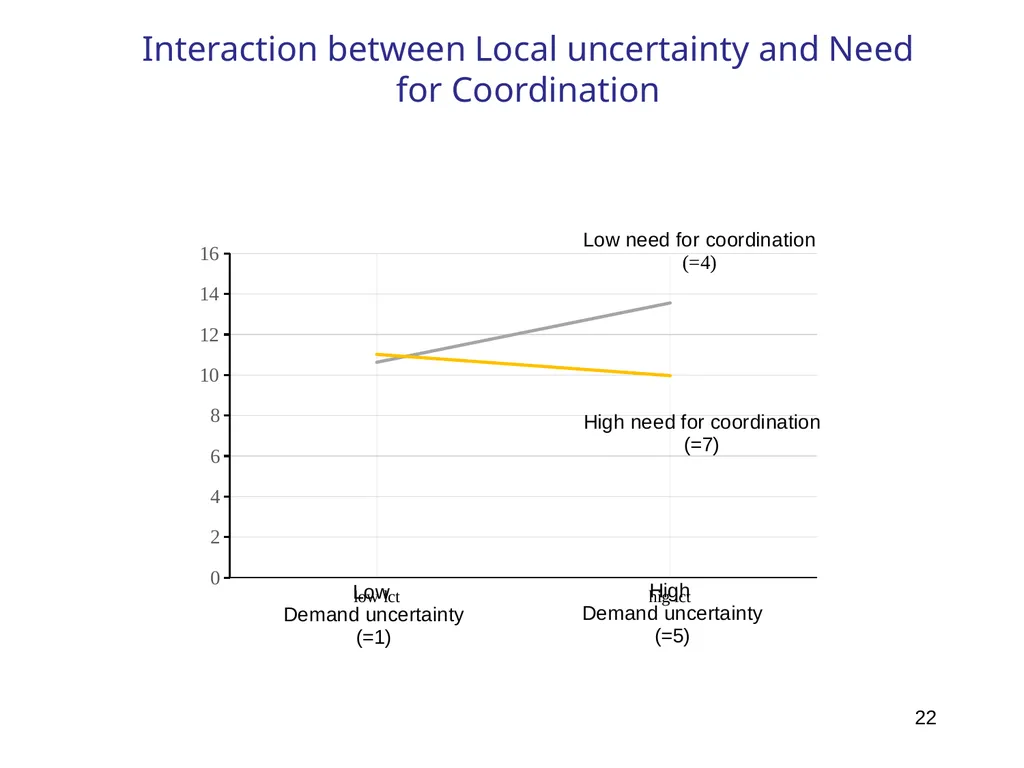
Increase in local uncertainty/volatility (local shock has more variance) => more delegation if need for coordination is low
=> less delegation if need for coordination is high (NOVEL PREDICTION)<br>
asymmetric information
local uncertainty/volatility (unpredictability local environment)
Increase in asymmetric information => more delegation (center imperfectly observes local shock) (classic finding)
Increase in local uncertainty/volatility (local shock has more variance) => more delegation if need for coordination is low
=> less delegation if need for coordination is high (NOVEL PREDICTION)<br>
15
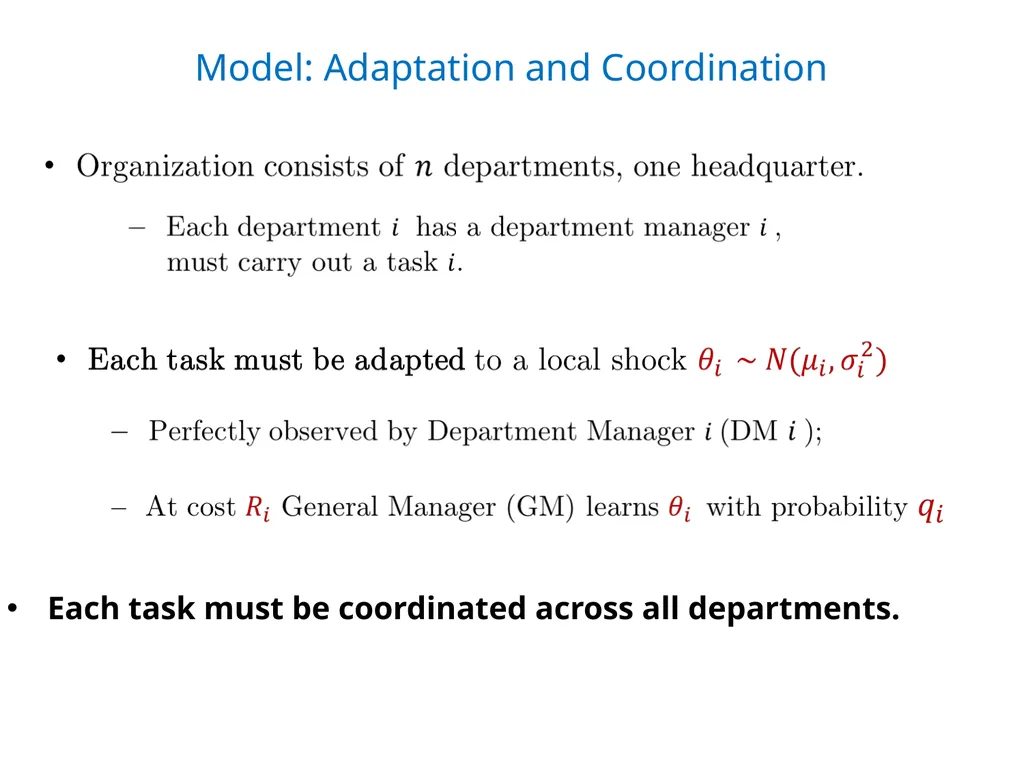
Model: Adaptation and Coordination Each task must be coordinated across all departments.<br>
16
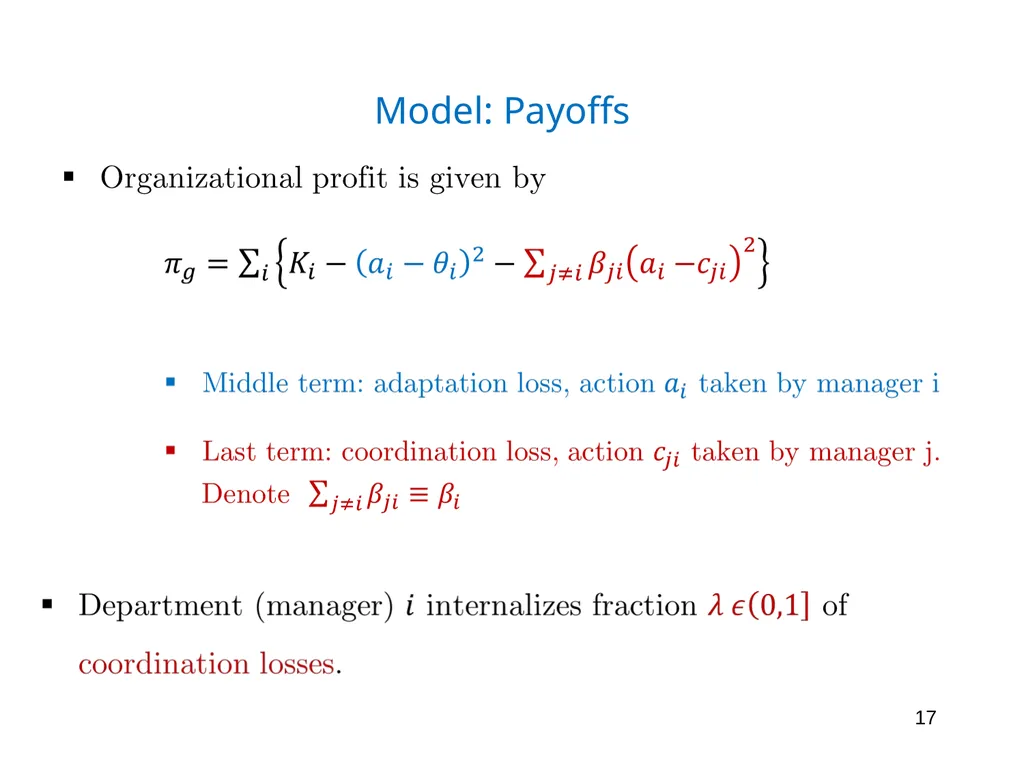
Model: Payoffs 17<br>
17
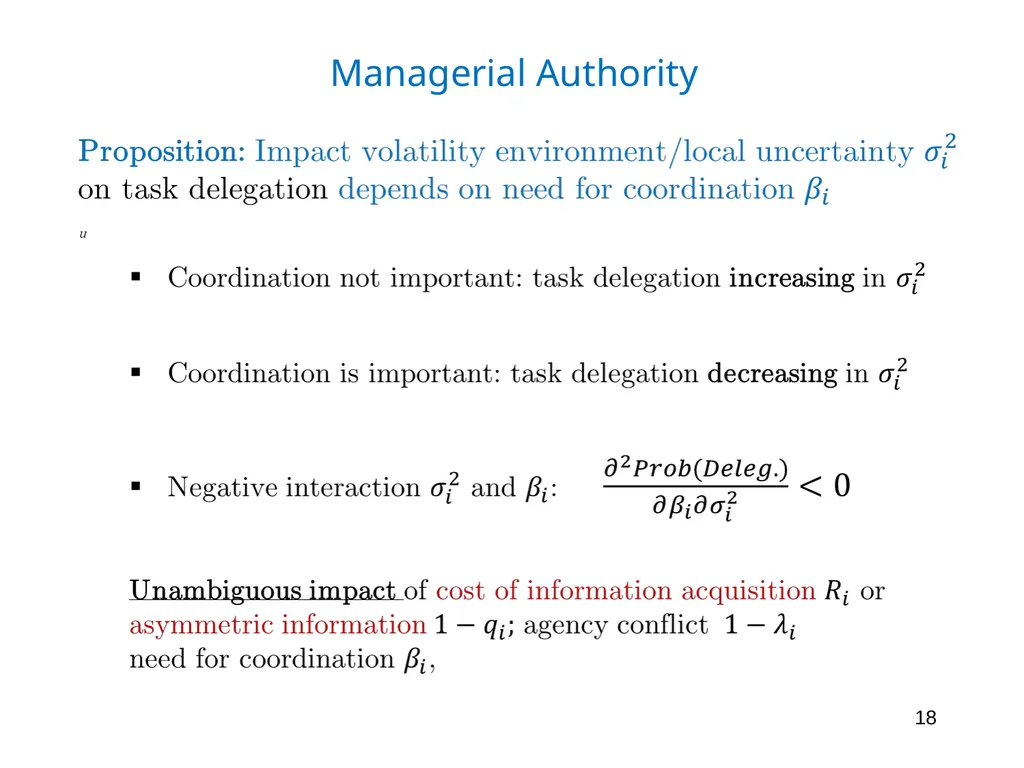
Managerial Authority 18<br>
18
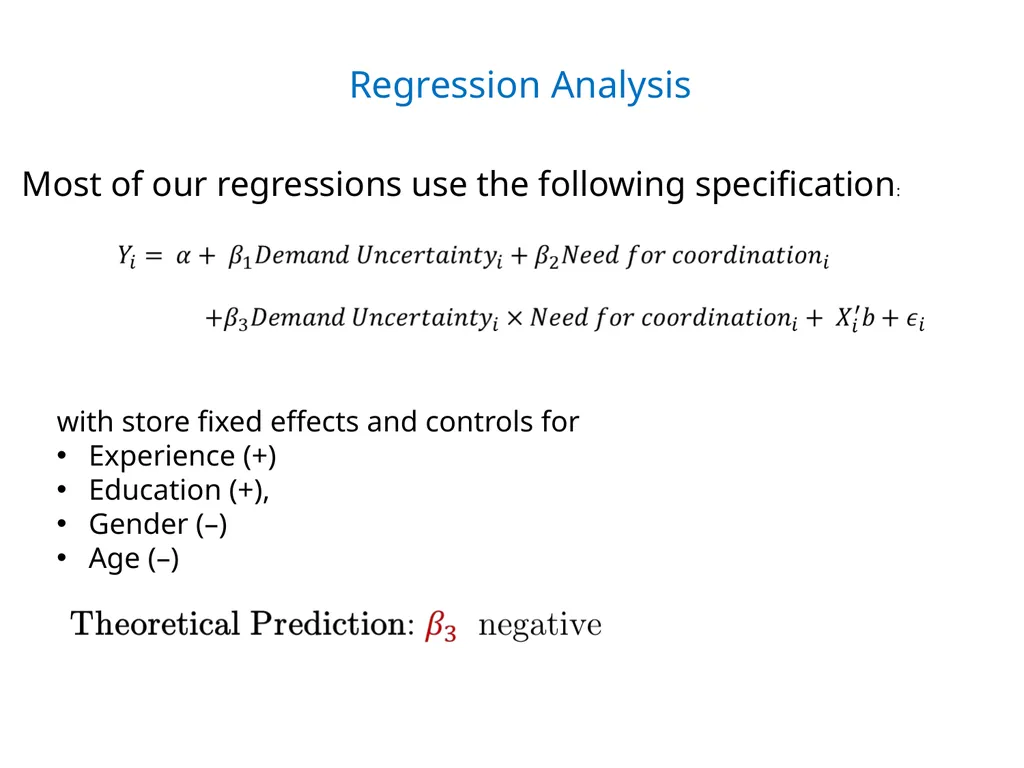
Regression Analysis Most of our regressions use the following specification: with store fixed effects and controls for
Experience (+)
Education (+),
Gender (–)
Age (–)<br>
Experience (+)
Education (+),
Gender (–)
Age (–)<br>
19
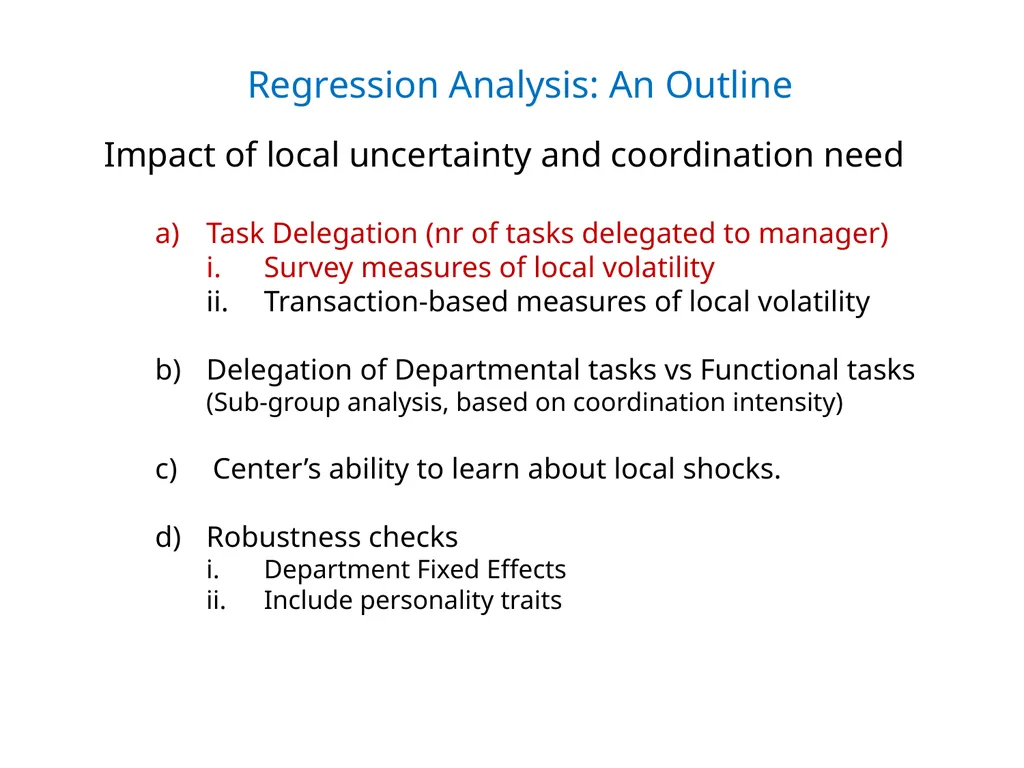
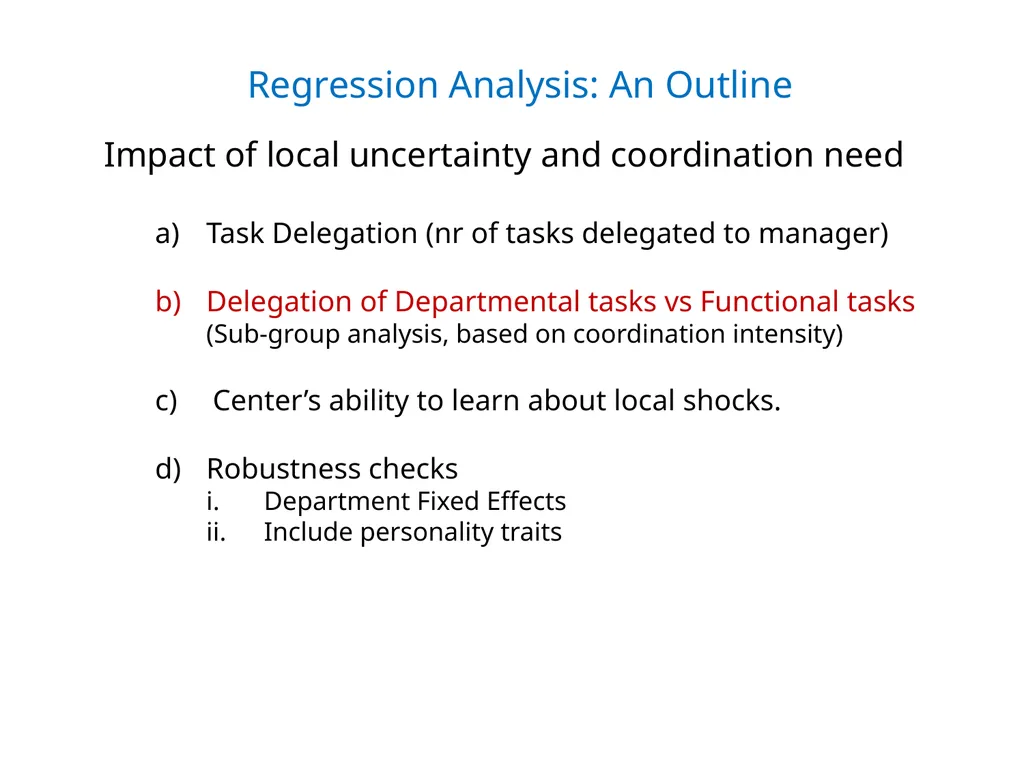
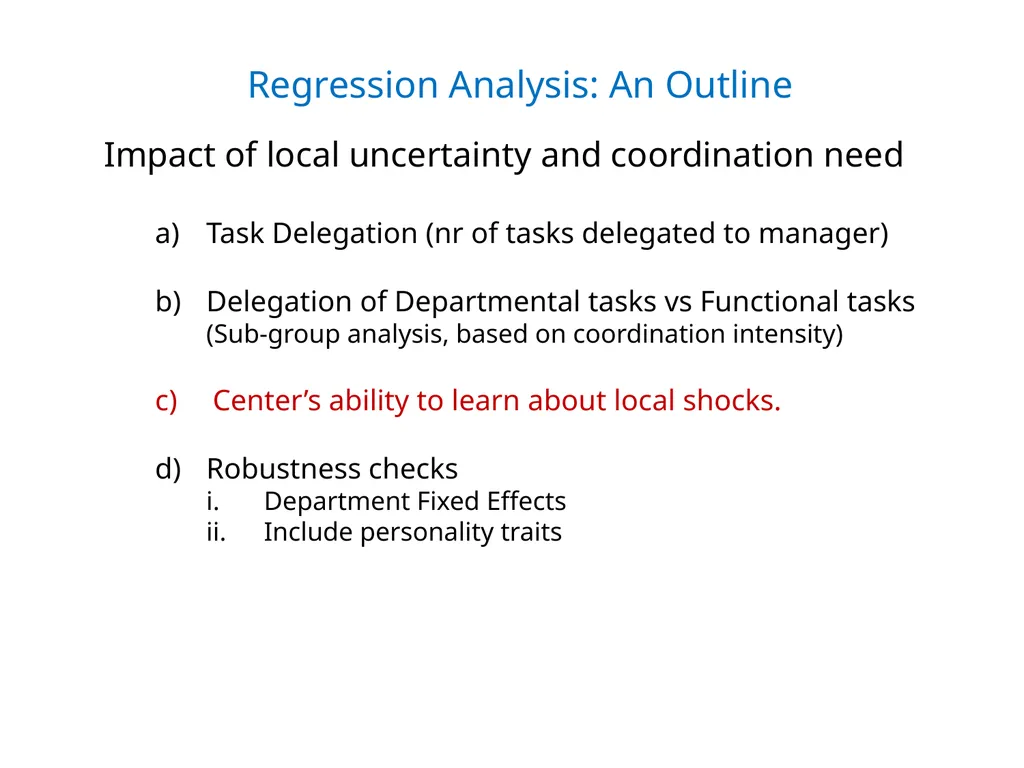
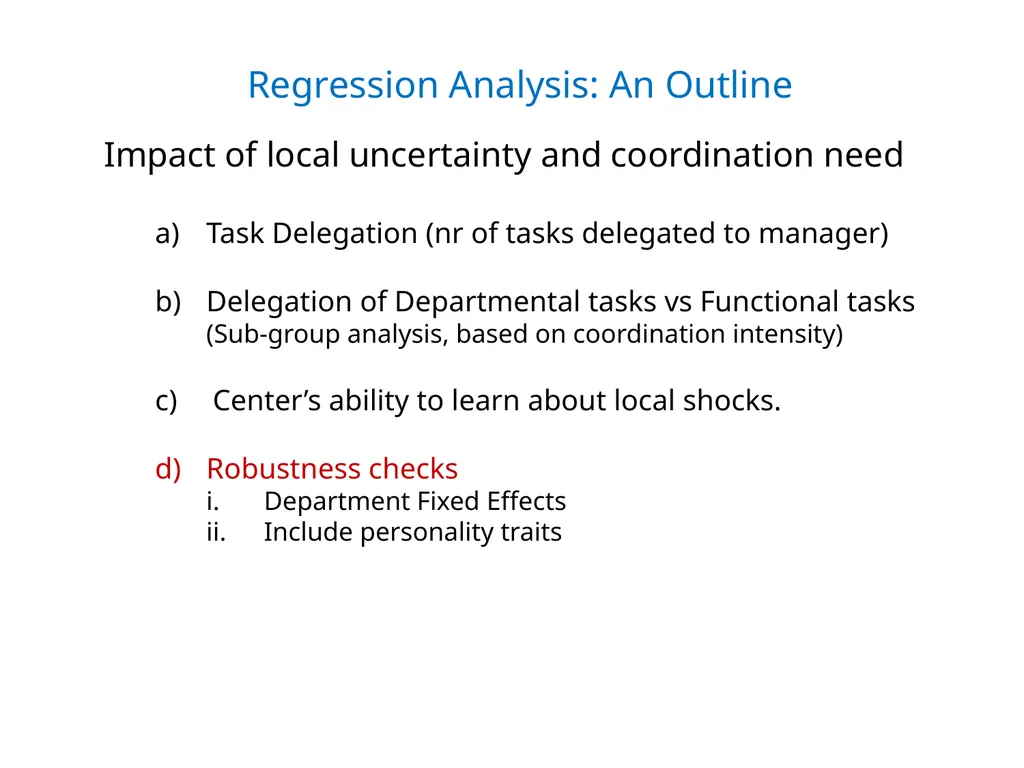
Impact of local uncertainty and coordination need
Task Delegation (nr of tasks delegated to manager)
Survey measures of local volatility
Transaction-based measures of local volatility
Delegation of Departmental tasks vs Functional tasks
(Sub-group analysis, based on coordination intensity)
Center’s ability to learn about local shocks.
Robustness checks
Department Fixed Effects
Include personality traits Regression Analysis: An Outline<br>
Task Delegation (nr of tasks delegated to manager)
Survey measures of local volatility
Transaction-based measures of local volatility
Delegation of Departmental tasks vs Functional tasks
(Sub-group analysis, based on coordination intensity)
Center’s ability to learn about local shocks.
Robustness checks
Department Fixed Effects
Include personality traits Regression Analysis: An Outline<br>
20
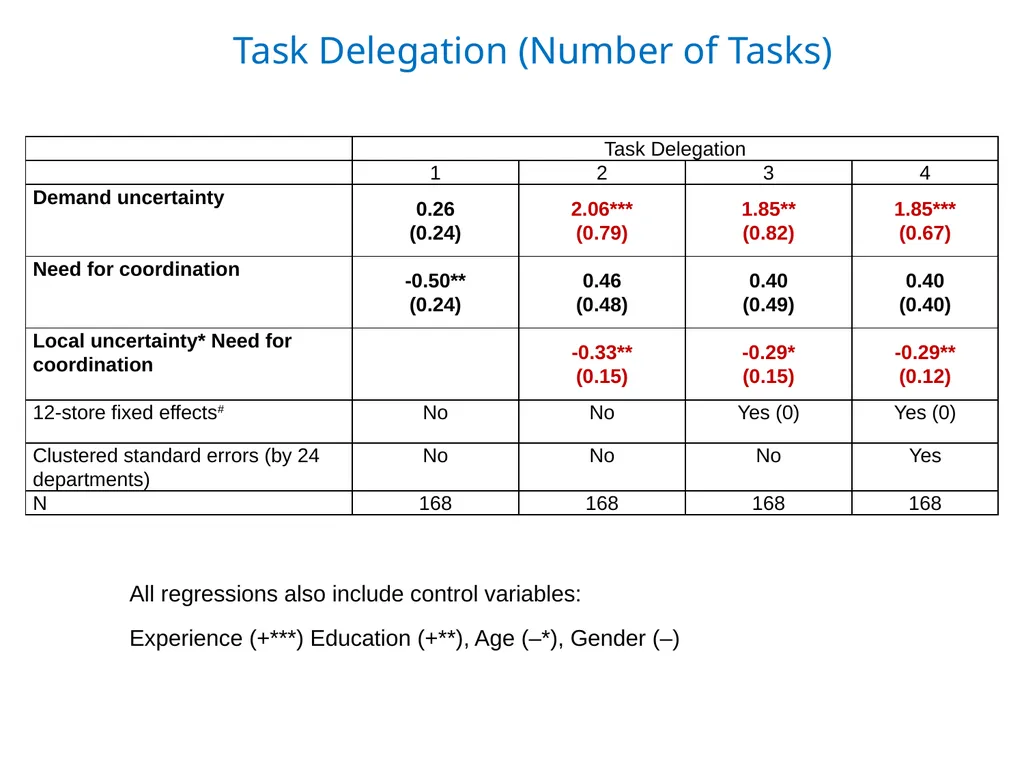
Task Delegation (Number of Tasks) All regressions also include control variables:
Experience (+***) Education (+**), Age (–*), Gender (–)<br>
Experience (+***) Education (+**), Age (–*), Gender (–)<br>
21
Interaction between Local uncertainty and Need for Coordination 22<br>
22
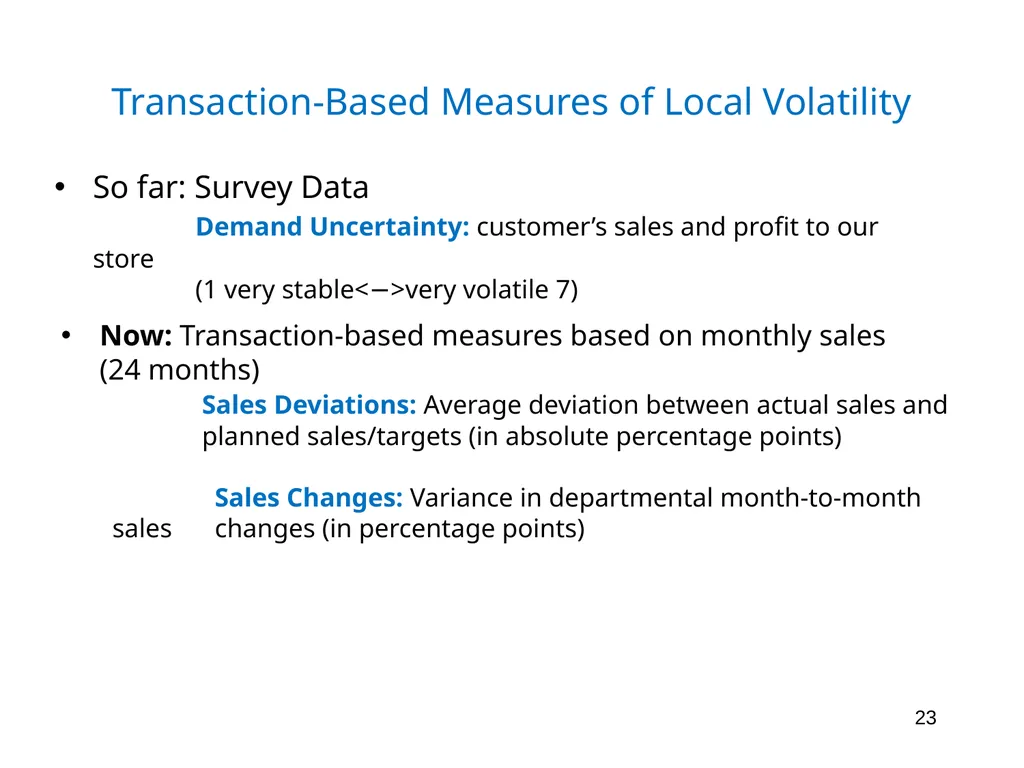
Transaction-Based Measures of Local Volatility 23 So far: Survey Data
Demand Uncertainty: customer’s sales and profit to our store
(1 very stable<−>very volatile 7) Now: Transaction-based measures based on monthly sales
(24 months)
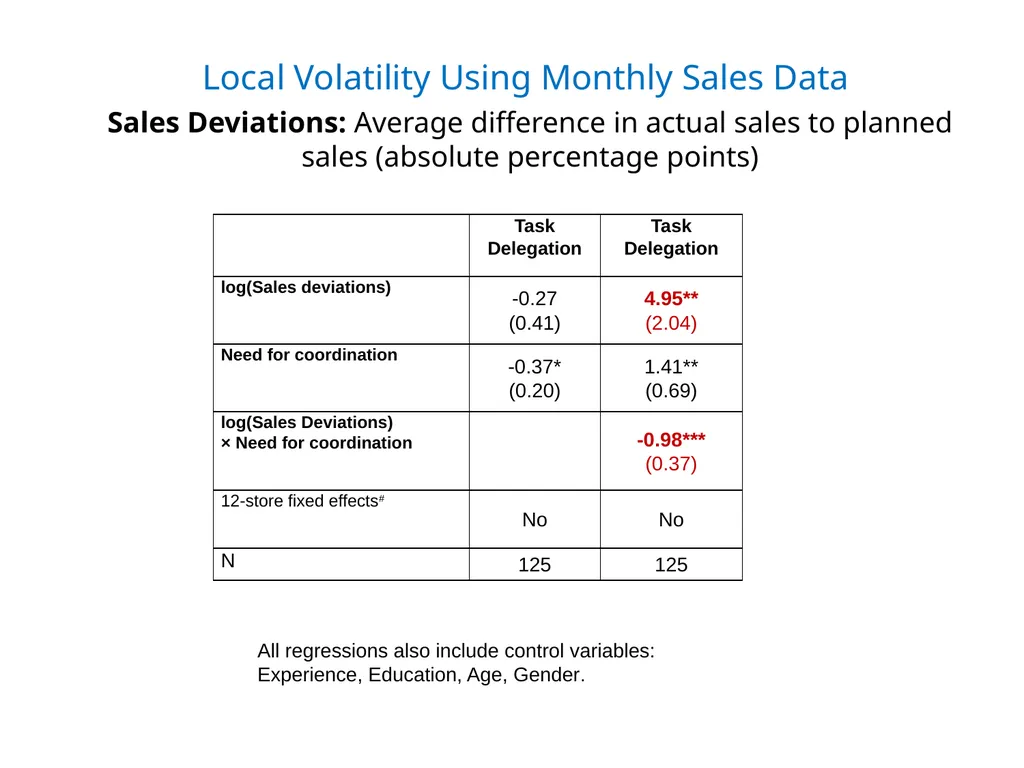
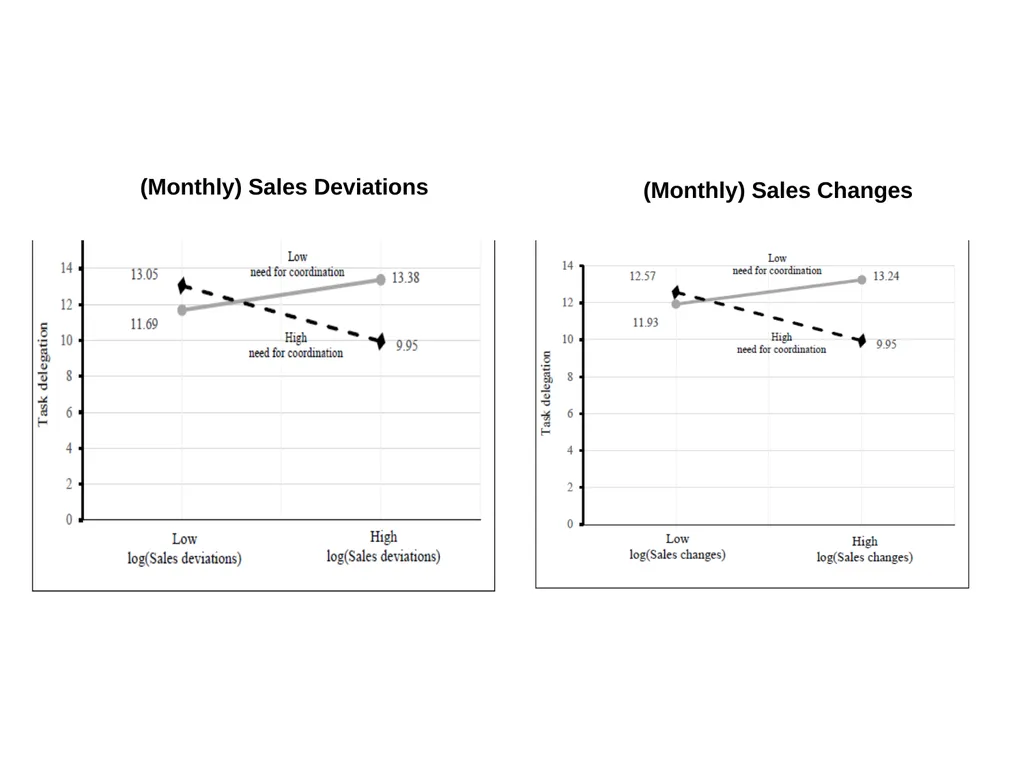
Sales Deviations: Average deviation between actual sales and planned sales/targets (in absolute percentage points)
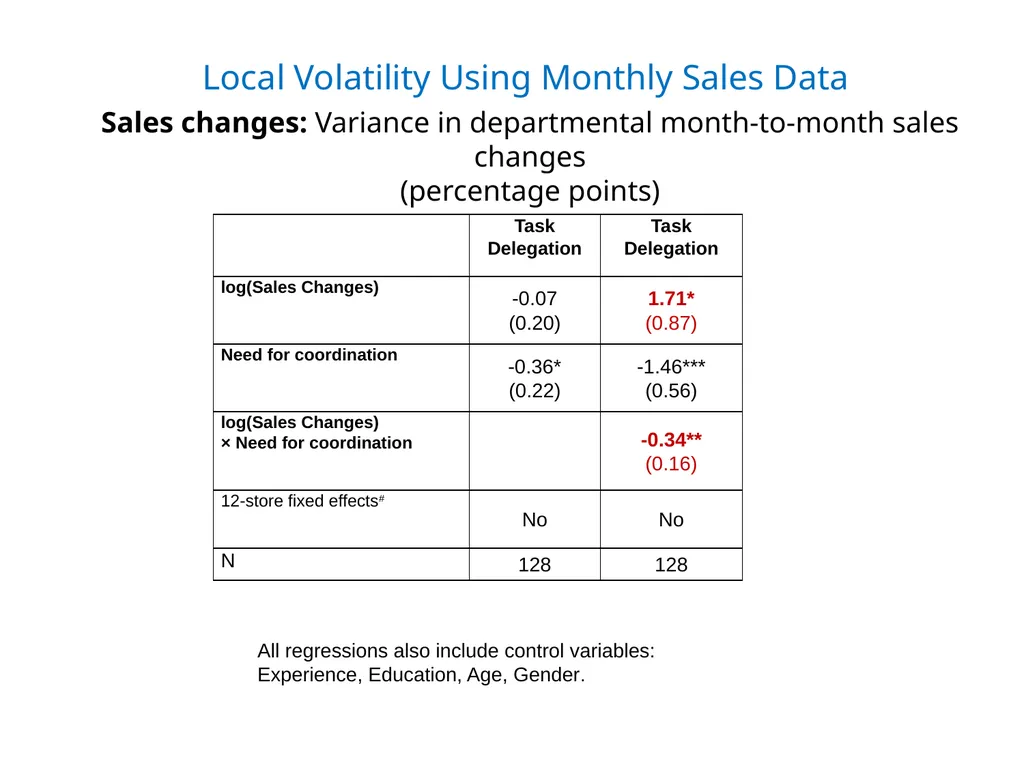
Sales Changes: Variance in departmental month-to-month sales changes (in percentage points)<br>
Sales Changes: Variance in departmental month-to-month sales changes (in percentage points)<br>
23
Local Volatility Using Monthly Sales Data All regressions also include control variables:
Experience, Education, Age, Gender. Sales Deviations: Average difference in actual sales to planned sales (absolute percentage points)<br>
24
Local Volatility Using Monthly Sales Data All regressions also include control variables:
Experience, Education, Age, Gender. Sales changes: Variance in departmental month-to-month sales changes
(percentage points)<br>
25
(Monthly) Sales Deviations (Monthly) Sales Changes<br>
26
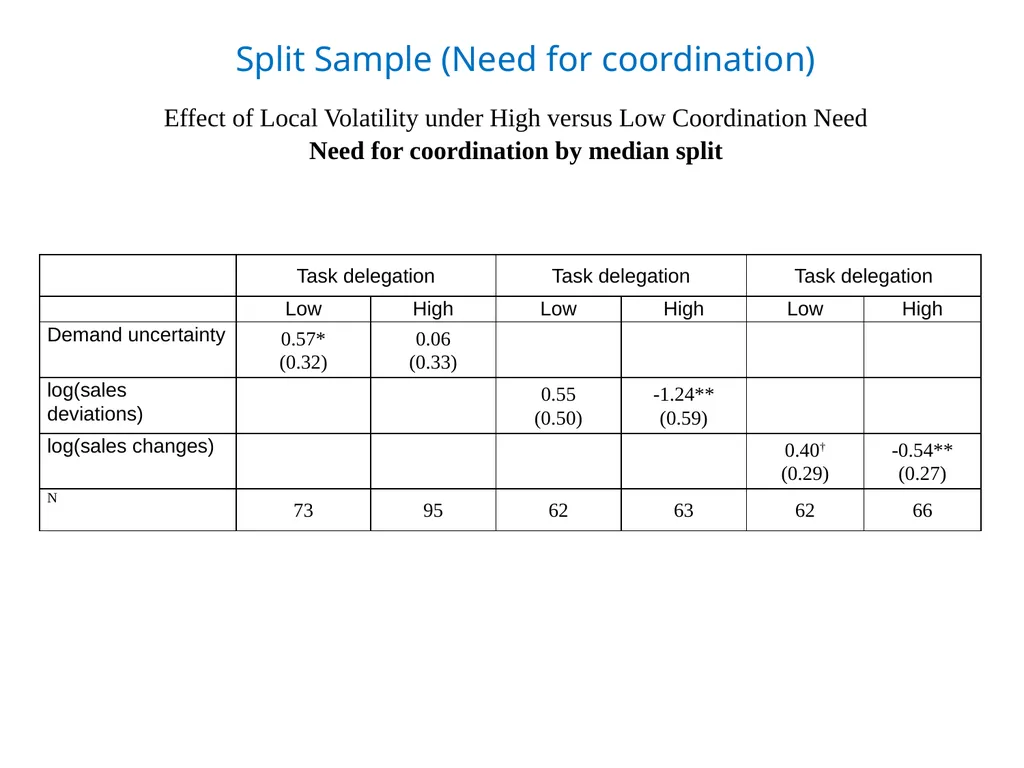
Split Sample (Need for coordination) Effect of Local Volatility under High versus Low Coordination Need
Need for coordination by median split<br>
Need for coordination by median split<br>
27
Impact of local uncertainty and coordination need
Task Delegation (nr of tasks delegated to manager)
Delegation of Departmental tasks vs Functional tasks
(Sub-group analysis, based on coordination intensity)
Center’s ability to learn about local shocks.
Robustness checks
Department Fixed Effects
Include personality traits Regression Analysis: An Outline<br>
Task Delegation (nr of tasks delegated to manager)
Delegation of Departmental tasks vs Functional tasks
(Sub-group analysis, based on coordination intensity)
Center’s ability to learn about local shocks.
Robustness checks
Department Fixed Effects
Include personality traits Regression Analysis: An Outline<br>
28
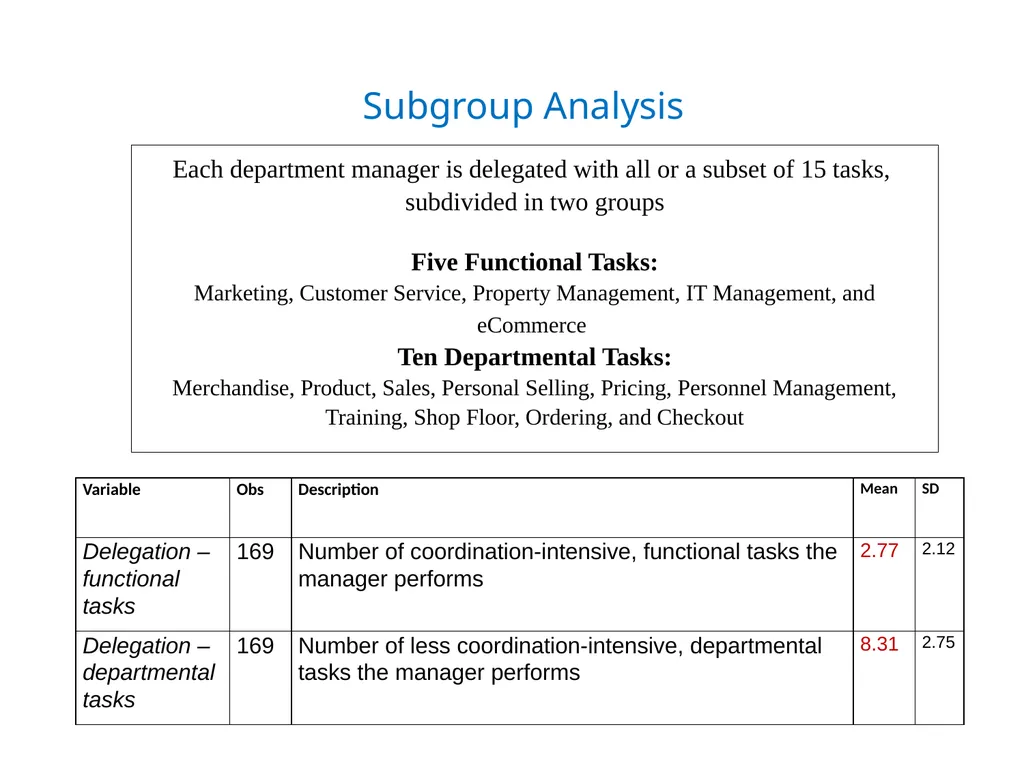
Subgroup Analysis Each department manager is delegated with all or a subset of 15 tasks,
subdivided in two groups
Five Functional Tasks:
Marketing, Customer Service, Property Management, IT Management, and eCommerce
Ten Departmental Tasks:
Merchandise, Product, Sales, Personal Selling, Pricing, Personnel Management, Training, Shop Floor, Ordering, and Checkout<br>
Five Functional Tasks:
Marketing, Customer Service, Property Management, IT Management, and eCommerce
Ten Departmental Tasks:
Merchandise, Product, Sales, Personal Selling, Pricing, Personnel Management, Training, Shop Floor, Ordering, and Checkout<br>
29
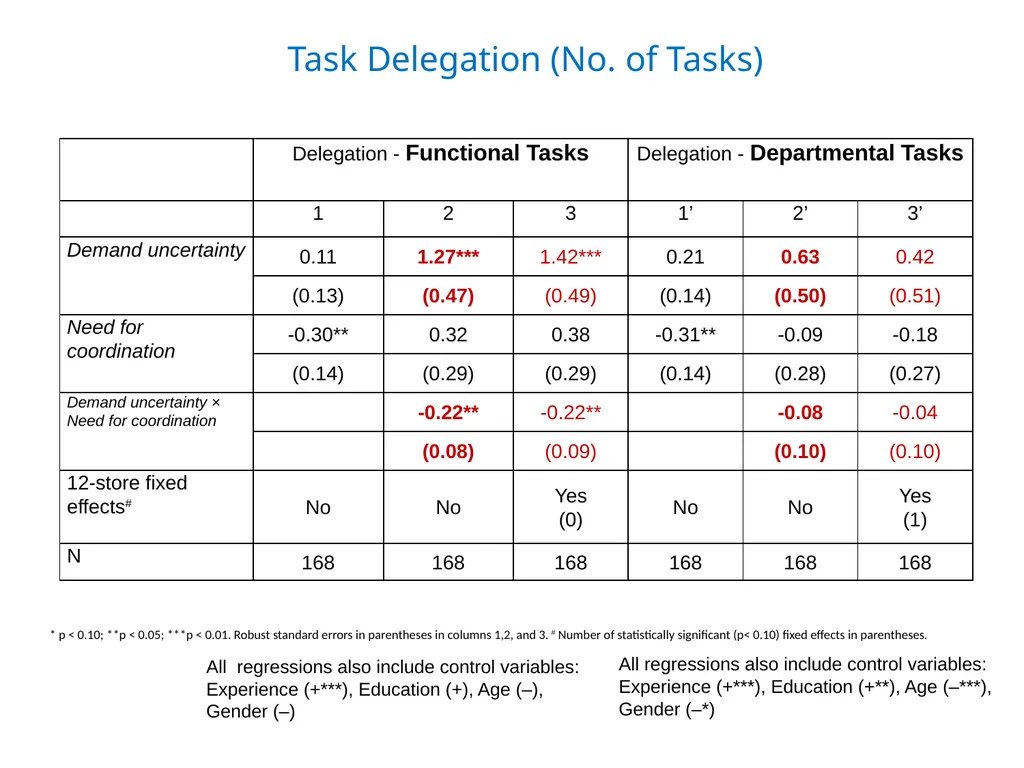
Task Delegation (No. of Tasks) * p < 0.10; **p < 0.05; ***p < 0.01. Robust standard errors in parentheses in columns 1,2, and 3. # Number of statistically significant (p< 0.10) fixed effects in parentheses. All regressions also include control variables: Experience (+***), Education (+), Age (–), Gender (–) All regressions also include control variables: Experience (+***), Education (+**), Age (–***), Gender (–*)<br>
30
Impact of local uncertainty and coordination need
Task Delegation (nr of tasks delegated to manager)
Delegation of Departmental tasks vs Functional tasks
(Sub-group analysis, based on coordination intensity)
Center’s ability to learn about local shocks.
Robustness checks
Department Fixed Effects
Include personality traits Regression Analysis: An Outline<br>
Task Delegation (nr of tasks delegated to manager)
Delegation of Departmental tasks vs Functional tasks
(Sub-group analysis, based on coordination intensity)
Center’s ability to learn about local shocks.
Robustness checks
Department Fixed Effects
Include personality traits Regression Analysis: An Outline<br>
31
Center’s Ability to Learn about Local Shocks<br>
32
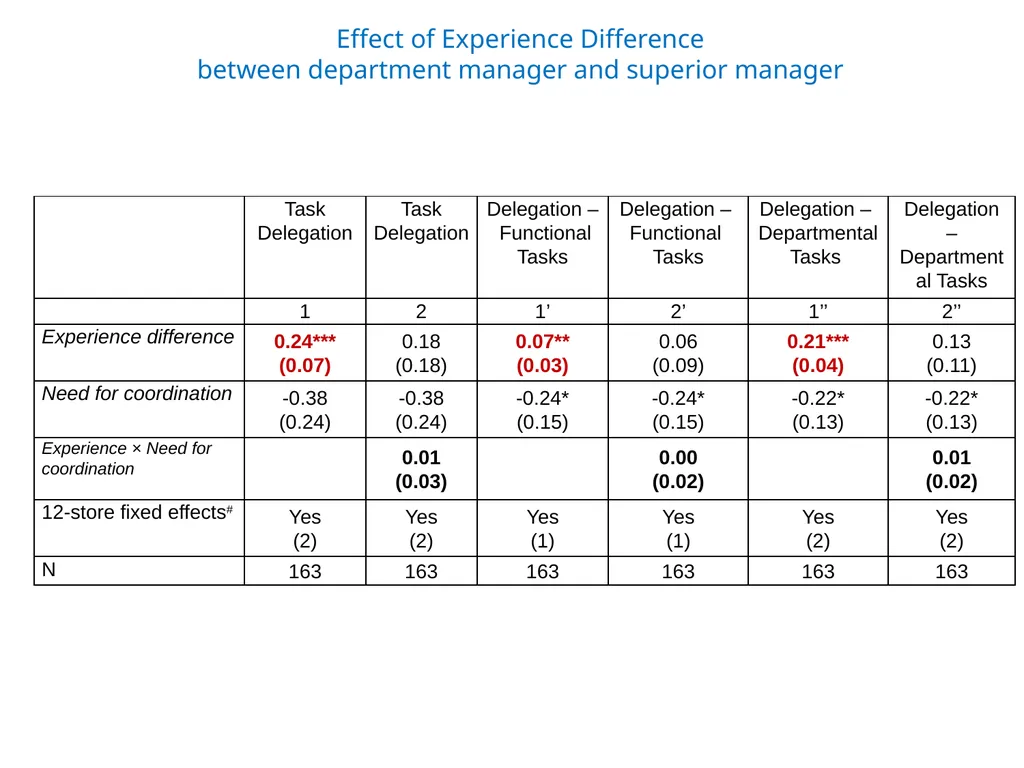
Effect of Experience Difference
between department manager and superior manager<br>
33
Conclusion<br>
34
Impact of local uncertainty and coordination need
Task Delegation (nr of tasks delegated to manager)
Delegation of Departmental tasks vs Functional tasks
(Sub-group analysis, based on coordination intensity)
Center’s ability to learn about local shocks.
Robustness checks
Department Fixed Effects
Include personality traits Regression Analysis: An Outline<br>
Task Delegation (nr of tasks delegated to manager)
Delegation of Departmental tasks vs Functional tasks
(Sub-group analysis, based on coordination intensity)
Center’s ability to learn about local shocks.
Robustness checks
Department Fixed Effects
Include personality traits Regression Analysis: An Outline<br>
35
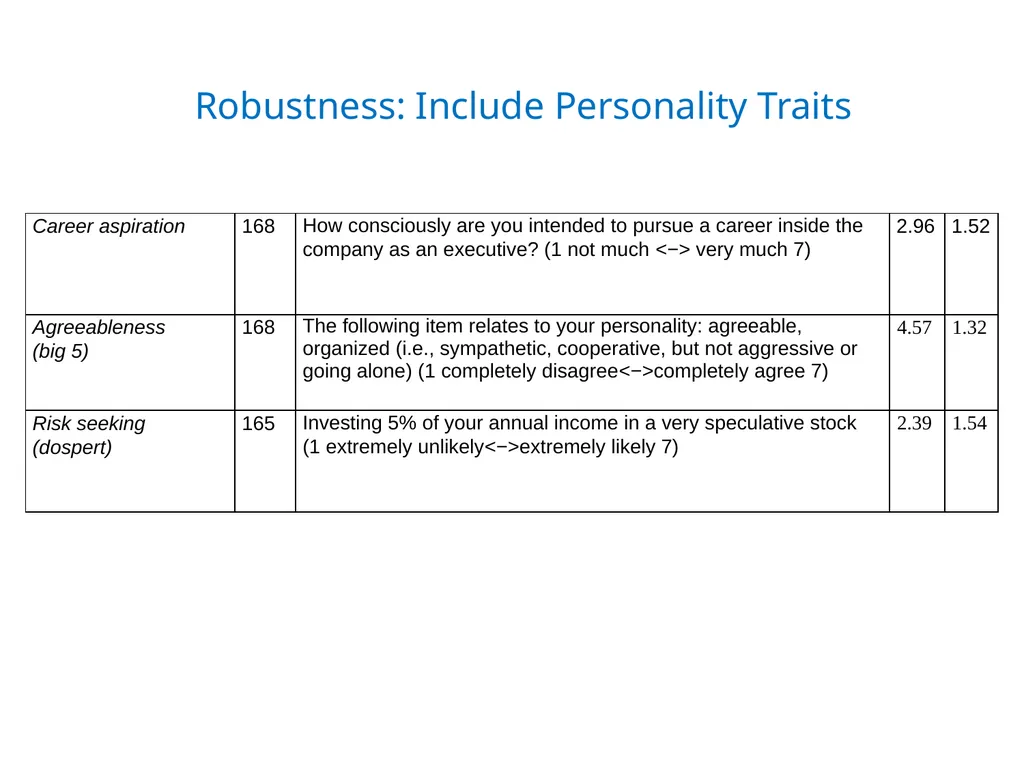
Robustness: Include Personality Traits<br>
36
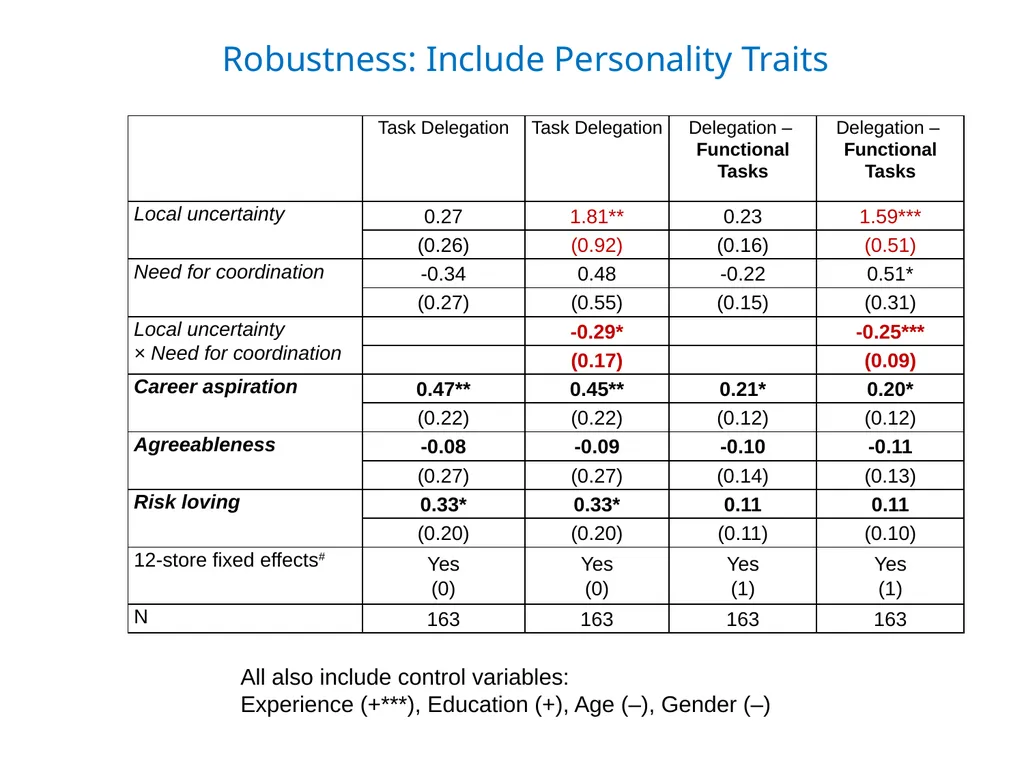
Robustness: Include Personality Traits All also include control variables:
Experience (+***), Education (+), Age (–), Gender (–)<br>
37
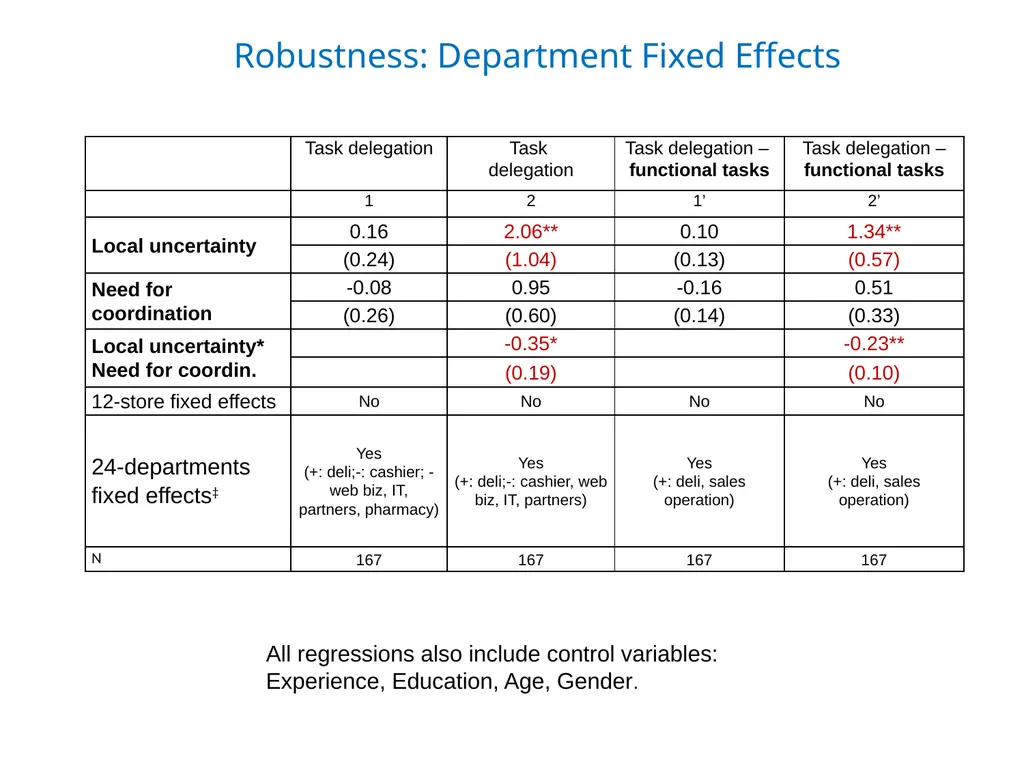
Robustness: Department Fixed Effects All regressions also include control variables:
Experience, Education, Age, Gender.<br>
38
Conclusion<br>
39
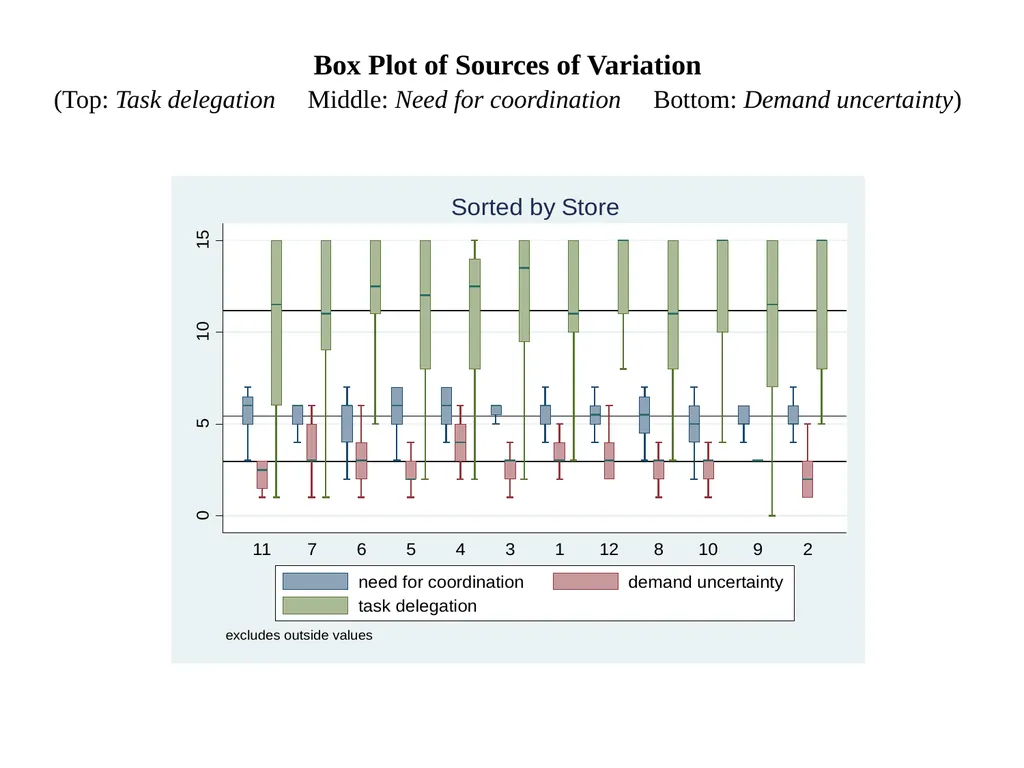
Box Plot of Sources of Variation
(Top: Task delegation Middle: Need for coordination Bottom: Demand uncertainty)<br>
(Top: Task delegation Middle: Need for coordination Bottom: Demand uncertainty)<br>
40
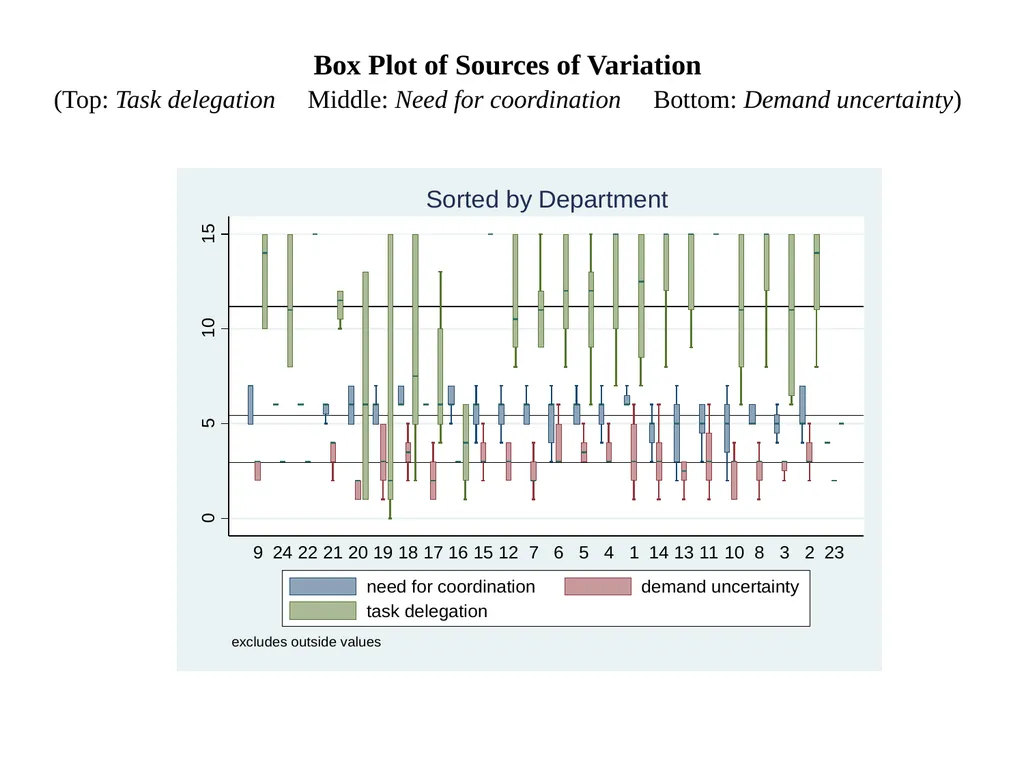
Box Plot of Sources of Variation
(Top: Task delegation Middle: Need for coordination Bottom: Demand uncertainty)<br>
(Top: Task delegation Middle: Need for coordination Bottom: Demand uncertainty)<br>