
December 2023 Draft: ENT Paediatric Primary and

Description: December 2023 Draft: ENT Paediatric Primary and Secondary Care Interface Guidelines Purpose: This Guideline has been produced utilising published guidance and in collaboration with clinical and non-clinical staff across South East London
Related Topics
Download Presentation
"December 2023 Draft: ENT Paediatric Primary and" is the property of its rightful owner. Permission is granted to download and print the materials on this website for personal, non-commercial use only, and to display it on your personal computer provided you do not modify the materials and that you retain all copyright notices contained in the materials. By downloading content from our website, you accept the terms of this agreement.
Presentation Transcript
slide1. December 2023 Draft: ENT Paediatric Primary and Secondary Care Interface Guidelines<br>
slide2. Purpose:
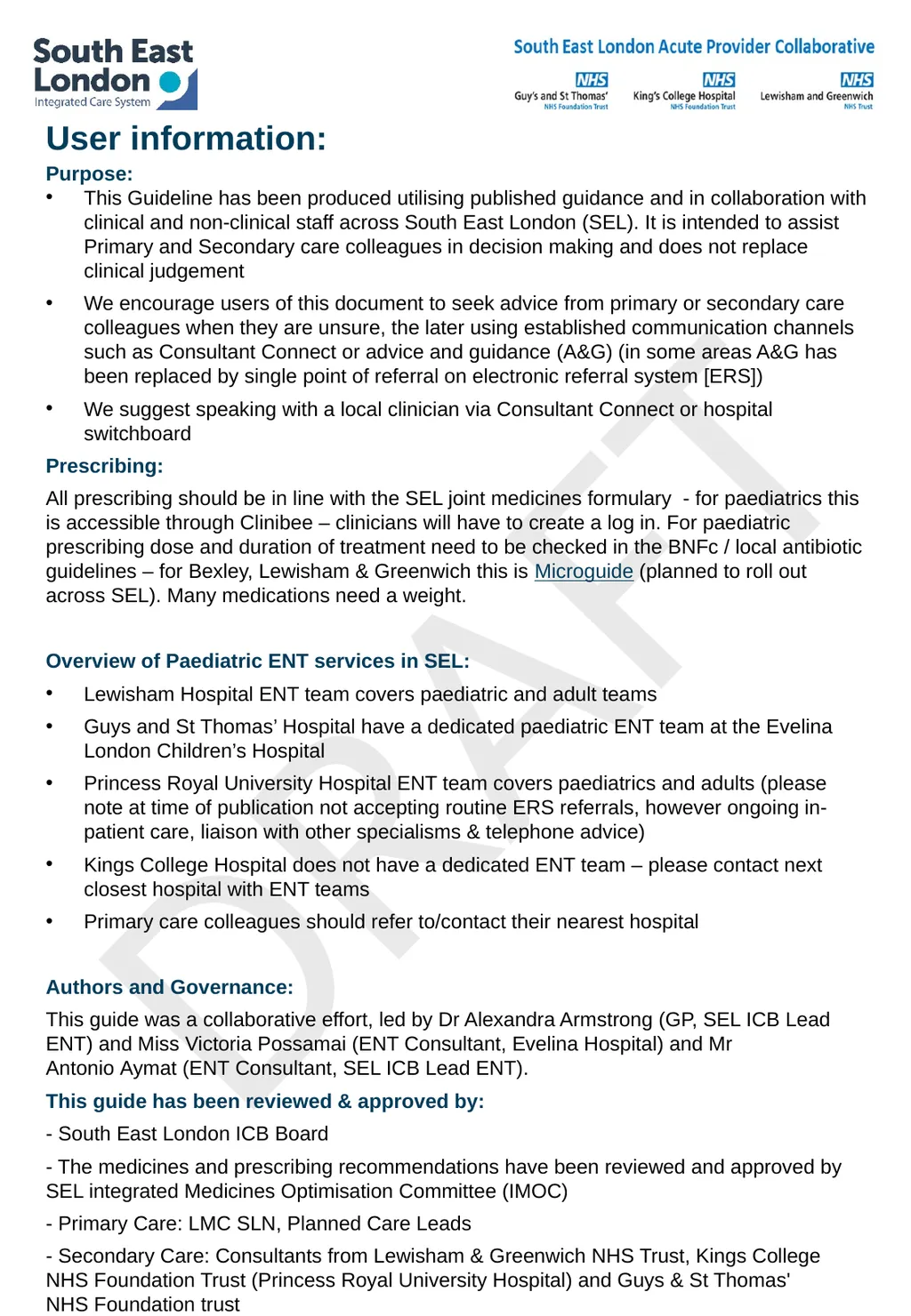
This Guideline has been produced utilising published guidance and in collaboration with clinical and non-clinical staff across South East London (SEL). It is intended to assist Primary and Secondary care colleagues in decision making and does not replace clinical judgement
We encourage users of this document to seek advice from primary or secondary care colleagues when they are unsure, the later using established communication channels such as Consultant Connect or advice and guidance (A&G) (in some areas A&G has been replaced by single point of referral on electronic referral system [ERS])
We suggest speaking with a local clinician via Consultant Connect or hospital switchboard
Prescribing:
All prescribing should be in line with the SEL joint medicines formulary - for paediatrics this is accessible through Clinibee – clinicians will have to create a log in. For paediatric prescribing dose and duration of treatment need to be checked in the BNFc / local antibiotic guidelines – for Bexley, Lewisham & Greenwich this is Microguide (planned to roll out across SEL). Many medications need a weight.
Overview of Paediatric ENT services in SEL:
Lewisham Hospital ENT team covers paediatric and adult teams
Guys and St Thomas’ Hospital have a dedicated paediatric ENT team at the Evelina London Children’s Hospital
Princess Royal University Hospital ENT team covers paediatrics and adults (please note at time of publication not accepting routine ERS referrals, however ongoing in-patient care, liaison with other specialisms & telephone advice)
Kings College Hospital does not have a dedicated ENT team – please contact next closest hospital with ENT teams
Primary care colleagues should refer to/contact their nearest hospital
Authors and Governance:
This guide was a collaborative effort, led by Dr Alexandra Armstrong (GP, SEL ICB Lead ENT) and Miss Victoria Possamai (ENT Consultant, Evelina Hospital) and Mr Antonio Aymat (ENT Consultant, SEL ICB Lead ENT).
This guide has been reviewed & approved by:
- South East London ICB Board
- The medicines and prescribing recommendations have been reviewed and approved by SEL integrated Medicines Optimisation Committee (IMOC)
- Primary Care: LMC SLN, Planned Care Leads
- Secondary Care: Consultants from Lewisham & Greenwich NHS Trust, Kings College NHS Foundation Trust (Princess Royal University Hospital) and Guys & St Thomas' NHS Foundation trust User information:<br>
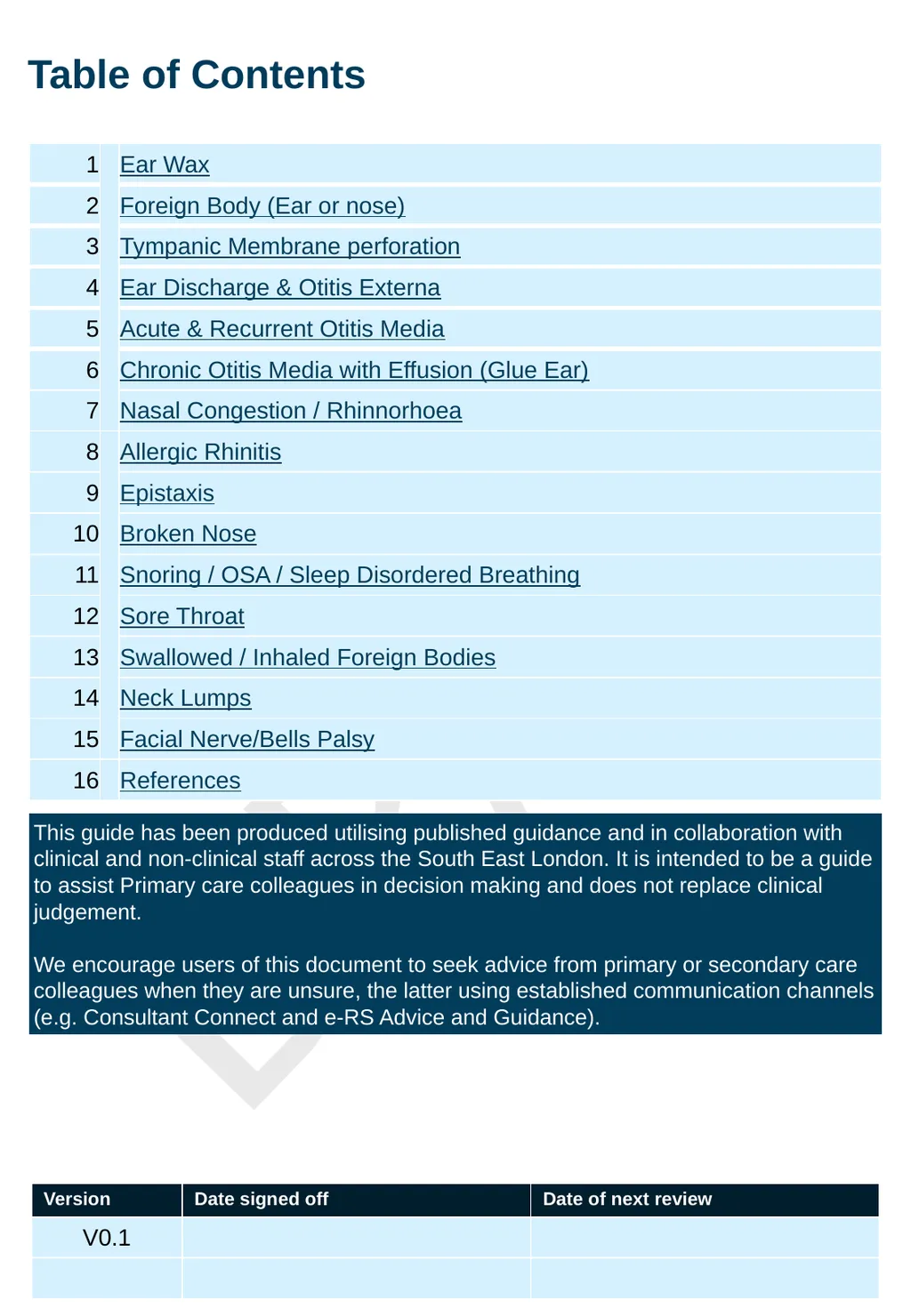
slide3. Table of Contents This guide has been produced utilising published guidance and in collaboration with clinical and non-clinical staff across the South East London. It is intended to be a guide to assist Primary care colleagues in decision making and does not replace clinical judgement.
We encourage users of this document to seek advice from primary or secondary care colleagues when they are unsure, the latter using established communication channels (e.g. Consultant Connect and e-RS Advice and Guidance).<br>
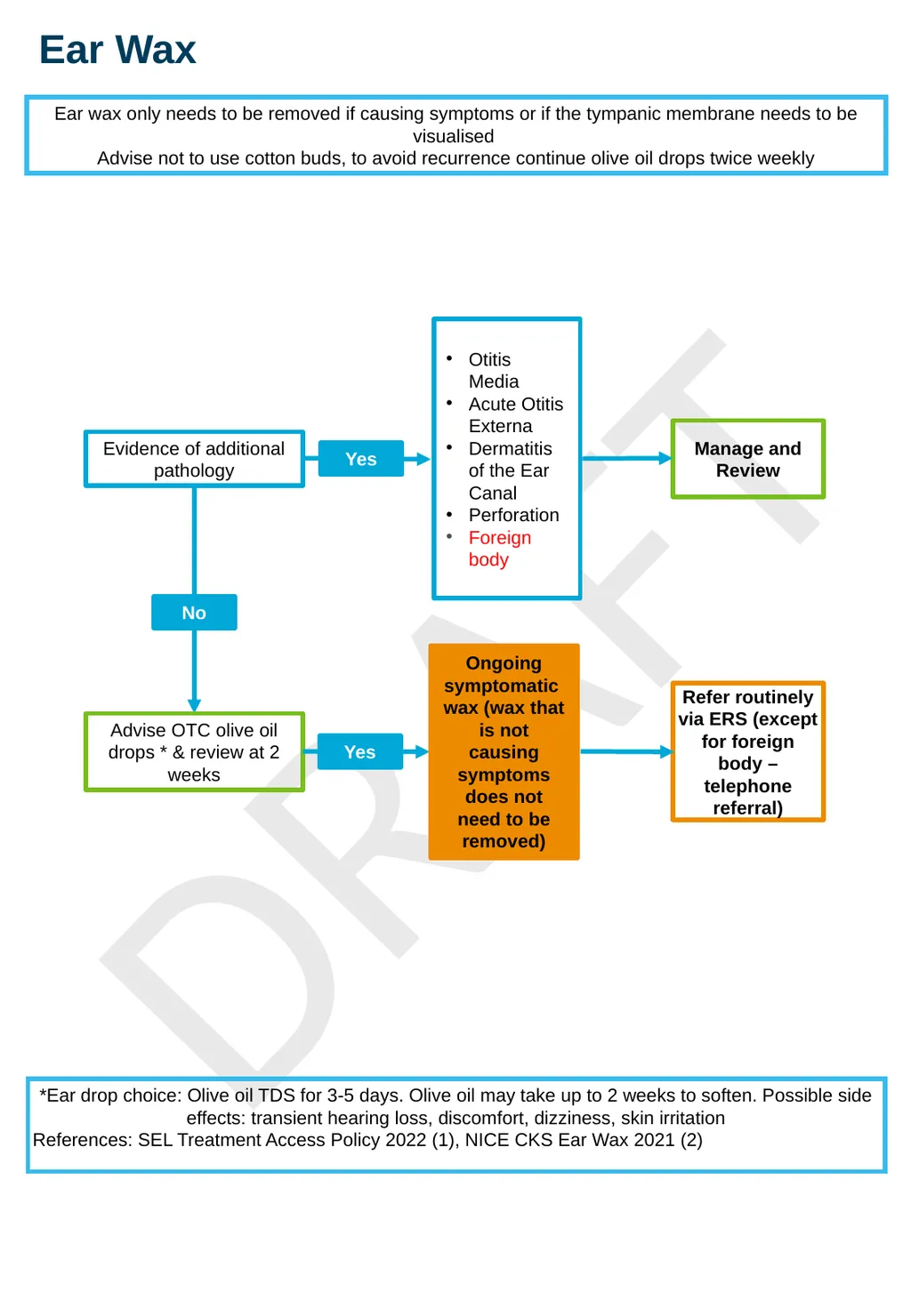
slide4. Ear wax only needs to be removed if causing symptoms or if the tympanic membrane needs to be visualised
Advise not to use cotton buds, to avoid recurrence continue olive oil drops twice weekly *Ear drop choice: Olive oil TDS for 3-5 days. Olive oil may take up to 2 weeks to soften. Possible side effects: transient hearing loss, discomfort, dizziness, skin irritation
References: SEL Treatment Access Policy 2022 (1), NICE CKS Ear Wax 2021 (2) Ear Wax<br>
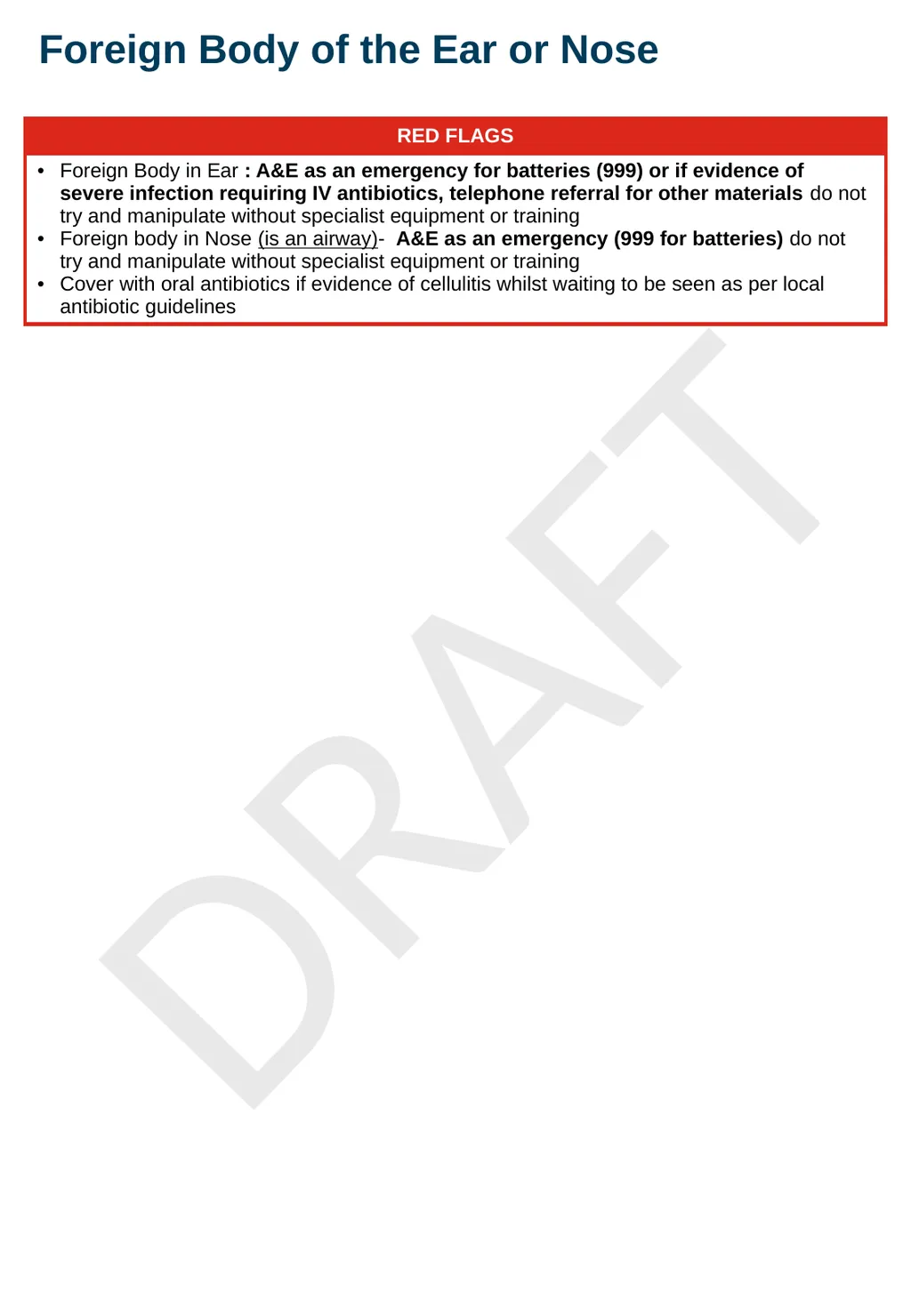
slide5. Foreign Body of the Ear or Nose<br>
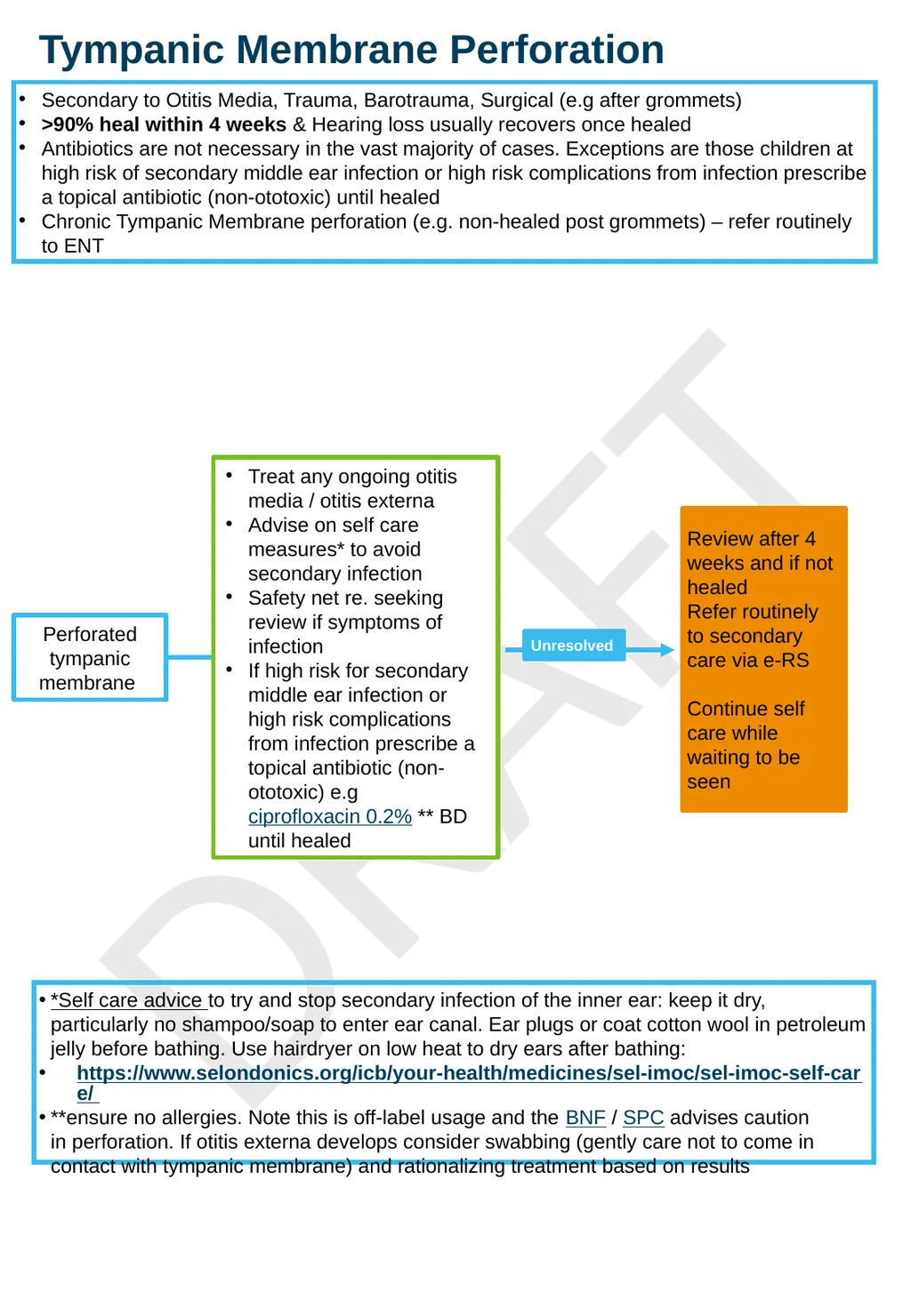
slide6. Secondary to Otitis Media, Trauma, Barotrauma, Surgical (e.g after grommets)
>90% heal within 4 weeks & Hearing loss usually recovers once healed
Antibiotics are not necessary in the vast majority of cases. Exceptions are those children at high risk of secondary middle ear infection or high risk complications from infection prescribe a topical antibiotic (non-ototoxic) until healed
Chronic Tympanic Membrane perforation (e.g. non-healed post grommets) – refer routinely to ENT *Self care advice to try and stop secondary infection of the inner ear: keep it dry, particularly no shampoo/soap to enter ear canal. Ear plugs or coat cotton wool in petroleum jelly before bathing. Use hairdryer on low heat to dry ears after bathing:
https://www.selondonics.org/icb/your-health/medicines/sel-imoc/sel-imoc-self-care/
**ensure no allergies. Note this is off-label usage and the BNF / SPC advises caution in perforation. If otitis externa develops consider swabbing (gently care not to come in contact with tympanic membrane) and rationalizing treatment based on results Tympanic Membrane Perforation Perforated tympanic membrane Treat any ongoing otitis media / otitis externa
Advise on self care measures* to avoid secondary infection
Safety net re. seeking review if symptoms of infection
If high risk for secondary middle ear infection or high risk complications from infection prescribe a topical antibiotic (non-ototoxic) e.g ciprofloxacin 0.2% ** BD until healed Unresolved Review after 4 weeks and if not healed
Refer routinely to secondary care via e-RS
Continue self care while waiting to be seen<br>
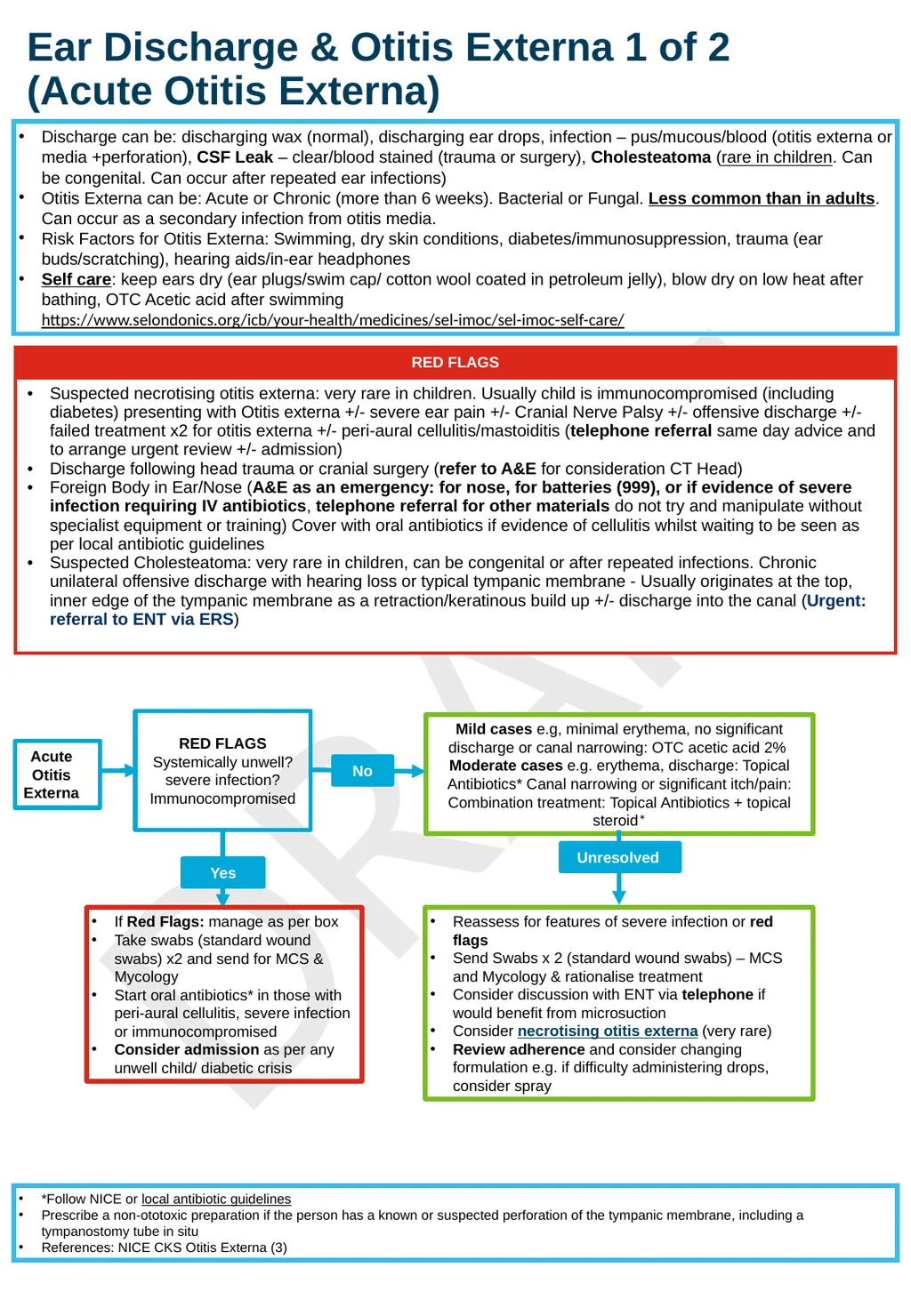
slide7. Acute Otitis Externa RED FLAGS
Systemically unwell? severe infection? Immunocompromised Yes Mild cases e.g, minimal erythema, no significant discharge or canal narrowing: OTC acetic acid 2%
Moderate cases e.g. erythema, discharge: Topical Antibiotics* Canal narrowing or significant itch/pain: Combination treatment: Topical Antibiotics + topical steroid* Reassess for features of severe infection or red flags
Send Swabs x 2 (standard wound swabs) – MCS and Mycology & rationalise treatment
Consider discussion with ENT via telephone if would benefit from microsuction
Consider necrotising otitis externa (very rare)
Review adherence and consider changing formulation e.g. if difficulty administering drops, consider spray No Unresolved Discharge can be: discharging wax (normal), discharging ear drops, infection – pus/mucous/blood (otitis externa or media +perforation), CSF Leak – clear/blood stained (trauma or surgery), Cholesteatoma (rare in children. Can be congenital. Can occur after repeated ear infections)
Otitis Externa can be: Acute or Chronic (more than 6 weeks). Bacterial or Fungal. Less common than in adults. Can occur as a secondary infection from otitis media.
Risk Factors for Otitis Externa: Swimming, dry skin conditions, diabetes/immunosuppression, trauma (ear buds/scratching), hearing aids/in-ear headphones
Self care: keep ears dry (ear plugs/swim cap/ cotton wool coated in petroleum jelly), blow dry on low heat after bathing, OTC Acetic acid after swimming https://www.selondonics.org/icb/your-health/medicines/sel-imoc/sel-imoc-self-care/ *Follow NICE or local antibiotic guidelines
Prescribe a non-ototoxic preparation if the person has a known or suspected perforation of the tympanic membrane, including a tympanostomy tube in situ
References: NICE CKS Otitis Externa (3) If Red Flags: manage as per box
Take swabs (standard wound swabs) x2 and send for MCS & Mycology
Start oral antibiotics* in those with peri-aural cellulitis, severe infection or immunocompromised
Consider admission as per any unwell child/ diabetic crisis Ear Discharge & Otitis Externa 1 of 2 (Acute Otitis Externa)<br>
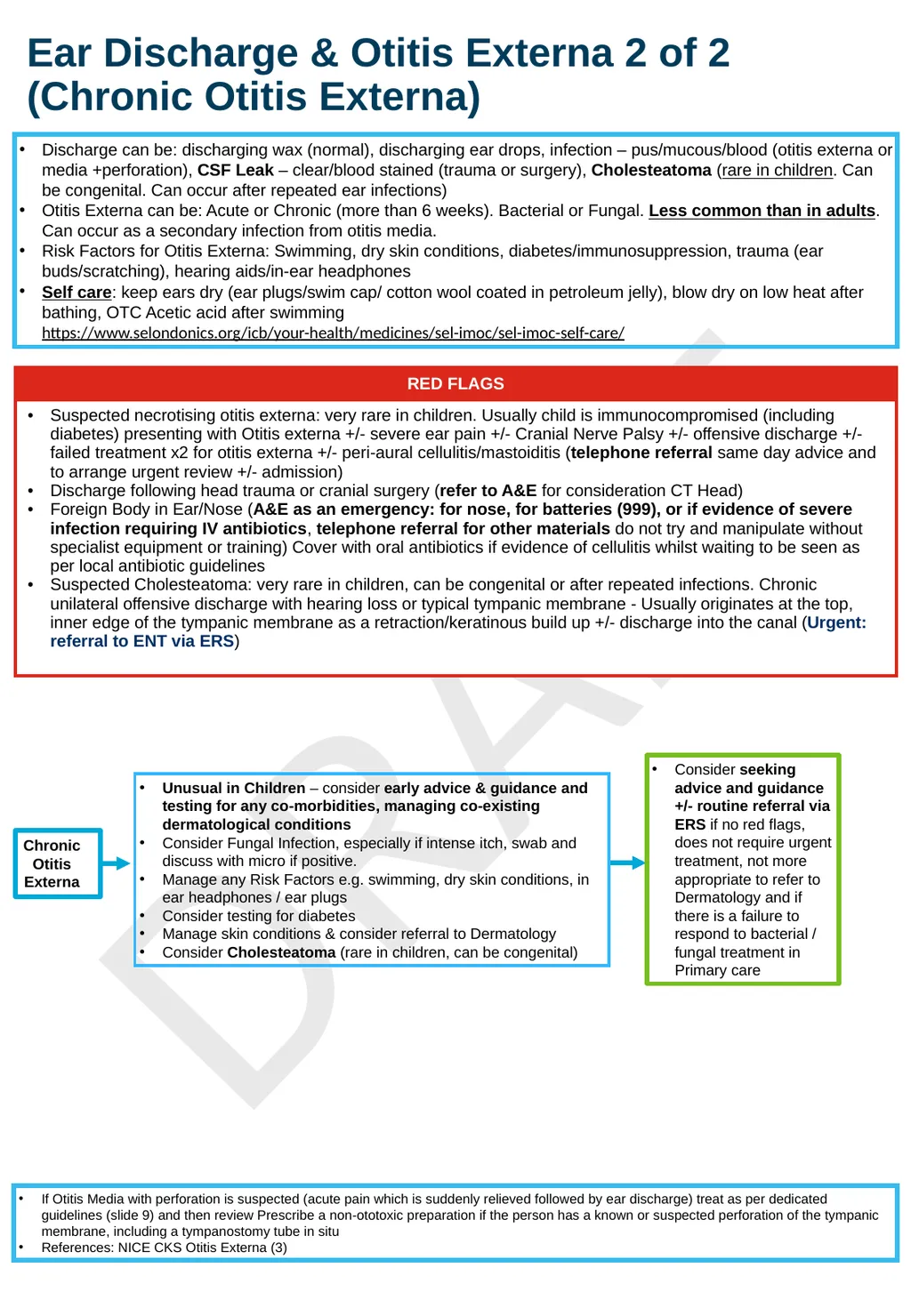
slide8. Ear Discharge & Otitis Externa 2 of 2 (Chronic Otitis Externa) Discharge can be: discharging wax (normal), discharging ear drops, infection – pus/mucous/blood (otitis externa or media +perforation), CSF Leak – clear/blood stained (trauma or surgery), Cholesteatoma (rare in children. Can be congenital. Can occur after repeated ear infections)
Otitis Externa can be: Acute or Chronic (more than 6 weeks). Bacterial or Fungal. Less common than in adults. Can occur as a secondary infection from otitis media.
Risk Factors for Otitis Externa: Swimming, dry skin conditions, diabetes/immunosuppression, trauma (ear buds/scratching), hearing aids/in-ear headphones
Self care: keep ears dry (ear plugs/swim cap/ cotton wool coated in petroleum jelly), blow dry on low heat after bathing, OTC Acetic acid after swimming https://www.selondonics.org/icb/your-health/medicines/sel-imoc/sel-imoc-self-care/ Unusual in Children – consider early advice & guidance and testing for any co-morbidities, managing co-existing dermatological conditions
Consider Fungal Infection, especially if intense itch, swab and discuss with micro if positive.
Manage any Risk Factors e.g. swimming, dry skin conditions, in ear headphones / ear plugs
Consider testing for diabetes
Manage skin conditions & consider referral to Dermatology
Consider Cholesteatoma (rare in children, can be congenital) Chronic Otitis Externa Consider seeking advice and guidance +/- routine referral via ERS if no red flags, does not require urgent treatment, not more appropriate to refer to Dermatology and if there is a failure to respond to bacterial / fungal treatment in Primary care If Otitis Media with perforation is suspected (acute pain which is suddenly relieved followed by ear discharge) treat as per dedicated guidelines (slide 9) and then review Prescribe a non-ototoxic preparation if the person has a known or suspected perforation of the tympanic membrane, including a tympanostomy tube in situ
References: NICE CKS Otitis Externa (3)<br>
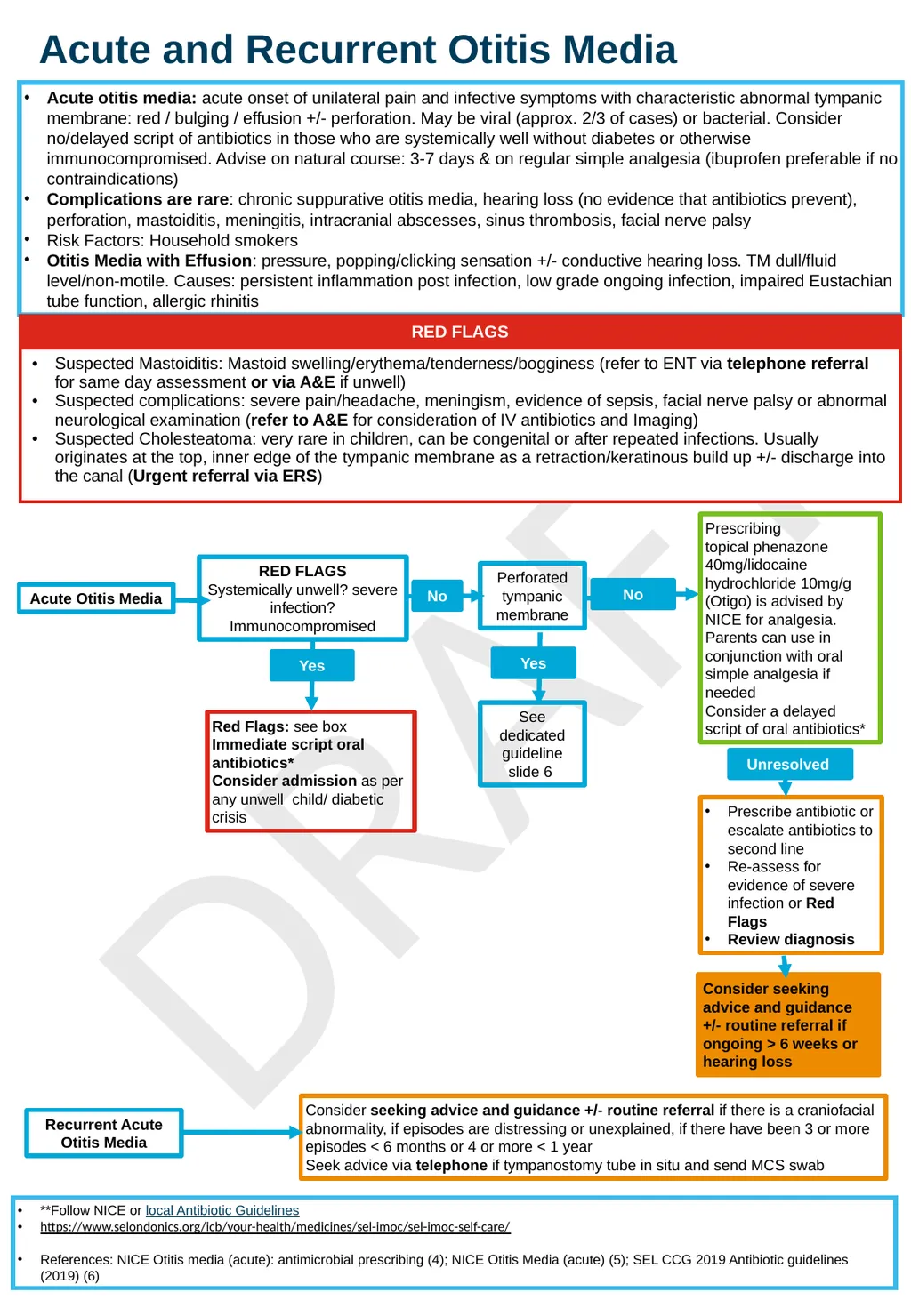
slide9. Acute otitis media: acute onset of unilateral pain and infective symptoms with characteristic abnormal tympanic membrane: red / bulging / effusion +/- perforation. May be viral (approx. 2/3 of cases) or bacterial. Consider no/delayed script of antibiotics in those who are systemically well without diabetes or otherwise immunocompromised. Advise on natural course: 3-7 days & on regular simple analgesia (ibuprofen preferable if no contraindications)
Complications are rare: chronic suppurative otitis media, hearing loss (no evidence that antibiotics prevent), perforation, mastoiditis, meningitis, intracranial abscesses, sinus thrombosis, facial nerve palsy
Risk Factors: Household smokers
Otitis Media with Effusion: pressure, popping/clicking sensation +/- conductive hearing loss. TM dull/fluid level/non-motile. Causes: persistent inflammation post infection, low grade ongoing infection, impaired Eustachian tube function, allergic rhinitis **Follow NICE or local Antibiotic Guidelines
https://www.selondonics.org/icb/your-health/medicines/sel-imoc/sel-imoc-self-care/
References: NICE Otitis media (acute): antimicrobial prescribing (4); NICE Otitis Media (acute) (5); SEL CCG 2019 Antibiotic guidelines (2019) (6) Acute Otitis Media RED FLAGS
Systemically unwell? severe infection? Immunocompromised Red Flags: see box
Immediate script oral antibiotics*
Consider admission as per any unwell child/ diabetic crisis Perforated tympanic membrane No Consider seeking advice and guidance +/- routine referral if there is a craniofacial abnormality, if episodes are distressing or unexplained, if there have been 3 or more episodes < 6 months or 4 or more < 1 year
Seek advice via telephone if tympanostomy tube in situ and send MCS swab Prescribe antibiotic or escalate antibiotics to second line
Re-assess for evidence of severe infection or Red Flags
Review diagnosis Yes No Prescribing topical phenazone 40mg/lidocaine hydrochloride 10mg/g (Otigo) is advised by NICE for analgesia. Parents can use in conjunction with oral simple analgesia if needed
Consider a delayed script of oral antibiotics* Unresolved Yes See dedicated guideline slide 6 Recurrent Acute Otitis Media Acute and Recurrent Otitis Media Consider seeking advice and guidance +/- routine referral if ongoing > 6 weeks or hearing loss<br>
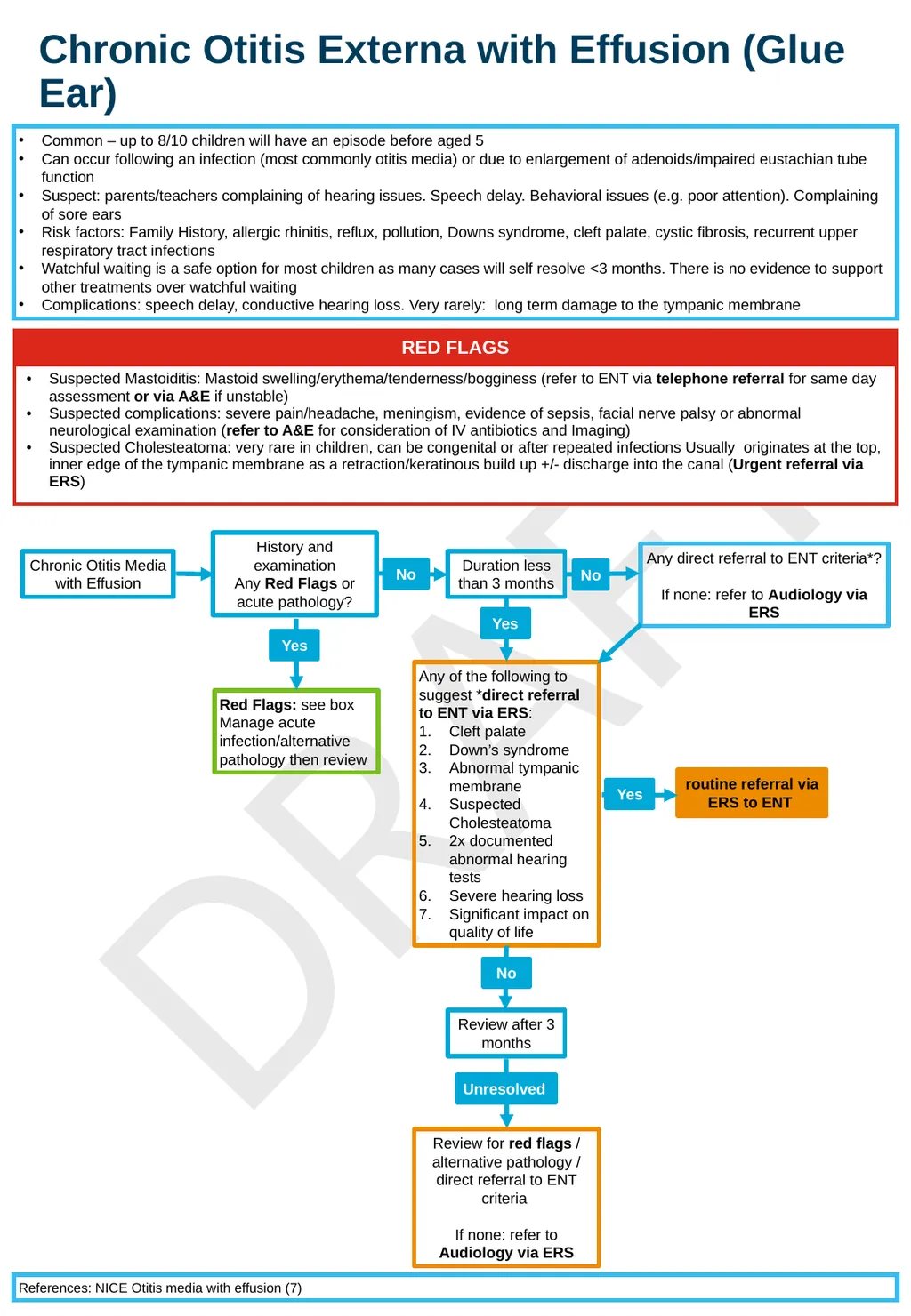
slide10. Common – up to 8/10 children will have an episode before aged 5
Can occur following an infection (most commonly otitis media) or due to enlargement of adenoids/impaired eustachian tube function
Suspect: parents/teachers complaining of hearing issues. Speech delay. Behavioral issues (e.g. poor attention). Complaining of sore ears
Risk factors: Family History, allergic rhinitis, reflux, pollution, Downs syndrome, cleft palate, cystic fibrosis, recurrent upper respiratory tract infections
Watchful waiting is a safe option for most children as many cases will self resolve <3 months. There is no evidence to support other treatments over watchful waiting
Complications: speech delay, conductive hearing loss. Very rarely: long term damage to the tympanic membrane References: NICE Otitis media with effusion (7) Chronic Otitis Externa with Effusion (Glue Ear)<br>
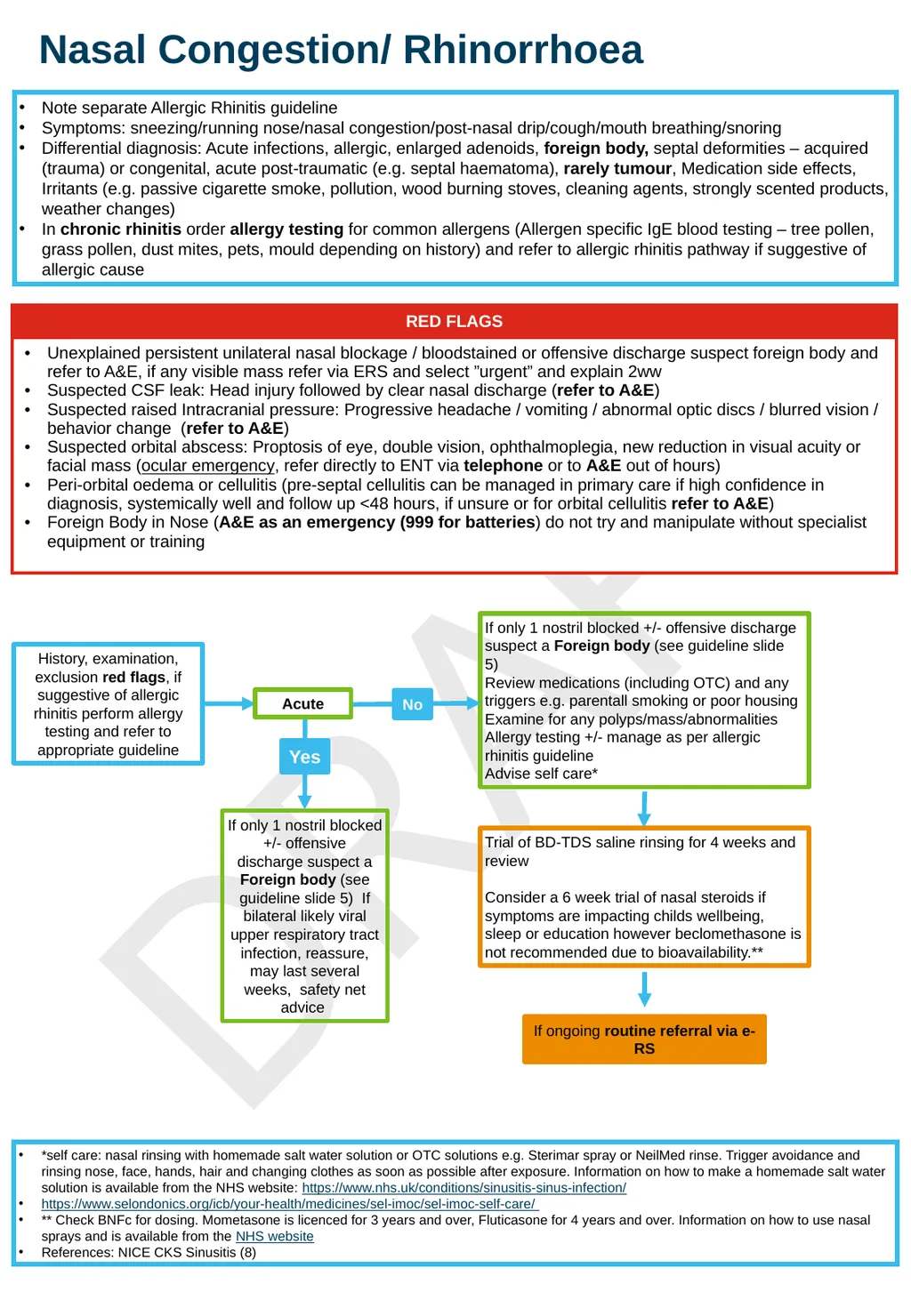
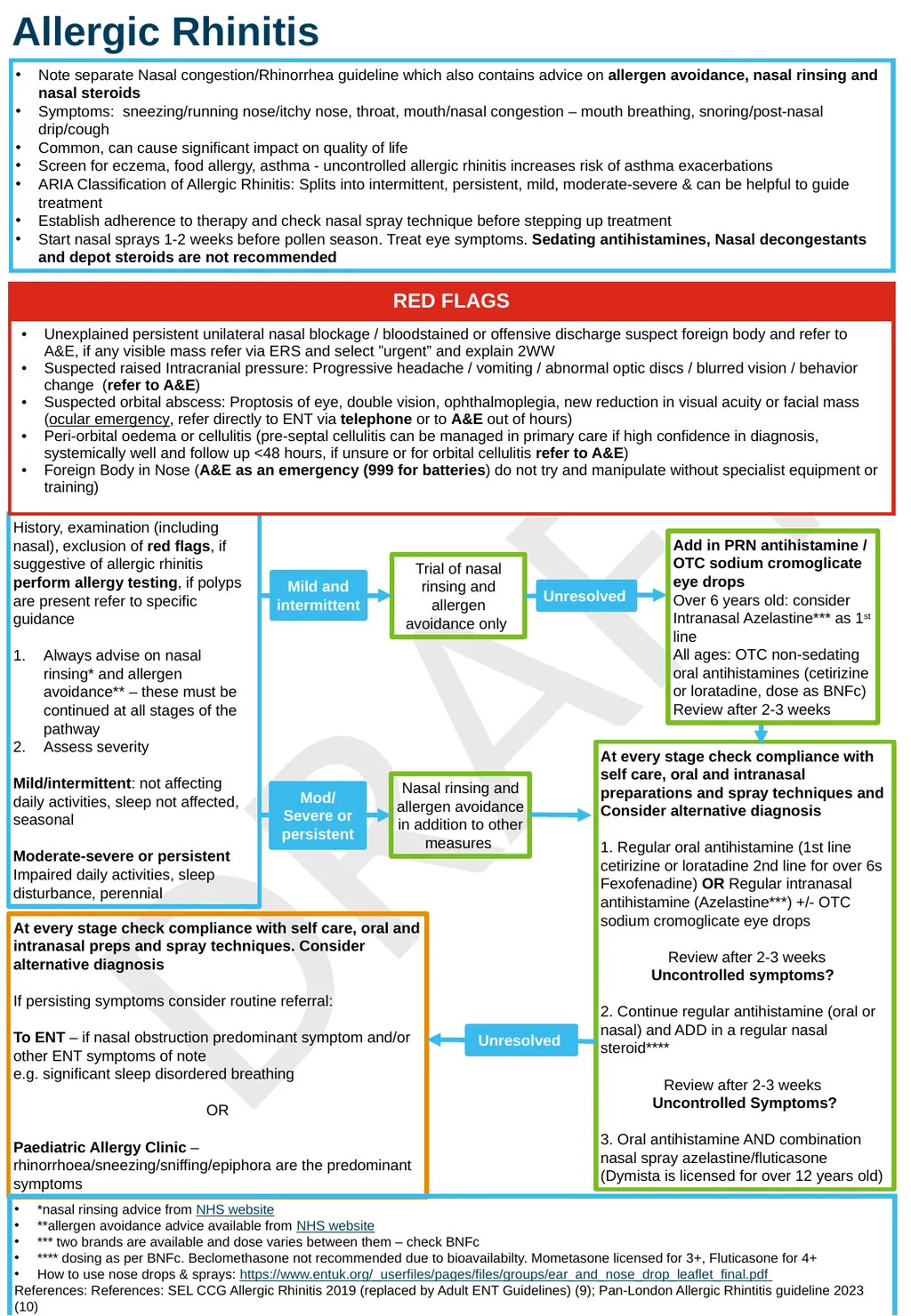
slide11. Note separate Allergic Rhinitis guideline
Symptoms: sneezing/running nose/nasal congestion/post-nasal drip/cough/mouth breathing/snoring
Differential diagnosis: Acute infections, allergic, enlarged adenoids, foreign body, septal deformities – acquired (trauma) or congenital, acute post-traumatic (e.g. septal haematoma), rarely tumour, Medication side effects, Irritants (e.g. passive cigarette smoke, pollution, wood burning stoves, cleaning agents, strongly scented products, weather changes)
In chronic rhinitis order allergy testing for common allergens (Allergen specific IgE blood testing – tree pollen, grass pollen, dust mites, pets, mould depending on history) and refer to allergic rhinitis pathway if suggestive of allergic cause *self care: nasal rinsing with homemade salt water solution or OTC solutions e.g. Sterimar spray or NeilMed rinse. Trigger avoidance and rinsing nose, face, hands, hair and changing clothes as soon as possible after exposure. Information on how to make a homemade salt water solution is available from the NHS website: https://www.nhs.uk/conditions/sinusitis-sinus-infection/
https://www.selondonics.org/icb/your-health/medicines/sel-imoc/sel-imoc-self-care/
** Check BNFc for dosing. Mometasone is licenced for 3 years and over, Fluticasone for 4 years and over. Information on how to use nasal sprays and is available from the NHS website
References: NICE CKS Sinusitis (8) History, examination, exclusion red flags, if suggestive of allergic rhinitis perform allergy testing and refer to appropriate guideline If only 1 nostril blocked +/- offensive discharge suspect a Foreign body (see guideline slide 5)
Review medications (including OTC) and any triggers e.g. parentall smoking or poor housing
Examine for any polyps/mass/abnormalities
Allergy testing +/- manage as per allergic rhinitis guideline
Advise self care* If only 1 nostril blocked +/- offensive discharge suspect a Foreign body (see guideline slide 5) If bilateral likely viral upper respiratory tract infection, reassure, may last several weeks, safety net advice Trial of BD-TDS saline rinsing for 4 weeks and review
Consider a 6 week trial of nasal steroids if symptoms are impacting childs wellbeing, sleep or education however beclomethasone is not recommended due to bioavailability.** No Yes Acute Nasal Congestion/ Rhinorrhoea If ongoing routine referral via e-RS<br>
slide12. Note separate Nasal congestion/Rhinorrhea guideline which also contains advice on allergen avoidance, nasal rinsing and nasal steroids
Symptoms: sneezing/running nose/itchy nose, throat, mouth/nasal congestion – mouth breathing, snoring/post-nasal drip/cough
Common, can cause significant impact on quality of life
Screen for eczema, food allergy, asthma - uncontrolled allergic rhinitis increases risk of asthma exacerbations
ARIA Classification of Allergic Rhinitis: Splits into intermittent, persistent, mild, moderate-severe & can be helpful to guide treatment
Establish adherence to therapy and check nasal spray technique before stepping up treatment
Start nasal sprays 1-2 weeks before pollen season. Treat eye symptoms. Sedating antihistamines, Nasal decongestants and depot steroids are not recommended *nasal rinsing advice from NHS website
**allergen avoidance advice available from NHS website
*** two brands are available and dose varies between them – check BNFc
**** dosing as per BNFc. Beclomethasone not recommended due to bioavailabilty. Mometasone licensed for 3+, Fluticasone for 4+
How to use nose drops & sprays: https://www.entuk.org/_userfiles/pages/files/groups/ear_and_nose_drop_leaflet_final.pdf
References: References: SEL CCG Allergic Rhinitis 2019 (replaced by Adult ENT Guidelines) (9); Pan-London Allergic Rhintitis guideline 2023 (10) Allergic Rhinitis<br>
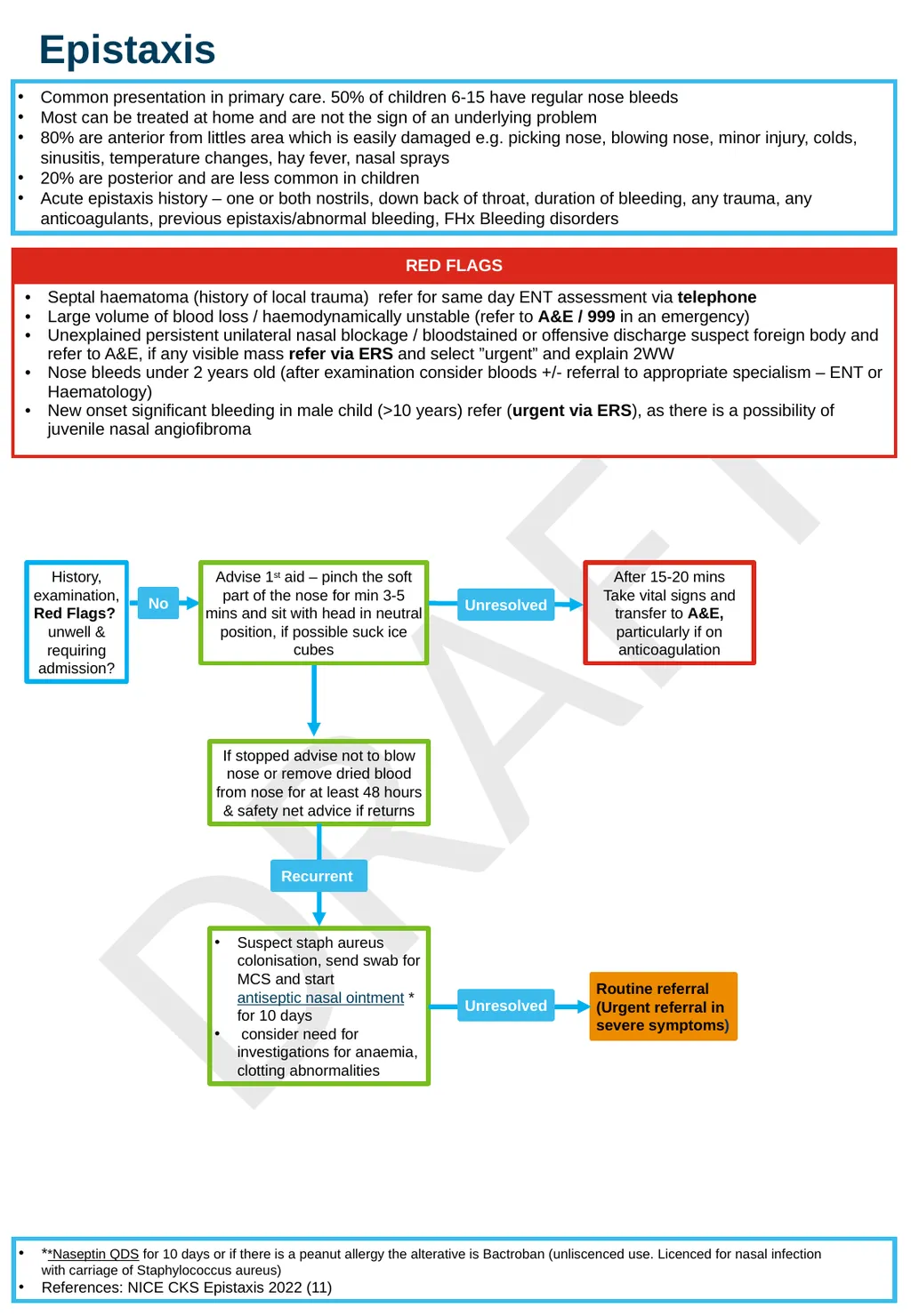
slide13. Common presentation in primary care. 50% of children 6-15 have regular nose bleeds
Most can be treated at home and are not the sign of an underlying problem
80% are anterior from littles area which is easily damaged e.g. picking nose, blowing nose, minor injury, colds, sinusitis, temperature changes, hay fever, nasal sprays
20% are posterior and are less common in children
Acute epistaxis history – one or both nostrils, down back of throat, duration of bleeding, any trauma, any anticoagulants, previous epistaxis/abnormal bleeding, FHx Bleeding disorders **Naseptin QDS for 10 days or if there is a peanut allergy the alterative is Bactroban (unliscenced use. Licenced for nasal infection with carriage of Staphylococcus aureus)
References: NICE CKS Epistaxis 2022 (11) If stopped advise not to blow nose or remove dried blood from nose for at least 48 hours & safety net advice if returns After 15-20 mins
Take vital signs and transfer to A&E, particularly if on anticoagulation Suspect staph aureus colonisation, send swab for MCS and start antiseptic nasal ointment * for 10 days
consider need for investigations for anaemia, clotting abnormalities Routine referral
(Urgent referral in severe symptoms) History, examination, Red Flags? unwell & requiring admission? Advise 1st aid – pinch the soft part of the nose for min 3-5 mins and sit with head in neutral position, if possible suck ice cubes Unresolved Unresolved No Recurrent Epistaxis<br>
slide14. Any nasal injury with persisting deformity needs to be reviewed by ENT 5-7 days post-injury as if MUA is needed this occurs within 2-3 weeks
Refer to ENT emergency clinic via telephone
For late presentations: Septo-rhinoplasty is a restricted procedure on the NHS and not considered before age 16-18. There needs to be both:
severe nasal deformity with complete obstruction of at least one nostril
causing a severe functional limitation
Not considered before age 16-18 References: SEL Treatment Access Policy 2022 (1) Broken Nose<br>
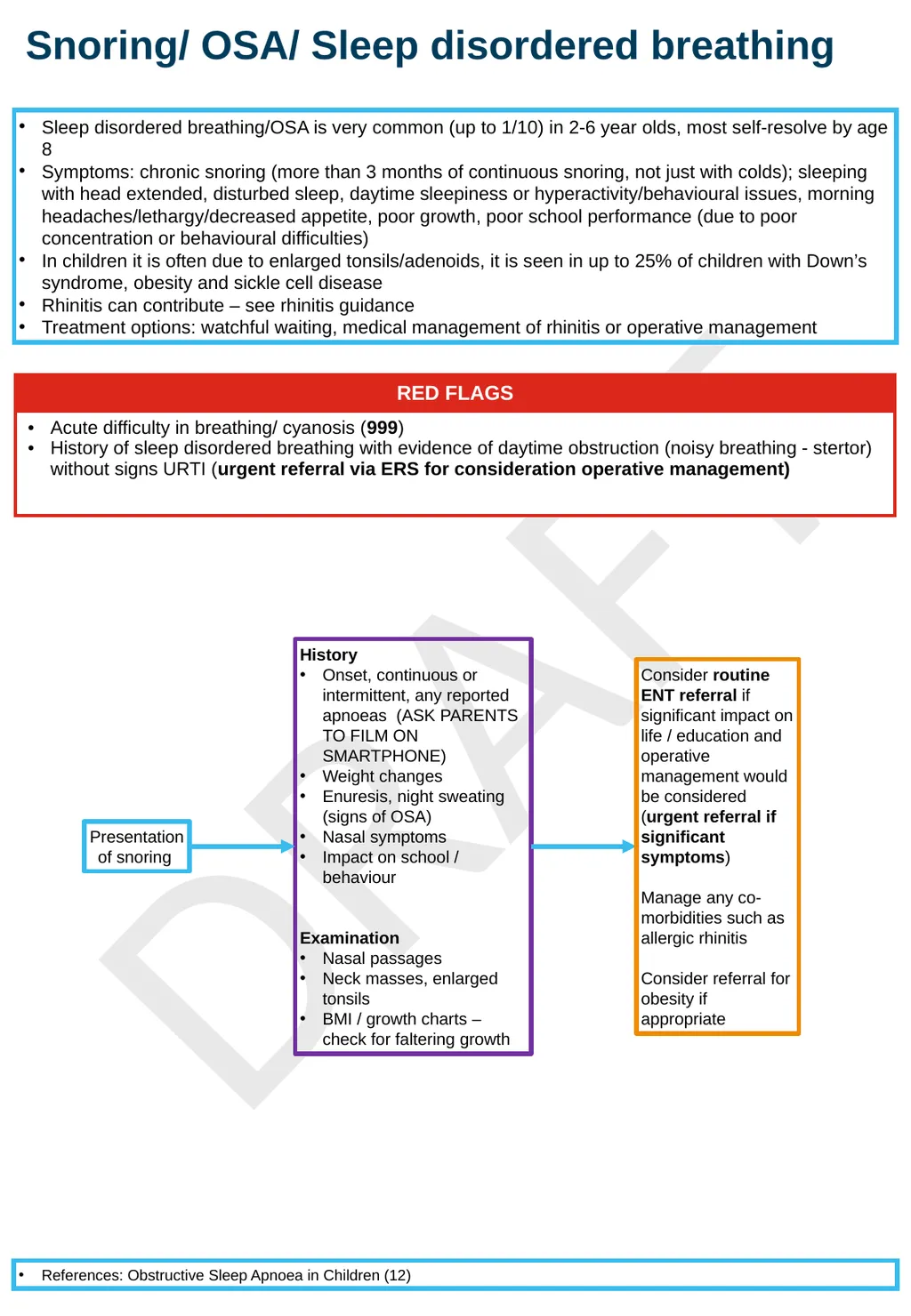
slide15. Sleep disordered breathing/OSA is very common (up to 1/10) in 2-6 year olds, most self-resolve by age 8
Symptoms: chronic snoring (more than 3 months of continuous snoring, not just with colds); sleeping with head extended, disturbed sleep, daytime sleepiness or hyperactivity/behavioural issues, morning headaches/lethargy/decreased appetite, poor growth, poor school performance (due to poor concentration or behavioural difficulties)
In children it is often due to enlarged tonsils/adenoids, it is seen in up to 25% of children with Down’s syndrome, obesity and sickle cell disease
Rhinitis can contribute – see rhinitis guidance
Treatment options: watchful waiting, medical management of rhinitis or operative management Presentation of snoring History
Onset, continuous or intermittent, any reported apnoeas (ASK PARENTS TO FILM ON SMARTPHONE)
Weight changes
Enuresis, night sweating (signs of OSA)
Nasal symptoms
Impact on school / behaviour
Examination
Nasal passages
Neck masses, enlarged tonsils
BMI / growth charts – check for faltering growth Consider routine ENT referral if significant impact on life / education and operative management would be considered (urgent referral if significant symptoms)
Manage any co-morbidities such as allergic rhinitis
Consider referral for obesity if appropriate References: Obstructive Sleep Apnoea in Children (12) Snoring/ OSA/ Sleep disordered breathing<br>
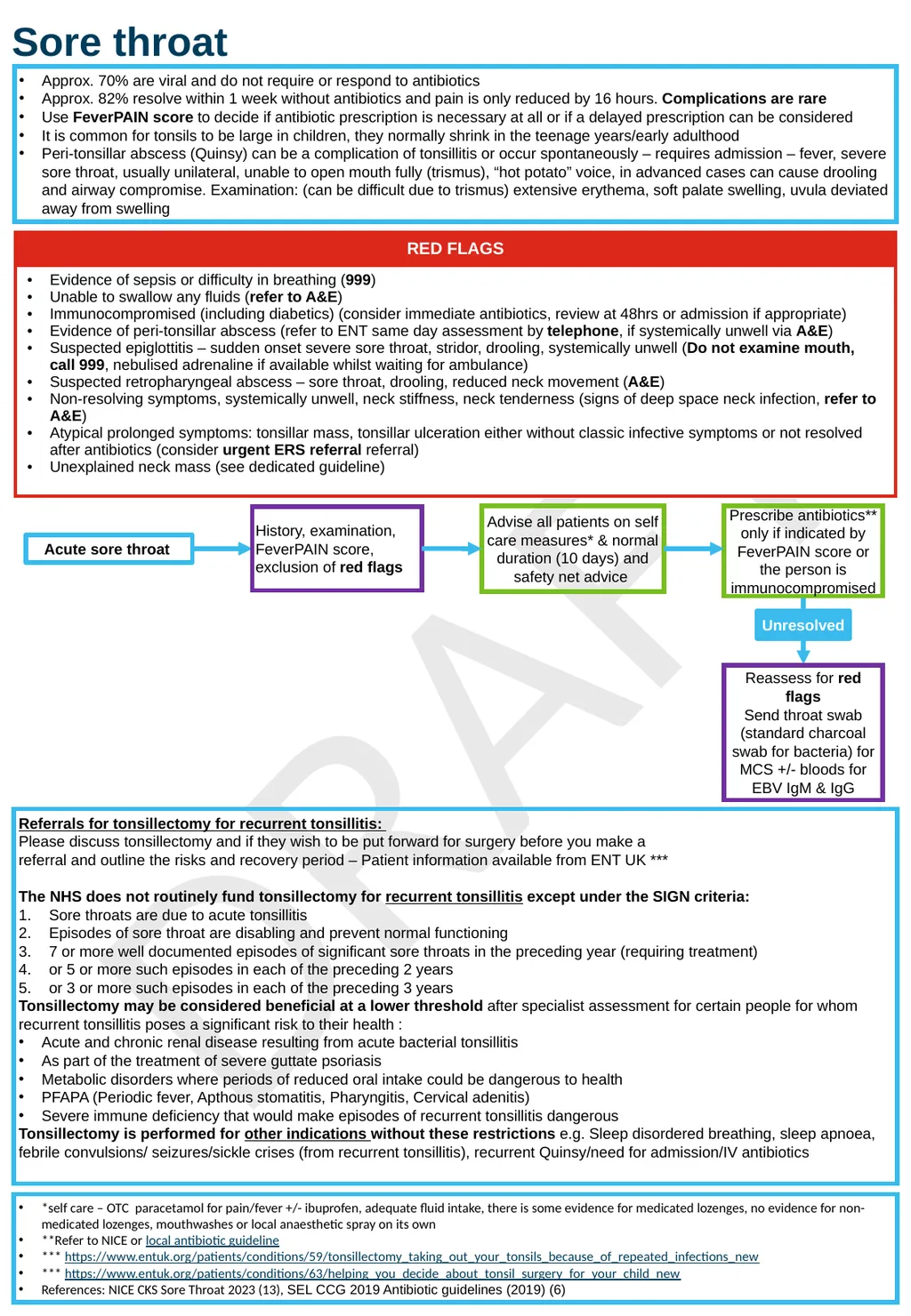
slide16. Approx. 70% are viral and do not require or respond to antibiotics
Approx. 82% resolve within 1 week without antibiotics and pain is only reduced by 16 hours. Complications are rare
Use FeverPAIN score to decide if antibiotic prescription is necessary at all or if a delayed prescription can be considered
It is common for tonsils to be large in children, they normally shrink in the teenage years/early adulthood
Peri-tonsillar abscess (Quinsy) can be a complication of tonsillitis or occur spontaneously – requires admission – fever, severe sore throat, usually unilateral, unable to open mouth fully (trismus), “hot potato” voice, in advanced cases can cause drooling and airway compromise. Examination: (can be difficult due to trismus) extensive erythema, soft palate swelling, uvula deviated away from swelling Acute sore throat History, examination, FeverPAIN score, exclusion of red flags Advise all patients on self care measures* & normal duration (10 days) and safety net advice Prescribe antibiotics** only if indicated by FeverPAIN score or the person is immunocompromised Reassess for red flags
Send throat swab (standard charcoal swab for bacteria) for MCS +/- bloods for EBV IgM & IgG Referrals for tonsillectomy for recurrent tonsillitis:
Please discuss tonsillectomy and if they wish to be put forward for surgery before you make a
referral and outline the risks and recovery period – Patient information available from ENT UK ***
The NHS does not routinely fund tonsillectomy for recurrent tonsillitis except under the SIGN criteria:
Sore throats are due to acute tonsillitis
Episodes of sore throat are disabling and prevent normal functioning
7 or more well documented episodes of significant sore throats in the preceding year (requiring treatment)
or 5 or more such episodes in each of the preceding 2 years
or 3 or more such episodes in each of the preceding 3 years
Tonsillectomy may be considered beneficial at a lower threshold after specialist assessment for certain people for whom recurrent tonsillitis poses a significant risk to their health :
Acute and chronic renal disease resulting from acute bacterial tonsillitis
As part of the treatment of severe guttate psoriasis
Metabolic disorders where periods of reduced oral intake could be dangerous to health
PFAPA (Periodic fever, Apthous stomatitis, Pharyngitis, Cervical adenitis)
Severe immune deficiency that would make episodes of recurrent tonsillitis dangerous
Tonsillectomy is performed for other indications without these restrictions e.g. Sleep disordered breathing, sleep apnoea, febrile convulsions/ seizures/sickle crises (from recurrent tonsillitis), recurrent Quinsy/need for admission/IV antibiotics *self care – OTC paracetamol for pain/fever +/- ibuprofen, adequate fluid intake, there is some evidence for medicated lozenges, no evidence for non-medicated lozenges, mouthwashes or local anaesthetic spray on its own
**Refer to NICE or local antibiotic guideline
*** https://www.entuk.org/patients/conditions/59/tonsillectomy_taking_out_your_tonsils_because_of_repeated_infections_new
*** https://www.entuk.org/patients/conditions/63/helping_you_decide_about_tonsil_surgery_for_your_child_new
References: NICE CKS Sore Throat 2023 (13), SEL CCG 2019 Antibiotic guidelines (2019) (6) Unresolved Sore throat<br>
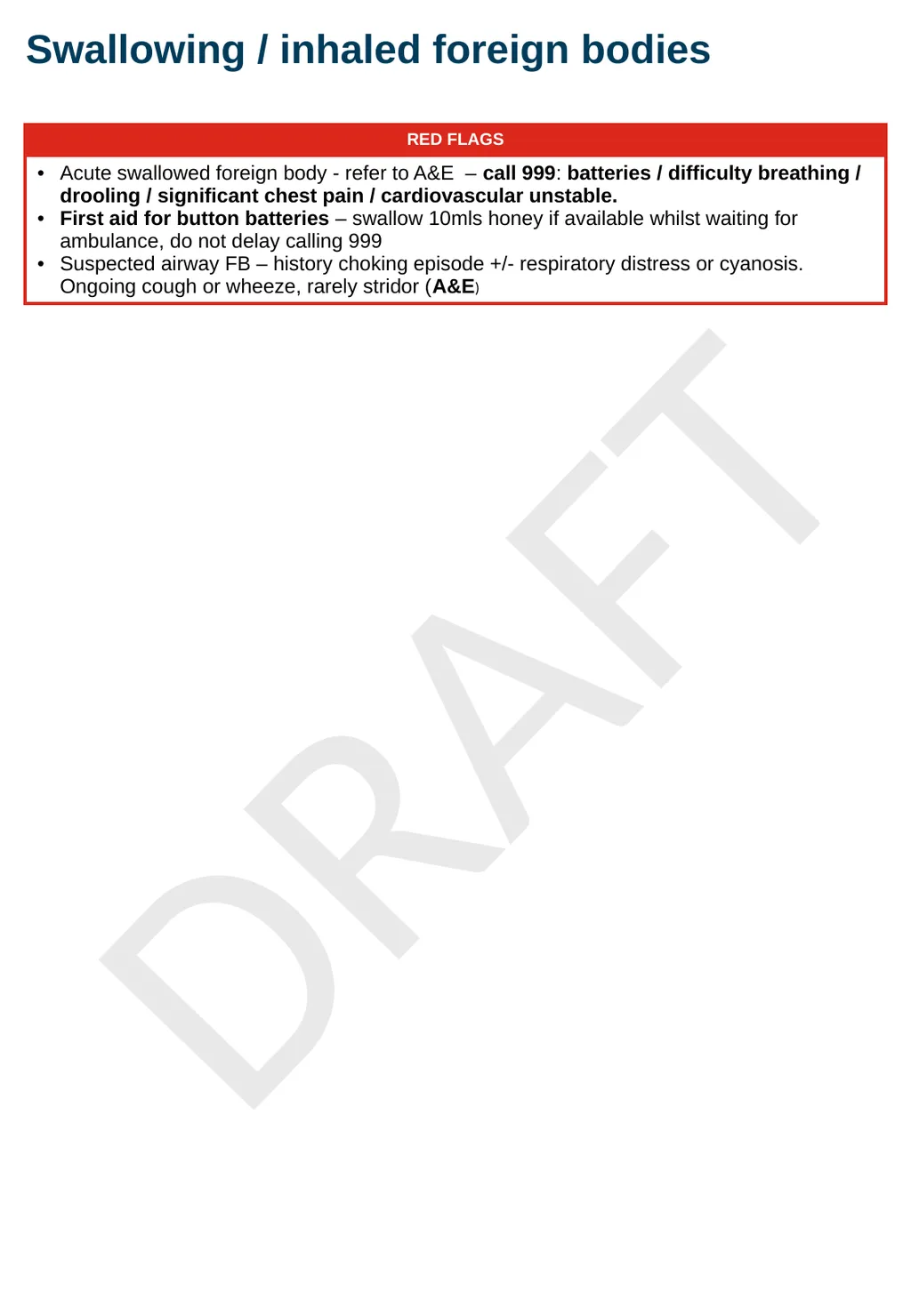
slide17. Swallowing / inhaled foreign bodies<br>
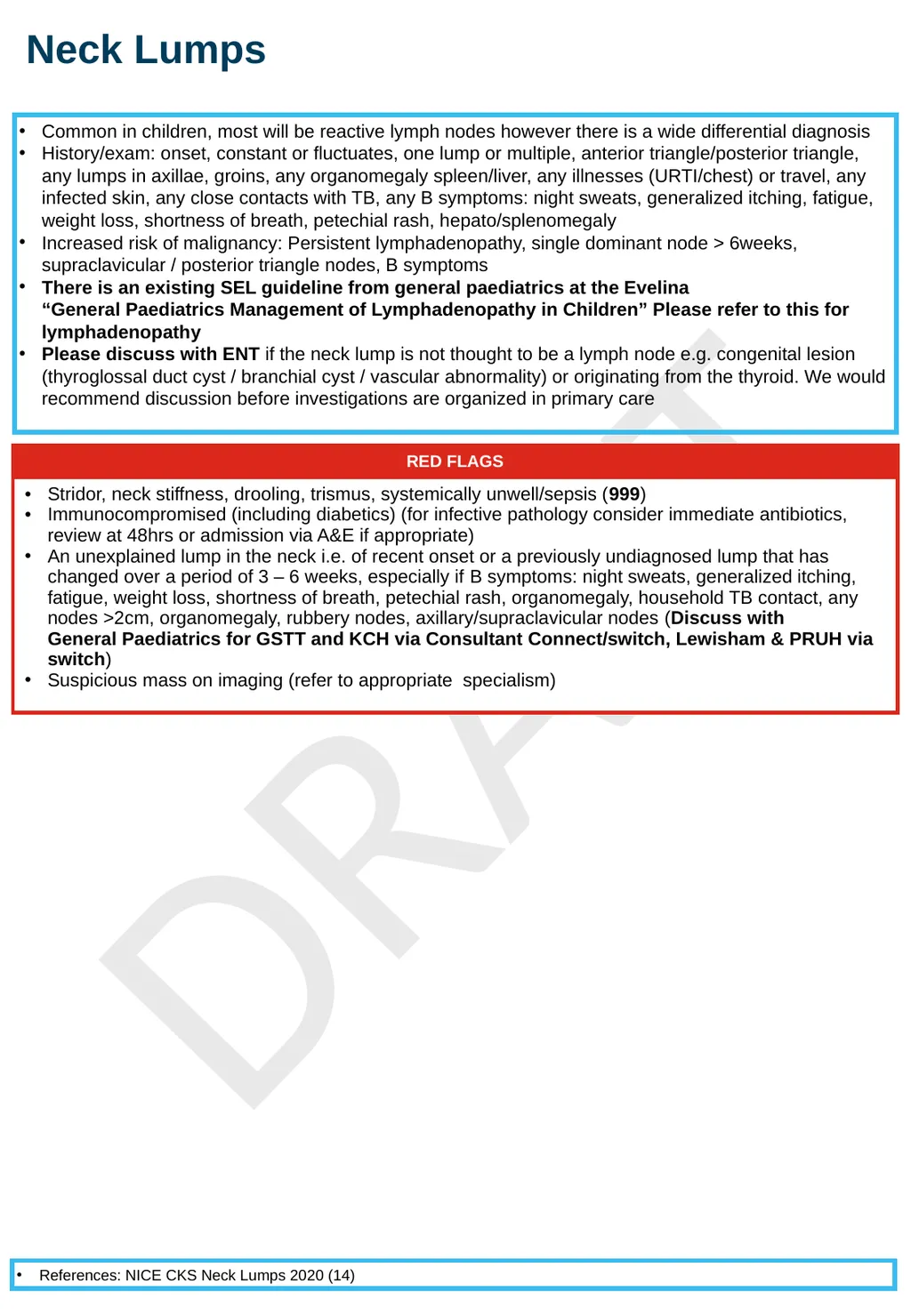
slide18. References: NICE CKS Neck Lumps 2020 (14) Neck Lumps Common in children, most will be reactive lymph nodes however there is a wide differential diagnosis
History/exam: onset, constant or fluctuates, one lump or multiple, anterior triangle/posterior triangle, any lumps in axillae, groins, any organomegaly spleen/liver, any illnesses (URTI/chest) or travel, any infected skin, any close contacts with TB, any B symptoms: night sweats, generalized itching, fatigue, weight loss, shortness of breath, petechial rash, hepato/splenomegaly
Increased risk of malignancy: Persistent lymphadenopathy, single dominant node > 6weeks, supraclavicular / posterior triangle nodes, B symptoms
There is an existing SEL guideline from general paediatrics at the Evelina “General Paediatrics Management of Lymphadenopathy in Children” Please refer to this for lymphadenopathy
Please discuss with ENT if the neck lump is not thought to be a lymph node e.g. congenital lesion (thyroglossal duct cyst / branchial cyst / vascular abnormality) or originating from the thyroid. We would recommend discussion before investigations are organized in primary care<br>
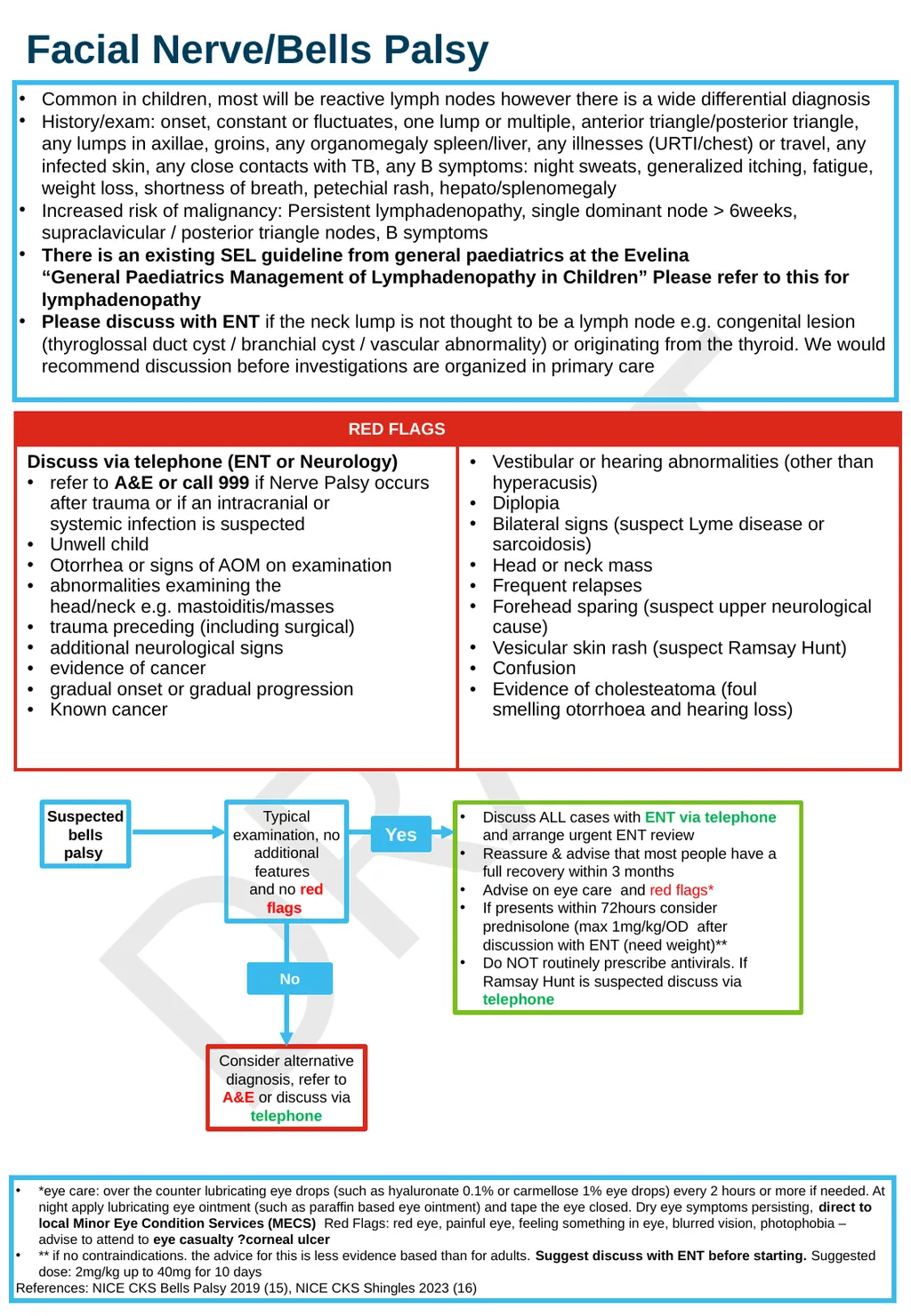
slide19. *eye care: over the counter lubricating eye drops (such as hyaluronate 0.1% or carmellose 1% eye drops) every 2 hours or more if needed. At night apply lubricating eye ointment (such as paraffin based eye ointment) and tape the eye closed. Dry eye symptoms persisting, direct to local Minor Eye Condition Services (MECS) Red Flags: red eye, painful eye, feeling something in eye, blurred vision, photophobia – advise to attend to eye casualty ?corneal ulcer
** if no contraindications. the advice for this is less evidence based than for adults. Suggest discuss with ENT before starting. Suggested dose: 2mg/kg up to 40mg for 10 days
References: NICE CKS Bells Palsy 2019 (15), NICE CKS Shingles 2023 (16) Facial Nerve/Bells Palsy Common in children, most will be reactive lymph nodes however there is a wide differential diagnosis
History/exam: onset, constant or fluctuates, one lump or multiple, anterior triangle/posterior triangle, any lumps in axillae, groins, any organomegaly spleen/liver, any illnesses (URTI/chest) or travel, any infected skin, any close contacts with TB, any B symptoms: night sweats, generalized itching, fatigue, weight loss, shortness of breath, petechial rash, hepato/splenomegaly
Increased risk of malignancy: Persistent lymphadenopathy, single dominant node > 6weeks, supraclavicular / posterior triangle nodes, B symptoms
There is an existing SEL guideline from general paediatrics at the Evelina “General Paediatrics Management of Lymphadenopathy in Children” Please refer to this for lymphadenopathy
Please discuss with ENT if the neck lump is not thought to be a lymph node e.g. congenital lesion (thyroglossal duct cyst / branchial cyst / vascular abnormality) or originating from the thyroid. We would recommend discussion before investigations are organized in primary care<br>
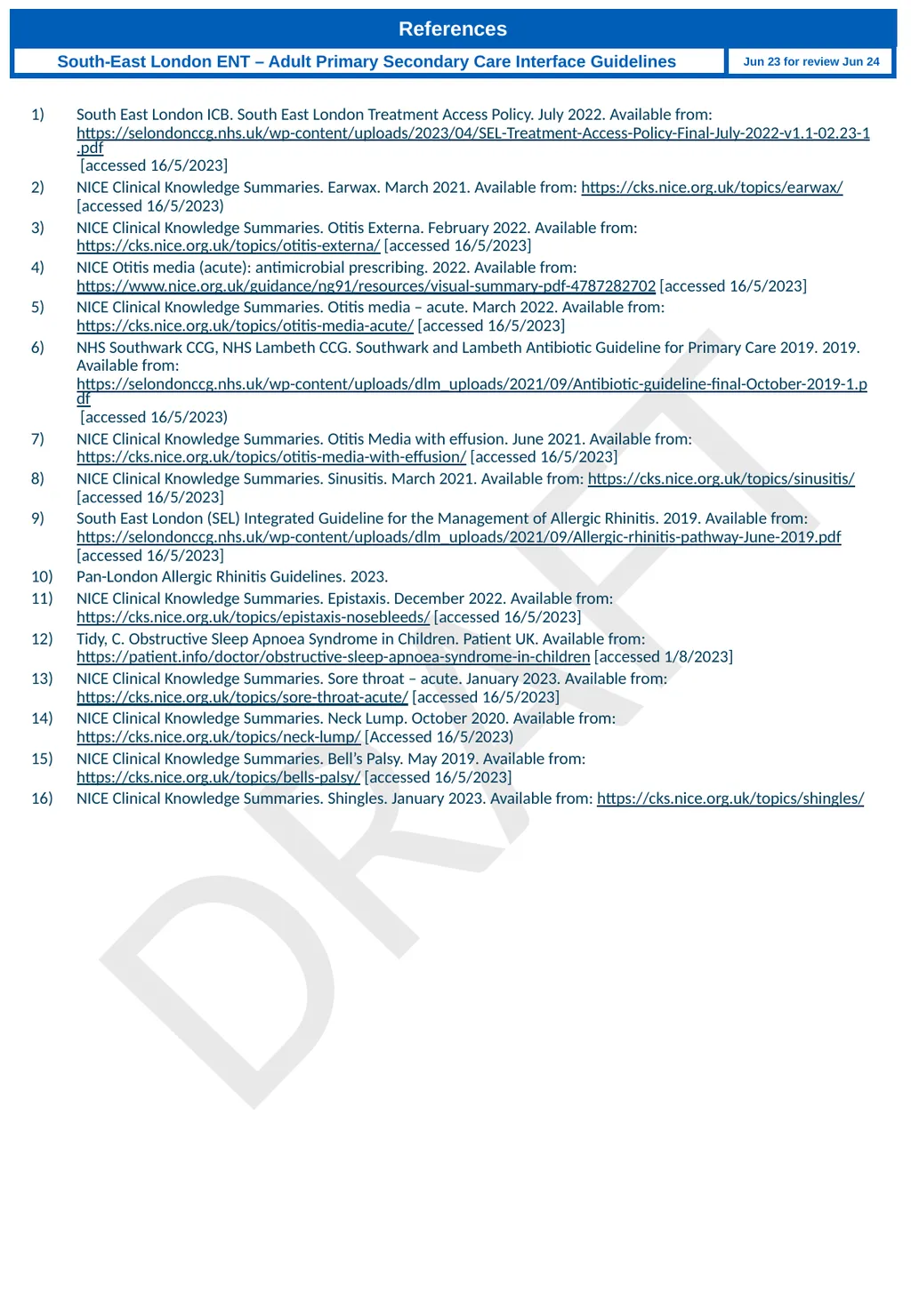
slide20. References South-East London ENT – Adult Primary Secondary Care Interface Guidelines Jun 23 for review Jun 24 South East London ICB. South East London Treatment Access Policy. July 2022. Available from: https://selondonccg.nhs.uk/wp-content/uploads/2023/04/SEL-Treatment-Access-Policy-Final-July-2022-v1.1-02.23-1.pdf [accessed 16/5/2023]
NICE Clinical Knowledge Summaries. Earwax. March 2021. Available from: https://cks.nice.org.uk/topics/earwax/ [accessed 16/5/2023)
NICE Clinical Knowledge Summaries. Otitis Externa. February 2022. Available from: https://cks.nice.org.uk/topics/otitis-externa/ [accessed 16/5/2023]
NICE Otitis media (acute): antimicrobial prescribing. 2022. Available from: https://www.nice.org.uk/guidance/ng91/resources/visual-summary-pdf-4787282702 [accessed 16/5/2023]
NICE Clinical Knowledge Summaries. Otitis media – acute. March 2022. Available from: https://cks.nice.org.uk/topics/otitis-media-acute/ [accessed 16/5/2023]
NHS Southwark CCG, NHS Lambeth CCG. Southwark and Lambeth Antibiotic Guideline for Primary Care 2019. 2019. Available from: https://selondonccg.nhs.uk/wp-content/uploads/dlm_uploads/2021/09/Antibiotic-guideline-final-October-2019-1.pdf [accessed 16/5/2023)
NICE Clinical Knowledge Summaries. Otitis Media with effusion. June 2021. Available from: https://cks.nice.org.uk/topics/otitis-media-with-effusion/ [accessed 16/5/2023]
NICE Clinical Knowledge Summaries. Sinusitis. March 2021. Available from: https://cks.nice.org.uk/topics/sinusitis/ [accessed 16/5/2023]
South East London (SEL) Integrated Guideline for the Management of Allergic Rhinitis. 2019. Available from: https://selondonccg.nhs.uk/wp-content/uploads/dlm_uploads/2021/09/Allergic-rhinitis-pathway-June-2019.pdf [accessed 16/5/2023]
Pan-London Allergic Rhinitis Guidelines. 2023.
NICE Clinical Knowledge Summaries. Epistaxis. December 2022. Available from: https://cks.nice.org.uk/topics/epistaxis-nosebleeds/ [accessed 16/5/2023]
Tidy, C. Obstructive Sleep Apnoea Syndrome in Children. Patient UK. Available from: https://patient.info/doctor/obstructive-sleep-apnoea-syndrome-in-children [accessed 1/8/2023]
NICE Clinical Knowledge Summaries. Sore throat – acute. January 2023. Available from: https://cks.nice.org.uk/topics/sore-throat-acute/ [accessed 16/5/2023]
NICE Clinical Knowledge Summaries. Neck Lump. October 2020. Available from: https://cks.nice.org.uk/topics/neck-lump/ [Accessed 16/5/2023)
NICE Clinical Knowledge Summaries. Bell’s Palsy. May 2019. Available from: https://cks.nice.org.uk/topics/bells-palsy/ [accessed 16/5/2023]
NICE Clinical Knowledge Summaries. Shingles. January 2023. Available from: https://cks.nice.org.uk/topics/shingles/<br>
slide2. Purpose:
This Guideline has been produced utilising published guidance and in collaboration with clinical and non-clinical staff across South East London (SEL). It is intended to assist Primary and Secondary care colleagues in decision making and does not replace clinical judgement
We encourage users of this document to seek advice from primary or secondary care colleagues when they are unsure, the later using established communication channels such as Consultant Connect or advice and guidance (A&G) (in some areas A&G has been replaced by single point of referral on electronic referral system [ERS])
We suggest speaking with a local clinician via Consultant Connect or hospital switchboard
Prescribing:
All prescribing should be in line with the SEL joint medicines formulary - for paediatrics this is accessible through Clinibee – clinicians will have to create a log in. For paediatric prescribing dose and duration of treatment need to be checked in the BNFc / local antibiotic guidelines – for Bexley, Lewisham & Greenwich this is Microguide (planned to roll out across SEL). Many medications need a weight.
Overview of Paediatric ENT services in SEL:
Lewisham Hospital ENT team covers paediatric and adult teams
Guys and St Thomas’ Hospital have a dedicated paediatric ENT team at the Evelina London Children’s Hospital
Princess Royal University Hospital ENT team covers paediatrics and adults (please note at time of publication not accepting routine ERS referrals, however ongoing in-patient care, liaison with other specialisms & telephone advice)
Kings College Hospital does not have a dedicated ENT team – please contact next closest hospital with ENT teams
Primary care colleagues should refer to/contact their nearest hospital
Authors and Governance:
This guide was a collaborative effort, led by Dr Alexandra Armstrong (GP, SEL ICB Lead ENT) and Miss Victoria Possamai (ENT Consultant, Evelina Hospital) and Mr Antonio Aymat (ENT Consultant, SEL ICB Lead ENT).
This guide has been reviewed & approved by:
- South East London ICB Board
- The medicines and prescribing recommendations have been reviewed and approved by SEL integrated Medicines Optimisation Committee (IMOC)
- Primary Care: LMC SLN, Planned Care Leads
- Secondary Care: Consultants from Lewisham & Greenwich NHS Trust, Kings College NHS Foundation Trust (Princess Royal University Hospital) and Guys & St Thomas' NHS Foundation trust User information:<br>
slide3. Table of Contents This guide has been produced utilising published guidance and in collaboration with clinical and non-clinical staff across the South East London. It is intended to be a guide to assist Primary care colleagues in decision making and does not replace clinical judgement.
We encourage users of this document to seek advice from primary or secondary care colleagues when they are unsure, the latter using established communication channels (e.g. Consultant Connect and e-RS Advice and Guidance).<br>
slide4. Ear wax only needs to be removed if causing symptoms or if the tympanic membrane needs to be visualised
Advise not to use cotton buds, to avoid recurrence continue olive oil drops twice weekly *Ear drop choice: Olive oil TDS for 3-5 days. Olive oil may take up to 2 weeks to soften. Possible side effects: transient hearing loss, discomfort, dizziness, skin irritation
References: SEL Treatment Access Policy 2022 (1), NICE CKS Ear Wax 2021 (2) Ear Wax<br>
slide5. Foreign Body of the Ear or Nose<br>
slide6. Secondary to Otitis Media, Trauma, Barotrauma, Surgical (e.g after grommets)
>90% heal within 4 weeks & Hearing loss usually recovers once healed
Antibiotics are not necessary in the vast majority of cases. Exceptions are those children at high risk of secondary middle ear infection or high risk complications from infection prescribe a topical antibiotic (non-ototoxic) until healed
Chronic Tympanic Membrane perforation (e.g. non-healed post grommets) – refer routinely to ENT *Self care advice to try and stop secondary infection of the inner ear: keep it dry, particularly no shampoo/soap to enter ear canal. Ear plugs or coat cotton wool in petroleum jelly before bathing. Use hairdryer on low heat to dry ears after bathing:
https://www.selondonics.org/icb/your-health/medicines/sel-imoc/sel-imoc-self-care/
**ensure no allergies. Note this is off-label usage and the BNF / SPC advises caution in perforation. If otitis externa develops consider swabbing (gently care not to come in contact with tympanic membrane) and rationalizing treatment based on results Tympanic Membrane Perforation Perforated tympanic membrane Treat any ongoing otitis media / otitis externa
Advise on self care measures* to avoid secondary infection
Safety net re. seeking review if symptoms of infection
If high risk for secondary middle ear infection or high risk complications from infection prescribe a topical antibiotic (non-ototoxic) e.g ciprofloxacin 0.2% ** BD until healed Unresolved Review after 4 weeks and if not healed
Refer routinely to secondary care via e-RS
Continue self care while waiting to be seen<br>
slide7. Acute Otitis Externa RED FLAGS
Systemically unwell? severe infection? Immunocompromised Yes Mild cases e.g, minimal erythema, no significant discharge or canal narrowing: OTC acetic acid 2%
Moderate cases e.g. erythema, discharge: Topical Antibiotics* Canal narrowing or significant itch/pain: Combination treatment: Topical Antibiotics + topical steroid* Reassess for features of severe infection or red flags
Send Swabs x 2 (standard wound swabs) – MCS and Mycology & rationalise treatment
Consider discussion with ENT via telephone if would benefit from microsuction
Consider necrotising otitis externa (very rare)
Review adherence and consider changing formulation e.g. if difficulty administering drops, consider spray No Unresolved Discharge can be: discharging wax (normal), discharging ear drops, infection – pus/mucous/blood (otitis externa or media +perforation), CSF Leak – clear/blood stained (trauma or surgery), Cholesteatoma (rare in children. Can be congenital. Can occur after repeated ear infections)
Otitis Externa can be: Acute or Chronic (more than 6 weeks). Bacterial or Fungal. Less common than in adults. Can occur as a secondary infection from otitis media.
Risk Factors for Otitis Externa: Swimming, dry skin conditions, diabetes/immunosuppression, trauma (ear buds/scratching), hearing aids/in-ear headphones
Self care: keep ears dry (ear plugs/swim cap/ cotton wool coated in petroleum jelly), blow dry on low heat after bathing, OTC Acetic acid after swimming https://www.selondonics.org/icb/your-health/medicines/sel-imoc/sel-imoc-self-care/ *Follow NICE or local antibiotic guidelines
Prescribe a non-ototoxic preparation if the person has a known or suspected perforation of the tympanic membrane, including a tympanostomy tube in situ
References: NICE CKS Otitis Externa (3) If Red Flags: manage as per box
Take swabs (standard wound swabs) x2 and send for MCS & Mycology
Start oral antibiotics* in those with peri-aural cellulitis, severe infection or immunocompromised
Consider admission as per any unwell child/ diabetic crisis Ear Discharge & Otitis Externa 1 of 2 (Acute Otitis Externa)<br>
slide8. Ear Discharge & Otitis Externa 2 of 2 (Chronic Otitis Externa) Discharge can be: discharging wax (normal), discharging ear drops, infection – pus/mucous/blood (otitis externa or media +perforation), CSF Leak – clear/blood stained (trauma or surgery), Cholesteatoma (rare in children. Can be congenital. Can occur after repeated ear infections)
Otitis Externa can be: Acute or Chronic (more than 6 weeks). Bacterial or Fungal. Less common than in adults. Can occur as a secondary infection from otitis media.
Risk Factors for Otitis Externa: Swimming, dry skin conditions, diabetes/immunosuppression, trauma (ear buds/scratching), hearing aids/in-ear headphones
Self care: keep ears dry (ear plugs/swim cap/ cotton wool coated in petroleum jelly), blow dry on low heat after bathing, OTC Acetic acid after swimming https://www.selondonics.org/icb/your-health/medicines/sel-imoc/sel-imoc-self-care/ Unusual in Children – consider early advice & guidance and testing for any co-morbidities, managing co-existing dermatological conditions
Consider Fungal Infection, especially if intense itch, swab and discuss with micro if positive.
Manage any Risk Factors e.g. swimming, dry skin conditions, in ear headphones / ear plugs
Consider testing for diabetes
Manage skin conditions & consider referral to Dermatology
Consider Cholesteatoma (rare in children, can be congenital) Chronic Otitis Externa Consider seeking advice and guidance +/- routine referral via ERS if no red flags, does not require urgent treatment, not more appropriate to refer to Dermatology and if there is a failure to respond to bacterial / fungal treatment in Primary care If Otitis Media with perforation is suspected (acute pain which is suddenly relieved followed by ear discharge) treat as per dedicated guidelines (slide 9) and then review Prescribe a non-ototoxic preparation if the person has a known or suspected perforation of the tympanic membrane, including a tympanostomy tube in situ
References: NICE CKS Otitis Externa (3)<br>
slide9. Acute otitis media: acute onset of unilateral pain and infective symptoms with characteristic abnormal tympanic membrane: red / bulging / effusion +/- perforation. May be viral (approx. 2/3 of cases) or bacterial. Consider no/delayed script of antibiotics in those who are systemically well without diabetes or otherwise immunocompromised. Advise on natural course: 3-7 days & on regular simple analgesia (ibuprofen preferable if no contraindications)
Complications are rare: chronic suppurative otitis media, hearing loss (no evidence that antibiotics prevent), perforation, mastoiditis, meningitis, intracranial abscesses, sinus thrombosis, facial nerve palsy
Risk Factors: Household smokers
Otitis Media with Effusion: pressure, popping/clicking sensation +/- conductive hearing loss. TM dull/fluid level/non-motile. Causes: persistent inflammation post infection, low grade ongoing infection, impaired Eustachian tube function, allergic rhinitis **Follow NICE or local Antibiotic Guidelines
https://www.selondonics.org/icb/your-health/medicines/sel-imoc/sel-imoc-self-care/
References: NICE Otitis media (acute): antimicrobial prescribing (4); NICE Otitis Media (acute) (5); SEL CCG 2019 Antibiotic guidelines (2019) (6) Acute Otitis Media RED FLAGS
Systemically unwell? severe infection? Immunocompromised Red Flags: see box
Immediate script oral antibiotics*
Consider admission as per any unwell child/ diabetic crisis Perforated tympanic membrane No Consider seeking advice and guidance +/- routine referral if there is a craniofacial abnormality, if episodes are distressing or unexplained, if there have been 3 or more episodes < 6 months or 4 or more < 1 year
Seek advice via telephone if tympanostomy tube in situ and send MCS swab Prescribe antibiotic or escalate antibiotics to second line
Re-assess for evidence of severe infection or Red Flags
Review diagnosis Yes No Prescribing topical phenazone 40mg/lidocaine hydrochloride 10mg/g (Otigo) is advised by NICE for analgesia. Parents can use in conjunction with oral simple analgesia if needed
Consider a delayed script of oral antibiotics* Unresolved Yes See dedicated guideline slide 6 Recurrent Acute Otitis Media Acute and Recurrent Otitis Media Consider seeking advice and guidance +/- routine referral if ongoing > 6 weeks or hearing loss<br>
slide10. Common – up to 8/10 children will have an episode before aged 5
Can occur following an infection (most commonly otitis media) or due to enlargement of adenoids/impaired eustachian tube function
Suspect: parents/teachers complaining of hearing issues. Speech delay. Behavioral issues (e.g. poor attention). Complaining of sore ears
Risk factors: Family History, allergic rhinitis, reflux, pollution, Downs syndrome, cleft palate, cystic fibrosis, recurrent upper respiratory tract infections
Watchful waiting is a safe option for most children as many cases will self resolve <3 months. There is no evidence to support other treatments over watchful waiting
Complications: speech delay, conductive hearing loss. Very rarely: long term damage to the tympanic membrane References: NICE Otitis media with effusion (7) Chronic Otitis Externa with Effusion (Glue Ear)<br>
slide11. Note separate Allergic Rhinitis guideline
Symptoms: sneezing/running nose/nasal congestion/post-nasal drip/cough/mouth breathing/snoring
Differential diagnosis: Acute infections, allergic, enlarged adenoids, foreign body, septal deformities – acquired (trauma) or congenital, acute post-traumatic (e.g. septal haematoma), rarely tumour, Medication side effects, Irritants (e.g. passive cigarette smoke, pollution, wood burning stoves, cleaning agents, strongly scented products, weather changes)
In chronic rhinitis order allergy testing for common allergens (Allergen specific IgE blood testing – tree pollen, grass pollen, dust mites, pets, mould depending on history) and refer to allergic rhinitis pathway if suggestive of allergic cause *self care: nasal rinsing with homemade salt water solution or OTC solutions e.g. Sterimar spray or NeilMed rinse. Trigger avoidance and rinsing nose, face, hands, hair and changing clothes as soon as possible after exposure. Information on how to make a homemade salt water solution is available from the NHS website: https://www.nhs.uk/conditions/sinusitis-sinus-infection/
https://www.selondonics.org/icb/your-health/medicines/sel-imoc/sel-imoc-self-care/
** Check BNFc for dosing. Mometasone is licenced for 3 years and over, Fluticasone for 4 years and over. Information on how to use nasal sprays and is available from the NHS website
References: NICE CKS Sinusitis (8) History, examination, exclusion red flags, if suggestive of allergic rhinitis perform allergy testing and refer to appropriate guideline If only 1 nostril blocked +/- offensive discharge suspect a Foreign body (see guideline slide 5)
Review medications (including OTC) and any triggers e.g. parentall smoking or poor housing
Examine for any polyps/mass/abnormalities
Allergy testing +/- manage as per allergic rhinitis guideline
Advise self care* If only 1 nostril blocked +/- offensive discharge suspect a Foreign body (see guideline slide 5) If bilateral likely viral upper respiratory tract infection, reassure, may last several weeks, safety net advice Trial of BD-TDS saline rinsing for 4 weeks and review
Consider a 6 week trial of nasal steroids if symptoms are impacting childs wellbeing, sleep or education however beclomethasone is not recommended due to bioavailability.** No Yes Acute Nasal Congestion/ Rhinorrhoea If ongoing routine referral via e-RS<br>
slide12. Note separate Nasal congestion/Rhinorrhea guideline which also contains advice on allergen avoidance, nasal rinsing and nasal steroids
Symptoms: sneezing/running nose/itchy nose, throat, mouth/nasal congestion – mouth breathing, snoring/post-nasal drip/cough
Common, can cause significant impact on quality of life
Screen for eczema, food allergy, asthma - uncontrolled allergic rhinitis increases risk of asthma exacerbations
ARIA Classification of Allergic Rhinitis: Splits into intermittent, persistent, mild, moderate-severe & can be helpful to guide treatment
Establish adherence to therapy and check nasal spray technique before stepping up treatment
Start nasal sprays 1-2 weeks before pollen season. Treat eye symptoms. Sedating antihistamines, Nasal decongestants and depot steroids are not recommended *nasal rinsing advice from NHS website
**allergen avoidance advice available from NHS website
*** two brands are available and dose varies between them – check BNFc
**** dosing as per BNFc. Beclomethasone not recommended due to bioavailabilty. Mometasone licensed for 3+, Fluticasone for 4+
How to use nose drops & sprays: https://www.entuk.org/_userfiles/pages/files/groups/ear_and_nose_drop_leaflet_final.pdf
References: References: SEL CCG Allergic Rhinitis 2019 (replaced by Adult ENT Guidelines) (9); Pan-London Allergic Rhintitis guideline 2023 (10) Allergic Rhinitis<br>
slide13. Common presentation in primary care. 50% of children 6-15 have regular nose bleeds
Most can be treated at home and are not the sign of an underlying problem
80% are anterior from littles area which is easily damaged e.g. picking nose, blowing nose, minor injury, colds, sinusitis, temperature changes, hay fever, nasal sprays
20% are posterior and are less common in children
Acute epistaxis history – one or both nostrils, down back of throat, duration of bleeding, any trauma, any anticoagulants, previous epistaxis/abnormal bleeding, FHx Bleeding disorders **Naseptin QDS for 10 days or if there is a peanut allergy the alterative is Bactroban (unliscenced use. Licenced for nasal infection with carriage of Staphylococcus aureus)
References: NICE CKS Epistaxis 2022 (11) If stopped advise not to blow nose or remove dried blood from nose for at least 48 hours & safety net advice if returns After 15-20 mins
Take vital signs and transfer to A&E, particularly if on anticoagulation Suspect staph aureus colonisation, send swab for MCS and start antiseptic nasal ointment * for 10 days
consider need for investigations for anaemia, clotting abnormalities Routine referral
(Urgent referral in severe symptoms) History, examination, Red Flags? unwell & requiring admission? Advise 1st aid – pinch the soft part of the nose for min 3-5 mins and sit with head in neutral position, if possible suck ice cubes Unresolved Unresolved No Recurrent Epistaxis<br>
slide14. Any nasal injury with persisting deformity needs to be reviewed by ENT 5-7 days post-injury as if MUA is needed this occurs within 2-3 weeks
Refer to ENT emergency clinic via telephone
For late presentations: Septo-rhinoplasty is a restricted procedure on the NHS and not considered before age 16-18. There needs to be both:
severe nasal deformity with complete obstruction of at least one nostril
causing a severe functional limitation
Not considered before age 16-18 References: SEL Treatment Access Policy 2022 (1) Broken Nose<br>
slide15. Sleep disordered breathing/OSA is very common (up to 1/10) in 2-6 year olds, most self-resolve by age 8
Symptoms: chronic snoring (more than 3 months of continuous snoring, not just with colds); sleeping with head extended, disturbed sleep, daytime sleepiness or hyperactivity/behavioural issues, morning headaches/lethargy/decreased appetite, poor growth, poor school performance (due to poor concentration or behavioural difficulties)
In children it is often due to enlarged tonsils/adenoids, it is seen in up to 25% of children with Down’s syndrome, obesity and sickle cell disease
Rhinitis can contribute – see rhinitis guidance
Treatment options: watchful waiting, medical management of rhinitis or operative management Presentation of snoring History
Onset, continuous or intermittent, any reported apnoeas (ASK PARENTS TO FILM ON SMARTPHONE)
Weight changes
Enuresis, night sweating (signs of OSA)
Nasal symptoms
Impact on school / behaviour
Examination
Nasal passages
Neck masses, enlarged tonsils
BMI / growth charts – check for faltering growth Consider routine ENT referral if significant impact on life / education and operative management would be considered (urgent referral if significant symptoms)
Manage any co-morbidities such as allergic rhinitis
Consider referral for obesity if appropriate References: Obstructive Sleep Apnoea in Children (12) Snoring/ OSA/ Sleep disordered breathing<br>
slide16. Approx. 70% are viral and do not require or respond to antibiotics
Approx. 82% resolve within 1 week without antibiotics and pain is only reduced by 16 hours. Complications are rare
Use FeverPAIN score to decide if antibiotic prescription is necessary at all or if a delayed prescription can be considered
It is common for tonsils to be large in children, they normally shrink in the teenage years/early adulthood
Peri-tonsillar abscess (Quinsy) can be a complication of tonsillitis or occur spontaneously – requires admission – fever, severe sore throat, usually unilateral, unable to open mouth fully (trismus), “hot potato” voice, in advanced cases can cause drooling and airway compromise. Examination: (can be difficult due to trismus) extensive erythema, soft palate swelling, uvula deviated away from swelling Acute sore throat History, examination, FeverPAIN score, exclusion of red flags Advise all patients on self care measures* & normal duration (10 days) and safety net advice Prescribe antibiotics** only if indicated by FeverPAIN score or the person is immunocompromised Reassess for red flags
Send throat swab (standard charcoal swab for bacteria) for MCS +/- bloods for EBV IgM & IgG Referrals for tonsillectomy for recurrent tonsillitis:
Please discuss tonsillectomy and if they wish to be put forward for surgery before you make a
referral and outline the risks and recovery period – Patient information available from ENT UK ***
The NHS does not routinely fund tonsillectomy for recurrent tonsillitis except under the SIGN criteria:
Sore throats are due to acute tonsillitis
Episodes of sore throat are disabling and prevent normal functioning
7 or more well documented episodes of significant sore throats in the preceding year (requiring treatment)
or 5 or more such episodes in each of the preceding 2 years
or 3 or more such episodes in each of the preceding 3 years
Tonsillectomy may be considered beneficial at a lower threshold after specialist assessment for certain people for whom recurrent tonsillitis poses a significant risk to their health :
Acute and chronic renal disease resulting from acute bacterial tonsillitis
As part of the treatment of severe guttate psoriasis
Metabolic disorders where periods of reduced oral intake could be dangerous to health
PFAPA (Periodic fever, Apthous stomatitis, Pharyngitis, Cervical adenitis)
Severe immune deficiency that would make episodes of recurrent tonsillitis dangerous
Tonsillectomy is performed for other indications without these restrictions e.g. Sleep disordered breathing, sleep apnoea, febrile convulsions/ seizures/sickle crises (from recurrent tonsillitis), recurrent Quinsy/need for admission/IV antibiotics *self care – OTC paracetamol for pain/fever +/- ibuprofen, adequate fluid intake, there is some evidence for medicated lozenges, no evidence for non-medicated lozenges, mouthwashes or local anaesthetic spray on its own
**Refer to NICE or local antibiotic guideline
*** https://www.entuk.org/patients/conditions/59/tonsillectomy_taking_out_your_tonsils_because_of_repeated_infections_new
*** https://www.entuk.org/patients/conditions/63/helping_you_decide_about_tonsil_surgery_for_your_child_new
References: NICE CKS Sore Throat 2023 (13), SEL CCG 2019 Antibiotic guidelines (2019) (6) Unresolved Sore throat<br>
slide17. Swallowing / inhaled foreign bodies<br>
slide18. References: NICE CKS Neck Lumps 2020 (14) Neck Lumps Common in children, most will be reactive lymph nodes however there is a wide differential diagnosis
History/exam: onset, constant or fluctuates, one lump or multiple, anterior triangle/posterior triangle, any lumps in axillae, groins, any organomegaly spleen/liver, any illnesses (URTI/chest) or travel, any infected skin, any close contacts with TB, any B symptoms: night sweats, generalized itching, fatigue, weight loss, shortness of breath, petechial rash, hepato/splenomegaly
Increased risk of malignancy: Persistent lymphadenopathy, single dominant node > 6weeks, supraclavicular / posterior triangle nodes, B symptoms
There is an existing SEL guideline from general paediatrics at the Evelina “General Paediatrics Management of Lymphadenopathy in Children” Please refer to this for lymphadenopathy
Please discuss with ENT if the neck lump is not thought to be a lymph node e.g. congenital lesion (thyroglossal duct cyst / branchial cyst / vascular abnormality) or originating from the thyroid. We would recommend discussion before investigations are organized in primary care<br>
slide19. *eye care: over the counter lubricating eye drops (such as hyaluronate 0.1% or carmellose 1% eye drops) every 2 hours or more if needed. At night apply lubricating eye ointment (such as paraffin based eye ointment) and tape the eye closed. Dry eye symptoms persisting, direct to local Minor Eye Condition Services (MECS) Red Flags: red eye, painful eye, feeling something in eye, blurred vision, photophobia – advise to attend to eye casualty ?corneal ulcer
** if no contraindications. the advice for this is less evidence based than for adults. Suggest discuss with ENT before starting. Suggested dose: 2mg/kg up to 40mg for 10 days
References: NICE CKS Bells Palsy 2019 (15), NICE CKS Shingles 2023 (16) Facial Nerve/Bells Palsy Common in children, most will be reactive lymph nodes however there is a wide differential diagnosis
History/exam: onset, constant or fluctuates, one lump or multiple, anterior triangle/posterior triangle, any lumps in axillae, groins, any organomegaly spleen/liver, any illnesses (URTI/chest) or travel, any infected skin, any close contacts with TB, any B symptoms: night sweats, generalized itching, fatigue, weight loss, shortness of breath, petechial rash, hepato/splenomegaly
Increased risk of malignancy: Persistent lymphadenopathy, single dominant node > 6weeks, supraclavicular / posterior triangle nodes, B symptoms
There is an existing SEL guideline from general paediatrics at the Evelina “General Paediatrics Management of Lymphadenopathy in Children” Please refer to this for lymphadenopathy
Please discuss with ENT if the neck lump is not thought to be a lymph node e.g. congenital lesion (thyroglossal duct cyst / branchial cyst / vascular abnormality) or originating from the thyroid. We would recommend discussion before investigations are organized in primary care<br>
slide20. References South-East London ENT – Adult Primary Secondary Care Interface Guidelines Jun 23 for review Jun 24 South East London ICB. South East London Treatment Access Policy. July 2022. Available from: https://selondonccg.nhs.uk/wp-content/uploads/2023/04/SEL-Treatment-Access-Policy-Final-July-2022-v1.1-02.23-1.pdf [accessed 16/5/2023]
NICE Clinical Knowledge Summaries. Earwax. March 2021. Available from: https://cks.nice.org.uk/topics/earwax/ [accessed 16/5/2023)
NICE Clinical Knowledge Summaries. Otitis Externa. February 2022. Available from: https://cks.nice.org.uk/topics/otitis-externa/ [accessed 16/5/2023]
NICE Otitis media (acute): antimicrobial prescribing. 2022. Available from: https://www.nice.org.uk/guidance/ng91/resources/visual-summary-pdf-4787282702 [accessed 16/5/2023]
NICE Clinical Knowledge Summaries. Otitis media – acute. March 2022. Available from: https://cks.nice.org.uk/topics/otitis-media-acute/ [accessed 16/5/2023]
NHS Southwark CCG, NHS Lambeth CCG. Southwark and Lambeth Antibiotic Guideline for Primary Care 2019. 2019. Available from: https://selondonccg.nhs.uk/wp-content/uploads/dlm_uploads/2021/09/Antibiotic-guideline-final-October-2019-1.pdf [accessed 16/5/2023)
NICE Clinical Knowledge Summaries. Otitis Media with effusion. June 2021. Available from: https://cks.nice.org.uk/topics/otitis-media-with-effusion/ [accessed 16/5/2023]
NICE Clinical Knowledge Summaries. Sinusitis. March 2021. Available from: https://cks.nice.org.uk/topics/sinusitis/ [accessed 16/5/2023]
South East London (SEL) Integrated Guideline for the Management of Allergic Rhinitis. 2019. Available from: https://selondonccg.nhs.uk/wp-content/uploads/dlm_uploads/2021/09/Allergic-rhinitis-pathway-June-2019.pdf [accessed 16/5/2023]
Pan-London Allergic Rhinitis Guidelines. 2023.
NICE Clinical Knowledge Summaries. Epistaxis. December 2022. Available from: https://cks.nice.org.uk/topics/epistaxis-nosebleeds/ [accessed 16/5/2023]
Tidy, C. Obstructive Sleep Apnoea Syndrome in Children. Patient UK. Available from: https://patient.info/doctor/obstructive-sleep-apnoea-syndrome-in-children [accessed 1/8/2023]
NICE Clinical Knowledge Summaries. Sore throat – acute. January 2023. Available from: https://cks.nice.org.uk/topics/sore-throat-acute/ [accessed 16/5/2023]
NICE Clinical Knowledge Summaries. Neck Lump. October 2020. Available from: https://cks.nice.org.uk/topics/neck-lump/ [Accessed 16/5/2023)
NICE Clinical Knowledge Summaries. Bell’s Palsy. May 2019. Available from: https://cks.nice.org.uk/topics/bells-palsy/ [accessed 16/5/2023]
NICE Clinical Knowledge Summaries. Shingles. January 2023. Available from: https://cks.nice.org.uk/topics/shingles/<br>