
Decking 201: Selecting The Right Decking Material
LV
Published · 22 slides · 0 views
1 / 1
Description
Decking 201: Selecting The Right Decking Material PROFESSIONAL TRAINING OUTLINE 2020 General Woodcraft Inc. Brought to you by General Woodcraft, Inc. and MataverdeDecking.com , New London, CT and Cotati, CA Decking Material Options Lets
Related Topics
Share
Embed code
Download this presentation From Below
"Decking 201: Selecting The Right Decking Material" is the property of its rightful owner. Permission is granted to download and print the materials on this website for personal, non-commercial use only, and to display it on your personal computer provided you do not modify the materials and that you retain all copyright notices contained in the materials. By downloading content from our website, you accept the terms of this agreement.
Presentation Transcript
01
Decking 201: Selecting The Right Decking Material PROFESSIONAL TRAINING OUTLINE © 2020 General Woodcraft Inc. Brought to you by General Woodcraft, Inc. and MataverdeDecking.com , New London, CT and Cotati, CA<br>
02
Decking Material Options Let’s look at the most popular decking options:
Synthetic Decking
Softwood Decking
Hardwood Decking
High-Density Hardwood Decking
All decking material options have strengths and weaknesses. Learn which decking material options works best with your projects. © 2020 General Woodcraft Inc.<br>
Synthetic Decking
Softwood Decking
Hardwood Decking
High-Density Hardwood Decking
All decking material options have strengths and weaknesses. Learn which decking material options works best with your projects. © 2020 General Woodcraft Inc.<br>
03
Synthetic Decking Material Options Synthetic Decking is available in three basic types:
Composite
‘Capped’ composite
Plastic or PVC
All three types have pros and cons. Composite or ‘wood composite’ decking was the original synthetic decking, so let’s start there… © 2020 General Woodcraft Inc.<br>
Composite
‘Capped’ composite
Plastic or PVC
All three types have pros and cons. Composite or ‘wood composite’ decking was the original synthetic decking, so let’s start there… © 2020 General Woodcraft Inc.<br>
04
Synthetic Decking Material Options Composite Decking
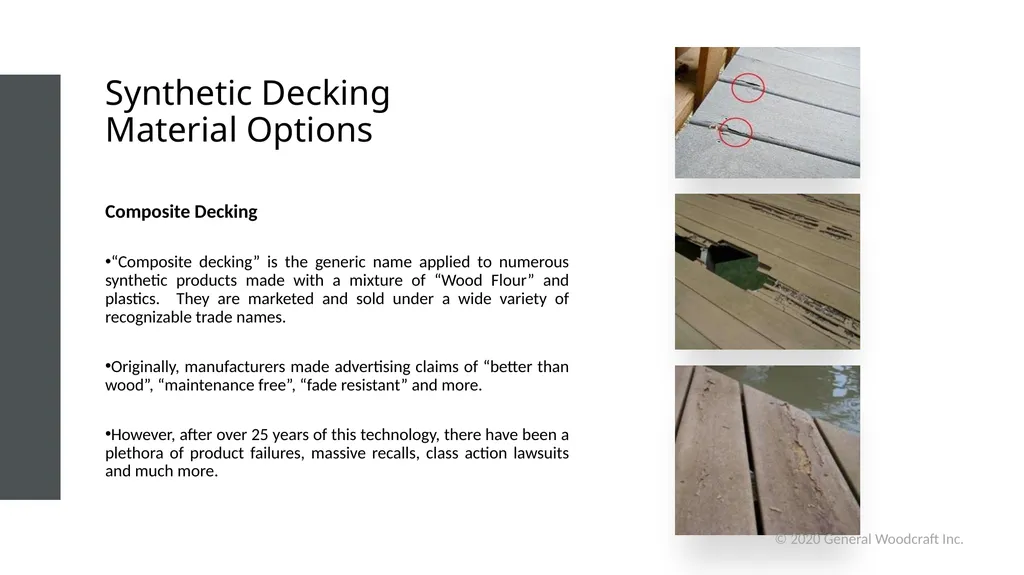
“Composite decking” is the generic name applied to numerous synthetic products made with a mixture of “Wood Flour” and plastics. They are marketed and sold under a wide variety of recognizable trade names.
Originally, manufacturers made advertising claims of “better than wood”, “maintenance free”, “fade resistant” and more.
However, after over 25 years of this technology, there have been a plethora of product failures, massive recalls, class action lawsuits and much more. © 2020 General Woodcraft Inc.<br>
“Composite decking” is the generic name applied to numerous synthetic products made with a mixture of “Wood Flour” and plastics. They are marketed and sold under a wide variety of recognizable trade names.
Originally, manufacturers made advertising claims of “better than wood”, “maintenance free”, “fade resistant” and more.
However, after over 25 years of this technology, there have been a plethora of product failures, massive recalls, class action lawsuits and much more. © 2020 General Woodcraft Inc.<br>
05
Synthetic Decking Material Options 2nd Generation Composite Decking
“Composite decking” fades in color quickly and is an absolute haven for mold and spores. UV and weather exposure quickly makes these decking products very undesirable.
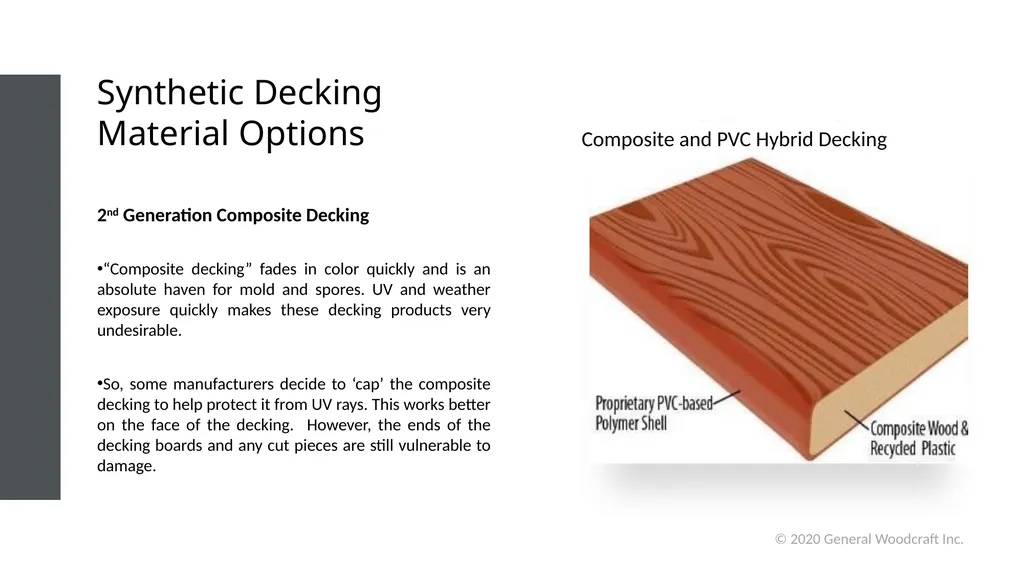
So, some manufacturers decide to ‘cap’ the composite decking to help protect it from UV rays. This works better on the face of the decking. However, the ends of the decking boards and any cut pieces are still vulnerable to damage. Composite and PVC Hybrid Decking © 2020 General Woodcraft Inc.<br>
“Composite decking” fades in color quickly and is an absolute haven for mold and spores. UV and weather exposure quickly makes these decking products very undesirable.
So, some manufacturers decide to ‘cap’ the composite decking to help protect it from UV rays. This works better on the face of the decking. However, the ends of the decking boards and any cut pieces are still vulnerable to damage. Composite and PVC Hybrid Decking © 2020 General Woodcraft Inc.<br>
06
Synthetic Decking
Material Options PVC AND Plastic Decking
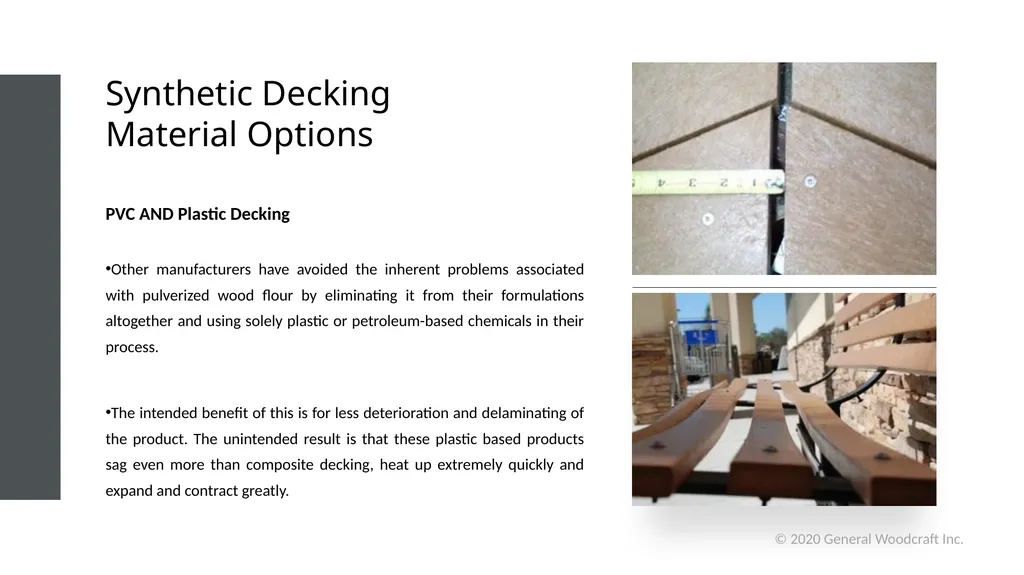
Other manufacturers have avoided the inherent problems associated with pulverized wood flour by eliminating it from their formulations altogether and using solely plastic or petroleum-based chemicals in their process.
The intended benefit of this is for less deterioration and delaminating of the product. The unintended result is that these plastic based products sag even more than composite decking, heat up extremely quickly and expand and contract greatly. © 2020 General Woodcraft Inc.<br>
Other manufacturers have avoided the inherent problems associated with pulverized wood flour by eliminating it from their formulations altogether and using solely plastic or petroleum-based chemicals in their process.
The intended benefit of this is for less deterioration and delaminating of the product. The unintended result is that these plastic based products sag even more than composite decking, heat up extremely quickly and expand and contract greatly. © 2020 General Woodcraft Inc.<br>
07
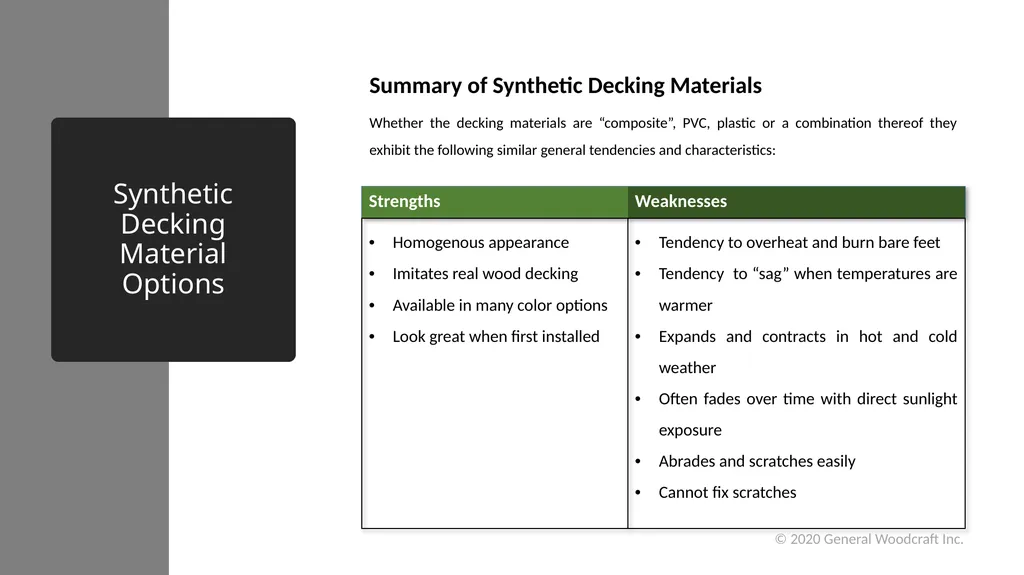
Synthetic Decking Material Options Summary of Synthetic Decking Materials
Whether the decking materials are “composite”, PVC, plastic or a combination thereof they exhibit the following similar general tendencies and characteristics: © 2020 General Woodcraft Inc.<br>
Whether the decking materials are “composite”, PVC, plastic or a combination thereof they exhibit the following similar general tendencies and characteristics: © 2020 General Woodcraft Inc.<br>
08
Wood Decking Material Options Real wood decking materials are all-natural products and as such exhibit a wide range of characteristics typical of their individual species. Natural variations will also occur from species to species, board to board within a species, and often within the same decking board. These natural variations of color, graining and texture are unique and inherent characteristics in real wood product.
All wood species are not created equally, and this section intends to identify the different characteristics typical of species. There are exceptions but, in general, softwoods are less durable than hardwoods and high-density hardwoods are the most durable and stable species available on earth. © 2020 General Woodcraft Inc.<br>
All wood species are not created equally, and this section intends to identify the different characteristics typical of species. There are exceptions but, in general, softwoods are less durable than hardwoods and high-density hardwoods are the most durable and stable species available on earth. © 2020 General Woodcraft Inc.<br>
09
Softwood Decking
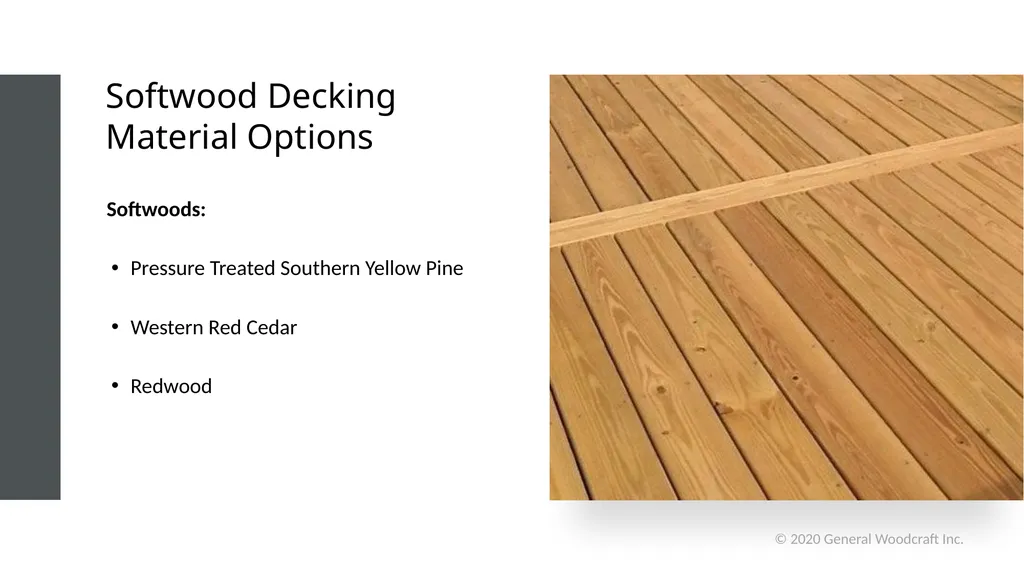
Material Options Softwoods:
Pressure Treated Southern Yellow Pine
Western Red Cedar
Redwood © 2020 General Woodcraft Inc.<br>
Pressure Treated Southern Yellow Pine
Western Red Cedar
Redwood © 2020 General Woodcraft Inc.<br>
10
Softwood Decking
Material Options
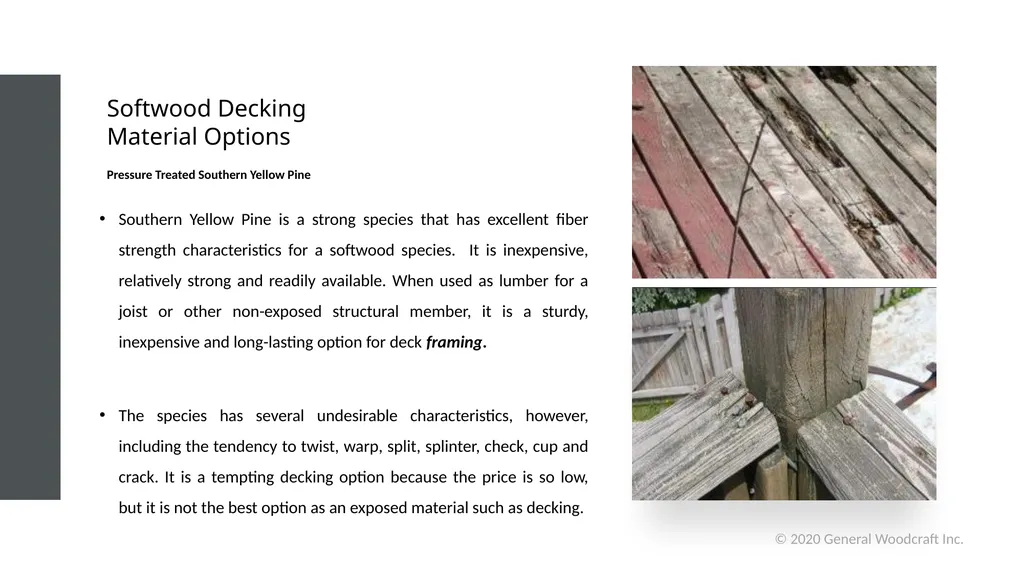
Pressure Treated Southern Yellow Pine Southern Yellow Pine is a strong species that has excellent fiber strength characteristics for a softwood species. It is inexpensive, relatively strong and readily available. When used as lumber for a joist or other non-exposed structural member, it is a sturdy, inexpensive and long-lasting option for deck framing.
The species has several undesirable characteristics, however, including the tendency to twist, warp, split, splinter, check, cup and crack. It is a tempting decking option because the price is so low, but it is not the best option as an exposed material such as decking. © 2020 General Woodcraft Inc.<br>
The species has several undesirable characteristics, however, including the tendency to twist, warp, split, splinter, check, cup and crack. It is a tempting decking option because the price is so low, but it is not the best option as an exposed material such as decking. © 2020 General Woodcraft Inc.<br>
11
Softwood Decking
Material Options
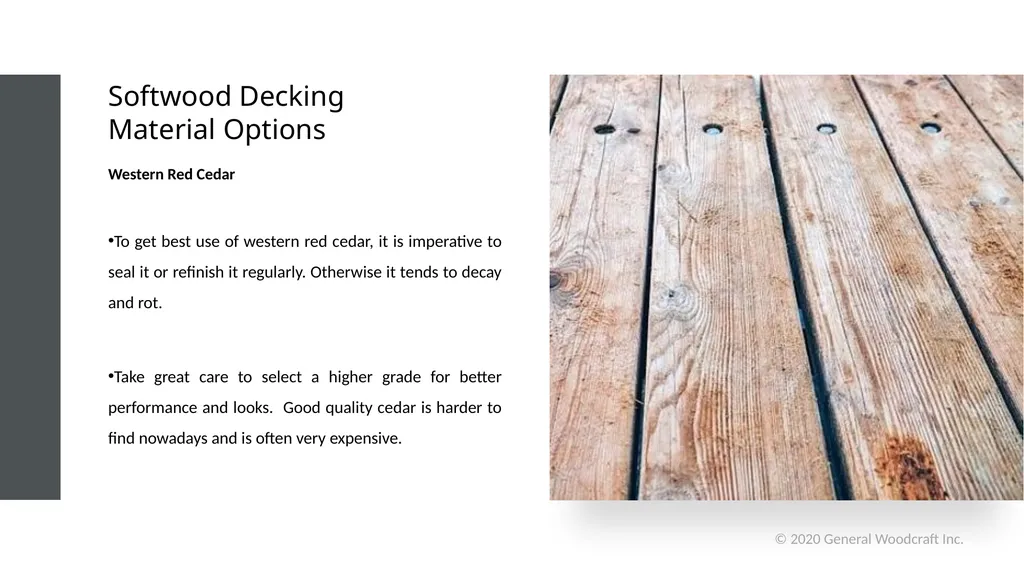
Western Red Cedar To get best use of western red cedar, it is imperative to seal it or refinish it regularly. Otherwise it tends to decay and rot.
Take great care to select a higher grade for better performance and looks. Good quality cedar is harder to find nowadays and is often very expensive. © 2020 General Woodcraft Inc.<br>
Take great care to select a higher grade for better performance and looks. Good quality cedar is harder to find nowadays and is often very expensive. © 2020 General Woodcraft Inc.<br>
12
Softwood Decking
Material Options
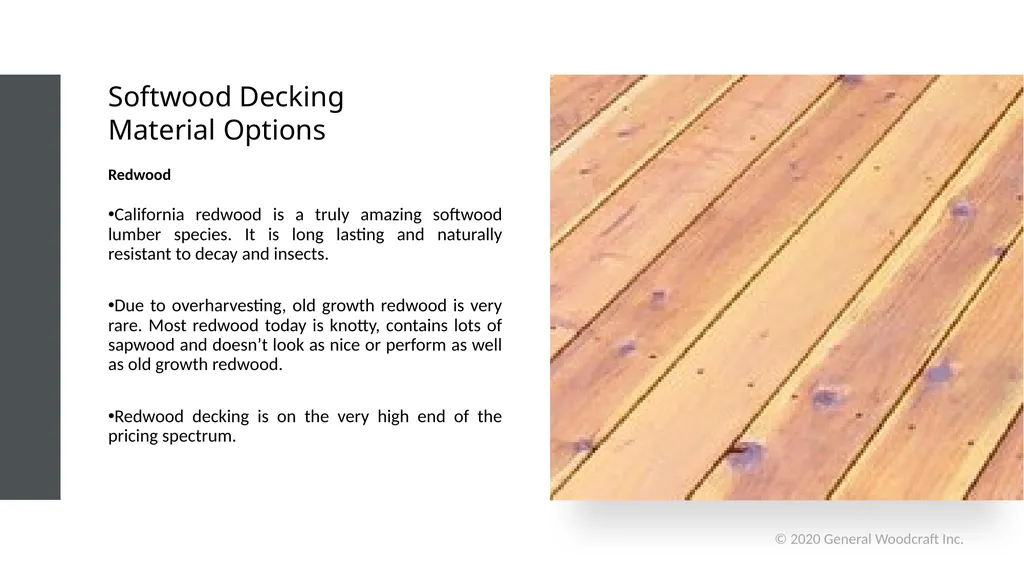
Redwood California redwood is a truly amazing softwood lumber species. It is long lasting and naturally resistant to decay and insects.
Due to overharvesting, old growth redwood is very rare. Most redwood today is knotty, contains lots of sapwood and doesn’t look as nice or perform as well as old growth redwood.
Redwood decking is on the very high end of the pricing spectrum. © 2020 General Woodcraft Inc.<br>
Due to overharvesting, old growth redwood is very rare. Most redwood today is knotty, contains lots of sapwood and doesn’t look as nice or perform as well as old growth redwood.
Redwood decking is on the very high end of the pricing spectrum. © 2020 General Woodcraft Inc.<br>
13
Softwood Decking Material Options Summary of Softwood Decking Materials
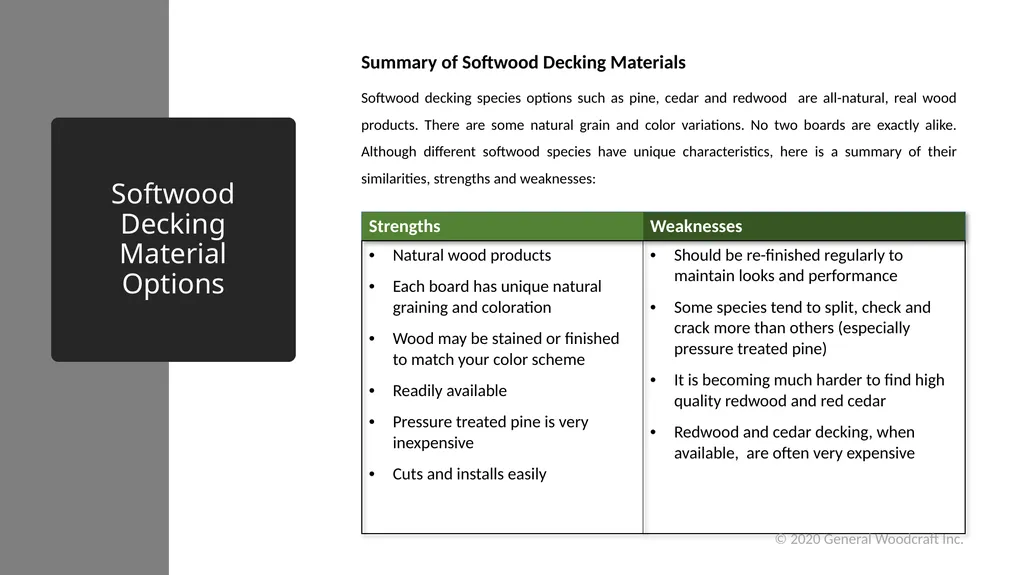
Softwood decking species options such as pine, cedar and redwood are all-natural, real wood products. There are some natural grain and color variations. No two boards are exactly alike. Although different softwood species have unique characteristics, here is a summary of their similarities, strengths and weaknesses: © 2020 General Woodcraft Inc.<br>
Softwood decking species options such as pine, cedar and redwood are all-natural, real wood products. There are some natural grain and color variations. No two boards are exactly alike. Although different softwood species have unique characteristics, here is a summary of their similarities, strengths and weaknesses: © 2020 General Woodcraft Inc.<br>
14
Hardwood Decking
Material Options
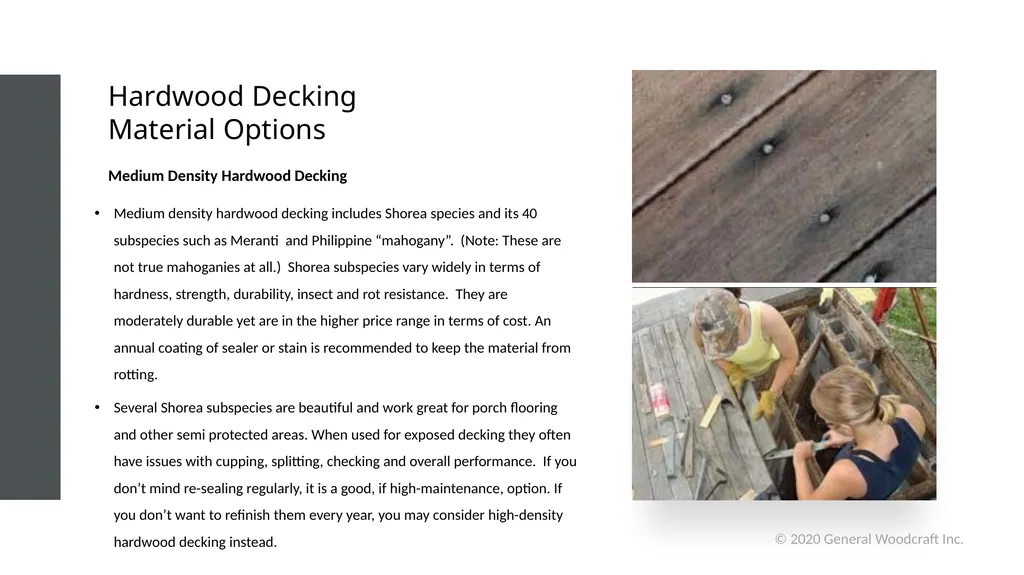
Medium Density Hardwood Decking Medium density hardwood decking includes Shorea species and its 40 subspecies such as Meranti and Philippine “mahogany”. (Note: These are not true mahoganies at all.) Shorea subspecies vary widely in terms of hardness, strength, durability, insect and rot resistance. They are moderately durable yet are in the higher price range in terms of cost. An annual coating of sealer or stain is recommended to keep the material from rotting.
Several Shorea subspecies are beautiful and work great for porch flooring and other semi protected areas. When used for exposed decking they often have issues with cupping, splitting, checking and overall performance. If you don’t mind re-sealing regularly, it is a good, if high-maintenance, option. If you don’t want to refinish them every year, you may consider high-density hardwood decking instead. © 2020 General Woodcraft Inc.<br>
Several Shorea subspecies are beautiful and work great for porch flooring and other semi protected areas. When used for exposed decking they often have issues with cupping, splitting, checking and overall performance. If you don’t mind re-sealing regularly, it is a good, if high-maintenance, option. If you don’t want to refinish them every year, you may consider high-density hardwood decking instead. © 2020 General Woodcraft Inc.<br>
15
Hardwood Decking
Material Options
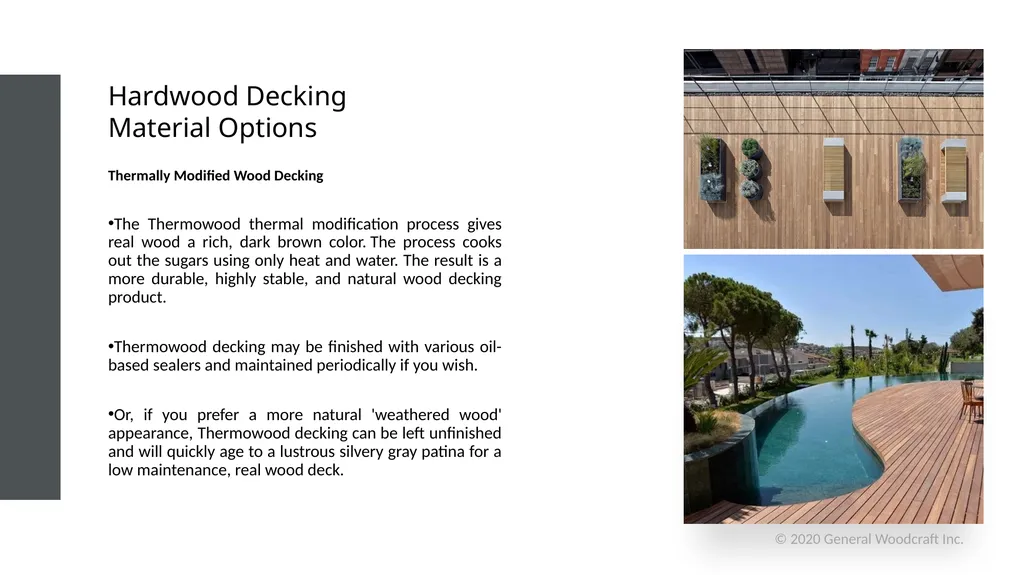
Thermally Modified Wood Decking The Thermowood thermal modification process gives real wood a rich, dark brown color. The process cooks out the sugars using only heat and water. The result is a more durable, highly stable, and natural wood decking product.
Thermowood decking may be finished with various oil-based sealers and maintained periodically if you wish.
Or, if you prefer a more natural 'weathered wood' appearance, Thermowood decking can be left unfinished and will quickly age to a lustrous silvery gray patina for a low maintenance, real wood deck. © 2020 General Woodcraft Inc.<br>
Thermowood decking may be finished with various oil-based sealers and maintained periodically if you wish.
Or, if you prefer a more natural 'weathered wood' appearance, Thermowood decking can be left unfinished and will quickly age to a lustrous silvery gray patina for a low maintenance, real wood deck. © 2020 General Woodcraft Inc.<br>
16
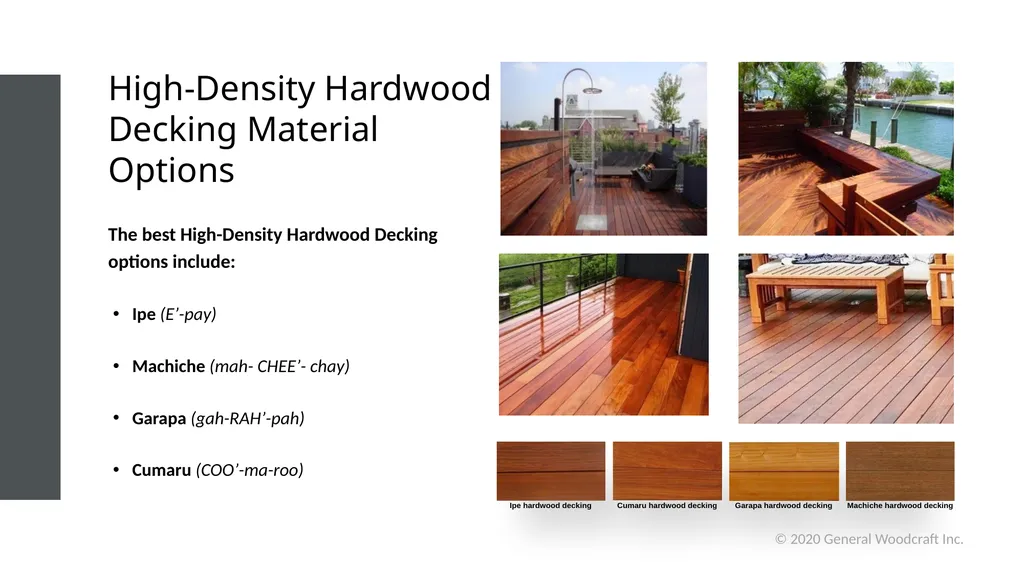
High-Density Hardwood Decking Material Options The best High-Density Hardwood Decking
options include:
Ipe (E’-pay)
Machiche (mah- CHEE’- chay)
Garapa (gah-RAH’-pah)
Cumaru (COO’-ma-roo) © 2020 General Woodcraft Inc.<br>
options include:
Ipe (E’-pay)
Machiche (mah- CHEE’- chay)
Garapa (gah-RAH’-pah)
Cumaru (COO’-ma-roo) © 2020 General Woodcraft Inc.<br>
17
High-Density Hardwood Decking Material Options
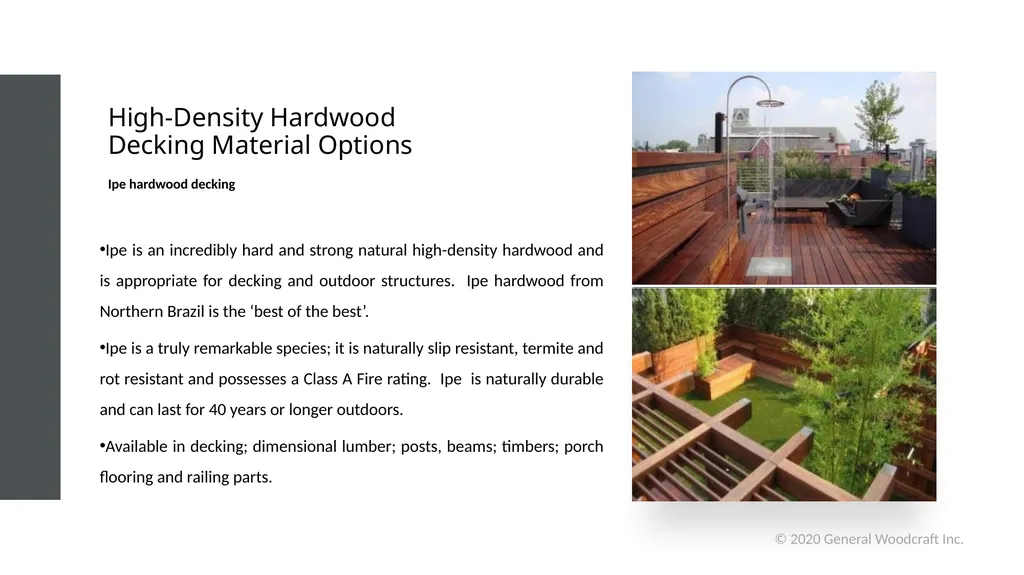
Ipe hardwood decking Ipe is an incredibly hard and strong natural high-density hardwood and is appropriate for decking and outdoor structures. Ipe hardwood from Northern Brazil is the ‘best of the best’.
Ipe is a truly remarkable species; it is naturally slip resistant, termite and rot resistant and possesses a Class A Fire rating. Ipe is naturally durable and can last for 40 years or longer outdoors.
Available in decking; dimensional lumber; posts, beams; timbers; porch flooring and railing parts. © 2020 General Woodcraft Inc.<br>
Ipe is a truly remarkable species; it is naturally slip resistant, termite and rot resistant and possesses a Class A Fire rating. Ipe is naturally durable and can last for 40 years or longer outdoors.
Available in decking; dimensional lumber; posts, beams; timbers; porch flooring and railing parts. © 2020 General Woodcraft Inc.<br>
18
High-Density
Hardwood Decking
Material Options
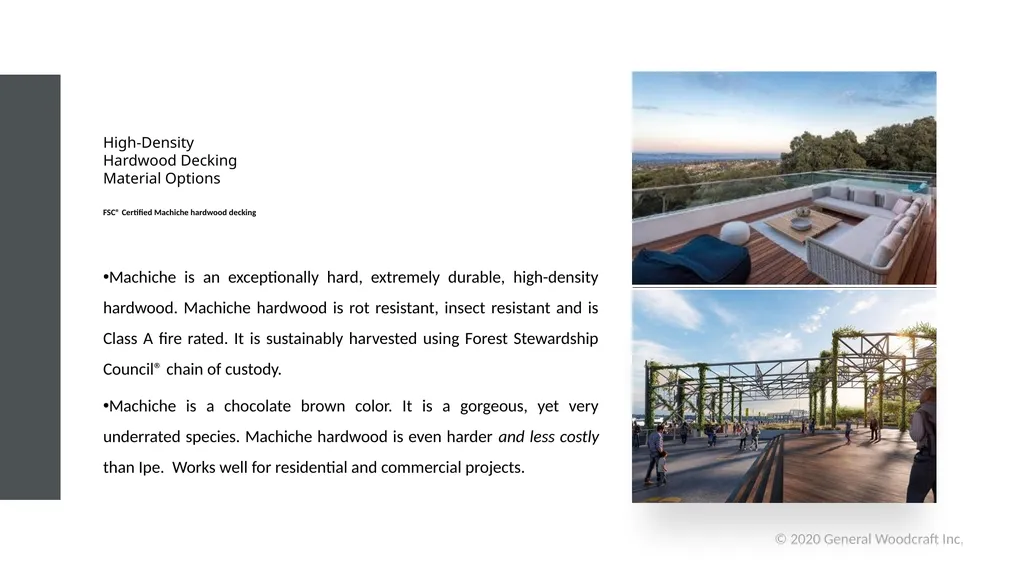
FSC® Certified Machiche hardwood decking Machiche is an exceptionally hard, extremely durable, high-density hardwood. Machiche hardwood is rot resistant, insect resistant and is Class A fire rated. It is sustainably harvested using Forest Stewardship Council® chain of custody.
Machiche is a chocolate brown color. It is a gorgeous, yet very underrated species. Machiche hardwood is even harder and less costly than Ipe. Works well for residential and commercial projects. © 2020 General Woodcraft Inc.<br>
Machiche is a chocolate brown color. It is a gorgeous, yet very underrated species. Machiche hardwood is even harder and less costly than Ipe. Works well for residential and commercial projects. © 2020 General Woodcraft Inc.<br>
19
High-Density
Hardwood Decking
Material Options
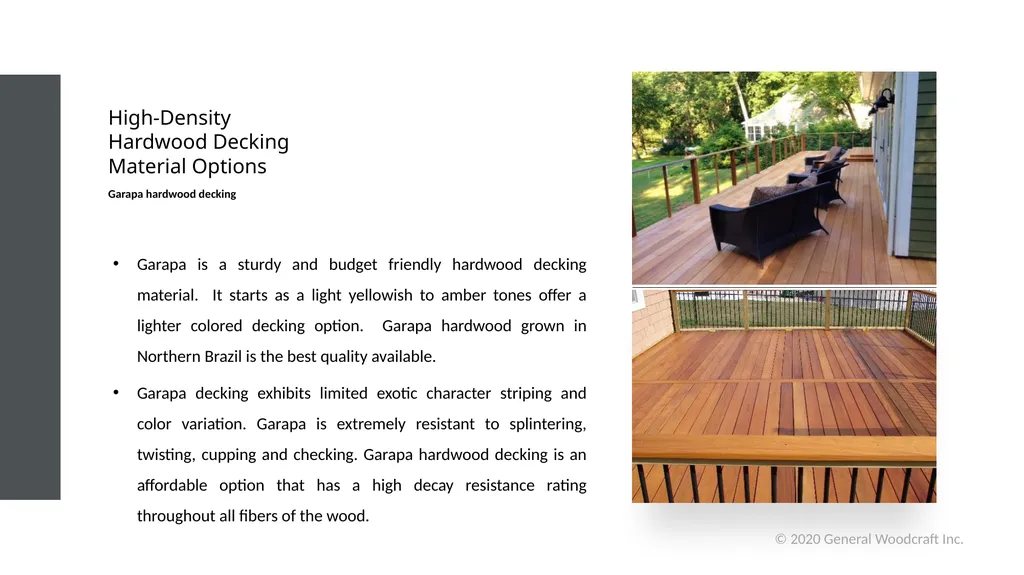
Garapa hardwood decking Garapa is a sturdy and budget friendly hardwood decking material. It starts as a light yellowish to amber tones offer a lighter colored decking option. Garapa hardwood grown in Northern Brazil is the best quality available.
Garapa decking exhibits limited exotic character striping and color variation. Garapa is extremely resistant to splintering, twisting, cupping and checking. Garapa hardwood decking is an affordable option that has a high decay resistance rating throughout all fibers of the wood. © 2020 General Woodcraft Inc.<br>
Garapa decking exhibits limited exotic character striping and color variation. Garapa is extremely resistant to splintering, twisting, cupping and checking. Garapa hardwood decking is an affordable option that has a high decay resistance rating throughout all fibers of the wood. © 2020 General Woodcraft Inc.<br>
20
High-Density
Hardwood Decking
Material Options
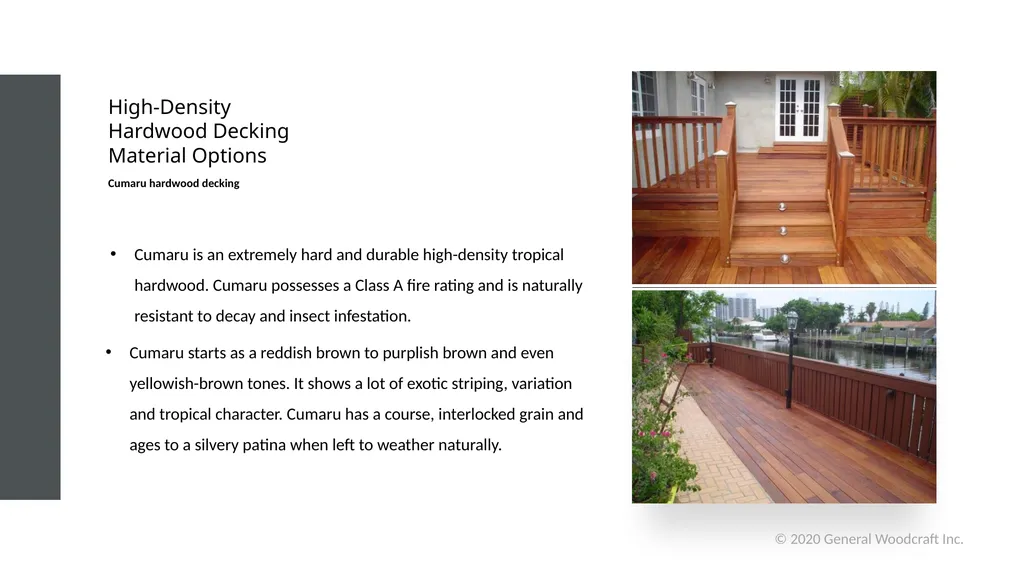
Cumaru hardwood decking Cumaru is an extremely hard and durable high-density tropical hardwood. Cumaru possesses a Class A fire rating and is naturally resistant to decay and insect infestation.
Cumaru starts as a reddish brown to purplish brown and even yellowish-brown tones. It shows a lot of exotic striping, variation and tropical character. Cumaru has a course, interlocked grain and ages to a silvery patina when left to weather naturally. © 2020 General Woodcraft Inc.<br>
Cumaru starts as a reddish brown to purplish brown and even yellowish-brown tones. It shows a lot of exotic striping, variation and tropical character. Cumaru has a course, interlocked grain and ages to a silvery patina when left to weather naturally. © 2020 General Woodcraft Inc.<br>
21
High-Density Hardwood Decking Material Options Summary of High-Density Hardwood Decking Materials
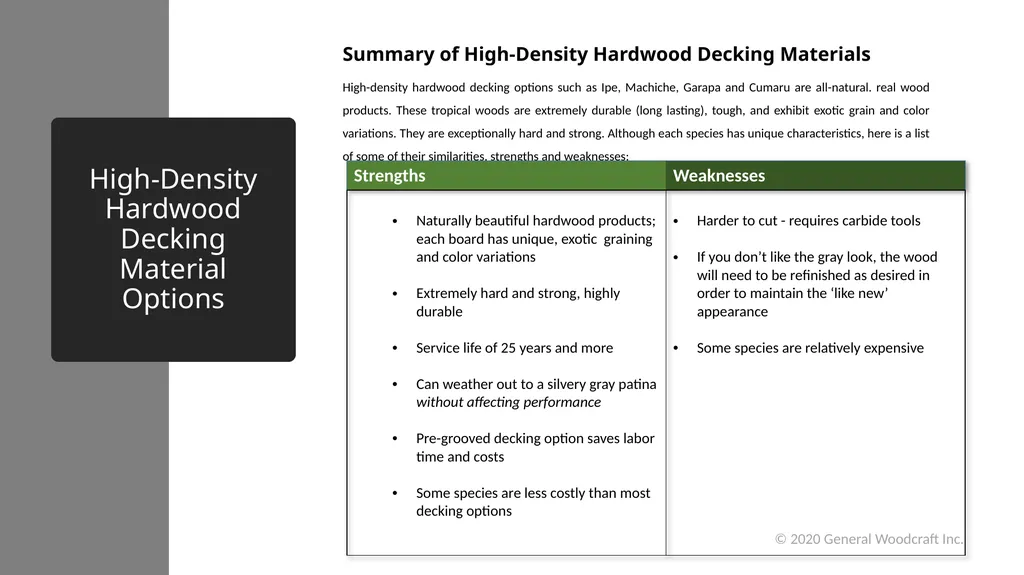
High-density hardwood decking options such as Ipe, Machiche, Garapa and Cumaru are all-natural. real wood products. These tropical woods are extremely durable (long lasting), tough, and exhibit exotic grain and color variations. They are exceptionally hard and strong. Although each species has unique characteristics, here is a list of some of their similarities, strengths and weaknesses: © 2020 General Woodcraft Inc.<br>
High-density hardwood decking options such as Ipe, Machiche, Garapa and Cumaru are all-natural. real wood products. These tropical woods are extremely durable (long lasting), tough, and exhibit exotic grain and color variations. They are exceptionally hard and strong. Although each species has unique characteristics, here is a list of some of their similarities, strengths and weaknesses: © 2020 General Woodcraft Inc.<br>
22
Return To The Page To Proceed To The Test END OF SECTION © 2020 General Woodcraft Inc. Brought to you by General Woodcraft, Inc. and MataverdeDecking.com , New London, CT and Cotati, CA Thank you for completing this online training.<br>