Deep Learning CS771: Introduction to Machine Learning Nisheeth Limitations of Linear Models Linear models: Output produced by taking a linear combination of input features This basic architecture is classically also known as the
"“Deep” Learning CS771: Introduction to Machine" is the property of its rightful owner. Permission is granted to
download and print the materials on this website for personal, non-commercial use only, and to display it
on your personal computer provided you do not modify the materials and that you retain all copyright
notices contained in the materials. By downloading content from our website, you accept the terms of this
agreement.
Presentation Transcript
01
“Deep” Learning CS771: Introduction to Machine Learning
Nisheeth<br>
02
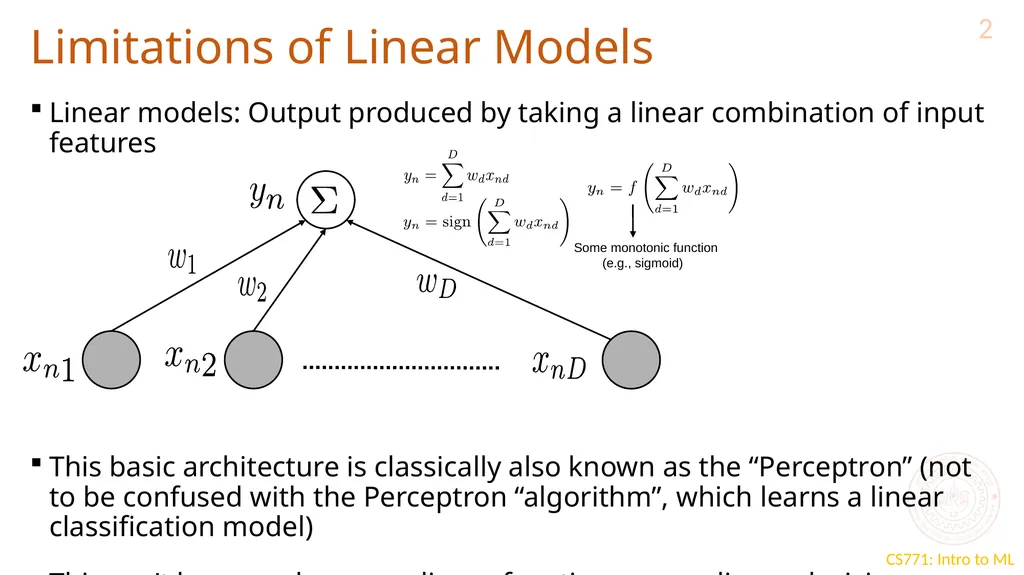
Limitations of Linear Models Linear models: Output produced by taking a linear combination of input features
This basic architecture is classically also known as the “Perceptron” (not to be confused with the Perceptron “algorithm”, which learns a linear classification model)
This can’t however learn nonlinear functions or nonlinear decision boundaries 2 Some monotonic function
(e.g., sigmoid)<br>
03
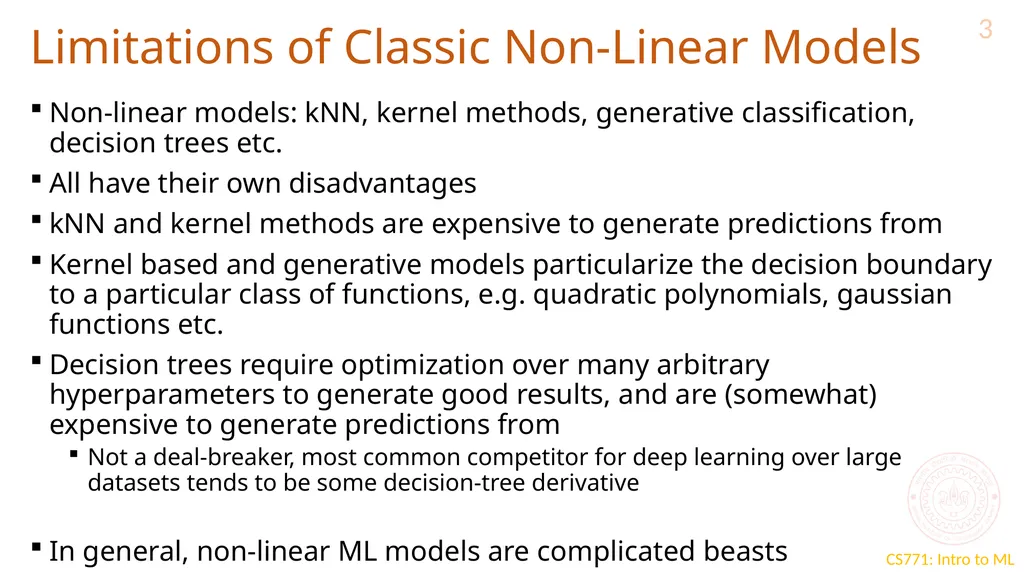
Limitations of Classic Non-Linear Models Non-linear models: kNN, kernel methods, generative classification, decision trees etc.
All have their own disadvantages
kNN and kernel methods are expensive to generate predictions from
Kernel based and generative models particularize the decision boundary to a particular class of functions, e.g. quadratic polynomials, gaussian functions etc.
Decision trees require optimization over many arbitrary hyperparameters to generate good results, and are (somewhat) expensive to generate predictions from
Not a deal-breaker, most common competitor for deep learning over large datasets tends to be some decision-tree derivative
In general, non-linear ML models are complicated beasts 3<br>
04
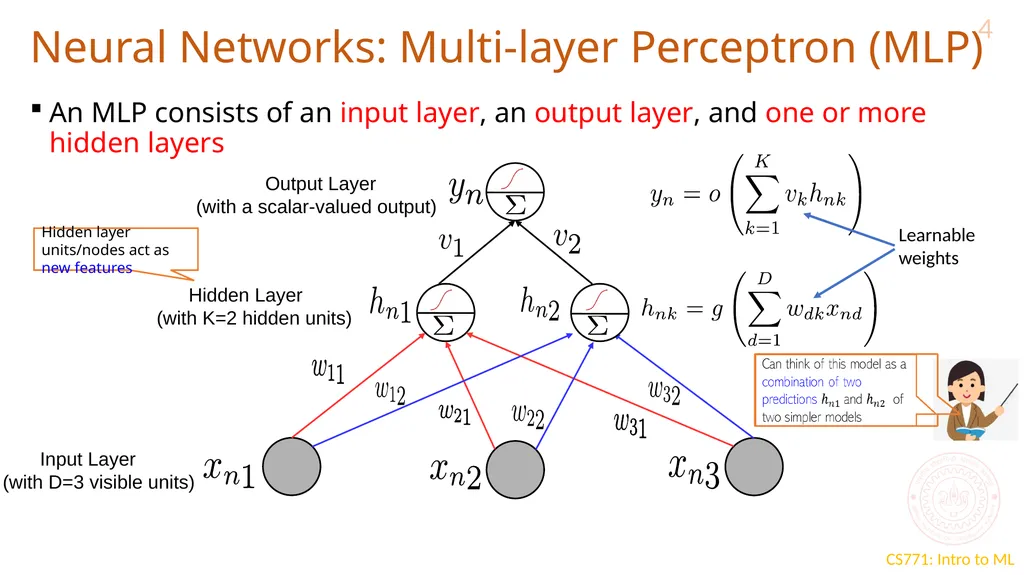
Neural Networks: Multi-layer Perceptron (MLP) An MLP consists of an input layer, an output layer, and one or more hidden layers 4 Input Layer
(with D=3 visible units) Hidden Layer
(with K=2 hidden units) Output Layer
(with a scalar-valued output) Hidden layer units/nodes act as new features Learnable weights<br>
05
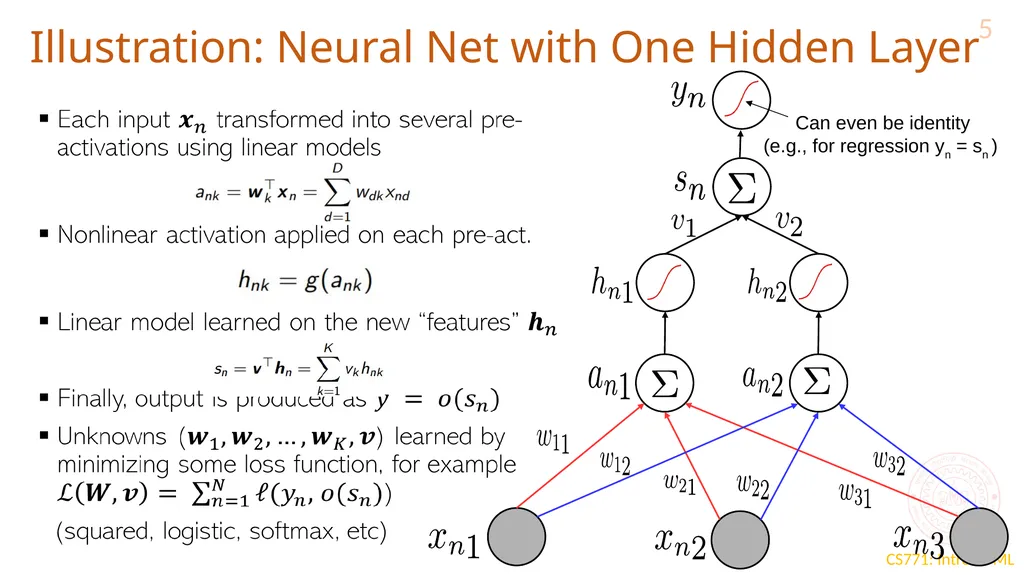
Illustration: Neural Net with One Hidden Layer 5 Can even be identity
(e.g., for regression yn = sn )<br>
06
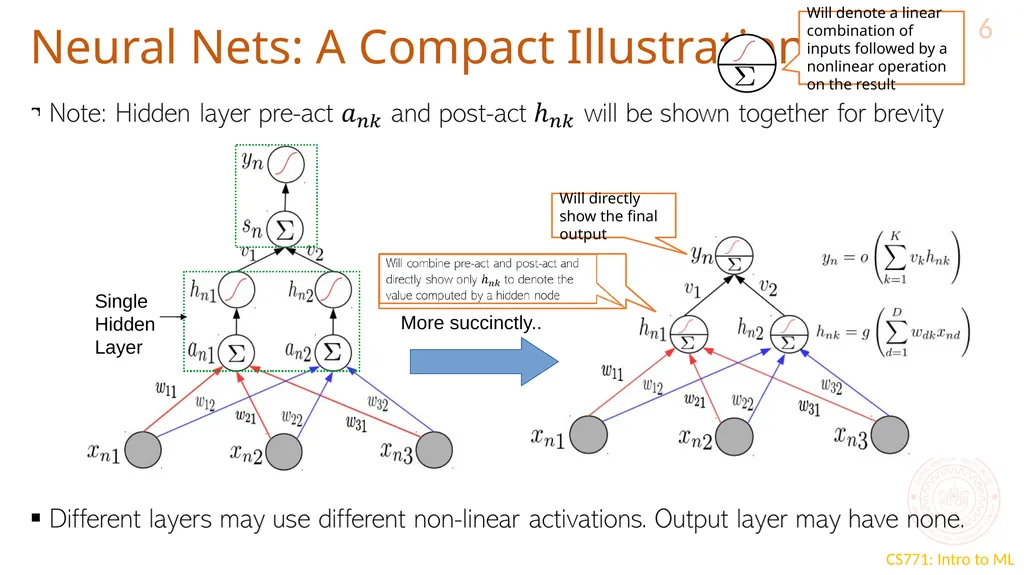
Neural Nets: A Compact Illustration 6 Single
Hidden
Layer More succinctly.. Will directly show the final output Will denote a linear combination of inputs followed by a nonlinear operation on the result<br>
07
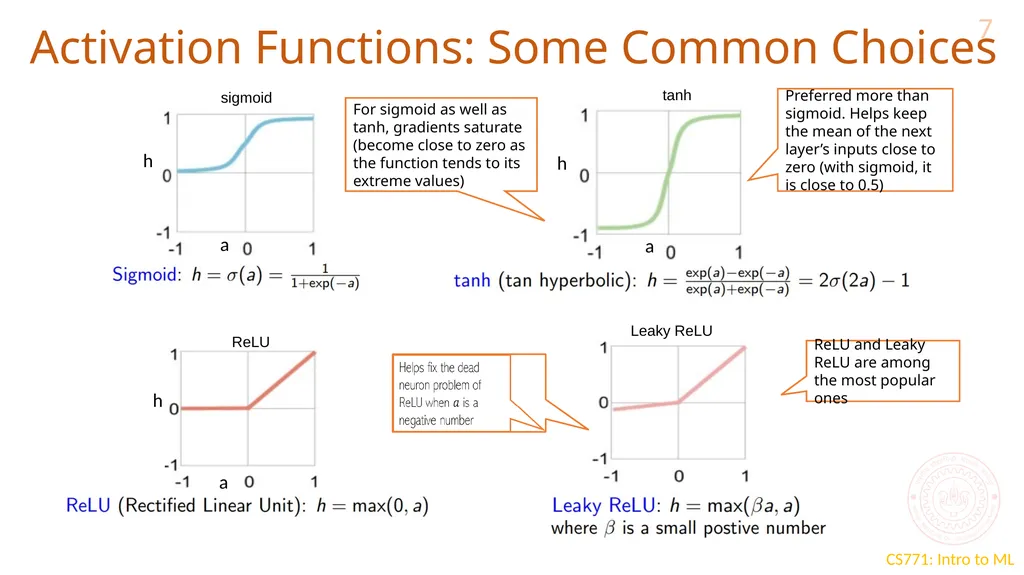
Activation Functions: Some Common Choices 7 sigmoid tanh ReLU Leaky ReLU h a h a h a ReLU and Leaky ReLU are among the most popular ones Preferred more than sigmoid. Helps keep the mean of the next layer’s inputs close to zero (with sigmoid, it is close to 0.5) For sigmoid as well as tanh, gradients saturate (become close to zero as the function tends to its extreme values)<br>
08
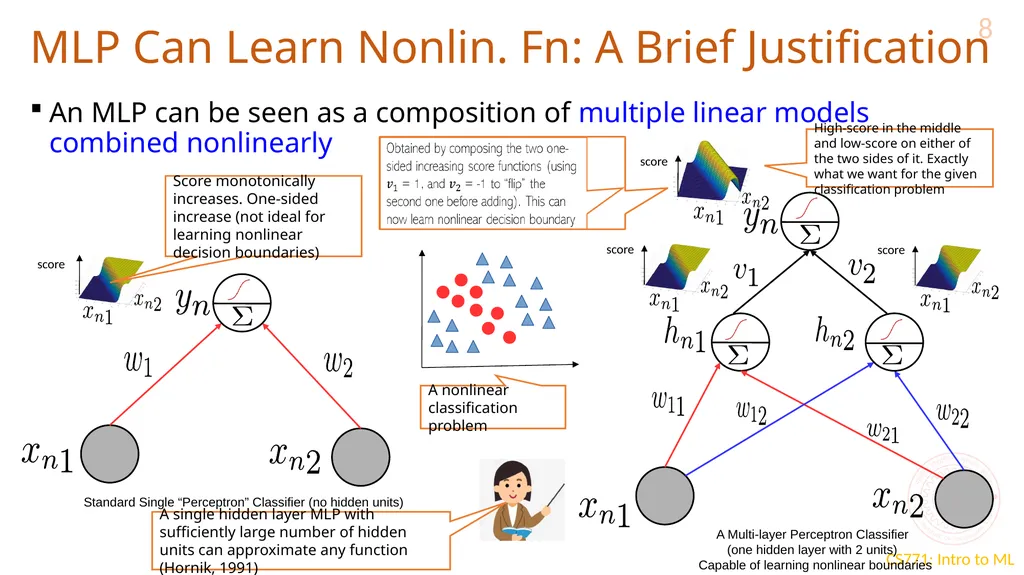
MLP Can Learn Nonlin. Fn: A Brief Justification An MLP can be seen as a composition of multiple linear models combined nonlinearly 8 Standard Single “Perceptron” Classifier (no hidden units) score Score monotonically increases. One-sided increase (not ideal for learning nonlinear decision boundaries) A Multi-layer Perceptron Classifier
(one hidden layer with 2 units)
Capable of learning nonlinear boundaries score score score High-score in the middle and low-score on either of the two sides of it. Exactly what we want for the given classification problem A nonlinear classification problem A single hidden layer MLP with sufficiently large number of hidden units can approximate any function (Hornik, 1991)<br>
09
Examples of some basic NN/MLP architectures 9<br>
10
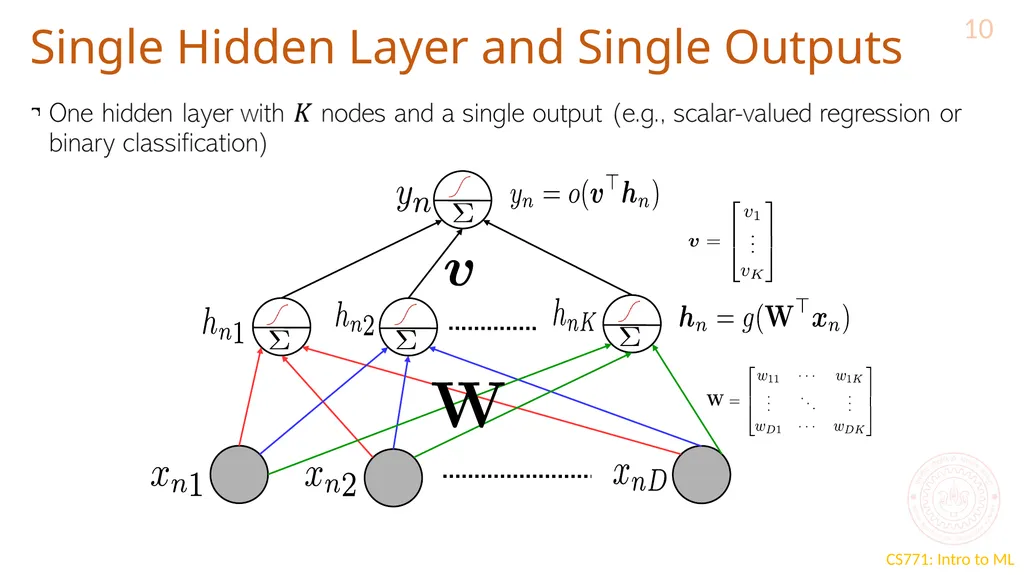
Single Hidden Layer and Single Outputs 10<br>
11
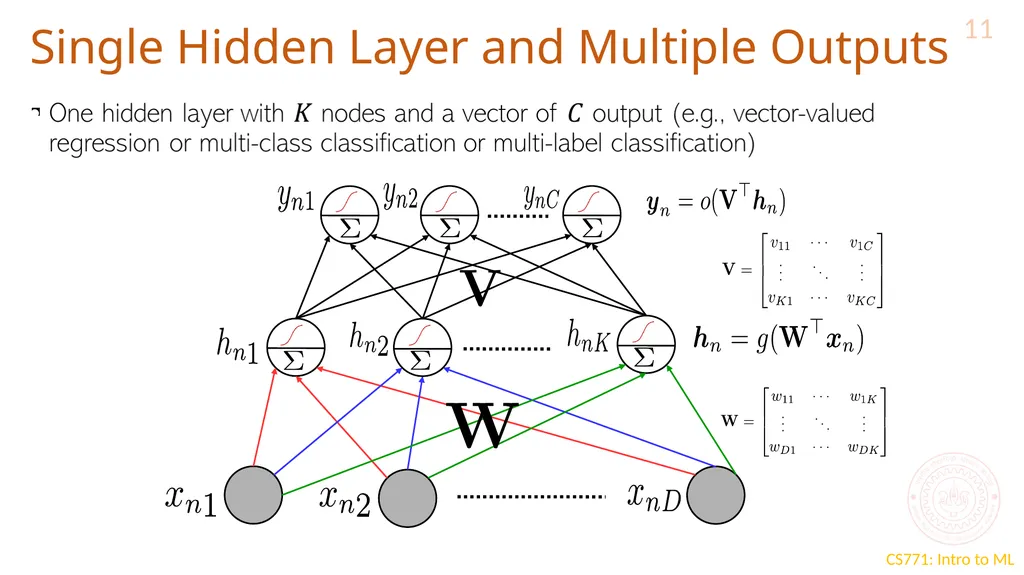
Single Hidden Layer and Multiple Outputs 11<br>
12
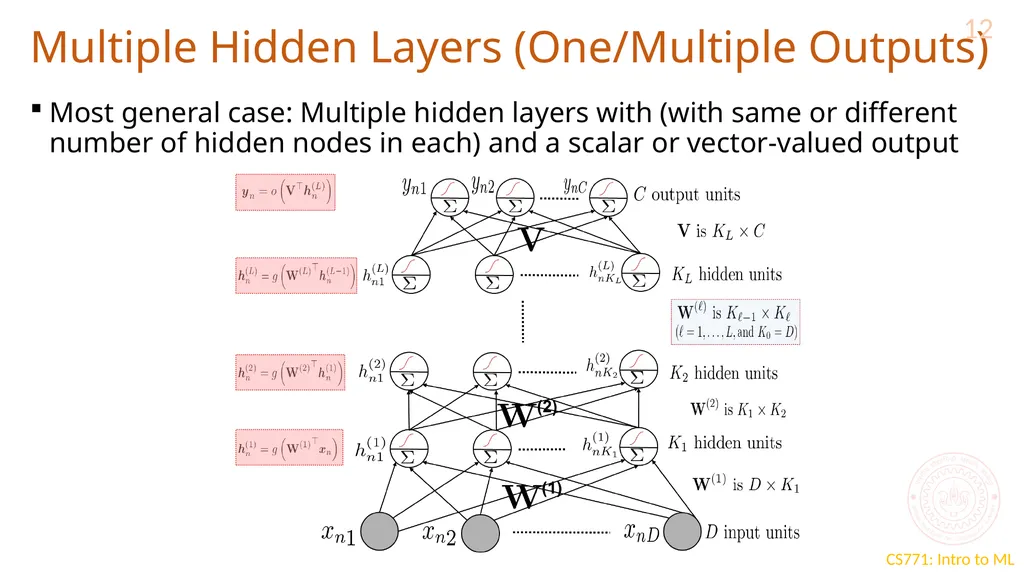
Multiple Hidden Layers (One/Multiple Outputs) Most general case: Multiple hidden layers with (with same or different number of hidden nodes in each) and a scalar or vector-valued output 12<br>
13
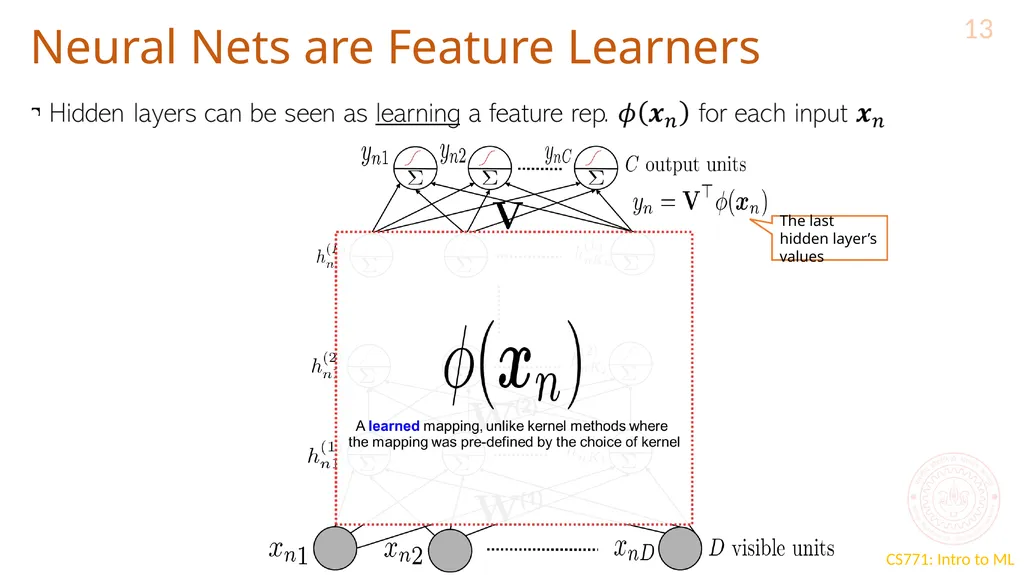
Neural Nets are Feature Learners 13 The last hidden layer’s values<br>
14
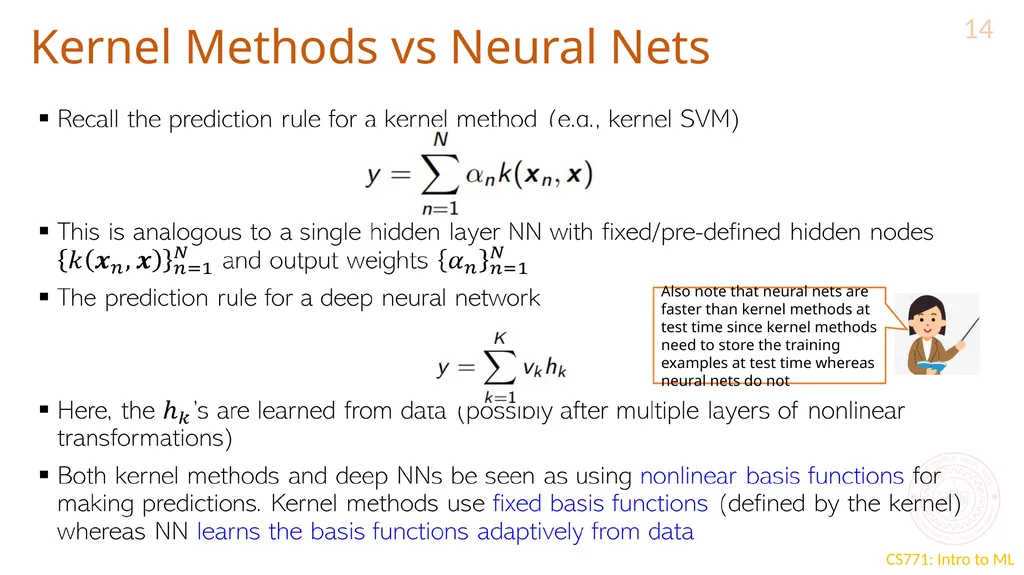
Kernel Methods vs Neural Nets 14 Also note that neural nets are faster than kernel methods at test time since kernel methods need to store the training examples at test time whereas neural nets do not<br>
15
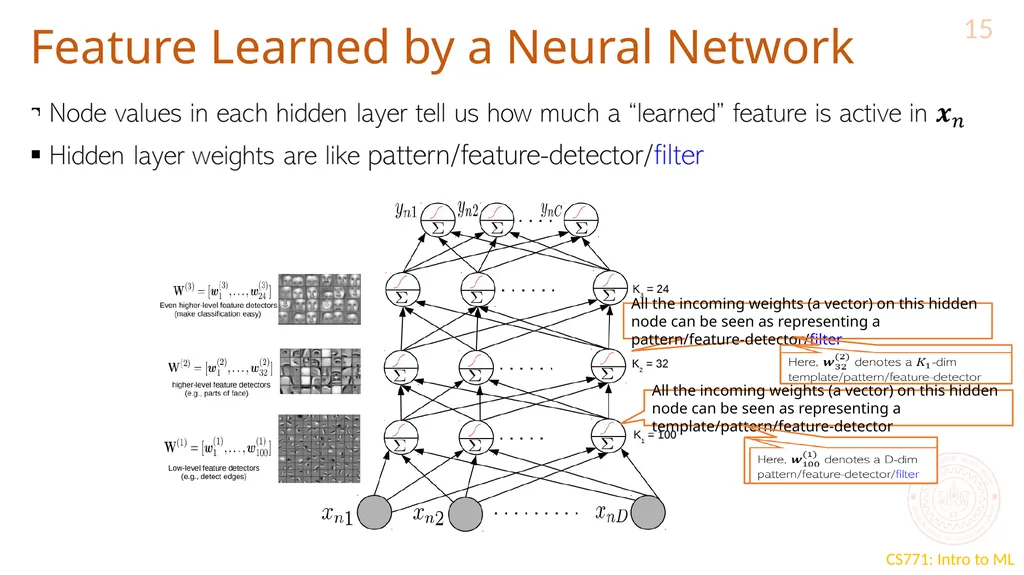
Feature Learned by a Neural Network 15 All the incoming weights (a vector) on this hidden node can be seen as representing a template/pattern/feature-detector All the incoming weights (a vector) on this hidden node can be seen as representing a pattern/feature-detector/filter<br>
16
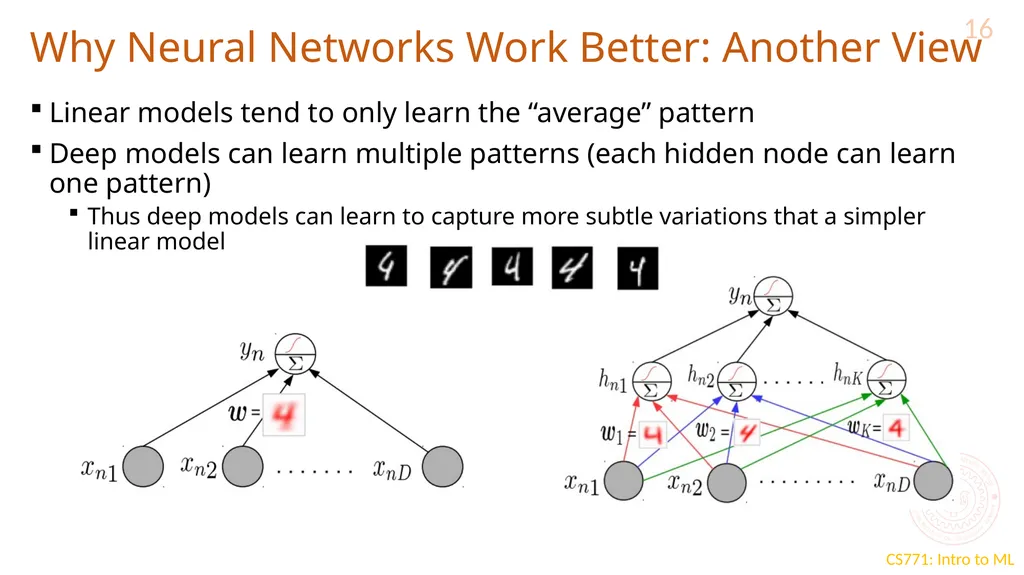
Why Neural Networks Work Better: Another View Linear models tend to only learn the “average” pattern
Deep models can learn multiple patterns (each hidden node can learn one pattern)
Thus deep models can learn to capture more subtle variations that a simpler linear model 16<br>