
DEER LAB Title: Limiting Factor Deer Population
TG
Published · 7 slides · 0 views
1 / 1
Description
DEER LAB Title: Limiting Factor Deer Population Lab Name: Maria C. Delgado Hernandez Period: 4 Date: 10122022 PROBLEM STATEMENT: How will resource availability affect the population ecosystem? HYPOTHESIS: When resources go down, the
Related Topics
Share
Embed code
Download this presentation From Below
"DEER LAB Title: Limiting Factor Deer Population" is the property of its rightful owner. Permission is granted to download and print the materials on this website for personal, non-commercial use only, and to display it on your personal computer provided you do not modify the materials and that you retain all copyright notices contained in the materials. By downloading content from our website, you accept the terms of this agreement.
Presentation Transcript
01
DEER LAB
Title: Limiting Factor Deer Population Lab Name: Maria C. Delgado Hernandez
Period: 4 Date: 10/12/2022<br>
Period: 4 Date: 10/12/2022<br>
02
PROBLEM STATEMENT: How will resource availability affect the population ecosystem?
HYPOTHESIS: When resources go down, the population also goes down.
PROCEDURE: The deer eat the grass they need to feed themselves, thanks to the fact that the deer are eating, they reproduce and the deer that die become grass, when the predators appeared, that is to say the wolves, the population of the deer decreased but not by bad way but in a good way because the ecosystem has a balance, that is, there are predators (the wolves) that help the deer population not to be so large.<br>
03
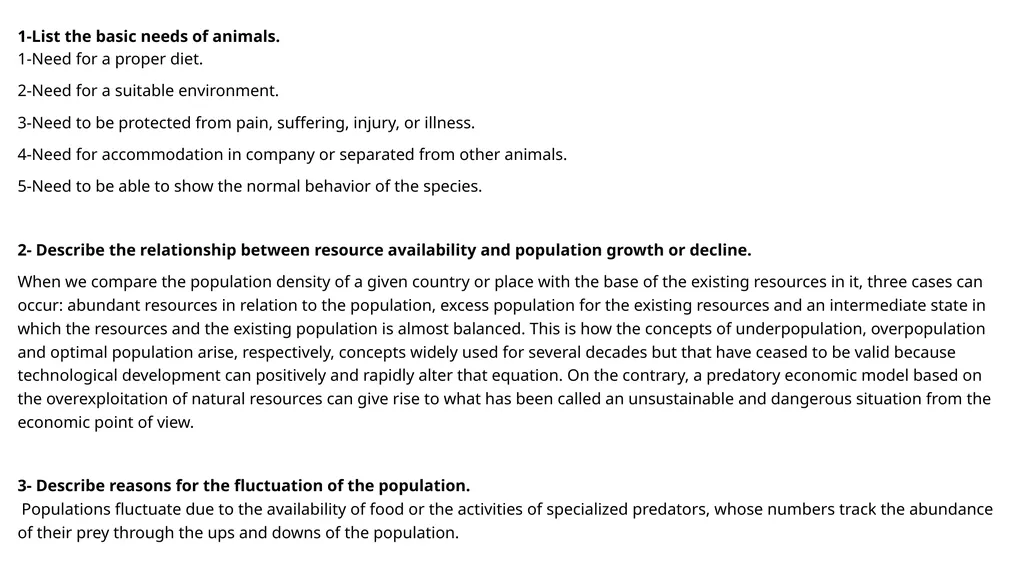
1-List the basic needs of animals.
1-Need for a proper diet.
2-Need for a suitable environment.
3-Need to be protected from pain, suffering, injury, or illness.
4-Need for accommodation in company or separated from other animals.
5-Need to be able to show the normal behavior of the species.
2- Describe the relationship between resource availability and population growth or decline.
When we compare the population density of a given country or place with the base of the existing resources in it, three cases can occur: abundant resources in relation to the population, excess population for the existing resources and an intermediate state in which the resources and the existing population is almost balanced. This is how the concepts of underpopulation, overpopulation and optimal population arise, respectively, concepts widely used for several decades but that have ceased to be valid because technological development can positively and rapidly alter that equation. On the contrary, a predatory economic model based on the overexploitation of natural resources can give rise to what has been called an unsustainable and dangerous situation from the economic point of view.
3- Describe reasons for the fluctuation of the population. Populations fluctuate due to the availability of food or the activities of specialized predators, whose numbers track the abundance of their prey through the ups and downs of the population.<br>
1-Need for a proper diet.
2-Need for a suitable environment.
3-Need to be protected from pain, suffering, injury, or illness.
4-Need for accommodation in company or separated from other animals.
5-Need to be able to show the normal behavior of the species.
2- Describe the relationship between resource availability and population growth or decline.
When we compare the population density of a given country or place with the base of the existing resources in it, three cases can occur: abundant resources in relation to the population, excess population for the existing resources and an intermediate state in which the resources and the existing population is almost balanced. This is how the concepts of underpopulation, overpopulation and optimal population arise, respectively, concepts widely used for several decades but that have ceased to be valid because technological development can positively and rapidly alter that equation. On the contrary, a predatory economic model based on the overexploitation of natural resources can give rise to what has been called an unsustainable and dangerous situation from the economic point of view.
3- Describe reasons for the fluctuation of the population. Populations fluctuate due to the availability of food or the activities of specialized predators, whose numbers track the abundance of their prey through the ups and downs of the population.<br>
04
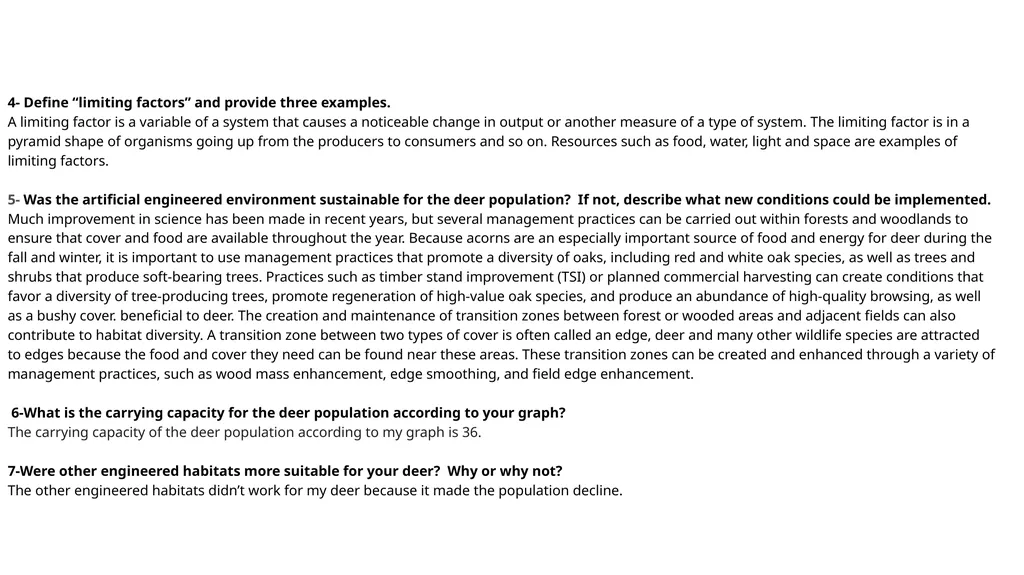
4- Define “limiting factors” and provide three examples.
A limiting factor is a variable of a system that causes a noticeable change in output or another measure of a type of system. The limiting factor is in a pyramid shape of organisms going up from the producers to consumers and so on. Resources such as food, water, light and space are examples of limiting factors.
5- Was the artificial engineered environment sustainable for the deer population? If not, describe what new conditions could be implemented.
Much improvement in science has been made in recent years, but several management practices can be carried out within forests and woodlands to ensure that cover and food are available throughout the year. Because acorns are an especially important source of food and energy for deer during the fall and winter, it is important to use management practices that promote a diversity of oaks, including red and white oak species, as well as trees and shrubs that produce soft-bearing trees. Practices such as timber stand improvement (TSI) or planned commercial harvesting can create conditions that favor a diversity of tree-producing trees, promote regeneration of high-value oak species, and produce an abundance of high-quality browsing, as well as a bushy cover. beneficial to deer. The creation and maintenance of transition zones between forest or wooded areas and adjacent fields can also contribute to habitat diversity. A transition zone between two types of cover is often called an edge, deer and many other wildlife species are attracted to edges because the food and cover they need can be found near these areas. These transition zones can be created and enhanced through a variety of management practices, such as wood mass enhancement, edge smoothing, and field edge enhancement.
6-What is the carrying capacity for the deer population according to your graph?
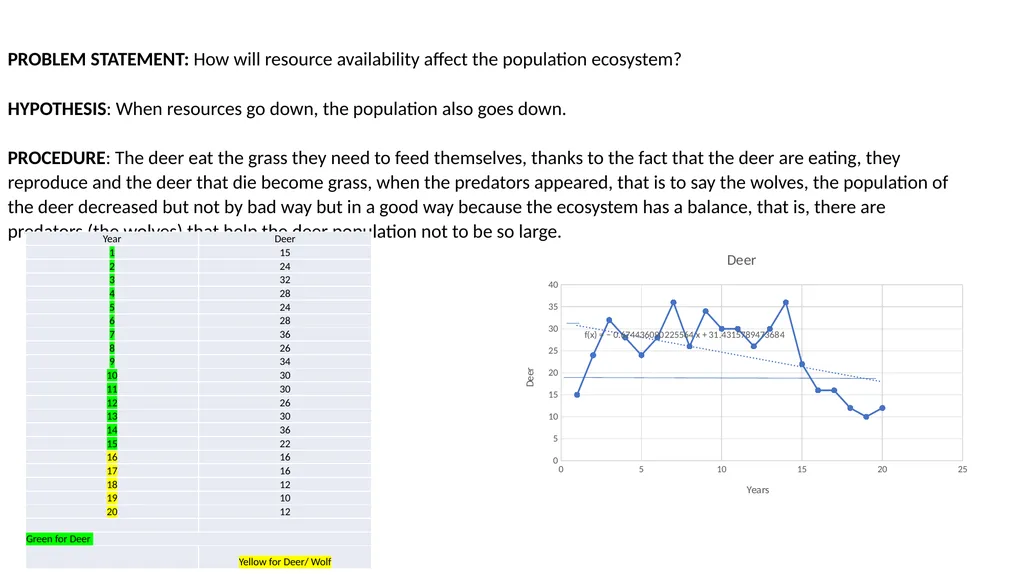
The carrying capacity of the deer population according to my graph is 36.
7-Were other engineered habitats more suitable for your deer? Why or why not?
The other engineered habitats didn’t work for my deer because it made the population decline.<br>
05
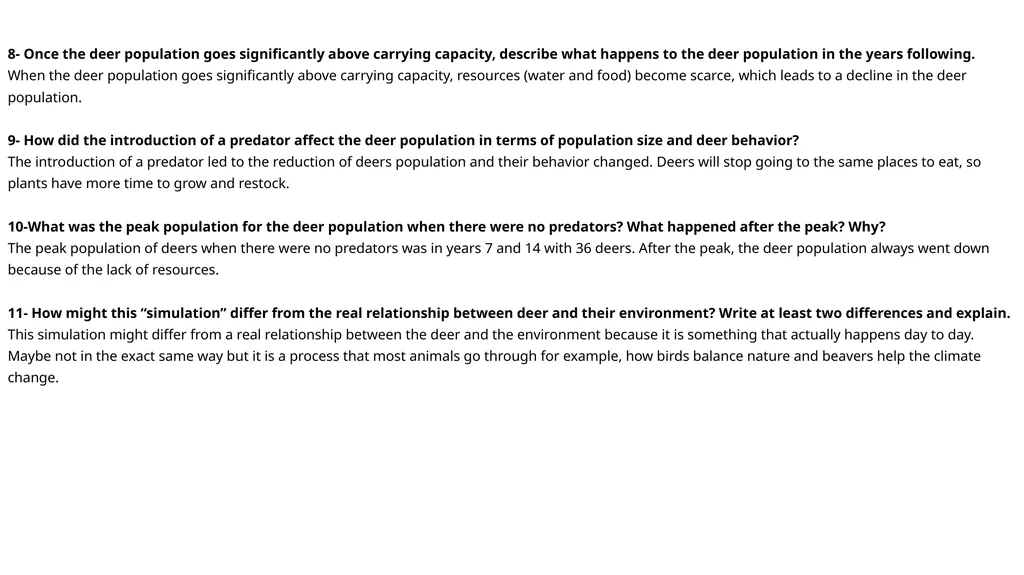
8- Once the deer population goes significantly above carrying capacity, describe what happens to the deer population in the years following.
When the deer population goes significantly above carrying capacity, resources (water and food) become scarce, which leads to a decline in the deer population.
9- How did the introduction of a predator affect the deer population in terms of population size and deer behavior?
The introduction of a predator led to the reduction of deers population and their behavior changed. Deers will stop going to the same places to eat, so plants have more time to grow and restock.
10-What was the peak population for the deer population when there were no predators? What happened after the peak? Why?
The peak population of deers when there were no predators was in years 7 and 14 with 36 deers. After the peak, the deer population always went down because of the lack of resources.
11- How might this “simulation” differ from the real relationship between deer and their environment? Write at least two differences and explain.
This simulation might differ from a real relationship between the deer and the environment because it is something that actually happens day to day. Maybe not in the exact same way but it is a process that most animals go through for example, how birds balance nature and beavers help the climate change.<br>
06
12- How do you think this “simulation” game differs from real predator-prey relationships? Explain.
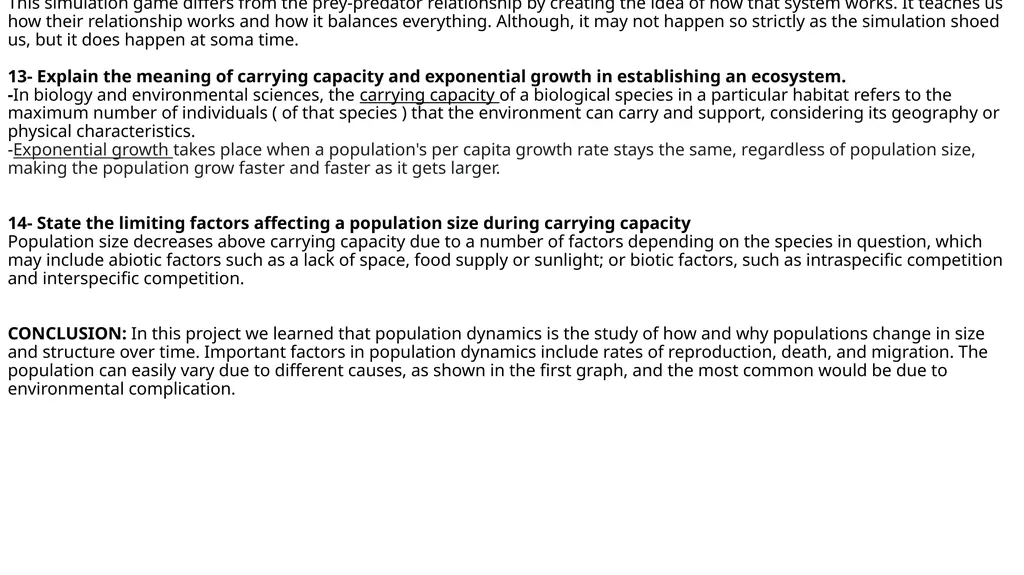
This simulation game differs from the prey-predator relationship by creating the idea of how that system works. It teaches us how their relationship works and how it balances everything. Although, it may not happen so strictly as the simulation shoed us, but it does happen at soma time.
13- Explain the meaning of carrying capacity and exponential growth in establishing an ecosystem.
-In biology and environmental sciences, the carrying capacity of a biological species in a particular habitat refers to the maximum number of individuals ( of that species ) that the environment can carry and support, considering its geography or physical characteristics.
-Exponential growth takes place when a population's per capita growth rate stays the same, regardless of population size, making the population grow faster and faster as it gets larger.
14- State the limiting factors affecting a population size during carrying capacity
Population size decreases above carrying capacity due to a number of factors depending on the species in question, which may include abiotic factors such as a lack of space, food supply or sunlight; or biotic factors, such as intraspecific competition and interspecific competition.
CONCLUSION: In this project we learned that population dynamics is the study of how and why populations change in size and structure over time. Important factors in population dynamics include rates of reproduction, death, and migration. The population can easily vary due to different causes, as shown in the first graph, and the most common would be due to environmental complication.<br>
07
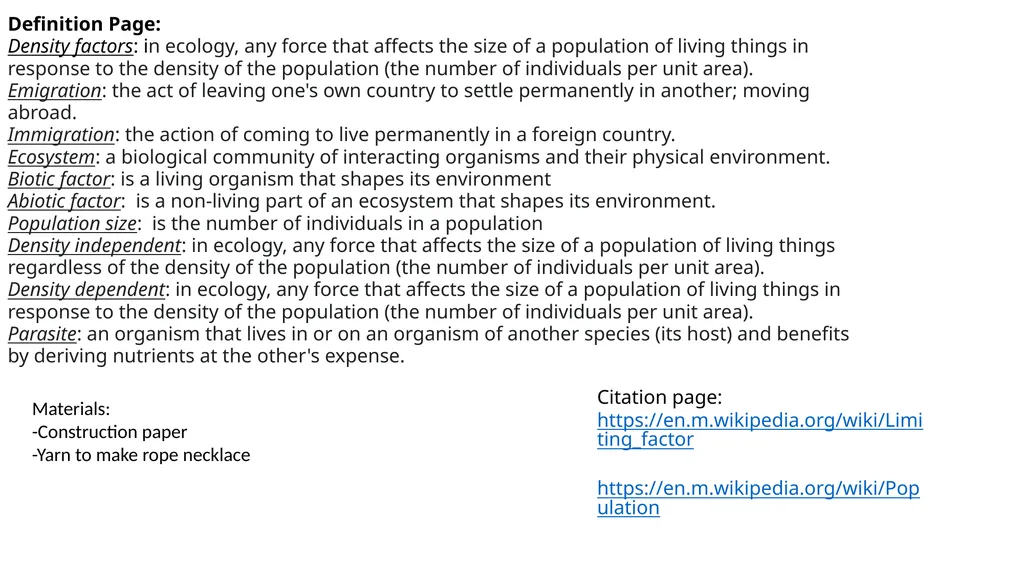
Definition Page:
Density factors: in ecology, any force that affects the size of a population of living things in response to the density of the population (the number of individuals per unit area).
Emigration: the act of leaving one's own country to settle permanently in another; moving abroad.
Immigration: the action of coming to live permanently in a foreign country.
Ecosystem: a biological community of interacting organisms and their physical environment.
Biotic factor: is a living organism that shapes its environment
Abiotic factor: is a non-living part of an ecosystem that shapes its environment.
Population size: is the number of individuals in a population
Density independent: in ecology, any force that affects the size of a population of living things regardless of the density of the population (the number of individuals per unit area).
Density dependent: in ecology, any force that affects the size of a population of living things in response to the density of the population (the number of individuals per unit area).
Parasite: an organism that lives in or on an organism of another species (its host) and benefits by deriving nutrients at the other's expense. Materials:
-Construction paper
-Yarn to make rope necklace Citation page: https://en.m.wikipedia.org/wiki/Limiting_factor
https://en.m.wikipedia.org/wiki/Population<br>
-Yarn to make rope necklace Citation page: https://en.m.wikipedia.org/wiki/Limiting_factor
https://en.m.wikipedia.org/wiki/Population<br>