Defensive coding techniques Engineering Secure Software Defensive Coding vs. Risk Analysis Risk analysis All about domain, assets, threats, what-ifs Global-minded Prioritization is critical Defensive Coding One small change in code big
"Defensive coding techniques Engineering Secure" is the property of its rightful owner. Permission is granted to
download and print the materials on this website for personal, non-commercial use only, and to display it
on your personal computer provided you do not modify the materials and that you retain all copyright
notices contained in the materials. By downloading content from our website, you accept the terms of this
agreement.
Defensive Coding vs. Risk Analysis Risk analysis
All about domain, assets, threats, what-ifs
Global-minded
Prioritization is critical
Defensive Coding
One small change in code big change in risk analysis
e.g. storing passwords in the Customer table vs. Users table
e.g. website allowing uploading files for one feature
“Weakest Link” mentality
Less about prioritization
Technology-specific
We should always code defensively<br>
03
Defensive Coding Principles Writing insecure code is surprisingly easy
Arcane coding assumptions
Many different technologies to know
Maintainability still counts
Duplicate code is even harder to secure.
Vulnerabilities often have regressions and incomplete fixes
Know thy APIs
Misusing an API in the wrong context can be a vulnerability e.g. an XML parser that also executes includes
Copying from Internet examples without understanding? For shame.
Don’t be paranoid. Know what you can trust.<br>
04
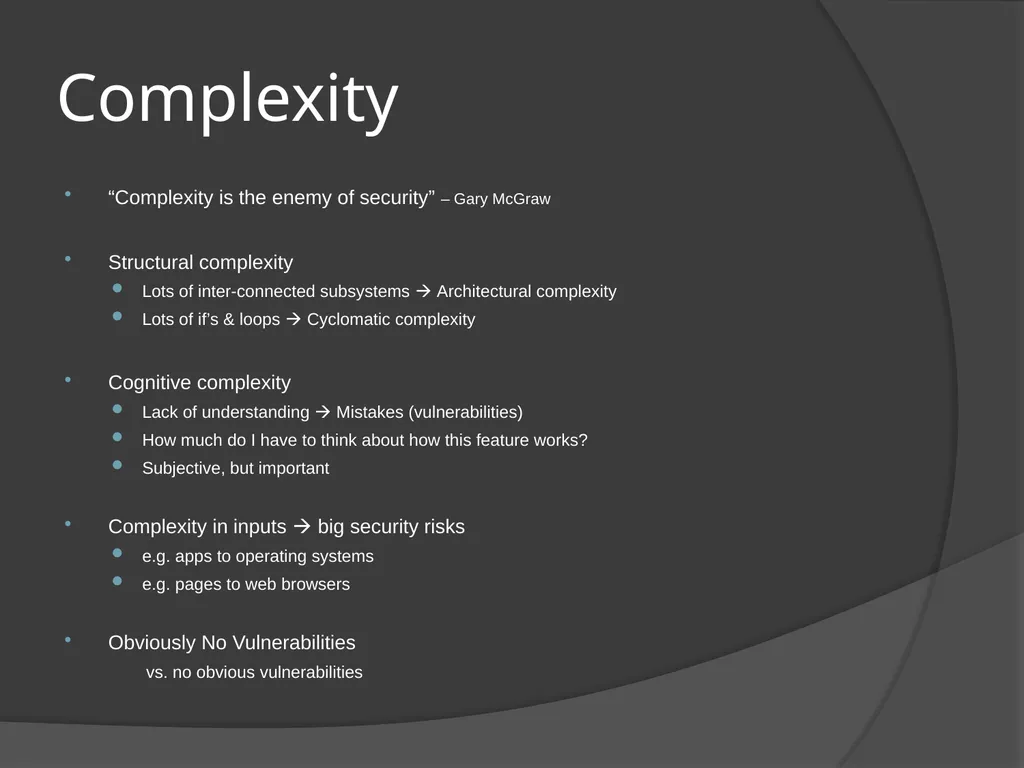
Complexity “Complexity is the enemy of security” – Gary McGraw
Structural complexity
Lots of inter-connected subsystems Architectural complexity
Lots of if’s & loops Cyclomatic complexity
Cognitive complexity
Lack of understanding Mistakes (vulnerabilities)
How much do I have to think about how this feature works?
Subjective, but important
Complexity in inputs big security risks
e.g. apps to operating systems
e.g. pages to web browsers
Obviously No Vulnerabilities
vs. no obvious vulnerabilities<br>
05
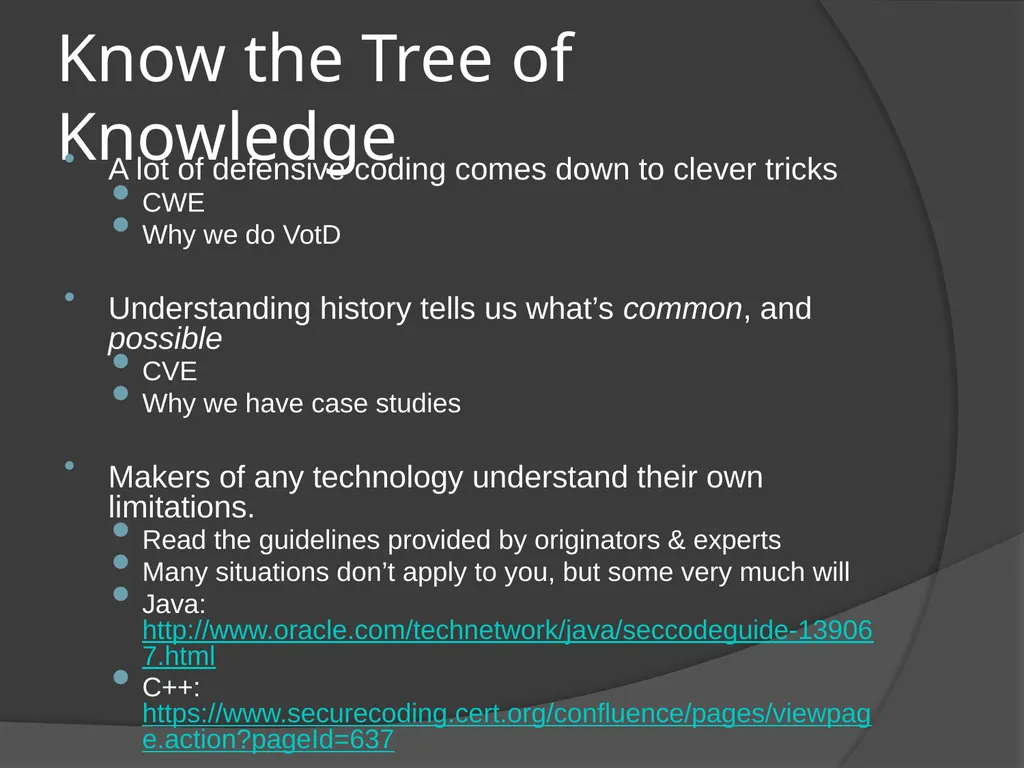
Know the Tree of Knowledge A lot of defensive coding comes down to clever tricks
CWE
Why we do VotD
Understanding history tells us what’s common, and possible
CVE
Why we have case studies
Makers of any technology understand their own limitations.
Read the guidelines provided by originators & experts
Many situations don’t apply to you, but some very much will
Java: http://www.oracle.com/technetwork/java/seccodeguide-139067.html
C++: https://www.securecoding.cert.org/confluence/pages/viewpage.action?pageId=637<br>
06
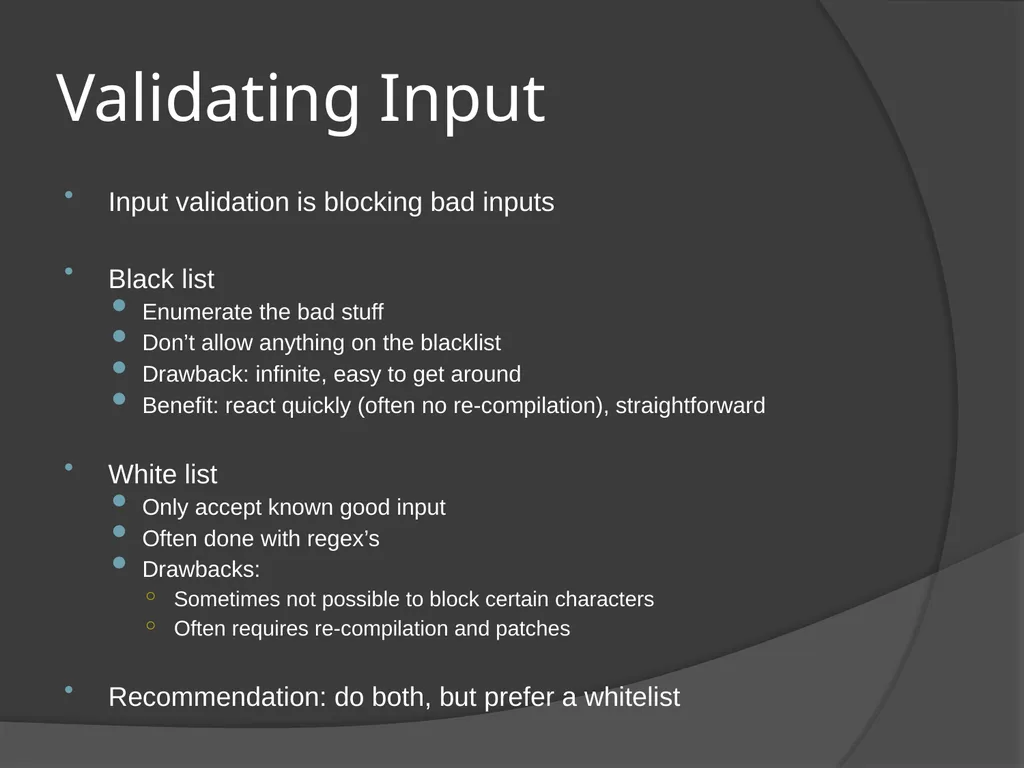
Validating Input Input validation is blocking bad inputs
Black list
Enumerate the bad stuff
Don’t allow anything on the blacklist
Drawback: infinite, easy to get around
Benefit: react quickly (often no re-compilation), straightforward
White list
Only accept known good input
Often done with regex’s
Drawbacks:
Sometimes not possible to block certain characters
Often requires re-compilation and patches
Recommendation: do both, but prefer a whitelist<br>
07
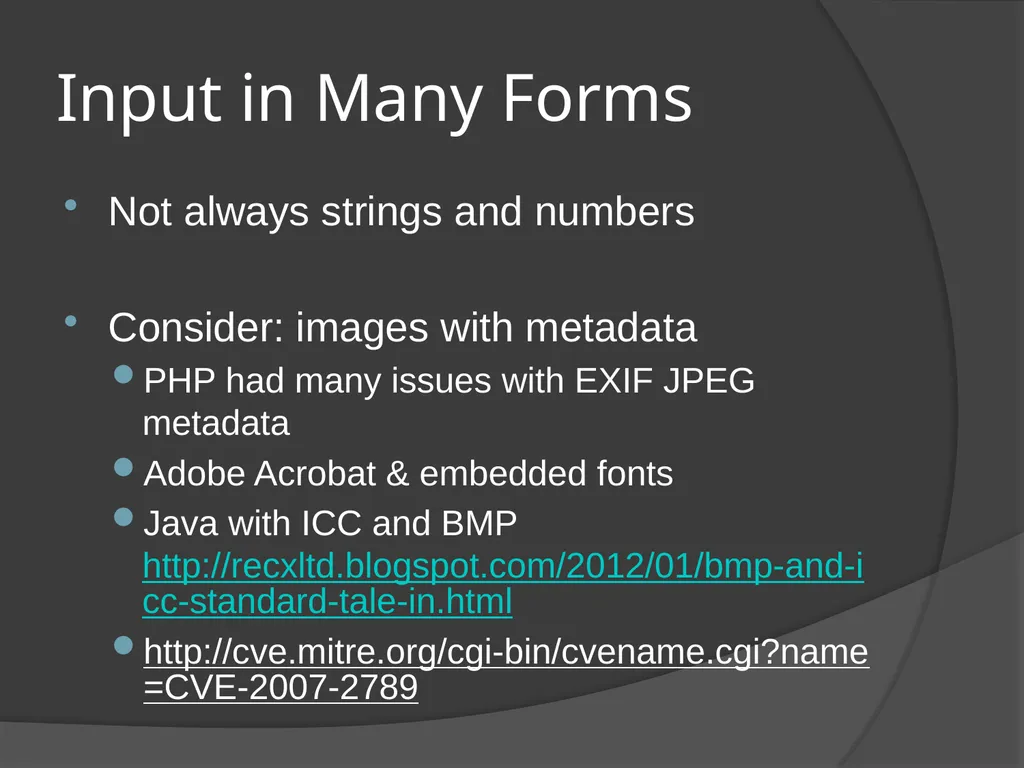
Input in Many Forms Not always strings and numbers
Consider: images with metadata
PHP had many issues with EXIF JPEG metadata
Adobe Acrobat & embedded fonts
Java with ICC and BMP http://recxltd.blogspot.com/2012/01/bmp-and-icc-standard-tale-in.html
http://cve.mitre.org/cgi-bin/cvename.cgi?name=CVE-2007-2789<br>
08
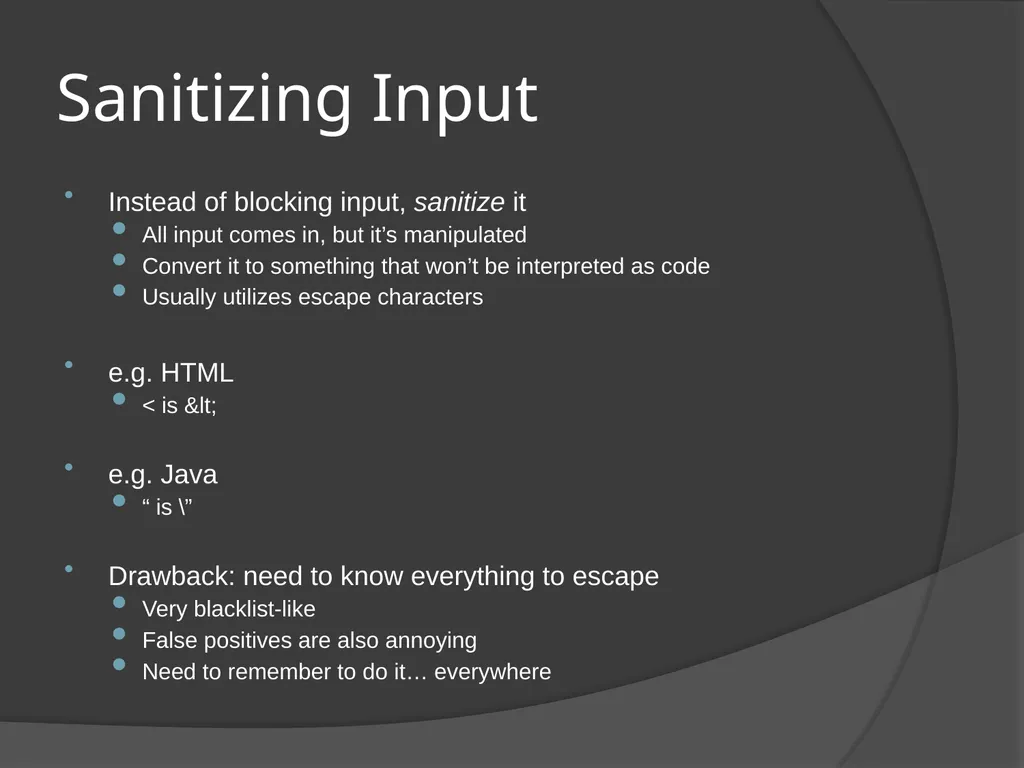
Sanitizing Input Instead of blocking input, sanitize it
All input comes in, but it’s manipulated
Convert it to something that won’t be interpreted as code
Usually utilizes escape characters
e.g. HTML
< is <
e.g. Java
“ is \”
Drawback: need to know everything to escape
Very blacklist-like
False positives are also annoying
Need to remember to do it… everywhere<br>
09
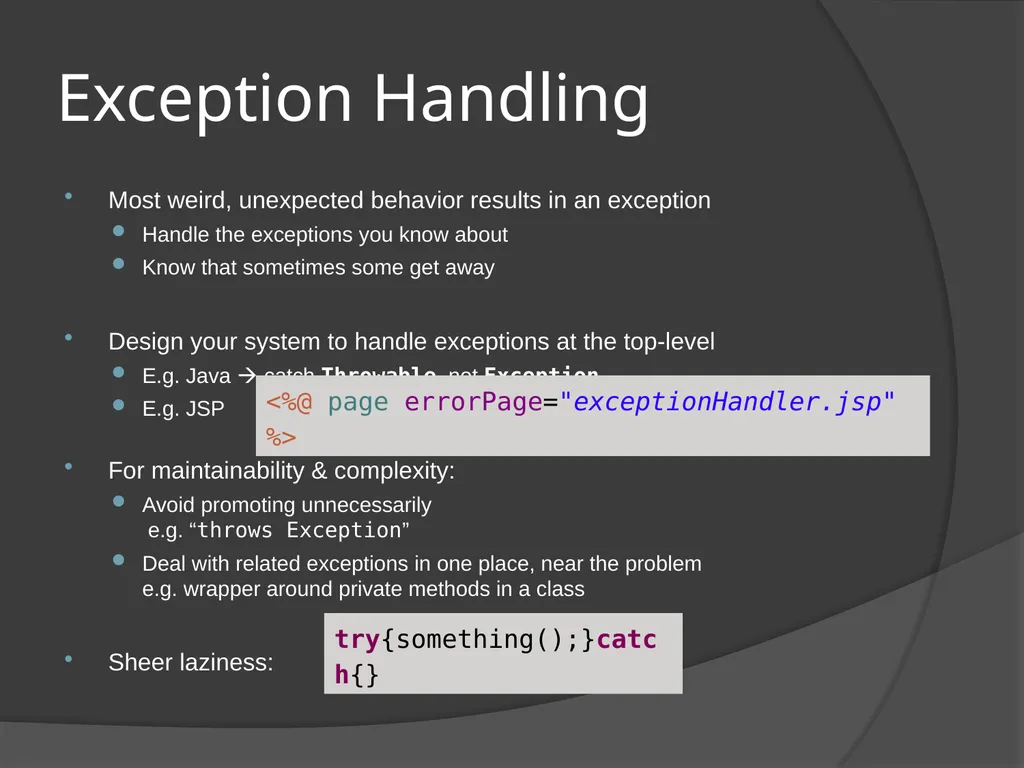
Exception Handling Most weird, unexpected behavior results in an exception
Handle the exceptions you know about
Know that sometimes some get away
Design your system to handle exceptions at the top-level
E.g. Java catch Throwable, not Exception
E.g. JSP
For maintainability & complexity:
Avoid promoting unnecessarily e.g. “throws Exception”
Deal with related exceptions in one place, near the problem e.g. wrapper around private methods in a class
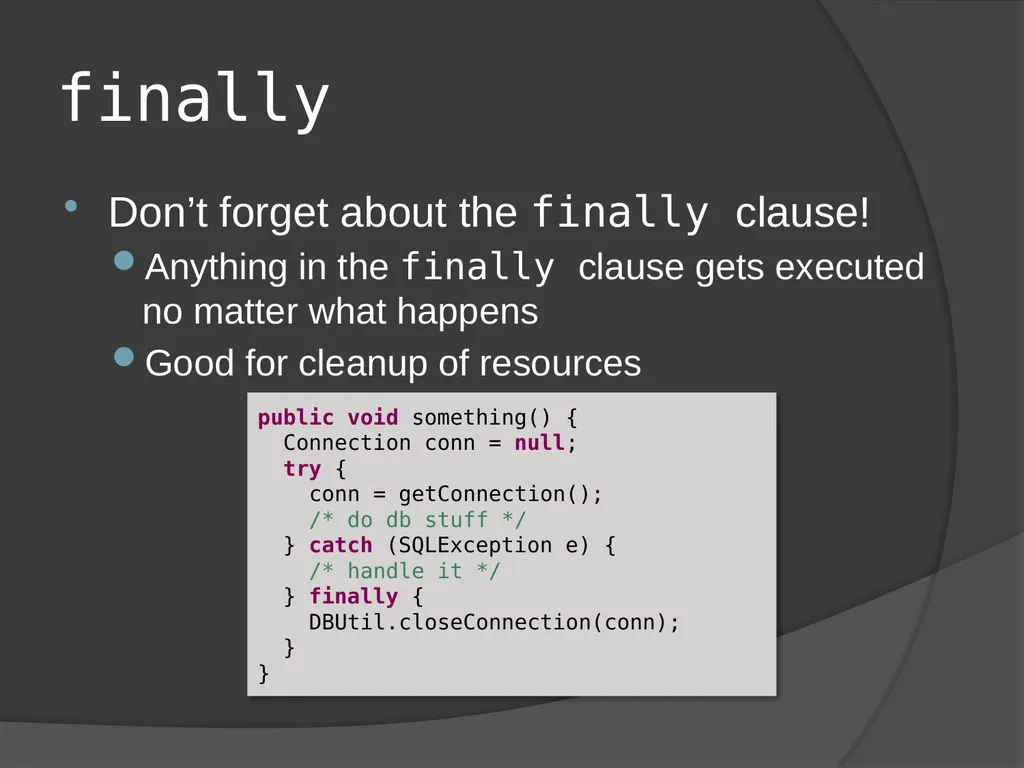
finally Don’t forget about the finally clause!
Anything in the finally clause gets executed no matter what happens
Good for cleanup of resources public void something() {
Connection conn = null;
try {
conn = getConnection();
/* do db stuff */
} catch (SQLException e) {
/* handle it */
} finally {
DBUtil.closeConnection(conn);
}
}<br>
11
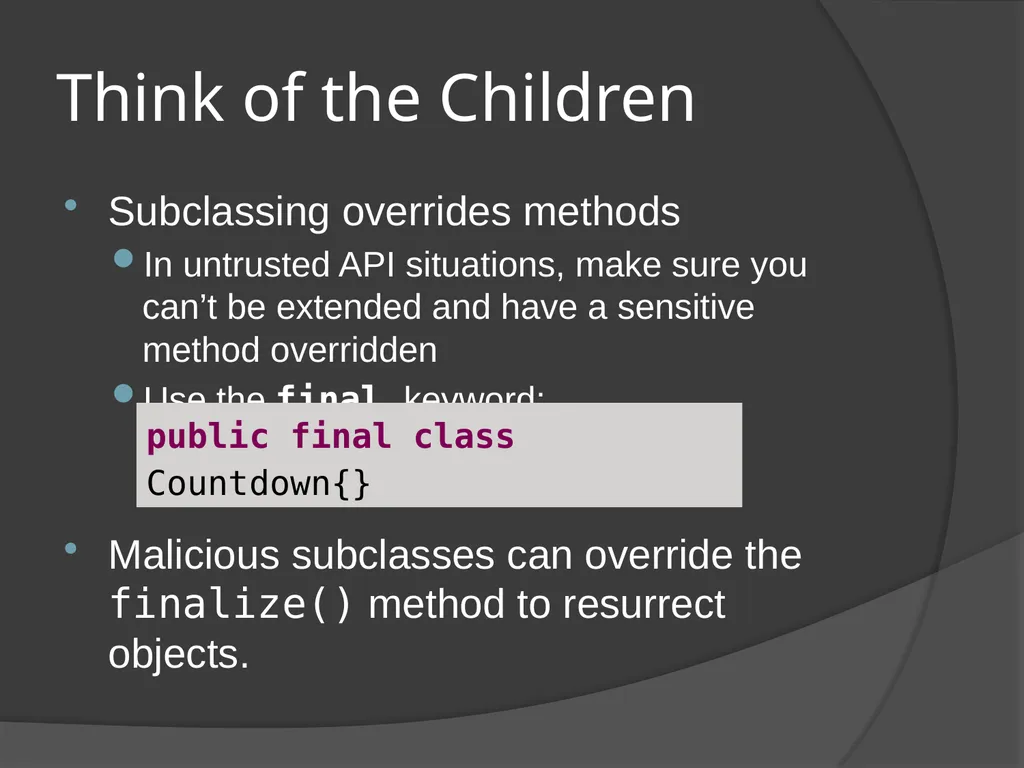
Think of the Children Subclassing overrides methods
In untrusted API situations, make sure you can’t be extended and have a sensitive method overridden
Use the final keyword:
Malicious subclasses can override the finalize() method to resurrect objects. public final class Countdown{}<br>
12
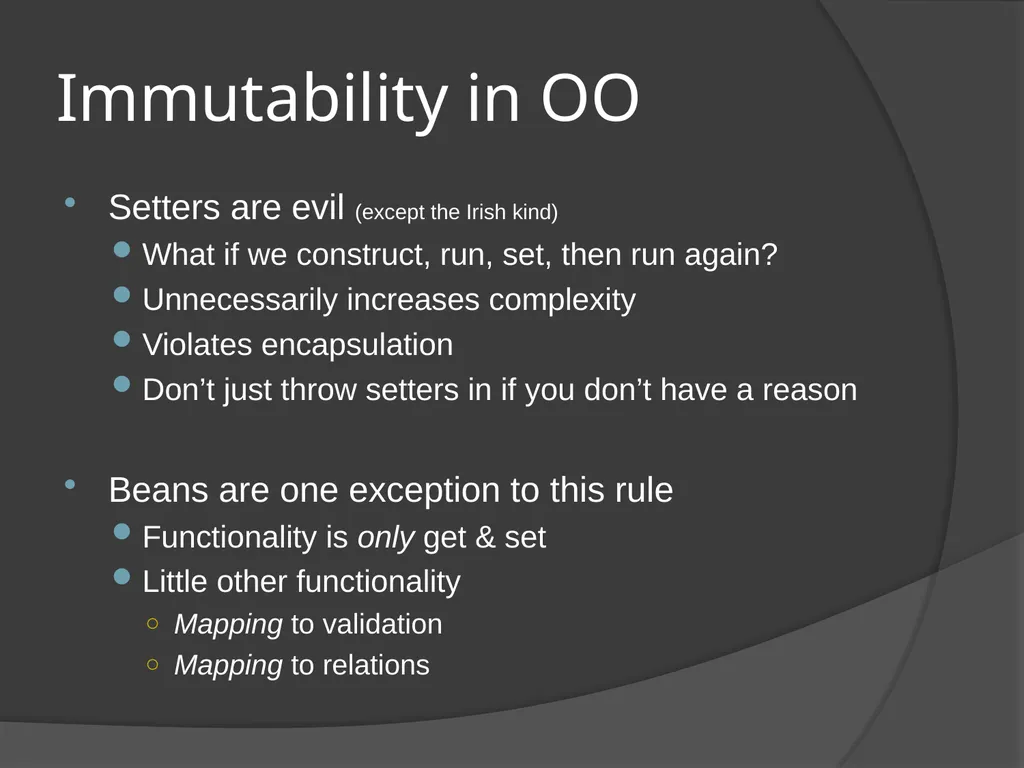
Immutability in OO Setters are evil (except the Irish kind)
What if we construct, run, set, then run again?
Unnecessarily increases complexity
Violates encapsulation
Don’t just throw setters in if you don’t have a reason
Beans are one exception to this rule
Functionality is only get & set
Little other functionality
Mapping to validation
Mapping to relations<br>
13
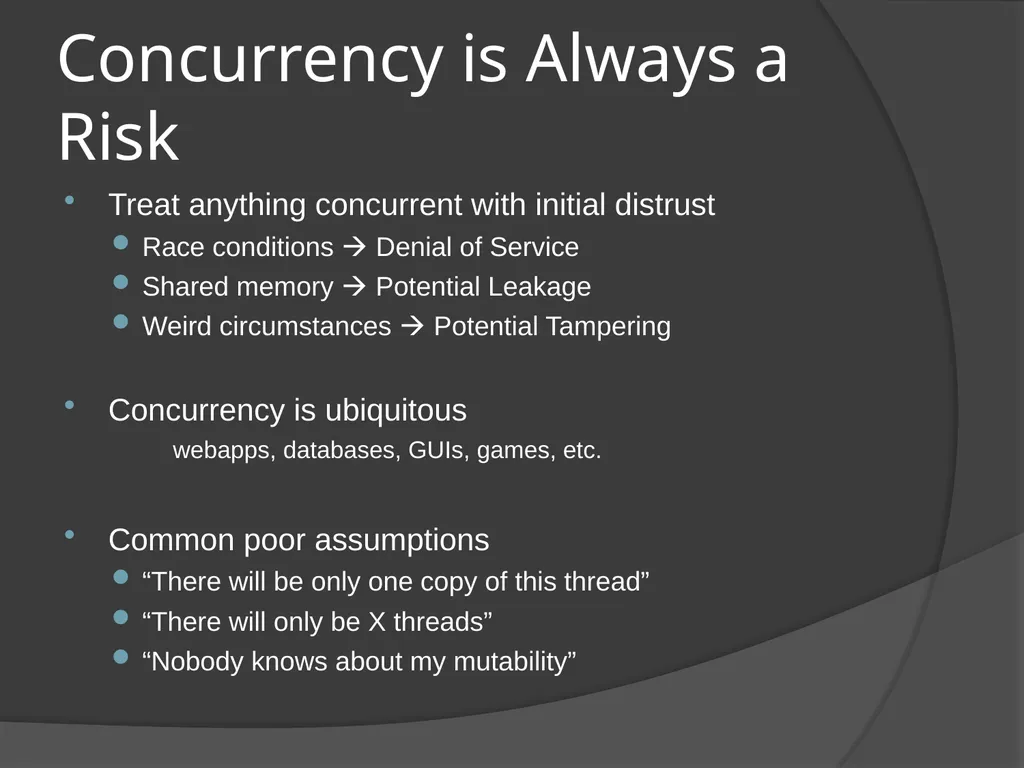
Concurrency is Always a Risk Treat anything concurrent with initial distrust
Race conditions Denial of Service
Shared memory Potential Leakage
Weird circumstances Potential Tampering
Concurrency is ubiquitous webapps, databases, GUIs, games, etc.
Common poor assumptions
“There will be only one copy of this thread”
“There will only be X threads”
“Nobody knows about my mutability”<br>
14
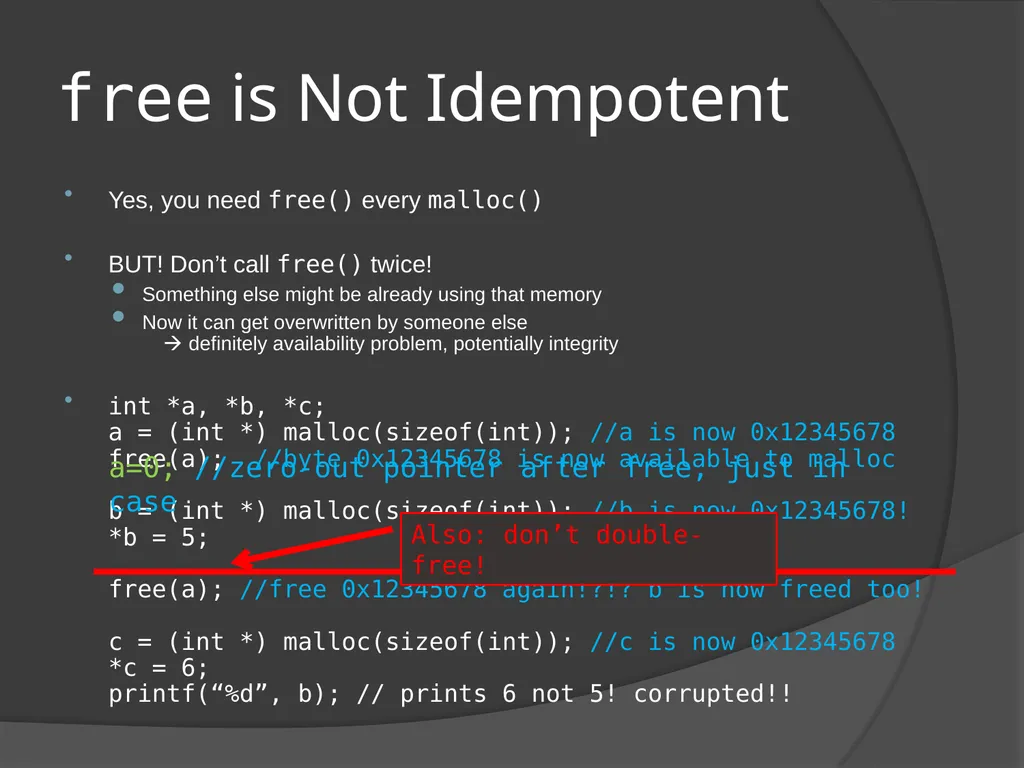
free is Not Idempotent Yes, you need free() every malloc()
BUT! Don’t call free() twice!
Something else might be already using that memory
Now it can get overwritten by someone else definitely availability problem, potentially integrity
int *a, *b, *c; a = (int *) malloc(sizeof(int)); //a is now 0x12345678 free(a); //byte 0x12345678 is now available to malloc b = (int *) malloc(sizeof(int)); //b is now 0x12345678! *b = 5; free(a); //free 0x12345678 again!?!? b is now freed too! c = (int *) malloc(sizeof(int)); //c is now 0x12345678 *c = 6; printf(“%d”, b); // prints 6 not 5! corrupted!! a=0; //zero-out pointer after free, just in case<br>