
Defining Data Driven Needs for the Project Purpose
Description: Defining Data Driven Needs for the Project Purpose 2017 Partnering Conference August 16, 2017 Walter Jeffery Moore, AICP Senior Planner Neel-Schaffer, Inc. Your Assignment to draft a Purpose Need Statement feels like: Define the
Related Topics
Download Presentation
"Defining Data Driven Needs for the Project Purpose" is the property of its rightful owner. Permission is granted to download and print the materials on this website for personal, non-commercial use only, and to display it on your personal computer provided you do not modify the materials and that you retain all copyright notices contained in the materials. By downloading content from our website, you accept the terms of this agreement.
Presentation Transcript
slide1. Defining Data Driven Needs for the Project Purpose
2017 Partnering Conference
August 16, 2017 Walter Jeffery Moore, AICP
Senior Planner
Neel-Schaffer, Inc.<br>
slide2. Your Assignment to draft a Purpose & Need Statement feels like: Define the “universe”
& give two examples.<br>
slide3. Agenda The What of a P&N Statement?
The Why of a P&N Statement?
The P&N Building Blocks
Using Your Words: The Language of Purpose<br>
slide4. A clear & concise message directed to the public, officials, & consultants
The “battle cry” for the project; Consistent Message!
Included in the advertisement for Design or Planning Services
Included in meeting notices, invitation letters, media advisories, etc. WHAT is a P&N? A Tool for Communication<br>
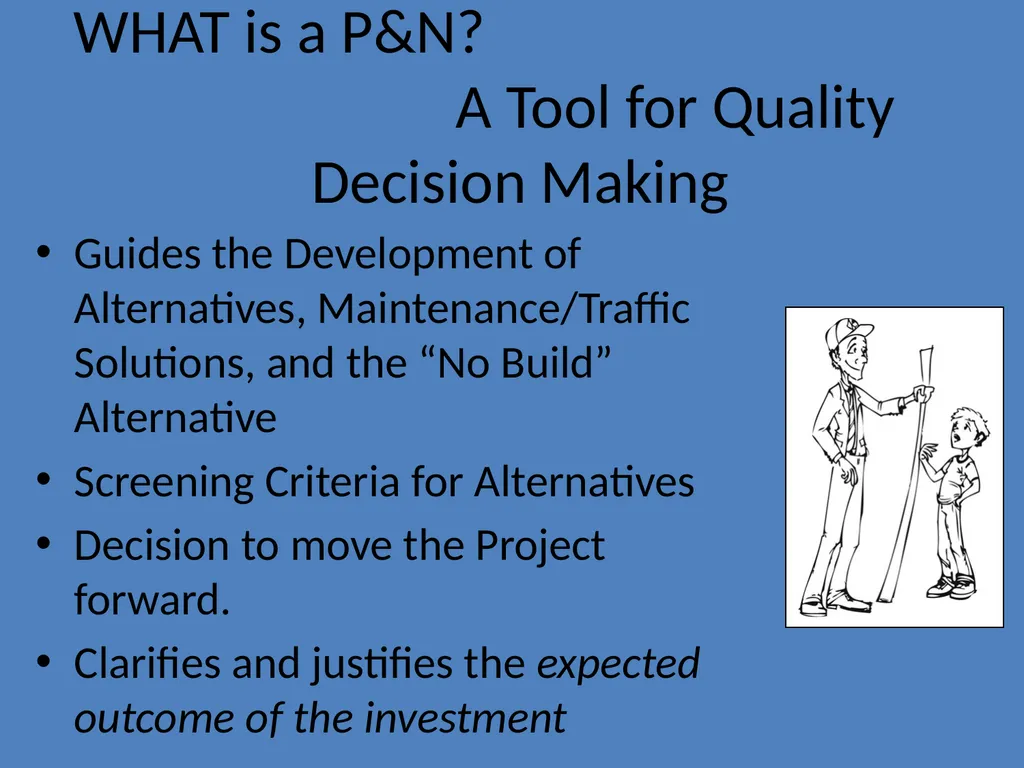
slide5. WHAT is a P&N? A Tool for Quality Decision Making Guides the Development of Alternatives, Maintenance/Traffic Solutions, and the “No Build” Alternative
Screening Criteria for Alternatives
Decision to move the Project forward.
Clarifies and justifies the expected outcome of the investment<br>
slide6. Legally required for projects that include NEPA documentation What is NEPA? The National Environmental Policy Act (NEPA) is a United States environmental law that promotes the enhancement of the environment and established the President's Council on Environmental Quality (CEQ). The law was enacted on January 1, 1970. As the bill was an early step towards the development of the United States's environmental policy.
The Legal Guidance for Purpose & Need Statements comes from NEPA CEQ regulation, Section 1502.13.
“…shall briefly specify the underlying purpose and need to which the agency is responding in proposing alternatives including the proposed action.”<br>
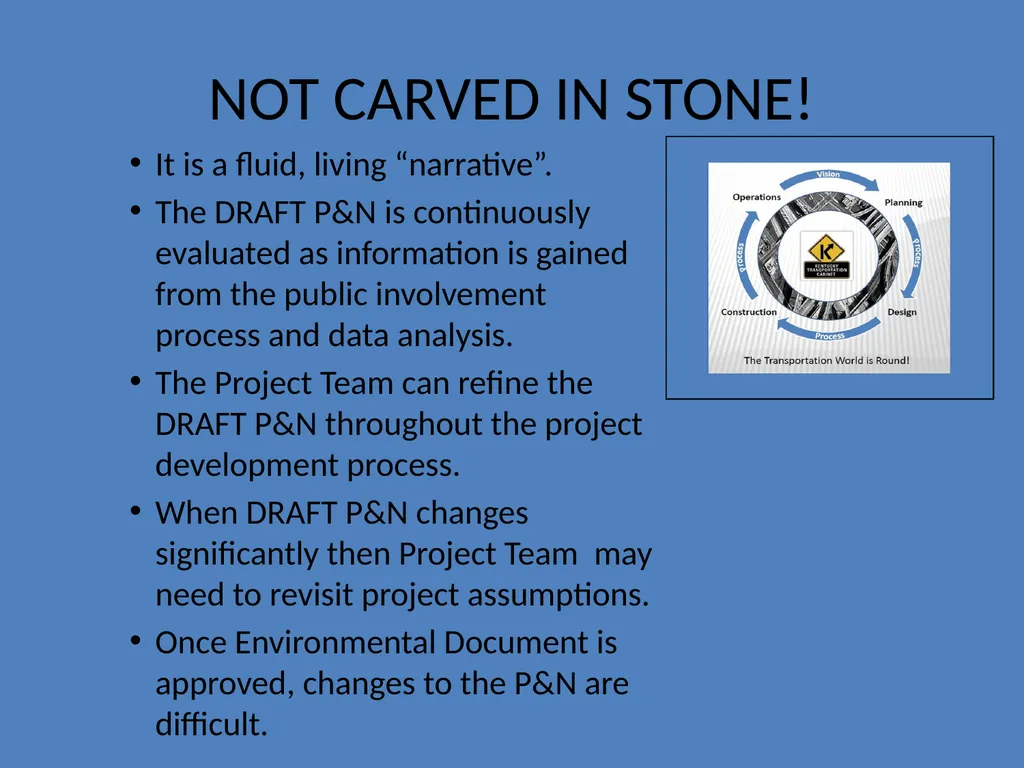
slide7. NOT CARVED IN STONE! It is a fluid, living “narrative”.
The DRAFT P&N is continuously evaluated as information is gained from the public involvement process and data analysis.
The Project Team can refine the DRAFT P&N throughout the project development process.
When DRAFT P&N changes significantly then Project Team may need to revisit project assumptions.
Once Environmental Document is approved, changes to the P&N are difficult.<br>
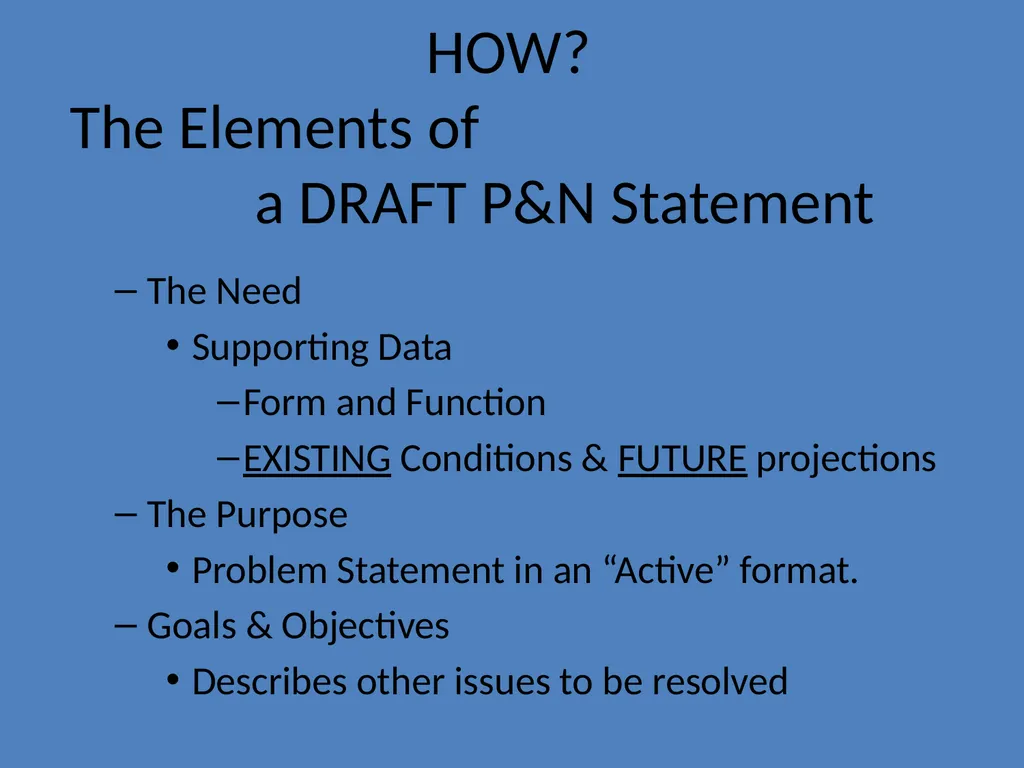
slide8. HOW? The Elements of a DRAFT P&N Statement The Need
Supporting Data
Form and Function
EXISTING Conditions & FUTURE projections
The Purpose
Problem Statement in an “Active” format.
Goals & Objectives
Describes other issues to be resolved<br>
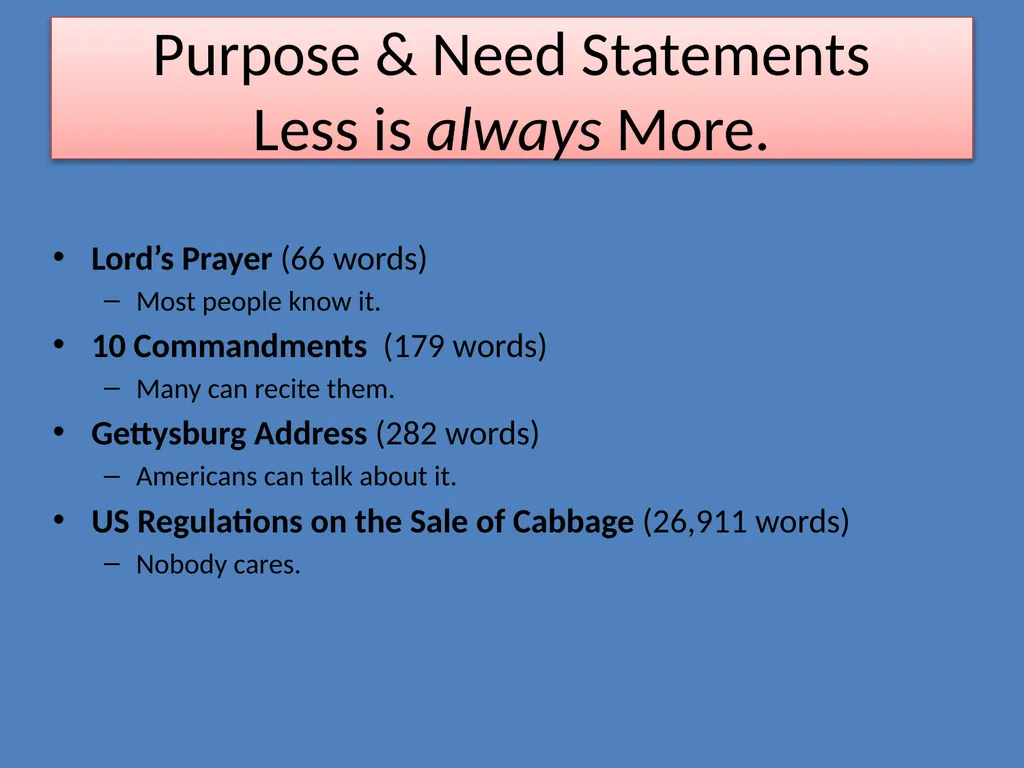
slide9. Purpose & Need Statements Less is always More. Lord’s Prayer (66 words)
Most people know it.
10 Commandments (179 words)
Many can recite them.
Gettysburg Address (282 words)
Americans can talk about it.
US Regulations on the Sale of Cabbage (26,911 words)
Nobody cares.<br>
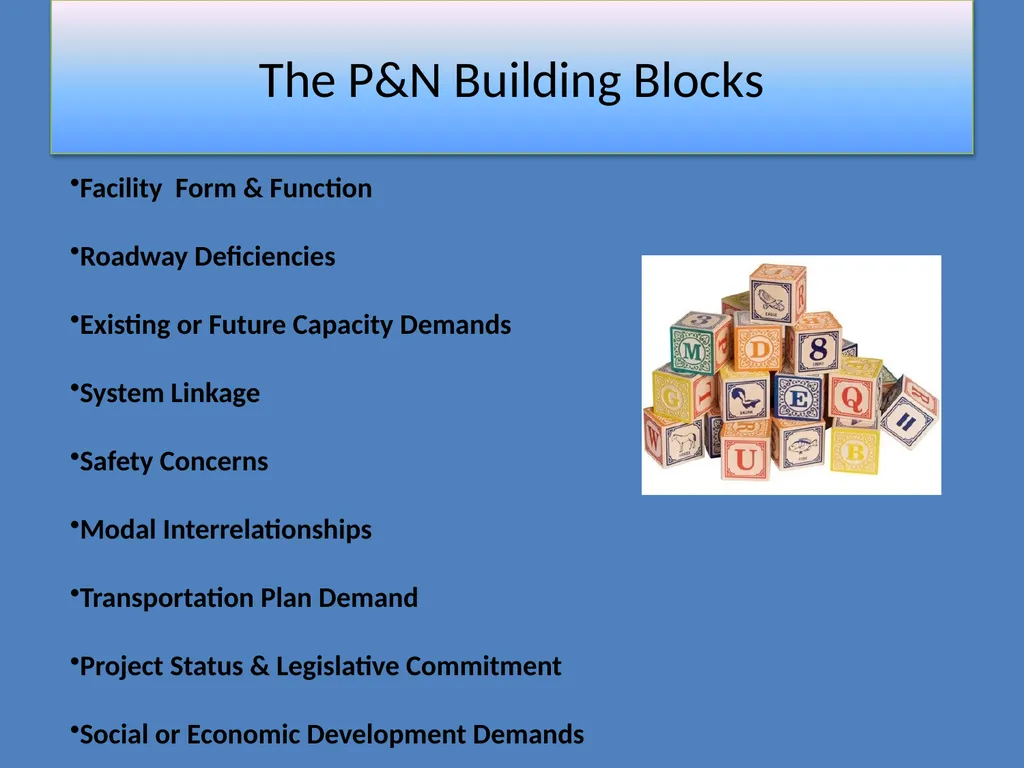
slide10. The P&N Building Blocks Facility Form & Function
Roadway Deficiencies
Existing or Future Capacity Demands
System Linkage
Safety Concerns
Modal Interrelationships
Transportation Plan Demand
Project Status & Legislative Commitment
Social or Economic Development Demands<br>
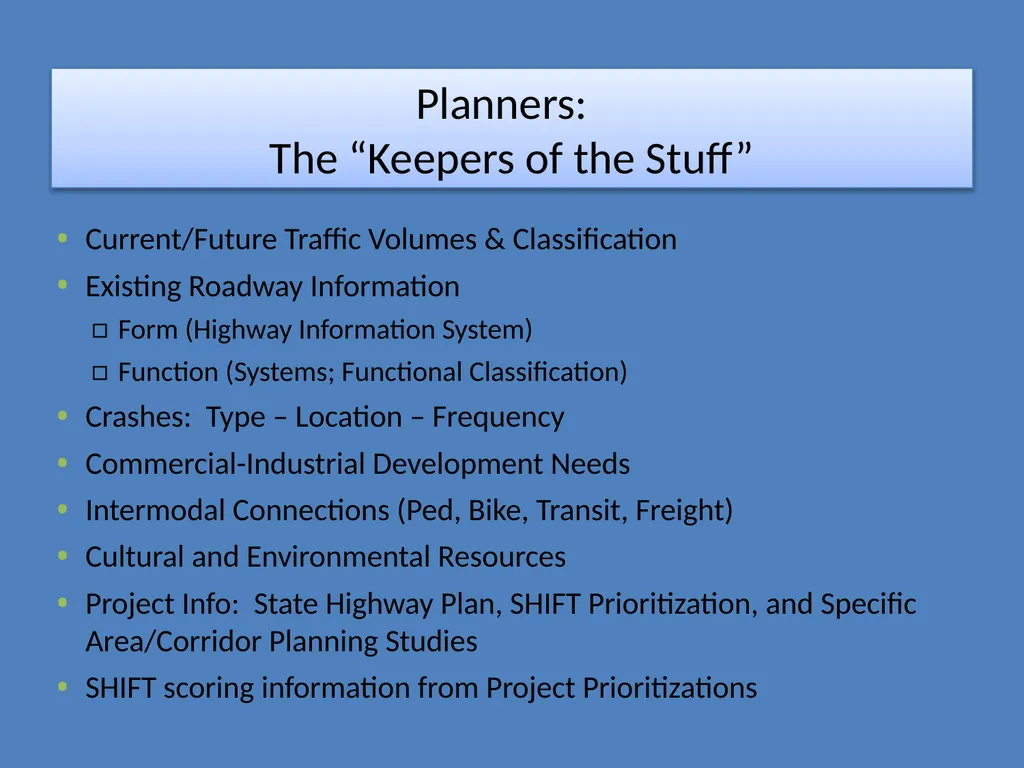
slide11. Planners: The “Keepers of the Stuff” Current/Future Traffic Volumes & Classification
Existing Roadway Information
Form (Highway Information System)
Function (Systems; Functional Classification)
Crashes: Type – Location – Frequency
Commercial-Industrial Development Needs
Intermodal Connections (Ped, Bike, Transit, Freight)
Cultural and Environmental Resources
Project Info: State Highway Plan, SHIFT Prioritization, and Specific Area/Corridor Planning Studies
SHIFT scoring information from Project Prioritizations<br>
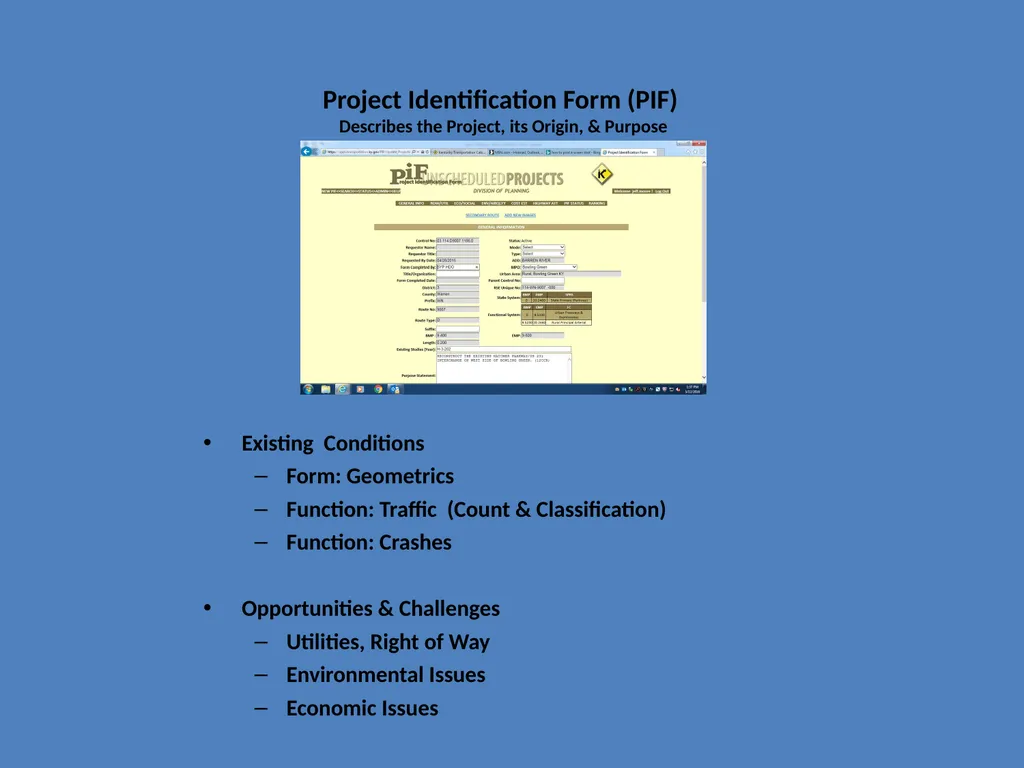
slide12. Project Identification Form (PIF) Describes the Project, its Origin, & Purpose Existing Conditions
Form: Geometrics
Function: Traffic (Count & Classification)
Function: Crashes
Opportunities & Challenges
Utilities, Right of Way
Environmental Issues
Economic Issues<br>
slide13. The Flow of the P&N Project Identification Form (PIF)
Data Needs Analysis (DNA)
Design Executive Summary (DES)
Environmental Documents (CE, EA, EIS)<br>
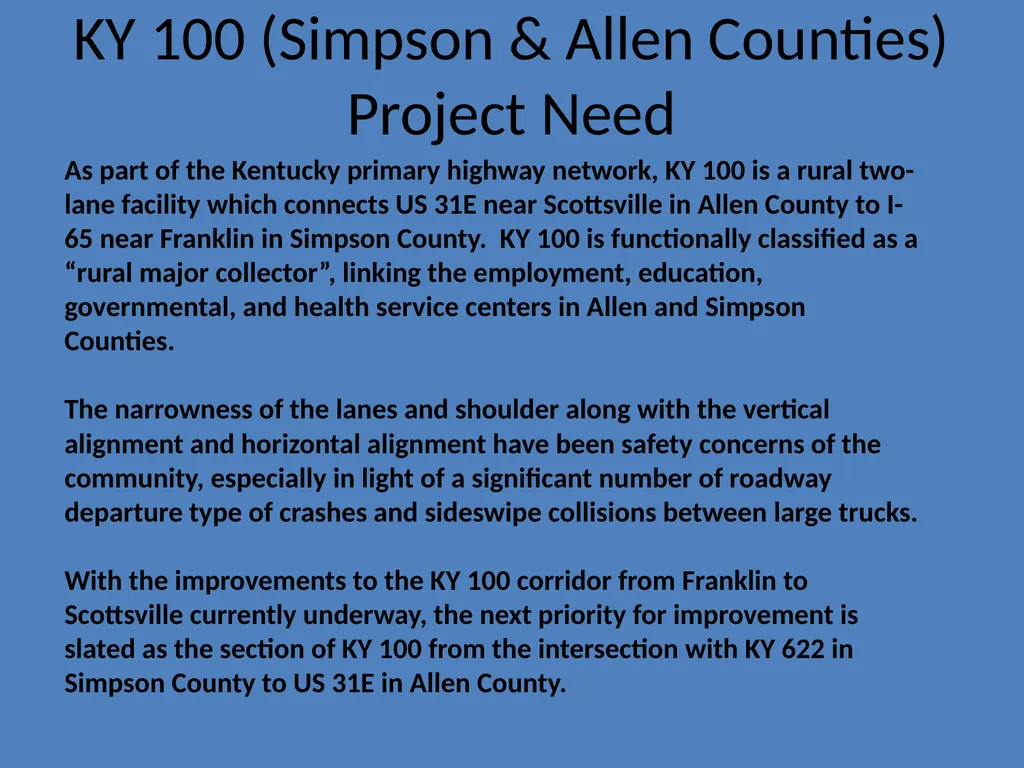
slide14. KY 100 (Simpson & Allen Counties) Project Need As part of the Kentucky primary highway network, KY 100 is a rural two-lane facility which connects US 31E near Scottsville in Allen County to I-65 near Franklin in Simpson County. KY 100 is functionally classified as a “rural major collector”, linking the employment, education, governmental, and health service centers in Allen and Simpson Counties.
The narrowness of the lanes and shoulder along with the vertical alignment and horizontal alignment have been safety concerns of the community, especially in light of a significant number of roadway departure type of crashes and sideswipe collisions between large trucks.
With the improvements to the KY 100 corridor from Franklin to Scottsville currently underway, the next priority for improvement is slated as the section of KY 100 from the intersection with KY 622 in Simpson County to US 31E in Allen County.<br>
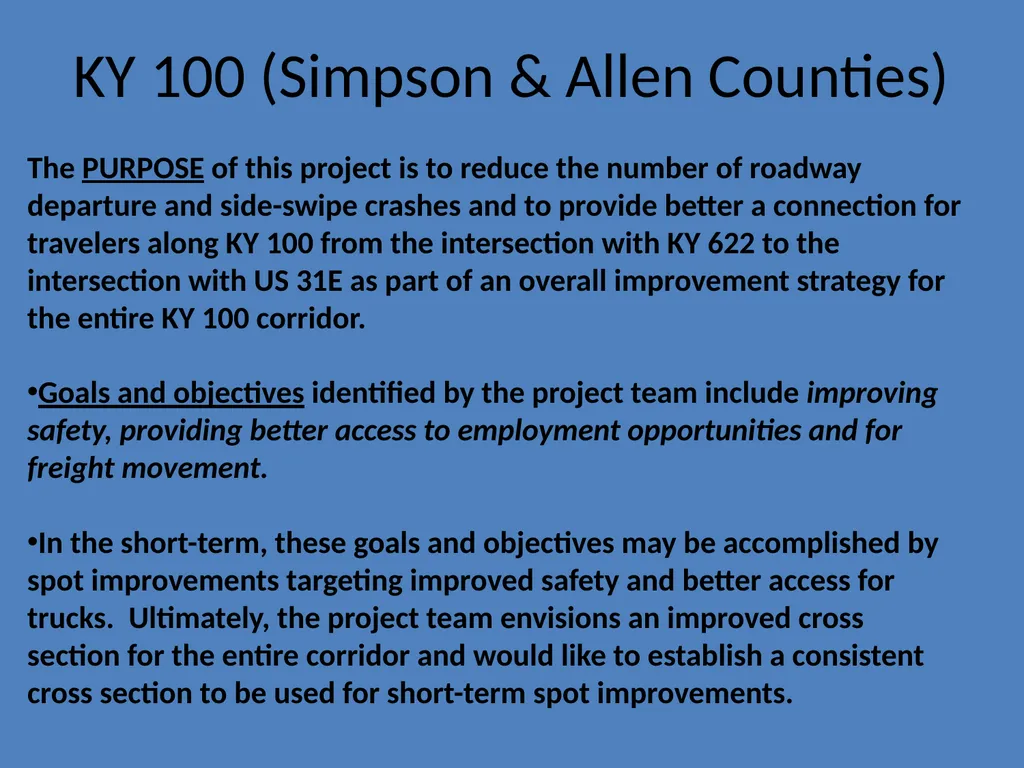
slide15. KY 100 (Simpson & Allen Counties) The PURPOSE of this project is to reduce the number of roadway departure and side-swipe crashes and to provide better a connection for travelers along KY 100 from the intersection with KY 622 to the intersection with US 31E as part of an overall improvement strategy for the entire KY 100 corridor.
Goals and objectives identified by the project team include improving safety, providing better access to employment opportunities and for freight movement.
In the short-term, these goals and objectives may be accomplished by spot improvements targeting improved safety and better access for trucks. Ultimately, the project team envisions an improved cross section for the entire corridor and would like to establish a consistent cross section to be used for short-term spot improvements.<br>
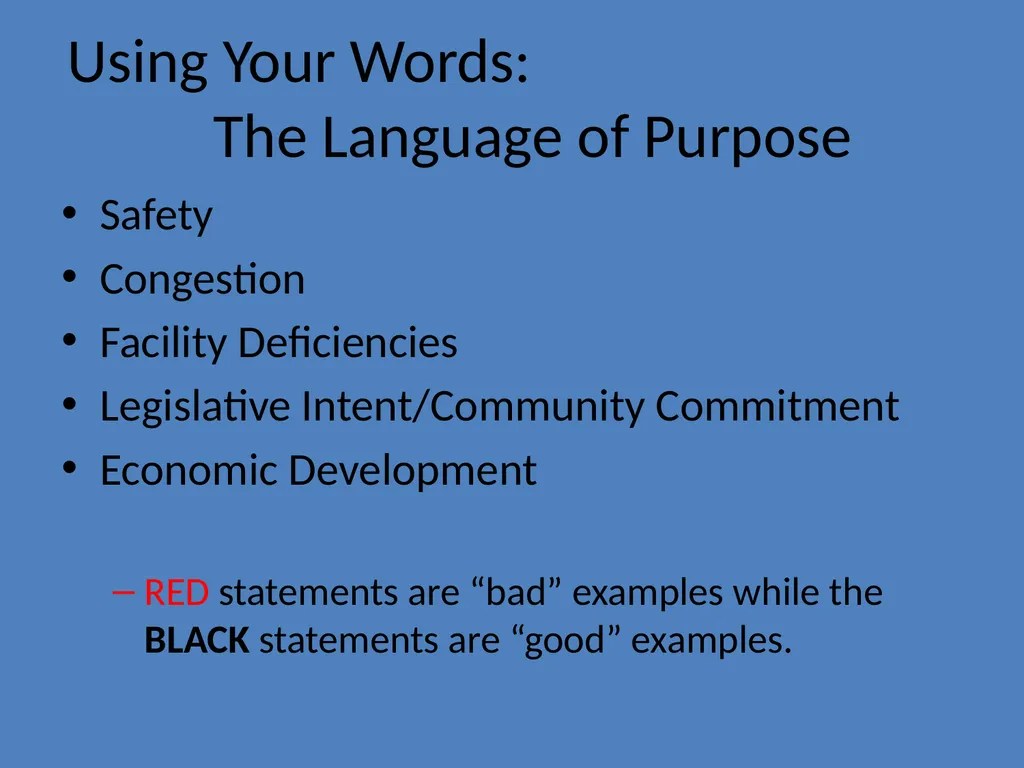
slide16. Using Your Words: The Language of Purpose Safety
Congestion
Facility Deficiencies
Legislative Intent/Community Commitment
Economic Development
RED statements are “bad” examples while the BLACK statements are “good” examples.<br>
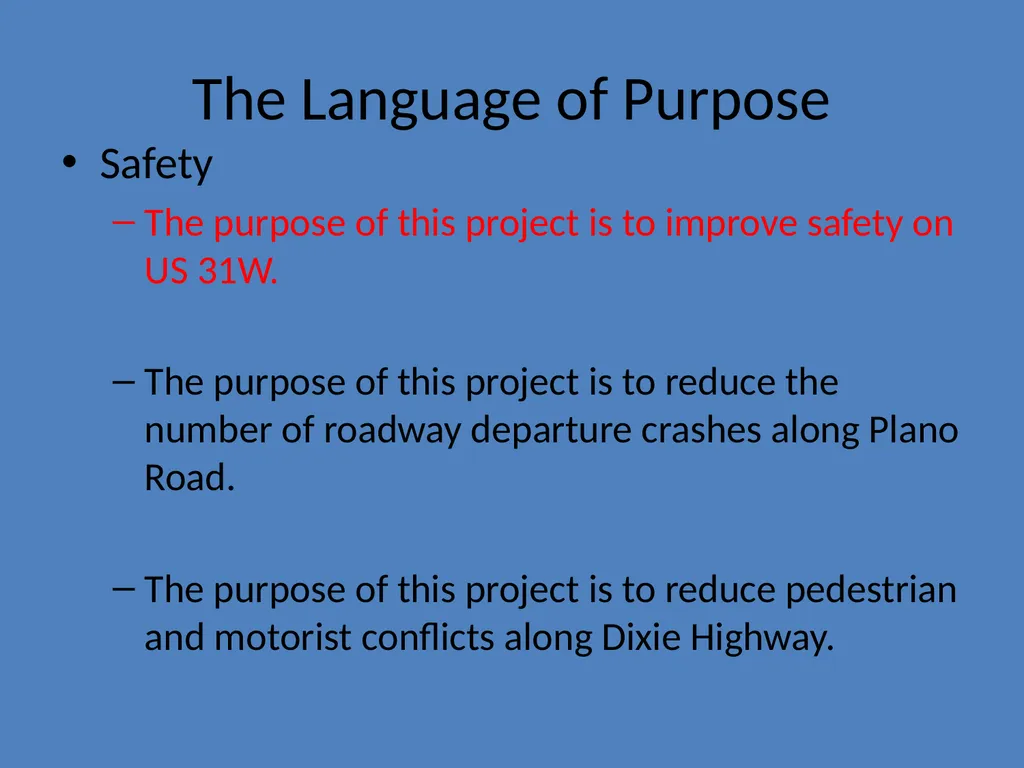
slide17. The Language of Purpose Safety
The purpose of this project is to improve safety on US 31W.
The purpose of this project is to reduce the number of roadway departure crashes along Plano Road.
The purpose of this project is to reduce pedestrian and motorist conflicts along Dixie Highway.<br>
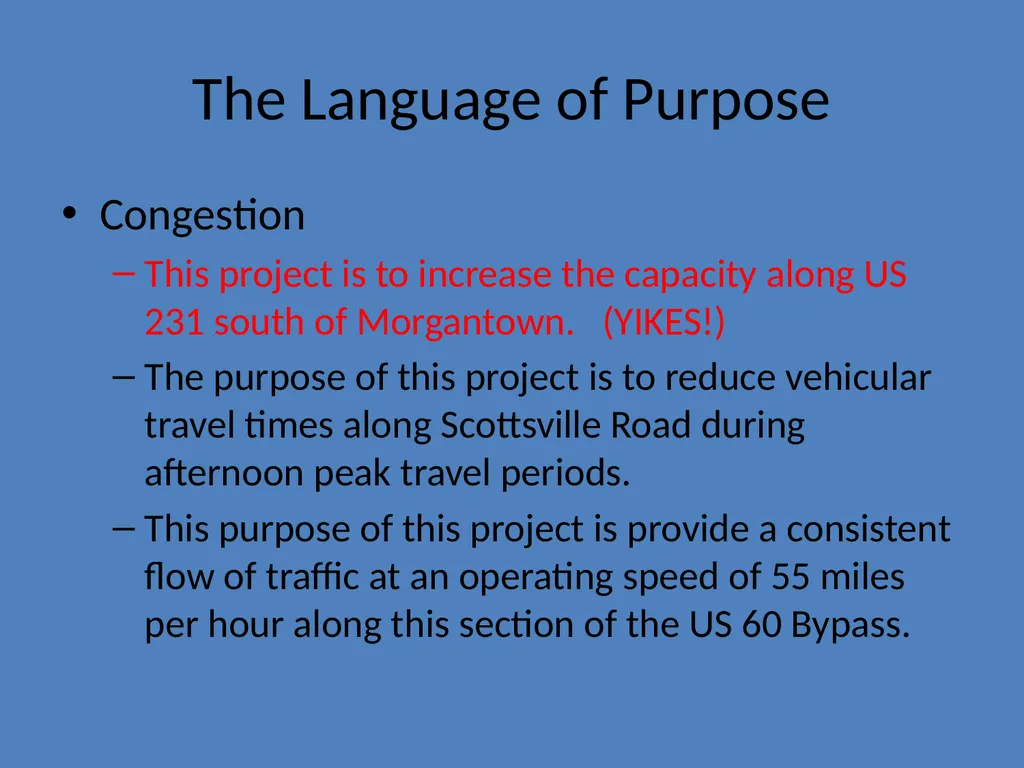
slide18. The Language of Purpose Congestion
This project is to increase the capacity along US 231 south of Morgantown. (YIKES!)
The purpose of this project is to reduce vehicular travel times along Scottsville Road during afternoon peak travel periods.
This purpose of this project is provide a consistent flow of traffic at an operating speed of 55 miles per hour along this section of the US 60 Bypass.<br>
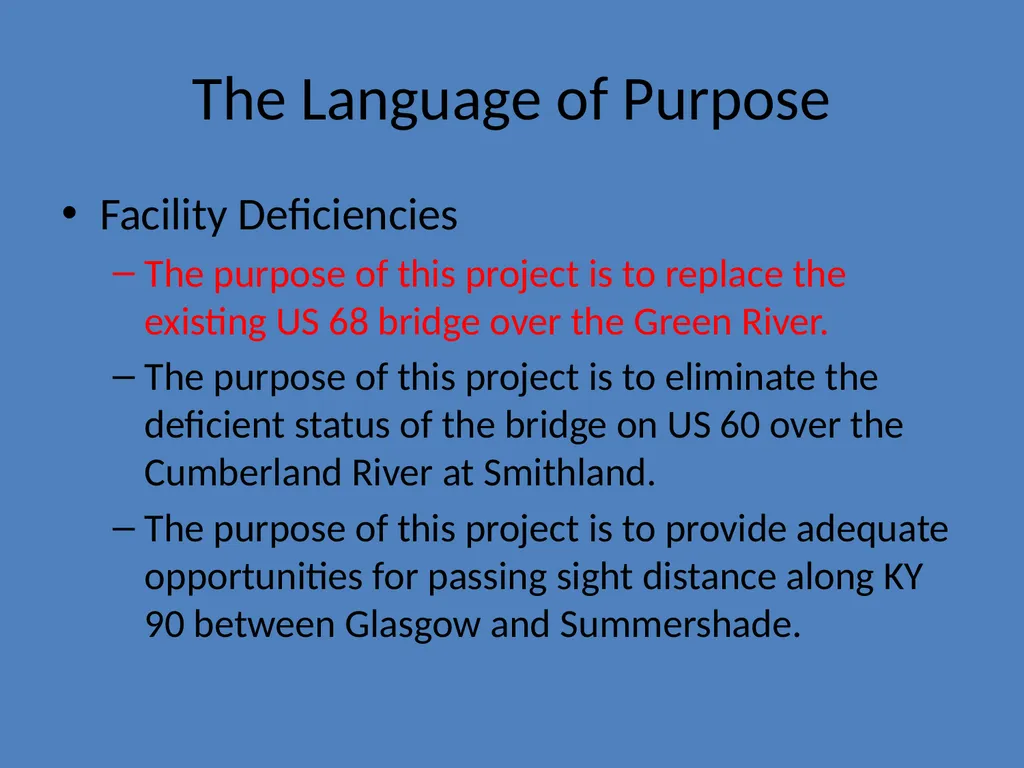
slide19. The Language of Purpose Facility Deficiencies
The purpose of this project is to replace the existing US 68 bridge over the Green River.
The purpose of this project is to eliminate the deficient status of the bridge on US 60 over the Cumberland River at Smithland.
The purpose of this project is to provide adequate opportunities for passing sight distance along KY 90 between Glasgow and Summershade.<br>
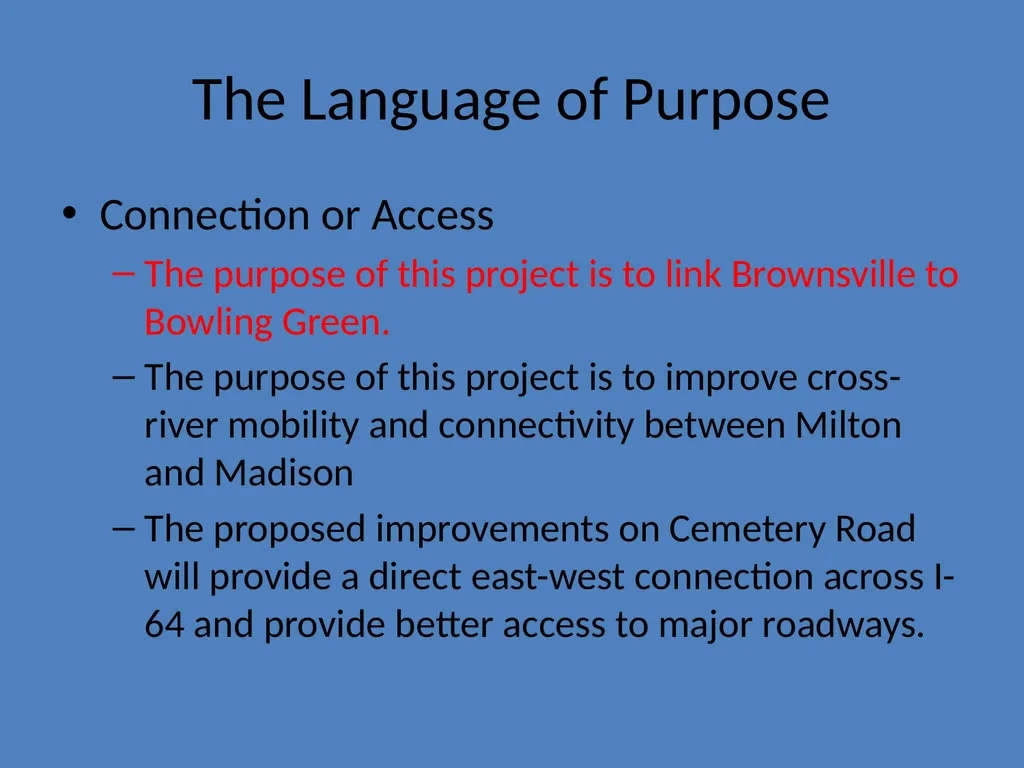
slide20. The Language of Purpose Connection or Access
The purpose of this project is to link Brownsville to Bowling Green.
The purpose of this project is to improve cross-river mobility and connectivity between Milton and Madison
The proposed improvements on Cemetery Road will provide a direct east-west connection across I-64 and provide better access to major roadways.<br>
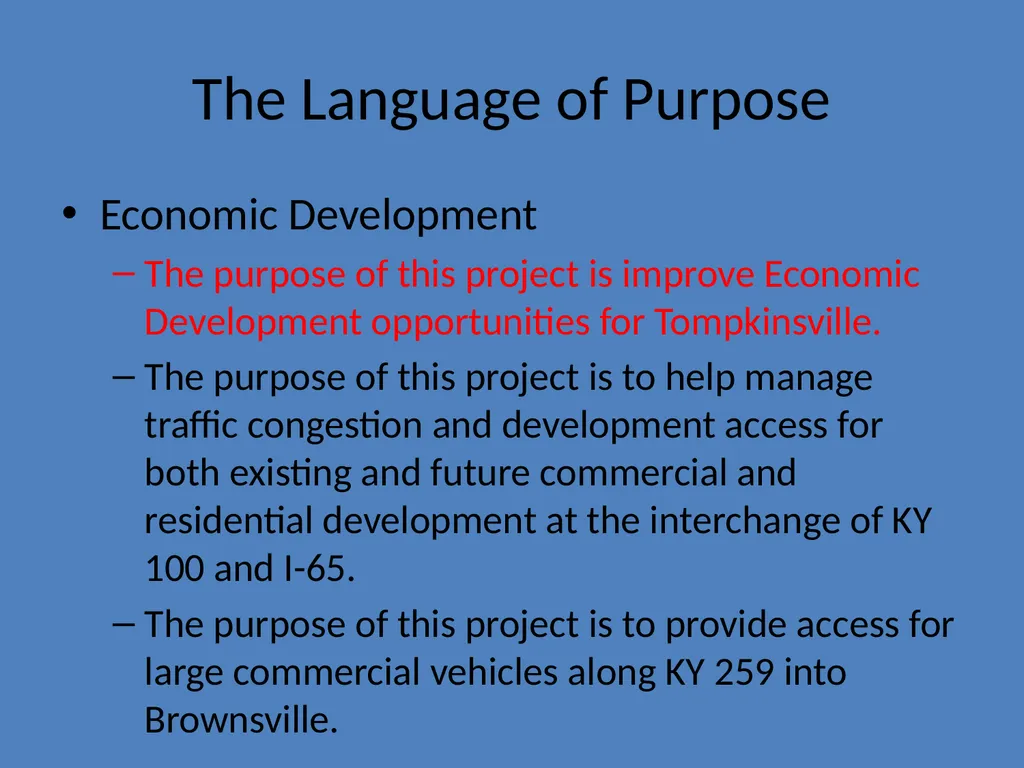
slide21. The Language of Purpose Economic Development
The purpose of this project is improve Economic Development opportunities for Tompkinsville.
The purpose of this project is to help manage traffic congestion and development access for both existing and future commercial and residential development at the interchange of KY 100 and I-65.
The purpose of this project is to provide access for large commercial vehicles along KY 259 into Brownsville.<br>
slide22. KYTC P&N Guidance Design Memo from 2005 (http://transportation.ky.gov/Highway-Design/Documents/Purpose%20and%20Need%20Statement%20Guidance%20and%20Instructions.pdf)
Instructions in the Highway Design Policy Guide (http://transportation.ky.gov/Highway-Design/Highway%20Design%20Manual%202015/HD-200.pdf, chapter 202.6.1) also in HD103 (Key Decision Points).<br>
slide23. Walter Jeffery Moore, AICP
Senior Planner
Neel-Schaffer, Inc.
Jeff.moore@neel-schaffer.com Any Questions?<br>
Senior Planner
Neel-Schaffer, Inc.<br>
slide2. Your Assignment to draft a Purpose & Need Statement feels like: Define the “universe”
& give two examples.<br>
slide3. Agenda The What of a P&N Statement?
The Why of a P&N Statement?
The P&N Building Blocks
Using Your Words: The Language of Purpose<br>
slide4. A clear & concise message directed to the public, officials, & consultants
The “battle cry” for the project; Consistent Message!
Included in the advertisement for Design or Planning Services
Included in meeting notices, invitation letters, media advisories, etc. WHAT is a P&N? A Tool for Communication<br>
slide5. WHAT is a P&N? A Tool for Quality Decision Making Guides the Development of Alternatives, Maintenance/Traffic Solutions, and the “No Build” Alternative
Screening Criteria for Alternatives
Decision to move the Project forward.
Clarifies and justifies the expected outcome of the investment<br>
slide6. Legally required for projects that include NEPA documentation What is NEPA? The National Environmental Policy Act (NEPA) is a United States environmental law that promotes the enhancement of the environment and established the President's Council on Environmental Quality (CEQ). The law was enacted on January 1, 1970. As the bill was an early step towards the development of the United States's environmental policy.
The Legal Guidance for Purpose & Need Statements comes from NEPA CEQ regulation, Section 1502.13.
“…shall briefly specify the underlying purpose and need to which the agency is responding in proposing alternatives including the proposed action.”<br>
slide7. NOT CARVED IN STONE! It is a fluid, living “narrative”.
The DRAFT P&N is continuously evaluated as information is gained from the public involvement process and data analysis.
The Project Team can refine the DRAFT P&N throughout the project development process.
When DRAFT P&N changes significantly then Project Team may need to revisit project assumptions.
Once Environmental Document is approved, changes to the P&N are difficult.<br>
slide8. HOW? The Elements of a DRAFT P&N Statement The Need
Supporting Data
Form and Function
EXISTING Conditions & FUTURE projections
The Purpose
Problem Statement in an “Active” format.
Goals & Objectives
Describes other issues to be resolved<br>
slide9. Purpose & Need Statements Less is always More. Lord’s Prayer (66 words)
Most people know it.
10 Commandments (179 words)
Many can recite them.
Gettysburg Address (282 words)
Americans can talk about it.
US Regulations on the Sale of Cabbage (26,911 words)
Nobody cares.<br>
slide10. The P&N Building Blocks Facility Form & Function
Roadway Deficiencies
Existing or Future Capacity Demands
System Linkage
Safety Concerns
Modal Interrelationships
Transportation Plan Demand
Project Status & Legislative Commitment
Social or Economic Development Demands<br>
slide11. Planners: The “Keepers of the Stuff” Current/Future Traffic Volumes & Classification
Existing Roadway Information
Form (Highway Information System)
Function (Systems; Functional Classification)
Crashes: Type – Location – Frequency
Commercial-Industrial Development Needs
Intermodal Connections (Ped, Bike, Transit, Freight)
Cultural and Environmental Resources
Project Info: State Highway Plan, SHIFT Prioritization, and Specific Area/Corridor Planning Studies
SHIFT scoring information from Project Prioritizations<br>
slide12. Project Identification Form (PIF) Describes the Project, its Origin, & Purpose Existing Conditions
Form: Geometrics
Function: Traffic (Count & Classification)
Function: Crashes
Opportunities & Challenges
Utilities, Right of Way
Environmental Issues
Economic Issues<br>
slide13. The Flow of the P&N Project Identification Form (PIF)
Data Needs Analysis (DNA)
Design Executive Summary (DES)
Environmental Documents (CE, EA, EIS)<br>
slide14. KY 100 (Simpson & Allen Counties) Project Need As part of the Kentucky primary highway network, KY 100 is a rural two-lane facility which connects US 31E near Scottsville in Allen County to I-65 near Franklin in Simpson County. KY 100 is functionally classified as a “rural major collector”, linking the employment, education, governmental, and health service centers in Allen and Simpson Counties.
The narrowness of the lanes and shoulder along with the vertical alignment and horizontal alignment have been safety concerns of the community, especially in light of a significant number of roadway departure type of crashes and sideswipe collisions between large trucks.
With the improvements to the KY 100 corridor from Franklin to Scottsville currently underway, the next priority for improvement is slated as the section of KY 100 from the intersection with KY 622 in Simpson County to US 31E in Allen County.<br>
slide15. KY 100 (Simpson & Allen Counties) The PURPOSE of this project is to reduce the number of roadway departure and side-swipe crashes and to provide better a connection for travelers along KY 100 from the intersection with KY 622 to the intersection with US 31E as part of an overall improvement strategy for the entire KY 100 corridor.
Goals and objectives identified by the project team include improving safety, providing better access to employment opportunities and for freight movement.
In the short-term, these goals and objectives may be accomplished by spot improvements targeting improved safety and better access for trucks. Ultimately, the project team envisions an improved cross section for the entire corridor and would like to establish a consistent cross section to be used for short-term spot improvements.<br>
slide16. Using Your Words: The Language of Purpose Safety
Congestion
Facility Deficiencies
Legislative Intent/Community Commitment
Economic Development
RED statements are “bad” examples while the BLACK statements are “good” examples.<br>
slide17. The Language of Purpose Safety
The purpose of this project is to improve safety on US 31W.
The purpose of this project is to reduce the number of roadway departure crashes along Plano Road.
The purpose of this project is to reduce pedestrian and motorist conflicts along Dixie Highway.<br>
slide18. The Language of Purpose Congestion
This project is to increase the capacity along US 231 south of Morgantown. (YIKES!)
The purpose of this project is to reduce vehicular travel times along Scottsville Road during afternoon peak travel periods.
This purpose of this project is provide a consistent flow of traffic at an operating speed of 55 miles per hour along this section of the US 60 Bypass.<br>
slide19. The Language of Purpose Facility Deficiencies
The purpose of this project is to replace the existing US 68 bridge over the Green River.
The purpose of this project is to eliminate the deficient status of the bridge on US 60 over the Cumberland River at Smithland.
The purpose of this project is to provide adequate opportunities for passing sight distance along KY 90 between Glasgow and Summershade.<br>
slide20. The Language of Purpose Connection or Access
The purpose of this project is to link Brownsville to Bowling Green.
The purpose of this project is to improve cross-river mobility and connectivity between Milton and Madison
The proposed improvements on Cemetery Road will provide a direct east-west connection across I-64 and provide better access to major roadways.<br>
slide21. The Language of Purpose Economic Development
The purpose of this project is improve Economic Development opportunities for Tompkinsville.
The purpose of this project is to help manage traffic congestion and development access for both existing and future commercial and residential development at the interchange of KY 100 and I-65.
The purpose of this project is to provide access for large commercial vehicles along KY 259 into Brownsville.<br>
slide22. KYTC P&N Guidance Design Memo from 2005 (http://transportation.ky.gov/Highway-Design/Documents/Purpose%20and%20Need%20Statement%20Guidance%20and%20Instructions.pdf)
Instructions in the Highway Design Policy Guide (http://transportation.ky.gov/Highway-Design/Highway%20Design%20Manual%202015/HD-200.pdf, chapter 202.6.1) also in HD103 (Key Decision Points).<br>
slide23. Walter Jeffery Moore, AICP
Senior Planner
Neel-Schaffer, Inc.
Jeff.moore@neel-schaffer.com Any Questions?<br>