
Definiteness And Indefiniteness In English Assist
AM
Published · 16 slides · 0 views

1 / 1
Description
Definiteness And Indefiniteness In English Assist Lecturer Eman A.S. Al-Khalil M.A. - English Linguistics - Translation Sallaheddin University outline Introduction What does (in) definite mean? Uniqueness Familiarity Existentiality Forms of
Related Topics
Share
Embed code
Download this presentation From Below
"Definiteness And Indefiniteness In English Assist" is the property of its rightful owner. Permission is granted to download and print the materials on this website for personal, non-commercial use only, and to display it on your personal computer provided you do not modify the materials and that you retain all copyright notices contained in the materials. By downloading content from our website, you accept the terms of this agreement.
Presentation Transcript
01
Definiteness And Indefiniteness In English Assist Lecturer Eman A.S. Al-Khalil
M.A. - English Linguistics -
Translation
Sallaheddin University<br>
M.A. - English Linguistics -
Translation
Sallaheddin University<br>
02
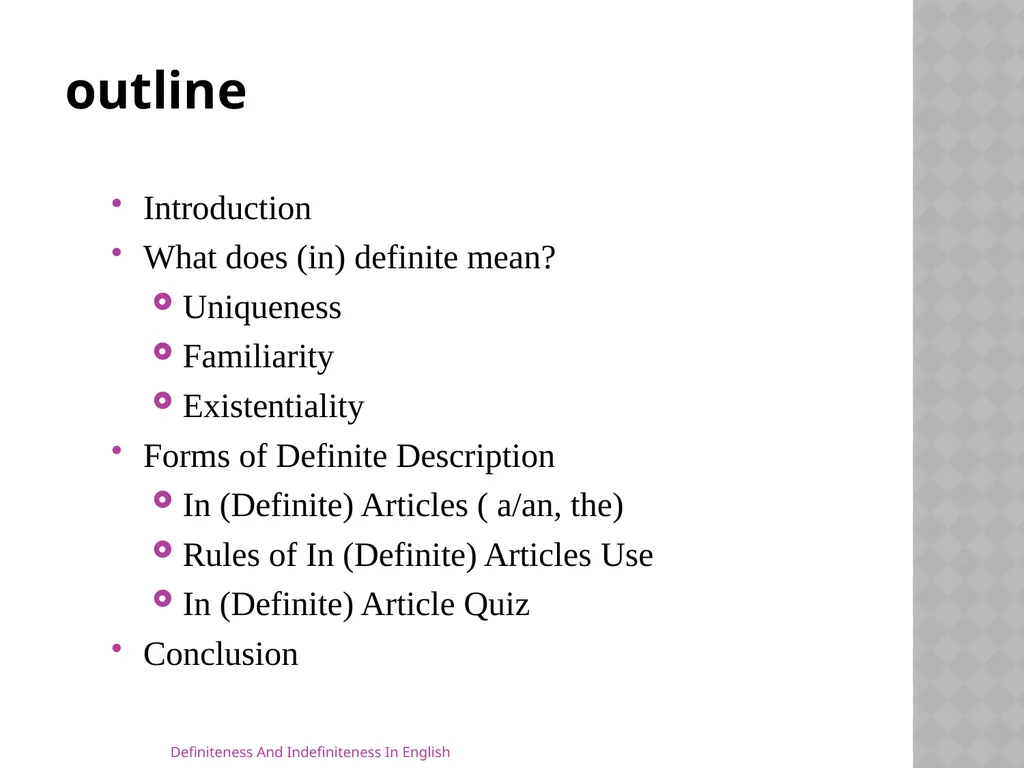
outline Introduction
What does (in) definite mean?
Uniqueness
Familiarity
Existentiality
Forms of Definite Description
In (Definite) Articles ( a/an, the)
Rules of In (Definite) Articles Use
In (Definite) Article Quiz
Conclusion Definiteness And Indefiniteness In English<br>
What does (in) definite mean?
Uniqueness
Familiarity
Existentiality
Forms of Definite Description
In (Definite) Articles ( a/an, the)
Rules of In (Definite) Articles Use
In (Definite) Article Quiz
Conclusion Definiteness And Indefiniteness In English<br>
03
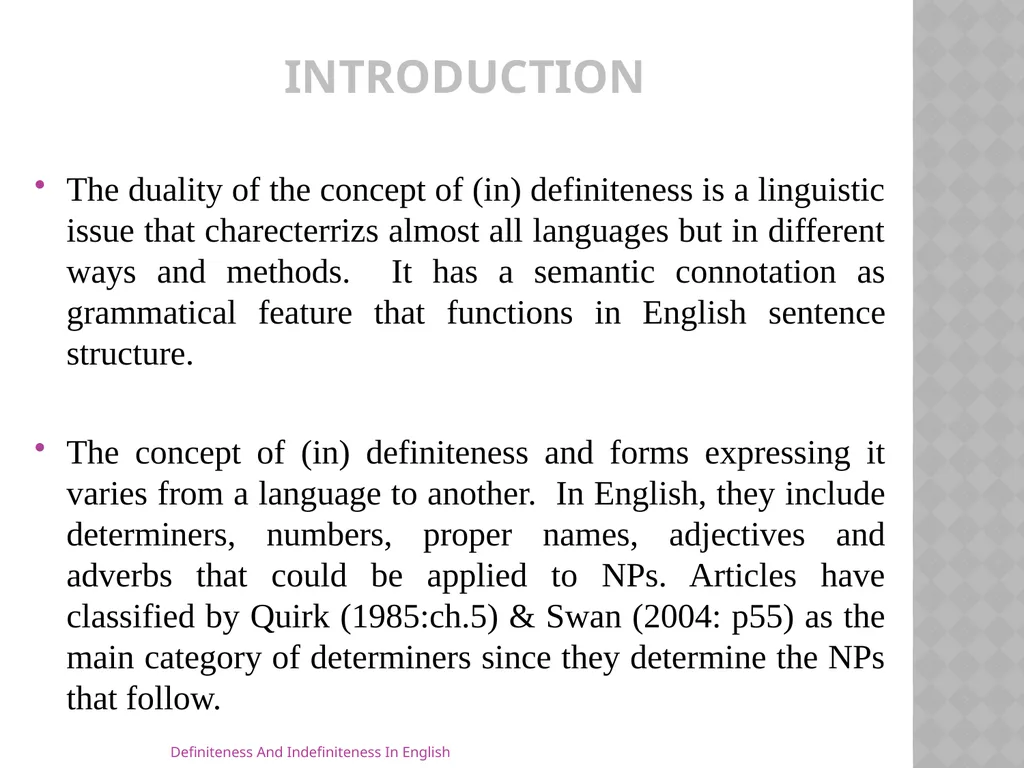
Introduction The duality of the concept of (in) definiteness is a linguistic issue that charecterrizs almost all languages but in different ways and methods. It has a semantic connotation as grammatical feature that functions in English sentence structure.
The concept of (in) definiteness and forms expressing it varies from a language to another. In English, they include determiners, numbers, proper names, adjectives and adverbs that could be applied to NPs. Articles have classified by Quirk (1985:ch.5) & Swan (2004: p55) as the main category of determiners since they determine the NPs that follow. Definiteness And Indefiniteness In English<br>
The concept of (in) definiteness and forms expressing it varies from a language to another. In English, they include determiners, numbers, proper names, adjectives and adverbs that could be applied to NPs. Articles have classified by Quirk (1985:ch.5) & Swan (2004: p55) as the main category of determiners since they determine the NPs that follow. Definiteness And Indefiniteness In English<br>
04
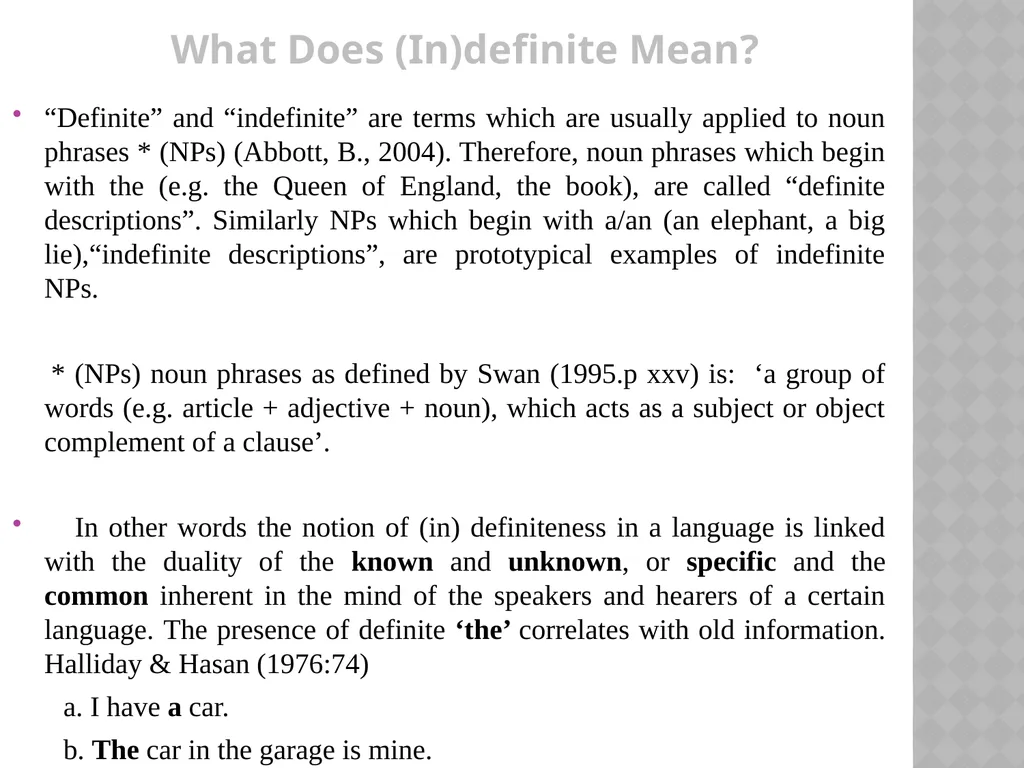
What Does (In)definite Mean? “Definite” and “indefinite” are terms which are usually applied to noun phrases * (NPs) (Abbott, B., 2004). Therefore, noun phrases which begin with the (e.g. the Queen of England, the book), are called “definite descriptions”. Similarly NPs which begin with a/an (an elephant, a big lie),“indefinite descriptions”, are prototypical examples of indefinite NPs.
* (NPs) noun phrases as defined by Swan (1995.p xxv) is: ‘a group of words (e.g. article + adjective + noun), which acts as a subject or object complement of a clause’.
In other words the notion of (in) definiteness in a language is linked with the duality of the known and unknown, or specific and the common inherent in the mind of the speakers and hearers of a certain language. The presence of definite ‘the’ correlates with old information. Halliday & Hasan (1976:74)
a. I have a car.
b. The car in the garage is mine.<br>
* (NPs) noun phrases as defined by Swan (1995.p xxv) is: ‘a group of words (e.g. article + adjective + noun), which acts as a subject or object complement of a clause’.
In other words the notion of (in) definiteness in a language is linked with the duality of the known and unknown, or specific and the common inherent in the mind of the speakers and hearers of a certain language. The presence of definite ‘the’ correlates with old information. Halliday & Hasan (1976:74)
a. I have a car.
b. The car in the garage is mine.<br>
05
Uniqueness
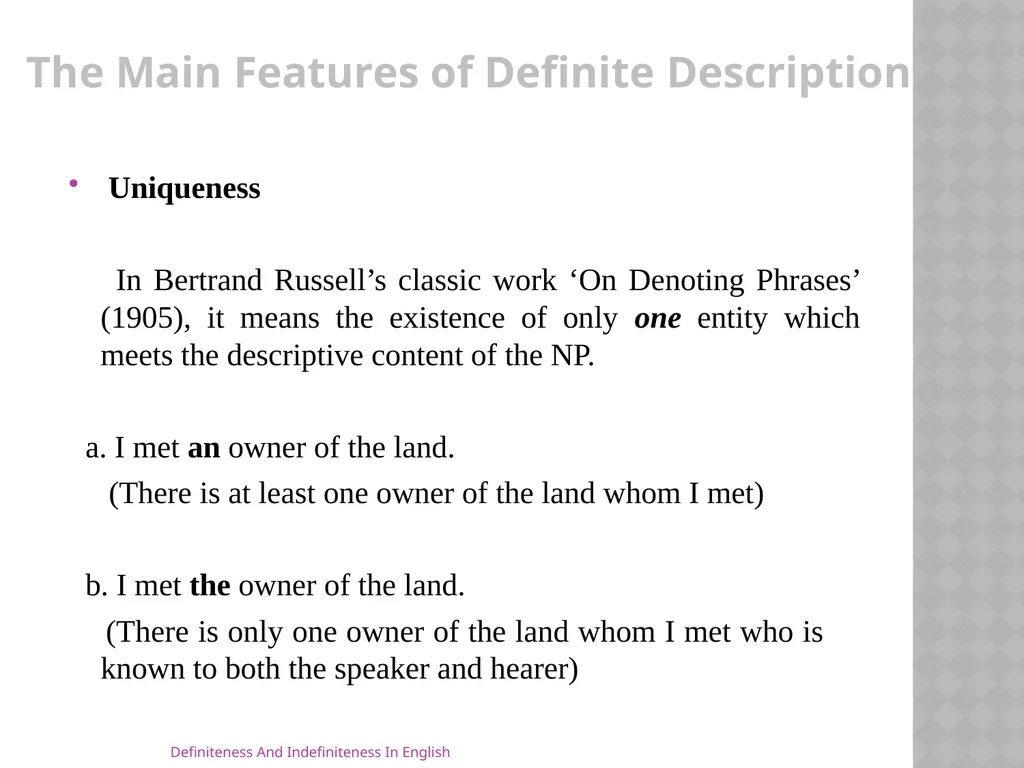
In Bertrand Russell’s classic work ‘On Denoting Phrases’ (1905), it means the existence of only one entity which meets the descriptive content of the NP.
a. I met an owner of the land.
(There is at least one owner of the land whom I met)
b. I met the owner of the land.
(There is only one owner of the land whom I met who is known to both the speaker and hearer) The Main Features of Definite Description Definiteness And Indefiniteness In English<br>
In Bertrand Russell’s classic work ‘On Denoting Phrases’ (1905), it means the existence of only one entity which meets the descriptive content of the NP.
a. I met an owner of the land.
(There is at least one owner of the land whom I met)
b. I met the owner of the land.
(There is only one owner of the land whom I met who is known to both the speaker and hearer) The Main Features of Definite Description Definiteness And Indefiniteness In English<br>
06
Familiarity
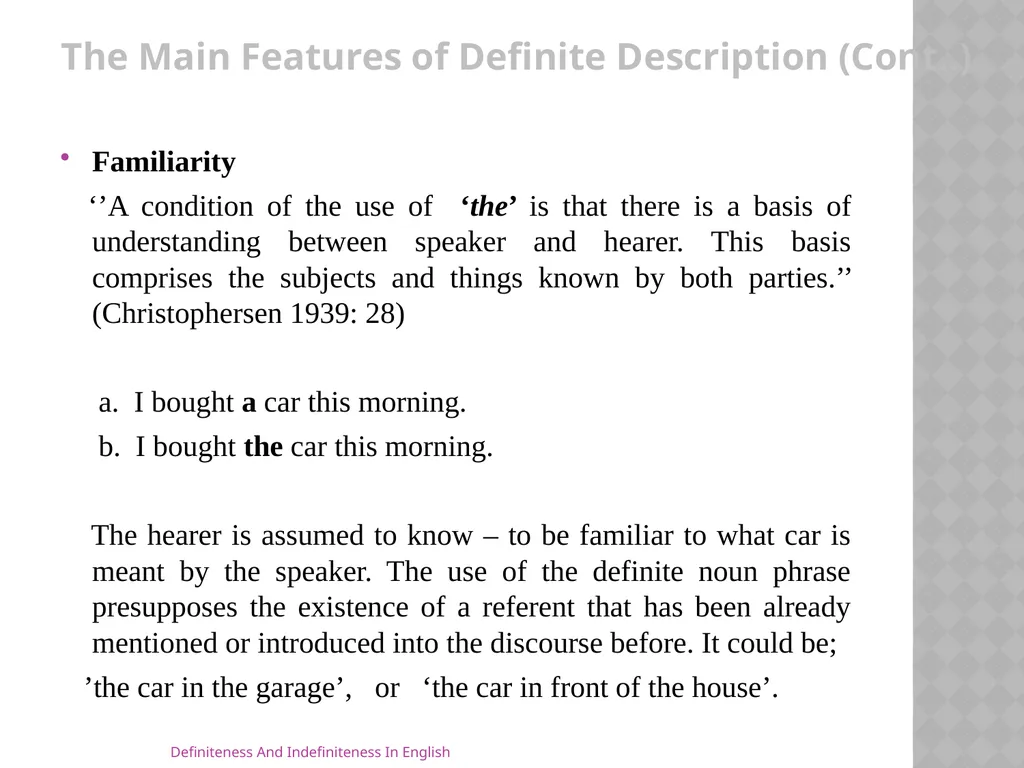
‘’A condition of the use of ‘the’ is that there is a basis of understanding between speaker and hearer. This basis comprises the subjects and things known by both parties.’’ (Christophersen 1939: 28)
a. I bought a car this morning.
b. I bought the car this morning.
The hearer is assumed to know – to be familiar to what car is meant by the speaker. The use of the definite noun phrase presupposes the existence of a referent that has been already mentioned or introduced into the discourse before. It could be;
’the car in the garage’, or ‘the car in front of the house’. The Main Features of Definite Description (Cont..) Definiteness And Indefiniteness In English<br>
‘’A condition of the use of ‘the’ is that there is a basis of understanding between speaker and hearer. This basis comprises the subjects and things known by both parties.’’ (Christophersen 1939: 28)
a. I bought a car this morning.
b. I bought the car this morning.
The hearer is assumed to know – to be familiar to what car is meant by the speaker. The use of the definite noun phrase presupposes the existence of a referent that has been already mentioned or introduced into the discourse before. It could be;
’the car in the garage’, or ‘the car in front of the house’. The Main Features of Definite Description (Cont..) Definiteness And Indefiniteness In English<br>
07
Existentiality
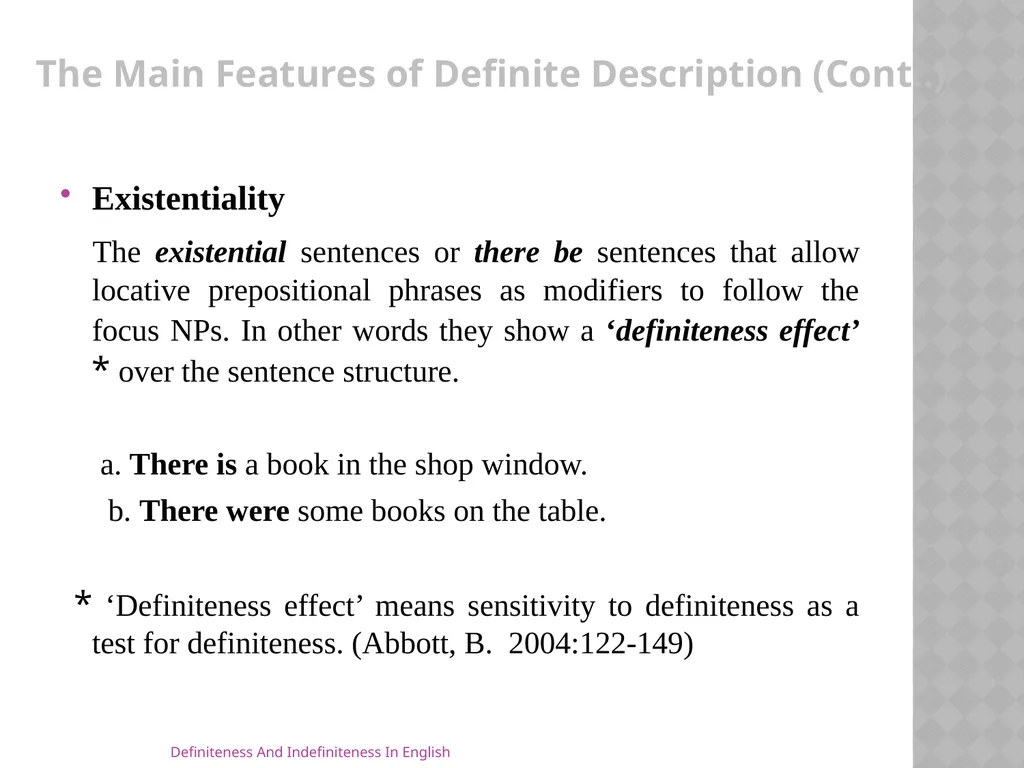
The existential sentences or there be sentences that allow locative prepositional phrases as modifiers to follow the focus NPs. In other words they show a ‘definiteness effect’ * over the sentence structure.
a. There is a book in the shop window.
b. There were some books on the table.
* ‘Definiteness effect’ means sensitivity to definiteness as a test for definiteness. (Abbott, B. 2004:122-149) The Main Features of Definite Description (Cont..) Definiteness And Indefiniteness In English<br>
The existential sentences or there be sentences that allow locative prepositional phrases as modifiers to follow the focus NPs. In other words they show a ‘definiteness effect’ * over the sentence structure.
a. There is a book in the shop window.
b. There were some books on the table.
* ‘Definiteness effect’ means sensitivity to definiteness as a test for definiteness. (Abbott, B. 2004:122-149) The Main Features of Definite Description (Cont..) Definiteness And Indefiniteness In English<br>
08
Forms Of Definite Description Definiteness And Indefiniteness In English<br>
09
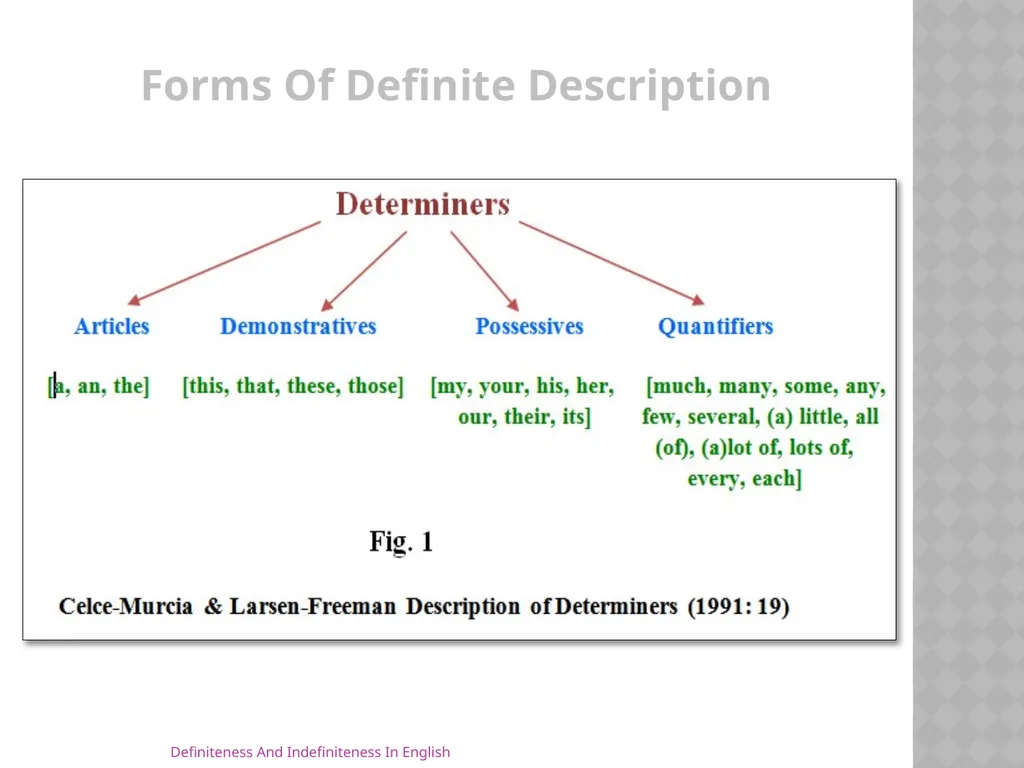
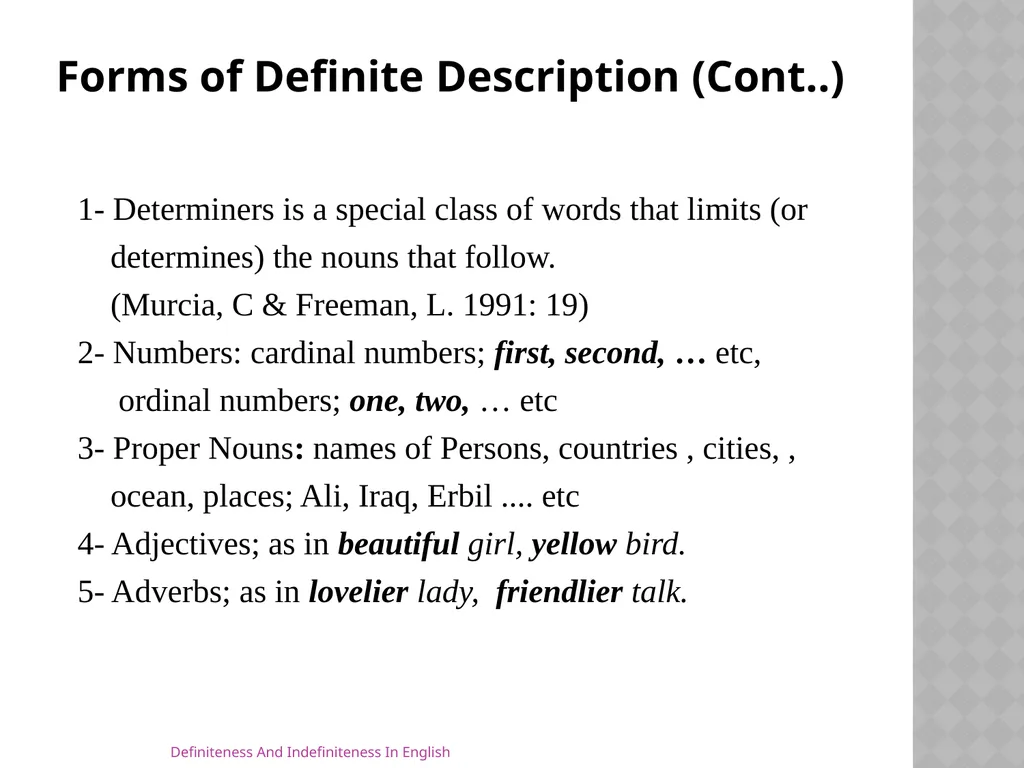
Forms of Definite Description (Cont..) 1- Determiners is a special class of words that limits (or
determines) the nouns that follow.
(Murcia, C & Freeman, L. 1991: 19)
2- Numbers: cardinal numbers; first, second, … etc,
ordinal numbers; one, two, … etc
3- Proper Nouns: names of Persons, countries , cities, ,
ocean, places; Ali, Iraq, Erbil .... etc
4- Adjectives; as in beautiful girl, yellow bird.
5- Adverbs; as in lovelier lady, friendlier talk. Definiteness And Indefiniteness In English<br>
determines) the nouns that follow.
(Murcia, C & Freeman, L. 1991: 19)
2- Numbers: cardinal numbers; first, second, … etc,
ordinal numbers; one, two, … etc
3- Proper Nouns: names of Persons, countries , cities, ,
ocean, places; Ali, Iraq, Erbil .... etc
4- Adjectives; as in beautiful girl, yellow bird.
5- Adverbs; as in lovelier lady, friendlier talk. Definiteness And Indefiniteness In English<br>
10
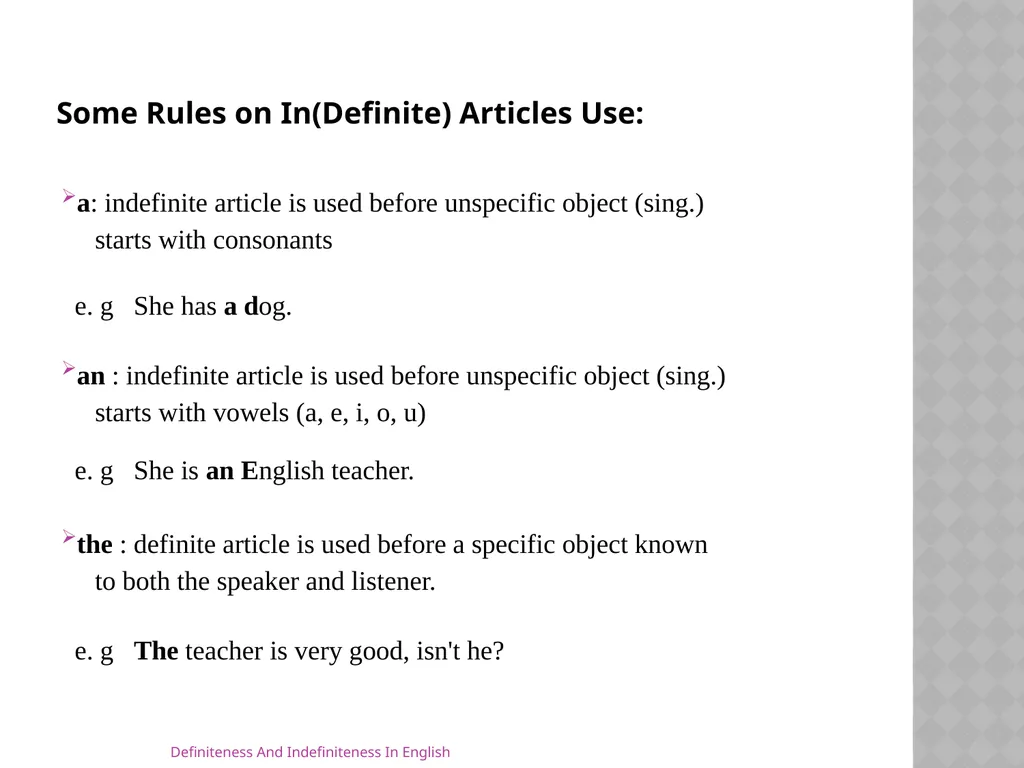
Some Rules on In(Definite) Articles Use: Definiteness And Indefiniteness In English a: indefinite article is used before unspecific object (sing.)
starts with consonants
e. g She has a dog.
an : indefinite article is used before unspecific object (sing.)
starts with vowels (a, e, i, o, u) e. g She is an English teacher.
the : definite article is used before a specific object known
to both the speaker and listener.
e. g The teacher is very good, isn't he?<br>
starts with consonants
e. g She has a dog.
an : indefinite article is used before unspecific object (sing.)
starts with vowels (a, e, i, o, u) e. g She is an English teacher.
the : definite article is used before a specific object known
to both the speaker and listener.
e. g The teacher is very good, isn't he?<br>
11
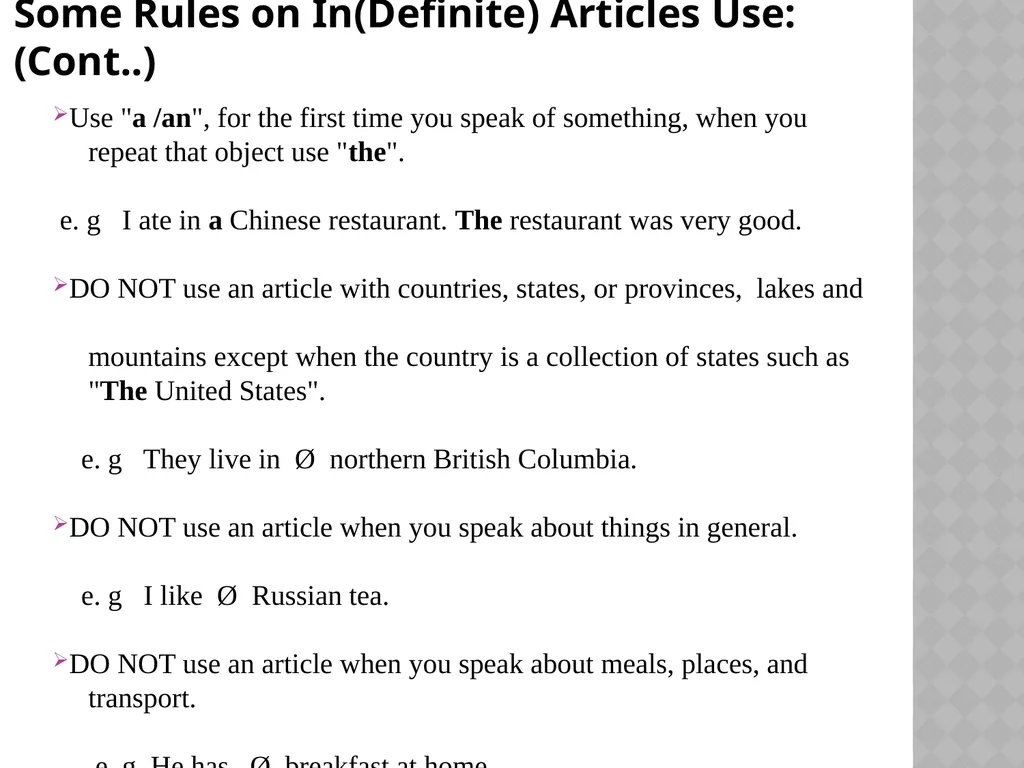
Use "a /an", for the first time you speak of something, when you
repeat that object use "the".
e. g I ate in a Chinese restaurant. The restaurant was very good.
DO NOT use an article with countries, states, or provinces, lakes and
mountains except when the country is a collection of states such as
"The United States".
e. g They live in Ø northern British Columbia.
DO NOT use an article when you speak about things in general.
e. g I like Ø Russian tea.
DO NOT use an article when you speak about meals, places, and
transport.
e. g He has Ø breakfast at home. Some Rules on In(Definite) Articles Use: (Cont..)<br>
repeat that object use "the".
e. g I ate in a Chinese restaurant. The restaurant was very good.
DO NOT use an article with countries, states, or provinces, lakes and
mountains except when the country is a collection of states such as
"The United States".
e. g They live in Ø northern British Columbia.
DO NOT use an article when you speak about things in general.
e. g I like Ø Russian tea.
DO NOT use an article when you speak about meals, places, and
transport.
e. g He has Ø breakfast at home. Some Rules on In(Definite) Articles Use: (Cont..)<br>
12
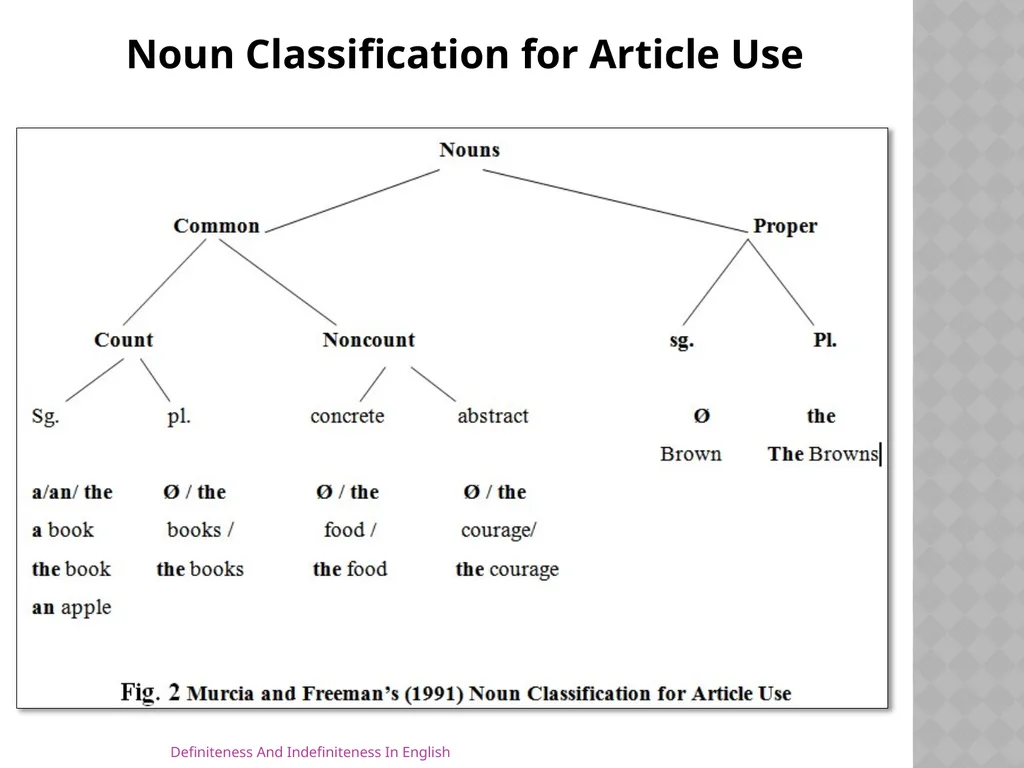
Definiteness And Indefiniteness In English Noun Classification for Article Use<br>
13
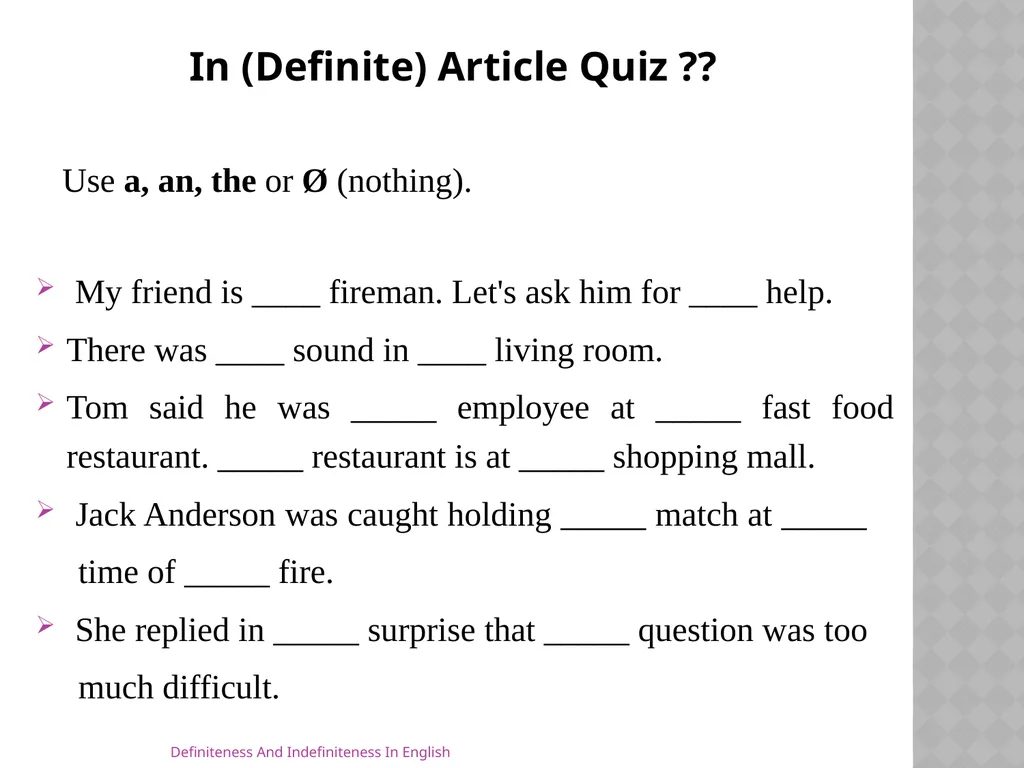
In (Definite) Article Quiz ?? Use a, an, the or Ø (nothing).
My friend is ____ fireman. Let's ask him for ____ help.
There was ____ sound in ____ living room.
Tom said he was _____ employee at _____ fast food restaurant. _____ restaurant is at _____ shopping mall.
Jack Anderson was caught holding _____ match at _____
time of _____ fire.
She replied in _____ surprise that _____ question was too
much difficult. Definiteness And Indefiniteness In English<br>
My friend is ____ fireman. Let's ask him for ____ help.
There was ____ sound in ____ living room.
Tom said he was _____ employee at _____ fast food restaurant. _____ restaurant is at _____ shopping mall.
Jack Anderson was caught holding _____ match at _____
time of _____ fire.
She replied in _____ surprise that _____ question was too
much difficult. Definiteness And Indefiniteness In English<br>
14
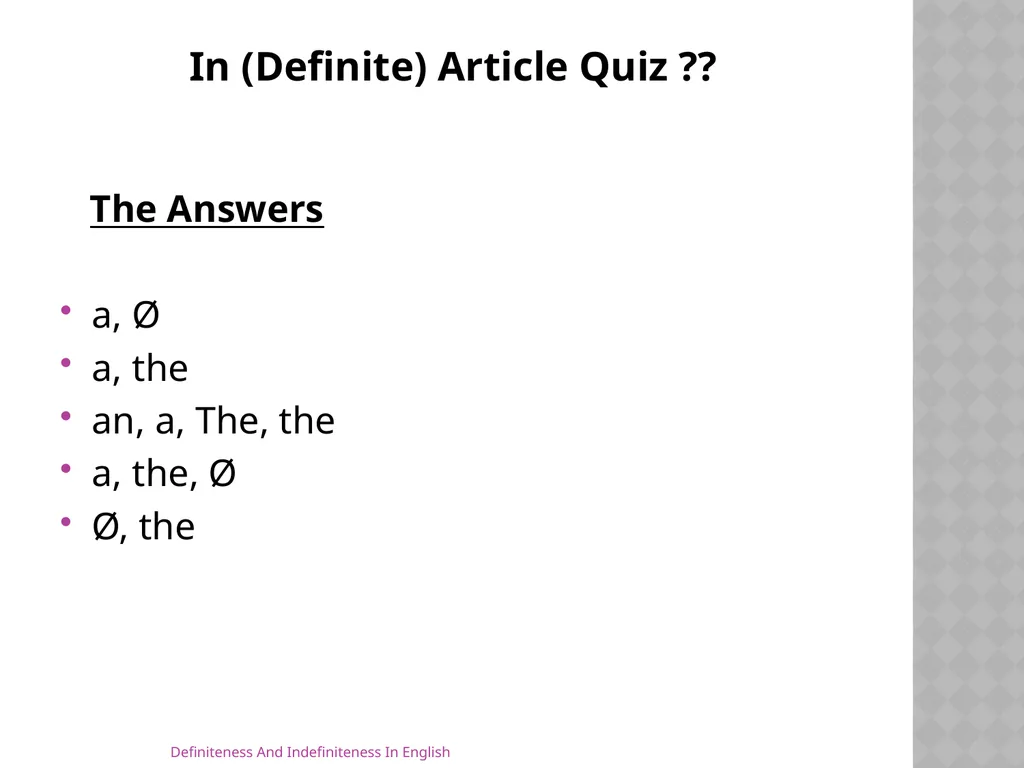
The Answers
a, Ø
a, the
an, a, The, the
a, the, Ø
Ø, the Definiteness And Indefiniteness In English In (Definite) Article Quiz ??<br>
a, Ø
a, the
an, a, The, the
a, the, Ø
Ø, the Definiteness And Indefiniteness In English In (Definite) Article Quiz ??<br>
15
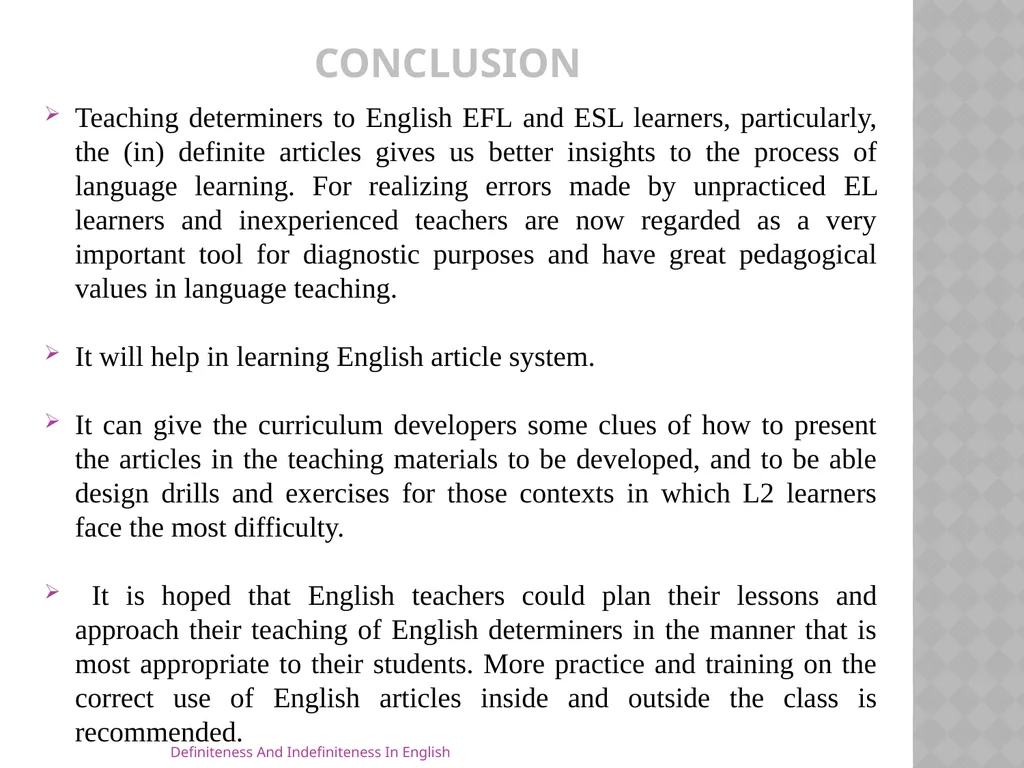
Conclusion Teaching determiners to English EFL and ESL learners, particularly, the (in) definite articles gives us better insights to the process of language learning. For realizing errors made by unpracticed EL learners and inexperienced teachers are now regarded as a very important tool for diagnostic purposes and have great pedagogical values in language teaching.
It will help in learning English article system.
It can give the curriculum developers some clues of how to present the articles in the teaching materials to be developed, and to be able design drills and exercises for those contexts in which L2 learners face the most difficulty.
It is hoped that English teachers could plan their lessons and approach their teaching of English determiners in the manner that is most appropriate to their students. More practice and training on the correct use of English articles inside and outside the class is recommended. Definiteness And Indefiniteness In English<br>
It will help in learning English article system.
It can give the curriculum developers some clues of how to present the articles in the teaching materials to be developed, and to be able design drills and exercises for those contexts in which L2 learners face the most difficulty.
It is hoped that English teachers could plan their lessons and approach their teaching of English determiners in the manner that is most appropriate to their students. More practice and training on the correct use of English articles inside and outside the class is recommended. Definiteness And Indefiniteness In English<br>
16
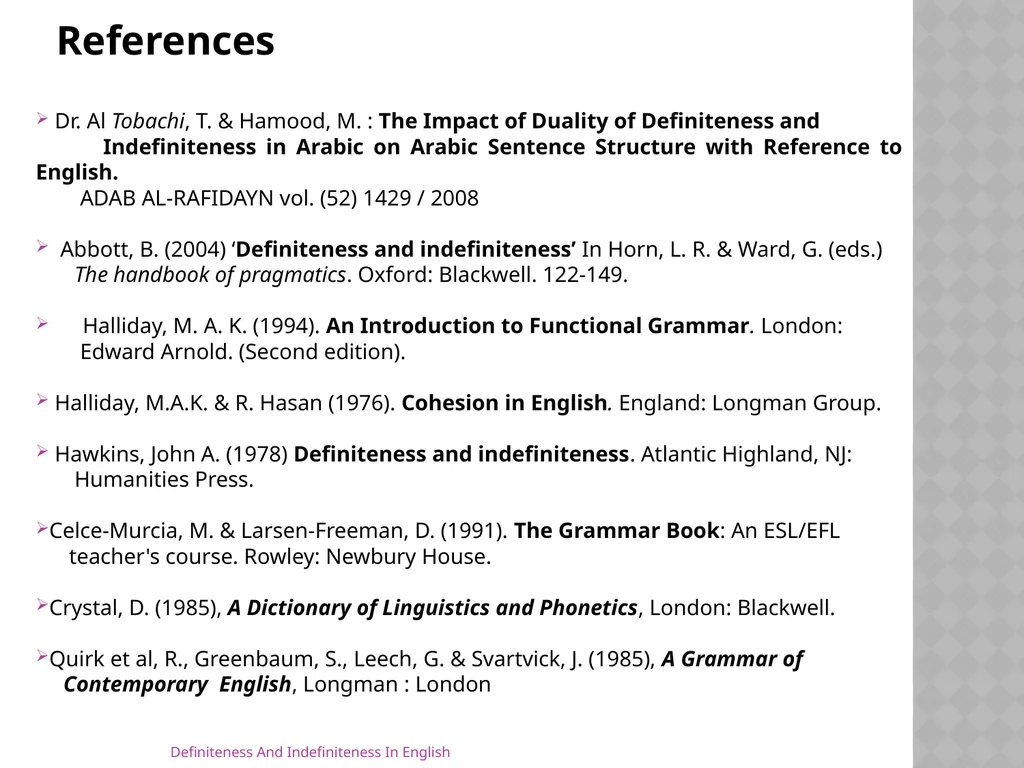
References Dr. Al Tobachi, T. & Hamood, M. : The Impact of Duality of Definiteness and
Indefiniteness in Arabic on Arabic Sentence Structure with Reference to English.
ADAB AL-RAFIDAYN vol. (52) 1429 / 2008
Abbott, B. (2004) ‘Definiteness and indefiniteness’ In Horn, L. R. & Ward, G. (eds.)
The handbook of pragmatics. Oxford: Blackwell. 122-149.
Halliday, M. A. K. (1994). An Introduction to Functional Grammar. London:
Edward Arnold. (Second edition).
Halliday, M.A.K. & R. Hasan (1976). Cohesion in English. England: Longman Group.
Hawkins, John A. (1978) Definiteness and indefiniteness. Atlantic Highland, NJ:
Humanities Press.
Celce-Murcia, M. & Larsen-Freeman, D. (1991). The Grammar Book: An ESL/EFL
teacher's course. Rowley: Newbury House.
Crystal, D. (1985), A Dictionary of Linguistics and Phonetics, London: Blackwell.
Quirk et al, R., Greenbaum, S., Leech, G. & Svartvick, J. (1985), A Grammar of
Contemporary English, Longman : London Definiteness And Indefiniteness In English<br>
Indefiniteness in Arabic on Arabic Sentence Structure with Reference to English.
ADAB AL-RAFIDAYN vol. (52) 1429 / 2008
Abbott, B. (2004) ‘Definiteness and indefiniteness’ In Horn, L. R. & Ward, G. (eds.)
The handbook of pragmatics. Oxford: Blackwell. 122-149.
Halliday, M. A. K. (1994). An Introduction to Functional Grammar. London:
Edward Arnold. (Second edition).
Halliday, M.A.K. & R. Hasan (1976). Cohesion in English. England: Longman Group.
Hawkins, John A. (1978) Definiteness and indefiniteness. Atlantic Highland, NJ:
Humanities Press.
Celce-Murcia, M. & Larsen-Freeman, D. (1991). The Grammar Book: An ESL/EFL
teacher's course. Rowley: Newbury House.
Crystal, D. (1985), A Dictionary of Linguistics and Phonetics, London: Blackwell.
Quirk et al, R., Greenbaum, S., Leech, G. & Svartvick, J. (1985), A Grammar of
Contemporary English, Longman : London Definiteness And Indefiniteness In English<br>