
Delivering a Better Future for Cheshire and
JO
Published · 12 slides · 0 views

1 / 1


Description
Delivering a Better Future for Cheshire and Warrington Exporting: a route to business growth and economic development INCREASING THE GROWTH AMBITION AND RESILIANCE OF OUR BUSINESS COMMUNITY. Our vision is to CHAMPION Exporting As A route to
Related Topics
Share
Embed code
Download this presentation From Below
"Delivering a Better Future for Cheshire and" is the property of its rightful owner. Permission is granted to download and print the materials on this website for personal, non-commercial use only, and to display it on your personal computer provided you do not modify the materials and that you retain all copyright notices contained in the materials. By downloading content from our website, you accept the terms of this agreement.
Presentation Transcript
01
Delivering a Better Future
for Cheshire and Warrington<br>
for Cheshire and Warrington<br>
02
Exporting:
a route to business growth and economic development INCREASING THE GROWTH AMBITION AND RESILIANCE OF OUR BUSINESS COMMUNITY.
Our vision is to CHAMPION Exporting As A route to LOCAL business growth by harnessing the support and expertise of the private and public sector.
we will inspire and nurture an inclusive community of growth-minded exporting businesses not only to increase their own resilience but also that of the local economy.<br>
Our vision is to CHAMPION Exporting As A route to LOCAL business growth by harnessing the support and expertise of the private and public sector.
we will inspire and nurture an inclusive community of growth-minded exporting businesses not only to increase their own resilience but also that of the local economy.<br>
03
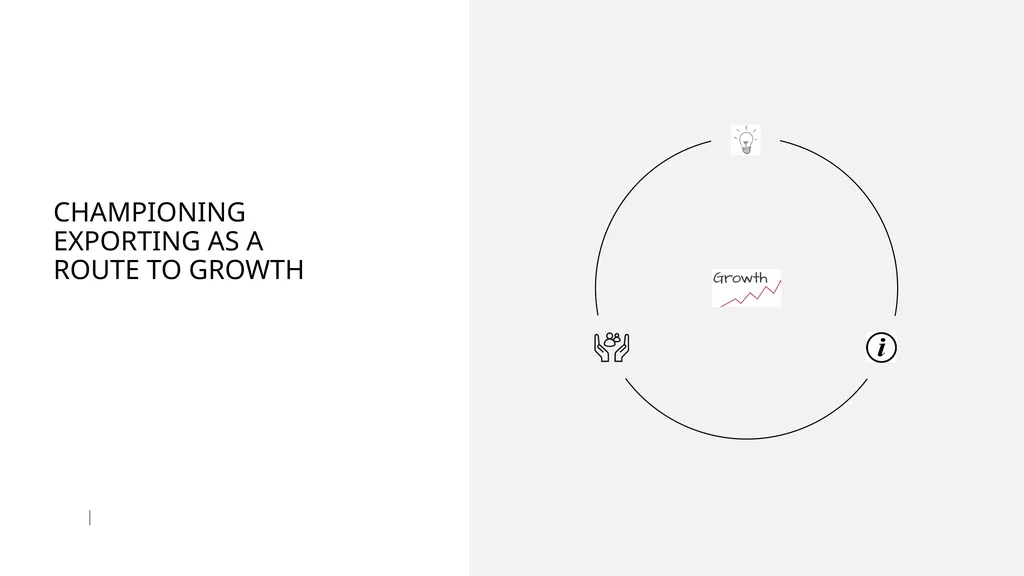
Championing exporting as a route to growth<br>
04
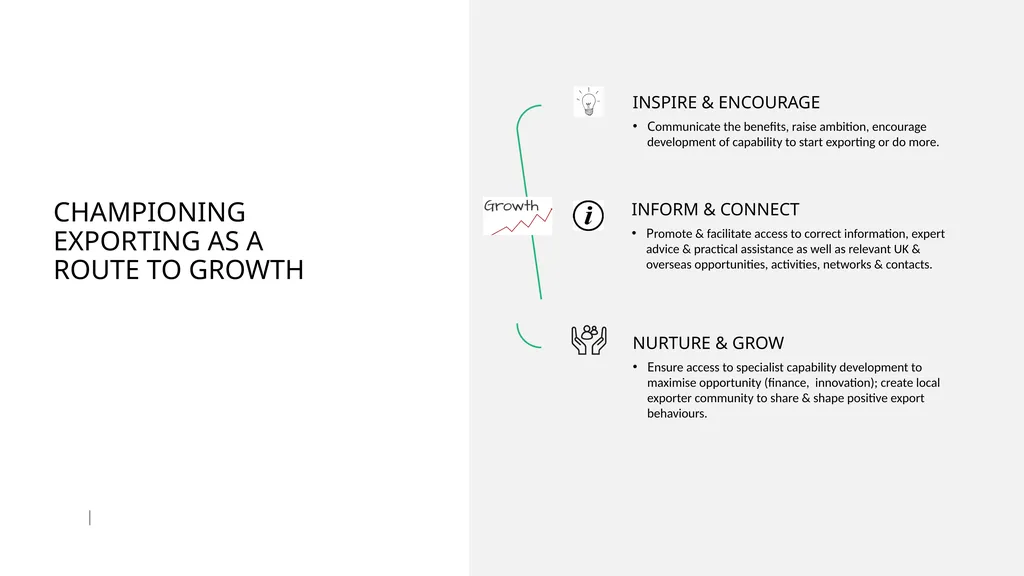
Championing exporting as a route to growth INSPIRE & ENCOURAGE
Communicate the benefits, raise ambition, encourage development of capability to start exporting or do more. NURTURE & GROW
Ensure access to specialist capability development to maximise opportunity (finance, innovation); create local exporter community to share & shape positive export behaviours. INFORM & CONNECT
Promote & facilitate access to correct information, expert advice & practical assistance as well as relevant UK & overseas opportunities, activities, networks & contacts.<br>
Communicate the benefits, raise ambition, encourage development of capability to start exporting or do more. NURTURE & GROW
Ensure access to specialist capability development to maximise opportunity (finance, innovation); create local exporter community to share & shape positive export behaviours. INFORM & CONNECT
Promote & facilitate access to correct information, expert advice & practical assistance as well as relevant UK & overseas opportunities, activities, networks & contacts.<br>
05
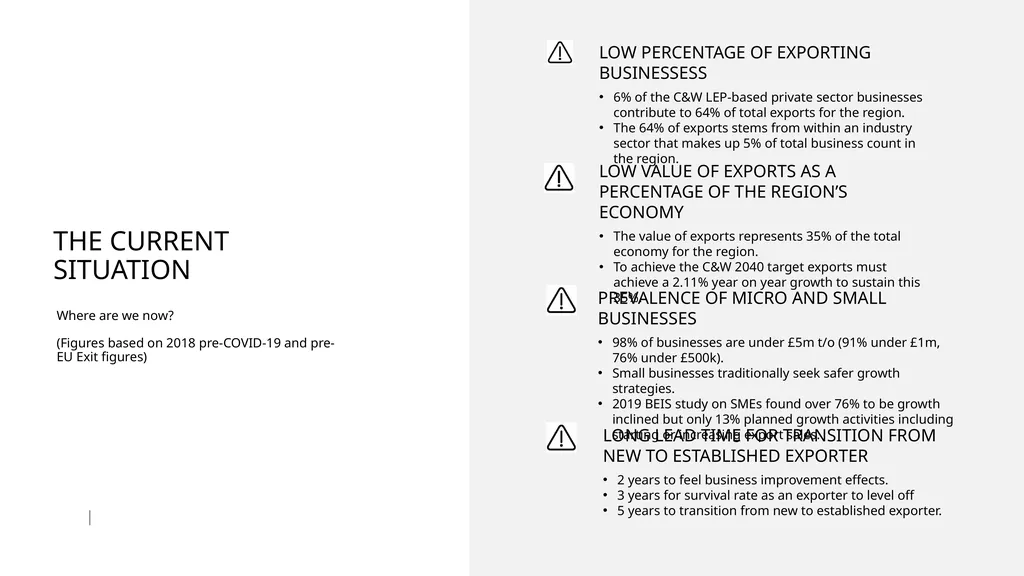
The current situation Where are we now?
(Figures based on 2018 pre-COVID-19 and pre-EU Exit figures) LOW PERCENTAGE OF EXPORTING BUSINESSESS
6% of the C&W LEP-based private sector businesses contribute to 64% of total exports for the region.
The 64% of exports stems from within an industry sector that makes up 5% of total business count in the region. LOW VALUE OF EXPORTS AS A PERCENTAGE OF THE REGION’S ECONOMY
The value of exports represents 35% of the total economy for the region.
To achieve the C&W 2040 target exports must achieve a 2.11% year on year growth to sustain this 35%. LONG LEAD TIME FOR TRANSITION FROM NEW TO ESTABLISHED EXPORTER
2 years to feel business improvement effects.
3 years for survival rate as an exporter to level off
5 years to transition from new to established exporter. PREVALENCE OF MICRO AND SMALL BUSINESSES
98% of businesses are under £5m t/o (91% under £1m, 76% under £500k).
Small businesses traditionally seek safer growth strategies.
2019 BEIS study on SMEs found over 76% to be growth inclined but only 13% planned growth activities including starting or increasing export sales.<br>
6% of the C&W LEP-based private sector businesses contribute to 64% of total exports for the region.
The 64% of exports stems from within an industry sector that makes up 5% of total business count in the region. LOW VALUE OF EXPORTS AS A PERCENTAGE OF THE REGION’S ECONOMY
The value of exports represents 35% of the total economy for the region.
To achieve the C&W 2040 target exports must achieve a 2.11% year on year growth to sustain this 35%. LONG LEAD TIME FOR TRANSITION FROM NEW TO ESTABLISHED EXPORTER
2 years to feel business improvement effects.
3 years for survival rate as an exporter to level off
5 years to transition from new to established exporter. PREVALENCE OF MICRO AND SMALL BUSINESSES
98% of businesses are under £5m t/o (91% under £1m, 76% under £500k).
Small businesses traditionally seek safer growth strategies.
2019 BEIS study on SMEs found over 76% to be growth inclined but only 13% planned growth activities including starting or increasing export sales.<br>
06
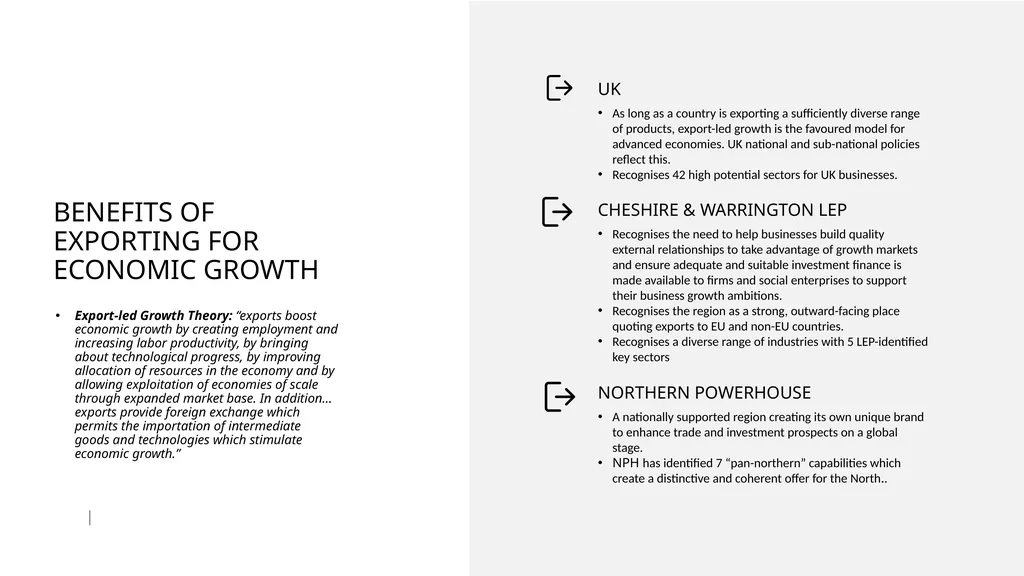
Benefits of Exporting for economic growth UK
As long as a country is exporting a sufficiently diverse range of products, export-led growth is the favoured model for advanced economies. UK national and sub-national policies reflect this.
Recognises 42 high potential sectors for UK businesses. CHESHIRE & WARRINGTON LEP
Recognises the need to help businesses build quality external relationships to take advantage of growth markets and ensure adequate and suitable investment finance is made available to firms and social enterprises to support their business growth ambitions.
Recognises the region as a strong, outward-facing place quoting exports to EU and non-EU countries.
Recognises a diverse range of industries with 5 LEP-identified key sectors NORTHERN POWERHOUSE
A nationally supported region creating its own unique brand to enhance trade and investment prospects on a global stage.
NPH has identified 7 “pan-northern” capabilities which create a distinctive and coherent offer for the North.. Export-led Growth Theory: “exports boost economic growth by creating employment and increasing labor productivity, by bringing about technological progress, by improving allocation of resources in the economy and by allowing exploitation of economies of scale through expanded market base. In addition…exports provide foreign exchange which permits the importation of intermediate goods and technologies which stimulate economic growth.”<br>
As long as a country is exporting a sufficiently diverse range of products, export-led growth is the favoured model for advanced economies. UK national and sub-national policies reflect this.
Recognises 42 high potential sectors for UK businesses. CHESHIRE & WARRINGTON LEP
Recognises the need to help businesses build quality external relationships to take advantage of growth markets and ensure adequate and suitable investment finance is made available to firms and social enterprises to support their business growth ambitions.
Recognises the region as a strong, outward-facing place quoting exports to EU and non-EU countries.
Recognises a diverse range of industries with 5 LEP-identified key sectors NORTHERN POWERHOUSE
A nationally supported region creating its own unique brand to enhance trade and investment prospects on a global stage.
NPH has identified 7 “pan-northern” capabilities which create a distinctive and coherent offer for the North.. Export-led Growth Theory: “exports boost economic growth by creating employment and increasing labor productivity, by bringing about technological progress, by improving allocation of resources in the economy and by allowing exploitation of economies of scale through expanded market base. In addition…exports provide foreign exchange which permits the importation of intermediate goods and technologies which stimulate economic growth.”<br>
07
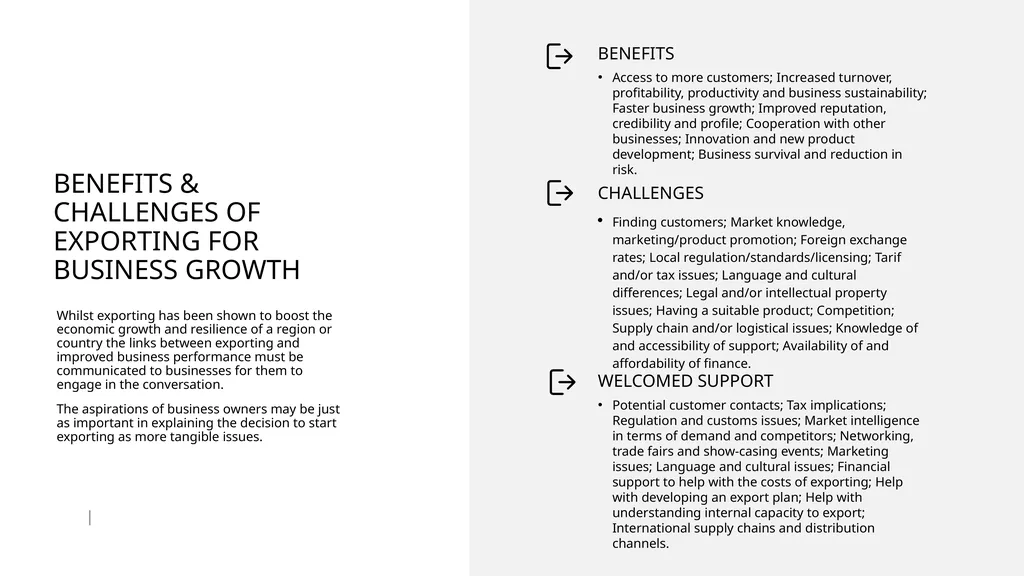
Benefits & CHALLENGES of Exporting for business growth Whilst exporting has been shown to boost the economic growth and resilience of a region or country the links between exporting and improved business performance must be communicated to businesses for them to engage in the conversation.
The aspirations of business owners may be just as important in explaining the decision to start exporting as more tangible issues. BENEFITS
Access to more customers; Increased turnover, profitability, productivity and business sustainability; Faster business growth; Improved reputation, credibility and profile; Cooperation with other businesses; Innovation and new product development; Business survival and reduction in risk. CHALLENGES
Finding customers; Market knowledge, marketing/product promotion; Foreign exchange rates; Local regulation/standards/licensing; Tarif and/or tax issues; Language and cultural differences; Legal and/or intellectual property issues; Having a suitable product; Competition; Supply chain and/or logistical issues; Knowledge of and accessibility of support; Availability of and affordability of finance. WELCOMED SUPPORT
Potential customer contacts; Tax implications; Regulation and customs issues; Market intelligence in terms of demand and competitors; Networking, trade fairs and show-casing events; Marketing issues; Language and cultural issues; Financial support to help with the costs of exporting; Help with developing an export plan; Help with understanding internal capacity to export; International supply chains and distribution channels.<br>
The aspirations of business owners may be just as important in explaining the decision to start exporting as more tangible issues. BENEFITS
Access to more customers; Increased turnover, profitability, productivity and business sustainability; Faster business growth; Improved reputation, credibility and profile; Cooperation with other businesses; Innovation and new product development; Business survival and reduction in risk. CHALLENGES
Finding customers; Market knowledge, marketing/product promotion; Foreign exchange rates; Local regulation/standards/licensing; Tarif and/or tax issues; Language and cultural differences; Legal and/or intellectual property issues; Having a suitable product; Competition; Supply chain and/or logistical issues; Knowledge of and accessibility of support; Availability of and affordability of finance. WELCOMED SUPPORT
Potential customer contacts; Tax implications; Regulation and customs issues; Market intelligence in terms of demand and competitors; Networking, trade fairs and show-casing events; Marketing issues; Language and cultural issues; Financial support to help with the costs of exporting; Help with developing an export plan; Help with understanding internal capacity to export; International supply chains and distribution channels.<br>
08
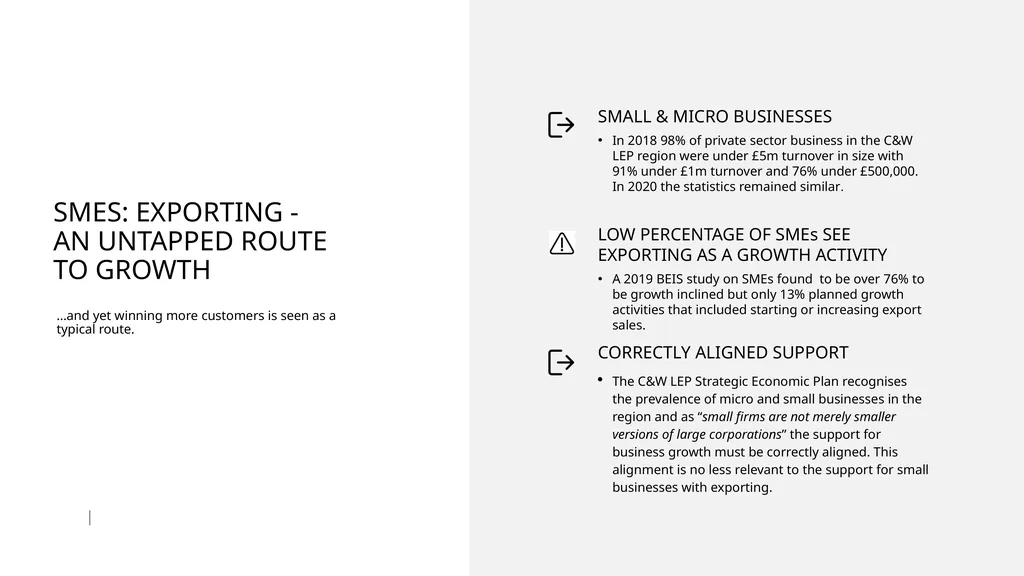
SMES: Exporting - AN UNTAPPED route to growth …and yet winning more customers is seen as a typical route. LOW PERCENTAGE OF SMEs SEE EXPORTING AS A GROWTH ACTIVITY
A 2019 BEIS study on SMEs found to be over 76% to be growth inclined but only 13% planned growth activities that included starting or increasing export sales. CORRECTLY ALIGNED SUPPORT
The C&W LEP Strategic Economic Plan recognises the prevalence of micro and small businesses in the region and as “small firms are not merely smaller versions of large corporations” the support for business growth must be correctly aligned. This alignment is no less relevant to the support for small businesses with exporting. SMALL & MICRO BUSINESSES
In 2018 98% of private sector business in the C&W LEP region were under £5m turnover in size with 91% under £1m turnover and 76% under £500,000. In 2020 the statistics remained similar.<br>
A 2019 BEIS study on SMEs found to be over 76% to be growth inclined but only 13% planned growth activities that included starting or increasing export sales. CORRECTLY ALIGNED SUPPORT
The C&W LEP Strategic Economic Plan recognises the prevalence of micro and small businesses in the region and as “small firms are not merely smaller versions of large corporations” the support for business growth must be correctly aligned. This alignment is no less relevant to the support for small businesses with exporting. SMALL & MICRO BUSINESSES
In 2018 98% of private sector business in the C&W LEP region were under £5m turnover in size with 91% under £1m turnover and 76% under £500,000. In 2020 the statistics remained similar.<br>
09
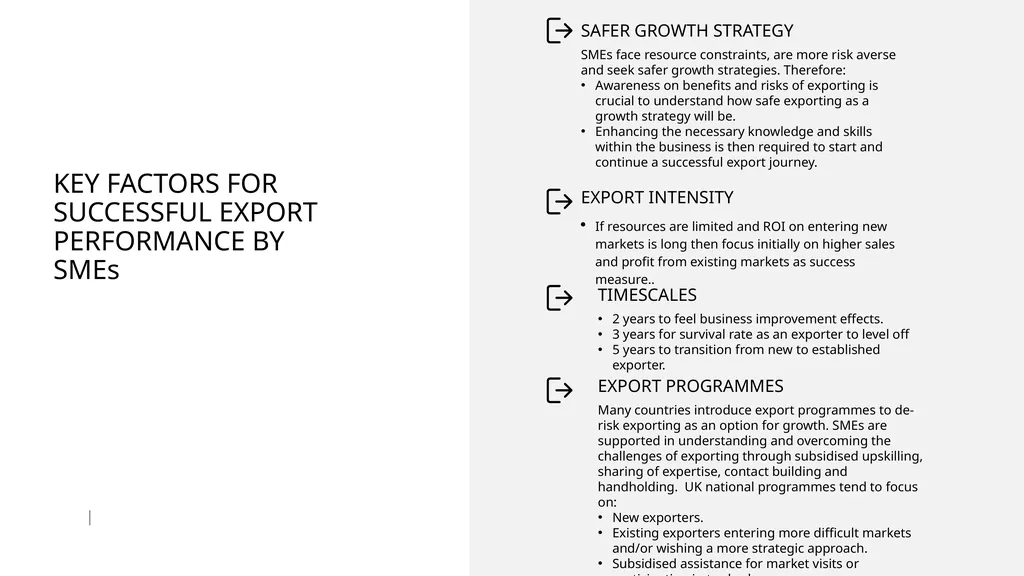
KEY FACTORS FOR SUCCESSFUL EXPORT PERFORMANCE BY SMEs SAFER GROWTH STRATEGY
SMEs face resource constraints, are more risk averse and seek safer growth strategies. Therefore:
Awareness on benefits and risks of exporting is crucial to understand how safe exporting as a growth strategy will be.
Enhancing the necessary knowledge and skills within the business is then required to start and continue a successful export journey. TIMESCALES
2 years to feel business improvement effects.
3 years for survival rate as an exporter to level off
5 years to transition from new to established exporter. EXPORT INTENSITY
If resources are limited and ROI on entering new markets is long then focus initially on higher sales and profit from existing markets as success measure.. EXPORT PROGRAMMES
Many countries introduce export programmes to de-risk exporting as an option for growth. SMEs are supported in understanding and overcoming the challenges of exporting through subsidised upskilling, sharing of expertise, contact building and handholding. UK national programmes tend to focus on:
New exporters.
Existing exporters entering more difficult markets and/or wishing a more strategic approach.
Subsidised assistance for market visits or participation in trade shows.<br>
SMEs face resource constraints, are more risk averse and seek safer growth strategies. Therefore:
Awareness on benefits and risks of exporting is crucial to understand how safe exporting as a growth strategy will be.
Enhancing the necessary knowledge and skills within the business is then required to start and continue a successful export journey. TIMESCALES
2 years to feel business improvement effects.
3 years for survival rate as an exporter to level off
5 years to transition from new to established exporter. EXPORT INTENSITY
If resources are limited and ROI on entering new markets is long then focus initially on higher sales and profit from existing markets as success measure.. EXPORT PROGRAMMES
Many countries introduce export programmes to de-risk exporting as an option for growth. SMEs are supported in understanding and overcoming the challenges of exporting through subsidised upskilling, sharing of expertise, contact building and handholding. UK national programmes tend to focus on:
New exporters.
Existing exporters entering more difficult markets and/or wishing a more strategic approach.
Subsidised assistance for market visits or participation in trade shows.<br>
10
STAKEHOLDERS & MULTIPLIERS IN C&W LEP REGION STAKEHOLDERS
LEP · County Councils · DIT · Chambers of Commerce & Industry · Business Membership Organisations · Education / Development Providers · Core Business Services Providers (financial, legal, accounting) · Logistics Providers. MULTIPLIERS
Growth Hub · Marketing Cheshire · DIT NPH Export Champions · DIT NW International Trade Advisers · Media · All stakeholders. THINK BEYOND THE TRADITIONAL
Modernise thinking on stakeholders/multipliers. A closer working relationship with e.g. non-exec directors and marketing communications/digital marketing businesses would be modern way to identify businesses looking to grow through exports.<br>
LEP · County Councils · DIT · Chambers of Commerce & Industry · Business Membership Organisations · Education / Development Providers · Core Business Services Providers (financial, legal, accounting) · Logistics Providers. MULTIPLIERS
Growth Hub · Marketing Cheshire · DIT NPH Export Champions · DIT NW International Trade Advisers · Media · All stakeholders. THINK BEYOND THE TRADITIONAL
Modernise thinking on stakeholders/multipliers. A closer working relationship with e.g. non-exec directors and marketing communications/digital marketing businesses would be modern way to identify businesses looking to grow through exports.<br>
11
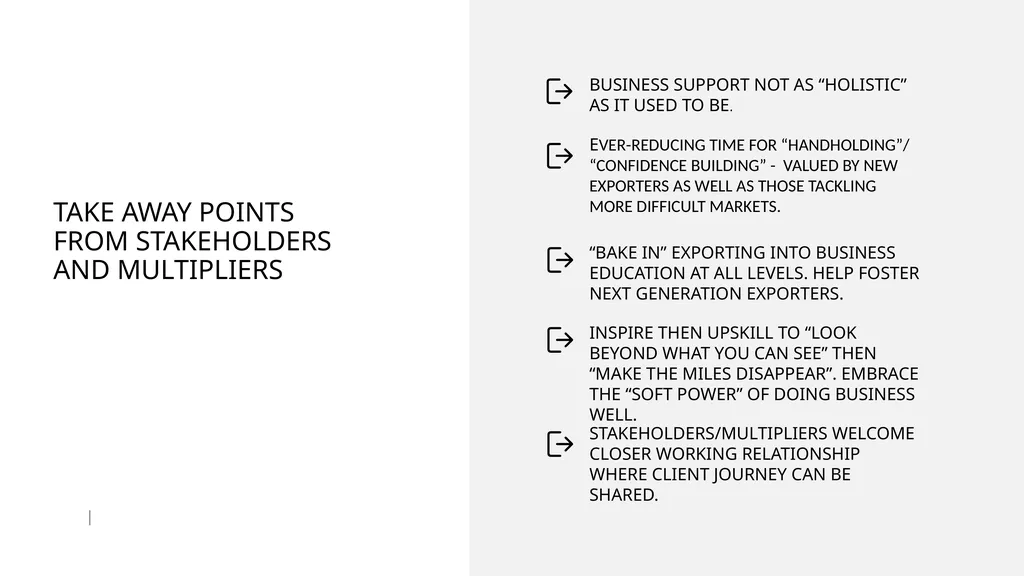
TAKE AWAY POINTS FROM STAKEHOLDERS AND MULTIPLIERS BUSINESS SUPPORT NOT AS “HOLISTIC” AS IT USED TO BE. STAKEHOLDERS/MULTIPLIERS WELCOME CLOSER WORKING RELATIONSHIP WHERE CLIENT JOURNEY CAN BE SHARED. EVER-REDUCING TIME FOR “HANDHOLDING”/ “CONFIDENCE BUILDING” - VALUED BY NEW EXPORTERS AS WELL AS THOSE TACKLING MORE DIFFICULT MARKETS. “BAKE IN” EXPORTING INTO BUSINESS EDUCATION AT ALL LEVELS. HELP FOSTER NEXT GENERATION EXPORTERS. INSPIRE THEN UPSKILL TO “LOOK BEYOND WHAT YOU CAN SEE” THEN “MAKE THE MILES DISAPPEAR”. EMBRACE THE “SOFT POWER” OF DOING BUSINESS WELL.<br>
12
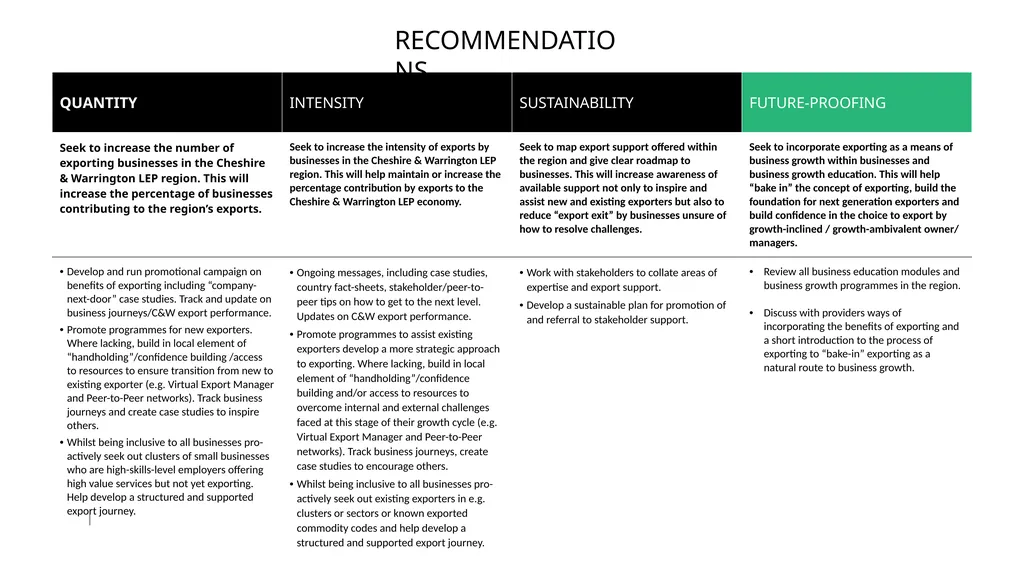
RECOMMENDATIONS<br>