
Democracy and its dimensions. The State. Lecture 3
EM
Published · 19 slides · 0 views

1 / 1
Description
Democracy and its dimensions. The State. Lecture 3 Defining democracy Democracy born in antiquity (Greece) At first viewed pejoratively (Plato, Aristotle) Up to XXth century considered mob rule Nowadays exteremely popular and respected
Related Topics
Share
Embed code
Download this presentation From Below
"Democracy and its dimensions. The State. Lecture 3" is the property of its rightful owner. Permission is granted to download and print the materials on this website for personal, non-commercial use only, and to display it on your personal computer provided you do not modify the materials and that you retain all copyright notices contained in the materials. By downloading content from our website, you accept the terms of this agreement.
Presentation Transcript
01
Democracy and its dimensions. The State. Lecture 3<br>
02
Defining democracy Democracy – born in antiquity (Greece)
At first viewed pejoratively (Plato, Aristotle)
Up to XXth century considered „mob rule”
Nowadays exteremely popular and respected – all are democrats
But what does this mean?<br>
At first viewed pejoratively (Plato, Aristotle)
Up to XXth century considered „mob rule”
Nowadays exteremely popular and respected – all are democrats
But what does this mean?<br>
03
Defining democracy 2 – issues to examine How has the term „democracy” been used throughout history?
What issues have been discussed in relation to the nature of democracy?
What models of democratic rule have been invented?
How about their advantages and disadvantages?
How do democratic systems operate in practice?
Does democracy really enables the people to rule?<br>
What issues have been discussed in relation to the nature of democracy?
What models of democratic rule have been invented?
How about their advantages and disadvantages?
How do democratic systems operate in practice?
Does democracy really enables the people to rule?<br>
04
The main characteristics of democracy a system of rule by the poor and disadvantaged
a form of government in which people people rule directly
An egalitarian society in terms of equality of opportunity and merit
A system of welfare and redistribution – fewer inequalities
A decision-making proces in which the principle of majority rules
A system guaranteeing the rights of minorities – power of majority restricted
A means of filling public offices through the popular vote
A system of government that serves the interests of all citizens
Abraham Lincoln’s definition (Gettysburg Address – 1864) – the government of the people, by the people and for the people<br>
a form of government in which people people rule directly
An egalitarian society in terms of equality of opportunity and merit
A system of welfare and redistribution – fewer inequalities
A decision-making proces in which the principle of majority rules
A system guaranteeing the rights of minorities – power of majority restricted
A means of filling public offices through the popular vote
A system of government that serves the interests of all citizens
Abraham Lincoln’s definition (Gettysburg Address – 1864) – the government of the people, by the people and for the people<br>
05
Democracy debate The main questions around which the fierce ideological and political debat revolves
Who are the people?
In what sense should the people rule?
How far should popular rule extend?<br>
Who are the people?
In what sense should the people rule?
How far should popular rule extend?<br>
06
Who are „the people”? A principle of political equality – one of the core features of democracy
Every political system has restrictions regarding political participation
In Greece – only male citizens over 20 – women, slaves and foreigners excluded
XVIII and XIXth centuries – exclusion of the poor and women
Universal suffrage in the UK – 1928, the USA – 1960-ies, Poland-1918
In contemporary democratic systems – children and some prisoners excluded
The people – all citizens or the majority who rule
Normally they are members of nations; but cosmopolitan democracy also possible due to globalization (transnational citizenship)<br>
Every political system has restrictions regarding political participation
In Greece – only male citizens over 20 – women, slaves and foreigners excluded
XVIII and XIXth centuries – exclusion of the poor and women
Universal suffrage in the UK – 1928, the USA – 1960-ies, Poland-1918
In contemporary democratic systems – children and some prisoners excluded
The people – all citizens or the majority who rule
Normally they are members of nations; but cosmopolitan democracy also possible due to globalization (transnational citizenship)<br>
07
How should the people rule? Various forms of political participation
Direct democracy – referendums (e. g. Switzerland), mass gatherings, interactive TV or the internet
Indirect (representative) democracy – the act of voting, choice of their representatives
but elections must be competitive (who submites and selects the candidates), authentic, making politicians publicly accountable
Totalitarian democracies – a parody of democracy; rule for the people and not by the people; domination of the leader; submission to the leader
plebiscitary democracy
Which form of rule do you prefer? Why?<br>
Direct democracy – referendums (e. g. Switzerland), mass gatherings, interactive TV or the internet
Indirect (representative) democracy – the act of voting, choice of their representatives
but elections must be competitive (who submites and selects the candidates), authentic, making politicians publicly accountable
Totalitarian democracies – a parody of democracy; rule for the people and not by the people; domination of the leader; submission to the leader
plebiscitary democracy
Which form of rule do you prefer? Why?<br>
08
How should the people rule? (2) Direct democracy
Stricter control over citizens’ own matters
Educates citizens making them more responsible and involved
Easier expression of the public’s own views and interests
Rule is legitimate as people are more willing to respect their own decisions
Representative democracy
More realistic an approach to political life (direct democracy unrealistic)
It relieves citizens of the burden of decision-making (a division of labour in politics),
Government – placed in the hands of better-educated, experienced, knowledgeable politicians
It distances citizens from politics – thus compromises more possible<br>
Stricter control over citizens’ own matters
Educates citizens making them more responsible and involved
Easier expression of the public’s own views and interests
Rule is legitimate as people are more willing to respect their own decisions
Representative democracy
More realistic an approach to political life (direct democracy unrealistic)
It relieves citizens of the burden of decision-making (a division of labour in politics),
Government – placed in the hands of better-educated, experienced, knowledgeable politicians
It distances citizens from politics – thus compromises more possible<br>
09
How far should popular rule extend? What issues to be decided by the people and what by individuals themselves?
Liberal individualism – democracy restricted only to narrow realm of political life (matters concerning community) – the rest for citizens
Democracy should be on guard of individual liberty with limited influence on autonomous individuals’ lives
Radical democracy – democracy as a universal principle to be used in any realm of social life (in economy – socialists – social democracy), family (feminists) , it favours decentralization, participation and dispersal of political power
Democracy a friend of liberty not its enemy – any decision can be made democratically be in matters of property or social structure<br>
Liberal individualism – democracy restricted only to narrow realm of political life (matters concerning community) – the rest for citizens
Democracy should be on guard of individual liberty with limited influence on autonomous individuals’ lives
Radical democracy – democracy as a universal principle to be used in any realm of social life (in economy – socialists – social democracy), family (feminists) , it favours decentralization, participation and dispersal of political power
Democracy a friend of liberty not its enemy – any decision can be made democratically be in matters of property or social structure<br>
10
Models of democracy 1 Classical model of democracy
Principle of popular self-government
Direct democratic rule – Athens – a city-state in Greece
High activity of citizens in Athens – 40 meetings a year, public roles, decisions
Critics – e. g. Plato (The Republic) – citizens lack competence and experience
In fact the Athenian democracy restricted to a minority of inhabitants
Slavery and the confinement of women made their participation possible
At present – this model exists in Switzerland (smaller cantons), in New England (USA) and<br>
Principle of popular self-government
Direct democratic rule – Athens – a city-state in Greece
High activity of citizens in Athens – 40 meetings a year, public roles, decisions
Critics – e. g. Plato (The Republic) – citizens lack competence and experience
In fact the Athenian democracy restricted to a minority of inhabitants
Slavery and the confinement of women made their participation possible
At present – this model exists in Switzerland (smaller cantons), in New England (USA) and<br>
11
Models of democracy 2 Protective democracy
Born in XVII-XVIII centuries to protect individual’s liberty from the absolutist government
Rooted in the individualist assumptions of liberalism – the widest freedom for individual
John Locke – the right to vote based on natural rights (to life, freedom and property)
Property – key value – citizens could defend themselves by creating a tax-setting body – legislature – only property owners could vote
Democracy – „the government by consent operating through a representative assembly”
Jeremy Bentham (1748-1832) – everybody seeks pleasure and avoids pain – universal suffreage leads to „the greatest happiness for the greatest number”
Consent – the basis of protective democracy exercised through voting in elections, an agreement to be ruled or governed
Protective democracy – protecting citizens’ rights through separation of powers
Individuals must be entirely responsible for their economic and social circumstances<br>
Born in XVII-XVIII centuries to protect individual’s liberty from the absolutist government
Rooted in the individualist assumptions of liberalism – the widest freedom for individual
John Locke – the right to vote based on natural rights (to life, freedom and property)
Property – key value – citizens could defend themselves by creating a tax-setting body – legislature – only property owners could vote
Democracy – „the government by consent operating through a representative assembly”
Jeremy Bentham (1748-1832) – everybody seeks pleasure and avoids pain – universal suffreage leads to „the greatest happiness for the greatest number”
Consent – the basis of protective democracy exercised through voting in elections, an agreement to be ruled or governed
Protective democracy – protecting citizens’ rights through separation of powers
Individuals must be entirely responsible for their economic and social circumstances<br>
12
Models of democracy 3 Developmental democracy
Interested in the widening scope of popular participation in democratic process
widens liberty and fosters personal growth – development of individual and community
based on the theory by Jean-Jaques Rousseau (1712-1778)
one can achieve freedom and autonomy through participation in the life of community
freedom=obedience to general will (genuine interests of a collective body – the common good)
„participatory society” – one can achieve self-development by participating in the decisions that shape his.her life – opennes, accountability and decentralization – grass-roots democracy (New Left thinkers)
However Rousseau was criticized for distinguishing between „true will” and „subjective will” of citizens so it creates space for imposing it from above (dictator).
Deliberative (parliamentary) democracy – milder version – John Stuart Mill – democracy as an educational experience for individuals<br>
Interested in the widening scope of popular participation in democratic process
widens liberty and fosters personal growth – development of individual and community
based on the theory by Jean-Jaques Rousseau (1712-1778)
one can achieve freedom and autonomy through participation in the life of community
freedom=obedience to general will (genuine interests of a collective body – the common good)
„participatory society” – one can achieve self-development by participating in the decisions that shape his.her life – opennes, accountability and decentralization – grass-roots democracy (New Left thinkers)
However Rousseau was criticized for distinguishing between „true will” and „subjective will” of citizens so it creates space for imposing it from above (dictator).
Deliberative (parliamentary) democracy – milder version – John Stuart Mill – democracy as an educational experience for individuals<br>
13
Models of democracy 4 People’s democracy
Invented in the orthodox communist regimes – immitating the Soviet model
Rejection of liberal models of (parliamentary) democracy
Was based upon social equality achieved through common ownership
Marx – proletarian revolution will overthrown capitalist democracy, establish „proletarian dictatorship” and „proletarian democracy”
Then the state will „wither away” in communist society
Vladimir IIyich Lenin – bolshevik party led proletariat, had wisdom, competence - „the vanguard of the working class”
This gave the communist party unlimited power – democracy only in theory – in practice dictatorship<br>
Invented in the orthodox communist regimes – immitating the Soviet model
Rejection of liberal models of (parliamentary) democracy
Was based upon social equality achieved through common ownership
Marx – proletarian revolution will overthrown capitalist democracy, establish „proletarian dictatorship” and „proletarian democracy”
Then the state will „wither away” in communist society
Vladimir IIyich Lenin – bolshevik party led proletariat, had wisdom, competence - „the vanguard of the working class”
This gave the communist party unlimited power – democracy only in theory – in practice dictatorship<br>
14
The State 1. The state is omnipresent in all spheres of life (public and private)
2. Key issues discussed in relation to the state:
What is the state, and how can it be distinguished fro government?
How has state power been analysed and explained?
Is the state a for good or a force to evil?
What roles have been assigned to the state? What is the responsibility of the state and civil society?
How has globalization affected the role and power of the state?
3. What do you think the state is?<br>
2. Key issues discussed in relation to the state:
What is the state, and how can it be distinguished fro government?
How has state power been analysed and explained?
Is the state a for good or a force to evil?
What roles have been assigned to the state? What is the responsibility of the state and civil society?
How has globalization affected the role and power of the state?
3. What do you think the state is?<br>
15
What is the state? Understood in three different ways:
Idealist perspective – Georg W. F. Hegel – state as ethical community – the highest form of human’s freedom – uncritical approach reverence towards the state that later inspired Marxists, some liberals and fascists.
Functionalist perspective – the main role of the state – uphold social order and maintain social stability through its institutions
Organizational perspective – set of institutions responsible for collective organization of social existence
The state is the political organization that establishes sovereign jurisdiction within defined territorial borders and exercises authority (including the exclusive right to aplly coercion i. e. „legitimate violence”)
It is different than civil society – embraces political executive in a narrow sense (government), legislative, judiciary, the bureaucracy, the military the police etc.<br>
Idealist perspective – Georg W. F. Hegel – state as ethical community – the highest form of human’s freedom – uncritical approach reverence towards the state that later inspired Marxists, some liberals and fascists.
Functionalist perspective – the main role of the state – uphold social order and maintain social stability through its institutions
Organizational perspective – set of institutions responsible for collective organization of social existence
The state is the political organization that establishes sovereign jurisdiction within defined territorial borders and exercises authority (including the exclusive right to aplly coercion i. e. „legitimate violence”)
It is different than civil society – embraces political executive in a narrow sense (government), legislative, judiciary, the bureaucracy, the military the police etc.<br>
16
The State and government State more extensive than government. The latter constitutes part of the state.
State – permanent; government – temporary
Government realizes the state’s goals („the braines of the state”)
State – impersonal authority; Government – personalized and ideologically involved.
State represents the the common good (at least it should); Government represents sympathies of a particular political group<br>
State – permanent; government – temporary
Government realizes the state’s goals („the braines of the state”)
State – impersonal authority; Government – personalized and ideologically involved.
State represents the the common good (at least it should); Government represents sympathies of a particular political group<br>
17
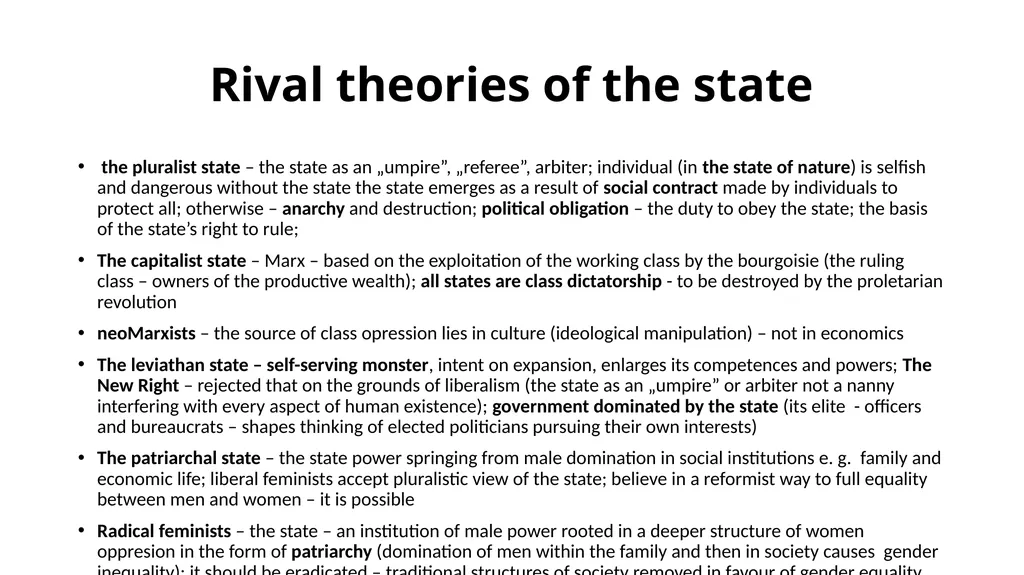
Rival theories of the state the pluralist state – the state as an „umpire”, „referee”, arbiter; individual (in the state of nature) is selfish and dangerous without the state the state emerges as a result of social contract made by individuals to protect all; otherwise – anarchy and destruction; political obligation – the duty to obey the state; the basis of the state’s right to rule;
The capitalist state – Marx – based on the exploitation of the working class by the bourgoisie (the ruling class – owners of the productive wealth); all states are class dictatorship - to be destroyed by the proletarian revolution
neoMarxists – the source of class opression lies in culture (ideological manipulation) – not in economics
The leviathan state – self-serving monster, intent on expansion, enlarges its competences and powers; The New Right – rejected that on the grounds of liberalism (the state as an „umpire” or arbiter not a nanny interfering with every aspect of human existence); government dominated by the state (its elite - officers and bureaucrats – shapes thinking of elected politicians pursuing their own interests)
The patriarchal state – the state power springing from male domination in social institutions e. g. family and economic life; liberal feminists accept pluralistic view of the state; believe in a reformist way to full equality between men and women – it is possible
Radical feminists – the state – an institution of male power rooted in a deeper structure of women oppresion in the form of patriarchy (domination of men within the family and then in society causes gender inequality); it should be eradicated – traditional structures of society removed in favour of gender equality<br>
The capitalist state – Marx – based on the exploitation of the working class by the bourgoisie (the ruling class – owners of the productive wealth); all states are class dictatorship - to be destroyed by the proletarian revolution
neoMarxists – the source of class opression lies in culture (ideological manipulation) – not in economics
The leviathan state – self-serving monster, intent on expansion, enlarges its competences and powers; The New Right – rejected that on the grounds of liberalism (the state as an „umpire” or arbiter not a nanny interfering with every aspect of human existence); government dominated by the state (its elite - officers and bureaucrats – shapes thinking of elected politicians pursuing their own interests)
The patriarchal state – the state power springing from male domination in social institutions e. g. family and economic life; liberal feminists accept pluralistic view of the state; believe in a reformist way to full equality between men and women – it is possible
Radical feminists – the state – an institution of male power rooted in a deeper structure of women oppresion in the form of patriarchy (domination of men within the family and then in society causes gender inequality); it should be eradicated – traditional structures of society removed in favour of gender equality<br>
18
The role of the state The minimal state
The developmental state
The social – democratic state
The collectivized state
The totalitarian state<br>
The developmental state
The social – democratic state
The collectivized state
The totalitarian state<br>
19
Conclusions There is at least several models of democracy that rival each other namely classical democracy, protective democracy, developmental democracy and people’s democracy
Liberal democracy is definitely the most popular model of democracy nowadays
There are rival theories of the state such as pluralist, Marxist, The New Right and feminist.
The state has fulfilled many roles in the history of mankind as a minimal, developmental, social-democratic, collectvized and totalitarian state.<br>
Liberal democracy is definitely the most popular model of democracy nowadays
There are rival theories of the state such as pluralist, Marxist, The New Right and feminist.
The state has fulfilled many roles in the history of mankind as a minimal, developmental, social-democratic, collectvized and totalitarian state.<br>