
Denied parties screening DHL Express – Excellence.
DP
Published · 18 slides · 0 views

1 / 1

Description
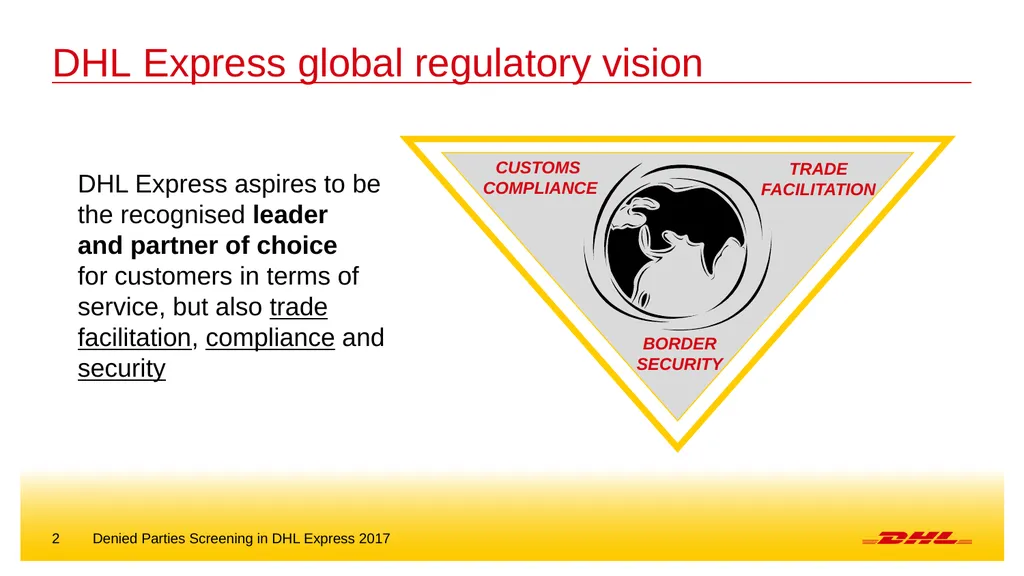
Denied parties screening DHL Express Excellence. Simply delivered. DHL Express global regulatory vision DHL Express aspires to be the recognised leader and partner of choice for customers in terms of service, but also trade facilitation,
Related Topics
Share
Embed code
Download this presentation From Below
"Denied parties screening DHL Express – Excellence." is the property of its rightful owner. Permission is granted to download and print the materials on this website for personal, non-commercial use only, and to display it on your personal computer provided you do not modify the materials and that you retain all copyright notices contained in the materials. By downloading content from our website, you accept the terms of this agreement.
Presentation Transcript
01
Denied parties
screening DHL Express – Excellence. Simply delivered.<br>
02
DHL Express global regulatory vision DHL Express aspires to be
the recognised leader
and partner of choice
for customers in terms of service, but also trade facilitation, compliance and security<br>
the recognised leader
and partner of choice
for customers in terms of service, but also trade facilitation, compliance and security<br>
03
Focus on compliance Scrutiny from governments and customs authorities has significantly increased globally, with a particular focus on counterfeit goods, undervaluation, smuggling and security concerns
As a result, they have introduced legislation regarding:
Denied Parties
Sanctions and Embargoes<br>
As a result, they have introduced legislation regarding:
Denied Parties
Sanctions and Embargoes<br>
04
What is a Denied Party? Denied Parties can be individuals or companies…
...who are actively involved in a terrorist organization and/or are directly suspected of terrorism and/or involved in financial fraud
...against whom Sanctions have been imposed because of political issues e.g. human rights violations, financing of terrorism, etc)…
…and who may under no circumstances receive economic resources (money/goods/services) in order to allow them to achieve their political goals e.g. financing terrorist groups, proliferation of nuclear capability, etc<br>
...who are actively involved in a terrorist organization and/or are directly suspected of terrorism and/or involved in financial fraud
...against whom Sanctions have been imposed because of political issues e.g. human rights violations, financing of terrorism, etc)…
…and who may under no circumstances receive economic resources (money/goods/services) in order to allow them to achieve their political goals e.g. financing terrorist groups, proliferation of nuclear capability, etc<br>
05
What are sanctions and embargos? “Sanction”: a corrective act taken by one nation against another nation
that has violated a treaty or International Law
“Embargo”: an official ban on trade or other commercial activity with a particular country
A Sanction/Embargo stops or restricts goods, technology, knowledge, ideas and finance from being provided to red flag countries or individuals supporting such regimes that are considered to be a threat to mankind<br>
“Embargo”: an official ban on trade or other commercial activity with a particular country
A Sanction/Embargo stops or restricts goods, technology, knowledge, ideas and finance from being provided to red flag countries or individuals supporting such regimes that are considered to be a threat to mankind<br>
06
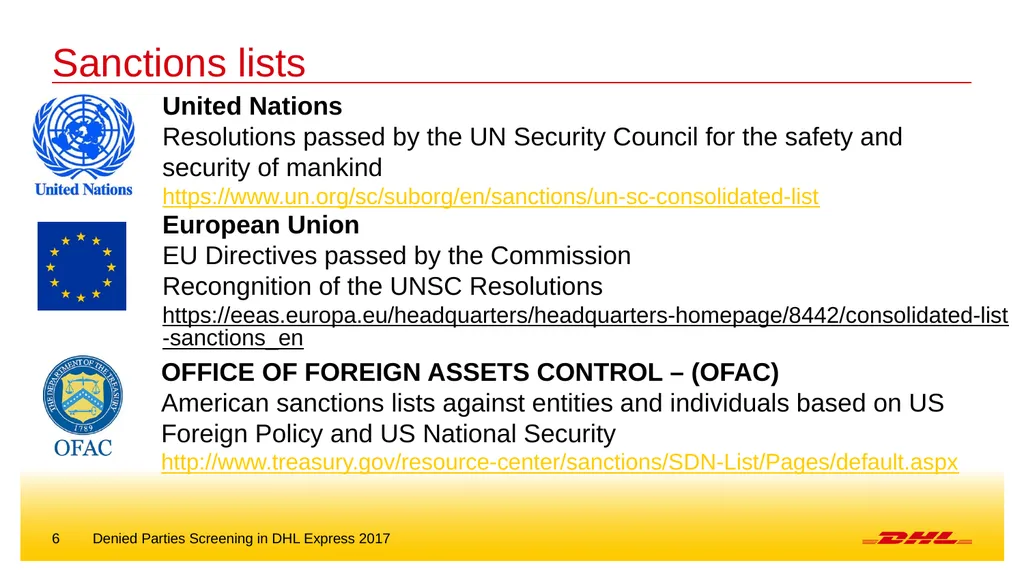
Sanctions lists United Nations
Resolutions passed by the UN Security Council for the safety and security of mankind
https://www.un.org/sc/suborg/en/sanctions/un-sc-consolidated-list European Union
EU Directives passed by the Commission
Recongnition of the UNSC Resolutions
https://eeas.europa.eu/headquarters/headquarters-homepage/8442/consolidated-list-sanctions_en OFFICE OF FOREIGN ASSETS CONTROL – (OFAC)
American sanctions lists against entities and individuals based on US Foreign Policy and US National Security
http://www.treasury.gov/resource-center/sanctions/SDN-List/Pages/default.aspx<br>
Resolutions passed by the UN Security Council for the safety and security of mankind
https://www.un.org/sc/suborg/en/sanctions/un-sc-consolidated-list European Union
EU Directives passed by the Commission
Recongnition of the UNSC Resolutions
https://eeas.europa.eu/headquarters/headquarters-homepage/8442/consolidated-list-sanctions_en OFFICE OF FOREIGN ASSETS CONTROL – (OFAC)
American sanctions lists against entities and individuals based on US Foreign Policy and US National Security
http://www.treasury.gov/resource-center/sanctions/SDN-List/Pages/default.aspx<br>
07
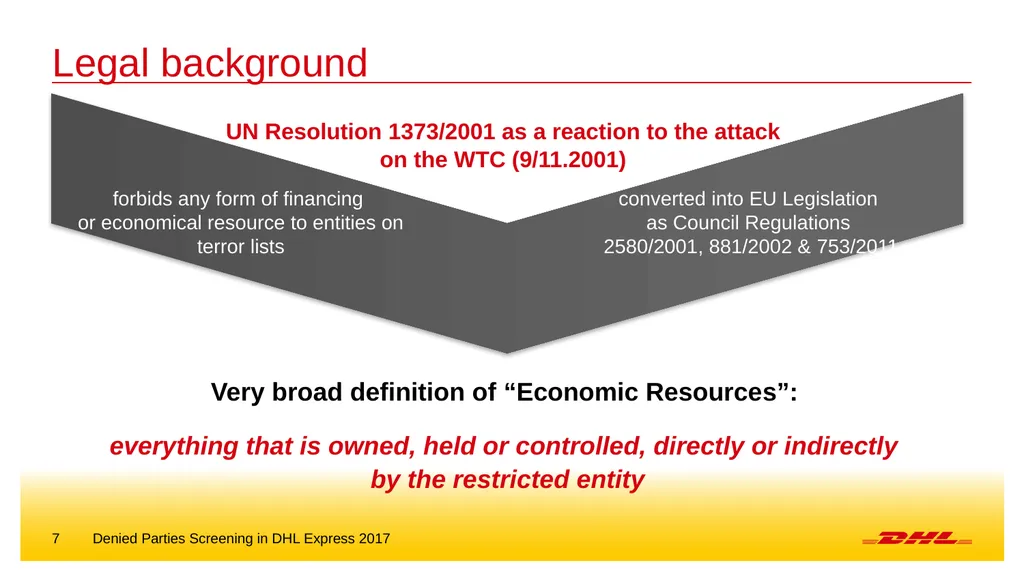
Legal background Very broad definition of “Economic Resources”:
everything that is owned, held or controlled, directly or indirectly by the restricted entity<br>
everything that is owned, held or controlled, directly or indirectly by the restricted entity<br>
08
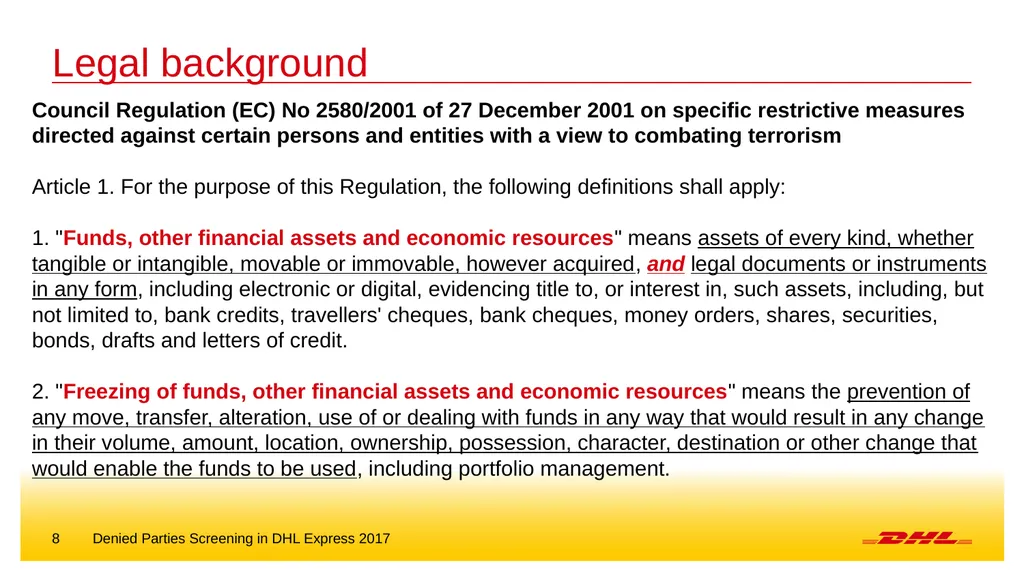
Legal background Council Regulation (EC) No 2580/2001 of 27 December 2001 on specific restrictive measures directed against certain persons and entities with a view to combating terrorism
Article 1. For the purpose of this Regulation, the following definitions shall apply:
1. "Funds, other financial assets and economic resources" means assets of every kind, whether tangible or intangible, movable or immovable, however acquired, and legal documents or instruments in any form, including electronic or digital, evidencing title to, or interest in, such assets, including, but not limited to, bank credits, travellers' cheques, bank cheques, money orders, shares, securities, bonds, drafts and letters of credit.
2. "Freezing of funds, other financial assets and economic resources" means the prevention of any move, transfer, alteration, use of or dealing with funds in any way that would result in any change in their volume, amount, location, ownership, possession, character, destination or other change that would enable the funds to be used, including portfolio management.<br>
Article 1. For the purpose of this Regulation, the following definitions shall apply:
1. "Funds, other financial assets and economic resources" means assets of every kind, whether tangible or intangible, movable or immovable, however acquired, and legal documents or instruments in any form, including electronic or digital, evidencing title to, or interest in, such assets, including, but not limited to, bank credits, travellers' cheques, bank cheques, money orders, shares, securities, bonds, drafts and letters of credit.
2. "Freezing of funds, other financial assets and economic resources" means the prevention of any move, transfer, alteration, use of or dealing with funds in any way that would result in any change in their volume, amount, location, ownership, possession, character, destination or other change that would enable the funds to be used, including portfolio management.<br>
09
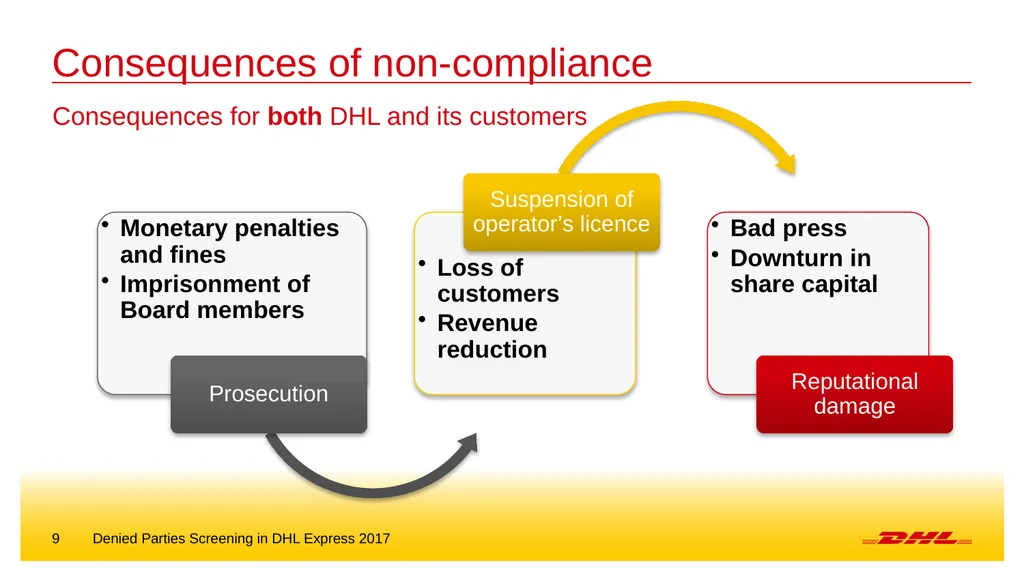
Consequences of non-compliance
Consequences for both DHL and its customers<br>
10
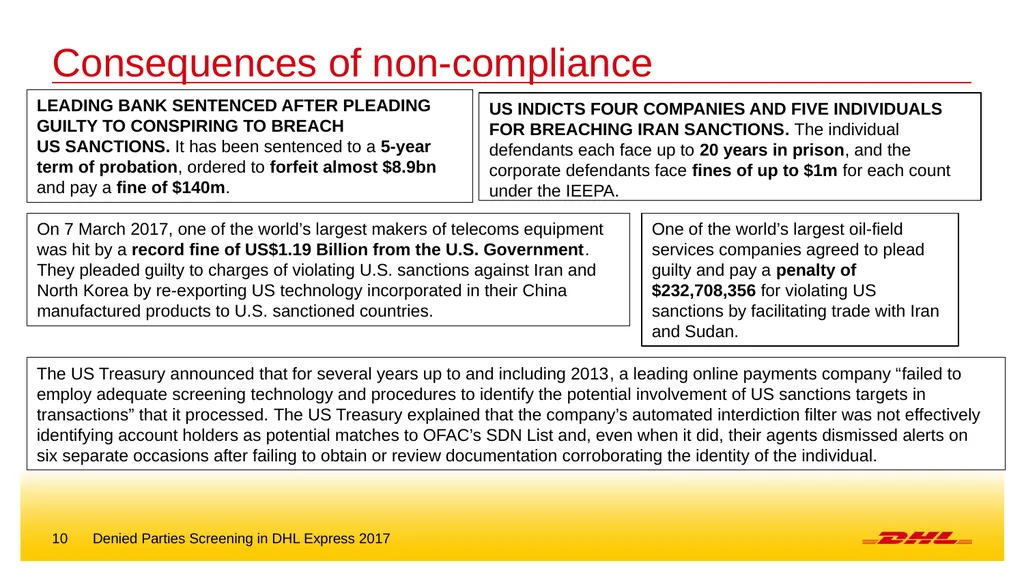
Consequences of non-compliance LEADING BANK SENTENCED AFTER PLEADING GUILTY TO CONSPIRING TO BREACH US SANCTIONS. It has been sentenced to a 5-year term of probation, ordered to forfeit almost $8.9bn and pay a fine of $140m. US INDICTS FOUR COMPANIES AND FIVE INDIVIDUALS FOR BREACHING IRAN SANCTIONS. The individual defendants each face up to 20 years in prison, and the corporate defendants face fines of up to $1m for each count under the IEEPA. One of the world’s largest oil-field services companies agreed to plead guilty and pay a penalty of $232,708,356 for violating US sanctions by facilitating trade with Iran and Sudan. The US Treasury announced that for several years up to and including 2013, a leading online payments company “failed to employ adequate screening technology and procedures to identify the potential involvement of US sanctions targets in transactions” that it processed. The US Treasury explained that the company’s automated interdiction filter was not effectively identifying account holders as potential matches to OFAC’s SDN List and, even when it did, their agents dismissed alerts on six separate occasions after failing to obtain or review documentation corroborating the identity of the individual. On 7 March 2017, one of the world’s largest makers of telecoms equipment was hit by a record fine of US$1.19 Billion from the U.S. Government. They pleaded guilty to charges of violating U.S. sanctions against Iran and North Korea by re-exporting US technology incorporated in their China manufactured products to U.S. sanctioned countries.<br>
11
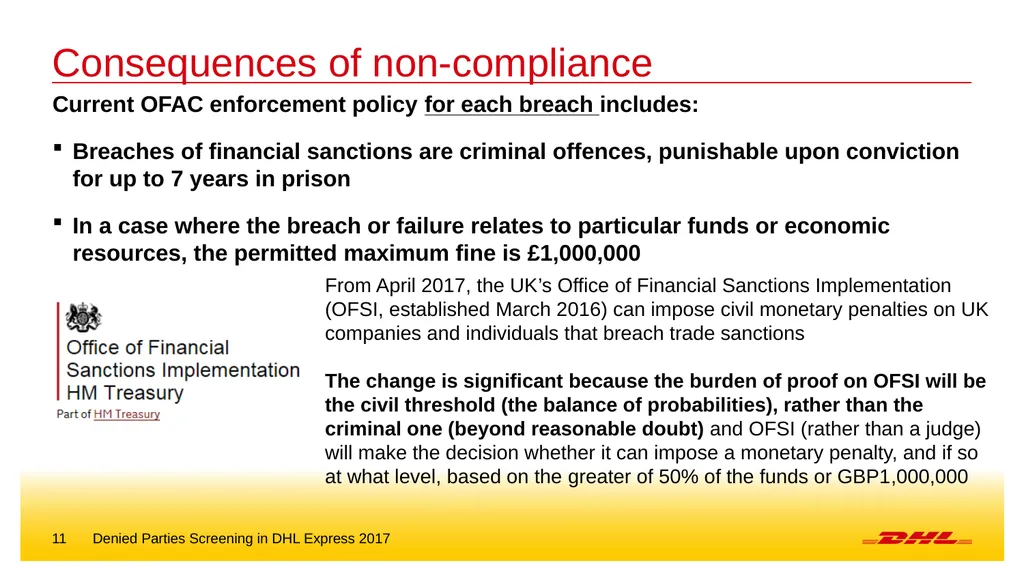
Consequences of non-compliance From April 2017, the UK’s Office of Financial Sanctions Implementation (OFSI, established March 2016) can impose civil monetary penalties on UK companies and individuals that breach trade sanctions
The change is significant because the burden of proof on OFSI will be the civil threshold (the balance of probabilities), rather than the criminal one (beyond reasonable doubt) and OFSI (rather than a judge) will make the decision whether it can impose a monetary penalty, and if so at what level, based on the greater of 50% of the funds or GBP1,000,000 Current OFAC enforcement policy for each breach includes:
Breaches of financial sanctions are criminal offences, punishable upon conviction for up to 7 years in prison
In a case where the breach or failure relates to particular funds or economic resources, the permitted maximum fine is £1,000,000<br>
The change is significant because the burden of proof on OFSI will be the civil threshold (the balance of probabilities), rather than the criminal one (beyond reasonable doubt) and OFSI (rather than a judge) will make the decision whether it can impose a monetary penalty, and if so at what level, based on the greater of 50% of the funds or GBP1,000,000 Current OFAC enforcement policy for each breach includes:
Breaches of financial sanctions are criminal offences, punishable upon conviction for up to 7 years in prison
In a case where the breach or failure relates to particular funds or economic resources, the permitted maximum fine is £1,000,000<br>
12
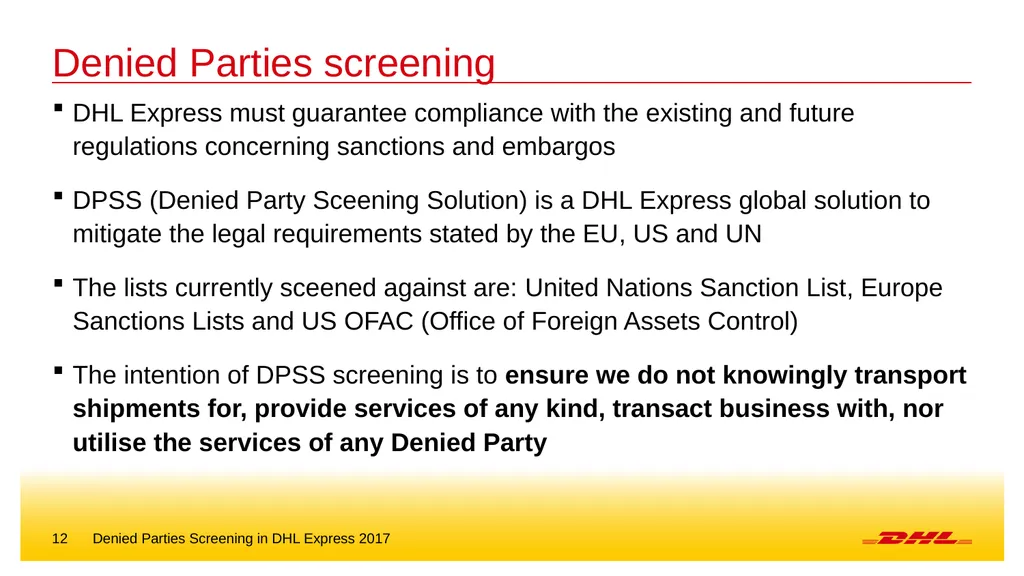
Denied Parties screening DHL Express must guarantee compliance with the existing and future regulations concerning sanctions and embargos
DPSS (Denied Party Sceening Solution) is a DHL Express global solution to mitigate the legal requirements stated by the EU, US and UN
The lists currently sceened against are: United Nations Sanction List, Europe Sanctions Lists and US OFAC (Office of Foreign Assets Control)
The intention of DPSS screening is to ensure we do not knowingly transport shipments for, provide services of any kind, transact business with, nor utilise the services of any Denied Party<br>
DPSS (Denied Party Sceening Solution) is a DHL Express global solution to mitigate the legal requirements stated by the EU, US and UN
The lists currently sceened against are: United Nations Sanction List, Europe Sanctions Lists and US OFAC (Office of Foreign Assets Control)
The intention of DPSS screening is to ensure we do not knowingly transport shipments for, provide services of any kind, transact business with, nor utilise the services of any Denied Party<br>
13
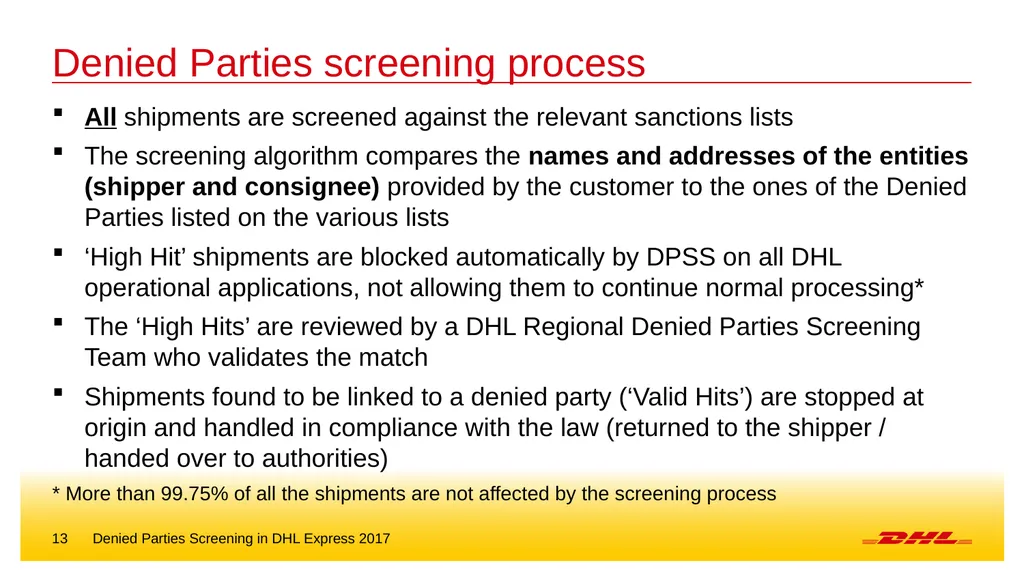
Denied Parties screening process All shipments are screened against the relevant sanctions lists
The screening algorithm compares the names and addresses of the entities (shipper and consignee) provided by the customer to the ones of the Denied Parties listed on the various lists
‘High Hit’ shipments are blocked automatically by DPSS on all DHL operational applications, not allowing them to continue normal processing*
The ‘High Hits’ are reviewed by a DHL Regional Denied Parties Screening Team who validates the match
Shipments found to be linked to a denied party (‘Valid Hits’) are stopped at origin and handled in compliance with the law (returned to the shipper / handed over to authorities)
* More than 99.75% of all the shipments are not affected by the screening process<br>
The screening algorithm compares the names and addresses of the entities (shipper and consignee) provided by the customer to the ones of the Denied Parties listed on the various lists
‘High Hit’ shipments are blocked automatically by DPSS on all DHL operational applications, not allowing them to continue normal processing*
The ‘High Hits’ are reviewed by a DHL Regional Denied Parties Screening Team who validates the match
Shipments found to be linked to a denied party (‘Valid Hits’) are stopped at origin and handled in compliance with the law (returned to the shipper / handed over to authorities)
* More than 99.75% of all the shipments are not affected by the screening process<br>
14
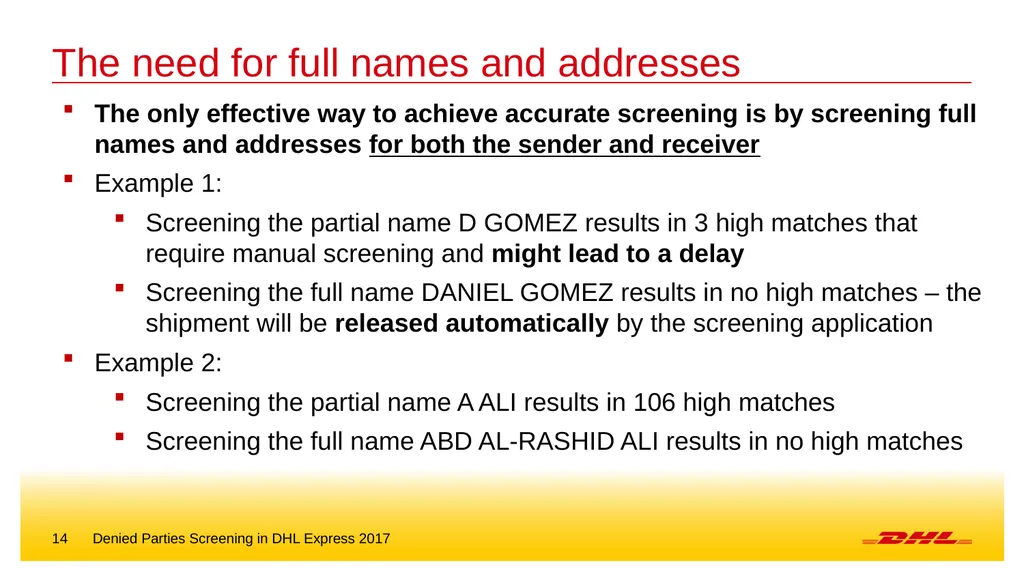
The need for full names and addresses The only effective way to achieve accurate screening is by screening full names and addresses for both the sender and receiver
Example 1:
Screening the partial name D GOMEZ results in 3 high matches that require manual screening and might lead to a delay
Screening the full name DANIEL GOMEZ results in no high matches – the shipment will be released automatically by the screening application
Example 2:
Screening the partial name A ALI results in 106 high matches
Screening the full name ABD AL-RASHID ALI results in no high matches<br>
Example 1:
Screening the partial name D GOMEZ results in 3 high matches that require manual screening and might lead to a delay
Screening the full name DANIEL GOMEZ results in no high matches – the shipment will be released automatically by the screening application
Example 2:
Screening the partial name A ALI results in 106 high matches
Screening the full name ABD AL-RASHID ALI results in no high matches<br>
15
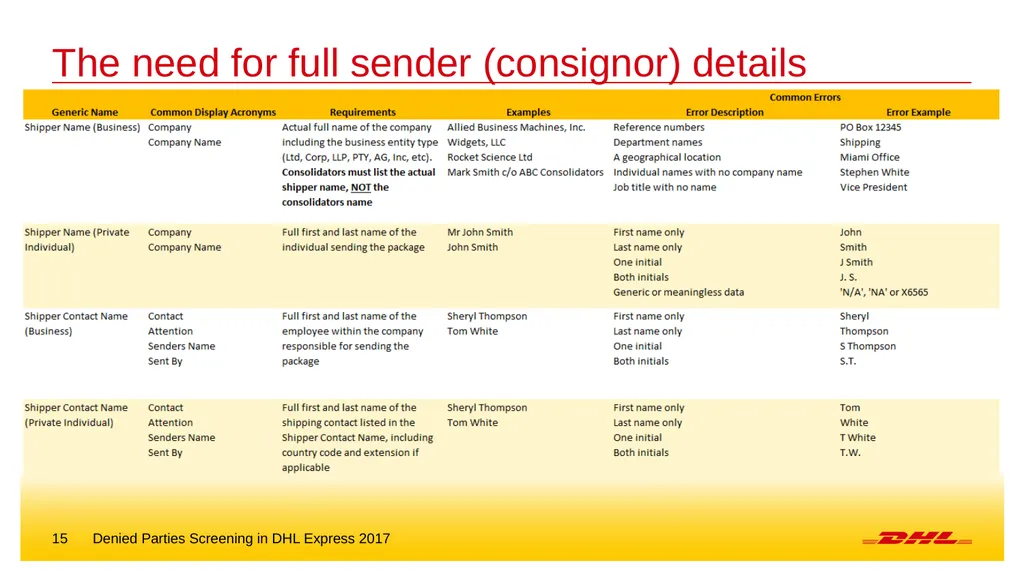
The need for full sender (consignor) details<br>
16
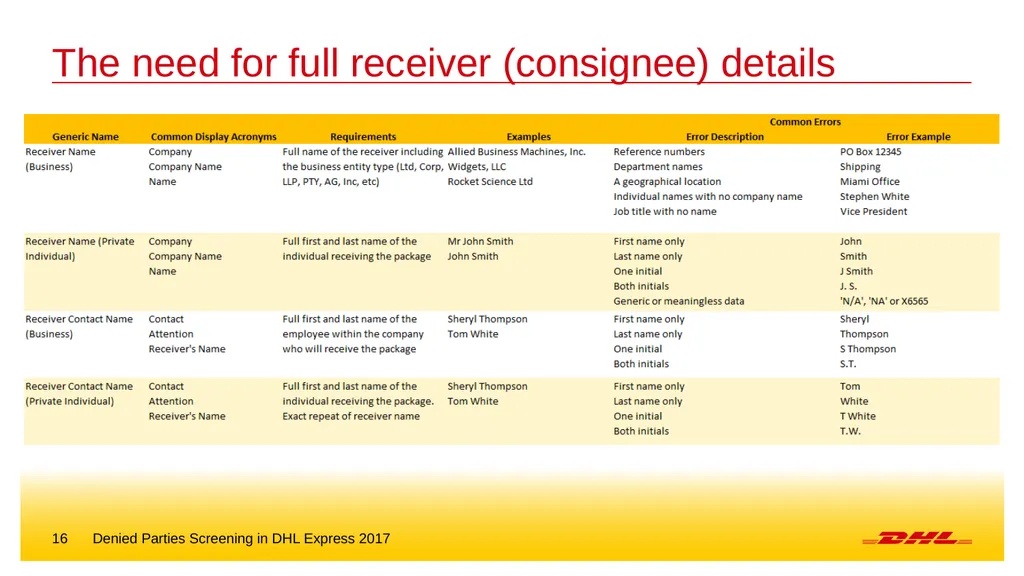
The need for full receiver (consignee) details<br>
17
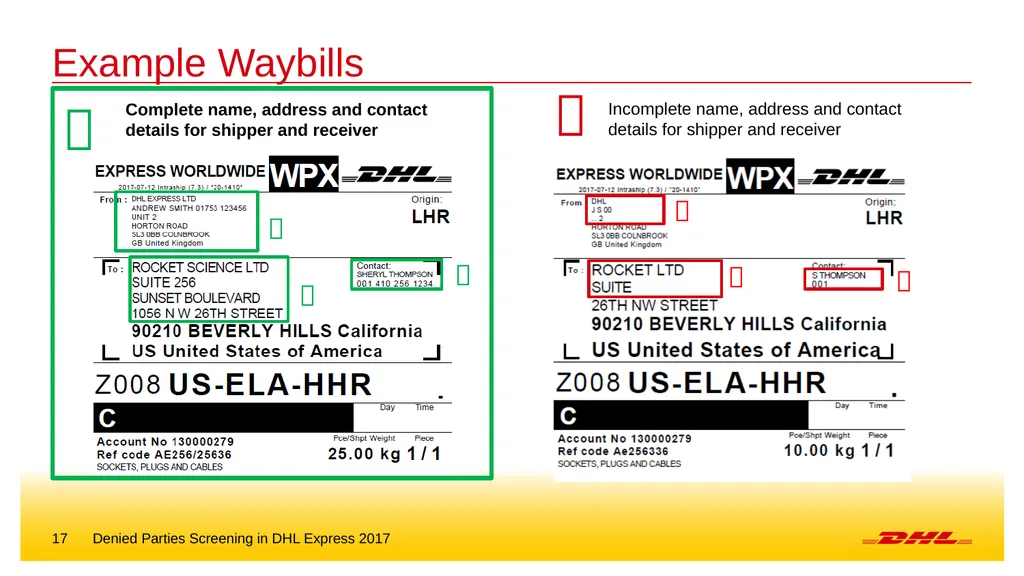
Example Waybills Complete name, address and contact details for shipper and receiver Incomplete name, address and contact details for shipper and receiver <br>