Dense graphs with a large triangle cover have a large triangle packing Raphael Yuster SIAM DM10 2 The problem, formulation and definitions Triangle (edge) cover: a set of edges meeting all triangles. Triangle (edge) packing: a set of
"Dense graphs with a large triangle cover have a" is the property of its rightful owner. Permission is granted to
download and print the materials on this website for personal, non-commercial use only, and to display it
on your personal computer provided you do not modify the materials and that you retain all copyright
notices contained in the materials. By downloading content from our website, you accept the terms of this
agreement.
Presentation Transcript
01
Dense graphs with a large triangle cover have a large triangle packing Raphael Yuster SIAM DM’10<br>
02
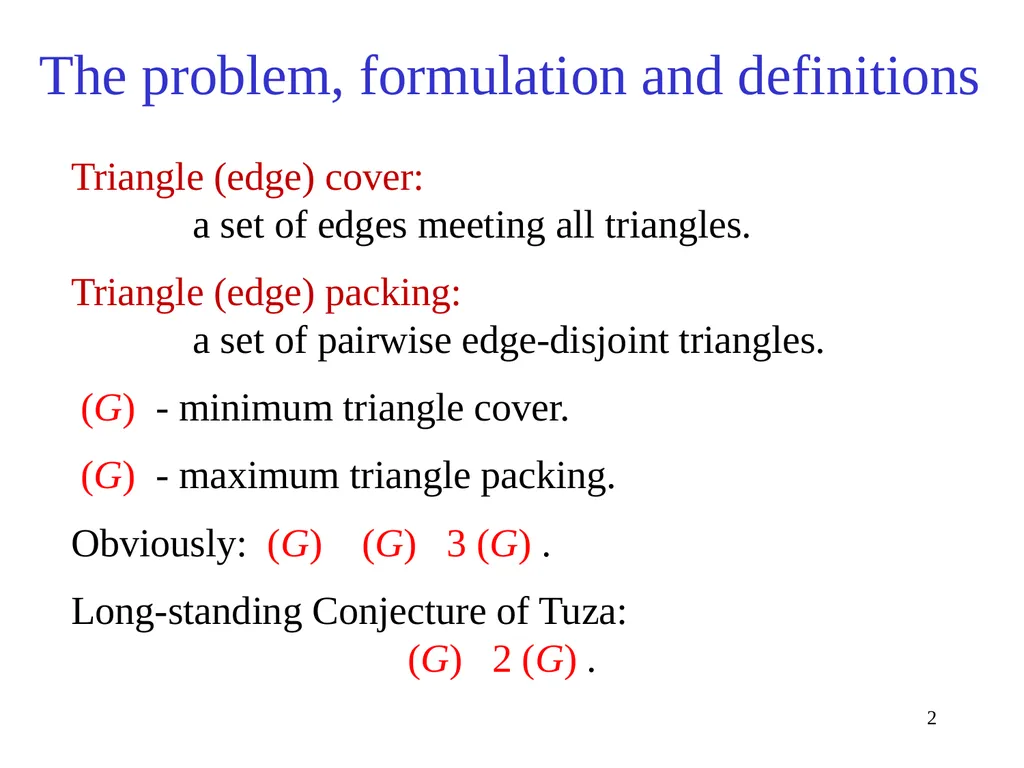
2 The problem, formulation and definitions Triangle (edge) cover: a set of edges meeting all triangles.
Triangle (edge) packing: a set of pairwise edge-disjoint triangles.
(G) - minimum triangle cover.
(G) - maximum triangle packing.
Obviously: (G) (G) 3(G) .
Long-standing Conjecture of Tuza: (G) 2(G) .<br>
03
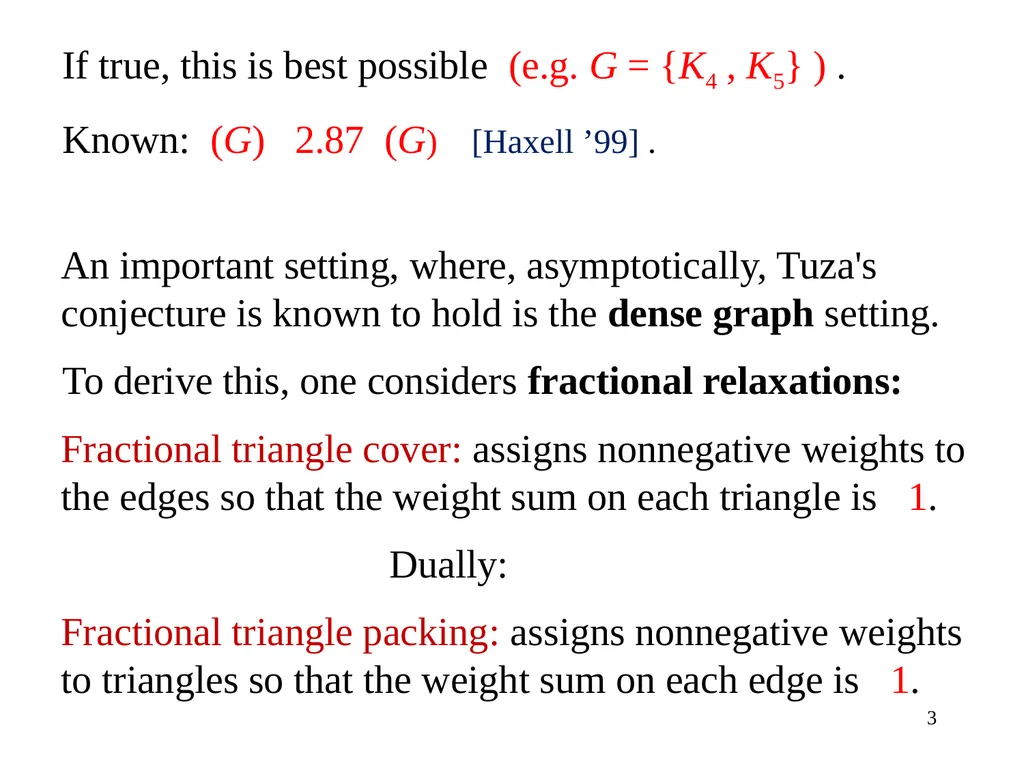
3 If true, this is best possible (e.g. G = {K4 , K5} ) .
Known: (G) 2.87 (G) [Haxell ’99] .
An important setting, where, asymptotically, Tuza's conjecture is known to hold is the dense graph setting.
To derive this, one considers fractional relaxations:
Fractional triangle cover: assigns nonnegative weights to the edges so that the weight sum on each triangle is 1.
Dually:
Fractional triangle packing: assigns nonnegative weights to triangles so that the weight sum on each edge is 1.<br>
04
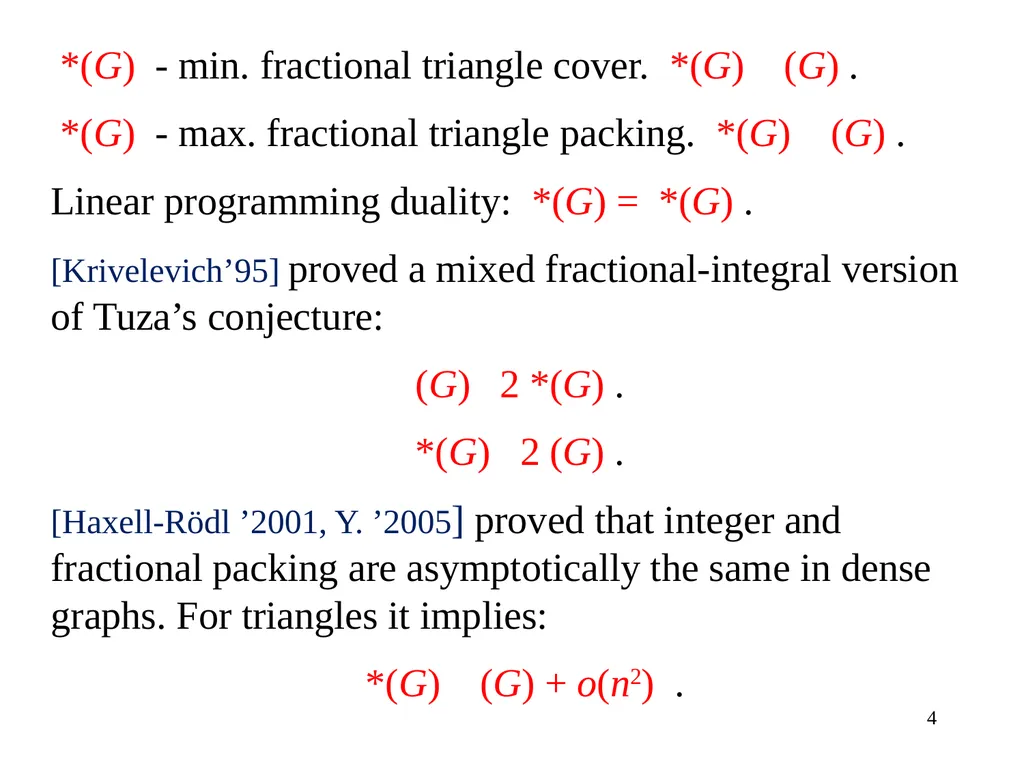
4 *(G) - min. fractional triangle cover. *(G) (G) .
*(G) - max. fractional triangle packing. *(G) (G) .
Linear programming duality: *(G) = *(G) .
[Krivelevich’95] proved a mixed fractional-integral version of Tuza’s conjecture:
(G) 2*(G) .
*(G) 2(G) .
[Haxell-Rödl ’2001, Y. ’2005] proved that integer and fractional packing are asymptotically the same in dense graphs. For triangles it implies:
*(G) (G) + o(n2) .<br>
05
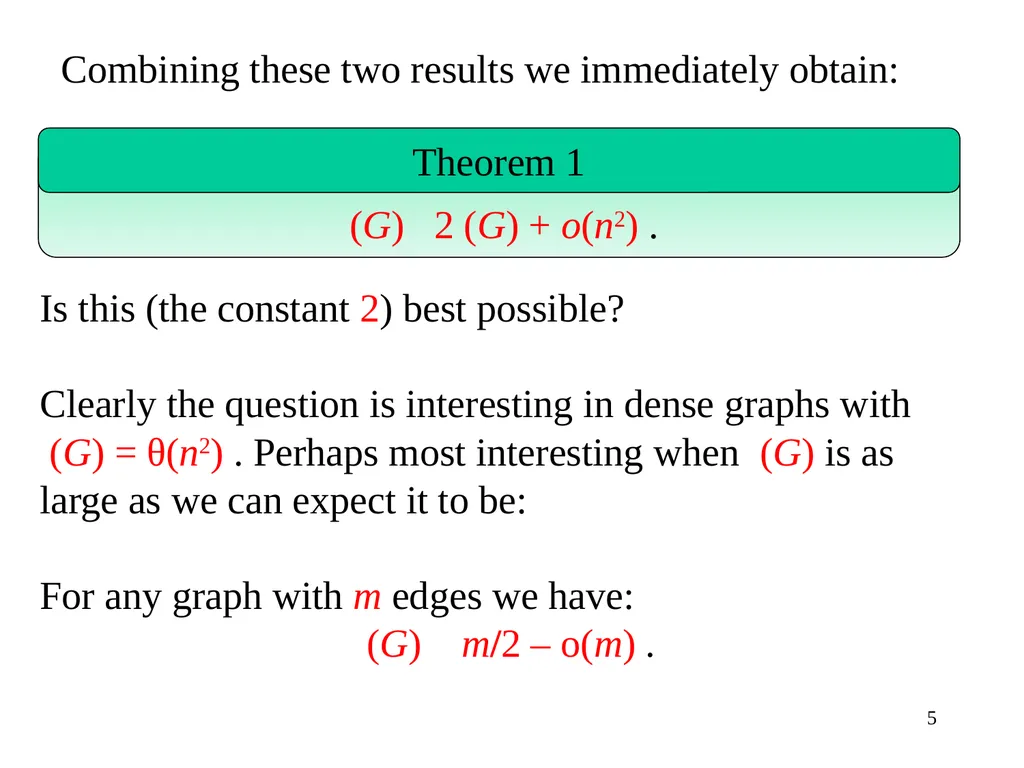
(G) 2(G) + o(n2) . 5 Theorem 1 Combining these two results we immediately obtain: Is this (the constant 2) best possible?
Clearly the question is interesting in dense graphs with (G) = θ(n2) . Perhaps most interesting when (G) is as large as we can expect it to be:
For any graph with m edges we have: (G) m/2 – o(m) .<br>
06
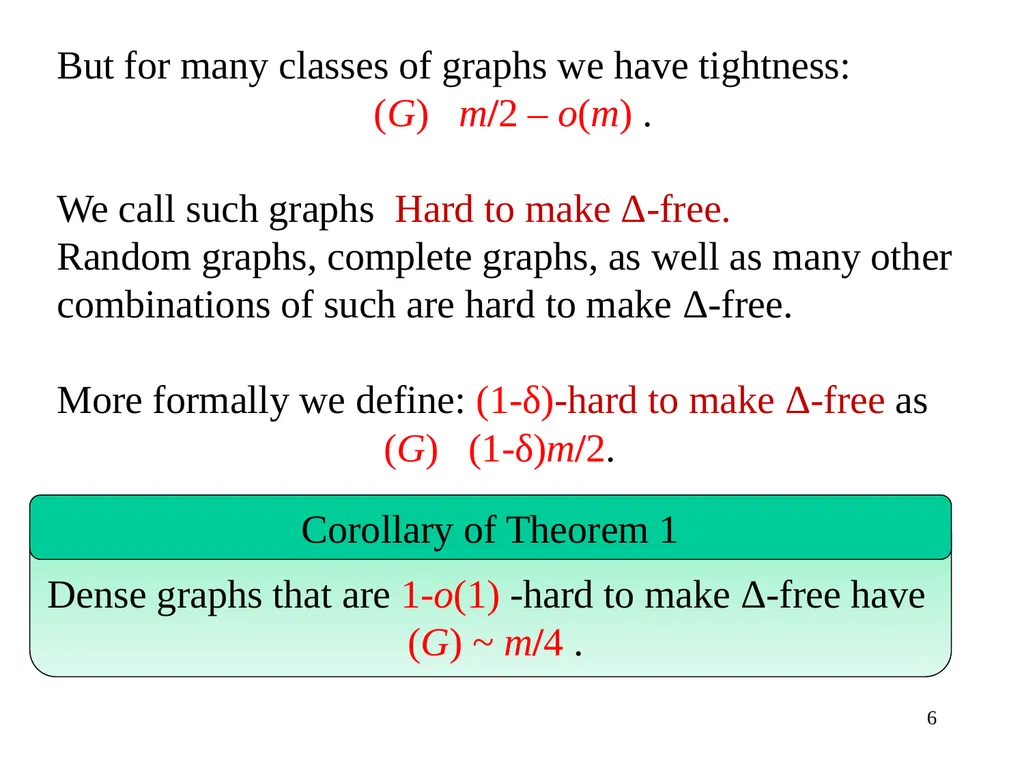
6 But for many classes of graphs we have tightness:
(G) m/2 – o(m) .
We call such graphs Hard to make Δ-free.
Random graphs, complete graphs, as well as many other combinations of such are hard to make Δ-free.
More formally we define: (1-δ)-hard to make Δ-free as (G) (1-δ)m/2. Dense graphs that are 1-o(1) -hard to make Δ-free have
(G) ~ m/4 . Corollary of Theorem 1<br>
07
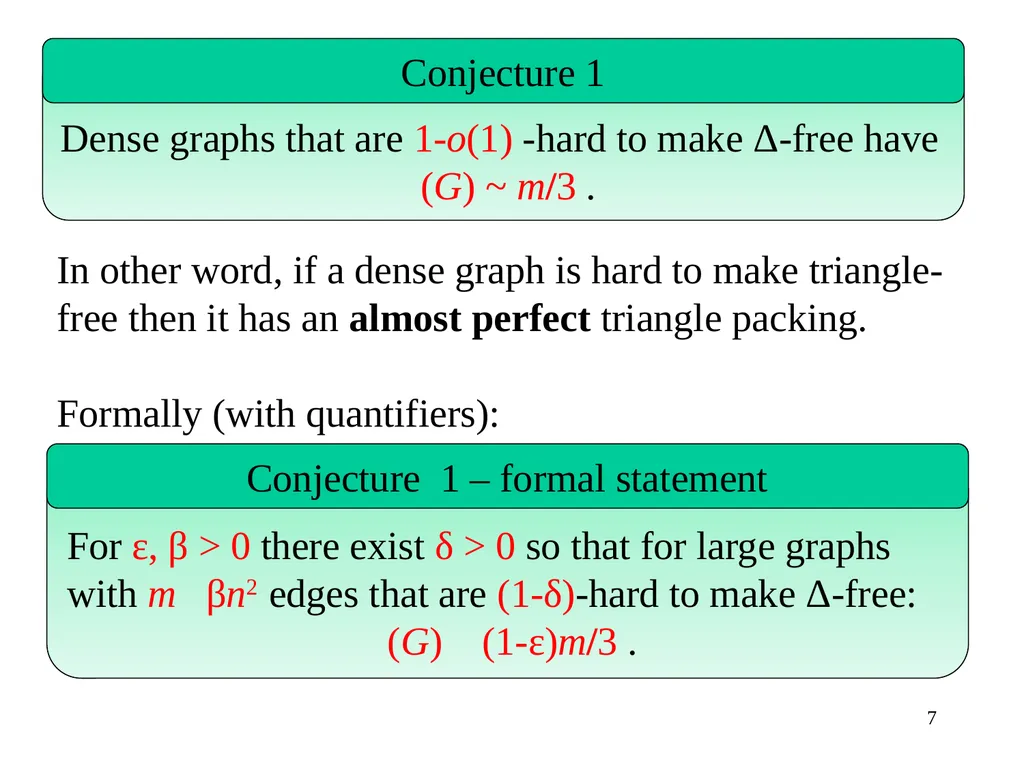
7 Dense graphs that are 1-o(1) -hard to make Δ-free have
(G) ~ m/3 . Conjecture 1 In other word, if a dense graph is hard to make triangle-free then it has an almost perfect triangle packing.
Formally (with quantifiers): For ε, β > 0 there exist δ > 0 so that for large graphs with m βn2 edges that are (1-δ)-hard to make Δ-free:
(G) (1-ε)m/3 . Conjecture 1 – formal statement<br>
08
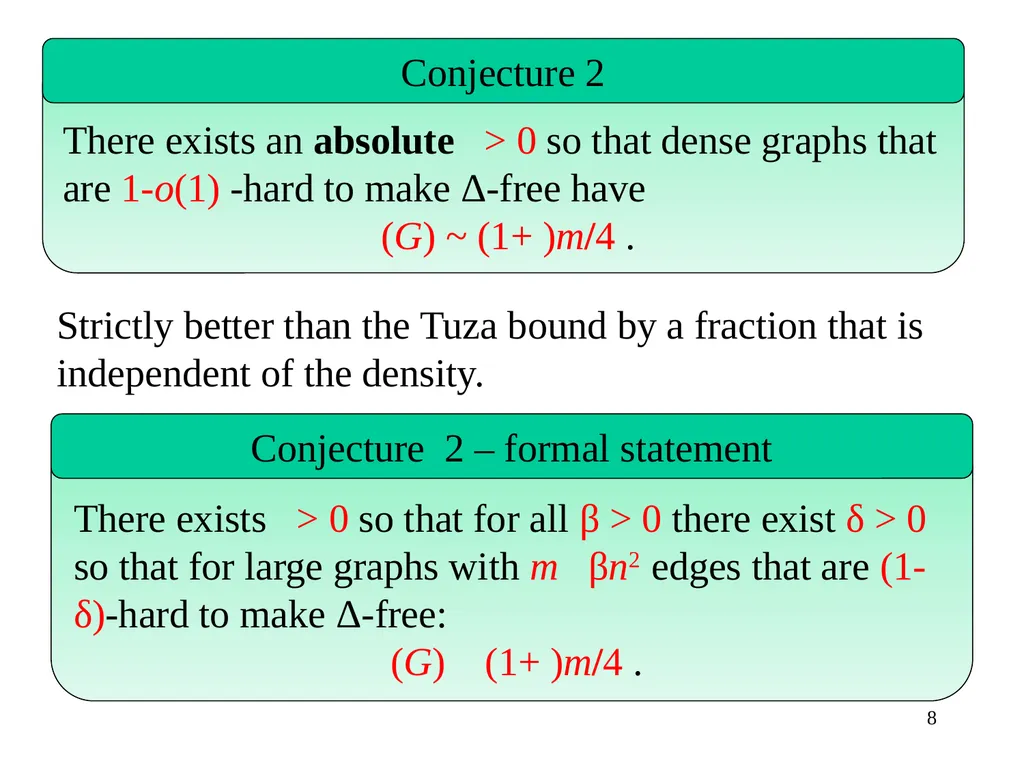
8 There exists an absolute > 0 so that dense graphs that are 1-o(1) -hard to make Δ-free have
(G) ~ (1+)m/4 . Conjecture 2 There exists > 0 so that for all β > 0 there exist δ > 0 so that for large graphs with m βn2 edges that are (1-δ)-hard to make Δ-free:
(G) (1+)m/4 . Conjecture 2 – formal statement Strictly better than the Tuza bound by a fraction that is independent of the density.<br>
09
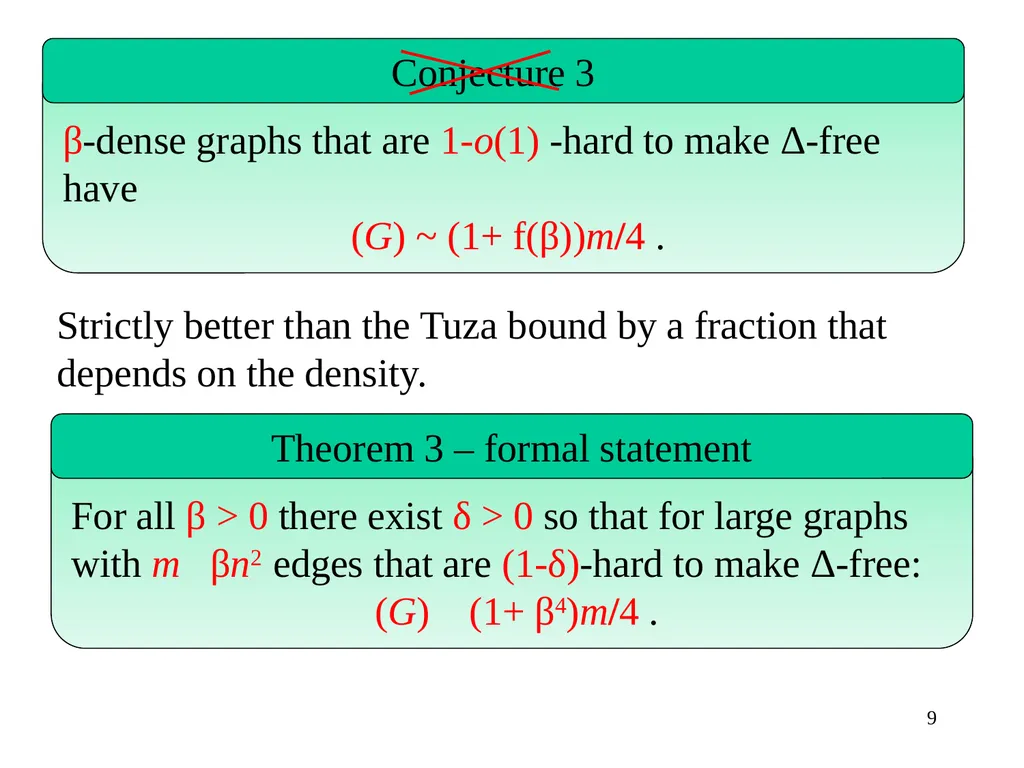
9 β-dense graphs that are 1-o(1) -hard to make Δ-free have
(G) ~ (1+ f(β))m/4 . Conjecture 3 For all β > 0 there exist δ > 0 so that for large graphs with m βn2 edges that are (1-δ)-hard to make Δ-free:
(G) (1+ β4)m/4 . Theorem 3 – formal statement Strictly better than the Tuza bound by a fraction that depends on the density.<br>
10
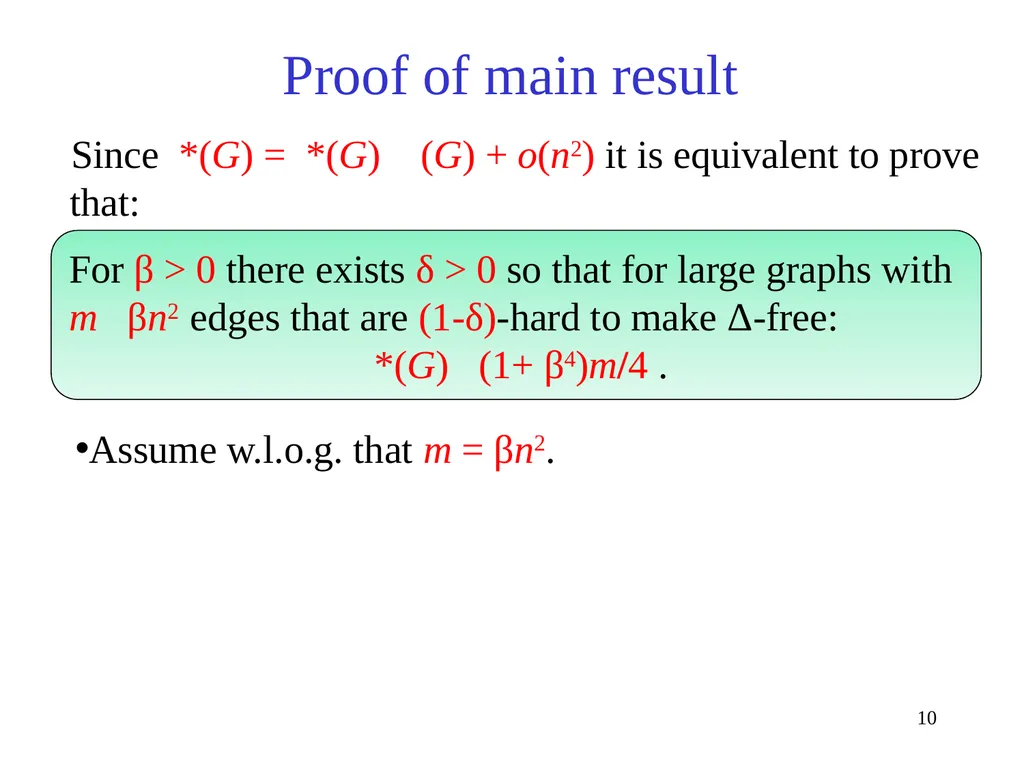
10 Proof of main result Since *(G) = *(G) (G) + o(n2) it is equivalent to prove that: For β > 0 there exists δ > 0 so that for large graphs with m βn2 edges that are (1-δ)-hard to make Δ-free:
*(G) (1+ β4)m/4 . Assume w.l.o.g. that m = βn2.<br>
11
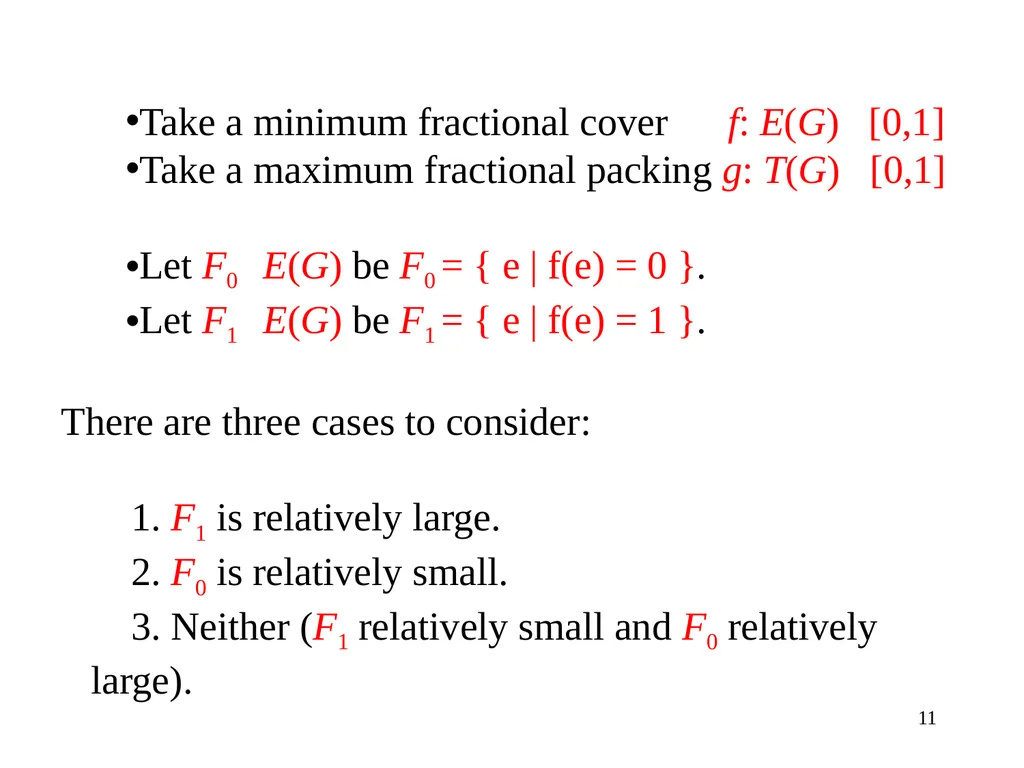
11 Take a minimum fractional cover f: E(G) [0,1]
Take a maximum fractional packing g: T(G) [0,1]
Let F0 E(G) be F0 = { e | f(e) = 0 }.
Let F1 E(G) be F1 = { e | f(e) = 1 }.
There are three cases to consider:
F1 is relatively large.
F0 is relatively small.
Neither (F1 relatively small and F0 relatively large).<br>
12
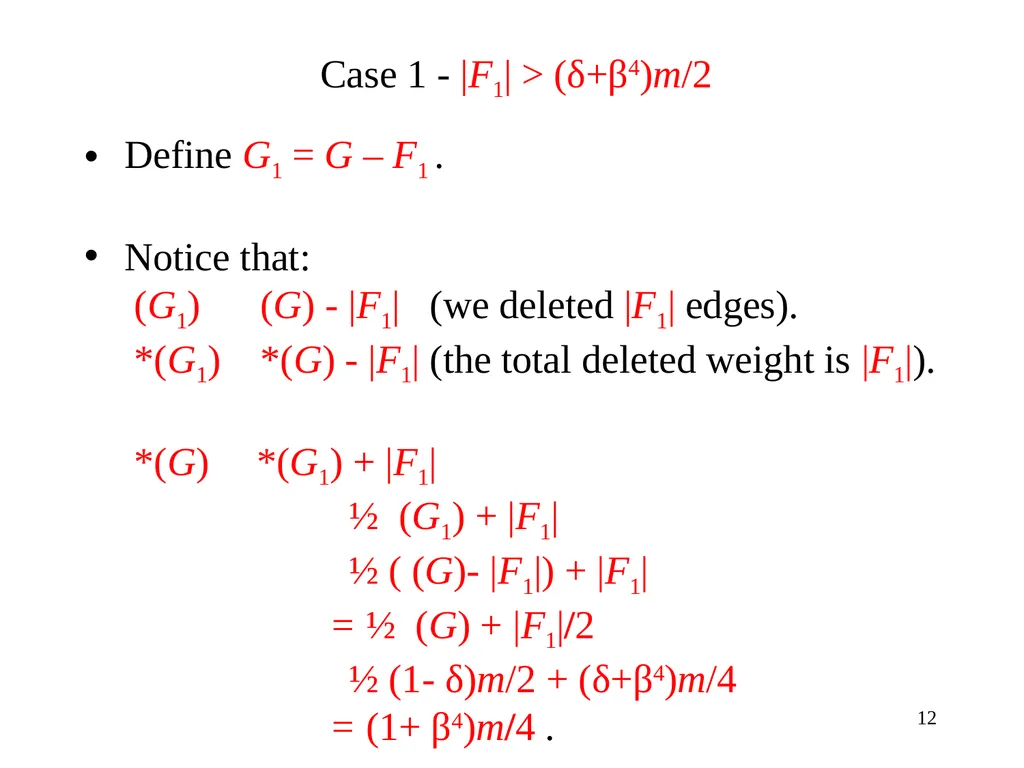
12 Case 1 - |F1| > (δ+β4)m/2 Define G1 = G – F1 .
Notice that:
(G1) (G) - |F1| (we deleted |F1| edges).
*(G1) *(G) - |F1| (the total deleted weight is |F1|).
*(G) *(G1) + |F1|
½ (G1) + |F1|
½ ((G)- |F1|) + |F1|
= ½ (G) + |F1|/2
½ (1- δ)m/2 + (δ+β4)m/4
= (1+ β4)m/4 .<br>
13
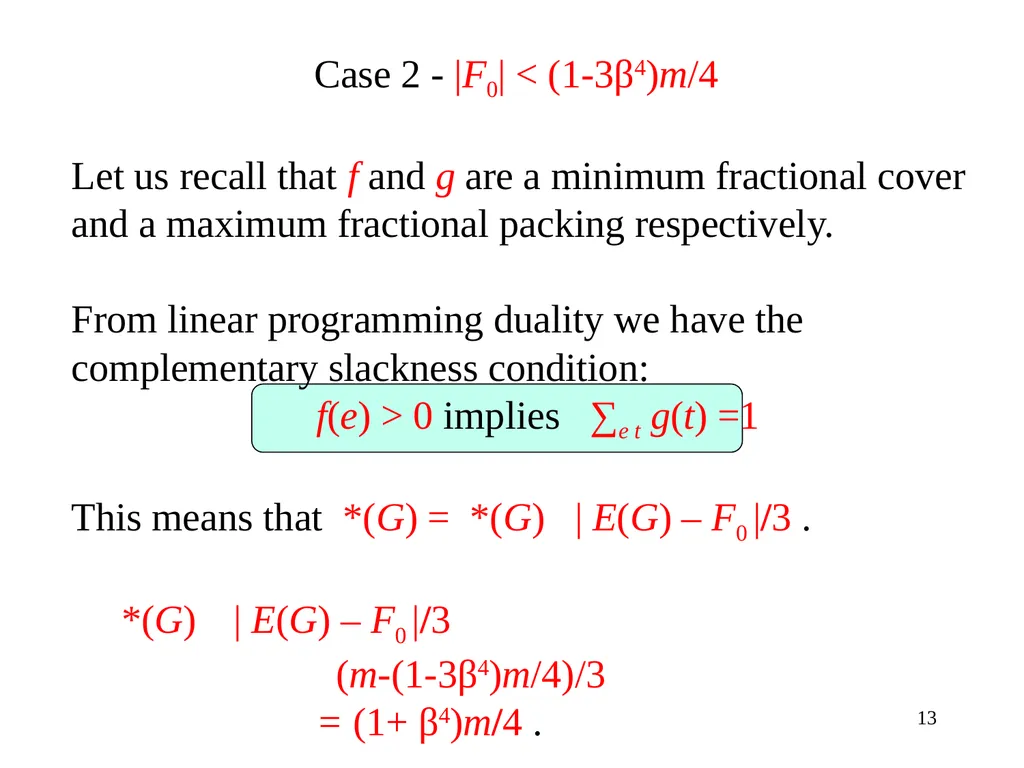
13 Case 2 - |F0| < (1-3β4)m/4
Let us recall that f and g are a minimum fractional cover and a maximum fractional packing respectively.
From linear programming duality we have the complementary slackness condition:
f(e) > 0 implies ∑et g(t) =1
This means that *(G) = *(G) | E(G) – F0 |/3 .
*(G) | E(G) – F0 |/3
(m-(1-3β4)m/4)/3
= (1+ β4)m/4 .<br>
14
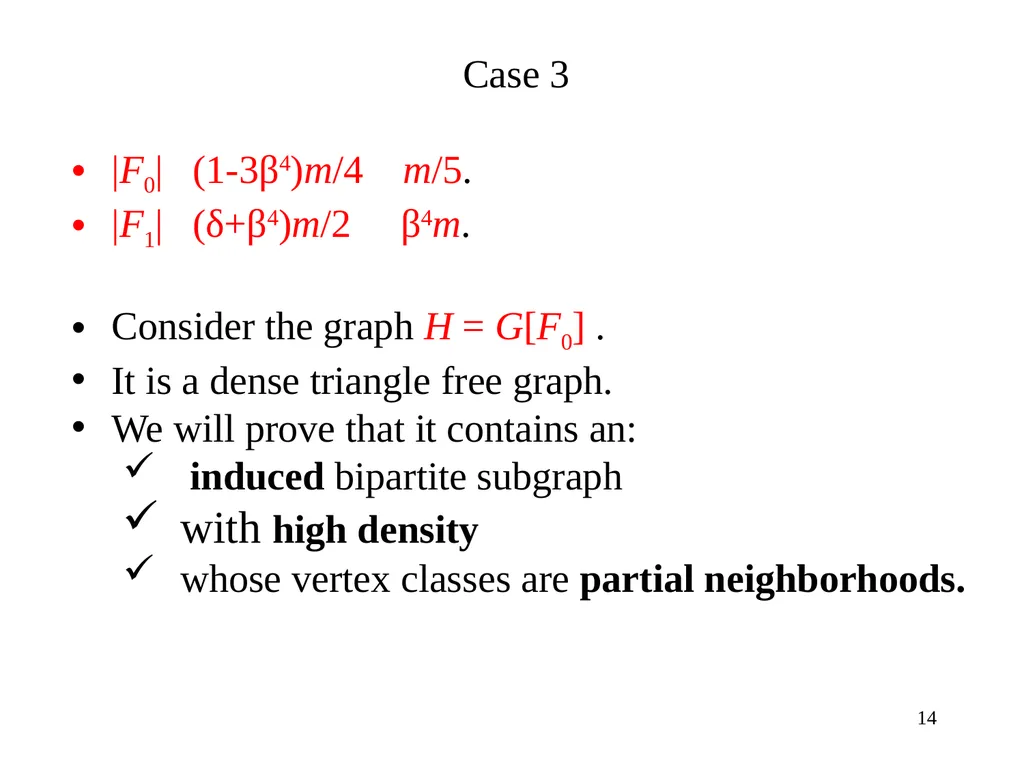
14 Case 3
|F0| (1-3β4)m/4 m/5.
|F1| (δ+β4)m/2 β4m.
Consider the graph H = G[F0] .
It is a dense triangle free graph.
We will prove that it contains an:
induced bipartite subgraph
with high density
whose vertex classes are partial neighborhoods.<br>
15
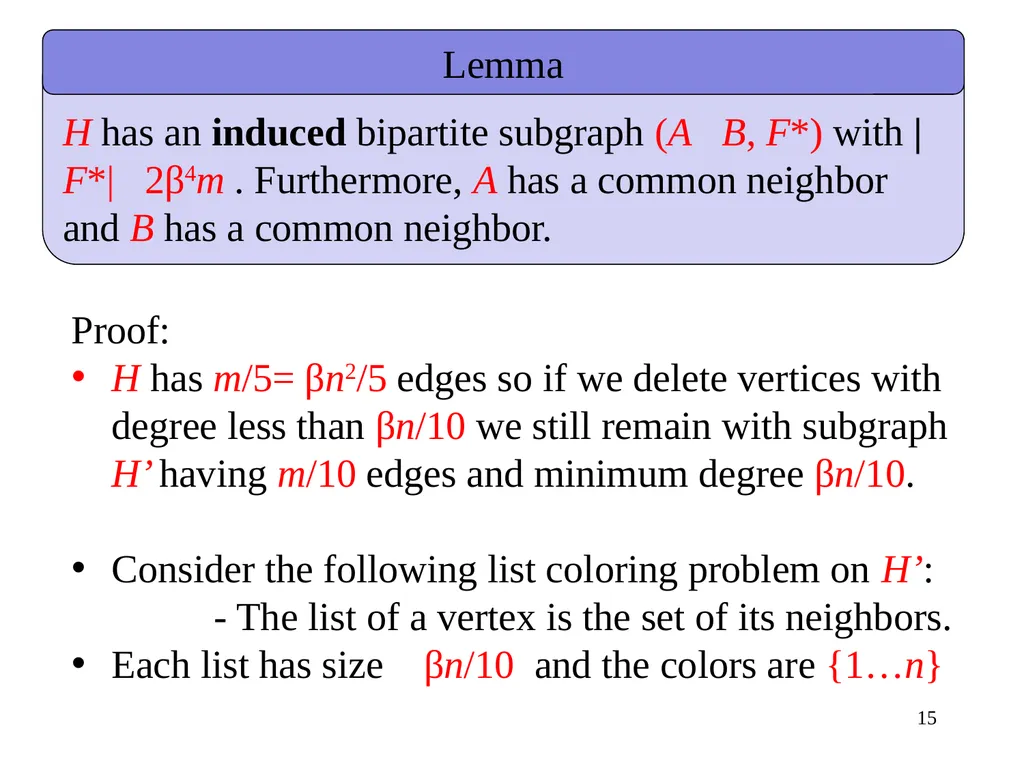
15 Proof:
H has m/5= βn2/5 edges so if we delete vertices with degree less than βn/10 we still remain with subgraph H’ having m/10 edges and minimum degree βn/10.
Consider the following list coloring problem on H’: - The list of a vertex is the set of its neighbors.
Each list has size βn/10 and the colors are {1…n} H has an induced bipartite subgraph (A B, F*) with |F*| 2β4m . Furthermore, A has a common neighbor and B has a common neighbor. Lemma<br>
16
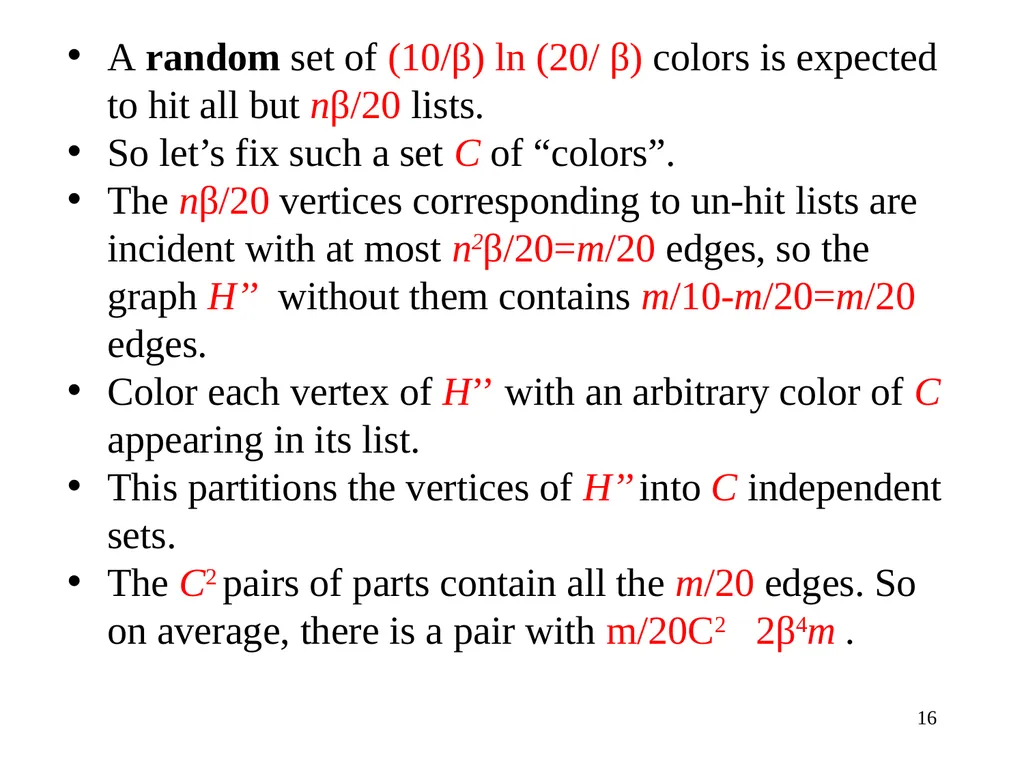
16 A random set of (10/β) ln (20/ β) colors is expected to hit all but nβ/20 lists.
So let’s fix such a set C of “colors”.
The nβ/20 vertices corresponding to un-hit lists are incident with at most n2β/20=m/20 edges, so the graph H’’ without them contains m/10-m/20=m/20 edges.
Color each vertex of H’’ with an arbitrary color of C appearing in its list.
This partitions the vertices of H’’ into C independent sets.
The C2 pairs of parts contain all the m/20 edges. So on average, there is a pair with m/20C2 2β4m .<br>
17
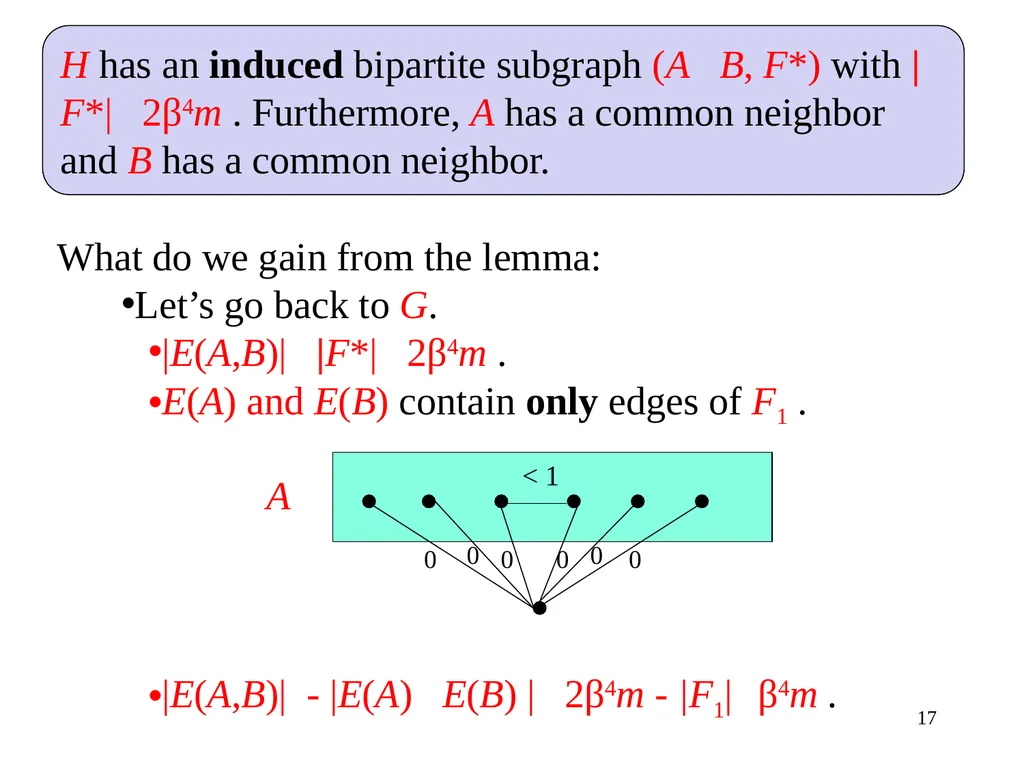
17 What do we gain from the lemma:
Let’s go back to G.
|E(A,B)| |F*| 2β4m .
E(A) and E(B) contain only edges of F1 .
|E(A,B)| - |E(A) E(B) | 2β4m - |F1| β4m . H has an induced bipartite subgraph (A B, F*) with |F*| 2β4m . Furthermore, A has a common neighbor and B has a common neighbor. < 1 A<br>
18
18 Reaching a contradiction
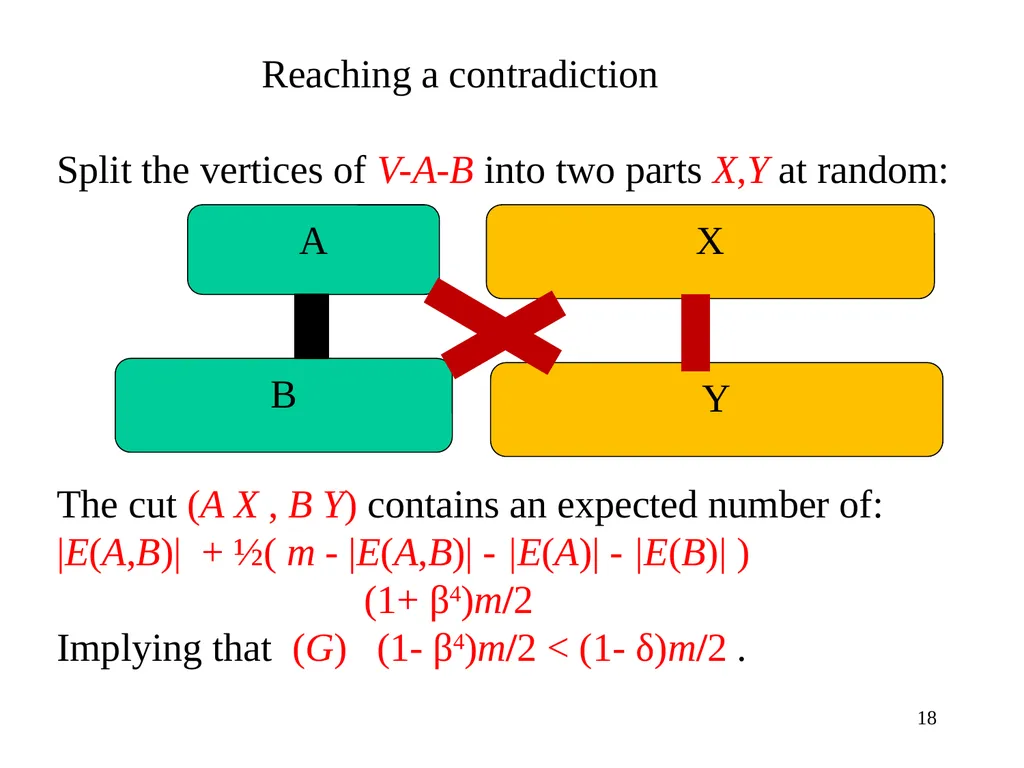
Split the vertices of V-A-B into two parts X,Y at random:
The cut (AX , BY) contains an expected number of:
|E(A,B)| + ½( m - |E(A,B)| - |E(A)| - |E(B)| )
(1+ β4)m/2
Implying that (G) (1- β4)m/2 < (1- δ)m/2 . A B X Y<br>