DENTAL CEMENTS SECOND YEAR BDS LECTURE By: Dr. Kinjal Solanki Department of prosthodontics crown and bridge AMC dental college Luting is derived from a greek word LUTUM meaning mud. Primarily cements were used to fill the gap between
"DENTAL CEMENTS SECOND YEAR BDS LECTURE By: Dr." is the property of its rightful owner. Permission is granted to
download and print the materials on this website for personal, non-commercial use only, and to display it
on your personal computer provided you do not modify the materials and that you retain all copyright
notices contained in the materials. By downloading content from our website, you accept the terms of this
agreement.
Presentation Transcript
01
DENTAL CEMENTS SECOND YEAR BDS LECTURE
By: Dr. Kinjal Solanki
Department of prosthodontics & crown and bridge
AMC dental college<br>
02
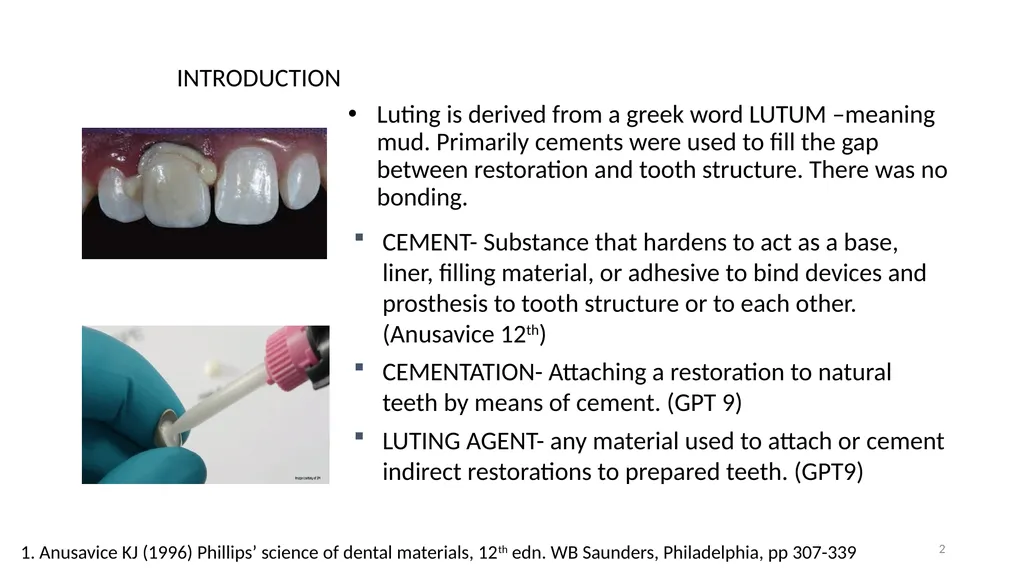
Luting is derived from a greek word LUTUM –meaning mud. Primarily cements were used to fill the gap between restoration and tooth structure. There was no bonding. 2 INTRODUCTION CEMENT- Substance that hardens to act as a base, liner, filling material, or adhesive to bind devices and prosthesis to tooth structure or to each other. (Anusavice 12th)
CEMENTATION- Attaching a restoration to natural teeth by means of cement. (GPT 9)
LUTING AGENT- any material used to attach or cement indirect restorations to prepared teeth. (GPT9) 1. Anusavice KJ (1996) Phillips’ science of dental materials, 12th edn. WB Saunders, Philadelphia, pp 307-339<br>
03
Hold the restoration and tooth together
Act as barrier for microbial intrusion
Seal interface between tooth and restoration 3 NEED FOR LUTING AGENT<br>
04
According to Craig (Based on the ingredients)
Water based cements
Glass & Resin modified glass ionomer
Zinc Polyacrylate
Zinc Phosphate
Resin based cements
Composite & adhesive resin
Compomers
Oil based cements
Zinc Oxide Eugenol
Non Eugenol -Zinc Oxide 4 Classifications: 2. Craig RG. Restorative dental materials, 8th ed. St Louis:Mosby; 1989. p. 189-225.<br>
05
Non- Adhesive/ mechanical bonding:
Cement fills the restoration- tooth gap and holds by engaging in small surface irregularities.
Micromechanical Bonding:
Surface irregularities are enhanced by air abrasion or acid etching and it improves the frictional retention.
Molecular Bonding:
Chemical bond formation between cement and the tooth structure. 5 Luting Mechanism (by schillinburg) 4. Shillingburg HT, Hobo S, Whitsett LD, Jacobi R, Brackett SE (1997) Fundamentals of fixed prosthodontics, 3rd edn. Quintessence Publishing Co Inc, Chicago, pp 385–415<br>
06
Long working time, shorter setting time
Adheres well to both tooth structure and cast alloys
Provides a good seal
Nontoxic to the pulp
Adequate strength
Can be compressible into thin layers
Low viscosity
Low solubility
Good working and setting characteristics
Any excess can be easily removed 6 Ideal requirements of luting Cements 5. Rosenstiel. Contemporary fixed prosthodontics 4th edition. Luting agents and cementation procedures. Pg no:765-781.<br>