
Department of Mathematical Sciences School of
LS
Published · 29 slides · 0 views

1 / 1

Description
Department of Mathematical Sciences School of Science and Technology B.A. in Mathematics CIP Code: 27.0101 Program Code: 150 1 Program Quality Improvement Report 2009-2010 Student-Learning Outcomes 2 Program Quality Improvement Report
Related Topics
Share
Embed code
Download this presentation From Below
"Department of Mathematical Sciences School of" is the property of its rightful owner. Permission is granted to download and print the materials on this website for personal, non-commercial use only, and to display it on your personal computer provided you do not modify the materials and that you retain all copyright notices contained in the materials. By downloading content from our website, you accept the terms of this agreement.
Presentation Transcript
01
Department of Mathematical Sciences
School of Science and Technology B.A. in Mathematics
CIP Code: 27.0101
Program Code: 150 1 Program Quality Improvement Report 2009-2010<br>
CIP Code: 27.0101
Program Code: 150 1 Program Quality Improvement Report 2009-2010<br>
02
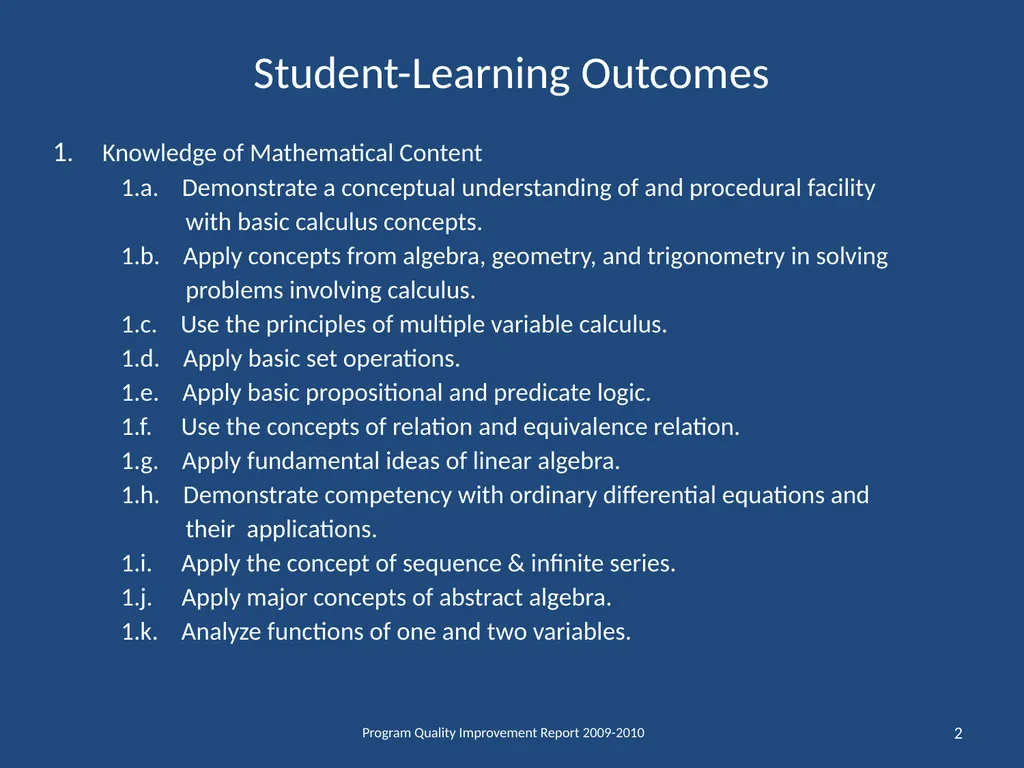
Student-Learning Outcomes 2 Program Quality Improvement Report 2009-2010 1. Knowledge of Mathematical Content
1.a. Demonstrate a conceptual understanding of and procedural facility
with basic calculus concepts.
1.b. Apply concepts from algebra, geometry, and trigonometry in solving
problems involving calculus.
1.c. Use the principles of multiple variable calculus.
1.d. Apply basic set operations.
1.e. Apply basic propositional and predicate logic.
1.f. Use the concepts of relation and equivalence relation.
1.g. Apply fundamental ideas of linear algebra.
1.h. Demonstrate competency with ordinary differential equations and
their applications.
1.i. Apply the concept of sequence & infinite series.
1.j. Apply major concepts of abstract algebra.
1.k. Analyze functions of one and two variables.<br>
1.a. Demonstrate a conceptual understanding of and procedural facility
with basic calculus concepts.
1.b. Apply concepts from algebra, geometry, and trigonometry in solving
problems involving calculus.
1.c. Use the principles of multiple variable calculus.
1.d. Apply basic set operations.
1.e. Apply basic propositional and predicate logic.
1.f. Use the concepts of relation and equivalence relation.
1.g. Apply fundamental ideas of linear algebra.
1.h. Demonstrate competency with ordinary differential equations and
their applications.
1.i. Apply the concept of sequence & infinite series.
1.j. Apply major concepts of abstract algebra.
1.k. Analyze functions of one and two variables.<br>
03
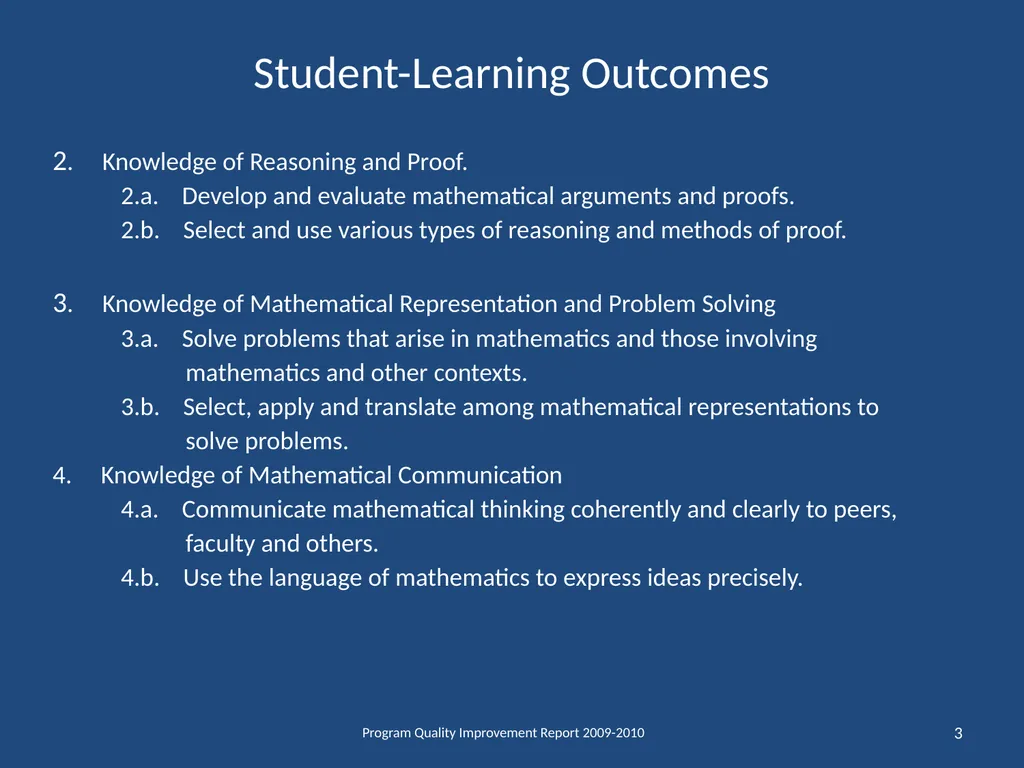
Student-Learning Outcomes 3 Program Quality Improvement Report 2009-2010 2. Knowledge of Reasoning and Proof.
2.a. Develop and evaluate mathematical arguments and proofs.
2.b. Select and use various types of reasoning and methods of proof.
3. Knowledge of Mathematical Representation and Problem Solving
3.a. Solve problems that arise in mathematics and those involving
mathematics and other contexts.
3.b. Select, apply and translate among mathematical representations to
solve problems.
4. Knowledge of Mathematical Communication
4.a. Communicate mathematical thinking coherently and clearly to peers,
faculty and others.
4.b. Use the language of mathematics to express ideas precisely.<br>
2.a. Develop and evaluate mathematical arguments and proofs.
2.b. Select and use various types of reasoning and methods of proof.
3. Knowledge of Mathematical Representation and Problem Solving
3.a. Solve problems that arise in mathematics and those involving
mathematics and other contexts.
3.b. Select, apply and translate among mathematical representations to
solve problems.
4. Knowledge of Mathematical Communication
4.a. Communicate mathematical thinking coherently and clearly to peers,
faculty and others.
4.b. Use the language of mathematics to express ideas precisely.<br>
04
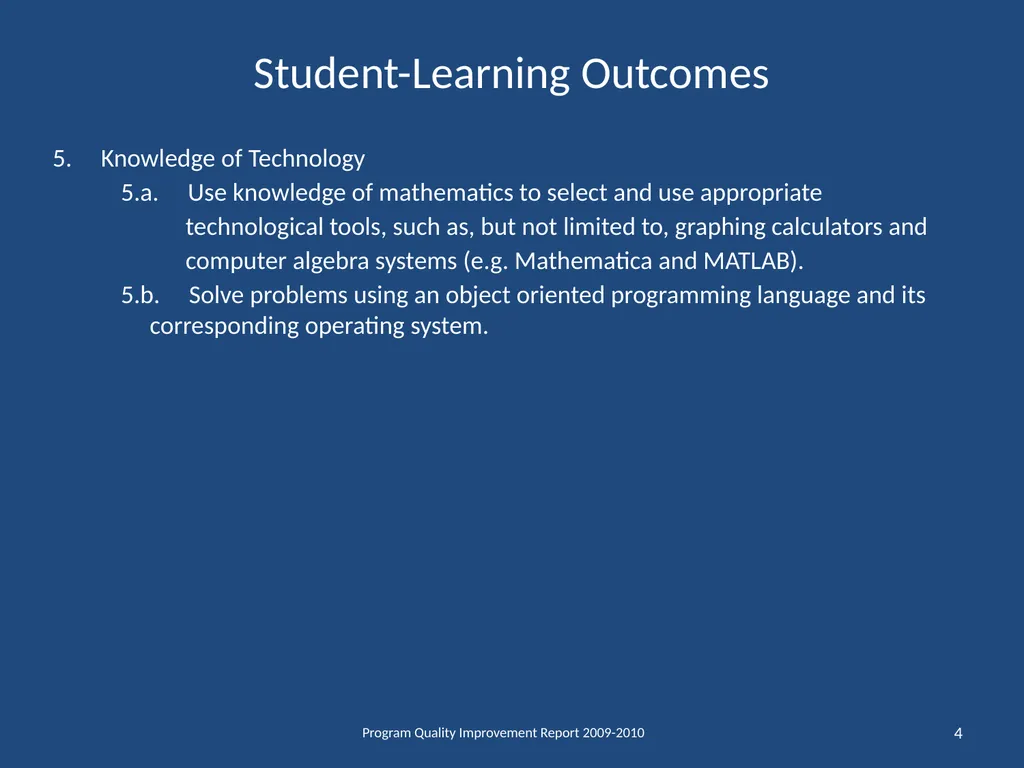
Student-Learning Outcomes 4 Program Quality Improvement Report 2009-2010 5. Knowledge of Technology
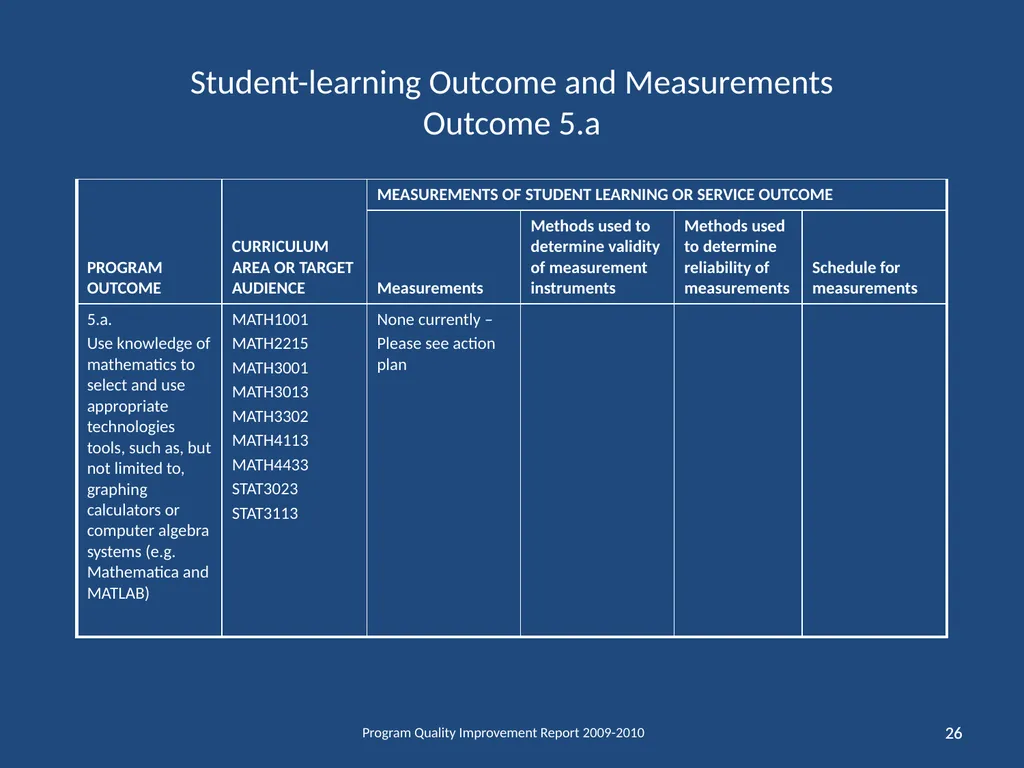
5.a. Use knowledge of mathematics to select and use appropriate
technological tools, such as, but not limited to, graphing calculators and
computer algebra systems (e.g. Mathematica and MATLAB).
5.b. Solve problems using an object oriented programming language and its corresponding operating system.<br>
5.a. Use knowledge of mathematics to select and use appropriate
technological tools, such as, but not limited to, graphing calculators and
computer algebra systems (e.g. Mathematica and MATLAB).
5.b. Solve problems using an object oriented programming language and its corresponding operating system.<br>
05
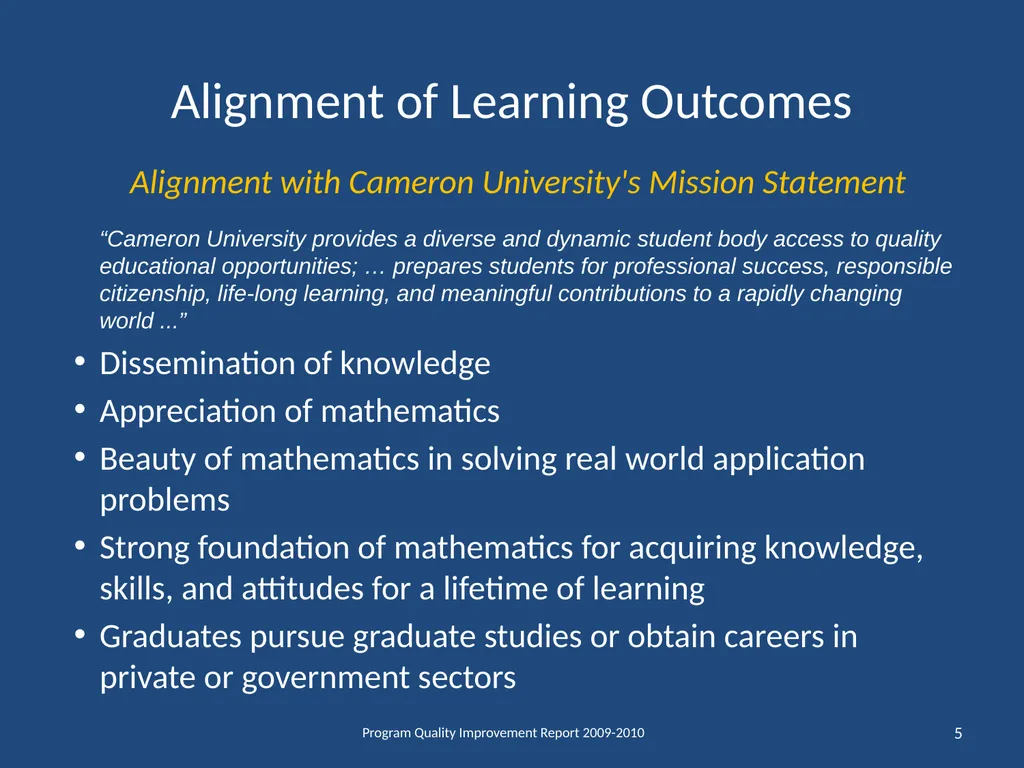
5 Program Quality Improvement Report 2009-2010 Alignment of Learning Outcomes Alignment with Cameron University's Mission Statement
“Cameron University provides a diverse and dynamic student body access to quality educational opportunities; … prepares students for professional success, responsible citizenship, life-long learning, and meaningful contributions to a rapidly changing world ...”
Dissemination of knowledge
Appreciation of mathematics
Beauty of mathematics in solving real world application problems
Strong foundation of mathematics for acquiring knowledge, skills, and attitudes for a lifetime of learning
Graduates pursue graduate studies or obtain careers in private or government sectors<br>
“Cameron University provides a diverse and dynamic student body access to quality educational opportunities; … prepares students for professional success, responsible citizenship, life-long learning, and meaningful contributions to a rapidly changing world ...”
Dissemination of knowledge
Appreciation of mathematics
Beauty of mathematics in solving real world application problems
Strong foundation of mathematics for acquiring knowledge, skills, and attitudes for a lifetime of learning
Graduates pursue graduate studies or obtain careers in private or government sectors<br>
06
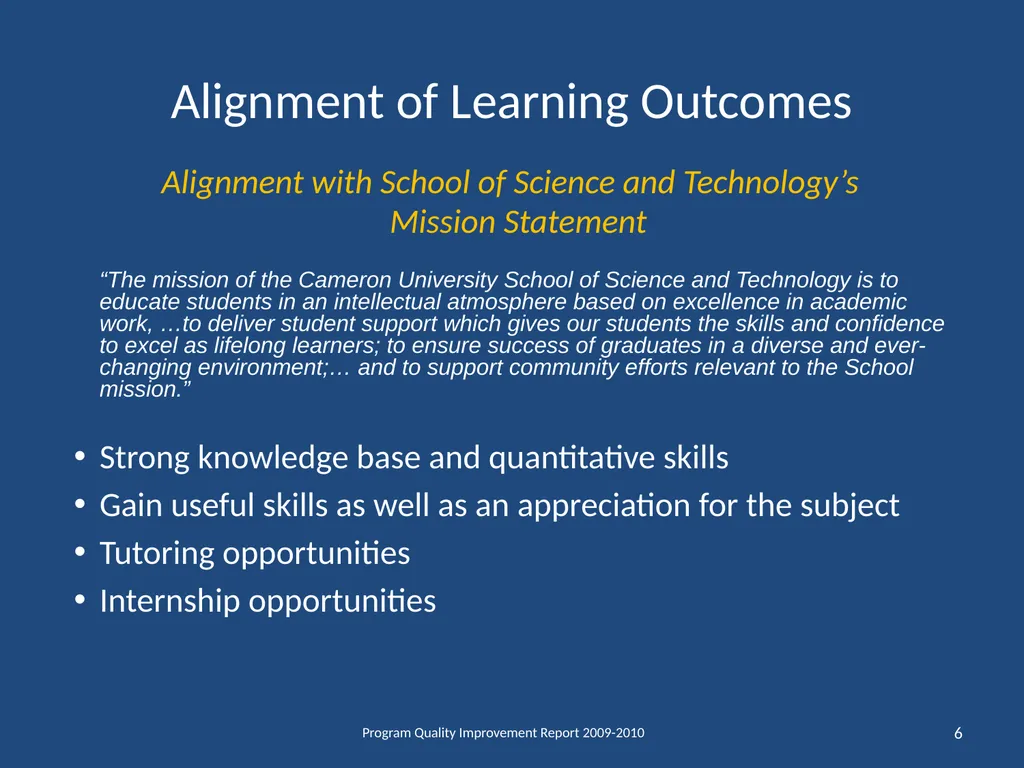
6 Program Quality Improvement Report 2009-2010 Alignment of Learning Outcomes Alignment with School of Science and Technology’s
Mission Statement
“The mission of the Cameron University School of Science and Technology is to educate students in an intellectual atmosphere based on excellence in academic work, …to deliver student support which gives our students the skills and confidence to excel as lifelong learners; to ensure success of graduates in a diverse and ever-changing environment;… and to support community efforts relevant to the School mission.”
Strong knowledge base and quantitative skills
Gain useful skills as well as an appreciation for the subject
Tutoring opportunities
Internship opportunities<br>
Mission Statement
“The mission of the Cameron University School of Science and Technology is to educate students in an intellectual atmosphere based on excellence in academic work, …to deliver student support which gives our students the skills and confidence to excel as lifelong learners; to ensure success of graduates in a diverse and ever-changing environment;… and to support community efforts relevant to the School mission.”
Strong knowledge base and quantitative skills
Gain useful skills as well as an appreciation for the subject
Tutoring opportunities
Internship opportunities<br>
07
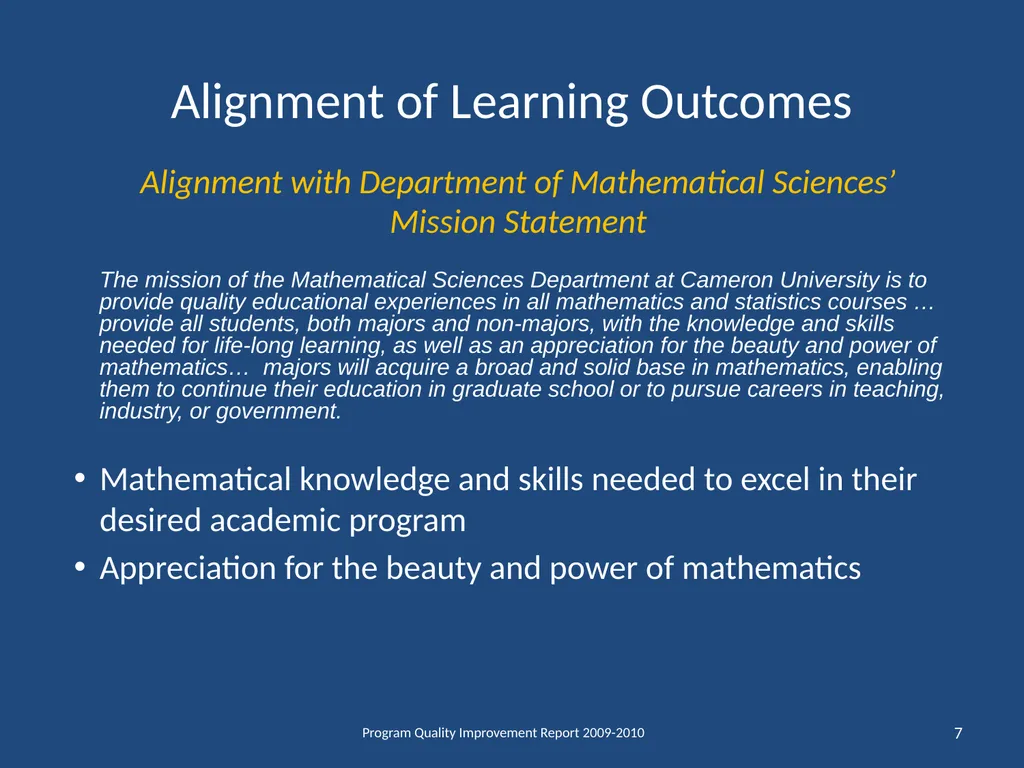
7 Program Quality Improvement Report 2009-2010 Alignment of Learning Outcomes Alignment with Department of Mathematical Sciences’
Mission Statement
The mission of the Mathematical Sciences Department at Cameron University is to provide quality educational experiences in all mathematics and statistics courses …provide all students, both majors and non-majors, with the knowledge and skills needed for life-long learning, as well as an appreciation for the beauty and power of mathematics… majors will acquire a broad and solid base in mathematics, enabling them to continue their education in graduate school or to pursue careers in teaching, industry, or government.
Mathematical knowledge and skills needed to excel in their desired academic program
Appreciation for the beauty and power of mathematics<br>
Mission Statement
The mission of the Mathematical Sciences Department at Cameron University is to provide quality educational experiences in all mathematics and statistics courses …provide all students, both majors and non-majors, with the knowledge and skills needed for life-long learning, as well as an appreciation for the beauty and power of mathematics… majors will acquire a broad and solid base in mathematics, enabling them to continue their education in graduate school or to pursue careers in teaching, industry, or government.
Mathematical knowledge and skills needed to excel in their desired academic program
Appreciation for the beauty and power of mathematics<br>
08
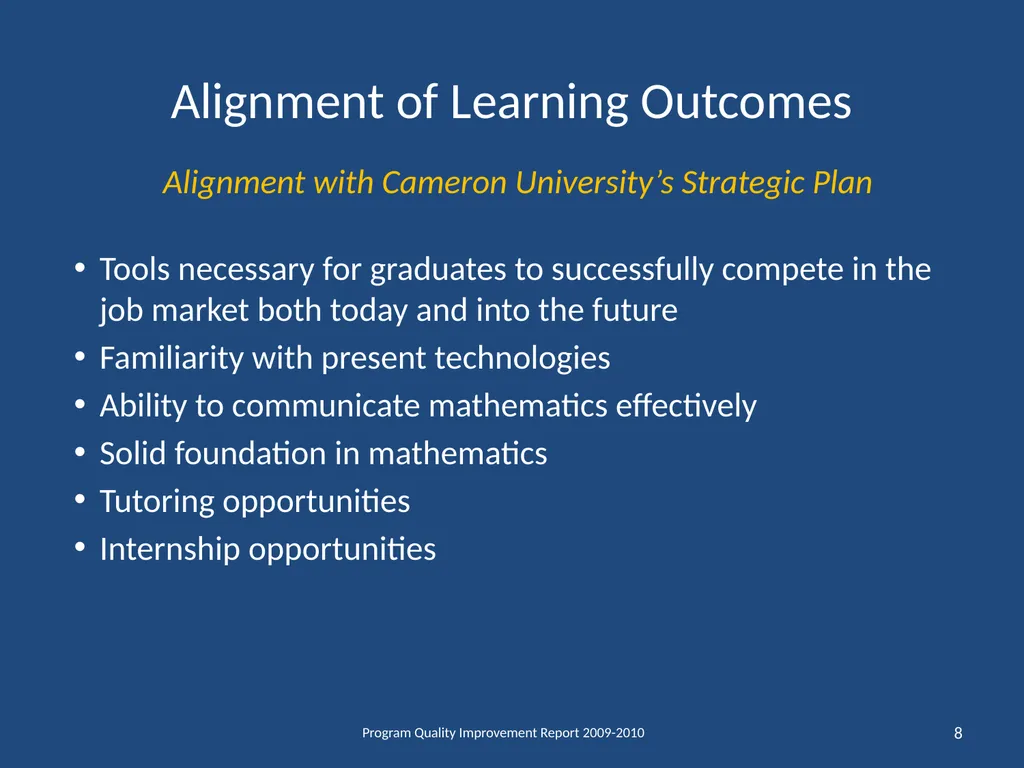
8 Program Quality Improvement Report 2009-2010 Alignment of Learning Outcomes Alignment with Cameron University’s Strategic Plan
Tools necessary for graduates to successfully compete in the job market both today and into the future
Familiarity with present technologies
Ability to communicate mathematics effectively
Solid foundation in mathematics
Tutoring opportunities
Internship opportunities<br>
Tools necessary for graduates to successfully compete in the job market both today and into the future
Familiarity with present technologies
Ability to communicate mathematics effectively
Solid foundation in mathematics
Tutoring opportunities
Internship opportunities<br>
09
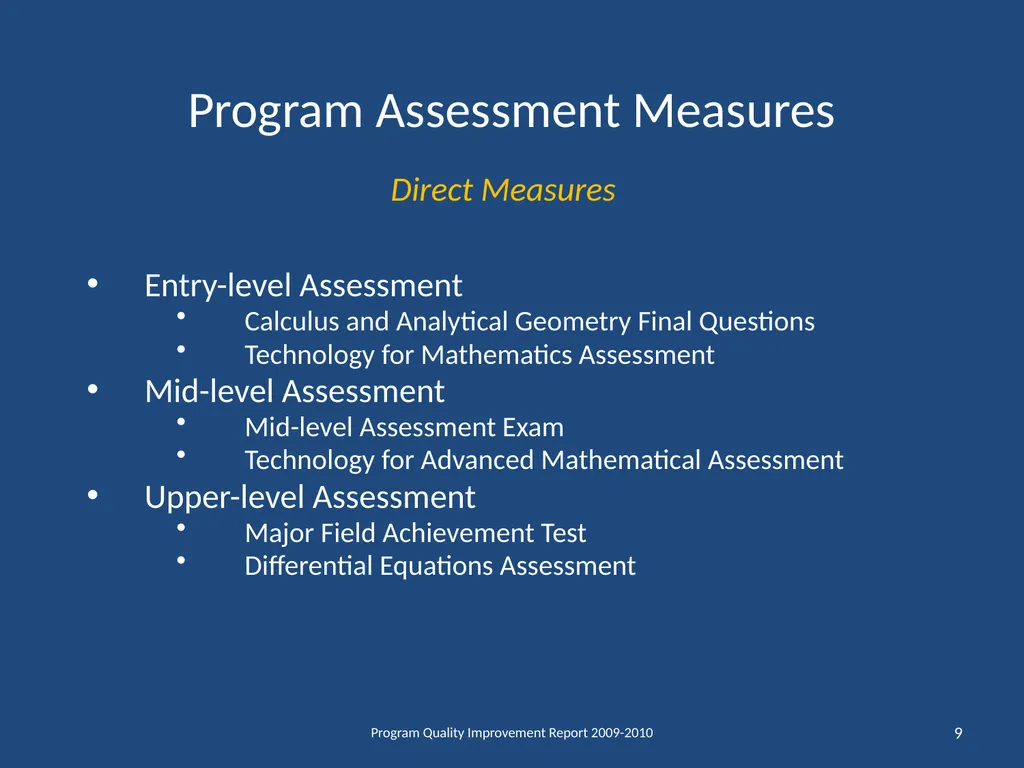
Program Quality Improvement Report 2009-2010 9 Program Assessment Measures Direct Measures
Entry-level Assessment
Calculus and Analytical Geometry Final Questions
Technology for Mathematics Assessment
Mid-level Assessment
Mid-level Assessment Exam
Technology for Advanced Mathematical Assessment
Upper-level Assessment
Major Field Achievement Test
Differential Equations Assessment<br>
Entry-level Assessment
Calculus and Analytical Geometry Final Questions
Technology for Mathematics Assessment
Mid-level Assessment
Mid-level Assessment Exam
Technology for Advanced Mathematical Assessment
Upper-level Assessment
Major Field Achievement Test
Differential Equations Assessment<br>
10
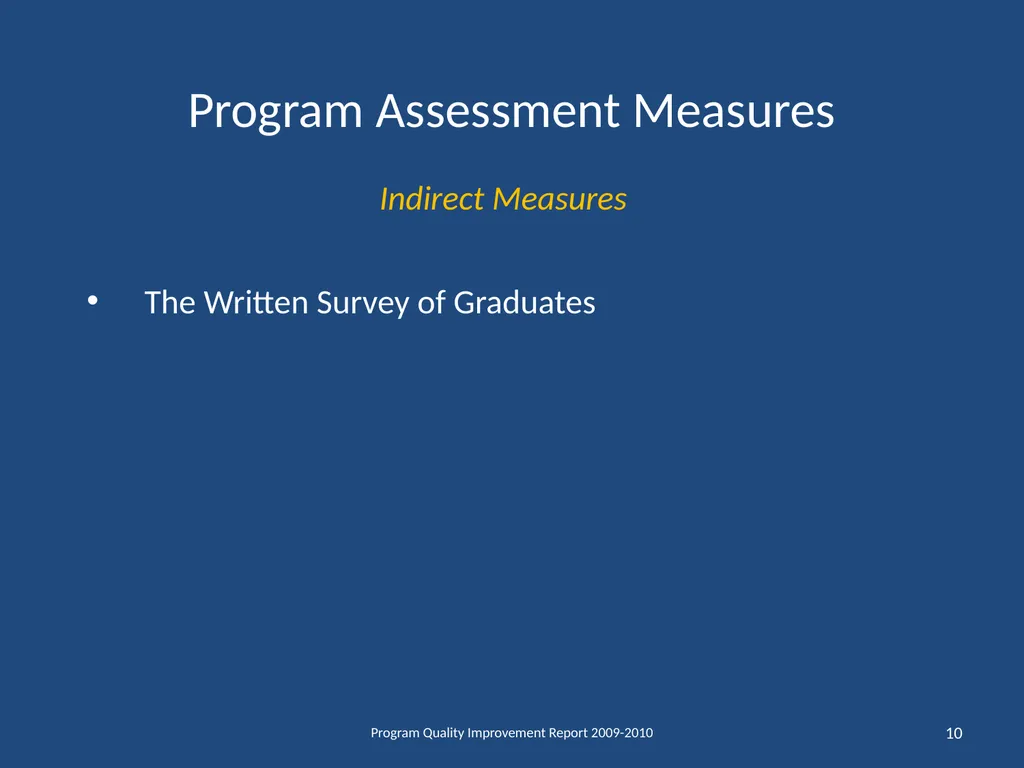
Program Quality Improvement Report 2009-2010 10 Program Assessment Measures Indirect Measures
The Written Survey of Graduates<br>
The Written Survey of Graduates<br>
11
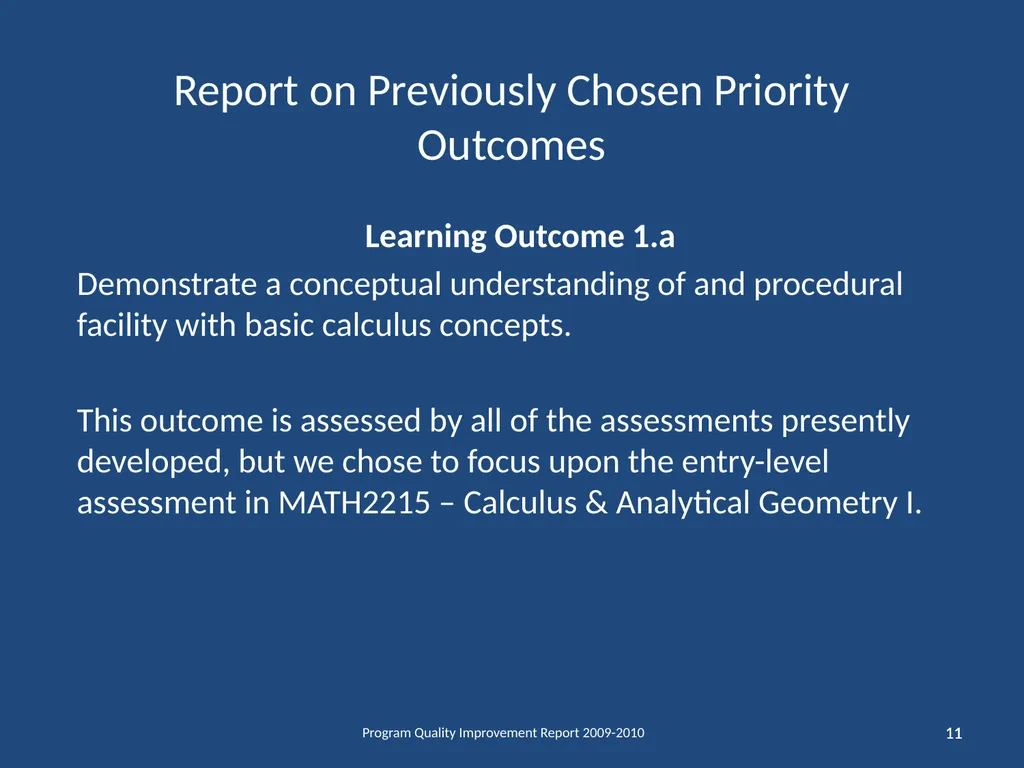
Report on Previously Chosen Priority Outcomes Learning Outcome 1.a
Demonstrate a conceptual understanding of and procedural facility with basic calculus concepts.
This outcome is assessed by all of the assessments presently developed, but we chose to focus upon the entry-level assessment in MATH2215 – Calculus & Analytical Geometry I. 11 11 Program Quality Improvement Report 2009-2010<br>
Demonstrate a conceptual understanding of and procedural facility with basic calculus concepts.
This outcome is assessed by all of the assessments presently developed, but we chose to focus upon the entry-level assessment in MATH2215 – Calculus & Analytical Geometry I. 11 11 Program Quality Improvement Report 2009-2010<br>
12
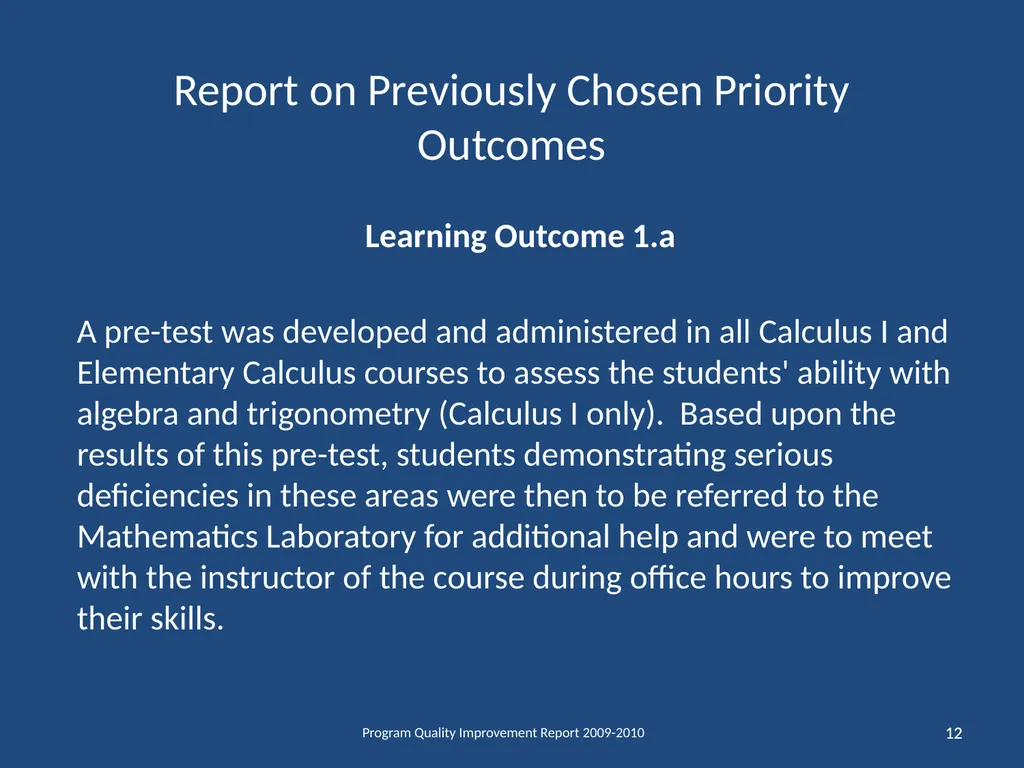
Learning Outcome 1.a
A pre-test was developed and administered in all Calculus I and Elementary Calculus courses to assess the students' ability with algebra and trigonometry (Calculus I only). Based upon the results of this pre-test, students demonstrating serious deficiencies in these areas were then to be referred to the Mathematics Laboratory for additional help and were to meet with the instructor of the course during office hours to improve their skills. 12 12 Program Quality Improvement Report 2009-2010 Report on Previously Chosen Priority Outcomes<br>
A pre-test was developed and administered in all Calculus I and Elementary Calculus courses to assess the students' ability with algebra and trigonometry (Calculus I only). Based upon the results of this pre-test, students demonstrating serious deficiencies in these areas were then to be referred to the Mathematics Laboratory for additional help and were to meet with the instructor of the course during office hours to improve their skills. 12 12 Program Quality Improvement Report 2009-2010 Report on Previously Chosen Priority Outcomes<br>
13
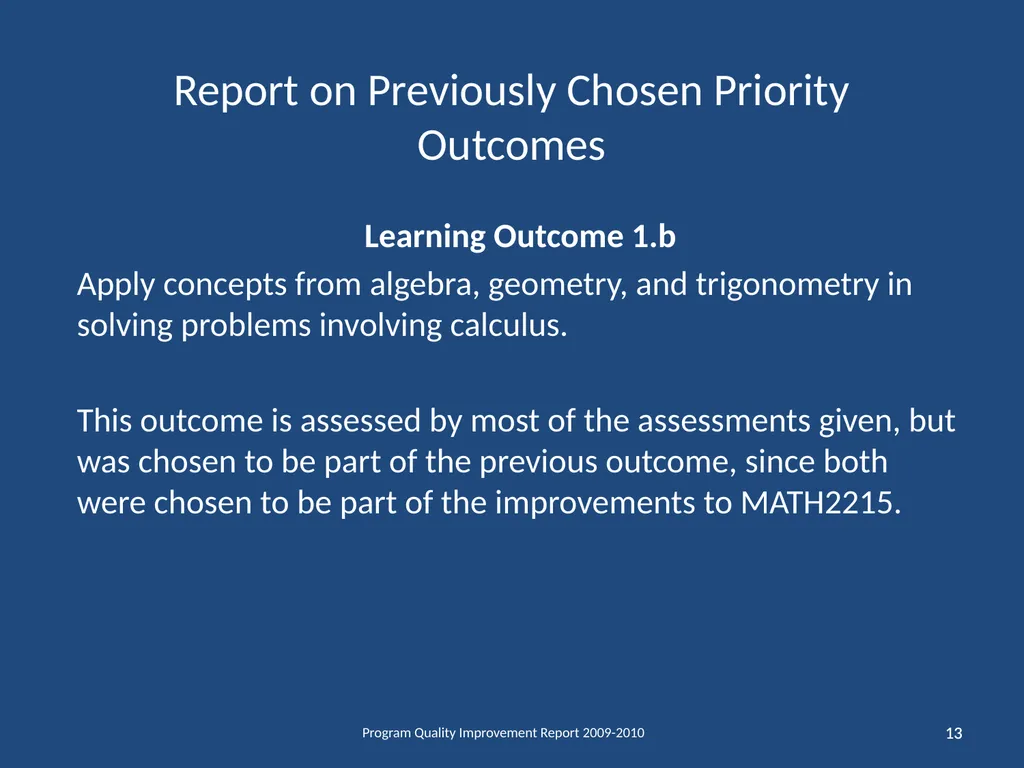
Learning Outcome 1.b
Apply concepts from algebra, geometry, and trigonometry in solving problems involving calculus.
This outcome is assessed by most of the assessments given, but was chosen to be part of the previous outcome, since both were chosen to be part of the improvements to MATH2215. 13 13 Program Quality Improvement Report 2009-2010 Report on Previously Chosen Priority Outcomes<br>
Apply concepts from algebra, geometry, and trigonometry in solving problems involving calculus.
This outcome is assessed by most of the assessments given, but was chosen to be part of the previous outcome, since both were chosen to be part of the improvements to MATH2215. 13 13 Program Quality Improvement Report 2009-2010 Report on Previously Chosen Priority Outcomes<br>
14
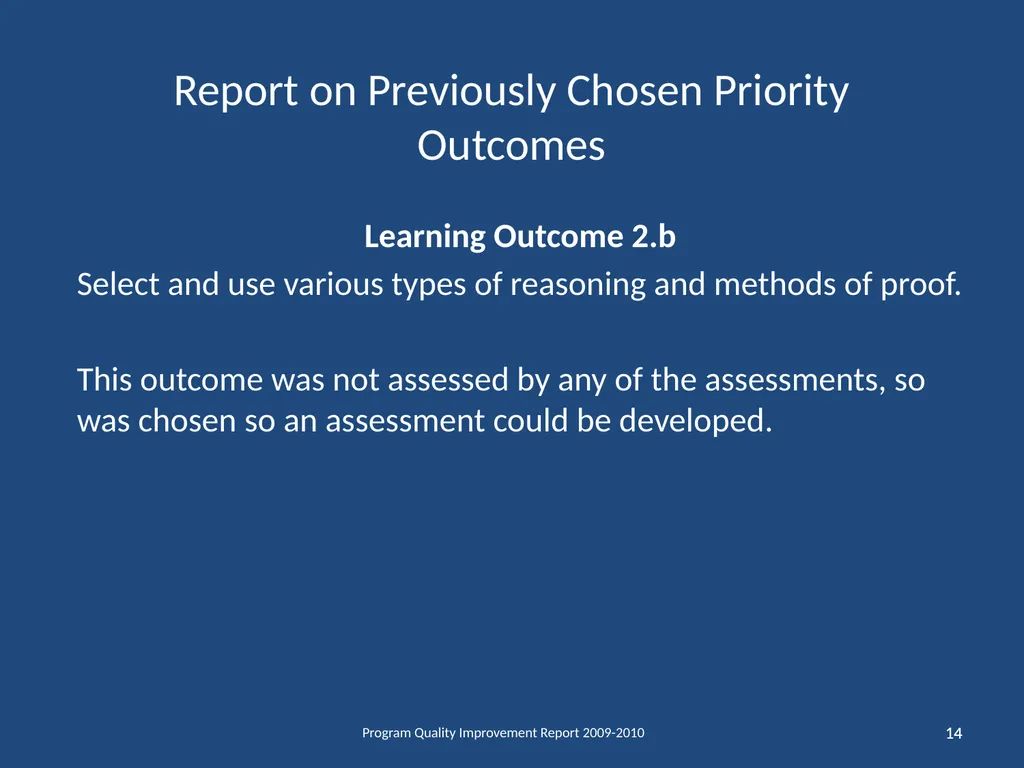
Learning Outcome 2.b
Select and use various types of reasoning and methods of proof.
This outcome was not assessed by any of the assessments, so was chosen so an assessment could be developed. 14 14 Program Quality Improvement Report 2009-2010 Report on Previously Chosen Priority Outcomes<br>
Select and use various types of reasoning and methods of proof.
This outcome was not assessed by any of the assessments, so was chosen so an assessment could be developed. 14 14 Program Quality Improvement Report 2009-2010 Report on Previously Chosen Priority Outcomes<br>
15
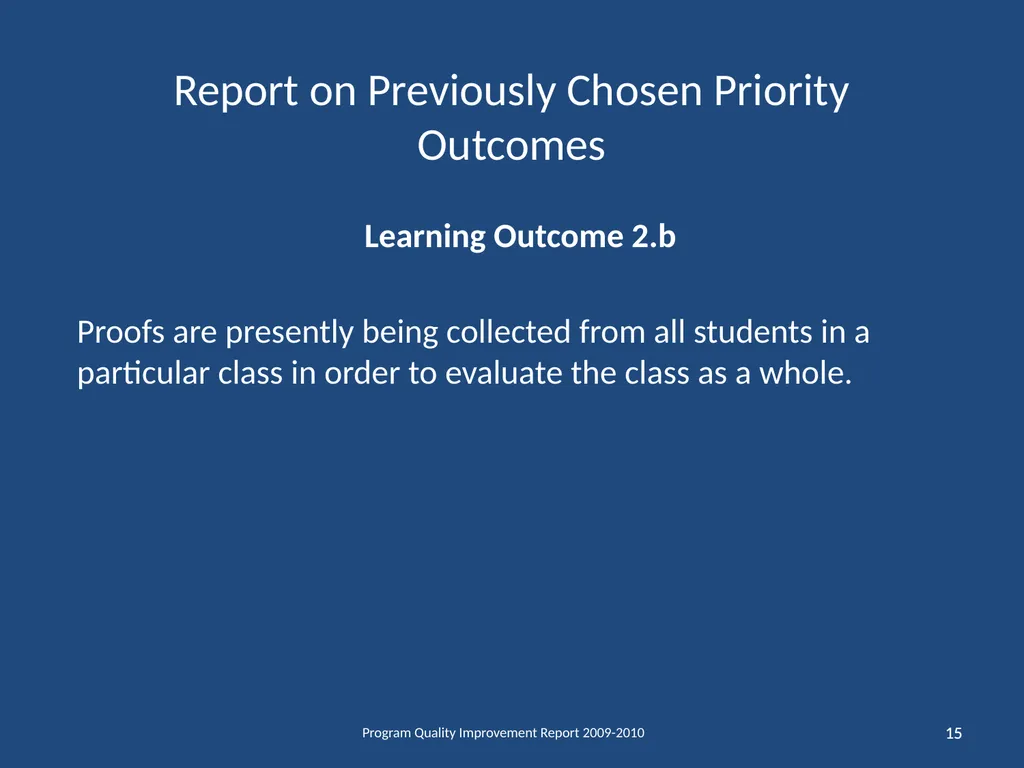
Learning Outcome 2.b
Proofs are presently being collected from all students in a particular class in order to evaluate the class as a whole. 15 15 Program Quality Improvement Report 2009-2010 Report on Previously Chosen Priority Outcomes<br>
Proofs are presently being collected from all students in a particular class in order to evaluate the class as a whole. 15 15 Program Quality Improvement Report 2009-2010 Report on Previously Chosen Priority Outcomes<br>
16
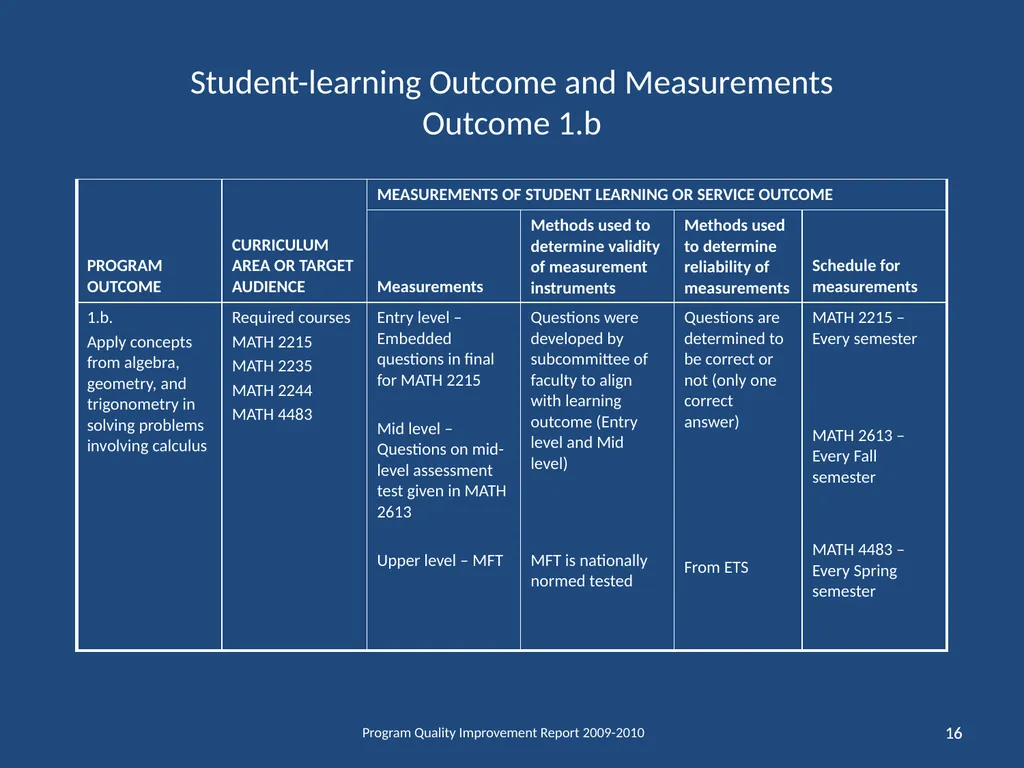
Student-learning Outcome and Measurements
Outcome 1.b 16 16 Program Quality Improvement Report 2009-2010<br>
17
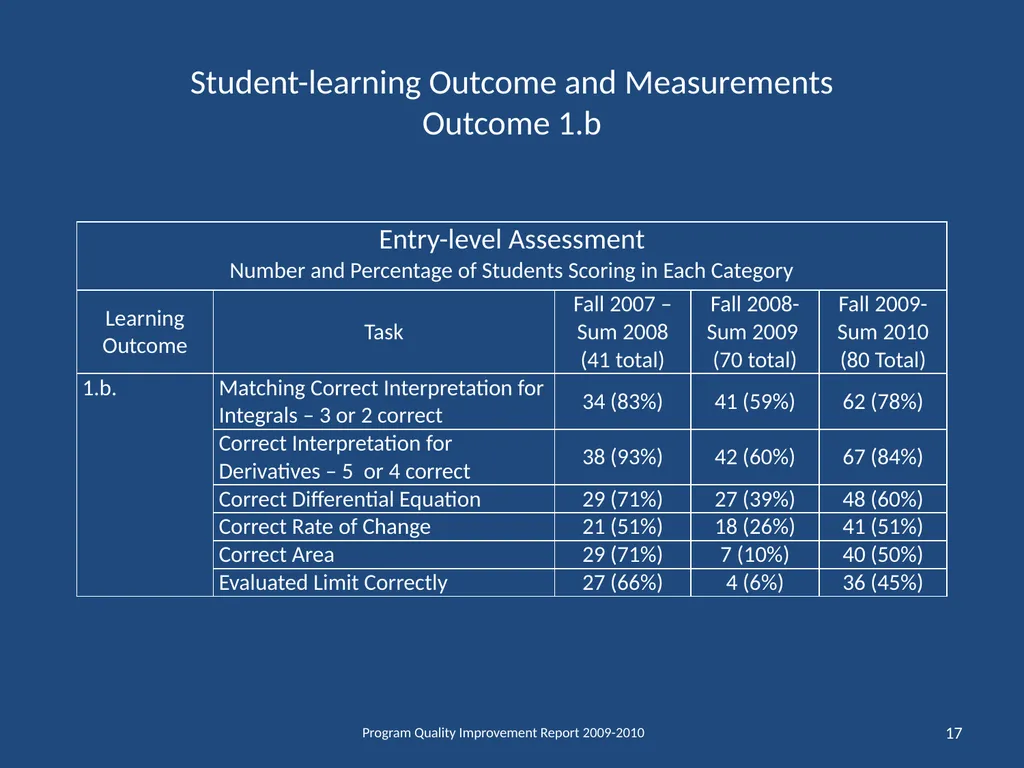
17 Program Quality Improvement Report 2009-2010 Student-learning Outcome and Measurements
Outcome 1.b<br>
18
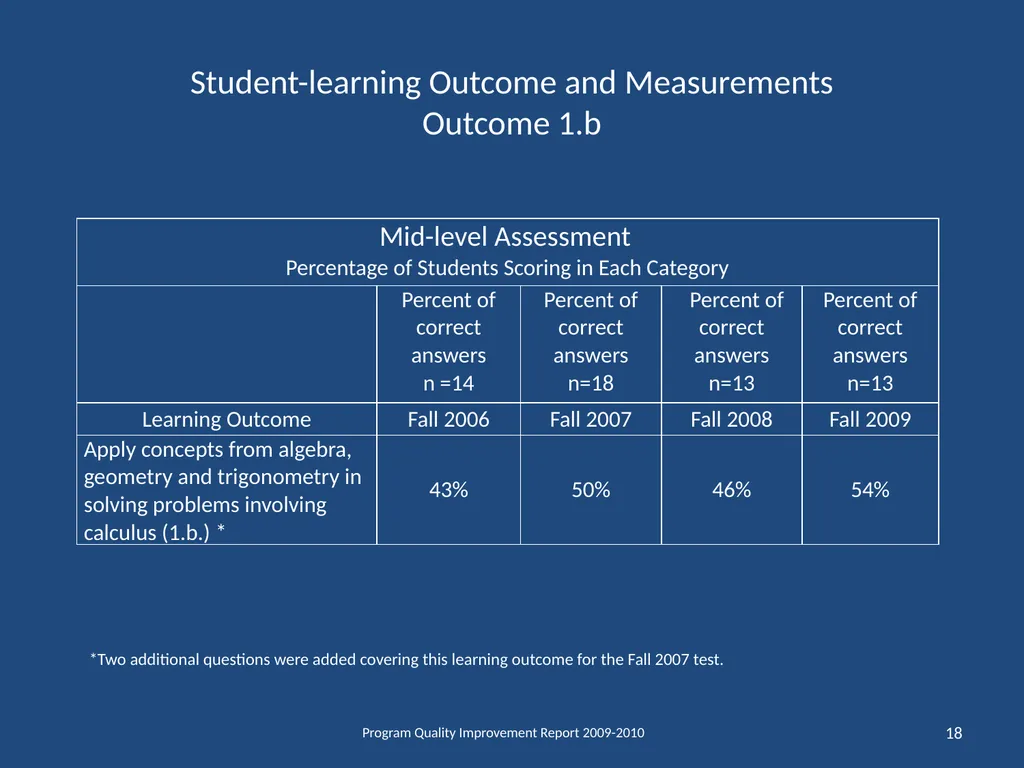
18 *Two additional questions were added covering this learning outcome for the Fall 2007 test. Program Quality Improvement Report 2009-2010 Student-learning Outcome and Measurements
Outcome 1.b<br>
19
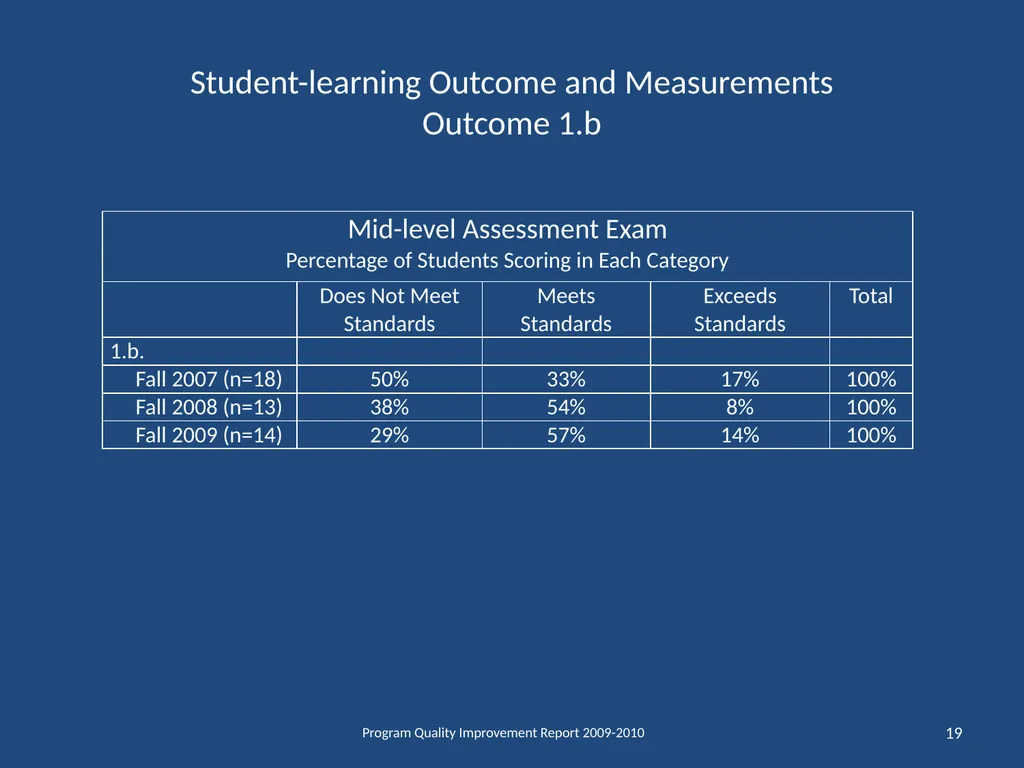
19 Program Quality Improvement Report 2009-2010 Student-learning Outcome and Measurements
Outcome 1.b<br>
20
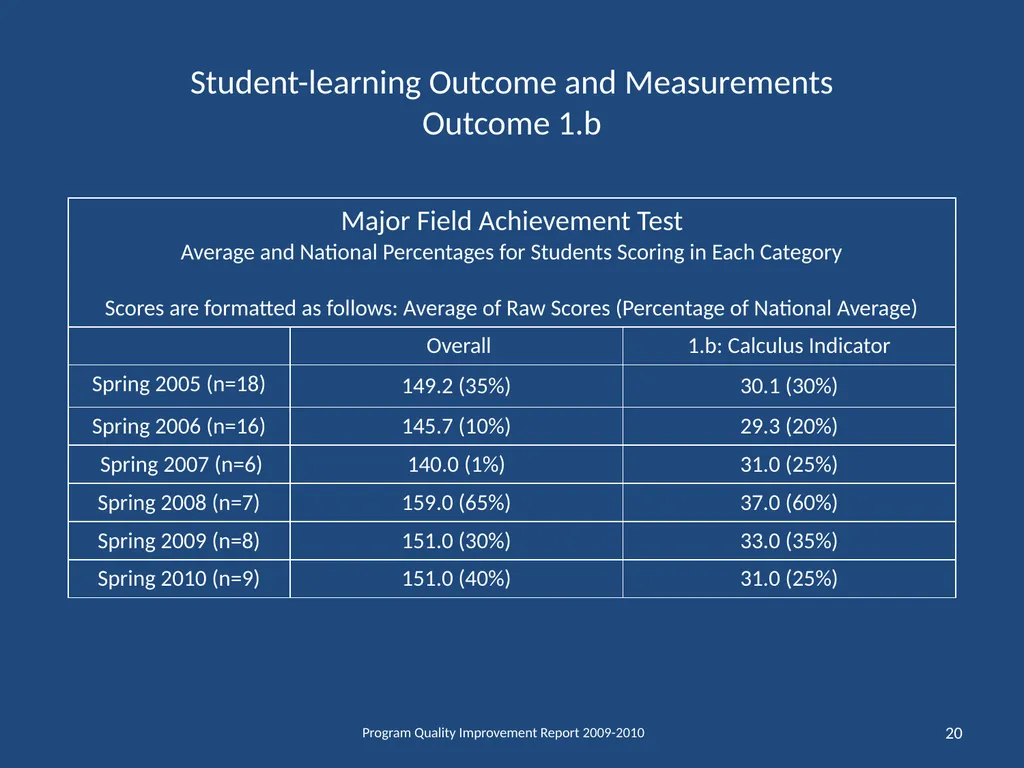
20 Program Quality Improvement Report 2009-2010 Student-learning Outcome and Measurements
Outcome 1.b<br>
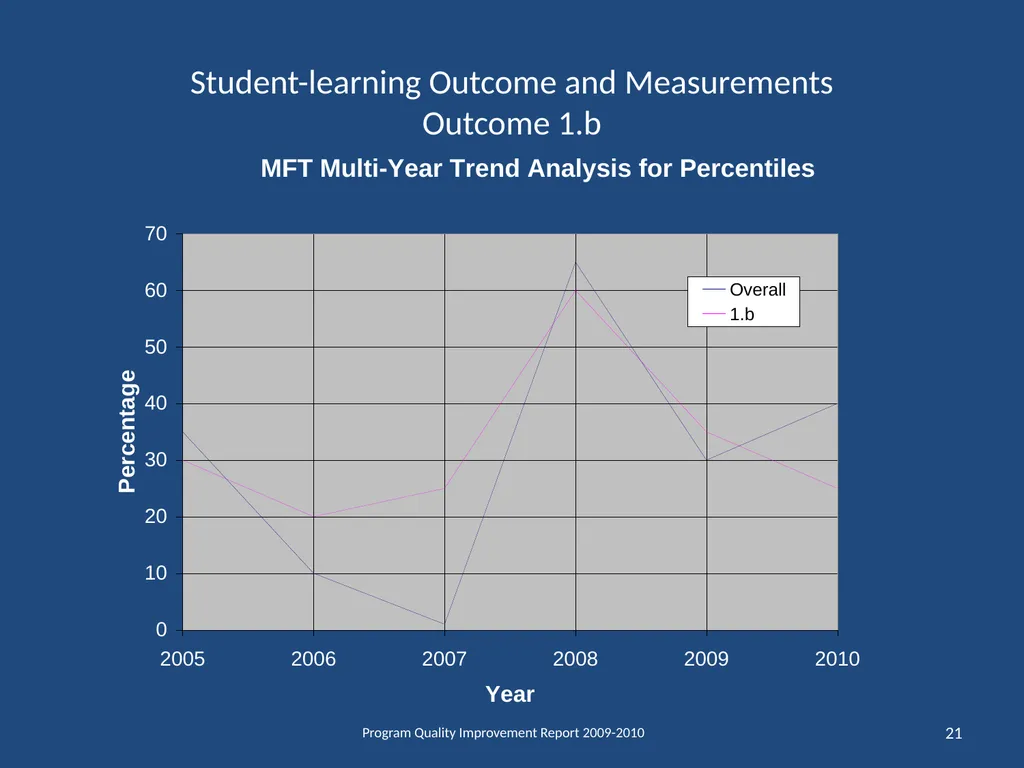
21
21 Program Quality Improvement Report 2009-2010 Student-learning Outcome and Measurements
Outcome 1.b<br>
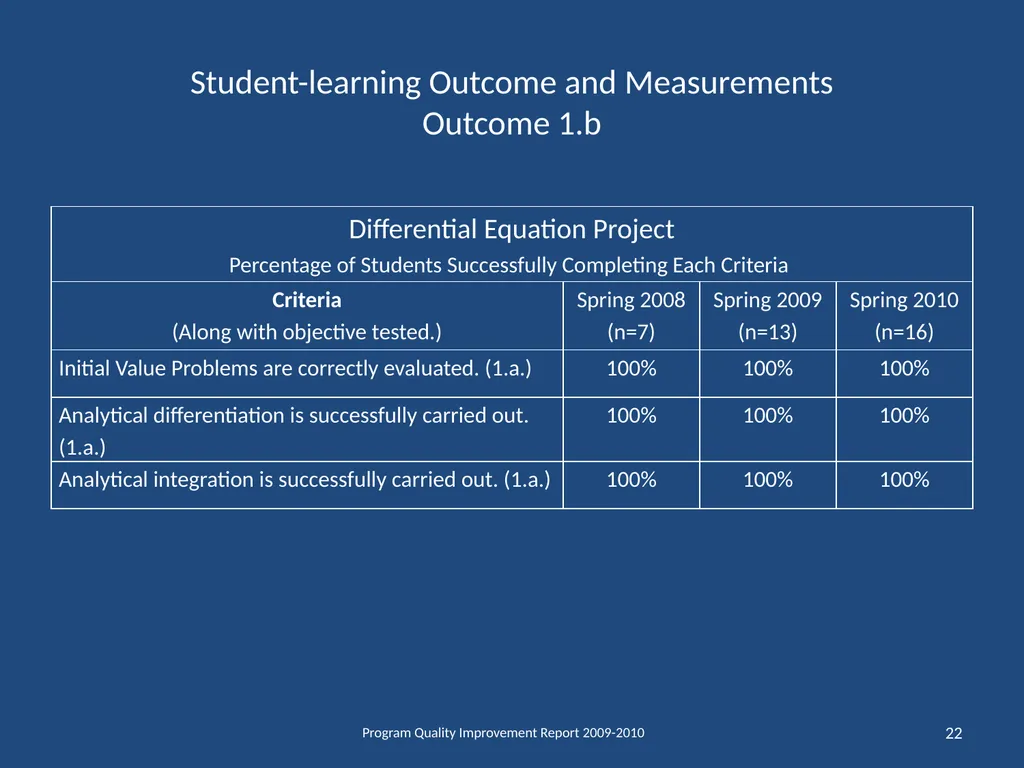
22
22 Program Quality Improvement Report 2009-2010 Student-learning Outcome and Measurements
Outcome 1.b<br>
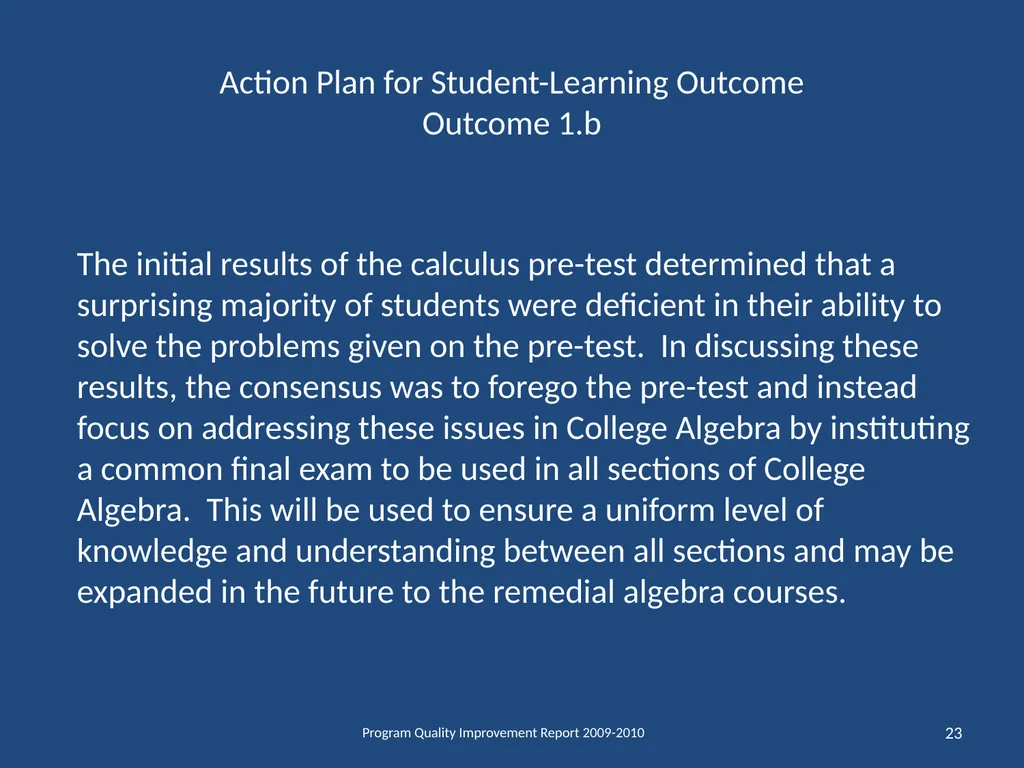
23
Action Plan for Student-Learning Outcome
Outcome 1.b The initial results of the calculus pre-test determined that a surprising majority of students were deficient in their ability to solve the problems given on the pre-test. In discussing these results, the consensus was to forego the pre-test and instead focus on addressing these issues in College Algebra by instituting a common final exam to be used in all sections of College Algebra. This will be used to ensure a uniform level of knowledge and understanding between all sections and may be expanded in the future to the remedial algebra courses. 23 Program Quality Improvement Report 2009-2010<br>
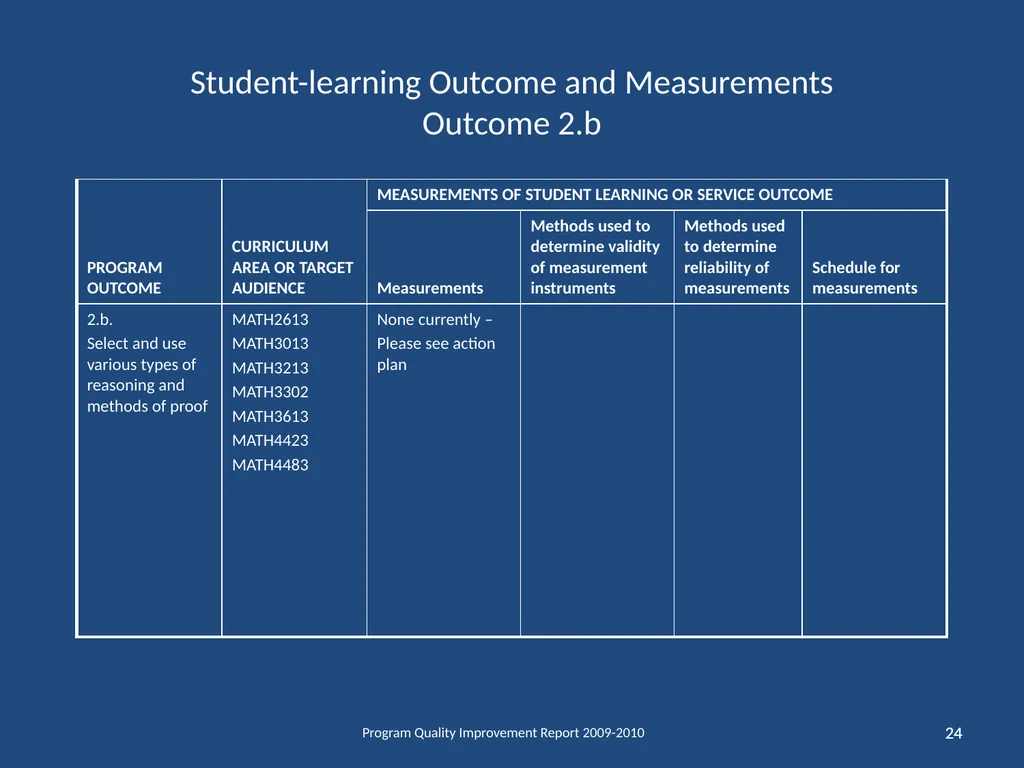
24
24 24 Program Quality Improvement Report 2009-2010 Student-learning Outcome and Measurements
Outcome 2.b<br>
25
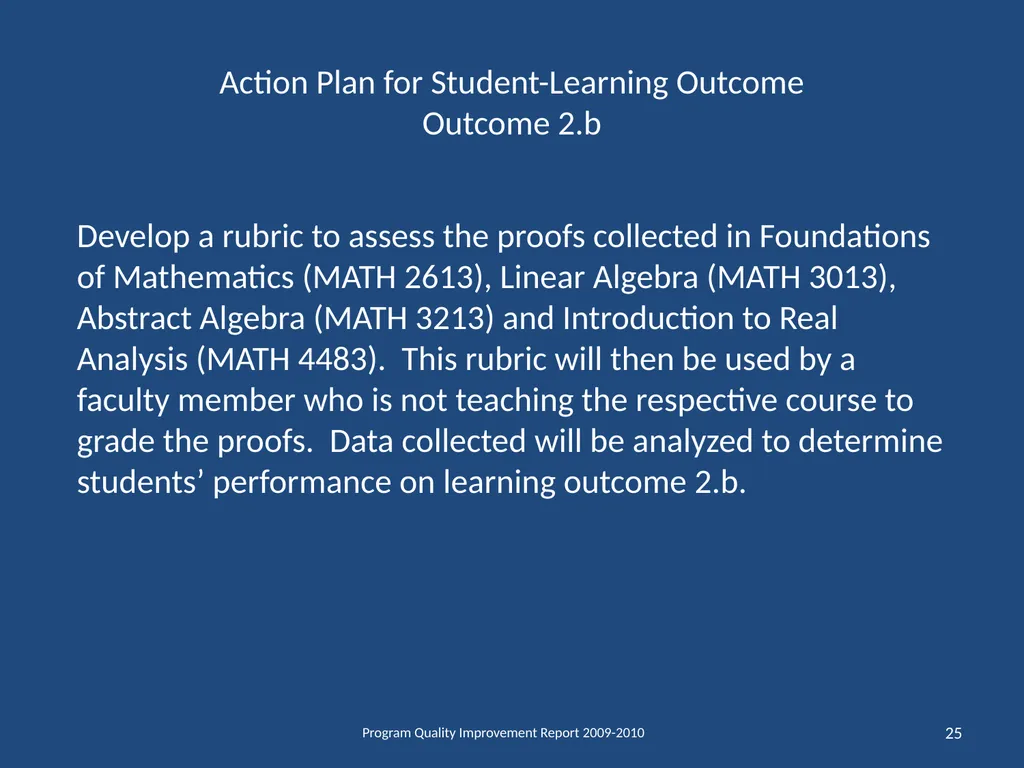
Develop a rubric to assess the proofs collected in Foundations of Mathematics (MATH 2613), Linear Algebra (MATH 3013), Abstract Algebra (MATH 3213) and Introduction to Real Analysis (MATH 4483). This rubric will then be used by a faculty member who is not teaching the respective course to grade the proofs. Data collected will be analyzed to determine students’ performance on learning outcome 2.b. 25 Program Quality Improvement Report 2009-2010 Action Plan for Student-Learning Outcome
Outcome 2.b<br>
26
26 26 Program Quality Improvement Report 2009-2010 Student-learning Outcome and Measurements
Outcome 5.a<br>
27
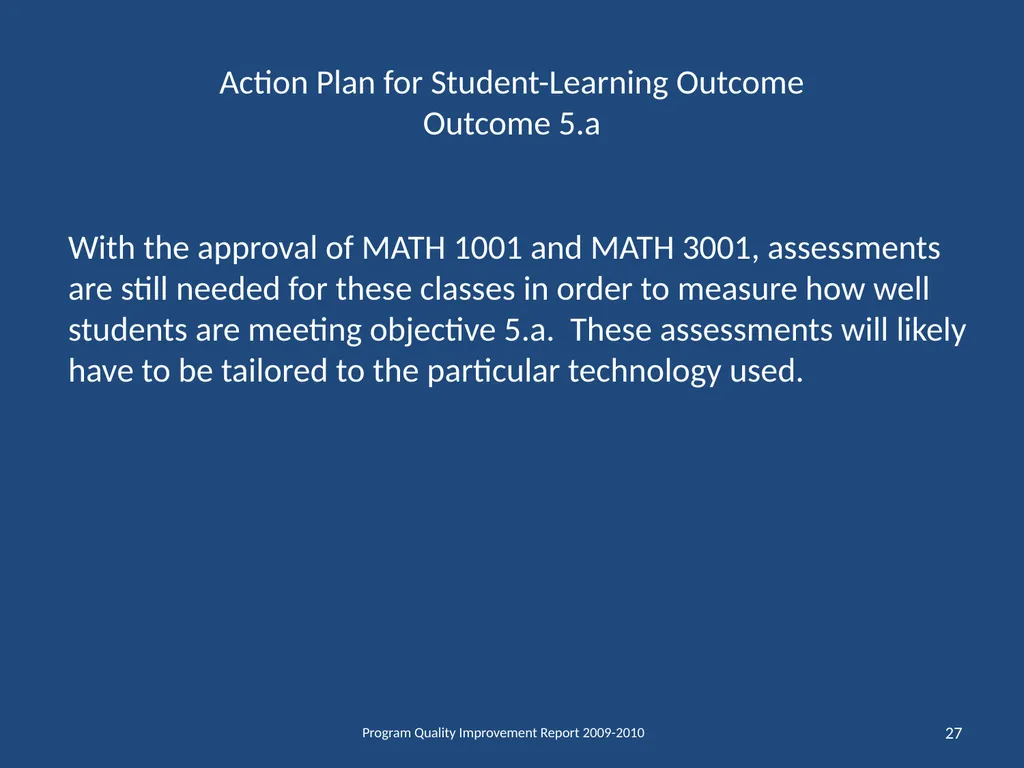
With the approval of MATH 1001 and MATH 3001, assessments are still needed for these classes in order to measure how well students are meeting objective 5.a. These assessments will likely have to be tailored to the particular technology used. 27 Program Quality Improvement Report 2009-2010 Action Plan for Student-Learning Outcome
Outcome 5.a<br>
28
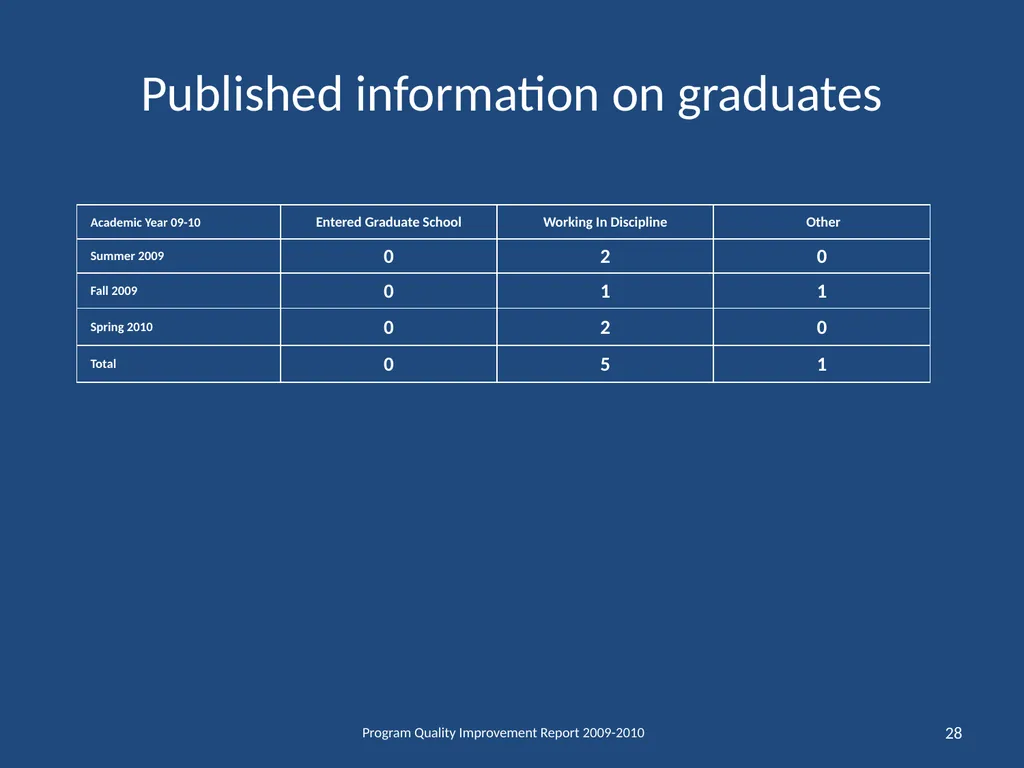
Published information on graduates 28 Program Quality Improvement Report 2009-2010<br>
29
Questions? 29 Program Quality Improvement Report 2009-2010<br>