DEPARTMENT OF SOCICLA DEVELOPMENT PROGRAMMES ADDREESING TEENANGE PREGNANCY TABLE OF CONTENTS Background Governments Intervention and Response DSD programmes Conclusion 1 BACKGROUND It is important for girls to remain longer in school to
"DEPARTMENT OF SOCICLA DEVELOPMENT PROGRAMMES" is the property of its rightful owner. Permission is granted to
download and print the materials on this website for personal, non-commercial use only, and to display it
on your personal computer provided you do not modify the materials and that you retain all copyright
notices contained in the materials. By downloading content from our website, you accept the terms of this
agreement.
Presentation Transcript
01
DEPARTMENT OF SOCICLA DEVELOPMENT PROGRAMMES ADDREESING TEENANGE PREGNANCY<br>
02
TABLE OF CONTENTS Background
Governments’ Intervention and Response
DSD programmes
Conclusion 1<br>
03
BACKGROUND It is important for girls to remain longer in school to achieve better socio-economic outcomes.
Adolescent pregnancy is a concern for the country and for policy makers as it poses risks related to health, education and socio-economic aspects.
Teenage pregnancy phenomenon is multi-facet and requires multi-sectoral approach from key stakeholders in government and Non-Profit Organizations.
February 2015, Cabinet approved the National Adolescent Sexual and Reproductive Health and Rights (ASRH&R) Framework Strategy to address the gaps that were hampering progress when it comes to ASRH&R in the country.
ASRH&R Programme of Action (PoA) is a comprehensive strategy aimed at promoting and protecting the sexual and reproductive health and rights of adolescents.
In response to this issue, government has implemented various programmes to address root causes of teenage pregnancy and to provide support to young mothers. 3<br>
04
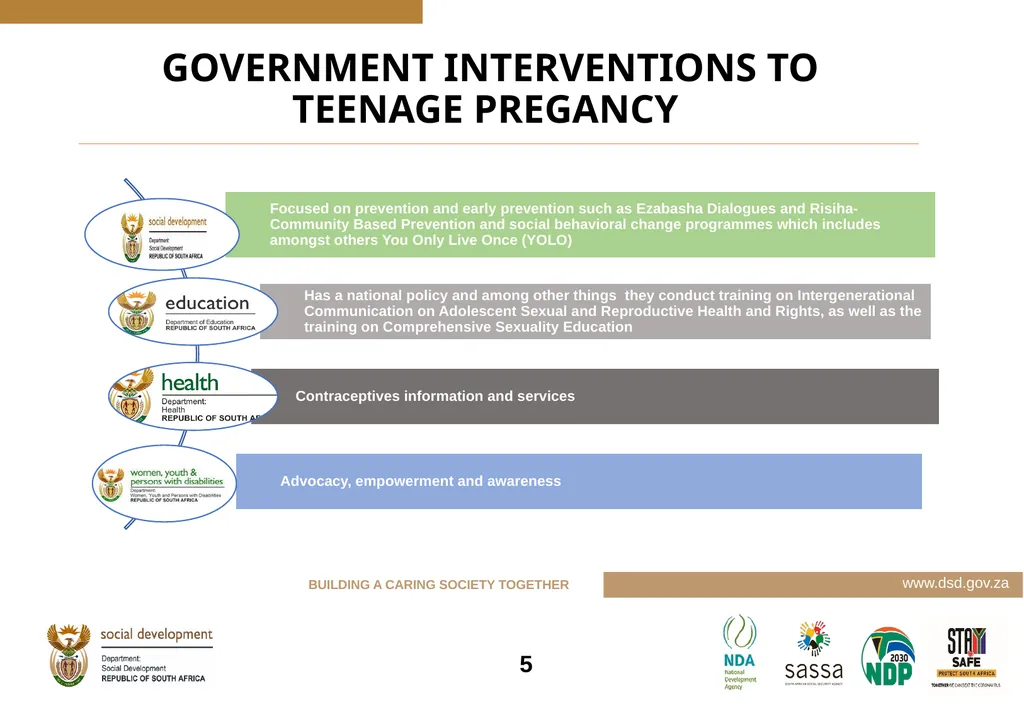
GOVERNMENT INTERVENTIONS TO TEENAGE PREGANCY 5<br>
05
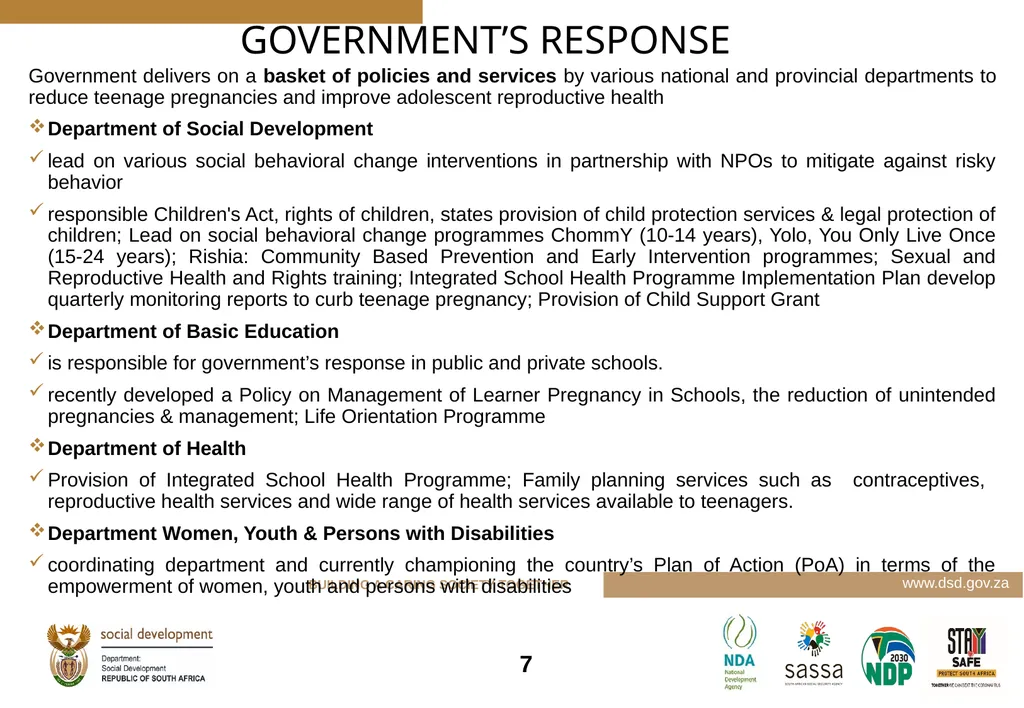
GOVERNMENT’S RESPONSE Government delivers on a basket of policies and services by various national and provincial departments to reduce teenage pregnancies and improve adolescent reproductive health
Department of Social Development
lead on various social behavioral change interventions in partnership with NPOs to mitigate against risky behavior
responsible Children's Act, rights of children, states provision of child protection services & legal protection of children; Lead on social behavioral change programmes ChommY (10-14 years), Yolo, You Only Live Once (15-24 years); Rishia: Community Based Prevention and Early Intervention programmes; Sexual and Reproductive Health and Rights training; Integrated School Health Programme Implementation Plan develop quarterly monitoring reports to curb teenage pregnancy; Provision of Child Support Grant
Department of Basic Education
is responsible for government’s response in public and private schools.
recently developed a Policy on Management of Learner Pregnancy in Schools, the reduction of unintended pregnancies & management; Life Orientation Programme
Department of Health
Provision of Integrated School Health Programme; Family planning services such as contraceptives, reproductive health services and wide range of health services available to teenagers.
Department Women, Youth & Persons with Disabilities
coordinating department and currently championing the country’s Plan of Action (PoA) in terms of the empowerment of women, youth and persons with disabilities 7<br>
06
GOVERNMENT’S RESPONSE Government delivers on a basket of policies and services by various national and provincial departments to reduce teenage pregnancies and improve adolescent reproductive health
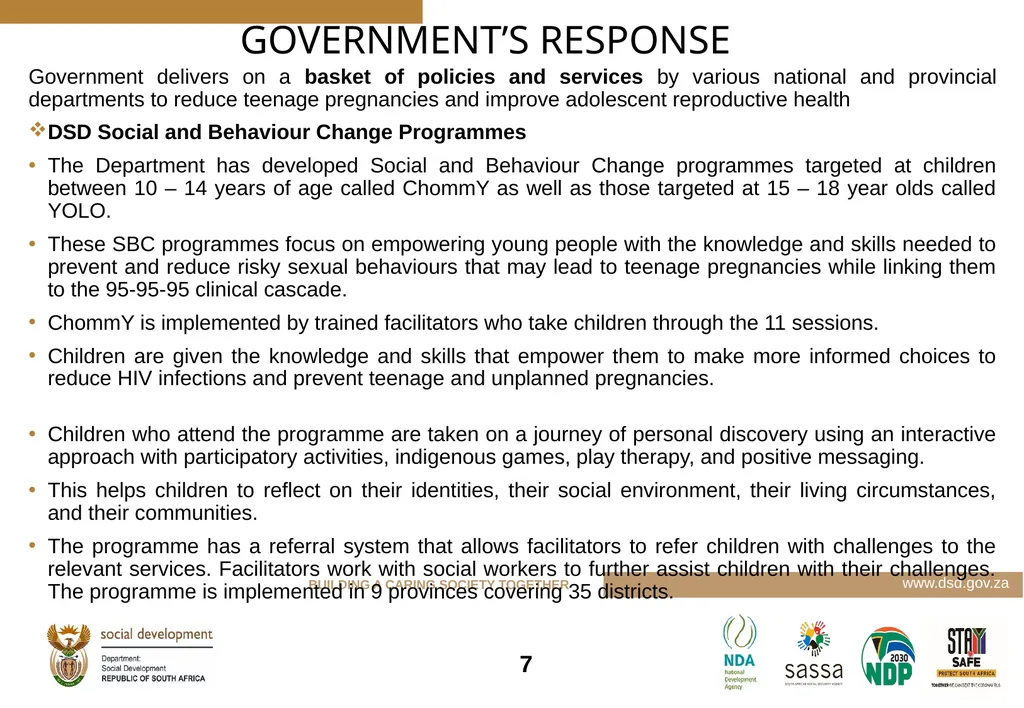
DSD Social and Behaviour Change Programmes
The Department has developed Social and Behaviour Change programmes targeted at children between 10 – 14 years of age called ChommY as well as those targeted at 15 – 18 year olds called YOLO.
These SBC programmes focus on empowering young people with the knowledge and skills needed to prevent and reduce risky sexual behaviours that may lead to teenage pregnancies while linking them to the 95-95-95 clinical cascade.
ChommY is implemented by trained facilitators who take children through the 11 sessions.
Children are given the knowledge and skills that empower them to make more informed choices to reduce HIV infections and prevent teenage and unplanned pregnancies.
Children who attend the programme are taken on a journey of personal discovery using an interactive approach with participatory activities, indigenous games, play therapy, and positive messaging.
This helps children to reflect on their identities, their social environment, their living circumstances, and their communities.
The programme has a referral system that allows facilitators to refer children with challenges to the relevant services. Facilitators work with social workers to further assist children with their challenges. The programme is implemented in 9 provinces covering 35 districts. 7<br>
07
GOVERNMENT’S RESPONSE Government delivers on a basket of policies and services by various national and provincial departments to reduce teenage pregnancies and improve adolescent reproductive health
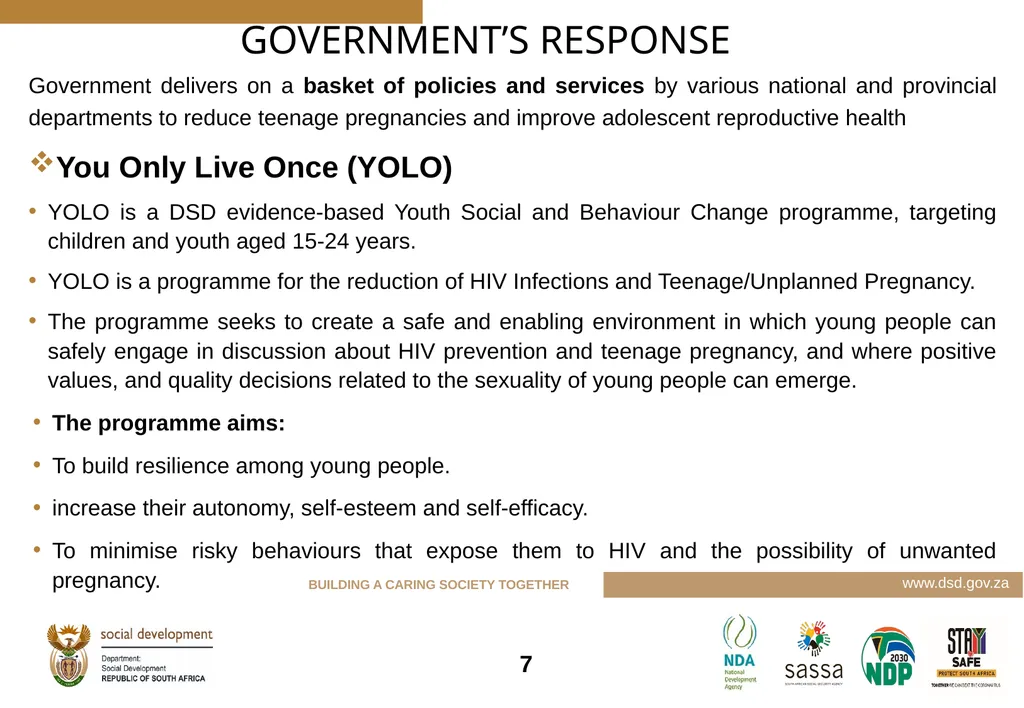
You Only Live Once (YOLO)
YOLO is a DSD evidence-based Youth Social and Behaviour Change programme, targeting children and youth aged 15-24 years.
YOLO is a programme for the reduction of HIV Infections and Teenage/Unplanned Pregnancy.
The programme seeks to create a safe and enabling environment in which young people can safely engage in discussion about HIV prevention and teenage pregnancy, and where positive values, and quality decisions related to the sexuality of young people can emerge.
The programme aims:
To build resilience among young people.
increase their autonomy, self-esteem and self-efficacy.
To minimise risky behaviours that expose them to HIV and the possibility of unwanted pregnancy. 7<br>
08
RECOMMENDATIONS It is recommended that Portfolio Committee :
Note the presentation on the programmes aimed at addressing teenage pregnancy rendered by DSD
Portfolio Committee extend an invitation to other department dealing with the Teenage Pregnancy<br>