
Dependency Analysis Recap Program Equivalence Data
Description: Dependency Analysis Recap Program Equivalence Data dependencies across loop iterations Data Dependencies in Nested Loop Iteration Number loop index: I Lower and Upper Bound: L and U Step size: S iteration number i (I L1) S Example:
Related Topics
Download Presentation
"Dependency Analysis Recap Program Equivalence Data" is the property of its rightful owner. Permission is granted to download and print the materials on this website for personal, non-commercial use only, and to display it on your personal computer provided you do not modify the materials and that you retain all copyright notices contained in the materials. By downloading content from our website, you accept the terms of this agreement.
Presentation Transcript
slide1. Dependency Analysis<br>
slide2. Recap Program Equivalence
Data dependencies across loop iterations<br>
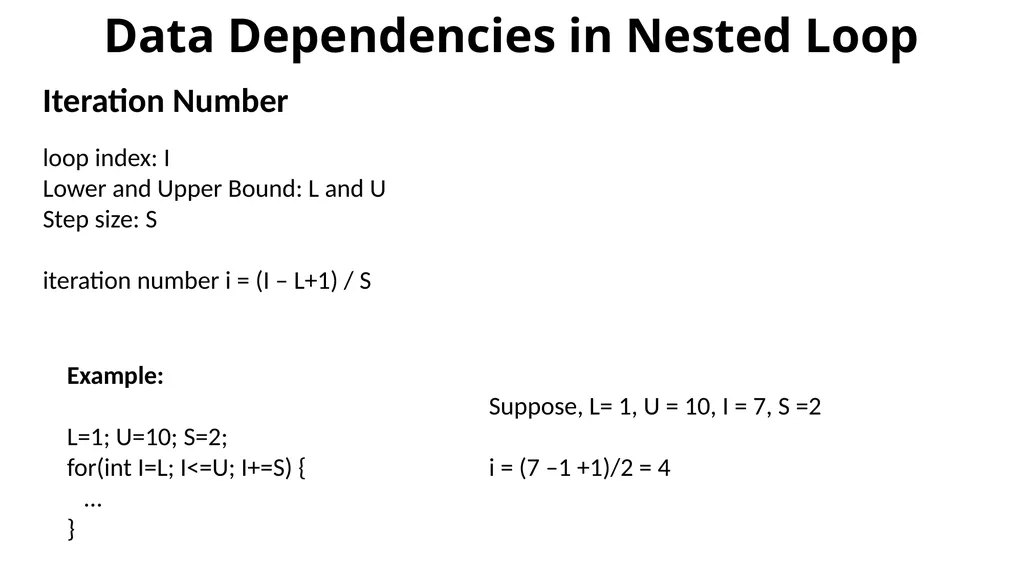
slide3. Data Dependencies in Nested Loop Iteration Number loop index: I
Lower and Upper Bound: L and U
Step size: S
iteration number i = (I – L+1) / S Example:
L=1; U=10; S=2;
for(int I=L; I<=U; I+=S) {
…
} Suppose, L= 1, U = 10, I = 7, S =2
i = (7 –1 +1)/2 = 4<br>
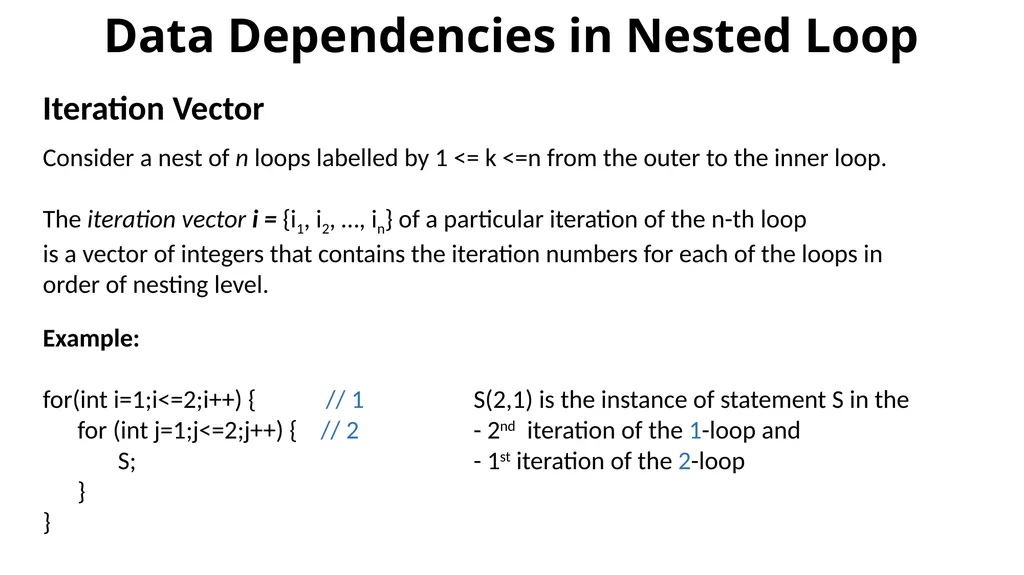
slide4. Data Dependencies in Nested Loop Iteration Vector Consider a nest of n loops labelled by 1 <= k <=n from the outer to the inner loop.
The iteration vector i = {i1, i2, …, in} of a particular iteration of the n-th loop
is a vector of integers that contains the iteration numbers for each of the loops in order of nesting level. Example:
for(int i=1;i<=2;i++) { // 1
for (int j=1;j<=2;j++) { // 2
S;
}
} S(2,1) is the instance of statement S in the
- 2nd iteration of the 1-loop and
- 1st iteration of the 2-loop<br>
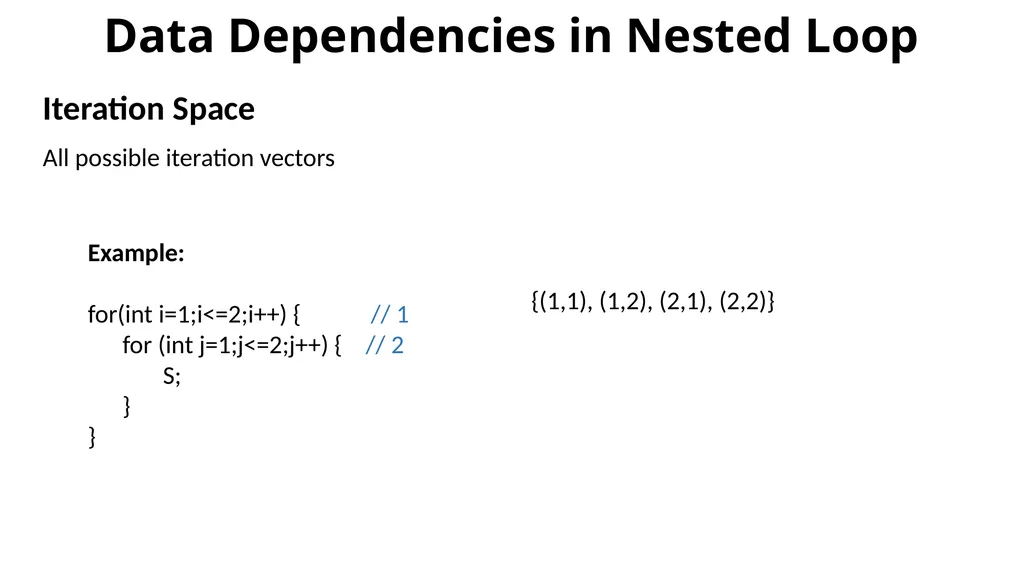
slide5. Data Dependencies in Nested Loop Iteration Space All possible iteration vectors Example:
for(int i=1;i<=2;i++) { // 1
for (int j=1;j<=2;j++) { // 2
S;
}
} {(1,1), (1,2), (2,1), (2,2)}<br>
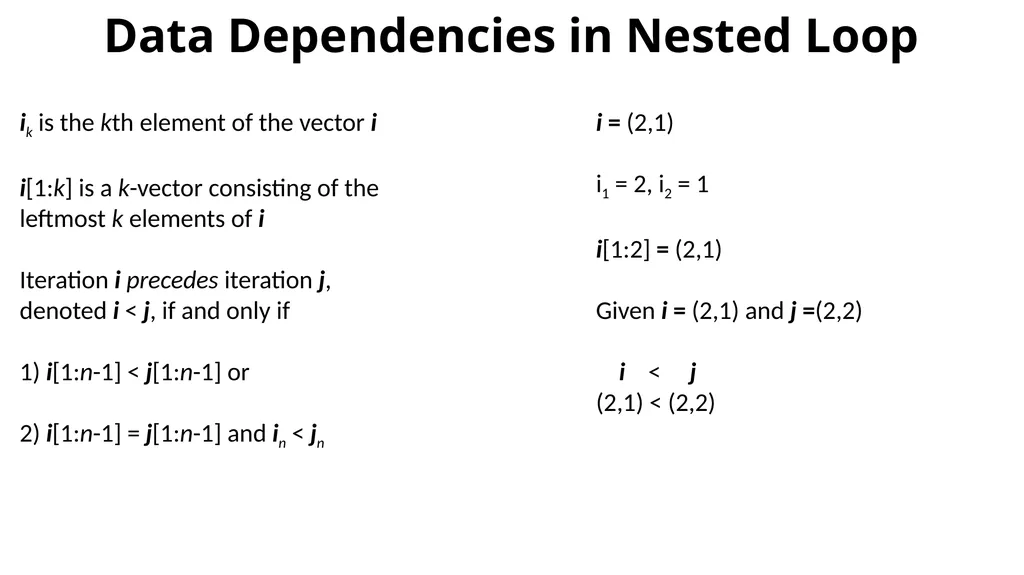
slide6. Data Dependencies in Nested Loop ik is the kth element of the vector i
i[1:k] is a k-vector consisting of the leftmost k elements of i
Iteration i precedes iteration j,
denoted i < j, if and only if
1) i[1:n-1] < j[1:n-1] or
2) i[1:n-1] = j[1:n-1] and in < jn i = (2,1)
i1 = 2, i2 = 1
i[1:2] = (2,1)
Given i = (2,1) and j =(2,2)
i < j
(2,1) < (2,2)<br>
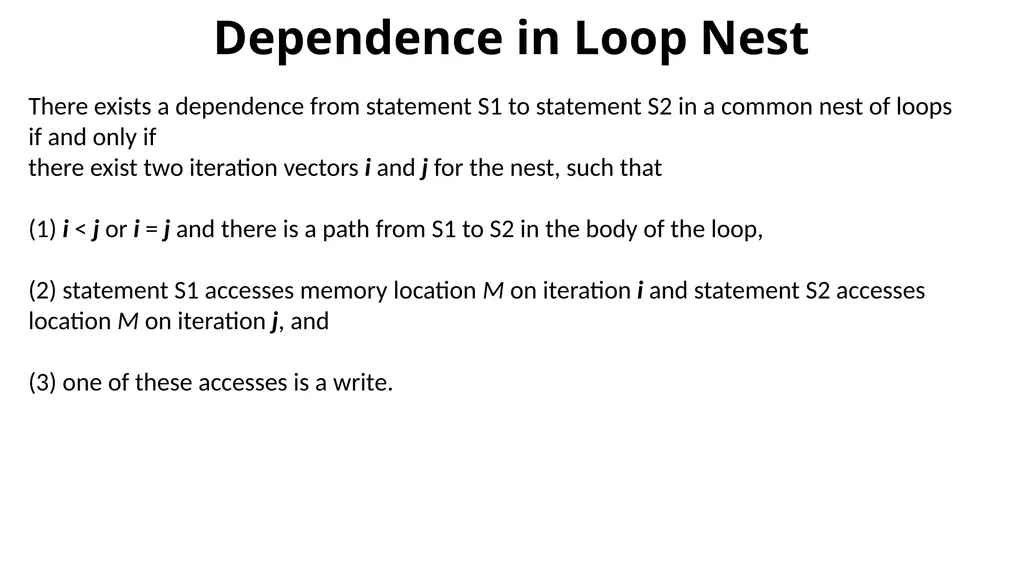
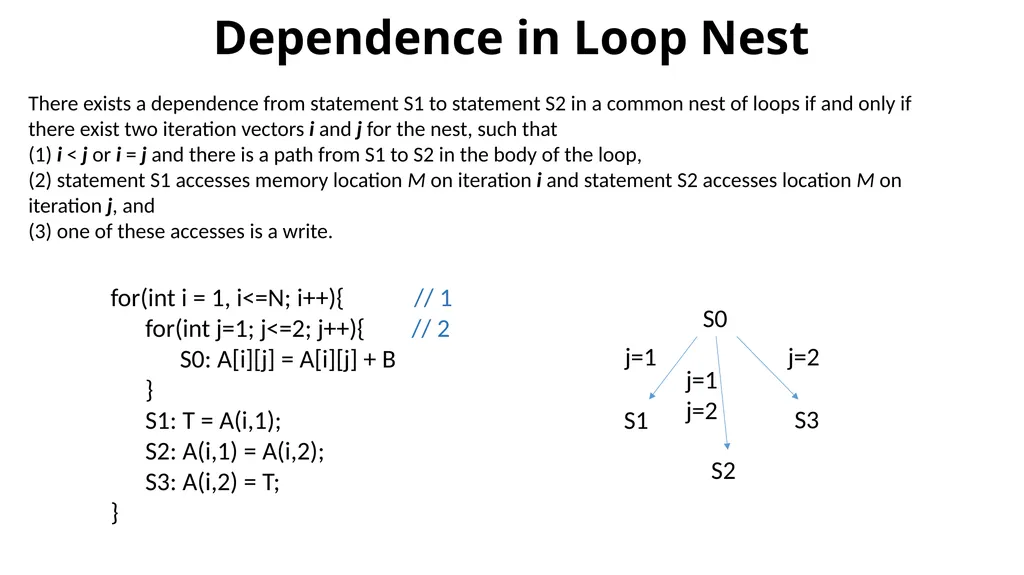
slide7. Dependence in Loop Nest There exists a dependence from statement S1 to statement S2 in a common nest of loops if and only if
there exist two iteration vectors i and j for the nest, such that
(1) i < j or i = j and there is a path from S1 to S2 in the body of the loop,
(2) statement S1 accesses memory location M on iteration i and statement S2 accesses location M on iteration j, and
(3) one of these accesses is a write.<br>
slide8. Dependence in Loop Nest There exists a dependence from statement S1 to statement S2 in a common nest of loops if and only if
there exist two iteration vectors i and j for the nest, such that
(1) i < j or i = j and there is a path from S1 to S2 in the body of the loop,
(2) statement S1 accesses memory location M on iteration i and statement S2 accesses location M on iteration j, and
(3) one of these accesses is a write. for(int i = 1, i<=N; i++){ // 1
for(int j=1; j<=2; j++){ // 2
S0: A[i][j] = A[i][j] + B
}
S1: T = A(i,1);
S2: A(i,1) = A(i,2);
S3: A(i,2) = T;
} S0 S1 S2 S3 j=1 j=1
j=2 j=2<br>
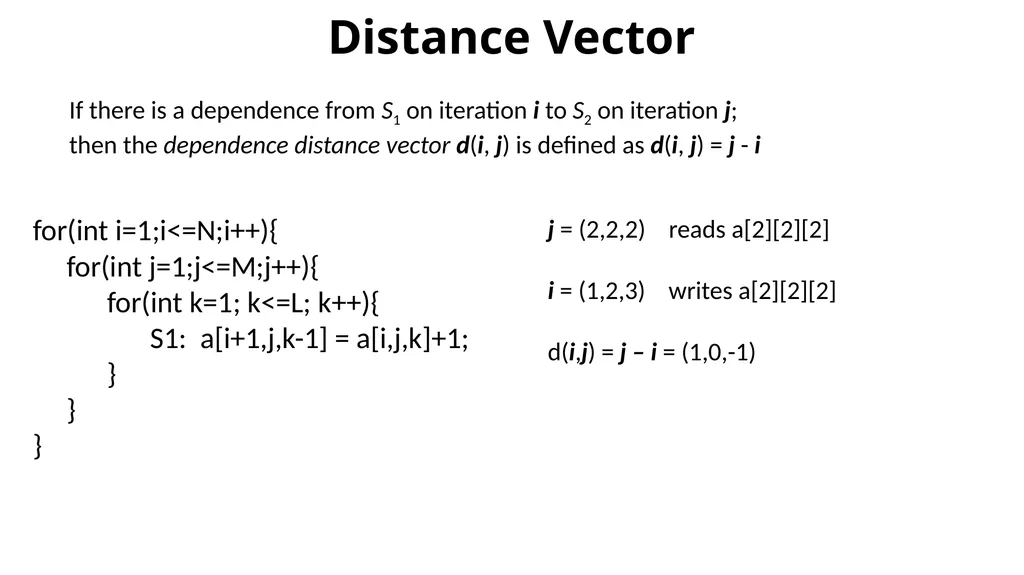
slide9. Distance Vector If there is a dependence from S1 on iteration i to S2 on iteration j;
then the dependence distance vector d(i, j) is defined as d(i, j) = j - i for(int i=1;i<=N;i++){
for(int j=1;j<=M;j++){
for(int k=1; k<=L; k++){
S1: a[i+1,j,k-1] = a[i,j,k]+1;
}
}
} j = (2,2,2) reads a[2][2][2]
i = (1,2,3) writes a[2][2][2]
d(i,j) = j – i = (1,0,-1)<br>
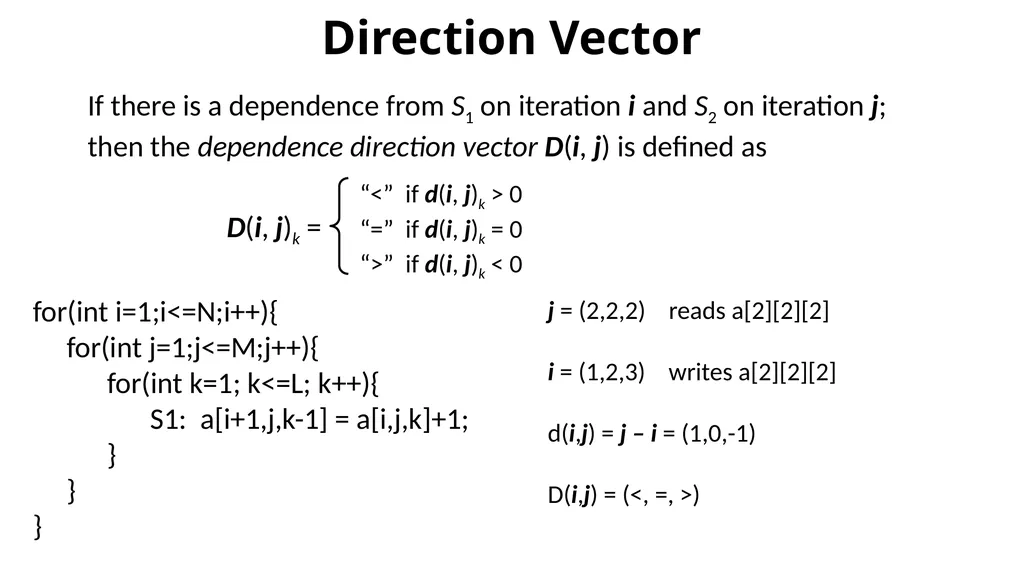
slide10. Direction Vector If there is a dependence from S1 on iteration i and S2 on iteration j;
then the dependence direction vector D(i, j) is defined as D(i, j)k = “<” if d(i, j)k > 0 “=” if d(i, j)k = 0 “>” if d(i, j)k < 0 for(int i=1;i<=N;i++){
for(int j=1;j<=M;j++){
for(int k=1; k<=L; k++){
S1: a[i+1,j,k-1] = a[i,j,k]+1;
}
}
} j = (2,2,2) reads a[2][2][2]
i = (1,2,3) writes a[2][2][2]
d(i,j) = j – i = (1,0,-1)
D(i,j) = (<, =, >)<br>
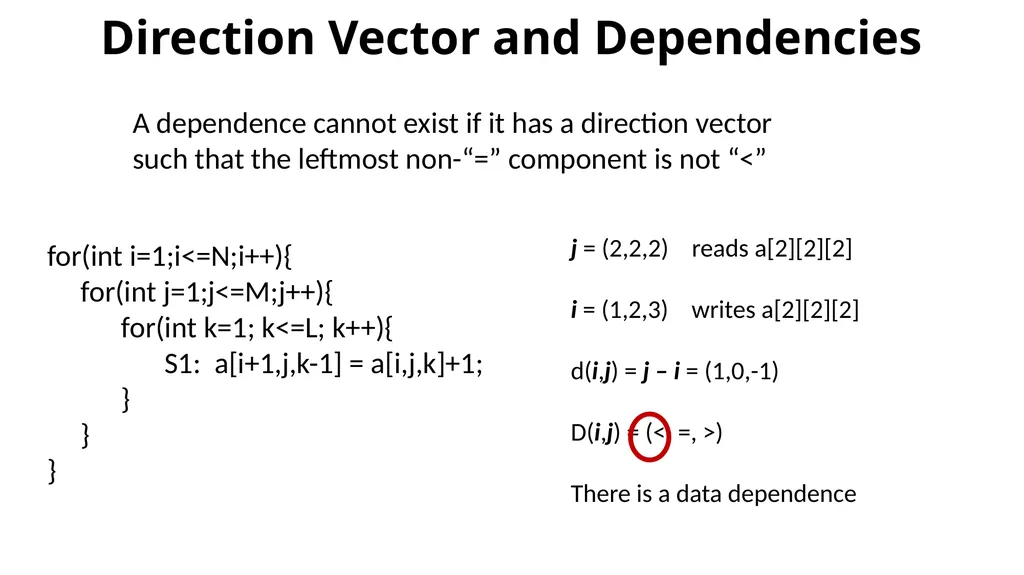
slide11. Direction Vector and Dependencies for(int i=1;i<=N;i++){
for(int j=1;j<=M;j++){
for(int k=1; k<=L; k++){
S1: a[i+1,j,k-1] = a[i,j,k]+1;
}
}
} j = (2,2,2) reads a[2][2][2]
i = (1,2,3) writes a[2][2][2]
d(i,j) = j – i = (1,0,-1)
D(i,j) = (<, =, >)
There is a data dependence A dependence cannot exist if it has a direction vector such that the leftmost non-“=” component is not “<”<br>
slide12. Direction Vector and Dependencies for(int i=1;i<=N;i++){
for(int j=1;j<=M;j++){
for(int k=1; k<=L; k++){
S1: a[i+1,j,k-1] = a[i,j,k]+1;
}
}
} Any anti-dependence?
i = (2,2,2) reads a[2][2][2]
j = (1,2,3) writes a[2][2][2]
d(i,j) = j – i = (-1,0,1)
D(i,j) = (>, =, <)
No anti-dependence A dependence cannot exist if it has a direction vector such that the leftmost non-“=” component is not “<”<br>
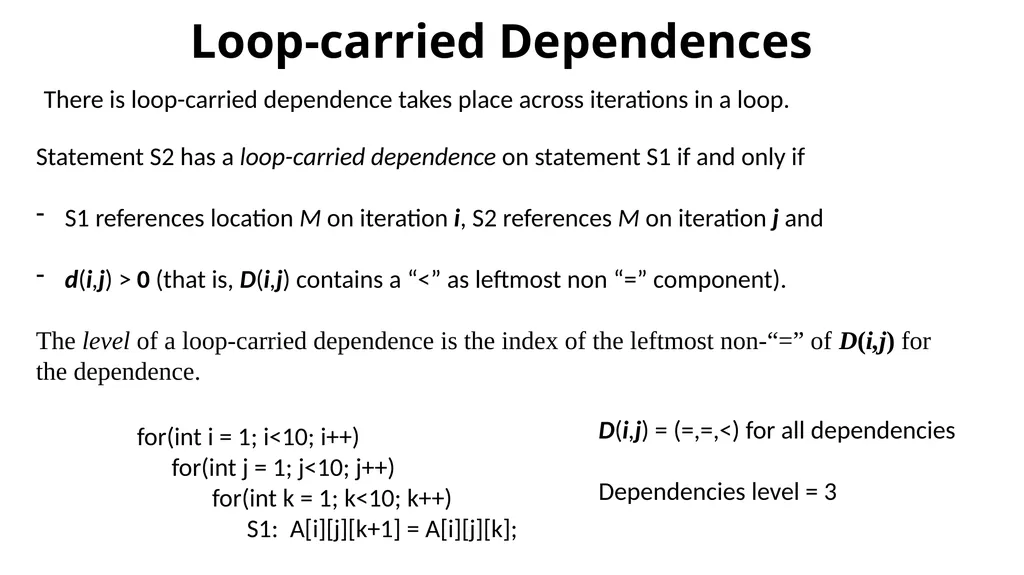
slide13. Loop-carried Dependences There is loop-carried dependence takes place across iterations in a loop. Statement S2 has a loop-carried dependence on statement S1 if and only if
S1 references location M on iteration i, S2 references M on iteration j and
d(i,j) > 0 (that is, D(i,j) contains a “<” as leftmost non “=” component).
The level of a loop-carried dependence is the index of the leftmost non-“=” of D(i,j) for the dependence. for(int i = 1; i<10; i++)
for(int j = 1; j<10; j++)
for(int k = 1; k<10; k++)
S1: A[i][j][k+1] = A[i][j][k]; D(i,j) = (=,=,<) for all dependencies
Dependencies level = 3<br>
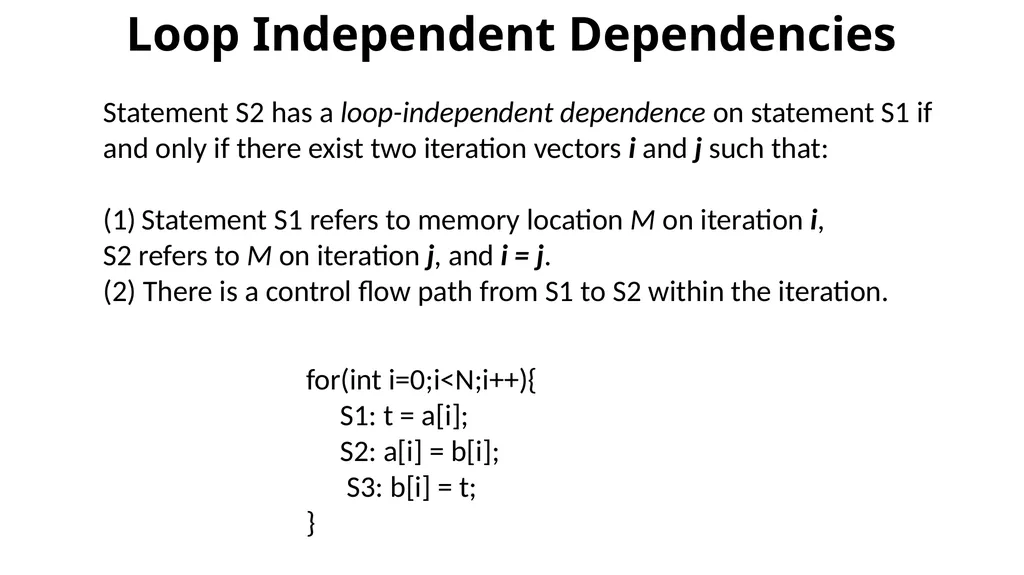
slide14. Loop Independent Dependencies Statement S2 has a loop-independent dependence on statement S1 if and only if there exist two iteration vectors i and j such that:
Statement S1 refers to memory location M on iteration i,
S2 refers to M on iteration j, and i = j.
(2) There is a control flow path from S1 to S2 within the iteration. for(int i=0;i<N;i++){
S1: t = a[i];
S2: a[i] = b[i];
S3: b[i] = t;
}<br>
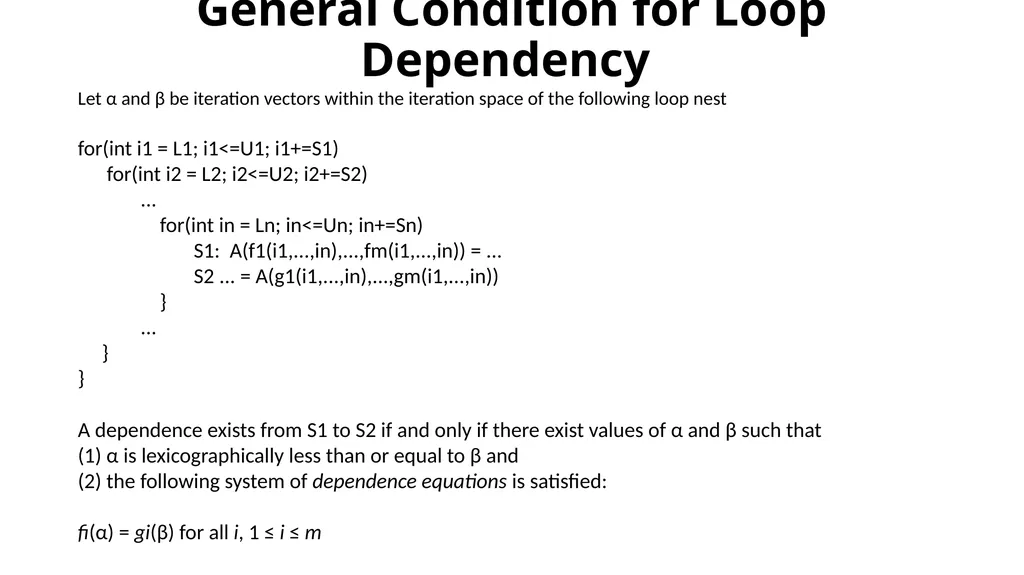
slide15. General Condition for Loop Dependency Let α and β be iteration vectors within the iteration space of the following loop nest
for(int i1 = L1; i1<=U1; i1+=S1)
for(int i2 = L2; i2<=U2; i2+=S2)
...
for(int in = Ln; in<=Un; in+=Sn)
S1: A(f1(i1,...,in),...,fm(i1,...,in)) = ...
S2 ... = A(g1(i1,...,in),...,gm(i1,...,in))
}
...
}
}
A dependence exists from S1 to S2 if and only if there exist values of α and β such that
(1) α is lexicographically less than or equal to β and
(2) the following system of dependence equations is satisfied:
fi(α) = gi(β) for all i, 1 ≤ i ≤ m<br>
slide16. References Chapter 2
Optimizing compilers for modern architectures
a dependence-based approach
by Randy Allen, Ken Kennedy<br>
slide2. Recap Program Equivalence
Data dependencies across loop iterations<br>
slide3. Data Dependencies in Nested Loop Iteration Number loop index: I
Lower and Upper Bound: L and U
Step size: S
iteration number i = (I – L+1) / S Example:
L=1; U=10; S=2;
for(int I=L; I<=U; I+=S) {
…
} Suppose, L= 1, U = 10, I = 7, S =2
i = (7 –1 +1)/2 = 4<br>
slide4. Data Dependencies in Nested Loop Iteration Vector Consider a nest of n loops labelled by 1 <= k <=n from the outer to the inner loop.
The iteration vector i = {i1, i2, …, in} of a particular iteration of the n-th loop
is a vector of integers that contains the iteration numbers for each of the loops in order of nesting level. Example:
for(int i=1;i<=2;i++) { // 1
for (int j=1;j<=2;j++) { // 2
S;
}
} S(2,1) is the instance of statement S in the
- 2nd iteration of the 1-loop and
- 1st iteration of the 2-loop<br>
slide5. Data Dependencies in Nested Loop Iteration Space All possible iteration vectors Example:
for(int i=1;i<=2;i++) { // 1
for (int j=1;j<=2;j++) { // 2
S;
}
} {(1,1), (1,2), (2,1), (2,2)}<br>
slide6. Data Dependencies in Nested Loop ik is the kth element of the vector i
i[1:k] is a k-vector consisting of the leftmost k elements of i
Iteration i precedes iteration j,
denoted i < j, if and only if
1) i[1:n-1] < j[1:n-1] or
2) i[1:n-1] = j[1:n-1] and in < jn i = (2,1)
i1 = 2, i2 = 1
i[1:2] = (2,1)
Given i = (2,1) and j =(2,2)
i < j
(2,1) < (2,2)<br>
slide7. Dependence in Loop Nest There exists a dependence from statement S1 to statement S2 in a common nest of loops if and only if
there exist two iteration vectors i and j for the nest, such that
(1) i < j or i = j and there is a path from S1 to S2 in the body of the loop,
(2) statement S1 accesses memory location M on iteration i and statement S2 accesses location M on iteration j, and
(3) one of these accesses is a write.<br>
slide8. Dependence in Loop Nest There exists a dependence from statement S1 to statement S2 in a common nest of loops if and only if
there exist two iteration vectors i and j for the nest, such that
(1) i < j or i = j and there is a path from S1 to S2 in the body of the loop,
(2) statement S1 accesses memory location M on iteration i and statement S2 accesses location M on iteration j, and
(3) one of these accesses is a write. for(int i = 1, i<=N; i++){ // 1
for(int j=1; j<=2; j++){ // 2
S0: A[i][j] = A[i][j] + B
}
S1: T = A(i,1);
S2: A(i,1) = A(i,2);
S3: A(i,2) = T;
} S0 S1 S2 S3 j=1 j=1
j=2 j=2<br>
slide9. Distance Vector If there is a dependence from S1 on iteration i to S2 on iteration j;
then the dependence distance vector d(i, j) is defined as d(i, j) = j - i for(int i=1;i<=N;i++){
for(int j=1;j<=M;j++){
for(int k=1; k<=L; k++){
S1: a[i+1,j,k-1] = a[i,j,k]+1;
}
}
} j = (2,2,2) reads a[2][2][2]
i = (1,2,3) writes a[2][2][2]
d(i,j) = j – i = (1,0,-1)<br>
slide10. Direction Vector If there is a dependence from S1 on iteration i and S2 on iteration j;
then the dependence direction vector D(i, j) is defined as D(i, j)k = “<” if d(i, j)k > 0 “=” if d(i, j)k = 0 “>” if d(i, j)k < 0 for(int i=1;i<=N;i++){
for(int j=1;j<=M;j++){
for(int k=1; k<=L; k++){
S1: a[i+1,j,k-1] = a[i,j,k]+1;
}
}
} j = (2,2,2) reads a[2][2][2]
i = (1,2,3) writes a[2][2][2]
d(i,j) = j – i = (1,0,-1)
D(i,j) = (<, =, >)<br>
slide11. Direction Vector and Dependencies for(int i=1;i<=N;i++){
for(int j=1;j<=M;j++){
for(int k=1; k<=L; k++){
S1: a[i+1,j,k-1] = a[i,j,k]+1;
}
}
} j = (2,2,2) reads a[2][2][2]
i = (1,2,3) writes a[2][2][2]
d(i,j) = j – i = (1,0,-1)
D(i,j) = (<, =, >)
There is a data dependence A dependence cannot exist if it has a direction vector such that the leftmost non-“=” component is not “<”<br>
slide12. Direction Vector and Dependencies for(int i=1;i<=N;i++){
for(int j=1;j<=M;j++){
for(int k=1; k<=L; k++){
S1: a[i+1,j,k-1] = a[i,j,k]+1;
}
}
} Any anti-dependence?
i = (2,2,2) reads a[2][2][2]
j = (1,2,3) writes a[2][2][2]
d(i,j) = j – i = (-1,0,1)
D(i,j) = (>, =, <)
No anti-dependence A dependence cannot exist if it has a direction vector such that the leftmost non-“=” component is not “<”<br>
slide13. Loop-carried Dependences There is loop-carried dependence takes place across iterations in a loop. Statement S2 has a loop-carried dependence on statement S1 if and only if
S1 references location M on iteration i, S2 references M on iteration j and
d(i,j) > 0 (that is, D(i,j) contains a “<” as leftmost non “=” component).
The level of a loop-carried dependence is the index of the leftmost non-“=” of D(i,j) for the dependence. for(int i = 1; i<10; i++)
for(int j = 1; j<10; j++)
for(int k = 1; k<10; k++)
S1: A[i][j][k+1] = A[i][j][k]; D(i,j) = (=,=,<) for all dependencies
Dependencies level = 3<br>
slide14. Loop Independent Dependencies Statement S2 has a loop-independent dependence on statement S1 if and only if there exist two iteration vectors i and j such that:
Statement S1 refers to memory location M on iteration i,
S2 refers to M on iteration j, and i = j.
(2) There is a control flow path from S1 to S2 within the iteration. for(int i=0;i<N;i++){
S1: t = a[i];
S2: a[i] = b[i];
S3: b[i] = t;
}<br>
slide15. General Condition for Loop Dependency Let α and β be iteration vectors within the iteration space of the following loop nest
for(int i1 = L1; i1<=U1; i1+=S1)
for(int i2 = L2; i2<=U2; i2+=S2)
...
for(int in = Ln; in<=Un; in+=Sn)
S1: A(f1(i1,...,in),...,fm(i1,...,in)) = ...
S2 ... = A(g1(i1,...,in),...,gm(i1,...,in))
}
...
}
}
A dependence exists from S1 to S2 if and only if there exist values of α and β such that
(1) α is lexicographically less than or equal to β and
(2) the following system of dependence equations is satisfied:
fi(α) = gi(β) for all i, 1 ≤ i ≤ m<br>
slide16. References Chapter 2
Optimizing compilers for modern architectures
a dependence-based approach
by Randy Allen, Ken Kennedy<br>