04
Differential Blockade-the why? Injection of local anesthetic will reach spinal nerve roots
Blockade of nerve impulse transmission occurs
Spinal nerve roots contain several nerve fiber types and classifications- some are more susceptible to local anesthetics than others<br>
05
Differential Blockade-Local Anesthetic Factors As local anesthetic spreads you see a smaller concentration of local anesthetic at sites distal to the injection
Local anesthetic concentration and duration of contact plays a role
Susceptibility of nerve fiber types to be blocked<br>
06
Differential Blockade-Anatomic Factors Small mylelinated fibers are more susceptible to blockade
Large unmyelinated fibers are less susceptible to blockade
Thus there is a difference between the sympathetic level, sensory level, and motor levels<br>
07
How Big of a Difference? The sympathetic level is generally 2-6 levels higher than the sensory level. The sensory level is generally 2 levels higher than the motor level<br>
08
Testing Levels-Sympathetic An alcohol wipe can be used to test the level of sympathetic blockade. You are testing the patients ability to differentiate differences in skin temperature discernment<br>
09
Testing Levels-Sensory Level Use a blunt needle that is sharp enough to produce a “pin prick” sensation but not sharp enough to break the skin (i.e. spinal needle stylet)<br>
11
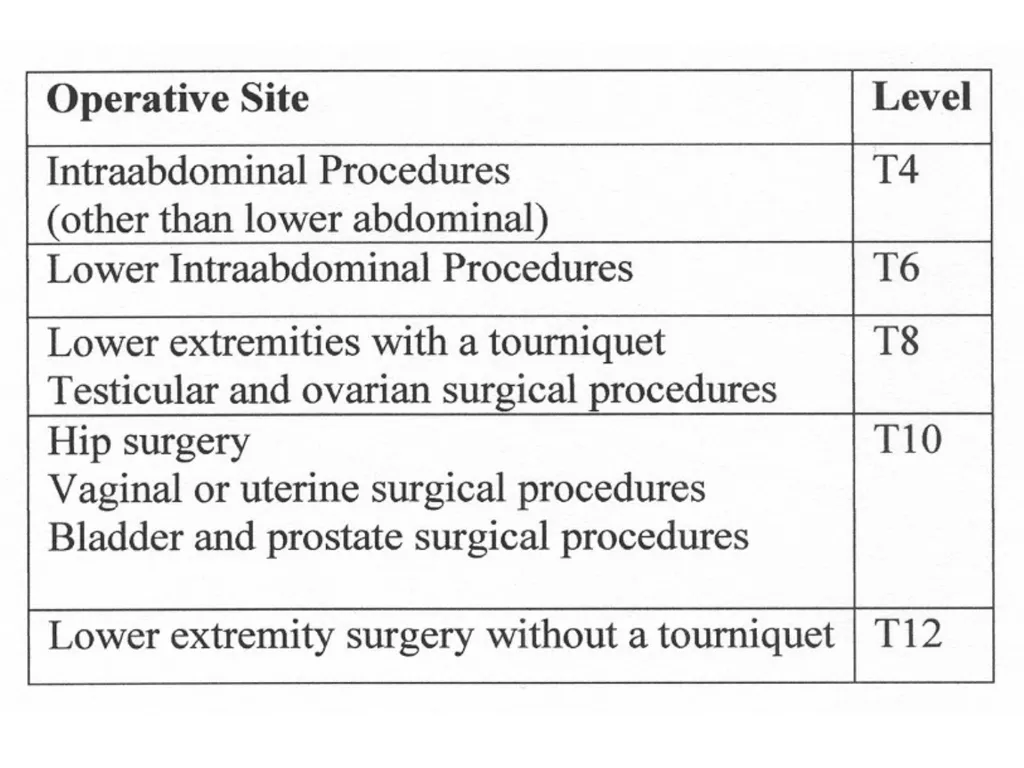
Common operative sites and minimum level of blockade<br>
12
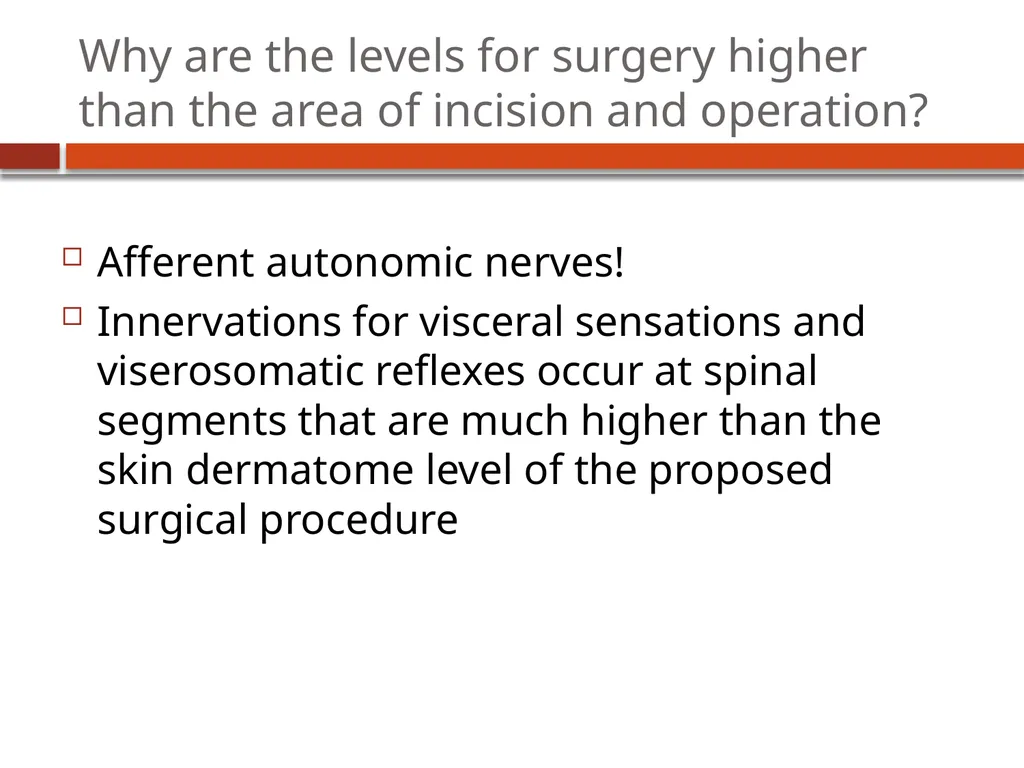
Why are the levels for surgery higher than the area of incision and operation? Afferent autonomic nerves!
Innervations for visceral sensations and viserosomatic reflexes occur at spinal segments that are much higher than the skin dermatome level of the proposed surgical procedure<br>
13
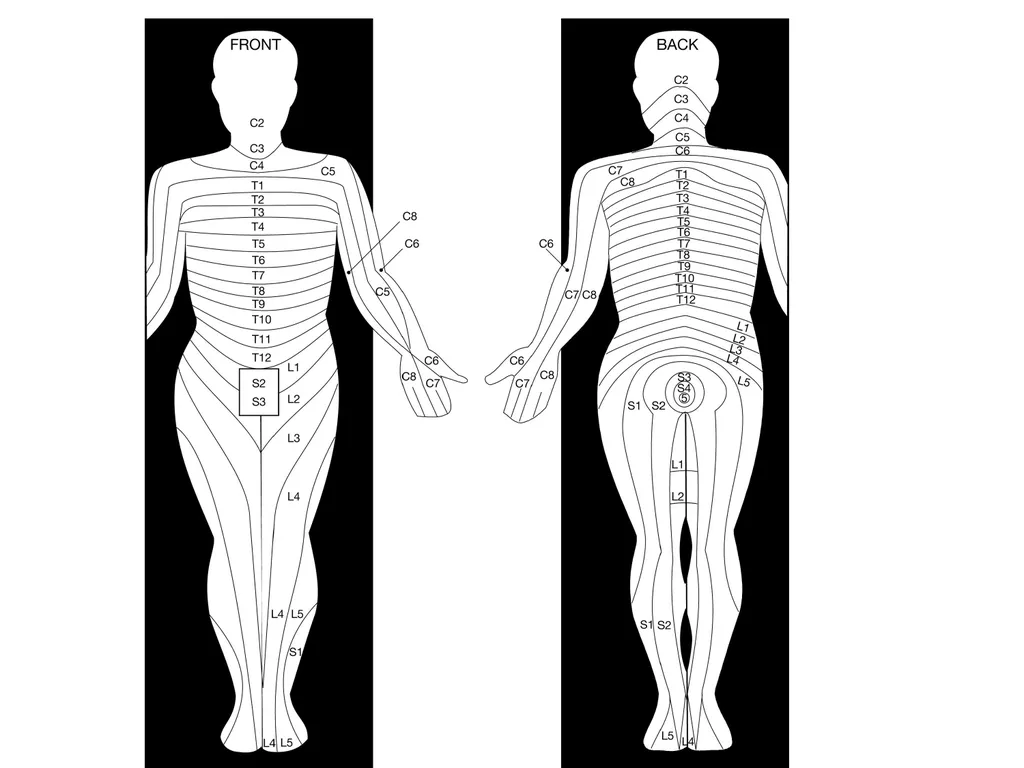
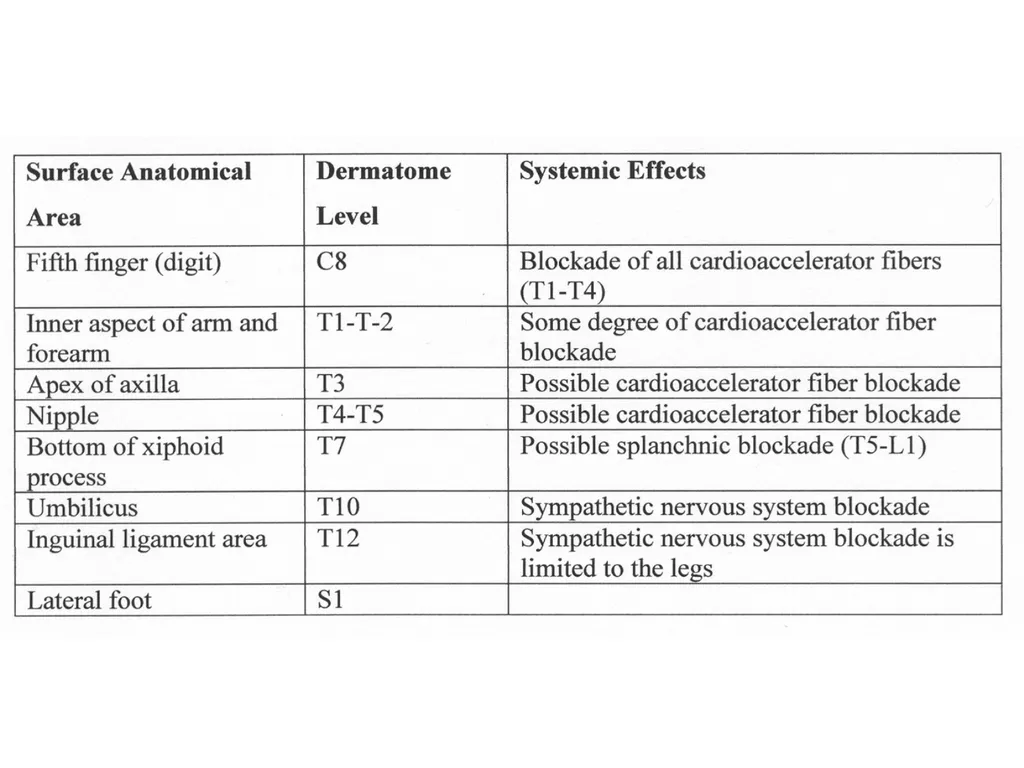
Surface Anatomical Landmarks, Dermatome level, and Systemic Effects Important to know so you can assess if the block is adequate
Important to know to anticipate systemic effects and potential complications
Assessment of inadequate block will allow you to employ an alternative anesthetic technique before incision<br>
14
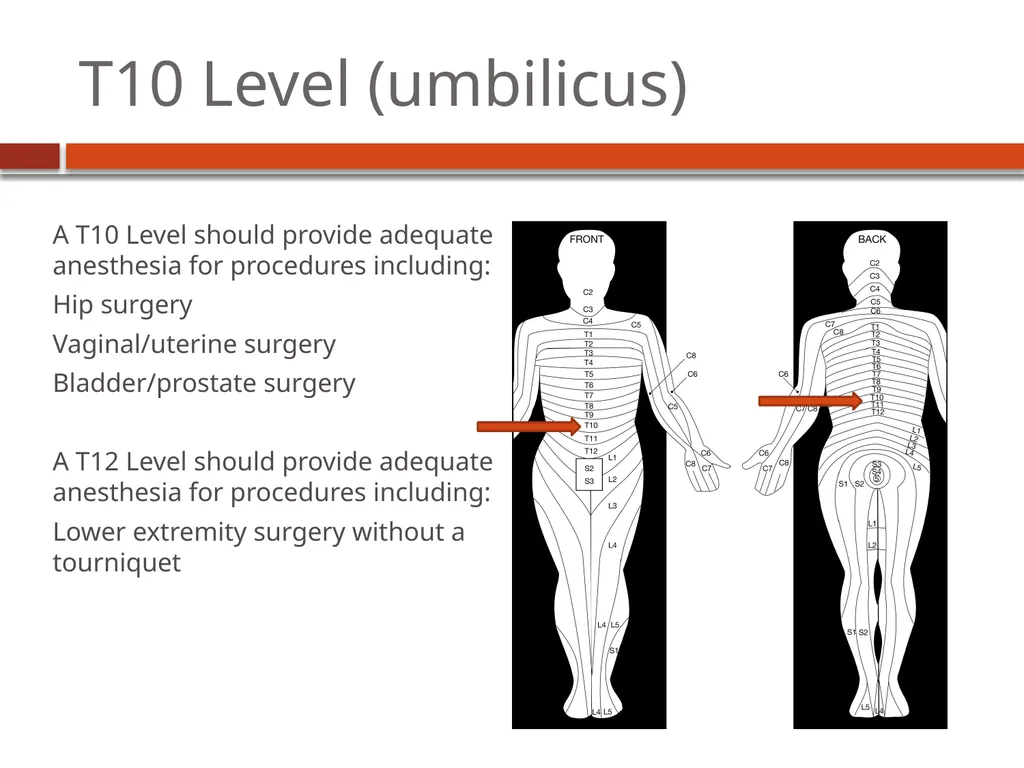
T10 Level (umbilicus) A T10 Level should provide adequate anesthesia for procedures including:
Hip surgery
Vaginal/uterine surgery
Bladder/prostate surgery
A T12 Level should provide adequate anesthesia for procedures including:
Lower extremity surgery without a tourniquet<br>
15
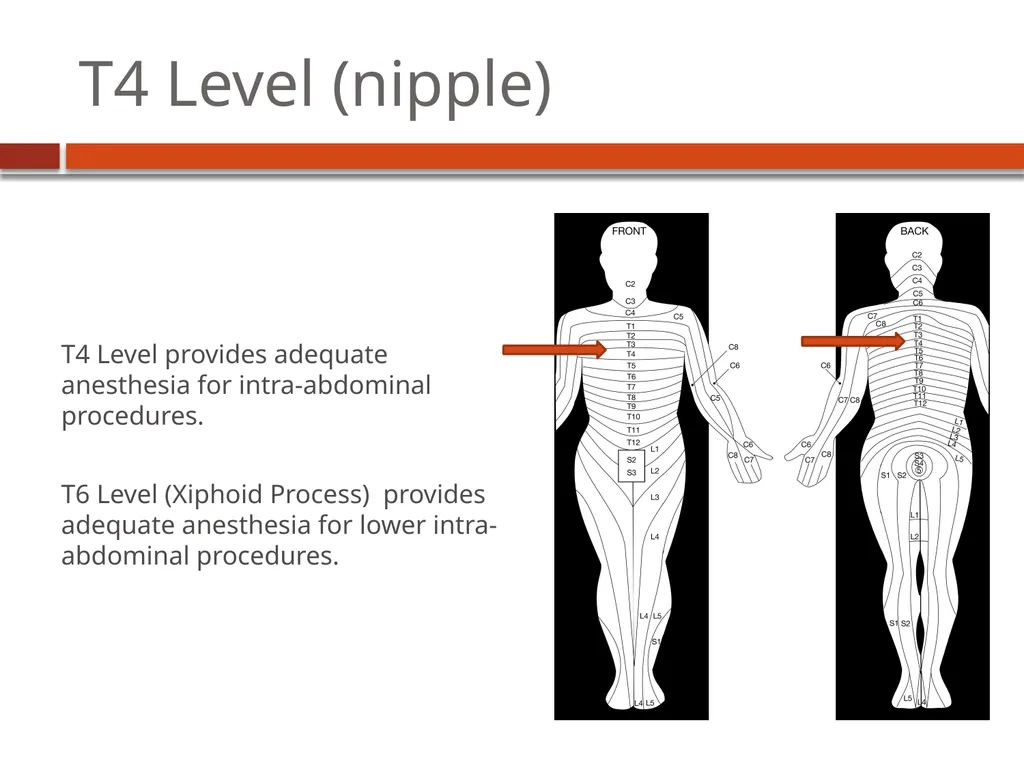
T4 Level (nipple) T4 Level provides adequate anesthesia for intra-abdominal procedures.
T6 Level (Xiphoid Process) provides adequate anesthesia for lower intra-abdominal procedures.<br>
16
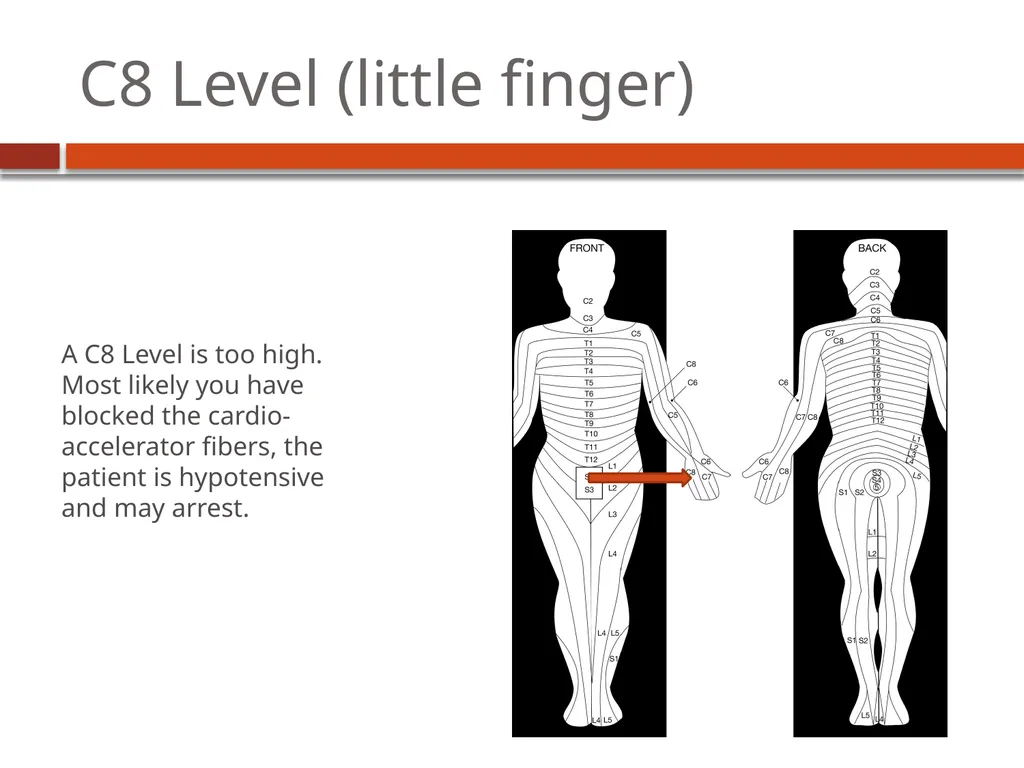
C8 Level (little finger) A C8 Level is too high. Most likely you have blocked the cardio-accelerator fibers, the patient is hypotensive and may arrest.<br>
17
Where is T5? A survey of anaesthetists. T5 is found between T4 (nipple level) and T6 (xiphoid process)
Pain during C-section a common cause of malpractice suits in England.
73 anaesthetists (consultants and trainees) were asked to identify T5 on an anatomical torso model of a non pregnant female. K Congreve, I Gardner, C Laxton, M Scrutton. Where is T5? A survey of anaesthetists. Anaesthesia, pp. 453-455. 61, 2006.<br>
18
Where is T5? A survey of anaesthetists. Purposely used a “non-pregnant” model to prevent landmarks that may be disguised by the physical changes that occur. K Congreve, I Gardner, C Laxton, M Scrutton. Where is T5? A survey of anaesthetists. Anaesthesia, pp. 453-455. 61, 2006.<br>
19
Results 1 out of 7 were 2 or more dermatomes away from T5.
Anesthesia providers that “believe” that T5 is higher than where it is actually at may encounter more cardiovascular instability due to blockade of the cardio-accelerator fibers (T1-T4). K Congreve, I Gardner, C Laxton, M Scrutton. Where is T5? A survey of anaesthetists. Anaesthesia, pp. 453-455. 61, 2006.<br>
20
Results Anesthesia providers who “believe” that T5 is lower than where it is may be left with an inadequate block resulting in pain and conversion to general anesthesia. K Congreve, I Gardner, C Laxton, M Scrutton. Where is T5? A survey of anaesthetists. Anaesthesia, pp. 453-455. 61, 2006.<br>
21
Take Home Message Knowledge of “where” the dermatomes are located anatomically are essential and foundational in testing neuraxial blockade. K Congreve, I Gardner, C Laxton, M Scrutton. Where is T5? A survey of anaesthetists. Anaesthesia, pp. 453-455. 61, 2006.<br>
22
References Brown, D.L. (2005). Spinal, epidural, and caudal anesthesia. In R.D. Miller Miller’s Anesthesia, 6th edition. Philadelphia: Elsevier Churchill Livingstone.
Burkard J, Lee Olson R., Vacchiano CA. (2005) Regional Anesthesia. In JJ Nagelhout & KL Zaglaniczny (eds) Nurse Anesthesia 3rd edition. Pages 977-1030.
Congreve K,Gardner I, Laxton C, Scrutton M. (2006) Where is T5? A survey of anaesthetists. Anaesthesia, pp. 453-455.
Kleinman, W. & Mikhail, M. (2006). Spinal, epidural, & caudal blocks. In G.E. Morgan et al Clinical Anesthesiology, 4th edition. New York: Lange Medical Books.
Warren, D.T. & Liu, S.S. (2008). Neuraxial Anesthesia. In D.E. Longnecker et al (eds) Anesthesiology. New York: McGraw-Hill Medical.<br>