Descartes conceivability argument for substance dualism Michael Lacewing enquiriesalevelphilosophy.co.uk (c) Michael Lacewing Substance dualism Substance dualism: there are two sorts of substance, mind (or soul) and matter Minds are
"Descartes’ conceivability argument for substance" is the property of its rightful owner. Permission is granted to
download and print the materials on this website for personal, non-commercial use only, and to display it
on your personal computer provided you do not modify the materials and that you retain all copyright
notices contained in the materials. By downloading content from our website, you accept the terms of this
agreement.
Presentation Transcript
01
Descartes’ conceivability argument for substance dualism Michael Lacewing
enquiries@alevelphilosophy.co.uk (c) Michael Lacewing<br>
02
Substance dualism Substance dualism: there are two sorts of substance, mind (or soul) and matter
Minds are distinct from bodies
Minds are not properties of bodies
Mental properties are properties of a mental substance
Cartesian substance dualism: minds can exist independent of bodies (c) Michael Lacewing<br>
03
Descartes’ conceivability argument I have a clear and distinct idea of myself as something that thinks and isn’t extended.
I have a clear and distinct idea of body as something that is extended and does not think.
Nothing in our concepts rules out the possibility that mind and body are distinct. (c) Michael Lacewing<br>
04
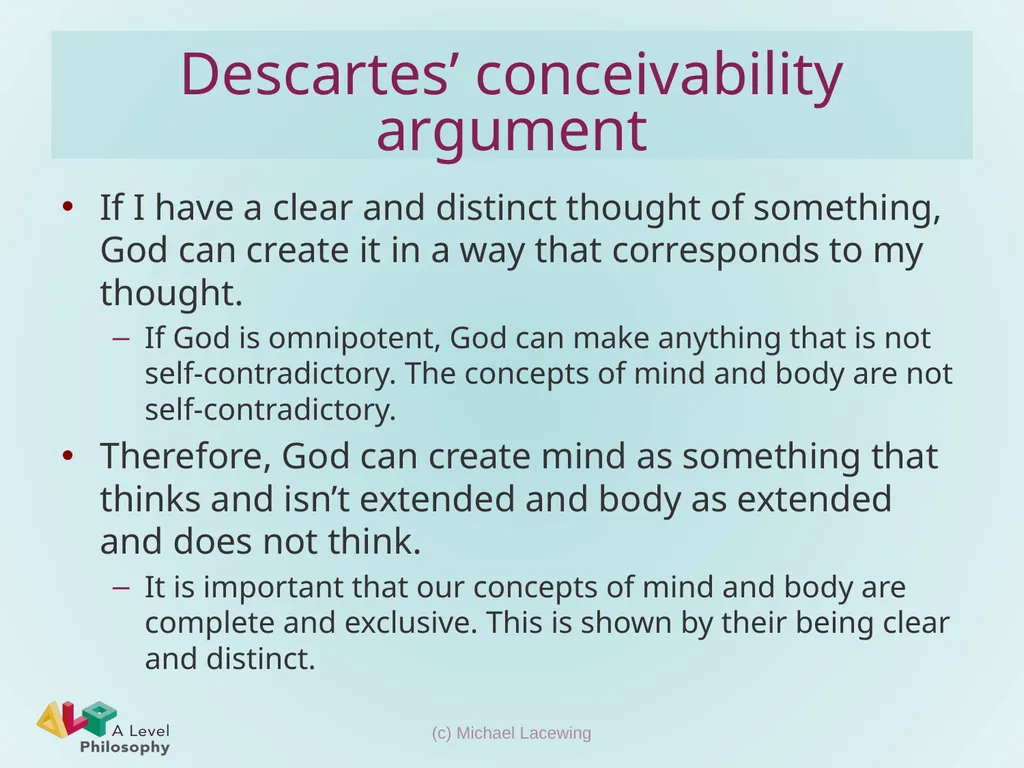
Descartes’ conceivability argument If I have a clear and distinct thought of something, God can create it in a way that corresponds to my thought.
If God is omnipotent, God can make anything that is not self-contradictory. The concepts of mind and body are not self-contradictory.
Therefore, God can create mind as something that thinks and isn’t extended and body as extended and does not think.
It is important that our concepts of mind and body are complete and exclusive. This is shown by their being clear and distinct. (c) Michael Lacewing<br>
05
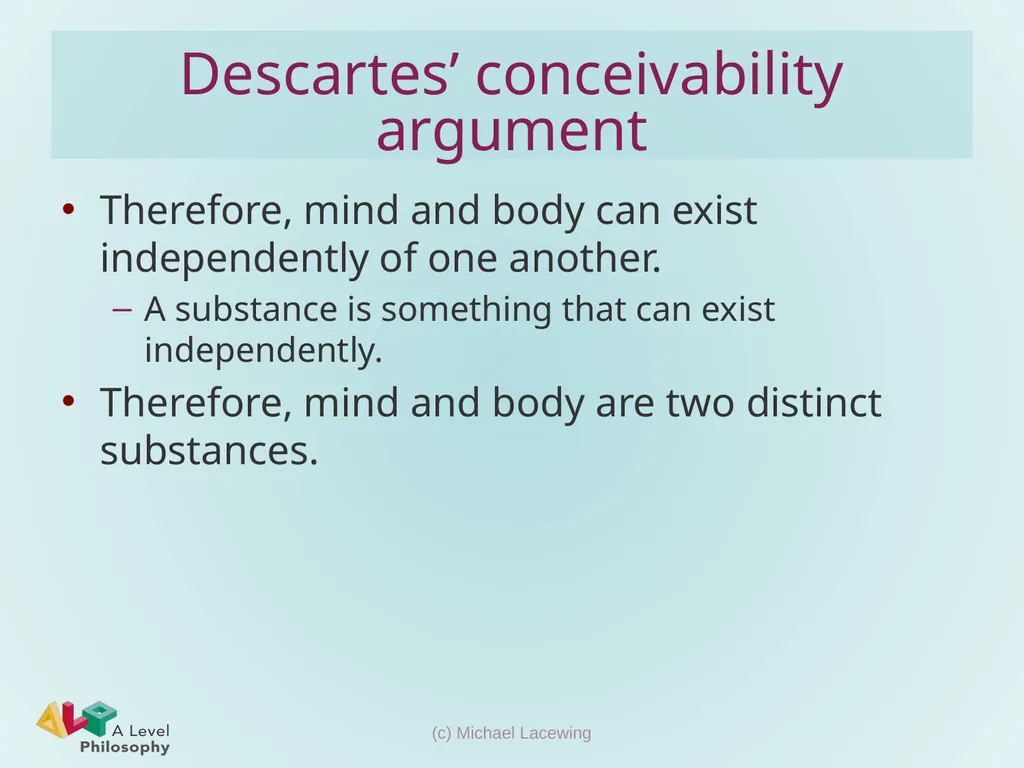
Descartes’ conceivability argument Therefore, mind and body can exist independently of one another.
A substance is something that can exist independently.
Therefore, mind and body are two distinct substances. (c) Michael Lacewing<br>
06
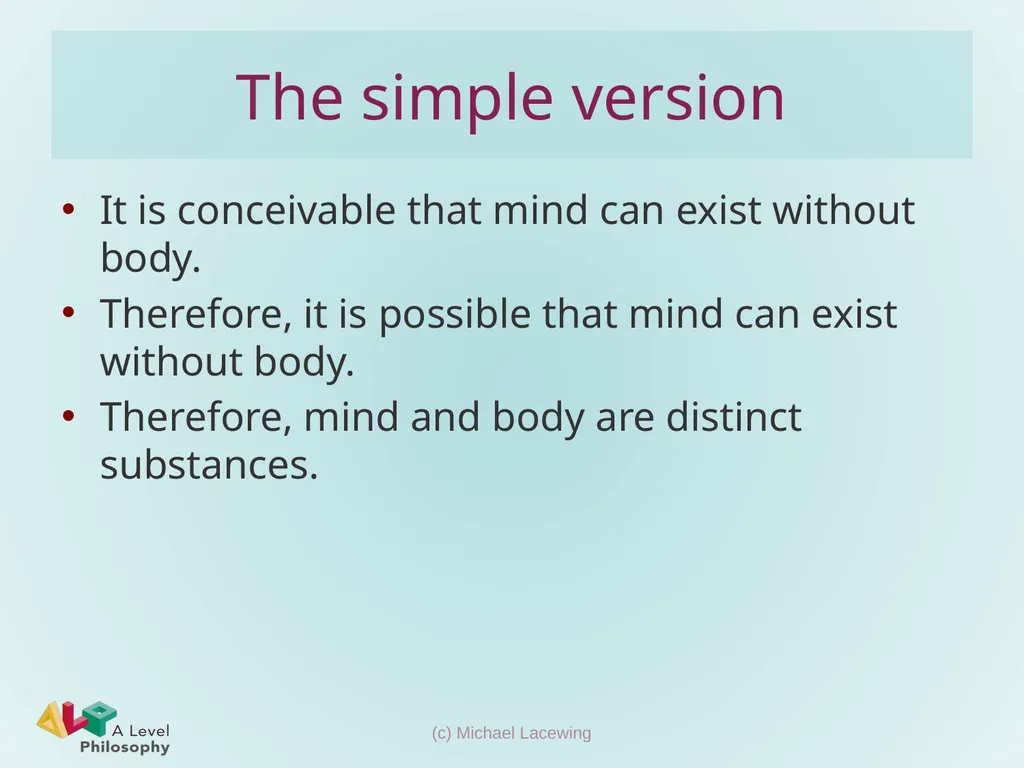
The simple version It is conceivable that mind can exist without body.
Therefore, it is possible that mind can exist without body.
Therefore, mind and body are distinct substances. (c) Michael Lacewing<br>
07
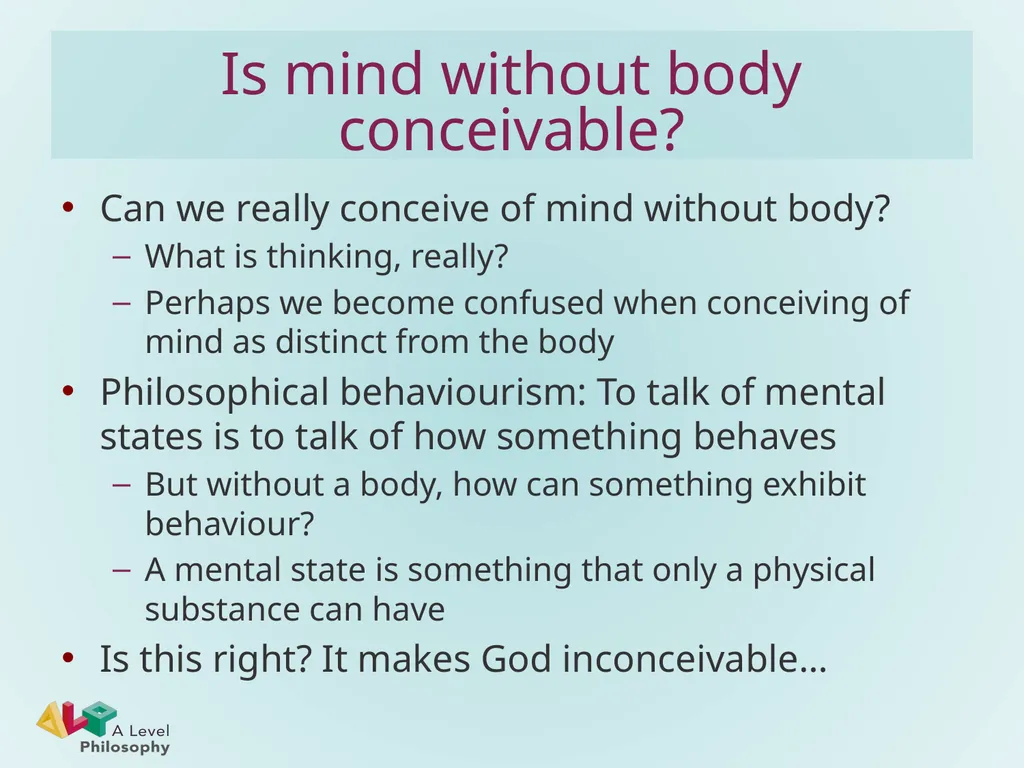
Is mind without body conceivable? Can we really conceive of mind without body?
What is thinking, really?
Perhaps we become confused when conceiving of mind as distinct from the body
Philosophical behaviourism: To talk of mental states is to talk of how something behaves
But without a body, how can something exhibit behaviour?
A mental state is something that only a physical substance can have
Is this right? It makes God inconceivable…<br>
08
What is conceivable may not be metaphysically possible Just because Descartes can think of his mind existing without his body, this doesn’t mean that his mind really can exist without his body.
Physical possibility: what is possible given the laws of nature as they are in the actual world
Logical possibility: what is not self-contradictory, what our concepts allow
It is logically possible that the laws of nature were different
Metaphysical possibility: what is necessarily, but not analytically, true; constrained by identity and nature of things
Water is H2O – given that it is, nothing could be water but not H2O<br>
09
Conceivability and possibility What is conceivable is not always possible
It is conceivable that water is not H2O, but it is not metaphysically possible
The Masked Man fallacy
I think the Masked Man robbed the bank; I don’t think my father robbed the bank; Therefore, my father isn’t the Masked Man.
In one sense, it is possible that my father is not the Masked Man. (I can certainly conceive this.)
But if, unknown to me, my father is the Masked Man, then it is impossible that my father is not the Masked Man (c) Michael Lacewing<br>
10
Conceivability and possibility From conceiving that ‘two’ people are distinct, we can’t infer that they are distinct.
Perhaps this applies to mind and body
Descartes’ reply: when we clearly and distinctly conceive of two things as distinct, then we can infer that they are distinct
Clear and distinct conception can establish possibility, e.g. all triangles must have angles that add up to 180°
Masked Man: not clear and distinct; mind and body: clear and distinct<br>
11
Possibility and reality Suppose it is possible that the mind can exist as a distinct substance. Does this show that it is a distinct substance?
If we can conceive of the mind and body as not distinct, e.g. that the mind is the thinking part of something extended, then it also seems possible that the mind is not a substance
So which is it?
Descartes must show not only that it is possible for the mind to be independent of the body, but that it is impossible for it to be dependent on the body<br>