Description: This set of PowerPoint slides can be used as part of an introduction to the studies of reproductive anatomy. It includes a short reference to the traditional binary presentation of sex and adds definitions of sex and gender.
"Description: This set of PowerPoint slides can be" is the property of its rightful owner. Permission is granted to
download and print the materials on this website for personal, non-commercial use only, and to display it
on your personal computer provided you do not modify the materials and that you retain all copyright
notices contained in the materials. By downloading content from our website, you accept the terms of this
agreement.
Presentation Transcript
01
Description:
This set of PowerPoint slides can be used as part of an introduction to the studies of reproductive anatomy. It includes a short reference to the “traditional” binary presentation of sex and adds definitions of sex and gender. The topics covered by this resource include:
Professionalism in health care
Sex, gender
Male / female binary Bioethics in Anatomy Education Resources:
Sex and Gender in Reproductive Anatomy Creator: Sabine Hildebrandt
Contact details: sabine.hildebrandt@childrens.harvard.edu Further reading:
Štrkalj G, Pather N. 2020. Beyond the Sex Binary: Towards the Inclusive Anatomical Sciences Education. Anat Sci Edu published online 8/2020<br>
02
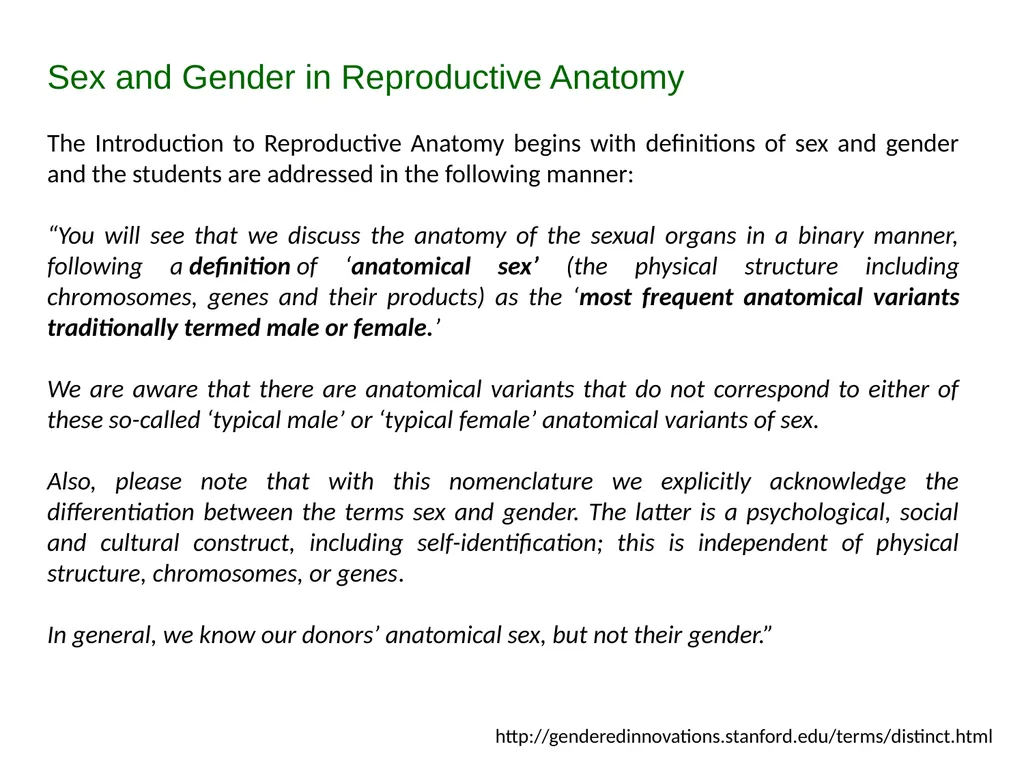
The Introduction to Reproductive Anatomy begins with definitions of sex and gender and the students are addressed in the following manner:
“You will see that we discuss the anatomy of the sexual organs in a binary manner, following a definition of ‘anatomical sex’ (the physical structure including chromosomes, genes and their products) as the ‘most frequent anatomical variants traditionally termed male or female.’
We are aware that there are anatomical variants that do not correspond to either of these so-called ‘typical male’ or ‘typical female’ anatomical variants of sex.
Also, please note that with this nomenclature we explicitly acknowledge the differentiation between the terms sex and gender. The latter is a psychological, social and cultural construct, including self-identification; this is independent of physical structure, chromosomes, or genes.
In general, we know our donors’ anatomical sex, but not their gender.” http://genderedinnovations.stanford.edu/terms/distinct.html Sex and Gender in Reproductive Anatomy<br>
03
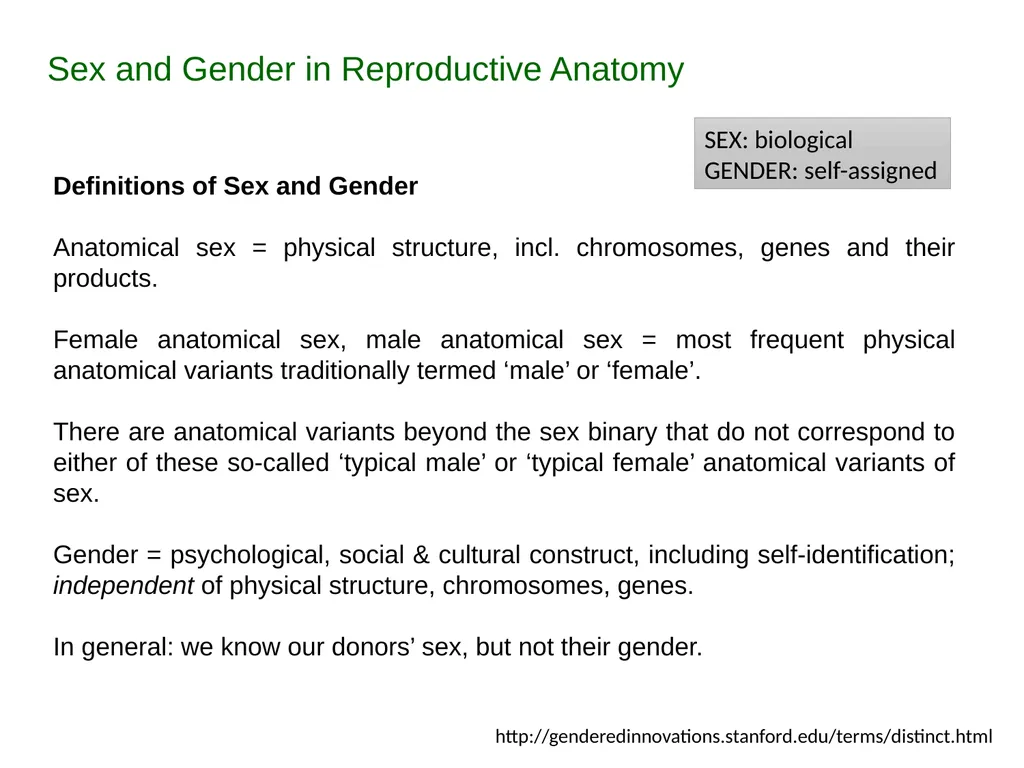
Definitions of Sex and Gender
Anatomical sex = physical structure, incl. chromosomes, genes and their products.
Female anatomical sex, male anatomical sex = most frequent physical anatomical variants traditionally termed ‘male’ or ‘female’.
There are anatomical variants beyond the sex binary that do not correspond to either of these so-called ‘typical male’ or ‘typical female’ anatomical variants of sex.
Gender = psychological, social & cultural construct, including self-identification; independent of physical structure, chromosomes, genes.
In general: we know our donors’ sex, but not their gender. Sex and Gender in Reproductive Anatomy http://genderedinnovations.stanford.edu/terms/distinct.html SEX: biological
GENDER: self-assigned<br>
04
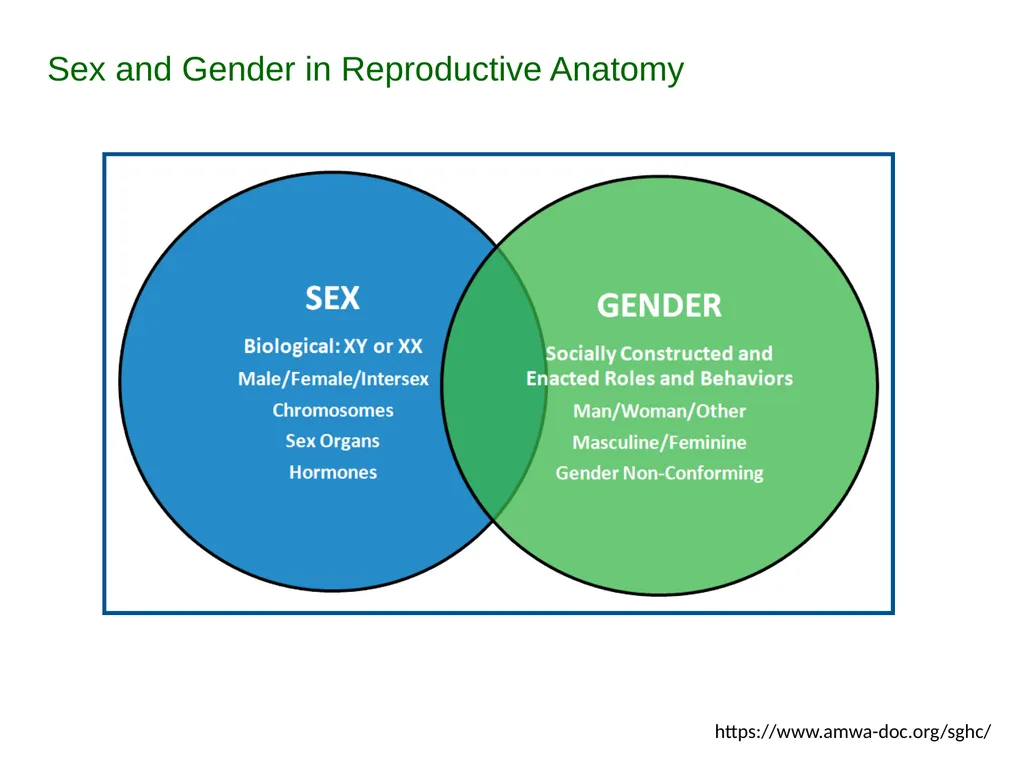
https://www.amwa-doc.org/sghc/ Sex and Gender in Reproductive Anatomy<br>
05
Sex assigned at birth1, inner sense of gender2, how gender is outwardly communicated3, and how gender is perceived by others4 are all separate but interrelated elements that inform individual experiences of gender. https://lgbt.hms.harvard.edu/terminology Sex and Gender in Reproductive Anatomy<br>
06
Questions to consider:
Should patients be consulted about their gender?
If so, should patients be referred to by their gender identity or by their sex? When talking to the patient? When talking about the patient to other health professionals?
Should body donors be consulted about their gender when completing donation forms?
If so, should the donors in the laboratory be referred to by their gender identity or by their sex?
If a male donor in the laboratory had a tattoo that stated, “Please refer to me as she / her”, how would you describe the donor? Pinterest.com Sex and Gender in Reproductive Anatomy<br>